


Introduction
Since 2020, COVID-19 has been a major public health crisis, which has heightened concerns about the risk infectious diseases pose to older populations. Older people (aged over 65 years) have a significantly higher risk of serious illness from a COVID-19 infection than younger age groups and are exponentially more at risk of death and hospitalisation (Yanez et al., Reference Yanez, Weiss, Romand and Treggiari2020; Palmer et al., Reference Palmer, Cunniffe and Donnelly2021). Like elsewhere in the world, the COVID-19 pandemic prompted fundamental changes in day-to-day life for Australians, despite the spread of COVID-19 in Australia between the years 2020 and 2021 having been relatively limited in comparison to other nations due to Australia's geographical isolation, and the strictly imposed public health measures implemented by its states and territories (Wang et al., Reference Wang, Liu and Hu2020). The state most affected by COVID-19 control measures has been Victoria and its major city, Melbourne, which experienced six ‘lockdowns’ between March 2020 and December 2021, totalling 245 days.
The current study took place after the second major lockdown, which spanned 112 days from July to October in 2020, and at the time was considered to be one of the longest and strictest lockdowns in the world (Mercer, Reference Mercer2020; Zhuang and Cave, Reference Zhuang and Cave2020). This lockdown was in response to the second wave of COVID-19 in Victoria, which resulted in ~20,000 recorded cases and ~800 deaths, with 7 per cent of cases and 75 per cent of deaths linked to 222 outbreaks in residential aged careFootnote 1 homes (Parliament of Victoria, 2021). The use of these lockdowns, stay-at-home measures, state border closures and other public health measures effectively reduced community transmissions in 2020 (Milne et al., Reference Milne, Xie, Poklepovich, O'Halloran, Yap and Whyatt2021). Much has been published about the effect of COVID-19 on residential aged care in Australia (Royal Commission into Aged Care Quality and Safety, 2020; Aitken et al., Reference Aitken, Holmes and Ibrahim2021; Viray et al., Reference Viray, Low, Sinnappu, Harvey and Brown2021). Yet, there has been comparatively little attention paid to the effects of COVID-19 on other older-age accommodation models, namely retirement villages (although see Ng et al., Reference Ng, Hill and Burton2022). The aim of our study is therefore to investigate the experiences of older adults living in retirement villages during the first three lockdowns in Victoria from March 2020 to February 2021.
Retirement villages are a unique setting to explore because they combine a mix of lifestyle and supported living. In Victorian State Government legislation (Parliament of Victoria, 2017), retirement villages are defined as housing communities for older adults that provide accommodation and services, which older people must typically ‘buy into’. Legislation explicitly distinguishes these from residential aged care homes, with the latter involving a higher duty of care and falling under the regulatory jurisdiction of the Commonwealth Department of Health and Aged Care. Nonetheless, 28 per cent of Australian retirement villages are co-located with aged care homes; an arrangement often described as providing ‘continuity of care’ for residents with changing needs (Hu et al., Reference Hu, Xia, Skitmore, Buys and Zuo2017; Property Council of Australia, 2021).
Social spaces of the ‘third age’
As Bernard et al. (Reference Bernard, Liddle, Bartlam, Scharf and Sim2012) point out, the terms ‘retirement’ and ‘village’ bring connotations that do not always align with realities. The concept of ‘retirement’ implies that residents are no longer in paid employment but can also suggest a period of life defined by reduced activity and social disengagement. This contrasts somewhat with the industry's promotion of retirement villages as providing desirable lifestyle choices during an active and socially engaged period of life (Bernard et al., Reference Bernard, Liddle, Bartlam, Scharf and Sim2012). Furthermore, the concept of a ‘village’ is often used to suggest an idyllic rural community. Yet, the physical layout, location and size of retirement villages varies broadly in Australia, ranging from fully detached units in village-like arrangements, medium-density blocks of townhouses, to high-density vertical apartment buildings (Parliament of Victoria, 2017). Current trends suggest there will be a growing proportion of these high-density vertical developments, located in urban areas, in the future (Property Council of Australia, 2021).
Despite the variety of facilities across the sector, retirement villages can broadly be considered part of the cultural field of the ‘third age’ (West et al., Reference West, Shaw, Hagger and Holland2017). Gilleard and Higgs (Reference Gilleard, Higgs, Carr and Komp2011) theorise the third age as a generational phenomenon, manifesting during the latter half of the 20th century when cohorts who came of age after the mid-20th-century expansion of consumer culture reach retirement age. As an ideology, the third age upholds aspirations of post-retirement lifestyles characterised by social participation, leisure and active consumption. It accords with the popular notion of ‘ageing well’ (Gilleard and Higgs, Reference Gilleard, Higgs, Carr and Komp2011, Reference Gilleard and Higgs2013), which Higgs and Gilleard (Reference Higgs and Gilleard2021) argue invokes both a cultural marginalisation and psychological suppression of the traditional association of old age with corporeal limitations and increasing dependency. As a material culture, the third age is manifest in the social practices, clubs and associations, leisure opportunities, and goods and services that have become increasingly popular to an active post-retirement demographic in recent decades. Importantly, this conception of the third age shifts focus from chronological age as a marker of the lifecourse on to broader social, cultural and generational trends. While the baby-boomer generation has accumulated considerable wealth that is driving the expansion of post-retirement consumption (Bevin, Reference Bevin2018), the third age is not a cultural field of equal opportunity. The degree to which an individual can participate in the third age is shaped by factors such as their socio-economic resources, health or disability status, care-giving duties and experiences of minority group discrimination (Gilleard and Higgs, Reference Gilleard, Higgs, Carr and Komp2011).
Prior research has examined the ways in which retirement villages are promoted and configured as social spaces for the third age (Bernard et al., Reference Bernard, Liddle, Bartlam, Scharf and Sim2012; Chandler and Robinson, Reference Chandler and Robinson2014; West et al., Reference West, Shaw, Hagger and Holland2017; Schwitter, Reference Schwitter2022). Retirement villages are typically marketed as environments that support active ageing by offering opportunities for social interaction, intellectual stimulation and physical activities (Hu et al., Reference Hu, Xia, Skitmore, Buys and Zuo2017; Petersen et al., Reference Petersen, Tilse and Cockburn2017; Malta et al., Reference Malta, Williams and Batchelor2018; Ng et al., Reference Ng, Hill and Burton2022). Residents can engage in various hobbies, join clubs or interest groups, and participate in recreational programmes which are less conveniently accessible within the wider community (Gardner et al., Reference Gardner, Browning and Kendig2005). Retirement villages also often provide access to amenities such as fitness centres, swimming pools, walking trails and other recreational facilities that enable residents to maintain a healthy and active lifestyle. The provision of these services and facilities aligns with the idea that post-retirement is an extended period of social engagement and active living.
In contrast to the way health or aged care services market themselves to older adults, the emphasis of retirement villages’ promotional material is often on personal growth and empowerment rather than care. Operators’ advertising typically depicts moving into a retirement village as an empowered choice of an agentive older person, with residents represented as being physically fit and attractive (Bishop and Hynes, Reference Bishop and Hynes2010). Residents themselves are usually motivated to move by a combination of factors, including lifestyle, greater perceived safety, more-accessible living spaces and infrastructure, and facilitated access to medical or personal care (Stimson and McCrea, Reference Stimson and McCrea2004; Nathan et al., Reference Nathan, Wood and Giles-Corti2012; Hu et al., Reference Hu, Xia, Skitmore, Buys and Zuo2017; Yoshihara et al., Reference Yoshihara, Bloomfield, Wu, Tatton, Hikaka, Boyd, Peri and Connolly2023). Yet, while many retirement villages offer health-care services or in-home support to residents (Property Council of Australia, 2014, 2017; Productivity Commission, 2015; Hu et al., Reference Hu, Xia, Skitmore, Buys and Zuo2017), this is not typically the focus of their business models nor promotional materials (Bishop and Hynes, Reference Bishop and Hynes2010).
The design of retirement villages also accords with third-age aspirations for autonomy and the construction of a self-identity outside work and family roles. Ideals of independence and individual choice are highly valued and promoted by providing residents with their own private units or apartments (Shippee, Reference Shippee2012), while allowing them to downsize to a more manageable living space than the traditional family home (Gardner et al., Reference Gardner, Browning and Kendig2005; Productivity Commission, 2015; Bevin, Reference Bevin2018; James et al., Reference James, Rowley and Stone2020; Xia et al., Reference Xia, Chen, Walliah, Buys, Skitmore and Susilawati2021). Retirement villages may also foster a sense of community by bringing together individuals in similar lifestages. Residents can connect with like-minded peers, develop new friendships, engage in social activities within the village and offer mutual help (Schwitter, Reference Schwitter2022). This social support network helps reduce social isolation and contributes to overall wellbeing (Gardner et al., Reference Gardner, Browning and Kendig2005; Chandler and Robinson, Reference Chandler and Robinson2014).
However, Gilleard and Higgs (Reference Gilleard and Higgs2013) argue cultural values associated with the third age can also amplify anxieties around physical or cognitive health and declining capacities in older age. Many operators in the retirement village sector are reluctant to associate themselves with the expectations and responsibilities of being an aged care provider, partly to avoid the increased liability and regulation this brings, but also because they see it as conflicting with their branding as a desirable and enabling lifestyle choice (Property Council of Australia, 2017; Smeed, Reference Smeed2017). The perceived dependency and frailty of some residents can also be stigmatised within village communities (Shippee, Reference Shippee2012). Some research has found that residents with poor health or disabilities have experienced marginalisation and discrimination from more-active members of a village community (Williams and Guendouzi, Reference Williams and Guendouzi2000; Chandler and Robinson, Reference Chandler and Robinson2014; Schwitter, Reference Schwitter2022). There can be a tension between independence and dependence in retirement villages, with more dependent or frail residents perceived to be a ‘burden’ and unsuited to the village community and lifestyle (Carr and Fang, Reference Carr and Fang2022).
The current study
This study considers the cultural space of retirement villages during the first year of the COVID-19 pandemic. Similar to retirement villages in other nations, during the COVID-19 pandemic and associated lockdowns in Australia, retirement villages (as a result of strict public health measures around movement and visiting homes) became gated communities, and residents became highly limited in their engagement with the outside world (Dutton, Reference Dutton2021). Australian retirement villages were not subject to the same Commonwealth directives or government oversight as residential aged care facilities. Consequently, during the first year of the pandemic in Australia, it was largely left to retirement village operators, staff and residents to interpret the public health advice given to the wider community and apply it in their own management, policies and response to COVID-19 (Department of Health, 2020; Rayner et al., Reference Rayner, Southgate, Courtney and Tan2020).
Method
We conducted qualitative interviews with 14 older people (aged 65+) residing in retirement villages in Victoria, Australia. Semi-structured interviews took place during January and February 2021, a time period that was after strict lockdowns, and a time when COVID-19 appeared less of a public health threat, and a sense of normality could be felt in Australia. However, concern was growing over new variants, and participants’ responses reflect their past experiences, current concerns and future fears about how future lockdowns may affect village life.
The study was conducted in accordance with COREQ requirements (Tong et al., Reference Tong, Sainsbury and Craig2007). Interviewees were recruited from a national longitudinal survey study exploring the emotional, mental, health and societal behaviours and experiences of people during the COVID-19 pandemic (Goh et al., Reference Goh, Panisset, Dang, Gartoulla, Brijnath, Ostaszkiewicz, Batchelor, Chau and Dow2020, Reference Goh, Dang, Wijesuriya, Lamb, Panisset, Gartoulla, Tan, Batchelor, Brijnath and Dow2023). Of the survey respondents, 122 participants responded to the invitation to take part in additional qualitative interviews. Two researchers generated a maximum variation sample of 31 individuals willing to take part in an interview, and of these 14 lived in retirement villages in Victoria, Australia. The study received ethical approval from the University of Melbourne Office of Research Ethics and Integrity. All participants were sent information about the study and provided written consent prior to interviews. Participants’ consent was also verbally confirmed during interviews. Any identifying information about participants or their retirement villages has been removed to protect confidentiality.
Procedure
Due to COVID-19 restrictions, all interviews were conducted remotely, over telephone or Zoom, based on participants’ preferences. Consent forms and plain-language statements were provided to participants by email or post, prior to interviews taking place. Interviews were approximately 45 minutes long, and were audio-recorded with participants’ consent, using either a handheld recorder or the recording function built into Zoom. An interview topic guide was developed based on initial findings from the survey and formed the basis of semi-structured interviews. Questions covered three broad topic areas: (a) general views about COVID-19, (b) personal experiences, and (c) living and financial situation. The full set topic guide is included in the online supplementary material. Interviews were conducted by two trained and experienced qualitative researchers. Interview transcripts were professionally transcribed, and independently read through by ASG and SMG for familiarisation. Preliminary notes were recorded by both and informed the thematic analysis (Jackson and Bazeley, Reference Jackson and Bazeley2019).
Analysis
ASG and SMG followed a thematic analysis (Braun and Clarke, Reference Braun and Clarke2021) approach using NVivo 20 (QSR International). We both first became familiar with all of the transcripts through close reading and then decided that the experiences of retirement village residents were a pertinent topic for research. To facilitate analysis, we collaboratively developed a coding scheme using NVivo's inbuilt Mindmap feature. Developing a preliminary coding scheme is recommended as a way to facilitate team coding (see Jackson and Bazeley, Reference Jackson and Bazeley2019: 314). However, we wanted to maintain a degree of flexibility in our coding, to allow for different interpretations between the two coders and allow for unforeseen codes. Hence our initial coding scheme was comprised of ‘parent nodes’ (i.e. more general high-level codes such as ‘social isolation’, ‘family relationships’, ‘financial stress’, etc.), under which we created more detailed ‘child nodes’ (more specific lower-level codes). We checked this approach on two transcripts, and after making some small revisions, divided the transcripts approximately into half between us. Once we had both completed all our coding, we met again to discuss our progress. We combined our coding using NVivo's merge projects feature, and synthesised or revised our nodes until we had one set. We then independently read the codes again to check for consistency and accuracy. Once this stage was complete, most of the codes had been ‘flattened out’, i.e. only a few ‘parent nodes’ were left and the more specific ‘child nodes’ had been synthesised or revised into more general, overarching codes. We then discussed and agreed on key themes emerging from our coding. After the key themes were identified and defined, ASG conducted a literature search that determined the theoretical approach for the write-up. More details about the recruitment strategy, interview questions and thematic analysis are included in the online supplementary material.
Findings
Thirty-one participants were recruited from a large national study on older community-dwelling adults’ experience of COVID-19 and the associated lockdowns in Australia (Goh et al., Reference Goh, Panisset, Dang, Gartoulla, Brijnath, Ostaszkiewicz, Batchelor, Chau and Dow2020, Reference Goh, Dang, Wijesuriya, Lamb, Panisset, Gartoulla, Tan, Batchelor, Brijnath and Dow2023). Of these, 14 interview participants (45%) resided in a retirement village in Victoria during the pandemic. Table 1 provides participants’ demographic information. Study participants came from 12 different villages. We used postcodes to classify village locations according to the Monash Modified Model, which measures remoteness in Australia (Department of Health and Aged Care, 2023). We also used the Index of Relative Socio-economic Advantage and Disadvantage (IRSAD), which classifies locations on a five-point scale with higher numbers indicating greater socio-economic advantage (Australian Bureau of Statistics, 2018). One participant did not provide a postcode, yet indicated during the interview that they were in metropolitan Melbourne.
Participant demographic information
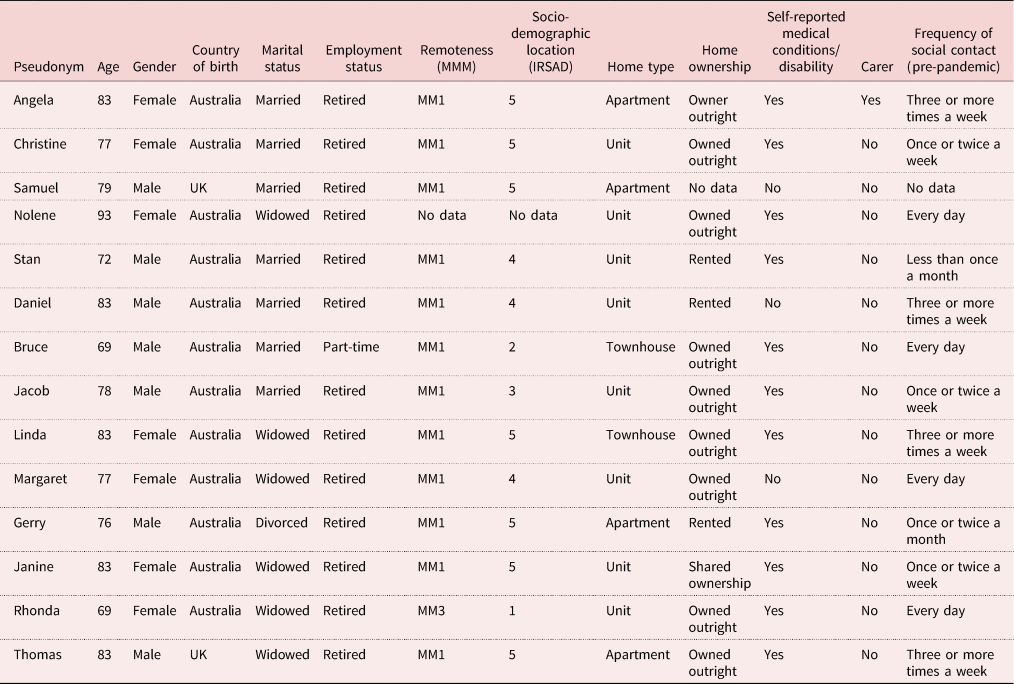
Notes: MMM: The Monash Modified Model classifies geographical remoteness in Australia, with MM1 indicating a major metropolitan area and MM3 indicating a large rural town. IRSAD: Index of Relative Socio-economic Advantage and Disadvantage (five-point scale with higher numbers indicating greater socio-economic advantage). UK: United Kingdom.
Participants’ home types reflect the variability of the retirement village sector, with eight living in units, two in medium-density housing or townhouses, and four in apartments. Some participants reported that different housing types were co-located within their village, but our data did not capture this. Participants’ median age was 78.5 (range = 69–93 years). One participant was a carer for her husband with dementia; no others reported care-giving responsibilities.
We found that there were strong interpersonal benefits to community living during the COVID-19 pandemic. However, the pandemic and its associated restrictions had bought about significant challenges and participants expressed frustration and feelings of deprivation in relation to the various elements that had originally drawn them to the retirement village ‘lifestyle’ pre-pandemic. This tension between value and frustrations is explored through five themes, identified across the interviews: (1) benefits and frustrations of retirement village living during a pandemic; (2) the loss of amenities and activities: disappointments, stress and embracing alternatives; (3) heightened loneliness and social isolation during lockdowns; (4) reaching out to others during the pandemic: community spirit and support; and (5) variable experiences of operators’ response to COVID-19 and lockdowns. Below we have selected quotations that best illustrate our findings; these data have been de-identified and pseudonyms used.
Theme 1: Benefits and frustrations of retirement village living during a pandemic
Participants had concerns about COVID-19, but said they felt more secure than if they had been living in the broader community. This was because of the ‘gated’ and restricted access to the village, which prevented members of the public freely coming and going. The sense of community afforded by retirement village settings often meant that participants felt responsibility for looking after each other:
This is community living. There's some really good friends here and so on. And you really feel you've got to do the right thing by everybody. Thankfully, there haven't been any problems. We've been well sort of looked after from that point of view. But it does just determine your behaviour. (Thomas)
Participants reported that their retirement villages implemented protective measures against COVID-19 infection and spread, including sign-in sheets, mask-wearing, hand sanitising and temperature checks. Often these restrictions were described as ‘strict’, but participants usually felt these measures were justified and hoped that these would help reduce the risk of COVID-19 in their community:
…they were very strict here and they have all got the sign-in forms and the temperature checks at the door. So, there's the automatic temperature check that you do by photographing yourself, so they've still got that and it's only recently that we could take off our masks inside … So, they were very, very strict here. (Angela)
However, most participants also expressed frustration and indicated they were fatigued by the lockdown restrictions. Some expressed resentment towards residents who ‘broke the rules’, for example by coming and going from the village unnecessarily:
If I went out and saw people doing stupid things or I saw people going out when they really didn't need to and coming back into the village, I actually got a bit angry because I thought here we are doing our best and you absolutely have to go out but you don't really need to, so why are you? (Margaret)
The pandemic reinforced to many participants that they were part of a community of older, and potentially vulnerable, people. While participants felt that the retirement village setting afforded them greater safety and peer support than they would likely have received living in the community, there was evidently an expectation from some that residents should follow the rules to ensure each other's welfare. Tension arose when some residents were perceived to transgress lockdown rules.
Theme 2: The loss of amenities and activities: disappointments, stress and embracing alternatives
It was evident that, for many participants, the appeal of moving into a retirement village arose from having access to private exercise and leisure facilities, which afforded a post-retirement lifestyle based around social engagement and physical activity – the social spaces of the ‘third age’ mentioned in the Introduction. However, during lockdowns communal spaces, dining rooms, gyms, and other activities and facilities had been shut down and were only gradually re-opening at the time of our interviews. Many participants expressed frustration that they had paid to access amenities that they were unable to use because of lockdown restrictions. Some participants felt this was not justified as these are private facilities that are inaccessible to the public and therefore posed a lower risk for COVID-19 outbreaks:
The restrictions been placed on us here which are a damn nuisance, like we've got a dining room but that had to be shut. Now it's open and we can use that again. We've got a swimming pool, we've got a gym, we've got a library, stuff like that, which we weren't allowed to use during the big lockdown and that was … Actually, I suppose when you step back and look at this situation you think: ‘Oh, poor bloke. He can't use the library and can't use the swimming pool. Well, he is lucky to have those facilities in the first place.’ I guess, yes, I am, but we pay for them! (Thomas)
For many participants, village facilities like gyms and swimming pools were important for maintaining regular exercise. With their closure, participants expressed concern that their fitness, strength and mobility might decline. Some remarked that due to their advanced age, it would be difficult to return to their pre-pandemic fitness:
I'm still not back to where I was at the beginning of the year, because the older you get the harder it is to get back from breaks. When you're 25 and you have four weeks off, you come back better than ever because you've been overtraining. But when you're 79, you have practically three months off where you only go down to the gym once a week for an hour, it takes you a fair while to get back. (Samuel)
For most participants, walking became their primary physical and social activity. Some villages were better designed to accommodate walking than others, but even participants in higher-density accommodation reported taking pleasure in walking around the corridors or outside garden spaces. Walking was perceived as important on a physical, psychological and social level, as it afforded opportunities to socialise with other residents and check on each other's welfare:
We'd walk around six, seven, eight times a day just to get exercise because there was nothing else you could do. I kept my phone on me … sometimes it would take us 10 or 15 minutes to walk around or another time it might take an hour because there'd be people that come out that want to talk. (Bruce)
I think I got out of it fairly lightly because on a good day I could go for a walk around the village as many times as I like and there would always be other people doing the same thing. So, for people who like me could get out, are able enough to get out and walk, that was how I socialised. I'm quite comfortable in my own company anyway, so I could choose what I wanted to do and if I wanted to be madly social, I went for a walk in the late afternoon because lots of people did it then. It was just lovely to be able to get out, get some fresh air and talk to people. (Margaret)
So, we walk around the ring road. So, all the people in the apartments have come on their balconies and that and we'd all chat. Sometimes it was probably 20 or 30 of us sort of in the middle of the road spread out all having a lovely time. (Christine)
It was also evident that walking the same restricted route every day, often with masks on, could become tedious as the lockdowns persisted. One participant in our study was a spousal carer and she reported that the cessation of social groups and exercise classes had been particularly challenging for her husband, who lives with dementia. The loss of regular interaction and activities caused him ‘stress’ that she then had to manage:
We were allowed to walk around the village itself, wearing our masks, I have to say, we had to wear our masks … So, I think it affected my husband [with dementia] much more than me because we weren't able to do the socially interacting things that we would normally do … I was very keen to make sure that he was as safe as he could be but that meant it was extremely isolating. Fortunately, we've got a very nice apartment but … it's still a smallish space when you can't invite friends to come and visit you and so on. (Angela)
The closure of cafes on site and catered meals also caused stress for residents who did not typically cook for themselves and used meal services daily:
Some of the people in here, there's a lot of single ladies in here, they hadn't cooked for years. They had a meal from the village every day and they just shut up shop. They just packed up, something like 2 o'clock in the afternoon they just all took off and they didn't tell anybody and of course at that stage it was a bit of panic buying. It was just a nightmare. (Christine)
Some residents had reportedly become unaccustomed to shopping for meals, were poorly equipped to cook for themselves or were worried about the risks of going out to shop for groceries. Many participants commented that these more-dependent residents were particularly vulnerable during the lockdown period. With the cessation of regular services, they became reliant on support from other residents in the community for shopping and meal preparation.
Theme 3: Heightened loneliness and social isolation during lockdowns
Loneliness and lack of socialisation were significant concerns for most participants and were considered the hardest aspect of the lockdowns. The terms ‘loneliness’ and ‘isolation’ were used interchangeably by participants. Participants reported that some residents did not feel comfortable going outside as they were very afraid of catching COVID-19. These individuals hardly left their accommodation and did not walk outdoors as much as others:
…a lot of our residents were really too scared to leave the house at all. (Adele)
I've been nervous about it; I've been scared about it [COVID-19]. At times I get quite petrified, but it doesn't last long. I just go back to a normal level of trying to look after myself. I stay inside [the housing unit] as much as possible and when I can I shut the windows, keep the doors shut … I haven't done as much walking as I normally do. (Gerry)
Participants typically argued that the lockdown was most isolating for single participants, or those who lived alone:
They found it very difficult. One of the women – we met up the street, not in the corridors. She's a single lady. [She said] ‘It's just not fair. You're allowed to be together, but I can't be with anybody. And no one is allowed to come and visit me, and I can't go and visit any of the other people in the complex.’ (Samuel)
Despite concerns around loneliness within the village, participants suggested that the lockdown would likely be worse if they were living elsewhere by themselves. Living in the retirement village was seen as preferable, as it provided access to some peer support, however restricted:
The alternative for people like me and for most of the residents here, we have a few couples here but not many, the alternative is living in the family home by yourself and I would – that in itself if you've lost a spouse living by yourself in the family home would be pretty traumatic anyhow or pretty grim and dismal and then the pandemic on top of it would be reduced – add to the problem. (Thomas)
I think it's gone back in a way to a bit more like it was in our childhood, where neighbourhood communities were very important. I think that people living in – perhaps in our age group, who were perhaps living in blocks of units where there weren't people of perhaps their own age and stage group – that must have been very isolating for them. (Angela)
Despite many reporting increased social isolation and loneliness during lockdowns, participants generally argued that living in a retirement village was advantageous, as it provided a closed community of peers that afforded more social contact and peer support than they thought they would have had living in their own home.
Theme 4: Reaching out to others during the pandemic: community spirit and support
The risk of loneliness and isolation during lockdowns, combined with the sense of having communal obligations to other residents, reinforced the need for participants to go out of their way to connect and support others in their village. Some of these efforts were formally organised through resident committees:
We actually decided, with our social committee, we split up the various blocks of people. We're a very small retirement village, it's only a total of 76 units. We split that up between us, to keep an eye on X number of units, and we had a couple of people who really needed support. (Nolene)
A few participants were members of social committees or residents’ committees, which typically took a lead role in providing a voice for residents during the implementation of lockdown measures, and also sought ways to maintain community connections and facilitate peer support:
The social club made an effort to contact everybody by having little gifts of Christmas tokens and visits from people. So, they were attempting to keep contact as much as they were able to, even if it just meant knocking on the door and leaving something on the doorstep to say that we're still thinking of everybody. (Daniel)
For these residents, participating in formal residents’ organisations was a way to keep busy. The following participant was President of the Residents’ Committee, and at 69 years old, one of the younger residents of her village. She described the many ways she organised peer support for other residents, especially those who were less physically able, afraid to leave the village or did not have a car:
I did shopping. And I've actually continued to do that for some who it's too much of an effort. They're well in their eighties, so I now regularly do shopping for people, supermarket shopping or taking them to some appointments. I did that; I delivered all of the mail for people who didn't feel comfortable going to the main depot to get it out of their box in the office. But I did a lot of making sure that I talked to people. I would just knock on the door and say, ‘You okay? What can I do?’ And there were other people who did that. (Rhonda)
Participants described a lot of spontaneous and ad hoc peer support between residents of their village during the lockdown period. However, as the following quote shows, participants could also be selective about who they supported and how they supported them. Sometimes participants found other residents too dependent or too demanding, which exacerbated the stress caused by lockdown measures:
One of my neighbours and I, when we felt a little bit … not locked away, but you know, isolated too much, we would ring one another up and say, ‘I've got the heebie-jeebies again.’ Then we'd talk for a while … The other one the other side is too elderly. She even gave me a little bit of stress recently when she rang me [about a possible scam caller]. (Janine)
It was evident from our interviews that the pandemic and lockdown had prompted various forms of community self-organisation and peer support between residents, especially where some residents were perceived to be more isolated or more vulnerable. However, peer support tended to be better organised where institutions such as resident committees or social groups had been stronger and better resourced prior to the pandemic.
Theme 5: Variable experiences of operators’ response to COVID-19 and lockdowns
Most participants reported that village operators were proactive in implementing lockdown measures, obtaining personal protective equipment such as masks, and ensuring residents’ continued welfare throughout the lockdown period:
…the office team here were ringing around, they were trying to get round to all the residents who live here and there are 400-odd residents here, to ring them sort of not on a regular basis but every now and again just ringing to check people are okay and I'm sure if they knew the ones that were particularly vulnerable, they probably rang them more often. But I'd always say, ‘Look, we are absolutely fine.’ (Angela)
While most participants were satisfied with the performance of their housing operators, or at least acknowledged that they did their best in a demanding situation, a small number had criticisms of their operator's conduct. One participant reported that her village's newly appointed manager struggled to adapt to the lockdown measures (likely due to inexperience), while the owner was interstate and offered little support. As the President of the Residents’ Committee, this participant took on the responsibility of implementing lockdown restrictions and communicating this with other residents:
[T]he manager was just appointed to the position at Easter or a bit before, just the week before the lockdown, so it had a major impact for her … I was working with her anyway because she didn't know a lot of the protocols as such. And then I would then liaise with the rest of the Residents’ Committee, usually by phone to say blah-blah-blah and we'd agree on it. We had little contact with the actual owner in Brisbane other than a few phone calls. (Rhonda)
Another participant voiced grievances about their operator, reporting that staff abandoned the facility at the start of lockdowns in 2020, leaving residents to fend for themselves:
What happened here on the 17th or 18th of March [2020], or whatever date it was that they closed up the first time, all the staff here and management and everything they were terrified, they just packed up and they left. We were just left to our own devices with nobody here … There's so many unhappy people in here at the minute after what's happened with COVID. Our service fees stayed the same and we got no services because everything was shut so we got nothing. (Christine)
This experience of being abandoned by management left residents of this village feeling powerless, according to Christine. She went on to remark that residents ‘don't get any say’ in what the operator does and how service fees are spent, and she accused the operator of attempting to delay the village's annual general meeting to avoid accountability. While this experience was extreme, other participants too voiced degrees of dissatisfaction about losing access to services and amenities while their fees remained the same during the lockdown closures.
Discussion
This study explores the perspectives of people living in retirement villages in Australia, who underwent a series of strict lockdowns and restrictions during the first year of the COVID-19 pandemic. Our findings demonstrate the salience of the ‘third age’ as a sociological concept that explains the cultural spaces configured within retirement villages. It was evident that an important pull factor for retirement village life for our participants was the cultural context of social engagement, leisure and physical exercise that the village context affords (West et al., Reference West, Shaw, Hagger and Holland2017), as well as the opportunity to reduce household labour such as cooking and grocery shopping. However, based on our findings, we suggest that COVID-19 lockdown measures interrupted and frustrated participants’ post-retirement plans and their expectations of how they participate in ‘third-age’ culture. The closure of amenities and cancellation of services resulted in a period when participants’ lived experiences were at marked odds with the aspirations that motivated their move into a retirement village. Moreover, the vulnerability and dependency of some other residents was brought into sharper relief by the pandemic and lockdowns.
Participants perceived that living in a retirement village was an advantage during a pandemic and lockdowns. Belonging to an age-specific community created a sense of mutual responsibility between village residents that they said would not be typical of living in the wider community (Gardner et al., Reference Gardner, Browning and Kendig2005; Schwitter, Reference Schwitter2022). Despite the limitations on contact with other village residents during the lockdown period, residents reported that they had access to a greater network of support than would have been available if they were still living in their family home. Residents became highly attentive to each other's needs and innovated ways of staying connected and offering peer support. This self-organisation of support between residents was most evident where strong engagement with resident committees predated the pandemic. When resident committees were not available, peer support tended to be more ad hoc and based on individual friendships and acquaintances rather than embodying a wider community spirit.
Increased personal safety is often regarded as an important pull factor for retirement village lifestyles (Stimson and McCrea, Reference Stimson and McCrea2004; Nathan et al., Reference Nathan, Wood and Giles-Corti2012; Hu et al., Reference Hu, Xia, Skitmore, Buys and Zuo2017). This was another perceived advantage of living in a retirement village during the COVID-19 pandemic. Participants argued that the restrictions placed on outsider visitors during lockdowns minimised the risk of COVID-19 entering the village and causing an outbreak. Perceptions about personal safety were also connected with the actions of other community members, with tensions arising when some residents transgressed lockdown rules, or were perceived to be coming and going unnecessarily.
While most participants saw the lockdowns as a justified public health measure, they expressed concerns about the impact on their fitness, social life and overall wellbeing. In agreement with another study (Ng et al., Reference Ng, Hill and Burton2022), we found that walking became the de facto source of physical activity for retirement village residents during lockdowns. Many residents who were accustomed to more rigorous exercise routines expressed concerns around declining fitness due to lockdowns. Walking was not simply motivated by exercise but was also an opportunity for socialisation and to check in on other residents. Interestingly, even in higher-density facilities such as vertical apartments, participants found ways to routinely walk around the gardens or corridors.
With the cessation of services and increased confinement, most participants said they felt some degree of isolation. However, it was often emphasised in interviews that the isolation was worse for some residents than others. Single women were seen to be especially vulnerable to social isolation when services ceased, and physical distancing measures were enforced. However, this was by no means homogenous, as some single female participants kept busy supporting other residents and participating in formal organisations. Nevertheless, the lockdowns highlighted how reliant some residents had been on village services and on the community more generally. Some participants expressed impatience towards other residents who they regarded as ‘too elderly’ and too dependent on them during the lockdowns.
It was evident that Victoria's lockdowns had a major impact on participants’ lifestyles. Participants frequently contrasted a rich post-retirement lifestyle prior to the pandemic, involving leisure activities, social engagements, health and fitness, with a more constrained and boring lifestyle during the height of lockdowns. Many participants reported that they had chosen to move to a retirement village in order to pursue an active lifestyle choice, which was also a financial decision. The ability to fulfil this choice was effectively put on hold by lockdowns.
Policy implications
International literature suggests that retirement villages are appropriate places for older people to reside during a pandemic, owing to operators’ abilities to implement social distancing measures and adapt their provision of goods and services to public health guidelines (Dobbs et al., Reference Dobbs, Peterson and Hyer2020; Dutton, Reference Dutton2021). Yet, some research has described the ‘devastating impact’ of the pandemic on retirement villages, especially in the United States of America (USA) (where they are defined as assisted living facilities), where operators felt underprepared, burnt out and poorly informed about infection control best practices (Kyler-Yano et al., Reference Kyler-Yano, Tunalilar, Hasworth, Kohon, Winfree, Wilton, Tuttle and Carder2022). Assisted living facilities in the USA saw much higher COVID-19 mortality than the general population, suggesting that there should be equivalent policy attention to that received by US nursing homes (Temkin-Greener et al., Reference Temkin-Greener, Guo, Mao, Cai and Li2020). The impact of COVID-19 on Australia's aged care system has been much publicised and researched (Royal Commission into Aged Care Quality and Safety, 2020; Aitken et al., Reference Aitken, Holmes and Ibrahim2021; Viray et al., Reference Viray, Low, Sinnappu, Harvey and Brown2021), but there is comparatively little known about the impact on the retirement village sector and we were unable to locate studies of case numbers specifically in Australian retirement villages.
Retirement villages are considered ‘housing products’ under Australian law, and village operators and staff are not subject to the same degree of regulation and legal responsibility towards residents as aged care or health-care providers are (Petersen et al., Reference Petersen, Tilse and Cockburn2017; Malta et al., Reference Malta, Williams and Batchelor2018). For instance, training and qualification requirements of retirement village management are typically minimal, especially compared to equivalent roles in the aged care or health-care sectors (Smeed, Reference Smeed2017). The consumer rights of retirement village residents is an established topic of research in Australia. A number of studies have reported unsatisfactory dispute resolution processes, with comments from residents that they feel ‘trapped’ in by contracts and disempowered vis-à-vis housing operators (Hu et al., Reference Hu, Xia, Skitmore, Buys and Zuo2017; Petersen et al., Reference Petersen, Tilse and Cockburn2017; Malta et al., Reference Malta, Williams and Batchelor2018). It was apparent from our findings that the practical duty of care shown towards residents was not consistent across all operators. While most operators were evidently proactive in implementing infection control measures and means of monitoring residents’ wellbeing, in one case staff reportedly ‘abandoned’ the site and left residents to manage on their own. This effectively left residents subject to the same lockdown conditions and restrictions as the wider community, only within accommodation that was designed, marketed and costed to be supported by communal services and amenities. While this is a single case in our findings, it reflects concerns raised in a recent Victorian parliamentary inquiry that regulation of the sector is addressing residents’ aged care needs (Parliament of Victoria, 2017).
It was also evident from our findings that retirement village residents are a heterogeneous population. Some participants reported that they frequently engage in overseas travel, sports and physical activity, and the organisation of the village. Yet we also heard reports of other residents who found it difficult to access shopping or mail, were dependent on the operator for meals and felt very vulnerable to COVID-19 infections. This spotlights for us that while many residents may fit the mould of agentive third-age lifestyle consumer portrayed in promotional materials, there are others who have more acute needs and a greater degree of dependency. While divisions between residents like this have been reported before (Evans, Reference Evans2009; Nielson et al., Reference Nielson, Wiles and Anderson2019; Carr and Fang, Reference Carr and Fang2022), our findings suggest that divisions may have been amplified by the pandemic and the restrictions and closures to which retirement village services were subject. Our findings reinforce suggestions that the Commonwealth should be paying closer attention to the shifting demographics of retirement villages (Smeed, Reference Smeed2017), and in particular the sector's growing role as an ‘alternative’ to residential aged care, to ensure regulation and legal classification are sufficiently addressing residents’ needs.
Limitations
Older people who live in retirement villages in Australia tend to be middle class, well-educated and English-speaking. While our findings illuminate the issues faced by this cohort, it does not capture perspectives of older individuals experiencing financial difficulties, housing insecurity or those from differing ethnic backgrounds who had a very different experience of the pandemic. The sampling for the survey study that we recruited from required individuals to volunteer to take part in the survey and interviews – scepticism about the severity of COVID-19 and opposition to measures such as lockdowns, social distancing and measures to reduce the transmissibility of COVID-19 may have led to distrust of scientific expertise (Brubaker, Reference Brubaker2020) and a biased sample. A sample size of 14 residents is unlikely to capture the diversity of residents’ experiences across Victorian retirement villages during 2020, and our findings should not be treated as generalisable nor transferable to other jurisdictions or to other forms of accommodation. Moreover, our interview topic guide did not include extensive questions about the facility, such as the overall size or whether it was a commercial or not-for-profit operator. We acknowledge that these factors may have shaped participants’ experiences.
In addition, the participants for this study gave their perspectives and insights in the middle of a stressful global crisis, with limited benefit of hindsight. Victoria (particularly its capital, Melbourne), has experienced at least another 100 days of lockdown measures since interviews and analysis took place. We cannot speculate as to whether this, and the new variants of COVID-19, have changed the experiences and/or perspectives of these individuals and their retirement villages/communities.
Conclusion
This study illustrates the experiences and perceptions of older people living in Australian retirement villages during the height of COVID-19 lockdowns. The findings reveal how some of the latent tensions and limitations to the sector were exacerbated during lockdowns. The communal spirit and interpersonal networks of retirement village communities provided important support and reassurance to residents throughout the COVID-19 lockdowns. Yet our findings show heterogeneity within village populations. When services closed during lockdowns, this revealed a tension between the policy assumption that retirement villages are a housing consumption choice of the ‘third age’, and the unmet needs of residents who have come to depend on village services for day-to-day functioning.
Supplementary material
The supplementary material for this article can be found at https://doi.org/10.1017/S0144686X24000023.
Author contributions
ASG and SMG conducted recruitment, data collection and analysis, and wrote the manuscript. AMYG designed and led the project, provided oversight, contributed to data analysis and edited the manuscript. All other authors contributed to research design and analysis, and provided feedback on the manuscript prior to submission.
Financial support
This research received no specific grant from any funding agency in the public, commercial or not-for-profit sectors.
Competing interests
The authors declare no competing interests.
Ethical standards
The University of Melbourne Office of Research Ethics and Integrity provided ethical approval for all aspects of this study (ethics ID 2056799.1).


 Open access

