




Introduction
As a disruptive technology, GenAI has the power to radically transform language and literacy practices in unprecedented ways. While search engines enable the retrieval of information and social media platforms facilitate its dissemination, GenAI offers creation. It actively produces human-like text, speech, and multimodal outputs, challenging notions of language use, authorship, and creativity (Gourlay, Reference Gourlay, Cutajar, Borg, De Laat, N. and Ryberg2024). By offering personalized feedback, simulating human conversations, and generating linguistic outputs tailored to learners’ needs, it has implications for language learning and teaching that involve both practical and ethical dilemmas and that necessitate a continual rethinking of pedagogy and assessment. While AI has historically been embedded within broader technologies, such as recommendation systems, automated grading tools, and search engines, these applications of AI have largely operated behind the scenes, optimizing information retrieval and shaping user experiences in ways that are concealed in the technical layers of mediation. The advent of GenAI, however, marks a significant shift because it involves interactive co-construction, where linguistic and semiotic texts are produced in real time based on user input, and where learners need to constantly negotiate their agency in mediated meaning-making processes. By enabling greater access to diverse registers and styles while blurring the lines between authorship and automation, GenAI heralds a pivotal shift in the way we communicate and learn, ushering us into an age where the entanglements of humans and machines become more dynamic and complex.
Built upon large language models (LLMs), GenAI platforms like ChatGPT, Copilot, and Gemini process and analyze large volumes of linguistic data efficiently to automate tasks like content categorization, sentiment analysis, and translation, hence they are adept at performing language-intensive tasks. Large vision models (LVMs), on the other hand, that power DALL-E or Midjourney, learn from extensive image or video datasets. OpenAI (2024), the developer of ChatGPT, has described its latest LLM, GPT-4o as omnimodal, capable of accepting input and generating output in any combination of text, image, video, and audio by processing these modes using the same neural network. While multimodal composition entails the manual arrangement or fitting together of distinct modes, omnimodal interaction involves a seamless convergence of modes, dissolving boundaries and enabling the simultaneous analysis and generation of integrated, context-sensitive outputs: a dynamic process that requires new literacies. In AI research, the term “generative” emphasizes the underlying logic of this technology to produce output based on statistical patterns in the training data. Distinct from predictive, classificatory, and rule-based AI models, GenAI provides a range of functionalities that serve various purposes: compositional (crafting essays, creating images, or producing code), informational (providing definitions, explanations, or translations), modificative (editing, summarizing, formatting, proofreading), evaluative (providing feedback on specific information), simulative (simulating human interaction by generating language associated with a specified character or situation), and elicitative (facilitating brainstorming processes through open-ended questions). Although these functionalities can overlap during interaction, recognizing how they serve specific human intentions and become affordances for learning is key to understanding how learners negotiate their agency when they use GenAI.
Given the enormous potential of GenAI for language learning, recent research on GenAI has largely focused on its pedagogical implications, such as its effectiveness in enhancing language learning (Guan et al., Reference Guan, Zhang and Gu2024; Kasneci et al., Reference Kasneci, Seßler, Küchemann, Bannert, Dementieva, Fischer and Kasneci2023; Lee & Lee, Reference Lee and Lee2024), language teaching (Bonner et al., Reference Bonner, Lege and Frazier2023; Kohnke et al., Reference Kohnke, Moorhouse and Zou2023; Pack & Maloney, Reference Pack and Maloney2023; Yan, Reference Yan2023), the emergence of AI literacies (Kang & Yi, Reference Kang and Yi2023; Ou et al., Reference Ou, Khuder, Franzetti and Negretti2024), and underlying ethical issues (Dang & Wang, Reference Dang and Wang2024; Pack & Maloney, Reference Pack and Maloney2024). There have been explorations of learner perceptions of GenAI (Liu & Ma, Reference Liu and Ma2024; Liu et al., Reference Liu, Darvin and Ma2024a; Wang, Reference Wang2024), learner motivation (Liu & Reinders, Reference Liu and Reinders2024; Liu et al., Reference Liu, Darvin and Ma2024b), and teacher perspectives and readiness (Kaplan-Rakowski et al., Reference Kaplan-Rakowski, Grotewold, Hartwick and Papin2023; Moorhouse, Reference Moorhouse2024). Jiang and Hyland (Reference Jiang and Hyland2024) compared the linguistic features of ChatGPT texts and human writing, while Woo et al. (Reference Woo, Susanto, Yeung, Guo and Fung2024) examined how the use of AI tools in writing an essay affected the way they were marked in terms of content, language, and organization. Warschauer et al. (Reference Warschauer, Tseng, Yim, Webster, Jacob, Du and Tate2023) identified the different contradictions of AI in language learning and proposed an AI literacy framework that involves understanding tool affordances and constraints, knowing how to access and navigate tools across tasks, construct prompts, and incorporate AI texts into writing while corroborating the accuracy of generated content.
Recognizing the need for learners to understand the affordances and constraints of GenAI, the challenge is that this technology operates as a black box where internal processes involving datasets and algorithms remain opaque. Because GenAI mimics human language and interaction fluently, there also has been a tendency to anthropomorphize these tools and credit them with the human capacity to understand, feel, and act with intentionality (Dong, Reference Dong2024; Lenci, Reference Lenci2023). Such anthropomorphization can obscure its capacity for error and encourage misplaced trust in or deference to its outputs. At the same time, learners typically engage with these tools in isolation and receive highly individualized outputs that are neither standardized nor shared, limiting opportunities for collective negotiation of meaning and critical reflection. Given these concerns, developing a critical perspective of how literacies or literacy practices are materialized (Gourlay, Reference Gourlay2015) must involve examining human–AI interactions (Amershi et al., Reference Amershi, Weld, Vorvoreanu, Fourney, Nushi, Collisson, Suh, Iqbal, Bennett, Inkpen, Teevan, Kikin-Gil and Horvitz2019) and identifying patterns through which human intentions are negotiated with the opaque mechanisms of material tools. For Maly (Reference Maly2024), the problem with the invisibilization of mediation and technology however is that “What is invisible cannot be questioned,” and that ultimately this issue is “deeply connected to the reproduction of power” (p. 14). Developing a critical awareness of how GenAI actively shapes learning and mediates knowledge production thus requires specific theoretical tools to dissect how power operates in human–AI interactions.
To address this need, this article offers a framework for examining the power dynamics that shape the use of GenAI. By tracing the sociomaterial to the ideological, it seeks to make visible how agency is negotiated in these material-discursive practices (Barad, Reference Barad2007). It proceeds from the recognition that in language learning contexts, learners exercise agency when they develop GenAI literacy practices (henceforth, GenAI practices) that enable them to learn effectively, negotiate resources, and achieve their own intentions. Drawing on Darvin and Norton’s (Reference Darvin and Norton2015) model of investment, the paper explores issues of power, agency, and inequality that emerge from human–AI interactions, and asks: How can learners invest in agentive GenAI practices? To address this question, it begins with an introduction to the model of investment as a critical lens to examine language and literacy practices, and then draws on sociomateriality (Fenwick, Reference Fenwick, Scott and Hargreaves2015) to demonstrate how a focus on the entanglement of bodies, objects, and discourse in human–AI interactions can illuminate issues of identity, capital, and ideology. By discussing how issues of positioning, unequal access to resources, and ideological reproduction become relevant in these interactions, this paper asserts that investing in agentive GenAI practices involves learners actively negotiating the way power operates in the interactive co-construction of meaning. It concludes with a discussion of the pedagogical implications of such issues, and the need for critical digital literacies in the age of GenAI.
The model of investment: identity, capital, and ideology
Conceptualized by Bonny Norton in 1995, investment is “a construct that signals the complex relationship between language learner identity and language learning commitment” (Norton, Reference Norton2013, p. 6). It recognizes that while one can be motivated to learn, one’s commitment to learning can be ambivalent because this socially and historically constructed relationship is shaped by material conditions and circumscribed by power. How learners position themselves and how they are positioned by powerful others in various learning contexts shape the extent to which they invest in their learning. Drawing on poststructuralist understandings of subjectivity, Norton (Reference Norton2013) recognized that identities are discursively constructed in social interaction, and that when language learners speak in different situations, they are always negotiating these subject-positions and reconfiguring their relationship to the world. This perpetual negotiation of power implies that investment is best expressed as the ongoing process of investing, because it is always shifting and fluid, a perpetual site of struggle. While it has been viewed by others as an economic metaphor associated with the allocation of resources and the expectation of a return (Holborow, Reference Holborow2015), investing is an agentive act because it involves a learner’s capacity to examine the material and symbolic conditions of specific situations and to choose to invest in or disinvest from learning an L2, and to participate in or withdraw from the language and literacy practices of various social contexts.
Two decades later, responding to the emerging issues of a globalized and digitalized world, Darvin and Norton (Reference Darvin and Norton2015) conceptualized a model of investment (Figure 1) that addressed the increasing obfuscation of power relations through market-driven logics and the embedding of control within complex networked systems. Recognizing the compression of time and space through the affordances of internet connectivity, mobile communication devices, and social media, this model acknowledged the fluidity with which learners are able to move across online and offline contexts. Technology was not only transforming the way we communicated (Barton & Lee, Reference Barton and Lee2013), but also the distribution of power across local, national, and global scales (Blommaert, Reference Blommaert2010; Canagarajah & De Costa, Reference Canagarajah and De Costa2016). The dynamic nature of unbounded online spaces occupied by diverse sets of people required new literacies (Jones & Hafner, Reference Jones and Hafner2021; Lam & Warriner, Reference Lam and Warriner2012) and a communicative competence that involves being able to shift effortlessly between codes, styles, and registers. By recognizing communicative norms and practices and mobilizing communicative strategies as required, learners are able to cultivate a sens pratique or practical sense “developed through practice and [that] serves very practical purposes” (Darvin & Norton, Reference Darvin and Norton2015, p. 48).
Darvin and Norton’s (Reference Darvin and Norton2015) model of investment.

To make visible how power operates in this new world order, the model of investment integrated the notions of ideology and capital with identity to demonstrate how their dynamic interaction shapes the way learners exercise their agency and invest in particular discursive practices. In this conceptualization, ideologies are “dominant ways of thinking that organize and stabilize societies” (Darvin & Norton, Reference Darvin and Norton2015, p. 44) and that shape the extent to which identities and resources are legitimated and valued. The model recognizes that as learners participate in online and offline spaces, they enact dispositions developed through their lived experiences and shaped by their access to resources. Drawing on Bourdieu’s (Reference Bourdieu1990) notion of habitus, disposition refers to particular ways of thinking that are acquired by individuals over time, that are shaped by broader ideologies, and that guide individual practices. As learners interact with others, they are positioned in different ways and subjected to patterns of control such as institutional norms and policies, schooling systems, standardized assessments, and various modes of social gatekeeping. They negotiate their material, linguistic, semiotic, cultural, or social resources, which become capital when they are valued by powerful others. By investing in particular discursive practices, learners hope to achieve specific intentions, but at the same time their access to resources that afford certain actions, and the extent to which their resources are valued as capital is crucial to this investment.
Since its inception, the model has served as a critical lens to examine various language and literacy practices (Hajar & Karakus, Reference Hajar and Karakus2024) in research areas, such as English language learning (Rabbidge & Zaheeb, Reference Rabbidge and Zaheeb2023), heritage language learning (Afreen & Norton, Reference Afreen and Norton2022), intercultural communication (Shi et al., Reference Shi, Chang and Gao2022), international students (Xu et al., Reference Xu, Ma and Zhou2023; Zhang & Huang, Reference Zhang and Huang2024), university students (Sung, Reference Sung2023), adult migrant learners (Arum, Reference Arum2024; Iikkanen, Reference Iikkanen2022), and teacher identity (Barkhuizen, Reference Barkhuizen2016; Stranger–Johannessen & Norton, Reference Stranger-Johannessen and Norton2017) to name a few. The model has also been used extensively to examine how language learners invest in agentive digital literacy practices including digital storytelling (Kendrick et al., Reference Kendrick, Early, Michalovich and Mangat2022; Stranger-Johannessen & Norton, Reference Stranger-Johannessen and Norton2019), digital multimodal composing (Darvin, Reference Darvin, Canilao and Reyes2024; Darvin & Zhang, Reference Darvin and Zhang2023; Jiang, Reference Jiang2018; Jiang et al., Reference Jiang, Yang and Yu2020), texting (Cook, Reference Cook2025), critical digital literacies (Liu, Reference Liu2023), and the digital wilds (Liu & Darvin, Reference Liu and Darvin2024; Liu, Reference Liu2025). In these studies involving technology use, the model of investment served as a critical lens to understand how learners performed identities, engaged with others, consumed and produced information online, while negotiating unequal material conditions and access to resources. Some studies also used the model to examine how the designs of platforms indexed certain ideologies and interests and encouraged specific behaviours online. By foregrounding the interplay of identities, ideologies, and capital, the model helped dissect asymmetrical relations of power in online and offline spaces. Aligned with this purpose, this paper outlines how the model can be used to frame issues of power and inequality surrounding GenAI use, and asserts that a critical awareness of these issues is what enables learners to negotiate human–AI interactions with greater agency. It draws on theories of sociomateriality to dissect the entanglements of these material-discursive interactions, and to trace how such entanglements point to broader issues of power.
Investing in agentive generative AI practices
By emphasizing the interconnectedness of human and nonhuman entities in learning environments, sociomateriality (Fenwick, Reference Fenwick, Scott and Hargreaves2015; Guerrettaz et al., Reference Guerrettaz, Engman and Matsumoto2021; Toohey, Reference Toohey2019) serves as a lens to foreground the inseparability of bodies, artifacts, and discourse in shaping situations. While not a unified theory, it is a research orientation that shares with actor-network theory (Latour, Reference Latour2005), posthumanism (Barad, Reference Barad2007; Braidotti, Reference Braidotti2017; Pennycook, Reference Pennycook2018), and new materialism (Coole & Frost, Reference Coole, Frost, Coole and Frost2010), a focus on making visible the relations among things. Whether these relations are treated as assemblages (Deleuze & Guattari, Reference Deleuze and Guattari1987) that involve the arrangement of discrete entities or as entanglements (Barad, Reference Barad2007) that stress the fundamental inseparability of these parts, relational materiality helps us understand how dynamic material configurations can enable and constrain possibilities for learning. This view shares with poststructuralism the goal to challenge stable and coherent notions of identity and power, and Barad (Reference Barad2007) reconciles the discursive ontology of poststructuralism with the material ontology of posthumanism by acknowledging that discourse is not only linguistic but materially instantiated through “material-discursive practices” (p. 132). In human–AI interactions, patterns and meanings emerge through the relations of people, discourse, data, algorithms, and platform designs. The notion of distributed agency (Enfield, Reference Enfield, Enfield and Kockelman2017; Godwin-Jones, Reference Godwin-Jones2024) highlights how the capacity to act and exert control is not something possessed solely by humans but is distributed across sociotechnical systems. Materiality is performative in that objects, spaces, and technologies do not merely exist, but they actively configure practices, and the intentions of humans can be aided or constrained by nonhuman actors. In this case, agency in GenAI-mediated learning is not a unilateral exercise of control by the learner but an emergent property of interactions between learners, GenAI platforms, and the material environment.
This attention to matter as a relational force is not dissociated from issues of power that the model of investment explores. By mediating action, materials “wield power” (Guerrettaz et al., Reference Guerrettaz, Engman and Matsumoto2021, p. 9) because by interacting with other things and forces, they are able to “exclude, invite, and regulate forms of participation” (Fenwick, Reference Fenwick, Scott and Hargreaves2015, p. 3). As technologies become domesticated into everyday use and invisibilized (Kelly-Holmes, Reference Kelly-Holmes2024), agentive use of GenAI requires a critical awareness of how these tools operate. Such an awareness is necessary to resist the orthopraxy (Blommaert, Reference Blommaert2005) of normative digital practices, including beliefs regarding these tools that often recede into the ideological space of “common sense” and that cede agency to technological objects. Latour (Reference Latour2005) acknowledges that some practices and objects in the material world easily become stabilized into “matters of fact” and that dissecting material assemblages is a way to disturb these foreclosures or certainties so that they can resurface as “matters of concern.” Recognizing power as a diffuse, interwoven process, Braidotti (Reference Braidotti2017) affirms how attention to matter can enable “embedded and embodied relational and affective cartographies” (p. 22) of power relations. These cartographies involve the mapping out of the shifting configurations of power embedded in digital infrastructures and embodied by human and nonhuman agents.
Aligned with this view, Fenwick (Reference Fenwick, Scott and Hargreaves2015) asserts that criticality and sociomateriality are not incompatible, and that a “critical sociomaterial approach” (p. 91) is particularly useful in understanding learning and teaching practices. What such an approach resists is “the imposition of normative categories and ideologies on phenomena” (p. 89) without examining beforehand their material dynamics. Hence, the starting point of a critical sociomaterial analysis of human–AI interactions has to be attention to the entanglements of bodies, devices, platform designs, algorithms, and discourses as learners use these tools. The dissection of these material-discursive entanglements is what enables an understanding of the meanings and practices that emerge from such interactions and that can be traced back to issues of identity, capital, and ideology. The diagram above (Figure 2) illustrates how the model of investment can serve as a framework for examining how power operates in human–AI interactions, with black text denoting human-related elements and red text representing those related to AI.
The model of investment as a framework for examining how power operates in human–AI interactions.
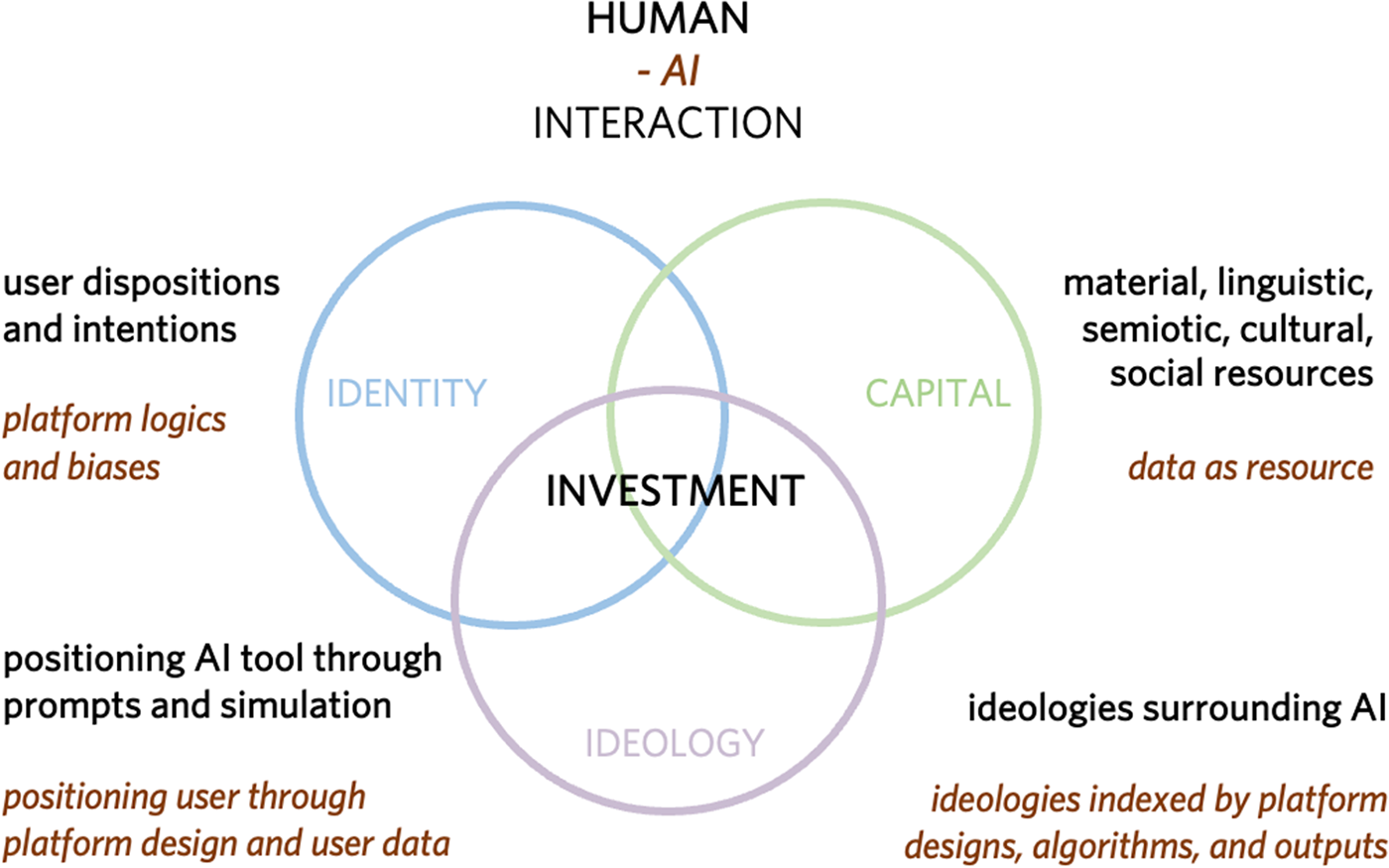
In addition to observing how GenAI platforms are used with devices in physical spaces, investigations of human–AI interactions also involve examining what appears on the screen: platform designs, learner prompts, and machine-generated outputs. Conducting such an analysis requires a materialist semiotics (Blommaert, Reference Blommaert, Pachler and Böck2013) that views “signs not as primarily mental and abstract phenomena reflected in ‘real’ moments of enactment, but as material forces subject to and reflective of conditions of production and patterns of distribution” (p. 33). In this case, the words, images, and sounds that learners input as prompts, and the designs and outputs of GenAI platforms, are material forces that have the power to engender effects in human–AI interaction (Bucher, Reference Bucher2018). Through indexicality (Blommaert, Reference Blommaert2005), the meanings that emerge from these material interactions index or point to the identities of learners and broader issues of capital and ideologies. How these constructs can frame issues of power, agency, and inequality that emerge from human–AI interaction is discussed in the following sections.
Identity as emergent and distributed
While sociomateriality decenters the human subject, this posthumanist perspective is not epistemologically irreconcilable with the notion of identity. For Pennycook (Reference Pennycook2016), this orientation invites “emergent and distributed accounts of identity” (p. 11) that recognize how identity is not something that exists within an individual but develops through interaction, distributed across spaces, objects, and technologies. When material things act with other objects, bodies and forces, the interaction can produce identities, including social groups, and modes of exclusion (Waltz, Reference Waltz2006). By recognizing identity as an emergent property of a distributed network of interactions, identity is always an ongoing process of becoming, a “nonunitary relational subject, nomadic, outward bound” (Braidotti, Reference Braidotti2017, p. 17) that resists confinement by stable categories, and always moves within and is transformed by the material world. In human–AI interaction, learners approach GenAI with particular intentions and dispositions towards technology, but their identities emerge from interaction, as chatbots address them and provide output that learners in turn need to interpret and respond to. As nonhuman entities, GenAI tools do not have identities nor intentions, but embedded in their design are internal logics and biases that are constituted by the interaction of datasets and algorithms.
How learners and GenAI tools position each other in interaction also shape the emergence of learner identities. In ChatGPT, learners construct prompts and can ask the chatbot to assume certain roles or personas (e.g. “Act as if you are an employer interviewing me for a job”), and by simulating this identity, the chatbot adopts a register, tone, or style that is rendered appropriate based on the platform’s dataset. Not only does such simulation foster the anthropomorphization of GenAI, but, as Jones (Reference Jones2025) argues, it also reproduces stereotypes because LLMs generate probabilistic representations derived from existing data. While learners can position GenAI tools through prompts and simulated interactions, these tools in turn can position learners through platform design. Snapchat’s chatbot My AI for instance positions users as a friend by initiating interaction through the conversation starter, “Hey there, my snap-tastic friend! How’s life treating you today?”, a prompt that encourages simulative rather than compositional or informational interaction. In Character.AI, learners can chat with Characters like “Giga Chad” designed to simulate the identity of a “true alpha male, a strong role model” and whose description includes “I turn boys into real men” and “Women admire me.” These descriptions and conversation starters function as sociotechnical structures (Darvin, Reference Darvin2023) designed to frame the interaction with AI. By simulating an identity based on online meme culture and that represents an exaggerated ideal of masculinity, Giga Chad positions users in a highly gendered way, either as someone aspiring to emulate the so-called “alpha male” ideals or as a spectator to this performative masculinity. The ensuing interaction prompts specific subject positions that learners will need to take up, or resist in relation to how the character is constructed. Users are led to either conform to or react against the hyper-masculine, heteronormative values that the character embodies, and one’s embodied and affective responses are part of how identity unfolds in this moment.
Another issue of positioning in human–AI interaction is the way GenAI tools position users through the data they collect, translating user prompts, uploaded files, and conversation histories into patterns, profiles, and categorizations, and designating an algorithmic identity (Blommaert, Reference Blommaert2017). Every input contributes to a data-driven construction of users, and responses are made to align with this constructed algorithmic identity. In this regard, how AI detection tools like GPTZero are given the power to determine plagiarism and position learners as “cheaters” presents a significant issue. Assigning a document-level score that indicates the probability of AI use, these tools calculate a written work’s perplexity and attribute randomness of language patterns to human writing and predictability to AI writing. The logic of this design, however, points to how these tools cannot provide absolute proof of AI authorship (Sadasivan et al., Reference Sadasivan, Kumar, Balasubramanian, Wang and Feizi2023), creating a challenging ethical conflict where learners can be accused of plagiarism for something that cannot be definitively proven. A study from Stanford (Liang et al., Reference Liang, Yuksekgonul, Mao, Wu and Zou2023) has also found that these detectors consistently misclassify writing samples from L2 writers as AI-generated because the reduced linguistic variability and syntactic complexity of some learner texts trigger the detectors’ perplexity-based classification mechanisms.
The unequal distribution of resources
As users and tools are positioned in human–AI interactions, the distribution of resources also shapes the way these interactions unfold and the way agency is exercised. In a study of the GenAI practices of multilingual youth in Canada, Darvin (Reference Darvin2025) observed how the devices and platforms that learners have access to actively shape what they can do with GenAI. While platforms like ChatGPT can be accessed for free, there are significant disparities in the features and functionalities between free and paid versions, as well as access through a mobile app and a browser on a laptop. At the time of the study, ChatGPT Plus provided access to GPT-4, which offered more nuanced, coherent, and detailed responses than the free version that only offered GPT-3.5. ChatGPT Plus also includes faster response times, priority access during peak usage, and a web browser plugin that allows ChatGPT to access the internet to retrieve real time information. Responses from the free version, on the other hand, are based on the training data available up to the model’s cutoff date. In Darvin’s (Reference Darvin2025) study, differences in human–AI interactions were also evident when learners accessed GenAI platforms using a laptop vs. a phone. Apart from the enhanced visibility of accessing ChatGPT through a laptop’s larger screen, the browser version enables more effective file management features like drag-and-drop, the handling of multiple file formats and sizes, and switching between tabs to verify information using other sources. Such affordances also appear to encourage more research, content creation, and data-heavy projects. Accessing GenAI apps on a mobile phone, on the other hand, seemed to restrict the learners from moving to other spaces online, and thus discouraged lateral reading. One other feature available in ChatGPT Plus is Canvas, an expanded workspace that allows users to modify a generated text in an open-ended way. In contrast to the more linear conversational interface of the regular ChatGPT, Canvas enables greater user agency by allowing users to arrange content spatially, elicit feedback on specific sections, compare different versions of text and work on multiple drafts simultaneously. Users could edit, revise, add content, and annotate texts in real time, enabling greater control over the composition process and ownership of revisions. These modificative, evaluative, and elicitative functionalities made available only through paid subscription demonstrate how access to material resources shape the extent to which learners are able to perform specific actions and exercise agency in human-AI interactions.
While learners rely on a range of material, cultural, social, linguistic and semiotic resources, the most important resource of GenAI tools is data. In the economy of big data, data is power, and the inequalities of training datasets that GenAI tools access and that shape human-AI interactions reflect both human control and uneven global knowledge production. While there are more than 7,000 languages in the world, only 20 have text corpora of hundreds of millions of words (Laumann, Reference Laumann2022) that are sufficient to support high performance in an LLM. High-resource languages like English, which is used in 52% of websites on the internet (Statista, 2024), dominate the datasets used to train GenAI. Due to their ubiquity in online content, languages like Spanish, German, Russian, Japanese, and Chinese are more accurately represented and better supported in GenAI applications. In contrast, low-resource languages, which typically have fewer than one million sentences of available bitext data (Costa-Jussà et al., Reference Costa-Jussà, Cross, Çelebi, Elbayad, Heafield, Heffernan and Wang2022), are often marginalized, leading to poor performance or outright exclusion in GenAI tools. Cantonese, for instance, has 85 million speakers, but because it is spoken more than written and because of the variety of informal writing conventions, the availability of Cantonese text corpora suited for training LLMs is relatively scarce (Liu, Reference Liu, Scherrer, Jauhiainen, N, Nakov, Tiedemann and Zampieri2022). This divide between low-resource and high-resource languages has implications in terms of the extent to which multilingual learners including speakers of Indigenous or endangered languages are able to benefit from the use of these tools. Such inequalities also mean that while a learner may post a question to ChatGPT in Punjabi and get a response in this language, this does not mean that the response is based on Punjabi sources, raising issues regarding cultural misalignment (Masoud et al., Reference Masoud, Liu, Ferianc, Treleaven and Rodrigues2023). Because of the hegemony of high-resource languages online, Masoud et al. (Reference Masoud, Liu, Ferianc, Treleaven and Rodrigues2023) point out that datasets often reflect the cultural values of Western, Educated, Industrialized, Rich and Democratic (WEIRD) societies, and LLMs often default to Western-centric assumptions and cultural norms. By providing a singular, definitive answer to queries based on such datasets, GenAI can reinforce dominant cultural narratives and contribute to the homogenization of knowledge and new forms of digital colonialism (Kwet, Reference Kwet2019). When AI-generated content feeds back into its own training data, it also creates a self-referential loop where models are increasingly trained on their own prior outputs and the diversity of responses degrade over time (Shumailov et al., Reference Shumailov, Shumaylov, Zhao, Papernot, Anderson and Gal2024), creating “a precarious echo chamber of artificiality” (Nosta, Reference Nosta2023). These issues demonstrate how in GenAI systems, the inequalities of data not only privilege dominant ideologies but even amplify them.
Ideologies surrounding and embedded in GenAI
A sociomaterial analysis of human–AI interactions can reveal patterns of use that index ideologies surrounding and embedded in GenAI technology. Technological utopianism (Chan, Reference Chan2023), for instance, is an ideology that promotes the idea that technology has to power to bring about radical positive change, often leading to an idealized future. Discourses promoting GenAI as a revolutionary tool that will democratize education and make knowledge accessible can shape how learners and teachers decide the place of this technology in classrooms. Conversely, technological dystopianism sees a threat to human values and society, often focusing on the risks of GenAI being used for disinformation and manipulation. Both ideologies share a deterministic assumption that technological development is inevitable and overpowering, and exerts influence on social practices in ways that override human agency (Chan, Reference Chan2023). Emphasizing efficiency and market-driven solutions, neoliberal ideologies (Block et al., Reference Block, Gray and Holborow2012) can emphasize GenAI technologies as a means to maximize productivity through automation and optimize content creation and teaching and learning processes. At the same time, ideologies of neutrality (Benjamin, Reference Benjamin2019) can be linked to dataism (Erdocia et al., Reference Erdocia, Migge and Schneider2024), the belief that data and GenAI models built on massive datasets can offer objective, unbiased insights into the world.
These normative sets of ideas can become visible in the material interactions of teachers and learners with these tools, and as these humans articulate their beliefs about GenAI. Inscribed by ideologies, dispositions towards GenAI shape the extent to which teachers and learners resist, adapt to, depend on, or critically engage with this technology (Baker et al., Reference Baker, Mills, McDonald and Wang2023). Hellmich and Vinall (Reference Hellmich and Vinall2023) noted the tension between teachers’ dispositions towards new technologies and students’ practices, particularly when teachers position such tools as conduits for plagiarism, echoing concerns regarding academic dishonesty, negative impact on productivity, and superficial learning (Baek et al., Reference Baek, Tate and Warschauer2024; Mah et al., Reference Mah, Walker, Phalen, Levine, Beck and Pittman2024; Zhang & Tur, Reference Zhang and Tur2023). In a study analyzing survey data from university learners of non-English languages, Hellmich et al. (Reference Hellmich, Vinall, Brandt, Chen and Sparks2024) examined orientations towards ChatGPT and found that 74% of participants opted not to use the platform for language learning, citing factors such as institutional policies, ethical concerns, tool constraints, and other reflections on learning. Students’ concerns about fairness, intellectual theft, or the potential erosion of language learning reflected an alignment with broader ideologies about academic integrity, equitable knowledge production, and the value of rigorous learning practices.
Ideology is also relevant to understanding human-AI interactions because platform designs, algorithms, and outputs of GenAI tools can index specific interests, intentions, and ways of thinking. The design of ChatGPT’s simple question-and-answer interface, for instance, signals the valuing of quick, conversational interactions that flatten complex inquiries into transactions privileging singular, definitive answers. Similarly, content moderation protocols embedded in these platforms are not ideologically neutral; they are designed to comply not only with ethical standards but particular ways of thinking. A notable illustration emerged in early 2024, when Google’s GenAI model, Gemini generated historically inaccurate images of racially diverse Founding Fathers of the United States and female popes. The incident revealed the deliberate design choices of its developers embedded in Google’s algorithm, which aimed to promote diversity in generated images. While this design choice likely stemmed from contemporary ideals of diversity and inclusion, the incident demonstrated not only algorithmic control but also how developers can programmatically encode particular worldviews. Beyond design, GenAI outputs also reflect the biases present in training data, revealing a “coded inequity” (Benjamin, Reference Benjamin2019) that reproduces ideologies of race, ethnicity, gender, and social class. Caliskan et al. (Reference Caliskan, Ajay, Charlesworth, Wolfe and Banaji2022) for instance assert that large-scale corpora frequently encode a “masculine default,” a bias that Alvero et al. (Reference Alvero, Lee, Regla-Vargas, Kizilcec, Joachims and Antonio2024) found in AI-generated college admissions essays that most closely resembled those written by male students with significant social privilege. Similarly, in their study of automated formative feedback on student writing, Dixon-Román et al. (Reference Dixon-Román, Nichols and Nyame-Mensah2020) describe how AI algorithms function as a “racializing assemblage” that imposes standards of writing aligned with white, middle-class literacy norms.
By adopting a sociomaterial lens to examine the relevance of identity, capital, and ideology in human–AI interactions, this section highlights how the use of GenAI tools is always a site of struggle: how learners and tools position each other through prompts, conversation starters, and simulations; how the composition and volume of resources, whether they be devices, platforms or data, shape the distribution of agency; and how the interaction between bodies, objects, and discourses index competing and colluding ideologies. Learners participate in these interactions with different dispositions and intentions, while GenAI tools operate with specific internal logics and biases. Through repetition, human–AI interactions are sedimented into practices, and stabilized into norms and conventions. Tracing the asymmetries of material interactions to issues of identity, capital and ideology disturbs these practices, and interrogates what has been stabilized as “matters of fact” so that they might be reconstituted as “matters of concern.”
Conclusion
While a sociomaterial orientation of human–AI interaction views agency as relational, emergent and distributed across human and nonhuman actors, language learning and teaching views the cultivation of learner agency as a crucial pedagogical goal. Tension between these views arise because the notion of distributed agency potentially diffuses responsibility and intentionality, complicating pedagogical efforts to develop learner autonomy and critical consciousness. However, this tension is not irreconcilable. Decentering the human by exploring how agency is distributed among objects, bodies, and discourse provides a vital perspective on the material entanglements that shape our world. Ultimately, however, it is learners and teachers, endowed with a critical awareness of these entanglements, who hold the agency to harness GenAI as a tool for learning and social transformation. With the rise of agentic AI designed to operate autonomously, make decisions and take actions with minimal human intervention, the negotiation of learner agency in human-AI interactions requires even greater critical attention. A sociomaterial lens casts a light on how discourse, languages, ideologies, and symbolic practices are entangled with datasets, algorithms, and designs. A critical orientation, in turn, enables learners and teachers to examine how human agency both interacts with, and is constrained or amplified by a range of GenAI functionalities. To invest in agentive GenAI practices that enable meaningful learning and the achievement of their own intentions, learners need to recognize the power of GenAI to position them in particular ways, steer interactions, and promote specific ways of thinking. Agentive co-construction with GenAI requires learners to resist fully relinquishing the production of meaning and texts to a tool and to ensure that reflexive learning takes place. At the same time, teachers designing classroom tasks that integrate GenAI need to align its use with specific learning objectives to ensure that the tool functions as a scaffold rather than a substitute for learning.
Asserting one’s agency in human–AI interaction aligns with the goals of critical digital literacies (Darvin, Reference Darvin, Thorne and May2017, Reference Darvin2025). Whereas functional digital literacies enable learners to work with the logic of a tool’s design and recognize its affordances and constraints, critical digital literacies involve problematizing this design and challenging issues of power. In the case of GenAI, these literacies can include interrogating how these tools mediate, amplify, or diminish their capacities for intentional action; recognizing patterns of algorithmic control; verifying generated output and analyzing embedded biases; and engaging in critical co-construction through iterative and counterdiscursive prompting. Critical digital literacies also demand an awareness of the material consequences of GenAI, and a discernment of not only how to use it, but also to what extent and for what purpose. As this technology becomes increasingly embedded in educational contexts, it is vital to consider its environmental implications, particularly its reliance on energy-intensive data centers that require extensive cooling, with each string of prompts consuming roughly 16 ounces of water (Collier, Reference Collier2024). Although we may focus on the local, material intricacies of human–AI interactions, their impact is neither fleeting nor isolated. Rather, these interactions are deeply entangled with our relationship with the earth and with others, and with broader issues of identity, ideology, and capital.
While it is easy to conceptualize the “human” in human-AI interaction solely as the user or learner, it is crucial to recognize another key human presence in this relationship: the platform designers–namely, the technology companies, AI engineers and software architects who create these tools with specific intentions and interests. Algorithms may encode ideologies that marginalize and exclude others, but it is humans who construct the logics that govern such algorithms. Similarly, while big data can contain harmful biases, these biases emerge from human discourse, reflecting the inequalities and power relations of the social world. Asserting the role of humans in the evolution of GenAI is a crucial step toward decolonizing this technology and critically rethinking the epistemologies, data infrastructures, power relations and governance models that underpin it. For this reason, involving speakers of diverse languages and custodians of underrepresented, Indigenous, or endangered languages in the design of LLMs is critical to resist new modes of linguistic racism (May, Reference May2023), the amplification of Global North/South inequalities, and colonial ways of thinking (Bird, Reference Bird2020; De Roock, Reference De Roock2024; McKnight & Shipp, Reference McKnight and Shipp2024). Attention to materials and objects helps illuminate the power of GenAI and its potential for language learning, yet as Thorne (Reference Thorne2024) reminds us, learning is ultimately “driven by the human relationships that it makes possible” (p. 6). Language learning, at its core, is a social practice shaped by identities, relationships, and human interactions. While GenAI may disrupt established language and literacy practices, humans are not determined by these technologies. Social transformation lies not only in agentive human interaction with GenAI, but in human collaboration through GenAI–designing and using these tools in reflexive, inclusive, and equitable ways that reaffirm our shared responsibility for the future of learning.


 Open access

