

Introduction
Next to Graphidaceae, the lichenized fungal family Trypetheliaceae is the most important and conspicuous element of crustose lichen communities in tropical forest and savanna ecosystems (Komposch & Hafellner Reference Komposch and Hafellner1999, Reference Komposch and Hafellner2000, Reference Komposch and Hafellner2002, Reference Komposch and Hafellner2003; Komposch et al. Reference Komposch, Aptroot and Hafellner2002; Aptroot et al. Reference Aptroot, Lücking, Sipman, Umaña and Chaves2008, Reference Aptroot, Menezes, Lima, Xavier-Leite and Cáceres2013; Aptroot 2009 Reference Aptroota , Reference Aptrootb ). The number of species recognized in this family has greatly increased recently, not only due to the discovery of new species (Aptroot et al. Reference Aptroot, Menezes, Lima, Xavier-Leite and Cáceres2013; Lima et al. Reference Lima, Maia, Aptroot and Cáceres2013; Weerakoon & Aptroot Reference Weerakoon and Aptroot2014; Córdova-Chávez et al. Reference Córdova-Chávez, Aptroot, Castillo-Camposa, Cáceres and Pérez-Pérez2014; Aptroot & Cáceres Reference Aptroot and Cáceres2016; Flakus et al. Reference Flakus, Kukwa and Aptroot2016), but also based on phylogenetic studies which resulted in a refined species concept (Aptroot & Lücking Reference Aptroot and Lücking2016; Lücking et al. Reference Lücking, Nelsen, Aptroot, Barillas de Klee, Bawingan, Benatti, Binh, Bungartz, Cáceres and Canêz2016). Previously unrecognized species are often discovered because the placement of specimens identified with currently used names on a phylogenetic tree results in conflicting topologies, which then triggers a more detailed study of the sequenced material and the discovery of subtle morphological features characterizing separate clades.
In this paper we describe a large number of new taxa, including material which, prior to phylogenetic studies, had been identified as common existing species. In these cases, it turned out that the sequenced material was not conspecific with the taxon on which the name was based, and in many cases not even closely related. Hence, these species are here formally described, illustrated, and discussed in a phylogenetic and morphological context. Most belong in the redefined, megadiverse genus Astrothelium, which includes species previously classified in Campylothelium, Cryptothelium, Laurera, and Trypethelium (Nelsen et al. Reference Nelsen, Lücking, Aptroot, Andrew, Cáceres, Rivas Plata, Gueidan, da Silva Canêz, Knight and Ludwig2014; Aptroot & Lücking Reference Aptroot and Lücking2016; Lücking et al. Reference Lücking, Nelsen, Aptroot, Barillas de Klee, Bawingan, Benatti, Binh, Bungartz, Cáceres and Canêz2016).
Material and Methods
Thallus morphology was examined using a LEICA MS5 dissecting microscope. Sections of thalli and ascomata were cut by hand with a razor blade and examined in squash preparations mounted in water, KOH and Lugol’s solution, using a ZEISS Axioskop 2 compound microscope. All measurements are given in water. TLC was carried out using standard techniques with solvent C, following Orange et al. (Reference Orange, James and White2010). Molecular sequence data of the mitochondrial small subunit (mtSSU) and the nuclear large subunit (nuLSU) of the rDNA cistron were obtained for most specimens following previously published protocols (Nelsen et al. Reference Nelsen, Lücking, Grube, Mbatchou, Muggia, Rivas Plata and Lumbsch2009, Reference Nelsen, Lücking, Mbatchou, Andrew, Spielmann and Lumbsch2011, Reference Nelsen, Lücking, Aptroot, Andrew, Cáceres, Rivas Plata, Gueidan, da Silva Canêz, Knight and Ludwig2014) and are published separately (Nelsen et al. Reference Nelsen, Lücking, Grube, Mbatchou, Muggia, Rivas Plata and Lumbsch2009, Reference Nelsen, Lücking, Mbatchou, Andrew, Spielmann and Lumbsch2011, Reference Nelsen, Lücking, Aptroot, Andrew, Cáceres, Rivas Plata, Gueidan, da Silva Canêz, Knight and Ludwig2014; Lücking et al. Reference Lücking, Nelsen, Aptroot, Barillas de Klee, Bawingan, Benatti, Binh, Bungartz, Cáceres and Canêz2016).
Results and Discussion
Architrypethelium lauropaluanum Lücking, M. P. Nelsen & Marcelli sp. nov.
MycoBank No.: MB 817268
Differing from Architrypethelium hyalinum in the perithecia immersed between coarse thallus verrucae and in the additional ascospore septa.
Type: Brazil, Minas Gerais, Serra do Caraça, Reserva Particular do Patrimônio Natural (RPPN) Santuário do Caraça, Belchior trail, 20°06'S, 43°29'W, 1300–1400 m, Atlantic rainforest, disturbed gallery forest remnants (mata de galeria or floresta ombrófila densa montana) along small river leading to Cascatinha Waterfall, 27 July 2010, R. Lücking 31021 (SP—holotype; B, F—isotypes).
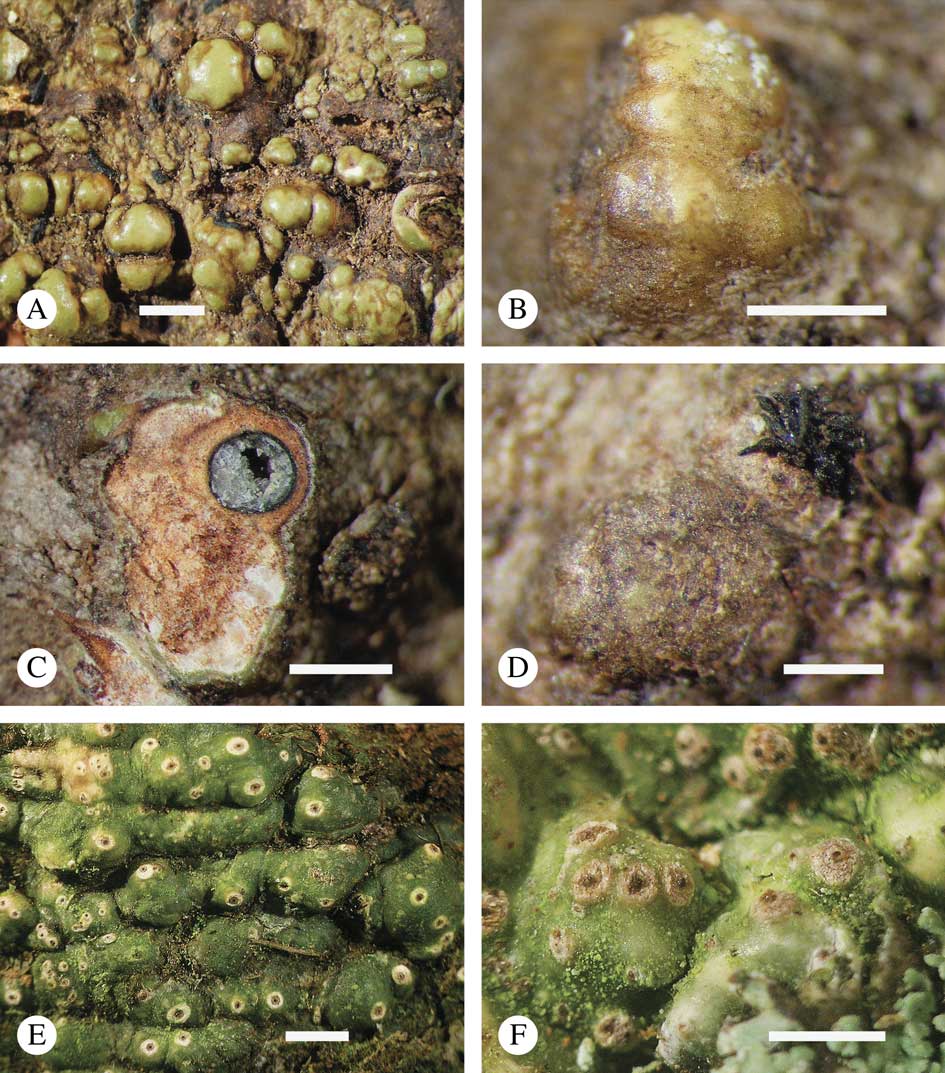
(Fig. 1A)
A, Architrypethelium lauropaluanum (isotype), bullate thallus with immersed, hidden ascomata. B & C, Astrothelium aurantiacocinereum (isotype), thallus with pseudostromatic ascomata. D–F, A. carassense (isotype); D & E, thallus with immersed ascomata; F, fused ascomata exposed. Scales: A–F =1 mm. In colour online.
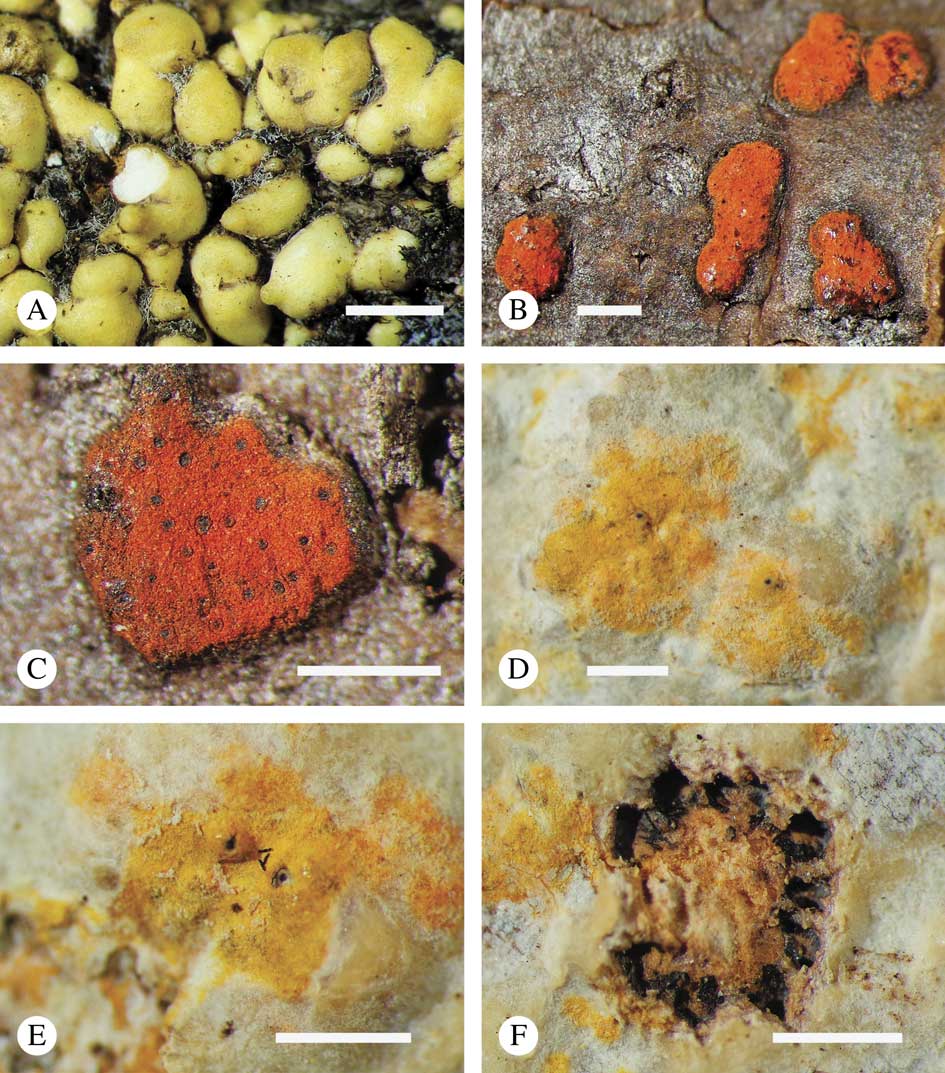
Thallus crustose, corticolous, continuous, ≤7 cm diam., coarsely bumpy with bumps 1–3 mm diam. (gall-forming), olive-yellow; in section with thin cortex and with irregular photobiont layer and thick medulla immersed in the modified periderm; photobiont layer and medulla encrusted with numerous, small crystals.
Perithecia solitary, deeply immersed between the thallus galls, with apical to more or less eccentric ostioles; ostioles papilliform, 0·1–0·2 mm diam., brownish; perithecia subglobose to pyriform, with ostiolar channels oriented irregularly, 0·5–0·7 mm wide and ≤1 mm high. Excipulum in section 50–150 μm thick, carbonized, covered with amorphous, orange-brown tissue. Hamathecium composed of densely anastomosing, 0·5 μm thick, net-like paraphyses embedded in a gelatinous matrix, clear, IKI−; ostiolar channel clear. Ascospores 8 per ascus, fusiform, 3–7-septate (the last septa often indistinct or not well developed), with distosepta and angular lumina but not distinctly diamond-shaped, 100–120×25–30 μm, hyaline, IKI−.
Secondary chemistry. Thallus (not perithecia) with lichexanthone, UV+ yellow.
Etymology. This new species is dedicated to Padre Lauro Palú, long-term director of the Santuário do Caraça and colleague of Marcelo Marcelli.
Notes. This new species is placed here in the genus Architrypethelium due to the very large ascospores that are principally 3-septate, with a septal structure of the Architrypethelium type (Aptroot Reference Aptroot1991; Nelsen et al. Reference Nelsen, Lücking, Aptroot, Andrew, Cáceres, Rivas Plata, Gueidan, da Silva Canêz, Knight and Ludwig2014; Aptroot & Lücking Reference Aptroot and Lücking2016). However, the ascospores develop 2–4 additional septa that are less distinct than the three primary septa. Within Architrypethelium, only A. hyalinum Aptroot has ascospores that remain hyaline, and that species also produces lichexanthone on the thallus, but its morphology is different, with the perithecia superficial and not immersed between strongly prominent thallus verrucae. Several species of Astrothelium produce similar ascospores, such as A. megalophthalmum (Müll. Arg.) Aptroot & Lücking with pseudostromata and lacking lichexanthone, and A. pictum Aptroot with pseudostromata and a red medullary pigment. Astrothelium diplocarpoides Müll. Arg. has smaller, typically astrothelioid ascospores, an inspersed hamathecium, and produces lichexanthone on the thallus and the perithecial warts.
Additional specimens examined. Peru: Madre de Dios: Los Amigos Research and Training Center, Centro de Investigación y Capacitación Río Los Amigos (CICRA), 90 km W of Puerto Maldonado; 12°35'S, 70°06'W, 270 m, tropical lowland rainforest, on bark of tree, viii 2008, M. P. Nelsen s. n. (F).
Astrothelium aurantiacocinereum Lücking, Naksuwankul & Lumbsch sp. nov.
MycoBank No.: MB 817269
Differing from Astrothelium aeneum in the prominent, well-delimited, trypethelioid pseudostromata and the absence of pigment on the thallus surface, as well as in the barely lichenized thallus.
Type: New Caledonia, Province Sud, Dumbéa, Monts Dzumac, along roadside up to the mountain top, 22°02'S, 166°28'E, 920 m, relict montane forest, on bark, September 2012, K. B. Naksuwankul & H. T. Lumbsch 7537 (IRD—holotype; B, F—isotypes).
Thallus crustose, corticolous, continuous, ≤10 cm diam., smooth to uneven, dark grey to brownish grey; in section thinly corticate and with indistinct, endoperidermal photobiont layer (appearing barely lichenized).
Perithecia 5–20 aggregated in rounded to irregular or sometimes elongate pseudostromata, with separate, apical ostioles; pseudostromata 1–3 mm long and 1–2 mm wide, prominent to sessile, ≤0·6 mm high, covered by a thick, carbonized layer with a deep orange pigment layer above, K+ purple; ostioles visible as blackish dots, 0·03–0·05 mm diam.; invididual perithecia subglobose, 0·3–0·4 mm wide and 0·3–0·4 mm high, space between perithecia filled with amorphous, orange-brown tissue. Excipulum in section 30–50 μm thick, carbonized. Hamathecium composed of densely anastomosing, 0·5 μm thick, net-like paraphyses embedded in a gelatinous matrix, clear, IKI−; ostiolar channel clear. Ascospores 8 per ascus, fusiform-ellipsoid, 3-septate with distosepta and diamond-shaped lumina, 22–27×8–10 μm, hyaline, IKI−.
Secondary chemistry. Pseudostromata covered with deep orange pigment that bleeds purple; base of thallus bleeding yellow (reaction of substratal periderm?).
Etymology. The epithet refers to the strong contrast between the orange pseudostromata and the grey thallus.
Notes. This is a unique new species that at first glance resembles a true Trypethelium (Nelsen et al. Reference Nelsen, Lücking, Aptroot, Andrew, Cáceres, Rivas Plata, Gueidan, da Silva Canêz, Knight and Ludwig2014; Aptroot & Lücking Reference Aptroot and Lücking2016) but produces astrothelioid ascospores. Only a small number of species in Astrothelium, including A. aeneum (Eschw.) Aptroot & Lücking, A. inspersaeneum E. L. Lima et al., and A. neogalbineum (R. C. Harris) Aptroot & Lücking, have orange pseudostromata combined with 3-septate ascospores. However, in all these three species the perithecia are immersed to erumpent and dispersed to aggregate but do not form prominent to sessile, trypethelioid pseudostromata. Another unique feature is the barely lichenized, dark grey thallus that strongly contrasts with the orange pseudostromata. Barely lichenized thalli are thus far known only from basal lineages within the family but not in the derived genus Astrothelium. Unfortunately, no sequence data could be obtained for this material but it is possible that it represents an unrecognized genus.
Astrothelium carassense Lücking, M. P. Nelsen & Marcelli sp. nov.
MycoBank No.: MB 817270
Differing from Astrothelium purpurascens in the orange, K+ red pseudostroma pigment and the slightly larger ascospores.
Type: Brazil, Minas Gerais, Serra do Caraça, Reserva Particular do Patrimônio Natural (RPPN) Santuário do Caraça, Belchior trail, 20°06'S, 43°29'W, 1300–1400 m, Atlantic rainforest, disturbed gallery forest remnants (mata de galeria or floresta ombrófila densa montana) along small river leading to Cascatinha Waterfall, 27 July 2010, R. Lücking 31004 (SP—holotype; B, F—isotypes).
Thallus crustose, corticolous, continuous, ≤10 cm diam., uneven to bumpy with bumps 1–2 mm diam. (gall-forming), very pale olive-yellow, irregularly white-pruinose (appearing roughened); in section corticate, with photobiont layer deeply immersed in the modified periderm.
Perithecia 8–11 aggregated in concentric circles with fused, centrally shared ostiole, completely immersed in pseudostromata; pseudostromata 2–4 mm diam., slightly elevated over thallus level, uneven to bumpy, covered with orange pigment that penetrates into the cortex and periderm, central ostiole papilliform, 0·3–0·4 mm diam., with black dot; individual perithecia pyriform, arranged laterally with ostiolar channel oriented towards the centre, 0·5–0·6 mm wide and ≤1 mm long (‘high’). Excipulum in section 20–30 μm thick, carbonized; space between individual perithecia filled with amorphous, orange-brown tissue. Hamathecium composed of densely anastomosing, 0·5 μm thick, net-like paraphyses embedded in a gelatinous matrix, clear, IKI−; ostiolar channel strongly inspersed with grey-brown oil droplets. Ascospores 8 per ascus, oblong-fusiform, densely muriform, with 15–19 transverse distosepta and approximately the same number of secondary eusepta and 3–7 longitudinal eusepta per segment, 100–170×30–40 μm, hyaline, IKI−, without strong median thickening.
Secondary chemistry. Orange anthraquinone covering the pseudostromata, K+ red.
Etymology. Named after the type locality.
Notes. This new species is characterized by the astrothelioid perithecia with fused ostioles, the orange anthraquinone covering the pseudostromata, and the large, muriform ascospores. Only four other species of Astrothelium are known with this type of perithecial arrangement, muriform ascospores, and presence of pigments (Aptroot & Lücking Reference Aptroot and Lücking2016). Astrothelium isabellinum Eschw. and A. purpurascens (Müll. Arg.) Aptroot & Lücking have a red pseudostroma pigment reacting K+ green; in addition, A. isabellinum has 2-spored asci and A. purpurascens has slightly smaller ascospores. Astrothelium praetervisum (Müll. Arg.) Aptroot & Lücking features an orange thallus pigment but has small ascospores not exceeding 70×25 μm. Most similar is Astrothelium amazonum (R. C. Harris) Aptroot & Lücking, which shares the orange pseudostroma pigment but differs in the smaller ascospores not exceeding 100×30 μm.
Astrothelium cryptolucens Lücking, M. P. Nelsen & N. Salazar sp. nov.
MycoBank No.: MB 817271
Differing from Astrothelium carrascoense in the inspersed hymenium.
Type: Panama, Panamá, Altos de Campana National Park, 50 km W of Panama City near the town of Capira, access gravel road leading to forest, 8°42'N, 79°57'W, 500–600 m, submontane rainforest, on bark of exposed roadside trees, 14 March 2009, R. Lücking 27019 (PMA—holotype; B, F—isotypes).
A–D, Astrothelium cryptolucens (isotype), bullate thallus with immersed, largely hidden ascomata only visible by their ostioles. E & F, A. fijiense (isotype), thallus with erumpent ascomata covered by whitish layer. Scales: A–F =1 mm. In colour online.
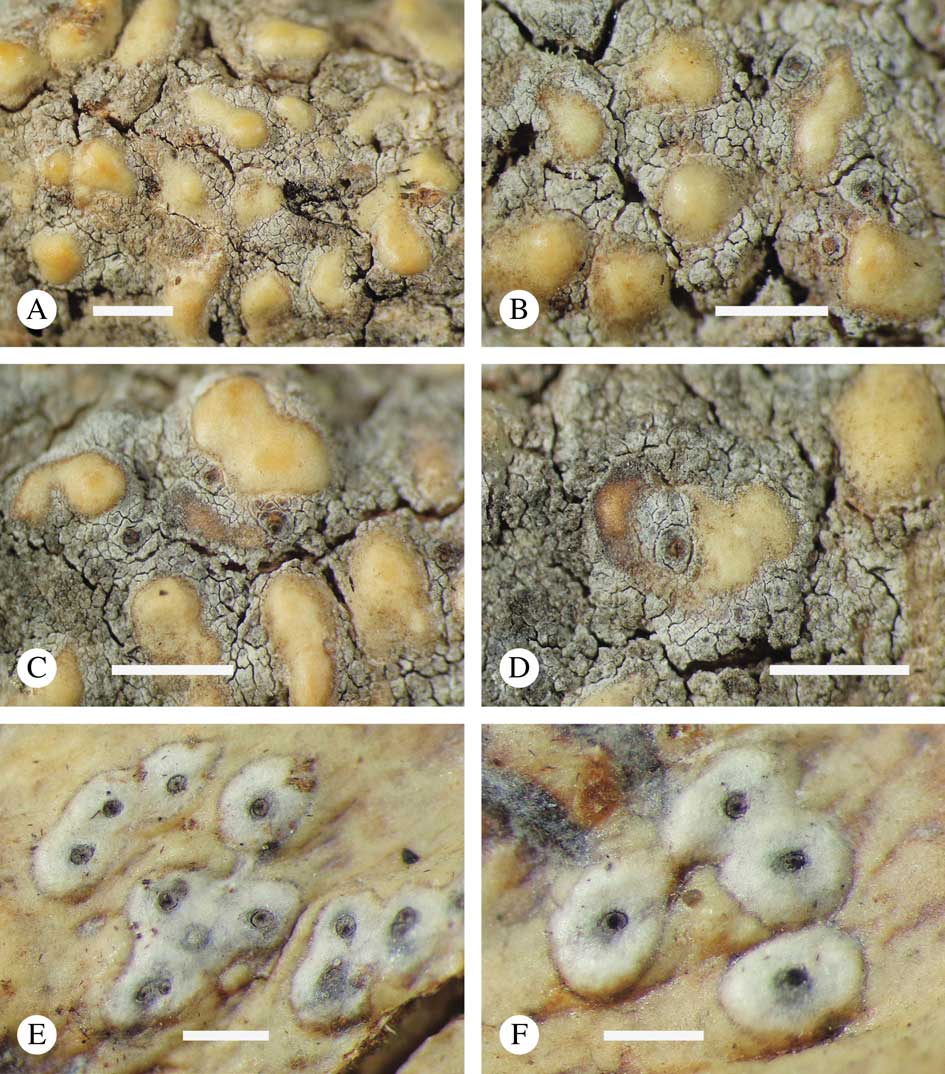
Thallus crustose, corticolous, continuous, ≤10 cm diam., uneven to coarsely bumpy with bumps 1–3 mm diam. or often elongate (gall-forming), olive-yellow; in section with thin cortex and with irregular photobiont layer and thick medulla immersed in the modified periderm; photobiont layer and medulla encrusted with numerous, small crystals.
Perithecia loosely aggregated and completely immersed in irregular to linear pseudostromata, with lateral, separate ostioles; pseudostromata 2–5 mm long and 1–3 mm wide, immersed, always developed between galls, often anastomosing, uneven and cracked into numeros small ‘areoles’, covered with a brownish white layer; ostioles papilliform, 0·05–0·10 mm diam., brownish; perithecia pyriform, arranged laterally with ostiolar channels oriented irregularly, 0·3–0·5 mm wide and ≤1 mm long (‘high’). Excipulum in section 50–150 μm thick, carbonized; space between individual perithecia filled with amorphous, orange-brown tissue. Hamathecium composed of densely anastomosing, 0·5 μm thick, net-like paraphyses embedded in a gelatinous matrix, clear, IKI−; upper part of hamathecium and ostiolar channel strongly inspersed. Ascospores 1–2 per ascus, oblong-ellipsoid, densely muriform with distinct median constriction and distinctly thickened median septum and thick outer wall, 150–200×50–60 μm, hyaline, IKI−.
Secondary chemistry. Pseudostromata with lichexanthone, UV+ yellow.
Etymology. The epithet refers to the cryptothelioid habit with completely immersed perithecia and the presence of lichexanthone.
Notes. This new species belongs in the Astrothelium sepultum complex, with large, muriform, centrally constricted ascospores and lichexanthone. It differs from other species in this complex in the distinctly gall-forming thallus with numerous galls strongly contrasting with the pseudostromatic, UV+ yellow areas. Astrothelium cryptolucens appears to be the only species in this complex in which the perithecia maintain separate ostioles, in spite of their dense arrangement in pseudostromata. This species is close to A. carrascoense Flakus et al. (Flakus et al. Reference Flakus, Kukwa and Aptroot2016), which differs by the inspersed hamathecium.
Astrothelium fijiense Lücking, Naksuwankul & Lumbsch sp. nov.
MycoBank No.: MB 817272
Differing from Astrothelium cinereorosellum in the presence of lichexanthone on the well-delimited pseudostromata and in the slightly shorter ascospores.
Type: Fiji, Viti Levu Island, Suva area, Nakoba Levu, Telecommunication Tower, 18°04'S, 178°25'E, 750 m, secondary forest on steep slope, on bark, 2011, H. T. Lumbsch & K. B. Naksuwankul 20500k (SUVA—holotype; B, F, MSUT—isotypes).
Thallus crustose, corticolous, continuous, ≤5 cm diam., smooth to uneven, light olive-yellow; in section with thick, cartilaginous cortex, thin and irregular, epiperidermal photobiont layer, and distinct, mostly epiperidermal medulla, encrusted with small, grey crystals.
Perithecia solitary or 2–4 aggregated in rounded, often fused and then elongate pseudostromata, with separate, apical ostioles; pseudostromata 0·7–1·5 mm diam. and ≤3 mm long when fused, erumpent, applanate, 0·4–0·5 mm thick, covered by a whitish layer contrasting with the surrounding thallus; ostioles appearing as blackish spots, 0·1–0·2 mm diam.; individual perithecia applanately subglobose, 0·4–0·6 mm wide and ≤0·4 mm high. Excipulum in section 30–60 μm thick, carbonized, covered by amorphous, orange-brown tissue. Hamathecium composed of densely anastomosing, 0·5 μm thick, net-like paraphyses embedded in a gelatinous matrix, densely inspersed with sordid yellowish grey oil droplets, IKI−; ostiolar channel inspersed. Ascospores 8 per ascus, narrowly fusiform, 7-septate with distosepta and diamond-shaped lumina, 40–50×11–13 μm, hyaline, IKI−.
Secondary chemistry. Lichexanthone on the thallus and pseudostromata, UV+ yellow.
Etymology. Named after the type locality.
Notes. Astrothelium fijiense is characterized by the usually rounded, erumpent, applanate pseudostromata contrasting with the thallus, the inspersed hamathecium, 7-septate ascospores, and the presence of lichexanthone. The most similar taxon is A. cinereorosellum (Kremp.) Aptroot & Lücking, which differs in the absence of lichexanthone on the pseudostromata and in the slightly longer ascospores, and the lack of distinct, contrasting pseudostromata.
Astrothelium laevithallinum Lücking, M. P. Nelsen & Marcelli sp. nov.
MycoBank No.: 817273
Differing from Astrothelium endochryseum in the smooth thallus.
Type: Brazil, Minas Gerais, Serra do Caraça, Reserva Particular do Patrimônio Natural (RPPN) Santuário do Caraça, Cascatinha Waterfall, 20°06'S, 43°29'W, 1300–1400 m, Atlantic rainforest, disturbed gallery forest remnants (mata de galeria or floresta ombrófila densa montana) near waterfall, 27 July 2010, R. Lücking 31061 (SP—holotype; F—isotype).
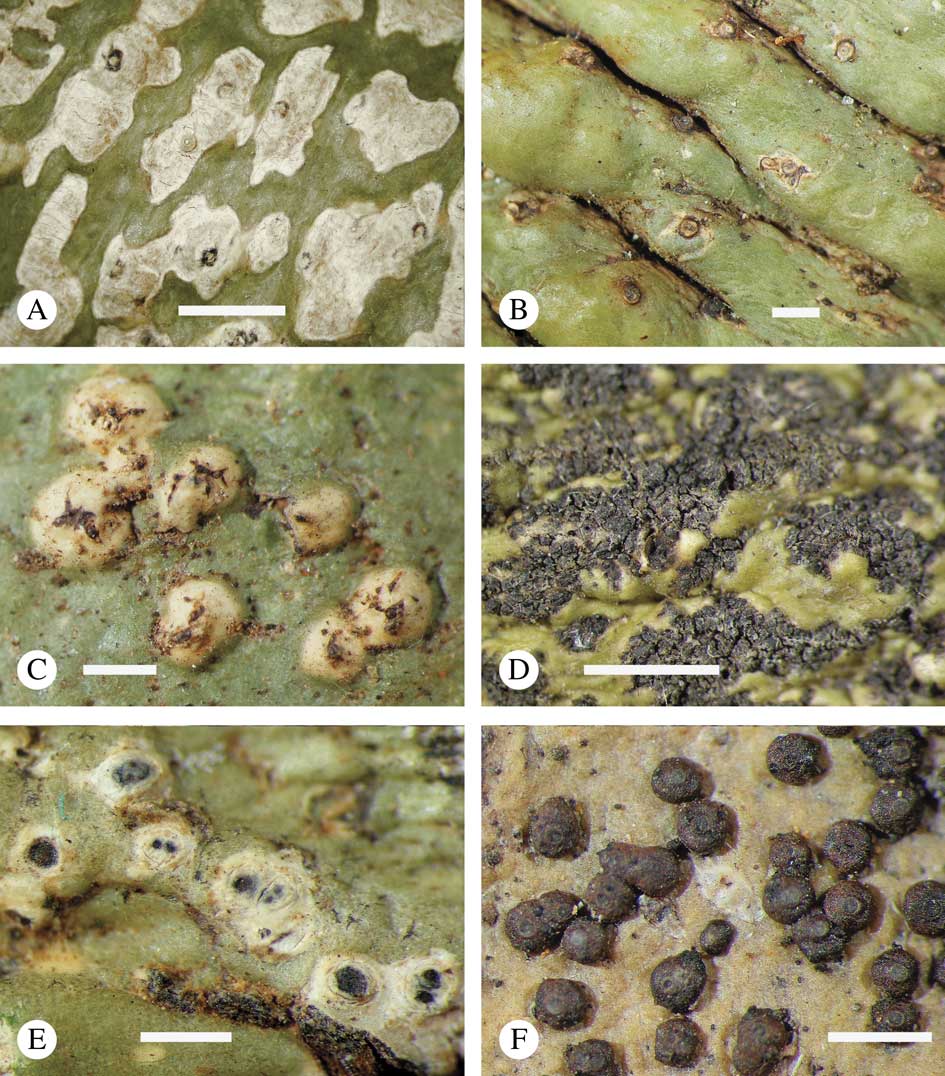
A & B, Astrothelium laevithallinum (isotype); A, thallus with pseudostromatic ascomata; B pseudostromatic ascomata with yellow medullary pigment. C & D, A. leucosessile (isotype), thallus with prominent to sessile, pseudostromatic ascomata. E & F, A. macrostomoides (isotype), thallus with immersed ascomata. Scales: A–F =1 mm. In colour online.
Thallus crustose, corticolous, continuous, ≤5 cm diam., smooth to uneven, green; in section with thick, cartilaginous cortex and distinct, epiperidermal photobiont layer, and thick medulla immersed in the periderm.
Perithecia 3–7 aggregated in irregular pseudostromata, with separate, apical ostioles; pseudostromata 1–3 mm diam., prominent, ≤1 mm high, covered by a grey-brown thallus layer; internally between the perithecia filled with yellow, K+ red pigment granules, in section bleeding deep yellow then deep orange to cinnabar red, covered by a carbonized layer with a thin cortex above; ostioles visible as black dots, 0·05–0·10 mm diam.; individual perithecia subglobose, 0·8–1·0 mm wide and 0·7–0·9 mm high. Excipulum in section 20–30 μm thick, carbonized, laterally covered by dense pigment granules. Hamathecium composed of densely anastomosing, 0·5 μm thick, net-like paraphyses embedded in a gelatinous matrix, clear, IKI−; ostiolar channel clear. Ascospores 8 per ascus, fusiform, 3-septate with distosepta and diamond-shaped lumina, 35–42×10–12 μm, hyaline, IKI−.
Secondary chemistry. Pseudostromata with yellow pigment that bleeds first deep yellow, then deep orange to cinnabar red.
Etymology. The name refers to the smooth thallus as compared to its closest relative with a bullate thallus (see below).
Notes. This new species is related and similar to Astrothelium endochryseum (Vain.) Aptroot & Lücking, but differs mainly in the smooth, not bullate thallus. Both species are phylogenetically distinct, emphasizing the importance of thallus morphology as a taxonomic character (Lücking et al. Reference Lücking, Nelsen, Aptroot, Barillas de Klee, Bawingan, Benatti, Binh, Bungartz, Cáceres and Canêz2016).
Astrothelium leucosessile Lücking, M. P. Nelsen & Aptroot sp. nov.
MycoBank No.: MB 817274
Differing from Astrothelium phlyctaena in the conspicuous, sessile pseudostromata.
Type: Panama, Panamá, Altos de Campana National Park, 50 km W of Panama City near the town of Capira, access gravel road leading to forest, 8°42'N, 79°57'W, 500–600 m, submontane rainforest, on bark of exposed roadside trees, 14 March 2009, R. Lücking 27093 (PMA—holotype; B, F—isotypes).
Thallus crustose, corticolous, continuous, ≤5 cm diam., smooth to uneven, light olive-grey with streaks of yellowish white pruina; in section thinly corticate, with photobiont layer immersed in the uppermost periderm layer.
Perithecia 2–5 aggregated in irregular to elongate pseudostromata with separate, apical ostioles; pseudostromata 1–2 mm long and 0·6–1·5 mm wide, prominent to sessile, 0·4–0·6 mm high, covered by a whitish thallus layer and often with streaks of yellowish white pruina; ostioles appearing as blackish dots, 0·03–0·05 mm diam.; individual perithecia subglobose but with a distinctly pyriform chamber with long ostiolar channel, 0·4–0·5 mm wide and ≤0·5 mm high. Excipulum in section 50–120 μm thick, strongly carbonized; narrow space between individual perithecia filled with amorphous, orange-brown tissue. Hamathecium composed of densely anastomosing, 0·5 μm thick, net-like paraphyses embedded in a gelatinous matrix, densely inspersed, IKI−; ostiolar channel densely inspersed. Ascospores 8 per ascus, fusiform-ellipsoid, 3-septate with distosepta and diamond-shaped lumina, 20–25×8–10 μm, hyaline, IKI−.
Secondary chemistry. Lichexanthone on the thallus and especially the pseudostromata, UV+ yellow.
Etymology. The epithet refers to the whitish, sessile pseudostromata.
Notes. This new species agrees with the broad concept of Astrothelium phlyctaena (Fée) Aptroot & Lücking (=Trypethelium ochroleucum (Eschw.) Nyl.), but is not closely related to the latter species (Lücking et al. Reference Lücking, Nelsen, Aptroot, Barillas de Klee, Bawingan, Benatti, Binh, Bungartz, Cáceres and Canêz2016). While in A. phlyctaena the perithecia are dispersed to irregularly aggregate and erumpent, in A. leucosessile they are clearly organized in prominent to sessile pseudostromata, closely resembling a species of Trypethelium s. str.
Additional specimens examined. Panama: Panamá: Altos de Campana National Park, 50 km W of Panama City near the town of Capira, access gravel road leading to forest, 8°42'N, 79°57'W, 500–600 m, submontane rainforest, on bark of exposed roadside trees, 2009, R. Lücking 27059 (F).—Peru: Madre de Dios: Los Amigos Research and Training Center, Centro de Investigación y Capacitación Río Los Amigos (CICRA), 90 km W of Puerto Maldonado, 12°35'S, 70°6'W, 270 m, tropical lowland rainforest, on bark of tree, viii 2008, M. P. Nelsen s. n. (F).—Brazil: Rondônia: Porto Velho, Parque Natural Municipal de Porto Velho, 8º41'10''S, 63º52'05''W, 100 m, on tree bark in primary rainforest, 2012, M. Cáceres & A. Aptroot 11201 (B, ISE).
Astrothelium macrostomoides Lücking, M. P. Nelsen & Benatti sp. nov.
MycoBank No.: MB 817275
Differing from Astrothelium macrostomum in the larger ascospores.
Type: Brazil, Minas Gerais, Serra do Caraça, Reserva Particular do Patrimônio Natural (RPPN) Santuário do Caraça, trail through forest to chapel, 20°06'S, 43°29'W, 1300–1400 m, Atlantic rainforest, relatively well-preserved gallery forest (mata de galeria or floresta ombrófila densa montana) along small river, 27 July 2010, R. Lücking 31243 (SP—holotype; B, F—isotype).
Thallus crustose, corticolous, continuous, ≤7 cm diam., uneven to coarsely bullate (gall-forming), olive-green; in section with thick, cartilaginous cortex and distinct, epiperidermal photobiont layer, and indistinct medulla partially immersed in the periderm and encrusted with numerous small, grey crystals.
Perithecia 5–10 aggregated in rounded to irregular, diffuse pseudostromata, with fused, eccentric ostioles forming a common ostiole more or less in the centre of the pseudotromata; pseudostromata 1·5–2·5 mm diam., erumpent, ≤1·5 mm high, covered by olive-green thallus except for the whitish, contrasting ostiolar area; ostioles papilliform, 0·2–0·3 mm diam., yellowish brown; individual perithecia pyriform, 0·4–0·6 mm wide and ≤1 mm high. Excipulum in section 30–50 μm thick, carbonized, space between perithecia filled with amorphous, orange-brown tissue. Hamathecium composed of densely anastomosing, 0·5 μm thick, net-like paraphyses embedded in a gelatinous matrix, clear, IKI−; ostiolar channel clear. Ascospores 8 per ascus, fusiform, 5(–7)-septate with distosepta and diamond-shaped lumina, 80–110×17–25 μm, hyaline, IKI−.
Secondary chemistry. Pseudostromata with lichexanthone, UV+ yellow.
Etymology. The epithet refers to the similarity with Astrothelium macrostomum.
Notes. Astrothelium macrostomoides is characterized by fused perithecia with lichexanthone on the pseudostromata and by rather large, predominantly 5-septate ascospores. Most similar is A. macrostomum Aptroot, which differs chiefly in the smaller ascospores. Astrothelium diplocarpoides Müll. Arg. has an inspersed hamathecium and both thallus and pseudostromata covered with lichexanthone, and its ascospores are also slightly smaller.
Astrothelium megacrypticum Lücking, M. P. Nelsen & N. Salazar sp. nov.
MycoBank No.: MB 817276
Differing from Astrothelium longisporum in the single-spored asci and larger ascospores.
Type: Panama, Panamá, Altos de Campana National Park, 50 km W of Panama City near the town of Capira, access gravel road leading to forest, 8°42'N, 79°57'W, 500–600 m, submontane rainforest, on bark of exposed roadside trees, 14 March 2009, R. Lücking 27017 (PMA—holotype; B, F—isotypes).
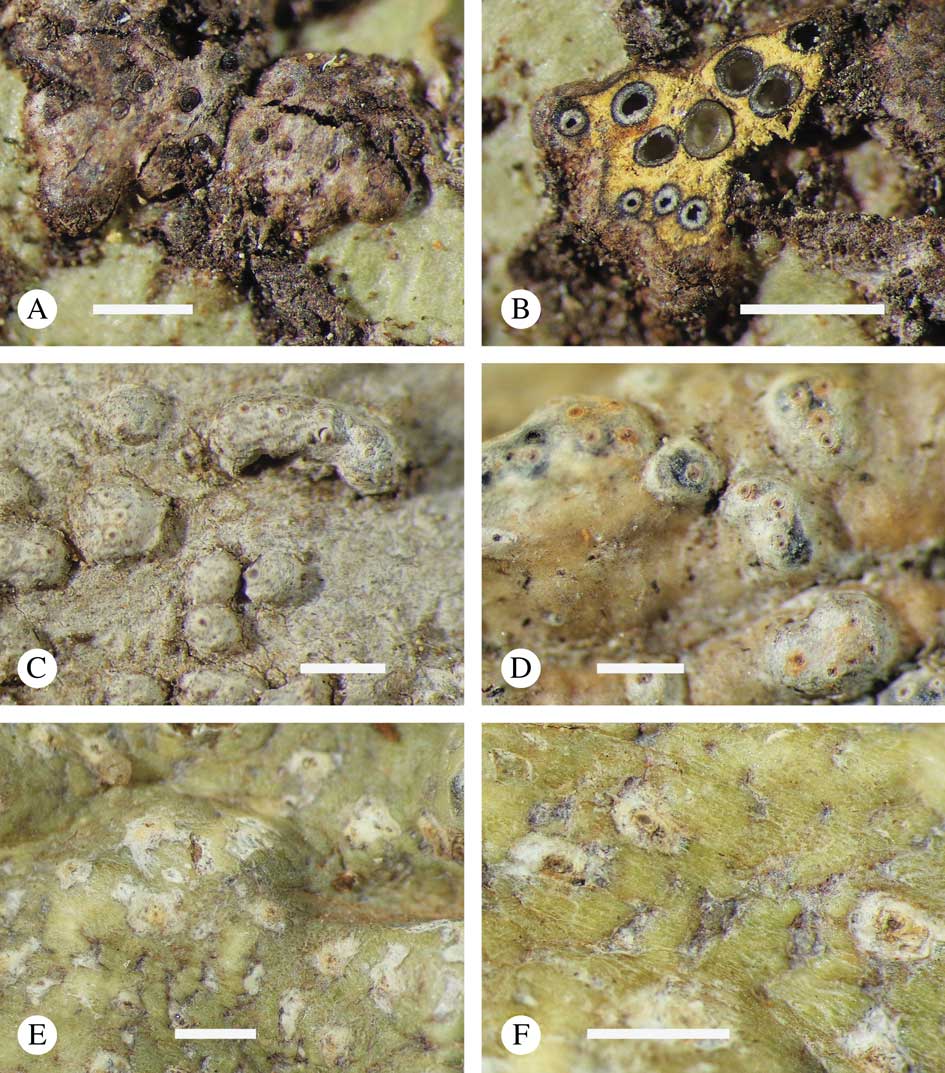
A–D, Astrothelium megacrypticum (isotype): A–C, bullate thallus with immersed-erumpent ascomata visible by their ostioles; D, with immersed-erumpent ascomata visible by their extruded ascospores. E & F, A. nicaraguense (E, isotype; F, Lücking 28546), thallus with erumpent to prominent, solitary to diffusely pseudostromatic ascomata. Scales: A–F =1 mm. In colour online.
Thallus crustose, corticolous, continuous, ≤10 cm diam., uneven to bumpy with irregular, dispersed bumps 1–2 mm diam. (gall-forming), olive-green; in section with thick, cartilaginous cortex, thick, epiperidermal photobiont layer with crenulate upper limit against the cortex, and massive, endoperidermal medulla within the modified periderm, encrusted with numerous small, grey crystals.
Perithecia solitary, deeply immersed in the thallus, not visible except for the accumulation of extruded ascospores near the ostioles, with eccentric to lateral, cryptic ostiole; individual perithecia subglobose, 0·7–1·0 mm wide and ≤1 mm high. Excipulum in section 30–50 μm thick, carbonized, covered by amorphous, orange-brown tissue. Hamathecium composed of densely anastomosing, 0·5 μm thick, net-like paraphyses embedded in a gelatinous matrix, strongly inspersed with large oil droplets, IKI−; ostiolar channel strongly inspersed with large oil droplets. Ascospores 1 per ascus, oblong-ellipsoid, densely muriform, 250–350×40–60 μm, hyaline, IKI−.
Secondary chemistry. No substances detected.
Etymology. The name refers to the cryptic perithecia and the very large ascospores.
Notes. This new species is characterized by the campylothelioid perithecia which are completely immersed and not visible from the outside except for the accumulation of extruded ascospores near the ostiole. The ascospores are among the largest in the family and probably the largest in the genus, being matched only by ascospores in the genus Aptrootia. Most similar are Astrothelium colombiense Aptroot and A. longisporum Aptroot et al. Both share solitary perithecia, hymenial inspersion, and large, muriform ascospores with the new species. However, the ascospores are smaller in both species and occur in numbers of eight in A. longisporum. In addition, A. columbiense features apical ostioles and gall-formation is also absent in both taxa.
Additional specimens examined. Panama: Panamá: Altos de Campana National Park, 50 km W of Panama City near the town of Capira, access gravel road leading to forest, 8°42'N, 79°57'W, 500–600 m, submontane rainforest, on bark of exposed roadside trees, 14 iii 2009, R. Lücking s. n. (F).
Astrothelium nicaraguense Lücking, M. P. Nelsen & T. Orozco sp. nov.
MycoBank No.: MB 817277
Differing from Astrothelium gigantosporum in the smaller ascospores.
Type: Nicaragua, Granada, Reserva Natural Volcán Mombacho, near Granada, 11°50'N, 85°58'W, 1000 m, montane rainforest, slightly disturbed forest along trail towards the crater, on fallen tree trunk, 22 April 2009, R. Lücking 28503 (HNMN—holotype; B—isotype).
Thallus crustose, corticolous, continuous, ≤3 cm diam., uneven to bullate, olive-green; in section with thick, cartilaginous cortex and distinct, epiperidermal photobiont layer, and thick medulla.
Perithecia solitary or diffusely pseudostromatic, with separate, apical to slightly irregularly oriented ostioles, 0·9–1·2 mm diam., erumpent to prominent, ≤1 mm high, covered by an olive-green thallus layer except for the dark, grey-brown ostiolar area surrounded by a whitish rim; ostioles visible as black dots, 0·05–0·10 mm diam.; individual perithecia pyriform, 0·6–0·8 mm wide and 0·8–1·0 mm high. Excipulum in section 70–100 μm thick, carbonized. Hamathecium composed of densely anastomosing, 0·5 μm thick, net-like paraphyses embedded in a gelatinous matrix, clear, IKI−; ostiolar channel clear. Ascospores 1 per ascus, oblong-ellipsoid, densely muriform, without median constriction, 160–180(–200)×40–50(–60) µm, hyaline, IKI−.
Secondary chemistry. No substances detected.
Etymology. The name refers to the geographical situation of the type locality.
Notes. Astrothelium nicaraguense is most similar to A. gigantosporum in morphology, ascospore septation, and chemistry, but differs in the smaller ascospores without median constriction occurring 1 per ascus (200–280×50–65 µm, with median constriction and occurring 2 per ascus in the latter). Both species are related but phylogenetically distinct (Lücking et al. Reference Lücking, Nelsen, Aptroot, Barillas de Klee, Bawingan, Benatti, Binh, Bungartz, Cáceres and Canêz2016).
Additional specimens examined. Nicaragua: Granada: Reserva Natural Volcán Mombacho, near Granada, 11°50'N, 85°58'W, 800 m, montane rainforest, slightly disturbed forest along trail towards the crater, on tree trunk, 22 April 2009, R. Lücking 28546 (B), 28551 (F, HNMN).
Astrothelium norisianum Lücking, M. P. Nelsen & Aptroot sp. nov.
MycoBank No.: MB 817278
Differing from Astrothelium sepultum in the distinct, well-delimited pseudostromata.
Type: Panama, Panamá, Altos de Campana National Park, 50 km W of Panama City near the town of Capira, gravel road through forest, 8°42'N, 79°57'W, 500–600 m, submontane rainforest, on bark of trees in shady understorey, 14 March 2009, R. Lücking 27178b (PMA—holotype; B, F—isotypes).
(Fig. 5A)
A, Astrothelium norisianum (Guariglia et al. 1485), thallus with immersed-erumpent, sharply pseudostromatic ascomata; B, A. obtectum (isotype), thallus with immersed ascomata; C, A. sordithecium (isotype), thallus with erumpent to prominent ascomata covered by whitish layer; D, A. subendochryseum (isotype), thallus with erumpent, confluent to pseudostromatic ascomata; E, A. subinterjectum (isotype), thallus with immersed-erumpent ascomata with whitish rim surrounding ostiolar area; F, Bathelium porinosporum (isotype), thallus with sessile, exposed ascomata. Scales: A–F =1 mm. In colour online.
Thallus crustose, corticolous, continuous, ≤15 cm diam., uneven to coarsely bumpy with bumps 1–5 mm diam. (gall-forming), very pale olive-yellow; in section with thick, cartilaginous cortex and with photobiont layer and thick medulla immersed in the modified periderm.
Perithecia 5–10 aggregated and completely immersed in irregular to linear pseudostromata, with lateral, fused ostioles; pseudostromata 2–5 mm long and 1–3 mm wide, immersed but often developed on galls, often anastomosing, uneven, covered with a whitish layer, with one to several shared ostioles; ostioles papilliform, 0·05–0·10 mm diam., brownish; individual perithecia pyriform, arranged laterally with ostiolar channels oriented and fused irregularly, 0·3–0·5 mm wide and ≤1 mm long (‘high’). Excipulum in section 20–30 μm thick, dark brown to weakly carbonized; space between individual perithecia filled with amorphous, orange-brown tissue. Hamathecium composed of densely anastomosing, 0·5 μm thick, net-like paraphyses embedded in a gelatinous matrix, clear, IKI−; upper part of hamathecium and ostiolar channel strongly inspersed. Ascospores 1–2 per ascus, oblong-ellipsoid, densely muriform with distinct median constriction and thick outer wall, 150–200×50–60 μm, hyaline, IKI−.
Secondary chemistry. Thallus and pseudostromata with lichexanthone, UV+ yellow.
Etymology. This new species is dedicated to Prof. Dr Noris Salazar-Allen, renowned Panamanian botanist, for her numerous contributions to our knowledge of Panamanian cryptogams.
Notes. Astrothelium norisianum appears to be the only species with Cryptothelium morphology developing distinct, well-delimited pseudostromata. It is most similar to Astrothelium sepultum Mont., which has similar-sized ascospores and also produces lichexanthone, but the perithecia are not arranged in distinct pseudostromata and the asci are consistently 2-spored; also, the ostiolar area is not inspersed. Astrothelium megalostomum (Vain.) Aptroot & Lücking agrees in the (partially) inspersed hymenium but lacks distinct pseudostromata and only the perithecial warts are UV+ yellow.
Additional specimens examined. Panama: Panamá: Altos de Campana National Park, 50 km W of Panama City near the town of Capira, gravel road through forest, 8°42'N, 79°57'W, 500–600 m, submontane rainforest, on bark of trees in shady understorey, 2009, R. Lücking 27178a (B, F, PMA).—Venezuela: Amazonas: Atabapo, surroundings of Culebra community, between Cerro Duida and Cerro Huachamacari, 03°40'N, 65°45'W, 200–400 m, Amazon forest interrupted by small savannas, 1982, M. Guariglia et al. 1485 (NY).—Peru: Madre de Dios: Los Amigos Research and Training Center, Centro de Investigación y Capacitación Río Los Amigos (CICRA), 90 km W of Puerto Maldonado, 12°35'S, 70°06'W, 270 m, tropical lowland rainforest, on bark of tree, 2008, M. P. Nelsen 4000d (F).
Astrothelium obtectum Lücking, M. P. Nelsen & Benatti sp. nov.
MycoBank No.: MB 817279
Differing from Astrothelium nigrocacuminum in the smaller ascospores.
Type: Brazil, Minas Gerais, Serra do Caraça, Reserva Particular do Patrimônio Natural (RPPN) Santuário do Caraça, trail through forest to chapel, 20°06'S, 43°29'W, 1300–1400 m, Atlantic rainforest, relatively well-preserved gallery forest (mata de galeria or floresta ombrófila densa montana) along small river, 27 July 2010, R. Lücking 31242 (SP—holotype; B, F—isotypes).
(Fig. 5B)
Thallus crustose, corticolous, continuous, ≤10 cm diam., coarsely folded, olive-green; in section with massive, cartilaginous cortex and distinct, epiperidermal photobiont layer, and indistinct medulla immersed in the periderm.
Perithecia 5–10 aggregated in rounded to irregular, diffuse pseudostromata, with fused, eccentric ostioles forming a common ostiole in the centre of the pseudotromata; pseudostromata 2–5 mm diam., erumpent, ≤1·5 mm thick, covered by olive-green thallus layer up to the shared ostiole; ostioles papilliform, 0·2–0·5 mm diam., brown with the surrounding area cream-coloured; individual perithecia pyriform, 0·4–0·6 mm wide and ≤1 mm high. Excipulum in section 50–80 μm thick, carbonized, space between perithecia filled with amorphous, orange-brown tissue. Hamathecium composed of densely anastomosing, 0·5 μm thick, net-like paraphyses embedded in a gelatinous matrix, clear, IKI−; ostiolar channel clear. Ascospores 8 per ascus, fusiform, 3-septate with distosepta and diamond-shaped lumina, 50–60×14–17 μm, hyaline, IKI−.
Secondary chemistry. Pseudostromata thinly covered with lichexanthone, UV+ orange-yellow.
Etymology. The epithet refers to the immersed perithecia covered by thallus tissue.
Notes. This new species has a typical Astrothelium morphology and is similar to taxa such as A. leucoconicum Nyl. and A. nigrocacuminum Flakus et al. (Flakus et al. Reference Flakus, Kukwa and Aptroot2016). It differs from A. nigrocacuminum in the smaller ascospores and from A. leucoconicum in the clear hymenium and the slightly shorter and much narrower ascospores.
Astrothelium sordithecium Lücking, M. P. Nelsen & Marcelli sp. nov.
MycoBank No.: MB 817280
Differing from Astrothelium leucothelium in the inspersed hymenium and the absence of lichexanthone from the thallus surface outside the pseudostromata.
Type: Brazil, Minas Gerais, Serra do Caraça, Reserva Particular do Patrimônio Natural (RPPN) Santuário do Caraça, Belchior trail, 20°06'S, 43°29'W, 1300–1400 m, Atlantic rainforest, disturbed gallery forest remnants (mata de galeria or floresta ombrófila densa montana) along small river leading to Cascatinha Waterfall, 27 July 2010, R. Lücking 31011 (SP—holotype; F—isotype).
(Fig. 5C)
Thallus crustose, corticolous, continuous, ≤5 cm diam., smooth to uneven, olive-green to grey-green; in section with thick, cartilaginous cortex and distinct, epiperidermal photobiont layer, and distinct medulla partially immersed in the periderm and encrusted with numerous small, grey crystals.
Perithecia 4–8 aggregated in rounded to slightly irregular, distinct pseudostromata, with fused, eccentric ostioles forming 1–3 shared ostioles in the centre of the pseudotromata; pseudostromata 1–2 mm diam., prominent, ≤1 mm high, covered by a whitish thallus layer up to the shared ostioles; ostioles visible as small black dots, 0·08–0·10 mm diam., developed along narrowly triangular slits of the whitish layer that are visible as dark brown lines from above; individual perithecia pyriform, 0·4–0·5 mm wide and ≤0·6 mm high. Excipulum in section 30–50 μm thick, carbonized, space between perithecia filled with amorphous, orange-brown tissue. Hamathecium composed of densely anastomosing, 0·5 μm thick, net-like paraphyses embedded in a gelatinous matrix, densely inspersed with sordid yellowish brown oil droplets, IKI−; ostiolar channel inspersed. Ascospores 8 per ascus, fusiform, 3-septate with distosepta and diamond-shaped lumina, 30–40×10–12 μm, hyaline, IKI−.
Secondary chemistry. Pseudostromata cortex with lichexanthone, UV+ yellow.
Etymology. The epithet refers to the yellow-brown inspersion of the hamathecium.
Notes. Astrothelium sordithecium is characterized by a dense, yellow-brown inspersion of the hamathecium somewhat resembling that of certain Pseudopyrenula species. It is probably related to A. variolosum (Ach.) Müll. Arg. and similar taxa. Astrothelium variolosum itself has smaller ascospores and the entire thallus is covered with lichexanthone. Astrothelium leucothelium Nyl. has similar-sized ascospores but a clear hamathecium and also the thallus contains lichexanthone.
Astrothelium subendochryseum Lücking, M. P. Nelsen & Marcelli sp. nov.
MycoBank No.: MB 817281
Differing from Astrothelium endochryseum in the absence of pigment in the pseudostromata and the lateral thallus cover of the pseudostromata.
Type: Brazil, Minas Gerais, Serra do Caraça, Reserva Particular do Patrimônio Natural (RPPN) Santuário do Caraça, Cascatinha Waterfall, 20°06'S, 43°29'W, 1300–1400 m, Atlantic rainforest, disturbed gallery forest remnants (mata de galeria or floresta ombrófila densa montana) near waterfall, 27 July 2010, R. Lücking 31088 (SP—holotype; B, F—isotypes).
(Fig. 5D)
Thallus crustose, corticolous, continuous, ≤7 cm diam., bullate, olive-green; in section with thick, cartilaginous cortex and distinct, epiperidermal photobiont layer, and thick medulla.
Perithecia 10–30 aggregated in irregular pseudostromata, with separate, apical ostioles; pseudostromata 1–3 mm diam., erumpent to prominent, ≤1 mm high, laterally covered by an olive-green thallus layer but individual perithecia exposed in upper part, dark grey-brown; ostioles visible as black dots, 0·05–0·10 mm diam.; individual perithecia pyriform, 0·25–0·35 mm wide and 0·3–0·5 mm high. Excipulum in section 30–60 μm thick, carbonized. Hamathecium composed of densely anastomosing, 0·5 μm thick, net-like paraphyses embedded in a gelatinous matrix, clear, IKI−; ostiolar channel clear. Ascospores 8 per ascus, fusiform, 3-septate with distosepta and diamond-shaped lumina, 22–25×8–10 μm, hyaline, IKI−.
Secondary chemistry. No substances detected.
Etymology. The name refers to the close relationship with Astrothelium endochryseum.
Notes. This new species features the morphology of taxa previously placed in the genus Bathelium, but differs in the distinct lateral thallus cover of the pseudostromata and the absence of a medullary pigment in the pseudostromata. Anatomically it comes close to species of the Astrothelium nitidiusculum complex, but these species differ in the absence of Bathelium-like pseudostromata and are not closely related. The related A. endochryseum (Vain.) Aptroot & Lücking differs chiefly in the orange medullary pigment and the larger ascospores.
Additional specimens examined. El Salvador: Suchitoto: Hacienda Colima, 13°56'N, 89°01'W, 400–450 m, 2009, R. Lücking 28121 (F, ITIC).
Astrothelium subinterjectum Lücking, M. P. Nelsen & Jungbluth sp. nov.
MycoBank No.: MB 817282
Differing from Astrothelium obtectum in the smaller pseudostromata and smaller ascospores, and from A. interjectum in the diffuse pseudostromata and smaller ascospores.
Type: Brazil, São Paulo, Pratânia, Fazenda Palmeira da Serra, 22°49'S, 48°45'W, 715 m, gallery forest in Cerrado area, 15 July 2009, Nelsen B15 (SP—holotype; B, F—isotypes).
(Fig. 5E)
Thallus crustose, corticolous, continuous, ≤10 cm diam., uneven, olive-green; in section with cartilaginous cortex and epiperidermal photobiont layer, and indistinct medulla immersed in the periderm.
Perithecia 5–8 aggregated in rounded to irregular, diffuse pseudostromata, with fused, eccentric ostioles forming one to several, shared ostioles; pseudostromata 2–3 mm diam., erumpent, ≤1·2 mm thick, covered by olive-green thallus layer up to the shared ostiole; ostioles papilliform, 0·2–0·4 mm diam., black with the surrounding area whitish; individual perithecia pyriform, 0·4–0·5 mm wide and ≤1 mm high. Excipulum in section 30–60 μm thick, carbonized, space between perithecia filled with amorphous, orange-brown tissue. Hamathecium composed of densely anastomosing, 0·5 μm thick, net-like paraphyses embedded in a gelatinous matrix, clear, IKI−; ostiolar channel clear. Ascospores 8 per ascus, fusiform, 3-septate with distosepta and diamond-shaped lumina, 20–25×7–9 μm, hyaline, IKI−.
Secondary chemistry. Pseudostromata thinly covered with lichexanthone, UV+ (orange-) yellow.
Etymology. The epithet refers to the similarity with Astrothelium interjectum.
Notes. This new species is similar and closely related to Astrothelium obtectum described above, but is generally smaller in all dimensions and produces considerably smaller ascospores. Like Astrothelium obtectum, it is similar to A. crassum (Fée) Aptroot, A. interjectum R. C. Harris, and A. variolosum, but differs from those taxa in the broad, erumpent, diffuse pseudostromata, and also from A. crassum in the UV+ yellow pseudostromata, from A. interjectum in the smaller ascospores, and from A. variolosum in the UV− thallus.
Bathelium porinosporum Lücking, M. P. Nelsen & Gueidan sp. nov.
MycoBank No.: MB 817283
Differing from other Bathelium species in the 3-septate, euseptate ascospores.
Type: Vietnam, Dong Nai, Western Highlands, Cát Tiên National Park, 6 km SW of the accommodation area, near a ranger house, 15 February 2012, C. Gueidan 3040 (BM—holotype, B, F, VNMN—isotypes).
(Fig. 5F)
Thallus crustose, corticolous, continuous, ≤10 cm diam., smooth to uneven, light olive; in section with thick, cartilaginous cortex and irregular photobiont layer immersed in the periderm.
Perithecia solitary, sessile with constricted base, with apical ostiole, lacking thalline cover, applanately subglobose, dark reddish brown, 0·4–0·5 mm wide and 0·25–0·30 mm high; ostiolar area flattened, appearing as a 0·10–0·15 mm wide, grey-brown spot often separated by a thin slit. Excipulum in section 30–50 μm thick, carbonized, laterally covered by amorphous, orange-brown tissue and what appears to be a carbonized cortex. Hamathecium composed of densely anastomosing, 0·5 μm thick, net-like paraphyses embedded in a gelatinous matrix, clear, IKI−; ostiolar channel clear. Ascospores 8 per ascus, fusiform, 3–5-septate (eusepta only), 20–30×6–7 μm, hyaline, IKI−.
Secondary chemistry. Perithecial wall with a thinly dispersed, reddish brown pigment that bleeds first deep yellow, then deep orange to cinnabar red.
Etymology. The epithet refers to the porinoid ascospores.
Notes. Bathelium porinosporum is characterized by the typical Bathelium-like, sessile, dark brown perithecia, in combination with transversely septate ascospores. It is the only species thus far recognized in the genus with transversely septate ascospores. The ascospores are notably euseptate (thin walls and septa) and if observed without context closely resemble those of the unrelated genus Porina.
In addition to the mtSSU and nuLSU sequence data published elsewhere for this taxon (Lücking et al. Reference Lücking, Nelsen, Aptroot, Barillas de Klee, Bawingan, Benatti, Binh, Bungartz, Cáceres and Canêz2016), the following ITS barcode locus data were also generated: Gueidan 3040 (the holotype; KU504486), Gueidan 3018 (KU504485), Gueidan 3041 (KU504487), Gueidan 3053 (KU504488), Gueidan 3055 (KU504489).
Additional specimens examined. Vietnam: Western Highlands: Dong Nai Province, Cát Tiên National Park, 6 km SW of the accommodation area, near a ranger house, 2012, Gueidan 3041 (BM, F, VNMN); ibid., 10 km SW of the accommodation area, in a tree plantation near a gate leading to the minority village, 2012, Gueidan 3053 (BM, F, VNMN), Gueidan 3055, (BM, VNMN); ibid., on Dipterocarpus planted along the road heading south of the accommodation area, 2012, Gueidan 3018 (BM, F, VNMN).
Nigrovothelium bullatum Lücking, Upreti & Lumbsch sp. nov.
MycoBank No.: MB 817285
Differing from Nigrovothelium tropicum in the bullate thallus.
Type: India, Tamil Nadu, Eastern Ghat, Chennai, Mamallapuram, 40 m, disturbed dry evergreen forest with cashew nut trees, on cashew nut tree, 9 January 2008, H. T. Lumbsch, D. K. Upreti, P. K. Divakar & J. Tandon 19701-b (LWG—holotype; B, F—isotypes).
(Fig. 6A)
A, Nigrovothelium bullatum (isotype), bullate thallus with exposed ascomata; B & C, Trypethelium tolimense (isotype), thallus with pseudostromatic ascomata; D, Viridothelium vonkonratii (isotype), thallus with immersed-erumpent ascomata; E & F, V. tricolor (isotype), thallus with immersed-erumpent, confluent to pseudostromatic ascomata with whitish cover and black ostiole. Scales: A–F =1 mm. In colour online.
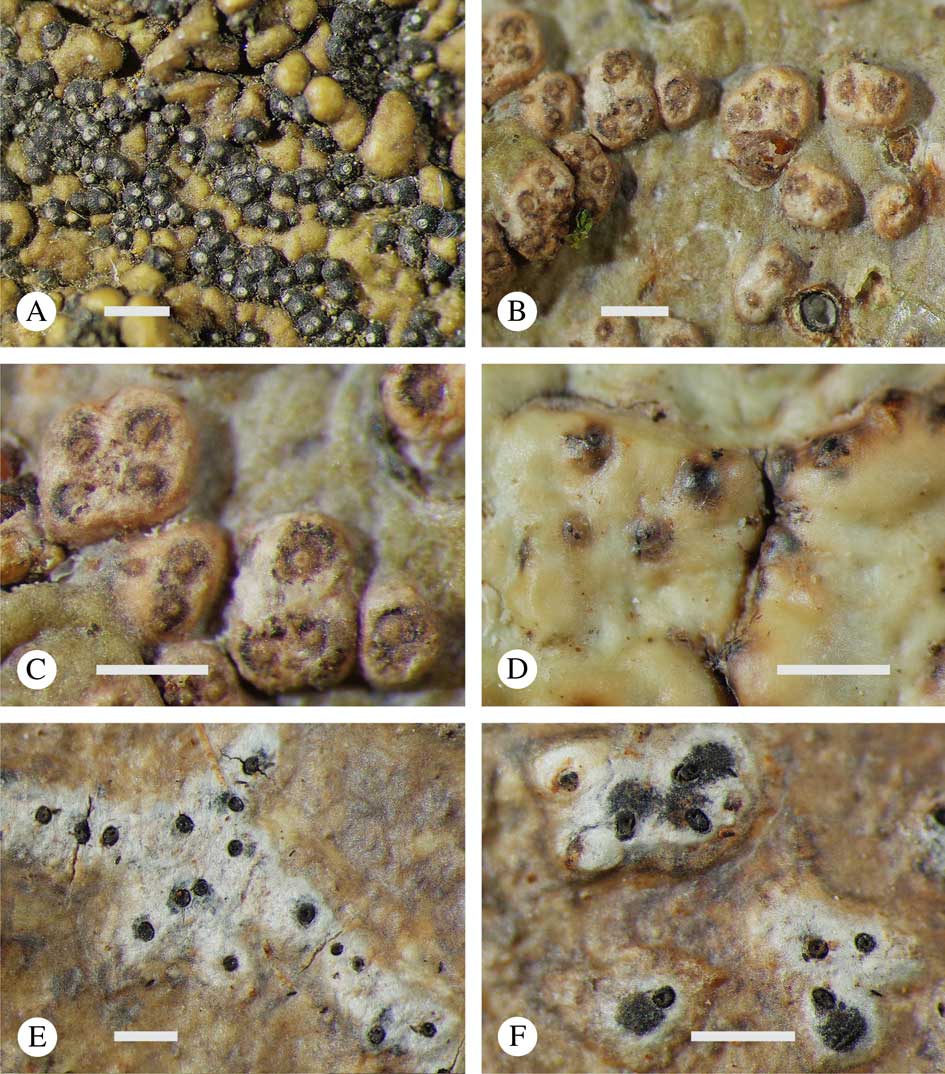
Thallus crustose, corticolous, continuous, ≤10 cm diam., strongly verrucose-bullate, olive-green to olive-brown; in section with thick, cartilaginous cortex and distinct, epiperidermal photobiont layer, and thick medulla.
Perithecia solitary but dense and often confluent, with separate, apical ostioles, 0·2–0·3 mm diam., sessile, ≤0·25 mm high, exposed, black, ostiolar area grey; ostioles visible as tiny black dots. Excipulum in section 50–100 μm thick, carbonized. Hamathecium composed of densely anastomosing, 0·5 μm thick, net-like paraphyses embedded in a gelatinous matrix, clear, IKI−; ostiolar channel clear. Ascospores 8 per ascus, fusiform, 3-septate with distosepta and diamond-shaped lumina, 20–25×8–10 μm, hyaline, IKI−.
Secondary chemistry. No substances detected.
Etymology. The name refers to the strongly bullate thallus.
Notes. This new species is closely related to the taxon previously known as Trypethelium tropicum (Ach.) Müll. Arg. and now placed in the genus Nigrovothelium (Lücking et al. Reference Lücking, Nelsen, Aptroot, Barillas de Klee, Bawingan, Benatti, Binh, Bungartz, Cáceres and Canêz2016). Both species agree in morphological and anatomical details of the perithecia, but while N. tropicum (Ach.) Lücking et al. has a smooth to uneven thallus, that of N. bullatum is strongly verrucose bullate. The recognition of the latter as a distinct species is supported by molecular data (Lücking et al. Reference Lücking, Nelsen, Aptroot, Barillas de Klee, Bawingan, Benatti, Binh, Bungartz, Cáceres and Canêz2016).
Trypethelium tolimense Lücking, Moncada & M. Gut. sp. nov.
MycoBank No.: MB 817286
Differing from Trypethelium xanthoplatystomum in the absence of a yellow-orange pigment on the pseudostromata and the K+ yellow (not K+ red) medullary pigment.
Type: Colombia, Tolima, Purificacion, Vereda El Tambo, Finca El Santuario; 3°41'S, 74°54'W, 300–350 m, disturbed forest remnants on finca, 10 August 2010, R. Lücking & B. Moncada 32593 (UDBC—holotype; B—isotype).
Thallus crustose, corticolous, continuous, ≤5 cm diam., smooth to uneven, light olive; in section with thick, cartilaginous cortex, thick, epiperidermal photobiont layer, and thin medulla immersed in the periderm.
Perithecia (1–)3–10 aggregated in rounded to irregular pseudostromata, with separate, apical ostioles; pseudostromata (0·6–)1·0–3·0 mm diam., prominent, ≤0·5 mm high, covered by a brownish white thallus layer contrasting with the surrounding thallus; internally between the perithecia filled with light yellow, K+ yellow pigment granules, in section bleeding yellow; ostioles papilliform, 0·05–0·10 mm wide, whitish translucent, surrounded by a dark brown rim; individual perithecia subglobose, 0·4–0·5 mm wide and 0·3–0·4 mm high. Excipulum in section 20–50 μm thick, carbonized except near the ostiole, laterally covered by yellow pigment granules. Hamathecium composed of densely anastomosing, 0·5 μm thick, net-like paraphyses embedded in a gelatinous matrix, clear, IKI−; ostiolar channel clear. Ascospores 8 per ascus, narrowly fusiform, 11–15-septate with eusepta and angular lumina, 70–80×10–12 μm, hyaline, IKI−.
Secondary chemistry. Thallus and pseudostromata with lichexanthone, UV+ yellow; medulla of pseudostromata with pale yellow pigment, bleeding yellow.
Etymology. Referring to the geographical location of the type locality.
Notes. This new species features a typical Trypethelium morphology and ascospores, but is set apart from other species of the genus by the presence of lichexanthone on the thallus and pseudostromata, in combination with the pale yellow, K+ yellow medullary pigment of the pseudostromata. Three other species in the genus contain lichexanthone: Trypethelium regnellii Malme and T. luteolucidum Aptroot et al. have an inspersed hamathecium and larger ascospores, and lack a medullary pigment, whereas T. xanthoplatystomum Flakus & Aptroot has pseudostromata covered with a yellow-orange pigment and the medullary pigment is orange and reacts K+ red. Also, in all other species of the genus with a medullary pigment, the pigment reacts K+ red or purple.
Viridothelium tricolor Lücking, M. P. Nelsen & N. Salazar sp. nov.
MycoBank No.: MB 817287
Characterized by black perithecia with a lateral ostiole immersed in white pseudostromata strongly contrasting with the surrounding brown thallus, in combination with 2-spored asci and large, muriform ascospores.
Type: Panama, Panamá, Altos de Campana National Park, 50 km W of Panama City near the town of Capira, access gravel road leading to forest, 8°42'N, 79°57'W, 500–600 m, submontane rainforest, on bark of exposed roadside trees, 15 March 2011, M. P. Nelsen s.n. (PMA—holotype; B, F—isotypes).
Thallus crustose, corticolous, continuous, ≤7 cm diam., smooth to uneven, reddish to yellowish brown; in section thinly corticate, with photobiont layer immersed in the uppermost periderm layers.
Perithecia solitary or more commonly (2–)3–10(–20) aggregated in irregular to elongate pseudostromata with separate, eccentric to lateral, rarely apical ostioles; pseudostromata 1–10 mm long and 1–3 mm wide, immersed to erumpent, ≤0·8 mm high, white and strongly contrasting with the surrounding thallus, individual perithecia usually completely immersed but sometimes visible as grey-black bumps; ostioles distinct, not fused, forming blackish spots, 0·15–0·25 mm diam., strongly contrasting with the white pseudostromata and the brown thallus; individual perithecia pyriform with short ostiolar channel, 0·5–0·7 mm wide and ≤ 0·7 mm high. Excipulum in section 50–200 μm thick, strongly carbonized; narrow space between individual perithecia filled with amorphous, orange-brown tissue. Hamathecium composed of densely anastomosing, 0·5 μm thick, net-like paraphyses embedded in a gelatinous matrix, clear, IKI−; ostiolar channel clear. Ascospores 2 per ascus, oblong-ellipsoid, richly muriform with more or less thin eusepta, 120–150×30–40 μm, hyaline, IKI−.
Secondary chemistry. No substances detected.
Etymology. The name refers to the conspicuous colour contrast between the thallus and the pseudostromata.
Notes. This new species was at first mistaken for Campylothelium puiggarii, based on depauperate material from Venezuela. However, the material from Panama underlines the considerable differences, in particular the morphology with the black perithecia immersed in white pseudostromata that strongly contrast with the surrounding thallus. This species shares most key characters with the unrelated Astrothelium campylocartilagineum Aptroot and A. andamanicum (Makhija & Patw.) Aptroot, neither of which have distinct pseudostromata. In spite of these similarities, it clusters within the newly established genus Viridothelium (Lücking et al. Reference Lücking, Nelsen, Aptroot, Barillas de Klee, Bawingan, Benatti, Binh, Bungartz, Cáceres and Canêz2016).
Additional specimens examined. Panama: Panamá: Altos de Campana National Park, 50 km W of Panama City near the town of Capira, access gravel road leading to forest, 8°42'N, 79°57'W, 500–600 m, submontane rainforest, on bark of exposed roadside trees, 2009, R. Lücking 27014p (F, PMA), 27057 (B), 27085 (F, PMA).—Venezuela: Aragua: Henri Pittier National Park, Dr Alberto Fernández Yépez Biological Station, km 12 on road from Maracay to Ocumare, Andrew Field Trail, 10°21'N, 67°40'W, 1100–1200 m, tropical cloud forest, 2010, R. Lücking 32241 (B, VEN).
Viridothelium vonkonratii Lücking, Naksuwankul & Lumbsch sp. nov.
MycoBank No.: MB 817288
Differing from Viridothelium virens in the larger ascospores.
Type: Fiji, Kadavu Island, 19°02'S, 178°11'E, on bark, 2011, H. T. Lumbsch & K. B. Naksuwankul 20551a (SUVA—holotype; B, F, MSUT—isotypes).
(Fig. 6D)
Thallus crustose, corticolous, continuous, ≤10 cm diam., uneven to bumpy (gall-forming), very pale olive-yellow; in section corticate, with photobiont layer deeply immersed in the modified periderm.
Perithecia solitary or becoming crowded, with separate, lateral ostiole, almost completely immersed in the thallus or upper portion erumpent and appearing dark greyish, 0·5–0·7 mm diam. and ≤1 mm high. Excipulum in section 20–30 μm thick, weakly carbonized, laterally covered with a thin layer of amorphous, orange-brown tissue. Hamathecium composed of densely anastomosing, 0·5 μm thick, net-like paraphyses embedded in a gelatinous matrix, clear, IKI−; ostiolar channel clear. Ascospores 8 per ascus, oblong-fusiform, 15–21-septate, with distinct distosepta and diamond-shaped lumina, 90–100×22–26 μm, hyaline, IKI−.
Secondary chemistry. No substances detected.
Etymology. Named after our esteemed colleague and renowned bryologist, Matt von Konrat, who organized the field trip.
Notes. The genus Viridothelium is in most aspects similar to Astrothelium. The two genera cannot be readily separated based on morphology, except for the thin-walled ascospores in Viridothelium (similar to those of Trypethelium); phylogenetically, they are only distantly related. Apparently, both genera can include species with transversely septate and others with muriform ascospores. This is another species in Viridothelium known with transversely septate ascospores, similar to those of V. virens (Tuck. ex Michener) Lücking et al.. Viridothelium vonkonratii differs from the latter in ascospore size and septation, as well as the solitary to crowded, but not pseudostromatic ascomata.
We are grateful to the National Science Foundation for funding aspects of this work through the grant NSF-DEB 0715660 “Neotropical Epiphytic Microlichens – An Innovative Inventory of a Highly Diverse yet Little Known Group of Symbiotic Organisms” to The Field Museum (PI Robert Lücking). The Caterpillar® Company provided additional funds to study lichens from Panama. MN was further supported through a grant from the Committee on Evolutionary Biology (University of Chicago), a Graduate Student Research Grant from The American Society of Plant Taxonomists, and a Brown Family Fellowship through the Field Museum, as well as a William Harper Rainey Fellowship through the University of Chicago. Field support in Panama was provided by the University of Panama (Department of Botany) in the development of two lichen seminars (2009, 2011) during which the lichens were collected. Thanks also to Park authorities and rangers of Parque Nacional Altos de Campana during the field trips and to the Ministry of the Environment (formerly A.N.A.M.) for collection and export permits. In Colombia, logistical support was provided by the Universidad Distrital Francisco José de Caldas and the Cardenas Herrera family for access to their Finca El Santuario. For field support in Brazil, we thank the Universidade Estadual Paulista, campus Botucatu, and the administration of the Santuário do Caraça, as well as the owners of Fazenda Palmeira da Serra in São Paulo State. Work on Fiji was supported by the National Geographic Committee for Research and Exploration, Grant No. 8247-07. For field work in New Caledonia, we thank the Thai Research Fund and Mahasarakham University for providing financial assistance (K. Papong RSA 5580045), the National Science Foundation (Awards No. DEB-1025861 and DEB-1145898), the Mohamed bin Zayed Species Conservation Fund (Award No. 11253111), and the Negaunee Foundation. We also thank ‘Direction du développement économique et de l’environnement de la Province Nord’, and ‘Direction de l’environnement de la Province Sud’ for plant permits to both provinces. KN also thanks Mahasarakham University, Thailand. The Universidad Distrital Francisco José de Caldas in Bogotá, Colombia, is thanked for providing support to BM as part of the program ‘Movilidad Académica’ for professors.



