


 if its group of units is of type
  . We also obtain results which relate the Hochschild cohomological dimension of the monoid to the cohomological dimension of its group of units. In particular we show that the Hochschild cohomological dimension of the monoid is bounded above by the maximum of

 . Moreover, we show that if







1 Introduction
Algorithmic problems in algebra have their origins in logic and topology in the fundamental work of Dehn, Thue and Tietze in the early 1900s; see [Reference Book and Otto7, Reference Lyndon and Schupp44, Reference Margolis, Meakin and Sapir47]. The most important algorithmic question concerning an algebraic structure is the word problem, which asks whether one can decide whether two expressions over generators represent the same element. Markov [Reference Markov48] and Post [Reference Post52] proved independently that in general the word problem for finitely presented monoids is undecidable. This was later extended to cancellative monoids by Turing [Reference Turing57] and then to groups by Novikov [Reference Novikov50] and Boone [Reference Boone8].
Given that the word problem is undecidable in general, a central theme running through the development of geometric and combinatorial group and monoid theory has been to identify and study families all of whose members have solvable word problem; see [Reference Bridson and Salamon9, Chapter 2]. One of the most important and interesting such families is the class of one-relator groups, which were shown to have decidable word problem in classical work of Magnus [Reference Magnus45] in the 1930s. The theory of one-relator groups has developed extensively over the last century and continues to be a highly active area of research; see [Reference Linton and Nyberg-Brodda42] for a recent survey.
One of the challenges in studying one-relator groups is that their geometry can be quite complicated. On the other hand, one-relator groups have turned out to be susceptible for study using topological and homological methods. A classical result of this kind is Lyndon’s Identity Theorem [Reference Lyndon43] which, interpreted topologically, constructs certain natural classifying spaces for one-relator groups that can be used to deduce all one-relator groups are $\mathrm {FP}_\infty $
, and to determine their cohomological dimension. Some recent important results on one-relator groups that have been impacted by topological and homological methods include: residual finiteness of one-relator groups with torsion [Reference Wise61], the proof that one-relator groups with torsion are virtually free-by-cyclic [Reference Kielak and Linton31], and the coherence of one-relator groups [Reference Jaikin-Zapirain and Linton30]. In particular, a key step in the recent breakthrough coherence theorem of Jaikin-Zapirain and Linton [Reference Jaikin-Zapirain and Linton30] was to establish homological coherence of one-relator groups, meaning that every finitely generated subgroup is of type
$\mathrm {FP}_\infty $
, and to determine their cohomological dimension. Some recent important results on one-relator groups that have been impacted by topological and homological methods include: residual finiteness of one-relator groups with torsion [Reference Wise61], the proof that one-relator groups with torsion are virtually free-by-cyclic [Reference Kielak and Linton31], and the coherence of one-relator groups [Reference Jaikin-Zapirain and Linton30]. In particular, a key step in the recent breakthrough coherence theorem of Jaikin-Zapirain and Linton [Reference Jaikin-Zapirain and Linton30] was to establish homological coherence of one-relator groups, meaning that every finitely generated subgroup is of type $\mathrm {FP}_2$
.
$\mathrm {FP}_2$
.
This paper is part of a programme of research initiated by the authors in [Reference Gray and Steinberg22, Reference Gray and Steinberg23, Reference Gray and Steinberg24] aimed at developing topological and homological methods for monoids and then applying these new results and techniques to the class of one-relator monoidsFootnote 1. In contrast to one-relator groups, far less is currently known about one-relator monoids, and many fundamental questions about them remain open. Indeed, it is an important longstanding open problem whether the word problem is decidable for one-relator monoids. While in general this problem is open, it has been solved in a number of key cases in the work of Adjan, Adjan and Oganesyan, and Lallement; see [Reference Adjan1, Reference Adjan and Oganesyan2, Reference Lallement41].
A natural way to attack the word problem for one-relator monoids is via the theory of string rewriting systems. Indeed, an open problem which is intimately related to the word problem for one-relator monoids is the question of whether every one-relator monoid admits a finite complete rewriting system (meaning a monoid presentation which is confluent and terminating; see [Reference Holt, Eick and O’Brien27, Chapter 12]). Since complete rewriting systems give computable normal forms, a positive answer to this question would solve the word problem for one-relator monoids.
Homological and topological methods provide important tools for investigating the question of whether a given monoid admits a presentation by a finite complete rewriting system. The Anick-Groves-Squier theorem, cf. [Reference Brown11], shows that if a monoid admits a finite complete rewriting system, then the monoid must satisfy the homological finiteness properties left- and right- $\mathrm {FP}_\infty $
. Kobayashi [Reference Kobayashi34] improved this result by showing a monoid admitting a finite complete rewriting is of type bi-
$\mathrm {FP}_\infty $
. Kobayashi [Reference Kobayashi34] improved this result by showing a monoid admitting a finite complete rewriting is of type bi- . There are in fact a range of finiteness properties satisfied by monoids that admit finite complete rewriting systems, and they have received extensive attention in the literature. The homotopical finiteness property FDT (finite derivation type) was introduced by Squier in [Reference Squier, Otto and Kobayashi55] where it was shown that any monoid admitting a finite complete rewriting system had FDT. The two-sided homological finiteness property bi- $\mathrm {FP}_n$
was introduced in [Reference Kobayashi and Otto37], and in [Reference Kobayashi and Otto38] it was proved that bi-
$\mathrm {FP}_n$
was introduced in [Reference Kobayashi and Otto37], and in [Reference Kobayashi and Otto38] it was proved that bi- $\mathrm {FP}_3$
is equivalent to the property FHT (finite homological type). Note that Alonso and Hermiller in [Reference Alonso and Hermiller3] introduced another homological finiteness property satisfied by monoids admitting finite complete rewriting systems (that they also called bi-
$\mathrm {FP}_3$
is equivalent to the property FHT (finite homological type). Note that Alonso and Hermiller in [Reference Alonso and Hermiller3] introduced another homological finiteness property satisfied by monoids admitting finite complete rewriting systems (that they also called bi- $\mathrm {FP}_n$
) that was later shown by Pride [Reference Pride54] to be equivalent to a monoid satisfying both left-
$\mathrm {FP}_n$
) that was later shown by Pride [Reference Pride54] to be equivalent to a monoid satisfying both left- $\mathrm {FP}_n$
and right-
$\mathrm {FP}_n$
and right- $\mathrm {FP}_n$
.
$\mathrm {FP}_n$
.
In Figure 1 we have arranged all these properties and the various implications between them. Note that by results in [Reference Cremanns and Otto14, Reference Kobayashi34, Reference Kobayashi36, Reference Kobayashi and Otto38, Reference Lafont39, Reference Pride53, Reference Pride54, Reference Wang and Pride58] none of the implications in Figure 1 are reversible in general. In particular, in relation to the results we prove in this paper, it is important to stress that it is not true that a monoid satisfying left- $\mathrm {FP}_n$
and right-
$\mathrm {FP}_n$
and right- $\mathrm {FP}_n$
is of type bi-
$\mathrm {FP}_n$
is of type bi- $\mathrm {FP}_n$
.
$\mathrm {FP}_n$
.

Figure 1 Homological finiteness properties satisfied by monoids that admit finite complete rewriting systems, and all implications between them. The proofs that all these implications hold, and that none of the implications in the diagram are reversible, can be found in the papers [Reference Cremanns and Otto14, Reference Kobayashi34, Reference Kobayashi36, Reference Kobayashi and Otto38, Reference Lafont39, Reference Pride53, Reference Pride54, Reference Wang and Pride58].
These homological finiteness properties have also arisen naturally in connection to other areas including: monoids with finitely generated universal left congruence, which is equivalent to left- $\mathrm {FP}_1$
(see [Reference Dandan, Gould, Quinn-Gregson and Zenab15, Reference East, Gould, Miller, Quinn-Gregson and Ruškuc17, Reference Kobayashi35]), the notion of ancestry in a monoid, due to White from the study of Banach algebras on groups and monoids see [Reference Dandan, Gould, Quinn-Gregson and Zenab15, Section 3] and [Reference White60], and finitely dominated monoids (meaning there is a finite subset that dominates the monoid in the sense of Howie and Isbell [Reference Howie and Isbell28]), which is equivalent to bi-
$\mathrm {FP}_1$
(see [Reference Dandan, Gould, Quinn-Gregson and Zenab15, Reference East, Gould, Miller, Quinn-Gregson and Ruškuc17, Reference Kobayashi35]), the notion of ancestry in a monoid, due to White from the study of Banach algebras on groups and monoids see [Reference Dandan, Gould, Quinn-Gregson and Zenab15, Section 3] and [Reference White60], and finitely dominated monoids (meaning there is a finite subset that dominates the monoid in the sense of Howie and Isbell [Reference Howie and Isbell28]), which is equivalent to bi- $\mathrm {FP}_1$
; see [Reference Kobayashi35]. Monoids of type left-
$\mathrm {FP}_1$
; see [Reference Kobayashi35]. Monoids of type left- $\mathrm {FP}_n$
are also used to define the higher dimensional BNSR invariants of groups; see [Reference Bieri, Neumann and Strebel5, Reference Bieri and Renz6].
$\mathrm {FP}_n$
are also used to define the higher dimensional BNSR invariants of groups; see [Reference Bieri, Neumann and Strebel5, Reference Bieri and Renz6].
Motivated by the open question of whether one-relator monoids admit finite complete rewriting systems, together with the Anick-Groves-Squier theorem, Kobayashi initiated the study of homological finiteness properties of one-relator monoids in the papers [Reference Kobayashi32, Reference Kobayashi33]. In these papers Kobayashi resolved this problem in low dimensions by showing that all one-relator monoids are FDT and thus are of type left- $\mathrm {FP}_3$
and right-
$\mathrm {FP}_3$
and right- $\mathrm {FP}_3$
. He then asked the natural question [Reference Kobayashi33, Problem 1] of whether this result could be extended to higher dimension left- and right-
$\mathrm {FP}_3$
. He then asked the natural question [Reference Kobayashi33, Problem 1] of whether this result could be extended to higher dimension left- and right- $\mathrm {FP}_n$
for all n. In [Reference Gray and Steinberg22] we gave a positive answer to Kobayashi’s problem by proving that every one-relator monoid is of type left-
$\mathrm {FP}_n$
for all n. In [Reference Gray and Steinberg22] we gave a positive answer to Kobayashi’s problem by proving that every one-relator monoid is of type left- $\mathrm {FP}_\infty $
and right-
$\mathrm {FP}_\infty $
and right- $\mathrm {FP}_\infty $
. Looking at the diagram in Figure 1 it is clear that the remaining main open question in this area is to determine whether all one-relator monoids are of type bi-
$\mathrm {FP}_\infty $
. Looking at the diagram in Figure 1 it is clear that the remaining main open question in this area is to determine whether all one-relator monoids are of type bi- $\mathrm {FP}_\infty $
. Establishing the property bi-
$\mathrm {FP}_\infty $
. Establishing the property bi- $\mathrm {FP}_\infty $
is the best possible result on homological finiteness properties that one could hope to prove for one-relator monoids since it would imply all other previous results on such properties for this class.
$\mathrm {FP}_\infty $
is the best possible result on homological finiteness properties that one could hope to prove for one-relator monoids since it would imply all other previous results on such properties for this class.
One of the main applications of the general results we prove in this paper is to resolve this problem in the key case of one-relator monoids where the defining relation is of the form $r=1$
. We obtain results in this paper on one-relator monoids of the form
$r=1$
. We obtain results in this paper on one-relator monoids of the form $\langle A \mid r=1 \rangle $
by proving more general results for monoids defined by finite presentations of the form
$\langle A \mid r=1 \rangle $
by proving more general results for monoids defined by finite presentations of the form $\langle A\mid w_1=1,\ldots ,w_k=1\rangle $
. These are called special monoids in the literature. Special monoids were studied in the sixties by Adjan [Reference Adjan1] and Makanin [Reference Makanin46]. Adjan proved that the group of units of a one-relator special monoid is a one-relator group and solved the word problem for this class of one-relator monoids by reducing the word problem of the monoid to that of the group of units. Makanin proved more generally that the group of units of a k-relator special monoid is a k-relator group and showed that the monoid has decidable word problem if and only if its group of units does. Later Zhang [Reference Zhang63] gave a more modern approach to these results via the theory of string rewriting systems.
$\langle A\mid w_1=1,\ldots ,w_k=1\rangle $
. These are called special monoids in the literature. Special monoids were studied in the sixties by Adjan [Reference Adjan1] and Makanin [Reference Makanin46]. Adjan proved that the group of units of a one-relator special monoid is a one-relator group and solved the word problem for this class of one-relator monoids by reducing the word problem of the monoid to that of the group of units. Makanin proved more generally that the group of units of a k-relator special monoid is a k-relator group and showed that the monoid has decidable word problem if and only if its group of units does. Later Zhang [Reference Zhang63] gave a more modern approach to these results via the theory of string rewriting systems.
The main general result in this paper reduces the problem of whether the homological finiteness property bi- $\mathrm {FP}_n$
holds in a special monoid, to the corresponding question for its group of units. In addition, our methods can be applied to relate the Hochschild cohomological dimension of the monoid to the cohomological dimension of its group of units. Throughout we shall use
$\mathrm {FP}_n$
holds in a special monoid, to the corresponding question for its group of units. In addition, our methods can be applied to relate the Hochschild cohomological dimension of the monoid to the cohomological dimension of its group of units. Throughout we shall use $\mathrm {cd}(G)$
to denote the cohomological dimension of a group G. Our first main result is:
$\mathrm {cd}(G)$
to denote the cohomological dimension of a group G. Our first main result is:
Theorem A. Let M be a finitely presented monoid of the form
 $$\begin{align*}M = \langle A \mid w_1=1, \ldots, w_k=1 \rangle\end{align*}$$
and let G be the group of units of M.
-
(i) If G is of type
 (for
$1 \leq n \leq \infty $
) then M is of type bi-.
(for
$1 \leq n \leq \infty $
) then M is of type bi-. -
(ii) Furthermore, the Hochschild cohomological dimension of M is bounded below by
$\mathrm {cd}(G)$
and bounded above by
$\mathrm {max}\{ 2, \mathrm {cd}(G) \}$
.
 (for
(for 
 .
.

We shall then go on to apply this result to prove the following two-sided Lyndon’s Identity Theorem for one-relator monoids of the form $\langle A\mid w=1\rangle $
.
$\langle A\mid w=1\rangle $
.
Theorem B. Every one-relator monoid of the form $\langle A \mid r=1 \rangle $
is of type bi-
$\langle A \mid r=1 \rangle $
is of type bi- $\mathrm {FP}_\infty $
. Moreover, if r is not a proper power then the one-relator monoid has Hochschild cohomological dimension at most
$\mathrm {FP}_\infty $
. Moreover, if r is not a proper power then the one-relator monoid has Hochschild cohomological dimension at most $2$
, while if r is a proper power then the monoid has infinite Hochschild cohomological dimension.
$2$
, while if r is a proper power then the monoid has infinite Hochschild cohomological dimension.
As explained in Section 8 below, Theorem B gives a positive solution for an important infinite family of base cases towards a proof of the more general conjecture that all one-relator monoids $\langle A\mid u=v \rangle $
are of type bi-
$\langle A\mid u=v \rangle $
are of type bi- $\mathrm {FP}_\infty $
.
$\mathrm {FP}_\infty $
.
The property bi- $\mathrm {FP}_n$
is significantly more robust, and carries more information about a monoid, than either of the properties left-
$\mathrm {FP}_n$
is significantly more robust, and carries more information about a monoid, than either of the properties left- $\mathrm {FP}_n$
or right-
$\mathrm {FP}_n$
or right- $\mathrm {FP}_n$
. For instance, for any monoid M if we adjoin a zero element to form
$\mathrm {FP}_n$
. For instance, for any monoid M if we adjoin a zero element to form $M^0 = M \cup \{0 \}$
, then the monoid
$M^0 = M \cup \{0 \}$
, then the monoid $M^0$
will automatically be of type left- and right-
$M^0$
will automatically be of type left- and right- $\mathrm {FP}_\infty $
while in contrast for any integer n the monoid
$\mathrm {FP}_\infty $
while in contrast for any integer n the monoid $M^0$
will be of type bi-
$M^0$
will be of type bi- $\mathrm {FP}_n$
if and only if M itself is of type bi-
$\mathrm {FP}_n$
if and only if M itself is of type bi- $\mathrm {FP}_n$
; see [Reference Gray and Steinberg24, Section 3]. There are other results that provide evidence that bi-
$\mathrm {FP}_n$
; see [Reference Gray and Steinberg24, Section 3]. There are other results that provide evidence that bi- $\mathrm {FP}_n$
is a more reasonably behaved property than its one-sided counterparts. For instance, in [Reference Gray and Steinberg18] we shall prove that a von Neumann regular monoid with finitely many left and right ideals is of type bi-
$\mathrm {FP}_n$
is a more reasonably behaved property than its one-sided counterparts. For instance, in [Reference Gray and Steinberg18] we shall prove that a von Neumann regular monoid with finitely many left and right ideals is of type bi- $\mathrm {FP}_n$
if and only if all of its maximal subgroups are of type
$\mathrm {FP}_n$
if and only if all of its maximal subgroups are of type $\mathrm {FP}_n$
. For left- or right-
$\mathrm {FP}_n$
. For left- or right- $\mathrm {FP}_n$
this result fails to hold since any group with a zero element adjoined is left- and right-
$\mathrm {FP}_n$
this result fails to hold since any group with a zero element adjoined is left- and right- $\mathrm {FP}_\infty $
.
$\mathrm {FP}_\infty $
.
The importance of Hochschild cohomology stems from the fact that it is the standard notion of cohomology for rings; [Reference Hochschild26],[Reference Weibel59, Chapter 9], or [Reference Mitchell49]. See [Reference Witherspoon62] for a recent survey article on Hochschild cohomology and its many important uses in algebra. The Hochschild cohomological dimension of a monoid bounds both its left and right cohomological dimension, but there are examples where all three dimensions are different; see [Reference Cheng13, Reference Guba and Pride25].
To prove our main results we shall need to introduce and develop an entirely new two-sided analogue of the classical Adjan–Makanin–Zhang theory of special monoids. This makes the results in this paper significantly more difficult than the corresponding one-sided results proved in [Reference Gray and Steinberg24, Section 3]. To give an example of this, implicit in the work of Adjan and Makanin, and explicit in Zhang, is the fundamental result that the submonoid of right units (dually left units) of a special monoid M are isomorphic to the free product of the group of units and a finite rank free monoid. This algebraic description of the right units is key to relating the structure of special monoids and their groups of units. For the two-sided theory developed in this paper the right units R and left units L are replaced by a single monoid $N = \{ (x,y) \in R \times L: xy=1 \}$
, which is a submonoid of
$N = \{ (x,y) \in R \times L: xy=1 \}$
, which is a submonoid of $M\times M^{op}$
. Here
$M\times M^{op}$
. Here $M^{op}$
denotes the opposite of the monoid M (see Section 2 below for the definition of this notion). It turns out, rather miraculously, that for any special monoid M this submonoid N of
$M^{op}$
denotes the opposite of the monoid M (see Section 2 below for the definition of this notion). It turns out, rather miraculously, that for any special monoid M this submonoid N of $M\times M^{op}$
is also isomorphic to a free product of the group of units of M with a finite rank free monoid.
$M\times M^{op}$
is also isomorphic to a free product of the group of units of M with a finite rank free monoid.
Another key ingredient for studying special monoids is the fact, proved in [Reference Gray and Steinberg24, Corollary 3.12], that any two right Schützenbeger graphs of a special monoid are isomorphic to each other (as directed labelled graph) and that modulo these graphs the Cayley graph has a tree-like structure. This structural description of the right Cayley graph together with results about the left-multiplication action of M on it were then combined in [Reference Gray and Steinberg24, Theorem 3.20] to build a left equivalent classifying space for the monoid. To prove the two-sided results in this paper we need to establish several new results that give a sufficient level of information about the structure of the two-sided Cayley graph of the monoid and the action of $M\times M^{op}$
upon it.
$M\times M^{op}$
upon it.
In this way, the results in this paper make new contributions to the theory of special monoids by fully developing, for the first time, the two-sided theory. We note in passing that the success of the theory of special monoids has inspired the development of a parallel theory of special inverse monoids initiated in important work of Ivanov, Margolis and Meakin [Reference Ivanov, Margolis and Meakin29] and then developed further in several recent papers including [Reference Gray19, Reference Gray and Kambites20, Reference Gray and Ruškuc21].
The paper is organised as follows. In Section 2 we give some preliminary definitions and results on presentations, rewriting systems and homological algebra. In Section 3 we give some background on the theory of finitely presented special monoids including results that give normal forms for the elements of the monoid. Section 4 is devoted to proving that the monoid N, discussed above, has the structure of the free product of a group and a free monoid. In Section 5 we prove that $M \times M$
is a free N-set and apply this in Lemma 5.3 to show that the quotient
$M \times M$
is a free N-set and apply this in Lemma 5.3 to show that the quotient $\overleftrightarrow {\Gamma }/N$
of the two-sided Cayley graph
$\overleftrightarrow {\Gamma }/N$
of the two-sided Cayley graph $\overleftrightarrow {\Gamma }$
of M by N is a forest. Section 6 is devoted to the proof that the set E of edges collapsed when forming
$\overleftrightarrow {\Gamma }$
of M by N is a forest. Section 6 is devoted to the proof that the set E of edges collapsed when forming $\overleftrightarrow {\Gamma }/N$
is a finitely generated free
$\overleftrightarrow {\Gamma }/N$
is a finitely generated free $M \times M^{\mathrm {op}}$
-set. In Section 7 we combine all the results from Sections 4–6 together to prove our main results Theorem A and Theorem B. Finally in Section 8 we give a framework for attacking the problem of proving that all one-relator monoids
$M \times M^{\mathrm {op}}$
-set. In Section 7 we combine all the results from Sections 4–6 together to prove our main results Theorem A and Theorem B. Finally in Section 8 we give a framework for attacking the problem of proving that all one-relator monoids $\langle A \mid u=v \rangle $
, explain how Theorem B deals with an infinite family of base cases for that approach, and also show how to deal with the other infinite family of base cases by showing that if a nonspecial one-relator monoid M has defining relation
$\langle A \mid u=v \rangle $
, explain how Theorem B deals with an infinite family of base cases for that approach, and also show how to deal with the other infinite family of base cases by showing that if a nonspecial one-relator monoid M has defining relation $u=v$
such that there is no nonempty word r with
$u=v$
such that there is no nonempty word r with $u,v \in A^*r \cap r A^*$
, then M is of type bi-
$u,v \in A^*r \cap r A^*$
, then M is of type bi- $\mathrm {FP}_\infty $
and the Hochschild cohomological dimension at most
$\mathrm {FP}_\infty $
and the Hochschild cohomological dimension at most $2$
.
$2$
.
2 Preliminaries
Presentations and complete rewriting systems
We recall some basic definitions and notation for monoid presentations and rewriting systems. For further details we refer the reader to [Reference Holt, Eick and O’Brien27, Chapter 12]. Let A be a nonempty set, that we call an alphabet, and let $A^*$
denote the free monoid of all words over A. Given two words
$A^*$
denote the free monoid of all words over A. Given two words $u,v \in A^*$
we write
$u,v \in A^*$
we write $u \equiv v$
to indicate that u and v are equal as words in
$u \equiv v$
to indicate that u and v are equal as words in $A^*$
, in which case we say the words are graphically equal. A rewriting system over A is a subset R of
$A^*$
, in which case we say the words are graphically equal. A rewriting system over A is a subset R of $A^* \times A^*$
. The pair
$A^* \times A^*$
. The pair $\langle A \mid R \rangle $
is called a monoid presentation. The elements of R are called rewrite rules of the system, and the defining relations of the presentation. We write
$\langle A \mid R \rangle $
is called a monoid presentation. The elements of R are called rewrite rules of the system, and the defining relations of the presentation. We write $u \rightarrow _R v$
for words
$u \rightarrow _R v$
for words $u,v \in A^*$
if there are words
$u,v \in A^*$
if there are words $\alpha , \beta \in A^*$
and a rewrite rule
$\alpha , \beta \in A^*$
and a rewrite rule $(\ell ,r) \in R $
such that
$(\ell ,r) \in R $
such that $u \equiv \alpha \ell \beta $
and
$u \equiv \alpha \ell \beta $
and $v \equiv \alpha r \beta $
. We use
$v \equiv \alpha r \beta $
. We use $\rightarrow _R^*$
to denote the reflexive transitive closure of
$\rightarrow _R^*$
to denote the reflexive transitive closure of $\rightarrow _R$
, and write
$\rightarrow _R$
, and write $\leftrightarrow _R^*$
for the symmetric closure of
$\leftrightarrow _R^*$
for the symmetric closure of $\rightarrow _R^*$
. When the set of rewrite rules with respect to which we are working with is clear from context, we shall often omit the subscript R and simply write
$\rightarrow _R^*$
. When the set of rewrite rules with respect to which we are working with is clear from context, we shall often omit the subscript R and simply write $\rightarrow $
,
$\rightarrow $
, $\rightarrow ^*$
and
$\rightarrow ^*$
and $\leftrightarrow ^*$
. The relation
$\leftrightarrow ^*$
. The relation $\leftrightarrow _R^*$
is a congruence on the free monoid
$\leftrightarrow _R^*$
is a congruence on the free monoid $A^*$
and the quotient
$A^*$
and the quotient $A^* / {\leftrightarrow _R^*}$
is the monoid defined by the presentation
$A^* / {\leftrightarrow _R^*}$
is the monoid defined by the presentation $\langle A \mid R \rangle $
. When working with a monoid M defined by presentation
$\langle A \mid R \rangle $
. When working with a monoid M defined by presentation $\langle A \mid R \rangle $
, given two words
$\langle A \mid R \rangle $
, given two words $u,v \in A^*$
we write
$u,v \in A^*$
we write $u=v$
(or sometimes we write
$u=v$
(or sometimes we write $u =_M v$
) to mean they are equal in M.
$u =_M v$
) to mean they are equal in M.
Given a rewriting system R over an alphabet A, we say that a word $u \in A^*$
is irreducible (or reduced) if no rewrite rule can be applied to it, that is, there is no word v such that
$u \in A^*$
is irreducible (or reduced) if no rewrite rule can be applied to it, that is, there is no word v such that $u \rightarrow v$
. The rewriting system
$u \rightarrow v$
. The rewriting system $\mathfrak {R}$
is Noetherian if there is no infinite chain of words
$\mathfrak {R}$
is Noetherian if there is no infinite chain of words $u_i \in A^*$
with
$u_i \in A^*$
with $u_i \rightarrow u_{i+1}$
for all
$u_i \rightarrow u_{i+1}$
for all $i \geq 1$
. We say that the rewriting system is confluent if whenever
$i \geq 1$
. We say that the rewriting system is confluent if whenever $u \rightarrow ^* u_1$
and
$u \rightarrow ^* u_1$
and $u \rightarrow ^* u_2$
there is a word
$u \rightarrow ^* u_2$
there is a word $v \in A^*$
such that
$v \in A^*$
such that $u_1 \rightarrow ^* v$
and
$u_1 \rightarrow ^* v$
and $u_2 \rightarrow ^* v$
. A rewriting system that is both Noetherian and confluent is called complete. If R is a complete rewriting system then each
$u_2 \rightarrow ^* v$
. A rewriting system that is both Noetherian and confluent is called complete. If R is a complete rewriting system then each $\leftrightarrow ^*$
equivalence class contains a unique irreducible word, so in this situation the irreducible words give a set of normal forms for the elements of the monoid that is defined by the presentation
$\leftrightarrow ^*$
equivalence class contains a unique irreducible word, so in this situation the irreducible words give a set of normal forms for the elements of the monoid that is defined by the presentation $\langle A \mid R \rangle $
.
$\langle A \mid R \rangle $
.
The category of M-sets
For any monoid M a left M-set consists of a set X and a mapping $M \times X \rightarrow X$
written
$M \times X \rightarrow X$
written $(m,x) \mapsto mx$
called a left action, such that
$(m,x) \mapsto mx$
called a left action, such that $1x=x$
and
$1x=x$
and $m(nx) = (mn)x$
for all
$m(nx) = (mn)x$
for all $m,n \in M$
and
$m,n \in M$
and $x \in X$
. We define right M-sets dually. Note that right M-sets are the same thing as left
$x \in X$
. We define right M-sets dually. Note that right M-sets are the same thing as left $M^{op}$
-sets, where
$M^{op}$
-sets, where $M^{op}$
is the opposite of the monoid M which is the monoid with the same underlying set M and multiplication given by
$M^{op}$
is the opposite of the monoid M which is the monoid with the same underlying set M and multiplication given by $x \cdot y = yx$
. An M-biset is an
$x \cdot y = yx$
. An M-biset is an $M\times M^{op}$
-set. We often write
$M\times M^{op}$
-set. We often write $(m_1,m_2)x=m_1xm_2$
in this case. A mapping
$(m_1,m_2)x=m_1xm_2$
in this case. A mapping $f\colon X \rightarrow Y$
between M-sets is said to be M-equivariant if
$f\colon X \rightarrow Y$
between M-sets is said to be M-equivariant if $f(mx) = mf(x)$
for all
$f(mx) = mf(x)$
for all $x \in X$
,
$x \in X$
, $m \in M$
. For a fixed monoid M the collection of M-sets together with M-equivariant mappings form a category.
$m \in M$
. For a fixed monoid M the collection of M-sets together with M-equivariant mappings form a category.
A left M-set X is a free left M-set on B if there is a subset $B \subseteq X$
such that each element of X can be expressed uniquely as
$B \subseteq X$
such that each element of X can be expressed uniquely as $mb$
with
$mb$
with $m\in M$
and
$m\in M$
and $b\in B$
. In this situation we call B a basis for X. Free left M-sets have the usual universal property. The free left M-set on B exists and can be realised as the set
$b\in B$
. In this situation we call B a basis for X. Free left M-sets have the usual universal property. The free left M-set on B exists and can be realised as the set $M \times B$
with action
$M \times B$
with action $m(m',b) = (mm',b)$
. Free right M-sets are defined dually. If X is a free left M-set with basis B, then
$m(m',b) = (mm',b)$
. Free right M-sets are defined dually. If X is a free left M-set with basis B, then $\mathbb ZX$
is a free left
$\mathbb ZX$
is a free left $\mathbb ZM$
-module with basis B.
$\mathbb ZM$
-module with basis B.
Given any right M-set X we define a natural preorder relation $\leq $
on X where
$\leq $
on X where $x \leq y$
if and only if
$x \leq y$
if and only if $xM \subseteq yM$
. We write
$xM \subseteq yM$
. We write $x \approx y$
if there is a sequence
$x \approx y$
if there is a sequence $z_1, z_2, \ldots , z_n$
of elements of X such that for each
$z_1, z_2, \ldots , z_n$
of elements of X such that for each $0 \leq i \leq n-1$
either
$0 \leq i \leq n-1$
either $z_i \leq z_{i+1}$
or
$z_i \leq z_{i+1}$
or $z_i \geq z_{i+1}$
. This is an equivalence relation and we call the
$z_i \geq z_{i+1}$
. This is an equivalence relation and we call the $\approx $
-classes of X the weak orbits of the M-set. This corresponds to the notion of the weakly connected components in a directed graph. If X is a right M-set then we use
$\approx $
-classes of X the weak orbits of the M-set. This corresponds to the notion of the weakly connected components in a directed graph. If X is a right M-set then we use $X/M$
to denote the set of weak orbits of the M-set.
$X/M$
to denote the set of weak orbits of the M-set.
Homological algebra
Let R be a ring. Then a left R-module V is said to be of type $\mathrm {FP}_n$
if it has a projective resolution
$\mathrm {FP}_n$
if it has a projective resolution $P_\bullet \to V\to 0$
such that
$P_\bullet \to V\to 0$
such that $P_i$
is finitely generated for
$P_i$
is finitely generated for $0\leq i\leq n$
. This is equivalent to having a free resolution that is finitely generated through degree n; see [Reference Brown12, Proposition 4.3]. We say that V is of type
$0\leq i\leq n$
. This is equivalent to having a free resolution that is finitely generated through degree n; see [Reference Brown12, Proposition 4.3]. We say that V is of type $\mathrm {FP}_\infty $
if it has a projective (equivalently, free) resolution that is finitely generated in all degrees. A right R-module is
$\mathrm {FP}_\infty $
if it has a projective (equivalently, free) resolution that is finitely generated in all degrees. A right R-module is $\mathrm {FP}_n$
if it is
$\mathrm {FP}_n$
if it is $\mathrm {FP}_n$
as a left
$\mathrm {FP}_n$
as a left $R^{op}$
-module, and we say an R-R-bimodule (called here an R-bimodule) is
$R^{op}$
-module, and we say an R-R-bimodule (called here an R-bimodule) is $\mathrm {FP}_n$
if it is
$\mathrm {FP}_n$
if it is $\mathrm {FP}_n$
as a left
$\mathrm {FP}_n$
as a left $R^e=R\otimes _{\mathbb Z}R^{op}$
-module. Note that if M is a monoid, then
$R^e=R\otimes _{\mathbb Z}R^{op}$
-module. Note that if M is a monoid, then $\mathbb ZM^e\cong \mathbb Z[M\times M^{op}]$
. We also write
$\mathbb ZM^e\cong \mathbb Z[M\times M^{op}]$
. We also write $\mathrm {FP}_n(R)$
to indicate that we are referring to the ring R in the case that ambiguity might arise. For convenience, all modules will be considered
$\mathrm {FP}_n(R)$
to indicate that we are referring to the ring R in the case that ambiguity might arise. For convenience, all modules will be considered $\mathrm {FP}_{-1}$
. A ring R is of type bi-
$\mathrm {FP}_{-1}$
. A ring R is of type bi- $\mathrm {FP}_n$
if the R-bimodule R is
$\mathrm {FP}_n$
if the R-bimodule R is $\mathrm {FP}_n(R^e)$
. We say that a left R-module V has projective dimension at most d if it has a projective resolution of length d.
$\mathrm {FP}_n(R^e)$
. We say that a left R-module V has projective dimension at most d if it has a projective resolution of length d.
A monoid M is of type left- $\mathrm {FP}_n$
(respectively, right-
$\mathrm {FP}_n$
(respectively, right- $\mathrm {FP}_n$
) if the trivial left (respectively, right)
$\mathrm {FP}_n$
) if the trivial left (respectively, right) ${\mathbb {Z}M}$
-module
${\mathbb {Z}M}$
-module $\mathbb Z$
is of type
$\mathbb Z$
is of type $\mathrm {FP}_n$
. Kobayashi and Otto [Reference Kobayashi and Otto37] defined M to be of type bi-
$\mathrm {FP}_n$
. Kobayashi and Otto [Reference Kobayashi and Otto37] defined M to be of type bi- $\mathrm {FP}_n$
if
$\mathrm {FP}_n$
if $\mathbb ZM$
is of type bi-
$\mathbb ZM$
is of type bi- $\mathrm {FP}_n$
. So, the monoid M is of type bi-
$\mathrm {FP}_n$
. So, the monoid M is of type bi-
 if there is a projective resolution
 $$\begin{align*}\cdots \rightarrow P_1 \rightarrow P_0 \rightarrow \mathbb ZM \rightarrow 0 \end{align*}$$
of the $\mathbb ZM$
-bimodule
$\mathbb ZM$
-bimodule $\mathbb ZM$
, where
$\mathbb ZM$
, where $P_0, P_1, \ldots , P_n$
are finitely generated projective
$P_0, P_1, \ldots , P_n$
are finitely generated projective $\mathbb {Z}M$
-bimodules. If a monoid is of type bi-
$\mathbb {Z}M$
-bimodules. If a monoid is of type bi- $\mathrm {FP}_n$
then it is both of type left-
$\mathrm {FP}_n$
then it is both of type left- $\mathrm {FP}_n$
and right-
$\mathrm {FP}_n$
and right- $\mathrm {FP}_n$
; see [Reference Kobayashi and Otto38, Proposition 4.2].
$\mathrm {FP}_n$
; see [Reference Kobayashi and Otto38, Proposition 4.2].
Kobayashi [Reference Kobayashi34] proved that if a monoid admits a presentation by a finite complete rewriting system then that monoid must be of type bi- $\mathrm {FP}_\infty $
. See also [Reference Gray and Steinberg23, Section 11] for a topological proof of this using the theory of equivariant collapsing schemes (i.e., discrete Morse theory).
$\mathrm {FP}_\infty $
. See also [Reference Gray and Steinberg23, Section 11] for a topological proof of this using the theory of equivariant collapsing schemes (i.e., discrete Morse theory).
The left (right) cohomological dimension of a monoid M is the projective dimension of the trivial left (right) ${\mathbb {Z}M}$
-module
${\mathbb {Z}M}$
-module $\mathbb {Z}$
. For a group G the right cohomological dimension is equal to the left cohomological dimension and is just called the cohomological dimension of the group and is denoted
$\mathbb {Z}$
. For a group G the right cohomological dimension is equal to the left cohomological dimension and is just called the cohomological dimension of the group and is denoted $\mathrm {cd}(G)$
. The Hochschild cohomological dimension of a monoid M, written
$\mathrm {cd}(G)$
. The Hochschild cohomological dimension of a monoid M, written $\dim M$
, is the projective dimension of
$\dim M$
, is the projective dimension of $\mathbb ZM$
as a
$\mathbb ZM$
as a $\mathbb Z[M\times M^{op}]$
-module. The Hochschild cohomological dimension bounds both the left and right cohomological dimension of the monoid.
$\mathbb Z[M\times M^{op}]$
-module. The Hochschild cohomological dimension bounds both the left and right cohomological dimension of the monoid.
We shall need the following result on modules of type $\mathrm {FP}_n$
which may be found in [Reference Bieri4, Proposition 1.4].
$\mathrm {FP}_n$
which may be found in [Reference Bieri4, Proposition 1.4].
Lemma 2.1. Let R be a ring. If $0\to A\to B\to C\to 0$
is an exact sequence of left R-modules such that A is of type
$0\to A\to B\to C\to 0$
is an exact sequence of left R-modules such that A is of type $\mathrm {FP}_{n-1}$
and B is of type
$\mathrm {FP}_{n-1}$
and B is of type $\mathrm {FP}_n$
, then C is of type
$\mathrm {FP}_n$
, then C is of type $\mathrm {FP}_n$
.
$\mathrm {FP}_n$
.
We shall also make use of following result about projective dimension of R-modules. The following lemma can be proved by applying [Reference Brown10, Lemma 1.5]; see [Reference Gray and Steinberg24, Corollary 2.4].
Lemma 2.2. Let R be a ring and suppose that
 $$\begin{align*}C_n\longrightarrow C_{n-1}\longrightarrow\cdots\longrightarrow C_0\longrightarrow V\to 0\end{align*}$$
is a partial resolution of an R-module V. Let $d\geq n$
and suppose that
$d\geq n$
and suppose that $C_n\to C_{n-1}$
is injective. If
$C_n\to C_{n-1}$
is injective. If $C_i$
has a projective dimension of at most
$C_i$
has a projective dimension of at most $d-i$
, for
$d-i$
, for $0\leq i\leq n$
, then V has a projective dimension at most d.
$0\leq i\leq n$
, then V has a projective dimension at most d.
In [Reference Gray and Steinberg24, Section 3] a key part of proving results relating the one-sided homological finiteness properties of a special monoid and those of its group of units involved analysing properties of the right and left Cayley graphs of the monoid. In this paper, to study bi- $\mathrm {FP}_n$
and the Hochschild cohomological dimension we shall need to prove results about the structure of the two-sided Cayley graph of the monoid M which is defined as follows. Let M be a monoid generated by a finite set A. Then the two-sided Cayley graph
$\mathrm {FP}_n$
and the Hochschild cohomological dimension we shall need to prove results about the structure of the two-sided Cayley graph of the monoid M which is defined as follows. Let M be a monoid generated by a finite set A. Then the two-sided Cayley graph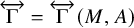 $\overleftrightarrow {\Gamma } = \overleftrightarrow {\Gamma }(M,A)$
of M with respect to A is the directed labelled graph with vertex set
$\overleftrightarrow {\Gamma } = \overleftrightarrow {\Gamma }(M,A)$
of M with respect to A is the directed labelled graph with vertex set $M \times M$
and directed edges
$M \times M$
and directed edges $M \times A \times M$
where
$M \times A \times M$
where $(m_1, a, m_2)$
is a directed edge with initial vertex
$(m_1, a, m_2)$
is a directed edge with initial vertex $(m_1, am_2)$
and terminal vertex
$(m_1, am_2)$
and terminal vertex $(m_1a, m_2)$
. Just as a monoid acts naturally by left multiplication on its right Cayley graph, there is a natural action of
$(m_1a, m_2)$
. Just as a monoid acts naturally by left multiplication on its right Cayley graph, there is a natural action of $M \times M^{\mathrm {op}}$
on
$M \times M^{\mathrm {op}}$
on $\overleftrightarrow {\Gamma } = \overleftrightarrow {\Gamma }(M,A)$
via
$\overleftrightarrow {\Gamma } = \overleftrightarrow {\Gamma }(M,A)$
via
 $$ \begin{align*} (m_1,m_2)\cdot (x,y) &= (m_1x,ym_2)\\ (m_1, m_2) \cdot (x,a,y) &= (m_1 x, a, y m_2) \end{align*} $$
where $(m_1, m_2) \in M \times M^{\mathrm {op}}$
,
$(m_1, m_2) \in M \times M^{\mathrm {op}}$
, $x,y \in M$
and
$x,y \in M$
and $a \in A$
. These are free
$a \in A$
. These are free $M \times M^{\mathrm {op}}$
-sets with bases
$M \times M^{\mathrm {op}}$
-sets with bases $\{(1,1)\}$
and
$\{(1,1)\}$
and $\{1\}\times A\times \{1\}$
, respectively. The two-sided Cayley graph and this action of
$\{1\}\times A\times \{1\}$
, respectively. The two-sided Cayley graph and this action of $M \times M^{\mathrm {op}}$
will play a central role in the proof of the mains result of this paper. See [Reference Gray and Steinberg23, Section 5.3] for more on the two-sided Cayley graph and its role in the study of two-sided homological and geometric finiteness properties of monoids.
$M \times M^{\mathrm {op}}$
will play a central role in the proof of the mains result of this paper. See [Reference Gray and Steinberg23, Section 5.3] for more on the two-sided Cayley graph and its role in the study of two-sided homological and geometric finiteness properties of monoids.
3 Finitely presented special monoids
We now give some definitions and results due to Zhang [Reference Zhang63] that will be used throughout the paper. Let $M = \langle A \mid w_1=1, \ldots , w_k=1 \rangle $
and let G be the group of units of M. By [Reference Zhang63, Theorem 3.7], G has a group presentation with k defining relations. We call a word
$M = \langle A \mid w_1=1, \ldots , w_k=1 \rangle $
and let G be the group of units of M. By [Reference Zhang63, Theorem 3.7], G has a group presentation with k defining relations. We call a word $u \in A^*$
invertible if it represents an element of the group of units G. We say that an invertible word
$u \in A^*$
invertible if it represents an element of the group of units G. We say that an invertible word $u \in A^*$
is indecomposable if it has no proper prefix that is invertible. It is straightforward to see that every nonempty invertible word u has a unique factorisation
$u \in A^*$
is indecomposable if it has no proper prefix that is invertible. It is straightforward to see that every nonempty invertible word u has a unique factorisation $u \equiv u_1 \ldots u_l$
where each
$u \equiv u_1 \ldots u_l$
where each $u_j$
is nonempty and indecomposable. For each relation word
$u_j$
is nonempty and indecomposable. For each relation word $w_i$
in the presentation of M let
$w_i$
in the presentation of M let $w_i \equiv w_{i,1} \ldots w_{i,n_i}$
be its decomposition into nonempty indecomposable invertible words. Given any invertible word
$w_i \equiv w_{i,1} \ldots w_{i,n_i}$
be its decomposition into nonempty indecomposable invertible words. Given any invertible word $\beta \in A^+$
we call
$\beta \in A^+$
we call $\beta $
minimal if it is indecomposable, and in addition
$\beta $
minimal if it is indecomposable, and in addition $|\beta | \leq \mathrm {max}_{1 \leq i \leq k}|w_i|$
. Now let
$|\beta | \leq \mathrm {max}_{1 \leq i \leq k}|w_i|$
. Now let $\Delta $
be the set of all minimal invertible words
$\Delta $
be the set of all minimal invertible words $\delta \in A^*$
such that
$\delta \in A^*$
such that $\delta = w_{i,j}$
in M for some
$\delta = w_{i,j}$
in M for some $1 \leq i \leq n, 1 \leq j \leq n_j$
. It is immediate from the definition that
$1 \leq i \leq n, 1 \leq j \leq n_j$
. It is immediate from the definition that $\Delta $
is a finite set of indecomposable invertible words. It is proved in [Reference Zhang63, Section 3] that the elements represented by words from
$\Delta $
is a finite set of indecomposable invertible words. It is proved in [Reference Zhang63, Section 3] that the elements represented by words from $\Delta $
give a finite generating set for the group of units G of M.
$\Delta $
give a finite generating set for the group of units G of M.
An important result of Zhang [Reference Zhang63] shows how $\Delta $
can be used to give an infinite rewriting system for the monoid M modulo the group of units of M, in the following way. Let
$\Delta $
can be used to give an infinite rewriting system for the monoid M modulo the group of units of M, in the following way. Let $<_s$
be the short-lex order on
$<_s$
be the short-lex order on $A^*$
induced by some fixed order on the generators A. Then define a rewriting system
$A^*$
induced by some fixed order on the generators A. Then define a rewriting system
 $$\begin{align*}S = \{ u \rightarrow v \mid u, v \in \Delta^*, u = v \ \text{in } M \ \text{and} \ u>_s v \}. \end{align*}$$
It follows from [Reference Zhang63, Proposition 3.2] that S is an infinite complete rewriting system defining the special monoid M. We call a word $\alpha \in A^*$
irreducible (or reduced) if it is irreducible with respect to the rewriting system S. For any word
$\alpha \in A^*$
irreducible (or reduced) if it is irreducible with respect to the rewriting system S. For any word $w \in A$
we shall use
$w \in A$
we shall use $\overline {w}$
to denote the unique reduced word such that
$\overline {w}$
to denote the unique reduced word such that $w = \overline {w}$
in M.
$w = \overline {w}$
in M.
The following lemma is folklore.
Lemma 3.1. Let T be a monoid and $r,s,t\in T$
with
$r,s,t\in T$
with $rs$
and
$rs$
and $st$
invertible. Then s and
$st$
invertible. Then s and $rst$
are invertible.
$rst$
are invertible.
Proof. First note that $rst[(st)^{-1}s(rs)^{-1}] = 1$
and
$rst[(st)^{-1}s(rs)^{-1}] = 1$
and $[(st)^{-1}s(rs)^{-1}]rst = 1$
, whence
$[(st)^{-1}s(rs)^{-1}]rst = 1$
, whence $rst$
is invertible. Since
$rst$
is invertible. Since $rs,st$
are invertible, s is left and right invertible, hence invertible.
$rs,st$
are invertible, s is left and right invertible, hence invertible.
A key result for us is the following.
Lemma 3.2 [Reference Zhang63, Lemma 3.4]
An irreducible word $u \in A^*$
is invertible if and only if
$u \in A^*$
is invertible if and only if $u \in \Delta ^*$
.
$u \in \Delta ^*$
.
Another result that will prove useful later on is the following normal form result of Otto and Zhang [Reference Otto and Zhang51, Theorem 5.2 and Lemma 5.4]. We shall say a word $w\in A^*$
is trivial if it represents the trivial element of M. We say a subword u of a word w is a maximal invertible subword if u is an invertible word and u is not properly contained in some other invertible subword of w. Lemma 3.1 implies that any nonempty invertible subword u of a word w is contained in a unique maximal invertible subword of w.
$w\in A^*$
is trivial if it represents the trivial element of M. We say a subword u of a word w is a maximal invertible subword if u is an invertible word and u is not properly contained in some other invertible subword of w. Lemma 3.1 implies that any nonempty invertible subword u of a word w is contained in a unique maximal invertible subword of w.
Lemma 3.3 [Reference Otto and Zhang51, Theorem 5.2]
Let $M = \langle A \mid w_1=1, \ldots , w_k=1 \rangle $
. Then every word
$M = \langle A \mid w_1=1, \ldots , w_k=1 \rangle $
. Then every word $u \in A^*$
can be uniquely factorised as
$u \in A^*$
can be uniquely factorised as $u\equiv u_0a_1u_1 \ldots a_m u_m$
where
$u\equiv u_0a_1u_1 \ldots a_m u_m$
where $a_i \in A$
, for
$a_i \in A$
, for $1 \leq i \leq m$
, and
$1 \leq i \leq m$
, and $u_j$
is a maximal invertible subword of u for
$u_j$
is a maximal invertible subword of u for $0 \leq j \leq m$
. We call this the Otto-Zhang normal form of u. Moreover, if
$0 \leq j \leq m$
. We call this the Otto-Zhang normal form of u. Moreover, if $v \in A^*$
with
$v \in A^*$
with $u=v$
in M, then the Otto-Zhang normal form of v is
$u=v$
in M, then the Otto-Zhang normal form of v is $v \equiv v_0a_1v_1 \ldots a_m v_m$
where
$v \equiv v_0a_1v_1 \ldots a_m v_m$
where $u_i = v_i$
in M for
$u_i = v_i$
in M for $i=0,\ldots , m$
.
$i=0,\ldots , m$
.
We note that some of the $u_i$
and
$u_i$
and $v_j$
in the lemma above may be empty.
$v_j$
in the lemma above may be empty.
Lemma 3.4. Let $M = \langle A \mid w_1=1, \ldots , w_k=1 \rangle $
, let
$M = \langle A \mid w_1=1, \ldots , w_k=1 \rangle $
, let $u \in A^*$
and let
$u \in A^*$
and let
 $$\begin{align*}u\equiv u_0a_1u_1 \ldots a_m u_m \end{align*}$$
be the Otto-Zhang normal form of u. Then $\overline {u}\equiv \overline {u_0}a_1\overline {u_1}\cdots a_m\overline {u_m}$
and each
$\overline {u}\equiv \overline {u_0}a_1\overline {u_1}\cdots a_m\overline {u_m}$
and each $\overline {u_i}\in \Delta ^*$
. Moreover, this is the Otto-Zhang normal form of
$\overline {u_i}\in \Delta ^*$
. Moreover, this is the Otto-Zhang normal form of $\overline {u}$
.
$\overline {u}$
.
Proof. To see this, it suffices to show that each $\overline {u_i}$
is a maximal invertible subword of
$\overline {u_i}$
is a maximal invertible subword of $v \equiv \overline {u_0}a_1\overline {u_1}\cdots a_m\overline {u_m}$
, and that v is reduced. Suppose that w is a maximal invertible subword of v. Since each
$v \equiv \overline {u_0}a_1\overline {u_1}\cdots a_m\overline {u_m}$
, and that v is reduced. Suppose that w is a maximal invertible subword of v. Since each $\overline {u_j}$
is invertible, it follows from Lemma 3.1 that if w contains a letter from some
$\overline {u_j}$
is invertible, it follows from Lemma 3.1 that if w contains a letter from some $\overline {u_j}$
then it must contain the entire
$\overline {u_j}$
then it must contain the entire $\overline {u_j}$
. It follows that either either
$\overline {u_j}$
. It follows that either either $w\equiv \overline {u}_i$
for some i, or
$w\equiv \overline {u}_i$
for some i, or $w\equiv \overline {u_{i-1}}a_{i}\cdots a_k\overline {u_k}$
for some
$w\equiv \overline {u_{i-1}}a_{i}\cdots a_k\overline {u_k}$
for some $1\leq i\leq k\leq m$
. But in the latter case
$1\leq i\leq k\leq m$
. But in the latter case $u_{i-1}a_i\cdots a_ku_k$
is an invertible word, a contradiction. Thus each
$u_{i-1}a_i\cdots a_ku_k$
is an invertible word, a contradiction. Thus each $\overline {u_j}$
is a maximal invertible subword of v. It now follows that v is reduced since the left-hand side of each rewrite rule is nonempty and invertible, and each maximal invertible subword of v is reduced. Finally, by Lemma 3.2, each
$\overline {u_j}$
is a maximal invertible subword of v. It now follows that v is reduced since the left-hand side of each rewrite rule is nonempty and invertible, and each maximal invertible subword of v is reduced. Finally, by Lemma 3.2, each $\overline {u_i}$
is a word in
$\overline {u_i}$
is a word in $\Delta ^*$
.
$\Delta ^*$
.
Let us say that a word $u \in A^*$
, written in Otto-Zhang normal form
$u \in A^*$
, written in Otto-Zhang normal form
 $$\begin{align*}u\equiv u_0a_1u_1 \ldots a_m u_m \end{align*}$$
has no invertible suffix if $u_m$
represents the identity of M, that is
$u_m$
represents the identity of M, that is $\overline {u_m}$
is empty. We define having no invertible prefix dually. In particular, a nonempty reduced word
$\overline {u_m}$
is empty. We define having no invertible prefix dually. In particular, a nonempty reduced word $\mu $
has no invertible suffix if the Otto-Zhang normal form of
$\mu $
has no invertible suffix if the Otto-Zhang normal form of $\mu $
is
$\mu $
is $\mu \equiv \mu _0a_1\mu _1\cdots \mu _na_n$
with the
$\mu \equiv \mu _0a_1\mu _1\cdots \mu _na_n$
with the $a_i\in A$
and the
$a_i\in A$
and the $\mu _i$
the maximal invertible subwords of
$\mu _i$
the maximal invertible subwords of $\mu $
. In particular,
$\mu $
. In particular, $\mu $
is not invertible. There is an obvious dual condition for any nonempty reduced word to have no invertible prefix.
$\mu $
is not invertible. There is an obvious dual condition for any nonempty reduced word to have no invertible prefix.
4 Proving that
$N \cong G \ast C^*$
for some finite set C

Throughout this section
 $$\begin{align*}M = \langle A \mid w_1=1, \ldots, w_k=1 \rangle. \end{align*}$$
Let $R_1$
and
$R_1$
and $L_1$
be the right and left units, respectively, of the monoid M. Let
$L_1$
be the right and left units, respectively, of the monoid M. Let $G = R_1 \cap L_1$
be the group of units of M. Define a monoid
$G = R_1 \cap L_1$
be the group of units of M. Define a monoid
 $$\begin{align*}N = \{ (u,v) : u \in R_1, v \in L_1, uv=1 \} \end{align*}$$
with multiplication
 $$\begin{align*}(a,b) \cdot (x,y) = (ax,yb). \end{align*}$$
Note that N is a submonoid of $R_1\times L_1^{\mathrm {op}}\subseteq M \times M^{\mathrm {op}}$
.
$R_1\times L_1^{\mathrm {op}}\subseteq M \times M^{\mathrm {op}}$
.
We remark that while N is a set of pairs of elements of M we shall almost always write elements of N as pairs $(u,v)$
where
$(u,v)$
where $u, v \in A^*$
. This should of course be interpreted as meaning the pair
$u, v \in A^*$
. This should of course be interpreted as meaning the pair $([u],[v])$
where
$([u],[v])$
where $[u], [v] \in M$
are the elements of M represented by the words u and v, respectively.
$[u], [v] \in M$
are the elements of M represented by the words u and v, respectively.
By results of Zhang [Reference Zhang63, Theorem 4.4] we know that $R_1 \cong G \ast C^*$
for some finite set C, and
$R_1 \cong G \ast C^*$
for some finite set C, and $L_1 \cong G \ast D^*$
for some finite set D, it follows that N is a submonoid of
$L_1 \cong G \ast D^*$
for some finite set D, it follows that N is a submonoid of $(G \ast C^*) \times (G \ast D^*) ^{\mathrm {op}}$
. This implies that N is group-embeddable, and thus, in particular, N is two-sided cancellative. More generally
$(G \ast C^*) \times (G \ast D^*) ^{\mathrm {op}}$
. This implies that N is group-embeddable, and thus, in particular, N is two-sided cancellative. More generally $R_1 \times L_1^{op}$
is a group-embeddable and thus two-sided cancellative monoid.
$R_1 \times L_1^{op}$
is a group-embeddable and thus two-sided cancellative monoid.
Our aim in this section is to prove that $N \cong G \ast X^*$
for some finite set X. The key to proving this result is to identify a suitable generating set with respect to which we can see that N has this free product structure.
$N \cong G \ast X^*$
for some finite set X. The key to proving this result is to identify a suitable generating set with respect to which we can see that N has this free product structure.
Given any invertible word $\alpha \in A^*$
we shall use
$\alpha \in A^*$
we shall use $\alpha ^{-1}$
to denote the reduced form of the inverse of the invertible element
$\alpha ^{-1}$
to denote the reduced form of the inverse of the invertible element $\alpha $
. For example if
$\alpha $
. For example if $M = \langle A \mid r=1 \rangle $
where
$M = \langle A \mid r=1 \rangle $
where $r \equiv (ab)(cd)(ab)$
then
$r \equiv (ab)(cd)(ab)$
then $(cd)(ab) = (ab)(cd)$
is the inverse of
$(cd)(ab) = (ab)(cd)$
is the inverse of $ab$
and it may be verified that
$ab$
and it may be verified that $(ab)^{-1} = (ab)(cd)$
is the normal form in this case. By Lemma 3.2 we know that
$(ab)^{-1} = (ab)(cd)$
is the normal form in this case. By Lemma 3.2 we know that $\alpha ^{-1} \in \Delta ^*$
for every invertible word
$\alpha ^{-1} \in \Delta ^*$
for every invertible word $\alpha \in A^*$
, and if
$\alpha \in A^*$
, and if $\alpha $
is itself irreducible, then also
$\alpha $
is itself irreducible, then also $\alpha \in \Delta ^*$
.
$\alpha \in \Delta ^*$
.
Let $u,v\in A^+$
be reduced words such that
$u,v\in A^+$
be reduced words such that $uv=1$
in M. Then by definition of the Zhang rewriting system and the fact that
$uv=1$
in M. Then by definition of the Zhang rewriting system and the fact that $u,v$
are reduced, there must exist factorisations
$u,v$
are reduced, there must exist factorisations $u\equiv u_1u_2$
and
$u\equiv u_1u_2$
and $v\equiv v_1v_2$
with
$v\equiv v_1v_2$
with $u_2v_1\in \Delta ^*$
and
$u_2v_1\in \Delta ^*$
and $u_2$
and
$u_2$
and $v_1$
both nonempty. Of course,
$v_1$
both nonempty. Of course, $u_2v_1$
is an invertible word. In general, if
$u_2v_1$
is an invertible word. In general, if $u,v$
are nonempty words, we say that an invertible word
$u,v$
are nonempty words, we say that an invertible word $z\in A^+$
cuts across
$z\in A^+$
cuts across $(u,v)\in A^+\times A^+$
if
$(u,v)\in A^+\times A^+$
if $u\equiv u_1u_2$
and
$u\equiv u_1u_2$
and $v\equiv v_1v_2$
with
$v\equiv v_1v_2$
with $z\equiv u_2v_1$
and
$z\equiv u_2v_1$
and $u_2,u_1$
nonempty. Let
$u_2,u_1$
nonempty. Let $(u,v) \in N$
with u and v both reduced. It follows from the definitions that
$(u,v) \in N$
with u and v both reduced. It follows from the definitions that $u=1$
in M if and only if
$u=1$
in M if and only if $v=1$
in M. Otherwise,
$v=1$
in M. Otherwise, $u \in A^+$
and
$u \in A^+$
and $v \in A^+$
and the argument above shows that at least one invertible word cuts across
$v \in A^+$
and the argument above shows that at least one invertible word cuts across $(u,v)$
. The collection of invertible words cutting across
$(u,v)$
. The collection of invertible words cutting across $(u,v)$
is partially ordered by subword inclusion, as subwords of
$(u,v)$
is partially ordered by subword inclusion, as subwords of $uv$
.
$uv$
.
Here a subword of $uv$
cutting across
$uv$
cutting across $(u,v)$
is specified by choosing a letter x in u and a letter y in v and taking the unique subword of
$(u,v)$
is specified by choosing a letter x in u and a letter y in v and taking the unique subword of $uv$
that begins with that particular letter x and ends with that particular letter y. Distinct pairs of such letters
$uv$
that begins with that particular letter x and ends with that particular letter y. Distinct pairs of such letters $x,y$
determine distinct subwords of
$x,y$
determine distinct subwords of $uv$
, viewed as subwords of
$uv$
, viewed as subwords of $uv$
, even if graphically they are the same word. For example, suppose
$uv$
, even if graphically they are the same word. For example, suppose $M = \langle a,b \mid (ab)^6=1 \rangle $
. Let
$M = \langle a,b \mid (ab)^6=1 \rangle $
. Let $u \equiv aba$
and
$u \equiv aba$
and $v \equiv bab$
so that
$v \equiv bab$
so that $uv \equiv ababab$
. Then this word
$uv \equiv ababab$
. Then this word $uv$
contains the word
$uv$
contains the word $abab$
as a subword in two different ways, once as a prefix
$abab$
as a subword in two different ways, once as a prefix $\underline {abab}ab$
of
$\underline {abab}ab$
of $uv$
and once as a suffix
$uv$
and once as a suffix $ab\underline {abab}$
of
$ab\underline {abab}$
of $uv$
. Each of these subwords
$uv$
. Each of these subwords $abab$
of
$abab$
of $uv$
cuts across
$uv$
cuts across $(u,v) = (aba,bab)$
but, even though they are both equal to the word
$(u,v) = (aba,bab)$
but, even though they are both equal to the word $abab$
, they are distinct as subwords of
$abab$
, they are distinct as subwords of $uv$
, and thus they are two distinct elements in the poset of invertible words cutting across
$uv$
, and thus they are two distinct elements in the poset of invertible words cutting across $(u,v)$
. Furthermore since as subwords of
$(u,v)$
. Furthermore since as subwords of $uv$
neither of these words
$uv$
neither of these words $abab$
is contained in the other, they are incomparable in this poset. Note that the subword
$abab$
is contained in the other, they are incomparable in this poset. Note that the subword $ab$
cutting across
$ab$
cutting across $uv$
, which is the underlined word in
$uv$
, which is the underlined word in $ab\underline {ab}ab$
, is also an element of the poset of invertible words cutting across
$ab\underline {ab}ab$
, is also an element of the poset of invertible words cutting across $(u,v)$
, and this element of the poset is contained, as a subword of
$(u,v)$
, and this element of the poset is contained, as a subword of $uv$
, in both the subwords
$uv$
, in both the subwords $abab$
of
$abab$
of $uv$
and hence lies below each of those elements of the poset.
$uv$
and hence lies below each of those elements of the poset.
Returning to the general argument, we now aim to show that set of invertible words cutting across $(u,v)$
, if nonempty, is a lattice. Let us prove a more general result first.
$(u,v)$
, if nonempty, is a lattice. Let us prove a more general result first.
Proposition 4.1. Let $u\in A^+$
and v be a nonempty subword of u. If some invertible subword of u contains v, then the set of invertible subwords of u containing v is a lattice ordered by subword inclusion. Moreover, if
$u\in A^+$
and v be a nonempty subword of u. If some invertible subword of u contains v, then the set of invertible subwords of u containing v is a lattice ordered by subword inclusion. Moreover, if $\delta \equiv u_1vu_2$
is the unique smallest element of this lattice, then
$\delta \equiv u_1vu_2$
is the unique smallest element of this lattice, then $u_1$
has no nonempty invertible prefix and
$u_1$
has no nonempty invertible prefix and $u_2$
has no nonempty invertible suffix.
$u_2$
has no nonempty invertible suffix.
Proof. We begin by showing the poset is a lattice. Let $x,y\in A^+$
be invertible subwords of u containing v. We must show that
$x,y\in A^+$
be invertible subwords of u containing v. We must show that $x,y$
have a join and meet in the collection of invertible subwords of v containing u. Write
$x,y$
have a join and meet in the collection of invertible subwords of v containing u. Write $x\equiv x_1vx_2$
and
$x\equiv x_1vx_2$
and $y\equiv y_1vy_2$
. Without loss of generality assume that
$y\equiv y_1vy_2$
. Without loss of generality assume that $|x_1|\leq |y_1|$
. If
$|x_1|\leq |y_1|$
. If $|x_2|\leq |y_2|$
, then x is a subword of y and so the meet and join in this case are clearly given by x and y, respectively. So assume that
$|x_2|\leq |y_2|$
, then x is a subword of y and so the meet and join in this case are clearly given by x and y, respectively. So assume that $|x_2|>|y_2|$
. Then it suffices to show that
$|x_2|>|y_2|$
. Then it suffices to show that $y_1vx_2$
and
$y_1vx_2$
and $x_1vy_2$
are invertible, as these will then be the meet and join, respectively, of
$x_1vy_2$
are invertible, as these will then be the meet and join, respectively, of $x,y$
in this poset. Write
$x,y$
in this poset. Write $y_1\equiv \alpha x_1$
and
$y_1\equiv \alpha x_1$
and $x_2\equiv y_2\beta $
. Then
$x_2\equiv y_2\beta $
. Then $y_1vy_2\equiv \alpha x_1vy_2$
and
$y_1vy_2\equiv \alpha x_1vy_2$
and $x_1vx_2\equiv x_1vy_2\beta $
are invertible, and so
$x_1vx_2\equiv x_1vy_2\beta $
are invertible, and so $x_1vy_2$
and
$x_1vy_2$
and $y_1vx_2\equiv \alpha x_1vy_2\beta $
are invertible by Lemma 3.1, as required.
$y_1vx_2\equiv \alpha x_1vy_2\beta $
are invertible by Lemma 3.1, as required.
For the final statement, if $u_1\equiv u_1'u_1"$
with
$u_1\equiv u_1'u_1"$
with $u_1'$
invertible, then
$u_1'$
invertible, then $u_1"vu_2$
is invertible and hence by minimality of u, we must have
$u_1"vu_2$
is invertible and hence by minimality of u, we must have $u_1"\equiv u_1$
, and so
$u_1"\equiv u_1$
, and so $u_1'$
is empty. Dually
$u_1'$
is empty. Dually $u_2$
has no nonempty invertible suffix.
$u_2$
has no nonempty invertible suffix.
Proposition 4.2. Let $(u,v)\in A^+\times A^+$
. Suppose that some invertible word cuts across
$(u,v)\in A^+\times A^+$
. Suppose that some invertible word cuts across $(u,v)$
. Then the poset of invertible words cutting across
$(u,v)$
. Then the poset of invertible words cutting across $(u,v)$
is a lattice.
$(u,v)$
is a lattice.
Proof. Let a be the last letter of u and b the first letter of v and consider the subword $ab$
of the word
$ab$
of the word $uv$
where
$uv$
where $ab$
cuts across
$ab$
cuts across $(u,v)$
. Then the invertible words cutting across
$(u,v)$
. Then the invertible words cutting across $(u,v)$
are the subwords of
$(u,v)$
are the subwords of $uv$
containing this particular subword
$uv$
containing this particular subword $ab$
of
$ab$
of $uv$
. Therefore, this poset is a lattice by Proposition 4.1.
$uv$
. Therefore, this poset is a lattice by Proposition 4.1.
Definition 4.3. Given any pair $(\mu ,\gamma )\in A^+\times A^+$
such that some invertible word cuts across
$(\mu ,\gamma )\in A^+\times A^+$
such that some invertible word cuts across $(\mu ,\gamma )$
, we define the height of
$(\mu ,\gamma )$
, we define the height of $(\mu ,\gamma )$
to be the height of the lattice of invertible words cutting across
$(\mu ,\gamma )$
to be the height of the lattice of invertible words cutting across $(\mu ,\gamma )$
, i.e., the length of the longest chain of invertible words cutting across
$(\mu ,\gamma )$
, i.e., the length of the longest chain of invertible words cutting across $(\mu ,\gamma )$
.
$(\mu ,\gamma )$
.
Clearly since the lattice in Definition 4.3 is always finite, it must have finite height, and so the height of a pair of words $(\mu ,\gamma )\in A^+\times A^+$
, such that some invertible word cuts across
$(\mu ,\gamma )\in A^+\times A^+$
, such that some invertible word cuts across $(\mu ,\gamma )$
, is always finite.
$(\mu ,\gamma )$
, is always finite.
We shall later need the following property of height $0$
pairs.
$0$
pairs.
Lemma 4.4. Let $\mu ,\gamma \in A^*$
be reduced with
$\mu ,\gamma \in A^*$
be reduced with $\mu \gamma $
invertible but
$\mu \gamma $
invertible but $\mu $
noninvertible (or, equivalently,
$\mu $
noninvertible (or, equivalently, $\gamma $
noninvertible). If
$\gamma $
noninvertible). If $(\mu ,\gamma )$
has height
$(\mu ,\gamma )$
has height $0$
, then
$0$
, then $\mu $
has no nonempty left invertible prefix and
$\mu $
has no nonempty left invertible prefix and $\gamma $
has no nonempty right invertible suffix.
$\gamma $
has no nonempty right invertible suffix.
Proof. Write $\mu \equiv \mu 'a$
and
$\mu \equiv \mu 'a$
and $\gamma \equiv b\gamma '$
with
$\gamma \equiv b\gamma '$
with $a,b\in A$
. Note that
$a,b\in A$
. Note that $\mu '$
is right invertible and
$\mu '$
is right invertible and $\gamma '$
is left invertible, and so
$\gamma '$
is left invertible, and so $\mu '$
has no nonempty left invertible prefix and
$\mu '$
has no nonempty left invertible prefix and $\gamma '$
has no nonempty right invertible suffix by Proposition 4.1. Since
$\gamma '$
has no nonempty right invertible suffix by Proposition 4.1. Since $\mu $
and
$\mu $
and $\gamma $
are also not invertible, but are right and left invertible, respectively, the lemma follows.
$\gamma $
are also not invertible, but are right and left invertible, respectively, the lemma follows.
We are now ready to provide a finite generating set for N.
Lemma 4.5. The monoid N is generated by the set $X \cup Y$
where
$X \cup Y$
where
 $$\begin{align*}Y=\{(\delta,\delta^{-1}): \delta\in \Delta\}\end{align*}$$
and X consists of all pairs $(\delta _1,\delta _2\delta ^{-1})$
such that:
$(\delta _1,\delta _2\delta ^{-1})$
such that:
-
1.
$\delta _1,\delta _2\in A^+$
are reduced; -
2.
$\delta \equiv \delta _1\delta _2$
is invertible; -
3.
$(\delta _1,\delta _2)$
has height
$0$
; -
4.
$\delta _1$
has no invertible suffix.


Furthermore these four conditions imply that $\delta \equiv \delta _1 \delta _2 \in \Delta $
, and hence the set X is finite. Therefore N is finitely generated by the set
$\delta \equiv \delta _1 \delta _2 \in \Delta $
, and hence the set X is finite. Therefore N is finitely generated by the set $X \cup Y$
.
$X \cup Y$
.
Proof. Let $u,v\in A^*$
be reduced with
$u,v\in A^*$
be reduced with $uv=1$
in M. We prove by induction on
$uv=1$
in M. We prove by induction on $|u|$
that
$|u|$
that $(u,v)\in \langle X\cup Y\rangle $
. If
$(u,v)\in \langle X\cup Y\rangle $
. If $u=1$
, then since
$u=1$
, then since $uv=1$
in M and v is reduced, we must have
$uv=1$
in M and v is reduced, we must have $v=1$
. Proceeding by induction, if
$v=1$
. Proceeding by induction, if $|u|>0$
, then
$|u|>0$
, then $uv$
is not reduced (being
$uv$
is not reduced (being $1$
in M), and so we can apply a rewrite rule to it. Since
$1$
in M), and so we can apply a rewrite rule to it. Since $u,v$
are reduced, the left-hand side of any applicable rewrite rule cuts across
$u,v$
are reduced, the left-hand side of any applicable rewrite rule cuts across $(u,v)$
. But the left-hand side of any rewrite rule is invertible and nonempty. Hence there is an invertible word cutting across
$(u,v)$
. But the left-hand side of any rewrite rule is invertible and nonempty. Hence there is an invertible word cutting across $(u,v)$
. Let
$(u,v)$
. Let $\delta $
be the minimal invertible word cutting across
$\delta $
be the minimal invertible word cutting across $(u,v)$
; this exists by Proposition 4.2. Write
$(u,v)$
; this exists by Proposition 4.2. Write $u\equiv u'\delta _1$
and
$u\equiv u'\delta _1$
and $v\equiv \delta _2v'$
with
$v\equiv \delta _2v'$
with $\delta \equiv \delta _1\delta _2$
. Suppose first that
$\delta \equiv \delta _1\delta _2$
. Suppose first that $\delta _1$
has no invertible suffix. We compute
$\delta _1$
has no invertible suffix. We compute $(u,v)=(u',\delta v')(\delta _1,\delta _2\delta ^{-1})$
. Note that
$(u,v)=(u',\delta v')(\delta _1,\delta _2\delta ^{-1})$
. Note that $|u'|<|u|$
and
$|u'|<|u|$
and $u'\delta v'\equiv uv$
, and hence is
$u'\delta v'\equiv uv$
, and hence is $1$
in M. So
$1$
in M. So $(u',\delta v')\in \langle X\cup Y\rangle $
by induction, noting that
$(u',\delta v')\in \langle X\cup Y\rangle $
by induction, noting that $u'$
is a reduced word, whereas
$u'$
is a reduced word, whereas $(\delta _1,\delta _2\delta ^{-1})\in X$
by minimality of
$(\delta _1,\delta _2\delta ^{-1})\in X$
by minimality of $\delta $
which implies
$\delta $
which implies $(\delta _1, \delta _2)$
has height zero. Otherwise,
$(\delta _1, \delta _2)$
has height zero. Otherwise, $\delta _1\equiv \delta _1'\gamma $
where
$\delta _1\equiv \delta _1'\gamma $
where $\gamma $
is a nonempty invertible suffix. Since
$\gamma $
is a nonempty invertible suffix. Since $\delta _1$
is reduced,
$\delta _1$
is reduced, $\gamma \in \Delta ^*$
by Lemma 3.2. Therefore,
$\gamma \in \Delta ^*$
by Lemma 3.2. Therefore, $(\gamma ,\gamma ^{-1})\in \langle Y\rangle $
. But then
$(\gamma ,\gamma ^{-1})\in \langle Y\rangle $
. But then $(u,v) = (u'\delta _1'\gamma ,v) = (u'\delta _1',\overline {\gamma v})(\gamma ,\gamma ^{-1})$
, where
$(u,v) = (u'\delta _1'\gamma ,v) = (u'\delta _1',\overline {\gamma v})(\gamma ,\gamma ^{-1})$
, where $u' \delta _1'$
is a reduced word since it is a subword of the reduced word u. Since
$u' \delta _1'$
is a reduced word since it is a subword of the reduced word u. Since $u'\delta _1'\overline {\gamma v}=uv=1$
in M, and
$u'\delta _1'\overline {\gamma v}=uv=1$
in M, and $|u'\delta _1'|<|u|$
, we deduce that
$|u'\delta _1'|<|u|$
, we deduce that $(u'\delta _1'\gamma ,v)\in \langle X\cup Y\rangle $
by induction, and hence
$(u'\delta _1'\gamma ,v)\in \langle X\cup Y\rangle $
by induction, and hence $(u,v)\in \langle X\cup Y\rangle $
.
$(u,v)\in \langle X\cup Y\rangle $
.
Finally, we show that conditions (1)–(4) together imply that $\delta \equiv \delta _1\delta _2 \in \Delta $
and hence the set X is finite. There are two cases to consider.
$\delta \equiv \delta _1\delta _2 \in \Delta $
and hence the set X is finite. There are two cases to consider.
First suppose that $\delta \equiv \delta _1\delta _2$
is not reduced. Since
$\delta \equiv \delta _1\delta _2$
is not reduced. Since $\delta _1$
and
$\delta _1$
and $\delta _2$
are both reduced by (1) it follows that the left hand side
$\delta _2$
are both reduced by (1) it follows that the left hand side $\mu \in \Delta ^+$
of some rewrite rule cuts across
$\mu \in \Delta ^+$
of some rewrite rule cuts across $(\delta _1, \delta _2)$
. Write
$(\delta _1, \delta _2)$
. Write $\delta _1\delta _2 \equiv \delta _1' \mu _1 \mu _2 \delta _2'$
where
$\delta _1\delta _2 \equiv \delta _1' \mu _1 \mu _2 \delta _2'$
where $\delta _1 \equiv \delta _1' \mu _1$
,
$\delta _1 \equiv \delta _1' \mu _1$
, $\delta _2 \equiv \mu _2 \delta _2'$
and
$\delta _2 \equiv \mu _2 \delta _2'$
and $\mu _1\mu _2 \in \Delta ^+$
with
$\mu _1\mu _2 \in \Delta ^+$
with $\mu _1$
and
$\mu _1$
and $\mu _2$
both nonempty words. Since by (4) the word
$\mu _2$
both nonempty words. Since by (4) the word $\delta _1$
has no invertible suffix, it follows that
$\delta _1$
has no invertible suffix, it follows that $\mu _1 \not \in \Delta ^+$
hence there is a word
$\mu _1 \not \in \Delta ^+$
hence there is a word $\gamma \in \Delta $
such that
$\gamma \in \Delta $
such that $\gamma $
cuts across
$\gamma $
cuts across $(\delta _1,\delta _2)$
. Since by (3) we have that
$(\delta _1,\delta _2)$
. Since by (3) we have that $(\delta _1,\delta _2)$
has height zero this is only possible if
$(\delta _1,\delta _2)$
has height zero this is only possible if $\delta \equiv \delta _1 \delta _2 \equiv \gamma \in \Delta $
. This completes the proof that in this case
$\delta \equiv \delta _1 \delta _2 \equiv \gamma \in \Delta $
. This completes the proof that in this case $\delta \equiv \delta _1\delta _2 \in \Delta $
.
$\delta \equiv \delta _1\delta _2 \in \Delta $
.
Next we consider the case that $\delta \equiv \delta _1\delta _2$
is reduced. Since
$\delta \equiv \delta _1\delta _2$
is reduced. Since $\delta _1\delta _2$
is reduced, then as it is invertible it belongs to
$\delta _1\delta _2$
is reduced, then as it is invertible it belongs to $\Delta ^*$
by Lemma 3.2. Since
$\Delta ^*$
by Lemma 3.2. Since $\delta _1\notin \Delta ^*$
(being noninvertible), the expression of
$\delta _1\notin \Delta ^*$
(being noninvertible), the expression of $\delta _1\delta _2$
as a product of words from
$\delta _1\delta _2$
as a product of words from $\Delta $
must involve an element
$\Delta $
must involve an element $\delta '\in \Delta $
cutting across
$\delta '\in \Delta $
cutting across $(\delta _1,\delta _2)$
. Since any element of
$(\delta _1,\delta _2)$
. Since any element of $\Delta $
is invertible, we deduce that
$\Delta $
is invertible, we deduce that $\delta _1\delta _2\equiv \delta ' \in \Delta $
by definition of height
$\delta _1\delta _2\equiv \delta ' \in \Delta $
by definition of height $0$
. This completes the proof that in this case
$0$
. This completes the proof that in this case $\delta \equiv \delta _1\delta _2 \in \Delta $
.
$\delta \equiv \delta _1\delta _2 \in \Delta $
.
We have shown that the conditions (1)–(4) together imply that $\delta \equiv \delta _1\delta _2 \in \Delta $
and hence, since
$\delta \equiv \delta _1\delta _2 \in \Delta $
and hence, since $\Delta $
is finite, the set X is also finite.
$\Delta $
is finite, the set X is also finite.
Remark 4.6. The idea behind the height zero condition in the definition of the set X in Lemma 4.5 is to ensure that the generating set obtained in minimal. In particular, if we were to remove the height zero assumption from the set X in Lemma 4.5 then in general it would result in a generating set for N that is not minimal. To see this consider, for example, the monoid M defined by the presentation $\langle a,b,c,d \mid (abcd)(bc)(abcd) = 1 \rangle $
. It is straightforward to verify that the minimal invertible pieces of this defining relator are
$\langle a,b,c,d \mid (abcd)(bc)(abcd) = 1 \rangle $
. It is straightforward to verify that the minimal invertible pieces of this defining relator are $abcd$
and
$abcd$
and $bc$
. Consider the following three elements from N
$bc$
. Consider the following three elements from N
 $$\begin{align*}(b,c(bc)^{-1}), \quad (ab,cd(abcd)^{-1}), \quad (a,bcd(abcd)^{-1}). \end{align*}$$
All three of theses elements has the form $(\delta _1, \delta _2 \delta ^{-1})$
where
$(\delta _1, \delta _2 \delta ^{-1})$
where $\delta \equiv \delta _1\delta _2 \in \Delta $
since it may be shown that
$\delta \equiv \delta _1\delta _2 \in \Delta $
since it may be shown that $bc \in \Delta $
and
$bc \in \Delta $
and $abcd \in \Delta $
. However, if we included all three of these generators in a generating set for N then that generating set would not be minimal since
$abcd \in \Delta $
. However, if we included all three of these generators in a generating set for N then that generating set would not be minimal since
 $$\begin{align*}(a,bcd(abcd)^{-1}) \cdot (b,c(bc)^{-1}) = (ab,c(bc)^{-1}bcd(abcd)^{-1}) = (ab,cd(abcd)^{-1}). \end{align*}$$
Note that the pair $(ab,cd(abcd)^{-1})$
does not have height zero, and the product above shows that this element can be written as a product of the two height zero elements
$(ab,cd(abcd)^{-1})$
does not have height zero, and the product above shows that this element can be written as a product of the two height zero elements $(a,bcd(abcd)^{-1})$
and
$(a,bcd(abcd)^{-1})$
and $(b,c(bc)^{-1})$
.
$(b,c(bc)^{-1})$
.
We are now in a position to prove that N decomposes as a free product of its group of units and a free monoid of finite rank. Let us recall briefly the normal form for a free product. Suppose that $\{M_i:i\in I\}$
is a collection of monoids. Consider the alphabet
$\{M_i:i\in I\}$
is a collection of monoids. Consider the alphabet $B=\bigsqcup _{i\in I}M_i\setminus \{1\}$
. An element of
$B=\bigsqcup _{i\in I}M_i\setminus \{1\}$
. An element of $M_i\setminus \{1\}$
is called an
$M_i\setminus \{1\}$
is called an $M_i$
-syllable or a syllable of type
$M_i$
-syllable or a syllable of type $M_i$
. A word in
$M_i$
. A word in $B^*$
is in normal form if it does not contain two consecutive syllables of the same type. The length of a normal form is called its syllable length. Each element of the free product
$B^*$
is in normal form if it does not contain two consecutive syllables of the same type. The length of a normal form is called its syllable length. Each element of the free product  has a unique representative in normal form.
The following is a variant of the Ping Pong Lemma from group theory (see, e.g., [Reference de La Harpe16, Chapter II.B] or [Reference Lyndon and Schupp44, Proposition 12.2 of Chapter III]).
Lemma 4.7 (Ping Pong Lemma)
Let N be a cancellative monoid, G a subgroup of the group of units of N and $X\subseteq N$
. Suppose that
$X\subseteq N$
. Suppose that $N=\langle G\cup X\rangle $
and there is a right N-set A such that
$N=\langle G\cup X\rangle $
and there is a right N-set A such that $A=A_0\sqcup \bigsqcup _{x\in X}Ax$
with
$A=A_0\sqcup \bigsqcup _{x\in X}Ax$
with $Axg\subseteq A_0$
whenever
$Axg\subseteq A_0$
whenever $x\in X$
and
$x\in X$
and $1\neq g\in G$
, and
$1\neq g\in G$
, and $Ax\subsetneq A$
. Then
$Ax\subsetneq A$
. Then $\langle X\rangle $
is a free monoid with basis X and
$\langle X\rangle $
is a free monoid with basis X and $N\cong G\ast X^*$
.
$N\cong G\ast X^*$
.
Proof. First note that if $X=\emptyset $
, then
$X=\emptyset $
, then $N=G$
and there is nothing to prove. So we may assume that
$N=G$
and there is nothing to prove. So we may assume that $X\neq \emptyset $
. For each
$X\neq \emptyset $
. For each $x \in X$
if
$x \in X$
if $x^i=x^j$
for some
$x^i=x^j$
for some $i,j \in \mathbb {N}$
with
$i,j \in \mathbb {N}$
with $i> j$
then since N is a cancellative monoid this would imply
$i> j$
then since N is a cancellative monoid this would imply $x^{i-j}=1$
and thus x is invertible. But if x were invertible it would imply
$x^{i-j}=1$
and thus x is invertible. But if x were invertible it would imply $Ax=A$
contradicting the hypotheses of the lemma. Hence, each
$Ax=A$
contradicting the hypotheses of the lemma. Hence, each $x\in X$
generates a free submonoid
$x\in X$
generates a free submonoid $x^*$
. We want to show that
$x^*$
. We want to show that  . By assumption, the natural homomorphism
  from the free product to N is surjective. The action of N on A can be used to define an action of
  on A via the homomorphism $\phi $
. More precisely, we define an action of
$\phi $
. More precisely, we define an action of  on A where for each
  and
and $a \in A$
we define
$a \in A$
we define $a s = a \phi (s)$
. Next note that if an element
$a s = a \phi (s)$
. Next note that if an element $\alpha $
of the free product
$\alpha $
of the free product  is in normal form with last syllable of type $x^*$
, then
$x^*$
, then $A\alpha \subseteq Ax$
. If
$A\alpha \subseteq Ax$
. If $\alpha $
has last syllable of type G, there are two cases. If
$\alpha $
has last syllable of type G, there are two cases. If $\alpha \in G\setminus \{1\}$
, then
$\alpha \in G\setminus \{1\}$
, then $A\alpha =A$
and
$A\alpha =A$
and $Ax\alpha \subseteq A_0$
for all
$Ax\alpha \subseteq A_0$
for all $x\in X$
; if
$x\in X$
; if $\alpha =\alpha 'x^kg$
with
$\alpha =\alpha 'x^kg$
with $x\in X$
,
$x\in X$
, $k>0$
and
$k>0$
and $g\in G\setminus \{1\}$
, then
$g\in G\setminus \{1\}$
, then $A\alpha \subseteq A_0$
. It follows that if
$A\alpha \subseteq A_0$
. It follows that if $\alpha $
is a nonempty normal form, then it acts nontrivially on A, and we can determine the type of its last syllable from its action on A.
$\alpha $
is a nonempty normal form, then it acts nontrivially on A, and we can determine the type of its last syllable from its action on A.
Suppose that $\alpha $
and
$\alpha $
and $\beta $
are normal forms for the free product. We induct on the sum of their syllable lengths to show that if
$\beta $
are normal forms for the free product. We induct on the sum of their syllable lengths to show that if $\alpha $
and
$\alpha $
and $\beta $
represent the same element of N, then they are equal in the free product. By the previous paragraph, we may assume that
$\beta $
represent the same element of N, then they are equal in the free product. By the previous paragraph, we may assume that $\alpha $
and
$\alpha $
and $\beta $
are nonempty and their last syllables have the same type. Suppose first that
$\beta $
are nonempty and their last syllables have the same type. Suppose first that $\alpha = \alpha 'x^k$
and
$\alpha = \alpha 'x^k$
and $\beta =\beta 'x^m$
with
$\beta =\beta 'x^m$
with $x\in X$
and
$x\in X$
and $\alpha ',\beta '$
of one shorter syllable length. Without loss of generality assume that
$\alpha ',\beta '$
of one shorter syllable length. Without loss of generality assume that $k\leq m$
. Then cancelling
$k\leq m$
. Then cancelling $x^k$
we get
$x^k$
we get $\alpha '$
and
$\alpha '$
and $\beta 'x^{m-k}$
represent the same element of N. By induction, since
$\beta 'x^{m-k}$
represent the same element of N. By induction, since $\alpha '$
does not end in an
$\alpha '$
does not end in an $x^*$
-syllable, we must have that
$x^*$
-syllable, we must have that $m=k$
and
$m=k$
and $\alpha '=\beta '$
in the free product. Next suppose that
$\alpha '=\beta '$
in the free product. Next suppose that $\alpha =\alpha ' g$
and
$\alpha =\alpha ' g$
and $\beta =\beta 'g'$
where
$\beta =\beta 'g'$
where $g,g'\in G\setminus \{1\}$
and
$g,g'\in G\setminus \{1\}$
and $\alpha ',\beta '$
have syllable length one shorter. Then
$\alpha ',\beta '$
have syllable length one shorter. Then $\alpha '=\beta ' g'g^{-1}$
in N. Since
$\alpha '=\beta ' g'g^{-1}$
in N. Since $\alpha '$
does not end in a G-syllable, we deduce by induction that
$\alpha '$
does not end in a G-syllable, we deduce by induction that $g'g^{-1} =1$
and
$g'g^{-1} =1$
and $\alpha '=\beta '$
in the free product. This completes the proof.
$\alpha '=\beta '$
in the free product. This completes the proof.
We now apply the Ping Pong Lemma to our setting.
Theorem 4.8. The monoid N is isomorphic to a free product $G \ast C^*$
where G is the group of units of M and C is a finite set. More precisely, let
$G \ast C^*$
where G is the group of units of M and C is a finite set. More precisely, let $X \cup Y$
be the finite generating set for N obtained in Lemma 4.5. Then X is a basis for a free submonoid of N and
$X \cup Y$
be the finite generating set for N obtained in Lemma 4.5. Then X is a basis for a free submonoid of N and $N\cong G\ast X^*$
where the copy of G is identified with
$N\cong G\ast X^*$
where the copy of G is identified with $\langle Y\rangle $
.
$\langle Y\rangle $
.
Proof. Note that if $\mu ,\gamma \in A^*$
are reduced with
$\mu ,\gamma \in A^*$
are reduced with $\mu $
nonempty, and with
$\mu $
nonempty, and with $\mu \gamma $
invertible and with
$\mu \gamma $
invertible and with $\mu $
having no invertible suffix, then
$\mu $
having no invertible suffix, then $\mu $
is right invertible, but not invertible.
$\mu $
is right invertible, but not invertible.
We prove the free product decomposition using the Ping Pong Lemma applied to the right action of N on itself. We know that N is generated by $X\cup Y$
by Lemma 4.5. We have already pointed out that N is cancellative. Note that if
$X\cup Y$
by Lemma 4.5. We have already pointed out that N is cancellative. Note that if $x=(\delta _1,\delta _2\delta ^{-1})\in X$
with
$x=(\delta _1,\delta _2\delta ^{-1})\in X$
with $\delta _1\delta _2\equiv \delta \in \Delta $
and
$\delta _1\delta _2\equiv \delta \in \Delta $
and $\delta _1$
having no invertible suffix, then
$\delta _1$
having no invertible suffix, then $\delta _1$
is right invertible (as
$\delta _1$
is right invertible (as $\delta $
is invertible), and hence is not left invertible. It follows that x is not left invertible, and so
$\delta $
is invertible), and hence is not left invertible. It follows that x is not left invertible, and so $Nx\subsetneq N$
for all
$Nx\subsetneq N$
for all $x\in X$
. We now prove that the collection
$x\in X$
. We now prove that the collection $\{Nx: x\in X\}$
is pairwise disjoint.
$\{Nx: x\in X\}$
is pairwise disjoint.
Let $\pi \in N$
with
$\pi \in N$
with $\pi =(\pi _{\ell },\pi _r)$
where
$\pi =(\pi _{\ell },\pi _r)$
where $\pi _{\ell }$
and
$\pi _{\ell }$
and $\pi _r$
are reduced words. If
$\pi _r$
are reduced words. If $(\mu ,\gamma \tau ^{-1})\in X$
with
$(\mu ,\gamma \tau ^{-1})\in X$
with $\mu \gamma \equiv \tau \in \Delta $
, we shall show that we can uniquely recover
$\mu \gamma \equiv \tau \in \Delta $
, we shall show that we can uniquely recover $(\mu ,\gamma \tau ^{-1})$
from
$(\mu ,\gamma \tau ^{-1})$
from $(\pi _\ell \mu , \gamma \tau ^{-1} \pi _r)=\pi (\mu ,\gamma \tau ^{-1})$
. We need a claim in order to do this. We continue to write
$(\pi _\ell \mu , \gamma \tau ^{-1} \pi _r)=\pi (\mu ,\gamma \tau ^{-1})$
. We need a claim in order to do this. We continue to write $\overline {w}$
for the reduced form of w.
$\overline {w}$
for the reduced form of w.
Claim 1. Let $\pi =(\pi _\ell ,\pi _r)\in N$
with
$\pi =(\pi _\ell ,\pi _r)\in N$
with $\pi _{\ell },\pi _r$
reduced,
$\pi _{\ell },\pi _r$
reduced, $(\mu ,\gamma \tau ^{-1})\in X$
with
$(\mu ,\gamma \tau ^{-1})\in X$
with $\mu \gamma \equiv \tau \in \Delta $
and
$\mu \gamma \equiv \tau \in \Delta $
and $\delta \in \Delta ^*$
reduced. Then
$\delta \in \Delta ^*$
reduced. Then
 $$\begin{align*}\pi(\mu,\gamma\tau^{-1})(\delta,\delta^{-1}) = (\pi_{\ell}\mu\delta,\delta^{-1}\gamma\overline {\tau^{-1} \pi_r})\end{align*}$$
and $\pi _{\ell }\mu \delta $
and
$\pi _{\ell }\mu \delta $
and $\gamma \overline {\tau ^{-1} \pi _r}$
are both reduced.
$\gamma \overline {\tau ^{-1} \pi _r}$
are both reduced.
Proof of Claim 1
By assumption $\pi _{\ell }$
,
$\pi _{\ell }$
, $\pi _r$
and
$\pi _r$
and $\delta $
are reduced. The words
$\delta $
are reduced. The words $\mu ,\gamma $
are reduced by the definition of X in Lemma 4.5. First we observe that
$\mu ,\gamma $
are reduced by the definition of X in Lemma 4.5. First we observe that $\pi _{\ell }\mu $
is reduced. This follows since
$\pi _{\ell }\mu $
is reduced. This follows since $\pi _{\ell }$
and
$\pi _{\ell }$
and $\mu $
are reduced, and no rewrite rule can be applied with the left-hand side of the rewrite rule including both letters in
$\mu $
are reduced, and no rewrite rule can be applied with the left-hand side of the rewrite rule including both letters in $\pi _{\ell }$
and in
$\pi _{\ell }$
and in $\mu $
since the left-hand side of every rewrite rule belongs to
$\mu $
since the left-hand side of every rewrite rule belongs to $\Delta ^+$
, and hence is invertible, and that would then give a nonempty left invertible prefix of
$\Delta ^+$
, and hence is invertible, and that would then give a nonempty left invertible prefix of $\mu $
, something we already observed in Lemma 4.4 it does not have. Dually,
$\mu $
, something we already observed in Lemma 4.4 it does not have. Dually, $\gamma \overline {\tau ^{-1}\pi _r}$
is reduced because no rewrite rule can be applied to
$\gamma \overline {\tau ^{-1}\pi _r}$
is reduced because no rewrite rule can be applied to $\gamma $
or
$\gamma $
or $\overline {\tau ^{-1}\pi _r}$
since they are reduced, and furthermore, any rewrite rule applied across both of these words (i.e., involving letters from both of them) would contradict the fact (proved in Lemma 4.4) that
$\overline {\tau ^{-1}\pi _r}$
since they are reduced, and furthermore, any rewrite rule applied across both of these words (i.e., involving letters from both of them) would contradict the fact (proved in Lemma 4.4) that $\gamma $
has no nonempty right invertible suffix, as the left-hand side of any rewrite rule is nonempty and invertible.
$\gamma $
has no nonempty right invertible suffix, as the left-hand side of any rewrite rule is nonempty and invertible.
Next we prove that $\delta $
is a maximal invertible subword of
$\delta $
is a maximal invertible subword of $\pi _{\ell }\mu \delta $
. Indeed, by definition of the generating set X the word
$\pi _{\ell }\mu \delta $
. Indeed, by definition of the generating set X the word $\mu $
does not have an invertible suffix. It follows that there is no suffix
$\mu $
does not have an invertible suffix. It follows that there is no suffix $\mu "$
of
$\mu "$
of $\mu $
such that
$\mu $
such that $\mu "\delta $
is invertible. Also, a suffix of
$\mu "\delta $
is invertible. Also, a suffix of $\pi _{\ell }\mu \delta $
of the form
$\pi _{\ell }\mu \delta $
of the form $\sigma \mu \delta $
cannot be invertible since if it were, then
$\sigma \mu \delta $
cannot be invertible since if it were, then $\sigma \mu $
would be invertible, implying
$\sigma \mu $
would be invertible, implying $\mu $
is left invertible. But since by definition
$\mu $
is left invertible. But since by definition $\mu $
is right invertible this would imply
$\mu $
is right invertible this would imply $\mu $
is invertible, and this would contradict the fact that
$\mu $
is invertible, and this would contradict the fact that $\mu $
has no invertible suffix. Hence
$\mu $
has no invertible suffix. Hence $\delta $
is a maximal invertible subword of
$\delta $
is a maximal invertible subword of $\pi _{\ell }\mu \delta $
.
$\pi _{\ell }\mu \delta $
.
Finally we show that $\pi _{\ell }\mu \delta $
is reduced. Since
$\pi _{\ell }\mu \delta $
is reduced. Since $\pi _{\ell }\mu $
and
$\pi _{\ell }\mu $
and $\delta $
are both reduced the left hand side of any rewrite rule applied to
$\delta $
are both reduced the left hand side of any rewrite rule applied to $\pi _{\ell }\mu \delta $
must cut across
$\pi _{\ell }\mu \delta $
must cut across $(\pi _{\ell }\mu ,\delta )$
. But the left hand side of any rewrite rule is nonempty and invertible so there would be an invertible word cutting across
$(\pi _{\ell }\mu ,\delta )$
. But the left hand side of any rewrite rule is nonempty and invertible so there would be an invertible word cutting across $(\pi _{\ell }\mu ,\delta )$
. But then since
$(\pi _{\ell }\mu ,\delta )$
. But then since $\delta $
is invertible, by Lemma 3.1 that would imply that
$\delta $
is invertible, by Lemma 3.1 that would imply that $\delta $
is not a maximal invertible subword of
$\delta $
is not a maximal invertible subword of $\pi _{\ell }\mu \delta $
, contradicting what was proved in the previous paragraph. Hence
$\pi _{\ell }\mu \delta $
, contradicting what was proved in the previous paragraph. Hence $\pi _{\ell }\mu \delta $
is reduced. This completes the proof of the claim.
$\pi _{\ell }\mu \delta $
is reduced. This completes the proof of the claim.
From Claim 1 it follows that $\pi _{\ell }\mu $
and
$\pi _{\ell }\mu $
and $\gamma \overline {\tau ^{-1}\pi _r}$
are reduced. We now recover
$\gamma \overline {\tau ^{-1}\pi _r}$
are reduced. We now recover $(\mu ,\gamma \tau ^{-1})$
uniquely from
$(\mu ,\gamma \tau ^{-1})$
uniquely from $(\pi _\ell \mu ,\gamma \overline {\tau ^{-1} \pi _r})$
in the following way. Consider all the invertible words cutting across this pair. There is at least one such word since
$(\pi _\ell \mu ,\gamma \overline {\tau ^{-1} \pi _r})$
in the following way. Consider all the invertible words cutting across this pair. There is at least one such word since $\mu \gamma $
is invertible and
$\mu \gamma $
is invertible and $\mu $
and
$\mu $
and $\gamma $
are both nonempty words by definition of X. By Proposition 4.2 the set of invertible words cutting across this pair is a lattice under inclusion. We claim that the word
$\gamma $
are both nonempty words by definition of X. By Proposition 4.2 the set of invertible words cutting across this pair is a lattice under inclusion. We claim that the word $\mu \gamma $
is the unique minimal element of this lattice. This word is minimal because, by definition of X, the pair
$\mu \gamma $
is the unique minimal element of this lattice. This word is minimal because, by definition of X, the pair $(\mu , \gamma )$
has height zero. In a lattice minimal elements are unique. It follows that we can recover
$(\mu , \gamma )$
has height zero. In a lattice minimal elements are unique. It follows that we can recover $(\mu , \gamma \tau ^{-1})$
from
$(\mu , \gamma \tau ^{-1})$
from $(\pi _\ell \mu ,\gamma \overline {\tau ^{-1} \pi _r})$
, and hence the collection
$(\pi _\ell \mu ,\gamma \overline {\tau ^{-1} \pi _r})$
, and hence the collection $\{Nx: x\in X\}$
is pairwise disjoint.
$\{Nx: x\in X\}$
is pairwise disjoint.
Let $N_0$
be the complement of
$N_0$
be the complement of $\bigsqcup _{x\in X}Nx$
. By the Ping Pong Lemma, it remains to show that
$\bigsqcup _{x\in X}Nx$
. By the Ping Pong Lemma, it remains to show that $Nx(g,g^{-1})\subseteq N_0$
for all
$Nx(g,g^{-1})\subseteq N_0$
for all $x\in X$
and
$x\in X$
and $g\neq 1$
in G. Indeed, let
$g\neq 1$
in G. Indeed, let $x=(\mu ,\gamma \tau ^{-1})\in X$
, and let
$x=(\mu ,\gamma \tau ^{-1})\in X$
, and let $\delta \in \Delta ^*$
be reduced representing g, whence
$\delta \in \Delta ^*$
be reduced representing g, whence $\delta $
is nonempty. Let
$\delta $
is nonempty. Let $\pi =(\pi _\ell ,\pi _r)\in N$
with
$\pi =(\pi _\ell ,\pi _r)\in N$
with $\pi _\ell ,\pi _r$
reduced. Then
$\pi _\ell ,\pi _r$
reduced. Then $\pi x(g,g^{-1}) = (\pi _\ell \mu \delta ,\delta ^{-1} \gamma \tau ^{-1} \pi _r)$
and
$\pi x(g,g^{-1}) = (\pi _\ell \mu \delta ,\delta ^{-1} \gamma \tau ^{-1} \pi _r)$
and $\pi _\ell \mu \delta $
is reduced by Claim 1. Now if
$\pi _\ell \mu \delta $
is reduced by Claim 1. Now if $\pi x(g,g^{-1})=\pi 'x'$
with
$\pi x(g,g^{-1})=\pi 'x'$
with $\pi '=(\pi _\ell ',\pi _r')\in N$
,
$\pi '=(\pi _\ell ',\pi _r')\in N$
, $x'=(\mu ',\gamma '(\tau ')^{-1})\in X$
,
$x'=(\mu ',\gamma '(\tau ')^{-1})\in X$
, $\tau '\equiv \mu '\gamma '\in \Delta $
and
$\tau '\equiv \mu '\gamma '\in \Delta $
and $\pi _\ell ',\pi _r'$
reduced, then we would have
$\pi _\ell ',\pi _r'$
reduced, then we would have $\pi 'x'=(\pi _\ell '\mu ',\gamma '(\tau ')^{-1}\pi _r')$
with
$\pi 'x'=(\pi _\ell '\mu ',\gamma '(\tau ')^{-1}\pi _r')$
with $\pi _\ell '\mu '$
reduced by Claim 1. Thus
$\pi _\ell '\mu '$
reduced by Claim 1. Thus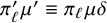 $\pi _\ell '\mu '\equiv \pi _\ell \mu \delta $
. We cannot have
$\pi _\ell '\mu '\equiv \pi _\ell \mu \delta $
. We cannot have $\delta $
as a suffix of
$\delta $
as a suffix of $\mu '$
since
$\mu '$
since $\mu '$
has no invertible suffix and
$\mu '$
has no invertible suffix and $\delta $
is nonempty. If
$\delta $
is nonempty. If $\mu '$
is a suffix of
$\mu '$
is a suffix of $\delta $
, then it is left invertible, but it is also right invertible since
$\delta $
, then it is left invertible, but it is also right invertible since $\mu '\gamma '$
is invertible. This contradicts that
$\mu '\gamma '$
is invertible. This contradicts that $\mu '$
has no invertible suffix. Thus
$\mu '$
has no invertible suffix. Thus $\pi x(g,g^{-1})\in N_0$
. This completes the proof that X freely generates
$\pi x(g,g^{-1})\in N_0$
. This completes the proof that X freely generates $X^*$
and
$X^*$
and $N\cong G\ast X^*$
by the Ping Pong Lemma.
$N\cong G\ast X^*$
by the Ping Pong Lemma.
5 Proving
$M \times M$
is a free N-set

As in the previous section, throughout this section
 $$\begin{align*}M = \langle A \mid w_1=1, \ldots, w_k=1 \rangle. \end{align*}$$
For the next part of the argument we want to prove that $M \times M$
is a free right N-set under the action
$M \times M$
is a free right N-set under the action
 $$\begin{align*}(m_1,m_2) \cdot (n_1,n_2) = (m_1 n_1, n_2 m_2), \end{align*}$$
where $(m_1,m_2) \in M \times M$
and
$(m_1,m_2) \in M \times M$
and $(n_1,n_2) \in N$
. Note that in the above situation we have
$(n_1,n_2) \in N$
. Note that in the above situation we have
 $$\begin{align*}m_1m_2 = m_1 n_1 n_2 m_2 \end{align*}$$
in M since $n_1n_2=1$
by definition of N.
$n_1n_2=1$
by definition of N.
We shall need the following remark. If S is a cancellative monoid and X is a free right S-set, then $xs=xs'$
implies
$xs=xs'$
implies $s=s'$
for
$s=s'$
for $x\in X$
and
$x\in X$
and $s,s'\in S$
, and dually for free left S-sets. Indeed, this is true for the right action of S on itself by cancellativity, and a free S-set is a disjoint union of copies of the action of S on itself.
$s,s'\in S$
, and dually for free left S-sets. Indeed, this is true for the right action of S on itself by cancellativity, and a free S-set is a disjoint union of copies of the action of S on itself.
Our aim in this section is to prove the following result. Note the basis in the following theorem is not finite, but we do not expect nor need it to be so.
Theorem 5.1. The set $M \times M$
is a free right N-set under the action
$M \times M$
is a free right N-set under the action
 $$\begin{align*}(m_1,m_2) \cdot (n_1,n_2) = (m_1 n_1, n_2 m_2), \end{align*}$$
where $(m_1,m_2) \in M \times M$
and
$(m_1,m_2) \in M \times M$
and $(n_1,n_2) \in N$
. In more detail, let
$(n_1,n_2) \in N$
. In more detail, let $\mathcal {B}$
be the set of all pairs of words
$\mathcal {B}$
be the set of all pairs of words $(\alpha _1, \alpha _2)$
such that
$(\alpha _1, \alpha _2)$
such that $\alpha _1\alpha _2 \equiv \alpha $
is a reduced word and
$\alpha _1\alpha _2 \equiv \alpha $
is a reduced word and $\alpha $
has Otto-Zhang normal form
$\alpha $
has Otto-Zhang normal form
 $$\begin{align*}\alpha\equiv w_0a_1w_1\cdots a_mw_m\end{align*}$$
with $\alpha _1\equiv w_0a_1\cdots wa_{i-1}$
and
$\alpha _1\equiv w_0a_1\cdots wa_{i-1}$
and $\alpha _2\equiv w_{i-1}a_i\cdots a_mw_m$
for some
$\alpha _2\equiv w_{i-1}a_i\cdots a_mw_m$
for some $1\leq i\leq m+1$
. Then
$1\leq i\leq m+1$
. Then $M \times M$
is a free right N-set with basis
$M \times M$
is a free right N-set with basis $\mathcal {B}$
.
$\mathcal {B}$
.
Proof. Let $u,v\in A^*$
be reduced words and let
$u,v\in A^*$
be reduced words and let $uv\equiv w_0a_1\cdots a_mw_m$
in Otto-Zhang normal form. Suppose, moreover, that
$uv\equiv w_0a_1\cdots a_mw_m$
in Otto-Zhang normal form. Suppose, moreover, that $u\equiv w_0a_0\cdots w_{i-2}a_{i-1}w_{i-1}'$
and
$u\equiv w_0a_0\cdots w_{i-2}a_{i-1}w_{i-1}'$
and $v\equiv w_{i-1}"a_i\cdots a_mw_m$
where
$v\equiv w_{i-1}"a_i\cdots a_mw_m$
where $w_{i-1}\equiv w_{i-1}'w_{i-1}"$
. Note that for
$w_{i-1}\equiv w_{i-1}'w_{i-1}"$
. Note that for $j\neq i-1$
, we have that
$j\neq i-1$
, we have that $w_j$
is reduced and hence belongs to
$w_j$
is reduced and hence belongs to $\Delta ^*$
by Lemma 3.2. Also,
$\Delta ^*$
by Lemma 3.2. Also, $\overline {uv} = w_0a_1\cdots a_{i-1}\overline {w_{i-1}}a_i\cdots a_m w_m$
by Lemma 3.4. It follows that
$\overline {uv} = w_0a_1\cdots a_{i-1}\overline {w_{i-1}}a_i\cdots a_m w_m$
by Lemma 3.4. It follows that $(u',v')\in \mathcal B$
where
$(u',v')\in \mathcal B$
where $u'\equiv w_0a_1\cdots w_{i-2}a_{i-1}$
and
$u'\equiv w_0a_1\cdots w_{i-2}a_{i-1}$
and $v'\equiv \overline {w_{i-1}}a_i\cdots a_mw_m$
. We claim that
$v'\equiv \overline {w_{i-1}}a_i\cdots a_mw_m$
. We claim that $(u,v)\in (u',v')N$
. Indeed, note that
$(u,v)\in (u',v')N$
. Indeed, note that $(w_{i-1}',w_{i-1}"w_{i-1}^{-1})\in N$
since
$(w_{i-1}',w_{i-1}"w_{i-1}^{-1})\in N$
since $w_{i-1}' w_{i-1}"w_{i-1}^{-1} \equiv w_{i-1}w_{i-1}^{-1} = 1$
, and
$w_{i-1}' w_{i-1}"w_{i-1}^{-1} \equiv w_{i-1}w_{i-1}^{-1} = 1$
, and
 $$\begin{align*}(u',v')(w_{i-1}',w_{i-1}"w_{i-1}^{-1}) = (u'w_{i-1}', w_{i-1}"w_{i-1}^{-1} w_{i-1}a_i\cdots a_mw_m) = (u,v),\end{align*}$$
as required. We conclude that $\mathcal B$
is a generating set for
$\mathcal B$
is a generating set for $M\times M$
as a right N-set. It remains, to show each element of
$M\times M$
as a right N-set. It remains, to show each element of $M\times M$
has only one expression in the form
$M\times M$
has only one expression in the form $(\alpha _1,\alpha _2)(n_1,n_2)$
with
$(\alpha _1,\alpha _2)(n_1,n_2)$
with $(\alpha _1,\alpha _2)\in \mathcal B$
and
$(\alpha _1,\alpha _2)\in \mathcal B$
and $(n_1,n_2)\in N$
.
$(n_1,n_2)\in N$
.
Suppose that $(\alpha _1,\alpha _2)\in \mathcal B$
and let
$(\alpha _1,\alpha _2)\in \mathcal B$
and let $x,y$
be reduced words with
$x,y$
be reduced words with $xy=1$
. We show that
$xy=1$
. We show that $(\alpha _1,\alpha _2)$
can be recovered from the right-hand side of
$(\alpha _1,\alpha _2)$
can be recovered from the right-hand side of $(\alpha _1,\alpha _2)(x,y) = (\alpha _1x,y\alpha _2)$
. Note that by definition of
$(\alpha _1,\alpha _2)(x,y) = (\alpha _1x,y\alpha _2)$
. Note that by definition of $\mathcal B$
,
$\mathcal B$
, $\alpha _1$
has no invertible suffix.
$\alpha _1$
has no invertible suffix.
First we claim that $\alpha _1x$
is reduced. Indeed, since
$\alpha _1x$
is reduced. Indeed, since $\alpha _1$
and x are reduced, any rewrite rule that is applicable must cut across
$\alpha _1$
and x are reduced, any rewrite rule that is applicable must cut across $(\alpha _1,x)$
. Since the left-hand side of a rewrite rule is nonempty and invertible, this means we can write
$(\alpha _1,x)$
. Since the left-hand side of a rewrite rule is nonempty and invertible, this means we can write $\alpha _1\equiv \alpha \beta $
and
$\alpha _1\equiv \alpha \beta $
and $x\equiv \gamma \delta $
with
$x\equiv \gamma \delta $
with $\beta \gamma $
invertible and
$\beta \gamma $
invertible and $\beta $
,
$\beta $
, $\gamma $
nonempty. Since x is right invertible, we deduce that
$\gamma $
nonempty. Since x is right invertible, we deduce that $\gamma $
is invertible and hence
$\gamma $
is invertible and hence $\beta $
is invertible, contradicting that
$\beta $
is invertible, contradicting that $\alpha _1$
has no invertible suffix. Hence
$\alpha _1$
has no invertible suffix. Hence $\alpha _1x$
is reduced.
$\alpha _1x$
is reduced.
Consider $(\alpha _1x,\overline {y\alpha _2})$
. Let
$(\alpha _1x,\overline {y\alpha _2})$
. Let $\mu $
be the longest invertible word that cuts across
$\mu $
be the longest invertible word that cuts across $(\alpha _1x,\overline {y\alpha _2})$
if such a word exists, while if no such word exists then let
$(\alpha _1x,\overline {y\alpha _2})$
if such a word exists, while if no such word exists then let $\mu $
be the longest invertible suffix of
$\mu $
be the longest invertible suffix of $\alpha _1 x$
, which could possibly be empty. We claim that
$\alpha _1 x$
, which could possibly be empty. We claim that $\alpha _1x\overline {y\alpha _2}\equiv \alpha _1\mu \nu $
with
$\alpha _1x\overline {y\alpha _2}\equiv \alpha _1\mu \nu $
with $\overline {\mu \nu }=\alpha _2$
. It will then follow that we can recover
$\overline {\mu \nu }=\alpha _2$
. It will then follow that we can recover $(\alpha _1,\alpha _2)$
from
$(\alpha _1,\alpha _2)$
from $(\alpha _1,\alpha _2)(x,y)$
.
$(\alpha _1,\alpha _2)(x,y)$
.
Indeed, to prove the claim let $\alpha _1\alpha _2\equiv w_0a_0\cdots a_mw_m$
in Otto-Zhang normal form. Each
$\alpha _1\alpha _2\equiv w_0a_0\cdots a_mw_m$
in Otto-Zhang normal form. Each $w_j$
is reduced because
$w_j$
is reduced because $\alpha _1\alpha _2$
is reduced, by the definition of
$\alpha _1\alpha _2$
is reduced, by the definition of $\mathcal B$
, and then
$\mathcal B$
, and then $w_j \in \Delta ^*$
by Lemma 3.4. Then by definition of
$w_j \in \Delta ^*$
by Lemma 3.4. Then by definition of $\mathcal B$
, we have some i with
$\mathcal B$
, we have some i with $\alpha _1\equiv w_0a_0\cdots w_{i-2}a_{i-1}$
and
$\alpha _1\equiv w_0a_0\cdots w_{i-2}a_{i-1}$
and $\alpha _2\equiv w_{i-1}a_i\cdots a_mw_m$
. Then
$\alpha _2\equiv w_{i-1}a_i\cdots a_mw_m$
. Then $\alpha _1xy\alpha _2\equiv w_0a_0\cdots w_{i-2}a_{i-1}xyw_{i-1}a_i\cdots a_mw_m$
. By Lemma 3.1, it follows that any maximal invertible subword of
$\alpha _1xy\alpha _2\equiv w_0a_0\cdots w_{i-2}a_{i-1}xyw_{i-1}a_i\cdots a_mw_m$
. By Lemma 3.1, it follows that any maximal invertible subword of $\alpha _1xy\alpha _2$
is either a maximal invertible subword of
$\alpha _1xy\alpha _2$
is either a maximal invertible subword of $\alpha _1$
,
$\alpha _1$
, $\alpha _2$
or contains
$\alpha _2$
or contains $xy$
. But since
$xy$
. But since $xy=1$
in M and
$xy=1$
in M and $w_{i-1}$
is maximal invertible in
$w_{i-1}$
is maximal invertible in $\alpha _1\alpha _2$
, it follows that
$\alpha _1\alpha _2$
, it follows that $xyw_{i-1}$
is the maximal invertible subword of
$xyw_{i-1}$
is the maximal invertible subword of $\alpha _1xy\alpha _2\equiv w_0a_0\cdots w_{i-2}a_{i-1}xyw_{i-1}a_i\cdots a_mw_m$
containing
$\alpha _1xy\alpha _2\equiv w_0a_0\cdots w_{i-2}a_{i-1}xyw_{i-1}a_i\cdots a_mw_m$
containing $xy$
. It follows that the Otto Zhang normal form of the word
$xy$
. It follows that the Otto Zhang normal form of the word $\alpha _1xy\alpha _2$
is
$\alpha _1xy\alpha _2$
is
 $$\begin{align*}\alpha_1xy\alpha_2\equiv w_0a_0\cdots w_{i-2}a_{i-1}(xyw_{i-1})a_i\cdots a_mw_m \end{align*}$$
where the maximal invertible subwords in this normal form are the words
 $$\begin{align*}w_0, \ldots, w_{i-2}, xyw_{i-1}, w_i, \ldots, w_m. \end{align*}$$
Since $xyw_{i-1}$
is invertible it follows that
$xyw_{i-1}$
is invertible it follows that $y w_{i-1}$
is left invertible. Since
$y w_{i-1}$
is left invertible. Since $a_i w_i \cdots a_mw_m$
has no invertible prefix it follows that no invertible word cuts across the pair
$a_i w_i \cdots a_mw_m$
has no invertible prefix it follows that no invertible word cuts across the pair
 $$\begin{align*}(y w_{i-1}, a_i w_i \cdots a_mw_m). \end{align*}$$
Indeed, if $\sigma \equiv \sigma _1 \sigma _2$
were an invertible word that cuts across this pair with
$\sigma \equiv \sigma _1 \sigma _2$
were an invertible word that cuts across this pair with $\sigma _2$
a prefix of
$\sigma _2$
a prefix of $a_i w_i \cdots a_mw_m$
, then
$a_i w_i \cdots a_mw_m$
, then $\sigma _1$
is left invertible since it is a suffix of the left invertible word
$\sigma _1$
is left invertible since it is a suffix of the left invertible word $y w_{i-1}$
, and
$y w_{i-1}$
, and $\sigma _1$
is right invertible since it is a prefix of the invertible word
$\sigma _1$
is right invertible since it is a prefix of the invertible word $\sigma $
. Then
$\sigma $
. Then $\sigma _1$
and
$\sigma _1$
and $\sigma $
are invertible and thus
$\sigma $
are invertible and thus $\sigma _2$
is an invertible prefix of
$\sigma _2$
is an invertible prefix of $a_i w_i \cdots a_mw_m$
which is a contradiction. It follows that every invertible subword of the word
$a_i w_i \cdots a_mw_m$
which is a contradiction. It follows that every invertible subword of the word
 $$\begin{align*}y w_{i-1} a_i w_i \cdots a_mw_m \end{align*}$$
is contained in either a subword of $y w_{i-1}$
or else is a subword of
$y w_{i-1}$
or else is a subword of $a_i w_i \cdots a_mw_m$
. It follows that the Otto-Zhang normal form of
$a_i w_i \cdots a_mw_m$
. It follows that the Otto-Zhang normal form of $y\alpha _2$
is graphically equal to the product of the Otto-Zhang normal form of
$y\alpha _2$
is graphically equal to the product of the Otto-Zhang normal form of $yw_{i-1}$
and
$yw_{i-1}$
and $\nu :=a_iw_i\cdots a_mw_m$
. We conclude from Lemma 3.4 that
$\nu :=a_iw_i\cdots a_mw_m$
. We conclude from Lemma 3.4 that $\overline {y\alpha _2} \equiv \overline {yw_{i-1}}a_iw_i\cdots a_mw_m$
. Then
$\overline {y\alpha _2} \equiv \overline {yw_{i-1}}a_iw_i\cdots a_mw_m$
. Then
 $$\begin{align*}\alpha_1 x \overline {y\alpha_2} \equiv w_0a_0\cdots w_{i-2}a_{i-1}x\overline {yw_{i-1}}a_iw_i\cdots a_mw_m.\end{align*}$$
Now there are two cases. If there is an invertible word that cuts across $(\alpha _1x,\overline {y\alpha _2})$
then it follows that
$(\alpha _1x,\overline {y\alpha _2})$
then it follows that $\mu = x\overline {yw_{i-1}}$
since
$\mu = x\overline {yw_{i-1}}$
since $xy=1$
,
$xy=1$
, $x\overline {yw_{i-1}}$
is invertible, and
$x\overline {yw_{i-1}}$
is invertible, and $w_{i-1}$
is a maximal invertible subword of
$w_{i-1}$
is a maximal invertible subword of $\alpha _1\alpha _2$
. Therefore,
$\alpha _1\alpha _2$
. Therefore, $\alpha _1\overline {y\alpha _2}\equiv \alpha _1\mu \nu $
and
$\alpha _1\overline {y\alpha _2}\equiv \alpha _1\mu \nu $
and $\overline {\mu \nu }=\alpha _2$
. In the other case there is no invertible word that cuts across
$\overline {\mu \nu }=\alpha _2$
. In the other case there is no invertible word that cuts across $(\alpha _1x,\overline {y\alpha _2})$
. In this case since
$(\alpha _1x,\overline {y\alpha _2})$
. In this case since $x \overline {yw_{i-1}}$
is invertible, either x is empty or
$x \overline {yw_{i-1}}$
is invertible, either x is empty or $\overline {yw_{i-1}}$
is empty. If x is empty then y is also empty since
$\overline {yw_{i-1}}$
is empty. If x is empty then y is also empty since $xy=1$
and x and y are reduced. Therefore,
$xy=1$
and x and y are reduced. Therefore, $(\alpha _1 x, \overline {y \alpha _2}) = (\alpha _1, \alpha _2)$
, and by definition of
$(\alpha _1 x, \overline {y \alpha _2}) = (\alpha _1, \alpha _2)$
, and by definition of $\mathcal {B}$
the word
$\mathcal {B}$
the word $\alpha _1$
has no nontrivial invertible suffix, so
$\alpha _1$
has no nontrivial invertible suffix, so $\mu $
is empty. So we recover
$\mu $
is empty. So we recover $\alpha _2 = \nu = \overline {\mu \nu }$
. Otherwise,
$\alpha _2 = \nu = \overline {\mu \nu }$
. Otherwise, $\overline {yw_{i-1}}$
is the empty word so
$\overline {yw_{i-1}}$
is the empty word so
 $$\begin{align*}\alpha_1 x \overline {y\alpha_2} \equiv w_0a_0\cdots w_{i-2}a_{i-1}xa_iw_i\cdots a_mw_m.\end{align*}$$
In this case in M we have $x = xy w_{i-1} = w_{i-1}$
. In particular x is invertible. Furthermore
$x = xy w_{i-1} = w_{i-1}$
. In particular x is invertible. Furthermore
 $$\begin{align*}\alpha_1 x \equiv w_0a_0\cdots w_{i-2}a_{i-1}x \end{align*}$$
Suppose that x is not the longest invertible suffix of the word $\alpha _1 x$
; say, e.g., z is a longer such suffix. Then since
$\alpha _1 x$
; say, e.g., z is a longer such suffix. Then since $xy w_{i-1}$
and z are both invertible with x a suffix of z, it would follow from Lemma 3.1 that
$xy w_{i-1}$
and z are both invertible with x a suffix of z, it would follow from Lemma 3.1 that $zyw_{i-1}$
is an invertible word strictly containing
$zyw_{i-1}$
is an invertible word strictly containing $xy w_{i-1}$
contradicting the fact proved above that
$xy w_{i-1}$
contradicting the fact proved above that $xyw_{i-1}$
is a maximal invertible subword of
$xyw_{i-1}$
is a maximal invertible subword of $\alpha _1xy\alpha _2$
. Hence in this case x is the longest invertible suffix of the word
$\alpha _1xy\alpha _2$
. Hence in this case x is the longest invertible suffix of the word $\alpha _1 x$
. So by definition
$\alpha _1 x$
. So by definition $\mu \equiv x$
and
$\mu \equiv x$
and
 $$\begin{align*}\alpha_1 x \overline {y\alpha_2} \equiv \alpha_1 xa_iw_i\cdots a_mw_m \equiv \alpha_1 \mu \nu \end{align*}$$
and
 $$\begin{align*}\overline {\mu \nu} = \overline {xa_iw_i\cdots a_mw_m } = \overline {w_{i-1}a_iw_i\cdots a_mw_m } = \alpha_2 \end{align*}$$
since in this case, as we saw above, $x = w_{i-1}$
in M. This completes the proof that we can recover
$x = w_{i-1}$
in M. This completes the proof that we can recover $(\alpha _1, \alpha _2)$
from
$(\alpha _1, \alpha _2)$
from $(\alpha _1, \alpha _2)(x,y)$
.
$(\alpha _1, \alpha _2)(x,y)$
.
Next suppose that $(\alpha _1,\alpha _2)\in \mathcal B$
and
$(\alpha _1,\alpha _2)\in \mathcal B$
and $(\alpha _1,\alpha _2)(x,y)=(\alpha _1,\alpha _2)(x',y')$
with
$(\alpha _1,\alpha _2)(x,y)=(\alpha _1,\alpha _2)(x',y')$
with $(x,y)$
and
$(x,y)$
and $(x',y')\in N$
. We show that
$(x',y')\in N$
. We show that $(x,y)=(x',y')$
. Indeed, by Corollary [Reference Gray and Steinberg24, Corollary 3.8], M is a free right
$(x,y)=(x',y')$
. Indeed, by Corollary [Reference Gray and Steinberg24, Corollary 3.8], M is a free right $R_1$
-set and a free left
$R_1$
-set and a free left $L_1$
-set. Note that
$L_1$
-set. Note that $R_1,L_1$
are cancellative monoids. Hence the equations
$R_1,L_1$
are cancellative monoids. Hence the equations $\alpha _1x=\alpha _1x'$
and
$\alpha _1x=\alpha _1x'$
and $y\alpha _2=y'\alpha _2$
imply that
$y\alpha _2=y'\alpha _2$
imply that $x=x'$
and
$x=x'$
and $y=y'$
, as required.
$y=y'$
, as required.
Remark 5.2. Let $u,v \in A^*$
be reduced. Write
$u,v \in A^*$
be reduced. Write
 $$ \begin{align*} uv &\equiv w_0a_1w_1 \ldots a_m w_m \end{align*} $$
as in the statement of Lemma 3.3, where $a_i \in A$
for all
$a_i \in A$
for all $1 \leq i \leq m$
and
$1 \leq i \leq m$
and $w_i$
is a maximal invertible subword of w for all
$w_i$
is a maximal invertible subword of w for all $0 \leq i \leq m$
(where some of the
$0 \leq i \leq m$
(where some of the $w_i$
could be the empty word). Suppose that
$w_i$
could be the empty word). Suppose that
 $$ \begin{align*} u & \equiv w_0a_1\cdots w_{i-2}a_{i-1}w_{i-1}' \\ v & \equiv w_{i-1}"a_iw_i\cdots a_mw_m \end{align*} $$
with $w_{i-1}\equiv w_{i-1}'w_{i-1}"$
. The proof of Theorem 5.1 shows that
$w_{i-1}\equiv w_{i-1}'w_{i-1}"$
. The proof of Theorem 5.1 shows that $(u,v)$
is in the weak N-orbit of the basis element
$(u,v)$
is in the weak N-orbit of the basis element $(w_0a_1\cdots w_{i-2}a_{i-1},\overline {w_{i-1}}a_i\cdots a_mw_m)$
.
$(w_0a_1\cdots w_{i-2}a_{i-1},\overline {w_{i-1}}a_i\cdots a_mw_m)$
.
Since the set $M \times M$
is a free right N-set Theorem 5.1, the observation in the previous paragraph provides a characterisation of exactly when two pairs
$M \times M$
is a free right N-set Theorem 5.1, the observation in the previous paragraph provides a characterisation of exactly when two pairs $(u_1,v_1)$
and
$(u_1,v_1)$
and $(u_2,v_2)$
belong to the same weak N-orbit of the free right N-set
$(u_2,v_2)$
belong to the same weak N-orbit of the free right N-set $M \times M$
. Indeed,
$M \times M$
. Indeed, $(u_1,v_1)$
and
$(u_1,v_1)$
and $(u_2,v_2)$
belong to the same weak N-orbit if and only if the basis elements from
$(u_2,v_2)$
belong to the same weak N-orbit if and only if the basis elements from $\mathcal {B}$
obtained from
$\mathcal {B}$
obtained from $(u_1,v_1)$
and from
$(u_1,v_1)$
and from $(u_2,v_2)$
via the process described in the previous paragraph are the same. This description of the weak N-orbits of
$(u_2,v_2)$
via the process described in the previous paragraph are the same. This description of the weak N-orbits of $M \times M$
will be used in several arguments below.
$M \times M$
will be used in several arguments below.
Recall from the preliminaries section above that if a monoid N acts on the right of a set A, then the weak orbits of N on A are the equivalence classes under the smallest equivalence relation on A such that $a,an$
are equivalent for all
$a,an$
are equivalent for all $a\in A$
and
$a\in A$
and $n\in N$
. We recall for the benefit of the reader that
$n\in N$
. We recall for the benefit of the reader that $\mathbb ZA\otimes _{\mathbb ZN} \mathbb Z$
is a free abelian group with basis the set of weak orbits of N on A via the map sending
$\mathbb ZA\otimes _{\mathbb ZN} \mathbb Z$
is a free abelian group with basis the set of weak orbits of N on A via the map sending $a\otimes 1$
to the weak orbit of a.
$a\otimes 1$
to the weak orbit of a.
An important consequence of Theorem 5.1 and Remark 5.2, which will be proved in Lemma 5.3 below, is that $\overleftrightarrow {\Gamma } /N$
is a forest, where
$\overleftrightarrow {\Gamma } /N$
is a forest, where $\overleftrightarrow {\Gamma }$
is the two-sided Cayley graph of M and
$\overleftrightarrow {\Gamma }$
is the two-sided Cayley graph of M and $\overleftrightarrow {\Gamma } /N$
is the graph obtained by collapsing the induced subgraph on each weak orbit of N on the vertices of
$\overleftrightarrow {\Gamma } /N$
is the graph obtained by collapsing the induced subgraph on each weak orbit of N on the vertices of $\overleftrightarrow {\Gamma }$
to a point. So
$\overleftrightarrow {\Gamma }$
to a point. So $\overleftrightarrow {\Gamma } /N$
has vertex set
$\overleftrightarrow {\Gamma } /N$
has vertex set $(M\times M)/N$
and edge set consisting of those edges e of
$(M\times M)/N$
and edge set consisting of those edges e of $\overleftrightarrow {\Gamma }$
with initial vertex
$\overleftrightarrow {\Gamma }$
with initial vertex $\iota (e)$
in a different weak N-orbit than terminal vertex
$\iota (e)$
in a different weak N-orbit than terminal vertex $\tau (e)$
. The corresponding edge of
$\tau (e)$
. The corresponding edge of $\overleftrightarrow {\Gamma } /N$
goes from
$\overleftrightarrow {\Gamma } /N$
goes from $[\iota (e)]$
to
$[\iota (e)]$
to $[\tau (e)]$
where
$[\tau (e)]$
where $[(m,m')]$
denotes the weak N-orbit of
$[(m,m')]$
denotes the weak N-orbit of $(m,m')\in M\times M$
. This gives a bijection between the edges of
$(m,m')\in M\times M$
. This gives a bijection between the edges of $\overleftrightarrow {\Gamma }/N$
and the set of edges of
$\overleftrightarrow {\Gamma }/N$
and the set of edges of $\overleftrightarrow {\Gamma }$
whose initial and terminal vertices belong to distinct N-orbits. Thus for each such edge in
$\overleftrightarrow {\Gamma }$
whose initial and terminal vertices belong to distinct N-orbits. Thus for each such edge in $\overleftrightarrow {\Gamma }$
we can sensibly talk about the corresponding edge in
$\overleftrightarrow {\Gamma }$
we can sensibly talk about the corresponding edge in $\overleftrightarrow {\Gamma }/N$
. There is an
$\overleftrightarrow {\Gamma }/N$
. There is an $M\times M^{op}$
-equivariant cellular map
$M\times M^{op}$
-equivariant cellular map $\overleftrightarrow {\Gamma }\to \overleftrightarrow {\Gamma }/N$
sending a vertex to its class, and sending any edge connecting two vertices in the same weak N-orbit to that weak N-orbit (which is a vertex of the graph
$\overleftrightarrow {\Gamma }\to \overleftrightarrow {\Gamma }/N$
sending a vertex to its class, and sending any edge connecting two vertices in the same weak N-orbit to that weak N-orbit (which is a vertex of the graph $\overleftrightarrow {\Gamma }/N$
) and sending every other edge in
$\overleftrightarrow {\Gamma }/N$
) and sending every other edge in $\overleftrightarrow {\Gamma }$
to the corresponding edge in
$\overleftrightarrow {\Gamma }$
to the corresponding edge in $\overleftrightarrow {\Gamma }/N$
.
$\overleftrightarrow {\Gamma }/N$
.
Recall that $\pi _0(\overleftrightarrow {\Gamma })$
denotes the set of path-connected components of
$\pi _0(\overleftrightarrow {\Gamma })$
denotes the set of path-connected components of $\overleftrightarrow {\Gamma }$
which is isomorphic to M as an
$\overleftrightarrow {\Gamma }$
which is isomorphic to M as an $M \times M^{\mathrm {op}}$
-set; see [Reference Gray and Steinberg23, Section 5.3]. Note that if
$M \times M^{\mathrm {op}}$
-set; see [Reference Gray and Steinberg23, Section 5.3]. Note that if $[(m_1,m_2)]=[(m_1',m_2')]$
, then
$[(m_1,m_2)]=[(m_1',m_2')]$
, then $m_1m_2=m_1'm_2'$
. It follows that the map
$m_1m_2=m_1'm_2'$
. It follows that the map $\overleftrightarrow {\Gamma }\to \overleftrightarrow {\Gamma }/N$
factors through the map
$\overleftrightarrow {\Gamma }\to \overleftrightarrow {\Gamma }/N$
factors through the map $\overleftrightarrow {\Gamma }\to \pi _0(\overleftrightarrow {\Gamma })\cong M$
, and so
$\overleftrightarrow {\Gamma }\to \pi _0(\overleftrightarrow {\Gamma })\cong M$
, and so $\pi _0(\overleftrightarrow {\Gamma }/N)$
is identified with M.
$\pi _0(\overleftrightarrow {\Gamma }/N)$
is identified with M.
Lemma 5.3. The quotient $\overleftrightarrow {\Gamma } /N$
of the two-sided Cayley graph
$\overleftrightarrow {\Gamma } /N$
of the two-sided Cayley graph $\overleftrightarrow {\Gamma }$
of M by N is a forest.
$\overleftrightarrow {\Gamma }$
of M by N is a forest.
Proof. Let $s \in M$
and consider the component corresponding to s in
$s \in M$
and consider the component corresponding to s in $\overleftrightarrow {\Gamma }/N$
. Let w be the reduced word that equals s. Write
$\overleftrightarrow {\Gamma }/N$
. Let w be the reduced word that equals s. Write
 $$\begin{align*}w \equiv w_0 a_1 w_1 \ldots a_m w_m \end{align*}$$
in Otto-Zhang normal form where the $w_i$
are maximal invertible subwords (possibly empty, and all in
$w_i$
are maximal invertible subwords (possibly empty, and all in $\Delta ^*$
) and all
$\Delta ^*$
) and all $a_i \in A$
, as in the statement of Lemma 3.3. Let
$a_i \in A$
, as in the statement of Lemma 3.3. Let $w'\equiv a_1 a_2 \ldots a_m$
. We claim that the m-component of
$w'\equiv a_1 a_2 \ldots a_m$
. We claim that the m-component of $\overleftrightarrow {\Gamma }/N$
is isomorphic to the labelled graph denoted
$\overleftrightarrow {\Gamma }/N$
is isomorphic to the labelled graph denoted $\mathcal A(w')$
with vertex set
$\mathcal A(w')$
with vertex set $0,\ldots , m$
and an edge labelled by
$0,\ldots , m$
and an edge labelled by $a_i$
from
$a_i$
from $i-1$
to i for
$i-1$
to i for $1\leq i\leq m$
. It will then follow that
$1\leq i\leq m$
. It will then follow that $\overleftrightarrow {\Gamma }/N$
is a forest.
$\overleftrightarrow {\Gamma }/N$
is a forest.
Define a cellular map from the m-component of $\overleftrightarrow {\Gamma }$
to
$\overleftrightarrow {\Gamma }$
to $A(w')$
as follows. If
$A(w')$
as follows. If $\alpha _1,\alpha _2\in A^*$
are reduced with
$\alpha _1,\alpha _2\in A^*$
are reduced with $\alpha _1\alpha _2=m$
, then
$\alpha _1\alpha _2=m$
, then $\alpha _1\equiv w_0a_1\cdots w_{i-2}a_{i-1}w_{i-1}'$
and
$\alpha _1\equiv w_0a_1\cdots w_{i-2}a_{i-1}w_{i-1}'$
and $\alpha _2\equiv w_{i-1}"a_iw_i\cdots a_mw_m$
with
$\alpha _2\equiv w_{i-1}"a_iw_i\cdots a_mw_m$
with $\overline {w_{i-1}'w_{i-1}"}=w_{i-1}$
by Lemmas 3.3 and 3.4. Both
$\overline {w_{i-1}'w_{i-1}"}=w_{i-1}$
by Lemmas 3.3 and 3.4. Both $w_{i-1}'$
and
$w_{i-1}'$
and $w_{i-1}"$
can be empty. Send
$w_{i-1}"$
can be empty. Send $(\alpha _1,\alpha _2)$
to
$(\alpha _1,\alpha _2)$
to $i-1$
. Notice in particular that the basis element
$i-1$
. Notice in particular that the basis element $(w_0a_1\cdots w_{i-2}a_{i-1}, w_{i-1}a_iw_i\cdots a_mw_m)$
is sent to
$(w_0a_1\cdots w_{i-2}a_{i-1}, w_{i-1}a_iw_i\cdots a_mw_m)$
is sent to $i-1$
, and so this map is surjective on vertices. By Remark 5.2, this map factors through
$i-1$
, and so this map is surjective on vertices. By Remark 5.2, this map factors through $(M\times M)/N$
, and the induced map is injective on vertices. An edge in the m-component of
$(M\times M)/N$
, and the induced map is injective on vertices. An edge in the m-component of $\overleftrightarrow {\Gamma }$
has the form
$\overleftrightarrow {\Gamma }$
has the form $(\mu ,a,\gamma )$
where
$(\mu ,a,\gamma )$
where $\mu ,\gamma \in A^*$
are reduced,
$\mu ,\gamma \in A^*$
are reduced, $a\in A$
and
$a\in A$
and $\mu a\gamma =m$
. By Lemmas 3.3 and 3.4, we have two cases. The first is that
$\mu a\gamma =m$
. By Lemmas 3.3 and 3.4, we have two cases. The first is that $\mu \equiv w_0a_0\cdots w_{i-2}a_{i-1}w_{i-1}'$
,
$\mu \equiv w_0a_0\cdots w_{i-2}a_{i-1}w_{i-1}'$
, $\gamma \equiv w_{i-1}"a_i\cdots a_mw_m$
where
$\gamma \equiv w_{i-1}"a_i\cdots a_mw_m$
where $\overline {w_{i-1}'aw_{i-1}"}=w_{i-1}$
. In this case, by Remark 5.2, this edge is between two vertices in the same weak N-orbit, namely that of the basis element
$\overline {w_{i-1}'aw_{i-1}"}=w_{i-1}$
. In this case, by Remark 5.2, this edge is between two vertices in the same weak N-orbit, namely that of the basis element $(w_0a_0\cdots w_{i-2}a_{i-1},w_{i-1}a_i\cdots a_mw_m)$
. The second case is that
$(w_0a_0\cdots w_{i-2}a_{i-1},w_{i-1}a_i\cdots a_mw_m)$
. The second case is that $\mu \equiv w_0a_0\cdots w_{i-1}$
,
$\mu \equiv w_0a_0\cdots w_{i-1}$
, $\gamma \equiv w_i\cdots a_mw_0$
and
$\gamma \equiv w_i\cdots a_mw_0$
and $a=a_i$
. In this case, initial vertex is in the weak N-orbit of the basis element
$a=a_i$
. In this case, initial vertex is in the weak N-orbit of the basis element $(w_0a_0\cdots a_{i-1}, w_{i-1}a_i\cdots a_mw_m)$
, whereas the terminal vertex is in the weak N-orbit of the basis element
$(w_0a_0\cdots a_{i-1}, w_{i-1}a_i\cdots a_mw_m)$
, whereas the terminal vertex is in the weak N-orbit of the basis element $(w_0\cdots w_{i-1}a_i, w_i\cdots a_mw_m)$
. We map the corresponding edge of
$(w_0\cdots w_{i-1}a_i, w_i\cdots a_mw_m)$
. We map the corresponding edge of $\overleftrightarrow {\Gamma }/N$
to the edge labeled
$\overleftrightarrow {\Gamma }/N$
to the edge labeled $a_i$
from
$a_i$
from $i-1$
to i. This completes the proof of the isomorphism.
$i-1$
to i. This completes the proof of the isomorphism.
6 Proving the set of collapsed edges is a finitely generated free
$M \times M^{\mathrm {op}}$
-set

As in the previous section, throughout this section
 $$\begin{align*}M = \langle A \mid w_1=1, \ldots, w_k=1 \rangle. \end{align*}$$
Up to this point we have proved that:
-
•
$N \cong G \ast C^*$
for some finite set C where G is the group of units of M. -
•
$M \times M$
is a free N-set, with basis
$\mathcal {B}$
defined above, under the action
$$\begin{align*}(m_1,m_2) \cdot (n_1,n_2) = (m_1 n_1, n_2 m_2). \end{align*}$$


The final thing we need to prove is that the set E of edges collapsed when forming $\overleftrightarrow {\Gamma }/N$
is a finitely generated free
$\overleftrightarrow {\Gamma }/N$
is a finitely generated free $M \times M^{\mathrm {op}}$
-set. More precisely, we want to consider the edges E of the two-sided Cayley graph
$M \times M^{\mathrm {op}}$
-set. More precisely, we want to consider the edges E of the two-sided Cayley graph $\overleftrightarrow {\Gamma }$
between vertices in the same weak N-orbit of
$\overleftrightarrow {\Gamma }$
between vertices in the same weak N-orbit of $M \times M$
. Then
$M \times M$
. Then $M \times M^{\mathrm {op}}$
acts on this set E of edges via
$M \times M^{\mathrm {op}}$
acts on this set E of edges via
 $$\begin{align*}(m_1, m_2) \cdot (u,a,v) = (m_1 u, a, v m_2) \end{align*}$$
where $(m_1, m_2) \in M \times M^{\mathrm {op}}$
,
$(m_1, m_2) \in M \times M^{\mathrm {op}}$
, $a \in A$
and
$a \in A$
and $u, v, m_1, m_2$
are reduced words over A.
$u, v, m_1, m_2$
are reduced words over A.
Drawing an analogy with our argument in [Reference Gray and Steinberg24] the edges E are the analogue of edges between vertices in the same $\mathrel {\mathscr {R}}$
-class in that argument, and N is playing the role of
$\mathrel {\mathscr {R}}$
-class in that argument, and N is playing the role of $R_1$
– the right units. Note however that N is not in general the submonoid of right units of the monoid
$R_1$
– the right units. Note however that N is not in general the submonoid of right units of the monoid $M \times M^{\mathrm {op}}$
.
$M \times M^{\mathrm {op}}$
.
With the above definitions we want to prove the following.
Theorem 6.1. Let E be the set of edges of the two-sided Cayley graph $\overleftrightarrow {\Gamma }$
between vertices in the same weak N-orbit. Then E is a finitely generated free left
$\overleftrightarrow {\Gamma }$
between vertices in the same weak N-orbit. Then E is a finitely generated free left $M \times M^{\mathrm {op}}$
-set under the action
$M \times M^{\mathrm {op}}$
-set under the action
 $$\begin{align*}(m_1, m_2) \cdot (u,a,v) = (m_1 u, a, v m_2) \end{align*}$$
for $(m_1, m_2) \in M \times M^{\mathrm {op}}$
and
$(m_1, m_2) \in M \times M^{\mathrm {op}}$
and $(u,a,v) \in E$
, with finite basis
$(u,a,v) \in E$
, with finite basis
 $$ \begin{align*} & \mathcal{C} = \{ (\delta_1, a, \delta_2): \delta_1 a \delta_2\ \text{ is invertible},\ a \in A,\ \delta_1,\ \delta_2 \in A^*\ \text{ are reduced, and no proper invertible} \\& \qquad \text{subword of } \delta_1a\delta_2 \text{ contains the particular occurrence of } a \text{ that lies between } \delta_1 \text{ and } \delta_2 \}. \end{align*} $$
Furthermore, if $(\delta _1, a, \delta _2) \in \mathcal {C}$
then
$(\delta _1, a, \delta _2) \in \mathcal {C}$
then $\delta _1 a \delta _2 \in \Delta $
.
$\delta _1 a \delta _2 \in \Delta $
.
Proof. Let $(u,a,v)$
be an edge with
$(u,a,v)$
be an edge with $u,v\in A^*$
reduced, and let
$u,v\in A^*$
reduced, and let
 $$\begin{align*}uav\equiv w_0a_1\cdots a_mw_m\end{align*}$$
in Otto-Zhang normal form. First of all we claim that $(u,a,v)\in E$
if and only if the distinguished occurrence of a is not any of the
$(u,a,v)\in E$
if and only if the distinguished occurrence of a is not any of the $a_i$
. Suppose first that
$a_i$
. Suppose first that $a_i$
is the distinguished occurrence of a for some i, then
$a_i$
is the distinguished occurrence of a for some i, then $uav$
is reduced by Lemma 3.4 (since
$uav$
is reduced by Lemma 3.4 (since $u,v$
are reduced, and hence their subwords
$u,v$
are reduced, and hence their subwords $w_j$
are reduced) and
$w_j$
are reduced) and
 $$ \begin{align*} (u,av) & = (w_0a_1\cdots a_{i-1}w_{i-1},a_i\cdots a_mw_m) & \text{and}\\ (ua,v) &= (w_0\cdots w_{i-1}a_i, w_ia_{i+1}\cdots a_mw_m) \end{align*} $$
are in different weak N-orbits by Remark 5.2, as $(u a,v)$
is a basis element and
$(u a,v)$
is a basis element and
 $$\begin{align*}(w_0a_1\cdots a_{i-1},w_{i-1}a_i\cdots a_mw_m)\end{align*}$$
is the basis element in the weak orbit of $(u,av)$
.
$(u,av)$
.
On the other hand, suppose that a is a letter of some $w_i$
. Then
$w_i$
. Then $u\equiv w_0a_1\cdots a_iw_i'$
and
$u\equiv w_0a_1\cdots a_iw_i'$
and $v\equiv w_i"a_{i+1}\cdots a_mw_m$
with
$v\equiv w_i"a_{i+1}\cdots a_mw_m$
with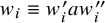 $w_i\equiv w_i'aw_i"$
. It follows from Remark 5.2 that
$w_i\equiv w_i'aw_i"$
. It follows from Remark 5.2 that $(ua,v)$
and
$(ua,v)$
and $(u,av)$
both belong to the weak N-orbit of the basis element
$(u,av)$
both belong to the weak N-orbit of the basis element $(w_0a_1\cdots a_i,\overline {w_i}a_{i+1}\cdots a_mw_m)$
. In particular, each element of
$(w_0a_1\cdots a_i,\overline {w_i}a_{i+1}\cdots a_mw_m)$
. In particular, each element of $\mathcal C$
belongs to E.
$\mathcal C$
belongs to E.
We must now show that if $(u,a,v)\in E$
, then
$(u,a,v)\in E$
, then $(u,a,v) = (m_1,m_2)(\delta _1,a,\delta _2)$
for a unique
$(u,a,v) = (m_1,m_2)(\delta _1,a,\delta _2)$
for a unique $(m_1,m_2)\in M\times M^{op}$
and
$(m_1,m_2)\in M\times M^{op}$
and $(\delta _1,a,\delta _2)\in \mathcal C$
. As before let
$(\delta _1,a,\delta _2)\in \mathcal C$
. As before let $uav\equiv w_0a_1\cdots a_mw_m$
in Otto-Zhang normal form. Then, by the above, there is a unique i such that the distinguished a occurs in
$uav\equiv w_0a_1\cdots a_mw_m$
in Otto-Zhang normal form. Then, by the above, there is a unique i such that the distinguished a occurs in $w_i$
. Since
$w_i$
. Since $w_i$
is invertible, there is a unique minimal invertible subword
$w_i$
is invertible, there is a unique minimal invertible subword $\delta _1a\delta _2$
containing this a by Proposition 4.1. Write
$\delta _1a\delta _2$
containing this a by Proposition 4.1. Write $u\equiv u'\delta _1$
and
$u\equiv u'\delta _1$
and $v\equiv \delta _2v'$
. Then
$v\equiv \delta _2v'$
. Then $(\delta _1,a,\delta _2)\in \mathcal C$
and
$(\delta _1,a,\delta _2)\in \mathcal C$
and $(u,a,v) = (u',v')(\delta _1,a,\delta _2)$
. We claim that these choices are unique.
$(u,a,v) = (u',v')(\delta _1,a,\delta _2)$
. We claim that these choices are unique.
Clearly the letter a is uniquely determined by $(u,a,v)$
. Suppose that
$(u,a,v)$
. Suppose that $\alpha ,\beta ,\delta _1',\delta _2'$
are reduced with
$\alpha ,\beta ,\delta _1',\delta _2'$
are reduced with $(\alpha ,\beta )(\delta _1',a,\delta _2')=(u,a,v)$
and
$(\alpha ,\beta )(\delta _1',a,\delta _2')=(u,a,v)$
and $(\delta _1',a,\delta _2')\in \mathcal C$
. Then
$(\delta _1',a,\delta _2')\in \mathcal C$
. Then $(u,a,v)=(\alpha \delta _1',a,\delta _2'\beta )$
. We claim that
$(u,a,v)=(\alpha \delta _1',a,\delta _2'\beta )$
. We claim that $\alpha \delta _1'$
and
$\alpha \delta _1'$
and $\delta _2'\beta $
are reduced. We handle just the first case as the second is dual. Since
$\delta _2'\beta $
are reduced. We handle just the first case as the second is dual. Since $\alpha ,\delta _1'$
are reduced and each left-hand side of a rewrite rule is nonempty and invertible, it follows that the only way we can apply a rewrite rule is if it overlaps
$\alpha ,\delta _1'$
are reduced and each left-hand side of a rewrite rule is nonempty and invertible, it follows that the only way we can apply a rewrite rule is if it overlaps $\alpha $
and
$\alpha $
and $\delta _1'$
. This would imply that
$\delta _1'$
. This would imply that $\delta _1'$
has a left invertible prefix. Now any prefix of
$\delta _1'$
has a left invertible prefix. Now any prefix of $\delta _1'$
is right invertible since
$\delta _1'$
is right invertible since $\delta _1'a\delta _2'$
is invertible. But then we obtain a contradiction to the fact that
$\delta _1'a\delta _2'$
is invertible. But then we obtain a contradiction to the fact that $\delta _1'$
has no invertible prefix by Proposition 4.1. Thus
$\delta _1'$
has no invertible prefix by Proposition 4.1. Thus $\alpha \delta _1'\equiv u'\delta _1$
and, dually,
$\alpha \delta _1'\equiv u'\delta _1$
and, dually, $\delta _2'\beta \equiv \delta _2v'$
. Then
$\delta _2'\beta \equiv \delta _2v'$
. Then $\delta _1'a\delta _2'$
and
$\delta _1'a\delta _2'$
and $\delta _1a\delta _2$
are both minimal invertible subwords of
$\delta _1a\delta _2$
are both minimal invertible subwords of $uav\equiv \alpha \delta _1'a\delta _2'\beta $
containing the distinguished a. By uniqueness of the minimal invertible subword containing a, which follows from Proposition 4.1, we conclude that
$uav\equiv \alpha \delta _1'a\delta _2'\beta $
containing the distinguished a. By uniqueness of the minimal invertible subword containing a, which follows from Proposition 4.1, we conclude that $\delta _1'a\delta _2'\equiv \delta _1a\delta _2$
, with the distinguished occurrences of a the same. Thus
$\delta _1'a\delta _2'\equiv \delta _1a\delta _2$
, with the distinguished occurrences of a the same. Thus $\delta _1\equiv \delta _1'$
,
$\delta _1\equiv \delta _1'$
, $\delta _2\equiv \delta _2'$
,
$\delta _2\equiv \delta _2'$
, $u'\equiv \alpha $
and
$u'\equiv \alpha $
and $v'\equiv \beta $
. This establishes the uniqueness, and so
$v'\equiv \beta $
. This establishes the uniqueness, and so $\mathcal C$
is a basis.
$\mathcal C$
is a basis.
To prove that $\mathcal C$
is finite we show that if
$\mathcal C$
is finite we show that if $(\delta _1,a,\delta _2)\in \mathcal C$
, then
$(\delta _1,a,\delta _2)\in \mathcal C$
, then $\delta _1a\delta _2\in \Delta $
. We begin by showing that
$\delta _1a\delta _2\in \Delta $
. We begin by showing that $\delta _1a\delta _2\in \Delta ^*$
. If
$\delta _1a\delta _2\in \Delta ^*$
. If $\delta _1a\delta _2$
is reduced, then it belongs to
$\delta _1a\delta _2$
is reduced, then it belongs to $\Delta ^*$
by Lemma 3.2 since it is invertible. Otherwise, we can apply a rewrite rule to
$\Delta ^*$
by Lemma 3.2 since it is invertible. Otherwise, we can apply a rewrite rule to $\delta _1a\delta _2$
. Since
$\delta _1a\delta _2$
. Since $\delta _1,\delta _2$
are reduced, the left-hand side of the rewrite rule must contain a. Since each left-hand side of a rewrite rule is in
$\delta _1,\delta _2$
are reduced, the left-hand side of the rewrite rule must contain a. Since each left-hand side of a rewrite rule is in $\Delta ^+$
, hence invertible, and
$\Delta ^+$
, hence invertible, and $\delta _1a\delta _2$
has no proper invertible subword containing the distinguished a, we must have that
$\delta _1a\delta _2$
has no proper invertible subword containing the distinguished a, we must have that $\delta _1a\delta _2$
is the left-hand side of a rewrite rule, and hence in
$\delta _1a\delta _2$
is the left-hand side of a rewrite rule, and hence in $\Delta ^*$
. It follows now that there is a subword of
$\Delta ^*$
. It follows now that there is a subword of $\delta _1a\delta _2$
containing a that belongs to
$\delta _1a\delta _2$
containing a that belongs to $\Delta $
. But then since elements of
$\Delta $
. But then since elements of $\Delta $
are invertible, we deduce by minimality that
$\Delta $
are invertible, we deduce by minimality that $\delta _1a\delta _2\in \Delta $
. We conclude that
$\delta _1a\delta _2\in \Delta $
. We conclude that $\mathcal C$
is finite as
$\mathcal C$
is finite as $\Delta $
is finite.
$\Delta $
is finite.
7 Two-sided homological finiteness properties of special monoids
With all the results in place they can be combined to prove the following main result. We shall use freely that $\mathbb ZM$
-bimodules are the same thing as left
$\mathbb ZM$
-bimodules are the same thing as left $\mathbb Z[M\times M^{op}]$
-modules.
$\mathbb Z[M\times M^{op}]$
-modules.
Before giving the proof, we make a general topological remark. If X is a CW complex, then the cellular chain complex can be augmented to
 $$\begin{align*}\cdots\rightarrow C_1(X)\to C_0(X)\to H_0(X)\to 0\end{align*}$$
where the map $C_0(X)\to H_0(X)$
is the projection. This chain complex is natural with respect to cellular maps. Identifying
$C_0(X)\to H_0(X)$
is the projection. This chain complex is natural with respect to cellular maps. Identifying $H_0(X)$
with the free abelian group on the path components of X, this map sends each vertex (viewed as a basis element of
$H_0(X)$
with the free abelian group on the path components of X, this map sends each vertex (viewed as a basis element of $C_0(X)$
) to its path component. Hence we can view this complex as the direct sum of the standard augmented cellular chain complexes of the path components of X. In particular, it will be exact if each path component of X is contractible.
$C_0(X)$
) to its path component. Hence we can view this complex as the direct sum of the standard augmented cellular chain complexes of the path components of X. In particular, it will be exact if each path component of X is contractible.
Theorem 7.1 (Theorem A)
Let M be a finitely presented monoid of the form
 $$\begin{align*}M = \langle A \mid w_1=1, \ldots, w_k=1 \rangle\end{align*}$$
and let G be the group of units of M.
-
(i) If G is of type
(for
$1 \leq n \leq \infty $
) then M is of type bi-. -
(ii) Furthermore, the Hochschild cohomological dimension of M is bounded below by
$\mathrm {cd}(G)$
and bounded above by
$\mathrm {max}\{ 2, \mathrm {cd}(G) \}$
.
 (for
(for 
 .
.

Proof. Let $\overleftrightarrow {\Gamma }$
be the two-sided Cayley graph of M and let F be
$\overleftrightarrow {\Gamma }$
be the two-sided Cayley graph of M and let F be $\overleftrightarrow {\Gamma } /N$
which is a forest by Lemma 5.3. Notice that the multiplication map
$\overleftrightarrow {\Gamma } /N$
which is a forest by Lemma 5.3. Notice that the multiplication map $M \times M \rightarrow M$
factors through
$M \times M \rightarrow M$
factors through $(M \times M)/N$
and hence the connected components of F are still isomorphic to M as an M-biset. The augmented cellular chain complex
$(M \times M)/N$
and hence the connected components of F are still isomorphic to M as an M-biset. The augmented cellular chain complex
 $$\begin{align*}0 \rightarrow C_1(F) \rightarrow C_0(F) \rightarrow H_0(F)\cong {\mathbb{Z}M} \rightarrow 0 \end{align*}$$
is a bimodule resolution of ${\mathbb {Z}M}$
with exactness following from the discussion before the theorem, as F is a forest and hence has contractible path components.
${\mathbb {Z}M}$
with exactness following from the discussion before the theorem, as F is a forest and hence has contractible path components.
Now $C_1(F)$
is the quotient of a free bimodule on A, namely
$C_1(F)$
is the quotient of a free bimodule on A, namely $\mathbb Z[M\times A\times M]$
, by
$\mathbb Z[M\times A\times M]$
, by $\mathbb ZE$
where E is the finitely generated free
$\mathbb ZE$
where E is the finitely generated free $M\times M^{op}$
-set from Theorem 6.1. Thus we have a free resolution
$M\times M^{op}$
-set from Theorem 6.1. Thus we have a free resolution
 $$\begin{align*}0\longrightarrow \mathbb ZE\longrightarrow \mathbb Z[M\times A\times M]\to C_1(F)\to 0\end{align*}$$
by finitely generated free bimodules, and so $C_1(F)$
is
$C_1(F)$
is  and has projective dimension at most 1.
We have $C_0(F)\cong \mathbb {Z}[(M\times M)/N]\cong \mathbb {Z}[M \times M]\otimes _{{\mathbb {Z}N}} \mathbb {Z}$
. In Theorem 4.8 we proved that N is a free product of the group of units G and a finitely generated free monoid. Together with [Reference Gray and Steinberg24, Corollary 4.13] this then implies that N is of type left-
$C_0(F)\cong \mathbb {Z}[(M\times M)/N]\cong \mathbb {Z}[M \times M]\otimes _{{\mathbb {Z}N}} \mathbb {Z}$
. In Theorem 4.8 we proved that N is a free product of the group of units G and a finitely generated free monoid. Together with [Reference Gray and Steinberg24, Corollary 4.13] this then implies that N is of type left- , and hence $\mathbb {Z}$
is a left
$\mathbb {Z}$
is a left ${\mathbb {Z}N}$
-module of type
${\mathbb {Z}N}$
-module of type  . Let
. Let $F_\bullet \to \mathbb {Z}\to 0$
be a free resolution of
$F_\bullet \to \mathbb {Z}\to 0$
be a free resolution of $\mathbb {Z}$
by
$\mathbb {Z}$
by ${\mathbb {Z}N}$
-modules with
${\mathbb {Z}N}$
-modules with $F_i$
finitely generated for
$F_i$
finitely generated for $0\leq i\leq n$
. Then since
$0\leq i\leq n$
. Then since $M\times M^{op}$
is a free right N-set, it follows that
$M\times M^{op}$
is a free right N-set, it follows that $\mathbb {Z}[M \times M^{op}]$
is free as a right
$\mathbb {Z}[M \times M^{op}]$
is free as a right ${\mathbb {Z}N}$
-module and hence flat. Thus
${\mathbb {Z}N}$
-module and hence flat. Thus $\mathbb Z[M\times M^{op}]\otimes _{{\mathbb {Z}N}} F_\bullet \to \mathbb Z[M\times M^{op}]\otimes _{{\mathbb {Z}N}} \mathbb {Z}\to 0$
is a free resolution with
$\mathbb Z[M\times M^{op}]\otimes _{{\mathbb {Z}N}} F_\bullet \to \mathbb Z[M\times M^{op}]\otimes _{{\mathbb {Z}N}} \mathbb {Z}\to 0$
is a free resolution with $\mathbb Z[M\times M^{op}]\otimes _{{\mathbb {Z}N}} F_i$
finitely generated for
$\mathbb Z[M\times M^{op}]\otimes _{{\mathbb {Z}N}} F_i$
finitely generated for $0\leq i\leq n$
. Therefore,
$0\leq i\leq n$
. Therefore, $C_0(F)\cong \mathbb {Z}[M \times M^{op}]\otimes _{{\mathbb {Z}N}} \mathbb {Z}$
is a
$C_0(F)\cong \mathbb {Z}[M \times M^{op}]\otimes _{{\mathbb {Z}N}} \mathbb {Z}$
is a $\mathbb Z[M\times M^{op}]$
-module of type
$\mathbb Z[M\times M^{op}]$
-module of type  . Now since $C_0(F)$
is
$C_0(F)$
is  and
and $C_1(F)$
is
$C_1(F)$
is  it follows from Lemma 2.1 that the ${\mathbb {Z}M}$
is
${\mathbb {Z}M}$
is  as a
as a $\mathbb Z[M\times M^{op}]$
-module, and hence the monoid M is of type bi-
$\mathbb Z[M\times M^{op}]$
-module, and hence the monoid M is of type bi- .
.
By [Reference Gray and Steinberg24, Corollary 4.15], since N is a free product of G and a free monoid we can choose a free resolution of $\mathbb {Z}$
over
$\mathbb {Z}$
over ${\mathbb {Z}N}$
to have length at most
${\mathbb {Z}N}$
to have length at most $\mathrm {max}\{1, \mathrm {cd}(G) \}$
, and so we can deduce from the above argument that
$\mathrm {max}\{1, \mathrm {cd}(G) \}$
, and so we can deduce from the above argument that $C_0(F)$
has projective dimension at most
$C_0(F)$
has projective dimension at most $\max \{1,\mathrm {cd}(G)\}$
. Since
$\max \{1,\mathrm {cd}(G)\}$
. Since $C_1(F)$
has projective dimension at most
$C_1(F)$
has projective dimension at most $1$
, we deduce that
$1$
, we deduce that ${\mathbb {Z}M}$
has projective dimension at most
${\mathbb {Z}M}$
has projective dimension at most $\mathrm {max}\{2, \mathrm {cd}(G) \}$
, and thus M has Hochschild dimension at most
$\mathrm {max}\{2, \mathrm {cd}(G) \}$
, and thus M has Hochschild dimension at most $\mathrm {max}\{2, \mathrm {cd}(G)\}$
, by Lemma 2.2.
$\mathrm {max}\{2, \mathrm {cd}(G)\}$
, by Lemma 2.2.
The fact that the Hochschild cohomological dimension of M is bounded below by that of G follows from [Reference Gray and Steinberg24, Theorem 3.16(2)] together with the fact that the Hochschild cohomological dimension bounds both the left and right cohomological dimension of a monoid; see [Reference Gray and Steinberg23, Section 7].
7.1 Applying the general result to special one-relator monoids
In the one-relator case the main theorem above specialises to the following which gives a Lyndon’s Identity type theorem for the two-sided homology of one-relator monoids.
Theorem 7.2 (Theorem B)
Every one-relator monoid of the form $\langle A \mid r=1 \rangle $
is of type bi-
$\langle A \mid r=1 \rangle $
is of type bi- $\mathrm {FP}_\infty $
. Moreover, if r is not a proper power then the one-relator monoid has Hochschild cohomological dimension at most
$\mathrm {FP}_\infty $
. Moreover, if r is not a proper power then the one-relator monoid has Hochschild cohomological dimension at most $2$
, while if r is a proper power then the monoid has infinite Hochschild cohomological dimension.
$2$
, while if r is a proper power then the monoid has infinite Hochschild cohomological dimension.
Proof. Let $M= \langle A \mid r=1 \rangle $
. The group of units G of M is a one-relator group by Adjan’s theorem [Reference Adjan1, Lemma 96] and hence the group G is of type
$M= \langle A \mid r=1 \rangle $
. The group of units G of M is a one-relator group by Adjan’s theorem [Reference Adjan1, Lemma 96] and hence the group G is of type $\mathrm {FP}_\infty $
by Lyndon’s Identity Theorem [Reference Lyndon43]. Now applying Theorem 7.1(i) we deduce that M is of type bi-
$\mathrm {FP}_\infty $
by Lyndon’s Identity Theorem [Reference Lyndon43]. Now applying Theorem 7.1(i) we deduce that M is of type bi- $\mathrm {FP}_\infty $
.
$\mathrm {FP}_\infty $
.
For the second statement, if r is not a proper power then the group of units G will be a torsion-free one-relator group (see, e.g., [Reference Gray and Steinberg24, Lemma 3.18]). Then Lyndon’s results [Reference Lyndon43] imply that G has cohomological dimension at most 2, which implies the same for the Hochschild cohomological dimension of M by Theorem 7.1(ii).
If r is a proper power then G has torsion and hence infinite cohomological dimension. Therefore M has infinite Hochschild cohomological dimension by Theorem 7.1(ii).
8 Other one-relator monoids
In [Reference Gray and Steinberg22] we proved that all one-relator monoids $\langle A \mid u=v \rangle $
are of type left-
$\langle A \mid u=v \rangle $
are of type left- $\mathrm {FP}_\infty $
(and dually of type right-
$\mathrm {FP}_\infty $
(and dually of type right- $\mathrm {FP}_\infty $
). In that paper we also classified the one-relator monoids of cohomological dimension at most 2. It is natural to ask to what extent the results in this paper on two-sided homology might be extended to general one-relator monoids
$\mathrm {FP}_\infty $
). In that paper we also classified the one-relator monoids of cohomological dimension at most 2. It is natural to ask to what extent the results in this paper on two-sided homology might be extended to general one-relator monoids $\langle A \mid u=v \rangle $
. In particular, it would be interesting to see whether the techniques in this paper can be further developed to prove that all one-relator monoids
$\langle A \mid u=v \rangle $
. In particular, it would be interesting to see whether the techniques in this paper can be further developed to prove that all one-relator monoids $\langle A \mid u=v \rangle $
are of type bi-
$\langle A \mid u=v \rangle $
are of type bi- $\mathrm {FP}_\infty $
.
$\mathrm {FP}_\infty $
.
One natural approach to answering this question would be to try to use the same general proof strategy that was employed in [Reference Gray and Steinberg22] in the one-sided case. From that viewpoint, the result in this paper showing that special monoids are all of type bi- $\mathrm {FP}_\infty $
would provide one important infinite family of base cases. The other infinite family of base cases are the, so-called, strictly aspherical one-relator monoids. It turns out (as we shall explain below) that known results can be applied to deduce that these strictly aspherical one-relator monoids are also of type bi-
$\mathrm {FP}_\infty $
would provide one important infinite family of base cases. The other infinite family of base cases are the, so-called, strictly aspherical one-relator monoids. It turns out (as we shall explain below) that known results can be applied to deduce that these strictly aspherical one-relator monoids are also of type bi- $\mathrm {FP}_\infty $
. Hence combined with the results in this paper that deals with all the base cases. Thus following same approach as in [Reference Gray and Steinberg22] this means that the key to proving that all one-relator monoids are of type bi-
$\mathrm {FP}_\infty $
. Hence combined with the results in this paper that deals with all the base cases. Thus following same approach as in [Reference Gray and Steinberg22] this means that the key to proving that all one-relator monoids are of type bi- $\mathrm {FP}_\infty $
will be to develop an understanding of how the property bi-
$\mathrm {FP}_\infty $
will be to develop an understanding of how the property bi- $\mathrm {FP}_\infty $
behaves under a process called compression (a common framework for both Adjan–Oganesyan compression [Reference Adjan and Oganesyan2] and Lallement compression [Reference Lallement40] that was developed in [Reference Gray and Steinberg22]). Developing this understanding in the one-sided case was already quite an involved task, occupying much of the paper [Reference Gray and Steinberg22], and we expect the two-sided case to be even more challenging.
$\mathrm {FP}_\infty $
behaves under a process called compression (a common framework for both Adjan–Oganesyan compression [Reference Adjan and Oganesyan2] and Lallement compression [Reference Lallement40] that was developed in [Reference Gray and Steinberg22]). Developing this understanding in the one-sided case was already quite an involved task, occupying much of the paper [Reference Gray and Steinberg22], and we expect the two-sided case to be even more challenging.
Let us outline this approach in more detail. For full details of the terminology used here we refer the reader to [Reference Gray and Steinberg22]. Let M be the one-relator monoid defined by the presentation $\langle A \mid u=v \rangle $
where, without loss of generality, we assume
$\langle A \mid u=v \rangle $
where, without loss of generality, we assume $|v| \leq |u|$
. This presentation for M is called compressible if there is a nonempty word
$|v| \leq |u|$
. This presentation for M is called compressible if there is a nonempty word $r \in A^+$
such that
$r \in A^+$
such that $u,v \in A^*r \cap rA^* $
. Otherwise, the presentation is called incompressible. If
$u,v \in A^*r \cap rA^* $
. Otherwise, the presentation is called incompressible. If $u,v \in A^*r \cap rA^* $
then there is an associated compressed one-relator monoid
$u,v \in A^*r \cap rA^* $
then there is an associated compressed one-relator monoid $M_r$
that has a shorter defining relation, and the word problem of
$M_r$
that has a shorter defining relation, and the word problem of $M_r$
is equivalent to that of M. The compression operation is transitive and confluent and it follows that there is a unique incompressible monoid
$M_r$
is equivalent to that of M. The compression operation is transitive and confluent and it follows that there is a unique incompressible monoid $M'$
to which M compresses.
$M'$
to which M compresses.
It follows from [Reference Gray and Steinberg22, Lemma 3.4 and Proposition 3.5] and [Reference Kobayashi32, Corollary 5.6] that if M is the one-relator monoid defined by the presentation $\langle A \mid u=v \rangle $
and
$\langle A \mid u=v \rangle $
and $M'$
is the unique incompressible monoid to which M compresses then either
$M'$
is the unique incompressible monoid to which M compresses then either
-
(i)
$M'$
is a special one-relator monoid
$\langle B \mid w=1 \rangle $
, or else -
(ii)
$M'$
is a nonspecial one-relator monoid with a strictly aspherical presentation
$\langle B \mid w=z \rangle $
.


Here a monoid presentation is strictly aspherical if each connected component of the Squier complex of the presentation is simply connected (see [Reference Gray and Steinberg22, Section 2] for the relevant definitions).
In case (i) above it follows from the results in this paper that $M' = \langle B \mid w=1 \rangle $
is of type bi-
$M' = \langle B \mid w=1 \rangle $
is of type bi- $\mathrm {FP}_\infty $
. In case (ii) the compressed monoid
$\mathrm {FP}_\infty $
. In case (ii) the compressed monoid $M' = \langle B \mid w=z \rangle $
is strictly aspherical, and it turns out, as we shall now explain, that this is enough to show that
$M' = \langle B \mid w=z \rangle $
is strictly aspherical, and it turns out, as we shall now explain, that this is enough to show that $M'$
is also of type bi-
$M'$
is also of type bi- $\mathrm {FP}_\infty $
. Indeed, a key fact used in the proof of the main result of [Reference Gray and Steinberg22] was that the Cayley complex of a strictly aspherical presentation turns out to be contractible; see [Reference Gray and Steinberg22, Lemmas 6.4 and 6.5]. It turns out that key fact also holds in the two-sided case too, and that it is likely to be equally important in the approach we are describing here to proving that all one-relator monoids are of type bi-
$\mathrm {FP}_\infty $
. Indeed, a key fact used in the proof of the main result of [Reference Gray and Steinberg22] was that the Cayley complex of a strictly aspherical presentation turns out to be contractible; see [Reference Gray and Steinberg22, Lemmas 6.4 and 6.5]. It turns out that key fact also holds in the two-sided case too, and that it is likely to be equally important in the approach we are describing here to proving that all one-relator monoids are of type bi- $\mathrm {FP}_\infty $
.
$\mathrm {FP}_\infty $
.
In more detail, in [Reference Pride53] Pride defines $\pi _2^{(b)}(\mathcal {P}) = H_1(D(\mathcal {P}))$
where
$\pi _2^{(b)}(\mathcal {P}) = H_1(D(\mathcal {P}))$
where $D(\mathcal {P})$
is the Squier complex of the presentation. Hence if
$D(\mathcal {P})$
is the Squier complex of the presentation. Hence if $\mathcal {P}$
is strictly aspherical then
$\mathcal {P}$
is strictly aspherical then $\pi _1(D(\mathcal {P}))$
is trivial at every vertex, hence in this case
$\pi _1(D(\mathcal {P}))$
is trivial at every vertex, hence in this case $\pi _2^{(b)}(\mathcal {P}) = H_1(D(\mathcal {P})) = 0$
. Then the argument in the final two paragraphs of the article [Reference Steinberg56] shows that the second homology of the 2-sided Cayley 2-complex of the presentation
$\pi _2^{(b)}(\mathcal {P}) = H_1(D(\mathcal {P})) = 0$
. Then the argument in the final two paragraphs of the article [Reference Steinberg56] shows that the second homology of the 2-sided Cayley 2-complex of the presentation $\mathcal {P}$
is equal to
$\mathcal {P}$
is equal to $\pi _2^{(b)}(\mathcal {P})$
. When the presentation
$\pi _2^{(b)}(\mathcal {P})$
. When the presentation $\mathcal {P}$
is strictly aspherical this implies that second homology of the two-sided Cayley complex is
$\mathcal {P}$
is strictly aspherical this implies that second homology of the two-sided Cayley complex is $0$
. Together with the fact proved in [Reference Gray and Steinberg23, Theorem 7.12] that each connected component of the two-sided Cayley complex is simply connected, this implies by the Hurewicz and Whitehead theorems that the connected components of the two-sided Cayley complex are contractible. Then it follows that the two-sided Cayley graph is a bi-equivariant classifying space for the monoid, in the sense defined in [Reference Gray and Steinberg23, Section 7], from which it follows that the monoid is bi-
$0$
. Together with the fact proved in [Reference Gray and Steinberg23, Theorem 7.12] that each connected component of the two-sided Cayley complex is simply connected, this implies by the Hurewicz and Whitehead theorems that the connected components of the two-sided Cayley complex are contractible. Then it follows that the two-sided Cayley graph is a bi-equivariant classifying space for the monoid, in the sense defined in [Reference Gray and Steinberg23, Section 7], from which it follows that the monoid is bi- $\mathrm {F}_\infty $
and hence by [Reference Gray and Steinberg23, Proposition 7.7] is also bi-
$\mathrm {F}_\infty $
and hence by [Reference Gray and Steinberg23, Proposition 7.7] is also bi- $\mathrm {FP}_\infty $
. Also this shows that a strictly aspherical finitely presented monoid has Hochschild cohomological dimension at most
$\mathrm {FP}_\infty $
. Also this shows that a strictly aspherical finitely presented monoid has Hochschild cohomological dimension at most $2$
, again by results of [Reference Gray and Steinberg23, Section 7], since the argument above shows that the 2-sided Cayley 2-complex is a bi-equivariant classifying space for the monoid.
$2$
, again by results of [Reference Gray and Steinberg23, Section 7], since the argument above shows that the 2-sided Cayley 2-complex is a bi-equivariant classifying space for the monoid.
In particular the observations in the previous paragraph can be used to give an alternative proof that when w is not a proper power the torsion-free special one-relator monoid $\langle A \mid w=1 \rangle $
is of type bi-
$\langle A \mid w=1 \rangle $
is of type bi- $\mathrm {FP}_\infty $
and has Hochschild cohomological dimension at most
$\mathrm {FP}_\infty $
and has Hochschild cohomological dimension at most $2$
, since Kobayashi proved in [Reference Kobayashi33, Corollary 7.5] that torsion-free special one-relator monoids are strictly aspherical. In addition these observations show the property bi-
$2$
, since Kobayashi proved in [Reference Kobayashi33, Corollary 7.5] that torsion-free special one-relator monoids are strictly aspherical. In addition these observations show the property bi- $\mathrm {FP}_\infty $
holds for one-relator monoids also in the following cases.
$\mathrm {FP}_\infty $
holds for one-relator monoids also in the following cases.
Theorem 8.1. Let $M = \langle A \mid u=v \rangle $
be an incompressible one-relator monoid with
$M = \langle A \mid u=v \rangle $
be an incompressible one-relator monoid with $u,v \in A^+$
, that is, there is no nonempty word
$u,v \in A^+$
, that is, there is no nonempty word $r \in A^+$
such that
$r \in A^+$
such that $u,v \in A^*r \cap r A^*$
. Then M is of type bi-
$u,v \in A^*r \cap r A^*$
. Then M is of type bi- $\mathrm {FP}_\infty $
and has Hochschild cohomological dimension at most
$\mathrm {FP}_\infty $
and has Hochschild cohomological dimension at most $2$
.
$2$
.
The class of examples covered by the previous proposition should, from the discussion in this section above, be viewed as a family of base cases for a possible future inductive proof using compression that all one-relator monoids are of type bi- $\mathrm {FP}_\infty $
.
$\mathrm {FP}_\infty $
.
Competing interests
The authors have no competing interest to declare.
Financial support
This work was supported by the EPSRC grant EP/V032003/1 ‘Algorithmic, topological and geometric aspects of infinite groups, monoids and inverse semigroups’. The second author was supported by a Simons Foundation Collaboration Grant, award number 849561, the Australian Research Council Grant DP230103184 and Marsden Fund Grant MFP-VUW2411


 Open access

