





1 Introduction
The following theorem was proved by Montgomery and Zippin in 1940 [Reference Montgomery and Zippin3].
Theorem 1.1 If G is a group of rotations of $\mathbb {R}^3$
that acts transitively on the unit sphere
$\mathbb {R}^3$
that acts transitively on the unit sphere $\mathbb {S}^2$
in
$\mathbb {S}^2$
in $\mathbb {R}^3$
, then G is the group of all rotations of
$\mathbb {R}^3$
, then G is the group of all rotations of $\mathbb {R}^3$
.
$\mathbb {R}^3$
.
The proof is based on the construction of a curve of subgroups, each of which is homeomorphic to the circle $\mathbb {S}^1$
, in the topological group G. In this short note, we:
$\mathbb {S}^1$
, in the topological group G. In this short note, we:
-
(1) give an elementary proof of Theorem 1.1;
-
(2) prove the analogous result for the group generated by reflections across planes through the origin;
-
(3) show that the statement corresponding to Theorem 1.1 in $\mathbb {R}^4$
is false.
$\mathbb {R}^4$
is false.

In terms of matrices, these refer to the orthogonal groups $\mathrm {SO}(3)$
,
$\mathrm {SO}(3)$
, $\mathrm {O}(3)$
, and
$\mathrm {O}(3)$
, and $\mathrm {SO}(4)$
, respectively.
$\mathrm {SO}(4)$
, respectively.
2 An elementary proof of Theorem 1.1
First, we recall that each rotation of $\mathbb {R}^3$
is the composition of two rotations of order two. Clearly, we need only prove this for a rotation R whose axis A is the line joining the points
$\mathbb {R}^3$
is the composition of two rotations of order two. Clearly, we need only prove this for a rotation R whose axis A is the line joining the points $\mathbf {e}_3$
and
$\mathbf {e}_3$
and $-\mathbf {e}_3$
, where
$-\mathbf {e}_3$
, where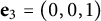 $\mathbf {e}_3 = (0,0,1)$
. Now
$\mathbf {e}_3 = (0,0,1)$
. Now $R = R_1R_2$
, for some reflections
$R = R_1R_2$
, for some reflections $R_1$
and
$R_1$
and $R_2$
, where each
$R_2$
, where each $R_j$
is the reflection across a vertical plane that contains A. Then
$R_j$
is the reflection across a vertical plane that contains A. Then $R=(R_1R_0)(R_0R_2)$
, where
$R=(R_1R_0)(R_0R_2)$
, where $R_0$
is the reflection across the equatorial plane of
$R_0$
is the reflection across the equatorial plane of $\mathbb {S}^2$
, and each factor is a rotation of order two.
$\mathbb {S}^2$
, and each factor is a rotation of order two.
Now suppose that G is a group of rotations of $\mathbb {R}^3$
about the origin
$\mathbb {R}^3$
about the origin $0$
that acts transitively on the unit sphere
$0$
that acts transitively on the unit sphere $\mathbb {S}^2$
. Then there is some g in G such that
$\mathbb {S}^2$
. Then there is some g in G such that $g(\mathbf {e}_3) = -\mathbf {e}_3$
. As rotations are linear maps, they map antipodal (i.e., diametrically opposite) points to antipodal points, so we see that g interchanges
$g(\mathbf {e}_3) = -\mathbf {e}_3$
. As rotations are linear maps, they map antipodal (i.e., diametrically opposite) points to antipodal points, so we see that g interchanges $\mathbf {e}_3$
and
$\mathbf {e}_3$
and $-\mathbf {e}_3$
. Now this can only happen if g is a rotation of order two, say with fixed points
$-\mathbf {e}_3$
. Now this can only happen if g is a rotation of order two, say with fixed points $\mathbf {v}$
and
$\mathbf {v}$
and $-\mathbf {v}$
. Now take any rotation R of order two, say with fixed points
$-\mathbf {v}$
. Now take any rotation R of order two, say with fixed points $\mathbf {w}$
and
$\mathbf {w}$
and $-\mathbf {w}$
, and note that R is uniquely determined by
$-\mathbf {w}$
, and note that R is uniquely determined by $\mathbf {w}$
. As G is transitive, there is some h in G with
$\mathbf {w}$
. As G is transitive, there is some h in G with $h(\mathbf {v}) = \mathbf {w}$
. As
$h(\mathbf {v}) = \mathbf {w}$
. As $hgh^{-1}$
is a rotation of order two which fixes
$hgh^{-1}$
is a rotation of order two which fixes $\mathbf {w}$
and
$\mathbf {w}$
and $-\mathbf {w}$
, we see that
$-\mathbf {w}$
, we see that $R = hgh^{-1}$
. This shows that G contains every rotation of
$R = hgh^{-1}$
. This shows that G contains every rotation of $\mathbb {R}^3$
of order two; hence G is the group of all rotations of
$\mathbb {R}^3$
of order two; hence G is the group of all rotations of $\mathbb {R}^3$
.
$\mathbb {R}^3$
.
3 The orthogonal group
$\mathrm {O}(3)$

The orthogonal group $\mathrm {O}(3)$
is the group generated by reflections across all planes through the origin in
$\mathrm {O}(3)$
is the group generated by reflections across all planes through the origin in $\mathbb {R}^3$
, and we have the following result.
$\mathbb {R}^3$
, and we have the following result.
Theorem 3.1 If G is a subgroup of $\mathrm {O}(3)$
that acts transitively on
$\mathrm {O}(3)$
that acts transitively on $\mathbb {S}^2$
, then G is
$\mathbb {S}^2$
, then G is $\mathrm {O}(3)$
or
$\mathrm {O}(3)$
or $\mathrm {SO}(3)$
.
$\mathrm {SO}(3)$
.
Proof Let $\mathbf {e}_1 = (1,0,0)$
. Exactly as in the proof of Theorem 1.1 there are maps g and h in
$\mathbf {e}_1 = (1,0,0)$
. Exactly as in the proof of Theorem 1.1 there are maps g and h in $\mathrm {O}(3)$
such that g interchanges
$\mathrm {O}(3)$
such that g interchanges $\mathbf {e}_3$
and
$\mathbf {e}_3$
and $-\mathbf {e}_3$
, and h interchanges
$-\mathbf {e}_3$
, and h interchanges $\mathbf {e}_1$
and
$\mathbf {e}_1$
and $-\mathbf {e}_1$
. Now each of g and h is either a rotation of order two or a reflection. If g and h are reflections, then
$-\mathbf {e}_1$
. Now each of g and h is either a rotation of order two or a reflection. If g and h are reflections, then $gh$
is a rotation of order two so that, in all cases, G contains a rotation of order two. By transitivity, G contains all rotations of order two; hence all rotations of
$gh$
is a rotation of order two so that, in all cases, G contains a rotation of order two. By transitivity, G contains all rotations of order two; hence all rotations of $\mathbb {R}^3$
. If G contains a reflection, then
$\mathbb {R}^3$
. If G contains a reflection, then $G = \mathrm {O}(3)$
; otherwise,
$G = \mathrm {O}(3)$
; otherwise, $G = \mathrm {SO}(3)$
.
$G = \mathrm {SO}(3)$
.
4 Rotations of
$\mathbb {R}^4$

It is well known that the orthogonal maps of $\mathbb {R}^4$
onto itself can be described in terms of quaternions; for more details, see [Reference Coxeter1, Reference Goldvard and Karp2, Reference Weiner and Wilkins4]. In particular, the elements of
$\mathbb {R}^4$
onto itself can be described in terms of quaternions; for more details, see [Reference Coxeter1, Reference Goldvard and Karp2, Reference Weiner and Wilkins4]. In particular, the elements of $\mathrm {SO}(4)$
are the maps of the form
$\mathrm {SO}(4)$
are the maps of the form $x\mapsto axb$
, where x is a quaternion (identified as a point in
$x\mapsto axb$
, where x is a quaternion (identified as a point in $\mathbb {R}^4$
), and a and b are unit quaternions. Now it is shown in [Reference Coxeter1, p. 142] that the set of such maps of the form
$\mathbb {R}^4$
), and a and b are unit quaternions. Now it is shown in [Reference Coxeter1, p. 142] that the set of such maps of the form $x \mapsto ax$
forms a subgroup of
$x \mapsto ax$
forms a subgroup of $\mathrm {SO}(4)$
, as do the maps of the form
$\mathrm {SO}(4)$
, as do the maps of the form $x \mapsto xb$
, and, moreover that the intersection of these two subgroups contains only the two maps
$x \mapsto xb$
, and, moreover that the intersection of these two subgroups contains only the two maps $x\mapsto x$
and
$x\mapsto x$
and $x\mapsto -x$
. This shows that the set of such maps
$x\mapsto -x$
. This shows that the set of such maps $x \mapsto ax$
forms a proper subgroup of
$x \mapsto ax$
forms a proper subgroup of $\mathrm {SO}(4)$
, and this acts transitively on
$\mathrm {SO}(4)$
, and this acts transitively on $\mathbb {S}^3$
since the orbit of
$\mathbb {S}^3$
since the orbit of $1$
is the set of unit quaternions (i.e.,
$1$
is the set of unit quaternions (i.e., $\mathbb {S}^3$
).
$\mathbb {S}^3$
).


 Open access

