




1. Introduction
The vast infrastructure of laws and institutions compelling the able-bodied to labour that was established in England in the centuries after the Black Death was provocatively characterized as constituting ‘a new serfdom’ by A. L. Beier, analogous to the ‘second serfdom’ imposed upon peasants in Eastern Europe.Footnote 1 One element within this edifice was the policy of parish (or pauper) apprenticeship established by the Poor Laws of 1598 and 1601, in which parish officers were granted the power to bind poor children by indenture as ‘apprentices’ to those judged fit to be masters, with the consent of two magistrates, until they reached the age of 21 (girls) or 24 (boys).Footnote 2 Since no consent was required by either the child or their parents/guardians, it was a mode of poor relief based on coerced labour. The majority of rural children were bound as apprentices in husbandry or housewifery, starting between the ages of 7 and 15, to live and work with their master or mistress as an unpaid indentured farm servant for a potential term of up to 14 or 17 years, in exchange for maintenance and the opportunity to gain experience and skills.Footnote 3 However, in this case, the parallels with serfdom ran deeper than its general coercive character. Most labour laws aimed to compel people into waged work, to restrict labour mobility generally and to shift the locus of extra-economic coercive power from individual landlords to the state. Yet, as this article will demonstrate, many rural parishes developed distinctive systems for organizing parish apprenticeships that compelled young people to perform unwaged work, bound them to specific local landholdings and empowered local landowners to exercise wide-ranging discretionary power over the local workforce. While the analogy is limited, it highlights the startling peculiarity of parish apprenticeships within the English economy. This is the first of two articles that aims to explicate why and how these labour systems bound children to local soil and explore their historical relationship to the Poor Laws and the labour market.
Parish apprenticeship had evolved into three distinct forms by the early nineteenth century, as recognized by Sidney and Beatrice Webb in 1927: the binding of children individually to masters with a premium, who accepted ‘voluntarily’; the binding of children in ‘batches to manufacturers’, primarily to textile factories; and the compulsory ‘allotment of parish children among the ratepayers’.Footnote 4 This third type is the subject of this study.Footnote 5 It was distinctive owing to the way the legal power to compel an individual to receive an apprentice was used to construct predictable systems for allocating children among ratepayers, which the Webbs noted was ‘somewhat analogous to the “Roundsman” and “Labour Rate” devices for sharing the burden of the adults’.Footnote 6 Indeed, this analogy was the basis of repeated criticisms by three assistant Poor Law commissioners in 1836. William Gilbert, for example, argued that apprenticeship schemes were erected ‘upon the same false principles upon which the labour-rate was established’ and were subject to the same ‘objections’.Footnote 7 The significance of the analogy is that the Labour Rate was one of the labour allocation schemes that emerged from the 1790s in response to the crisis of rural poverty and unemployment.Footnote 8 Each ratepayer was required either to employ labourers at an agreed wage level or to pay the equivalent in rates to the overseers, or some combination.Footnote 9 These labour schemes were condemned as one of the chief ‘evils’ of the Old Poor Law because they were judged to be an unnatural distortion of the labour market.Footnote 10 It is therefore striking that the commissioners criticized compulsory apprenticeship schemes in exactly the same terms – as ‘an undue interference with the market of free labour’.Footnote 11
Given the concerns of contemporaries and the significance of the historical associations, it is surprising that such schemes have been overlooked since the Webbs’ account a century ago. Beyond passing mentions in individual studies – which indicate their existence as early as the seventeenth century – we know nothing about the development of these schemes before the nineteenth century. Part of their apparent neglect can be explained by being confined to particular regions, as explored here. Yet, more fundamentally, our dominant interpretive frames have rendered them either invisible or insignificant. The most common framing is to study parish apprenticeships primarily as a device of poor relief, focusing on the circumstances of the family and its effectiveness as a method to alleviate poverty.Footnote 12 When attention turns to the economics of apprenticeship, however, it is either at the micro level of individuals and families within the household economy or at the macro level of the market economy.Footnote 13 In the latter, apprentices are reduced to an artificial supply of labour, the dynamics of which are explicable only as either a direct response to or an interference with market demand.Footnote 14 A partial exception is Katrina Honeyman’s study on factory apprenticeships after 1780, which demonstrates that they constituted a distinctive economic arrangement that was ‘rigorous, well coordinated and formally recorded’.Footnote 15 Methodologically, the standard approach has been encouraged by a reliance on indentures, which present a series of discrete, disconnected events with standardized information ripe for statistical analysis.Footnote 16 Theoretically, it has been shaped by the naturalization of markets within much economic history, which leads to a presumption that most economic phenomena should be explicable in market terms.Footnote 17 Yet, it is a mistake to attempt to explain parish apprenticeship schemes solely in terms of market forces for at least two simple reasons: first, their labour had no price and was not subject to standard supply-and-demand dynamics; second, in contrast to the decentralized allocation of a market, these schemes were centralized.Footnote 18 While historians of unfree labour have identified pauper apprenticeships as coerced labour shaped by non-market forces, this has focused on national law rather than local implementation.Footnote 19
The aim here is to contribute to the political economy of parish apprenticeship by exploring how its distinctive mode of organizing labour was shaped by legal and political institutions, without reducing it to an incidental by-product of how the costs of poor relief were distributed. It is principally concerned with compulsory apprenticeships as a local social policy, such that the question of labour is not merely about the allocation of productive resources but always deeply entangled with wider concerns about socialization, moral discipline and patriarchal authority.Footnote 20 Over two articles, this study presents the first sustained examination of the origins, evolution and governance of compulsory apprenticeship schemes in rural England. Such schemes were not marginal and could involve as many as one-quarter of all parish-born children.Footnote 21 The core analysis rests on a survey of the best-documented schemes in the South West before 1750 in order to focus on their early origins and development. It therefore does not attempt to offer a comprehensive national survey until their formal abolition in 1844.Footnote 22
This article, Part I, addresses the initial questions of when, where, why and how compulsory apprenticeship schemes were introduced. First, it explains the context in which they first emerged in the late seventeenth century, as the rising costs of poor relief and a relative labour shortage prompted experiments in parochial work schemes and a series of unsuccessful attempts at full national structural reform c.1695–1714. Second, building especially on Steve Hindle’s analysis, it shows how the legal uncertainty on the question of compellability arising from the 1601 Poor Law was only partially resolved by statute in 1697, which did not specify how parishes were to use their power. Third, it reviews the scattered historiographical clues about compulsory schemes in conjunction with evidence from the 1834 Poor Law Report to sketch a picture of regional differentiation and identify the significance of the South West. Fourth, it presents new evidence from 40 parishes in Devon, Somerset and Dorset that clearly demonstrates they were operating schemes based on binding to properties rather than persons before 1750, but that these evolved slowly through local initiative. Finally, it concludes with reflections on the general relationship between compulsory schemes, the Poor Law and the labour market. Part II builds on this by examining the scale and organizational principles governing the schemes, primarily through a detailed case study of the parish of Awliscombe, Devon.
2. Crisis and experimentation
Towards the end of the seventeenth century there was growing anxiety and frustration among ratepayers and policymakers about the rising costs of poor relief.Footnote 23 While commentators over-estimated the problem, a fresh assessment by Brodie Waddell confirms that the underlying trend was indeed ‘substantial growth’ in poor relief expenditure in the last three decades of the seventeenth century.Footnote 24 Further, Waddell has also shown how this was compounded by a general economic crisis in the 1690s, as a brutal combination of war-affected trade, rapid inflation and monetary instability severely damaged the living standards of the working population.Footnote 25 The late seventeenth century was also a period of rural labour shortage, which strengthened the bargaining position of servants and labourers, infuriated employers and fused with a wider anxiety among elites about young people ‘living at their own hands’ outside proper authority. Officials responded by intensifying their efforts to police poor youth through parish apprenticeship and compulsory service, targeting younger and older age groups, respectively.Footnote 26 Hence, the twin motivations to lower the poor rate and regulate the labour supply both served to renew attention to the implementation of parish apprenticeships towards the eighteenth century.
Local and national government responded to this turbulence with new experimental initiatives and efforts at wholesale reform of the Poor Laws.Footnote 27 Although the national efforts to overhaul the Elizabethan Poor Laws were ultimately a failure – with parliament unable to pass any of 14 bills between 1695 and 1714 – the efforts were revealing.Footnote 28 The priority was to more fully realize the aim of putting the poor to work, which had attracted creative solutions from a series of pamphlets from the 1670s stimulated by the ‘utility of the poor’ doctrine.Footnote 29 Leading this task from 1696 was the new Board of Trade, which received one proposal notable for both its content and its author.Footnote 30 John Locke, in his role as a commissioner for the board, sent his report on employment for the poor in the autumn of 1697. Regarding children, Locke proposed a combination of a ‘working school’ with a mix of voluntary and compulsory apprenticeships. Poor children aged 3 to 14 would be sent to learn and work in the school, from which local craftsmen and landholders were obliged to take boys as apprentices. Craftsmen would be ‘bound to take every other of their respective apprentices from amongst the boys’ without money at whatever age, until they reached 23. Landowners possessing more than £25 per annum and tenants renting more than £50 per annum would likewise be expected to choose a boy as an ‘apprentice in husbandry’. Crucially, these selections were underpinned by compulsory binding-by-property:
[W]hatever boys are not by this means bound out apprentices before they are full 14 shall … be bound to such gentlemen, yeomen, or farmers within the said hundred as have the greatest number of acres of land in their hands, who shall be obliged to take them for their apprentices till the age of 23, or bind them out at their own cost to some handicraftsmen.Footnote 31
Locke therefore proposed a kind of rotation system for parish apprentices among both craftsmen and landholders, the latter based on a minimum property qualification and adjusted to ensure that the larger landholders took the greatest proportion of children. While Locke’s proposal never progressed to statute, it is significant that ideas for binding children by property were circulating around Westminster at this time.
It is within this context of failed national reform that apprenticeship schemes must be understood as one of numerous efforts at local reform, especially alongside the more well-known founding of Corporations of the Poor and establishment of workhouses in towns and cities, beginning with Bristol in 1698 and followed by 14 more by 1712.Footnote 32 The workhouse and apprenticeships are often discussed together generally as alternative methods for instilling industrious habits in pauper children.Footnote 33 Yet the synchronous statutory support for compulsory apprenticeships (1697 Act) and for workhouses (through local Acts for Corporations in 1698) hints at a greater affinity. Hindle has suggested that in the early eighteenth century apprenticeships and workhouses were primarily disciplinary tools to restrict relief, functioning as a deterrent in the same manner as badging.Footnote 34 Yet, as we will see, this alone cannot account for the considerable administrative effort into designing complex systems for allocating children (when the deterrent was clearly ineffective). Similarly, John Broad contrasts the responses to two acute periods of crises – 1690–1710 and 1790–1815 – by characterizing the former as focused on ‘punitive measures’, including ‘forcing teenagers into apprenticeship’, and the latter with more productive measures of ‘Speenhamland, the roundsman system, and bread quotas’.Footnote 35 Yet, if we follow the Poor Law commissioners of the 1830s in seeing compulsory apprenticeships as constituting a labour allocation scheme, then there is a clear resemblance between these periods in the way parish vestries sought to exert central control over the supply and distribution of pauper labour.
3. The legal power of compulsion
The relationship between the 1697 Act and parochial rotation schemes is particularly oblique, and thus it is not surprising that the significance of both has been under-appreciated in histories of eighteenth-century parish apprenticeships. For many historians, the statute merely enhanced the ability of parishes to bind children through the threat of fining recalcitrant masters, providing a new revenue stream for shrewd vestries.Footnote 36 Only a few, following the Webbs, have loosely linked the Act to organized schemes for compulsory binding, but without further analysis.Footnote 37 Yet it was precisely the way in which the vague provisions of 1697 were interpreted by local authorities that enabled the construction of elaborate local labour systems.
The power to bind poor child apprentices was uncertain from the beginning. The Acts of 1598 and 1601 gave parish officers almost complete discretion as to the selection of both child and master (as long as they could get assent from two magistrates).Footnote 38 The basic legality of compulsory parish apprenticeship – referring to the compulsion of the master, not the child – was contested continually throughout the seventeenth century, as detailed by Hindle. The principle that anyone selected by parish officers was compellable was affirmed by Chief Justice Heath in 1633, the ‘spirit’ of which was largely upheld until the 1670s, but judicial guidebooks in 1682 and 1683 acknowledged that the matter of compulsion remained unsettled.Footnote 39 Yet there was also ongoing doubt and confusion about precisely who could be forced to take an apprentice – discussed in detail as ‘this Vexata Questio’ by an author of a Poor Law treatise in 1710.Footnote 40 A few judgments in the King’s Bench sought to limit the compulsory power in relation to landholding: in 1663, it was judged that an apprentice may be placed outside the parish, but only if the master did ‘farm Lands in the same Parish’;Footnote 41 in 1678, Judge Twisden concluded ‘that the Overseers of the Poor could not force Apprentice on any that did not personally occupy husbandry’;Footnote 42 in 1689, Chief Justice Holt gave his opinion that ‘in husbandry only they can bind by Compulsion’.Footnote 43 Notably, the last two cases interpreted the 1601 Act in light of a clause in the Statute of Artificers (1563) that allowed for any householder ‘using half a plough land at the least in tillage’ to take anyone aged 10 to 18 as an apprentice in husbandry until the age of 21 or 24, even though it was not strictly the purview of parish officers. This demonstrates how such statutes were understood to be overlapping and interlocking planks of social policy, which we misrepresent when we refer to separate Poor and Labour Laws. The correct application of parish apprenticeships was to be interpreted in terms of national labour strategy as well as tax liabilities.
The 1696–1697 parliamentary session sought to resolve the issue of compulsion by passing the first substantial amendment to the legal powers created by the 1601 Act. Owing to ‘there being Doubts whether the Persons to whom such Children are to be bound are compellable to receive such Children as Apprentices’, it declared that those appointed by parish officials were indeed compellable to accept and maintain apprentices, with a £10 fine as penalty for refusal.Footnote 44 Hindle reflected that the first century of legal ambiguities created ‘space for local negotiation’ of policy, which was ‘finally resolved’ by the 1697 statute.Footnote 45 Yet the statute remained strangely silent on the troublesome subject of who could be compelled to take apprentices, which kept open a range of interpretations and practical strategies. The most fundamental question was whether children could be bound to those living outside of the parish.Footnote 46 It was only settled in 1789, in Rex v Clapp, that the compulsory power applied to (and was therefore limited to) occupiers of lands within the parish, both resident and non-resident. Chief Justice Kenyon noted that the power must be limited as officers ‘cannot compel mere strangers who stand in no relation to the parish to take such apprentice’, but pointed out that the purpose of the 1601 Act ‘was to compel all those who had any property in the parish to contribute their due proportion towards the maintenance of the poor; and the receiving [of] apprentices is one mode of contributing to their general relief’.Footnote 47 The same legal clarification was given a few years earlier in 1780 with respect to the specific case of Incorporated Hundreds, which stipulated that the only people who could be compelled were ‘an inhabitant and occupier of lands, tenements, or hereditaments in the parish to which such child belongs’.Footnote 48 Hence, the power bestowed by the 1697 Act was eventually interpreted as placing a legal obligation on all landholders within the parish to maintain poor children allocated to them.
To gauge legal opinion in the intervening decades we can consider the guidebooks for justices published in the eighteenth century, which tended to present the 1697 Act as a subtle clarification of the law. In 1704, William Nelson’s The office and authority of a justice of peace followed Michael Dalton by asserting that ‘Every Man of good Estate or Ability may be compelled to take Apprentices’, since the power given to parish officers to bind children implied that masters must take them. In this view, the 1697 Act merely streamlined the mechanism for fining resistant masters in order to enforce this compulsory power.Footnote 49 However, Nelson claimed that parish officers could not bind to masters in another parish, only justices could. Revisions to later editions continued to assert that the scope of the compulsory power ultimately lay with magistrates.Footnote 50 Richard Burn’s The justice of the peace and parish officer replaced Nelson’s as the classic of the genre, but the early editions (1755, 1758, 1766, 1780) added little to the basic provision of 1697.Footnote 51 None of the handbooks gave any guidance on how to practically implement parish apprenticeships on any scale. Although a 1738 pamphlet on poverty claimed that the ‘Power of the Parish Officers extends no farther than to Masters within their Parish’, but magistrates could compel anyone within the county.Footnote 52 Therefore the period from the late seventeenth to the late eighteenth century was characterized by statutory licence for parishes to compel both apprentice and master into an indentured relationship, to be applied as they pleased under the eye of the magistrates.
4. Regional patterns
We currently know little about the relationship between the compulsory clause and local practice from 1697 to its abolition in 1844. The best overview remains the snapshot provided by the Webbs using evidence from the assistant Poor Law commissioners’ reports in 1834, in which they highlighted the variation of parish ‘allotment’ schemes, from rotations to lotteries, all seemingly designed to share the burden of maintaining children among occupiers.Footnote 53 By 1833, they summarized, the batch-binding of children to textile factories in the North and the Midlands had almost disappeared, while binding individual children by premium was declining but continued in most urban parishes. Yet the ‘great increase in pauperism’ at the end of the eighteenth century pushed parish officers to find solutions for higher numbers of poor children, to which some rural counties (‘notably Cornwall, Devon, Somerset, Suffolk, Norfolk and Yorkshire’) responded by using their powers of compulsion to forcibly allocate children among ratepayers, whereas in the counties that fully implemented the ‘Allowance System’ (Sussex, Surrey, Kent and Berkshire), ‘orphans and other children were simply kept in the poorhouse or workhouse’ until they were old enough for employment or weekly allowances.Footnote 54
However, a re-examination of the 1834 reports shows that compulsory apprenticeships were even more widespread in counties not mentioned by the Webbs, extending into the rural West Midlands counties of Herefordshire and Shropshire.Footnote 55 Further, their earlier existence is indicated by the observation that they had been ‘generally discontinued’ in Warwickshire, Worcestershire and Gloucestershire and had become ‘unknown, from disuse’ in Wiltshire and ‘quite obsolete’ in Dorset.Footnote 56 Even some Hampshire parishes such as Lymington were ‘billeting’ apprentices to ratepayers, while the Isle of Wight allocated apprentices to ratepayers according to a property qualification.Footnote 57 The ‘Rural Queries’ sent to parishes in 1832 did not contain a direct question about parish apprentices, but the occasional reference in answers mostly confirms this picture, although some parishes from Lancashire and the North Riding indicated that they systematically bound apprentices to husbandry.Footnote 58
This national snapshot provides little insight into implementation prior to the 1830s. If we gather together the occasional hints (often a sentence or less) scattered across more than a dozen county and parish studies, then they are broadly consistent with the geographical pattern found in the 1834 report. However, they push the chronology further back than the Webbs, who suggested that parishes resorted to compulsory apprenticeship from the 1790s only as a reluctant response to increases in poverty. Evidence for rotation or lottery schemes, or the systematic use of compulsory binding, appears in studies in Devon (from 1728),Footnote 59 Somerset (from 1741),Footnote 60 Wiltshire (from 1668),Footnote 61 Suffolk (from 1770),Footnote 62 Herefordshire (from 1750), Warwickshire (from 1787),Footnote 63 Staffordshire (from 1739),Footnote 64 Worcestershire (from 1781)Footnote 65 and Cambridgeshire (from c.1663?).Footnote 66 A few other references are unclear or difficult to verify, including to parishes in Essex found in the volumes of the Victoria County History (VCH).Footnote 67
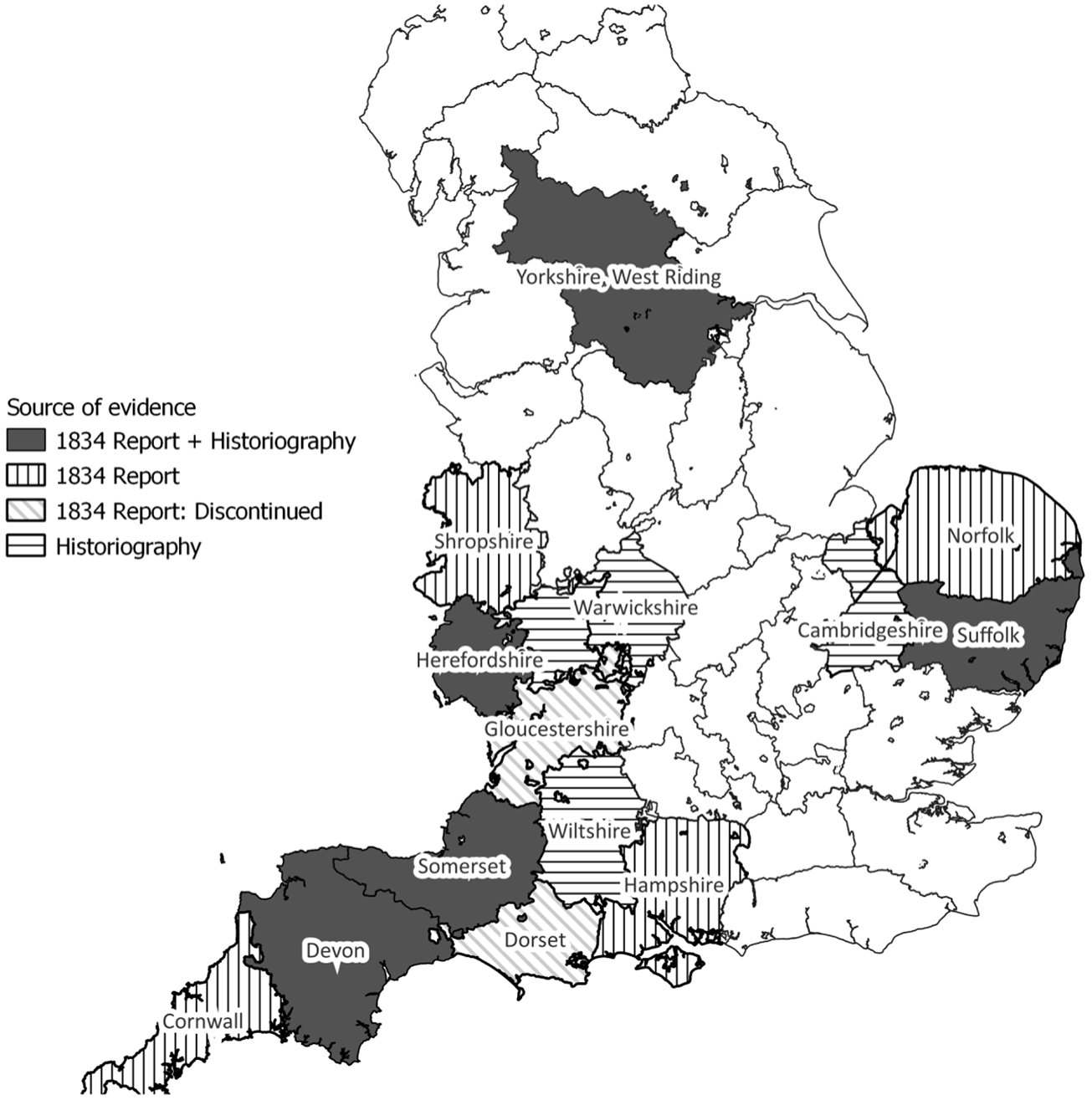
A fairly clear regional pattern emerges, as displayed in Figure 1, which highlights the counties with existing evidence for some schemes, combining the total of 26 reports in 1834 and the various county-level or parish-level studies cited earlier. This map is intended to provide a rough picture only, as the evidence is not co-extensive with county boundaries. Building on the regional contrast noted by the Webbs, we can identify a rough regional split that is mostly consistent with the basic socio-economic division between a highland pastoral zone in the North and the West and a lowland arable zone in the South and the East of England.Footnote 68 It is also mostly aligned with the two ‘macro-regions’ of Poor Law administration, with distinct cultures of welfare in the eighteenth century, as argued by Steven King.Footnote 69 In summary, the vast majority of evidence for compulsory schemes has been found to the North and West of a line running from around Weymouth to Teesmouth: especially the South-Western counties of Devon, Somerset and Cornwall; the West Midlands counties of Herefordshire, Worcestershire, Shropshire, Staffordshire and Warwickshire; and the West Riding in Yorkshire.Footnote 70 Yet it is important to stress that this is an incomplete picture that will certainly include significant variation within and between counties. The major exceptions to this broad pattern – the Eastern counties of Norfolk and Suffolk – are perhaps instructive as they represent a special case.Footnote 71 These schemes were developed and administered by the Incorporated Hundreds established from the 1750s onwards under local Acts of Parliament, which centralized administration, including the power to bind apprentices.Footnote 72 Indeed, an Act of 1780 was the first statute to clarify that apprentices could be forcibly bound only to inhabitants and occupiers in the same parish.Footnote 73 This anomaly indicates that any explanation of the schemes must incorporate the political structures administering poor relief as well as the general socio-economic conditions, or the farming system in particular. This theme will be addressed in Part II.
A map of counties in England with evidence of compulsory binding or rotation schemes, labelled by source of evidence.
With this regional picture in mind, a scoping exercise was conducted searching for earlier evidence of compulsory schemes in three counties representing different regions, all with a good survival of early eighteenth-century parish records, indicating a practice of binding parish apprentices: Devon in the South-West, West Yorkshire in the North and Essex in the East.Footnote 74 Whereas Devon and West Yorkshire were chosen as strong candidates, Essex was selected as a contrasting test case. Abundant early records were identified in Devon from the late seventeenth century, prompting a wider survey of the South-West including Somerset and Dorset, resulting in the detailed study that follows. A search for earlier records in West Yorkshire suggests that the systematic use of compulsory binding was predominantly an early nineteenth-century development, with only a few clear examples found in the late eighteenth century. The overall level of evidence for parish apprenticeships in Yorkshire is relatively low before 1800. Among 16 parishes and townships with good surviving records, only two (Bingley from 1766, Heptonstall from 1776) show clear evidence for organized property-binding schemes.Footnote 75 Elsewhere the records suggest only a partial use of the compulsory power in what were perhaps more flexible or hybrid systems without systematic estate-binding.Footnote 76 As numerous schemes were reported by John Tweedy in 1834, we can conclude that property-binding schemes were only adopted in Yorkshire from the late eighteenth and early nineteenth centuries.Footnote 77 In Essex, no concrete evidence was found that parishes were binding children with respect to estates, based on a sample of the best apprenticeship records across 21 parishes before 1750 (including those that the VCH indicated did operate early schemes).Footnote 78 Instead, vestry minutes show case-by-case agreements using premiums to incentivize masters.Footnote 79 However, there are indications that parishes used their compulsory powers when necessary, although usually simply to ‘parishioners’ rather than specifying occupiers or estates.Footnote 80 In summary, the South-West was confirmed as the key region for early development.
5. South-West schemes c.1670–1750
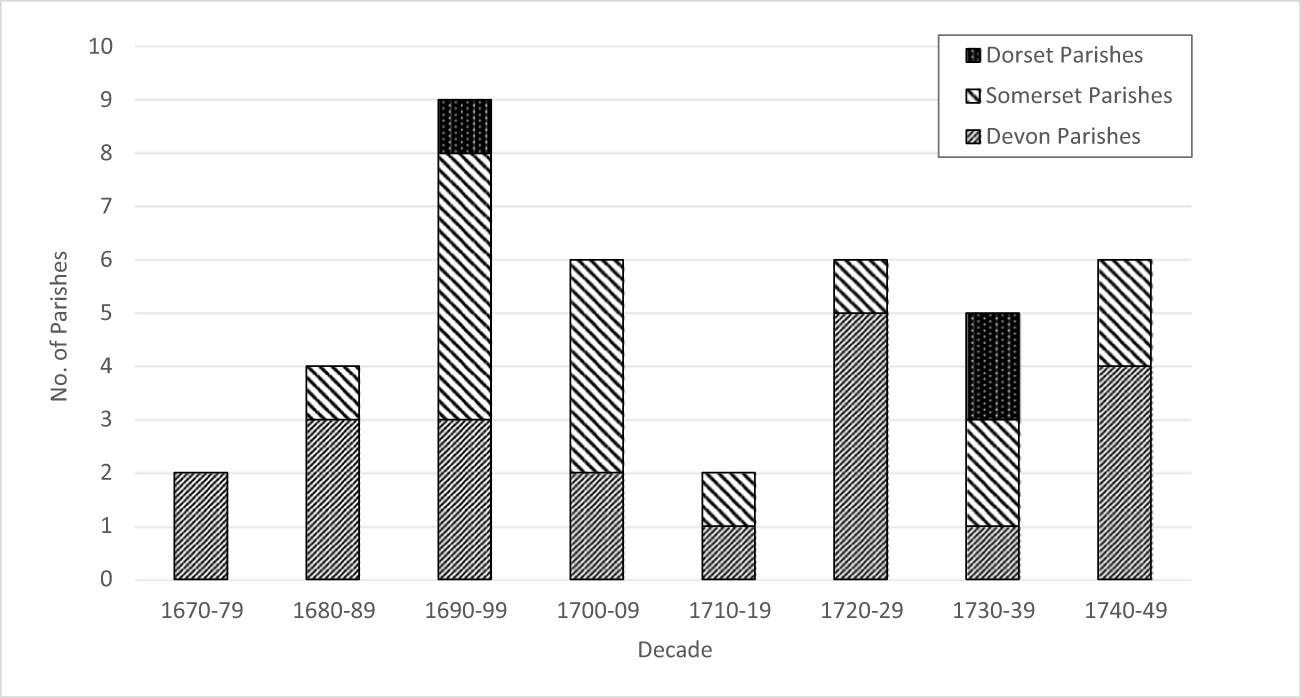
The following analysis is based on a survey of evidence for property-binding schemes beginning before 1750 in the South-Western counties of Devon, Somerset and Dorset.Footnote 81 After a thorough search of the county archive, positive evidence was found from 40 parishes, which can be roughly divided into four categories based on the type of record: (A) formal policies to organize an apprenticeship scheme based on the principle that occupiers of ‘estates’ could be compelled to receive a poor child from within the parish, as found in vestry memos or minutes; (B) systematic records that display the operation of such an organized scheme, but lacking a formal policy statement, such as registers or lists of apprentices bound out, or lists of estates liable to take them; (C) occasional references to estate-binding for individual or small groups of children, with no further evidence of wider organization; (D) statements in contracts (indentures) specifying that the child was bound to the named master ‘for’ or ‘in respect’ of a particular estate. Table 1 presents a summary of the earliest evidence (and record in which it was found) for 40 parishes in categories A, B and C (as D will be treated separately). To indicate the chronological development, Figure 2 displays the number of schemes introduced per decade from 1670 to 1750. Parishes are not directly comparable because the level of evidence varies significantly and many records are retrospective, which is potentially misleading about the formal beginnings of schemes (as discussed later).Footnote 82 All parishes in A and B operated some form of rotation scheme, binding children in turn to selected estates before going round again, albeit subject to various modifications. Where recorded, all parishes were almost universally binding children to farm service (to practise ‘husbandry’ or ‘huswifery’).
A graph showing the number of property-binding schemes introduced per decade in the counties of Devon, Somerset and Dorset, as indicated by the earliest surviving evidence from 1670 to 1750.
Summary of earliest evidence of property-binding across South-West England pre-1750
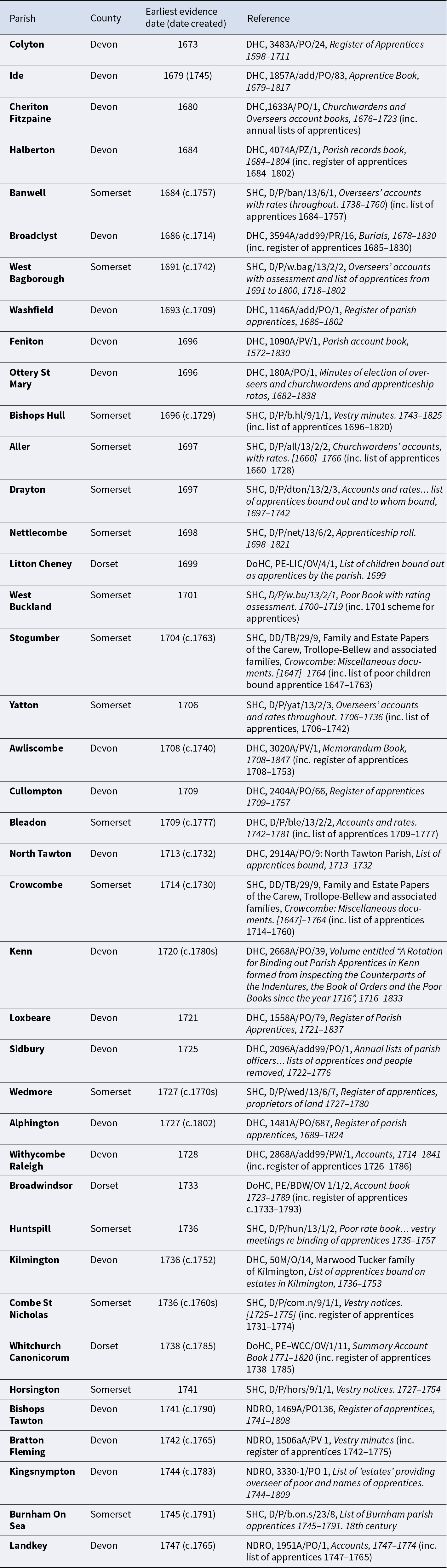
In this article (Part I), the analysis will focus on the chronological development and geographical trend that emerges. Part II will present a detailed analysis of the policy (e.g. landholding thresholds) and practice (e.g. scale) of the schemes. The main finding is clear from the table: property-binding schemes began before the end of the seventeenth century and were widely established in the South-West by the mid-eighteenth century, with many parishes keeping systematic records. The more detailed chronology will be reviewed in three stages: the earliest origins before and after the 1697 Act; the evolution over time; and the additional evidence from indentures. This is followed by a consideration of the geographical distribution.
5.1 Origins
What was the relationship between the 1697 Act and the property-binding schemes of individual parishes? The considerable autonomy of parishes to interpret national legislation was a general characteristic of the Poor Law, and a range of factors complicated local efforts at implementation.Footnote 83 It was common for statutes to lag behind local initiatives, but also for implementation to lag behind the law, especially since most Acts ‘enabled’ certain initiatives only by creating a series of overlapping powers.Footnote 84 In general, as we would expect given the vagueness of the law, property-binding schemes were primarily a local initiative, but were clearly boosted by the confirmation of their compulsory powers in the statute. The clearest evidence of an established practice of binding-by-property or ‘estates’ before 1697 is found in Devon. The Register of Apprentices in Halberton was headed ‘An account of Apprentices Bound out yearly by ye Parish and to whome and for what estate’. It began in 1684 with a change of hand in 1693 testifying to its near-contemporaneous compilation. Almost every entry from the start named the estate, although most simply labelled ‘his/her estate’, with 70 children bound before 1697.Footnote 85 The register for Colyton first added an estate to the name of the master in 1673 (‘To Robert Moore for Horneshayne Tenement’), with the property specification becoming more frequent over the next decade.Footnote 86 In Cheriton Fitzpaine, the annual accounts included a list of apprentices bound the previous year from 1676 onwards, with the first estates specified in 1680 (‘Nicholas West for Hayne barton’), although these were the exceptions and the lists stopped in the 1690s.Footnote 87 Many other surviving registers have entries dated before 1697, but were compiled retrospectively, which could indicate that binding-by-property was being practised from this earlier period, or that subsequent developments prompted a review of previous bindings to check the estates of the respective masters. The register for Ide, for example, described itself as an account of ‘what Estates … have Taken Apprentices from 1679 to this present yeare 1745’, with short entries such as ‘1679 John Bunce Bound on Ford Land’ often not specifying the name of the master at all.Footnote 88
There are only a few explicit signs of parishes responding directly to the 1697 statute. The most unequivocal example is a register (1697–1742) in Drayton (Somerset), whose title stated that it was an account of parish apprentices bound out ‘since ye new Act of Parliament that Impower'd them to doe ye same, which commenced the First of May 1697’.Footnote 89 Otherwise the noticeable flurry of activity in the years immediately following the passage of the Act is an indirect sign of influence. In Somerset, Nettlecombe began a highly organized system in 1698, as recorded in the most systematic register from the period, whose extensive table included a specific column for the respective ‘Estates’.Footnote 90 On 11 June 1701, the vestry of West Buckland, including the ‘most Substantial Inhabitants and owners of estates’, sat down to discuss and agree a scheme for the ‘Binding of poor Children our Apprentices by an equal pound Rate’, with a full classification of estates by value.Footnote 91 Further examples include: the first entry to name the estate in the list for Aller (covering 1660–1728 but compiled c.1709) was dated 1697;Footnote 92 the first list of children bound out to estates in Litton Cheney was dated 1699;Footnote 93 the earliest signs of estate-binding in the parishes of Stogumber and Yatton appear in 1704 and 1706.Footnote 94 Hence, it is likely that numerous parishes were acting on a principle of occupier liability and binding by estates before 1697, followed swiftly by other parishes responding to the legislative clarification of their compulsory power by organizing new schemes.
5.2 Evolution
Since complex administrative arrangements require more complex forms of record-keeping, the varying types of record and their level of detail likely reflect a genuine spectrum of organizational complexity across parishes and over time, despite the fundamental contingency of record survival. As such, the dating of different types of evidence is itself suggestive of the development of schemes over time. Roughly speaking, the first phase was simply adopting the principle that all occupiers of parish land were liable to receive an apprentice, which could be used to compel a parishioner to take an apprentice. But this could be implemented on a case-by-case basis without elaboration, especially if the numbers were low, and recorded in an ad hoc manner (in an indenture or a vestry minute). The second phase was reached when landholding became the primary or sole criterion for binding children and a de facto rota emerged, which at a certain scale required a basic list or register to keep track of when each estate last had an apprentice and whose turn was next. The third phase was reached when specific adjustments were introduced to regulate how the burden and benefits were distributed among landholders, the policy for which may be formalized in a vestry memo or reflected in how registers arranged information. The overall chronology of evidence supports this notion that parishes progressed through these three phases of organizational complexity: single references to binding in respect of an estate, especially in indentures, first appear around c.1670–1700; the earliest lists and registers of apprentices tracking rotations date back to c.1680–1710; and the earliest formal policies were recorded in 1740s (with one earlier exception).
This picture of evolving organizational complexity is supported in two key ways. First, recording the master’s estate grew slowly in importance over time, such that there was not a sharp ‘beginning’ to property-binding for most parishes. In many early lists or registers, the first entries named only the master, then the occasional entry specified ‘for’ a particular estate, which over a couple of decades became standardized, often in increasing detail.Footnote 95 This progression is apparent over four separate lists recorded in Banwell (Somerset), all backdated to the 1680s. The first list covering 1688–1722 was likely composed within these dates and did not record any estates; the second list covering 1688–1738 began adding estates from 1733; the third list covering 1684–1757 was more organized and recorded estates on a few earlier entries, but only regularly from the late 1730s, with annotations from a later hand adding estate descriptions to entries from the 1680s; the fourth list is the official Apprentice Register begun in 1803 but backdated to 1684, which similarly only consistently adds estates from the 1730s–1740s.Footnote 96 As the majority of registers are retrospective to some extent, the lack of early estate recording may partly be owing to a lack of information about bindings among the previous generation, but this only reinforces the impression that the importance of knowing and recording the estate increased over time. In fact, many retrospective registers of apprentices do not bother to name the child being apprenticed as they were concerned only with tracking estate and occupier liability.Footnote 97
The rising importance and increasing standardization are best exhibited in the changing format of registers. The Ottery St Mary register commenced with three columns in 1682: apprentice name, master name (‘to whom bound’) and date of indenture. After a few of decades of adding the estate next to the master’s name, from 1744 onwards the phrase ‘and what Estate’ was added to the middle column heading; and from 1781 a separate ‘Estate’ column was created to ensure that it would not be overlooked.Footnote 98 In North Tawton (Devon), a short list of apprentices bound out (with named estates) covering 1713–1732 over three pages was replaced by a large volume covering 1736–1829, with a mini-register per double page for each of 88 estates in the parish.Footnote 99 An almost identical transition in record-keeping took place in the nearby parishes Cheriton Fitzpaine and Sandford (Devon).Footnote 100 These registers were designed entirely around an estate-based system of distribution, making it easier to track the frequency of bindings to each estate, regardless of changing occupiers.
Second, schemes emerged gradually through customary practice, with the actual order of rotation constructed retrospectively and implemented retroactively. In most parishes, it is probable that the precise order in which estates took children was initially decided on a case-by-case basis, which then set a precedent to be maintained for consistency and fairness, prompting the need to make a list of previous bindings. The phrasing in many documents encourages this view: for example, a list of Langford Budville (Somerset) estates c.1756–1777 was headed ‘the Several estates accustomed to take apprentices in this parish’.Footnote 101 We can almost observe this retroactive phenomenon at work over a few vestry meetings held in Horsington (Somerset) in November 1741 ‘for considering of proper persons to take Apprentices’. On 25 November, the vestry compiled a ‘List of Estates and Persons are Lyable to Take Apprentices’ along with names of children to be bound. This simple list was annotated with information about previous apprenticeships; five parishioners claimed to have had an apprentice between 20 and 30 years beforehand (e.g. ‘Mr Christopher Wadman one abt 25 years ago’), while three could name the child that was bound to them more recently (8–12 years beforehand). Two potential masters were told to ‘produce’ the old indentures to prove their claim or otherwise ‘one to be put to him’. Such uncertainty and disagreements prompted a second list, perhaps compiled the following day: a ‘List of such Estates as have taken Apprentices allready and are to take their Turns after the before List is Compleated’ comprised 22 names with notes on when their last apprentice left or was due to leave, such as ‘about 14 years ago last Apprentice out’, ‘had one in 1738’ or ‘out of his time about 3 years hence’.Footnote 102 While some kind of rotation had likely been operating informally for many years, this was seemingly the first time Horsington had attempted to formalize a rotation system, as they clearly lacked an existing record to consult and had to conduct a data-gathering exercise. In this instance we see a rotation order in the process of being formalized and negotiated, with its attendant difficulties.
In some instances, the work of reconstruction appears to be the research of an individual, as a few annotated registers conjure up the image of a clerk sorting through the parish chest to establish what occurred decades earlier. In Kenn (Devon), a neat register in a slim volume was helpfully titled ‘A Rotation for Binding out Parish Apprentices in Kenn formed from inspecting the Counterparts of the Indentures, the Book of Orders and the Poor Books since the year 1716’, first compiled in the 1780s with entries running from 1720 to 1833.Footnote 103 It included the name of the estate, the present owner and the occupier at the time (i.e. who was appointed master).Footnote 104 Alongside this register is a separate earlier list titled ‘Rotation for binding Parish Apprentices at Kenn’, covering 1720–1772, which listed 66 estates labelled with two sets of overlapping dates correlating to two rotations – the first from 1720 to 1760, and the second in progress from 1760 to 1772 but almost complete – signalling an increase in the frequency of bindings, which may be linked to the effort for more careful record-keeping. The complications of administering an estate-based system over a long period of time were indicated by a small note at the bottom stating that the ‘Names of the Owners & Occupiers in this list are nearly as they stand at present and not as they were at the time from whence the Rotation begins’.Footnote 105 Taken together, we can trace the evolution of the rotation scheme from custom to formal system, through the progressive attempts to keep track of the order of previous bindings (c.1730s–1760s), to reconstruct and fix the rotation order (c.1772) and to eventually formalize the whole scheme through an ongoing register (c.1780s) and thereby establish a continuity between past and future bindings.Footnote 106 Similarly, the early part of the register for Combe St Nicholas (Somerset) (1731–1774) displays signs of its own construction; the scribe expressed their difficulties recovering accurate information, noting in the margin of the entries 1743–1750 that they did ‘not stand in ye order plac’d out, but as I could inform my Self [after?] being able to come at the Indentures or Counterparts’.Footnote 107
The key function of a register to serve as a record of the past rotation order was expressed in a few records.Footnote 108 It was articulated neatly in a couple of memos inserted into the register for Ide (Devon), which was created in 1745, extended back to 1679 and continued until 1817. On 12 June 1807, a short instruction explained to future officers how to ‘read’ the register to find out the sequence of participating estates: ‘All the Estates and Cotts that are liable to take apprentices in Ide are contained between Halscomb 1789 and Halscombe 1803. You must go back for Halscomb 1789 and Look forward.’ The rotation included 59 estates. Referring to the proportional set-up whereby estates over £40 took two apprentices (‘double’), it continued concisely: ‘NB. Canns Cotts is the first Single/Halscombe the first Double and/Halscombe the first Trible/and so go Round.’ Indeed, as if to reinforce the point, a different hand added bluntly a year later (26 April 1808): ‘This book is of no manner of use Only to see Whose turn it is to take apprentices.’Footnote 109
5.3 Indenture clauses
Another perspective on the increasing use of landholding as the key criterion for selecting masters can be gained by examining series of indentures. The contracts were slowly standardized over the seventeenth century, but until the 1660s included only the name, the residence and/or the occupation of the master. In the following decades it gradually became common in the South-West to add that the child was bound to that particular master ‘for’ or ‘in respect of’ a particular estate. The precise form of this addition varied. While handwritten indentures could easily incorporate a new clause or phrase, they were progressively replaced in the final decades of the seventeenth century by printed templates that left only small gaps for customization. Standard templates did not include a dedicated blank space for the qualifying estate to be entered, as they did with other key information, such as the names of the contracting parties. This is, of course, suggestive that property-binding was never fully formalized as a legal standard. Yet, there were exceptions. In 1692 – notably before the 1697 Act – a few printed templates used in the parish of Nettlecombe, Somerset, included the wording ‘and to, for, and in respect of’ followed by a blank space, which in one example on 21 Oct was completed by hand with ‘yea tenement in Nettlecombe’.Footnote 110 Considering the thousands of indentures that would later struggle to insert such information, it is surprising that this template model does not appear to have been widely produced.Footnote 111
The vast majority of indentures adopted one of two solutions: a brief addition following the master’s name inserted into the body of the contract, usually in simple forms such as ‘for X estate’ or ‘for occupation of X’; or a separate memo added somewhere in the margin or on the reverse. The latter was a sensible choice as the small insertions were frequently untidy and crammed against or above subsequent printed words, especially when further detail was required (e.g. ‘for the farm at X being [name of owner’s] estate which he/she now occupieth’). An example memo from Colyton (1710) reads: ‘The abovesaid apprentice is put upon the abovesaid Mrs Alice Haydon for her Estate in Colyton called Farwood.’Footnote 112 These memos occasionally recorded more complex arrangements. For example, a Nettlecombe indenture (1707) binding a child to Henry Burge included a memo explaining that this was in fact a deviation from the planned rotation: ‘This apprentice doth in course belong to Sir John Trevelyan Baronett but was bound to ye Henry Burge in Consideration of Four Pounds.’Footnote 113 In parishes with a policy of grouping estates to contribute financially, additional memos would not only specify the estate to which the child was bound but also list all the contributing estates and their amounts, which could be as many as seven properties, as found in one example from Bishops Hill (Somerset) in 1746.Footnote 114
Since the parishes with the best records of organized schemes often had indentures that specified the estate, and since indentures are by far the most widely surviving record of apprenticeships, a partial survey of surviving indentures, including parishes with no other records, was conducted to better indicate the chronological development of property-binding practices. Figure 3 shows a timeline of the earliest indentures with estate information found for 48 parishes before 1750, mostly from Devon, which can be used as an indicator of the gradual adoption of estate-binding.Footnote 115 However, it is important to keep in mind what this does and does not show: the specification of the estate merely provides justification for the selection of the master and does not necessarily signal that bindings were organized into a scheme. Conversely, indentures did not always name estates even when the binding was part of a planned rotation scheme, especially when the master was the owner of the relevant estate and it was presumably considered unnecessary. It is also notable that many early instances were in cases where the master was resident outside of the parish; hence, the estate was named to provide the rationale for placing an apprentice with them.Footnote 116 Overall, the proportion of indentures that name the estate varied significantly between parishes and was rarely universal. A fairly typical representative is Cullompton, for which 69 out of 174 indentures between 1668 and 1729 specified the estate.Footnote 117
A timeline of the earliest dates of indentures with the master’s estate specified for parishes in Devon, Somerset and Dorset 1660–1750.
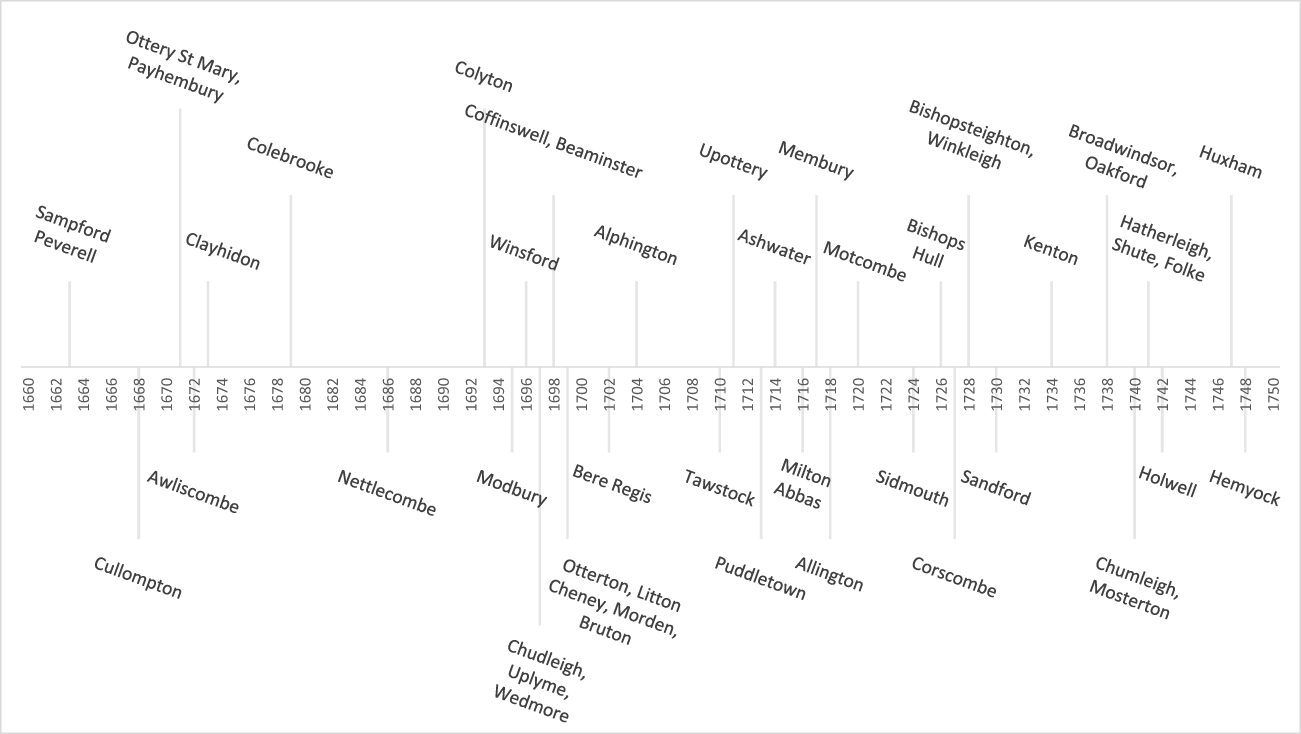
With these cautions, it is clearly significant that 11 parishes first specified the estate before the 1697 Act, beginning with Sampford Peverell in 1663, and in some cases were already adding detailed memos.Footnote 118 A further nine parishes first specified the estate in the years immediately following the statute (1697–1699). Over the next few decades more parishes slowly adopted the same approach, with another small cluster of six parishes around 1740–1742. This supports the chronology outlined earlier that it was becoming customary to bind apprentices to occupiers of estates in the late seventeenth century in a few areas, which accelerated after 1697 and became widely established for many Devon parishes by 1750.
5.4 Spatial distribution
We now know roughly when property-binding schemes developed, but where were they adopted? Figure 4 shows the geographical distribution within the South-West, highlighting the 40 parishes within the counties of Devon, Somerset and Dorset with evidence before 1750, shaded to show the chronology of earliest evidence (as detailed in Table 1). As this evidence is the result of a comprehensive search of the county archives, we can reasonably conclude that this distribution partly reflects actual geographic patterns. Two features are immediately noticeable. First, the earliest and best-documented schemes are located within a well-defined zone that joins east Devon, west and central Somerset and the western edge of Dorset. This sub- and inter-county zone is consistent with the broad macro-division as it cuts off most of Dorset.Footnote 119 Almost by definition – those with evidence of binding in rotation to landholders – these were all rural parishes.Footnote 120 Second, there are numerous clusters between two, three or even four contiguous parishes, which could indicate that ideas and practices were transferred between neighbouring villages that shared an administrative culture as well as socio-economic characteristics.Footnote 121
A map of parishes in Devon, Somerset and Dorset with evidence of property-binding before 1750, showing earliest evidence by decade.
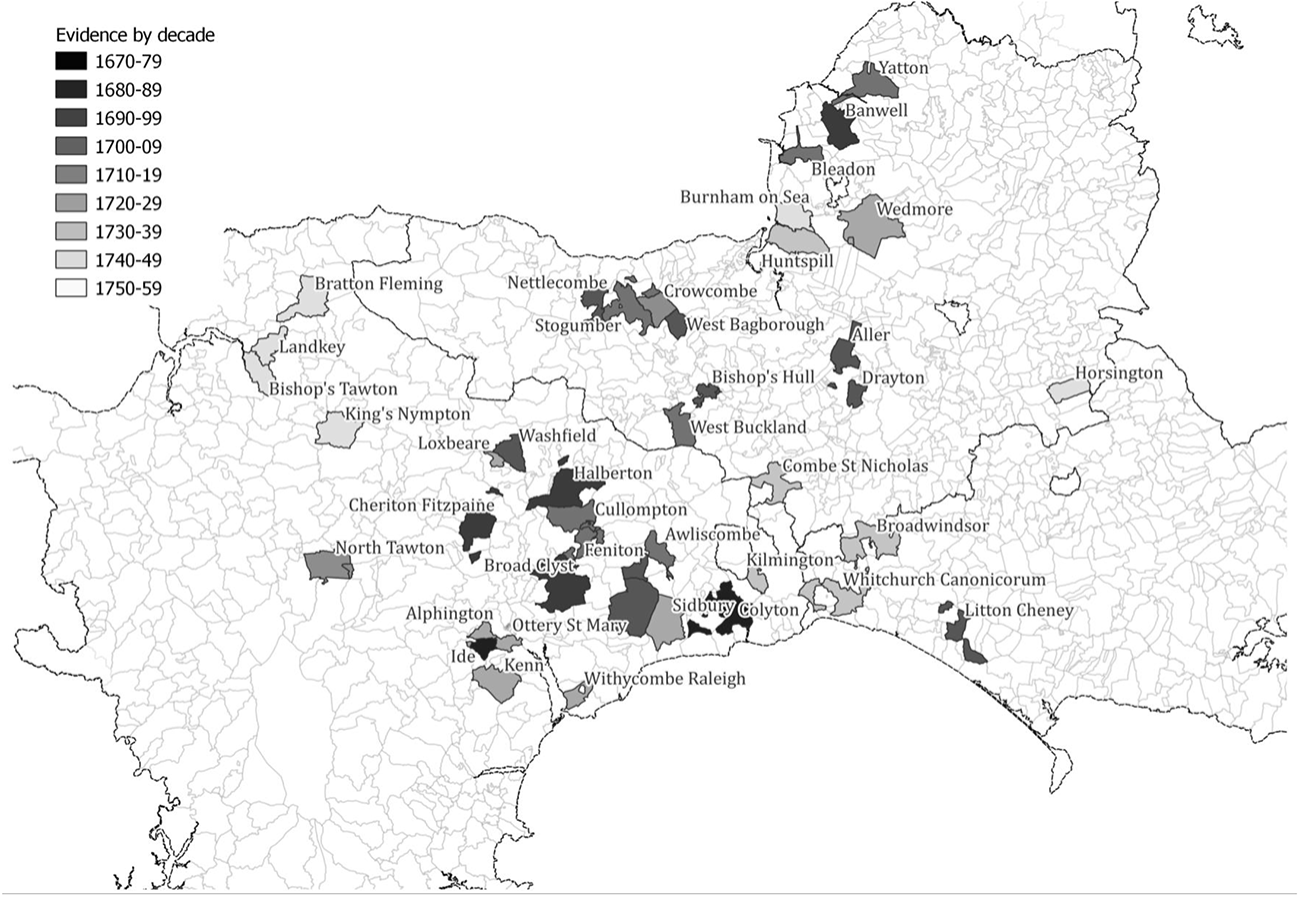
Broadly speaking, the schemes were spread throughout pastoral communities.Footnote 122 In the 1790s William Marshall collected information on the rural economy of the West of England, discussing seven ‘natural districts’.Footnote 123 Although Marshall observed that parish apprenticeships were ‘universal’ throughout Devonshire, the early schemes were overwhelmingly located in what he called the ‘Vale of Exeter’, plus the ‘Vale of Taunton’ and the ‘Dairy District’ (Devon and Dorset), with later incursions into north Devon, but almost none within west Devon, the South Hams or the ‘Mountains’, that is, Dartmoor and Exmoor.Footnote 124 The Vale of Exeter was characterized by small farms and encompassed the areas around the cloth towns of Exeter, Tiverton, Crediton and Honiton, with the parish schemes appearing to circulate like satellites around these urban centres. The Dairy District encompassed the Blackdown Hills in east Devon and Marshwood Vale in west Dorset, with extensive grasslands.Footnote 125 The Vale of Taunton, however, was mostly characterized by more arable production. Hence, there is a correlation between pastoral communities and the early development of rotational apprenticeship schemes.
If we focus our attention on differentiation within Devon, and the significance of east Devon, then the contours of an explanation may be found in the spatial variations of the structures of labour between east, south and north Devon in the late medieval period, as identified by H. S. A. Fox.Footnote 126 Three distinct types of labour supply characterized these regions, related to different settlement patterns and modes of farming: the large, dispersed cattle-rearing farms in the north relied on live-in servants; the small dairy-oriented farms in the east were supplied by casual labour from independent cottagers; and the grain-producing farms in the south were intermediate between these two, relying on labourers in ‘tied cottages’ next to farms, dependent on the farmer for their work and accommodation. Although for an earlier period, Fox’s study sprang from the similarities between c.1350–1500 and c.1750–1850 in terms of a shift from hiring labourers to servants; when population decline or stagnation, relative labour shortage and a shift to pastoral farming all ‘encouraged farmers to begin to bind young people to annual contracts and to keep them on the farm’.Footnote 127 Fox’s argument is notable for drawing attention to the varying mix of ‘enticement’ or ‘social control’ used by larger employers to secure their required labour supply.Footnote 128
In this light, the development of extensive apprenticeship schemes in east Devon can be seen as an attempt to use the mechanisms of the Poor Law to exert control over the labour supply in a context where the relative independence of cottagers (who had a greater range of resources for earning a living than elsewhere through domestic cloth work or access to commons) meant that there was ‘no danger that labour would become entrapped in servanthood’.Footnote 129 If larger farmers struggled to entice workers through wages or other means, a local supply of servants could be artificially created by using their power on the vestry to bind children to farmers around the parish for long terms, whether by extracting younger members from labouring families or simply channelling orphans into these restrictive roles. This is not to argue that individual apprentices were bound to farmers in response to immediate labour demands, but rather that certain parishes favoured this social policy as a way of simultaneously managing family poverty and the local workforce. Indeed, since apprentices were bound from as young as seven, most were almost an initial burden to maintain, only later developing into an asset as cheap adult labour. This hypothesis will be explored in further depth by examining the governance structures and policymaking of parishes in Part II.
There are also two important qualifications about this distribution. First, this shows the distribution of organized schemes, but the spread of estate-binding generally was more widespread. Some of the Devon parishes with indentures specifying estates before 1750 are situated outside the above zone, stretching it slightly farther west and south, although the earliest indentures are mostly clustered in east Devon.Footnote 130 Second, later evidence from the nineteenth-century Poor Law reports indicates that this zone of early development spread wider over time, with compulsory schemes reported in south and north Devon in 1834.Footnote 131 Indeed, in 1843, Alfred Austin believed that a ‘few years ago compulsory or parish apprenticeship prevailed in the whole of Devonshire, and also in parts of the adjacent counties of Dorset and Somerset’.Footnote 132
6. Reflections: labour policies
The vague legal power of parishes to bind poor children as apprentices, first established in 1598 and bolstered in 1697, led to the evolution of a new kind of rural institution for managing poor youth, as distinctive as the workhouse, which diverged radically from the model of craft apprenticeships and whose economic logic resembled other labour allocation policies that motivated the dismantling of the Old Poor Law. The peculiarity of compulsory apprenticeships as a labour system was neatly articulated by the assistant Poor Law commissioner Robert Weale in 1836:
[T]he relation of the master and apprentice was entered into, not from any fitness in the child, in point of health, strength or age, to the situation to which he was bound, nor from any qualification on the part of the master, in point of family, business, or character, fitting him to receive apprentices, but from the circumstances that the estate which he held was of a certain value.Footnote 133
The systematic allocation of poor children as servants to landholders, solely on the basis of their occupation of property, achieved belated recognition by statute only in 1780 and never had clear national approval as a policy. As it was not implemented by design, it has no strict origin. Rather than being imposed from the centre, it was constructed haphazardly through local experimentation and evolved through custom as rural vestries and justices in certain areas converged on a similar solution for managing poor families and the local labour supply. Yet the resulting chronological pattern is significant in relation to three other areas of social policy. First, the earliest schemes were coeval with the new workhouse movement from the 1690s, both emerging in a context of economic crisis, rising poor rates and a renewed drive to set children to work. Second, they preceded and then ran parallel to the batch-binding of factory apprentices from around the country to the textile industries from the 1780s, showing that the systematic organization of parish apprenticeships began within agriculture, not manufacturing. Third, they anticipated the controversial labour allocation schemes of the Speenhamland era from the 1790s, in the way that the parish apportioned workers to property holders. In sum, they are a striking demonstration of how parishes found ways within the framework of the 1601 Poor Law to methodically organize the labour and socialization of poor youth.
Geographically, the schemes were regionally limited, but the South-West was not an anomaly. In general, English parishes can be roughly divided between those that bound poor apprentices by premium (voluntary) and those that bound by property (compulsory). Property-based schemes flourished across extensive areas of the pastoral West and North of England, albeit at different times. The reliance on compulsory apprenticeships in heavily agricultural communities owing to the limited opportunities for child employment has been commented on by both contemporaries and historians.Footnote 134 In 1834, Chapman observed that in the ‘strictly agricultural parishes’ of Devon, the overseers ‘appeared utterly at a loss to devise any expedient for the employment of the children’ beyond the use of compulsory apprenticeships.Footnote 135 Arthur Lewis also remarked that the ‘purely agricultural districts’ in the West Midlands would struggle to maintain poor children without ‘the power of compelling persons to take apprentices’, whereas manufacturing districts had little difficulty putting children to work.Footnote 136
Yet we still need to explain the different policy responses by agricultural parishes in the two macro-regions. Two regional patterns suggest the outline of an explanation. First, it is well-established that capitalist farming developed earliest and most intensely in the South and the East, with far higher numbers of wage workers in this period.Footnote 137 Second, the rural South and East was also the region of the highest prevalence of Speenhamland policies or labour allocation schemes for adults (c.1790–1830).Footnote 138 Indeed, the 1836 report noted that ‘in the western part of England and in Wales, where the Labour Rate and the roundsman systems were unknown, the evils and abuses of the compulsory binding of parish apprentices … were found to be extremely prevalent’.Footnote 139 Hence, extrapolating from the model for Devon sub-regions borrowed from Fox, we can put forward a general hypothesis: in the pastoral West and North where farming relied more on continually available resident labour, large farmers preferred to bind poor youth into long-term service through apprenticeship schemes to maintain a stable local labour force, whereas in the arable South and East with a plentiful supply of casual wage labour, large farmers preferred to regulate the short-term employment of adult paupers to maintain a flexible labour force through Speenhamland-style policies.Footnote 140 However, any exploration of this hypothesis would need to incorporate demographic trends and the effects of inward or outward migration on policies to bind within or without the parish.Footnote 141
The contrasting distribution of workhouses adds a further layer to this picture. The early parochial workhouse movement from 1714 was concentrated in the South-East, spreading from Essex through the Home Counties, such that the geographical development of apprentice schemes and that of workhouses are almost mirror images.Footnote 142 This would support the observation by the Webbs that in the South-East young children were mostly maintained in the workhouse until old enough to hire themselves out.Footnote 143 Yet parochial workhouses were also founded in Devon after the 1730s, undermining any neat division. Over the long term, it appears to have been equally common for workhouses and apprenticeships to operate in tandem, with younger children sent to the workhouse first and apprenticed second.Footnote 144 In the South-West, apprenticeship schemes and workhouses were perhaps alternative rural and urban strategies. It is notable that east Devon was the location for some of the earliest workhouses established by Corporations of the Poor in Exeter, Tiverton and Crediton, created by three local Acts of Parliament in 1698.Footnote 145 At the same time that these workhouses were being planned for the urban poor, surrounding rural parishes such as Halberton and Broadclyst were developing their alternative systems for systematically distributing rural children to local landholders. The rationale for the latter over the former was indirectly expounded by Richard Dunning, whose pamphlet Bread for the poor (Exeter, 1698) argued against workhouses as too costly and too risky, recommending instead that rural parishes use existing employment structures rather than centralize them in a single institution.Footnote 146 Hence, we could view farm apprenticeship schemes as institutions that placed a new layer of administration upon existing household economies to be managed by individual ratepayers, thereby distributing costs, risks and responsibilities. It is only a slight stretch to describe such schemes as networks of private workhouses.
The existence of these complex administrative schemes is itself a testament to the fact that the labour of parish apprentices was not an insignificant by-product of poor relief. As judicial debates, vestry negotiations and official rebukes all make abundantly clear, the administrative choice to compel occupiers of parish land to take on poor children as indentured servants facilitated a new form of labour organization with profound implications. In a few short steps, almost by accident, some rural parishes had improvised systems with an uncomfortable resemblance to the feudal relationship between land and labour, which authorities eventually came to condemn as a gross violation of the newly forged principles of a ‘free’ labour market. In a subsequent article, Part II, the policies of these compulsory schemes in the South-West will be examined, focusing on a case study of Awliscombe in Devon to explore how it was governed and administered within a particular community.
Acknowledgements
This research was supported by the European Research Council (ERC) as part of the project ‘FORMSofLABOUR: Gender, Freedom and Experience of Work in the Preindustrial Economy’.


 Open access

