Japan frequently experiences natural disasters, such as earthquakes and typhoons(1). To prepare for such situations, local government stockpile foods for evacuees(Reference Sudo, Shimada and Tsuboyama-Kasaoka2). Within few days following a disaster onset, hot meals or order boxed meals are to be distributed to the evacuees(3). Carbohydrate-based foods, such as instant noodles and bread, were previously reported to be in excess(Reference Tsuboyama-Kasaoka, Hoshi and Onodera4), and the consequential increased salt intake in evacuation shelters was associated with the risk of hypertension among the evacuees(Reference Hoshide, Nishizawa and Okawara5).
To sustain evacuees’ health, the nutritional supply of meals served in evacuation shelters must be estimated. The Ministry of Health, Labor and Welfare (MHLW) released the notice ‘Nutritional Reference Values for Feeding at Evacuation Shelters’ (reference values (RV))(6) for the prefectural governments of the affected areas. In general, registered dietitians and dietitians who provide support in evacuation shelters conduct dietary assessments of the provided meals(Reference Ito, Sudo and Tsuboyama-Kasaoka7). The survey results are assessed based on the RV and are used as scientific bases to change the contents of the meals provided at the shelters for nutritional improvement(Reference Sudo, Shimada and Tsuboyama-Kasaoka2).
Among various dietary assessment methods, the weighed food record (WFR) is considered the gold standard because it provides a high degree of accuracy in assessing food and nutrient intakes, without estimating the amount of food and recalling previous diets(Reference Baranowski and Willet8,9) . This method was conducted in evacuation shelters in the post-disaster period in Japan(Reference Takahashi10,Reference Takeda, Sudo and Tsuboyama-Kasaoka11) . Unlike dietary assessments in normal settings, WFR in shelters exhibit unique characteristics. First, an individual’s nutrient intake is not measured; in evacuation shelters, one meal is measured before distribution(Reference Takeda, Sudo and Tsuboyama-Kasaoka11) because it is provided to everyone regardless of their specific needs. Therefore, the nutrient content of one meal is measured regardless of the number of evacuees in the shelter. The aim is mainly to identify the shelters with the greatest need for improvement of meals rather than the individual nutritional assessment. Second, the meal contents following disasters tend to have less variety(12,Reference Moghadam, Amiresmaileli and Hassibi13) . Consequently, food does not change much from one day to the next. Nishimura(Reference Nishimura14) found that the monotonous menu of hot meal services was served by self-defence forces. Although local governments conducted WFR for a maximum of 3 d in July 2020 Heavy Rainfall (original data from the previous study(Reference Takeda, Sudo and Tsuboyama-Kasaoka11)), the difference may not be large between 3-d and fewer-day WFR.
Although the WFR is the most precise method for dietary assessment, it is time-consuming and could be burdensome for dietitians in emergency settings. In addition, to the best of our knowledge, no study has determined the number of days required for WFR in evacuation shelters. Thus, this study aimed to examine whether 1- and 2-d WFR for dietary assessment at shelters could replace the 3-d WFR conducted in disaster settings. In addition, the meal and dish categories that contributed to the potential variations were examined.
Experimental methods
Study background
Uniquely, Japan has consistently followed its annual National Health and Nutrition Survey since 1946 by applying WFR. Unlike Western countries that use a 24-h dietary recall for their national nutrition surveys(15–18), the WFR method is widely used by Japanese dietitians who work for local governments, not only for the National Health and Nutrition Survey but also for their periodic prefectural health and nutrition surveys(Reference Kubo, Kuno and Maruyama19).
During emergencies, it takes more time to order supplies from disaster-affected areas. Additionally, the concerned municipalities face difficulties in quickly procuring their basic supplies. Therefore, central government provide a ‘push-type relief’, including foods and beverages, without waiting for specific request from disaster-stricken municipalities(20). Moreover, foods are excessively delivered to specific areas because of media coverage and information spread through social networking services(21). Consequently, municipal agents cannot presume when and what type of foods they would receive beforehand. To collect promptly dietary information, WFR is also applied during emergencies for an instant dietary support since no additional training is required. Consequently, the use of alternative methods, such as the 24-h dietary recall, solely for emergency situations is not considered efficient.
Study setting
Kumamoto Prefecture, located in the southwest part of Japan, was lashed by heavy rainfalls in July 2020 (from 3 to 4 July 2020)(22). This prefecture mainly has electronics, transportation machinery and production machinery industries(23). In this prefecture, heavy and torrential rains are often due to the warm and humid air flowing in from the Eastern China Sea. Substantial precipitation, particularly during the rainy season, can lead to natural disasters(24). In this prefecture, depopulation is progressing, whereas its older population is increasing; approximately 30 % of the residents are > 65 years old at the year of that disaster(25). Owing to agricultural, forestry and fishery products, traditional dishes rooted in the local climate have been developed in each area(26). As a nutritional issue, 80 % of people in this prefecture consume excessive amounts of salt with lower consumption of vegetables than the recommended intake and the national average. Approximately 70 % of men and 40 % of women aged 40–74 years have high blood pressure or pre-hypertension(27).
Following the heavy rainfall, municipalities in Kumamoto Prefecture opened evacuation shelters and provided evacuees with food and water. In twelve evacuation shelters, administrative and/or volunteer dietitians dispatched from dietetic associations were asked to perform dietary assessments of shelter meals 16–20 d after the disaster. This period was classified as phase 2, which is not acute, and where hot meal services or boxed meals aim to be served. In this period, dietitians need to improve the deficiency of nutrients(3). WFR in the evacuation shelters were conducted for the prevention of lifestyle diseases due to unbalanced diets. For nutrition calculation, the prefectural government that had jurisdiction over the affected areas sent WFR sheets collected by the dietitians to the authors’ institutions that voluntarily backed them up. Because two of the twelve shelters did not record the weights of food in the WFR, we used data from ten shelters for the analysis. These ten shelters had operated for a median of 100 d (74–119, 25–75 %) since July 2020’s Heavy Rainfall(28–31), so the survey was conducted in the beginning period of the shelter opening. The average number of evacuees in each of the ten shelters during that period was 64 ranging between 15 and 300. Additionally, at least 18 % of the evacuees were vulnerable individuals (the majority had hypertension, followed in order with diabetes, kidney diseases, allergies and others). However, only one generic type of meals was distributed regardless of any specific condition.
WFR was conducted as a public service under the direction of the prefectural government to improve the conditions of the shelters. However, since it was based on administrative decision, no scientific sampling was set in this study. For this study, we asked permission from the prefectural government to use WFR data collected from these shelters. Written approval was given provided that the shelters’ names remain anonymous.
Weighed food record
The dietitians involved in this data collection were affiliated with various institutions, including health centres, local governments and dietetic associations within and outside the affected areas. For the WFR method, food record sheets, instructions for recorders and an example of recording were developed and sent to the prefectural nutrition officers who distributed these documents to the dietitians in charge.
During data collection, the dietitians in each shelter were instructed to weigh all food items served as breakfast, lunch and dinner. Basically, each food item was divided into individual ingredients and weighed using a digital scale so that the calculators could estimate the nutrition supply. Each meal was photographed using digital cameras or cell phones and placed on A4 paper, which was used as a scale. Data including product name, manufacturer’s name and nutrition fact labelled on ready-to-eat foods or boxed meal packages were recorded as photographs.
Since April 2015, the Food Labelling Act requires to list the amount of energy, protein, fat, carbohydrate and salt on every processed food(32). Ready-to-eat foods and boxed meals are usually prepared by stores or companies, so nutrients other than the mandated ones, especially vitamins on RV, are generally not listed on their nutrition label and on their website. Therefore, the weight records of all the ingredients facilitates in estimation of the amount of all the nutrients on RV that are not shown on the meals nutrition label.
Nutrition calculation
Among the ten shelters, six collected three-consecutive-day WFR and the remaining four collected two-consecutive-day WFR. In total, there were 26-d WFR consisting of seventy-nine meals.
Daily energy and nutrient contents in meals were calculated using Excel Eiyō Plus (in English, Nutrition Plus), which is a widely used add-in software for nutrition calculation, commercially available from Kenpaku sha, a Japanese publisher of academic books. The software is based on the latest Japanese standard food composition tables published by the Ministry of Education, Culture, Sports, Science and Technology(33). It also provides typical recipes with the weight ratio of ingredients and seasoning for commonly consumed dishes, so simmered vegetables or fried chicken, for example, could be nutritionally calculated using these typical recipes based on their weight record.
RV, nutritional reference values for evacuation shelters set by MHLW, consist of energy, protein and vitamins B1, B2 and C(6). A previous study granted by MHLW revealed the feasibility of the revised RV (draft), which added salt value considering hypertension(Reference Sato, Sudo and Takeda34). Because the current study examines whether 1- or 2-d WFR could be used for dietary assessment in shelters, we decided to calculate the energy and four nutrients in RV along with salt content.
For nutritional calculation of ready-to-eat foods, such as instant noodles and miso soup, we prioritised the nutritional information published in the manufacturers’ nutrition label or through their website. In case of any missing data regarding the amount of nutrients, especially vitamins, we selected similar food items on ‘18 Food Group (Prepared and processed foods)’ in Standard Tables of Food Composition in Japan 2020 (The Eighth Version)(33), followed by typical recipes in ‘Excel Eiyō Plus’ to fill the amount of these nutrients. Similarly, we referred to the nutrition label or website for nutritional information of boxed meals. Even when dishes could not be found in the Standard Tables of Food Composition, we calculated the nutrients using typical recipes in ‘Excel Eiyō Plus’. Foods from hot meal services were also referred to the 18 Food Group in Standard Tables of Food Composition first, followed by typical recipes in ‘Excel Eiyō Plus’.
Data analysis
Using three-consecutive-day WFR from six shelters (18-d WFR in total), pairs were formed between 1-d WFR and the average of three-consecutive-day WFR (standard) in each shelter. Correlation coefficients of the total eighteen pairs were then calculated to check whether only a 1-d WFR could identify the shelters with relatively poor diets (Fig. 1(a)). In addition, two-consecutive- and two-non-consecutive-day WFR were compared with the standard to test whether a 2-d WFR had larger correlation coefficients than a 1-d WFR (Fig. 1(b) and (c)). After conducting the Shapiro–Wilk test, Pearson’s correlation coefficient was calculated for normally distributed data. Otherwise, Spearman’s correlation coefficient was used.
Diagram of data used in the correlation analyses and paired sample tests. WFR, weighed food record. *Standard.

To compare the two-consecutive and two-non-consecutive-day WFR, the average of the three-consecutive-day WFR was also used as a standard (Fig. 1(b) and (c)). When the amounts of energy and nutrients followed a normal distribution, a paired t test was conducted; otherwise, the Wilcoxon signed-rank test was run.
Furthermore, the coefficients of between-day variation of energy or nutrients by meal category were calculated using all WFR from the ten shelters (26-d WFR in total). First, seventy-nine meals from 26-d WFR were grouped between two: ready-to-eat foods and boxed meals or foods from hot meal services. The former consisted of food aids mainly consisting of a carbohydrate-based diet with less food variety, whereas the latter usually included a main and/or a side dish. The CV of energy and nutrients were then calculated by meal category, in addition to the following three categories: staple, main and side dishes to identify the dietary components that contributed to the large variation. The staple dish was defined as the carbohydrate source (cereals), the main dish as the protein source (beans, fish and shellfish, meats and eggs) and the side dish as the vitamin, minerals and dietary fibres source (potatoes and starches, vegetables, fungi and algae) based on the Japanese Food Guide Spinning Top(Reference Yoshiike, Hayashi and Takemi35).
Because ready-to-eat carbohydrate-based foods were reported to be oversupplied(Reference Tsuboyama-Kasaoka, Hoshi and Onodera4), we examined whether the provision quantity affected the energy and nutrients supply within the ready-to-eat foods. In this study, the number of ready-to-eat staple foods was not balanced. Therefore, they were divided ready-to-eat foods-based meals into two groups (‘more than one’ and ‘one or less’ staple foods) based on the median, and the Mann–Whitney U test was conducted. In addition, some meals were provided with a salty soup or beverage, so those nutritional effects were investigated by grouping ‘meals with soup/beverage’ or ‘others’. In this study, only one type of beverage without foods was served twice. However, because they would not contribute to energy and nutrient supply compared with the meals, they were categorised into ‘others’. The Mann–Whitney U test was used for their analysis.
All statistical analyses were performed using IBM SPSS Statistics for Windows version 28. The significance level was set at 5 %.
Results
Correlation and comparison of energy and nutrients between weighed food record for different number of days
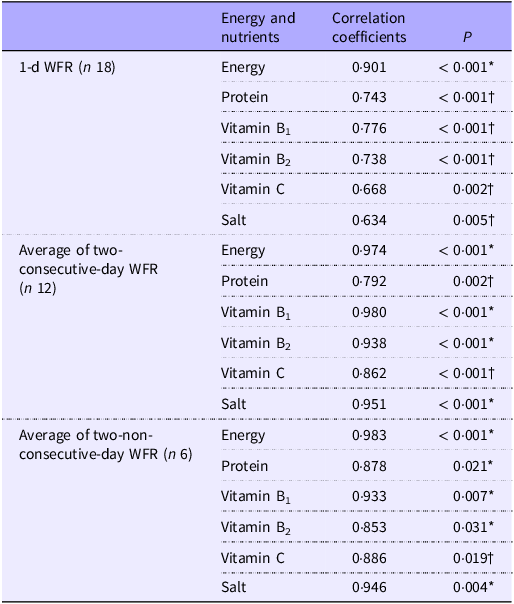
Energy and nutrients estimated from the 1-d WFR had a strong positive correlation (r > 0·6)(36) with the average of three-consecutive-day WFR (Table 1). However, stronger correlations in energy and nutrients were obtained with two-consecutive- and non-consecutive-day WFR; most of them had > 0·8, which is a very strong correlation coefficient(36). Overall, the amount of energy in the analysed food items showed a very strong positive correlation (r > 0·9)(36). Although vitamin C and salt in 1-d WFR had relatively lower correlation coefficients (r = 0·668 and 0·634) among energy and all nutrients, their values in the averages of two-consecutive or non-consecutive-day WFR had very strong positive correlation coefficients.
Correlation coefficients for the amounts of energy and nutrients with the average of three-consecutive-day WFR

WFR, weighed food record.
*Pearson’s correlation coefficient.
†Spearman’s correlation coefficient.
Although both averages of two-consecutive- and non-consecutive-day WFR had very strong positive correlation coefficients in amounts of energy and nutrients, which had stronger correlation with the standard was uncertain. To determine whether consecutive or non-consecutive days were preferable, two-paired tests were conducted between the averages of two-consecutive- or non-consecutive-day WFR and the average of three-consecutive-day WFR. For energy and nutrients other than salt, no significant difference between each pair was observed (Table 2).
Comparison for energy and nutrients between two-paired groups

WFR, weighed food record.
*Mean (standard deviation).
**Median (interquartile range).
†Paired t test.
‡Wilcoxon signed-rank test.
Meal characteristics
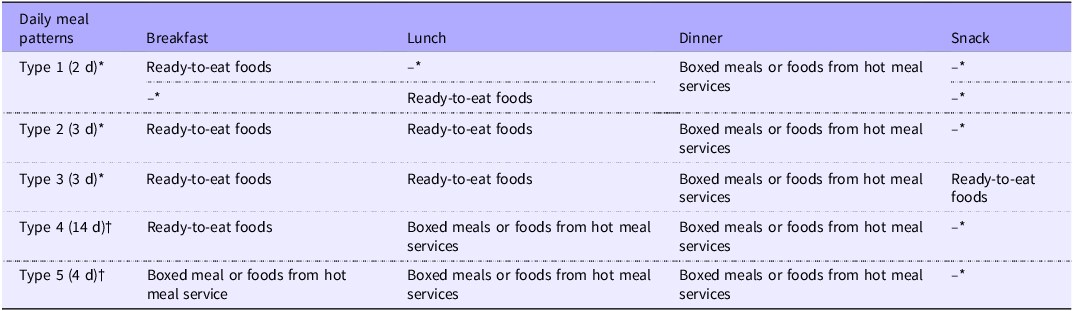
The combinations of foods in the daily meals were divided into five patterns (Table 3). In the four shelters with 2-d WFR, breakfast and lunch were all ready-to-eat foods of monotonous carbohydrate-based foods, such as rice balls and sweetbreads (types 1–3 in Table 3). As for the dinner, these shelters served boxed meals or foods from hot meal services consisting of rice, main and/or side dishes. The shelters also served snacks, including coffee, vegetable juice, beer and crunchy chocolate, for 3 d.
Observed daily meal patterns and their frequencies

WFR, weighed food record.
* Data from four shelters with two-consecutive-day WFR.
† Data from six shelters with three-consecutive-day WFR.
In six shelters with 3-d WFR, breakfast consisted of carbohydrate-based ready-to-eat foods were served for 14 d (type 4 in Table 3). All three meals (breakfast, lunch and dinner) were a combination of rice and main and/or side dishes for 4 days (type 5 in Table 3).
All meals were divided into ready-to-eat foods (n 31) and boxed meals or foods from hot meal services (n 48). As shown in Table 4, the average amounts of energy and nutrients per meal were higher in boxed meals or foods from hot meal services than in ready-to-eat foods. In contrast, CV for energy and all nutrients in ready-to-eat foods were larger than those in boxed meals or foods from hot meal services. In both meals, vitamin C had the largest CV. Salt was the second (boxed meals or foods from hot meal services) or third (ready-to-eat foods) nutrient with large CV. In addition, the CV of staple dish was the smallest, followed by the main and side dishes in both meal categories.
Average amounts and CV of energy and nutrients by meal category

*Mean (sd).
**Median (interquartile range).
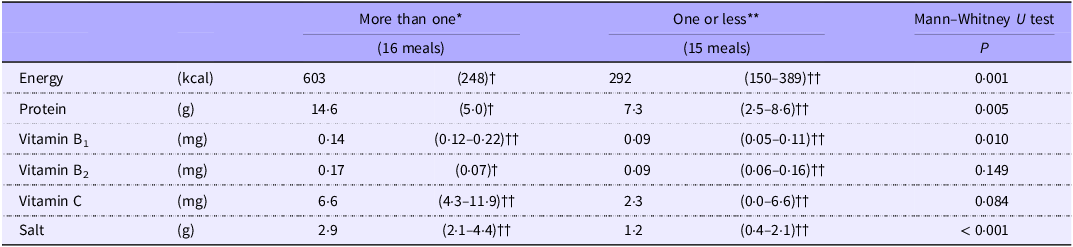
Ready-to-eat foods containing carbohydrate-based foods, such as rice balls or bread, were almost always served. However, the number of carbohydrate-based foods supplied was different for each meal. Out of thirty-one meals, sixteen consisted of ready-to-eat foods containing more than one carbohydrate-based food such as a combination of rice and bread. Eleven meals based on ready-to-eat foods contained one carbohydrate-based food, whereas the remaining four contained none. Table 5 shows the results of the Mann–Whitney U test of two groups divided by the number of carbohydrate-based foods: ‘more than one’ and ‘one or less’. Significant differences were detected in energy, protein, vitamin B1 and salt between meals with more than one carbohydrate-based food and meals with one or less those foods.
Association between meals with ‘more than one’ and ‘one or less’ ready-to-eat staple foods in energy and nutrients’ supply

* Number of carbohydrate-based dishes: four (n 1), three (n 3) and two (n 12).
** Number of carbohydrate-based dishes: one (n 11) and none (n 4).
†Mean (sd).
††Median (interquartile range).
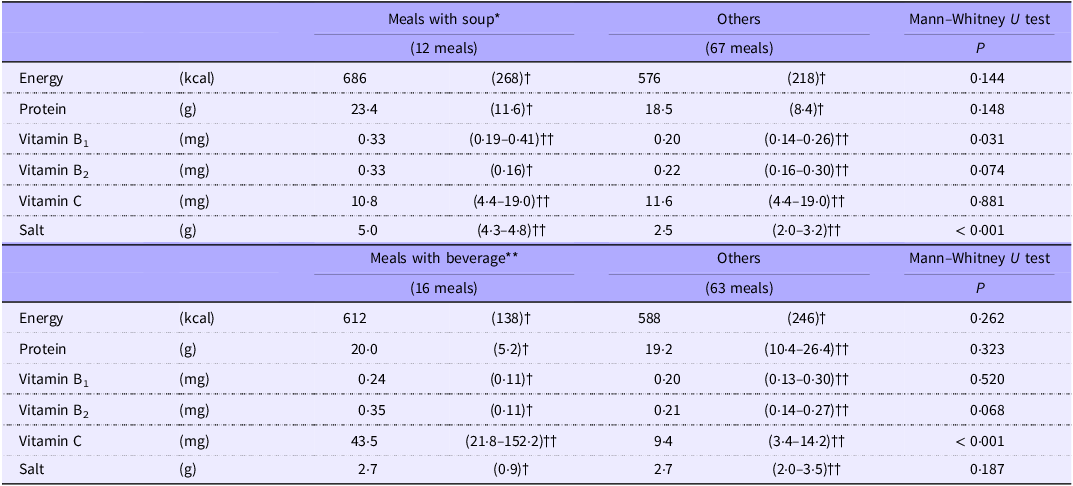
Table 6 shows the results of the Mann–Whitney U test of the effect of the provision of soup or beverage on the supply of energy and nutrients in meals. In this study, soup from instant noodles (57–75 g (without water); n 4), instant miso soup (42–54 g (without water); n 2) and Japanese or Chinese style soup from hot meal services made from granule soup stock or miso (124–400 g; n 6) were provided with meals. Consequently, meals with soup contained significantly higher amounts of vitamin B1 and salt. Some meals were also served with beverages such as vegetable juice (200–265 g; n 6), bottled green tea (500 g; n 5), lactic acid bacteria beverage (84 g; n 3), milk (206 g; n 1) and sports beverage (500 g; n 1). Table 6 shows that the amounts of vitamin C significantly increased in meals with beverages, which was about five times as meals without beverages.
Association between ‘meals with soup/beverage’ and ‘others’ in energy and nutrients’ supply

* Meals with soup: instant noodle (57–75 g (without water); n 4), instant miso soup (42–54 g (without water); n 2) and Japanese or Chinese style soup from hot meal services made from granule soup stock or miso (124–400 g; n 6).
** Meals with beverage: vegetable juice (200–265 g; n 6), bottled green tea (500 g; n 5), lactic acid bacteria beverage (84 g; n 3), milk (206 g; n 1) and sports beverage (500 g; n 1).
†Mean (sd).
††Median (interquartile range).
Discussion
Recommended number of weighed food record
As shown in Table 1, strong positive correlations were observed between standard (average of three-consecutive-day WFR) and 1-d WFR. According to the report of the Great East Japan Earthquake, dietary surveys must be conducted efficiently, and their results must be sent promptly to the local government to improve the nutritional status in shelters(37). Because no study has revealed the necessary number of days for WFR in emergency settings, this study was the first to show that only 1-d WFR could contribute to the relative evaluation to identify shelters with poorer nutrition supply as a substitute for 3-d WFR. This might serve as a rationale for local governments to promptly assist shelters that needed the most help. Table 1 also reveals that the energy amount had a very strong positive correlation with the standard. Therefore, a highly accurate assessment would be expected for energy supply, a necessary nutritional source for the immediate post-disaster(3).
As shown in Table 1, the average of two-consecutive- or two-non-consecutive-day WFR showed a stronger positive correlation with a standard comparing to 1-d WFR. Although 1-d WFR can be used for assessing nutrition supply, 2-d WFR would be preferable for more accurate nutritional assessment if the dietitians in the evacuation shelters are willing to commit. No significant differences were shown in energy and most nutrients in both pairs (Table 2), but previous studies(Reference Tarasuk and Beaton38,Reference Murakami, Oshikata and Miyamoto39) have revealed that non-consecutive-day data were more preferable than data collected on adjacent days because the former considered the changes in meal contents over an extended period. In addition, the dietary surveys for several days might reduce the motivation to continue consecutive-day WFR(Reference Gersovitz, Madden and Smiciklas-Wright40). Consequently, non-consecutive-day WFR are preferable when local governments ask dietitians to conduct 2-d WFR. If several non-consecutive-day WFR are needed in shelters, the survey period should be within the same phase, such as phase 2 (4 days to 1 month after the disaster) or phase 3 (over 1 month after the disaster)(3). These phases focus on dealing with the nutritional issues under conditions where food availability is relatively improved(3).
CV of energy and nutrients in meal categories and food groups
We further analysed how meals or food categories affect the number of necessary days for WFR. Compared with boxed meals or foods from hot meals services, meals consisting of ready-to-eat foods provided smaller average amounts of energy and all nutrients with larger CV (Table 4). In addition, ready-to-eat foods based meals with higher number of carbohydrate-based foods showed significantly higher levels of energy and some nutrients (Table 5). According to previous studies, rice balls, bread and biscuits(Reference Tsuboyama-Kasaoka, Hoshi and Onodera4,Reference Ainehvand, Raeissi and Ravaghi41,Reference Sasaki42) were often provided in disaster-affected areas. Although boxed meals or foods from hot meal services can increase some food categories(Reference Mihara, Harada and Oka43), differences in the number of carbohydrate-based foods in ready-to-eat foods-based meals appear to significantly contribute to CV in terms of energy and nutrients. Because CV of ready-to-eat foods might be larger than those of other meal types, 2-d WFR, preferably non-consecutive-day WFR, should be conducted instead of 1-d WFR considering variations when ready-to-eat foods are mainly served in the surveyed shelters.
Regarding food groups, staple dishes had the smallest CV (Table 4). In Japan where rice is usually consumed in a relatively stable amount, CV of cereals are relatively small(Reference Egami, Wakai and Kaitoh44,Reference Ogawa, Tsubono and Nishino45) . Therefore, our results were consistent, although the food environment in emergencies is different from that in normal situations. On the contrary, previous studies(Reference Egami, Wakai and Kaitoh44,Reference Ogawa, Tsubono and Nishino45) on side dishes have shown that fungi and algae require multiple days for estimation: > 2 years within 10 % of their true value because of their large within-individual variations. Vegetables took > 1 month within 10 % of their true value(Reference Egami, Wakai and Kaitoh44,Reference Ogawa, Tsubono and Nishino45) . Similar results were observed in this study, making it difficult to assess the nutritional supply (Table 4).
Other factors affecting large CV of energy and nutrients
Soup or beverages with meals can affect CV in terms of energy and nutrients (Table 6). For salt, meals with soup had significantly higher amounts than those without soup; the difference in quantity was approximately twice as much. Previous study has shown that the salt supply in evacuation shelters was high in food aids such as instant noodles(Reference Tsuboyama-Kasaoka, Hoshi and Onodera4). In addition, hypertension risk due to increased salt intake was reported after disasters(Reference Hoshide, Nishizawa and Okawara5). Therefore, the salty soup might contribute to the relatively large variations (Table 6). Beverages served with meals had significantly higher levels of vitamin C, approximately five times. The main dietary factors may be vegetable juice and bottled green tea, which are reported to be important sources of vitamin C(Reference Takeda, Sudo and Tsuboyama-Kasaoka11). In general, the addition of vegetables in meals, which are generally vitamin C sources, is difficult because of their scarcity(Reference Sudo, Sawaguchi and Yoshiike46). Therefore, estimating the accurate vitamin C supply might be hard given the limited number of WFR when vitamin C rich beverages are served.
Implementation of nutritional assessment in evacuation shelters
Conducting nutritional surveys in disasters might reduce Japan’s vulnerability. The results of this study would provide insights into the nutritional improvement in evacuation shelters. It would also be useful for understanding dietary issues during disasters in countries with very high vulnerability, such as Africa, Asia and Central America. For example, in Puerto Rico, after Hurricane María, a federal distribution centre provided snacks and sweets at a high frequency, whereas fruits, vegetables, proteins and grains accounted for only approximately 10 % of all foods provided(Reference Colón-Ramos, Roess and Robien47). In the aftermath of disasters in Iran, food aid was reported to be inappropriate because it contained high amounts of Na and sugar, with limited amounts of fibre(Reference Ainehvand, Raeissi and Ravaghi41). Although such dietary issues have been reported, no evidence shows that other countries have conducted dietary surveys for accurate nutritional assessment in times of disaster. Therefore, this study presents the validity of 1- or 2-d WFR and the important notice for assessment.
Strengths and limitations
This study has several limitations. First, the number of shelters included in this study was relatively small compared with those in studies conducted in normal settings. While previous studies have collected data from thirty-five volunteers(Reference Murakami, Oshikata and Miyamoto39), the present study focused on assessing shelters rather than individuals, which led to a smaller number of facilities. In addition, the July 2020 Heavy Rainfall affected a few regions, which further limited the number of shelters that could be included. For example, while there were 2417 shelters during the Great East Japan Earthquake in 2011(48), only a maximum of 212 shelters were available(49). However, food and nutrition assistance during disasters was strengthened after the Great East Japan Earthquake such as issuing RV(6) and developing food and nutritional assistance manuals for professionals(3). Although the scale of damage was not as large as that of the Great East Japan Earthquake, the July 2020 Heavy Rainfall had the largest number of human casualties following that earthquake(50) and these new food and nutrition assistance system was applied at that time. Therefore, the WFR in this study would reflect the latest food and nutritional assistance, and the analysis results are useful for future disaster management.
Second, a maximum of three-consecutive-day WFR is available for this study. Although this approach is commonly used in disaster settings because of the limited time available for data collection, it may not provide the same level of accuracy as the 7-d dietary records used in a previous study(Reference Murakami, Oshikata and Miyamoto39). However, the Disaster Relief Act limits the duration of evacuation shelters to a maximum of 7 d in general, which makes it challenging to collect data over a longer period unless a rare catastrophic disaster occurs. Whenever evacuation shelters are open for a longer period in the future, more research-based WFR might be collected to estimate the necessary number of days.
Conclusions
This study showed that even 1-d WFR could substitute the 3-d WFR in identifying shelters in immediate need of nutrition support. If the dietitians agree, two-non-consecutive-day WFR are recommended as it gives better degree of accuracy to assess the nutritional supply. Considering the large CV, 2-d WFR, preferably non-consecutive-day WFR, are recommended especially when the meals included ready-to-eat foods. Salty soup or beverages, which are rich in specific nutrients, can also affect the variation. To demonstrate the robustness and generalisability of these findings, a study, particularly one that spans larger areas should be conducted after large-scale disasters in the future.
Acknowledgements
The authors thank all the investigators and the government of the Kumamoto Prefecture for providing the relevant data for this study.
This study was funded by Grant-in Aid for Scientific Research from the Ministry of Health, Labor and Welfare (grant number 20FA2001) (Principal Investigator: Noriko Sudo). However, the funding body played no role in the design of the study, collection, analysis, interpretation of data and in writing the manuscript.
N. S. was in charge of administration and supervision of this study. N. S. and N. T-K. conceptualized, designed the research (including investigation and methodology), and contributed to funding acquisition. N. S., N. T-K. and S-N-S. contributed to the data collection. H. S. and N. S. conducted data curation. H. S. analyzed data using software and visualized the results. Major contributors to the manuscripts were H. S. and N. S. All authors critically revised and commented on the previous versions of the manuscript. After revisions, the final version of the manuscript was approved by all the authors. N. S. was responsible for submitting the manuscript.
The author(s) declare no conflicts of interest.
Due to the nature of the study, the Kumamoto prefectural government did not allow us to share their data publicly. However, these data are available from the corresponding authors upon reasonable request.
The government of Kumamoto Prefecture conducted this dietary survey as part of shelter management following disasters. Because it is based on the secondary use of data collected by local governments, this study was deemed not applicable for review by the Ethical Review Committee of the Ochanomizu University Research in Humanities and Social Sciences. The authors obtained permission for the secondary use of data from the government of Kumamoto Prefecture (Permission notice: Kenzusui No. 885). Consent to participate does not apply to this study. All methods were conducted in accordance with the relevant guidelines and regulations of the institution and the Declaration of Helsinki.