


Many governments have established guiding principles for the best cost-effective approach to counter problems posed by invasive species, and some countries have already developed rapid response strategies and early warning detection programmes (FICMNEW, 2003; DEFRA, 2008; Genovesi et al., Reference Genovesi, Scalera, Brunel, Roy and Solarz2010). For the outermost territories of Europe, European Regulation No. 1143/2014 on preventing and managing invasive alien species, establishes that the implementation of programmes is the responsibility of Member states. The regulation specifies that the requirements to control invasive species should be more restrictive in the outermost territories, and preventive measures or rapid response procedures should be adapted to the specific features of the territories. However, the regulation is only being partly enforced in many of these outermost territories. In the Canary Islands the number of invasive species is increasing (Martín Esquivel et al., Reference Martín Esquivel, Marrero Gómez, Zurita, Arechavaleta and Izquierdo Zamora2005) and the control of some of them entails severe financial costs (e.g. Lampropeltis californiae; Gesplan, 2015). The archipelago lacks effective control, rapid warning procedures for invasive species, or a legal framework to control movement of invasive species between islands.
The invasive Barbary ground squirrel Atlantoxerus getulus, which is native to Morocco and Algeria, illustrates the situation. A pair of squirrels were taken to Fuerteventura in 1965 as pets, and by the 1980s the species had colonized most of the island (López-Darias, Reference López-Darias2007). In Spain the species is now legally considered an invasive species. Its possession, commerce and transportation are banned, although it is still deliberately moved between islands. Here we review available data (from the scientific and grey literature, and personal communications with reliable sources) on known translocations of the Barbary ground squirrel in the Canary Islands, illustrating the lack of mechanisms preventing movement of invasive species within a European archipelago.
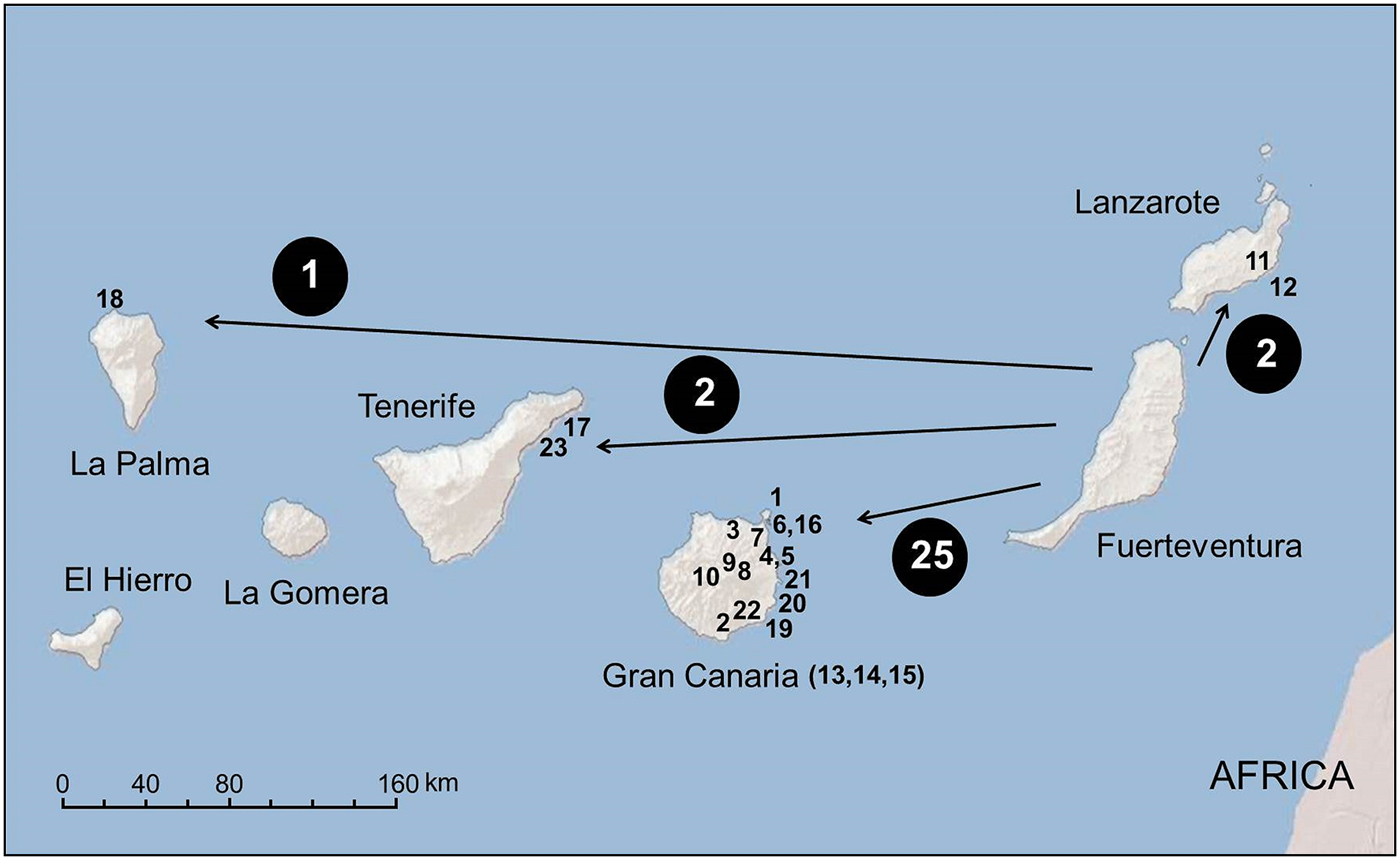
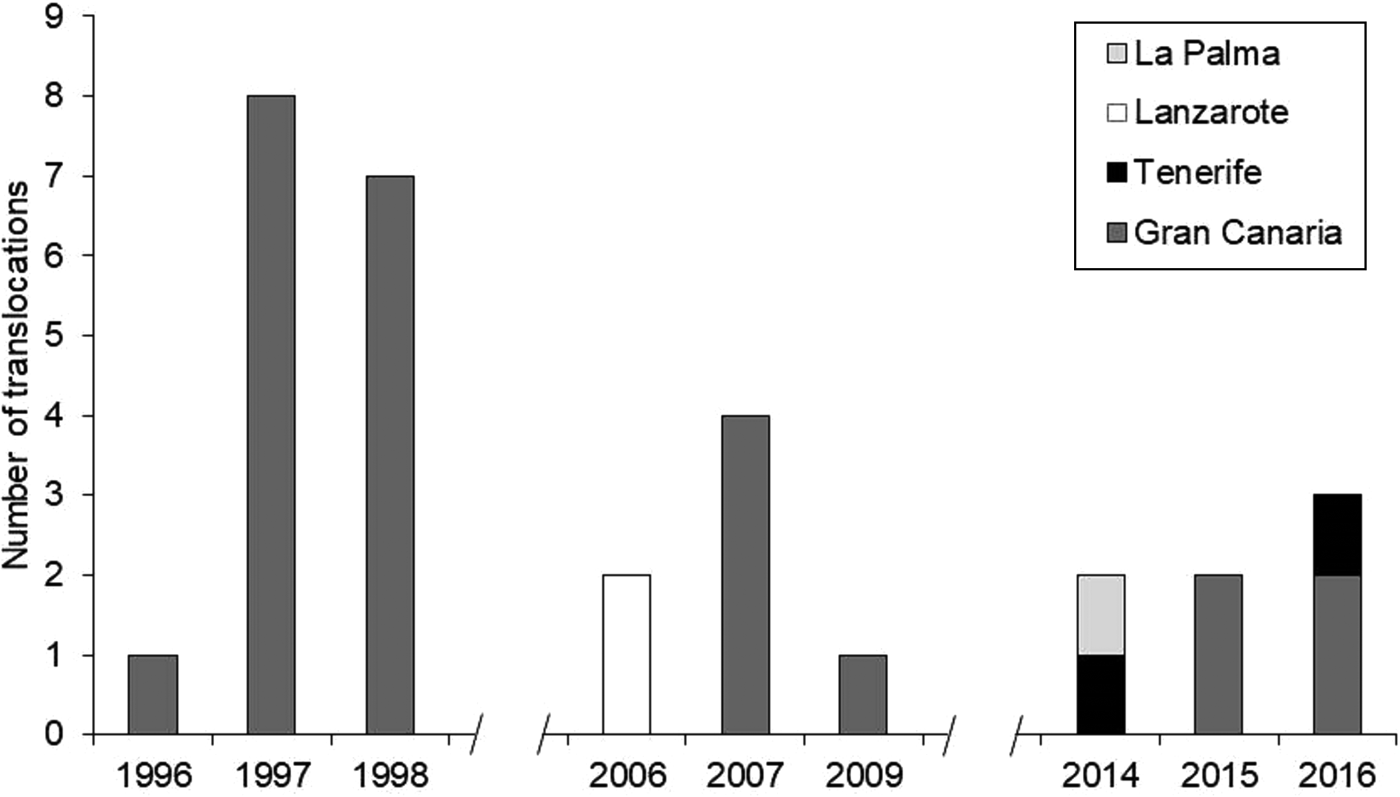
From 1996 to 2016 there were at least 23 confirmed translocations (involving at least 30 individuals; Table 1, Fig. 1) of Barbary ground squirrels between islands. An additional seven sightings, two in 2017, were not confirmed by knowledgeable individuals. There was no clear temporal pattern of translocations (Fig. 2), although they occurred in three periods: 1996–1998, 2006–2009 and 2014–2016. Most of the translocations (83.3%) were to Gran Canaria, probably because of its close commercial and touristic links with Fuerteventura. Gran Canaria is a transit nexus for most of the archipelago's commercial routes, and well connected (especially by sea) with Fuerteventura and Lanzarote. In addition, Gran Canaria is the most populated island and Fuerteventura is the main touristic island of the eastern Canaries, which increases the probability of squirrel translocations from Fuerteventura. Only a small number of translocations have been detected to Lanzarote, even though it is the closest island to Fuerteventura (15 km distant). Lanzarote's human population is six times less than that of Gran Canaria and, even though it is well connected to Fuerteventura by sea, the ports are mainly resorts, with few resident islanders, and thus the likelihood of translocations is lower.
The Canary Islands, showing the locations of all confirmed translocations of Barbary ground squirrels Atlantoxerus getulus during 1996–2016. Numbers correspond to the ID in Table 1. White numbers represent the total number of squirrels translocated to each island.
Number of known, confirmed translocations of Barbary ground squirrels within the Canary Islands per year from 1996 to 2016. Gaps between years indicate that no translocations were detected.
All known confirmed and unconfirmed translocations of the Barbary ground squirrel Atlantoxerus getulus from Fuerteventura to elsewhere in the Canary Islands (see ID numbers in Fig. 1) during 1996–2017, with date of detection or capture if known.
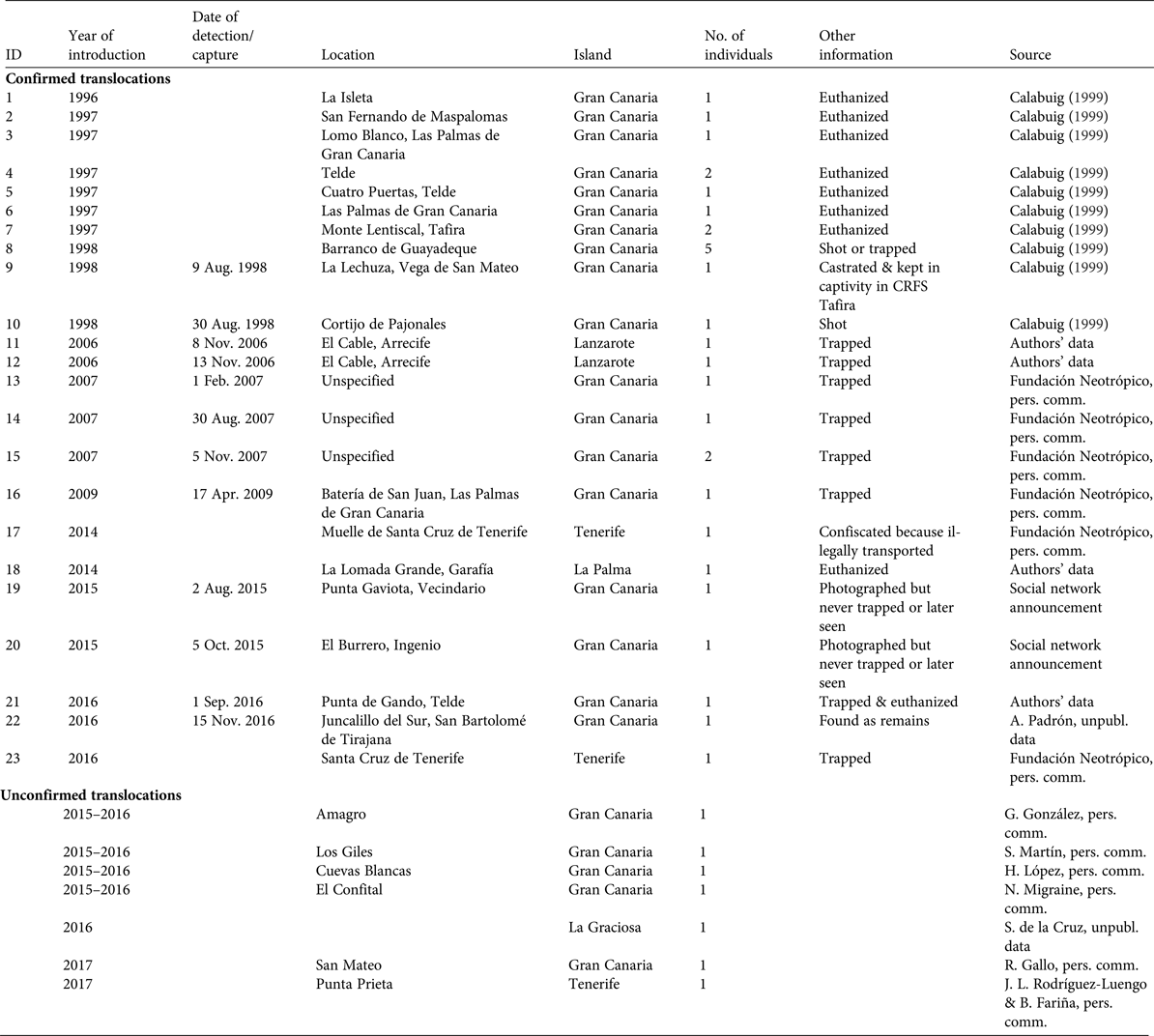
Considering the strict controls in place at airports, it is most likely that squirrels are moved by sea. As the keeping of squirrels is illegal, it is unlikely that escapes will be reported by owners to the relevant authorities. On only one occasion (ID 17, Table 1) was a squirrel confiscated at a port, which demonstrates the laxity of control measures. As all the islands in the archipelago are climatically suitable for the Barbary ground squirrel (López-Darias et al., Reference López-Darias, Lobo and Gouat2008), the invasion of other islands is only a matter of time unless effective procedures are applied.
When a squirrel is reported on islands other than Fuerteventura the relevant government body has to take actions that require both financial and human resources not specifically intended for the purpose. As there is no coordinated response protocol, each public administration tackles each detected translocation independently. In 2014 La Palma insular government captured an introduced squirrel shortly after its initial sighting, requiring 25 h of trapping and c. EUR 2,500 (ID 18, Table 1). On Gran Canaria, after failed attempts by the island government to capture two squirrels introduced in 2016, external professionals were subcontracted by the regional authorities (at a cost of EUR 8,000) almost 1 year after the original sighting. Following 100 hours of observation, 180 questionnaires collected from the local inhabitants, 900 ha searched and 3 h of trapping, they captured one squirrel (ID 21, Table 1).
The case of the Barbary ground squirrel is only one example of the permeability of the sea barriers within this archipelago. If larger animals can be translocated between islands (e.g. the mouflon Ovis orientalis; Acevedo-Rodríguez & Medina, Reference Acevedo-Rodríguez and Medina2010), it is probably relatively easy to translocate smaller animal species and plants. The costs of removing invasive species in the whole archipelago are unknown (controlling alien invertebrates on La Palma has been estimated to cost > EUR 5 million per year; García-Becerra & Medina, Reference García-Becerra and Medina2013). Removing naturalized invasive species is more expensive than preventing their introduction (Pimentel et al., Reference Pimentel, Lach, Zuniga and Morrison2000). EU Regulation No. 1143/2014 states that no later than January 2016 all nations should have fully operational structures for preventing and controlling the entry of invasive species. However, the implementation of those rules is delayed in the Canary Islands.
European outermost regions require an early warning and rapid response system, as implemented in New Zealand, Australia and Hawaii (e.g. Simberloff et al., Reference Simberloff, Martin, Genovesi, Maris, Wardle and Aronson2013), to prevent further introductions and translocations of species already established in other regions. The creation of such a system, involving governments, decision makers, experts, NGOs, and other appropriate stakeholders (Simpson et al., Reference Simpson, Jarnevich, Madsen, Westbrooks, Fournier and Mehrhoff2009), is a conservation priority for the Canary Islands and other biodiverse island territories. In July 2017 a pilot trial was approved by the Canary Government for an invasive species detection and intervention network (Gobierno de Canarias, 2017). The information summarized here has been shared with the public administration of the various islands and with other stakeholders, to encourage implementation of appropriate control mechanisms, and our recommendations have been passed via internal reports and personal communications to the Canarian authorities, both at insular and regional level.
Within the Canary Islands there have not yet been any public education campaigns to communicate the problems of invasive species. In the case of the Barbary ground squirrel the only action taken to prevent its transportation to other islands was to place information plaques at airports and ports in the 1970s, but these only remained in place for a few years. In addition to detection and intervention, a public education programme is required, to inform society about the risks related to invasive species.
Acknowledgements
Segundo Lorenzo and Ángel M. Mallorquín helped us in the field in La Palma. Aurelio Martín and Juan Luis Rodríguez-Luengo revised a first draft and provided useful data. Fundación Neotrópico, Guillermo Delgado, Salvador de la Cruz, Susana Saavedra, Jeremías Cabrera, Guillermo González, Beatriz Fariña, Nancia Migraine, Sonia Martín, Heriberto López and Ramón Gallo provided information about translocated squirrels. MLD is funded by the Program Agustín de Betancourt, under the identification Tenerife 2030 (P. INNOVA 2016-2021). JCP is funded by a Canary Islands Government PhD fellowship.
Author contributions
All authors contributed equally to this research and article.
Biographical sketches
Félix M. Medina studies the trophic feeding ecology of feral cats and their impacts on native species on islands, and he is interested in the effects of introduced species on the conservation of island ecosystems. Marta López-Darias's research is mainly focused on the ecology, impacts and management of invasive vertebrate species on islands, particularly on the Canary Islands. Julien C. Piquet's research is mainly focused on invasive species and their impact on insular biodiversity and ecological and evolutionary processes.



