





“[We] have made considerable progress in improving the quality of research conducted and in developing effective programs of intervention for children who have been maltreated. The journey has been long and the road continues into the distance; although at times I ponder that an easier path might be preferable, I know that ‘. . . I have promises to keep, / And miles to go before I sleep’.”
-Dr Dante Cicchetti’s concluding remarks at the receipt of the Award for Distinguished Senior Career Contributions to Psychology in the Public Interest (Cicchetti, Reference Cicchetti2004).
These remarks underscore the untold and seminal contributions of Dante Cicchetti as he helped create the discipline of developmental psychopathology and completed research with rigor, thoughtfulness, nuance, and creativity. Cicchetti’s concluding remarks are also quite prophetic, as the journey continues for developmental psychopathology researchers wishing to carry on the work of giants such as Cicchetti, Garmezy, Sroufe, Masten, Elder, Zigler, Cairns, Rutter, and many other scholars of developmental psychopathology and developmental science (Cicchetti, Reference Cicchetti1984). Inspired by Cicchetti’s trailblazing spirit, we believe that neuroscience and data science can support this research area on the road ahead to better understand the complex developmental pathways and processes involved in normal and abnormal development across multiple levels of analysis.
Data science is a multidisciplinary field encompassing techniques such as data mining and machine learning; this field is suited to uncover subtle trends, often in datasets with an incredibly large number of independent variables. Continuing Cicchetti’s drive to grapple with developmental complexities, this commentary will: (1) briefly review our research program on neurodevelopment and early life adversity (ELA), noting its evolution due in part to the work of Dr Cicchetti and colleagues; (2) illustrate how data science can support developmental psychopathology work focused on ELA; and (3) highlight additional, emerging opportunities as the field advances as a discipline.
Our past work on early life adversity and neurodevelopment
Our research program has aimed to elucidate how early life adversity (ELA) shapes youth mental health and development. ELAs are sadly common, with millions of children nation-wide and globally facing chronic stress and adverse experiences like physical abuse and neglect during childhood (Madigan et al., Reference Madigan, Deneault, Racine, Park, Thiemann, Zhu, Dimitropoulos, Williamson, Fearon, Cénat, McDonald, Devereux and Neville2023; Sacks & Murphey, Reference Sacks and Murphey2018). Such experiences are linked to different developmental challenges across multiple domains, including disrupted attachment behaviors, difficulties in social-emotional skills, and increases in different forms of psychopathology (as reviewed in Doyle & Cicchetti, Reference Doyle and Cicchetti2017)
Our research program began by exploring if ELA and experiences of stress influenced brain development, hypothesizing that exposure to ELA would disrupt typical neurodevelopmental processes (Hanson et al., Reference Hanson, Adluru, Chung, Alexander, Davidson and Pollak2013; Hanson et al., Reference Hanson, Chung, Avants, Shirtcliff, Gee, Davidson and Pollak2010, Reference Hanson, Chung, Avants, Rudolph, Shirtcliff, Gee, Davidson and Pollak2012). Such work derived from the research of Dr Cicchetti and his colleagues that distinctly illuminated the consequences of one form of ELA, child maltreatment (Carlson et al., Reference Carlson, Cicchetti, Barnett and Braunwald1989; Cicchetti & Valentino, Reference Cicchetti and Valentino2015; Kim & Cicchetti, Reference Kim and Cicchetti2010; Manly et al., Reference Manly, Kim, Rogosch and Cicchetti2001). While we believe our studies provided important early insights in the field, we also recognized their impact was limited by their cross-sectional and correlational design. That is, stress exposure was correlated with the brain, and the brain then correlated with behavioral functioning, all measured at the same time point. While it was clear that ELA is associated with changes in neurobiology, less was known about how these alterations may interact with factors at other levels of analyses to convey risk for psychopathology.
Accordingly, our work began to consider how ELA may convey risk for psychopathology through developmental cascades, where functioning in one domain or level may spread across different levels (e.g. molecular to behavioral), domains (e.g. social to academic), or systems (e.g. family to peers) (Masten, Reference Masten2007; Rutter & Sroufe, Reference Rutter and Sroufe2000). Illustrating this idea, we have focused on the concept of stress sensitization, or the notion that early adversity can alter how individuals respond to stressors later in life. We have found that exposure to ELAs were longitudinally associated with lower amygdala-prefrontal cortex structural and functional connectivity, a neurobiological circuit critical for emotion processing and regulation (Hanson et al., Reference Hanson, Albert, Skinner, Shen, Dodge and Lansford2019; Hanson et al., Reference Hanson, Knodt, Brigidi and Hariri2015). We then found that the interaction of lower connectivity in this circuit and higher contemporaneous stress related to elevated reports of psychopathology. Our focus on these ideas has continued and expanded to include neurobiological circuitry connected to feedback processing, reward learning, and value-based decision-making (Hanson et al., Reference Hanson, Knodt, Brigidi and Hariri2018; Palacios-Barrios et al., Reference Palacios-Barrios, Hanson, Barry, Albert, White, Skinner, Dodge and Lansford2021).
In a second line of research considering how ELA conveys risk for psychopathology through multiple levels of analysis, our team has posited a model of “amygdala allostasis” in relation to ELA (Hanson & Nacewicz, Reference Hanson and Nacewicz2021). We had struggled to understand conflicting and inconsistent findings related to structural alterations in the amygdala after ELA, with groups reporting larger, smaller, and no differences in this brain region critical for emotion processing and vigilance (Calem et al., Reference Calem, Bromis, McGuire, Morgan and Kempton2017; Hanson et al., Reference Hanson, Nacewicz, Sutterer, Cayo, Schaefer, Rudolph, Shirtcliff, Pollak and Davidson2015). Integrating developmental psychopathology perspectives again advanced the complexity of this work. We considered the limitations of past studies and current models, ultimately developing a model that more deeply integrated developmental timing (i.e. the period during which ELA occurs), amygdala-related neurodevelopment, and behavioral adaptations to adversity.
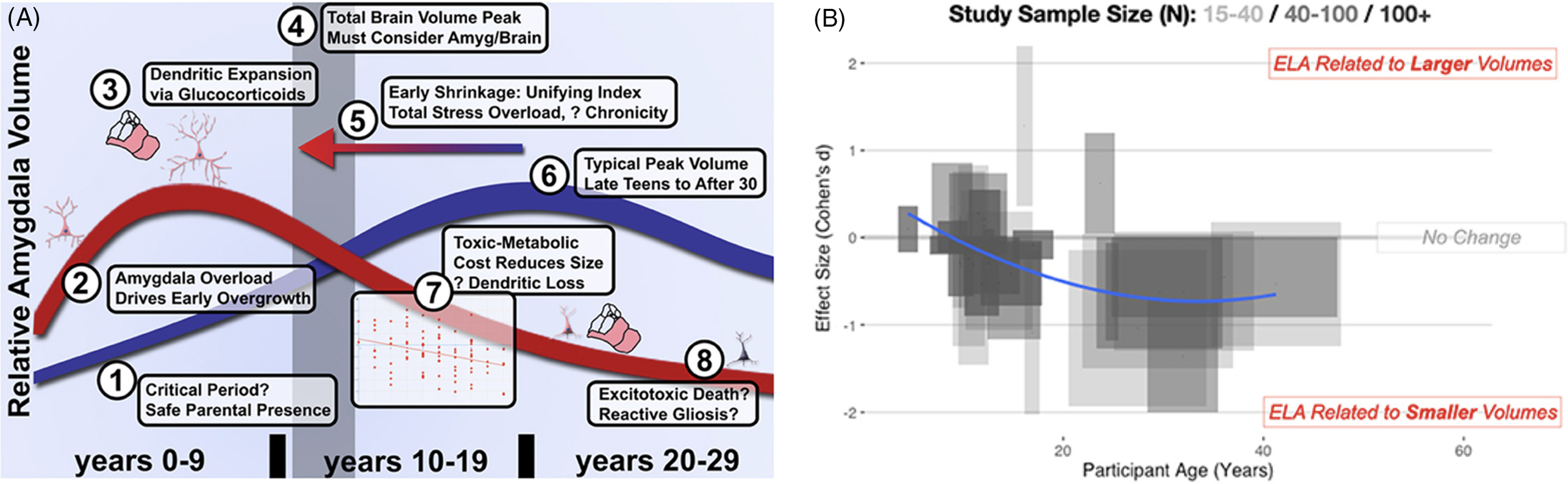
Synthesizing across dozens of studies examining amygdala volume and adversity in human and non-human animal samples, we posited that high levels of adversity would initially increase amygdala volumes; specifically, individual neurons in the amygdala would become enlarged, in different ways, to allow for greater sensitivity to threat and stress in an environment. We also predicted that ELA would lead to excessive neurochemical excitation and functional activity. However, over time and with extreme and chronic adversity, this excitation would lead to a cascade of excitotoxic cellular damage and, ultimately, amygdala hypotrophy (as depicted in Fig. 1). We believed that the presence of responsive caregivers and other social support during stressful developmental epochs may buffer against these maladaptive consequences such as by dampening fear responding, promoting positive neurochemical signaling related to safety, and strengthening neural circuits important for memory consolidation (as reviewed in Hanson & Nacewicz, Reference Hanson and Nacewicz2021). On the other hand, a lack of stable caregivers may leave individuals with ELA in a state of perceived “entrapment” where threats seem inescapable. The evidenced allostatic changes in amygdala neurobiology may be linked to behavioral challenges after ELA, such as attachment issues, aberrant emotion processing, and social difficulties. These behavioral processes may then reinforce perceptions of environmental threats for individuals who suffered ELA. Taken together, ELAs may have cascading effects on later development through alterations to brain and behavior, influencing how the brain responds to future challenges. Such ideas share a rich history with work on developmental cascades by Cicchetti, Masten, and colleagues (DePasquale et al., Reference DePasquale, Handley and Cicchetti2019; Handley et al., Reference Handley, Russotti, Rogosch and Cicchetti2019; Masten & Cicchetti, Reference Masten and Cicchetti2010). We credit this nuanced theory and scholarship with encouraging our ideas to evolve and explore how ELA may convey risk for psychopathology through dynamic transactions between neurobiological, environmental, and psychosocial factors over the course of development.
Model of amygdala volumetric changes after early life adversity. Panel A (left) depicts a hypothesized model showing how amygdala volume may initially increase, but then decrease with severity and chronicity of early life adversity. Panel B (right) summarizes findings from the past empirical studies of amygdala volumes in individuals exposed to early life adversity, with effect sizes and confidence intervals (vertical axis) depicted along with participant age ranges (horizontal axis) and sample sizes (box color). Adapted from Hanson & Nacewicz (Reference Hanson and Nacewicz2021), doi: 10.3389/fnhum.2021.624705.
How can data science support developmental psychopathology and developmental neuroscience?
The field of developmental psychopathology has the laudable goal of investigating development while honoring the complex, multilevel interplay of biological, psychological, and social/environmental factors that influence human development over time (Cicchetti & Blender, Reference Cicchetti and Blender2006; Cicchetti & Curtis, Reference Cicchetti and Curtis2007). Integrating and grappling with these intricacies in our theories and methods is incredibly challenging (as detailed previously by Marshall, Reference Marshall2013); this is partially due to vast amounts of heterogeneity in experiences between individuals. Developmental psychopathology research that leverages neuroimaging and neuroscience methods faces the challenge of honoring this nuance while also reporting results that apply across a sample (Hyde et al., Reference Hyde, Shaw and Hariri2013, Reference Hyde, Bezek and Michael2024). Yet, current work on the associations between ELA and psychopathology incorporating these methods often rely on “main effects,” or common patterns across neural regions that emerge when examining all study participants. This type of reporting may oversimplify crucial neurobiological variability – one individual may have stronger associations in brain regions of interest, while another may have weaker associations – yet, they may both arrive at a similar outcome. Moving forward, developmental neuroscience will need to consider the emergence of meaningful neurobiological subgroups with potentially different developmental pathways to psychopathology following ELA.
Data science techniques have the potential to significantly advance this type of research capturing critical differences in traits, states, and developmental transactions across time (Lazer et al., Reference Lazer, Pentland, Adamic, Aral, Barabási, Brewer, Christakis, Contractor, Fowler, Gutmann, Jebara, King, Macy, Roy and Van Alstyne2009; Yarkoni & Westfall, Reference Yarkoni and Westfall2017). These approaches often share elements with quantitative tools commonly used in psychology (e.g., Latent Class Analysis; Growth Mixture Modeling). Typically, psychology applies these techniques to focus on statistically “explaining” mechanisms between variables and considers a “good” model as one that fits well with the available and previously collected data. In contrast, data science emphasizes “prediction,” meaning building models that can accurately forecast patterns in new data, rather than explicating the mechanisms between variables in training datasets. Furthermore, data science leverages novel techniques such as cross-validation, which involves dividing the available data into multiple subsets, training a statistical model on a portion of the data, and evaluating its performance on the remaining data to estimate how well it will perform on “unseen” data (Hastie et al., Reference Hastie, Tibshirani, Friedman and Friedman2009). While this is an active area of exploration for many in developmental psychology (Brieant et al., Reference Brieant, Sisk, Keding, Cohodes and Gee2024; Van Lissa, Reference Van Lissa2023), we provide three brief illustrations about the potential to integrate such methods that we are building on in our own research (as shown in Fig. 2).
Schematic of the potential contributions of data science techniques to advancing research on early life adversity (ELA) and developmental psychopathology. We highlight ideas of multiple levels of analyses, equifinality and multifinality, and debates about conceptualizations of ELA (from top to bottom), noting challenges (left side) and opportunities with data science (right side).
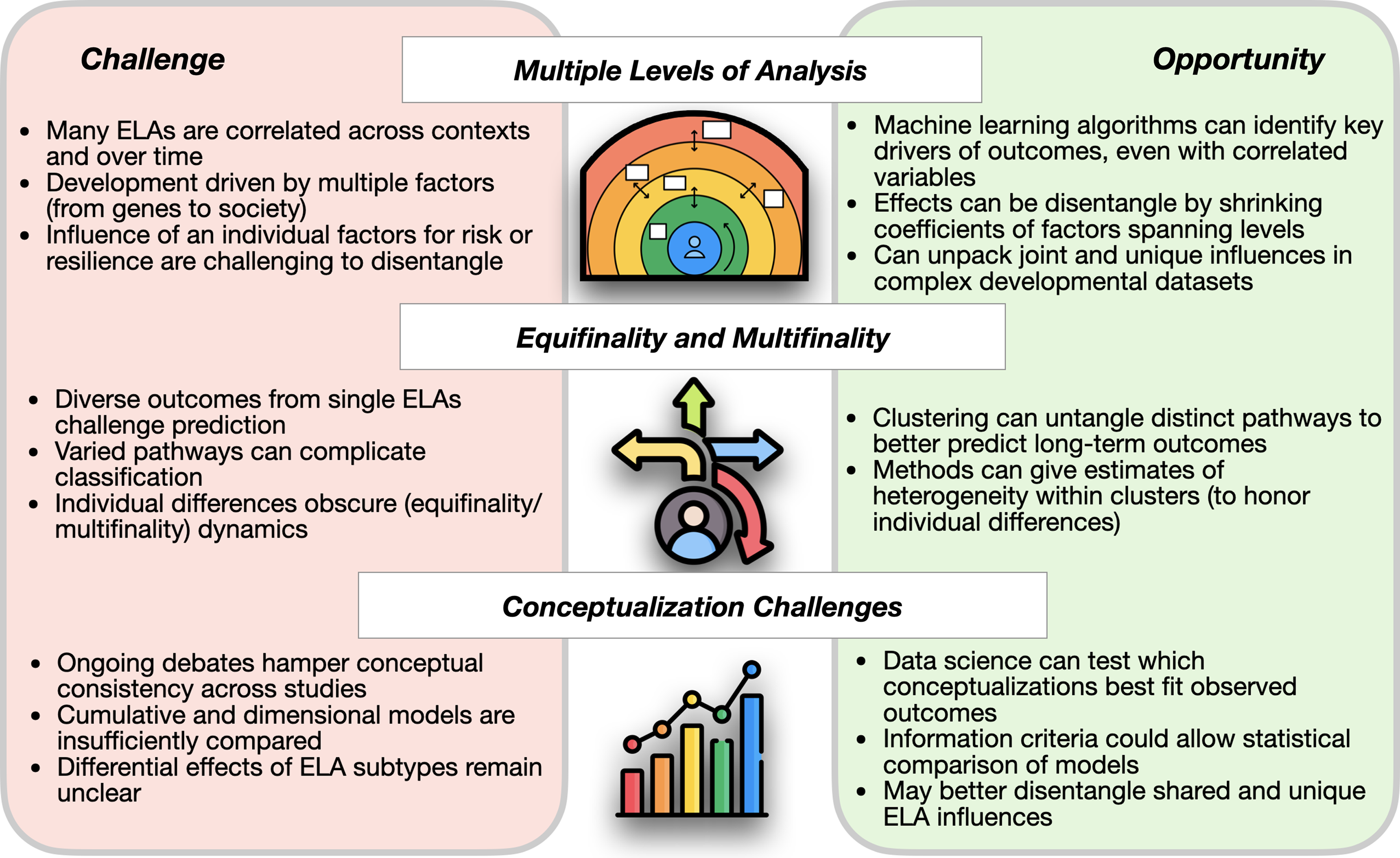
First, data science approaches may be relevant for thinking about multiple levels of analyses in developmental psychopathology, and how factors at different ecological levels of development and/or developmental epochs may contribute to risk and resilience (Bronfenbrenner, Reference Bronfenbrenner2000; Cicchetti, Reference Cicchetti2016). Any single factor relevant for risk and resilience may only contribute small amounts of variance to a behavioral outcome. Yet, it can be difficult to examine many predictors or confounding variables in small, longitudinal samples. Data scientists often describe this as the “curse of dimensionality” where there are many potential predictors (p), but relatively few observations (n). However, use of machine learning models (e.g., LASSO, elastic net, XGBoost, random forest) could be applied to understand how different neurobiological, environmental, and psychosocial factors each uniquely predict risk and resilience. These methods shrink (or penalize) coefficients for correlated predictors or select important variables in subsamples of the data, avoiding model overfitting and the inclusion of redundant features. Such properties allow machine learning to leverage many correlated variables to predict outcomes when sample sizes are limited.
For example, diverse types of ELAs are related to cognitive functions such as inhibitory control and working memory (Cowell et al., Reference Cowell, Cicchetti, Rogosch and Toth2015; Johnson et al., Reference Johnson, Policelli, Li, Dharamsi, Hu, Sheridan, McLaughlin and Wade2021; Nweze et al., Reference Nweze, Ezenwa, Ajaelu, Hanson and Okoye2023). It is less clear if specific ELAs might statistically relate to cognitive functioning after accounting for other types of adversities. There are many candidate ELAs to explore, and without including them, we may be overestimating associations in statistical models. As a demonstration, researchers used two machine learning models to examine if different types of ELAs at distinct developmental epochs influenced cognitive functions (Schalinski et al., Reference Schalinski, Teicher, Carolus and Rockstroh2018). This team used dozens of measures of ELA (e.g., neglect and abuse at many points in development; cumulative adversity scores focused on duration, severity, and multiplicity of ELA). In typical regression models, few significant differences would likely emerge if this many predictors were entered, due in part to collinearity between ELA variables. However, the machine learning models used by Schalinski et al. (Reference Schalinski, Teicher, Carolus and Rockstroh2018) uncovered that abuse in early childhood was found to be related to general cognitive ability, as well as lower performance on working memory and attention tasks. Such associations were not observed for other ELAs or abuse later in development. This approach may be used to investigate risk and protective factors at the genetic, neurobiological, environmental, or psychosocial levels during different developmental epochs that may be critical for specific outcomes, questions that are challenging to address with canonical statistical approaches like ordinary least squares regression. By leveraging machine learning models and accounting for multiple levels of influence comprehensively, we may be able to make sustained progress on the factors that promote resilience in the face of adversity and contribute to positive adaptations after ELA (Cicchetti & Rogosch, Reference Cicchetti and Rogosch1997; Luthar et al., Reference Luthar, Cicchetti and Becker2000).
Second, data science approaches may contribute to a more complete understanding of equifinality and multifinality, elucidating how both common and diverse pathways relate to long-term outcomes after ELA. As well-articulated by Cicchetti and Rogosch, many distinct developmental pathways can lead to similar outcomes (equifinality), but a single exposure or experience can also contribute to diverse developmental outcomes (multifinality) (Cicchetti & Rogosch, Reference Cicchetti and Rogosch1996). For example, child maltreatment spanning multiple years relates to many types of adult psychopathology, including anxiety, depression, substance use disorder, and antisocial personality disorder (Russotti et al., Reference Russotti, Warmingham, Duprey, Handley, Manly, Rogosch and Cicchetti2021). Data science approaches, such as clustering techniques, could aid in untangling these complex relationships and provide insight into how ELA may relate to both similar and diverse long-term outcomes. This is particularly important as there are large individual differences in the neurobiological factors of interest to scholars in developmental psychopathology (Mills et al., Reference Mills, Goddings, Clasen, Giedd and Blakemore2014).
An example of this comes from work by Lichenstein et al. (Reference Lichenstein, Roos, Kohler, Kiluk, Carroll, Worhunsky, Witkiewitz and Yip2022) examining adolescent neurodevelopment and risk factors for psychopathology, focused on reward, inhibition, and emotion regulation. This research team found six risk groups characterized by neurobiological markers of high reward, low reward, high inhibition, low inhibition, high emotion regulation, and low emotion regulation. Each neurobiological profile: (1) was identified using three different fMRI tasks, (2) spanned multiple regions and circuits in the brain including anterior cingulate cortex, dorsolateral prefrontal cortex, ventral striatum, orbitofrontal cortex, and inferior frontal gyrus, (3) was found in “unseen” subsets of the data, suggesting that the findings were replicable and robust, and (4) related to variations in developmental context (i.e., household income), neurocognition, and diagnostic determinations. This type of scholarship is critically needed in samples exposed to ELA as there are high levels of heterogeneity of risk and resilience seen after abuse, neglect, and other adversities.
As a last example of how data science techniques can advance the field of developmental psychopathology, there is ongoing debate regarding the best way to classify and define types of ELAs (McLaughlin et al., Reference McLaughlin, Sheridan, Humphreys, Belsky and Ellis2021; Smith & Pollak, Reference Smith and Pollak2021). Past approaches using cumulative risk models collapse across many different forms of ELAs (Evans et al., Reference Evans, Li and Whipple2013), while dimensional approaches typically consider these factors separately but not interactively (McLaughlin et al., Reference McLaughlin, Sheridan and Lambert2014). For example, some theorists have argued for specific dimensions of adversity including deprivation and threat (McLaughlin et al., Reference McLaughlin, Sheridan and Lambert2014). Such frameworks propose experiential distinctions between deprivation (the absence of expected environmental inputs and complexity) and threat (the presence of experiences that represent a threat to one’s physical integrity). There is, however, variable support for dimensional models, depending on how they are constructed (for deeper discussion, see Smith & Pollak, Reference Smith and Pollak2021). As a result, the field lacks consensus on the most informative models of ELAs. This impedes our ability to elucidate whether there are specific effects of distinct ELA types on long-term outcomes. Data science techniques could aid in this debate by helping us understand if ELAs have shared versus distinct effects on development.
Information criterion statistics are an underutilized technique that could compare the quality of statistical (and conceptual) models applied to a data set. Information criterion statistics, while common to psychology, are an area of active exploration in data science (Dziak et al., Reference Dziak, Coffman, Lanza, Li and Jermiin2020). With this approach, various metrics balance the goodness of fit of a model with its complexity (as measured by the number of parameters) to select the model that best fits the data without being overfit. Such model selection frameworks may advance the field and allow direct comparison of multiple, candidate theoretical models. Rather than relying on a single conceptual approach, these statistics could formally test which model best explains the observed data. This would involve use of Akaike, Bayesian, or other information statistics, an approach that has been common in other fields such as behavioral ecology (Burnham et al., Reference Burnham, Anderson and Huyvaert2011; Burnham & Anderson, Reference Burnham and Anderson2004). Use of these approaches may show that cumulative risk or dimensional models are more predictive for certain developmental outcomes. Such an understanding would critically advance developmental psychopathology as some outcomes may be driven by developmental elements common to multiple ELAs or effects could be due to specific experiences that are occurring during development.
In line with this approach, LaNoue et al. (Reference LaNoue, George, Helitzer and Keith2020) compared a cumulative risk model with multiple individual risk models to predict adult health outcomes after ELA. These investigators found that models examining dimensional ELAs had better explanatory fit for symptoms of depression (with lower Akaike information criterion, higher pseudo R 2, and higher concordance statistics), but not for other health outcomes (e.g., obesity and cardiac disease). Model selection approaches could also aid in arbitrating between different dimensional models; for example, some theorists have argued for specific dimensions of adversity including deprivation and threat (McLaughlin et al., Reference McLaughlin, Sheridan and Lambert2014; Miller et al., Reference Miller, Sheridan, Hanson, McLaughlin, Bates, Lansford, Pettit and Dodge2018), harshness and unpredictability (Belsky et al., Reference Belsky, Schlomer and Ellis2012), caregiver fragmentation and sensorial unpredictability (Baram et al., Reference Baram, Davis, Obenaus, Sandman, Small, Solodkin and Stern2012), and more recently, social threat/interpersonal adversity (Palacios-Barrios et al., Reference Palacios-Barrios, Patel and Hanson2024; Slavich et al., Reference Slavich, Roos, Mengelkoch, Webb, Shattuck, Moriarity and Alley2023). Future work could construct multiple statistical models with different dimensions of adversity and compare information criterion statistics for these models to see which conceptual approach best explains the observed data. To our knowledge, this approach has also not been implemented in studies leveraging neuroimaging, illuminating yet another gap that data science methods can potentially fill within developmental psychopathology.
Emerging opportunities for the future of developmental psychopathology
Dante Cicchetti started a movement to advance developmental science by bridging research, practice, and policy; he advocated for services to ameliorate suffering and enhance resilience among vulnerable youth. The multiple perspectives published in this special issue honoring the lifetime contributions of Dr Cicchetti beautifully illustrate ways to continue progress. This exciting future work includes investigating prenatal and intergenerational influences on development (Beeghly, Reference Beeghly2024; Bush, Reference Bush2024), advancing the frontiers of resilience research (Masten, Reference Masten2024), growing interdisciplinary training (Gotlib et al., Reference Gotlib, Buthmann and Uy2024), expanding participant representation and inclusivity (Tyrell et al., Reference Tyrell, Wang, Eboigbe and Skeeter2024), and informing the program and policy choices of governmental and non-governmental organizations (Scott et al., Reference Scott, Crowley, Long, Balma, Pugel, Gay, Day and Noll2024). Here, we contribute our perspective that data science and machine learning techniques are valuable tools for the advancement of developmental psychopathology research. To close, we discuss additional logistical and conceptual refinements that can be made to progress research focused on ELA and developmental psychopathology.
With respect to logistical changes to the research process, we advocate for an increase in transparency in data reporting, analytic methods, and publication procedures. Making key elements of research more open will allow other scientists to replicate findings and evaluate assumptions, subsequently advancing scientific understanding and helping build trust among research participants and the public. We, therefore, encourage the journal Development & Psychopathology and scholars in the field to adopt key reforms such as completing more “multiverse-style” analyses and expanding article submission types to include registered reports. Multiverse analyses refer to exploring various plausible research hypotheses or analysis pathways rather than relying on a single confirmatory analysis. This may involve incorporating several statistical techniques, covariate sets, and variable operationalizations (Steegen et al., Reference Steegen, Tuerlinckx, Gelman and Vanpaemel2016). To demonstrate the robustness of the findings, these multiple sets of analyses are all reported to illustrate if and how results persist across analytic choices.
An example of this approach comes from recent neurobiological work examining the robustness of age-related changes in amygdala-prefrontal circuitry during a facial emotion processing task (Bloom et al., Reference Bloom, VanTieghem, Gabard‐Durnam, Gee, Flannery, Caldera, Goff, Telzer, Humphreys, Fareri, Shapiro, Algharazi, Bolger, Aly and Tottenham2022). Researchers varied preprocessing and modeling choices across hundreds of analysis specifications to determine how results would be impacted by different analytic pipelines. Across analyses with distinct analytic assumptions and choices, age-related decreases in amygdala reactivity were fairly robust and consistently observed. At the same time, other neurobiological patterns were less consistent and more sensitive to analytic methods. While running multiple tests raises the risk of false positives, multiverse analyses deal with this issue by reporting all results transparently rather than selectively reporting only ’significant' findings. This increases robustness by showing effects that persist across variations. Acknowledging the analytic flexibility that is inherent to the research process can mitigate biases introduced through “researcher’s degrees of freedom” and ultimately, increase scientific reproducibility.
In addition to multiverse analyses, we encourage more journals to accept registered reports as a submission type. A registered report is a peer-reviewed study where the proposed methodology is evaluated and peer-reviewed before data is collected or analyzed. Researchers can receive an in-principle acceptance prior to conducting the research, before data is analyzed and results are known. This approach seeks to address the broader reproducibility crisis in psychology (Open Science Collaboration, 2015), mitigating problems of low statistical power, analytical flexibility, p-hacking, hypothesizing after results are known (“HARKing”), and publication bias (Pfeifer & Weston, Reference Pfeifer and Weston2020). While Development & Psychopathology has published registered reports (e.g., Nivison et al., Reference Nivison, Caldo, Magro, Raby, Groh, Vandell, Booth-LaForce, Fraley, Carlson, Simpson and Roisman2023), having a dedicated registered report submission category in the journal can foster a culture where researchers are explicitly encouraged to pursue confirmatory science through preregistration. This transparency will push the field toward more rigorous methods and cumulative knowledge building over time.
With respect to conceptual refinements, we hope that the field continues to expand and develop models of ELA and challenging developmental contexts that are more ecologically valid and capture the rich complexity of these experiences. Accounting more completely for real-world factors and how they relate to developmental processes over time would help advance our theoretical understanding. For example, we have completed multiple projects focused on economic challenges and child poverty (Barry et al., Reference Barry, Hanson, Calma-Birling, Lansford, Bates and Dodge2022; Hair et al., Reference Hair, Hanson, Wolfe and Pollak2022; Hanson et al., Reference Hanson, Hair, Shen, Shi, Gilmore, Wolfe and Pollak2013; Norbom et al., Reference Norbom, Hanson, Van der Meer, Ferschmann, Røysamb, von Soest, Andreassen, Agartz, Westlye and Tamnes2022); however, this work has presumed that household income, financial hardship, and other facets of socioeconomic status are static and stable year-to-year, ignoring the significant monthly volatility present in household finances and connected constructs (Morduch & Siwicki, Reference Morduch and Siwicki2017). For families below the poverty line, monthly incomes can vary significantly (by around 50%) depending on the time of year. Prior literature has rarely accounted for these common – and real-world – fluctuations despite their potential impacts on family and psychosocial processes.
With an eye toward more ecologically valid sampling, we recently completed an intensive longitudinal study to examine how youth internalizing and externalizing behaviors related to monthly variations in income, as well as youth and caregiver monthly reports of economic hardship (P. Miller et al., Reference Miller, Blatt, Hunter-Rue, Barry, Jamal-Orozco, Hanson and Votruba-Drzal2024). In this work, we found reasonable variability in caregiver and youth reports of financial stress and material deprivation (ICCs = 0.69–0.73). We also found that monthly income related to caregiver and youth reports of financial stress and material deprivation. While we ultimately are most concerned with the impact of economic challenge and child poverty, we believe there are often theoretical and temporal mismatches of economic circumstances, cascading family processes, and child outcomes. Put another way, challenges are driven by factors occurring weekly or monthly (e.g., bills), but we typically employ static, yearly measurements of income. We then connect these yearly measurements of income to family processes (e.g., economic parental stress; child-caregiver conflict) that are more likely to fluctuate around weekly or monthly economic challenges. This concept connects to larger discussions within the field about how our conceptual models may not always incorporate an individual’s perception about their own stress and adversity (Smith & Pollak, Reference Smith and Pollak2021). This is a debate that needs to be remediated moving forward given findings illustrating the critical role of informant perspective in developmental psychopathology research (Kahhalé et al., Reference Kahhalé, Barry and Hanson2023).
Two quotes resonate when thinking about the future of developmental psychopathology. American poet Robert Frost said, “Freedom Lies in Being Bold.” Embodying this emboldened spirit, Dr Dante Cicchetti, in the first ever issue of this journal, said, “The advancement of developmental psychopathology, is dependent upon our commitment to realizing the potential of the field. I invite you to become an active participant in this process” (Cicchetti, Reference Cicchetti1989). The discipline of developmental psychopathology emerged through the creative and daring vision of Dante Cicchetti and many others, making untold strides in promoting mental well-being, preventing psychological distress, and supporting healthy individuals, families, and communities (Masten, Reference Masten2006). Now, given worldwide trends of declining youth happiness (Marquez et al., Reference Marquez, Taylor, Boyle, Zhou and De Neve2024) and an increase in youth mental health challenges (Centers for Disease Control and Prevention, 2022), we must continue and redouble these efforts. We must be bold and active participants in the field, as was Dante Cicchetti – in addition to being a trailblazer, a thoughtful mentor, a community and movement builder, a courageous iconoclast, and a creative leader. We are thankful for the role he played in our development and that of this field.
Funding statement
The work was supported by grant R21MH128793 to JLH and funding from the University of Pittsburgh’s Kenneth P. Dietrich School of Arts and Sciences, and Learning, Research & Development Center provides to JLH, IK, and SS.
Competing interests
None.


 Open access

