




Introduction
Harms of hospitalization for older adults such as functional decline, falls, and delirium have been well known for decades and have been linked to worse outcomes in the form of longer hospital stays, increased dependency, and elevated health care costs (Creditor, Reference Creditor1993; Mondor et al., Reference Mondor, Maxwell, Hogan, Bronskill, Campitelli, Seitz and Wodchis2019). Despite the development and implementation of geriatric programs and interventions to reduce harms of hospitalization, they remain a pervasive problem in clinical care. This is especially true for older adults living with frailty, who are particularly vulnerable to functional decline following hospitalization (Theou et al., Reference Theou, Campbell, Malone and Rockwood2018).
Functional transitions to increased dependency affect both quality of life (Chitalu et al., Reference Chitalu, Tsui, Searle and Davis2022) and burden on the public health care system. Currently, the incremental 1-year direct costs of health care associated with frailty for patients receiving home care in Ontario are a minimum of 10,000 dollars (Mondor et al., Reference Mondor, Maxwell, Hogan, Bronskill, Campitelli, Seitz and Wodchis2019). Since the impact of increasing frailty on clinical outcomes is acknowledged as a significant factor in clinical practice and public health policy (Hoogendijk et al., Reference Hoogendijk, Afilalo, Ensrud, Kowal, Onder and Fried2019), new information regarding potentially modifiable factors to reduce harm to frail older adults from hospitalization is becoming increasingly important.
Functional decline has been associated with physical dependency and mortality, and the preservation of functional ability has become a key measurement of success in the evaluation of geriatric interventions (Gilmour & Ramage-Morin, Reference Gilmour and Ramage-Morin2021; Valenzuela et al., Reference Valenzuela, Morales, Castillo-García, Mayordomo-Cava, García-Hermoso, Izquierdo, Serra-Rexach and Lucia2020). For example, worsening frailty has been significantly associated with mortality, co-morbidity, cognitive decline, reduced mobility, and overall functional decline (Church et al., Reference Church, Rogers, Rockwood and Theou2020). Furthermore, the extent to which hospital factors contribute to functional decline is of interest, and in particular, the emergency department (ED) has been identified as a potential place for increased intervention for in-patient geriatric services (Ellis et al., Reference Ellis, Marshall and Ritchie2014; Theou et al., Reference Theou, Campbell, Malone and Rockwood2018).
Previous work has shown that older adults are more likely to use ambulance services, have longer ED stays, and are more likely to be admitted than any other age group (Aminzadeh & Dalziel, Reference Aminzadeh and Dalziel2002). For admitted patients, ED wait times have been found to correlate with the incidence of delirium, which contributes adversely to length of stay (LOS) and long-term functional outcomes (Han et al., Reference Han, Vasilevskis, Chandrasekhar, Liu, Schnelle, Dittus and Ely2017). Long ED wait times have also been associated with increased risk of short-term mortality and hospital admission even for patients who are not admitted to hospital (Guttmann et al., Reference Guttmann, Schull, Vermeulen and Stukel2011). A substantial frequency of undesirable events occur while patients are boarded in the ED, and these events are more frequent in older patients or those with more co-morbidities (Liu et al., Reference Liu, Thomas, Gordon, Hanedani and Weissman2009). However, there is little data examining the relationship between time spend in the ED and long-term functional decline post discharge.
In the following study, we sought to investigate how ED boarding time, defined as the time between decision to admit and transfer to a medical unit (Affleck et al., Reference Affleck, Parks, Drummond, Rowe and Ovens2013), was associated with functional trajectories of older adults admitted to medical units. ED boarding time is impacted by a lack of available hospital beds due to multiple factors including overcapacity, staffing issues, requirements for sex specific rooms, and infectious disease protocols. We hypothesized that more time spent in the ED would result in increased functional decline pre and post discharge, along with increased LOS.
Methods
Study design
We performed a secondary data analysis of 60 patients admitted to in-patient medical units at Health Sciences North in Sudbury, Ontario, Canada, a 462-bed hospital that provides local and regional clinical services. Patients were admitted between January and June 2015 in equal proportions to either an internal medicine and stroke unit, or an internal medicine and respiratory care unit. The original prospective observational study was conceived to compare the effects of an established multicomponent geriatric intervention (McElhaney et al., Reference McElhaney, Borycki, Briggs, Bisaillon, Upshur and Rockwood2012) on one medical unit to another unit that had implemented a single component geriatric intervention (Liu et al., Reference Liu, Moore, Almaawiy, Chan, Khan, Ewusie, Hamid and Straus2018). No statistically significant differences in functional decline or any reported outcomes were identified between these two groups. We attributed this result to the possibility of intervention contamination whereby the enthusiastic reception of the multicomponent intervention among nursing staff and multidisciplinary team members led to communication across wards located in the same hospital, and ultimately, treatment contamination in the control arm. It should be noted that no geriatric interventions for boarded patients in the ED were in place at the time of the original study. In this secondary analysis, we considered all patients from the original study as a single group to examine other factors that were associated with functional decline in older in-patients.
All study participants were 65 years of age or older. Patients were included in the study if they met the Clinical Frailty Scale (CFS) threshold of 4 or greater on admission; were admitted to a medical unit through the ED; and were under the care of a hospitalist physician. Participants were excluded if they had a diagnosis of cancer, stroke, or mental illness with active treatment; were a direct admission from home; were a transfer from another medical unit; or were under the care of their own family physician with admitting privileges or specialist team including internal medicine.
Written informed consent was obtained from all participants within 48 hours of the decision to admit; if potential participants could not consent due to cognitive impairment or acute illness, a substitute decision maker was engaged to provide consent and to help complete data collection. In the event the patient regained the ability to provide their own consent, efforts were made to obtain consent and assessment information directly from the patient. Ethical review for this study was obtained from the Research Ethics Board of Health Sciences North (#1004).
Data collection
A total of 82 patients were considered for the study. Of those, 60 met the inclusion/exclusion criteria, and were admitted in equal proportion to one of two medical units (Figure 1). Within 48 hours of admission, patient demographics including age, sex, number of medications, co-morbidities, and admitting diagnosis were collected. Due to the wide number and variety of admitting diagnoses, we organized them into five categories: cognitive concerns, exacerbation of chronic disease, infectious illness, mobility concerns, and social admissions. Authors reviewed the list of diagnoses and came to an agreement regarding appropriate placement within the five categories. Further details can be found in Supplementary Material 1.
Consort diagram.

Through the patient, a family member or substitute decision maker, frailty status prior to admission was ascertained using a frailty index composed of 30 items related to chronic conditions, disability, mental health, sensory impairments, and continence (Supplementary Material 2), which we have previously employed (Verschoor et al., Reference Verschoor, Haynes, Pawelec, Loeb, Andrew, Kuchel and McElhaney2021). The index is expressed as the number of deficits present relative to the total number of deficits considered. Hence, the frailty index ranges between 0 and 1, where larger scores indicate greater frailty. The maximum number of deficits that can be accumulated is generally the presence of two thirds of the variables collected (0.67), after which the burden of deficits is not compatible with life (Rockwood, Reference Rockwood2005; Searle et al., Reference Searle, Mitnitski, Gahbauer, Gill and Rockwood2008). For the purposes of this study, we used previously validated frailty cut points of robust 0.0 to ≤0.10, pre-frail >0.10 to ≤0.21, and frail >0.21 (Hoover et al., Reference Hoover, Rotermann, Sanmartin and Bernier2013). Admission characteristics including LOS, time spent in the ED and geriatric consult ordered by the attending physician and secondary outcomes including 30-day readmission or visit to the ED were obtained following discharge.
Boarding time in the ED was roughly categorized into convenient tertiles: 0–12 hours (boarding target), 12–24 hours (average boarding time in the ED), and 24 or more hours (above both target and average boarding time). We chose these specific time frames based on the incentivized provincial government targets for ED wait times. For complex patients admitted to hospital, the target for time spent in the ED is 8 hours (Ontario Health, 2023). In our study, we examined boarding time, which starts at time of decision to admit to the time the patient gets a bed on the medical unit (Affleck et al., Reference Affleck, Parks, Drummond, Rowe and Ovens2013). Therefore, since the average time for all patients to be assessed by a physician (time of triage to time of decision to admit) is currently 2 hours (Ontario Health, 2023) but unknown at the time of the study, we expanded the window considered within target from 0–8 to 0–12 hours to allow for this variability.
The second tertile of 12–24 hours was chosen based on our site’s estimated average time spent in the ED for admitted patients at the time of the study based on a comparison of trends from the start of tracking in 2009 (Canadian Institute for Health Information, 2019). Taking into account triage time to time of decision to admission, the average patient would have stayed in the ED between 12 and 24 hours. Our third tertile, of over 24 hours of boarding time, is well above the provincial target, and also above the site average wait in the ED.
Functional measures
Measures to assess and monitor functional decline across time points were the Barthel Index (BI), CFS, and the mobility section of the Hierarchical Assessment of Balance and Mobility (HABAM) tool. All measures were obtained at admission, discharge, and 6 months post discharge by trained research assistants using a variety of sources and consistent data collection tools (Supplementary Material 2).
Barthel Index
The BI is a simple index of independence originally designed to monitor functional improvement over time in a rehabilitation setting (Mahoney & Barthel, Reference Mahoney and Barthel1965). Total values assigned range from 0 to 100 with each item scored based on time and the amount of actual physical assistance needed if a patient cannot complete the activity independently. A score of 100 is completely independent and scores are lowered even if the patient needs only minimal help such as cueing and/or supervision to complete the task (Mahoney & Barthel, Reference Mahoney and Barthel1965). Compared with similar tools that evaluate independence through the evaluation of activities of daily living, the BI’s advantages include completeness, sensitivity to change, amenability to statistical manipulation, and recognition due to widespread use (Gresham et al., Reference Gresham, Phillips and Labi1980). For this study, participants who scored less than 90 were categorized as having at least some degree of dependency.
Clinical Frailty Scale
The CFS was originally developed to summarize the overall level of fitness and frailty in older adults after being assessed by a clinician using a nine-point scale (Rockwood, Reference Rockwood2005). The CFS is more than a measure of physical functioning. It provides a measure of frailty which allows capture of multi-dimensional features of functional decline including cognitive decline (Rockwood, Reference Rockwood2005). A score of 1 is very fit, while a score of 8 is very severely frail and a score of 9 is terminally ill. This study used CFS version 1.2, and patients with a CFS score of 5 or greater were considered frail (Dent et al., Reference Dent, Kowal and Hoogendijk2016).
Hierarchical Assessment of Balance and Mobility
The HABAM version 1.2 is a valid and reliable tool for assessing mobility and balance in frail older adults (MacKnight & Rockwood, Reference MacKnight and Rockwood1995). The mobility portion of the HABAM can be used to assess and monitor mobility changes over time using a scale ranging from zero (needs positioning in bed) to 28 (unlimited, vigorous activity). For the purposes of this study, patients who scored less than 19 (unlimited activity with an aid) were considered to have limited mobility.
Statistical analysis
Continuous data were summarized as the mean, standard deviation and range or median and interquartile range, and categorical as the count and frequency. For pairwise comparisons, Student’s t-test or Wilcoxon rank-sum test and Fisher’s exact test were employed, respectively. To estimate the association between functional measures at each time point and ED boarding time, mixed model regression was used. Base models included the fixed effect of ED boarding time and a random intercept for medical unit, and adjusted models also included the fixed effects of age, sex, baseline frailty, geriatric consult, and diagnosis. To estimate the effect of ED wait time on change in a given functional measure over time, the aforementioned models were additionally adjusted for using the prior time point measure; for example, for the change from admission to discharge, the measure at discharge was the outcome, and measure at admission was adjusted for. Results are presented as the coefficient and 95 per cent confidence interval, relative to the 0–12-hour ED boarding time group. All analyses were performed in the R environment, version 4.0.2.
Results
Patient characteristics
Patient characteristics by ED boarding time are summarized in Table 1. The average age of participants was 79 ± 8 years (range = 65–92), 53 per cent (n = 32) were female, 20 per cent (n = 12) took 16 or more medications, and the average number of co-morbidities reported was 4. We characterized baseline (pre-admission) level of frailty using the frailty index: on average, patients exhibited an FI of 0.28 ± 0.11, and using previously detailed cut points (Hoover et al., Reference Hoover, Rotermann, Sanmartin and Bernier2013), 5 per cent (n = 3) were robust, 20 per cent (n = 12) were pre-frail, and 75 per cent (n = 45) were frail. The most common reason for admission was due to exacerbation of chronic disease (33%, n = 20), infectious illness (20%, n = 12), and mobility concerns (30%, n = 18). Approximately 22 per cent (n = 13) received a geriatric consult. LOS was a median of 6 days (IQR = 4–8), and 30 days following discharge, 12 per cent (n = 7) had a repeat ED presentation and 10 per cent (n = 6) required readmission.
Comparison of patient characteristics between ED boarding time groups

Note: Bi-variate analyses included Student’s t-test for continuous data, and Fisher’s exact test for categorical.
Prior to transfer to a medical unit, 28 per cent (n = 17) spent 0–12 hours boarded in the ED, 37 per cent (n = 22) were boarded for 12–24 hours, and 35 per cent (n = 21) were boarded for over 24 hours.
No significant differences were observed for any of the above patient characteristics or outcomes for the 12–24 or 24 or more hour boarded groups relative to the 0–12-hour group, with exception of admitting diagnosis, the distribution of which was significantly different for those who were boarded 24 or more hours (p = 0.014) (Supplementary Material 1). Patients who were boarded over 24 hours were more likely to be admitted due to exacerbation of chronic disease (29.4% vs. 47.6%), infectious illness (5.9% vs. 28.6%), or social admission (5.9% vs. 14.3%). Patients admitted for cognitive concerns (11.8% vs. 0%) or mobility concerns (47.1% vs. 9.5%) were more likely to belong to the shorter boarding time groups.
Evaluating the change in functional measures over time
For the whole group, all three assessment instruments indicated lowest function on admission, which improved significantly by discharge, and were not statistically different 6 months later (Figure 2). For the BI, only 13 per cent of participants scored 90 or above on admission indicating no dependency (mean [95% CI] = 56 [50, 63]); however, that number rose to 33 per cent at discharge (76 [71, 81]) and 46 per cent by 6 months post discharge (76 [69, 82]). For the CFS, 8 per cent were below the frailty cut-off when assessed on admission (5.9 [5.7, 6.2]) and this number rose to 18 per cent by discharge (5.4 [5.2, 5.6]), further improving to 20 per cent by 6 months post discharge (5.4 [5.1, 5.7]). For the HABAM, 28 per cent of participants had unlimited mobility at time of admission (mean HABAM score 14.8 [13.0, 16.6]); by discharge, 43 per cent of participants had unlimited mobility (18.5 [17.3, 19.7]) and at 6 months post discharge this increased to 54 per cent (18.8 [17.6, 20.3]).
Trajectories of the Barthel Index, Clinical Frailty Score, and Hierarchical Assessment of Balance and Mobility over the course of admission and post discharge. Notes: Each instrument was measured at admission (AD), discharge (DC), and 6 months following discharge (6M). The mean and 95 per cent confidence interval are shown at each time point, and differences tested by Student’s t-test; ns = not significant, ****p < 0.0001, ***p < 0.001.

Associations between ED wait time and functional measures at each time point
To determine whether function differed depending on ED wait time, we evaluated the mean of each instrument over time for our three boarding time categories (Figure 3) and followed with multivariable regression analysis. For the BI and HABAM, patients who were boarded 12 or more hours were not found to be significantly different than those who were boarded less than 12 hours at admission. However, in the fully adjusted model, CFS scores were found to be higher at admission for those who waited longer than 24 hours, relative to 0–12-hour wait group, (coefficient [95% CI] = 0.58 [0.01, 1.16]) (Table 2). For all three measures, no statistically significant differences were observed between ED boarding time groups at discharge, which was not the case 6 months post discharge. Although only trending towards significance in the fully adjusted model, 6-month follow-up HABAM scores were much lower for patients who were boarded 24 or more hours, relative to 0–12 hours (−3.3 [−6.7, 0.03]), while both the BI and CFS were significantly worse for those that were boarded 24 or more hours compared to the 0–12-hour group, even after adjusting for age, sex, geriatric consult, baseline frailty index, and diagnosis: the BI was on average 18.6 points lower (95% CI = −33.7, −3.4), while the CFS was 0.66 points higher (0.1–1.31) (Table 2).
Trajectories of each instrument, stratified by emergency department wait time, in hours. Notes: The mean Barthel Index, Clinical Frailty Score, and Hierarchical Assessment of Balance and Mobility are shown at each time point (AD = Admission; DC = discharge; 6M = 6 months post discharge) for each wait time group. Error around the mean is not shown to improve visualization of differences between groups.

Associations between functional measures at each time point with ED boarding time
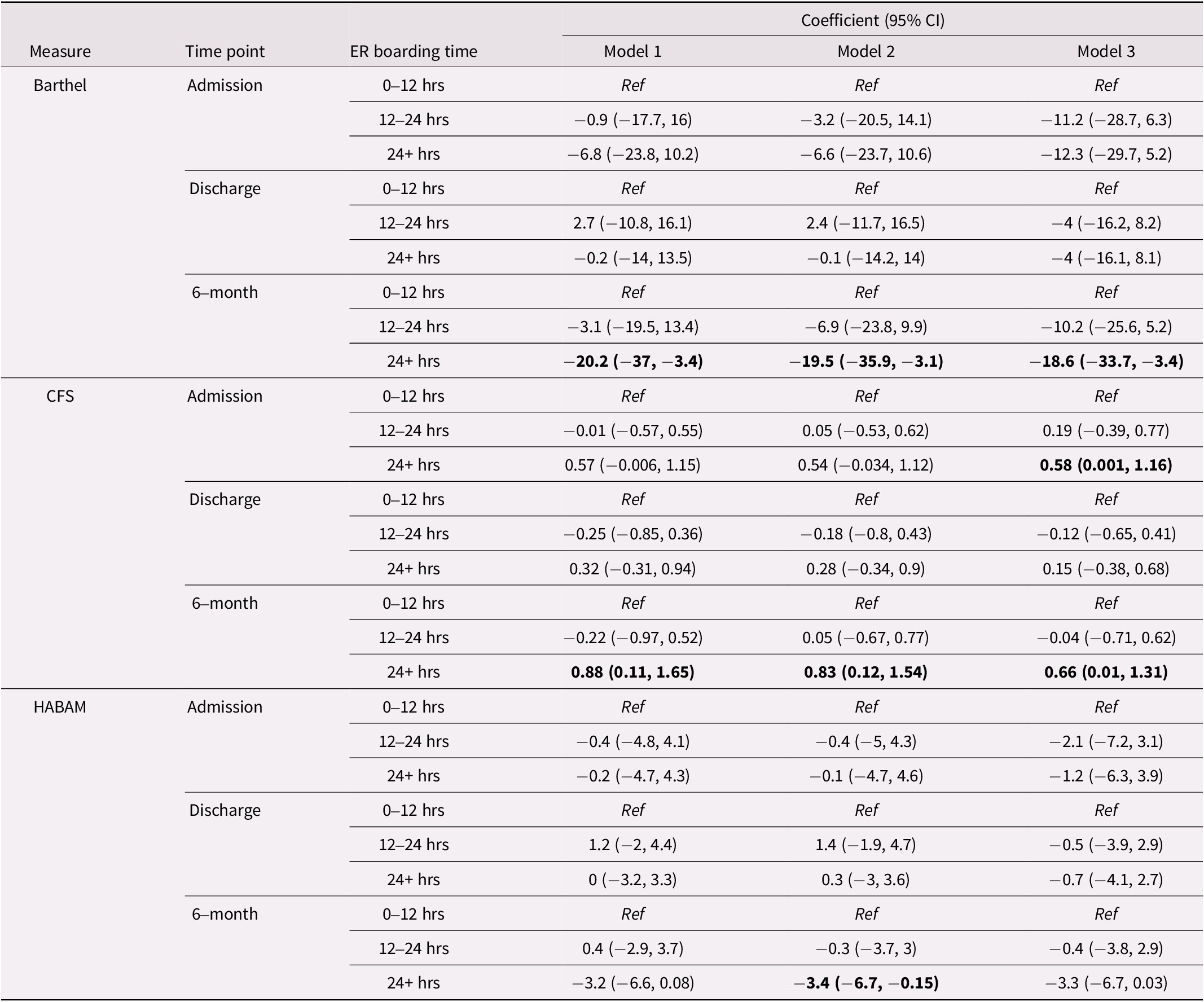
Notes: Estimates represent the difference and 95% confidence interval (CI) relative to the reference (ref) group, 0–12 hours; those bolded are considered statistically significant (p < 0.05). Each model included a random intercept for medical unit, and the following covariates: Model 1 – none; Model 2 – age and sex; Model 3 – age, sex, baseline frailty index, geriatric consult, and diagnosis.
Associations between ED wait time and the change in functional measures over time
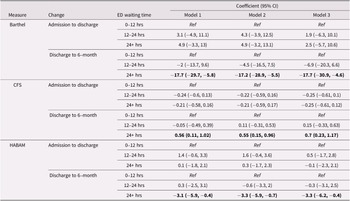
Given that the trajectory of functional decline is an important correlate of adverse outcomes in frail older adults (Rockwood et al., Reference Rockwood, Song and Mitnitski2011), we evaluated whether the change in functional measures differed with ED boarding time. Although no differences between groups were observed from admission to discharge, the change in all three measures from discharge to 6 months post discharge was significantly different for those who were boarded 24 or more hours, relative to 0–12 hours, after adjusting for age, sex, baseline frailty index, geriatric consult, and diagnosis (Table 3): the BI decreased an average of 17.7 points (95% CI: −30.9, −4.6), the HABAM decreased 3.3 points (−6.2, −0.4), while the CFS increased 0.7 points (0.23, 1.17). No discharge to 6-month differences were observed between the group who was boarded 12–24 hours, relative to the 0–12-hour group.
Associations of the change in functional measures from admission to discharge and discharge to 6 months post discharge with ED boarding time
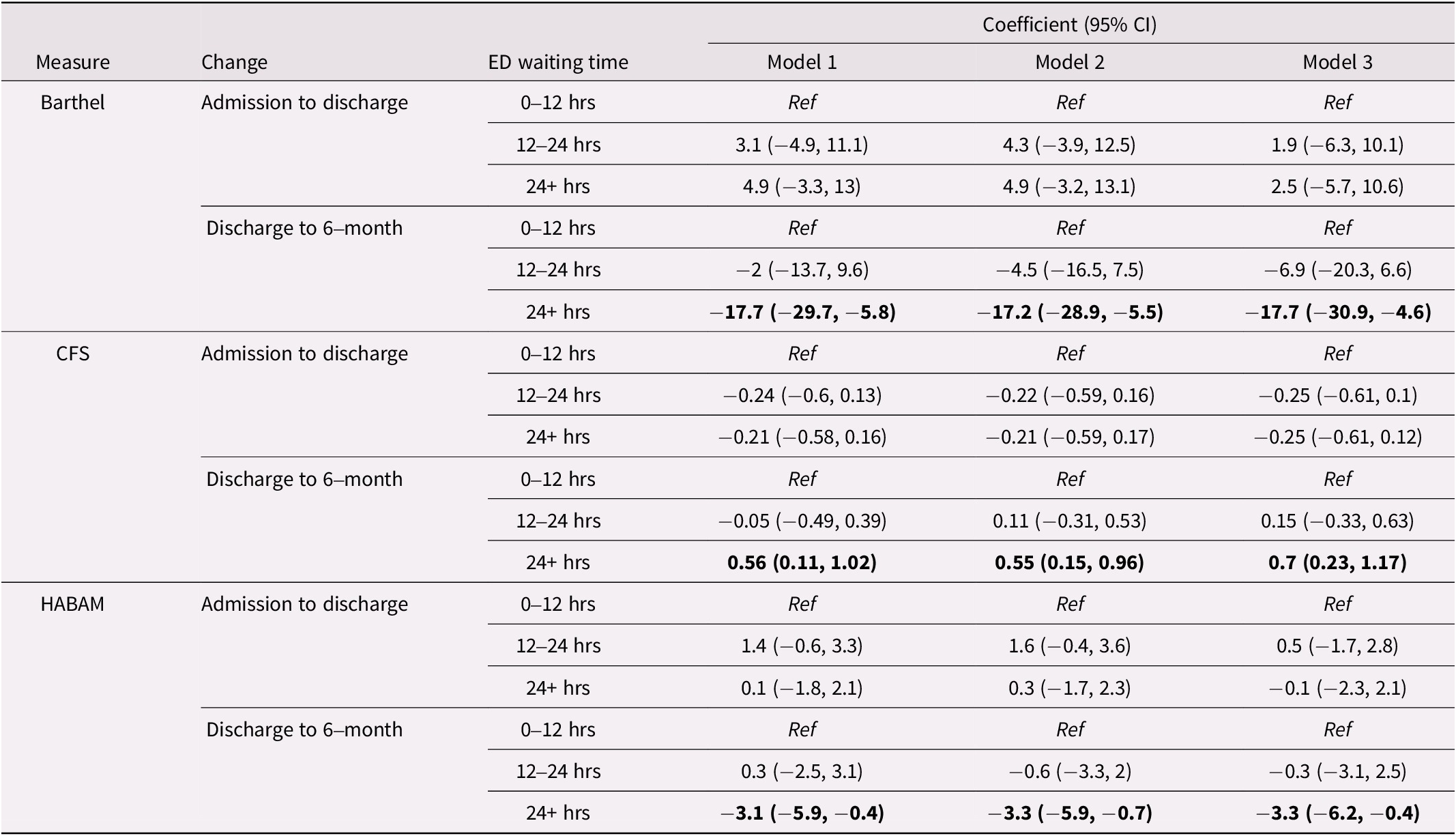
Notes: Estimates represent the difference and 95% confidence interval (CI) relative to the reference (ref) group, 0–12 hours; those bolded are considered statistically significant (p < 0.05). Each model included a random intercept for medical unit, the fixed effect of the prior time-point measure and the following covariates: Model 1 – none; Model 2 – age and sex; Model 3 – age, sex, baseline frailty index, geriatric consult, and diagnosis.
Discussion
Our study tracked standardized geriatric measures of function, frailty, and mobility longitudinally through acute hospitalization and to 6 months post discharge to examine the association of ED boarding time on functional decline. We found that an ED boarding time longer than 24 hours was not associated with increased LOS or functional decline by time of discharge but was associated with functional decline 6 months post discharge for all measures employed. Floor wide geriatric interventions in place for hospitalized older adults at our study site (Liu et al., Reference Liu, Moore, Almaawiy, Chan, Khan, Ewusie, Hamid and Straus2018; McElhaney et al., Reference McElhaney, Borycki, Briggs, Bisaillon, Upshur and Rockwood2012) may have accounted for the consistent LOS and functional improvement at time of discharge regardless of patient wait times with these programs offering temporary, but not sustained, functional improvement. Once discharged, and in-patient hospital supports for frail older adults were removed, the association of functional decline and ED wait times became measurable. We hypothesize that had these in-patient geriatric interventions not been in place, long ED wait times would also be associated with longer LOS as well as functional decline at time of discharge.
As compared to those who were boarded 0–12 hours, the BI decreased by an average of 17.7 points between discharge and 6 months post discharge, which is more than twice what is considered a clinically important change (i.e., 7.5) (Braun et al., Reference Braun, Thiel, Schulz and Grüneberg2021), whereas the HABAM decreased by an average of 3.3 points, which is also considered a clinically meaningful change (Braun et al., Reference Braun, Thiel, Schulz and Grüneberg2021). The CFS was observed to increase by an average of 0.7 points. According to the interRAI home care assessment tool, which is used across Ontario to qualify patients for government-funded home care services, an increase of 0.7 on the CFS would translate to an increase in services required to maintain patient care needs at home (Morris et al., Reference Morris, Fries, Bernabei, Steel, Ikegami, Carpenter, Gilgen, Dupasqueri, Frijters, Henrad, Hirdes and Belleville-Taylor2009). For example, a patient who was assessed as moderately frail on the CFS and required bathing once per week at discharge could still be assessed as moderately frail on the CFS 6 months later but would now require daily visits from a PSW. A rise of 0.7 on the CFS may also mean the difference between moderate and severe frailty which is the clinical difference between daily visits and multiple home care visits per day. It could also be the difference between requiring or not requiring home care services at all.
Our data suggest that ED boarding time may be a critical factor in the functional decline of older adults following hospitalization, although the pathological mechanism remains unclear. One possible component of this harm of hospitalization is the development of acute cognitive impairment, such as delirium, which is common in frail, older adults, and has previously been associated with wait time in the ED (Émond et al., Reference Émond, Grenier, Morin, Eagles, Boucher, Le Sage, Mercier, Voyer and Lee2017). Han et al. (Reference Han, Vasilevskis, Chandrasekhar, Liu, Schnelle, Dittus and Ely2017), previously showed that in-patient delirium originating in the ED can persist throughout admission and is associated with both functional and cognitive status 6 months post discharge.
A lack of mobilization in the ED could also have contributed to the long-term functional decline observed in our study as decreased mobility in hospital has also been associated with poor functional outcomes at 6 months post hospital discharge (Hajduk et al., Reference Hajduk, Murphy, Geda, Dodson, Tsang, Haghighat, Tinetti, Gill and Chaudhry2019). Furthermore, in a study of older adults, hospitalization for at least one night, or periods of restricted activity, such as staying in bed at least half a day due to illness or injury in the previous month, were associated with functional decline (Gill et al., Reference Gill, Allore, Gahbauer and Murphy2010). Prior research using the HABAM has demonstrated that the first 48 hours of a hospital stay represents a critical window to stabilize and improve mobility; older adults whose mobility continues to worsen during the first 48 hours of admission have a 17-fold increased odds of poor outcomes compared with those whose mobility stabilizes and improves (Hubbard et al., Reference Hubbard, Eeles, Rockwood, Fallah, Ross, Mitnitski and Rockwood2011). As our >24-hour boarding time group illustrates, spending more than half of this critical window waiting in the ED may discourage sustainable mobility recovery. It should be noted that at least temporary functional improvement in hospital was achieved with established floor wide geriatric programs in place despite the long ED wait. In the clinical context of our study, patients transferred to the medical units faster would have had earlier access to medical units where geriatric interventions were taking place, including nursing, physiotherapy, and occupational therapy services. These supports would be expected to reduce the harmful effects of immobility, resulting in improved functional trajectories post discharge, which was the case for participants that boarded in the ED for less than 24 hours. Together, our findings suggest that timely screening, recognition, and care for patients experiencing delirium (Émond et al., Reference Émond, Grenier, Morin, Eagles, Boucher, Le Sage, Mercier, Voyer and Lee2017; Han et al., Reference Han, Vasilevskis, Chandrasekhar, Liu, Schnelle, Dittus and Ely2017) with ongoing efforts to establish and maintain a culture of early mobilization in hospital (Pereira et al., Reference Pereira, Welch, Montgomery, Hatcher, Duggan and Greysen2021) may be beneficial in counteracting some of the harmful effects of ED boarding time.
In an effort to understand why ED boarding times were longer for some patients than others, we compared patient characteristics between boarding time groups; however, only the admitting diagnosis was found to be significantly different. A greater proportion of patients who were boarded in the ED longer than 24 hours had an admitting diagnosis related to exacerbation of chronic disease (48% vs. 29%), infectious illness (29% vs. 6%), and failure to cope (i.e., social admission: 14% vs. 6%) versus the 12-hour group. Patients who were admitted due to cognition or mobility issues were more likely to have shorter boarding times. An admitting diagnosis related to exacerbation of chronic disease or infectious illness may have presented atypically, which occurs in up to one third of frail older adults (Limpawattana et al., Reference Limpawattana, Phungoen, Mitsungnern, Laosuangkoon and Tansangworn2016). Likewise, patients with an admitting diagnosis of failure to cope are admitted by the ED physician with an uncertain medical diagnosis. Diagnostic uncertainly may contribute to longer boarding times in the ED as the physicians and consultants who are assuming care in hospital must determine the medical problem and how best to care for the patient (Webster et al., Reference Webster, Rice, Dainty, Zwarenstein, Durant and Kuper2015).
Other contributing factors for the functional decline identified in our study may be related to chronic hospital overcapacity and crowding. Canada has one of the lowest ratios of hospital beds to population in the developed world and ED overcrowding has been associated with increased mortality, LOS, and costs for admitted patients (OECD, 2022; Sun et al., Reference Sun, Hsia, Weiss, Zingmond, Liang, Han, McCreath and Asch2013).
The way people are triaged in the ED has also been identified as problematic for frail older adults as triage acuity and frailty are independent measures (Mowbray et al., Reference Mowbray, Brousseau, Mercier, Melady, Émond and Costa2020), and a previous study at the same site identified triage acuity as a variable in boarding time for admitted ICU patients (Montgomery et al., Reference Montgomery, Godfrey, Mossey, Conlon and Bailey2014). There have been calls to implement more intensive geriatric interventions within EDs; however, these programs are notoriously difficult to implement in the context of chronic overcrowding and staff shortages (Ellis et al., Reference Ellis, Marshall and Ritchie2014; Pereira et al., Reference Pereira, Welch, Montgomery, Hatcher, Duggan and Greysen2021). Despite this, there has been some early success in preserving function of frail older adults at this site with the hiring of a weekend physiotherapist to promote early mobilization in the ED (Rajendran et al., Reference Rajendran, Jeevanantham and Falk2022). Another recent study identified that nurses who worked in the ED were able to use their clinical judgment to identify when a comprehensive geriatric assessment could be beneficial to patients in the ED setting (Mowbry et al., Reference Mowbry, Ellis, Schumacher, Heckman, De Wit, Strum, Jones, Correia, Mercier and Costa2023). Successful implementation of specialized geriatric services for frail older adults in the ED would likely reduce the long-term risks of functional decline related to longer boarding times.
The strengths of this study include a relatively homogeneous sample of hospitalized frail older adults, for which we measured functional outcomes prospectively using three standardized tools. Further, we measured frailty retrospectively using a frailty index, allowing us to control for overall health status prior to admission. A limitation of this study is the context specific design. Given that all participants took part in floor wide geriatric interventions that are not standard of care on all medical units, it is possible that our findings are not representative of a typical in-patient medical unit. Even so, this study enrolled ‘all comers’ who were identified as having functional decline on admission and had a medical admission to hospital via the ED. In the absence of geriatric focused interventions on the medical units, it is likely that we would have seen even greater declines in function, possibly both at discharge and at 6 months post discharge as well as a longer LOS for those with boarding times over 24 hours in the ED. Also, we were not able to measure details of social circumstances, and social vulnerability, or some other unmeasured characteristic which was associated with longer ED stay and may have contributed to poor long-term outcomes.
Other limitations of our study include that this was a secondary analysis of a modest-sized cohort with a single site observational design. Since all three groups had similar frailty at baseline and we did not have an independent measure of illness acuity, we must also acknowledge that it is difficult to determine whether illness acuity at time of admission or long ED boarding time was the main factor for the poor long-term outcomes observed in the 24-hour group. Steps to control for illness acuity were considered in the design of our study; however, it could not entirely be controlled for. For example, the group that spent the most time boarded in the ED had statistically higher Clinical Frailty Scores at time of admission relative to their baseline frailty index scores compared to the other two boarding groups. This is important, as across all levels of frailty, illness acuity increases mortality risk (Pulok et al., Reference Pulok, Theou, van der Valk and Rockwood2020) with frailty remaining the most significant factor in terms of functional decline (Gilmour & Ramage-Morin, Reference Gilmour and Ramage-Morin2021). Moreover, although we controlled for degree of frailty at baseline, it is possible that other unmeasured factor(s) may have contributed to both longer ED boarding times and greater post-discharge functional declines resulting in confounding by indications. This study cannot be generalized to older adults who are robust or mildly frail at baseline and/or present to the ED with no measurable functional decline. Nevertheless, our study has identified a novel risk factor for post hospitalization functional decline, which, if replicated, would offer an important target for future interventional trials specifically for frail older adults who are presenting to the ED with functional decline.
Conclusion
We found that ED boarding time over 24 hours is related to functional decline for frail older adults by 6 months post discharge. Monitoring ED boarding time may be a very simple and effective screening tool to determine who is most at risk for long-term functional decline regardless of their reason for admission and discharge functional status. Targeted pathways to prioritize frail older adults for transfer out of the ED once the decision to admit has been reached, and multicomponent geriatric interventions starting in the ED for patients who are admitted and awaiting transfer to a ward bed, are potential interventions worthy of consideration and evaluation. Further, understanding that patients who have long ED boarding times are at risk for functional decline makes it possible to target hospital and community based interventions to slow functional decline. Advance care planning initiatives at time of discharge and in primary care settings post discharge may be helpful in preparing patients and families for future decision making related to anticipated increased care needs.
Supplementary material
The supplementary material for this article can be found at http://doi.org/10.1017/S0714980824000199.
Acknowledgements
We would like to acknowledge the pivotal contribution of Dr. Janet E. McElhaney, without whom this study would not have been possible.
Financial support
This project was funded through the Northern Ontario Academic Medicine Association. C.L.D. has received support through NOSM University’s Summer Student Research Award, the F. J. McLeod, Women’s Water and Neill Family bursaries. C.P.V. is supported as the Research Lead in Healthy Aging from the Health Sciences North Research Institute and the Health Sciences North Volunteer Association. G.A.K. is supported by the Travelers Chair in Geriatrics and Gerontology, as well as the UConn Older Americans Independence Center (Grant No. NIA P30AG067988).




 Open access

