




The publication of Thomas Paine's Common sense in January 1776 decisively changed the American cause. It is credited with convincing the ordinary subjects living in the American colonies that independence from Britain was desirable and achievable. While Common sense was published anonymously, the publisher, Robert Bell, clarified that it was ‘written by an Englishman’ by printing this phrase on the front page of the early editions. Originally a corset-maker from Norfolk, Paine got involved in politics in Sussex where he worked for the excise. When his business and marriage failed in 1774, he migrated to America and worked for a paper. Paine collected material from discussions with others, from reading widely, and from travelling to forge distinctive arguments in particular political crises. His pamphlet Common sense went through twenty-five editions in 1776 alone and became the bestseller of the revolution. Paine proclaimed ‘a new æra for politics’ that would overcome ‘ancient prejudices’ and ‘superstition’.Footnote 1 The old world of Europe, by contrast, was dominated by oppressive and belligerent monarchies. If America was reconciled with Britain, ‘eternal tyranny’ would follow.Footnote 2 Peace, liberty, and prosperity could be established only by an independent, unified, republican government. To gain independence, Paine proposed borrowing money from the public. ‘No nation ought to be without a debt. A national debt is a national bond; and when it bears no interest, is in no case a grievance.’Footnote 3 By instituting a national debt, America could not only build a fleet that was powerful enough to win the war against Britain but would also be unified by a long-term commitment.
Scholars commonly agree that the Financial Revolution changed history. The introduction of long-term funded national debt enabled governments to meet the increasing demands of warfare by borrowing money from the public. For lending money to the state, creditors received credit papers that they could trade on evolving stock markets. The technique was first used by Italian city-states during the Renaissance. In the late sixteenth century, the Dutch provinces started to borrow money from the public to finance their fight for independence from the Habsburgs. When William III became king of England, he introduced the Financial Revolution to engage the country in the wars against Louis XIV.Footnote 4 The Bank of England, institutionalized in 1694, and the joint-stock trading companies were involved in the raising and managing of England's or, from 1707, Britain's loans. Wales had already been fully integrated into the English state. Scotland received the sum of £398,085.10s, the so-called Equivalent, to compensate for new duties and customs, which, the Articles of the union stated, ‘will be applicable towards Payment of the Debts of England, contracted before the Union’.Footnote 5 Ireland retained comparable autonomy over its fiscal policy. Other territorial states followed the British example. The American provinces instituted a national debt to fight for independence, but their finances remained unstable until the federal government gained the constitutional power to levy taxes in 1788. The French revolutionaries planned a completely new state in 1789 but decided to honour the national debt of the ancien régime.Footnote 6 The Batavian revolutionaries too overthrew the established authorities of the Dutch Republic yet honoured the debts that the provinces had incurred in the early modern period.Footnote 7
Paying for warfare by borrowing money from the public, levying taxes in the form of future interest rate payments on the resulting debt, increased a state's military power and economic prosperity. Since creditworthiness depended on the rule of law, constitutional governments of free states were better able to accommodate the requirements of public credit.Footnote 8 Yet these promising effects of public borrowing were accompanied by potentially disastrous consequences. Intellectual historians have shown that eighteenth-century authors were not unequivocal supporters of commercial modernity and naïve believers in doux commerce, but that they have been obsessed with the danger national debt posed to constitutional government.Footnote 9 The Financial Revolution raised questions of belligerence and commerce, of virtue and wealth, connecting and raising questions about the continued existence of political and economic realms of society and the state. The intangibility of public credit and the transferability of shares in government debt to any person willing to pay undermined traditional ideas about property, virtue, authority, and loyalty to a nation. From a critical perspective, society appeared ever divided and corrupted: the taxes paid by the landed interest, the commercial interest, and the hardworking taxpayer were transferred to a monied interest of idle public creditors. The stock market attracted pernicious stockjobbers. An ever-growing national debt gave the government the chance to expand its power and tax all land and production, while the financial burden of servicing and repaying national debts undermined a country's competitiveness on international markets because prices had to be raised to generate revenues to pay the interest. In the long term, the existence of an indebted nation seemed unlikely, being a risky enterprise without a stable foundation in religion, country, or land.
Given the prevalence of eighteenth-century apprehension about public borrowing, Paine's recommendation to institute a national debt is surprising. Since proponents of public borrowing were in the minority in eighteenth-century Britain, they have received insufficient attention from historians. The Irish bishop George Berkeley argued that public credit was advantageous since it increased the supply of money and lowered the interest rate for the government and individuals. The most influential arguments for public debt were imported to Britain from abroad. Jean-François Melon's Essai politique sur le commerce (1734, translated in 1738) and Isaac de Pinto's Traité de la circulation et du crédit (1771, translated in 1774) both argued that public credit made countries richer by increasing the amount of money in circulation.Footnote 10 Yet such economic argumentation differed from Paine's endorsement of national debt on political grounds. It is well known that Paine's political thought is difficult to define. John Pocock, for example, stated that Paine ‘was no classical republican, only a hater of monarchy’ who ‘remains difficult to fit into any kind of category’.Footnote 11 Was the notion of public debt unifying a nation by creating political allegiance an instance of Paine's unconventionality? The answer is no.
National debt and political allegiance were closely connected in eighteenth-century British discourse. By tracing the idea that credit creates interest, this article offers a new explanation of political obligation. Scholarship on the legitimacy of political organization has focused on theories of divine will, human nature, political necessity, landownership, and consent through contract.Footnote 12 Eighteenth-century authors, however, acknowledged that a new basis for allegiance was created through investments in national debt. Since the obligation to support a debtor relied on creditors’ self-interest, resulting commitment to maintaining an indebted polity seemed suitable for a modern commercial polity. This connection was first made in reference to the revolutionary settlement and the threat that the deposed Stuart monarch and his Jacobite supporters posed, as the first part of this article argues. Tories polemically claimed that William III had introduced the national debt to secure his regime; non-tory observers agreed that there was a close link between subjects who were creditors and the established government that owed them money. The second section of the article shows that around the middle of the eighteenth century, when the Jacobites stopped posing a significant threat, the idea that creditors supported the indebted government was turned into a staple argument for critics of Britain's financial policy who emphasized the corrupting effects of public borrowing. At the same time, as the third part of the article illustrates, national debt was re-evaluated and proponents of Britain's system of public credit started to use the argument that lending money to a government secured political allegiance across national borders to explore the positive effects of modern state funding. When the War of American Independence revealed that such visions of international support were overoptimistic, reforming the British empire to consolidate Britain's debt seemed a viable solution to save the country from ruin. The last section of this article offers an outlook on the discussions of Britain's debt during French Revolution and on the question of what would happen to political allegiance if the government declared bankrupt. Tracing this hitherto-neglected argument shows how identical assumptions were used for divergent purposes. Ideas have a certain flexibility. They are not owned by authors of one political party or ideology.
I
The idea that the Financial Revolution was a political trick that William III and his advisers had played to strengthen the revolutionary government was most forcefully made by tory writers. Jonathan Swift published The conduct of the allies (1711) during the War of the Spanish Succession to attack the whigs for engaging Britain in an unnecessary, expensive, and destructive war. He claimed that Britain's allies and the Dutch in particular were unreliable, greedy, and selfish and that the reason for Britain's involvement in the war was not the national good, but the advancement of private interests. While the ‘great Traders in Money’ who ‘were wholly devoted to the Whigs’ made money from war, the resulting increase in national debt led to a growing tax burden, the spread of artificial wealth, and intensification of corruption in the government.Footnote 13 Swift located the historical origins of public borrowing in the need to secure the government of William III: ‘the true Reason for embracing this Expedient, was the Security of a new Prince, not firmly settled on the Throne: People were tempted to lend, by great Premiums and large Interest, and it concerned them nearly to preserve that Government, which they trusted with their Money’.Footnote 14 In the History of the four last years of the queen, Swift again emphasized that ‘whoever were lenders to the government, would, by surest principles, be obliged to support it’.Footnote 15 Written in 1712–13, Swift missed the political opportunity to publish the History at the time as his patron Robert Harley, earl of Oxford, had fallen from power. It appeared posthumously in 1758, shortly after the Seven Years’ War had broken out.
More details on the mechanisms underlying the assumption that subjects who were creditors had an interest to support the indebted revolutionary government were provided by Henry St John, the 1st Viscount Bolingbroke. In Some reflections on the present state of the nation (written in 1749, published posthumously in 1753), he made the national debt responsible for the ‘degeneration’ of the present age. His origin story of England's Financial Revolution was very similar to that related by Swift:
It was said that a new government, established against the antient principles, and actual engagements of many, could not be so effectually secured any way, as it would be if the private fortunes of great numbers were made to depend on the preservation of it; and that this could not be done unless they were induced to lend their money to the public, and to accept securities under the present establishment.Footnote 16
The massively grown national debt, Bolingbroke warned, enriched usuruers and stockjobbers, ‘those leeckes who fill themselves continually with the blood of the nation, and never cease to suck it’, and gave the joint-stock companies too much power over the government.Footnote 17 To guarantee the safety and prosperity of Britain, the national debt needed to be paid off urgently. Bolingbroke suggested the reform of abuses, the checking of corruption, and the introduction of a policy of peacefulness abroad and frugality domestically.Footnote 18
Swift's and Bolingbroke's contemporaries shared the idea that the national debt generated political allegiance to the revolutionary regime. This connection was not only made by tory critics of the established regime, but also by whigs. An often cited allegorial dream from Joseph Addison's and Richard Steele's court journal The Spectator (1711) is illustrative. The dream is set in the hall of the Bank of England. Surrounded by acts of parliament, the Magna Charta, and the Act of Settlement was ‘a beautiful Virgin, seated on a Throne of Gold’ named Publick Credit. Because of her delicate constitution, she is described as timorous and sickly. Reacting to news from around the world, her health decayed easily but recovered quickly. Because Publick Credit, like the ancient King Midas, could ‘convert whatever she pleas'd into that precious Metal’, she was surrounded by bags of money and piles of gold. The spectatorial dreamer described a dancing scene to reveal the factors on which the new financial system relied: the doors opened and ‘the most hideous Phantoms that I had ever seen (even in a Dream)’ entered the hall and danced around Publick Credit. These phantoms are identified as tyranny, anarchy, bigotry, atheism, the genius of a commonwealth, and Charles Edward Stuart. The Young Pretender held a sword in his right hand with which he brandished the Act of Settlement and a sponge in his left, a metaphor for a national bankruptcy. Because of this apparent threat, Publick Credit fainted and all the money around her turned into air and heaps of worthless paper. The phantoms were expelled by another group of dancers composed of liberty, monarchy, moderation, religion, and the genius of Great Britain. The virgin recovered and converted the air and paper again into ‘Pyramids of Guineas’.Footnote 19
If a return of the Stuarts would lead to a forced expropriation of public creditors, as The Specator suggested, a collapse of the financial system might in turn help the Jacobites to succeed. Consequently, any attempt to distress the stock market in London could be classified as an act of treason. In The anatomy of exchange-alley (1719), Daniel Defoe presented the practice of ‘stockjobbers’ to the public. The term referred to the manipulation of stock prices by means of deceit and fraud for personal enrichment. Defoe suspected that the Jacobites attempted to finance an invasion by spreading rumours about the collapse of the stock while themselves making profits through stock market speculation. Since stockjobbers, including whigs and Jews, were falling for this trick, they became not only ‘Abettors of Treason, assistant to Rebellion and Invasion’ but ‘eventually Traytors to King George, and to his Government, Family and Interest, and to their Country’.Footnote 20
When the first major financial crisis, the South Sea Bubble, occurred in 1720, observers suspected that it was an attempt by the Stuarts to create chaos and to end the relationship between subject public creditors and the indebted government. The War of the Spanish Succession (1701–14) left France and Britain highly indebted. In 1717, the chancellor of the exchequer Robert Walpole established a sinking fund, the mechanism that aimed to accumulate a surplus and repay part of the debt. However, it did not suffice to bring about the needed relief. In France, the duke of Orléans, regent for Louis XV, authorized the Scottish financier and Jacobite John Law to restructure the public finances, hoping to foster economic activity and lower the costs of the immense debt. Britain followed suit. In 1719, the government accepted a proposal from the South Sea Company to lower the government's management and servicing costs by swapping certain claims on Britain's debt for company shares. The South Sea Company had been established in 1711 by the tory government to counterweight the whig-dominated Bank of England and East India Company. It had received the Asiento in 1713, the monopoly rights to trade with South America, which Spain had granted Queen Anne after the War of the Spanish Succession.
During the early months of 1720, expectations of profit increased the prices of South Sea Company shares spectacularly. When confidence waned in late summer, prices for the overvalued shares plummeted. Disorder and a crash followed. Paris and the Netherlands experienced similar financial crises. Although the overall economic impact of the bubble on Britain's economy was marginal, the public reacted with outrage. Numerous satires, prints, and periodicals lamented the decay in morals, accused company directors and politicians of corruption and investors of madness, and decried an alleged reversal of the social order and a purported decay of commerce and manufacturing.Footnote 21 Public creditors felt that their trust in the South Sea Company and their loyalty to the political system had been betrayed. It was generally believed that James Francis Edward Stuart and his supporters would try to use the unrest created by the South Sea Bubble to destablize the constitution and overthrow the still fragile Hanoverian regime established when George I succeeded Anne in 1714. The politician Arthur Onslow, who had just entered parliament at the time of the South Sea Scheme, recalled in his family memoirs that he had ‘often wondered that this did not produce some convulsion in the State’ and a return of the Pretender.Footnote 22 Since these expectations were widely held, the directors of the South Sea Company needed to dispel the suspicion that they acted as a Jacobite tool and explicitly distanced themselves from the Stuarts.Footnote 23
In the aftermath, the South Sea Company was restructured and repurposed. Its directors were punished by a parliamentary inquiry, their estates being confiscated. The Bank of England made determined efforts to maintain credit. Walpole returned to the office of chancellor of the exchequer and became the first prime minister, introducing a rescue policy that quickly re-established trust and stability. In the following decades, the connection between investing in Britain's national debt and allegiance to the post-revolution monarchy seemed to weaken, as the comment of an anonymous pamphleteer during a debate to restructure Britain's debt suggests. In 1737, John Barnard proposed to lower the servicing costs and to increase Britain's economic competitiveness with the Dutch and the French by reducing the interest on the debt from 4 per cent to 3 per cent. A heated discussion about the plan's potential merits followed. A speech without-doors, addressed to the national creditors was one of the publications arguing against the proposed reduction of interest. Its anonymus author claimed that the national debt was the strongest proof of the high esteem which the people of England and all neighbouring countries had for Britain's constitution. Reflecting on the motives of public creditors, he explained that ‘There was a Time when lending Money to the Publick, was understood as undoubted Proof, that the Lender was a Friend to the late Revolution; and People of the other Side of the Question, thought him not very wise for running the Hazard.’Footnote 24 Even if this would still be the case now, the pamphleteer maintained, it was necessary to preserve public creditors’ rights and maintain their willingness to support the nation in the future. Barnard's plan ultimately failed because Walpole and public creditors opposed it.
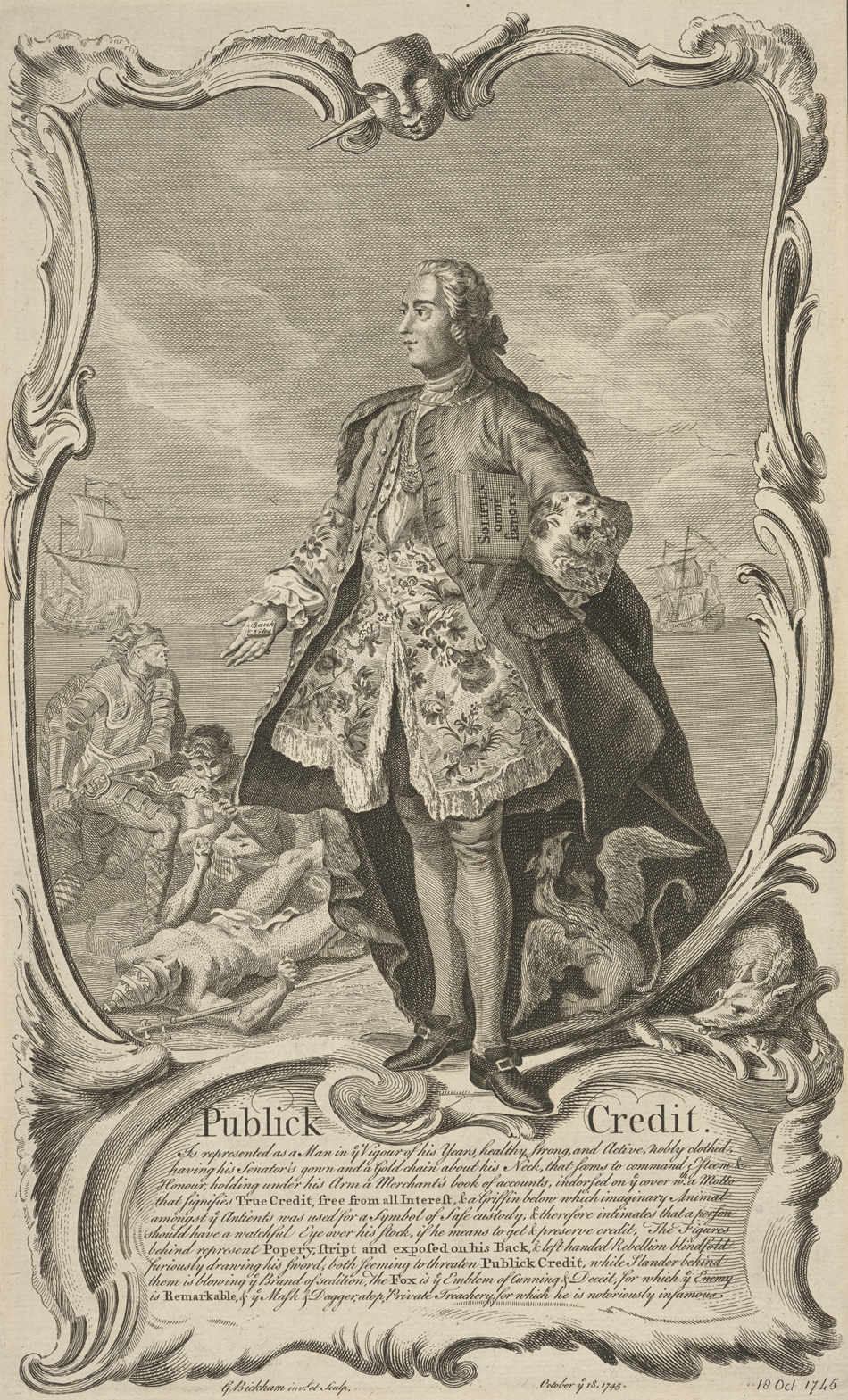
The character of Britain's debt started to change during the War of the Austrian Succession (1740–8). Formerly, the government had primarily used obligations to the Bank of England and, to a lesser extent, to the South Sea Company and the East India Company to take up loans. To finance the renewed war effort, Britain began issuing publicly subscribed annuities directly on the capital market that did not expire automatically and were not redeemable. This important change occurred as a result of a crisis caused by the final attack of the Jacobites on the Revolution Settlement. In 1745, Charles Edward Stuart landed in Scotland, captured Edinburgh, and marched into England, his army getting as far as Derby. The expectations of a Jacobite–French invasion caused a run on the Bank of England. To counter the growing disinclination to accept Bank notes, a list was published that named all merchants willing to support the Bank. An accompanying print confidently predicted that the Jacobite threat could be met effectively by public credit (Figure 1). Public credit in George Bickham's print is represented by ‘a Man in ye Vigour of his Years, healthy, strong, and Active’, who is well-dressed and has a steady, yet relaxed posture. He holds ‘Bank Notes’ in his open hand. In the background, the pope lies on the ground, stripped of his clothes, and a blind-folded soldier with tartan-patterned socks, a representation of the Jacobite rebellion, draws his swords. The scene is surrounded by symbols of deceit and treachery: a mask and dagger on top and a fox lurking at the bottom right corner.Footnote 25 Whereas the female representation of public credit fainted at the arrival of the Stuart claimant to the British throne in The Spectator from 1711, a male representation of public credit triumphed over the Jacobite threat in 1745. The financial system and the revolutionary settlement had become closely intertwinded and widely accepted.
George Bickham the Younger, Publick credit (1745), © The Trustees of the British Museum [1898,0520.116].
Anecdotal evidence seems to confirm that a restoration of the Stuart monarchy had been prevented by money lent to the government by supporters of the Glorious Revolution. In his highly critical The history of our customs, aids, subsidies, national debts, and taxes (1761), the antiquarian Timothy Cunningham reported that numerous Britons had contributed to ‘many voluntary subscriptions’ during the Jacobite rising of 1745 ‘for the preservation of our present happy establishment’.Footnote 26 Data about eighteenth-century lenders and evidence of their motives, however, do not suffice to verify such statements convincingly. Scholarly attempts to argue that lending was indeed motivated by party political alignements are therefore problematic.Footnote 27 The analysed statements rather show that contemporaries assigned national debt the power to create political attachment to the established government.
II
After the rising of 1745, the connection between Jacobitism and the Financial Revolution was broken. The view emerged that internal threats would not suffice to bring down the established financial system. David Hume confidently exclaimed in his essay ‘Of the Protestant succession’ in 1752 that ‘No revolution, made by national forces, will ever be able, without some other great necessity, to abolish our debts and incumbrances, in which the interest of so many persons is concern'd.’Footnote 28 Yet getting rid of Britain's debt was necessary, according to Hume, if the country was to survive. The War of the Austrian Succession had not only markedly increased the country's financial liabilities, but the nature of the new annutities additionally raised the servicing costs. To lower the long-term costs and symplify the management of the debt, Henry Pelham, chancellor of the exchequer and prime minister, introduced a conversion scheme between 1749 and 1751. The interest rate on certain debt instruments was gradually reduced from 4 per cent to 3 per cent and the various annuities were consolidiated into one stock, the so-called consols. Thereby, the foundation was laid for the expansion of public borrowing that took place during the Seven Years’ War (1756–63) and the American War of Independence (1775–83), which raised the national debt to a height seemingly beyond the sustainable.
The concerns caused by the growth of Britain's national debt are clearly expressed in Hume's essay ‘Of public credit’ (1752). Exploring the wider impact of public borrowing on the polity and economy, Hume argued that Britain was fighting expensive wars for glory, that the resulting tax burden disadvantaged the economy and threatened civil liberty, and that the mobile property created by credit undermined the middle ranks of society that protected the constitution from the factiousness of the people and the unprincipled ambition of monarchs. Hume's conclusion was unequivocal, ‘either the nation must destroy public credit, or public credit will destroy the nation’.Footnote 29 The only way out was a forced expropriation of public creditors. However, a voluntary bankruptcy was difficult to achieve in a free, quasi-republican state like Britain since public creditors had an influence on parliament. An attack by a foreign aggressor was perceived to be necessary in Hume's view to justify voluntary bankruptcy.Footnote 30
Many of Hume's contemporaries shared his concern about the growth and permanence of Britain's debt. Although they too doubted that the country was able to carry the financial burden, they sought less radical solutions and preferred reform to national bankruptcy. The argument that public borrowing created a bond between investing subjects and the government that owed them money was used by critics of Britain's debt policy to underline the corrupting effects of the financial system and to emphasize the urgent need for change. In addition to pamphlets and essays, critics of public borrowing started in the 1750s to publish historical accounts of Britain's financial system. They digested parliamentary material on the laws concerning the debt, the provisions made for it, and its growth; they made such information available to a wider public.Footnote 31 The historian George Gordon, not to be confused with his later namesake the Scottish politician Lord George Gordon, wrote a detailed and substantial History of our national debts and taxes in 1751. The book aimed to reveal that Britain's prosperity and liberty were in danger. A growing debt and increasing tax burden damaged the economy; the practice of stockjobbing threatened political allegiances and impoverished the nation. When Gordon inquired into the historical origins of public borrowing, he confirmed that credit created bonds of interest and explained the underlying mechanism. His account started in 1688 and maintained that the reason for the court of William III to introduce long-term funded debt was political attachment:
the Maxim was said to be, that running the Nation in Debt, was adding Security to the Revolution Establishment; because the publick Creditors would all be, of Course, for supporting it according to that Maxim which we have from divine Authority, as well as human Experience, For where your Treasure is, there will your Heart be also.Footnote 32
According to the Gospel of Matthew, the latter statement was used by Jesus to advise his followers that they should rather obtain spiritual values in preparation for the afterlife than material treasures for their earthly existence.
The argument that public borrowing bound subject creditors to the indebted government continued to be used throughout the eighteenth century. The politician John Perceval, 2nd earl of Egmont, claimed in 1763 that public borrowing had been instituted ‘as a kind of political security’ and been promoted by the Dutch ‘with a jealous eye’ to ruin the British competitor.Footnote 33 To curb excessive ministerial power and speculative stockjobbing, he proposed the establishment of a national bank and the selling of forest land. The anonymous author of Considerations on the policy, commerce and circumstances of the kingdom agreed in 1771 that Britain urgently needed reform. Analysing signs of decay in the country's commerce, he concluded that the high taxation resulting from the national debt, together with the power of stockjobbers, was ruinous. The root of the evil was described in familiar terms. ‘The ends of establishing [the Funds] were, to strenghten the hands of ministers, by the multiplication of employments: and to create attachment to government, from the dependency of property on its support for security.’Footnote 34 In 1781, the diplomatist and politician William Eden, 1st Baron Auckland tried to introduce calm in the heated debate about Britain's national debt by scrutinizing the practice of public borrowing in Four letters to the earl of Carlisle. He confirmed that the funding system had first been introduced ‘in order to secure the attachment of individuals to government, from the dependence of their property on its support and security’ and had given rise to ministerial patronage.Footnote 35
III
As a response to the criticism of national debt and the gloomy prophecies about Britain's future, commentators started in the second half of the eighteenth century to articulate more forcefully the advantages of public borrowing. They connected national debt with economic prosperity and political liberty, and used the argument that credit creates interest to address issues of composite monarchy, empire, and international allegiance. Robert Wallace's Characteristics of the present political state of Great Britain serves as a starting point. Wallace was a minister of the Church of Scotland and is best known for his dispute with Hume over the issue of population growth. He published the Characteristics in 1758 to defend Britain's constitution, morals, and culture against the attack that the English clergyman John Brown launched when Britain performed poorly in the early phase of the Seven Years’ War. Scotsmen like Wallace reassessed their position within Great Britain after the 1745 Jacobite rebellion had failed and started to form an Anglocentric North British identity.Footnote 36 Wallace aspired to share English liberties, such as to be ruled and taxed by consent through their own parliament, and to enjoy prosperity; he scrutinized the history of English institutions accordingly. From this process of identification with the English constitution, the national debt emerged as a price worth paying for Scotland's union with England, gaining protection and prosperity in addition to new kinds of liberty.
In the Characteristics, Wallace claimed that Britain in general and North Britain in particular had become more prosperous since the late seventeenth century. He ascribed this economic success to the just and fair government that the Glorious Revolution had introduced. ‘But there is no unmixed happiness on earth’, he warned, ‘Every thing is attended with disadvantages. Britons have been put to considerable expences to support the Revolution.’Footnote 37 Incurring national debt had been necessary to protect the revolutionary establishment from Louis XIV and the Pretender. Admitting that the financial effects burdened the economy, Wallace added that ‘Nor must we grudge necessary expence of this kind, till the formidable power of France shall be broken.’Footnote 38
According to Wallace, the enormity of Britain's debt was not a sign of weakness but, to the contrary, provided evidence of the strength of its consitution. The £60 million that British subjects had entrusted to the government, together with the £20 million foreigners had advanced, showed that the British government was commonly considered to be just, dependable, and trustworthy. Wallace explained that ‘When a free government is able to contract great debts by borrowing from its own subjects, this is a certain sign, that it has gained the confidence of the people. If foreigners are eager to have a share of its funds, this shews the confidence of the neighbouring nations.’Footnote 39 This confidence was a result of the Glorious Revolution. Earlier governments had encroached upon British liberty. James I had introduced ‘slavish principles’ in his bid for absolute power, Charles I had openly violated the people's rights. None of them had been able to gain their subjects’ trust and establish creditworthiness.
From Wallace's Characteristics, Britain's debt emerged as a necessary price for the post-revolutionary establishment and its guarantee of liberty. The argument could be taken a step further when the connection between subject creditors and allegiance to the indebted government was considered against the background of ongoing international war and domestic crisis. Hume, significantly, returned to the question of the relationship between national debt and the preservation of the established government. Throughout his life, he revised and republished his essays. After the Seven Years’ War, Hume reflected on the growth of Britain's debt and warned about a ‘degree of despotism which no oriental monarchy has ever yet attained’.Footnote 40 The patriotic and fanatical rhetoric of the London radicals around John Wilkes in the later 1760s too caused Hume great apprehension as he feared for Britain's well-balanced constitution.Footnote 41 In a revised version of ‘Of public credit’ from 1770, his overall tone remained remained alarmist, but, as Istvan Hont has shown, Hume admitted that the interest created through lending money could protect a weak government from popular unrest. In an overpopulated city like London, the people easily grew factitious ‘and even perhaps rebellious’ if the government refrained from using ‘discretionary power’ against them. Hume employed his earlier argument from ‘Of the Protestant succession’ when he claimed:
But to this evil the national debts themselves tend to provide a remedy. The first visible eruption, or even immediate danger, of public disorders must alarm all the stock-holders, whose property is the most precarious of any; and will make them fly to the support of government, whether menaced by Jacobitish violence or democratical frenzy.Footnote 42
Hume's idea that the national debt was Britain's last hope for the survival of its constitution proved short-lived. Once the danger arising from populist radicals had passed, he started to again stress that public borrowing would ruin Britain.Footnote 43
For the most fervent defenders of Britain's financial system, the idea that public creditors were bound to support the government that owed them money constituted an important argument in their quest to counter the extremely vocal critics of public borrowing. Crucially, the assumption that public creditors had a self-interest to protect the government debtors was not restricted to British subjects. Non-Britons had no emotional attachment to the British government and could not be expected to support it because of loyalty or patriotism. However, by holding British debt, they became interested in the continued ability of the debtor government to honour its agreements. Consequently, they could be expected to rally support for it in case of a national emergency. This argument was developed by Philip Francis in his translation of Isaac de Pinto's flattering analysis of Britain's financial system. The Dutch Sephardic merchant Pinto had written the Traité de la circulation et du crédit (1771) to prove Hume's gloomy prophecy about Britain's future wrong: ‘cette prétendue Banqueroute d'Angleterre a toujours été illusoire, pusque les dettes n'ayant point d’échéance, elles sont comme non existantes, n'ayant point de moment critique’.Footnote 44 The national debt gave military power to a state, paper money increased a country's circulation of goods, and speculation in government stock was a legitimate occupation. From Pinto's perspective, even a considerable growth of Britain's national debt was unproblematic as long as sufficient provisions for the servicing costs were made.Footnote 45
Philip Francis was a politician from Ireland and almost certainly the author of the Junius letters which fiercely criticized the government of George III. His translation of Pinto's Traité appeared as An essay on circulation and credit in 1774 when he sought an employment in politics. In the preface, Francis complained that ‘The English are a moody, restless, gloomy people’ who loved to anticipate the ruin of their country. Their favourite grievance, the national debt, was nursed not only by the vulgar but also by ‘Some of the ablest men in the kingdom.’ On the issue of public finance, even Hume had taken ‘prejudices for principles’ and built ‘good arguments upon false or doubtful data’.Footnote 46 Pinto had been of good service to Britain: he had shown that the national debt was not as dangerous as it was often thought and that it had brought national wealth and power to Britain. Furthermore, Francis explained, Pinto had helped in the negotiation of the Treaty of Paris that ended the Seven Year's War, convinced people on the continent to buy British stock, and changed foreign governments’ opinion about Britain's power. Francis rejected all claims that foreign public creditors were a burden to Britain as he explained that
I am not moved by the objection of the annuity carried out of the nation, because I am convinced that, if we are thrifty, we may gain more by the use than we lose by the interest. Would to God that the whole debt could be immediately purchased by, and transferred to, foreigners! What stronger guaranty could we possibly invent for preserving our independence as a nation, and for the security of the present establishment?Footnote 47
Thomas Mortiner, who had read the Traité in the original French version, ardently admired Pinto. Very little is known about Mortimer's life and background although he published several highly successful books on trade and finances. One of these books was The elements of commerce, politics and finances. A text book for British youth first published in 1772, it gave students historical accounts of the three fields, defined technical terms, and engaged with the opinions of various writers. Like Pinto, Mortimer aimed to counter the pessimistic perspectives of national debt of authors like Hume and, like Francis, Mortimer used the allegiance that Britain gained from foreign investors as a key argument.
According to Mortimer, the widespread concern about Britain's debt was groundless. Since the principal itself was not redeemable, the growth of the debt was no cause for concern. Not only had the debt ‘outlived the gloomy prohecies of its bankruptcy’, it ‘will support us triumphantly in twenty future wars against the united powers of the house of Bourbon’.Footnote 48 Public credit provided Britain with infinite resources, increased commerce, and enriched the country. Answering Hume's statement, Mortimer exclaimed that ‘the nation must support, not destroy public credit; and that public credit cannot destroy the nation’.Footnote 49
Non-British participation in Britain's debt provided additional benefits as these public creditors kept the prices of stock high, increased trade, and supported the government. Foreigners’ holdings of British national debt, Mortimer claimed, ‘certainly gives us a strong tie upon them; it helps to diminish the prejudices they generally entertain against us; it engages them, by motives of interest, to wish well to, and in some degree support, our public credit’. He emphasized that the support Britain received from foreign investors was not restricted to money. ‘Nor are they so likely, either at home or abroad, to conspire against the prosperity of Great Britain; because any revolution, or fatal reverse in the circumstances of the kingdom, must affect them personally, by diminishing the intrinsic value of their nominal capitals in our funds.’Footnote 50
The next military conflict quickly revealed that Francis's and Mortimer's expectations about the manageability of Britain's debt and about foreign creditors’ support had been unrealistic. In 1775, American resistance to the attempt of the British government to tax the colonies developed into a full-scale war of independence. The possibility of losing profitable colonies and the looming of another expensive war caused an acute crisis for an already highly indebted Britain. Its most important foreign creditors and traditional allies, the Dutch, did not rally to support London in this conflict but tried to remain neutral and eventually became Britain's enemies. Britain urgently needed viable solutions to the problem of gargantuan debt. The political implications of national debt seemed to hold the answer. If, as Wallace had argued, the national debt was a price worth paying for protecting the post-Glorious-Revolution constitution, those who enjoyed its liberties could be expected to contribute towards servicing and amortizing the debt.
This idea was developed by Adam Smith. In his Inquiry into the nature and causes of the wealth of nations of 1776, he not only inquired into the sources of national wealth but also warned about the current situation of Britain. Government policy had been guided by the false idea of a positive balance of trade, protecting the interests of a small group of powerful merchants and manufacturers. Due to this ‘mercantile system’, Britain had overextended its territory and markets. The costs incurred in acquiring and keeping colonies were vast. Since Britain had become burdened with an enormous debt and mortgaged future revenue to fund loans, a reform of empire was urgently needed if ruin was to be avoided.Footnote 51
Smith saw the solution in uniting Great Britain with Ireland, itself excluded from Britain's international trading system, and its North American colonies. By extending the British constitution and admitting an equal share of Irish and American representatives into parliamant ‘or if you will into the states general of the British Empire’, taxes could be introduced in all provinces.Footnote 52 If the land and consumption taxes of Britain would be extended to Ireland and North America, the money raised would be ‘sufficient in a few years to discharge the whole debt, and thus to restore completly the at present debilitated and languishing vigour of the empire’.Footnote 53 Aware that imposing taxes would be unpopular, Smith argued that justice demanded Ireland and North America contribute to servicing and repaying Britain's national debt:
The debt has been contracted in support of the government established by the revolution, a government to which the protestants of Ireland owe, not only the whole authority which they at present enjoy in their own country, but every security which they possess for their liberty, their property, and their religion; a government to which several of the colonies of America owe their present charters, and consequently their present consitutions, and to which all the colonies of America owe the liberty, security, and property, which they have since enjoyed.Footnote 54
Smith argued that the effects of this union would compensate for the rise in taxation. Ireland, like Scotland, would be freed from feudalism. The North American colonies would become liberated from ‘those rancours and virulent factions which are inseparable from small democracies’.Footnote 55 Alternatively, Britain had to abandon its ambition, forsake empire, and accommodate itself to ‘the real mediocrity’ of its circumstances.Footnote 56
A similar idea was introduced to the House of Lords by William Petty, 2nd earl of Shelburne, who thought himself to be a disciple of Smith. He used the majority of his speeches of the second half of the 1770s to attack Britain's policy towards its American colonies. To further the interest of prosperous merchants, corrupt ministers had infringed the liberties of British subjects living in North America who were now justly defending their rights. Britain could not afford to lose the colonies or continue engaging in war. Reconciliation was needed.Footnote 57 The solution that Shelburne proposed to the House of Lords was made widely available by his close acquaintance the Welsh dissenting minister Richard Price. In his influential Observations on the nature of civil liberty, Price offered an identical analysis of the American conflict. The only viable method of restoring international peace and security, so Price said, had been offered by Shelburne. Price sent the draft version of his proposal to Shelburne and asked him to ‘correct and alter’ it before he printed it on the last pages of his pamphlet.Footnote 58 Shelburne demanded that all hostilities be suspended and acts that had caused the Americans distress be repealed. All parts of the empire should be able to decide for themselves how to raise taxes, as was the right of any Englishman. In exchange, Shelburne proposed that ‘the debt of England, without entering into invidious distinctions how it came to be contracted, might be acknowledged the debt of every individual part of the whole Empire, Asia, as well as America, included’.Footnote 59 If this revenue was consequently used to pay off the national debt, taxes would gradually be reduced and the price of manufactured goods lowered.
IV
Ultimately, Britain neither established a debt-reduction union with its colonies, nor did the country declare a bankruptcy. The politician Edmund Burke pushed for ‘economical reform’ in the 1780s. With the assistance of Price, Prime Minister William Pitt the Younger re-established the sinking fund in 1786 turning the immensely grown national debt into a mathematical problem that seemed to be solvable by compound interest. To the surprise of many observers, it was not Britain, but France where financial pressure led to revolution. Having reached the limits of his government's ability to borrow money, Louis XVI called a meeting of the Estates-General in 1789, for the first time since 1614. The self-declared National Assembly introduced a series of radical measures, such as the nominal abolition of feudalism, but declared it would honour the debt of the ancien régime and introduced the assignats, interest-bearing bonds that were backed by confiscated ecclesiastical property and became legal-tender paper money in 1791. Because of overissue, the assignats collapsed in value. Prices and unrest consequently rose together. The monarchy fell and the First Republic was declared. After attacking Prussia and Austria in 1792, revolutionary France declared war on Britain and the Dutch Republic in 1793.
The French example and the beginning of what would prove to be an immensely expensive and long war lent new urgency to the question whether Britain was able to carry its financial burden. It is noteworthy that eighteenth-century authors remained silent on the details of the aftermath of the predicted national bankruptcy. If national debt created a bond between public creditors and the government that owed them money, would not a bankruptcy destroy the basis for political allegiance? All Hume was expecting was that ‘it wou'd not probably be long, e're credit wou'd again revive in as flourishing a condition as before’.Footnote 60 The most forceful answer was again provided by Thomas Paine. From his exile in Paris, he published The decline and fall of the English system of finance in 1796. Paine applied a mathematical approach to historical data on the growth of the national debt to calculate the future limits of Britain's financial system. He predicted that another war would break out within twenty years and that the ease with which the British government could take up new loans would cause a national bankruptcy. Referring to the recent examples of France and America, Paine expected that ‘a failure in the English finances will produce some change in the government of that country’.Footnote 61
In eighteenth-century Britain, authors across the political divide acknowledged that public borrowing had introduced a new species of political obligation. By lending money to a government, public creditors became interested in supporting their debtor's ability to honour the debt contract. From this perspective, public borrowing seemed to protect the constitution from rebellion and war and to provide a solution to the problem of the growing servicing costs. As much as national debt created a bond between public creditors and indebted governments, it also seemed to threaten the constitution it was introduced to protect. To many observers, Britain's debt grew excessively, disadvantaged the economy, and enfeebled the nation. Liberating the nation through a bankruptcy, however, threatened to dissolve the ties between government and citizens. If we want to understand the transformation that the introduction of long-term funded national debt has brought about, the ambiguity that eighteenth-century commentators expressed towards national debt needs to be acknowledged.
Acknowledgements
I would like to thank Richard Whatmore for commenting on draft versions of this article and the two anonymous peer reviewers for their constructive criticism.


 Open access

