


Few concepts have shaped contemporary political analysis as much as polarization. Over recent decades, it has become the master lens through which scholars and commentators interpret democratic crisis and has been applied both to shifts among the public and transformations within political elites (McCarty, Poole, and Rosenthal Reference McCarty, Poole and Rosenthal2016). Borrowed from physics, the metaphor depicts politics as an opinion space marked by symmetrical divergence: two sides, equally extreme and equally responsible, are drifting toward opposite poles, propelled by their mutual opposition.
The appeal is obvious. Polarization offers an ostensibly neutral frame, distributing blame evenly across the political spectrum. Much like journalism’s “both-sides” logic, its scholarly embrace allows analysts to diagnose dysfunction without appearing partisan (Benkler, Faris, and Roberts Reference Benkler, Faris and Roberts2018; Rosen Reference Rosen2018). It promises rigor, professionalism, and even-handedness—a language of crisis that seems impartial and scientific.
Yet this neutrality is not borne out by the empirical evidence. Across advanced democracies, crisis is resulting not from mutual divergence but from the one-sided transformation of the political right: the mainstreaming of authoritarian rhetoric, the normalization of conspiracy and hate as political strategies, and the systematic dismantling of institutional guardrails (Levitsky and Ziblatt Reference Levitsky and Ziblatt2018; Norris and Inglehart Reference Norris and Inglehart2019). Although “polarization” implies growing opinion distance, contemporary politics is structured less by ideology than by affect: escalating emotions, hardened identities, and the erosion of shared democratic norms (Mason Reference Mason2018).
To address these mismatches, scholars have stretched the metaphor of polarization. A proliferation of qualifiers—asymmetric, affective, sectarian, pernicious—acknowledge the gap between theory and reality yet retain polarization as the central frame. These refinements move closer to describing the current political moment but, in doing so, contradict the very meaning of the concept they modify—while continuing to fail to capture the core of the ongoing crisis. Political conflict and incivility have undeniably intensified in response to the authoritarian turn of the political right (Törnberg and Chueri Reference Törnberg and Chueri2025a), but these are symptoms of the crisis, not its root.
The polarization frame has come to structure scholarly understandings well beyond the study of partisan conflict itself, shaping how researchers approach phenomena associated with the rise of an authoritarian right. The expansive literature on misinformation, for example, has often emphasized structural explanations—such as media fragmentation, echo chambers, and algorithmic amplification—thereby positioning misinformation as a neutral byproduct of contemporary information environments. The evidence again questions the objectivity of such ostensible neutrality: misinformation is disproportionately produced, circulated, and legitimized within radical-right networks (Guess and Lyons Reference Guess, Lyons, Persily and Tucker2020). From climate denial to COVID conspiracies and election-fraud claims, falsehoods function not as informational noise but as strategic tools of mobilization, delegitimation, and institutional erosion for the authoritarian political right. As Törnberg and Chueri (Reference Törnberg and Chueri2025b) put it, “misinformation and radical-right populism must … be understood as inextricable and synergistic—two expressions of the same political moment.”
Polarization, then, is the wrong metaphor for today’s crisis: it is better understood as the radicalization of the political right. Abandoning the pretense of symmetry does not imply taking sides but rather rejecting false neutrality in favor of accuracy, objectivity, and conceptual clarity. The radicalization framework, long developed in extremism research, offers a more precise account of the political shifts unfolding at both elite and mass levels.
At the elite level, radicalization is inherently asymmetric, emphasizing leader-driven escalation, narrative entrepreneurship, and strategic norm violation, rather than ideological divergence. Its observable markers include antipluralist rhetoric, delegitimation of opponents and referees, constitutional hardball, institutional capture, and tolerance for political intimidation and violence (Kalmoe and Mason Reference Kalmoe and Mason2022; Levitsky and Ziblatt Reference Levitsky and Ziblatt2018; Lührmann and Lindberg Reference Lührmann and Lindberg2019). Among the mass public, radicalization likewise provides a better fit than polarization. It highlights grievance, identity, and threat construction, and traces how elite cues and media infrastructures normalize transgression. Indicators include acceptance of antidemocratic claims, conspiratorial delegitimation, support for norm violations, and rising tolerance of political violence (Hafez and Mullins Reference Hafez and Mullins2015; McCauley and Moskalenko Reference McCauley and Moskalenko2017; Moghaddam Reference Moghaddam2005). Crucially, moving from polarization to radicalization shifts the remedy from compromise, encouraging civility, and bridging divides to confronting antidemocratic actors, safeguarding targeted groups, and defending institutional integrity.
This article makes three contributions. First, it offers a conceptual critique of the use of polarization to understand the contemporary democratic crisis. Second, it proposes a reframing: radicalization provides a stronger framework for understanding contemporary dynamics. Third, it advances a normative claim: conceptual choices are not politically neutral. Casting authoritarian threats as mutual breaches of etiquette is not simply a misdiagnosis: it is an abdication of responsibility.
The article proceeds in four steps. It begins by tracing the rise of polarization in political science. The second section examines what this lens conceals. It then turns to the radicalization literature, showing how its focus on identity, grievance, and group dynamics offers a more compelling framework. It concludes with a reflection on the politics of conceptual framing—and the stakes of words.
The Polarization Paradigm
Over the past two decades, polarization has emerged as the dominant scholarly frame for diagnosing democratic crisis. The term originates in physics, where it describes the alignment of particles or fields toward opposite poles as they are pushed apart by mutual repulsion (Halliday, Resnick, and Walker Reference Halliday, Resnick and Walker2013). Imported into political science, the term carried over this meaning, suggesting the separation of parties or opinions along ideological lines toward separate poles, implying symmetry, equivalence, and two camps driven apart precisely by their mutual opposition. Politics is hence imagined as an abstract opinion space, with actors arrayed and measured by distance.
The rise of polarization as the master frame of democratic crisis is relatively recent. During the Cold War, political science was more concerned with the problem of consensus than division. In the United States, pluralist theorists such as Dahl (Reference Dahl1961) portrayed democracy as robust precisely because of cross-cutting cleavages and dispersed power, and early critics warned of elite convergence and the dangers of a “responsible” party system that might introduce ideological coherence into what had been a pragmatic, brokerage politics (APSA Committee on Political Parties 1950; Sundquist Reference Sundquist1983). In this period, the fear was that American parties were too weakly polarized, leaving voters with little meaningful choice.
By the 1980s, new methodological tools allowed polarization to be captured with unprecedented precision. Poole and Rosenthal’s (Reference Poole and Rosenthal1997) development of NOMINATE scaling transformed congressional roll-call votes into estimates of legislators’ “ideal points” in an ideological space. By aggregating across thousands of votes, their method produced striking visualizations of party distributions—and revealed a widening gap between Democrats and Republicans. This innovation redefined how polarization could be measured and conceptualized. Their findings helped institutionalize polarization as both a central fact of American politics and a foundational concept in political science. With their book Polarized America (McCarty, Poole, and Rosenthal Reference McCarty, Poole and Rosenthal2016), the argument crystallized: rising inequality was mapped onto increasing partisan distance, and democratic dysfunction was recast as legislative gridlock born of polarization.
Over time, polarization came to operate on two distinct but interconnected levels. Among political elites, it referred to the ideological divergence of parties and legislators, most prominently captured through NOMINATE scaling of congressional roll-call votes (McCarty, Poole, and Rosenthal Reference McCarty, Poole and Rosenthal2016; Poole and Rosenthal Reference Poole and Rosenthal1997). Here, polarization denoted the increasing separation of partisan positions within representative institutions, visible in voting behavior, agenda-setting, and policy outcomes.
At the mass level, the term was extended to describe attitudinal polarization among citizens, measured through survey data on issue preferences and partisan identification (Abramowitz and Saunders Reference Abramowitz and Saunders2008; Levendusky Reference Levendusky2009). In this usage, polarization signaled the extent to which the public’s views clustered at opposite ends of the ideological spectrum, echoing the spatial model that structured elite analyses.
The concept thus acquired a dual meaning: the measurable distance between elites in legislative and party competition, and the distribution of public attitudes across the ideological field. These parallel usages reinforced each other, helping establish polarization as the master framework for diagnosing democratic dysfunction. Yet in both applications, the underlying metaphor of poles implied symmetry and equivalence, framing democratic crisis as the result of two sides moving apart, rather than of asymmetrical transformations within one side of the spectrum.
The concept’s reach expanded further through debates over whether elites or citizens were the primary drivers of polarization. Fiorina and Abrams (Reference Fiorina and Abrams2008) emphasized continuity among voters, attributing polarization largely to elite behavior. Abramowitz and Saunders (Reference Abramowitz and Saunders2008) countered that mass publics had indeed diverged, whereas Levendusky (Reference Levendusky2009) highlighted partisan sorting, by which identities and ideology aligned even in the absence of widespread extremism. These disputes entrenched polarization as a shared paradigm across American politics, political behavior, and comparative research. Polarization research accelerated sharply after the 2016 presidential election of Donald Trump (Carothers and O’Donohue Reference Carothers and O’Donohue2019). The postelection period—marked by intensified partisan conflict, norm-breaking governance, and contestation of electoral legitimacy—coincided with a rapid expansion of polarization research across political science and adjacent fields. In Europe, where multiparty systems complicate simple left–right divergence, the polarization frame was nonetheless imported to describe both elite competition and mass attitudes (Reiljan Reference Reiljan2020). The concept thereby gained portability, traveling easily across subfields and regions.
By the 2000s, polarization had also escaped the academy. Media coverage routinely described politics in countries around the world as “more polarized than ever,” while commissions and civic organizations prescribed “depolarization” as the cure for democratic malaise (Pew Research Center 2014; Skocpol and Fiorina Reference Skocpol and Fiorina1999). Bridge-building initiatives, civility campaigns, and dialogue programs proliferated under the assumption that democracy’s problem was excessive distance between camps and a lack of shared middle ground. Political elites echoed this language, with calls to “restore the center” or “heal partisan divisions” becoming common tropes. The effect was to naturalize polarization as the central diagnosis of democratic crisis, reinforcing its grip on both scholarly and public imagination.
Over the past decade, the literature on polarization has expanded rapidly, introducing a range of new concepts intended to capture political dynamics that sit uneasily with the original notion of polarization. These extensions respond to persistent mismatches between the spatial model of polarization and observed patterns of political conflict: they have broadened the analytical focus from ideology alone to include identity, culture, emotion, and moral conflict (Finkel et al. Reference Finkel, Bail, Cikara, Ditto, Iyengar, Klar and Mason2020; Iyengar et al. Reference Iyengar, Lelkes, Levendusky, Malhotra and Westwood2019; lyengar, Sood, and Lelkes Reference Iyengar, Sood and Lelkes2012). Yet despite this diversification, the literature continues to rest on an underlying framework of symmetric divergence, in which opposing sides are understood as mutually escalating in their hostility. The analytic unit is distance or division, typically captured by roll-call scaling, survey-based ideology scores, or thermometer ratings. Polarization thus appears neutral, describing the geometry of disagreement while leaving its substantive content unexamined. It is a diagnosis that implies that the lack of civility and agreement is the key challenge of contemporary democracies.
There are clear reasons for the paradigm’s dominance. First, it fits seamlessly with the methodological infrastructures of the discipline: roll-call data lend themselves to scaling techniques, survey responses to measures of ideological consistency or affect. This ease of quantification has made polarization a workhorse concept across subfields. Second, and perhaps most importantly, the frame offers academics a refuge in a politicized environment: by emphasizing symmetry and structural drift, rather than responsibility or direction, polarization provides the language of detachment—enabling the analysis of democratic dysfunction without risking accusations of partisanship.
Here the dilemmas of research mirror those of journalism. As facts about elections and institutions themselves become contested, reporting that one party suppressed votes, denied results, or trafficked in falsehoods is often received not as fact-checking but as a partisan attack (Benkler, Faris, and Roberts Reference Benkler, Faris and Roberts2018; Rosen Reference Rosen2018). To avoid charges of bias, journalists have often resorted to “both-sides” reporting, seeking to describe one-sided transformation in symmetric and seemingly neutral terms. Political science faces much the same trap. To diagnose crisis as polarization allows scholars to appear detached, balanced, and professional, making their task one of measuring distances, tracing divisions, and explaining drift.
As the next section argues, this move comes at a substantial conceptual cost. Although the polarization paradigm offers an alibi for neutrality, it does so by sacrificing analytical clarity and obscuring the very dynamics it seeks to illuminate.
What Polarization Obscures
As we have seen, the concept of polarization thus at its core implies symmetry, divergence in an opinion space, and mutual repulsion between opposing camps. Yet scholarship on party competition, democratic backsliding, media ecologies, and public opinion has challenged each of these assumptions in diagnosing the current democratic crisis.
Symmetry
Across countries, the elite dynamics that have animated recent debates about polarization have been decisively one-sided. In the United States, longitudinal scaling shows that rising congressional separation has been driven primarily by Republicans’ rightward movement, rather than by a parallel shift among Democrats (McCarty, Poole, and Rosenthal Reference McCarty, Poole and Rosenthal2016). The pattern is not one of simple divergence but of a party organization and media ecosystem increasingly willing to flout governing norms and to treat opponents as illegitimate (Grossmann and Hopkins Reference Grossmann and Hopkins2016; Hacker and Pierson Reference Hacker and Pierson2020; Mann and Ornstein Reference Mann and Ornstein2016). From the Tea Party’s rejection of compromise to the mainstreaming of conspiracist narratives and Trump’s explicit delegitimation of elections, the trajectory is markedly asymmetric (Levitsky and Ziblatt Reference Levitsky and Ziblatt2018; Lieberman, Mettler, and Roberts Reference Lieberman, Mettler and Roberts2019; Skocpol and Williamson Reference Skocpol and Williamson2012).
European cases show similar asymmetries. In Hungary, Fidesz transformed from a conservative party into an authoritarian governing project while continuing to operate within electoral institutions; Poland’s PiS pursued parallel strategies of referee capture and media control (Grzymala-Busse Reference Grzymala-Busse2019; Sitter and Bakke Reference Sitter and Bakke2019). In Western Europe, even where radical right parties have not governed, they have reshaped political discourse by normalizing nativist and authoritarian frames, exerting a gravitational pull on mainstream competitors (Golder Reference Golder2016; Mudde Reference Mudde2019).
Earlier waves of populist authoritarianism—producing prominent left-wing cases of democratic backsliding, most notably in Latin America—were not primarily interpreted through the lens of polarization (Levitsky and Loxton Reference Levitsky, Loxton, Croissant, Kailitz, Koellner and Wurster2015; McCoy and Somer Reference McCoy and Somer2019; Weyland Reference Weyland2013). In cases such as Venezuela under Chávez and Maduro, Ecuador under Correa, or Bolivia under Morales, scholarly and policy debates primarily framed the problem in terms of left-wing authoritarianism, populism, and institutional capture (Schamis Reference Schamis2006). Although these contexts involved intense political conflict and social division, “polarization” did not function as the master diagnostic in the way it has come to do in more recent debates. By contrast, the concept of polarization has become a dominant interpretive frame to describe the most recent wave of democratic backsliding in advanced democracies—a wave driven largely by the political right (Carothers and O’Donohue Reference Carothers and O’Donohue2019). In the United States under Trump, Brazil under Bolsonaro, and several European democracies, the contemporary democratic crisis has frequently been described as a problem of polarization and framed as a symmetric breakdown of civility or mutual hostility between opposing camps, despite this authoritarian wave being almost exclusively driven by the political right.
In response to growing evidence that contemporary polarization is driven disproportionately by one political pole, scholars introduced the concept of asymmetric polarization (Hacker and Pierson Reference Hacker and Pierson2005; Mann and Ornstein Reference Mann and Ornstein2016). This move acknowledges that contemporary dynamics are imbalanced but does so by stretching the polarization paradigm, not replacing it. It functions as a conceptual halfway house: conceding asymmetry while preserving the spatial geometry and mutualizing intuitions of polarization. Even in recognizing differences in the intensity of affect or opinion, this literature stops short of confronting a deeper underlying asymmetry: one side is oriented toward defending democracy, the other toward dismantling it.
Divergence in Opinion Space
The second shortcoming of the concept of polarization is that it rests on a geometry of distance, imagining groups as drifting to opposite ends of an ideological spectrum. Yet, for both political elites and the public, the evidence suggests otherwise.
For political elites, the transformation of the right is not simply that they become “more extreme” points on a left–right continuum: they also contest the very framework of pluralist democracy. The shift is not one of ideological separation but of executive aggrandizement, referee capture, and normalized norm violations (Bermeo Reference Bermeo2016; Waldner and Lust Reference Waldner and Lust2018). Programmatically, this involves welfare chauvinism, ethnonational boundary-making, and punitive majoritarianism (Chueri Reference Chueri2022; Rydgren Reference Rydgren2018). The problem is not growing distance between parties in a shared opinion space, but the qualitative transformation of political conflict itself—from competition within a democratic framework to struggles over the framework’s survival.
For voters, the evidence again contradicts the notion of a move to ideological extremes. Fiorina and Abrams (Reference Fiorina and Abrams2008) argue that Americans are not more extreme but more neatly “sorted,” with partisan identities more tightly aligned with ideology and social characteristics. Baldassarri and Gelman (Reference Baldassarri and Gelman2008) likewise find little evidence of mass extremity, whereas Levendusky (Reference Levendusky2009) shows how elite cues sharpen partisan sorting without generating widespread ideological shifts. Here, too, polarization’s imagery of distance misleads: what matters is not how far apart voters are in an opinion space, but how conflicts are restructured around identity, belonging, and perceived threats to the polity itself.
This mismatch has again prompted a proliferation of qualifiers. Focusing on changes in the electorate, affective polarization shifts attention from ideological distance to partisan identity and hostility (Iyengar et al. Reference Iyengar, Lelkes, Levendusky, Malhotra and Westwood2019; Iyengar, Sood, and Lelkes Reference Iyengar, Sood and Lelkes2012), documenting how Americans increasingly dislike and distrust out-partisans at levels comparable to long-standing social divides. Mason (Reference Mason2018) argues that this animosity is fueled by social sorting and the stacking of multiple identities onto partisanship, turning party attachments into “mega-identities” that weaken cross-cutting ties and make political conflict feel socially consequential. Building on this shift from ideology to identity, the sectarian polarization literature casts polarization as a syndrome of othering, aversion, and moralization that encourages outright enmity and frames rivals as threats to the polity (Finkel et al. Reference Finkel, Bail, Cikara, Ditto, Iyengar, Klar and Mason2020). A related line of work on pernicious polarization defines polarization as a systemic process of camp formation in which political competition is simplified into a single, antagonistic us–versus–them divide (McCoy, Rahman, and Somer Reference McCoy, Rahman and Somer2018; McCoy and Somer Reference McCoy and Somer2019). It emphasizes the catalytic role of elites in sustaining this dynamic through strategies of enemy construction, delegitimation, and the amplification of existential threat perceptions (McCoy and Somer Reference McCoy and Somer2019; Roberts Reference Roberts2022; Somer, McCoy, and Luke Reference Somer, McCoy, Luke, Lührmann and Merkel2023). This perspective recognizes that the danger to democracy lies in the resulting erosion of pluralism and the growing acceptance of extraordinary measures against political opponents (Finkel et al. Reference Finkel, Bail, Cikara, Ditto, Iyengar, Klar and Mason2020; McCoy, Rahman, and Somer Reference McCoy, Rahman and Somer2018; Somer, McCoy, and Luke Reference Somer, McCoy, Luke, Lührmann and Merkel2023). Although much of the empirical development of affective polarization and political sectarianism has been US-centered, comparative research documents similar identity- and affect-driven divides in multiparty systems (Reiljan Reference Reiljan2020).
These qualifiers accurately concede the failures of the polarization frame while seeking to salvage it. Even though they correctly diagnose problems of the spatial polarization frame, the qualifiers risk retaining the term’s core connotations of symmetry and mutuality, as well as the intuition that the core pathology is the intensity of intergroup hostility. Yet the evidence suggests otherwise: right-wing animus is more organized, more pervasive, and more tightly bound to illiberal commitments (Hetherington and Rudolph Reference Hetherington and Rudolph2015; Kalmoe and Mason Reference Kalmoe and Mason2022). Recasting these dynamics as “polarization” risks confusing radicalization with reciprocal hostility. By centering partisan conflict rather than its political substance, the polarization frame equates anger at authoritarianism with authoritarian anger. It captures mutual partisan dislike but obscures the asymmetry behind it: that this dislike is driven by one side actively seeking to dismantle democratic institutions. As a result, it risks treating the defense of democracy itself as a democratic pathology.
Mutual Repulsion
Finally, the metaphor of polarization suggests a relational dynamic: one side’s extremity provokes a countermovement on the other, further widening the divide between the two sides. But the empirical record points to the precise opposite: accommodation. In the United States, Democrats have not mirrored Republicans’ rightward drift; their positioning has remained relatively stable, with modest leftward shifts on select issues, while still observing institutional forbearance (Hacker and Pierson Reference Hacker and Pierson2005; McCarty, Poole, and Rosenthal Reference McCarty, Poole and Rosenthal2016). In Europe, the reaction to radical-right breakthroughs has not been equal and opposite divergence but convergence on antipluralist positions: mainstream parties are hardening immigration stances, adopting welfare chauvinism, and amplifying law-and-order rhetoric (Abou‐Chadi Reference Abou‐Chadi2016; Abou-Chadi and Krause Reference Abou-Chadi and Krause2020; Bale et al. Reference Bale, Green‐Pedersen, Krouwel, Luther and Sitter2010; Meguid Reference Meguid2005; Reference Meguid2008). Rather than reciprocal extremism, the pattern is one of gravitational pull: the illiberal transformation of the right is reshaping the competitive field and dragging other parties toward its frames.
In sum, the three core meanings of the metaphor of polarization are all questioned by empirical evidence. Although polarization implies symmetric divergence of ideology driven by mutual repulsion, contemporary shifts tend to be asymmetric and propelled by parts of the political right becoming antidemocratic, authoritarian, and illiberal. The core pattern is not two poles drifting apart, but one pole pulling the system toward illiberalism while others accommodate by adopting its frames, issues, and policies.
The Risks of Misdiagnosis
The persistence of the polarization paradigm is not a neutral choice. To describe radicalization as polarization carries conceptual, scholarly, political, and ethical risks. Each distorts how we understand democratic crisis and narrows the range of possible responses.
The first danger is conceptual stretching (Sartori Reference Sartori1970). Polarization was designed to capture ideological divergence in two-party systems. As we have seen, this meaning fundamentally fails to describe the contemporary reality. Rather than abandoning the concept, scholars have responded by multiplying its modifiers: “affective polarization,” “asymmetric polarization,” “pernicious polarization,” and “sectarian polarization.” Each acknowledges a mismatch, yet rather than correcting the category error, each stretches the concept further. The result is a patchwork of ad hoc extensions that preserve the frame while diluting its analytic clarity.
Such stretching produces misdiagnosis. When deepening partisan hostility is redescribed as “affective polarization,” the pathology is framed as mutual dislike, rather than radicalization. When the Republican Party’s authoritarian turn is relabeled “asymmetric polarization,” the dynamic remains cast as unequal distance, rather than as growing illiberalism. Such labels contradict the basic meaning of the concept they seek to modify.
The scholarly risks are twofold. First, stretching fosters false equivalence: by treating radicalization as simply another type of polarization, the literature naturalizes a two-pole model. Second, it creates analytic blind spots. If crisis is understood as distance, then remedies are framed as civility, bipartisanship, and compromise. Yet when one side is radicalizing toward authoritarianism, centrism is not a cure but an accelerant (Levitsky and Ziblatt Reference Levitsky and Ziblatt2018; Mounk Reference Mounk2018). The focus on opinion space diverts attention from the actual mechanisms of democratic erosion: identity-based belonging, threat construction, norm violation, and a creeping tolerance for violence.
The political consequences are equally grave, because a flawed diagnosis produces misguided prescriptions. Calls for “depolarization” often yield dialogue initiatives, civics programs, or algorithmic tweaks to foster civility and polite conversation. These may be worthwhile in themselves, but they are not only inadequate but wholly inappropriate responses to one political side sliding into extremism and authoritarianism.
Worse yet, the polarization frame risks normalizing illiberalism. Concepts are never politically innocent. By depicting authoritarian politics as merely one pole of a diverging spectrum, it grants legitimacy to actors who reject pluralism and democratic institutions. Instead of identifying a threat to democracy, the polarization frame integrates it into a stylized geometry of disagreement. It thereby risks normalizing the abnormal by recasting authoritarianism as just another pole in partisan geometry, transforming assaults on pluralism and rule of law into technical problems of distance and civility (Levitsky and Ziblatt Reference Levitsky and Ziblatt2018). Research framed as polarization legitimizes antidemocratic actors by treating them as one half of a symmetric dynamic. At its worst, the language of neutrality becomes a form of complicity and abdication of scholarly responsibility.
The Radicalization Lens
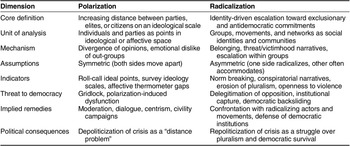
Radicalization offers a conceptual framework that captures contemporary political dynamics without the need for continual qualification or conceptual stretching (table 1). Whereas polarization suggests a symmetric process of divergence between opposing camps in an opinion space, radicalization describes a directional process of identity-driven escalation that undermines pluralism and democratic rules, often reshaping the broader political field in its wake. Rather than emphasizing distance between positions, radicalization foregrounds how political conflict becomes organized around exclusionary identities, moralized boundaries, and escalating norm transgression.
Polarization and Radicalization as Competing Frameworks for Diagnosing Democratic Crisis

Table 1 Long description
The table consists of three columns: Dimension, Polarization, and Radicalization.
* Core definition: Polarization is defined as increasing distance between parties or citizens on an ideological scale, while Radicalization is identity-driven escalation toward exclusionary and antidemocratic commitments.
* Unit of analysis: Polarization focuses on individuals and parties as points in space, whereas Radicalization focuses on groups, movements, and networks as social identities.
* Mechanism: Polarization involves divergence of opinions and emotional dislike, while Radicalization involves belonging, threat narratives, and intra-group escalation.
* Assumptions: Polarization is viewed as symmetric (both sides move), while Radicalization is asymmetric (one side radicalizes).
* Indicators: Polarization uses roll-call points and survey scales; Radicalization uses norm breaking, conspiracy narratives, and erosion of pluralism.
* Threat to democracy: Polarization leads to gridlock and dysfunction; Radicalization leads to delegitimation of opposition and democratic backsliding.
* Implied remedies: Polarization suggests moderation and dialogue; Radicalization suggests confrontation with radical actors and defense of institutions.
* Political consequences: Polarization depoliticizes crisis as a distance problem, while Radicalization repoliticizes it as a struggle for democratic survival.
As we have seen, such an understanding aligns in important respects with recent insights dispersed across strands of the polarization literature. Work on affective polarization highlights the emotional and identity-based dimensions of partisan conflict; research on asymmetric polarization acknowledges imbalance between political camps; and the literatures on sectarian and pernicious polarization emphasize moralization, camp formation, and elite-driven escalation (Finkel et al. Reference Finkel, Bail, Cikara, Ditto, Iyengar, Klar and Mason2020; McCoy, Rahman, and Somer Reference McCoy, Rahman and Somer2018; McCoy and Somer Reference McCoy and Somer2019). Taken together, these literatures increasingly describe a process of one-sided, directional antidemocratic escalation—precisely the phenomenon that the radicalization literature was developed to describe.
At its core, radicalization conceptualizes political conflict not as a spatial arrangement of opinions but as a deeply social and processual phenomenon. Originating in the study of extremism and political violence, the radicalization literature emphasizes identity, belonging, and group dynamics over ideological persuasion. Individuals rarely enter radical movements because they are convinced by policy arguments; instead, they are drawn by recognition, solidarity, and a sense of moral purpose within a bounded community (Dalgaard-Nielsen Reference Dalgaard-Nielsen2010; Doosje et al. Reference Doosje, Moghaddam, Kruglanski, De Wolf, Mann and Feddes2016; Hogg Reference Hogg2014). Political allegiance thus becomes a matter of who one is, rather than merely what one believes.
A central insight of this literature concerns the role of leaders in constructing and activating such identities. Leaders act as entrepreneurs of group identity, framing politics as a struggle between a virtuous in-group and threatening outsiders—immigrants, minorities, elites, or conspiratorial forces—thereby binding political loyalty to collective identity and moral obligation (Horgan Reference Horgan2008; Moghaddam Reference Moghaddam2005). This mechanism maps closely onto contemporary radical-right politics, where allegiance is grounded less in programmatic preference than in membership in an imagined ethnonational or moral community (Bonikowski Reference Bonikowski2017; Gidron and Bonikowski Reference Gidron and Bonikowski2013; Mudde Reference Mudde2004).
Threat narratives are central to this process. Radicalization advances when groups are portrayed as existentially endangered and extraordinary measures are framed as necessary acts of defense (Hafez and Mullins Reference Hafez and Mullins2015; Moghaddam Reference Moghaddam2005). Contemporary right-wing politics is saturated with such constructions: “great replacement” theories, stolen-election narratives, and portrayals of opponents as traitors or enemies of the people that function as identity-laden claims that delegitimize opposition and normalize hostility.
Radicalization research furthermore emphasizes dynamics of escalation. Radicalization intensifies through intragroup reinforcement, factional outbidding, and leader legitimation (Borum Reference Borum2011; Hafez and Mullins Reference Hafez and Mullins2015; Wiktorowicz Reference Wiktorowicz2005). As actors compete to demonstrate loyalty and resolve, previously marginal rhetoric becomes normalized, taboos erode, and norm violations are rewarded. What a polarization lens interprets as growing ideological distance, a radicalization lens understands as intensifying exclusionism and norm erosion within one political camp.
A key advantage of the radicalization lens lies in its inherent normative and processual directionality. Whereas polarization is typically operationalized as ideological or affective distance—a metric that carries no intrinsic implication of democratic decay (Fiorina and Abrams Reference Fiorina and Abrams2008; Iyengar et al. Reference Iyengar, Lelkes, Levendusky, Malhotra and Westwood2019)—radicalization denotes a specific movement toward illiberalism. It captures a dual process: the adoption of more exclusionary positions and the deepening of identity-based mobilization (Horgan Reference Horgan2008; McCauley and Moskalenko Reference McCauley and Moskalenko2008). Although analytically distinct, these dimensions are empirically symbiotic. As established in both radicalization and pernicious polarization research, identity-driven escalation fosters backsliding by delegitimizing institutional referees and lowering the threshold for extra-democratic measures (Bermeo Reference Bermeo2016; Graham and Svolik Reference Graham and Svolik2020; McCoy and Somer Reference McCoy and Somer2019). Antidemocratic outcomes need not be the initial aim of political actors: illiberalism can emerge as a structural byproduct of identity-mobilizing strategies pursued for electoral gain (Svolik Reference Svolik2019). Crucially, this lens highlights how authoritarian leaders are incentivized to radicalize their base. By framing political conflict as an existential struggle between irreconcilable identities, elites can effectively “capture” their supporters, inducing them to prioritize group victory over the preservation of democratic norms and institutional constraints (Svolik Reference Svolik2019).
Applying radicalization to mainstream party politics does not constitute a conceptual stretch. Many contemporary radical-right parties trace their origins to extremist milieus, such as neo-Nazi networks in Europe and white power movements in the United States, that have long been studied by scholars of radicalization (Kaplan Reference Kaplan2000; Mudde Reference Mudde2007). What has changed is not the underlying mechanisms but their migration into mainstream electoral politics. As research on the populist radical right demonstrates, these actors often operate within formal democratic institutions while advancing exclusionary and authoritarian agendas (Mudde Reference Mudde2019). Increasingly, similar dynamics characterize established conservative parties through processes of elite adaptation, programmatic convergence, and strategic accommodation (Abou-Chadi and Krause Reference Abou-Chadi and Krause2020). The result is what Mudde (Reference Mudde2019) terms a “radicalized mainstream right,” shifting the locus of democratic threat from marginal challengers to governing parties with the institutional capacity to translate illiberalism into durable political change (Buštı́ková Reference Buštı́ková and Rydgren2018; Reference Buštı́ková2021).
How the Radicalization Lens Clarifies What the Polarization Lens Obscures: An Examination of Cases
United States
Although scaling analyses in the United States do show widening partisan distance, they also demonstrate that separation has been driven primarily by Republicans’ rightward movement, rather than by a symmetric shift among Democrats (McCarty, Poole, and Rosenthal Reference McCarty, Poole and Rosenthal2016). Such a perspective, however, also conceals the substance of this shift: the Republican Party is increasingly characterized by rule-breaking, delegitimation of opponents, and a growing tolerance for violence (Kalmoe and Mason Reference Kalmoe and Mason2022; Mann and Ornstein Reference Mann and Ornstein2016). Survey evidence suggests that a significant minority of Republicans now endorse political violence against political opponents (Kalmoe and Mason Reference Kalmoe and Mason2022). A radicalization lens renders these developments legible. The Trump-era GOP fused partisan identity with threat narratives of “stolen elections” and “invasions at the border,” licensed norm violations, and tolerated violence framed as defense of the “true” people (Hacker and Pierson Reference Hacker and Pierson2020; Sides, Tesler, and Vavreck Reference Sides, Tesler and Vavreck2018). The dynamic is not symmetric divergence but identity-driven escalation concentrated on one party.
Brazil
Brazil is often described as polarized between the Workers’ Party (PT) and Jair Bolsonaro’s radical right. Polling data do show partisan dislike, but polarization fails to capture the one-sided erosion of norms under Bolsonaro, manifested in the systematic delegitimation of elections, tolerance for political violence, and conspiracy-laden attacks on institutions (Borges and Vidigal Reference Borges and Vidigal2018; Hunter and Power Reference Hunter and Power2019). Radicalization clarifies these dynamics. Bolsonaro fused partisan identity with evangelical and military constituencies, mobilized existential threats of “cultural Marxism” and electoral fraud, and normalized authoritarian gestures, culminating in the storming of government buildings on January 8, 2023. The PT, by contrast, pursued conventional electoral mobilization. What unfolded was not symmetric divergence but one-sided radicalization that pulled institutions into crisis.
Hungary
Hungary is frequently labeled as polarized, yet the trajectory since 2010 is better understood as the radicalization of a governing party. Under Viktor Orbán, Fidesz transformed from a mainstream conservative party into an authoritarian incumbent through constitutional redesign, referee capture in courts and media, and systematic norm erosion within competitive elections (Grzymala-Busse Reference Grzymala-Busse2019; Kelemen Reference Kelemen, Bressanelli, Koop and Reh2021). Opposition parties did not mirror these moves with symmetric extremism; they were constrained by the very institutional changes that Fidesz engineered. Polarization registers conflict; radicalization highlights the mechanisms of authoritarian capture: siege narratives of migration and “Soros,” identity mobilization, and the removal of taboos around illiberal governance.
Germany
Germany’s politics are likewise often described as polarized. Yet the rise of the AfD is not chiefly a story of symmetric divergence but of a radical-right challenger shifting discourse and incentives systemwide. Even without executive power, the AfD has normalized nativist frames and pressured competitors to adopt tougher stances on immigration and law-and-order measures (Abou-Chadi and Krause Reference Abou-Chadi and Krause2020; Mudde Reference Mudde2019). Comparative studies reveal how hostility toward minorities correlates with declining support for liberal norms in Europe (Norris and Inglehart Reference Norris and Inglehart2019; Rydgren Reference Rydgren2018). Polarization metrics capture rising affect and sharper divides but miss the gravitational pull of radicalization: factional outbidding and identity hardening within the AfD, combined with strategic convergence by established parties, bringing exclusionary claims once confined to the margins into the political mainstream.
Across these cases, polarization consistently misses the asymmetric, processual character of change, which is characterized by identity fusion, threat construction, norm violation, and referee capture concentrated on the right, often accompanied by accommodation rather than equal-and-opposite drift. Radicalization, by centering mechanisms and asymmetry, explains both institutional transformation in Hungary and Poland and discursive gravitational pull in Germany and France, as well as the GOP’s turn in the United States (Grzymala-Busse Reference Grzymala-Busse2019; Kelemen Reference Kelemen, Bressanelli, Koop and Reh2021; Levitsky and Ziblatt Reference Levitsky and Ziblatt2018).
Taken together, radicalization theory makes visible what polarization conceals. It shows a shifting relationship to politics on the political right, in which the dynamics once associated with fringe extremism—identity fusion, threat construction, norm erosion, and violence legitimation—are now visible in mainstream parties, governments, and electorates. “Polarization” reduces these dynamics to a problem of distance; “radicalization” identifies them as a process of democratic decay driven by asymmetric, identity-based escalation.
A Radicalization Research Agenda
Shifting from polarization to radicalization as the key concept for understanding the contemporary democratic crisis not only sharpens our diagnosis of present dynamics but also opens a distinct set of research frontiers. By foregrounding processes of identity formation, threat construction, and norm erosion, a radicalization lens directs political inquiry toward novel mechanisms. Whereas some are already being examined under the broad umbrella of polarization research, radicalization integrates them together as components of a single unified process, thereby offering a mechanism-based framework for explaining how political actors and groups become increasingly extreme and specifying the social, cognitive, and organizational processes toward moralization, exclusion, and, in some cases, violence. Several lines of inquiry stand out.
Micro-dynamics of Belonging
The radicalization literature shifts the focus of attention from disagreement or dislike to belonging: individuals are drawn less by policy conviction than by identity fusion, recognition, and solidarity (Doosje et al. Reference Doosje, Moghaddam, Kruglanski, De Wolf, Mann and Feddes2016; Hogg Reference Hogg2014). Elites amplify this through existential threat narratives that bind partisan identity to illiberal commitments. The radicalization frame raises pressing questions: How do radical-right elites cultivate belonging in democratic contexts? Under what conditions do threat narratives about immigrants, elites, or conspiratorial outsiders translate into moralized partisanship, willingness to abandon forbearance, or openness to violence?
Intraparty Escalation
Political science has extensively analyzed competition between parties, but less attention has been paid to the factional struggles within parties that are often part of driving radicalization. From a radicalization perspective, dynamics within organizations are central to radicalization, suggesting a view of parties not as unitary actors but as organizational arenas in which insurgent factions mobilize identity, loyalty, and grievance to challenge leadership, erode taboos, and shift the boundaries of acceptable discourse (Alimi, Bosi, and Demetriou Reference Alimi, Bosi and Demetriou2015). Research on party organization shows that internal rules—such as open primaries, decentralized candidate selection, weak gatekeeping, and activist-dominated memberships—can give highly mobilized minorities disproportionate influence, enabling processes of factional outbidding even when their positions lack broad electoral support (Hazan and Rahat Reference Hazan and Rahat2010; Levitsky and Ziblatt Reference Levitsky and Ziblatt2018). As factions compete to signal commitment to the in-group and hostility toward perceived out-groups, rhetorical escalation is rewarded, norm violations become normalized, and party leaders face mounting incentives to accommodate or adopt exclusionary positions to avoid internal displacement (Bale Reference Bale2018; Mudde Reference Mudde2019). In some cases, these dynamics culminate in party capture, where once-marginal actors gain control over nominations, agenda-setting, and disciplinary mechanisms, transforming mainstream parties into vehicles for illiberal politics (Buštı́ková Reference Buštı́ková and Rydgren2018).
A radicalization research agenda therefore foregrounds intraparty escalation as a central mechanism through which identity-driven politics migrates from the margins to the core of democratic systems. Key questions include the following: Which organizational rules and selection mechanisms amplify or constrain factional outbidding? How do leadership strategies interact with activist pressures to accelerate or contain radicalization? And under what conditions do internal party conflicts translate into durable shifts in democratic norms and institutional behavior?
Digital Infrastructures
Digital platforms have been a central focus of both polarization and radicalization research, but the analytical implications of these literatures differ in important ways. Whereas much polarization research has asked whether social media increases ideological distance or affective hostility between partisan groups—often finding small or heterogeneous average effects (Boxell, Gentzkow, and Shapiro Reference Boxell, Gentzkow and Shapiro2017; Nyhan et al. Reference Nyhan, Settle, Thorson, Wojcieszak, Barberá, Chen and Allcott2023; Tucker et al. Reference Tucker, Guess, Barberá, Vaccari, Siegel, Sanovich, Stukal and Nyhan2018), a radicalization lens shifts attention to the infrastructural conditions under which identity-driven escalation becomes more likely. From this perspective, platforms are not simply arenas of opinion exchange but also socio-technical infrastructures that shape pathways into and through radicalized political identities by amplifying grievance narratives, rewarding transgression, and accelerating intragroup reinforcement (Ebner Reference Ebner2021; Leidig Reference Leidig2023; Marwick, Clancy, and Furl Reference Marwick, Clancy and Furl2022; A. Törnberg and Törnberg Reference Törnberg and Törnberg2024). Research on online extremism shows that radicalization rarely proceeds through direct persuasion; instead, individuals are drawn into digital communities that offer recognition, belonging, and shared moral frames, within which opponents are delegitimized and norm violations normalized (Whitehouse Reference Whitehouse2018; Wiktorowicz Reference Wiktorowicz2005). Crucially, these dynamics increasingly characterize mainstream political actors and publics, as elites strategically exploit platform affordances to construct threat narratives, signal norm-breaking, and mobilize loyal in-groups, while platform metrics reward visibility, outrage, and identity signaling (Benkler, Faris, and Roberts Reference Benkler, Faris and Roberts2018; Brady et al. Reference Brady, Wills, Jost, Tucker and Van Bavel2017). A radicalization research agenda therefore reframes the study of digital media away from symmetric polarization effects and toward asymmetric, cumulative processes of identity hardening and democratic erosion. This raises a set of guiding questions: Which platform features and affordances facilitate pathways into radicalized political identities? How do elite cues and digital community dynamics interact to normalize exclusionism and norm violations?
Mass Openness to Illiberalism
A growing body of research shows that democratic backsliding is sustained not only by elite strategies but also by mass publics that become increasingly open to rule-breaking, repression, and even political violence in defense of partisan or identity-based goals (Kalmoe and Mason Reference Kalmoe and Mason2022). From a radicalization perspective, this openness reflects processes of identity escalation in which democratic norms are subordinated to perceived in-group survival. Experimental and survey research demonstrates that citizens are more willing to tolerate norm violations when they are framed as responses to existential threat, elite betrayal, or out-group aggression, especially when such cues are endorsed by trusted political leaders or reinforced within partisan networks (Graham and Svolik Reference Graham and Svolik2020; Svolik Reference Svolik2019). Yet the prevalence, intensity, and durability of such illiberal openness vary substantially across democracies, suggesting that radicalization among mass publics is contingent rather than inevitable.
A radicalization research agenda therefore shifts attention from average levels of democratic support to the social mechanisms that activate, amplify, or constrain mass-level tolerance for illiberalism. They include the role of elite signaling, peer dynamics, and media environments in legitimizing coercion, as well as countervailing forces such as social sanctions, crosscutting identities, civic engagement, and institutional checks that may interrupt or reverse radicalizing trajectories. Key guiding questions follow: How widespread is mass openness to illiberalism across democratic contexts? Which elite cues and social environments most effectively legitimize rule-breaking or violence? And under what conditions can social, civic, or institutional mechanisms successfully dampen or reverse mass radicalization?
From Depolarization to Deradicalization
A growing literature has examined interventions aimed at depolarization, typically understood as reducing disagreement or affective hostility between partisan groups through dialogue, civility campaigns, deliberative forums, or exposure to cross-cutting information (Fishkin Reference Fishkin2018; Santoro and Broockman Reference Santoro and Broockman2022; Törnberg et al. Reference Törnberg, Valeeva, Uitermark and Bail2023). This work has generated important insights into how misperceptions of out-partisans can be corrected and how interpersonal animosity may be softened. Yet both its diagnosis and its remedies largely presume the core issue to be a symmetric condition of mutual dislike. Recent large-scale experimental evidence underscores the limits of this approach. Although some interventions reliably reduce affective polarization, these effects are often short-lived, fail to generalize beyond the immediate context, and—crucially—do not necessarily translate into a stronger commitment to democratic norms or reduced support for rule-breaking (Holliday, Lelkes, and Westwood Reference Holliday, Lelkes and Westwood2025; Voelkel et al. Reference Voelkel, Chu, Stagnaro, Mernyk, Redekopp, Pink, Druckman, Rand and Willer2023). Mega-studies show that treatments effective in lowering partisan animosity frequently have little or no impact on tolerance for political violence, executive overreach, or the delegitimation of democratic referees (Voelkel et al. Reference Voelkel, Stagnaro, Chu, Pink, Mernyk, Redekopp and Ghezae2024). From a radicalization perspective, this divergence is expected: reducing interpersonal dislike addresses a symptom, not the underlying dynamics of identity-based escalation, existential threat perception, and elite legitimation of norm breaking. Moreover, it risks treating resistance against authoritarianism as a problem to be corrected.
A radicalization lens suggests a shift in emphasis from depolarization to deradicalization. Developed primarily in the study of violent extremism, deradicalization research abandons assumptions of symmetry and redirects attention from attitudes to identities and from disagreement to belonging, examining how individuals become emotionally and morally fused with movements, how threat and victimhood narratives sustain those attachments, and how they may be loosened or transformed over time (Della Porta and LaFree Reference Della Porta and LaFree2012; Doosje et al. Reference Doosje, Moghaddam, Kruglanski, De Wolf, Mann and Feddes2016; Hogg Reference Hogg2014). Applied to democratic politics, this perspective foregrounds illiberal commitments, such as acceptance of norm violations, delegitimation of opposition, or tolerance for political violence, as the central challenge and examines the mass-level processes through which partisan identity becomes bound to such positions. When aimed at the public, deradicalization hence focuses on disrupting identity fusion, weakening existential threat narratives, and cultivating alternative sources of recognition and belonging compatible with pluralism.
At the same time, deradicalization is not solely a mass phenomenon. Radicalization is actively produced and sustained by parties, movements, and media ecosystems that promote illiberal positions, reward escalation and punish dissent; reversing it therefore also implicates organizational incentives, elite strategies, and institutional constraints (Abou-Chadi and Krause Reference Abou-Chadi and Krause2020; Buštı́ková Reference Buštı́ková and Rydgren2018). Taken together, a deradicalization agenda complements and extends depolarization research by shifting the focus from mutual hostility to asymmetric escalation and from interpersonal affect to the identities, organizations, and incentives that sustain illiberal politics. Rather than asking how to soften partisan tone, it asks how democratic societies can unwind processes of radicalization—among both citizens and elites—before they harden into durable threats to pluralism and democratic rule.
Beyond Neutralist Diagnoses
The misdiagnosis of the radicalization of the political right has consequences well beyond the confines of the polarization literature. Across several influential research strands, expressions of right-wing extremism are recast as the byproduct of systemic or technological dysfunction and treated in ostensibly neutral terms. The expansive literature on “misinformation” offers a canonical example. Misinformation is frequently conceptualized as a generic “information disorder,” attributed to declining information quality, fragmented media environments, or algorithmic amplification in the digital age (Benkler, Faris, and Roberts Reference Benkler, Faris and Roberts2018; Törnberg Reference Törnberg2018; Vosoughi, Roy, and Aral Reference Vosoughi, Roy and Aral2018). Yet a growing body of evidence shows that political falsehoods are not evenly distributed across the ideological spectrum but are disproportionately produced, circulated, and legitimized within radical-right networks and parties, where they function as tools of political mobilization (Törnberg and Chueri Reference Törnberg and Chueri2025b). Framing these dynamics as neutral breakdowns in information flows obscures their political origins, masks asymmetries in responsibility and intent, and redirects scholarly and policy attention toward technical fixes rather than political accountability. A radicalization lens is part of challenging such neutralist diagnoses across research fields, recognizing them not as technological conditions but as symptoms of a broader process of right-wing radicalization.
Radicalization thus directs attention to actors, narratives, and institutions in motion: how belonging and threat are organized, how norms are undone, and how democratic guardrails hold or break. It insists that conceptual clarity and empirical inquiry are inseparable from normative responsibility: how we name democratic crisis shapes both its diagnosis and its remedy.
Taken together, these directions are part of a research agenda that reorients the study of democratic crisis. Rather than measuring ideological distances or prescribing civility, it encourages scholars to investigate how identities harden, how factions escalate, how platforms and institutions shape trajectories, and why democracies resist or succumb. The fate of democracy depends not on narrowing opinion gaps, but on confronting the mechanisms by which one political pole undermines pluralism and pulls the system in its wake.
Conclusion
This article has argued that polarization is the wrong metaphor for understanding the contemporary democratic crisis. Borrowed from physics, the metaphor depicts politics as an opinion space marked by symmetrical divergence: two sides, drifting toward opposite poles through mutual repulsion. Its appeal lies in its ostensible neutrality and balance, yet these very features make it a fundamental misdiagnosis. By framing democratic crisis as two sides in divergence, the focus on polarization obscures the one-sided radicalization of the political right, recasts exclusionary and antidemocratic commitments as mere ideological distance, and diverts attention from the processes that matter most.
Polarization fails to distinguish between conflict within democratic rules and conflict over democratic rules, recasting authoritarian abuses as just another partisan claim. The result is not neutrality but normalization, blurring the line between democratic contestation and democratic erosion (Boykoff and Boykoff Reference Boykoff and Boykoff2004; Nyhan Reference Nyhan2020). Much like journalistic “both-sides” reporting, academic reliance on polarization risks equating those who attack democracy with those who defend it. It offers an alibi for neutrality, shielding scholars from accusations of partisanship, but this comes at the cost of analytic clarity and empirical accuracy. The polarization frame invites familiar remedies—moderation, civility, compromise—while casting resistance to authoritarianism as a democratic pathology. The concept has become a cul-de-sac, sustained by ever-multiplying qualifiers that dilute rather than repair it.
The contributions of this article have been threefold. First, it has offered a conceptual critique: variants such as “asymmetric,” “affective,” “pernicious,” or “sectarian” polarization accurately identify the problems of the concept but also stretch it beyond analytical usefulness, exemplifying Sartori’s warning against category error. As a result, these refinements have rarely migrated into public or policy discourse, where polarization remains understood in terms of mutual hostility, concerns about tone and civility, and distance in opinion space. Second, the article imports insights from radicalization research on identity, belonging, threat narratives, and escalation into the study of mainstream democratic politics. As the mainstream has become radicalized (Mudde Reference Mudde2019), analytical tools developed to explain fringe extremism have become indispensable for understanding today’s radical-right parties and electorates. Third, it has highlighted scholarly responsibility. Concepts are never politically innocent. Persisting with the lens of polarization risks legitimizing antidemocratic actors by presenting them as one pole of a symmetric divide. In terms of remedies, the focus on polarization amounts to encouraging a polite tone as one political party is undermining democratic institutions.
Whereas polarization must be continually stretched to describe one-sided, identity-based illiberal escalation, the concept of radicalization was developed to describe precisely such a dynamic. Radicalization provides a unifying framework under which insights now scattered across the polarization literature—on hardening political identities, moralization, elite entrepreneurship, and norm erosion—can be integrated without importing misleading assumptions of symmetry or mutuality. It describes a single asymmetric process in which elite strategies, threat narratives, and intragroup escalation radicalize one political pole and reshape the strategic environment faced by institutions, publics, and opposition actors alike.
The implications for research are therefore clear. We need a systematic agenda centered on radicalization within democratic politics that examines how parties, media ecosystems, and movements mobilize identities, construct threats, escalate demands, and normalize norm violations; why some institutions resist pressure while others bend; and under what conditions publics are mobilized to counter radicalization rather than accommodate it. Above all, we need concepts that illuminate rather than obscure, and that capture asymmetry, specify mechanisms, and refuse to flatten democratic threats into questions of disagreement.
The normative stakes could not be sharper. Refusing to name asymmetry is itself a political act. To continue describing democratic crisis as polarization is to lend legitimacy to those undermining democracy by treating them as one half of a symmetric dynamic. Neutrality under these conditions is not objectivity: it is complicity.
Acknowledgements
I am grateful to Juliana Chueri, as always, for her thoughtful feedback and sharp comments. I also thank the anonymous reviewers for their careful engagement with the article and for comments that helped strengthen and clarify the argument.

 Open access

