




Introduction
Food waste is one of the major global problems with severe environmental, economic, and social consequences. According to the report of the European project FUSIONS (Food Use for Social Innovation by Optimising Waste Prevention Strategies), food waste encompasses ‘any food, and inedible parts of food, removed from the food supply chain to be recovered or disposed’ (Food Waste Definition, 2015). Globally, around 14% of all food produced is lost between harvest and retail (FAO, 2019), with a further 17% wasted at the retail and consumer levels, particularly in households (UNEP Food Waste Index, 2024). Halving global food waste by 2030 is one of the Sustainable Development Goals. However, only 5% of countries include food waste in their Nationally Determined Contributions from 2022 (UN SDG, 2024).
Food waste occurs at different supply chain stages and has many causes. However, the leading causes of waste are primarily the result of systemic flaws in food systems, including improper food handling at all supply chain stages, excessive inventory due to inaccurate planning, inappropriate storage conditions, oversized portions, and inappropriate consumer behavior (Hamid et al., Reference Hamid, Yatoo, Sayyed, Dineshkumar, Al-Khayri, Bashir, Sillanpää and Majeed2023; Leal Filho et al., Reference Leal Filho, Ribeiro, Setti, Azam, Abubakar, Castillo-Apraiz, Tamayo, Özuyar, Frizzo and Borsari2023; Zielińska et al., Reference Zielińska, Dąbrowska, Monastyrskyi and Drozda2023). The best solution to the problem is to prevent food waste at the source, for example, by improving production and order/purchase planning or storage methods (Marimuthu et al., Reference Marimuthu, Saikumar and Badwaik2024). Cooperation throughout the supply chain from producer to consumer is also important (Todd and Faour-Klingbeil, Reference Todd and Faour-Klingbeil2024). DTs can contribute to the reduction of food waste by generating actionable information that enhances information flows throughout the supply chain, enables the real-time detection of irregularities, and facilitates more informed consumer behavior.
The market for DTs is expanding rapidly, with global expenditures on DTs and related services reaching $ 2.2 trillion in 2023 and projected to increase by approximately 80% by 2027 (Statista, 2025). These technologies are associated with the Fourth Industrial Revolution, or Industry 4.0, which represents a transformation of manufacturing through a series of disruptive innovations in production, leading to substantially increased productivity and competitiveness (European Parliament, 2016). Industry 4.0 concept emphasizes the importance of communication and connectivity across the physical, biological, and digital systems to create smart, interconnected, and autonomous production environments. It emphasizes data-driven connectivity across all levels of manufacturing and supply chains, encompassing data acquisition through smart sensors (including those embedded in packaging), robotics, and IoT; data storage and verification via blockchain; data processing via cloud computing; and data analysis and interpretation using ML and AI to support real-time decision-making and enhance operational efficiency (Hassoun, Reference Hassoun, Aït-Kaddour, Abu-Mahfouz, Rathod, Bader, Barba, Biancolillo, Cropotova, Galanakis, Jambrak, Lorenzo, Måge, Ozogul and Regenstein2023a). Other DTs are also closely related. For example, Digital Twins, as digital representations of real-world products, processes, or physical objects, integrate various DTs (e.g., IoT and AI) in order to synchronize physical activities with the virtual world. Consequently, the combined application of these technologies is essential to fully realize their potential in reducing food waste (Arshad et al., Reference Arshad, Abdul-Malek, Parra-López, Hassoun, Qureshi, Sultan, Carmona-Torres, De Waal, Jagtap and Garcia-Garcia2025; Fernandez et al., Reference Fernandez, Alves, Gaspar, Lima and Silva2023; Hansoun et al., Reference Hassoun, Jagtap, Trollman, Garcia-Garcia, Abdullah, Goksen, Bader, Ozogul, Barba, Cropotova, Munekata and Lorenzo2023b; Kabadurmus et al., Reference Kabadurmus, Kayikci, Demir and Koc2023).
In recent years, DTs have been receiving increasing attention from academic, business, and policy spheres. The literature on DTs in the food supply chain primarily focuses on the following technologies: Big Data, Could Computing, Artificial Intelligence (AI), including Machine Learning (ML), blockchain, the Internet of Things (IoT), smart sensors, Digital Twins and Cyber Physical Systems (CPS), smart packaging, additive manufacturing (3D printing), robotics, Virtual/Augmented Reality (VR/AR), and imaging technologies. Definitions of these technologies are provided in Table A1 in the Supplementary Material. While the number of publications investigating their potential to reduce food waste continues to grow, research gaps remain. Most existing studies present a limited and fragmented perspective. Primary studies mainly focus on the implementation of a specific DT through on a single case or a small set of case studies or on the design of a particular digital solution aimed at reducing food waste, while neglecting the impacts of introducing these DTs in different areas—whether economic, social, or ethical (e.g., Annosi et al., Reference Annosi, Brunetta, Bimbo and Kostoula2021; Corsini et al., Reference Corsini, Annesi, Annunziata and Frey2024; Torres-Sánchez et al., Reference Torres-Sánchez, Martínez-Zafra, Castillejo, Guillamón-Frutos and Artés-Hernández2020). This limits the generalizability of their findings.
There are also a few review articles that synthesize existing knowledge on the impact of implementing DTs on food waste. These reviews adopt a narrative approach primarily because the studies they examined rarely assessed this impact quantitatively. For example, Ahmadzadeh et al. (Reference Ahmadzadeh, Ajmal, Ramanathan and Duan2023) provide a literature review on the use of IoT and Big Data in the agri-food supply chain with a focus on reducing food waste. Classifying these technologies into three categories—measurement and data collection (sensors), data processing (AI and ML algorithms), and data transmission (wireless communication technologies)—the study almost exclusively describes their role in quality monitoring. Similarly, a systematic review by Seyam et al. (Reference Seyam, Ei Barachi, Zhang, Du, Shen and Mathew2024), investigating 66 studies published between 2015 and 2023 on agri-food supply chain resilience and food waste reduction, focused considerably on the contribution of DTs on monitoring product quality and price adjustments. A more comprehensive review, drawing on 48 studies focused on the entire agri-food sector and published between 2016 and 2023, provided by Trevisan and Formentini (Reference Trevisan and Formentini2024), highlights that the vulnerability of agri-food products to deterioration and perishability, combined with strict supply chain regulations, increases the importance of DTs in managing uncertainties. DT’s influence goes beyond product quality monitoring, encompassing improvements in transparency and performance optimization.
This study aims to contribute to the discussion on reducing food waste through Industry 4.0 by systematically examining in which areas DTs can effectively contribute to food waste reduction in the food industry and downstream supply chain and through which mechanisms they achieve this impact. In addition to the potential benefits, this study also discusses the possible negative impacts associated with the adoption of DTs in the food sector.
This study is motivated by the growing body of research on food waste reduction and seeks to advance the knowledge established by previous research. It differs from previous reviews in the comprehensiveness of its search strategy, which includes both aggregate terms such as ‘digital technologies’ used by Trevisan and Formentini (Reference Trevisan and Formentini2024) and individual technologies, but within a broader scope than that covered by Ahmadzadeh et al. (Reference Ahmadzadeh, Ajmal, Ramanathan and Duan2023) and Seyam et al. (Reference Seyam, Ei Barachi, Zhang, Du, Shen and Mathew2024). Building on Dora et al. (Reference Dora, Biswas, Choudhary, Nayak and Irani2021), who observed that food waste in developed countries (the primary contributors to global food waste) predominantly occurs and is studied in the downstream stages of the agri-food supply chain, this analysis focuses on processing, distribution, retail, and food service. Unlike Trevisan and Formentini (Reference Trevisan and Formentini2024), whose review is technology-based, identifying areas of application for key DTs, the present study adopts a thematic approach, assigning DTs to specific thematic areas and providing a more detailed examination of the mechanisms through which these technologies effectively contribute to food waste reduction. Moreover, this study is based on a larger set of articles—73 studies published between 2020 and 2025—but focuses exclusively on food manufacturers and the downstream supply chain, thereby offering a more in-depth overview with a narrower focus.
The key contributions of this study are threefold: (i) it systematizes the thematic areas in which DTs contribute to food waste reduction in the food downstream supply chain; (ii) it demonstrates how DTs function within these thematic areas to achieve food waste reduction; and (iii) it contributes to a balanced discussion on DTs by also outlining potential risks associated with their implementation in the food industry and supply chain.
The remainder of this paper is organized as follows: Section ‘Materials and methods’ describes the materials and methods used. Section ‘Impact of digital technologies on food waste reduction’ first provides a general characterization of the set of articles analyzed (Section ‘Characteristics of the reviewed studies’), then presents the thematic areas and, within them, the mechanisms through which individual DTs contribute to reducing food waste (Section ‘Thematic areas and mechanisms of using DTs to reduce food waste’), and further addresses the negative impacts and potential risks associated with the implementation of DTs in the food industry and downstream supply chain. Section ‘Conclusion’ summarizes the conclusions drawn from the analyses and offers suggestions for future research.
Materials and methods
Digital technologies (DTs) for the food processing industry and food supply chain—and their implications for food waste reduction—were explored through a systematic review of articles providing empirical evidence or discussing DTs’ (expected) impacts. A brief description of these technologies is included in Table A1 in the Supplementary Material. The research followed the PRISMA protocol (Page et al., Reference Page, McKenzie, Bossuyt, Boutron, Hoffmann, Mulrow, Shamseer, Tetzlaff, Akl, Brennan, Chou, Glanville, Grimshaw, Hróbjartsson, Lalu, Li, Loder, Mayo-Wilson, McDonald, McGuinness, Stewart, Thomas, Tricco, Welch, Whiting and Moher2021) and employed a three-step approach to select the relevant studies within scientific journals. The first step—identification of potentially relevant studies within scientific journals—was based on the searching procedure relating DTs to food waste reduction. Web of Science was used as a search database. The analysis included only fully published peer-reviewed journal articles in English indexed in the Science Citation Index Expanded and the Social Science Citation Index, while conference proceedings, book chapters, and articles indexed in the Emerging Sources Citation Index were excluded. The examined technologies are highly up-to-date; 87% of the articles indexed in the Web of Science (April 9, 2025) are from 2020 to 2025. Therefore, articles published before 2020 were excluded. Table 1 presents the search query, applied to titles, abstracts, and keywords, that retrieved 488 records.
SQL query syntax for records focused on the effects of DTs on food waste

Note: The search strategy was performed on April 9, 2025.
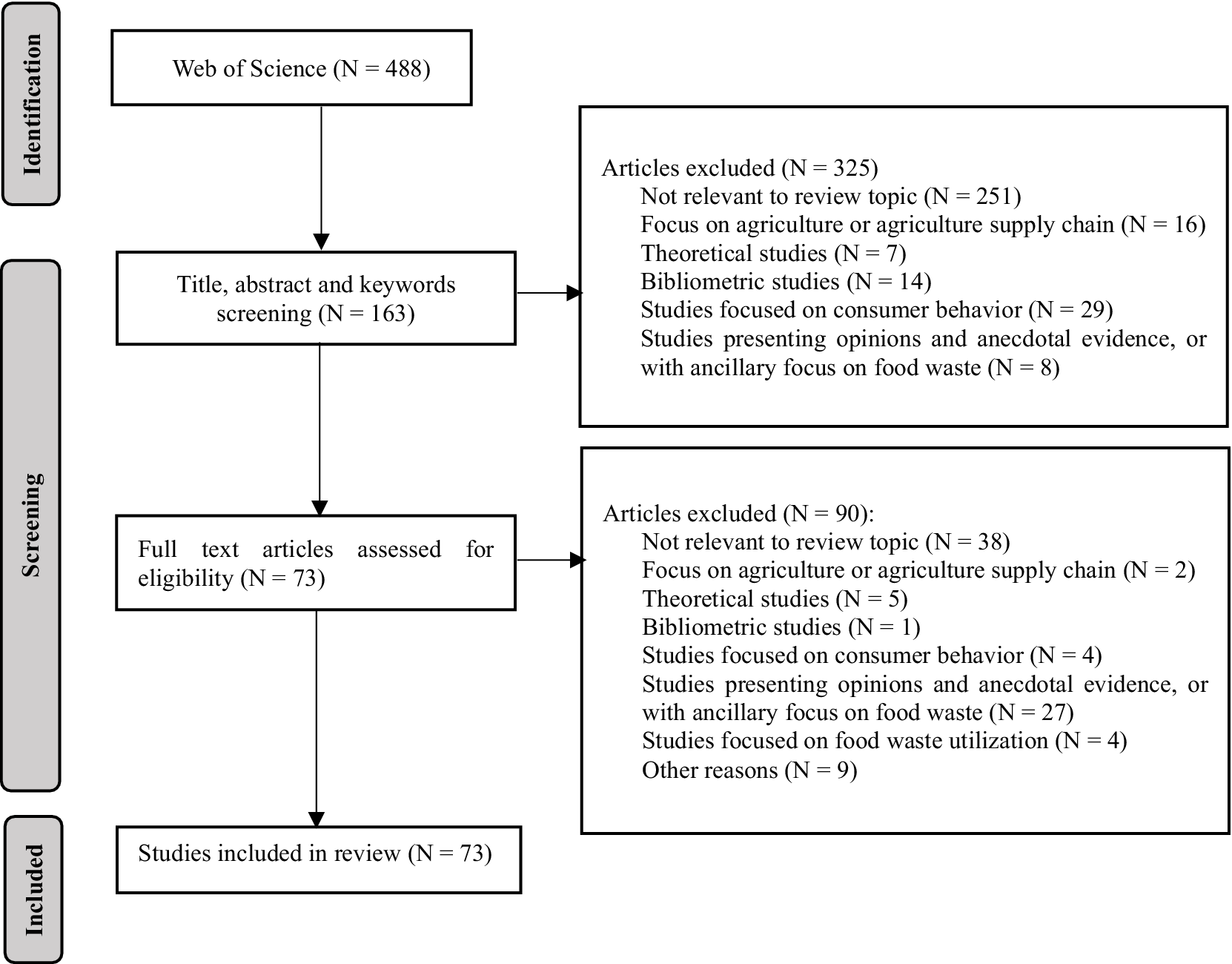
The second step—screening of found articles—examined the relevance of studies based on the title, abstract, and keywords. The third step—selection of relevant studies—investigated the relevance of studies based on the full text. In both steps, only studies that assess the impact of DTs on food waste reduction in the food processing industry and the downstream supply chain were considered relevant. Studies that exclusively addressed agricultural production or the agricultural supply chain were excluded from the review. The following articles that were excluded were theoretical studies presenting conceptual developments of technologies and purely bibliometric studies. Studies assessing consumer behavior were also considered as irrelevant. Finally, studies where food was wasted by the food processing industry or in the downstream supply chain were ancillary, and studies that relied on opinions and anecdotal evidence were also excluded. Two authors completed the process described above independently to ensure validity in the selection process. In case of disagreement, a consensus on selecting articles was reached through discussion. The selection process eliminated 415 articles. That is, a total of 73 articles were finalized for conducting the review. Figure 1 illustrates the process according to the PRISMA protocol.
PRISMA flow diagram of the review of DTs’ impact on food waste.
Note: ‘Other reasons’ include studies focused on food waste utilization not connected with digital technologies, studies investigating the drivers or barriers of technology adoption, and studies focused on supply chains in general.
Source: Own processing.

Key study parameters were extracted from the selected articles, including author names, affiliation of the first author, year of publication, journal title, publisher, and study type. Moreover, information was collected on the primary research focus (the processing stage, downstream stages, or both), analyzed technology, study objectives, methodological approach, and products. Two authors independently conducted this procedure. The extracted data were compared, and any discrepancies were resolved through discussion. The obtained information served as the basis for a qualitative synthesis using descriptive and thematic analysis (Tranfield et al., Reference Tranfield, Denyer and Smart2003).
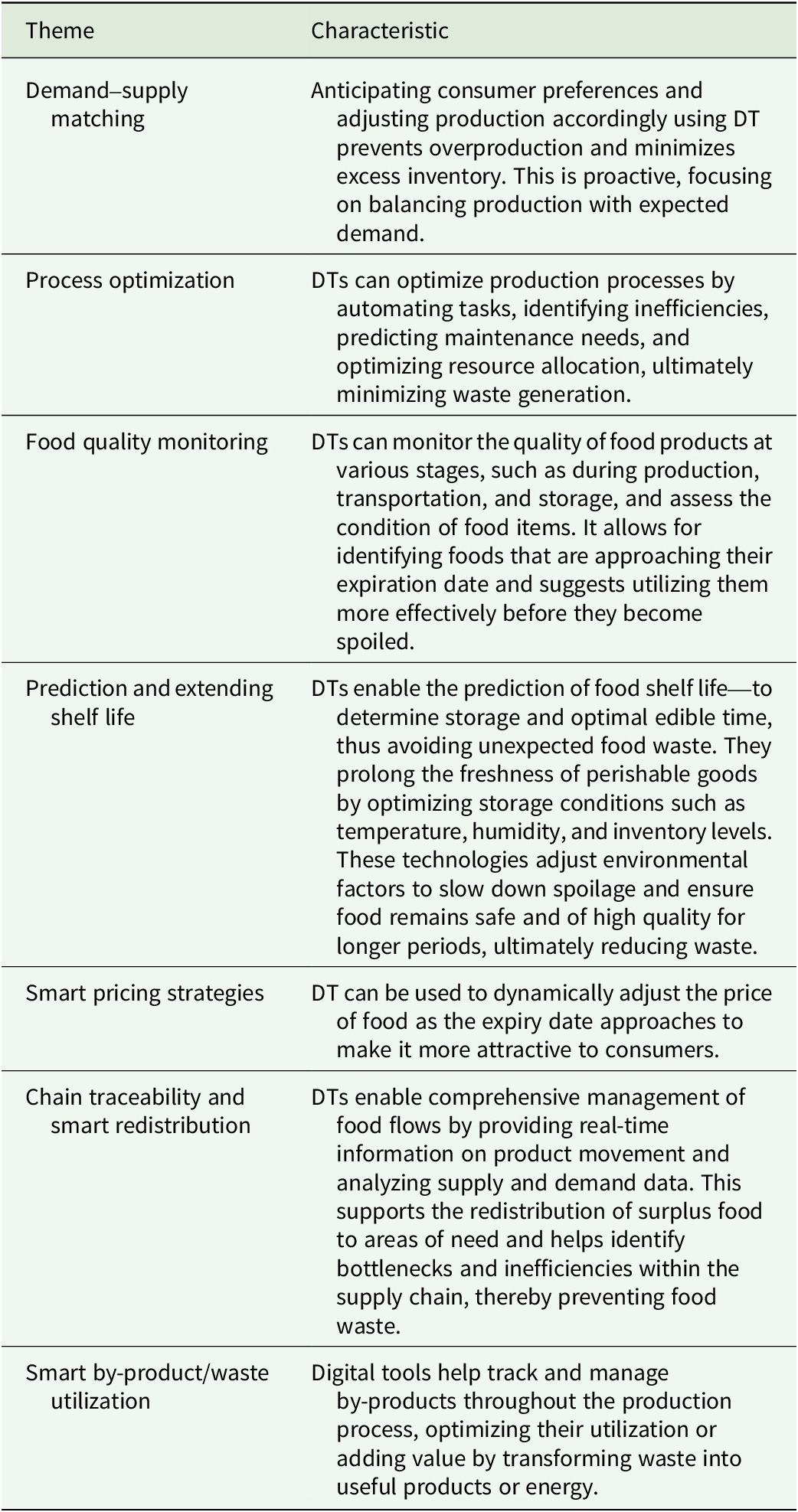
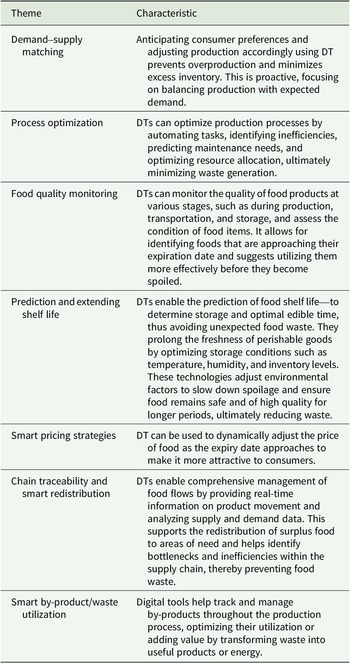
Subsequently, the studies were systematized into themes that represent ways in which DTs can contribute to reducing food waste. The themes were derived from the waste causes identified in the literature (e.g., Dey et al., Reference Dey, Santra, Choudhury, Ghosh and Samanta2025; Dora et al., Reference Dora, Biswas, Choudhary, Nayak and Irani2021; Urugo et al., Reference Urugo, Teka, Gemede, Mersha, Tessema, Woldemariam and Admassu2024). Demand–Supply Matching reflects the fact that one of the most common causes of food waste is overproduction resulting from market uncertainties. Process Optimization addresses inefficiencies in production processes, while Food Quality Monitoring focuses on waste stemming from quality issues and the need to meet stringent quality standards. Prediction and Shelf-Life Extension reflect waste resulting from inadequate storage, particularly due to improper temperature and humidity conditions. Smart Pricing Strategies mitigate overstocking caused by inaccurate ordering by dynamically adjusting prices to encourage timely consumption. Chain Traceability and Smart Redistribution enhance information visibility across the supply chain and optimize logistics and inventory management, thereby contributing to reduced overproduction and ensuring the efficient allocation of surplus food to areas of need. Finally, Smart By-Product/Waste Utilization reduces waste generated during preparatory activities or from discarded imperfect raw materials. A brief definition of these themes is provided in Table 2.
Food waste reduction themes and their characteristics
Source: Own processing.
Finally, insights were extracted from the analyzed set of articles regarding additional impacts, challenges, and risks associated with the implementation of DTs in the food industry and the downstream supply chain.
Impact of digital technologies on food waste reduction
Section ‘Characteristics of the reviewed studies’ characterizes the analyzed set of studies with respect to their type, research methodology, geographical distribution, examined DTs, and thematic areas. Section ‘Thematic areas and mechanisms of using DTs to reduce food waste’ further develops these themes by presenting the key DTs, their benefits, and the major advancements in the field. Section ‘Other impacts of digitalization’ presents risks and additional impacts associated with the implementation of DTs beyond the reduction of food waste.
Characteristics of the reviewed studies
For the systematic review of the effects of DTs on food waste reduction, 73 relevant articles were identified, comprising 32 primary studies and 41 reviews. The review articles included in the analysis represent a variety of review types—from narrative reviews and scoping reviews to systematic reviews. Publications explicitly labeled as a critical review in the article title or abstract were identified in only one case within the examined sample. However, it is important to note that authors often do not specify the type of review conducted. Out of a total of 41 reviews, only 15% of publications mention the kind of product being addressed—often within broader categories such as perishable goods or, more specifically, fruits and vegetables. According to the Food Loss Index (FAO, 2025), fruits and vegetables account for the largest share of total food waste. These products have a short shelf life, are sensitive to handling, and spoil easily, which makes them a logical focus for studies aimed at reducing food waste. Less represented categories include milk and dairy products, eggs, bakery goods, and frozen foods. In general, the more perishable a food product is, the more demanding it becomes in terms of temperature control and other environmental parameters. Insufficient temperature control can lead to microbial growth, the proliferation of pathogens and molds, or changes in the physical structure of food (e.g., the formation of ice crystals in frozen products). Even minor deviations in temperature, humidity, or storage duration can dramatically affect product quality and shelf life. Therefore, DTs find their most apparent application in these categories, where their benefits can also be more easily monitored and quantified.
Primary studies most commonly focus on the design of specific solutions and the results of their testing, method development, modeling, simulations, and laboratory experiments—often without evidence of direct experience from real-world operations. To a lesser extent, they include expert interviews (in three cases) and a very limited number of case studies (three cases), which document company-level experience with specific solutions and provide a clear quantification of impacts—such as reductions in waste and energy consumption, improvements in operational efficiency, decreased need for manual labor, and overall increases in business competitiveness. None of the primary studies assesses the economic efficiency of investments in digital technologies in relation to the benefits these solutions deliver. Instead, technological and environmental frameworks dominate the discourse. These primary studies mostly address broad food categories, such as perishable and fresh foods, without further specification. To a lesser extent, they focus on specific food types: for example, six primary studies target fruits and vegetables, two focus on meat and meat products, and only one addresses bread. There are no publications specifically focused on milk, dairy products (with the exception of butter), or other types of bakery goods.
The geographical distribution of the first authors reveals a notable regional concentration: 48% of all articles were affiliated with European universities and research institutions (including 26 studies located in European Union member states), 32% with Asian universities and research centers, 15% with North American academic institutions, 4% with those in Australia and Oceania, and 1% with African organizations. This distribution underscores the significant research focus on food waste mitigation, particularly within European strategic frameworks targeting sustainable development.
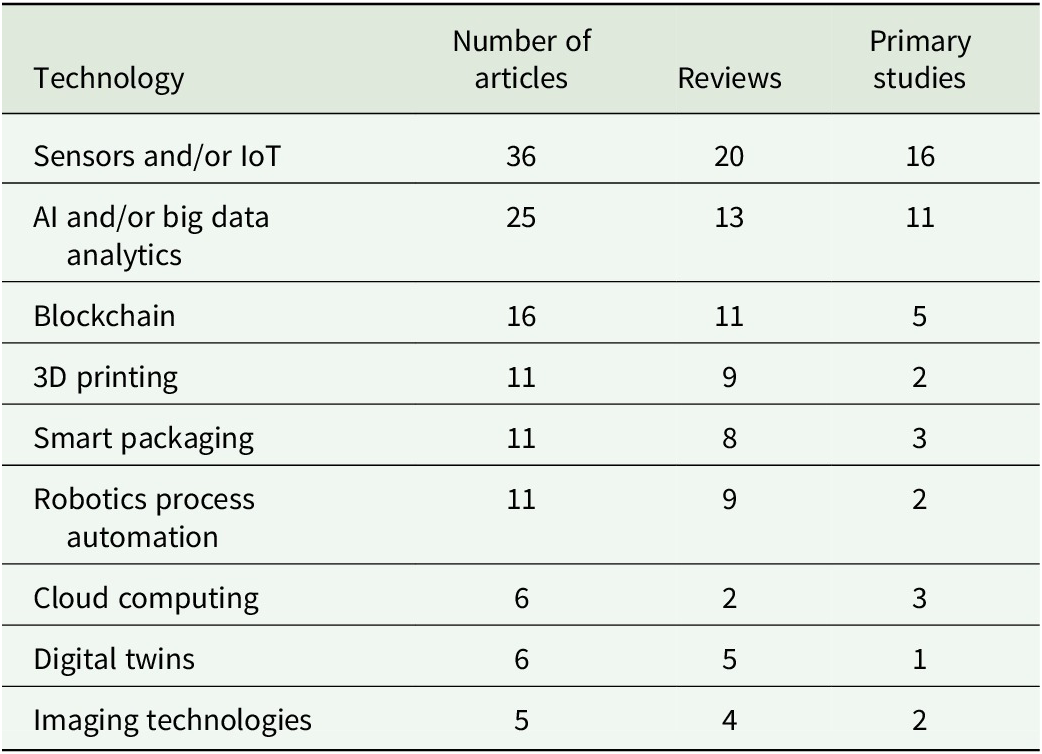
Regarding the DTs examined, the literature predominantly focuses on purely sensing technologies, the entire IoT structure, AI, including ML and deep learning approaches to big data analysis, as well as blockchain (Table 3). Of the total number of investigated articles, 40% dealt with more than one technology. A detailed analysis of technological focus across the publications reveals that 49% of articles examined sensors and/or IoT applications (with nine studies focusing solely on sensors), while 34% investigated AI and/or big data analytics implementations. Additionally, 22% of articles analyzed blockchain technology’s contribution to food waste reduction.
Representation of DTs

Note: Technologies are grouped into categories according to the predominant approach in the reviewed publications.
The utilization of these technologies for food waste reduction targeted food processors in 25% of the studies, focused on the downstream supply chain (distribution and retail) in 38% of cases, and analyzed the entire supply chain (processing, distribution, retail, and food service) in 37% of the studies.
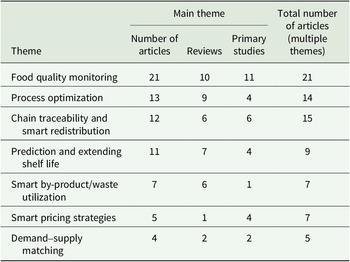
Among the themes, 30% of the articles (17 reviews and 5 primary studies) addressed more than one theme. Table 4 presents the distribution of themes, showing both the primary theme of each study (main theme) and the total number of studies exploring each theme.
Representation of themes

Source: Own processing.
Quality monitoring emerged as the most prominent thematic area, appearing as the main focus in 29% of the analyzed studies. This emphasis underscores the critical role of DTs in ensuring and tracking food quality throughout the supply chain. Process optimization was the second most significant theme, representing 18% of the studies, while supply chain traceability and smart redistribution accounted for 16%, and prediction and shelf-life extension comprised 15% of the publications. The temporal distribution of these themes is presented in Table A2 in the Supplementary Material.
Thematic areas and mechanisms of using DTs to reduce food waste
In this subsection, the individual thematic areas of DTs use will be presented in the order corresponding to their occurrence in the analyzed set of articles, as shown in Table 4. A brief overview of the thematic areas is provided in Table 2.
Food quality monitoring
Wastage is primarily caused by inefficiencies in the food supply chain and a lack of information at each stage of the food cycle. Therefore, monitoring and immediate detection of food quality are of fundamental importance as they can aid various decision-making processes in real-time—for example, decisions on consumption, inventory management, maintaining storage conditions, and even repurposing the food if it cannot be used for the desired application (Kapse et al., Reference Kapse, Kausley and Rai2022). DTs transform conventional supply chains into smart ones, with IoT infrastructure, the integrated set of physical and digital components, including sensors, communication networks, cloud platforms, data storage, and security mechanisms that enable real-time data collection, transmission, and analysis, serving as a cornerstone (Ahmadzadeh et al., Reference Ahmadzadeh, Ajmal, Ramanathan and Duan2023; Hassini et al., Reference Hassini, Ben-Daya and Bahroun2025; Ramanathan et al., Reference Ramanathan, Duan, Ajmal, Pelc, Gillespie, Ahmadzadeh, Condell, Hermens and Ramanathan2023; Trevisan and Formentini, Reference Trevisan and Formentini2024; Vedantam et al., Reference Vedantam, Jain, Panwar, Sunil, Wadhawan and Kumar2024). Primarily, IoT technology is employed with the aim of monitoring and detecting food deterioration stage and quality losses in real-time (Boz and Martin-Ryals, Reference Boz and Martin-Ryals2023; Duong et al., Reference Duong, Al-Fadhli, Jagtap, Bader, Martindale, Swainson and Paoli2020; Hassoun et al., Reference Hassoun, Jagtap, Trollman, Garcia-Garcia, Abdullah, Goksen, Bader, Ozogul, Barba, Cropotova, Munekata and Lorenzo2023b; Trevisan and Formentini, Reference Trevisan and Formentini2024; Urugo et al., Reference Urugo, Teka, Gemede, Mersha, Tessema, Woldemariam and Admassu2024).
Whereas some authors focus only on certain components of the IoT infrastructure, for example, sensors (Kapse et al., Reference Kapse, Kausley and Rai2022; Meliana et al., Reference Meliana, Liu, Show and Low2024; Nami et al., Reference Nami, Taheri, Siddiqui, Deen, Packirisamy and Deen2024; Pal and Kant, Reference Pal and Kant2020), others describe and discuss the use of the entire IoT infrastructure to reduce food waste, including big data analysis tools and wireless data transmission technologies (Ahmadzadeh et al., Reference Ahmadzadeh, Ajmal, Ramanathan and Duan2023; Vedantam et al., Reference Vedantam, Jain, Panwar, Sunil, Wadhawan and Kumar2024). The review of Vedantam et al. (Reference Vedantam, Jain, Panwar, Sunil, Wadhawan and Kumar2024) describes the aspects and main budding areas of IoT in the food and agricultural sectors. IoT can sense, monitor, and control different thermodynamic parameters like temperature, relative humidity, and other environmental factors in storage facilities, refrigerators, and transport vehicles. For example, Damdam et al. (Reference Damdam, Ozay, Ozcan, Alzahrani, Helabi and Salama2023) introduced an IoT-enabled electronic nose system with temperature/humidity sensors to monitor beef quality, while Pal and Kant (Reference Pal and Kant2020) developed an NFMI-based IoT infrastructure for fresh food transportation. IoT-based technology also supports the circular economy of food, as demonstrated by Iqbal and Kang (Reference Iqbal and Kang2024). Their results demonstrate that subsequent recycling of infected food inventories into secondary products removes 100% of the food waste, conserves 62% of the material resources, reduces preservation costs by 65.8%, and enhances profit by 49%.
Also, IoT can be used for intelligent packaging, which incorporates sensors (quantitative) and indicators (qualitative) to monitor gas composition, temperature, humidity, and freshness. Sensors, unlike indicators, transmit information and typically connect to power sources and RFID antennas, becoming IoT-enabled when internet-connected (Fernandez et al., Reference Fernandez, Alves, Gaspar, Lima and Silva2023). These DTs provide real-time food condition information, improving quality control, safety, and supply chain efficiency (Nami et al., Reference Nami, Taheri, Siddiqui, Deen, Packirisamy and Deen2024; Vedantam et al., Reference Vedantam, Jain, Panwar, Sunil, Wadhawan and Kumar2024). For example, Naik et al. (Reference Naik, Lee, Herrington, Barandun, Flock, Güder and Gonzalez-Macia2024) present the integration of gas detection sensors into packaging and their integration with wireless communication and batteryless electronics for assessing spinach spoilage. Moreover, active packaging can preserve food by reacting to environmental changes (Trevisan and Formentini, Reference Trevisan and Formentini2024). Fernandez et al. (Reference Fernandez, Alves, Gaspar, Lima and Silva2023) and Dwibedi et al. (Reference Dwibedi, Kaur, George, Rana, Ge and Sun2024) summarize suitable smart packaging for the agro-industry, while Nami et al. (Reference Nami, Taheri, Siddiqui, Deen, Packirisamy and Deen2024) focus on seafood and meat monitoring sensors that must be biocompatible, mass-producible, cost-effective, reusable, user-friendly, and accurate for industrial applications.
Intelligent packaging is associated with higher costs compared to conventional packaging. According to Nami et al. (Reference Nami, Taheri, Siddiqui, Deen, Packirisamy and Deen2024), the cost of intelligent packaging systems is estimated to account for approximately 50–100% of the total cost of the final packaging. Another hindrance is the availability and use of safe, food-friendly materials to produce the smart components. The review by Tracey et al. (Reference Tracey, Predeina, Krivoshapkina and Kumacheva2022) explores 3D printing as a viable alternative to conventional fabrication methods for these devices.
IoT technology, through ICT infrastructure and smart devices, enables real-time collection of large-scale data or big data (Ahmadzadeh et al., Reference Ahmadzadeh, Ajmal, Ramanathan and Duan2023; Trevisan and Formentini, Reference Trevisan and Formentini2024). These data are then analyzed using various techniques to derive insights, detect patterns, and generate predictions (Ahmadzadeh et al., Reference Ahmadzadeh, Ajmal, Ramanathan and Duan2023; Vedantam et al., Reference Vedantam, Jain, Panwar, Sunil, Wadhawan and Kumar2024). Multiple studies document positive food waste reduction outcomes from these DTs. Ramanathan et al. (Reference Ramanathan, Ramanathan, Adefisan, Da Costa, Cama-Moncunill and Samriya2022) report the successful implementation of temperature and humidity sensors combined with Machine Learning at UK frozen food manufacturer Yumchop. Trevisan and Formentini (Reference Trevisan and Formentini2024) describe Walmart’s machine learning algorithm for product quality assessment, which generated $86M in savings through reduced waste. Park et al. (Reference Park, Mason Earles and Nitin2025) present a deep learning-based yeast classification approach that combines conventional cultivation methods, white light optical microscopy of microcolony, and deep learning techniques for rapidly detecting and classifying yeasts. Kollia et al. (Reference Kollia, Stevenson and Kollias2021) demonstrate how deep learning optimizes retail refrigeration energy consumption while maintaining food safety and reducing waste.
The determination of various quality parameters (e.g., color, texture, texture-related features, flavor, and freshness) can also benefit from various imaging technologies, such as hyperspectral and multispectral imaging (see Table A1 in the Supplementary Material). For example, Domínguez et al. (Reference Domínguez, Del Río, Ortiz-Somovilla and Cantos-Villar2025) provide a thorough review of various noninvasive monitoring of tomato quality parameters; however, among these techniques, multispectral and hyperspectral analysis stand out the most due to their ability to monitor multiple quality parameters and their potential for operating in online multisensory platforms. Also, in the meat industry, hyperspectral imaging shows strong potential (Echegaray et al., Reference Echegaray, Hassoun, Jagtap, Tetteh-Caesar, Kumar, Tomasevic, Goksen and Lorenzo2022), with data typically analyzed using artificial neural networks (ANNs; Echegaray et al., Reference Echegaray, Hassoun, Jagtap, Tetteh-Caesar, Kumar, Tomasevic, Goksen and Lorenzo2022; Lytou et al., Reference Lytou, Fengou, Koukourikos, Karampiperis, Zervas, Carstensen, Genio, Carstensen, Schultz, Chorianopoulos and Nychas2024; Shi et al., Reference Shi, Zhao, Jia, Hou, Yang, Ying and Ji2024). Lytou et al. (Reference Lytou, Fengou, Koukourikos, Karampiperis, Zervas, Carstensen, Genio, Carstensen, Schultz, Chorianopoulos and Nychas2024) demonstrated this using a portable multispectral sensor and an ANN model to assess microbiological quality in seabream fillets.
Process optimization
Food waste generation in the production stage stems from rigorous quality standardization protocols and process inefficiencies. Products that fail to meet predetermined quality and dimensions parameters are systematically rejected. However, there is a lack of research that attempts to design processes to reduce food waste due to the mismatch of the dimensional parameters of the products. Food waste also arises from the deterioration of raw materials due to inadequate handling or storage prior to processing.
Additionally, production inefficiencies, including equipment malfunctions, operational errors, and poor storage conditions, can lead to product deterioration and physical damage before the distribution phase (Urugo et al., Reference Urugo, Teka, Gemede, Mersha, Tessema, Woldemariam and Admassu2024). DTs offer solutions to these challenges by streamlining production through task automation, identifying inefficiencies, forecasting maintenance needs, enhancing resource allocation, and improving quality control, ultimately reducing waste and increasing production efficiency.
In process optimization, sensors are widely used to monitor food processing operations (Duong et al., Reference Duong, Al-Fadhli, Jagtap, Bader, Martindale, Swainson and Paoli2020; Garre et al., Reference Garre, Ruiz and Hontoria2020; Hassoun et al., Reference Hassoun, Jagtap, Trollman, Garcia-Garcia, Abdullah, Goksen, Bader, Ozogul, Barba, Cropotova, Munekata and Lorenzo2023b). Their implementation provides detailed insights into production processes and reduces uncertainty by measuring various parameters. IoT networks enable these sensors to communicate and share data continuously, providing real-time monitoring and enabling proactive maintenance (Jagtap et al., Reference Jagtap, Garcia-Garcia and Rahimifard2021). Extensive data from these DTs require advanced analysis (Garre et al., Reference Garre, Ruiz and Hontoria2020), with machine learning providing a suitable solution, which consequently enables productivity gains and defect reduction (Barthwal et al., Reference Barthwal, Kathuria, Joshi, Kaler and Singh2024), as demonstrated in Spanish fruit and vegetable processing (Garre et al., Reference Garre, Ruiz and Hontoria2020). Additionally, big data analytics helps identify and prevent production weak points (Ciccullo et al., Reference Ciccullo, Fabbri, Abdelkafi and Pero2022). The interviews used by Annosi et al. (Reference Annosi, Brunetta, Bimbo and Kostoula2021) reveal that Greek food processing companies use big data to identify relevant actions to proactively embrace to prevent deficient production and food waste.
The integration of DTs enables comprehensive tracking of waste types and causes, leading to improved operational efficiency and waste reduction (Boz and Martin-Ryals, Reference Boz and Martin-Ryals2023; Trevisan and Formentini, Reference Trevisan and Formentini2024). For example, AI plays a role in food categorization using images captured by cameras and sensors of fruits and vegetables, enabling precise identification and classification of products based on size, shape, color, texture, and other relevant characteristics (Barthwal et al., Reference Barthwal, Kathuria, Joshi, Kaler and Singh2024). The review by Hassoun et al. (Reference Hassoun, Jagtap, Trollman, Garcia-Garcia, Abdullah, Goksen, Bader, Ozogul, Barba, Cropotova, Munekata and Lorenzo2023b) provides an example of AI accurately assessing which potatoes are best suited for making chips and which are ideal for French fries. Barthwal et al. (Reference Barthwal, Kathuria, Joshi, Kaler and Singh2024) add examples from sorting and grading of different fruits and vegetables, for example, tomatoes, figs, apples, hazelnuts, coconut, and coffee.
Digital twins and robotics can also improve efficiency for various tasks in the food processing industry (Boz and Martin-Ryals, Reference Boz and Martin-Ryals2023). However, Arshad et al. (Reference Arshad, Abdul-Malek, Parra-López, Hassoun, Qureshi, Sultan, Carmona-Torres, De Waal, Jagtap and Garcia-Garcia2025) mention that the food industry has one of the lowest levels of automation due to the difficulties that DTs face in contexts with such high variability and unpredictability as the food supply chain. Digital twins create virtual replicas of manufacturing lines for real-time monitoring of equipment performance, product quality, and processing parameters, allowing operators to predict maintenance needs, adjust production settings dynamically, and prevent product defects and waste through data-driven decision-making (Hassoun et al., Reference Hassoun, Jagtap, Trollman, Garcia-Garcia, Abdullah, Goksen, Bader, Ozogul, Barba, Cropotova, Munekata and Lorenzo2023b). Robotics automation reduces inefficiency by minimizing errors (Hassoun et al., Reference Hassoun, Jagtap, Trollman, Garcia-Garcia, Abdullah, Goksen, Bader, Ozogul, Barba, Cropotova, Munekata and Lorenzo2023b; Trevisan and Formentini, Reference Trevisan and Formentini2024). Automated systems with sensors ensure precise food processing, minimizing defects and optimizing yield (Urugo et al., Reference Urugo, Teka, Gemede, Mersha, Tessema, Woldemariam and Admassu2024). In the meat industry, robotization reduces human contact and increases processing speed, resulting in faster delivery and longer shelf life (Echegaray et al., Reference Echegaray, Hassoun, Jagtap, Tetteh-Caesar, Kumar, Tomasevic, Goksen and Lorenzo2022).
Chain traceability and smart redistribution
Food waste also arises from untraceability and inefficient redistribution, as these challenges hinder the timely identification and reallocation of surplus food to appropriate recipients. When information on the location, condition, and expiry dates of products is lacking, food is more likely to spoil before it can be redistributed, leading to preventable waste. DTs can ensure the information sharing needed to control and manage issues such as the timely transfer of foods across the supply chain (Annosi et al., Reference Annosi, Brunetta, Bimbo and Kostoula2021). Advanced traceability systems, particularly blockchain, address these inefficiencies by enhancing transparency and enabling precise monitoring, facilitating expedited redistribution that minimizes waste and optimizes resource use (Dong et al., Reference Dong, Jiang and Xu2023) and so contributes to sustainability across environmental, economic, and social dimensions (Hassoun et al., Reference Hassoun, Jagtap, Trollman, Garcia-Garcia, Abdullah, Goksen, Bader, Ozogul, Barba, Cropotova, Munekata and Lorenzo2023b; Trevisan and Formentini, Reference Trevisan and Formentini2024; Yogarajan et al., Reference Yogarajan, Masukujjaman, Ali, Khalid, Osman and Alam2023). The review of Pakseresht et al. (Reference Pakseresht, Ahmadi Kaliji and Xhakollari2022) highlights the benefits of blockchain for food supply chain collaboration. By enabling information exchange throughout all stages of the food supply chain, blockchain reduces information asymmetry and facilitates timely supply adjustments to accommodate fluctuating demand (Collart and Canales, Reference Collart and Canales2022; Pakseresht et al., Reference Pakseresht, Ahmadi Kaliji and Xhakollari2022; Wünsche and Fernqvist, Reference Wünsche and Fernqvist2022). Additionally, blockchain technology can coordinate food donations among businesses, charities, and other organizations, ensuring that surplus food is distributed to those in need instead of being wasted (Omar et al., Reference Omar, Hasan, Jayaraman, Salah and Omar2024). Shiraishi et al. (Reference Shiraishi, Roriz, Carocho, Prieto, Abreu, Barros and Heleno2025) highlight that integrating blockchain on a large scale faces challenges such as scalability, interoperability, data accuracy, security, and ethical concerns, particularly regarding AI and IoT integration. A crucial challenge for the future, according to Shiraishi et al. (Reference Shiraishi, Roriz, Carocho, Prieto, Abreu, Barros and Heleno2025), lies in leveraging blockchain together with AI and IoT (BlockIoT), as also mentioned by Zhang et al. (Reference Zhang, Gupta, Karimi, Wang, Yusoff, Vatanparast, Pan, Aghbashlo, Tabatabaei and Rajaei2025). Currently, blockchain is primarily used by major players in the food chain or in niche sectors, such as the wine industry, where consumers demand more transparency.
Despoudi et al. (Reference Despoudi, Sivarajah, Spanaki, Charles and Durai2023), who focused on Indian small and medium food enterprises (SMEs), highlight that cloud computing and IoT aid in real-time order processing and strengthen demand–supply linkages across locations, helping companies avoid waste through improved order tracking and timely processing. Ekren et al. (Reference Ekren, Mangla, Turhanlar, Kazancoglu and Li2021) highlight the role of IoT in lateral inventory management of perishable food to reduce food waste. Also, Vedantam et al. (Reference Vedantam, Jain, Panwar, Sunil, Wadhawan and Kumar2024) mention that IoT enables end-to-end traceability of food products. By incorporating sensors, RFID tags, or barcodes, companies can track products from farm to fork. Moreover, this technology helps identify and resolve issues like contamination, counterfeiting, and product recalls more efficiently, the importance of IoT technology in the case of meat safety is described in Echegaray et al. (Reference Echegaray, Hassoun, Jagtap, Tetteh-Caesar, Kumar, Tomasevic, Goksen and Lorenzo2022). Interviews employed by Annosi et al. (Reference Annosi, Brunetta, Bimbo and Kostoula2021) in Greek food companies also revealed the use of big data and IoT to track the shipment of food products throughout the supply chain. Yogarajan et al. (Reference Yogarajan, Masukujjaman, Ali, Khalid, Osman and Alam2023) and Pakseresht et al. (Reference Pakseresht, Ahmadi Kaliji and Xhakollari2022) add that the potential integration of these technologies with blockchain technology improves the accuracy and system reliability.
Furthermore, the overview of Meliana et al. (Reference Meliana, Liu, Show and Low2024) focused on biosensor applications in smart food traceability systems. The main principle of detection by biosensors is the combination of a bioreceptor with a transducer, generating a measurable signal proportional to the concentration of analytes. Thus, biosensors help ensure food safety and quality and prevent food waste.
Prediction and extending shelf life
Factors such as storage conditions (temperature and humidity), initial food characteristics, packaging, and season contribute to variations in shelf life, leading to chemical and microbiological changes, resulting in unexpected food spoilage, waste, economic losses, and issues with food safety and consumer trust (Shi et al., Reference Shi, Zhao, Jia, Hou, Yang, Ying and Ji2024; Skawińska and Zalewski, Reference Skawińska and Zalewski2022).
Traditional methods for measuring shelf life and freshness, such as temperature recording, water activity measurement, chemical composition analysis, and microbial screening, are time-consuming and destructive (Cozzolino et al., Reference Cozzolino, Alagappan and Hoffman2024). Advances in sensing technologies, particularly those using the electromagnetic spectrum from visible to infrared (IR), offer nondestructive alternatives. These techniques are promising for assessing chemical compositions and various quality parameters of food (Cozzolino et al., Reference Cozzolino, Alagappan and Hoffman2024).
Monitoring shelf life parameters with sensors is often passive and limited to specific times and places. To enhance this process, the collected data should be translated into machine learning models (Cozzolino et al., Reference Cozzolino, Alagappan and Hoffman2024), such as processed using ANNs (Shi et al., Reference Shi, Zhao, Jia, Hou, Yang, Ying and Ji2024). Skawińska and Zalewski (Reference Skawińska and Zalewski2022) recommend a real-time temperature measurement system during transportation, utilizing passive RFID, IoT, and Statistical Process Control (SPC) charts to detect temperature abuse and address cold chain instability. Similarly, Torres-Sánchez et al. (Reference Torres-Sánchez, Martínez-Zafra, Castillejo, Guillamón-Frutos and Artés-Hernández2020) propose a real-time shelf life monitoring system for fruits and vegetables using wireless sensor networks. Both authors agree that IoT offers a cost-effective solution for temperature monitoring.
Existing technologies for shelf life prediction for perishable products often simplify the storage or transportation conditions, for example, assuming stable temperatures. However, the storage or transportation of perishable products tends to be more complex with fluctuating parameters (Shi et al., Reference Shi, Zhao, Jia, Hou, Yang, Ying and Ji2024; Skawińska and Zalewski, Reference Skawińska and Zalewski2022). ANNs, with their flexible, data-driven nature, are well-suited for predicting shelf life under these conditions (Shi et al., Reference Shi, Zhao, Jia, Hou, Yang, Ying and Ji2024). Based on neural systems, ANNs process data and can model quality and shelf life across various food products. Shi et al. (Reference Shi, Zhao, Jia, Hou, Yang, Ying and Ji2024) conclude that ANN models, trained on large data sets, offer higher prediction accuracy than traditional models based on food quality loss or microbial changes. In turn, Waldhans et al. (Reference Waldhans, Albrecht, Ibald, Wollenweber and Kreyenschmidt2025) present the advantages of time–temperature indicators combined with predictive modeling for avoiding food waste in the raw pork sausage supply chain.
In extending shelf life, intelligent or smart packaging can contribute by detecting unfavorable storage conditions and enabling adjustments to slow down spoilage (Alam et al., Reference Alam, Kumar, Awad, Saravanan, Al-Sowayan, Rosaiah and Nivetha2025; Dwibedi et al., Reference Dwibedi, Kaur, George, Rana, Ge and Sun2024; Fernandez et al., Reference Fernandez, Alves, Gaspar, Lima and Silva2023). Integrated with systems monitoring temperature and humidity, it helps maintain food freshness, reducing waste (Urugo et al., Reference Urugo, Teka, Gemede, Mersha, Tessema, Woldemariam and Admassu2024). As part of packaging or storage containers, RFID technology enhances this process by providing real-time data on product conditions—such as temperature, humidity, or packaging integrity—throughout the supply chain. By identifying potential issues early, such as spoilage risks or deviations from optimal storage conditions, RFID allows for timely corrective actions, preventing food from deteriorating (Trevisan and Formentini, Reference Trevisan and Formentini2024; Urugo et al., Reference Urugo, Teka, Gemede, Mersha, Tessema, Woldemariam and Admassu2024). Nikolicic et al. (Reference Nikolicic, Kilibarda, Maslaric, Mircetic and Bojic2021), through simulation modeling, demonstrate that coordinated inventory management, supported by the application of RFID product labeling and ICT technologies, can significantly contribute to improving the sustainability of the food supply chain and provide an exact quantification of this contribution.
Digital twins—a virtual representation of a physical object, system, or process that enables real-time simulation, monitoring, and analysis (see Table A1 in the Supplementary Material)—can also be adopted to extend shelf life. For example, during transport, digital twin technology facilitates improved cooling management, thereby reducing product damage and quality deterioration (Trevisan and Formentini, Reference Trevisan and Formentini2024).
Smart by-product/waste utilization
Although preventing food waste is the preferred approach, some amount of food waste is unavoidable. However, this waste can be repurposed effectively, as waste or by-products from one food processing sector can serve as valuable resources for another sector. One innovative approach is 3D printing, which can support the concept of zero waste in the food industry (Alghamdy et al., Reference Alghamdy, Tejada-Ortigoza and Ahmad2025; Feng et al., Reference Feng, Zhang, Bhandari, Li and Mujumdar2025; Soni et al., Reference Soni, Ponappa and Tandon2022; Tan et al., Reference Tan, Lee, Foo, Tan, Tan, Ong, Leo and Hashimoto2023; Taneja et al., Reference Taneja, Sharma, Ayush, Sharma, Mousavi Khaneghah, Regenstein, Barba, Phimolsiripol and Sharma2022; Yoha and Moses, Reference Yoha and Moses2023). For example, waste or by-products from the food processing industry (such as milling fractions, fruit and vegetable peels, and gelatin gel from salmon skin) can be converted into a dried powder form that can be added to the printing material supply for extrusion-based 3D food printing. When optimized effectively, these materials can provide significant benefits, particularly as many are rich in prebiotic ingredients and vitamins (Kılınç and Kılınç, Reference Kılınç and Kılınç2024; Yoha and Moses, Reference Yoha and Moses2023), with Tan et al. (Reference Tan, Lee, Foo, Tan, Tan, Ong, Leo and Hashimoto2023) demonstrating this through the valorization of orange peels rich in bioflavonoids and antioxidants.
Unlike conventional food manufacturing, 3D printing also allows for extensive customization, enabling the personalization of nutrient content (Feng et al., Reference Feng, Zhang, Bhandari, Li and Mujumdar2025), the creation of visually appealing food items, and the ability to modify food structures to meet specific dietary needs. However, to ensure food safety, it is essential to standardize the selection of food waste to minimize the risks of microbial contamination or toxic substances (Yoha and Moses, Reference Yoha and Moses2023).
Smart pricing strategies
Food waste can also occur due to consumer preference for perfect-looking products, further due to inefficient inventory management in stores, and a lack of price incentives to purchase soon-to-expire items. Also, these causes can be effectively addressed through DTs, particularly by dynamic pricing systems (Trevisan and Formentini, Reference Trevisan and Formentini2024). Such pricing systems make products more attractive to price-sensitive consumers while helping retailers optimize their stock management and reduce waste and the associated disposal costs (Kabadurmus et al., Reference Kabadurmus, Kayikci, Demir and Koc2023).
Big data analytics, powered by machine/deep learning or AI in general, enables dynamic pricing and storage solutions, with IoT systems and image processing collecting deterioration data from perishable products to inform these decisions (Ciccullo et al., Reference Ciccullo, Fabbri, Abdelkafi and Pero2022; Seyam et al., Reference Seyam, Ei Barachi, Zhang, Du, Shen and Mathew2024; Trevisan and Formentini, Reference Trevisan and Formentini2024; Yang et al., Reference Yang, Feng and Whinston2022). A specific example is the pricing model proposed by Kayikci et al. (Reference Kayikci, Demir, Mangla, Subramanian and Koc2022), which uses real-time IoT sensor data to apply a dynamic pricing strategy and reduce food waste by retailers. Their solution employed hyperspectral imaging sensors to monitor product freshness and send signals to a computer that updates the unit price based on the freshness score and the remaining quantity of the product, helping grocery stores reduce food waste and increase profit. Similarly, Kollia et al. (Reference Kollia, Stevenson and Kollias2021) present in the framework of the experimental study the usage of deep learning methodologies for the optical recognition and verification of food consumption expiry date in automatic inspection of retail packaged food. Kapse et al. (Reference Kapse, Kausley and Rai2022) describe the wasteless system, which provides the dynamic price of food items depending on the inventory and expiry date. This wasteless system was implemented, according to Kapse et al. (Reference Kapse, Kausley and Rai2022), as a solution for one of the meat suppliers in Italy, where a meat waste reduction of 39% and increased revenue by 110% were achieved.
Additionally, Kabadurmus et al. (Reference Kabadurmus, Kayikci, Demir and Koc2023) and Seyam et al. (Reference Seyam, Ei Barachi, Zhang, Du, Shen and Mathew2024) highlight the role of smart packaging in providing information about the freshness of perishable products that can be used in data-driven pricing decisions.
Demand–supply matching
Uncertainty in both production processes and consumer demand patterns often leads to overproduction and subsequent food waste. Companies typically overproduce as they view underproduction as detrimental, resulting in excess products that often expire before purchase, particularly those with short shelf lives (Garre et al., Reference Garre, Ruiz and Hontoria2020). On the other hand, companies sometimes cause overproduction to minimize the risk arising from market uncertainty. When raw materials are cheap (e.g., due to surpluses at the farm level), businesses often adopt an overproduction function as a self-insurance strategy (Urugo et al., Reference Urugo, Teka, Gemede, Mersha, Tessema, Woldemariam and Admassu2024). Accurate food demand prediction has, therefore, become crucial for both businesses and society, enabling organizations to optimize their strategies and processes, for example, by synchronizing production schedules with demand forecasts while supporting broader economic, environmental, and social policies (Lutoslawski et al., Reference Lutoslawski, Hernes, Radomska, Hajdas, Walaszczyk and Kozina2021; Urugo et al., Reference Urugo, Teka, Gemede, Mersha, Tessema, Woldemariam and Admassu2024).
Big data analytics powered by AI can provide more realistic and timely sales forecasts, enabling businesses to make data-driven decisions and thereby reducing overproduction and preventing unnecessary waste (Annosi et al., Reference Annosi, Brunetta, Bimbo and Kostoula2021; Barthwal et al., Reference Barthwal, Kathuria, Joshi, Kaler and Singh2024; Boz and Martin-Ryals, Reference Boz and Martin-Ryals2023; Ciccullo et al., Reference Ciccullo, Fabbri, Abdelkafi and Pero2022; Lutoslawski et al., Reference Lutoslawski, Hernes, Radomska, Hajdas, Walaszczyk and Kozina2021; Omar et al., Reference Omar, Hasan, Jayaraman, Salah and Omar2024; Trevisan and Formentini, Reference Trevisan and Formentini2024; Urugo et al., Reference Urugo, Teka, Gemede, Mersha, Tessema, Woldemariam and Admassu2024). By analyzing historical data, weather patterns, consumer behavior, and other relevant factors, AI accurately predicts demand for various food products, enabling optimized inventory management and distribution, which helps mitigate the risks of food spoilage and shortages (Urugo et al., Reference Urugo, Teka, Gemede, Mersha, Tessema, Woldemariam and Admassu2024). The review of Hassoun et al. (Reference Hassoun, Jagtap, Trollman, Garcia-Garcia, Abdullah, Goksen, Bader, Ozogul, Barba, Cropotova, Munekata and Lorenzo2023b) provides an example of using big data analytics by bakeries to analyze weather data to estimate the demand for certain products based on the amount of sunshine, temperature, and consumer preferences.
Other impacts of digitalization
In the examined data set of 73 studies, we also focused on the broader impacts of digital transformation in the food industry and the downstream food supply chain. However, the other effects of DTs implementation are rarely explored or are only briefly mentioned in discussions or conclusions of investigated studies. A deeper analysis of impacts, albeit only at a theoretical level (without any quantification), was conducted based on in-depth interviews by Annosi et al. (Reference Annosi, Brunetta, Bimbo and Kostoula2021), through action research by Ramanathan et al. (Reference Ramanathan, Duan, Ajmal, Pelc, Gillespie, Ahmadzadeh, Condell, Hermens and Ramanathan2023), for blockchain via expert judgments by Wünsche and Fernqvist (Reference Wünsche and Fernqvist2022), and a systematic review by Yogarajan et al. (Reference Yogarajan, Masukujjaman, Ali, Khalid, Osman and Alam2023), or within the case study of the UK company Yumchop Foods by Ramanathan et al. (Reference Ramanathan, Ramanathan, Adefisan, Da Costa, Cama-Moncunill and Samriya2022). Specific quantification of impacts based on real case studies, however, is only available in Nikolicic (Reference Nikolicic, Kilibarda, Maslaric, Mircetic and Bojic2021). Most authors thus merely emphasize the need to analyze impacts concerning financial, social, and environmental sustainability (Hassoun et al., Reference Hassoun, Aït-Kaddour, Abu-Mahfouz, Rathod, Bader, Barba, Biancolillo, Cropotova, Galanakis, Jambrak, Lorenzo, Måge, Ozogul and Regenstein2023a; Trevisan and Formentini, Reference Trevisan and Formentini2024) and point out that these impacts are not measured using specific indicators—for example, CO₂ emission reduction, water and energy consumption, labor or capital utilization.
DTs can be perceived as a trigger for deeper organizational changes (Annosi et al., Reference Annosi, Brunetta, Bimbo and Kostoula2021). Their implementation does not exclusively yield benefits (such as efficiency, resilience, improved product quality and safety, process reliability, sustainable resource management, enhanced corporate environmental image, and process transparency) but also introduces a spectrum of potential risks spanning economic, ethical, social, and political dimensions (Arshad et al., Reference Arshad, Abdul-Malek, Parra-López, Hassoun, Qureshi, Sultan, Carmona-Torres, De Waal, Jagtap and Garcia-Garcia2025).
Economically, the adoption of new technologies often requires substantial investment, including additional implementation costs for system integration, ensuring interoperability with existing platforms, and training employees. Achieving compatibility often entails further investment in supporting technologies. In sectors with diverse product lines and complex logistics, these requirements heighten both technical complexity and scalability costs (Arshad et al., Reference Arshad, Abdul-Malek, Parra-López, Hassoun, Qureshi, Sultan, Carmona-Torres, De Waal, Jagtap and Garcia-Garcia2025; Collart and Canales, Reference Collart and Canales2022; Kabadurmus et al., Reference Kabadurmus, Kayikci, Demir and Koc2023). Collectively, these expenses tend to favor large companies, while small and medium-sized enterprises (SMEs), constrained by limited capital and prepared labor forces, are supposed to lag behind in the adoption of DTs (Urugo et al., Reference Urugo, Teka, Gemede, Mersha, Tessema, Woldemariam and Admassu2024; Vedantam et al., Reference Vedantam, Jain, Panwar, Sunil, Wadhawan and Kumar2024; Wünsche and Fernqvist, Reference Wünsche and Fernqvist2022). (Collart and Canales (Reference Collart and Canales2022) note that major players in the food industry are typically the early adopters of blockchain technology. Similarly, Kabadurmus et al. (Reference Kabadurmus, Kayikci, Demir and Koc2023) report that smart packaging solutions are predominantly implemented by large retailers.) Research by Despoudi et al. (Reference Despoudi, Sivarajah, Spanaki, Charles and Durai2023) shows that high investment costs for Industry 4.0 adoption represent a major competitive disadvantage for SMEs. Furthermore, SMEs face greater concerns regarding the scalability of technology, as they aim to avoid their investments becoming sunk costs. As a result, a digital gap emerges, diminishing the competitiveness of SMEs.
Although DTs can improve the efficiency of specific operations or entire production processes, related investment and operational costs may lead to decreased overall enterprise efficiency (Jagtap et al., Reference Jagtap, Garcia-Garcia and Rahimifard2021) or higher product prices. Hassini et al. (Reference Hassini, Ben-Daya and Bahroun2025) clearly demonstrate that IoT implementation reduces food waste but also leads to higher costs in the supply chain. Whether consumers are willing to pay a premium, for instance, for blockchain-enabled information that ensures product traceability throughout the supply chain remains unresolved (Collart and Canales, Reference Collart and Canales2022). Moreover, there is no consensus on whether DTs will become more affordable in the future (Wünsche and Fernqvist, Reference Wünsche and Fernqvist2022), although several studies acknowledge the possibility of future cost reductions (Echegaray et al., Reference Echegaray, Hassoun, Jagtap, Tetteh-Caesar, Kumar, Tomasevic, Goksen and Lorenzo2022; Nami et al., Reference Nami, Taheri, Siddiqui, Deen, Packirisamy and Deen2024; Pal and Kant, Reference Pal and Kant2020; Taneja et al., Reference Taneja, Sharma, Ayush, Sharma, Mousavi Khaneghah, Regenstein, Barba, Phimolsiripol and Sharma2022; Tracey et al., Reference Tracey, Predeina, Krivoshapkina and Kumacheva2022).
Digital transformation may also lead to reduced job opportunities (due to less reliance on manual labor) or structural unemployment (due to skill mismatches), particularly among workers lacking digital skills. Additionally, Annosi et al. (Reference Annosi, Brunetta, Bimbo and Kostoula2021) emphasize that it is not only about working with DTs and data. They argue that data form the base of the so-called knowledge pyramid, and to extract real value from them, context must be provided. This requires specific skills—both technical and managerial (interpreting data in relation to organizational goals). The lack of these analytical and interpretive skills was identified in Annosi et al. (Reference Annosi, Brunetta, Bimbo and Kostoula2021) as one of the greatest barriers to digitalization. In the social area, these changes may deepen existing inequalities, disproportionately affecting older individuals and those with lower education levels.
In the examined set of articles, the authors practically did not address the environmental paradox of digitalization—that is, the situation where DTs help reduce food waste but at the same time generate new environmental burdens themselves (e.g., electronic waste, higher electricity consumption).
Ethical concerns also arise, particularly regarding data security and sharing, intellectual property rights, and the risk of infringing on individual rights and autonomy (Collart and Canales, Reference Collart and Canales2022; Ramanathan et al., Reference Ramanathan, Duan, Ajmal, Pelc, Gillespie, Ahmadzadeh, Condell, Hermens and Ramanathan2023). DTs can enable unethical practices, such as the unauthorized use, distribution of protected content, including sensitive data like recipes, production processes, and supply chain information or personal data (Duong et al., Reference Duong, Al-Fadhli, Jagtap, Bader, Martindale, Swainson and Paoli2020; Vedantam et al., Reference Vedantam, Jain, Panwar, Sunil, Wadhawan and Kumar2024). Sharing data with multiple actors in the supply chain can also create opportunities for malicious actors to disrupt the food chain through cyberattacks (Ramanathan et al., Reference Ramanathan, Duan, Ajmal, Pelc, Gillespie, Ahmadzadeh, Condell, Hermens and Ramanathan2023). Ahmadzadeh et al. (Reference Ahmadzadeh, Ajmal, Ramanathan and Duan2023) note that food quality control faces insufficient hardware and software protection. Another significant concern is that when data become transparent, there is a risk of revealing profit margins; for example, retailers may pressure producers to reduce production costs (Duong et al., Reference Duong, Al-Fadhli, Jagtap, Bader, Martindale, Swainson and Paoli2020). Both producers and consumers may also fear the loss of privacy. Furthermore, consumer awareness of technological innovations remains limited. For example, tools like smart labels may not be fully understood, hindering their effective utilization (Arshad et al., Reference Arshad, Abdul-Malek, Parra-López, Hassoun, Qureshi, Sultan, Carmona-Torres, De Waal, Jagtap and Garcia-Garcia2025).
Annosi et al. (Reference Annosi, Brunetta, Bimbo and Kostoula2021) also highlighted another interesting insight—the role of external influences and the institutional environment (formal and informal), which, through regulatory or normative pressures, affect organizational decision-making. This shows that corporate digitalization choices are not always the result of internal strategy but often a requirement to adhere to legislation or market expectations. For example, firms are obliged to implement DTs to meet CO₂ reduction requirements or to comply with international standards. Social pressures also play a role—companies tend to replicate the behavior of other firms that have already digitalized or wait for proven ‘success cases’ before undertaking transformation themselves. This may lead to superficial or formal digitalization steps without real strategic impact. This phenomenon can be described by the concept of isomorphism, where organizations in the same environment begin to resemble one another—imitating competitors more out of fear of falling behind than belief in the benefits of digital solutions. Such behavior can have moral and economic consequences—firms may invest in digital systems purely for image or external pressure, without the ability to use these technologies effectively.
From a political perspective, data sharing and integration continue to pose significant challenges. Conflicting interests and divergent objectives among data owners often hinder effective collaboration. Questions of ownership, confidentiality, and governance typically demand lengthy negotiations. In complex supply chains involving numerous stakeholders with opposing priorities, reaching consensus becomes particularly difficult (Arshad et al., Reference Arshad, Abdul-Malek, Parra-López, Hassoun, Qureshi, Sultan, Carmona-Torres, De Waal, Jagtap and Garcia-Garcia2025). This is confirmed by research by Annosi et al. (Reference Annosi, Brunetta, Bimbo and Kostoula2021) and Despoudi et al. (Reference Despoudi, Sivarajah, Spanaki, Charles and Durai2023), where interviewees identified interconnectedness and collaboration issues as a major barrier to DTs implementation. Large companies often mentioned the need to find ways to collaborate with SMEs. An equally important issue concerns the compatibility and interoperability of technologies, which necessitates the establishment of appropriate standards (Collart and Canales, Reference Collart and Canales2022).
Conclusion
Food waste constitutes a multifaceted issue encompassing ethical, economic, and environmental dimensions. Substantial quantities of edible food are lost or wasted at various stages of the supply chain due to factors such as overproduction, inaccurate demand forecasting, production inefficiencies, and inadequate storage infrastructure.
DTs are transforming food supply chains by enhancing efficiency, resilience, and sustainability. However, this transformation is much broader than just implementing new tools—it is an opportunity for a new era in thinking about food as a valuable and limited resource, not as a commodity that can be carelessly thrown away. At the same time, this transformation is not without risks and costs. Motivated by this context, this study examines DTs with the potential to significantly reduce food waste and investigates their potential risks across economic, ethical, social, and political dimensions.
An analysis of studies indexed in the Web of Science database covering the period 2020–2025 reveals a predominance of European authors in this research interest, whereas contributions from Asia and the Americas are less frequent. This publication pattern probably reflects the European Union’s ambitious sustainable development agenda, including its commitment to halving food waste by 2030. DTs are increasingly regarded as key tools within agri-food supply chains for achieving the objectives set out in the European Green Deal. Furthermore, European food industry enterprises are subject to comparatively higher costs associated with regulation, labor, energy, and sustainability, which further stimulates research interest in efficiency, optimization, and the reduction of waste.
Of the 73 studies analyzed, fewer than half (32) were primary studies. These provide valuable insights based on experiments, simulations, interviews, and case studies (e.g., Walmart, Yumchop), but they lack concrete quantification of the impacts of digital technologies, particularly in economic, social, environmental, or ethical contexts. These studies describe the specific design of DTs in model or practical examples but lack concrete quantification of the impacts of DTs on the reduction of food waste but as in other areas. This reveals a knowledge gap with implications at both academic and business levels. The lack of data-driven evidence limits the evaluation of the impacts of DTs and complicates decision-making not only for firms considering their adoption but also for policymakers seeking to support their broader implementation. Existing primary studies demonstrate that DTs have the potential to reduce food waste. However, critical questions remain: to what extent, and is it economically worthwhile? Cost–benefit analyses, or even basic comparisons of investment costs and expected financial returns, are largely absent. Moreover, most studies overlook managerial, cultural, environmental, and organizational dimensions of DTs implementation. Research from the perspective of employees, technicians, or logistics specialists, those directly interacting with these technologies, is also notably insufficient. In addition, the analyzed studies rarely focus on specific product types, and for certain products, both primary studies and systematic reviews are entirely lacking.
The majority of articles focused on the use of DTs for quality monitoring during production, storage, transportation, and retail. In this area, the number of primary studies even exceeds that of review articles. The discussions predominantly center on IoT infrastructure, sensors, hyperspectral imaging, machine learning, and intelligent packaging with wireless connectivity. These technologies can significantly enhance freshness monitoring, prevent food spoilage, and contribute to the circular economy. Another prominently discussed area is the optimization of processes in the food industry, where the number of review papers significantly surpasses primary studies, indicating a lack of practical research verifying the deployment of these technologies under real-world conditions. The main benefit of DTs in this domain lies in their ability to minimize losses caused by strict quality standards and inefficient processes. Through automation, sensors, IoT, and AI, it is possible not only to optimize production but also to predict failures, monitor quality in real time, and reduce waste through improved classification and sorting of raw materials. A noteworthy example includes the use of AI to assess the suitability of potatoes for various products or to sort fruit based on parameters such as color or texture. Other areas of DT application include shelf-life prediction and extension, as well as food chain traceability, with only four primary studies identified in each of these fields. The Smart By-Product/Waste Utilization domain most frequently mentions 3D printing, which can support the zero-waste concept in the food industry. This area is represented by a single primary study that, within an experimental setting, demonstrates the valorization of orange peels. The Smart Pricing Strategies domain is the only area where primary studies outnumber reviews. The combination of IoT sensors, machine learning, and smart packaging enables real-time price adjustments based on freshness and quantity, leading to significant reductions in waste and increases in profit, as demonstrated in practical examples such as those from Italy or in the use of hyperspectral imaging of products. Domains such as Demand–Supply Matching and Smart Redistribution remain the least explored in current research. Across all thematic areas, emphasis was also placed on the integration of multiple technologies simultaneously (e.g., combining IoT, AI, blockchain, and sensor technologies within a smart supply chain).
Although DTs offer numerous positive effects, their implementation is also associated with potential risks. The reviewed studies most frequently highlight the risk of a digital gap between large companies and SMEs due to high implementation costs and limited access to capital for SMEs. Economically, it remains unclear to what extent these costs are reflected in food prices. The authors of both review and practical studies do not address the issue of the environmental paradox, where the implementation of DTs aimed at reducing food waste may lead, for example, to the generation of electronic waste, higher energy and water consumption, or other environmental burdens. Socially, DTs carry the risk of exacerbating structural unemployment. Potential threats to data security, privacy, and intellectual property rights raise concerns in the ethical dimension and increase pressure for the establishment of institutional standards.
The impact of DTs on reducing food waste is a highly relevant and rapidly evolving topic that contributes to several sustainability goals (SDG12, SDG2, SDG9). The number of research publications in this area is growing rapidly; nevertheless, as this review demonstrates, significant gaps remain. Future research should focus on risks, barriers, and the direct experiences of staff, managers, and technicians in specific operations within food production companies, wholesalers, and retailers. Studies assessing not only the direct effects on food waste reduction but also the return on investment of these solutions (including considerations of firm size, operation type) and comprehensive cost–benefit analyses would be particularly valuable. The lack of practical evidence on the benefits and the costs, or risks of implementing DTs, may discourage companies from considering their adoption. Alternatively, companies may implement DTs, as Annosi et al. (Reference Annosi, Brunetta, Bimbo and Kostoula2021) point out, as a result of external pressure or merely for image purposes, rather than out of conviction about the benefits of digital solutions. Such behavior can have serious economic, social, and environmental consequences. Therefore, this line of research could reduce this uncertainty and could support the overall transition toward Industry 4.0, the development of a sustainable food system, and the formulation of effective supportive policies.
The main contribution of this study lies in a thorough analysis of the most recent research on the use of DTs for reducing food waste. This study integrates fragmented insights from the fields of food technology, DTs—including data analytics and ML—within a sector that is still in a transitional phase of digital transformation.
Although this study aims to provide a comprehensive overview of the literature addressing the impact of DTs applied in the food industry on food waste, the authors acknowledge its limitations. First, due to the rapid growth in DT research, publications emerging during the manuscript preparation were necessarily excluded from analysis. Second, the literature search was limited to the Web of Science database, potentially omitting relevant findings indexed in other academic repositories. Third, the inclusion of English-language studies only may have introduced selection bias by excluding potentially relevant non-English research contributions. Furthermore, less frequently analyzed applications (e.g., novel digital solutions) are not included in the systematic analysis, potentially limiting the comprehensiveness of the technological interventions examined.
Supplementary material
The supplementary material for this article can be found at http://doi.org/10.1017/S1742170526100398.
Data availability statement
The list of included studies, their characteristics, and data extraction sheets from included studies are available upon request from the corresponding author.
Acknowledgements
The article is supported by the Excellence project 2026 at the Economics Department, Faculty of Informatics and Management of the University of Hradec Králové, Czech Republic.
Author contribution
Conceptualization: Z.Ž.K., G.T.; Data curation: Z.Ž.K.; Investigation: Z.Ž.K., G.T., M.R.; Methodology: Z.Ž.K.; Project administration: G.T.; Supervision: Z.Ž.K.; Visualization: Z.Ž.K.; Writing—original draft preparation: Z.Ž.K., G.T., M.R.; Writing—review and editing: Z.Ž.K., G.T., M.R.
Competing interests
The authors report that there are no competing interests to declare.
Disclosure of use of AI tools
The language and stylistic editing of the article were supported by the use of ChatGPT between June 30 and July 7, 2025. All stages of the systematic review process (identification, screening, selection, and synthesis) were conducted solely by the authors.



 Open access

