


A major and dramatic change in the health of children in the UK and many other developed countries has occurred over the past 10–20 years. As a consequence, primarily because of excess weight gain during early life, type 2 diabetes is now being seen in an alarming number of children(Reference Eriksson, Forsen and Osmond1). This situation is not only of concern in its own right but will substantially add to the health burden of these individuals as they approach adulthood. As a result of the increased concern relating to early disease in children it has even been proposed that they are routinely placed on, for example, statins(Reference Stein2). These individuals should then remain on prescription for the majority of their lives in order to ensure they do not have raised cholesterol(Reference Shafiq, Bhasin and Pattanaik3). This approach has been suggested without knowing the adverse developmental consequences statins could cause on growing children and adolescents. The present review will focus on some of the more recent findings that suggest potential pathways responsible for excess adiposity in early life and how this information may lead ultimately to sustainable strategies aimed at overcoming this health challenge.
Adiposity in early life
The recent finding that obese individuals possess approximately 30% more fat cells than lean counterparts indicates that it is not only the accumulation of excess lipid within existing adipocytes that contributes to obesity(Reference Spalding, Arner and Westermark4). What is even more striking about this finding is that the difference in fat cell number is apparent from the earliest age that measurements were made, i.e. approximately 5 years. Taken together these findings strongly suggest that the foundations for excessive adiposity are laid down during infancy and as such any therapeutic strategies aimed at preventing later obesity need to be similarly targeted. These findings are in contrast to previous work, primarily in the rat, that indicates that as there are so many fat cells present in all individuals this increase in fat cell numbers makes very little contribution to total fat mass(Reference Garaulet, Hernandez-Morante and Lujan5), a concept that now needs re-examining.
In large animals, including sheep and pigs, the postnatal period represents the main critical window of fat growth, although the growth differs in relation to the anatomical location(Reference Symonds and Lomax6). For example, in the neonatal pig fat is only present in the subcutaneous region(Reference Mostyn, Litten and Perkins7) and is rarely found around internal organs, whilst in newborn sheep it is only present around the kidneys and heart(Reference Alexander and Bell8). In both species fat distribution changes substantially over the first few weeks of life, as fat is the most rapidly-growing organ through this period and is soon found throughout the body(Reference Clarke, Buss and Juniper9). On the other hand, in term infants of normal body weight fat is present around the internal organs as well as subcutaneously, and it is the latter depot that grows substantially after birth(Reference McCance and Widdowson10). An appreciable amount of this fat can then be mobilised during the weaning period, although this process has not been well documented. There is, however, increasing evidence that excess fat deposition can occur at this time(Reference Ibanez, Suarez and Lopez-Bermejo11) and is very likely to have adverse long-term consequences.
Metabolic precursors for fetal adipose tissue development and fetal activity
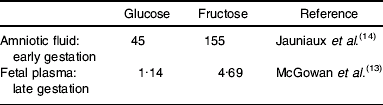
The major metabolic substrate in fat accumulation in the fetus is glucose, although in the sheep acetate also makes an important contribution(Reference Symonds, Lomax and Kenward12). In terms of other potential substrates for adipogenesis in the fetus fructose could be included, as it is the most abundant carbohydrate in the fetal circulation through gestation(Reference McGowan, Aldoretta and Hay13, Reference Jauniaux, Hempstock and Teng14) (Table 1). The function of fructose in the fetus has remained elusive to date as it only contributes to approximately 20% of oxidative requirements(Reference McGowan, Aldoretta and Hay13). A further reason why attention needs to be focused on the role of fructose in early life is the substantial increase in its availability within Western-style diets because of the approximately 20-fold increase in the use of high-fructose maize syrup over the past 15 years(Reference Apovian15).
Summary of the plasma concentrations (mm) of the primary carbohydrates in the fetal circulation
Changes in the fetal carbohydrate environment may not only impact on organogenesis but also on fetal behaviour, as glucose is the primary determinant of fetal breathing movements and as such is an indirect indicator of activity(Reference Fowden, Harding and Ralph16, Reference Symonds, Bird and Clarke17). It could well be the case that subtle changes in early behavioural patterns may set the differences in activity, as defined by non-exercise activity and thermogenesis, that have been shown to have the potential to contribute to a gradual accumulation of adipose tissue through adulthood(Reference Levine, Lanningham-Foster and McCrady18). At the same time in the fetus the entrainment of breathing movements with sleep state and swallowing(Reference Trahair and Harding19, Reference Ross and Nijland20) may have the potential to influence development of the digestive system and even gut microflora. To date, this aspect of energy homeostasis has been completely ignored, but it could be important given the pivotal role that secretion of gut hormones such as oxyntomodulin and peptide tyrosine–tyrosine (both gut peptides released from intestinal enteroendocrine cells in response to a meal) have in the regulation food intake in adults(Reference Chaudhri, Small and Bloom21, Reference Chaudhri, Wynne and Bloom22). The extent to which gut microflora may also differ between infants that are exclusively breast-fed or formula-fed remains to be established, although it is notable that the latter consume more food earlier in life and this intake is positively correlated with weight gain(Reference Ong, Emmett and Noble23).
Diet and physical activity in childhood
It is not only the consumption of excess or inappropriate amounts of carbohydrate by the mother during pregnancy that needs to be considered but also the offspring's energy intake during the weaning period and through childhood. A striking change in dietary patterns of children between 1950 and the early 1990s is that although total energy consumption has not changed, a very different pattern of carbohydrate consumption has occurred, primarily as a result of greater sugar consumption (Fig. 1)(Reference Prynne, Paul and Price24). This pattern of change has been accompanied by a dramatic change in the types of drinks consumed, with tea being replaced by soft drinks and juices. In addition, the total consumption of soft drinks is now more than double the amount of tea consumed by children in the 1950s (Fig. 1). In both children and adolescents increased soft drink consumption is further related to raised salt intake(Reference He, Marrero and MacGregor25), thus also impacting on blood pressure control(Reference He and MacGregor26). The adverse outcome in terms of overall energy balance may be even worse in children with the rise in sedentary behaviour such as watching television(Reference Wiecha, Peterson and Ludwig27, Reference Danner28). It is now recognised that the earlier a child adopts a pattern of increased television viewing then the more difficult it is to break this type of behaviour, although it can be dissociated from changes in overall physical activity(Reference Ekelund, Brage and Froberg29, Reference Reilly30). In addition, there is a positive relationship between television viewing and consumption of dietary components advertised, including soft drinks(Reference Wiecha, Peterson and Ludwig27).
Summary of the main dietary changes in children between 1950 and 1993. (A), Complete diet; (B) individual components of the diet ((□), tea; (▪), soft drinks and juices). NSHD, National Survey of Health and Development; NDNS, National Diet and Nutrition Survey. (Based on Prynne et al. (Reference Prynne, Paul and Price24).)

The impact of changes in early carbohydrate consumption is complex, as early exposure to sucrose can actually reduce the motivation to acquire sucrose in young mice(Reference Frazier, Mason and Zhuang31). However, early sucrose exposure subsequently promotes weight gain in adulthood when free access is allowed to palatable energy-dense foods. Whilst it is recognised that the sugar content of some soft drinks may have been reduced in recent years by replacement with artificial sweeteners, it does not necessarily improve overall health. Importantly, it could even contribute to a further increase in the total carbohydrate consumption, as studies in adult rodents indicate that artificial chemicals such as saccharin are more addictive than drugs such as cocaine(Reference Lenoir, Serre and Cantin32).
Genetic versus dietary causes of obesity and type 2 diabetes
Until very recently there have been no consistent reports of gene variants that influence the risk of obesity as well as predisposing to type 2 diabetes. Recent publications utilising genome-wide association studies based on a very large number of cohorts have, however, shown strong relationships between a common variant of the fat mass and obesity-associated (termed FTO) gene and BMI that is prevalent from as early as 7 years of age(Reference Frayling, Timpson and Weedon33). Indeed, this variant predisposes individuals to diabetes through an effect on body mass(Reference Frayling, Timpson and Weedon33), a relationship that has been confirmed in a separate study based on a European cohort(Reference Dina, Meyre and Gallina34), although not in Chinese populations(Reference Li, Wu and Loos35) or Oceanic populations(Reference Ohashi, Naka and Kimura36). Relative cohort size is, however, critical in determining such associations, as a minimum of 12 000 subjects are needed to show a strong relationship between FTO and BMI(Reference Freathy, Timpson and Lawlor37).
The potential divergence in response to variations in the FTO gene is further indicated by its widespread tissue distribution(Reference Frayling38–Reference Gerken, Girard and Tung40), with gene expression being greatest in the hypothalamus(Reference Gerken, Girard and Tung40). Moreover, in both mice(Reference Gerken, Girard and Tung40) and rats(Reference Fredriksson, Hagglund and Olszewski41) hypothalamic FTO mRNA abundance is modulated by nutritional status, but the response is species dependent; in mice starvation down regulates FTO mRNA transcription(Reference Gerken, Girard and Tung40) whereas in rats the opposite effect is seen(Reference Fredriksson, Hagglund and Olszewski41). A number of genetic mouse models, however, indicate rapid dietary-induced obesity after consumption from 12 weeks of age of a high-fat diet in which energy intake from fat is increased 6-fold (and as such is not physiological); commencing at 6 weeks of age has no effect on FTO gene expression in either the hypothalamus or a range of peripheral tissues(Reference Stratigopoulos, Padilla and Leduc42). Clearly, more information is required in relation to the regulation of the FTO gene from a developmental point of view and how it responds to an environment of excess rather than insufficient energy supply. In this context low physical activity may amplify its association with obesity(Reference Andreasen, Stender-Petersen and Mogensen43), although to date not all studies confirm this proposal(Reference Speakman, Rance and Johnstone44).
As the number of genome-wide association studies increase both in number and scope there is an ever-increasing number of genes and loci that appear to be related to type 2 diabetes(Reference Scott, Mohlke and Bonnycastle45, Reference Zeggini, Weedon and Lindgren46), although their predictive value for the population remains in doubt(Reference Lango, Palmer and Morris47). This outcome is not unexpected given the substantial number of changes in organ function that accompany type 2 diabetes, of which the main defects relate to impaired function of the pancreas together with insulin resistance(Reference Elbers, Onland-Moret and Franke48). To gain further insights into their relevance for glucose homeostasis such findings need to be related to changes in dietary preference and/or tissue function. For example, one genetic predisposition to sugar consumption relates to a variant of GLUT2 that is accompanied in both young and older adults by a greater intake, including that of fructose, if consumed as sweetened beverages(Reference Eny, Wolever and Fontaine-Bisson49) (summarised in Fig. 2). This finding is not unexpected as GLUT2 in the brain has been proposed to regulate glucose sensing, thereby having a similar function to that shown in pancreatic β-cells as well as having a primary role in regulating glucose homeostasis(Reference Marty, Dallaporta and Thorens50). Within the human cohorts examined, however, there is no relationship between excess sugar intake and an overall increase in food intake or in BMI(Reference Eny, Wolever and Fontaine-Bisson49). These observations are partly in contrast to findings from knock-out studies in which mice lacking GLUT2 eat more of a novel powdered diet, at least in the short term, but show no difference in body weight(Reference Bady, Marty and Dallaporta51). It may be that in the human subject it is not until an imbalanced dietary pattern is attained that any pathological outcomes are manifest, such as when a dietary intake attained in which >50% total energy intake is derived from one macronutrient, be that carbohydrate or fat(Reference Marti, Martinez-Gonzalez and Martinez52).
Summary of the effect of a gene variant for GLUT2 on carbohydrate intake in the adult. (A) Intake (g/d) of sucrose (▪), fructose (
 ) and glucose (□) by Thr/Thr and Thr/Ile+Ile/Ile variants. The difference between the variants for total intake of the three sugars was significant (P<0·05). (B) Consumption (no. of servings per d) of sweetened beverages and sweets for the Thr/Thr (□) and Thr/Ile+Ile/Ile (▪) variants. Values are means with their standard errors represented by vertical bars. The difference between the variants was significant for sweetened beverages (P=0·002) and for sweets (P=0·0004). (Based on Eny et al. (Reference Eny, Wolever and Fontaine-Bisson49).)

One pivotal factor determining diet and lifestyle from the time of conception is social class. The substantial impact that affluence has on, for example, the levels of breast-feeding and healthy adult eating patterns, as well as the proportion of the childhood population that is obese, is illustrated in Fig. 3(53). This factor is clearly one that may be implicated in epigenetic regulation of gene action(Reference Szyf, McGowan and Meaney54), which has gained substantial interest in relation to obesity and diabetes from mouse studies(Reference Waterland and Jirtle55). The translational relevance of such studies to human subjects must, however, be viewed with considerable caution, as there are far more imprinted genes in the mouse, which may make it unsuitable for disease pathway comparisons with larger mammals(Reference Jirtle and Skinner56).
Summary of the potential influence of social class on the incidence of breast-feeding, adult healthy eating (defined as the daily consumption of five or more portions of fruit and vegetables) and childhood obesity. Percentages of the population are given in relation to the best five (□) and worst five (▪) performing areas of the UK(53).

Nutritional programming and epigenetic adaptations: responses to extreme dietary manipulations
The epigenome is most susceptible to dysregulation during those periods of life associated with the greatest changes in organ development and growth, i.e. embryogenesis, fetal and neonatal development, puberty and final old age(Reference Jirtle and Skinner56). For example, in the more-extreme challenge of uterine artery ligation in the late-gestation rat, which reduces uterine artery blood flow by approximately 50%(Reference Ogata, Bussey and Finley57), substantial intrauterine growth retardation occurs(Reference Wigglesworth58). When these offspring are cross-fostered onto control dams they show rapid catch-up growth, an adaptation that is likely to be as important in determining the subsequent adverse outcomes as the preceding growth restriction in utero (Reference Symonds59). As adults these growth-manipulated offspring exhibit type 2 diabetes that is associated with progressive epigenetic silencing of the homeobox 1 transcription factor Pdx1 (Reference Park, Stoffers and Nicholls60), which is critical for pancreatic β-cell function and development(Reference Park, Stoffers and Nicholls60). Nevertheless, during the neonatal period the reduction in Pdx1 expression could be reversed in vitro by inhibition of histone deacetylase action. Potential epigenetic effects may well be extended to a number of other tissues and cells and could include the regulation of the intracellular energy locus, as recently shown in vitro (using human neonatal skin fibroblasts), at least under conditions of zero or very high (i.e. 1000 mg/l) glucose concentration(Reference Murayama, Ohmori and Fujimura61).
Further evidence that DNA methylation may have an important role in obesity comes from studies that have utilised the agouti mouse, in which a shift in coat colour from pseudo-agouti to a mottled and/or yellow appearance is accompanied by an increase in mature body weight to >40 g compared with approximately 30 g in controls(Reference Wolff, Kodell and Moore62, Reference Morgan, Sutherland and Martin63). In this model exposure to a diet that is artificially high in methyl donors as a result of an approximately 9-fold increase in choline and folic acid, approximately three times more methionine and approximately sixty times more vitamin B12 compared with control diets(Reference Wolff, Kodell and Moore62, Reference Reeves64) results in a shift in the methylation pattern and thus a comparable change in the coat colour distribution(Reference Waterland and Jirtle55). This magnitude of change for each of these nutrients is extreme, especially when compared with the approximately doubling of folic acid that has accompanied dietary fortification in America(Reference Jacques, Selhub and Bostom65), although re-cycling of these nutrients is very different in rodents because they exhibit croprophagia(Reference Devlin, Bottiglieri and Domann66). However, as the majority of these mice (i.e. approximately 90%) show a coat colour that is mottled in appearance there is actually little, if any, effect on the relative body-weight distribution, with the majority of mice continuing to have a high body weight and thus increased fat mass(Reference Waterland and Jirtle55).
The recent finding that exposure of pregnant and lactating mice to the environmental oestrogen bisphenol A, which has been linked to later obesity and cancer(Reference Maffini, Rubin and Sonnenschein67), results in a very subtle shift in the number of yellow offspring but has little effect on the total number of heavy (and thus obese) mice(Reference Dolinoy, Huang and Jirtle68). Moreover, exactly the same shift in coat colour can be obtained by adding high quantities of methyl donors or the phyto-oestrogen genistein to the diet(Reference Dolinoy, Huang and Jirtle68). It therefore simply reflects the same effects both diets have in comparison with controls irrespective of the additional dietary challenge(Reference Waterland and Jirtle55, Reference Dolinoy, Weidman and Waterland69). There is thus not convincing evidence of an ‘additional protective effect’ of a hypermethylating diet against the epigenetic response to bisphenol A per se(Reference Dolinoy, Huang and Jirtle68).
It has also recently been claimed that a similar magnitude of dietary methyl donor supplementation may prevent the shift in population distribution towards an increase in body weight(Reference Waterland, Travisano and Tahiliani70). On closer examination of the published results it is apparent that the only change in body-weight distribution is in the F3 generation, at which time in the unsupplemented group there is a shift from 54% to 72% of all animals being >50 g compared with no real change in the methyl-supplemented group, which remained at approximately 50%. This apparent absence of a change in body-weight distribution is only because there are approximately 20% more mice in the supplemented group that all appear to have a body weight <40 g. Given that in this strain of mice the females can have up to twice as much fat as males, and thus show a much wider distribution in body weight, this result could simply be an artifact of an unequal distribution of males and females between the two groups rather than being a direct response to the excess methyl donor intake that the animals have been exposed to for three generations. Clearly, the translation of such types of extreme nutritional interventions to the human population must be considered with the utmost caution.
Conclusion
As childhood obesity and overweight constitute a global epidemic, urgent sustainable strategies are needed to prevent the accompanying diseases, including type 2 diabetes. In the UK alone obesity prevalence doubled in the 1990s, so that by 2003 three million children (30%) were considered to be obese or overweight. Of critical concern is the further recent acceleration in the incidence of childhood obesity even above that predicted, with obesity currently costing the nation approximately £7×10⁹/year. It is now apparent that appropriate interventions need to be imposed as early in life as possible, for which evidence-based dietary advice linked to behavioural adaptations are pivotal.
Acknowledgements
The author acknowledges the support of the British Heart Foundation and the EU Sixth Framework Programme for Research and Technical Development of the European Community – The Early Nutrition Programming Project (FOOD-CT-2005–007036) in his research. The author declares no conflict of interest.



