




Introduction
Lecanora intumescens (Rebent.) Rabenh. and closely related species were for a long period of time regarded as belonging to the L. albella group (Imshaug & Brodo Reference Imshaug and Brodo1966; Brodo et al. Reference Brodo, Haldeman and Malíček2019). However, during the past two decades there have been several studies showing that this group can be divided into three separate phylogenetic lineages (Grube et al. Reference Grube, Baloch and Arup2004; Zhao et al. Reference Zhao, Leavitt, Zhao, Zhao, Arup, Grube, Pérez-Ortega, Printzen, Sliwa and Kraichak2016; Malíček et al. Reference Malíček, Berger, Palice and Vondrák2017): the L. albella/subcarnea group, L. rupicola group and the L. intumescens group. The result of these studies leaves L. intumescens and allies in a rather small group comprising L. intumescens, L. cateilea (Ach.) A. Massal. and L. excludens Malme. The last is regarded here as the correct name for the taxon L. septentrionalis H. Magn. (see Brodo et al. (Reference Brodo, Haldeman and Malíček2019) for an explanation). Based on morphological, chemical and molecular studies, we here describe L. caledonica, a fourth species of the group, as new to science.
Materials and Methods
Fresh material of the new species was collected in Norway (HH) and Scotland (UA); this was complemented with material of related species, mainly from Sweden and Norway but to some extent also from Alaska and Austria. Collections of the new species are deposited in E, TRH and LD. A small number of old specimens was found in the herbaria of O and TRH, mostly hidden under Lecanora subfusca auct.
The specimens were examined by interference contrast and light microscopy. Anatomical features were measured on hand-cut sections or squash preparations mounted in water. Morphological characters were measured on dry material using a dissecting microscope (×40). Chemical reagents used were 10% potassium hydroxide (K), undiluted standard bleach (C), and paraphenylenediamine in ethanol (Pd). Crystals were studied in polarized light (POL). Spore dimensions are calculated from ten measurements per specimen. Data on spore dimensions are presented in the following way: (min. extremes) 85% of the variation with a mean in italics (max. extremes). Specimens were studied by TLC according to standard methods (Orange et al. Reference Orange, James and White2001).
New sequences for this study (Table 1) were produced using direct PCR according to Arup et al. (Reference Arup, Vondrák and Halıcı2015). Amplifications were made of the internal transcribed spacer regions (nrITS) and the large subunit (nrLSU) of the nuclear ribosomal RNA genes, and the small subunit of the mitochondrial ribosomal RNA gene (mtSSU). Primers used for amplification were ITS1F (Gardes & Bruns Reference Gardes and Bruns1993), ITS4 (White et al. Reference White, Bruns, Lee, Taylor, Innis, Gelfand, Sninsky and White1990), AL1R (Döring et al. Reference Döring, Clerc, Grube and Wedin2000), LR5 or LR6 (Vilgalys & Hester Reference Vilgalys and Hester1990), mrSSU1 (Zoller et al. Reference Zoller, Scheidegger and Sperisen1999) and mrSSU7 (Zhou & Stanosz Reference Zhou and Stanosz2001). The PCR parameters included an initial hold at 94 °C for 5 min, then denaturation at 94 °C for 1 min, annealing at 50 °C or 54 °C (mtSSU) or 53–56 °C (nrITS and nrLSU) for 1 min, decreasing 1 °C per cycle for the first six of the 39 cycles (touchdown), and an extension at 72 °C for 3 min. The sequencing was carried out by Macrogen Inc., South Korea, using the same primers as for the PCR. The two resulting strands of each gene were assembled using Geneious v. 11.1.5. Subsequent alignments were performed in the same program and adjusted manually. Sequences have been submitted to GenBank as indicated in Table 1.
Sequences of Lecanora and allied species, newly produced (in bold) or downloaded from GenBank used in the analyses, with voucher information and Accession numbers.

Two alignments were prepared: one three-gene alignment combining data from the nrITS, nrLSU and mtSSU genes, including 23 representatives of the genus Lecanora s. lat., 2238 bases long, and a second one with 27 taxa, 525 bases long, of only ITS sequences of the L. intumescens group and close relatives. Protoparmelia memnonia Hafellner & Türk was used as an outgroup in the first alignment, and Protoparmeliopsis muralis (Schreb.) M. Choisy in the second. Introns in all the aligned genes and ambiguously aligned parts were excluded from the alignment. The alignments of the three different genes were first analyzed separately to check for incongruence between genes, but none was detected. A conflict was assumed to be significant if two different relationships were both supported with posterior probabilities ≥ 0.95.
Data were analyzed using the program MrBayes v. 3.2.4 (Ronquist et al. Reference Ronquist, Teslenko, van der Mark, Ayres, Darling, Höhna, Larget, Liu, Suchard and Huelsenbeck2012). A suitable model of molecular evolution was selected using the Bayesian Information Criterion (BIC) as implemented in jModelTest v. 2.1.4 (Guindon & Gascuel Reference Guindon and Gascuel2003; Darriba et al. Reference Darriba, Taboada, Doallo and Posada2012), evaluating only the 24 models available in MrBayes v. 3.2.0 (Ronquist et al. Reference Ronquist, Teslenko, van der Mark, Ayres, Darling, Höhna, Larget, Liu, Suchard and Huelsenbeck2012). For the combined analysis, the SYM + I + G model was found to be optimal for the nrITS, K80 + I + G for nrLSU and HKY + I + G for the mtSSU data set. For the ITS only data set, HKY + G was found to be optimal. No molecular clock was assumed. Three parallel runs with 2 000 000 generations starting with a random tree and employing six simultaneous chains were executed, five of which were incrementally heated with a temperature of 0.10. Analyses were diagnosed every 1000 generations in the last 50% of the tree sample and automatically halted when convergence was reached. Convergence was defined as a standard deviation of splits (of frequency 0.1) between runs below 0.01. Every 1000th tree was sampled. A majority-rule consensus tree was constructed from the post-burn-in tree samples. The consensus trees were visualized using FigTree v. 1.4.4 and redrawn in Adobe Illustrator.
Results
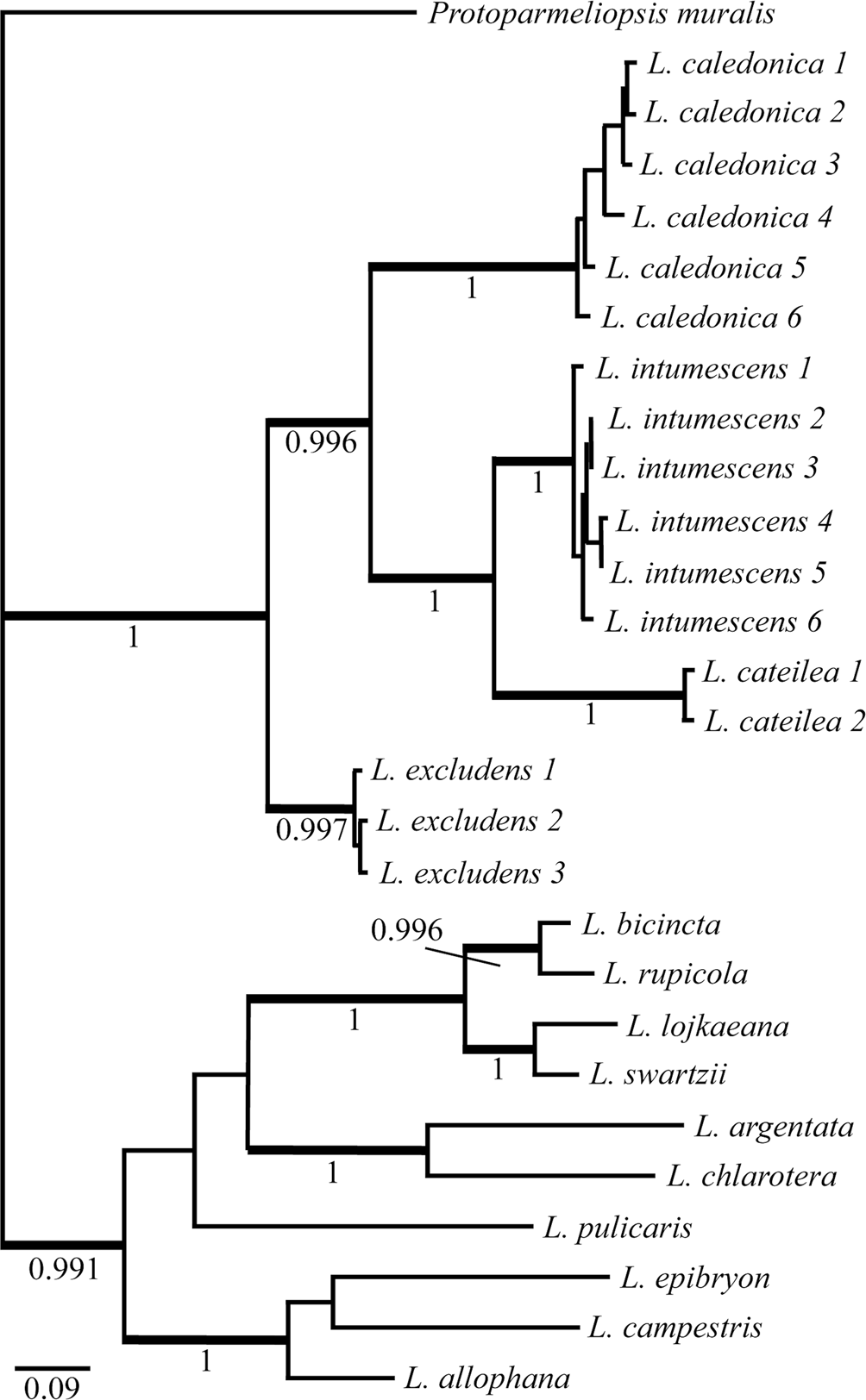
The results of the molecular studies are presented in two phylogenetic trees (Figs 1 & 2). The three-gene tree (Fig. 1), resulting from analysis of nrITS, nrLSU and mtSSU sequences, shows the position of the new species L. caledonica within Lecanora s. lat., where it clearly belongs to the L. intumescens clade that is fully supported. In this rather limited analysis of the genus Lecanora, the L. rupicola group is situated in a sister position to the L. intumescens group but without support. The second tree (Fig. 2), based on nrITS sequences of Lecanora, further supports the position of the new species inside the L. intumescens clade, with L. excludens at the base of the clade and L. caledonica as sister to the two species L. intumescens and L. cateilea. Its independence as a species separate from others in the group is also clearly demonstrated, with all terminal clades in the group fully supported.
Majority-rule consensus tree based on a Bayesian MCMC analysis of a combined data set of the ITS, LSU and mtSSU genes showing the position of Lecanora caledonica (shaded area) well inside the L. intumescens group. Branches with posterior probabilities ≥ 0.95 are shown in bold.

Majority-rule consensus tree based on a Bayesian MCMC analysis of ITS data of the Lecanora intumescens group and allies showing the position of L. caledonica in relation to the other species of the group. Branches with posterior probabilities ≥ 0.95 are shown in bold.
Lecanora caledonica is also clearly different from the other species in the group in morphological and chemical characters.
Taxonomy
Lecanora caledonica Holien, Coppins & Arup sp. nov.
MycoBank No.: MB 848677
Similar to Lecanora intumescens but differs chemically in containing atranorin, zeorin and an unknown UV+ ice blue substance versus atranorin, psoromic acid, ±2-O-demethylpsoromic acid, chloratranorin and zeorin. It further differs in the non-pruinose apothecium disc and shorter ascospores (9–14 μm versus 11.5–18 μm).
Type: Norway, Nord-Trøndelag, Flatanger, Lauvsnesodden, along the old church trail, corticolous on young Sorbus in deciduous forest, 64.50592°N, 10.88914°E, alt. c. 12 m, on Sorbus aucuparia, 13 December 2020, H. Holien 16072 (TRH L-19431—holotype; LD—isotype). GenBank nos: OQ945707, OQ946444, OQ945756.
(Fig. 3)
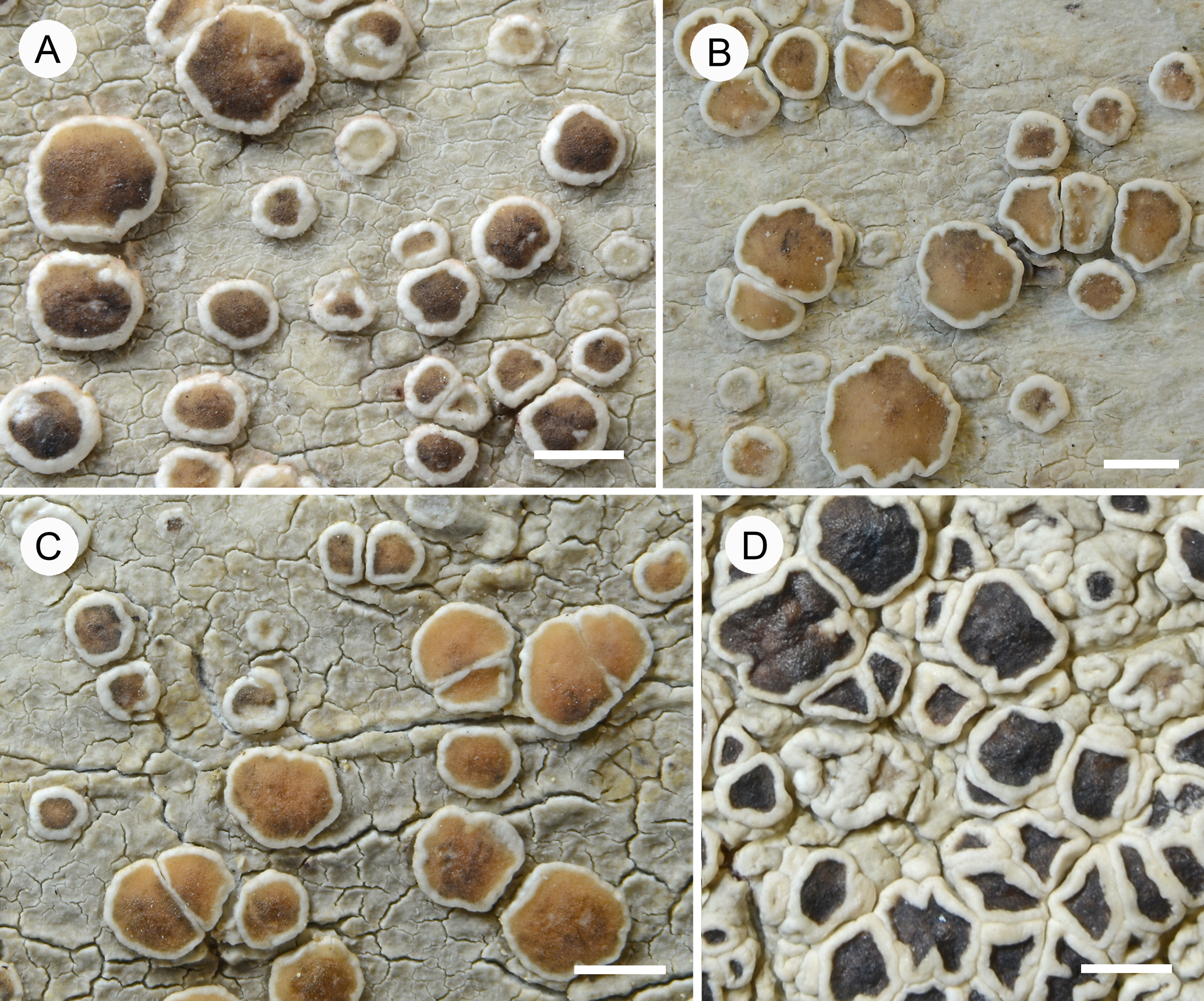
Habitus of Lecanora caledonica. A, common form with medium brown apothecium discs; holotype (TRH). B, another common form with paler beige discs; L-19682 (TRH). C, a form showing the variation that is commonly seen in the disc colour, from beige to brown, and often somewhat mottled; L-19429 (TRH). D, a less common form with dark brown, slightly glossy discs; L-13959 (TRH). Scales = 1 mm. In colour online.
Thallus 0.05–0.25(–0.45) mm thick, up to several cm wide, continuous, smooth to finely cracked or areolate; areolae 0.3–1.3 mm diam., irregular in outline, even and smooth to uneven or occasionally slightly verruculose or squamulose, of different shades of pale grey, sometimes yellowish grey; margin clearly delimited, sometimes by a thin black line against other thalli or as a white, slightly fimbriate prothallus.
Apothecia normally present and abundant, 0.4–1.5(–2.0) mm diam., adnate to sessile, round to irregular to often angular from compression in dense aggregates; disc varying greatly in colour from pale beige-orange to dark brown or almost black, normally matt, without pruina, slightly concave to somewhat convex, sometimes flexuous; thalline margin prominent and persistent, (30–)50–150(–240) μm thick (dry, seen from above), level with or slightly raised above disc, even to uneven or somewhat ridged, of thallus colour or paler; epihymenium beige-grey to brown-blackish, with small, POL+ granules on top and between the paraphyses (pulicaris-type), dissolving in K but not in N, when dark pigment is present N+ red, K+ olive; hymenium 60–80 μm thick; hypothecium hyaline, 125–400 μm thick; paraphyses 1.5–2 μm wide, simple to slightly branched, straight to flexuous, with tips to 3 μm wide; amphithecium usually filled with small POL+ crystals dissolving in K but not in N, and the pseudocortex with varying amounts of medium coarse crystals, to 8 μm large, not dissolving in K or N, and a layer of algae just below the hypothecium; pseudocortex indistinctly delimited from the medulla, up to 200 μm thick at base; asci 50–68 × 11–17 μm, with eight spores; ascospores simple, narrowly to broadly ellipsoid or ovoid, ends round or slightly pointed, (9.0–) 10.0–11.46–13.0(–14.0) × (4.8–)5.0–6.78–8.0(–9.5) μm, ratio spore length/width = 1.18–1.72–2.30 (n = 100), spore wall 0.8–1.0 μm.
Pycnidia sometimes present, immersed, as dark brown to blackish dots; conidia filiform, curved to almost straight, 18–25 × 0.8 μm.
Chemistry
Atranorin, zeorin and an unknown substance (R f values A5, B4, C5) that turns UV+ ice blue before charring (Fig. 4) and an additional substance in minor concentration (best seen on the A-plate, R f value 6). The unknown substances are colourless after treatment with sulphuric acid and heat. Thallus and apothecial margin K+ yellow, C−, KC+ yellow, Pd+ pale yellow, UV−.
Chromatogram in solvent A under short-wave UV (254 nm), before charring with sulphuric acid and heat. Lecanora caledonica is shown on lanes 9–12. References are gyrophoric acid and psoromic acid (8), gyrophoric acid (13) and confluentic acid (14). In colour online.

Etymology
The name caledonica refers to Scotland, where the species was first discovered.
Ecology and distribution
Lecanora caledonica is corticolous, occurring on deciduous trees with smooth bark. It is most often found on the trunks, but also on coarse branches. In Norway it is most commonly found on Alnus incana and Sorbus aucuparia, but it has also been found on Populus tremula, Salix aurita and S. caprea. In Trøndelag it is particularly frequent in secondary forests along the coast, dominated by deciduous trees developed after logging. It is also quite common in open forest close to the tree limit, for example in the Fosen peninsula in Trøndelag, or along rivers, streams and mires.
The species is part of a lichen community dominated by crustose species that is overgrown later in the succession by parmelioid foliose lichens in particular. Among accompanying species on the trunks are Arthonia radiata (Pers.) Ach., Arthopyrenia analepta (Ach.) Massal., Biatora toensbergii Holien & Printzen, Buellia disciformis (Fr.) Mudd, B. griseovirens (Turner & Borrer ex Sm.) Almb., Fuscidea arboricola Coppins & Tønsberg, Lecanora argentata (Ach.) Malme, L. carpinea (L.) Vain., L. farinaria Borrer, L. intumescens, L. symmicta (Ach.) Ach., Lecidella elaeochroma (Ach.) Choisy, Melanelixia glabratula (Lamy) Sandler & Arup, M. subaurifera (Nyl.) O. Blanco et al., Melanohalea exasperata (De Not.) O. Blanco et al., Micarea peliocarpa (Anzi) Coppins & R. Sant., Parmelia saxatilis (L.) Ach. s. lat., including P. ernstiae Feurerer & Thell/P. serrana A. Crespo et al., P. sulcata Taylor, Platismatia glauca (L.) W. L. Culb. & C. F. Culb., Ramalina farinacea (L.) Ach. and Usnea spp.
Lecanora caledonica seems to be an oceanic species and is so far known only from north-western Scotland (Fig. 5) and from coastal regions of Norway, from the areas around Bergen in the south, north to the surroundings of Tromsø (Fig. 6). Most Norwegian collections are from Trøndelag and Nordland counties and all localities in Norway, except the most northern one, are within the markedly oceanic section O2 (see Moen Reference Moen1999). Its vertical distribution ranges from around sea level to c. 400 m. Since the species has been known in Scotland for quite some time, the distribution there is fairly well known (Fig. 5). In Norway, it is expected to also occur more frequently south of Trøndelag.
Map showing the known distribution of Lecanora caledonica in Scotland. In colour online.

Map showing the known distribution of Lecanora caledonica in Norway. In colour online.

Lichen species with a similar distribution in Europe include, for example, Arthothelium norvegicum Coppins & Tønsberg (Coppins & Tønsberg Reference Coppins and Tønsberg1984), Bacidia caesiovirens S. Ekman & Holien (Ekman & Holien Reference Ekman and Holien1995), Biatora toensbergii (Printzen Reference Printzen1995) and Hypogymnia hultenii (Degel.) Krog (Westberg et al. Reference Westberg, Ahti, Thell, Thell and Moberg2011) which fit into the so-called Trøndelag phytogeographic element in the European lichen flora (Holien & Tønsberg Reference Holien and Tønsberg1996).
In Scotland, Lecanora caledonica has a very similar habitat ecology and altitudinal range, with Alnus glutinosa replacing A. incana as one of the main phorophytes. It has also been recorded more rarely on Acer pseudoplatanus, Crataegus sp., Fraxinus excelsior, Prunus padus and Ulmus glabra. On one occasion (Coppins 21574) it was found parasitized by Skyttea lecanorae Diederich & Etayo, a common parasite on Lecanora chlarotera Nyl., L. pulicaris (Pers.) Ach., and more rarely L. farinaria, in the Scottish Highlands.
Remarks
There is a considerable variation in disc colour, from pale beige to dark brown. A large part of this variation can sometimes be found within a single specimen and even within a single apothecium (Fig. 3B & C). This variation is due to a dark pigment in the epihymenium occurring in varying amounts. In cross-section it can be visualized as it reacts with N (pale red), and K (olive). Normally, the new species can be recognized by the uneven, rather thick, but smooth margin similar to the one usually found in L. intumescens. These two species are similar but L. caledonica differs chemically, which can be seen in the Pd reaction (Pd− instead of Pd+ deep yellow) and in the non-pruinose discs. According to Brodo et al. (Reference Brodo, Haldeman and Malíček2019), a small number of specimens of L. intumescens from southern Europe lacked psoromic acid based on TLC, although they reacted Pd+ yellow on the apothecial margin. Such specimens most certainly represent variations in the amount of psoromic acid in this species. The spores in L. caledonica also appear to be shorter, 9–14 μm long rather than 11.5–18 μm in L. intumescens. Another difference is the geographical distribution that is pronounced oceanic in L. caledonica whereas L. intumescens has a much wider distribution. Lecanora caledonica differs from L. excludens mainly in the much thicker thalline margin, generally smaller spores, larger apothecia and in the different secondary chemistry. Lecanora cateilea differs from the new species in having 12–16 spores per ascus, a different chemistry, in slightly pruinose apothecium discs and in smaller spores. Occasionally, the POL+ crystals in the epihymenium of L. caledonica are very few or even entirely absent, giving the disc a more shiny appearance (Fig. 3D) and making it more similar to L. allophana Nyl.; however, this species has a very different ecology, occurring on trees with higher pH and coarse bark (i.e. Populus, Fraxinus and Acer), and has more raised apothecia with a more narrow base and a different chemistry.
Selected material studied
Norway: Hordaland: Moster, viii 1915, Havaas & Lynge (O L-110198). Nordland: Brønnøy, ad Saulas paroch, Velfjord, undated, J. M. Norman (O L-110896); Leirfjord, N side of Lake Svartdalsvatnet, on Alnus incana, 66.18330°N, 13.27540°E, alt. 40 m, 2006, H. Holien 10689 (TRH L-19438); Rødøy, W of Kilboghamn, on Sorbus aucuparia, 66.49010°N, 13.21130°E, alt. 35 m, 2013, H. Holien 14122 (TRH L-19013); Gildeskål, Storvikvatnet W, on Alnus incana, 66.95810°N, 13.84509°E, alt. 210 m, 2022, H. Holien 16536 (TRH L-33525); Gildeskål, Inndyr, Lauvvatnet, on Alnus incana, 67.04031°N, 14.06149°E, alt. 105 m, 2022, H. Holien 16480 (TRH L-33518); Gildeskål, Kjellingelva, on Alnus incana, 67.05989°N, 14.35477°E, alt. 85 m, 2022, H. Holien 16618c (TRH L-33524); Gildeskål, Følvikelva, on Alnus incana, 67.13203°N, 14.20378°E, alt. 45 m, 2022, H. Holien 16608 (TRH L-33521); Bodø, Godøystraumen, on Salix caprea, 67.23817°N, 14.70939°E, alt. 5 m, 2022, H. Holien 16413 (TRH L-33527); Steigen, in Stegen ad Præstkontind, undated, J. M. Norman (O L-110845); Vestvågøy, Stamsund church, on Sorbus aucuparia, 68.14410°N, 13.83990°E, alt. 20 m, 2011, H. Holien 13031a (TRH L-19435); Sørfold, Aspfjorddalen, on Alnus incana, 67.4836°N, 15.6008°E, alt. 40 m, 2014, H. Holien 14499 (TRH L-19571). Nord-Trøndelag: Flatanger, Lake Honnavatnet NE, on Alnus incana, 64.41262°N, 10.92026°E, alt. 160 m, 2021, H. Holien 16336a (TRH L-19889); Flatanger, Lauvsnes, N end of Lake Lauvsnesvatnet, on Sorbus aucuparia, 64.49573°N, 10.91524°E, alt. 25 m, 2021, H. Holien 16084 (TRH L-19682); Flatanger, Vollan SE, Buknotten, on Sorbus aucuparia, 64.49909°N, 10.96098°E, alt. 25 m, 2022, H. Holien 16690 (TRH L-33617); Namsos (Namdalseid), between Skardbergfjellet and Lakshølhaugen, on Populus tremula, 64.38490°N, 11.17460°E, alt. 85 m, 2001, H. Holien 8778a (TRH L-19440); Nærøysund (Vikna), Kalvøya, S of Kalvøyskardsfjellan, on Salix aurita, 64.97140°N, 10.83880°E, alt. 10 m, 2011, H. Holien 13452 (TRH L-19430); Nærøysund (Nærøy), Kolvereid, the churchyard, 24 vii 1931, O. A. Høeg (TRH L-40662). Sør-Trøndelag: Osen, SW of Storkangsen, N of Essen lakelet, on Sorbus aucuparia, 64.21280°N, 10.78110°E, alt. 375 m, 2010, H. Holien 12623 (TRH L-13957); Åfjord, by Lake Måmyrvatnet, Nesodden, on Sorbus aucuparia, 64.098364°N, 10.549687°E, alt. 260 m, 1999, H. Holien 7782a (TRH L-13959); Åfjord, Roan, Inner Vargfossnessa Nature Reserve, along River Lonelva, corticolous on Alnus in humid forest, 64.127540°N, 10.66370°E, alt. 310 m, 2006, H. Holien 10520 (TRH L-19439). Troms: Tromsø, in insula Tromsø ad Fredriksberg, undated, J. M. Norman (O L-110900); Tromsø amt, Ramfjorden, 5 vi 1910, B. Lynge (O L-115132).—Great Britain: Scotland: V.C. 96, Easterness, Drumnadrochit, Divach Cottage by Divach Burn, on Salix, NH4927, c. 100 m, 1975, B. J. Coppins 3854 (E); Glen Strathfarrar. between Dunmaglass and Coille Gharbh, on Salix, NH33, alt. c. 100 m, 1975, B. J. Coppins et al. 2250 (E); Dundreggan, near Dundreggan Lodge, on twigs of fallen Populus tremula, NH32611457, c. 130 m, 29 viii 2014, J. R. Douglass s. n. (hb. Douglass); V.C. 97, Westerness, Loch Arkaig, S side, Aird Nòis, on Alnus glutinosa by mouth of burn, NN081907, alt. 50 m, 2018, B. J. Coppins (25979) & A. Acton (E); V.C. 104, North Ebudes, Skye, Kyleakin, South Obbe to Caisteal Maol, on Sorbus aucuparia, NG7526, 2010, U. Arup L10182 (LD); V.C. 105, West Ross, Beinn Eighe NNR, Allt a'Chuirn, on Sorbus aucuparia, NH0060, 1984, B. J. Coppins 10864 (E); Beinn Eighe NNR, Coille na Glas-leitir, upper part of forest, N of Cnoc na Gaoithe, on old Sorbus aucuparia, NG9964, alt. 150–200 m, 2001, A. M. & B. J. Coppins 19739 (E); Dundonnell, S of Dundonnell House, E side of river, on Fraxinus branches, NH11658537, alt. 50 m, 2007, A. M. & B. J. Coppins 22462 (E); ibid., on Alnus glutinosa branches by river, NH1185, alt. 50 m, 2007, A. M. & B. J. Coppins 22449 (E); Dundonnell, N of Dundonnell House, E side of river, on large Acer pseudoplatanus, NH110859, alt. 30 m, 2007, A. M. & B. J. Coppins 22470 (E); V.C. 108, West Sutherland, Inchnadamph, Allt a'Chalde Mòr, on Ulmus glabra branch, NC24972362, 120 m, 2004, B. J. Coppins 21574 (E, sub Skyttea lecanorae); Altnaharra, Loch Naver, N side, on Betula, NC6137, 75 m, 1984, B. J. Coppins 10348 (E); Tongue, woods between An Garbh-chnoc and Creag an t-Tralghean, on Salix, NC5754, alt. c. 60 m, 1984, B. J. Coppins 10410 (E).
Acknowledgements
UA is grateful to the Swedish Taxonomy Initiative (grant no. Dha 150/2011) and to Ove Almborn's donationsfond for financial support. HH is grateful to Torgrim Sund for technical assistance. BJC belatedly thanks Dr Irwin Brodo for generous comments, some 37 years ago, on his early collections of our ‘new’ species!
Author ORCIDs
Ulf Arup, 0000-0001-6612-8099; Håkon Holien, 0000-0003-3913-4746; Brian Coppins, 0000-0001-9464-0495.
Competing Interests
The author(s) declare none.


 Open access

