


-
Understand the implications of the intention-implementation model of action for treating substance misuse
-
Appreciate the relevance of philosophical work on akrasia for supporting recovery from substance misuse
-
Weigh up the advantages of applying alternative models of intentional agency in clinical responses to substance misuse
Substance misuse is an important public health problem as well as a major clinical challenge (Nuffield Council on Bioethics 2007). Arguably, these aspects are intimately related. In public discourse, substance misuse is routinely associated with increased burden on national health and social services, loss of productivity and the commission of often violent criminal offences. These uniformly negative connotations reinforce stigmatising attitudes towards substance misuse that might not only discourage people from seeking professional help in a timely fashion, but also stand in the way of successful recovery. In turn, relatively high relapse rates (Reference LevyLevy 2013) exacerbate the negative impact of substance misuse on public health. Philosophical work on the nature and scope of akrasia, or weakness of will (Reference ArpalyArpaly 2000; Reference DavidsonDavidson 2001; Reference RadoilskaRadoilska 2013a,Reference Radoilska, Fulford, Davies and Gippsb), offers a promising way of breaking out of this impasse by providing the conceptual resources required to challenge an implicit notion of control over one's actions that seems to be at root of the problem. This article focuses on variant models of akrasia, although it also acknowledges the potential role of other factors that could complement a holistic approach to a viable recovery plan.
Substance misuse: three fictitious case vignettes
Mr Miller: biological causation
Mr Robert Miller is a 65-year-old retired chief executive. His mother died at the age of 82 from ‘old age’. His father died at the age of 58 from carcinoma of the oesophagus, having been a heavy drinker throughout his adult life. Mr Miller was an only child and described a happy and stable childhood despite his father's drinking. He excelled at school, enjoyed good peer relationships and obtained a first class honours degree at university. He married in his late 20s, had two children in his 30s and, in his mid-40s, became the chief executive of a national company. He was described by his family as a good husband and father, with a reputation for honesty, integrity and fairness. Throughout his working life he drank alcohol most days, attributing this to the stress of his job and frequent socialising. In his early 60s he developed a morning tremor of his hands, which he thought was due to anxiety. His wife and children became increasingly concerned about his drinking, especially as he was known on occasions to drink and drive. Under considerable family pressure he saw his general practitioner (GP) and was referred for cognitive–behavioural therapy (CBT) to treat anxiety, stress and depression. He attended these sessions regularly, but did not find them helpful and his drinking pattern did not change. Following a blood test to check thyroid function, his GP detected markedly deranged liver function and referred him to a consultant psychiatrist, who diagnosed moderate alcohol dependence. Mr Miller declined the offer of medication, believing that he was strong willed enough to reduce his drinking on his own, but he did accept two counselling sessions with a substance misuse liaison worker. Nine months later, Mr Miller (now aged 64) arrived home one evening after drinking and fell out of his car in a very intoxicated state. An ambulance was called and Mr Miller was taken to a hospital emergency department. He was ‘terrified’ that he would be reported to the police for driving under the influence of alcohol, but this did not occur. The shock and embarrassment of this episode led him to accept treatment advice from his consultant psychiatrist, who arranged for a home detoxification followed by treatment with acamprosate (666 mg three times a day) and disulfiram (200 mg once a day), which his wife promised to supervise ‘religiously’. For 6 months prior to his retirement Mr Miller complied with treatment. His wife, however, stopped supervising disulfiram after 3 months as she had started to ‘trust’ her husband again. His mood was buoyant, his work performance strong and he looked physically fit, having lost weight. Against the advice of his consultant psychiatrist, Mr Miller stopped taking medication 1 month before retirement, so that he could ‘enjoy’ his farewell party. He was convinced that there would be no problems with alcohol after retirement in view of his clinical progress and the future stress-free lifestyle he anticipated. He drank at his retirement party, relapsed into uncontrolled heavy drinking and spent his early retirement days feeling depressed, deeply ashamed and bored. His very caring family were desperate for him to stop drinking and asked his psychiatrist whether he could be detained under the Mental Health Act 1983. After some persuasion, Mr Miller had another home detoxification and restarted treatment with acamprosate and supervised disulfiram. He drank on top of his medication and started to talk about ‘checking out’, by which he meant taking his own life.
Amy Parker: social causation
Amy Parker is a 21-year-old mother of one child. She never knew her biological father. Her mother had multiple boyfriends, who often brought alcohol and drugs into the home. As a young girl she was given alcohol and was sexually abused by a number of her mother's temporary partners. Her educational performance was poor and she socialised with a group of students on the fringe of school life. At the age of 11 years she started smoking cigarettes and as a 13-year-old she self-harmed by scratching the inside of her thighs with scissors, but this behaviour never came to the attention of her teachers or GP. By the age of 15 she had used a wide range of ‘party’ drugs. Social Services were temporarily involved when Amy was found living on the streets, having stopped going to school. At the age of 17 she smoked heroin and within 3 months was injecting into her arms and hands. Amy also used street diazepam, cheap alcohol and occasionally shared a pipe of crack cocaine. When she was 18 years old she developed a left-sided deep vein thrombosis after injecting into her groin and was found to be positive for hepatitis C. She became pregnant at the age of 19 and this led to a remarkable change in her behaviour. Amy began to attend meetings with a community substance misuse team (CSMT), where she was started on a methadone prescription. Her medication was supervised on a daily basis at a local supermarket pharmacy and the dose was gradually increased to 120 mL methadone mixture 1 mg/mL. This, together with the support of a substance misuse worker, appeared to help her stop using heroin and diazepam. A number of consecutive urine and swab tests were negative for illicit drugs. As she was positive for hepatitis C, Amy was offered appointments at her local hospital antenatal department, which she attended regularly. Towards the end of the second trimester of her pregnancy she returned to live with her mother. Amy said that she was determined to give her baby the ‘best possible chance’ and was ‘desperate’ to be a good mother and to care for her child well. Throughout her pregnancy Amy received close support from a community midwife, Social Services and the CSMT. By the third trimester she was considered to have made excellent progress. In view of this, and continuing regular negative tests for illicit drugs, the pick-up regime of methadone was reduced to twice weekly. A ‘small-for-dates’ baby boy was born in good health (apart from a squint) at 38 weeks’ gestation by spontaneous vaginal delivery. Amy experienced a short period of ‘baby blues’ and did not take to breastfeeding. Even with close support she found the routine of caring for her baby demanding and exasperating. Within 2 months of the birth Amy was no longer picking up her methadone regularly and she began to make excuses for failing to attend her key worker appointments at the CSMT. When she did attend she said she was exhausted. A drug screen taken at 12 weeks post-delivery tested positive for heroin, cocaine and diazepam. Conflict with her mother accelerated when Amy started going out in the evenings, leaving the baby in her mother's care. Her mother told the CSMT that Amy was ‘seeing’ drug users and dealers with whom she had had relationships in the past. Regardless of strenuous efforts and serious warnings from the CSMT, a health visitor and social workers from the child protection team, Amy returned to her old pattern of injecting drug use and unstable relationships. Despite Amy's promises to improve and pleas for clemency, her son was eventually removed from her care and put up for adoption.
Case vignette 3 Peter Phillips: psychological causation
Peter Phillips is a 27-year-old ex-army corporal with no family history of psychiatric disorder. He was an average student, sporty, popular and outgoing. After leaving school he joined the British army and excelled during basic training. He loved army life, enjoying the hard work, discipline and camaraderie. At weekends he would drink heavily with his friends, but this did not seem to affect his work performance. His military unit was closely knit, especially after their first tour of duty in Afghanistan. While leading a night patrol during a second tour in Afghanistan, the soldier behind Peter stepped on a land mine. Peter was spattered with blood and shrapnel, but able to continue. The patrol came under heavy fire and the men ran for cover. Peter found himself in an irrigation channel with two friends. While they attempted to provide covering fire, Peter showed great bravery (later formally recognised), running back to the wounded soldier and dragging him 20 metres into the ditch. Attempts were made to provide first aid, with tourniquets being applied to both leg stumps, but despite their best efforts the soldier died. Following this Peter said that his nerves were ‘shredded’. He felt constantly in danger, irritable, aggressive and guilty. After the tour in Afghanistan was over the unit was sent to Cyprus for rest and recreation. Peter got drunk every day, was argumentative and started getting into fights. Back in the UK he lost interest in army life and continued to drink heavily. He made the decision to apply for premature voluntary retirement. His unit medical officer referred him to a community psychiatric nurse (CPN) at the military Department of Community Mental Health. The CPN thought that Peter had post-traumatic stress disorder (PTSD), so provided an abbreviated form of trauma-focused CBT and suggested to the unit's medical officer that a prescription of mirtazapine (30 mg at night) might help. The treatment proved beneficial. Peter subsequently left the army, but found it difficult to obtain work. He continued to suffer intermittent nightmares of the incident in Afghanistan and drank half a bottle of vodka most nights as he was ‘frightened to go to sleep’. He was unable to maintain a stable relationship with a girlfriend and, owing to continuing unemployment, he came under financial pressure. His previous symptoms of PTSD returned ‘with a vengeance’. His drinking spiralled out of control, he wet the bed regularly and suffered a bad bout of pancreatitis, after which his GP told him to ‘completely and permanently abstain from alcohol’. However, Peter considered that using alcohol was the only way he could get to sleep and suppress the vivid memories, sense of danger, jumpiness and anxiety he experienced. Peter was arrested after attacking a stranger in a pub who had criticised the army and he ended up on a probation order. His probation officer arranged for referral to psychological services but, after waiting 4 months for an assessment, Peter was told that nothing could be done for him until he stopped drinking. Following referral to a CSMT he received an in-patient detoxification, during which he was re-referred to psychological services. Peter continued to have nightmares of Afghanistan, feelings of anger and aggression, and panic attacks. He kept away from all reminders of military life and avoided watching TV news programmes. Within 2 weeks of leaving the detoxification unit he started to drink a bottle of vodka a day. He was again turned away by psychological services because of his alcohol consumption. Peter has managed to get a job as a car park attendant, but is still drinking very heavily and suffering from PTSD. He says he ‘hates the taste’ of alcohol and wants to stop drinking, but he fears that without it he might kill himself as he cannot cope with his nightmares, loneliness and sense of guilt.
Voluntary action as intention implementation and its implications for substance misuse
Voluntary v. coerced actions
The model of action as implementation of prior intention (Reference GollwitzerGollwitzer 1999; Reference O'Connor and SandisO'Connor 2012) offers a plausible way of explaining voluntary (that is, intentional) actions as opposed to coerced ones. Following this line of thought, voluntary actions could be fully accounted for by an agent acknowledging: ‘I did ϕ because I wanted to ϕ’, in so far as this means ‘I did ϕ because I like/care about ϕ-ing’ or ‘I did ϕ because, by ϕ-ing, I get [closer to] x, y, z that I like/care about’.
By contrast, coerced actions are not accurately explained by pointing to the fact that the agent consented to perform them. Even a first-person account, such as ‘I did ϕ because I wanted to ϕ’, remains insufficient. In instances of coercion, this statement stands for ‘I did ϕ because I was made to [want to] ϕ’ or ‘Unless I ϕ-ed, x, y, z that I like/care about would have been lost or damaged. So, I did ϕ’ (Reference Radoilska, Fulford, Davies and GippsRadoilska 2013b).
The distinction between these two categories of action, voluntary and coerced, is central to our thinking about intentional agency in terms of authorship and ownership of actions. In particular, it helps to pin down the idea of an agent as the ultimate source of actions that are free, intentional and uncompelled. At the same time, however, the basic structure of action that the distinction builds upon might not be as helpful once we go beyond the one-step everyday actions, such as making a cup of tea or catching a train, that contribute to the intuitive appeal of this model. This is because the notion of action as implementation of prior intention depends on two underlying presuppositions that do not do justice to the variety of forms that intentional agency might take. The first presupposition is that voluntary actions flow from an explicit decision or choice made by the agent. The second is that, in the absence of coercion, the application of direct conscious effort is sufficient to translate such a decision into action.
Voluntary action and substance misuse
Applied to substance misuse, this conception of voluntary action supports two possible alternatives. Under the first alternative, substance misuse is voluntary and is therefore either chosen by the agent or results from his or her unwillingness to make the effort required to control problematic consumption. Under the second, substance misuse is involuntary: the agent is deemed unable to exert control over this aspect of his or her behaviour.
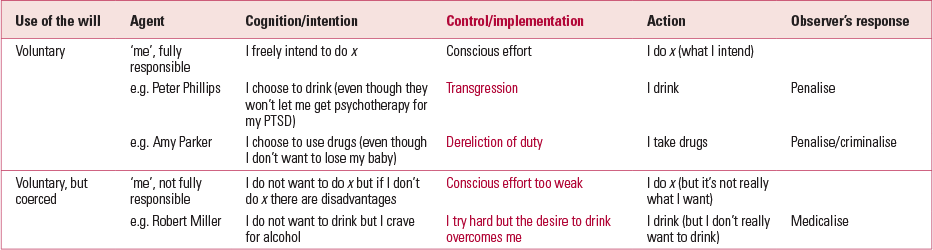
Adopting the first alternative leads to a criminal model of substance misuse (Reference MorseMorse 2000). In this model, substance misuse boils down to a kind of transgression or dereliction of duty that is best tackled by the implementation of strong disincentives or penalties, the role of which is to provide a reliable deterrent. Elements consistent with the criminal model of substance misuse can be observed in the treatment of Amy Parker and Peter Phillips, two of the fictitious patients introduced in the case vignettes at the beginning of this article: Amy is faced with the deterrent of having her child put for adoption unless she manages to ‘stay clean’, whereas Peter can access much needed psychological services only if he abstains from alcohol.
Adopting the second alternative leads to a medical model of substance misuse. In this model, substance misuse points to aetiology that may include biological, social or psychological causes beyond personal choice and control. Our case vignettes can be read as illustrations of the these kinds of causation: e.g. Robert Miller – biological, Amy Parker – social, and Peter Phillips – psychological. In other words, substance misuse is taken to indicate a certain passivity on the part of the user to the extent that, like any illness, it is something that happens to them instead of being done by them (Reference FrankfurtFrankfurt 1971). The underlying intuition is made particularly salient in Mrs Miller's request that her husband be detained under the Mental Health Act, since he is unable to control his alcohol consumption. Treatment is called for to compensate for an agent's apparently insufficient control over a particular aspect of his or her behaviour.
The coexistence of these alternative models leads to an apparent dilemma in societal as well as clinical responses to substance misuse: to treat, endorsing the medical model, or to deter and penalise, endorsing the criminal one. Both responses, however, imply that in so far as substance misuse is an illness rather than a personal choice, no responsibility attaches to it. Furthermore, whenever responsibility for substance misuse comes to the fore, it is captured as much as possible in value-neutral terms. The underlying aim, to avoid further stigmatising people for whom substance misuse is a problem, is understandable. Nevertheless, the resulting strategy is counterproductive as it suggests that responsibility for substance misuse can be assessed from the third-person perspective of an impartial and expert observer. In so doing, it inadvertently underwrites the objectifying attitudes towards vulnerable agents that it means to avoid. Table 1 summarises the key issues and problem areas arising from understanding akrasia in terms of the model of voluntary action as implementation of prior intention.
Understanding ‘weakness of will’ (akrasia) in terms of an ‘action’ being the implementation of an intention (problem areas in red)
Philosophical work on akrasia
Philosophical discussions of akrasia challenge the basic model of voluntary action as intention implementation. In this respect, they can be of direct relevance to clinical practice: by revising this model, it becomes possible to develop a better strategy for addressing substance misuse, beyond the limitations of the medical and criminal alternatives. To identify possible lessons from akrasia, this section first offers a concise overview of two classical conceptions, Plato's and Aristotle's. It then recaps central tenets of Donald Davidson's conception of weakness of will, which has been instrumental in shaping contemporary thinking on this matter.
Plato and Aristotle on akrasia
Plato's and Aristotle's theories of akrasia are of major philosophical interest in their own right; furthermore, their influence can be readily felt in the current debates on this topic. Plato's Protagoras (written 380 bc) and Aristotle's Nicomachean Ethics, Book VII (350 bc) are the two main texts presenting their respective positions – the first rejecting, the second defending, the possibility of akrasia. An additional source is Book IV of The Republic (360 bc), in which Plato draws a more nuanced picture.
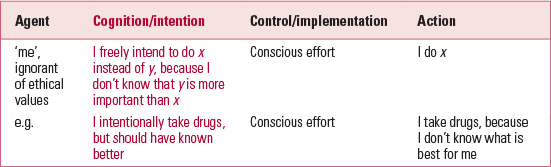
Importantly, both Plato and Aristotle discuss akrasia as an irreducibly ethical issue. For instance, Plato's rejection of akrasia is grounded in so-called Socratic intellectualism: the idea that no one does wrong knowingly. From this viewpoint, what looks like akratic behaviour, such as jeopardising long-term projects for the sake of instant gratification, is recast as being mistaken about what really matters. In other words, akrasia amounts to a kind of ignorance or cognitive failure, rather than a failure of self-control. This cognitive failure is explicitly defined in ethical terms: an akratic person is ignorant about ethical matters and this ignorance constitutes a distinct character flaw. Table 2 summarises Plato's view of akrasia in the context of substance misuse.
Plato's view of weakness of will applied to substance misuse (problem areas in red)
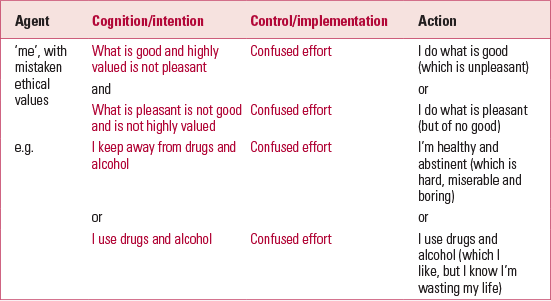
Aristotle moves away from Socratic intellectualism by introducing the notion of an apparent conflict of values. In essence, an akratic person mistakenly perceives good and pleasant courses of action as mutually exclusive. The former are seen as difficult and unrewarding albeit valued, the latter as immediately gratifying yet ultimately worthless. And so, akratic action is a response to the appeal of pleasure that is disvalued, in the face of valuable but challenging alternatives. Taking this view, confused cognition and faltering self-control are intertwined: disvalued courses of action seem pleasant to an akratic person only as a result of akrasia. Once indulged, they inevitably turn out to be disappointing. Similarly, valuable courses of action forgone as difficult and unrewarding only appear so through the lens of akrasia. Awareness of lost opportunities contributes to the underlying frustration of the akratic experience, which offers but dissatisfying pleasure.
As illustrated in Table 3, in terms of ethical assessment, Aristotle's model of akrasia points to a kind of weakness rather than wrongness. This becomes apparent if we consider the four main features of this model, which can be summarised as follows.
-
First, akrasia is a character disposition between virtue and vice. It cannot be assimilated to either.
-
Second, akrasia is closely related to another character disposition, enkrateia or strength of will. They both share the confused conception of good being incompatible with pleasure.
-
Third, failing self-control is only an indication rather than a defining feature of akrasia.
-
Fourth, unlike vice, akrasia can be overcome over time. This is achieved via a two-stage process, which starts with an akratic agent moving towards an enkratic pattern of action, whereby akratic pleasures are avoided but nevertheless missed, and ends with the now enkratic agent coming to appreciate valuable activities as inherently rewarding and enjoyable. This corrected evaluative perspective effaces the appearance of conflict between pleasure and goodness that motivates akrasia.
Aristotle's view of weakness of will (problem areas in red)
Davidson on weakness of will
Reference DavidsonDonald Davidson's seminal paper ‘How is weakness of the will possible?’ (2001) brought the topic into prominence in contemporary philosophy. Since its original publication in 1970, it has served as a standard, in relation to which later conceptions of akrasia are often defined. According to Davidson, akrasia or weakness of will is acting – knowingly and willingly – against one's better judgement. He argues against the then-dominant view, according to which akrasia is merely apparent and not real, since it is impossible to sincerely make an evaluative judgement, such as ‘Drink is bad for me’, without at the same time being motivated to abstain from drinking (Reference HareHare 1952). Davidson addresses this challenge by showing that, although we cannot go against our unconditional evaluative judgements, we can go against all-things-considered judgements, such as ‘Overall, drink is bad for me’, by thinking along the lines ‘yet, this drink will relax me’. The capacity of bracketing out our own all-things-considered judgements in this way makes akrasia possible. Table 4 indicates how Davidson's view could be applied to instances of substance misuse.
Davidson's view of weakness of will (problem areas in red)
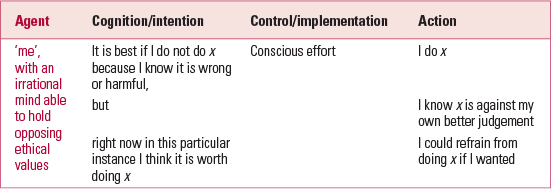
In later works, Davidson (e.g. 2004: pp. 169–188) further pursues this line of thought to reach the conclusion that akrasia is a form of irrationality resembling self-deception. This is because akrasia derives from holding a contradictory, hence irrational, judgement, such as ‘Drink is bad and at the same time good for me’, concealed from the conscious mind. The contradiction takes the form of two mutually exclusive judgements – ‘Drink is bad for me’ and ‘Drink is good for me’ – which are kept separate by an underlying mechanism of mind-partitioning. As a result, the irrationality of akrasia hardly ever comes to the fore at the point of akratic action.
The Davidsonian account of akrasia has four main features.
-
First, akrasia is different from other failures of rationality, such as ambivalence, procrastination and indecisiveness.
-
Second, it points to a failure to exercise rational self-control when this is clearly within one's power.
-
Third, this failure is defined in prudential as opposed to moral terms – acting against one's own better judgement.
-
Fourth, akrasia is exemplified in individual actions, as opposed to patterns of behaviour over time.
Alternative models of akrasia
Alternative conceptions of akrasia, such as those of Reference BratmanBratman (1979) and Reference HoltonHolton (1999), challenge the fourth feature of the Davidsonian model, arguing that akrasia is a failure to maintain stable intentions over time. Nevertheless, they share the key aspects of the conceptual framework set out by Davidson that are of particular relevance to clinical practice: akrasia is seen as a prudential, not a moral, failure of self-control.
There are three further theoretical paradigms within which the issue of akrasia could be explored: (a) theories of volition in neuroscience, psychology and the social sciences emphasising readiness potential (Reference Mele and KaneMele 2012; Reference Walter and KaneWalter 2012); (b) philosophical discussions of free will engaging with matters such as determinism, indeterminism and compatibilism (Reference Bishop and KaneBishop 2012; Reference Nahmias and KaneNahmias 2012); and (c) interdisciplinary work on motivation and resilience (Reference McGregor, Nash and InzlichtMcGregor 2009). For the purposes of the present discussion, it is important to note that in spite of significant differences at a methodological and conceptual level, all three paradigms share the feature of considering self-control from a prudential as opposed to moral perspective.
Discussion
At first blush, there is a clash between classical and contemporary approaches to akrasia or weakness of will: the former opt for an ethical, the latter for a prudential, appraisal. However, a closer look reveals that the underlying contrast is of degree or emphasis only. Classical approaches to akrasia avoid the stigmatising implications associated with a moralised attitude to failing in self-control. In this respect, they are well suited to address timely concerns about the ‘vindictiveness’ of attribution of responsibility in the context of substance misuse and substance dependence (Reference Poland and GrahamPoland 2011). Arguably, the classical approaches fare better than recent attempts to sketch a secondary notion of responsibility, such as ‘responsibility without blame’ (Reference Sinnott-Armstrong, Pickard, Fulford, Davies and GippsSinnott-Armstrong 2013). The reason for this is twofold. First, no stigmatising effect arises from discussing akrasia in ethical terms as long as the first-person perspective of akratic agents is treated on a par with the third-person perspective of experts, observers and other interested parties. This is because stigmatisation does not flow from ethical considerations about akrasia. Instead, it derives from the implicit imbalance of third- and first-person standing that comes with insulating expert from ethical discourse. Second, by employing an explicit ethical vocabulary for understanding and appraising akrasia, the classical approaches counterbalance the objectifying trend of a third-person narrative, whereby a ‘patient’ is someone who is ‘acted upon’ and ‘passive’. In particular, by acknowledging substance misuse as something that a person does rather than something that happens to a person, an ethical outlook on akrasia strengthens the foundations of personal agency. In so doing, it provides the conceptual resources needed for engaging people with problematic substance use as full members of the moral community.
Broadening the prudential interpretation of akrasia to encompass explicit ethical considerations has the welcome upshot of de-emphasising self-control in terms of direct conscious effort over individual actions. As clarified earlier, the model of voluntary action as implementation of prior intention does justice only to some basic one-step actions, but cannot be helpfully generalised to account for agency over time.
In the context of substance misuse, this basic model happens to support an unhelpful focus on ‘relapses’ as indicative that ‘all is lost’, as poignantly illustrated by our fictitious case vignettes. Mr Miller, Amy Parker and Peter Phillips are all expected, and expect themselves, to somehow take control of substance use rather than revisit their projects and commitments as a whole. Yet on reflection, the underlying compartmentalisation – problematic ‘out of control’ behaviour on the one hand, and meaningful occupations such as employment, family life and child care on the other – is unsustainable. This is because both sides of life – problematic and meaningful – are perceived through the lens of the basic model of voluntary action, which in fact is inadequate for either. As shown by recent philosophical work (Reference RadoilskaRadoilska 2013a), this model explains well only lesser, secondary actions at the periphery of intentional agency. The fact that these actions are relatively frequent in our everyday lives does not change their conceptual status, which is derivative. By setting aside the model of voluntary action as intention implementation, this new theory allows us to adopt a holistic approach to personal agency as actualisation of a person. By this theory, problematic aspects can be readjusted once they are recovered as expressions – albeit peripheral – of a self. In other words, by putting back agency at the heart of action, philosophical work on akrasia can be usefully integrated into a viable recovery plan that turns patients into lead agents.
Additional factors that could complement the holistic approach include (a) maintaining stable intentions over time (Reference BratmanBratman 2007), (b) improving participation and (c) nesting intention implementation within a behavioural modification network (Reference Schweiger Gallo, Keil and McCullochSchweiger Gallo 2009), all of which can be achieved by putting in place structures of positive behavioural support (Reference Gore, McGill and ToogoodGore 2013).
Conclusions
Applied to addiction, the standard view of voluntary action as implementation of prior intention leads to an over-simplification – it is broadly regarded as either illness behaviour or criminal behaviour. Yet, addiction can be neither of these, or both, and mainstream responses can be limited or even unhelpful. A philosophical examination of akrasia shows that there is plenty of scope to improve our understanding of addiction. In particular, it highlights the benefits of using an ethical vocabulary when discussing substance misuse: support for the agency of users and destigmatisation. This philosophical work also provides rationale for the exploration of new therapeutic approaches.
MCQs
Select the single best option for each question stem
-
1 The intention-implementation model of voluntary action:
-
a endorses a holistic view of agency
-
b cannot account for coerced actions
-
c helps avoid judgemental attitudes towards patients with substance misuse
-
d supports the first-person perspective of patients as agents
-
e emphasises a potentially unhelpful notion of control.
-
-
2 In Plato's conception, akrasia:
-
a has no ethical significance
-
b is caused by an overwhelming appetite for pleasure
-
c cannot be cured
-
d is a distinct cognitive failure
-
e never actually takes place.
-
-
3 In Aristotle's conception, akrasia:
-
a is just another vice
-
b is defined by lack of self-control
-
c only offers disappointing pleasures
-
d can be helped by the conscious exercise of will power e derives from a genuine conflict of values.
-
-
4 In Davidson's conception, weakness of will:
-
a is acting knowingly and willingly against one's better judgement
-
b is very similar to other failures of rationality, such as procrastination
-
c amounts to changing one's mind too often
-
d cannot be explained from a value-neutral perspective
-
e is an everyday phenomenon.
-
-
5 The model of action as actualisation:
-
a insulates expert from ethical discourse
-
b treats patients with substance misuse as fully responsible agents
-
c supports the programme of ‘responsibility without blame’ in clinical responses to substance misuse
-
d de-emphasises self-control
-
e promotes a compartmentalised approach to patient well-being.
-
MCQ answers

| 1 | e | 2 | d | 3 | c | 4 | a | 5 | b |
Acknowledgements
We would like to thank the three anonymous reviewers of this article for their helpful comments and suggestions on an earlier version.




eLetters
No eLetters have been published for this article.