





Introduction
The grass family, Poaceae, belongs to the order Poales and comprises 789 genera and 11,783 species distributed across 12 subfamilies (Soreng et al. Reference Soreng, Peterson, Zuloaga, Romaschenko, Clark, Teisher, Gillespie, Barberá, Welker and Kellogg2022). Members of this family are characterized by lanceolate leaves with sheaths, inflorescences arranged in spikes or panicles, unisexual flowers, and small, dry pollen grains (Simpson Reference Simpson and Simpson2010). Poaceae has a cosmopolitan distribution and is among the most economically important plant families, particularly in the food sector (APG 2016).
The genus Sporobolus, within Poaceae, includes approximately 150 to 200 species distributed throughout tropical and subtropical regions worldwide (Simon and Jacobs Reference Simon and Jacobs1999). Despite its ecological relevance, the genus remains underexplored, with limited dedicated research to date. Species occur mainly in open environments, such as pastures, fields, and savannas (DiTomaso and Kyser Reference DiTomaso and Kyser2013; Rana et al. Reference Rana, Wilder, Sellers, Ferrell and MacDonald2012), and exhibit adaptations to adverse conditions, including the C4 photosynthetic pathway, which enhances survival in hot and dry environments (Dias-Filho Reference Dias-Filho2015; Quattrocchi Reference Quattrocchi2006).
Taxonomically, Sporobolus belongs to the subfamily Pooideae, tribe Sporoboleae. Although its taxonomy is generally well established, identification can be challenging due to the high morphological similarity among species, which often requires detailed analysis (Dias-Filho Reference Dias-Filho2011; Peterson et al. Reference Peterson, Romaschenko, Arrieta and Saarela2014). The generic name Sporobolus derives from the Greek words sporos (seed) and bolos (to throw), referring to the seed-dispersal mechanism in which mature seeds are expelled from the fruit (Clifford and Bostock Reference Clifford and Bostock2007; Quattrocchi Reference Quattrocchi2006). This feature also inspired the common English name “dropseed.”
The identification of Sporobolus species is particularly complex in the so-called “indicus complex” (Baaijens and Veldkamp Reference Baaijens and Veldkamp1991; Pilger Reference Pilger and Werdermann1956). For example, in Australia, five exotic invasive species—rat-tail grass [Sporobolus africanus (Poir.) Robyns & Tournay], smut grass [Sporobolus fertilis (Steud.) Clayton], West Indian dropseed (Sporobolus jacquemontii Kunth) (a synonym of S. pyramidalis according to The Plant List [2013]), Sporobolus natalensis (Steud.) T. Durand & Schinz, and Sporobolus pyramidalis P. Beauv.—are collectively referred to as “weedy sporobolus grasses” (Bray and Officer Reference Bray and Officer2007; Palmer Reference Palmer, Julien, McFadyen and Cullen2012). Morphological difficulties in differentiating these taxa have led to the development of molecular tools to support accurate identification (Peterson et al. Reference Peterson, Romaschenko, Arrieta and Saarela2014; Shrestha et al. Reference Shrestha, Adkins, Graham and Loch2003, Reference Shrestha, Graham, Loch and Adkins2012).
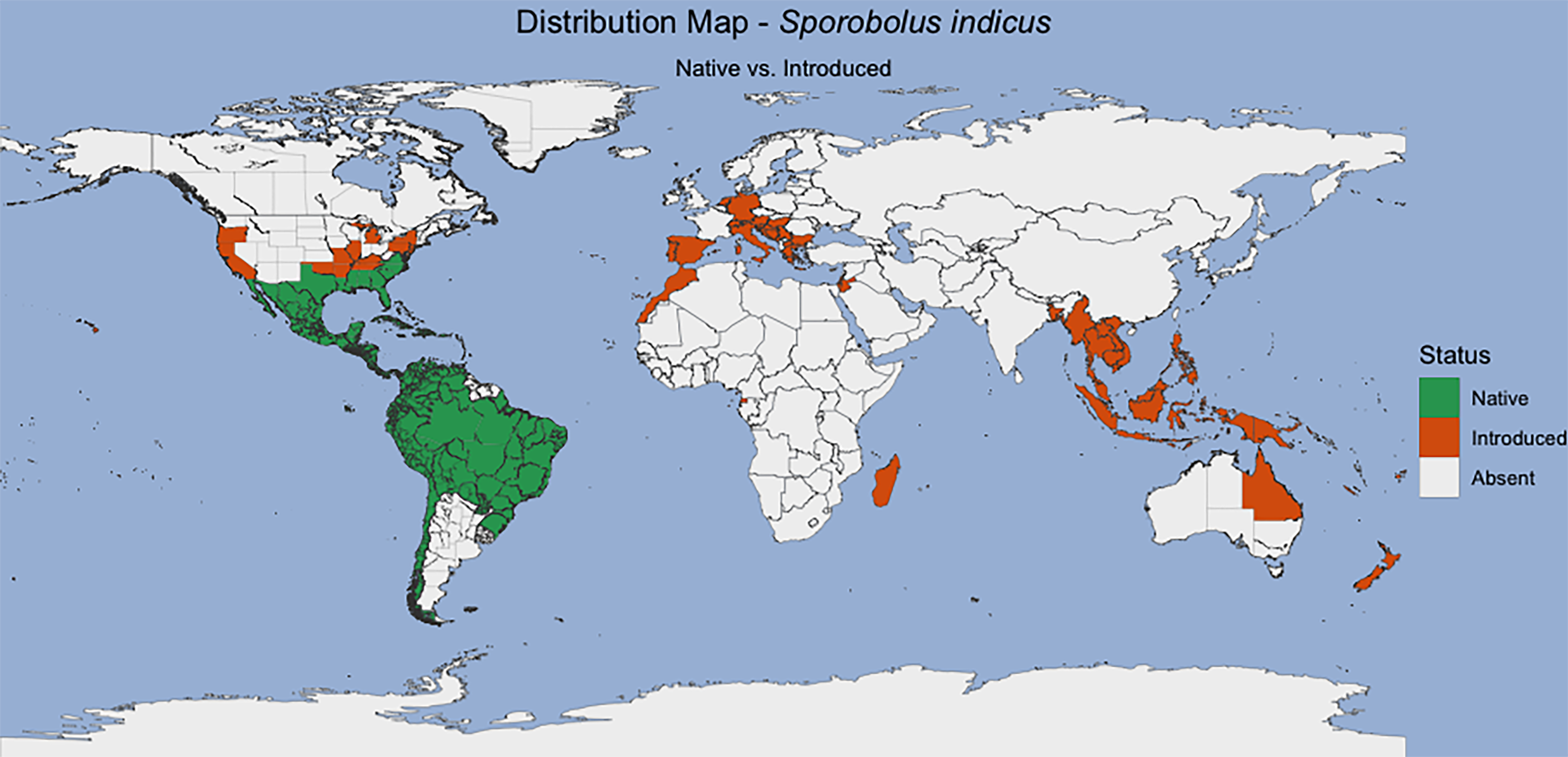
Sporobolus indicus (L.) R. Br., commonly known as capim-capeta or capim-mourão in Brazil and “smut grass” in the United States, is a perennial species native to the New World, ranging from the southern United States through Mexico, Central America, the Caribbean, and South America (Vélez-Gavilán Reference Vélez-Gavilán2022). It is characterized by rapid and aggressive growth (Cáceres Reference Cáceres2021). Its wide distribution has resulted in numerous regional names, including “wiregrass” or espartillo in Cuba, “mouse tail” in Mexico, and serrillo in Puerto Rico, reflecting its relevance in diverse production systems. Today, S. indicus occurs across the Americas as well as in parts of Europe, Asia, and Oceania (Figure 1), owing to its ability to adapt to a broad range of environments (Flora e Funga do Brasil 2025; Quattrocchi Reference Quattrocchi2006). It is recognized as an invasive weed in pastures in Brazil, the United States, and elsewhere (Bauer and Verloove Reference Bauer and Verloove2023; Kissmann Reference Kissmann1991; Lorenzi Reference Lorenzi2000; Quattrocchi Reference Quattrocchi2006) and is widely considered an indicator of pasture degradation (Dias-Filho Reference Dias-Filho2011).
Geographic distribution of Sporobolus indicus.
Source: WFO (2025).

Several traits make S. indicus a particularly harmful pasture weed: it is of low palatability, has poor nutritional value, and has the potential to produce large quantities of seed; S. indicus can produce up to ∼200,000 seeds per plant annually (Dias-Filho Reference Dias-Filho2015; Padilla et al. Reference Padilla, Sardiñas, Febles and Fraga2013). Moreover, a high proportion of seeds are dormant, with the capacity to germinate 2 to 10 yr after dispersal, complicating eradication efforts (Bray and Officer Reference Bray and Officer2007; Padilla et al. Reference Padilla, Sardiñas, Febles and Fraga2013). The mucilaginous seed coat is thought to confer ecological advantages in harsh environments (Yang et al. Reference Yang, Dong and Huang2010, Reference Yang, Baskin, Baskin, Zhang and Huang2012; Young and Evans Reference Young and Evans1973).
In addition, several well-documented drivers of pasture degradation facilitate the establishment and spread of S. indicus. Exotic species such as S. indicus may also act as indicators of altered soil dynamics, reflecting systems characterized by low structural stability, reduced carbon sequestration capacity, and consequently, diminished ecological value (Dias-Filho Reference Dias-Filho2011, Reference Dias-Filho2015; Padilla et al. Reference Padilla, Sardiñas, Febles and Fraga2013; Rai and Singh Reference Rai and Singh2020). Drought reduces competitive pressure by suppressing the growth and recovery of desirable forage species, creating recruitment niches for stress-tolerant weeds. Fire, depending on intensity and frequency, can remove aboveground biomass and expose mineral soil, enhancing seedling emergence of pioneer and opportunistic grasses. Mowing at inadequate heights or frequencies weakens perennial forage stands and increases light penetration to the soil surface, promoting germination of small-seeded weeds. Improper pasture management combined with low soil fertility has intensified degradation processes, resulting in substantial ecological and economic constraints (Dias-Filho Reference Dias-Filho2023).
High grazing pressure exacerbates these effects by reducing soil cover, increasing compaction, and selectively eliminating palatable forage species, thereby favoring the establishment and spread of grazing-tolerant and unpalatable species such as S. indicus. As degradation advances, pasture systems progressively lose their carrying capacity, directly limiting livestock productivity and regional economic performance (Dias-Filho Reference Dias-Filho2023). Consequently, identifying the drivers of pasture degradation and implementing effective mitigation strategies is fundamental to ensuring the long-term sustainability of grazing systems (Bustamante et al. Reference Bustamante, Silva, Scariot, Sampaio, Mascia, Garcia, Sano, Fernandes, Durigan, Roitman, Figueiredo, Rodrigues, Pillar, de Oliveira and Malhado2019).
As a means of mitigating these impacts, postemergence herbicides have been widely used for the management of S. indicus. Among the most frequently studied compounds are hexazinone, a triazine herbicide that inhibits photosystem II (PSII), leading to interveinal and marginal chlorosis (Ferrell and Mullahey Reference Ferrell and Mullahey2006). Hexazinone exhibits predominantly apoplastic movement, with limited phloem translocation following foliar absorption (Shaner Reference Shaner2014). Glyphosate is also extensively investigated; it acts as a 5-enolpyruvylshikimate-3-phosphate synthase (EPSPS) inhibitor, disrupting the shikimic acid pathway and preventing the synthesis of essential aromatic amino acids (Mendes and Silva Reference Mendes and Silva2022). However, glyphosate efficacy is limited (Cáceres Reference Cáceres2021), especially in large infestations. Because it is nonselective, glyphosate often causes phytotoxicity to surrounding forage species, necessitating targeted applications only to S. indicus clumps (Andrade and Dias-Filho Reference Andrade, Dias-Filho, Guimarães, Inoue and Ikeda2018; Dias-Filho Reference Dias-Filho2015). Chemical control is further complicated by the morphological and physiological similarity of S. indicus to forage grasses, which increases the risk of herbicide injury.
Overall, the management of monocotyledonous weeds, particularly perennial Poaceae species, remains challenging, because herbicides selective in perennial forage grasses generally provide poor control of invasive grasses within the same family (Santos et al. Reference Santos, Ferreira, Freitas, Ikeda, Oliveira, Rocha, Lima, Silva and Assis2008). Furthermore, mechanical and cultural practices such as burning or mowing often stimulate regrowth from basal buds, contributing to rapid reinfestation (Adjei et al. Reference Adjei, Mullahey, Mislevy and Kalmbacher2003). Therefore, the objective of this study is to conduct a systematic review of Sporobolus spp., synthesizing information on its occurrence and chemical management in the Americas between 1980 and 2025.
Materials and Methods
For this literature review, scientific articles on S. indicus were analyzed from digital platforms. A structured step-by-step process was established, beginning with the development of the key research question, objectives, and hypothesis. Subsequently, research methods and article selection criteria were defined. After information gathering, the available evidence regarding the chemical control of the species was critically analyzed.
A comprehensive literature search was conducted using ISI Web of Science (https://mjl.clarivate.com/search-results), Scopus (https://www.scopus.com/standard/marketing.uri#basic), and Google Scholar (https://scholar.google.com). The search was performed between October 2024 and June 2025 with the following keywords: “Pasture”, “Smutgrass”, and “Sporobolus indicus”. No language restrictions were applied, and the search covered the period from 1980 to 2025. The starting year was defined based on preliminary scoping searches indicating that the scientific use of the name Sporobolus indicus became consistent in indexed literature from this period onward, thereby ensuring taxonomic clarity and reproducibility of the search strategy.
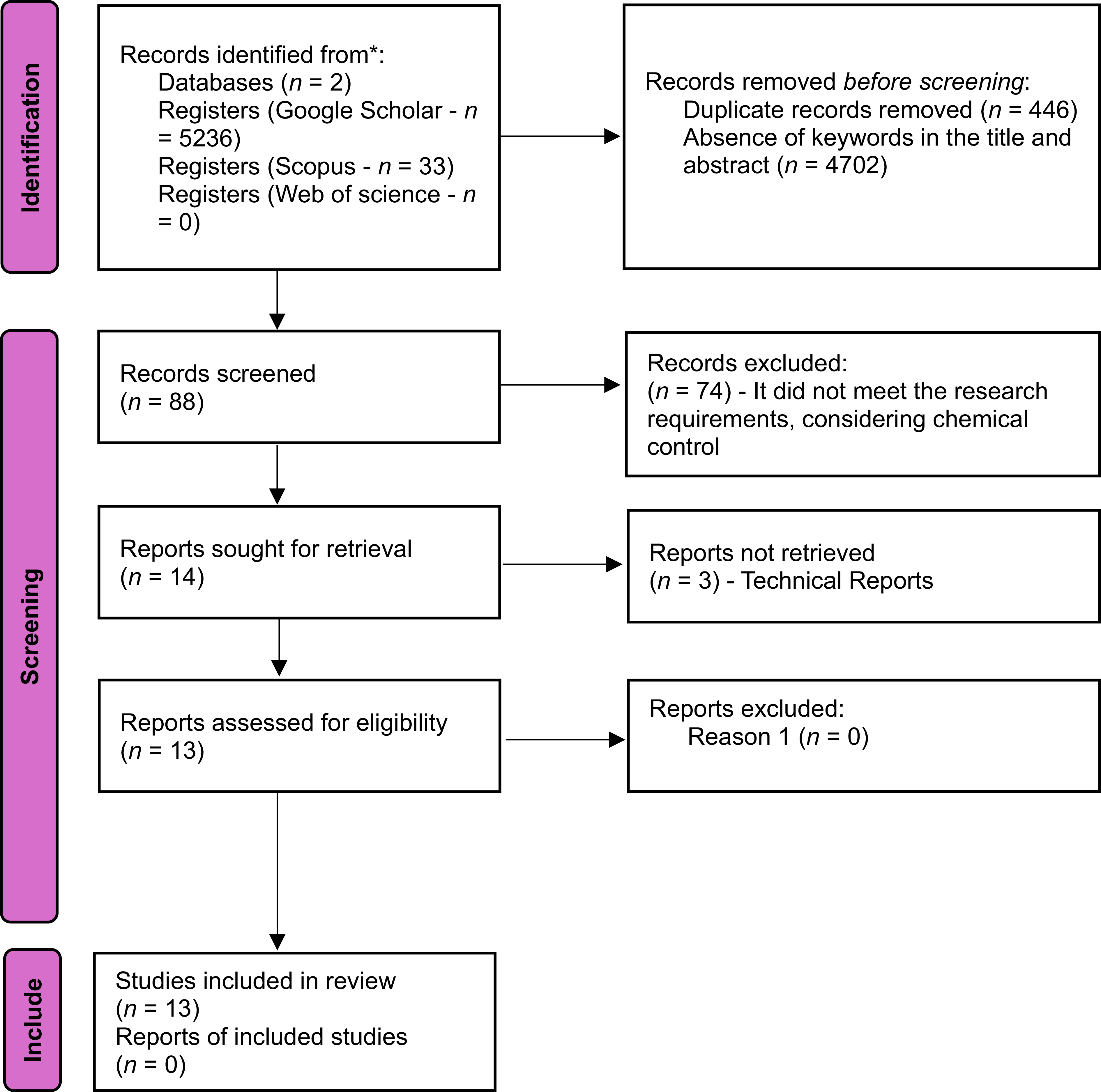
The initial search retrieved 5,269 articles. After removal of duplicates, 446 unique documents remained, whose titles and abstracts were screened for relevance. Screening followed eligibility criteria requiring that: (1) the study was published in a peer-reviewed journal; (2) it employed a structured experimental design in field or greenhouse conditions; and (3) it reported at least one of the following response variables: weed density, weed control efficacy, or treatments applied.
Following this method, 88 full-text articles were selected for weed management in general. Of these, 13 articles from the Americas were chosen for detailed analysis of chemical control, as most publications on this species originated from this geographic region. The article selection process followed the PRISMA guidelines (Page et al. Reference Page, McKenzie, Bossuyt, Boutron, Hoffmann, Mulrow, Shamseer, Jennifer, Tetzlaff, Akl, Brennan, Chou, Glanville, Grimshaw, Hróbjartsson and Lalu2021; Figure 2).
PRISMA flow diagram of article selection for chemical control Sporobolus spp. (Page et al. Reference Page, McKenzie, Bossuyt, Boutron, Hoffmann, Mulrow, Shamseer, Jennifer, Tetzlaff, Akl, Brennan, Chou, Glanville, Grimshaw, Hróbjartsson and Lalu2021).

Information was extracted from the selected articles, including common and scientific names, application timing, herbicides, application rates, study location, forage species, fertilizers, site characteristics, year of publication, and treatment efficacy. Data were obtained from both text and tables. Graphs were generated in R (R Core Team 2022) using the ggplot2 package (Wickham Reference Wickham2016).
Results and Discussion
The systematic literature review on the control of Sporobolus spp. identified 13 peer-reviewed studies published between 1999 and 2025 (Table 1), conducted primarily in pasture systems in the United States and Brazil. Most were carried out in bahiagrass (Paspalum notatum Flueggé) pastures, with fewer studies in other forage species such as koronivia grass [Urochloa humidicola (Rendle) Morrone & Zuloaga] and bermudagrass [Cynodon dactylon (L.) Pers.].
Summary of published studies on herbicide-based control of Sporobolus species in the United States and Brazil, including the main author and year, study location, pasture type, herbicide treatment and application timing, evaluated doses (kg ai ha− 1), fertilizer rates (kg ha− 1), and the scientific and common names reported.

a ATV, all-terrain vehicle; POST, postemergence herbicide; PRE, preemergence herbicide.
The taxonomic identity of some Sporobolus populations in Florida remains uncertain, as they may correspond to S. indicus, S. pyramidalis, or S. jacquemontii. Although several records and descriptions exist in the literature, there is no consensus on the botanical classification of these populations, with varieties such as indicus, africanus, and pyramidalis frequently reported.
A temporal distribution of the reviewed studies was observed. Although the search period spanned from 1980 to 2025, no eligible studies on the chemical control of S. indicus were published between 1980 and 1998. The first study meeting the inclusion criteria appeared between 1999 and 2006 (four studies), followed by isolated publications in 2011 and 2015, and a marked increase in research output between 2022 and 2025 (six studies) (Table 1).
Among the chemical control strategies, hexazinone was the most frequently reported herbicide, appearing in more than 80% of the studies, either applied alone or in combination with mowing or other active ingredients. Glyphosate, although widely used in general weed management, was reported less often and typically combined with mechanical practices such as mowing. Its application employed different equipment, including rope-wick applicators (weed wipers) and backpack sprayers. Other active ingredients mentioned included mesotrione, indaziflam, metsulfuron-methyl, nicosulfuron, terbuthylazine, and imazapic, although these were less frequently documented across the publications (Figure 3).
Number of studies conducted in the United States and Brazil evaluating different herbicides, herbicide combinations, and management practices for Sporobolus indicus control. “Renovation + hexazinone” refers to pasture renovation practices combined with hexazinone application, not to a commercial herbicide product.

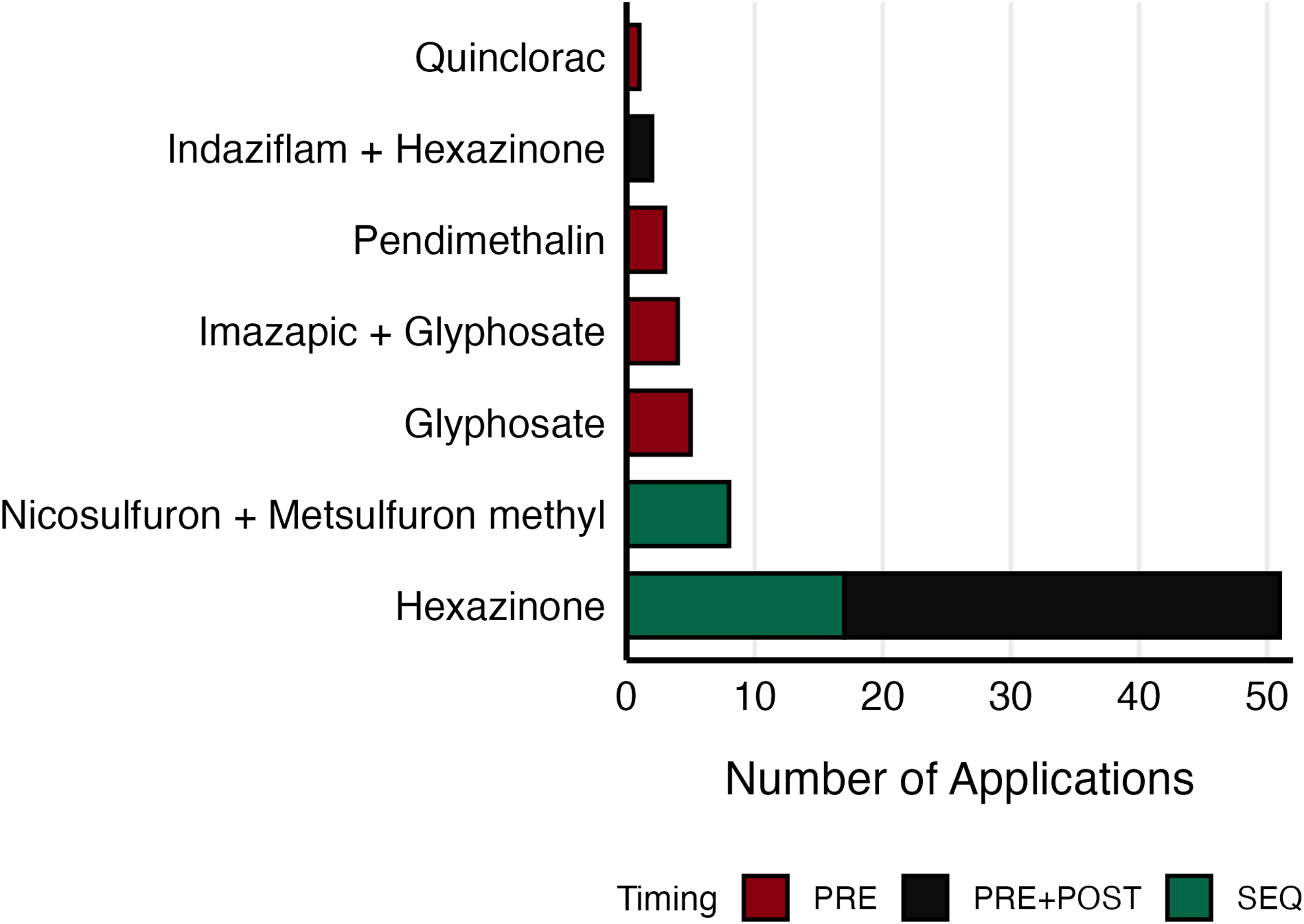
Regarding application timing, postemergence treatments were the most frequently reported approach in the reviewed literature, reflecting the emphasis of existing studies rather than application intensity within individual experiments (Figure 4). A smaller number of studies evaluated preemergence applications, primarily involving indaziflam, while others reported sequential strategies combining preemergence and postemergence treatments. In addition, some studies described integrated approaches in which herbicide applications were combined with mechanical practices, such as mowing followed by chemical control, illustrating how chemical management has been incorporated into broader integrated weed management frameworks.
Frequency of herbicide application events reported across studies conducted in the United States and Brazil, grouped by active ingredient and application timing. Bars represent the total number of application events described in the reviewed literature, not the number of applications within individual experiments.

Geographically, most studies were conducted in Florida (USA), particularly those addressing the control of West Indian dropseed, also known as giant smut grass [Sporobolus indicus (L.) R. Br. var. pyramidalis (P. Beauv.) Veldkamp], a highly problematic biotype in pastures of the southeastern United States. For South America, only one study was identified, carried out in Brazil, which evaluated combinations of mesotrione and triazine-class herbicides in Brachiaria spp. pastures, thereby expanding the available chemical control options.
The taxonomic uncertainty surrounding Sporobolus in Florida reflects an issue well recognized in the literature. While some authors distinguish S. jacquemontii from S. pyramidalis based on morphological traits (Clayton et al. Reference Clayton, Phillips, Renvoize and Polhill1974; Peterson et al. Reference Peterson, Hatch, Weakley, Barkworth, Capels, Long and Piep2003; Simon and Jacobs Reference Simon and Jacobs1999), others consider them morphologically indistinguishable and treat them as synonyms of S. indicus var. pyramidalis (Baaijens and Veldkamp Reference Baaijens and Veldkamp1991; Wunderlin et al. Reference Wunderlin, Hansen, Franck and Essig2025). Molecular evidence indicates that all three belong to Sporobolus sect. Sporobolus, although S. pyramidalis from Africa and Australia is genetically distinct from S. indicus and S. jacquemontii of the Americas (Peterson et al. Reference Peterson, Romaschenko, Arrieta and Saarela2014). Historical introductions of African and Brazilian accessions into USDA germplasm programs further contribute to this uncertainty, emphasizing the need for genetic analyses to clarify the identity of Florida populations. This taxonomic complexity, combined with the invasive behavior of several Sporobolus species, highlights the importance of identifying effective management strategies, particularly chemical control of S. indicus.
This integrated review of studies published between 1980 and 2025 demonstrates significant advances in understanding herbicide efficacy, integrated management approaches, and the limitations of conventional methods in tropical and subtropical pastures. Hexazinone emerged as the most studied and effective herbicide, particularly in Florida and Georgia (Mislevy et al. Reference Mislevy, Shilling, Martin and Hatch1999; Rana et al. Reference Rana, Sellers, Ferrell, MacDonald, Silveira and Vendramini2015; Shay et al. Reference Shay, Baxter, Basinger, Schwartz and Belcher2022, Reference Shay, Baxter, Basinger, Secor, Burt, Hancock, Schwartz and Belcher2024). Control levels above 85% were consistently achieved, particularly when hexazinone was applied at rates ≥0.84 kg ha⁻1 during the rainy season. Although hexazinone generally shows satisfactory selectivity for bahiagrass, temporary phytotoxicity may occur; however, plants typically recover within 40 d after treatment (Mislevy et al. Reference Mislevy, Shilling, Martin and Hatch1999). Recent field-based evidence has further demonstrated that hexazinone performance is strongly influenced by the interaction between application rate, rainfall following application, and application timing, with adequate precipitation being essential for consistent control (Dias et al. Reference Dias, Mncube, Sellers, Ferrell, Enloe, Vendramini and Moriel2025).
The use of fertilizers following herbicide application has been shown to mitigate phytotoxic effects and stimulate forage growth, accelerating canopy recovery and reducing weed competition. It has been associated with the mitigation of phytotoxic effects and the stimulation of forage growth, promoting faster canopy recovery and reducing weed interference. In this context, studies have shown that timely fertilization after hexazinone application accelerates the recovery of forage grasses such as bahiagrass, thereby increasing their competitiveness against weeds (Regmi et al. Reference Regmi, Devkota, Sellers, Dubeux, Sales, Mathew and Daramola2023; Sellers et al. Reference Sellers, Rana, Dias and Devkota2023; Shay et al. Reference Shay, Baxter, Basinger, Schwartz and Belcher2022). Although fertilizers represent a high-cost input for low-technology production systems, evidence indicates that the combined use of hexazinone and fertilization is more effective in controlling S. indicus than hexazinone applied alone (Rana et al. Reference Rana, Sellers, Ferrell, MacDonald, Silveira and Vendramini2013).
Application timing also strongly influenced outcomes. Summer applications achieved greater weed control with hexazinone herbicide than spring treatments (Howard et al. Reference Howard, Nolte, Hussey, Treadwell and Sellers2023), likely reflecting higher metabolic activity and more effective translocation of systemic herbicides during this period. The perennial growth habit of S. indicus, combined with the intensified allocation of carbon reserves to the root system during the pre-dormancy period, may contribute to increased efficacy of systemic herbicides. Although hexazinone exhibits predominantly xylem-mediated mobility, the greater physiological demand of roots during this phase may favor its accumulation in belowground tissues, thereby enhancing the effectiveness of chemical control (Howard Reference Howard2020). By contrast, pendimethalin, traditionally classified as a soil-applied, preemergence herbicide rather than a contact herbicide, showed low efficacy, which is consistent with Howard et al. (Reference Howard, Nolte, Hussey, Treadwell and Sellers2023), who reported preemergence applications provided limited control of S. indicus compared with indaziflam and hexazinone. This pattern is consistent with recent findings showing that rainfall shortly after application is a critical determinant of hexazinone activation and efficacy under field conditions (Dias et al. Reference Dias, Mncube, Sellers, Ferrell, Enloe, Vendramini and Moriel2025).
Integrated approaches combining postemergence herbicide applications with nitrogen fertilization have shown that reductions in S. indicus cover can be accompanied by improved recovery and dominance of bahiagrass (Shay et al. Reference Shay, Baxter, Basinger, Schwartz and Belcher2022, Reference Shay, Baxter, Basinger, Secor, Burt, Hancock, Schwartz and Belcher2024). These findings indicate that effective chemical control of S. indicus should be aligned with fertilization practices that stimulate forage growth, thereby supporting pasture recovery and limiting reinfestation. Evidence for mowing, however, is mixed: while Sellers et al. (2024) reported reduced efficacy when mowing preceded herbicide application, Ferrell and Mislevy (2001) observed no significant differences in control across mowing frequencies. Other studies indicated that aggressive mechanical practices, such as fraise mowing, may improve herbicide efficacy by physically removing growth points (Raimondi et al. Reference Raimondi, Constantin, Mendes, Oliveira and Rios2020; Richardson et al. Reference Richardson, Brosnan, McCalla and Breeden2020). For S. indicus, however, information remains limited, highlighting the need for additional research on chemical–mechanical integration.
Targeted application methods have also shown promise. Rope-wick applicators (weed wipers) delivering concentrated glyphosate or hexazinone reduced impacts on desirable forage (Dias et al. 2024). Although effective in suppressing S. indicus at the treated-clump level, the overall contribution of this approach is constrained by limitations in operational precision and scalability. Hexazinone remains the most extensively studied and frequently reported herbicide for chemical control of S. indicus; however, its efficacy is variable and strongly influenced by application timing, rate, and environmental conditions.
Hexazinone is highly susceptible to leaching because of its high water solubility of 33,000 mg L⁻1 and low affinity for soil particles, as indicated by a low soil adsorption coefficient (Koc = 54 ml g⁻1) (Felding Reference Felding1992). Consequently, downward movement beyond the root zone is more likely, particularly during summer periods characterized by frequent rainfall. In a greenhouse study, Dias et al. (Reference Dias, Mncube, Sellers, Ferrell, Enloe, Vendramini and Moriel2025) evaluated seven simulated rainfall accumulation levels (0, 6, 12, 25, 50, 100, and 200 mm) across two hexazinone rates and demonstrated that increasing rainfall significantly influenced herbicide efficacy based on both visual control and biomass reduction. Approximately 49 mm and 92 mm of rainfall were required to achieve 50% visual control and biomass reduction for hexazinone applied at 0.56 and 1.12 kg ai ha⁻1, respectively. Consistent with these findings, field experiments showed that peak hexazinone performance occurred from mid-June through mid-August when applications were followed by 10 to 75 mm of rainfall within the first 7 d after treatment.
Beyond hexazinone, several other active ingredients have been evaluated primarily in turfgrass systems or in the management of invasive and caespitose grass species with high seed production, rather than directly on S. indicus populations. Indaziflam, a cellulose biosynthesis inhibitor with moderate to low soil mobility, has demonstrated effective pre- and early postemergence control of invasive perennial and annual grasses by reducing seedling establishment and seedbank replenishment (Alonso et al. Reference Alonso, Koskinen, Oliveira, Constantin and Mislankar2011; Brosnan et al. Reference Brosnan, Breeden, McCullough and Henry2012; Sebastian et al. Reference Sebastian, Fleming, Patterson, Sebastian and Nissen2017). Acetolactate synthase (ALS)-inhibiting herbicides such as imazapic, nicosulfuron, and metsulfuron-methyl have shown variable efficacy against caespitose grass species depending on growth stage and application timing, primarily in systems other than S. indicus–infested pastures (Takano et al. Reference Takano, Benko, Zielinski, Hamza, Kalnmals, Roth and Riar2023). Terbuthylazine, a PSII inhibitor used as an atrazine substitute, has been evaluated mainly for its residual activity on grass weeds, with performance closely linked to soil organic matter content and sorption dynamics (Tasca et al. Reference Tasca, Puccini and Fletcher2018; Wang et al. Reference Wang, Lin, Hou, Richardson and Gan2010).
Because these active ingredients have been tested largely on species other than S. indicus, they were not included among the core studies of this systematic review. Nevertheless, their documented activity on invasive, tuft-forming grasses suggests potential relevance for future research targeting S. indicus management, particularly under tropical and subtropical pasture conditions. Mesotrione, an HPPD inhibitor widely used in maize (Zea mays L.), is rapidly degraded in soil (Carles et al. Reference Carles, Joly and Joly2017). When applied in combination with other active ingredients, mesotrione has shown activity against monocotyledonous species and provides selectivity under certain application conditions for some forage grasses used in pasture establishment in Brazil (Dan et al. Reference Dan, Barroso, Dan, Procópio, Oliveira, Constantin and Feldkircher2011). Under Brazilian conditions, Braz et al. (Reference Braz, Nascimento, Bilego, Bastos and Sousa2025) demonstrated that mesotrione alone was ineffective, but combinations with triazines (atrazine, terbuthylazine) substantially increased control efficacy while maintaining selectivity in U. humidicola, indicating potential for tropical systems. However, mesotrione is not labeled for forage crops in the United States, whereas indaziflam (Rejuvra®) is approved for use in grazed lands and hayfields and thus cannot be categorized as having the same regulatory status. In Brazil, mesotrione is registered primarily for maize and not for forage systems, although experimental studies have explored its potential under tropical conditions.
It is important to note that most of these herbicides, including indaziflam, mesotrione, and ALS inhibitors, are highly injurious to many forage species, including bahiagrass. Therefore, studies evaluating the regrowth of forage grasses following herbicide application are highly desirable.
Preventive management with preemergence herbicides is becoming increasingly important. Under greenhouse conditions, indaziflam completely inhibited S. indicus seedling emergence, resulting in 100% suppression relative to the non-treated control across all evaluated rates and assessment periods (Howard et al. Reference Howard, Nolte, Hussey, Treadwell and Sellers2023). In addition, the high soil persistence of indaziflam supports prolonged residual activity, reinforcing its potential role in preventing recruitment from the soil seedbank. This strategy is especially relevant, because S. indicus produces seeds with high dormancy and long persistence in the soil that can remain viable for 2 to 10 yr (Padilla et al. Reference Padilla, Sardiñas, Febles and Fraga2013). This extended seed longevity poses a significant challenge to long-term control and reinforces the need for preventive management approaches.
Despite these advances, the literature exhibits a pronounced geographic bias, with most research conducted in the subtropical United States, particularly in Florida, and an increasing number of studies emerging from Georgia. Although low soil fertility and high grazing pressure occur in several pasture systems in Florida, important differences remain between these regions and Brazilian systems. Pastures in the biomes Cerrado and Caatinga are characterized by highly weathered soils with strong acidity and aluminum toxicity, marked seasonality in rainfall with prolonged dry periods, and forage systems dominated by warm-season C4 species under extensive grazing regimes. These factors influence herbicide persistence, plant recovery, and reinfestation dynamics, limiting the direct extrapolation of findings from U.S. studies. Expanding research in these underrepresented environments is therefore essential to develop management strategies that are broadly applicable across tropical and subtropical systems.
Overall, the literature reviewed between 1980 and 2025 shows that chemical control of S. indicus has been achieved primarily through postemergence herbicide applications, with hexazinone consistently reported as the most effective option when environmental and management conditions are favorable. Notably, recent field studies explicitly demonstrate that the success of hexazinone-based management programs depends on aligning application timing and dose with prevailing rainfall patterns, reinforcing precipitation as a central driver of control reliability (Dias et al. Reference Dias, Mncube, Sellers, Ferrell, Enloe, Vendramini and Moriel2025). Across studies, successful control with hexazinone was closely associated with adequate soil moisture and precipitation following application, which enhanced root uptake and translocation, whereas reduced rainfall or dry conditions frequently resulted in inconsistent or short-lived control. Preventive strategies using residual herbicides such as indaziflam demonstrated strong suppression of seedling emergence, highlighting the importance of targeting recruitment from the soil seedbank rather than relying solely on postemergence control.
In addition, studies integrating chemical control with pasture management practices, particularly nitrogen fertilization, consistently reported improved recovery and competitiveness of desirable forage species, reinforcing the need to link weed suppression with forage stimulation. Although much of the available evidence originates from the southeastern United States, S. indicus is a widespread problem across tropical and subtropical pasture systems worldwide, and the limited number of field-based studies conducted under diverse edaphoclimatic conditions restricts the transferability of current recommendations. Expanding research across a broader range of environments is therefore essential to refine integrated management strategies and support more reliable, long-term control of S. indicus.
Funding statement
This research received no specific grant from any funding agency or the commercial or not-for-profit sectors.
Competing interests
The authors declare no conflicts of interest.



 Open access

