


Introduction: challenges to political inclusion
Affinity voting, the tendency of voters to prefer politicians who share their background characteristics, is often assumed to be widespread, yet research findings are inconsistent (Besco, Reference Besco2019; Bird et al., Reference Bird, Jackson, McGregor, Moore and Stephenson2016; Dolan, Reference Dolan2008; Goodyear-Grant and Croskill, Reference Goodyear-Grant and Croskill2011). The literature on gender affinity voting (for a meta-analysis see: Schwarz and Coppock, Reference Schwarz and Coppock2022) is sizable yet produces mixed results, while racial/ethnic affinity voting is a more consistently proven phenomenon (for a meta-analysis see: van Oosten et al., Reference van Oosten, Mügge and van der Pas2024a). Most existing evidence comes from the US and majority populations, though European minorities may respond differently. In this pre-registered paper, I explore the role of affinity voting from both majority and minority perspectives in France, Germany and the Netherlands.
To compare affinity voting among majority and minority subgroups (following Leeper et al., Reference Leeper, Hobolt and Tilley2019), I used a unique sampling method, as standard strategies would not yield enough minority participants for statistical analyses (Font and Méndez, Reference Font and Méndez2013). Strict European privacy regulations further limit the availability of sampling frames for racial/ethnic and religious minorities (Simon, Reference Simon2017). Therefore, I first conducted a large-scale mini-survey with Kantar Public and only included voters with certain specific countries of origin. All countries oversampled citizens from Türkiye. In France, citizens of North-African (Morocco, Tunisia, Algeria) and Sub-Saharan African (Niger, Mauritania, Ivory Coast, French Sudan, Senegal, Chad, Gabon, Cameroon, Congo) were also in the sample. The German sample included citizens with a Former Soviet Union (FSU) background, while in the Netherlands I sampled those with Moroccan, and Surinamese backgrounds as well. In total, 1889 of 3058 respondents had a migration background, of whom 649 self-identified as MuslimFootnote 1 . The sample also includes many non-religious respondents from Muslim majority countries, enabling me to isolate the independent effects of religion, migration background, and gender, and reducing concerns that results are driven by a single subgroup.
The sampled respondents from all subgroups were presented fictional profiles of politicians with randomised information on the politicians’ religion, migration background, gender and policy position, a method known as conjoint experiments (Hainmueller et al., Reference Hainmueller, Hopkins and Yamamoto2014). There are considerable advantages of experimental methods over observational data, particularly for this kind of research, where it is difficult to disentangle the independent effects of affinity and policy in real life because minority politicians sometimes advance the interests of their group (Dietrich and Hayes, Reference Dietrich and Hayes2023; Tate, Reference Tate2003), but in other cases may strategically distance themselves from the interests presumed to be part of their group (Aydemir and Vliegenthart Reference Aydemir and Vliegenthart2022, Reference Aydemir and Vliegenthart2016; Dancygier Reference Dancygier2017, Reference Dancygier2013; Porzycki et al., Reference Porzycki, Oshri and Shenhav2025; Stephens-Dougan, Reference Stephens-Dougan2020; van de Wardt et al., Reference van de Wardt, Sobolewska and English2024). Moreover, levels of knowledge are unknown for all subgroups, thus, measuring evaluations of real politicians would raise serious validity concerns. Therefore, using profiles of fictional politicians is the most appropriate design for getting to the bottom of the question whether sharing the same religion, migration background and gender impacts voting.
The findings reveal that instead of minorities, majorities are just as, if not more, likely to engage in affinity voting. Voters with a migration background do not prefer in-group politicians and even favour politicians without a migration background on average. Muslim voters do, however, engage in affinity voting in the Netherlands, to a lesser extent in Germany and not at all in France. Most importantly, non-religious voters are most likely to engage in affinity voting, with a strong preference for non-religious politicians, even when both the voter and politician agrees on policy, but especially when the voter and politician disagree. This study therefore not only sheds new light on the barriers to Muslim representation in European politics but also makes a broader contribution by demonstrating who is most likely to engage in affinity voting and under which circumstances.
Theory: migration background, religion, gender and policy affinity
Affinity voting refers to the tendency of voters to favour politicians who share their social identities or background characteristics, such as gender, religion, or migration background (e.g., Becerra-Chávez and Navia, Reference Becerra-Chávez and Navia2021). I understand affinity voting as voting to achieve descriptive representation, where politicians are perceived as “being like” the voter, but it is different from voting to achieve substantive representation, where politicians are seen as “standing for” the voter’s interests (Pitkin, Reference Pitkin1967). Existing research shows that shared identity can shape voting behaviour, with women preferring female candidates (Dolan, Reference Dolan2008; Goodyear-Grant and Croskill, Reference Goodyear-Grant and Croskill2011; Ortega et al., Reference Ortega, Recuero and Oñate2023; Schwarz and Coppock, Reference Schwarz and Coppock2022), ethnic and racial minorities supporting co-ethnic politicians (Aguilar et al., Reference Aguilar, Cunow, Desposato and Sangali Barone2015; English et al., Reference English, Pearson and Strolovitch2018; Lemi and Brown, Reference Lemi and Brown2019; van der Zwan et al., Reference van der Zwan, Tolsma and Lubbers2020), and Muslims favouring Muslim candidates (Azabar et al., Reference Azabar, Thijssen and van Erkel2020; Bai, Reference Bai2021; Campbell and Cowley, Reference Campbell and Cowley2014; Heath et al., Reference Heath, Verniers and Kumar2015). An ongoing debate in the literature interrogates whether identity holds intrinsic value for voters or primarily serves as an informational cue (Arnesen et al., Reference Arnesen, Duell and Johannesson2019; Cutler, Reference Cutler2002; Koch, Reference Koch2000; Lerman and Sadin, Reference Lerman and Sadin2016), a particularly pressing question within a context in which minority politicians often distance themselves from their group to broaden electoral appeal (Aydemir and Vliegenthart Reference Aydemir and Vliegenthart2022, Reference Aydemir and Vliegenthart2016; DancygierReference Dancygier2017, Reference Dancygier2013; Porzycki et al., Reference Porzycki, Oshri and Shenhav2025; Stephens-Dougan, Reference Stephens-Dougan2020; van de Wardt et al., Reference van de Wardt, Sobolewska and English2024). By examining both policy preferences and identity-based cues as drivers of vote choice, this paper disentangles the independent effect of affinity voting. In this study, I focus on affinity voting among what Mugglin et al. (Reference Mugglin, Murahwa and Ruedin2025) term “minorities of power”: groups that are not necessarily numerically smaller but structurally underrepresented in positions of political influence, i.e., people with a migration background, Muslims and women.
Migration background
In the US, evidence shows that affinity voting influences voting choices for co-ethnic candidates (for a meta-analysis see van Oosten et al., Reference van Oosten, Mügge and van der Pas2024a). Similarly, studies outside the US also suggest co-ethnic preferences in politics (Adida, Reference Adida2015; Chauchard, Reference Chauchard2016; Poertner, Reference Poertner2022). Affinity voting is most commonly explained by the assumption that in-groups will represent their policy interests (Arnesen et al., Reference Arnesen, Duell and Johannesson2019; Bergh and Bjørklund, Reference Bergh and Bjørklund2011; Cutler, Reference Cutler2002; Koch, Reference Koch2000; Lerman and Sadin, Reference Lerman and Sadin2016) but there are also other explanations prevalent in the literature. For instance, the concentration of immigrants in a particular neighbourhood increases in-group voting (Vermeulen et al., Reference Vermeulen, Harteveld, van Heelsum and van der Veen2020), with the assumed greater societal respect the in-group will receive (Ruedin, Reference Ruedin2009), showing the public your group has the ‘ability to rule’ (Mansbridge, Reference Mansbridge1999, 628), or as a ‘survival strategy’ when faced with a lack of societal acceptance (hooks, 1995 as cited in Lemi and Brown, Reference Lemi and Brown2019, 272), or targeting by political parties (Goerres et al., Reference Goerres, Mayer and Spies2020). That is why I pre-registered the following hypothesis:
H1a. Racial/ethnic minority respondents prefer politicians of their own racial/ethnic minority group to politicians of a different group.
Religion
There is very little research on Muslim affinity voting (but see: Azabar et al., Reference Azabar, Thijssen and van Erkel2020; Bai, Reference Bai2021; Campbell and Cowley, Reference Campbell and Cowley2014; Heath et al., Reference Heath, Verniers and Kumar2015) and the ubiquitous theory that affinity voting is a result of assumed policy as developed for racial and ethnic groups (e.g., Arnesen et al., Reference Arnesen, Duell and Johannesson2019; Cutler, Reference Cutler2002; Koch, Reference Koch2000; Lerman and Sadin, Reference Lerman and Sadin2016), may be less applicable to Muslims. Muslim-background politicians often have incentives (Dancygier Reference Dancygier2017, Reference Dancygier2013; López Ortega and Turnbull-Dugarte, Reference Ortega and Turnbull-Dugarte2025; van Oosten and Aydemir, Reference van Oosten and Aydemir2026) to distance themselves from their group and very often indeed do so (Aydemir and Vliegenthart 2016, Reference Abramson, Kocak and Magazinnik2022). The incentive to distance oneself from their Muslim group is a fact that Muslims may be more aware of (van Oosten, Reference van Oosten2025a) than majorities (Turnbull-Dugarte and López Ortega, Reference Turnbull-Dugarte and López Ortega2024; Turnbull-Dugarte et al., Reference Turnbull-Dugarte, Ortega and Hunklinger2025; van Oosten, Reference van Oosten2022), strengthened by Muslims’ heightened awareness of the diversity within their group (Fleischmann et al., Reference Fleischmann, Phalet and Klein2011). This leads to Muslims often witnessing politicians with the same background as them explicitly not representing their interests. Experiences of unfulfilled descriptive representation can lead to feelings of betrayal (Akachar, Reference Akachar2018; Anderson, Reference Anderson, Cose and Collins1997) and turn Muslims off from voting for in-group politicians. However, the opposite may also be true. Within the context of high levels of politicisation of Islam (Loukili, Reference Loukili2021a, Reference Loukili2021b; Vermeulen, Reference Vermeulen2018) and Islamophobia (Bracke and Aguilar, Reference Bracke and Hernández Aguilar2020; Brubaker, Reference Brubaker2017; Helbling and Traunmüller, Reference Helbling and Traunmüller2018) Muslims experience discrimination in many domains in life, for instance in the labour market (Fernández-Reino et al., Reference Fernández-Reino, Di Stasio and Veit2023). This politicisation and Islamophobia, and subsequent discrimination, has strengthened Muslim collective identity and heightened perceptions of identity threat (Lajevardi and Oskooii, Reference Lajevardi and Oskooii2018; Verkuyten and Yildiz, Reference Verkuyten and Ali Yildiz2009; Voas and Fleischmann, Reference Voas and Fleischmann2012), possibly leading to more affinity voting amongst Muslims than would be the case in conditions of less politicisation and Islamophobia. Moreover, evidence suggests that Muslim affinity voting is driven by feelings of exclusion rather than religiosity (Azabar et al., Reference Azabar, Thijssen and van Erkel2020). These dynamics suggest that exclusion may foster in-group solidarity, leading to the expectation that:
H1b. Muslim respondents prefer Muslim politicians to non-religious and Christian politicians.
Gender
Research on the gender affinity effect, which refers to the tendency for women to prefer female politicians (Dolan, Reference Dolan2008), has produced mixed results. Some studies find that women are more likely to support female candidates (Brians, Reference Brians2005; Kirkland and Coppock, Reference Kirkland and Coppock2018; van Erkel, Reference van Erkel2019), while others find no significant gender-based voting differences (Cargile and Pringle, Reference Cargile and Pringle2019; Coffé and von Schoultz, Reference Coffé and von Schoultz2020; Cowley, Reference Cowley2013) or even evidence that women penalise female candidates (Bauer, Reference Bauer2015; Eggers et al., Reference Eggers, Vivyan and Wagner2018; Mo, Reference Mo2015). These inconsistencies may have several explanations. First, women may be more inclined to vote for female candidates when debates about women’s underrepresentation are salient, but not when such issues are less prominent (Campbell and Heath, Reference Campbell and Heath2017). Second, variations in voter ideology may contribute to the mixed results, as sexism is more prevalent among conservative voters, with recent research showing that both conservative women and men still penalise female politicians (Sevi and Mekik, Reference Sevi and Mekik2025; Shorrocks et al., Reference Shorrocks, Ralph-Morrow and de Geus2025), particularly through abstention (Shorrocks et al., Reference Shorrocks, Ralph-Morrow and de Geus2025). Third, heuristics may also play a role, as voters may assume that female politicians are more likely to share their views on issues such as healthcare and women’s rights (Bernhard and Freeder, Reference Bernhard and Freeder2020; Holman et al., Reference Holman, Merolla and Zechmeister2016; Lau and Redlawsk, Reference Lau and Redlawsk2001; van Oosten, Reference van Oosten2024). Breaking through this cacophony of findings, a recent meta-analysis finds that both men and women prefer female politicians, although women do so slightly more strongly (as derived from a meta-analysis, see Schwarz and Coppock, Reference Schwarz and Coppock2022). Therefore, I pre-registered the following hypothesis:
H1c. Women prefer female to male politicians.
Policy
The Michigan School of Thought, developed in the, 1960s at the University of Michigan, explains voting behaviour as largely shaped by long-term psychological attachments to political parties, with voters relying on party identification and cognitive shortcuts when making electoral decisions (Tverdova, Reference Tverdova2010), with more current research confirming that policy matters more than affinity (Holman et al., Reference Holman, Merolla and Zechmeister2016; Schneider and Bos, Reference Schneider and Bos2016; Goodyear-Grant and Croskill, Reference Goodyear-Grant and Croskill2011). As discussed previously, much of the literature assumes that voters rely on descriptive representation as a shortcut to gain substantive representation (Arnesen et al., Reference Arnesen, Duell and Johannesson2019; Cutler, Reference Cutler2002; Koch, Reference Koch2000; Lerman and Sadin, Reference Lerman and Sadin2016). Indeed, adding partisanship to the experimental design shows that partisanship ‘crowds out’ identity (Kirkland and Coppock, Reference Kirkland and Coppock2018), even in within-party leadership races, which is arguably a least likely case (Wauters et al., Reference Wauters, Bouteca, Kern and Vandeleene2022; Baron et al., Reference Baron, Lauderdale and Sheehy-Skeffington2023). Moreover, when politicians make their policy positions explicit, the influence of identity-based heuristics should diminish (Badas and Stauffer, Reference Badas and Stauffer2019). For this reason, the present study includes information about candidates’ policy positions to reduce voters’ reliance on identity cues when inferring policy preferences. If this holds true, providing voters with clear policy information should lessen the use of affinity as an informational shortcut and reveal a more direct form of affinity voting (Kweon et al., Reference Kweon, Kang and You2025). Ultimately, partisanship will remain the strongest determinant of vote choice, as numerous studies emphasise (e.g., Funck and McCabe., Reference Funck and McCabe2022; Mummolo et al., Reference Mummolo, Peterson and Westwood2019; Peterson, Reference Peterson2017). I, therefore, pre-registered the following hypothesis:
H2. Respondents prefer politicians with similar policy positions to politicians with similar descriptive characteristics.
Case and methods: oversamples and conjoints in France, Germany and the Netherlands
Most studies on affinity voting are from the United States or Canada and as far as I know there have been no experimental studies on affinity voting amongst minorities in Europe. The data collection for this study took place in France, Germany and the Netherlands and fills a gap in the literature in contexts that differs in ways that could impact the tendency to engage in affinity voting in various ways. In France, there is a strong emphasis on citizenship, secularism and a strong division between church and state, there are no religious parties in the political landscape of France (Kuru, Reference Kuru2008) and low minority representation in politics (Hughes, Reference Hughes2016, 560). In Germany, Christian political parties have had a longstanding presence (Schotel, Reference Schotel2022), there is an intermediate level of minority representation in politics (Hughes, Reference Hughes2016, 560) and the approach towards Muslims is characterised by the history of integration of guest workers (Yurdakul, Reference Yurdakul2009). The Netherlands has a host of Christian parties (Kešić and Duyvendak, Reference Kešić and Duyvendak2019), a tradition of high minority representation in politics (Hughes, Reference Hughes2016, 560), increased by the emergence of a political party run by Muslim parliamentarians and voicing Muslim interests in 2017, DENK (van Oosten et al., Reference van Oosten, Mügge, Hakhverdian and van der Pas2024b; Vermeulen et al., Reference Vermeulen, Harteveld, van Heelsum and van der Veen2020; Otjes and Krouwel, Reference Otjes and Krouwel2019; Strijbis, Reference Strijbis, Giugni and Grasso2021). All three countries have a history of parliamentarians from mainstream and populist radical right parties espousing Islamophobic rhetoric (Vermeulen, Reference Vermeulen2018), with France and the Netherlands having a longer and more vociferous recent history of populist radical right parties and Germany being relatively new to the game and taking on a comparatively less strident tone (Brubaker, Reference Brubaker2017).
I sampled respondents who are citizens of either France, Germany or the Netherlands, with an oversample of respondents with specific migration backgrounds to make group-specific statistical inferences (Font and Méndez, Reference Font and Méndez2013, 48) and chose “minorities of power” (Mugglin et al., Reference Mugglin, Murahwa and Ruedin2025) that state experiencing discrimination to the largest extent (FRA: European Union Agency for Fundamental Rights, 2017, 31). In France, the oversampled groups of ethnic minority citizens consist of French citizens with a North-African (Morocco, Tunisia, Algeria), Sub-Saharan African (Niger, Mauritania, Ivory Coast, French Sudan, Senegal, Chad, Gabon, Cameroon, Congo) and Turkish background. In Germany, I oversampled German citizens with a Turkish and FSU background. In the Netherlands, I oversampled Dutch citizens with a Turkish, Moroccan and Surinamese background. Some groups have come to France, Germany or the Netherlands as a result of the colonial ties between host and home country, some came as guest workers (FRA: European Union Agency for Fundamental Rights, 2017, 93), and besides this, I also oversampled French citizens with a Turkish background and German re-migrants from the FSU. Some, but not all, of the oversampled migration backgrounds are countries with Muslim-majority populations (Dangubic et al., Reference Dangubić, Verkuyten and Stark2020; Phalet et al., Reference Phalet, Baysu and Verkuyten2010; Verkuyten and Yildiz, Reference Verkuyten and Ali Yildiz2009), making it possible to disentangle whether effects are either religiously or ethnically/racially driven.
After pre-registering (van Oosten, Reference van Oosten2020) and obtaining ethics approval (van Oosten, Reference van Oosten2025b), I conducted data collection between March and August, 2020, with fieldwork in France from 19 June to 4 August, in Germany from 22 June to 14 July, and in the Netherlands from 12 March to 15 May. In Germany and France, respondents were selected by Kantar Public from Kantar Profiles, Lucid, Bilendi, and Toluna, survey companies using self-selected participants, which heightens the risk of selection bias (Bethlehem, Reference Bethlehem2010), especially due to Kantar’s portal-driven system allowing respondents to choose surveys based on interest. Some were invited by email, while others accessed the portal independently, creating multiple layers of self-selection. Oversampling respondents with a migration background in France and Germany required a large-scale filter on parental birthplace, after which eligible participants were redirected to the full survey. In France, 18,023 panellists participated, 90% were screened out, and 1,199 completed the survey (7% success rate, 3% dropout). In Germany, 11,872 participated, 88% were screened out, and 954 completed it (8% success rate, 4% dropout). The Dutch fieldwork, designed similarly, differed in its sampling frame: Kantar Public used the NIPObase panel, based on government-commissioned research with access to the national population registry, reducing self-selection compared to Germany and France. Respondents were invited to NIPObase based on demographic needs, mitigating bias and limiting professional respondents. As migration background data were already available, no large-scale filter was needed; instead, targeted invitations were sent. The Netherlands achieved a 54% response rate with 10% dropout, following a reminder on 30 March, 2020. Response rates varied by group: 67% for Dutch respondents without a migration background, 39% for those with Moroccan, 42% Turkish, and 64% Surinamese backgrounds (see dataset at van Oosten, Reference van Oosten2025b). Migration background was confirmed through parental birthplace questions to ensure cross-country consistency. This approach enabled the formation of sizable minority groups within the final survey, ensuring diversity often lacking in survey research (Coppock and McClellan, Reference Coppock and McClellan2018; Krupnikov and Levine, Reference Krupnikov and Levine2014; Mullinix et al., Reference Mullinix, Leeper, Druckman and Freese2015). Respondents received ‘LifePoints’ (France and Germany) or ‘Nipoints’ (Netherlands) for completion, which could be converted into online gift cards worth about two euros for a fifteen-minute survey.
The category “migration background” has severe limitations. As “migration background” vocabulary does not reference race, the terminology seems objectively measurable and therefore neutral (van Oosten, Reference van Oosten2026). However, despite this seeming neutrality, analyses of the term “migration background” reveal the term is associated with being poor and disconnected from society (Elrick and Schwartzman, Reference Elrick and Schwartzman2015). Even though more and more individuals with a “migration background” are indeed citizens of France, Germany and the Netherlands, the terminology highlights their perpetual otherness (Borelli and Ruedin, Reference Borrelli and Ruedin2024; Rosenberger and Stöckl, Reference Rosenberger and Stöckl2016). Most importantly, the category “migration background” comprises a diverse group of people obscured into seeming conformity by the strength of this category (Krebbekx et al., Reference Krebbekx, Spronk and M’charek2017) who identify with their migration background in varying and unexpected ways (de Jong and Duyvendak, Reference de Jong and Duyvendak2023; Geurts et al, Reference Geurts, Davids and Spierings2021; Nadler et al., Reference Nadler, Hepplewhite and van Oosten2025). Mindful of these limitations, I used the category “migration background” anyway because it reflects the most common practice in public discourse and societies (James et al., Reference James, Thompson and Hendl2024; Krebbekx et al., Reference Krebbekx, Spronk and M’charek2017; Simon, Reference Simon2017). I categorised a respondent as having a migration background in a certain country when one or two parents were born in an oversampled country, following the original definition of the French, German and Dutch statistics bureaus (idem). For oversampling purposes, I asked questions about migration background at the start of the survey.
To minimise potential ordering effects on the data, I randomised the order in which respondents viewed the policy questions and experimental profiles. To mitigate acquiescence bias, due to which respondents tend to agree with statements, I randomised the wording of the policy questions. This approach had the added advantage of aligning with the policy positions expressed by the politicians in the experimental profiles: in both the policy questions and the randomised politician profiles there was a 50/50 chance to see, for example, “immigration is an asset” or “immigration is a burden” (see dataset at van Oosten, Reference van Oosten2025b for the full list of survey questions). I measured respondent policy positions on a scale from 0 to 10 and counted a respondent as agreeing with the statement if they answered 6–10 and disagreeing if they answered 0–4. I did not find any additional effects in analyses with (only) respondents who answer 5, see online Appendix 3.
In the randomised profiles, I asked respondents to read short descriptions of hypothetical politicians, randomising politicians’ migration background, religion, gender and policy position (see dataset at van Oosten, Reference van Oosten2025b for the full survey), also known as conjoint experiments (Hainmueller, Hopkins, and Yamamoto, Reference Hainmueller, Hopkins and Yamamoto2014; Hainmueller, Hangartner, and Yamamoto, Reference Hainmueller, Hangartner and Yamamoto2015). These politicians are merely hypothetical, and it is important to recognise the limitations this entails. Unlike real-world elections, where candidate supply (Dancygier et al., Reference Dancygier, Lindgren, Nyman and Vernby2021), media coverage (van der Pas and Aaldering, Reference van der Pas and Aaldering2020), and campaign dynamics (Aaldering and van der Pas, Reference Aaldering and van der Pas2020) all shape electoral outcomes, conjoint experiments capture voters’ first impressions under controlled conditions. These experiments tap into voters’ baseline preferences toward different candidate traits rather than their actual vote choices (van Oosten et al., Reference van Oosten, Mügge and van der Pas2024a: 17). In real life, voters often engage with real candidates over the course of campaigns, where bias can be activated, amplified, or mitigated (idem). Even when most voters are not biased against politicians, a small group of intensely prejudiced voters can disproportionately harm minority candidates through hate speech and negative campaigning (Abramson et al., Reference Abramson, Kocak and Magazinnik2022; van Oosten et al., Reference van Oosten, Mügge and van der Pas2024a: 17). Biases persist beneath the surface: 16% of Americans express discomfort with a female president, despite socially desirable claims to the contrary (Sevi and Mekik, Reference Sevi and Mekik2025). While list experiments indicate that social desirability bias is often smaller than feared (Blair et al., Reference Blair, Coppock and Moor2020), the strategic choices politicians make in their messaging can activate latent prejudices (Bauer, Reference Bauer2015). The experimental findings therefore reflect only one stage of a longer, more complex process of political evaluation: an initial, low-information snapshot rather than the full reality of electoral politics.
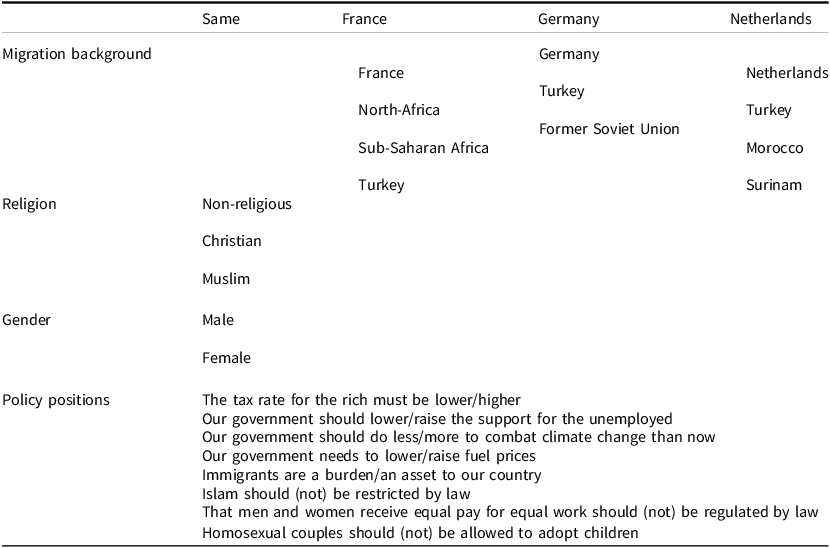
See Table 2 for the full list of randomised attributes and values that made up the profiles of the politicians. After presenting two politicians I asked the respondent: ‘which politician are you most likely to vote for?’ See Image 1 for an example. I repeated this three times, resulting in six profile-views per respondent. The dependent variable in this study is also known as a forced-choice question, in which respondents are asked to choose one of two politicians. In real-world elections, however, individuals can abstain from voting, and evidence suggests that when faced with a co-partisan female candidate, sexist voters often do so (Shorrocks et al., Reference Shorrocks, Ralph-Morrow and de Geus2025). Forced-choice questions therefore have the disadvantage of omitting this nuance. At the same time, they offer the advantage of producing slightly more pronounced results in contexts where respondents might otherwise prefer to avoid giving any answer at all. The survey also included rating questions for the politician profiles, allowing respondents to assign a score on a 0–10 scale. Van Oosten (Reference van Oosten2025c) compares the results from the forced-choice and rating questions, showing that the findings are largely consistent across the two measures.

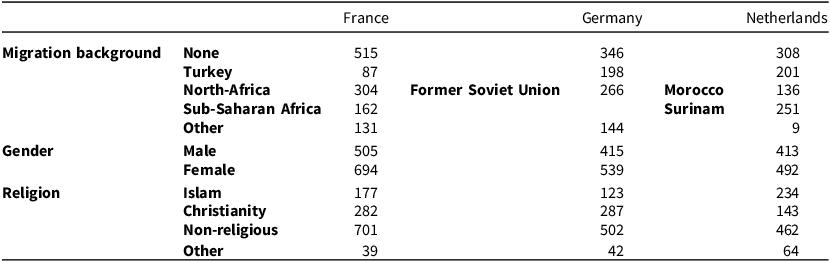
I measured religion as the final variable to measure, as it is typically considered an exogenous variable that is less likely to change based on the preceding questions, by asking: “Do you consider yourself as belonging to any particular religion or denomination? [yes/no]”, with answering “yes” being asked “Which one? [Christian, Muslim, Hindu, Buddhist, Jewish, Other, [specify].” The wording is in line with the standard questions on religious affiliation from the European Social Survey. Interestingly, a relatively high number of respondents from Muslim-majority countries indicated that they are non-religious (see Table 1). This pattern may, at least in part, reflect the wording of the religion question rather than genuine levels of non-religiosity. The phrasing “Do you consider yourself as belonging to any particular religion or denomination?” may have led some respondents to interpret “belonging” as formal membership or active participation in a religious institution, rather than personal belief. As a result, individuals who identify culturally or personally with Islam but do not practice regularly might have chosen the “no” option. Kantar had already gathered data on respondents’ gender (see all survey questions in van Oosten, Reference van Oosten2025b).
Distribution of respondents by migration background, gender, and religion across countries

Overview of attributes and levels used in the experimental profiles

I analyse and present the data using marginal means because I compare different subgroups and wish to avoid confusing readers with different reference categories (Leeper et al., Reference Leeper, Hobolt and Tilley2019). I present voting likelihoods, meaning that a statistically significant finding does not equal majority preference for that attribute, but that an individual is more likely to vote for a politician with that attribute (Abramson et al., Reference Abramson, Kocak and Magazinnik2022). When the outcomes are consistent in all three countries, I present visuals of the pooled data, with separate visuals for each country in online Appendix 2. When I make statements about the general population, I use population weights to weight down the impact of respondents with a migration background to the proportion they are in the population. In all analyses, I cluster the standard errors at the level of the respondent. I prepared the data using R-package ‘tidyr’ (Wickham, Reference Wickham2020), analysed it using marginal means with R-package ‘cregg’ (Leeper & Barnfield, Reference Leeper and Barnfield2020) and linear models using ‘miceadds’ (Robitzsch et al., Reference Robitzsch, Grund and Henke2021), and visualised it with R-package ‘ggplot2’ (Wickham et al., Reference Wickham, Chang, Henry, Pedersen, Takahashi, Wilke, Woo, Yutani and Dunnington2020). I pre-registered the hypotheses at Open Science Framework (van Oosten, Reference van Oosten2020).
Analysis: confirmatory and exploratory analyses
To what extent does sharing the same religion, migration background and gender versus policy positions impact voting? To answer this question, I systematically examine each of the pre-registered hypotheses, and I supplement these analyses with additional exploratory ones. In general, voters are most likely to prefer politicians with whom they share the same policy position (H2), instead of politicians with whom they share the same identity (H1abc). However, when running subgroup-analyses, I find that some groups are more likely to engage in affinity voting than others. I observe affinity voting based on religious and migration backgrounds, but not on gender. First (H1a), I discuss how voter and politician migration background impacts voting. Second (H1b), the influence of sharing the same religious affiliation on voting decisions. Third (H1c), the impact of sharing the same gender on voting. Fourth (H2), I analyse how voters evaluate politicians with whom they do and do not agree. Finally, I present exploratory analyses in which I study how affinity with policy versus identity impact voting. I conclude that non-religious voters are the most likely to engage in affinity voting and prefer their own group, sometimes compared to Christian politicians, but especially Muslim politicians. They do so even when they share the same policy positions, but especially when they differ in their policy positions: non-religious voters punish Muslim politicians more than their in-group.
Confirmatory analyses
Figure 1 (see online Appendix 2 for subgroup analyses; for all full model results, see Appendix 5, for sample sizes, see Table 1) depicts the testing of hypothesis H1a, which posits that respondents from racial/ethnic minority groups exhibit a preference for politicians from the same group. Using migration background as a proxy for minority status, I find no evidence to support this hypothesis. In other words, none of the voter groups with migration backgrounds displayed a significant preference for politicians from their own background over those from different backgrounds (see Appendix 2a for an overview of each subgroup). This result is consistent across all three countries, as shown in Appendix 2a as well. None of the migration background subgroups showed a statistically significant preference for their own group. Accordingly, I do not reject the H0 for hypothesis H1a.
Voting likelihood by whether voter or politician have a migration background.

Figure 1 (for all full model results, see Appendix 5, for sample sizes, see Table 1) highlights the most striking outcome. When combining all subsets of voters with and without a migration background and comparing the likelihood of voting for politicians with or without a migration background, I find that voters with migration backgrounds exhibit a significantly higher voting likelihood for politicians without migration backgrounds (54%) than for politicians with (49%). This points towards out-group affinity voting, and as far as I know, this is a phenomenon that is not yet documented in the literature.
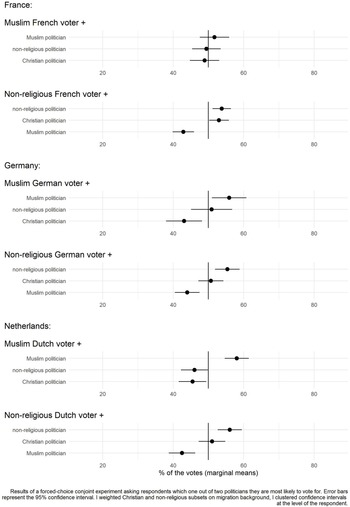
Figure 2 (for all full model results, see Appendix 5, for sample sizes, see Table 1) illustrates the results of hypothesis H1b., which contends that Muslim respondents prefer Muslim politicians over non-religious and Christian politicians. This hypothesis receives support only in the Netherlands, where Muslim voters demonstrate a significantly higher likelihood of voting for a Muslim politician (58%) than for a Christian (45%) or non-religious politician (46%). In France and Germany, however, I do not reject the H0 for this hypothesis. In France, Muslim voters exhibit nearly identical levels of support for Muslim, Christian and non-religious politicians. In Germany, Muslim voters prefer Muslim politicians (56%) over Christian politicians (43%), with non-religious politicians occupying an intermediary position between the two.
Voting likelihood when voter and politician share the same religion.

Figure 2 also shows the voting preferences of non-religious voters in France, Germany, and the Netherlands. In France, non-religious voters exhibit no significant difference in voting likelihood between non-religious (58%) and Christian (58%) politicians, despite the strong separation of Church and State and the absence of Christian parties. However, they are significantly less likely to vote for Muslim politicians (43%). In Germany and the Netherlands, non-religious voters are most likely to vote for non-religious politicians (55% and 56% respectively) and least likely to vote for Muslim politicians (44% and 42% respectively), with Christian politicians occupying an intermediary position (51% in both countries).
Additional analyses reveal that, across the three countries, non-religious voters are slightly more likely to prefer their in-group and to dislike the Muslim out-group, see Appendix 4. Despite the high effect sizes observed for Muslims’ in-group preferences, the effect sizes were larger for non-religious voters, and non-significant for Muslim voters who vote for non-religious politicians. In other words, non-religious voters, rather than their Muslim counterparts, are slightly more inclined to engage in affinity voting.
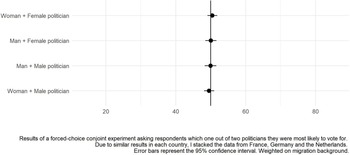
Figure 3 (for all full model results, see Appendix 5, for sample sizes, see Table 1) shows the testing of hypothesis H1c in which I state that women prefer female to male politicians. Contrary to the hypothesis, neither male nor female voters exhibit a significant preference for man or woman politicians. Therefore, I do not reject the H0 for hypothesis H1c. This result is consistent across all three countries, as shown in Appendix 2b. In the figure below, I therefore present stacked data from France, Germany, and the Netherlands. I conducted additional analyses to investigate whether there were any intersectional effects of migration background, religion with gender, but I found no consistent evidence for such effects (van Oosten, Reference van Oosten2025c).
Voting likelihood when voter and ploitician share the same gender.

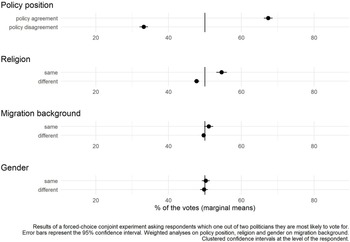
Figure 4 (for all full model results, see Appendix 5, for sample sizes, see Table 1) presents the outcomes of hypothesis H2, which examines whether respondents prefer politicians with similar policy positions or similar descriptive characteristics. The weighted outcomes show that policy agreement is more important to voters than sharing similar descriptive characteristics, by far. Therefore, I accept hypothesis H2. Voter have a 67% probability of voting for a politician when they share their policy stance, against 33% when they do not. Although sharing the same religion is also important to voters, policy positions are the most important by far, and Appendix 2c shows that this is consistent across countries. Irrespective of which religion, sharing the same religion leads to a voting likelihood of 55%, while not sharing the same religion reduces the likelihood to 48%. Sharing the same migration background and gender or not does not reveal any statistically significant differences.
Voting likelihood when voter and politician share the same.

Exploratory analyses
So far, the analyses have tested the extent to which voters engage in affinity voting apart from policy voting. The results show that there is little affinity voting on average, though non-religious voters prefer voting for non-religious politicians and, in the Netherlands, Muslims prefer voting for Muslims. Policy voting is the most impactful predictor of vote choice. Given these findings, the exploratory analyses zoom in on the interaction between shared religion and shared policy.
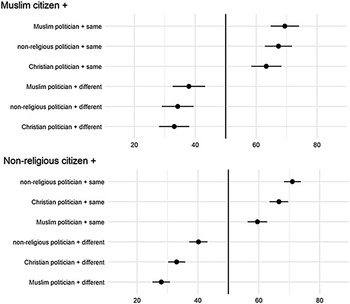
Figure 5 shows what voters choose when confronted with both the same religion and the same policy, different religion and same policy, same religion and different policy and different religion and different policy, focusing on the groups with the biggest differences: non-religious and Muslim voters. Figure 5 shows that Muslim voters’ preference for Muslim politicians is not significant when politician and voter both agree nor when they disagree. This is different for non-religious voters. Even when a non-religious voter and a Muslim politician share the same policy position, they prefer the non-religious politician over the Muslim politician, comfortably passing the test of significance. When they disagree, the non-religious voter is even more likely to prefer their own group, even over Christian politicians, and especially over Muslim politicians. Appendix 6 shows that non-religious voters are most likely to be biased against Muslim politicians when they disagree on immigration and gender equality issues.
Policy or religion?

Conclusion and discussion: disidentification and the consequences of silenced Muslims
Voters tend to engage much more in policy voting than affinity voting. Despite policy voting being most prevalent, this paper shows some religious affinity voting and out-group affinity voting for respondents with a migration background, while there is absolutely no gender affinity effect to be detected in these findings. Religious affinity voting shows itself in two ways: First, Muslim voters in the Netherlands, and to a lesser extent Germany, favour Muslim politicians over non-religious politicians, but this pattern does not appear in France at all. Second, non-religious voters consistently prefer their in-group across all three countries. Interestingly, voters with a migration background tend to align more with politicians without a migration background, i.e., out-group affinity voting? This research challenges the assumption that affinity voting is mainly a feature of marginalised groups. The most striking finding is that non-religious voters are the most prone to affinity voting, showing a strong preference for their in-group over Muslim politicians. Non-religious politicians are significantly less likely to support Muslim politicians, even when policy views align. When policy positions diverge, Muslim politicians still face the greatest penalties, though Christian politicians are also disadvantaged in these cases.
The finding that affinity voting is only consistently observed among non-religious voters challenges the notion that this behaviour stems from affinity. Rather than affinity or identification, it appears more likely that disidentification with the out-group (Muslims) is driving non-religious voters to favour their own group (López Ortega and Turnbull-Dugarte, Reference Ortega and Turnbull-Dugarte2025). Antipathy towards, and even mere associations with, Muslims lies at the heart of this lack of support and mere mention that a policy is supported by Muslims deters people from those policies (idem). In line with previous findings, my analyses show that even within a context in which policy voting is much more important than affinity voting and even when policy positions are held constant, non-religious voters consistently disidentify (idem) from Muslim politicians. Given this situation, it is unsurprising that Muslim politicians distance themselves from their in-group (Aydemir and Vliegenthart, Reference Aydemir and Vliegenthart2016, Reference Aydemir and Vliegenthart2022) in order to broaden their electoral appeal, a proven successful electoral strategy termed Broadstancing (van Oosten and Aydemir, Reference van Oosten and Aydemir2026).
Meanwhile, there is very little support for affinity voting amongst minority groups. Only Muslims in the Netherlands clearly prefer fellow Muslim politicians, while this is less so in Germany and not at all the case in France. A reason for this difference between France and Germany on the one hand and the Netherlands on the other, could be that the Netherlands has historically seen comparatively high levels of Muslim representation (Aktürk and Katliarou, Reference Aktürk and Katliarou2021; Hughes, Reference Hughes2016), as there is a political party in the Netherlands that consists of Muslim parliamentarians from Turkey and Morocco who advocate for Muslim rights, DENK (Loukili, Reference Loukili2021a, Reference Loukili2021b; Otjes and Krouwel, Reference Otjes and Krouwel2019; van Oosten et al., Reference van Oosten, Mügge, Hakhverdian and van der Pas2024b; Vermeulen et al., Reference Vermeulen, Harteveld, van Heelsum and van der Veen2020) and Muslim voters in the Netherlands are, therefore, more accustomed to Muslim politicians with whom they share the same policy positions. Explicitly practising Muslim politicians are very uncommon in national parliaments outside of the Netherlands (Aktürk and Katliarou, Reference Aktürk and Katliarou2021, 392, 393). More often, however, politicians of Muslim origin make a point of showing their commitment to the countries they live in (Dancygier, Reference Dancygier2017, 179) or be explicitly outspoken against Islam (what Korteweg and Yurdakul, Reference Korteweg and Yurdakul2021 call “codebreakers”).
Irrespective of the policy positions that Muslim politicians have, there are few Muslim politicians who openly profess being Muslim (Aktürk and Katliarou, Reference Aktürk and Katliarou2021), making those who do “rare and thus attention-grabbing” (Petsko et al., Reference Petsko, Rosette and Bodenhausen2022, 5). In this experiment, I explicitly stated whether a politician “practices Islam” or “does not practice any religion,” possibly creates a lack of information equivalence between non-religious and Muslim voters (Dafoe et al., Reference Dafoe, Zhang and Caughey2018). Contrary to the information voters read into a politician who “practices Islam”, voters may not necessarily associate any policy positions with politicians who “do not practice any religion,” potentially leading to heuristics based on projection instead of stereotyping, with more favourable outcomes for politicians who the respondent projected their own policy positions onto (van Oosten, Reference van Oosten2022).
The finding that voters with a migration background are more likely to vote for politicians without than with a migration background warrants further discussion. This finding is supported by Social Identity Theory’s assertion that in-group favouritism is more likely to occur in high-status groups than in low-status groups, contradicting popular notions that suggest otherwise (Tajfel and Turner, Reference Tajfel, Turner, Austin and Worchel1979, 36). I argue that voters with a migration background aligning themselves with high-status out-groups reflects a ‘social mobility belief system,’ as described by Social Identity Theory (Haslam, Reference Haslam2001, 25). This belief system implies that group boundaries are permeable, and individuals can attain mobility and access high-status groups. As a result, voters with a migration background tend to reject politicians who share perceived low-status group membership and instead prefer those with French, German, and Dutch backgrounds.
The general suspicion against Muslim politicians, as well as politicians with a migration background in some cases, shapes the dynamics in which minority politics unfolds. Extant literature suggests that party selectors face challenges when promoting diversity and inclusion of Muslim politicians on their party list (Dancygier, Reference Dancygier2017). They aim to attract voters who value diversity and inclusion, but are cautious about candidates who may come across as “beholden” to their group (Stephens-Dougan, Reference Stephens-Dougan2020). This leads to avoidance of any suspicion of clientelism in the best-case (Mugglin et al., Reference Mugglin, Murahwa and Ruedin2025) and ‘suppressive representation’ in the worst (Aydemir and Vliegenthart, Reference Aydemir and Vliegenthart2016). Because Muslim politicians are incentivised to distance themselves from Muslims (van Oosten and Aydemir, Reference van Oosten and Aydemir2026), many Muslim voters are confronted with in-group members doing so, which, in turn, contributes to feelings of betrayal and misrepresentation (Akachar et al., Reference Akachar, Celis and Severs2017; de Jong, Reference de Jong2025). Most importantly, when the voices of Muslim politicians are needed more than ever, in the face of a genocide western nations have supported, valuable insights run the risk of not being heard, leading to severe consequences.
Supplementary material
The supplementary material for this article can be found at https://doi.org/10.1017/S1755773926100393.
Data availability statement
-
1. The datasets, ethics approval, and research accountability are publicly available online here: https://doi.org/10.17605/OSF.IO/RF632
-
2. All code, images and online appendix are available here: https://osf.io/sgfnv/overview?view_only=2bbdfa1afc924a538cd4913c6d001dd7
Acknowledgements
I am greatly indebted to Floris Vermeulen, Liza Mügge, Armen Hakhverdian and Daphne van der Pas for their support throughout the process of writing this paper.
Funding statement
This research has been funded by Dr. Liza Mügge’s NWO-VIDI grant [Grant number 016.Vidi.175.355]
Competing interests
None.
Ethical standards
The studies were conducted in compliance with relevant laws and were approved by the appropriate institutional and/or national research ethics committee. If interested in confirming the ethics approval in the appendix please put in a request at the Academic Institute for Social Science Research (AISSR) – Tel: +31(0)20-525 2262 - Email: aissr@uva.nl – ERB number 2018-AISSR-9546 – Review carried out by Alix Nieuwenhuis.



 Open access

