





1. Introduction
In a magnetic confinement device, such as those used for fusion reactors, particles typically experience fast helical motion along magnetic field lines. These motions then form closed periodic orbits, sometimes with precession around an angular coordinate. For modelling many macroscopic phenomena that occur on relatively slow time scales compared with the orbit time scale, it is much more efficient to average the effect of the process over the orbit, rather than to solve the full equations of motion for the orbit, as this involves a much slower time scale calculation in fewer dimensions. This simplification is the basis for bounce-averaged Fokker–Planck (BAFP) theory, which can be used to model collisional transport (Rosenbluth, MacDonald & Judd Reference Rosenbluth, MacDonald and Judd1957; Hager et al. Reference Hager, Yoon, Ku, D’Azevedo, Worley and Chang2016), quasilinear wave–particle interactions (Stix Reference Stix1975; Bernstein & Baxter Reference Bernstein and Baxter1981; Fisch Reference Fisch1987; Fisch & Rax Reference Fisch and Rax1992; Eriksson & Helander Reference Eriksson and Helander1994; Herrmann & Fisch Reference Herrmann and Fisch1997; Herrmann Reference Herrmann1998), and radiation emission (Bilbao & Silva Reference Bilbao and Silva2023; Zhdankin, Kunz & Uzdensky Reference Zhdankin, Kunz and Uzdensky2023) and absorption (Ochs, Mlodik & Fisch Reference Ochs, Mlodik and Fisch2024; Ochs Reference Ochs2024) in tokamak (Harvey & McCoy Reference Harvey and McCoy1992), stellarator (Mynick & Hitchon Reference Mynick and Hitchon1986; Nemov et al. Reference Nemov, Kasilov, Kernbichler and Heyn1999; Velasco et al. Reference Velasco, Calvo, Parra and García-Regaña2020; d’Herbemont et al. Reference d’Herbemont, Parra, Calvo and Velasco2022) and mirror (BenDaniel & Allis Reference BenDaniel and Allis1962; Marx Reference Marx1970; Matsuda & Stewart Reference Matsuda and Stewart1986; Egedal et al. Reference Egedal, Endrizzi, Forest and Fowler2022; Frank et al. Reference Frank2024) plasmas.
Each closed orbit is associated with conserved constants of motion (COMs) in a lower dimensional space. For instance, the energy $\epsilon$
, magnetic moment
$\epsilon$
, magnetic moment $\mu$
and azimuthal momentum
$\mu$
and azimuthal momentum $p_\theta$
form the typical COMs for a steady-state axisymmetric magnetic field arrangement such as a tokamak or magnetic mirror. Since they are constant on each averaged trajectory, the COMs represent a natural coordinate system for solving BAFP problems. Thus, the first step is often to express the distribution function as a function only of the constants of motion
$p_\theta$
form the typical COMs for a steady-state axisymmetric magnetic field arrangement such as a tokamak or magnetic mirror. Since they are constant on each averaged trajectory, the COMs represent a natural coordinate system for solving BAFP problems. Thus, the first step is often to express the distribution function as a function only of the constants of motion $\boldsymbol{Z}$
, averaging over trajectories that differ only by the phase of the motion.
$\boldsymbol{Z}$
, averaging over trajectories that differ only by the phase of the motion.
This procedure often works well for simple field arrangements without local maxima in the fields. However, it runs into a problem if there are local maxima. Consider, for instance, particles in the one-dimensional (1-D) double well potential $\psi (x)$
shown in figure 1. This 1-D arrangement (with its associated two-dimensional (2-D) phase space) has the constant of motion
$\psi (x)$
shown in figure 1. This 1-D arrangement (with its associated two-dimensional (2-D) phase space) has the constant of motion $\epsilon = m v^2/2 + \psi (x)$
. For particles with energy
$\epsilon = m v^2/2 + \psi (x)$
. For particles with energy $\epsilon \gt \psi _0$
, the value of
$\epsilon \gt \psi _0$
, the value of $\epsilon$
defines a single trajectory shape that traverses both positive and negative
$\epsilon$
defines a single trajectory shape that traverses both positive and negative $x$
, and there is no problem defining
$x$
, and there is no problem defining $f(x,v) \rightarrow f(\epsilon )$
to average slow processes over the bounce motion. However, for
$f(x,v) \rightarrow f(\epsilon )$
to average slow processes over the bounce motion. However, for $\epsilon \lt \psi _0$
, the value of
$\epsilon \lt \psi _0$
, the value of $\epsilon$
no longer contains complete information about the trajectory, which bifurcates into two trajectories: one trapped in the well at
$\epsilon$
no longer contains complete information about the trajectory, which bifurcates into two trajectories: one trapped in the well at $x \gt 0$
and the other trapped in the well at
$x \gt 0$
and the other trapped in the well at $x \lt 0$
. Since the occupancy of each well can, in general, be different, the function
$x \lt 0$
. Since the occupancy of each well can, in general, be different, the function $f(\epsilon )$
is no longer well defined.
$f(\epsilon )$
is no longer well defined.
Multiple wells, however, do not mean that BAFP cannot be used to model multi-well configurations. The resolution lies in splitting the space into three domains, representing: (i) the passing trajectories at $\epsilon \gt \psi _0$
; (ii) the trajectories trapped in the left well; and (iii) the trajectories trapped in the right well. Boundary conditions (Matsuda & Stewart Reference Matsuda and Stewart1986; d’Herbemont et al. Reference d’Herbemont, Parra, Calvo and Velasco2022) then must be enforced between the domains to ensure continuity of the distribution function and particle conservation.
$\epsilon \gt \psi _0$
; (ii) the trajectories trapped in the left well; and (iii) the trajectories trapped in the right well. Boundary conditions (Matsuda & Stewart Reference Matsuda and Stewart1986; d’Herbemont et al. Reference d’Herbemont, Parra, Calvo and Velasco2022) then must be enforced between the domains to ensure continuity of the distribution function and particle conservation.
A one-dimension double well scalar potential $\psi (x)$
. The energy
$\psi (x)$
. The energy $\epsilon$
uniquely defines a single trajectory for
$\epsilon$
uniquely defines a single trajectory for $\epsilon \gt \psi _0$
. However, at
$\epsilon \gt \psi _0$
. However, at $\epsilon \lt \psi _0$
, there are two trajectories that have the same
$\epsilon \lt \psi _0$
, there are two trajectories that have the same $\epsilon$
, corresponding to trapping in the two wells. Thus, the function
$\epsilon$
, corresponding to trapping in the two wells. Thus, the function $f(\epsilon )$
is not necessarily well defined below
$f(\epsilon )$
is not necessarily well defined below $\epsilon =\psi _0$
.
$\epsilon =\psi _0$
.

These bifurcations of trajectories are common in mirror physics and the solution of their associated BAFP problems has appeared several times in the study of tandem mirrors (Cohen et al. Reference Cohen, Bernstein, Dorning and Rowlands1980; Matsuda & Stewart Reference Matsuda and Stewart1986; Katanuma et al. Reference Katanuma, Kiwamoto, Ishii and Miyoshi1986, Reference Katanuma, Kiwamoto, Sawada and Miyoshi1987; Fowler, Moir & Simonen Reference Fowler, Moir and Simonen2017), which are characterised by internal peaks in both the magnetic field and electric potential around the tandem end plugs. However, in solving these problems, the boundary conditions were typically imposed by hand for very specifically shaped fields, and were only ever attemped in two dimensions. In moving to three-dimensional (3-D) computational modelling of modern mirrors, with fields that can be significantly more complicated due to sloshing ion distributions (Egedal et al. Reference Egedal, Endrizzi, Forest and Fowler2022; Endrizzi et al. Reference Endrizzi2023; Frank et al. Reference Frank2024), multi-mirror configurations (Be’ery et al. Reference Be’ery, Gertsman and Seeman2018; Miller, Be’ery & Barth Reference Miller, Be’ery and Barth2021), ponderomotive plugs (Miller et al. Reference Miller, Be’ery, Gudinetsky and Barth2023; Rubin, Rax & Fisch Reference Rubin, Rax and Fisch2023; Ochs & Fisch Reference Ochs and Fisch2023; Rubin, Ochs & Fisch Reference Rubin, Ochs and Fisch2024; Kolmes & Fisch Reference Kolmes and Fisch2024; Rubin & Fisch Reference Rubin and Fisch2025; Ochs, Kolmes & Fisch Reference Ochs, Kolmes and Fisch2025) or centrifugal forces (Bekhtenev et al. Reference Bekhtenev, Volosov, Pal’chikov, Pekker and Yudin1980; Cho et al. Reference Cho2005; Schwartz et al. Reference Schwartz, Abel, Hassam, Kelly and Romero-Talamás2024; Kolmes, Ochs & Fisch Reference Kolmes, Ochs and Fisch2025), determining the domains by hand at the beginning of the simulation may be difficult or impossible. Furthermore, while modern codes for neoclassical transport in stellarators (Nemov et al. Reference Nemov, Kasilov, Kernbichler and Heyn1999; Velasco et al. Reference Velasco, Calvo, Parra and García-Regaña2020) solve similar multi-well matching problems, they generally assume that the electrostatic potential is constant enough on a trajectory to not influence the trapping condition, which is distinctly untrue for mirror plasmas. Thus, it is important to formalise conditions and methods for establishing solution domains for arbitrarily complicated and arbitrarily high-dimensional multi-well BAFP problems, with wells that result from variations in both the magnetic field and electric potential. Establishing these conditions, particularly for mirror-like plasmas, is the goal of this paper.
To fulfil this goal, we begin in §2, by reviewing the basics of BAFP theory. In §3, we show how trajectories bifurcate for common mirror configurations, establishing notation and motivating the need for a general method to identify consistent domains. In §4, we formalise the requirements for establishing consistent domains and show how to fully partition COM space $\boldsymbol{Z}$
so that the distribution
$\boldsymbol{Z}$
so that the distribution $f(\boldsymbol{Z})$
is single-valued and well defined. In §5, we establish the boundary conditions between these domains, allowing BAFP to be solved in the global space despite an arbitary number of trajectory bifurcations. Because these boundary conditions can be complicated, with different domains matched at different parts of the boundary, in §6, we show how the connections between the various domains can be simply visualised via a directed graph. Finally, in §7, we discuss how these ideas enable the design of simulations for dynamically evolving multi-well plasma systems.
$f(\boldsymbol{Z})$
is single-valued and well defined. In §5, we establish the boundary conditions between these domains, allowing BAFP to be solved in the global space despite an arbitary number of trajectory bifurcations. Because these boundary conditions can be complicated, with different domains matched at different parts of the boundary, in §6, we show how the connections between the various domains can be simply visualised via a directed graph. Finally, in §7, we discuss how these ideas enable the design of simulations for dynamically evolving multi-well plasma systems.
2. Bounce-averaged theory in COM coordinates
Here, we briefly review the basics of BAFP theory. We move quickly, with a primary focus on magnetic mirror geometries.
In a magnetic mirror, whether simple, tandem or centrifugal, particles in the mirror live on trapped trajectories. On the shortest time scale, the gyroperiod $1/\varOmega _c$
, the particle gyrates around the magnetic field line. On the next longest time scale, the bounce period
$1/\varOmega _c$
, the particle gyrates around the magnetic field line. On the next longest time scale, the bounce period $\tau _b \sim L_\parallel / v_\parallel$
, the particle transits the mirror, completing a closed orbit.
$\tau _b \sim L_\parallel / v_\parallel$
, the particle transits the mirror, completing a closed orbit.
Absent instabilities, particle deconfinement in such mirrors occurs due to collisional processes. Thus, on a collision time scale $\tau _c \gg \tau _b, 1/\varOmega _c$
, collisions push the particle onto new orbits. Eventually, the particle is pushed onto an orbit that leaves the device.
$\tau _c \gg \tau _b, 1/\varOmega _c$
, collisions push the particle onto new orbits. Eventually, the particle is pushed onto an orbit that leaves the device.
Obviously, it is inefficient (whether analytically or computationally) to resolve the gyroperiod, bounce time scales and complex trajectories when evaluating the slower diffusion processes that drive particles out of the device. Suitably averaging over these fast time scales to produce a lower-dimensional set of equations describing these slow processes is the goal of BAFP.
The first step in deriving the theory is to transform to coordinates that are constant along a trajectory. For an axisymmetric, non-relativistic plasma, a suitable set of COMs are:
 $$\begin{align}\mu &\equiv \frac {1}{2} \frac {m v_\perp ^2}{B(\boldsymbol{x})},\end{align}$$
 $$\begin{align}\epsilon &\equiv \frac {1}{2} m v_\parallel ^2 + \mu B(\boldsymbol{x}) + \psi (\boldsymbol{x}),\end{align}$$
 $$\begin{align}p_\theta &\equiv m \varOmega _r r + q \varPhi (\boldsymbol{x}).\end{align}$$
Here, $\mu$
is the magnetic moment of the particle,
$\mu$
is the magnetic moment of the particle, $\epsilon$
is the energy and
$\epsilon$
is the energy and $p_\theta$
is the azimuthal momentum. Additionally,
$p_\theta$
is the azimuthal momentum. Additionally, $v_\parallel$
and
$v_\parallel$
and $v_\perp$
are the velocity components parallel and perpendicular to the magnetic field,
$v_\perp$
are the velocity components parallel and perpendicular to the magnetic field, $\varOmega _r(\varPhi )$
is the rotation frequency of the magnetic surface, and
$\varOmega _r(\varPhi )$
is the rotation frequency of the magnetic surface, and $q$
and
$q$
and $m$
are the charge and mass of the particle. The potential energy term
$m$
are the charge and mass of the particle. The potential energy term $\psi$
is given by
$\psi$
is given by
 \begin{align} \psi = q \phi _\parallel + \frac {1}{2} m r^2 \varOmega _r^2 ,\end{align}
where $\phi _\parallel$
is a potential coordinate along the flux surface (Kolmes et al. Reference Kolmes, Ochs, Rax and Fisch2024). Finally,
$\phi _\parallel$
is a potential coordinate along the flux surface (Kolmes et al. Reference Kolmes, Ochs, Rax and Fisch2024). Finally, $\varPhi$
is the flux function, given by
$\varPhi$
is the flux function, given by
 \begin{align} \varPhi = r A_\theta . \end{align}
In looking at $p_\theta$
, note that the ratio of the first term to the second is given by
$p_\theta$
, note that the ratio of the first term to the second is given by
 \begin{align} \frac {m \varOmega _r }{q A_\theta } \sim \frac {\varOmega _r}{\varOmega _c}, \end{align}
i.e. $p_\theta$
conservation implies that particles stay on their flux surface for particles far from the Brillouin limit (Rax et al. Reference Rax, Fruchtman, Gueroult and Fisch2015). We assume in the following that we are in this regime, taking
$p_\theta$
conservation implies that particles stay on their flux surface for particles far from the Brillouin limit (Rax et al. Reference Rax, Fruchtman, Gueroult and Fisch2015). We assume in the following that we are in this regime, taking $\varPhi$
as the third COM in place of
$\varPhi$
as the third COM in place of $p_\theta$
.
$p_\theta$
.
To reach our six dimensions of phase space, we need three other variables. These we take to be the azimuthal angle $\theta$
, the gyro-angle
$\theta$
, the gyro-angle $\alpha$
and the distance along a field line
$\alpha$
and the distance along a field line $s$
. These variables
$s$
. These variables $(\theta ,\alpha ,s)$
are the variables we will integrate out to form the bounce-averaged theory. Integrating out
$(\theta ,\alpha ,s)$
are the variables we will integrate out to form the bounce-averaged theory. Integrating out $\alpha$
is the basis for gyro or drift kinetics; integrating out
$\alpha$
is the basis for gyro or drift kinetics; integrating out $\theta$
makes the theory axisymmetric and integrating out
$\theta$
makes the theory axisymmetric and integrating out $s$
results in the bounce average.
$s$
results in the bounce average.
Now, in general, we will start with an equation of the form:
 \begin{align} \sqrt {g_X} \frac {\partial f}{\partial t} = \frac {\partial }{\partial X^i} \left [ \sqrt {g_X} \, \Gamma _X^i (f,\boldsymbol{X})\right ] + \sqrt {g_X} S(\boldsymbol{X}) , \end{align}
where $\Gamma ^i(f,\boldsymbol{X})$
is a flux operator,
$\Gamma ^i(f,\boldsymbol{X})$
is a flux operator, $S(\boldsymbol{X})$
is a source operator and
$S(\boldsymbol{X})$
is a source operator and $\sqrt {g_X}$
is the volume element in the space
$\sqrt {g_X}$
is the volume element in the space $\boldsymbol{X} \equiv (\boldsymbol{x},\boldsymbol{p})$
. This equation is in conservation form; integrating the left-hand side gives the total change in particle number in a given region, while the first term on the right-hand side reduces to a surface integral of the flux out of the region.
$\boldsymbol{X} \equiv (\boldsymbol{x},\boldsymbol{p})$
. This equation is in conservation form; integrating the left-hand side gives the total change in particle number in a given region, while the first term on the right-hand side reduces to a surface integral of the flux out of the region.
To get our bounce-averaged Fokker–Planck equation, we first need to convert to the six-dimensional (6-D) space $\boldsymbol{Y}$
that contains the COMs, i.e.
$\boldsymbol{Y}$
that contains the COMs, i.e. $\boldsymbol{Y} \equiv (\epsilon ,\mu ,\varPhi ,\theta ,\alpha ,s)$
. Because the metric in phase space
$\boldsymbol{Y} \equiv (\epsilon ,\mu ,\varPhi ,\theta ,\alpha ,s)$
. Because the metric in phase space $\boldsymbol{X} \equiv (\boldsymbol{x},\boldsymbol{v})$
is
$\boldsymbol{X} \equiv (\boldsymbol{x},\boldsymbol{v})$
is $g_{ij} = \delta _{ij}$
, corresponding to a unit volume element, the volume element
$g_{ij} = \delta _{ij}$
, corresponding to a unit volume element, the volume element $\boldsymbol{\mathbf{d}V} =\sqrt {g_Y} \boldsymbol{\mathbf{d}Y}$
in the new coordinates is
$\boldsymbol{\mathbf{d}V} =\sqrt {g_Y} \boldsymbol{\mathbf{d}Y}$
in the new coordinates is
 \begin{align} \sqrt {g_Y} = 2\sqrt {\left | \frac {\partial X^m}{\partial Y^i} \frac {\partial X^n}{\partial Y^j} \delta _{ij} \right | } = \frac {\sqrt {2}}{m^{3/2}\sqrt {\epsilon - \mu B - \psi }}. \end{align}
Here, the factor of 2 comes from the fact that positive and negative $v_\parallel$
are condensed into the same portion of COM space. We also convert the flux
$v_\parallel$
are condensed into the same portion of COM space. We also convert the flux $\Gamma$
to
$\Gamma$
to $Y$
space. For instance, for a Fokker–Planck flux operator:
$Y$
space. For instance, for a Fokker–Planck flux operator:
 \begin{align} \Gamma ^i_X = A_X^i f + D_X^{ij} \frac {\partial f}{\partial X^j}, \end{align}
we take
 \begin{align} \Gamma ^i_Y = \frac {\partial Y^i}{\partial X^m} A_X^m f + \frac {\partial Y^i}{\partial X^m} \frac {\partial Y^j}{\partial X^n}D_X^{mn} \frac {\partial f}{\partial Y^j}, \end{align}
Now, we assume that $f$
is independent of
$f$
is independent of $(\theta ,\alpha ,s)$
, i.e. take
$(\theta ,\alpha ,s)$
, i.e. take $f(Z)$
,
$f(Z)$
, $\boldsymbol{Z} \equiv (\epsilon ,\mu ,\varPhi )$
. Then, we integrate the Fokker-Planck equation over the non-COM coordinates in
$\boldsymbol{Z} \equiv (\epsilon ,\mu ,\varPhi )$
. Then, we integrate the Fokker-Planck equation over the non-COM coordinates in $\boldsymbol{Y}$
. The integrals over
$\boldsymbol{Y}$
. The integrals over $\theta$
and
$\theta$
and $\alpha$
are trivial, leading to two factors of
$\alpha$
are trivial, leading to two factors of $2\pi$
. The integral over
$2\pi$
. The integral over $s$
is more non-trivial, but results in
$s$
is more non-trivial, but results in
 \begin{align} \sqrt {g_Z} \frac {\partial f}{\partial t} = \frac {\partial }{\partial Z^i} \left ( \sqrt {g_Z} \, \Gamma ^i (f,\boldsymbol{Z})\right ) + \sqrt {g_Z} S_Z(\boldsymbol{Z}) , \end{align}
where
 $$\begin{align}\sqrt {g_Z} &\equiv 4 \pi ^2 \int _{s_1}^{s_2}\, {\rm d}s \sqrt {g_Y},\end{align}$$
 $$\begin{align}\Gamma _Z^i &\equiv \frac {1}{\sqrt {g_Z}} \int _{s_1}^{s_2}\, {\rm d}s \sqrt {g_Y} \, \Gamma ^i_Y ,\end{align}$$
 $$\begin{align}S_Z &\equiv \frac {1}{\sqrt {g_Z}} \int _{s_1}^{s_2}\, {\rm d}s \sqrt {g_Y} S_Y,\end{align}$$
and where $s_1$
and
$s_1$
and $s_2$
are the two outer limits of the orbit.
$s_2$
are the two outer limits of the orbit.
Noting that $v_\parallel (s) = \sqrt {2 (\epsilon - \mu B(s) - \psi (s) )/ m }$
, we see that the volume element
$v_\parallel (s) = \sqrt {2 (\epsilon - \mu B(s) - \psi (s) )/ m }$
, we see that the volume element $\sqrt {g_Z}$
is proportional to the total bounce time
$\sqrt {g_Z}$
is proportional to the total bounce time $\tau _b = \int _{s_1}^{s_2} \,{\rm d}s/v_\parallel (s)$
, while the operators
$\tau _b = \int _{s_1}^{s_2} \,{\rm d}s/v_\parallel (s)$
, while the operators $\Gamma _Z^i$
and
$\Gamma _Z^i$
and $S_Z^i$
are averaged based on the time
$S_Z^i$
are averaged based on the time ${\rm ds}/v_\parallel (s)$
they spend in each region. Thus, the phase-space volume average and temporal bounce average are equivalent.
${\rm ds}/v_\parallel (s)$
they spend in each region. Thus, the phase-space volume average and temporal bounce average are equivalent.
3. Multiple wells and the need for multiple domains
Bounce-averaged theory provides a massive simplification to the collisional Vlasov equations. However, it relies on one major assumption: that $f$
can be written as a function of the COM coordinates alone:
$f$
can be written as a function of the COM coordinates alone: $f = f(\boldsymbol{Z})$
. As we will see, this condition is often violated in scenarios relevant for modern mirrors. When it is violated, a single function
$f = f(\boldsymbol{Z})$
. As we will see, this condition is often violated in scenarios relevant for modern mirrors. When it is violated, a single function $f(\boldsymbol{Z})$
on COM space is no longer adequate to describe the complete system. Then, the problem must be solved on a set of bounded domains, with appropriate boundary conditions enforced on the shared boundaries between domains.
$f(\boldsymbol{Z})$
on COM space is no longer adequate to describe the complete system. Then, the problem must be solved on a set of bounded domains, with appropriate boundary conditions enforced on the shared boundaries between domains.
To explore these issues, we will make two simplifications to the above mentioned theory. First, we will look at equations for a single value of $\varPhi$
, looking only at the 2-D COM space of
$\varPhi$
, looking only at the 2-D COM space of $(\epsilon ,\mu )$
. Despite this reduction in dimension, we note that the methods presented here generalise straightforwardly to 3-D COM space.
$(\epsilon ,\mu )$
. Despite this reduction in dimension, we note that the methods presented here generalise straightforwardly to 3-D COM space.
Second, we will consider a piecewise-constant series of potentials $\psi (n(s))$
and magnetic fields
$\psi (n(s))$
and magnetic fields $B(n(s))$
, with the
$B(n(s))$
, with the $n$
th piece of width
$n$
th piece of width $\Delta s_n$
, so that the integrals in the bounce-averaged theory become sums. Of course, this is equivalent in the limit of
$\Delta s_n$
, so that the integrals in the bounce-averaged theory become sums. Of course, this is equivalent in the limit of $\Delta s \rightarrow 0$
and the number of partitions going to infinity, but working with a small discrete number of areas will allow us to develop the discussion much more clearly.
$\Delta s \rightarrow 0$
and the number of partitions going to infinity, but working with a small discrete number of areas will allow us to develop the discussion much more clearly.
Consider, then, particle dynamics along a field line. As is often conventional, we will take the mirror dynamics to be symmetric about the mirror midplane, and so consider a sequence of $\psi (n)$
,
$\psi (n)$
, $B(n)$
, with
$B(n)$
, with $n \in \{0,\ldots ,N-1\}$
, and with
$n \in \{0,\ldots ,N-1\}$
, and with $n=0$
corresponding to the midplane and
$n=0$
corresponding to the midplane and $n = N-1$
corresponding to the mirror throat. We normalise the potentials and fields to their midplane values, with
$n = N-1$
corresponding to the mirror throat. We normalise the potentials and fields to their midplane values, with $\psi (0) = 0$
and
$\psi (0) = 0$
and $B(0) = 1$
, and arbitrary units for
$B(0) = 1$
, and arbitrary units for $\psi$
and
$\psi$
and $\epsilon$
.
$\epsilon$
.
Given sequences $\psi (n)$
and
$\psi (n)$
and $B(n)$
, we can determine the particles allowed in any given field line segment
$B(n)$
, we can determine the particles allowed in any given field line segment $n$
. For a particle to be allowed in a region, it must have positive parallel kinetic energy,
$n$
. For a particle to be allowed in a region, it must have positive parallel kinetic energy, $v_\parallel ^2 \gt 0$
. From (2.2), we see that this requires
$v_\parallel ^2 \gt 0$
. From (2.2), we see that this requires
 \begin{align} \epsilon \geqslant \mu B(n) + \psi (n) . \end{align}
Each pair $(\psi (n)$
,
$(\psi (n)$
, $B(n))$
thus determines an allowed region of
$B(n))$
thus determines an allowed region of $(\epsilon ,\mu )$
space, i.e. the region satisfying (3.1).
$(\epsilon ,\mu )$
space, i.e. the region satisfying (3.1).
(a) Discretised magnetic field $B$
and potential energy
$B$
and potential energy $\psi$
as a function of axial segment
$\psi$
as a function of axial segment $n$
and (b) COM-space acessibility plot for electrons in a magnetic mirror with a (typical) outward-pointing electric field. In the COM-space accessibility plot, each line
$n$
and (b) COM-space acessibility plot for electrons in a magnetic mirror with a (typical) outward-pointing electric field. In the COM-space accessibility plot, each line $n\in \{0,1,2\}$
represents the boundary below which particles do not have enough kinetic energy to enter that axial segment.
$n\in \{0,1,2\}$
represents the boundary below which particles do not have enough kinetic energy to enter that axial segment.

The simplest case is provided by electrons in a simple mirror (which also applies to both electrons and ions in a centrifugal mirror). An ambipolar potential generally forms (Pastukhov Reference Pastukhov1974; Najmabadi, Conn & Cohen Reference Najmabadi, Conn and Cohen1984; Ochs, Munirov & Fisch Reference Ochs, Munirov and Fisch2023), confining electrons and repelling ions. Thus, for electrons, both $\psi$
and
$\psi$
and $B$
increase as a function of line segment index
$B$
increase as a function of line segment index $n$
, and so particles are best trapped at the midplane (figure 2). This is the ideal situation for BAFP theory: trajectories that can access segment
$n$
, and so particles are best trapped at the midplane (figure 2). This is the ideal situation for BAFP theory: trajectories that can access segment $n=1$
also access segment
$n=1$
also access segment $n=0$
, so the distribution function
$n=0$
, so the distribution function $f(\epsilon ,\mu )$
is clearly single-valued. To apply a BAFP theory, operator averages are performed over segment
$f(\epsilon ,\mu )$
is clearly single-valued. To apply a BAFP theory, operator averages are performed over segment $n = 0$
for the particles above line 0 and below line 1, and over segments
$n = 0$
for the particles above line 0 and below line 1, and over segments $n\in \{0,1\}$
for the particles that are above line 1 and below line 2. A similar situation will occur whenever
$n\in \{0,1\}$
for the particles that are above line 1 and below line 2. A similar situation will occur whenever $\partial \psi /\partial s \geqslant 0$
and
$\partial \psi /\partial s \geqslant 0$
and $\partial B/\partial s \geqslant 0$
for the entire field line from the midplane to throat. Such a plasma can even be modelled using midplane momentum coordinates, since every allowed trapped trajectory reaches the midplane (
$\partial B/\partial s \geqslant 0$
for the entire field line from the midplane to throat. Such a plasma can even be modelled using midplane momentum coordinates, since every allowed trapped trajectory reaches the midplane ( $n=0$
).
$n=0$
).
(a) Discretised magnetic field $B$
and potential energy
$B$
and potential energy $\psi$
as a function of axial segment
$\psi$
as a function of axial segment $n$
and (b) COM-space acessibility plot for ions in a magnetic mirror with a (typical) outward-pointing electric field. Because of the decreasing electric potential towards the edge of the device, some ions get trapped between the mirror throat and the midplane, i.e. at
$n$
and (b) COM-space acessibility plot for ions in a magnetic mirror with a (typical) outward-pointing electric field. Because of the decreasing electric potential towards the edge of the device, some ions get trapped between the mirror throat and the midplane, i.e. at $n=1$
. These ions are referred to as ‘Yushmanov-trapped’.
$n=1$
. These ions are referred to as ‘Yushmanov-trapped’.

A somewhat more complex case is provided by ions in a simple mirror. Because the potential is repulsive, $\psi$
now decreases as a function of
$\psi$
now decreases as a function of $n$
(figure 3). Thus, a class of ions can develop which are trapped off the midplane in the potential well, despite the higher magnetic field there. These are known as ‘Yushmanov-trapped’ particles (Yushmanov Reference Yushmanov1966; Post Reference Post1987). In a plasma with Yushmanov-trapped particles, a midplane-momentum coordinate theory becomes insufficient, because these particles exist in the plasma but do not reach the midplane. However, the distribution function
$n$
(figure 3). Thus, a class of ions can develop which are trapped off the midplane in the potential well, despite the higher magnetic field there. These are known as ‘Yushmanov-trapped’ particles (Yushmanov Reference Yushmanov1966; Post Reference Post1987). In a plasma with Yushmanov-trapped particles, a midplane-momentum coordinate theory becomes insufficient, because these particles exist in the plasma but do not reach the midplane. However, the distribution function $f(\boldsymbol{Z})$
is still clearly single-valued, so BAFP theory can still be used, solved on a single domain in COM space. The operator averages are performed over
$f(\boldsymbol{Z})$
is still clearly single-valued, so BAFP theory can still be used, solved on a single domain in COM space. The operator averages are performed over $n=1$
for the Yushmanov particles, over
$n=1$
for the Yushmanov particles, over $n=0$
for the particles above line 0 and below line 1, and over
$n=0$
for the particles above line 0 and below line 1, and over $n\in \{0,1\}$
for the passing particles that traverse both segments.
$n\in \{0,1\}$
for the passing particles that traverse both segments.
(a) Discretised magnetic field $B$
and potential energy
$B$
and potential energy $\psi$
as a function of axial segment
$\psi$
as a function of axial segment $n$
and (b) COM-space acessibility plot for a scenario with a constant magnetic field and an internal potential maximum. This scenario exhibits a bifurcation of trajectories around
$n$
and (b) COM-space acessibility plot for a scenario with a constant magnetic field and an internal potential maximum. This scenario exhibits a bifurcation of trajectories around $n=1$
, and thus the bounce-averaged theory for this space requires three solution domains.
$n=1$
, and thus the bounce-averaged theory for this space requires three solution domains.

As the magnetic geometry and potentials become more complex, the single-valuedness can quickly break down. For instance, consider a case where the magnetic field is constant, but the potential has an intermediate peak (figure 4). Now, as in the 1-D double well in figure 1, $\epsilon$
and
$\epsilon$
and $\mu$
are not sufficient to define a particle trajectory, since a particle with insufficient
$\mu$
are not sufficient to define a particle trajectory, since a particle with insufficient $\epsilon$
to traverse the peak can be trapped on one side or the other. For instance, in figure 4, in region
$\epsilon$
to traverse the peak can be trapped on one side or the other. For instance, in figure 4, in region $r_1$
where
$r_1$
where $(\epsilon ,\mu )$
is below line 1 and above line 2, the particle can either be on a trajectory that is trapped in segment
$(\epsilon ,\mu )$
is below line 1 and above line 2, the particle can either be on a trajectory that is trapped in segment $n=0$
or a trajectory trapped in segment
$n=0$
or a trajectory trapped in segment $n=2$
. There is no reason for particles on these different trajectories to share a value for the distribution function; thus,
$n=2$
. There is no reason for particles on these different trajectories to share a value for the distribution function; thus, $f(\epsilon ,\mu )$
fails to be single-valued in this region. (A similar bifurcation occurs for a local maximum of the magnetic field; the only difference is that changing
$f(\epsilon ,\mu )$
fails to be single-valued in this region. (A similar bifurcation occurs for a local maximum of the magnetic field; the only difference is that changing $B$
would change the slope of the lines in
$B$
would change the slope of the lines in $(\epsilon ,\mu )$
space, rather than their
$(\epsilon ,\mu )$
space, rather than their $\epsilon$
-intercept.)
$\epsilon$
-intercept.)
When such a bifurcation of the trajectory happens, the domain on which the BAFP equations are solved must be split, to keep $f(\epsilon ,\mu )$
single-valued on each domain. Each domain consists of (a) an area in
$f(\epsilon ,\mu )$
single-valued on each domain. Each domain consists of (a) an area in $(\epsilon ,\mu )$
space and (b) a continuous subset of the field line segments
$(\epsilon ,\mu )$
space and (b) a continuous subset of the field line segments $n$
over which the bounce-average is taken. For the case in figure 4, three domains are required: the domain
$n$
over which the bounce-average is taken. For the case in figure 4, three domains are required: the domain $d_1$
consisting of region
$d_1$
consisting of region $r_2$
, bounce-averaged over field line segments
$r_2$
, bounce-averaged over field line segments $n \in \{0,1,2\}$
; the domain
$n \in \{0,1,2\}$
; the domain $d_2$
consisting of regions
$d_2$
consisting of regions $r_0$
and
$r_0$
and $r_1$
, bounce-averaged over field line segments
$r_1$
, bounce-averaged over field line segments $n \in \{0\}$
; and the domain
$n \in \{0\}$
; and the domain $d_3$
consisting of region
$d_3$
consisting of region $r_1$
, bounce-averaged over field line segments
$r_1$
, bounce-averaged over field line segments $n \in \{2\}$
.
$n \in \{2\}$
.
To solve the problem, the domains must be stitched together. This requires two boundary conditions at the boundary (line 1). First, $f(\epsilon ,\mu )$
must be continuous at the boundary. Second, the phase-space flux must be continuous, i.e.
$f(\epsilon ,\mu )$
must be continuous at the boundary. Second, the phase-space flux must be continuous, i.e.
 \begin{align} n_i \Gamma _Z^i \bigr |_{d_1} = n_i \Gamma _Z^i \bigr |_{d_2} + n_i \Gamma _Z^i \bigr |_{d_3}, \end{align}
where $n_i$
is a shared normal vector to the surface in
$n_i$
is a shared normal vector to the surface in $(\epsilon ,\mu )$
space.
$(\epsilon ,\mu )$
space.
Directed graph structure of boundary conditions for the field configuration in figure 4.

We can see from the flux conservation equation that the two domains $d_2$
and
$d_2$
and $d_3$
merge into
$d_3$
merge into $d_1$
. This suggests a representation of the relationship between the domains as a directed graph, with the directionality going from the domain representing a single passing trajectory to the domains representing bifurcated trajectories (figure 5).
$d_1$
. This suggests a representation of the relationship between the domains as a directed graph, with the directionality going from the domain representing a single passing trajectory to the domains representing bifurcated trajectories (figure 5).
3.1. Ambipolar fields and the need for an automatic method
Historically, especially in the study of tandem mirrors with thermal barriers, these domain relations have been imposed at the beginning of the problem and left fixed for the computation (Matsuda & Stewart Reference Matsuda and Stewart1986). However, this is likely to be insufficient for accurate simulations of modern mirrors, which often have potential profiles determined by sloshing kinetic ion distributions (Egedal et al. Reference Egedal, Endrizzi, Forest and Fowler2022; Endrizzi et al. Reference Endrizzi2023; Frank et al. Reference Frank2024). Correctly determining the resulting potentials requires solving for the electric potential in each region self-consistently over the course of the simulation so as to enforce quasineutrality, i.e. to enforce
 \begin{align} \sum _s Z_s \int _s f_s\, {\rm d}\boldsymbol{Z} = 0 \end{align}
for each region (Frank et al. Reference Frank2024; Kolmes et al. Reference Kolmes, Ochs and Fisch2025). As a result, it might not be known at the beginning of the simulation where the potential peak might occur, and thus over which field line segments and regions of $(\epsilon ,\mu )$
to define the domains. Thus, dynamic detection of such domains is a necessity.
$(\epsilon ,\mu )$
to define the domains. Thus, dynamic detection of such domains is a necessity.
(a) Discretised magnetic field $B$
and potential energy
$B$
and potential energy $\psi$
as a function of axial segment
$\psi$
as a function of axial segment $n$
and (b) COM-space acessibility plot for a scenario exhibiting trajectory bifurcation without a local maximum in either potential or magnetic field. This ‘Yushmanov trajectory bifurcation’ process is discussed in more detail in Appendix A.
$n$
and (b) COM-space acessibility plot for a scenario exhibiting trajectory bifurcation without a local maximum in either potential or magnetic field. This ‘Yushmanov trajectory bifurcation’ process is discussed in more detail in Appendix A.

Making matters worse, the bifurcation of trajectories does not generally require such an easy-to-spot feature as a local peak in the electric or magnetic field (which is the basis for such calculations in stellarator neoclassical transport codes (Nemov et al. Reference Nemov, Kasilov, Kernbichler and Heyn1999; Velasco et al. Reference Velasco, Calvo, Parra and García-Regaña2020)). Consider the field arrangement in figure 6. In segment $n=1$
, this has neither a local maximum in the magnetic or electric field, and thus does not seem like it would represent a barrier between local wells. Nevertheless, as can be seen in figure 6, there is a region of
$n=1$
, this has neither a local maximum in the magnetic or electric field, and thus does not seem like it would represent a barrier between local wells. Nevertheless, as can be seen in figure 6, there is a region of $(\epsilon ,\mu )$
space that can be accessed by particles with
$(\epsilon ,\mu )$
space that can be accessed by particles with $n \in \{0,2\}$
, but not for
$n \in \{0,2\}$
, but not for $n=1$
. Thus, this field set-up also has a trajectory bifurcation and must be solved using multiple grids.
$n=1$
. Thus, this field set-up also has a trajectory bifurcation and must be solved using multiple grids.
The conditions required for the particular situation in figure 6, which we term a ‘Yushmanov trajectory bifurcation’, can actually be solved for (Appendix A); it turns out that such a bifurcation will occur when
 \begin{align} \frac {\partial \psi }{\partial B} \lt 0 \quad\text{and}\quad \frac {\partial ^2\psi }{\partial B^2} \gt 0. \end{align}
Nevertheless, in anticipating arbitrary field arrangements involving multiple wells and, particularly, in looking forward to non-relativistic plasmas in three COM dimensions, it is clearly useful to have a generalisable method that can take the allowed regions (in COM space) for each part (in $\boldsymbol{x}$
) of the plasma, and return the requisite domains and boundary conditions. The development of such a method is the subject of the next sections.
$\boldsymbol{x}$
) of the plasma, and return the requisite domains and boundary conditions. The development of such a method is the subject of the next sections.
4. Formalising the requirements for cohesive domains
As a starting point, we assume that we have a set of segments $\mathcal{N} = \{0,\ldots , N-1\}$
, with allowed areas of
$\mathcal{N} = \{0,\ldots , N-1\}$
, with allowed areas of $(\epsilon ,\mu )$
space defined for each segment
$(\epsilon ,\mu )$
space defined for each segment $n \in \mathcal{N}$
, of the form
$n \in \mathcal{N}$
, of the form $\epsilon \geqslant b_n(\mu )$
. This will in general chop the
$\epsilon \geqslant b_n(\mu )$
. This will in general chop the $(\epsilon ,\mu )$
space up into a number of different regions
$(\epsilon ,\mu )$
space up into a number of different regions $r_i$
, with edges defined by the boundary functions
$r_i$
, with edges defined by the boundary functions $b_n(\mu )$
.
$b_n(\mu )$
.
We note that in formulating the problem in this way, the generalisation to 3-D $(\epsilon ,\mu ,\varPhi )$
space is straightforward, since each allowed region will now be given by
$(\epsilon ,\mu ,\varPhi )$
space is straightforward, since each allowed region will now be given by $\epsilon \geqslant b_n(\mu ,\varPhi )$
, with the boundaries between regions given by 2-D surfaces rather than 1-D curves. The following discussion thus applies immediately to more complicated and higher-dimensional problems, though to keep things clear, we will restrict the discussion to non-relativistic
$\epsilon \geqslant b_n(\mu ,\varPhi )$
, with the boundaries between regions given by 2-D surfaces rather than 1-D curves. The following discussion thus applies immediately to more complicated and higher-dimensional problems, though to keep things clear, we will restrict the discussion to non-relativistic $(\epsilon ,\mu )$
space.
$(\epsilon ,\mu )$
space.
Now, consider a specific region $r_i$
. This region will have a set
$r_i$
. This region will have a set $\mathcal{N}_i \subseteq \mathcal{N}$
of the segments for which
$\mathcal{N}_i \subseteq \mathcal{N}$
of the segments for which $r_i$
is an allowed region. Ordering the set
$r_i$
is an allowed region. Ordering the set $\mathcal{N}_i$
in terms of increasing
$\mathcal{N}_i$
in terms of increasing $n$
, we can in general then split
$n$
, we can in general then split $\mathcal{N}_i$
into maximal continuous subsequences
$\mathcal{N}_i$
into maximal continuous subsequences $\mathcal{C}_i^m$
, defined such that each
$\mathcal{C}_i^m$
, defined such that each $\mathcal{C}_i^m$
has no breaks in the integer sequence of
$\mathcal{C}_i^m$
has no breaks in the integer sequence of $n$
values. The set of all
$n$
values. The set of all $\mathcal{C}_i^m$
for a given region
$\mathcal{C}_i^m$
for a given region $r_i$
we denote
$r_i$
we denote $\boldsymbol{\mathcal{C}}_i$
. For a given
$\boldsymbol{\mathcal{C}}_i$
. For a given $r_i$
, the size (cardinality) of the set
$r_i$
, the size (cardinality) of the set $\boldsymbol{\mathcal{C}}_i$
represents the number of distinct trajectories in that region. For instance, returning to figure 6, the indicated region in
$\boldsymbol{\mathcal{C}}_i$
represents the number of distinct trajectories in that region. For instance, returning to figure 6, the indicated region in $(\epsilon ,\mu )$
, which we can label as region
$(\epsilon ,\mu )$
, which we can label as region $r_0$
, has
$r_0$
, has $\mathcal{N}_0 = \{0,2\}$
,
$\mathcal{N}_0 = \{0,2\}$
, $\mathcal{C}_0^0 = 0$
,
$\mathcal{C}_0^0 = 0$
, $\mathcal{C}_0^1 = 2$
and
$\mathcal{C}_0^1 = 2$
and $\boldsymbol{\mathcal{C}}_0 = \{\mathcal{C}_0^0,\mathcal{C}_0^1\} = \{\{0\},\{2\}\}$
. The fact that
$\boldsymbol{\mathcal{C}}_0 = \{\mathcal{C}_0^0,\mathcal{C}_0^1\} = \{\{0\},\{2\}\}$
. The fact that $|\boldsymbol{\mathcal{C}}_0| = 2$
means that there are two distinct trajectories; namely, those trapped in axial segment
$|\boldsymbol{\mathcal{C}}_0| = 2$
means that there are two distinct trajectories; namely, those trapped in axial segment $n=0$
and those trapped in axial segment
$n=0$
and those trapped in axial segment $n=2$
.
$n=2$
.
At this point, it is helpful to define a population, denoted $p_i^m$
, as the combination of the region
$p_i^m$
, as the combination of the region $r_i$
(a volume in COM space) and a maximal continuous subsequence of allowed axial segments
$r_i$
(a volume in COM space) and a maximal continuous subsequence of allowed axial segments $C_i^m$
in that region. The population defines everything other than the boundary conditions about the bounce-averaged Fokker–Planck problem in COM space: namely, it defines the region over which the problem is to be solved and the axial segments over which the bounce average is to be taken. Boundary conditions then come from stitching together connecting populations.
$C_i^m$
in that region. The population defines everything other than the boundary conditions about the bounce-averaged Fokker–Planck problem in COM space: namely, it defines the region over which the problem is to be solved and the axial segments over which the bounce average is to be taken. Boundary conditions then come from stitching together connecting populations.
However, solving the Fokker–Planck problem for each population so defined would be extremely inefficient, since there can be many regions even for problems (such as those in figures 2 and 3) that can be solved on a single domain. Thus, our goal will be to build up collections of compatible populations into maximal simulation domains.
Thus, define a domain $d$
as a collection of connected and pairwise-compatible populations
$d$
as a collection of connected and pairwise-compatible populations $\{p_i^m\}$
. To define ‘connected’ and ‘pairwise-compatible’, it is helpful to consider what happens as we try to extend the domain to a new population. Thus, consider a population
$\{p_i^m\}$
. To define ‘connected’ and ‘pairwise-compatible’, it is helpful to consider what happens as we try to extend the domain to a new population. Thus, consider a population $p_i^m$
in domain
$p_i^m$
in domain $d$
, with region
$d$
, with region $r_i$
and continuous sequence
$r_i$
and continuous sequence $\mathcal{C}_i^m$
. Then, try to extend the domain
$\mathcal{C}_i^m$
. Then, try to extend the domain $d$
by adding a population with region
$d$
by adding a population with region $r_j$
bordering
$r_j$
bordering $r_i$
. What are the conditions that allow this to happen?
$r_i$
. What are the conditions that allow this to happen?
First, it only makes sense to extend the domain if there is a population on $r_j$
that contacts trajectories from
$r_j$
that contacts trajectories from $p_i^m$
; i.e. if
$p_i^m$
; i.e. if
 \begin{align} \exists \mathcal{C}_j^n \in \boldsymbol{\mathcal{C}}_j : (r_i \text{ borders } r_j) \quad \mathrm{and}\quad (\mathcal{C}_j^n \cap \mathcal{C}_i^m \neq \{\}). \end{align}
If this condition is not satisfied, then trajectories in region $r_j$
are located in a spatially distinct part of the plasma from those trajectories described by
$r_j$
are located in a spatially distinct part of the plasma from those trajectories described by $p_i^m$
and thus do not interact in a Fokker–Planck manner with the population
$p_i^m$
and thus do not interact in a Fokker–Planck manner with the population $p_i^m$
. Thus, populations
$p_i^m$
. Thus, populations $p_i^m$
and
$p_i^m$
and $p_j^n$
are said to be connected if
$p_j^n$
are said to be connected if
 \begin{align} (r_i \text{ borders } r_j) \quad \mathrm{and} \quad (\mathcal{C}_j^n \cap \mathcal{C}_i^m \neq \{\}). \end{align}
However, connectedness is not sufficient to ensure that the domain can be extended. Consider, for instance, the regions $r_1$
and
$r_1$
and $r_2$
on either side of line 1 in figure 4. Then, consider the population
$r_2$
on either side of line 1 in figure 4. Then, consider the population $p_2^0 \equiv (r_2,\{0,1,2\})$
. Going to region
$p_2^0 \equiv (r_2,\{0,1,2\})$
. Going to region $r_1$
, we see that there are two populations that are connected to
$r_1$
, we see that there are two populations that are connected to $p_2^0$
:
$p_2^0$
: $p_1^0 \equiv (r_1,\{0\})$
and
$p_1^0 \equiv (r_1,\{0\})$
and $p_1^1 \equiv (r_1,\{2\})$
. Precisely because there are multiple connected populations in region
$p_1^1 \equiv (r_1,\{2\})$
. Precisely because there are multiple connected populations in region $r_1$
, the domain cannot be extended, because this multiplicity means that trajectories bifurcate at this point and a boundary condition (3.2) must be enforced at line 1. Thus, for
$r_1$
, the domain cannot be extended, because this multiplicity means that trajectories bifurcate at this point and a boundary condition (3.2) must be enforced at line 1. Thus, for $p_i^m$
in region
$p_i^m$
in region $r_i$
to be compatible with a population
$r_i$
to be compatible with a population $p_j^n$
in region
$p_j^n$
in region $r_j$
, we must have
$r_j$
, we must have
 \begin{align} \nexists \; l : (l\neq n)\quad \mathrm{and}\quad (\mathcal{C}_j^l \cap \mathcal{C}_i^m \neq \{\}). \end{align}
However, this is still not sufficient, since this compatibility relation must be reciprocal; condition (4.3) shows that $p_2^0$
is incompatible with the
$p_2^0$
is incompatible with the $p_1^0$
and
$p_1^0$
and $p_1^1$
in figure 5, but not that
$p_1^1$
in figure 5, but not that $p_1^0$
and
$p_1^0$
and $p_1^1$
are incompatible with
$p_1^1$
are incompatible with $p_2^0$
. Thus, for
$p_2^0$
. Thus, for $p_i^m$
in region
$p_i^m$
in region $r_i$
to be compatible with a population
$r_i$
to be compatible with a population $p_j^n$
in region
$p_j^n$
in region $r_j$
, we must also have
$r_j$
, we must also have
 \begin{align} \nexists \; l : (l\neq m)\quad \mathrm{and} \quad (\mathcal{C}_i^l \cap \mathcal{C}_j^n \neq \{\}). \end{align}
If, for populations $p_i^m$
and
$p_i^m$
and $p_j^n$
, conditions (4.3)–(4.4) hold, then the populations are compatible and can exist in the same domain.
$p_j^n$
, conditions (4.3)–(4.4) hold, then the populations are compatible and can exist in the same domain.
Unfortunately, it can be shown (Appendix B) that the compatibility property is not transitive. Thus, to add a population to the domain, connectedness must only be checked for one region, but compatibility must be checked with all populations already in the domain. This non-transitivity is why the domain was defined to be a connected and pairwise-compatible set of populations.
To completely partition the space for solution of the Fokker–Planck problem, we must assign every population to a domain. These domains are then connected by boundary conditions along shared boundaries. As shown in Appendix B, this decomposition is not, in general, unique. Nevertheless, an example algorithm for performing a valid decomposition is described in Appendix C.
At the end, each domain $d_a$
(which is a set of populations) will be associated with a set of connected regions
$d_a$
(which is a set of populations) will be associated with a set of connected regions $\mathbb{R}_a$
and a single continuous set of axial segments
$\mathbb{R}_a$
and a single continuous set of axial segments $\mathbb{C}_a$
. Thus, for each domain
$\mathbb{C}_a$
. Thus, for each domain $d_a$
, the BAFP problem is to be performed over the area in
$d_a$
, the BAFP problem is to be performed over the area in $\boldsymbol{Z}$
that is spanned by
$\boldsymbol{Z}$
that is spanned by $\mathbb{R}_a$
, with the bounce average taken over the axial segments contained in
$\mathbb{R}_a$
, with the bounce average taken over the axial segments contained in $\mathbb{C}_a$
.
$\mathbb{C}_a$
.
5. Enforcing boundary conditions
Now that the space is partitioned into domains, we must define boundary conditions for each domain. As in §3, we need to enforce continuity and particle conservation at each boundary; the key aspect will be to identify which populations must be matched.
There are two types of boundaries. External boundaries are defined by the edge of accessible $\boldsymbol{Z}$
for the total modelled space. These boundaries are either reflecting, if they represent the boundary of 0 kinetic energy that defines accessibility, or approximately absorbing (Dirichlet with a value of 0), if they represent the loss cone. (Though it may be noted that in more collisional mirrors (Mirnov & Riutov Reference Mirnov and Riutov1979; Rognlien & Cutler Reference Rognlien and Cutler1980) or mirrors with significant secondary electron emission from the walls (Konkashbaev, Landman & Ulinich Reference Konkashbaev, Landman and Ulinich1978; Skovorodin Reference Skovorodin2019), a non-zero loss cone boundary may be appropriate.)
$\boldsymbol{Z}$
for the total modelled space. These boundaries are either reflecting, if they represent the boundary of 0 kinetic energy that defines accessibility, or approximately absorbing (Dirichlet with a value of 0), if they represent the loss cone. (Though it may be noted that in more collisional mirrors (Mirnov & Riutov Reference Mirnov and Riutov1979; Rognlien & Cutler Reference Rognlien and Cutler1980) or mirrors with significant secondary electron emission from the walls (Konkashbaev, Landman & Ulinich Reference Konkashbaev, Landman and Ulinich1978; Skovorodin Reference Skovorodin2019), a non-zero loss cone boundary may be appropriate.)
The remaining boundaries are internal, representing matching conditions between domains. In general, if we look at a domain $d_a$
, each internal boundary can be defined by two regions; the region
$d_a$
, each internal boundary can be defined by two regions; the region $r_i$
(with population
$r_i$
(with population $p_i^m$
in domain
$p_i^m$
in domain $d_a$
) and the region
$d_a$
) and the region $r_j$
. If
$r_j$
. If $r_j$
does not represent a region within the domain
$r_j$
does not represent a region within the domain $d_a$
, then this represents an outer boundary of the domain
$d_a$
, then this represents an outer boundary of the domain $d_a$
, where the boundary conditions must be applied. We can denote this boundary by
$d_a$
, where the boundary conditions must be applied. We can denote this boundary by $b_{ij}^a$
.
$b_{ij}^a$
.
Now, note that of the two regions $r_i$
and
$r_i$
and $r_j$
, one of these regions will always have a set of accessible axial segments that is a strict superset of the other region; i.e.:
$r_j$
, one of these regions will always have a set of accessible axial segments that is a strict superset of the other region; i.e.:
 \begin{align} \mathcal{N}_{i} \subset \mathcal{N}_j \quad\text{ or }\quad \mathcal{N}_j \subset \mathcal{N}_i. \end{align}
Thus, we can define region $r_i$
to be `higher access’ than
$r_i$
to be `higher access’ than $r_j$
if
$r_j$
if $\mathcal{N}_i \supset \mathcal{N}_j$
, and ‘lower access’ if the reverse holds. In general, trajectories can bifurcate in going from the higher-access region to the lower-access region, but not vice versa.
$\mathcal{N}_i \supset \mathcal{N}_j$
, and ‘lower access’ if the reverse holds. In general, trajectories can bifurcate in going from the higher-access region to the lower-access region, but not vice versa.
Now let us establish the boundary conditions for boundary $b_{ij}^a$
between region
$b_{ij}^a$
between region $r_i$
(in domain
$r_i$
(in domain $d_a$
) and
$d_a$
) and $r_j$
(not in domain
$r_j$
(not in domain $d_a$
). We start by identifying the higher-access region. Then, taking the population for region
$d_a$
). We start by identifying the higher-access region. Then, taking the population for region $r_i$
in domain
$r_i$
in domain $d_a$
to be
$d_a$
to be $p_i^m$
, we start by finding the connected populations in region
$p_i^m$
, we start by finding the connected populations in region $r_j$
. This set of populations will define a set
$r_j$
. This set of populations will define a set $\mathcal{D}_{ij}^a$
of domains connected to domain
$\mathcal{D}_{ij}^a$
of domains connected to domain $d_a$
at that boundary, i.e. the domains which contain those connected populations. If
$d_a$
at that boundary, i.e. the domains which contain those connected populations. If $r_i$
is the higher-access region, then the boundary conditions now take the form:
$r_i$
is the higher-access region, then the boundary conditions now take the form:
 $$\begin{align}f(\boldsymbol{Z})\bigr |_{b_{ij}^a,d_a} &\underbrace {= f(\boldsymbol{Z})\bigr |_{b_{ji}^b,d_b} = \ldots }_{d_b \in \mathcal{D}_{ij}^a}\end{align}$$
 $$\begin{align}n_i \Gamma _Z^i \bigr |_{b_{ij}^a,d_a} &= \sum _{d_b \in \mathcal{D}_{ij}^a} n_i \Gamma _Z^i \bigr |_{b_{ji}^b,d_b}.\end{align}$$
Note that if $r_j$
has no populations that are connected to
$r_j$
has no populations that are connected to $p_i^m$
, then
$p_i^m$
, then $\mathcal{D}_{ij}^a = \{\}$
and the boundary conditions reduce to the reflecting boundary conditions of an external boundary.
$\mathcal{D}_{ij}^a = \{\}$
and the boundary conditions reduce to the reflecting boundary conditions of an external boundary.
If, instead, $r_i$
is the lower-access region, then there will be only one population
$r_i$
is the lower-access region, then there will be only one population $p_j^n$
that is connected to
$p_j^n$
that is connected to $p_i^m$
in domain
$p_i^m$
in domain $d_a$
. Denote the domain associated with
$d_a$
. Denote the domain associated with $p_j^n$
as
$p_j^n$
as $d_b$
. Then, we can establish the boundary conditions as in the previous paragraph, but starting with
$d_b$
. Then, we can establish the boundary conditions as in the previous paragraph, but starting with $p_j^n$
in
$p_j^n$
in $d_b$
. Explicitly, we first find all the populations
$d_b$
. Explicitly, we first find all the populations $p_i^l$
in region
$p_i^l$
in region $r_i$
connected to
$r_i$
connected to $p_j^n$
and thus construct the set of domains
$p_j^n$
and thus construct the set of domains $\mathcal{D}_{ji}^b$
containing those connected populations. Note that
$\mathcal{D}_{ji}^b$
containing those connected populations. Note that $\mathcal{D}_{ji}^b$
will, by definition, include
$\mathcal{D}_{ji}^b$
will, by definition, include $d_a$
. Then, the boundary conditions are
$d_a$
. Then, the boundary conditions are
 $$\begin{align}f(\boldsymbol{Z})\bigr |_{b_{ji}^b,d_b} &\underbrace {= f(\boldsymbol{Z})\bigr |_{b_{ij}^c,d_c} = \ldots }_{d_c \in \mathcal{D}_{ji}^b}\end{align}$$
 $$\begin{align}n_i \Gamma _Z^i \bigr |_{b_{ji}^b,d_b} &= \sum _{d_c \in \mathcal{D}_{ji}^b} n_i \Gamma _Z^i \bigr |_{b_{ji}^b,d_b}.\end{align}$$
The above mentioned procedure defines all internal boundary conditions for the BAFP problem.
6. Graph structure of domain connections
The rules outlined in §4 and §5 are sufficient to properly set up a BAFP problem, to solve it either analytically or (more likely if application is necessary) computationally. However, it is also useful when thinking about a problem to be able to quickly visualise how the various domains fit together. The above mentioned rules, which are focused on conditions at each boundary (of which each domain can have quite a number), do not make developing this intuition particularly straightforward. The goal, then, is to quickly encode the boundary condition connections into the connections between domains, which can then be visualised.
The condition for two domains to be connected is simple: domains $d_a$
and
$d_a$
and $d_b$
will be connected if
$d_b$
will be connected if
 \begin{align} \exists p_i^m \in d_a, p_j^n \in d_b: (p_i^m \text{ and } p_j^n \text{ are connected}). \end{align}
Furthermore, we can establish a ‘direction of connection’, based on whether $p_i^m$
or
$p_i^m$
or $p_j^n$
is in a higher-access region. We draw the direction from the higher-access region to the lower-access region, representing the direction in which trajectories can bifurcate. In other words, if
$p_j^n$
is in a higher-access region. We draw the direction from the higher-access region to the lower-access region, representing the direction in which trajectories can bifurcate. In other words, if $\mathcal{N}_i \supset \mathcal{N}_j$
, the direction of connection is from
$\mathcal{N}_i \supset \mathcal{N}_j$
, the direction of connection is from $d_a$
to
$d_a$
to $d_b$
. Note that if two domains connect at multiple boundaries, the direction of connection can, in principle, be bi-directional.
$d_b$
. Note that if two domains connect at multiple boundaries, the direction of connection can, in principle, be bi-directional.
With such connections established, the boundary condition structure of a BAFP problem can then be represented as a graph. This graph can help to clarify the multi-well structure of the BAFP problem, in particular, encoding the bifurcation structure of trajectories.
For instance, figure 7 shows a ‘tiered well’, where as $\epsilon$
decreases, trajectories first bifurcate at the local potential and magnetic maximum at
$\epsilon$
decreases, trajectories first bifurcate at the local potential and magnetic maximum at $n=3$
, and then bifurcate again at the local potential and magnetic maxima at
$n=3$
, and then bifurcate again at the local potential and magnetic maxima at $n=1$
and
$n=1$
and $n=5$
. Although there are only three resulting regions in
$n=5$
. Although there are only three resulting regions in $(\epsilon ,\mu )$
space, the separate wells mean that there are seven separate domains (figure 8). The boundaries between these domains are connected as shown in figure 9. Domain
$(\epsilon ,\mu )$
space, the separate wells mean that there are seven separate domains (figure 8). The boundaries between these domains are connected as shown in figure 9. Domain $d_6$
represents the domain of trajectories which transit the entire device. Then, this bifurcates into domains
$d_6$
represents the domain of trajectories which transit the entire device. Then, this bifurcates into domains $d_4$
and
$d_4$
and $d_5$
, which represent the trajectories trapped on either side of
$d_5$
, which represent the trajectories trapped on either side of $n=3$
, but which pass over the potential maxima at
$n=3$
, but which pass over the potential maxima at $n=1$
and
$n=1$
and $n=5$
. Finally, the trajectories bifurcate again at these final potential maxima. In this way, the graph structure succinctly encodes the domain connections that result from the well structure.
$n=5$
. Finally, the trajectories bifurcate again at these final potential maxima. In this way, the graph structure succinctly encodes the domain connections that result from the well structure.
Of course, the ‘tiered well’ is a very straightforward example with a very clear logic to the domain connections. The established rules for establishing cohesive domains and determining the connections between domains really prove their value when considering more complicated scenarios. For instance, consider the field arrangement in figure 10. One might scratch their head for quite a while coming up with a set of consistent domains to describe this problem, but the rules in §4, as implemented in the algorithm in Appendix C, can quickly come up with a set of consistent domains (figure 11). Furthermore, the methods described here can also quickly reveal the connections between these domains (figure 12). Thus, it can be seen that formulating the problem in this way opens up the possibility of solving arbitrarily complicated multi-well BAFP problems.
(a) A ‘tiered well’ field arrangement and (b) COM accessibility plot. In this scenario, in order of decreasing $\epsilon$
, trajectories first bifurcate around axial segment
$\epsilon$
, trajectories first bifurcate around axial segment $n=3$
, then bifurcate again around segments
$n=3$
, then bifurcate again around segments $n=1$
and
$n=1$
and $n=5$
.
$n=5$
.

Domain decomposition for the ‘tiered well’ in figure 7. Each domain $d_a$
consists of a list of populations, and as a result has an associated set of regions
$d_a$
consists of a list of populations, and as a result has an associated set of regions $\mathbb{R}_a$
(the shaded area in each plot) and continuous set of axial segments
$\mathbb{R}_a$
(the shaded area in each plot) and continuous set of axial segments $\mathbb{C}_a$
, given in the title of the plot. Here, several domains (e.g.
$\mathbb{C}_a$
, given in the title of the plot. Here, several domains (e.g. $d_0$
,
$d_0$
, $d_1$
,
$d_1$
, $d_2$
and
$d_2$
and $d_3$
) share the same region in
$d_3$
) share the same region in $(\epsilon ,\mu )$
, but represent different populations because they occur at different positions along the field line.
$(\epsilon ,\mu )$
, but represent different populations because they occur at different positions along the field line.


An arbitrary complicated field arrangement, with many crossings in the accessibility boundary lines.

An algorithmically solved consistent domain decomposition of the scenario in figure 10, showing the shaded set of regions $\mathbb{R}_a$
and continuous set of axial segments
$\mathbb{R}_a$
and continuous set of axial segments $\mathbb{C}_a$
for each domain
$\mathbb{C}_a$
for each domain $d_a$
.
$d_a$
.

Graph structure of domain connections for the scenario in figure 10, with the domains defined in figure 11. The graph structure is much more complicated than for the tiered well scenario in figures 7, 8 and 9, but if one chooses any set of connected nodes, it is possible to identify the boundary where the conditions are enforced.

7. Conclusion
In this paper, we have shown how to construct consistent domains for the solution of BAFP problems, so that in each domain, a single point in COM space corresponds to a single trajectory. We also showed which boundary conditions were enforced between the resulting domains and how these boundary connections (associated with trajectory bifurcations) could be succinctly summarised via directed graphs.
Though the focus was primarily on magnetic mirrors, the generality of the derived conditions should allow bounce-averaged theories to be applied to a variety of plasma systems with well-defined COM, including tokamaks and quasisymmetric stellarators. Crucially, the clear rules for identifying consistent domains should enable the gridding and boundary-matching process to be automated, allowing bounce-averaged theories to be applied even in systems where wells (and their associated trajectory bifurcations) arise dynamically and unpredictably over the course of the simulation. This is the case, for instance, in the simulation of magnetic mirrors with highly kinetic sloshing ion distrbutions or arrangements in which Yushmanov trapping becomes significant. Of course, there are other issues to be solved in making bounce-averaged simulations work efficiently for such plasmas, including the development of stable and efficient methods for the ambipolar solve discussed in §3.1, as well as efficient methods for choosing between the various possible domain decompositions so as to retain maximal efficiency and continuity. Nevertheless, the present work provides a crucial stepping stone towards enabling BAFP codes to simulate these more complicated and relevant modern systems, providing a self-consistent alternative to much more expensive codes that resolve the parallel dynamics.
Acknowledgements
The author thanks Nat Fisch, Alex Glasser, Thomas Foster and Elijah Kolmes for valuable conversations.
Editor Cary Forest thanks the referees for their advice in evaluating this article.
Funding
This work was supported by ARPA-E Grant No. DE-AR0001554.
Declaration of interests
The authors report no conflict of interest.
Appendix A. Differential condition for Yushmanov trajectory bifurcation
Here, we derive the non-relativistic condition for a trajectory bifurcation to occur when the potential is increasing and the magnetic field is decreasing as a function of axial coordinate $s$
(or vice versa); i.e. when
$s$
(or vice versa); i.e. when
 \begin{align} \text{sgn}\left (\frac {\partial B}{\partial s}\right ) = -\text{sgn}\left (\frac {\partial \psi }{\partial s}\right ). \end{align}
We call this a ‘Yushmanov trajectory bifurcation’ because it is closely related to the off-midplane ‘Yushmanov-trapped’ ions that are well known from mirror theory (Yushmanov Reference Yushmanov1966; Post Reference Post1987).
Thus, recall figure 6. The reason a trajectory bifurcation occurs in this case is that lines 0 and 2 intersect below line 1. We can easily write this condition in terms of $B_n$
and
$B_n$
and $\psi _n$
. The intersection point
$\psi _n$
. The intersection point $\mu ^*$
of lines 0 and 2 is given by
$\mu ^*$
of lines 0 and 2 is given by
 \begin{align} \mu ^* B_0 + \psi _0 = \mu ^* B_2 + \psi _2 \Rightarrow \mu ^* = \frac {\psi _2 - \psi _0}{B_0 - B_2}. \end{align}
Then, the value of the accessibility boundary at this $\mu ^*$
must be lower for line 0 than for line 1:
$\mu ^*$
must be lower for line 0 than for line 1:
 \begin{align} \mu ^* B_0 + \psi _0 \lt \mu ^* B_1 + \psi _1. \end{align}
We can turn the condition into a differential condition by taking the axial segments to be equally spaced with spacing $\Delta s$
, and taking
$\Delta s$
, and taking $\Delta s \rightarrow 0$
. This requires working to second order in
$\Delta s \rightarrow 0$
. This requires working to second order in $\Delta s$
:
$\Delta s$
:
 $$\begin{align}\psi _0 &= \psi _0;\end{align}$$
 $$\begin{align}\psi _1 &= \psi _0 + \frac {\partial \psi }{\partial s} \Delta s + \frac {1}{2} \frac {\partial ^2\psi }{\partial s^2} (\Delta s)^2;\end{align}$$
 $$\begin{align}\psi _2 &= \psi _0 + \frac {\partial \psi }{\partial s} (2 \Delta s) + \frac {\partial ^2\psi }{\partial s^2} (2 \Delta s)^2.\end{align}$$
The same expansion is enforced for $B$
. With this prescription, (A.3) becomes
$B$
. With this prescription, (A.3) becomes
 \begin{align} \frac {\partial ^2B/\partial s^2}{\partial B/\partial s} \gt \frac {\partial ^2\psi /\partial s^2}{\partial \psi /\partial s} . \end{align}
Thus, if (A.1) and (A.7) hold at a point, there will be a trajectory bifurcation there.
Accessibility region boundaries in COM space for $s=0,1,2$
for fields of the form in (A.9), demonstrating the Yushmanov trajectory bifurcation condition ((A.1) and (A.7) or (A.8)). In panel (a),
$s=0,1,2$
for fields of the form in (A.9), demonstrating the Yushmanov trajectory bifurcation condition ((A.1) and (A.7) or (A.8)). In panel (a), $a_B = a_\psi =1$
, and the lines all intersect at a single point, so there is (marginally) no bifurcation. In panel (b),
$a_B = a_\psi =1$
, and the lines all intersect at a single point, so there is (marginally) no bifurcation. In panel (b), $a_B = 1 \lt a_\psi = 1.2$
, and so there is no bifurcation. In panel (c),
$a_B = 1 \lt a_\psi = 1.2$
, and so there is no bifurcation. In panel (c), $a_B = 1.5 \gt a_\psi = 1$
, and so (A.7) (or (A.8)) is satisfied and there is a trajectory bifurcation. For all plots,
$a_B = 1.5 \gt a_\psi = 1$
, and so (A.7) (or (A.8)) is satisfied and there is a trajectory bifurcation. For all plots, $c_B = 1$
and
$c_B = 1$
and $c_\psi = 2$
.
$c_\psi = 2$
.

Alternatively, conditions (A.1) and (A.7) can also be put into $s$
-independent form by treating
$s$
-independent form by treating $\psi$
as a function of
$\psi$
as a function of $B$
and expanding
$B$
and expanding $\psi (B)$
, yielding the equivalent but simpler conditions for a trajectory bifurcation:
$\psi (B)$
, yielding the equivalent but simpler conditions for a trajectory bifurcation:
 \begin{align} \frac {\partial \psi }{\partial B} \lt 0\quad \text{and}\quad \frac {\partial ^2\psi }{\partial B^2} \gt 0. \end{align}
To see these conditions in action, we can take fields of the form:
 \begin{align} B = c_B e^{a_B s}; \quad \psi = c_\psi (1-e^{a_\psi s}), \end{align}
with $a_B \gt 0$
and
$a_B \gt 0$
and $a_\psi \gt 0$
to satisfy (A.1). Then, (A.7) and (A.8) reduce to the condition that
$a_\psi \gt 0$
to satisfy (A.1). Then, (A.7) and (A.8) reduce to the condition that $a_B \gt a_\psi$
.
$a_B \gt a_\psi$
.
The accessibility boundaries for fields of the form of (A.9) are shown in figure 13 for $s\in \{0,1,2\}$
. It can be seen that the condition
$s\in \{0,1,2\}$
. It can be seen that the condition $a_B \gt a_\psi$
, corresponding to (A.7), correctly describes the onset of the bifurcation.
$a_B \gt a_\psi$
, corresponding to (A.7), correctly describes the onset of the bifurcation.
Appendix B. Non-transitivity of compatibility and non-uniqueness of domain decomposition
In this appendix, we show that the compatibility conditions are not necessarily transitive and that the domain decomposition is not necessarily unique. To show this, an example field configuration suffices.
Thus, consider the field arrangement in figure 14. This grid is characterised by six populations:
 \begin{align} p_0^0&: \{r_0,\mathcal{C}_0^0 = \{0\}\}; \notag \\ p_1^0&: \{r_1,\mathcal{C}_1^0 = \{1\}\};\notag \\ p_2^0&: \{r_2,\mathcal{C}_2^0 = \{0,1\}\};\notag \\ p_3^0&: \{r_2,\mathcal{C}_3^0 = \{0,1,2\}\};\notag \\ p_4^0&: \{r_4,\mathcal{C}_4^0 = \{0\}\};\notag \\ p_4^1&: \{r_4,\mathcal{C}_4^1 = \{2\}\}. \end{align}
Example field configuration and COM-space accessibility plot demonstrating non-transitivity of population compatibility and non-uniqueness of the domain decomposition.

There is a clear incompatibility between the populations $p_3^0$
in region
$p_3^0$
in region $r_3$
, and the populations
$r_3$
, and the populations $p_4^0$
and
$p_4^0$
and $p_4^1$
in region
$p_4^1$
in region $r_4$
. However, every other population is compatible with both population
$r_4$
. However, every other population is compatible with both population $p_3^0$
and
$p_3^0$
and $p_4^0$
. Thus, the compatibility condition is seen to be non-transitive.
$p_4^0$
. Thus, the compatibility condition is seen to be non-transitive.
This non-transitivity also leads to non-uniqueness of the domain set. Due to the bifurcation in trajectories between regions $r_3$
and
$r_3$
and $r_4$
, three domains are required. However, which populations go into these domains is a matter of choice. For instance, we can simply assign each of the troublesome bifurcated populations in region
$r_4$
, three domains are required. However, which populations go into these domains is a matter of choice. For instance, we can simply assign each of the troublesome bifurcated populations in region $r_4$
to their own domain:
$r_4$
to their own domain:
 \begin{align} d_0 = \{p_0^0,p_1^0,p_2^0,p_3^0\}; \quad d_1 = \{p_4^0\}; \quad d_2 = \{p_4^1\}. \end{align}
Alternatively, however, we can also isolate population $p_3^0$
instead of
$p_3^0$
instead of $p_4^0$
. Then, we get
$p_4^0$
. Then, we get
 \begin{align} d_0' = \{p_0^0,p_1^0,p_2^0,p_4^0\}; \quad d_1' = \{p_3^0\}; \quad d_2' = \{p_4^1\}. \end{align}
Either of the domain decompositions are equally valid according to the conditions laid out in §4 and thus the decomposition is not generally unique.
Appendix C. Algorithm to find a complete set of domains
A complete partitioning of the populations into domains can be performed as follows.
-
(i) Define $\mathcal{U} = \{p_i^m\}$
, the set of unsorted populations.
$\mathcal{U} = \{p_i^m\}$
, the set of unsorted populations. -
(ii) Define
$\mathcal{D} = \{\}$
, the set of domains. -
(iii) If
$|\mathcal{U}| \gt 0$
, initialise a new domain
$d = \{\}$
; otherwise, terminate. -
(iv) Remove a population
$p_i^m$
from
$\mathcal{U}$
, add it to
$d$
. -
(v) Construct
$\mathcal{R}_i$
, the set of neighbouring regions of region
$r_i$
, where
$r_i$
is the region associated with populations
$p_i^m$
. -
(vi) Choose an
$r_j \in \mathcal{R}_i$
. -
(vii) Check if a population from
$r_j$
is already in
$d$
; if yes, go to the next region in
$\mathcal{R}_i$
. -
(viii) Check if a population
$p_j^n \in \mathcal{U}$
with region
$r_j$
is connected to population
$p_i^m$
(condition (4.2)) and compatible with all populations in
$d$
(conditions (4.3), (4.4)). -
(ix) If step (viii) is true, remove
$p_j^n$
from
$\mathcal{U}$
and add
$p_j^n$
to
$d$
. -
(x) Repeat steps (vi)–(ix) until all regions in
$\mathcal{R}_i$
have been checked. -
(xi) Repeat steps (v)–(x) for each population
$p_i^m$
in
$d$
. -
(xii) When all neighbouring regions of all populations have been checked, and no new populations can be added, add
$d$
to
$\mathcal{D}$
, and go to step (iii).


It is also useful to have a computer-friendly algorithm for step (viii) to determine compatibility and connectedness. To determine whether $p_i^m$
has a compatible population in region
$p_i^m$
has a compatible population in region $r_j$
, one can do the following.
$r_j$
, one can do the following.
-
(i) Count the number
$a$
of elements
$\mathcal{C}_j^n$
of
$\boldsymbol{\mathcal{C}}_j$
such that
$\mathcal{C}_j^n \cap \mathcal{C}_i^m \neq \{\}$
. -
(ii) If
$a = 1$
, then choose the single
$\mathcal{C}_j^n$
that intersects
$\mathcal{C}_i^m$
. -
(iii) Count the number
$b$
of elements
$C_i^k$
of
$\boldsymbol{\mathcal{C}}_i$
s.t.
$\mathcal{C}_i^k \cap \mathcal{C}_j^m \neq \{\}$
. -
(iv) Then:
-
(a) if
$a = 0$
,
$p_i^m$
is compatible with all populations in
$r_j$
, but not connected; -
(b) if
$a \gt 1$
, then
$p_i^m$
is connected to multiple populations in
$r_j$
, so there is no compatible population in
$r_j$
(there is a trajectory bifurcation going from
$r_i$
to
$r_j$
); -
(c) if
$a=1$
but
$b\gt 1$
, then
$p^n_j$
is connected to multiple populations in
$r_i$
, so
$p_j^n$
and
$p_i^m$
are not compatible (there is a trajectory bifurcation going from
$r_j$
to
$r_i$
); -
(d) if
$a = 1$
and
$b=1$
, then
$p_i^m$
is compatible with
$p_j^n$
in region
$r_j$
, with
$C_j^m$
given by step (ii). If
$r_i$
borders
$r_j$
, these populations are also connected.
-


If one wants to check whether a specific population $p_j^l$
in region
$p_j^l$
in region $r_j$
is compatible with
$r_j$
is compatible with $p_i^m$
, then one must additionally check that the compatible population
$p_i^m$
, then one must additionally check that the compatible population $p_j^n$
identified in step (ivd) is the same as the queried population
$p_j^n$
identified in step (ivd) is the same as the queried population $p_j^l$
.
$p_j^l$
.


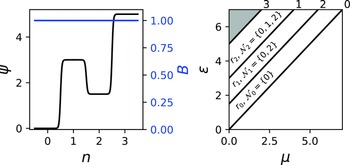


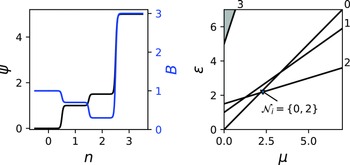


 Open access

