


Introduction
The use of ochre, a naturally occurring iron-rich mineral, is apparent in the African archaeological record around 500 000 years ago (500ka) and increases in intensity following hominin dispersals out of Africa (Watts et al. Reference Watts, Chazan and Wilkins2016; Dapschauskas et al. Reference Dapschauskas, Göden, Sommer and Kandel2022). Ochre is recorded in anthropogenic contexts in western Europe by about 250ka and in East Asia by 105ka, its use travelling with human migrations through Southeast Asia to reach Madjedbebe, the earliest currently known human occupation in Australia, at least 50ka (Roebroeks et al. Reference Roebroeks, Sier, Nielsen, De Loecker, Maria Parés, Arps and Mücher2012; Li et al. Reference Li, Doyon, Li, Wang, Zhang, Zhao and d’Errico2019; Hayes et al. Reference Hayes2022). Ochre comes in various forms, varying in colour from yellow, to red and purple. Red ochre has been widely associated with symbolism, particularly in mortuary practices, having been found associated with the earliest known interments of anatomically modern humans at Qafzeh cave in Israel (c. 92ka; Bar-Yosef Mayer et al. Reference Bar-Yosef Mayer, Vandermeersch and Bar-Yosef2009). Yet ochre has also been found to have multiple practical applications and is used today as body paint that offers protection against the sun and biting insects as well as having symbolic meaning (Rifkin Reference Rifkin2015; Rifkin et al. Reference Rifkin, Dayet, Queffelec, Summers, Lategan and d’Errico2015).
Red ochre appears in burials in a variety of forms, from lumps of raw mineral to intensely processed powder sprinkled over the deceased. In China, there is evidence for ochre use in burials from the Early Neolithic period, from c. 8ka (Norton & Gao Reference Norton and Gao2008; Dong et al. Reference Dong, Lin, Zhu, Luan and Underhill2019; Marinova Reference Marinova and Li2021). Zengpiyan Cave, a hunter-gatherer site in southern China, contained 18 flexed burials dating to c. 10ka, six of whom were stained with ochre (Pearson Reference Pearson2005). As tightly flexed burials with few, if any, grave goods are typically associated with hunter-gatherer groups—early farmers tending to inter their dead in extended, supine position with a broad range of grave goods—the cave is interpreted as a hunter-gatherer site, co-existing alongside early rice cultivators to the north, in the Yangzi Valley (Chi & Hung Reference Chi and Hung2012). The occurrence of ochred burials in Chinese late prehistory has not been extensively addressed in English. Tian (Reference Tian2018) provides a review of red pigment use in China, discussing both ochre and cinnabar, a rarer mineral pigment that is a compound of mercury (II) sulphide and has a brilliant red hue, the research links these red pigments to blood, spirituality and ancestors. The use of red pigment in burials has also been linked with elite status, indicating social inequality within sites but acting as a cultural unifier regionally (Pearson Reference Pearson2005; Wu et al. Reference Wu, Guo, Wang, Chen, Zhao, Xia and Yang2017; Dong et al. Reference Dong, Lin, Zhu, Luan and Underhill2019; Liu et al. Reference Liu2015. If both ochre and cinnabar were chosen for their colour, then the cultural origins of their use are likely linked.
In Southeast Asia, hunter-gatherer burials of the Hòabìnhian tradition often contain ochre, either in powdered or nodule form. For example, all seven burials from Con Moong Cave in northern Vietnam, dating between 15.7 and 9.4ka, contained traces of red ochre (Figure 1; Thong Reference Thong1980; Oxenham et al. Reference Oxenham, Willis, Nguyễn, Matsumura, Higham and Kim2022). At Niah Cave, on Borneo, traces of powdered ochre were found in the Hòabìnhian levels (c. 13–7ka) in association with several inhumations, while one burial found in the Hòabìnhian layers at Gua Cha in Malaysia, dating to 9ka, had been sprinkled with ochre (Bellwood Reference Bellwood1997). At Hang Muối, a layer of ochre was found under a burial; two burials at Mái đá Điều had ochre scattered within the grave; burials at Mái đá Triềng Xén contained ochre; and eight crania were discovered covered in red ochre at Mái đá Làng Vanh (Colani Reference Colani1927, Reference Colani1929). Ochre has also been observed covering a single burial and as stained patches of sediment in two others at Cồn Cổ Ngựa, a coastal sedentary hunter-gatherer site in northern Vietnam that dates from around 7–6.5ka (Oxenham & Tayles Reference Oxenham and Tayles2006; Higham Reference Higham2013). At Doi Phan Kan, the best-documented Hòabìnhian ochred burial site in Thailand, ochre was found in both powdered and nodule form associated with one of three burials and was probably used in the creation of rock art dating to 13ka (Imdirakphol et al. Reference Imdirakphol, Zazzo, Auetrakulvit, Tiamtinkrit, Pierret, Forestier and Zeitoun2017; Lebon et al. Reference Lebon2019). The findings from across these sites thus indicate that ochre played an important role in funerary rites.
Southeast Asian sites mentioned in the text: 1) Khok Phanom Di; 2) Nong Nor; 3) Ban Non Wat, Noen U-Loke, Ban Lum Khao; 4) Non Ban Jak; 5) Doi Pha Kan; 6) Cồn Cổ Ngựa; 7) Mái đá Điều, 8) Mái đá Làng Vanh; 9) Niah Cave; 10) Gua Cha; 11) Ban Na Di; 12) Hang Muối, Mái đá Triềng Xén (figure by C.F.W. Higham, using GeoMapApp (www.geomapapp.org), CC by Ryan et al. Reference Ryan2009).

This study examines the bioarchaeological evidence for red ochre use in burials from Neolithic to Iron Age sites in Thailand (c. 2300–1500 BC), where marked differences between the mortuary practices of Indigenous Hòabìnhian hunter-gatherers and incoming agriculturalist populations have already been noted (Higham Reference Higham2024). Red ochre has a deep temporal presence in the region, functioning as a powerful symbol of identity, transformation and spiritual belief from the earliest funerary contexts to the brink of state formation. By tracing its shifting presence across time and space, through the analysis of five key sites, we explore how ochre use reflects the dynamic interplay of migration, local traditions, technological developments and evolving cosmologies in prehistoric Southeast Asia.
Khok Phanom Di
Khok Phanom Di is a Neolithic site dating to c. 2300–1500 BC, located on the Bang Pakong River estuary (Figure 1). Excavations in 1985 recovered 156 individuals across seven mortuary phases (MP), representing 17–20 generations of inhabitants that saw the dead being interred directly over the ancestors (Higham Reference Higham1989). Graves were arranged in clusters interpreted as family groups based on the expression of non-metric cranial traits that have high heritability (Higham & Bannanurag Reference Higham and Bannanurag1990). The buried individuals were likely rice farmers, whose ancestors migrated from the Yangzi River region and who took advantage of the estuarine environment for its nodal location in exchange systems. Isotopic analyses suggest that patterns of mobility changed over time. In the earliest mortuary phase (c. 2300 BC), adults have non-local strontium isotope ratios (87Sr/86Sr), with males and females appearing to originate from different locations. From MP2 (c. 2000 BC) onwards, all males and children have local strontium signatures, while several females have non-local signatures, suggesting female immigration, and thus possible exogamy practices and a patrilocal society in the earlier part of the occupation span in contrast to the social prominence of females later in the sequence (Higham & Thosarat Reference Higham2004a; Bentley et al. Reference Bentley, Tayles, Higham, Macpherson and Atkinson2007).
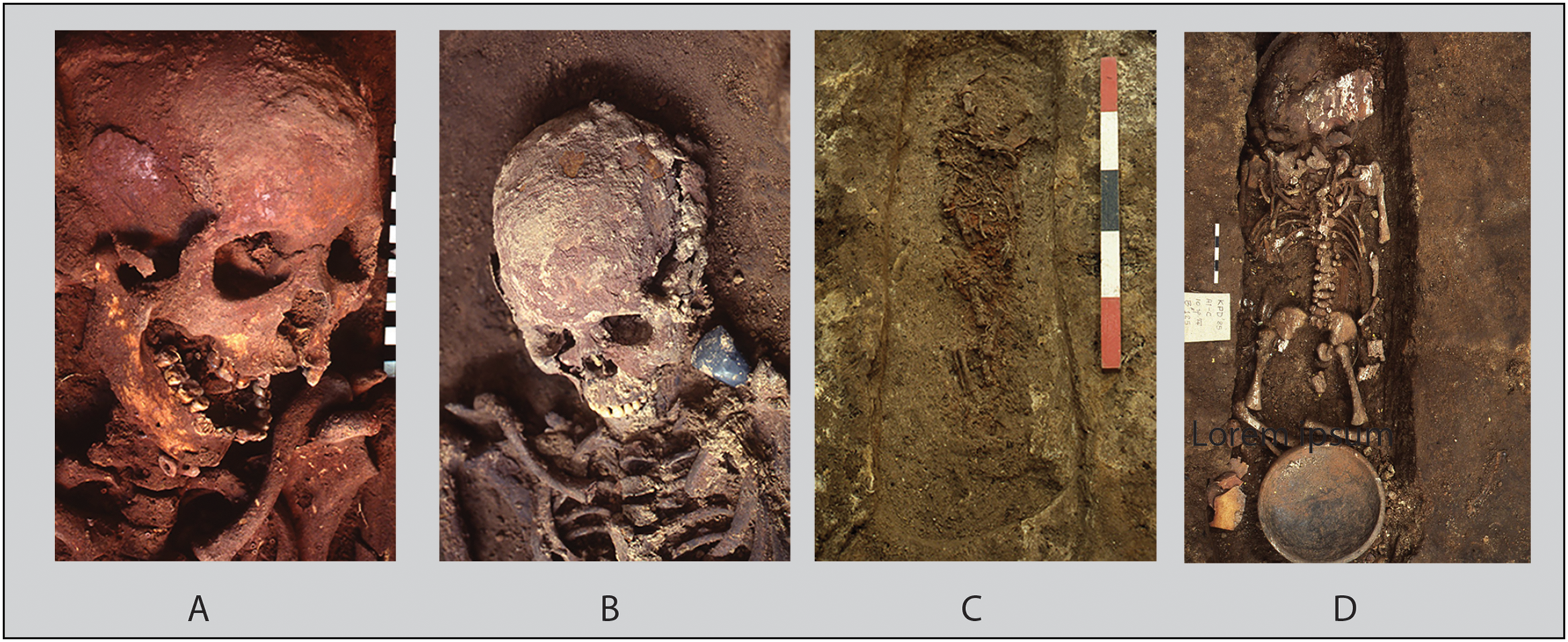
The site’s use as a cemetery was continuous for around 500 years. Most individuals were buried extended and supine in a rectangular grave, with the head to the east. Grave goods comprise a variety of shell beads, turtle carapaces, ceramic vessels and the clay anvils and burnishing stones used to fashion and decorate such vessels. Evidence for wooden biers and tapa shrouds have survived in some instances (Figure 2D). Some bones are stained red from their proximity to ochre during the decomposition process (Higham Reference Higham1989; Higham & Bannanurag Reference Higham and Bannanurag1990). To produce this staining, the body may have been placed in the grave and then covered with powdered ochre that impregnated the bones during decomposition. Alternatively, ochre might have been mixed with another medium as body paint, a practice widely observed today in many parts of the world (Havenga et al. Reference Havenga2022). Two factors favour this latter interpretation: most ochred individuals had ochre staining to the front and back and, where fabric has survived, shrouds appear to overlie the red bones (Figure 2D). Had ochre powder been sprinkled over a shrouded body, the shroud would have been reddened but possibly not the bones, although more research is needed to better understand the precise processes of ochre-to-bone transfer. One practical reason for using ochre as a body paint may have been as protection against insects (Rifkin Reference Rifkin2015; Rifkin et al. Reference Rifkin, Dayet, Queffelec, Summers, Lategan and d’Errico2015). At Khok Phanom Di, high infant mortality, likely due to thalassaemia—a genetic condition that offers resistance to malaria but causes iron-deficiency anaemia—is evident in skeletal lesions (Tayles Reference Tayles1996, Reference Tayles1999). Thalassaemia is typically found in regions where malaria, and thus the malaria-carrying mosquito, is prevalent. The heavy ochre use observed at the site may therefore reflect both symbolic practice and a response to this health burden.
Khok Phanom Di: A) burial 15, the wealthy burial of a female in MP5; B) burial 140, burial of a female with ochre and a stone adze in MP2; C) burial 150, burial of an infant in MP1; D) burial 125, burial of an infant with ochre, fabric shroud and bier, MP2 (figure by authors).

Excellent skeletal preservation means that it was possible to identify ochre staining on 82 per cent of individuals available for study (Paris Reference Paris2021, Reference Paris2024). In MP1, one of the six individuals is ochred; thereafter, it is largely only perinates interred in shallow graves without mortuary goods that lack ochre. Perinate burials that did contain ochre (accounting for 38 per cent of perinate burials) also followed similar practices to the wider assemblage. Perinates without ochre are on average physically smaller than those with ochre, possibly indicating that they were stillborn and/or that a post-birth rite of passage needed to be completed for the presence (or entitlement) of pigment (Paris Reference Paris2025). Ochre staining is not evenly distributed across skeletal elements or among individuals (Figure 3). For individuals under eight years of age (group A), ochre was either heavily applied across the skeleton or sparsely and patchily distributed, while older individuals (group B) showed more varied patterns, with concentrations on the skull (Paris Reference Paris2021). One female from MP5 (c. 1700 BC) was buried with exceptional grave goods—including over 121 000 shell beads and pottery tools—alongside an infant; aged approximately 15 months with matching wealth (Higham & Thosarat Reference Higham2004b: 87; Figure 2A). Both were heavily ochred, suggesting a link between social status and the intensity of ochre use.
A summary of pigment distribution across the skeletons of 124 ochred individuals at Khok Phanom Di. Ochre is scored as present or absent only if the relevant bone is available for observation. Individuals aged less than eight years at death are shown in graph A, those aged over eight years are shown in graph B (figure by authors).

Ban Non Wat
Ban Non Wat was occupied from c. 1700 BC by incoming rice farmers. A second Neolithic phase followed between 1250 and 1050 BC, with radiocarbon and artefactual evidence suggesting population continuity with the ensuing Bronze Age phases (BA1–5; 1050–430 BC) (Higham & Higham Reference Higham and Higham2009). This Bronze Age sequence began (BA1, 1050–1000 BC) with a sharp increase in the wealth of grave goods and the complexity of mortuary practices, which rose to spectacular levels in BA2 (1000–900 BC) and BA3A (900–850 BC) (Higham Reference Higham2024a). Mortuary traditions continued into BA3B (850–800 BC) and BA4 (800–700 BC), but with a marked decline in the quantity of grave goods (Smith et al. Reference Smith, Davies and Higham2015). This was maintained into BA5 (700–420 BC) and continued into the first phase of the Iron Age from c. 420 BC (IA1). A further three Iron Age phases are apparent in the settlement but with very few human graves.
Ochre use is absent across the 12 flexed burials and 69 supine interments from the Neolithic at Ban Non Wat (Higham & Kijngam Reference Higham and Kijngam2010), first appearing in powdered form in one of the seven BA1 burials. The source of the ochre has not been established, but it is possible that it is not local, which could explain its absence from Neolithic burials as other mortuary offerings do not indicate substantial trade in this period. In BA2, ochre use expands dramatically across a wider demographic, appearing in the burials of four of 11 males and six of seven females, frequently placed near the head, feet or alongside grave goods such as copper-base axes (Higham & Kijngam Reference Higham and Kijngam2012, Figure 4). Burials of juveniles also show increased ochre use—including two jar burials—highlighting that this symbolic tradition extended to all age groups. This emergence of ochre use coincides with a broader intensification in mortuary display, including large volumes of pottery, shell beads and copper-base artefacts, indicating a link between ochre and status or ritual significance, particularly for women and children.
Ban Non Wat, Bronze Age burials containing ochre: A) a female with ochre over a copper-base axe (burial 178, BA2); B) an infant with ochre beyond the head (burial 536, BA2); C) a male with ochre associated with a bivalve shell (burial 241, BA4); D) an adult with ochre next to a bivalve shell (burial 239, BA4); E) a male with ochre next to a bivalve shell (burial 270, BA4); F) a male with ochre next to a bivalve shell and the skull (burial 522, BA4); G) a child with ochre and a bivalve shell next to the skull (burial 512, BA4); H) an infant interred in a mortuary vessel with ochre (burial 412, BA2) (figure by authors).

BA3A and BA3B see a decline in ochre, with occasional use across all demographic groups (Figure 5). This continued into BA4, a phase characterised by more structured burial organisation in five distinct contemporaneous clusters (BA4A–E), likely reflecting kin or social groups. Ochre distribution between groups is uneven: BA4A emphasises ochred juveniles, while BA4B and 4C show moderate use among males and juveniles, and BA4D and 4E exhibit a more balanced application across sexes and ages, although overall frequency is low. BA5 marks a resurgence in ochre use. The burials of six of nine males and six of 15 females contained ochre, often in pellet form and paired with bivalve shells—objects widely interpreted as fertility or spiritual symbols (Higham Reference Higham2024b). These were commonly placed at the head, hands, feet and pelvis, reinforcing a symbolic or ritualistic reading (Figure 6). No juveniles in this phase were associated with ochre, a notable shift from earlier patterns.
The proportions of Bronze and Iron Age burials at Ban Non Wat with or without red ochre, separated by mortuary phase (figure by authors).

The location of red ochre in burials at Ban Non Wat, separated by mortuary phase (figure by authors).

In IA1, ochre use remained prominent but developed new social and spatial patterns. Burials in this phase fall into two contemporaneous groups—northern and southern—distinguished by orientation and treatment. In the northern group, the dead were orientated with the head to the north, and ochre appears across all demographics: 11 of 22 males, 10 of 18 females and eight of 24 juveniles were interred with red pigment, often around the head and feet, but sometimes on the knees, shoulders or within vessels. This suggests an increasingly formalised ritual tradition. The southern group were orientated with the head to the south, and showed distinct preferences, especially in the placement of ochre near the right arm or hand (Figure 7). Sixteen of 35 males, four of 16 females, 10 adults of indeterminate sex and four of nine juveniles were buried with ochre. Some graves held large quantities—up to 13 pellets—indicating a potentially codified or ceremonial use. Differences in treatment between the groups imply socially distinct mortuary ideologies or community affiliations operating concurrently. By IA2 (c. 200 BC–AD 100), ochre use vanished altogether. This phase, dominated by infant jar burials with occasional adult interments, marks the end of a complex tradition. The disappearance of ochre—despite the continuation of burial forms once associated with it—signals a broader shift in mortuary ideology, perhaps toward greater social conformity or changing cosmological beliefs.
Ban Non Wat, burials from IA1: A) burial 375, adult with ochre by the right leg and ankle; B) burial 323, adult with ochre by the right arm; C) burial 485, female with ochre over the face; D) burial 475, adult with ochre between the legs; E) burial 352, adult with ochre over the face and right shoulder; F) burial 323, adult with ochre and a spindle whorl (figure by authors).

Throughout the Bronze and Iron Ages, ochre use at Ban Non Wat was not universal, appearing in less than half of burials even at its peak, but did span all ages and sexes, reflecting its enduring symbolic value. Anatomical placement evolved over time: in BA2 and BA3, ochre was commonly at the head or feet; in BA4, this expanded to include the shoulders, elbows and knees; while in BA5, focus narrowed back to the head. IA1 introduced new patterns, with a northern burial group maintaining earlier placements and a southern group emphasising the right forearm. This variability suggests that ochre was applied with intentionality, aligned with community-specific rituals rather than arbitrary decoration. The pigment was typically placed outside the skeleton—on extremities or in associated vessels—indicating that it was applied during or after burial, possibly once the body was wrapped or placed in a wooden coffin. This practice further supports the view of ochre as a symbolically charged element in funerary rites.
The evolving relationship between ochre and grave wealth provides valuable insight into the symbolic economy of Ban Non Wat. In the early Bronze Age phases, ochre use rose alongside material wealth, linking pigment with status and ritual prestige. However, later phases saw continued ochre use even as grave goods declined, suggesting that the mineral had gained a spiritual value independent of economic factors. Other elements of mortuary practices—bivalve shells, womb-shaped jar burials, a painted parturition scene and evidence of feasting—point to a deep cultural investment in rebirth, ancestry and cosmological renewal, with red ochre at the centre of this evolving symbolic system.
Ban Lum Khao
Ban Lum Khao is located 7.6km south-east of Ban Non Wat and its cultural sequence matches that of Ban Non Wat in respect of having a parallel occupation during the late Neolithic, followed by BA2 and five burials (Higham & Thosarat Reference Higham and Thosarat2004b). None of the 10 Neolithic burials contained red ochre. The earlier Bronze Age graves at Ban Lum Khao, contemporaneous with BA2 at Ban Non Wat, were situated at the edge of the settlement and were markedly poor in terms of mortuary offerings. Just three of the 84 burials contained red ochre: an adult female with two pieces by the pelvis, a 30-year-old male with one piece placed by the right knee and an adult male with one piece by the head. Of 12 later Bronze Age burials (contemporaneous with BA5), three contained ochre, belonging to two infants and one young male.
Nong Nor
Nong Nor is located approximately 20km east of Khok Phanom Di (Higham & Thosarat Reference Higham, Thosarat, Higham and Thosarat1997). There are two phases of occupation at the site: a coastal Neolithic shell midden dating to the late third millennium BC, into which 169 Late Bronze Age burials dating to c. 700–500 BC were inserted. Individuals were interred with a variety of grave goods, including pottery, personal jewellery, grinding and polishing stones and animal remains. Infants were buried in lidded ceramic vessels; these were often associated with the burial of an adult, being located at the foot or the head of the adult. Only 19 per cent of graves survived intact, with many being disturbed in antiquity or by recent looting (Higham et al. Reference Higham, Debreceny, Manly, Higham and Thosarat1997). Of the 169 Bronze Age burials, only seven graves contained lumps of ochre. All seven were burials of adults, ranging across the broad age categories of young, middle and old, and as this includes three males, three females and one individual of undetermined sex, there does not appear to be any obvious discrimination among adults.
Non Ban Jak
Non Ban Jak is a Late Bronze Age moated site in the Upper Mun Valley, north-east Thailand. It comprises two mounds: the eastern, containing industrial, residential and mortuary contexts (c. AD 350–540), and the western, a residential zone with a four-phase cemetery where, in later phases, the dead were interred within houses. Cultural deposits span AD 230–690, with mortuary activity dated to AD 260–500 (Pedersen et al. Reference Pedersen2019; Higham & Kijngam Reference Higham2020). It was during this period that exchange contact with South Asia introduced exotic religions, including Buddhism, to this inland region.
A total of 199 burials were excavated, 42 from the eastern mound and 157 from the western (Higham & Kijngam Reference Higham2020). Adults were typically buried supine with grave goods that include pottery, iron tools, bronze ornaments and beads of carnelian, agate and gold; infants were interred in lidded ceramic vessels. Only three burials at Non Ban Jak contained red ochre, all in nodule form and all associated with adults—one male, one female and one probable female. The ochre was placed in different locations within each grave, including near the head, hand, femur and lower body (Figure 8). Two of these individuals were buried within the same house during the third mortuary phase.
Non Ban Jak burials with ochre: A) burial 72 (MP3), male with ochre by face; B) burial 76 (MP3), female with ochre by right ankle; C) burial 38 (MP3), female with ochre by right knee (figure by authors).

The rarity of ochre at Non Ban Jak is mirrored at nearby Noen U-Loke, 2km west of Ban Non Wat. Noen U-Loke spans much of the Iron Age and includes 127 burials across four mortuary phases. Despite a peak in burial wealth during the third phase—including one male interred with 150 bronze bangles and gold and silver ornaments—only two males from the earliest phase were buried with red ochre.
Discussion
During the third millennium BC, rice and millet farmers migrated from the region of the Yangzi River south into mainland Southeast Asia via riverine and coastal routes, integrating with Indigenous hunter-gatherers. Evidence of this integration is apparent at Khok Phanom Di, where early mortuary practices reflect a blend of traditions: hunter-gatherers were typically interred in a flexed position, while agriculturalists were laid supine, often accompanied by grave goods. Red ochre features in the burial customs of both groups (Bellwood Reference Bellwood1997; Pearson Reference Pearson2005; Higham Reference Higham2013, Reference Higham2021; Wu et al. Reference Wu, Guo, Wang, Chen, Zhao, Xia and Yang2017), but only one of the seven burials from the earliest mortuary phase, a perinate, contained ochre. Subsequent phases see more consistent ochre use, with the mineral pigment regularly impregnating bones and its quantity appearing to reflect identity and status. The lack of ochre in the burials of some perinates and very young individuals, for example, may reflect a lack of social recognition for these individuals (Paris Reference Paris2021, Reference Paris2025), while the wealth of grave goods and red ochre associated with an adult female and infant buried in MP5 indicates the recognition of high social status. The isotopic evidence from earlier Khok Phanom Di suggests a patrilocal society in the Neolithic with substantial trade links with other communities; the (re)combination and adaptation of traditions at this site is thus likely (Higham & Thosarat Reference Higham and Thosarat2004a). It is likely this settling population brought a variety of burial traditions with them, some that endured, such as ochre use, and others that did not. The contemporaneous and later cemetery sites of Ban Non Wat, Nong Nor and Non Ban Jak further demonstrate how ochre traditions varied and developed across the region.
Ban Non Wat and Ban Lum Khao are located 250km to the north-east of Khok Phanom Di and, based on the form and decoration of Neolithic ceramic vessels, are considered to belong to a different migratory population, one that did not initially employ red ochre in mortuary practices. The onset of the Bronze Age at both sites saw continuity of populations but transformative shifts in burial practices, including deeper graves, an increase in grave goods and the appearance of ochre in pellet form. This form of ochre differs markedly from the powdered ochre found at Khok Phanom Di. During BA2, half of burials at Ban Non Wat contained red ochre pellets, commonly placed near the head and feet and frequently found with bivalve shells, symbols of fertility, suggesting ritual associations with rebirth. While ochre use declines in BA3 and BA4, it rises again during the later Bronze Age and Early Iron Age, sometimes in association with spindle whorls and grey clay—materials linked with textile production. This may indicate the rising importance of the mineral pigment as a dye, possibly linking it to an artisan identity.
Noen U-Loke, located near Ban Non Wat, spans the Iron Age and features four mortuary phases. In the third phase, burial wealth peaks, including gold and silver ornaments. Despite this, only two males from the earliest phase were buried with red ochre. At nearby Non Ban Jak, dating to the final Iron Age, ochre was present in just three of 199 graves. Similarly, ochre use was rare in the Late Bronze Age burials at Nong Nor, near Khok Phanom Di. This scarcity makes it difficult to discern clear patterns, but the limited presence suggests that ochre was reserved for a few adults, regardless of wealth. No juveniles were buried with ochre at Nong Nor or Non Ban Jak, and this selective application may reflect adult mobility, with individuals introducing the practice from other regions—a hypothesis that ongoing isotopic studies may help clarify.
Variation in ochre use across time and space suggests shifting cultural meanings. The liberal distribution of powdered ochre over the body at Khok Phanom Di, must have been a spectacle, and thus the transition from a body powder to pellets marks a change in the way observers engaged with the pigment—a transformation of meaning. It is possible that the transition to use of ochre in its solid form suggests the commodification of the mineral; possibly pellets had a quantitative, currency-like value. This is further supported by the association of pigment nodules with utilitarian artefacts such as spindle whorls and grey clay. In an increasingly industrialised society with advancing trade networks, it is possible that the meaning or significance of ochre developed over time. During the Bronze Age period of Ban Non Wat, new technologies occur alongside social change, evidenced through fluctuating burial wealth and new associations with symbols of rebirth and fertility (Higham Reference Higham2021). The proximity of burials and lack of grave disturbance at this site also suggests that grave markers were in use. These new forms of symbolism and the presence of physical markers for burials may have relegated the importance of ochre in funerary traditions. The continued use of the pigment, but in a new pellet form, perhaps indicates a nod to tradition, while embracing new and complex technologies. Throughout the Bronze Age at Ban Non Wat, the association of red ochre with fertility symbols—such as bivalve shells and burial jars with blood-red interiors—suggests that mortuary rituals increasingly emphasised notions of regeneration. Iconography, such as snake motifs and representations of childbirth, reinforces this interpretation. By the later Iron Age, however, the social/spiritual role of ochre diminished markedly. It disappears entirely from burials at Noen U-Loke dating to IA 2-4 and appears in only minimal instances at Non Ban Jak, indicating a broader cultural transition, potentially influenced by external contact with South Asia.
Conclusion
Red ochre played a persistent yet evolving role in prehistoric Southeast Asian mortuary practices, reflecting shifts in ritual, identity and belief over more than three millennia. Initially prominent among the burials of Hòabìnhian hunter-gatherers, its use transformed with the arrival of Neolithic and Bronze Age agriculturalists. At Khok Phanom Di, ochre became widespread after the earliest mortuary phase, often staining skeletons and accompanying high-status burials. By contrast, ochre was entirely absent from Neolithic burials at Ban Non Wat and Ban Lum Khao, appearing at these sites only with the onset of the Bronze Age and in pellet or lump form, indicating different originating populations and a potential shift from performative to symbolic use.
In the Mun Valley, where Bronze Age communities differed culturally and possibly in origin from coastal groups, ochre became a common funerary element, symbolically paired with bivalve shells, red-painted jars and painted ceramics—all associated with notions of rebirth and transformation. At Ban Non Wat, ochre was found in the burials of individuals from both sexes and across all ages, although changing placement on the body—from heads and ankles to more varied anatomical locations—suggests dynamic ritual meanings. Associations with spindle whorls and grey clay hint at additional practical or artisanal connections, potentially tied to textile production. By the Late Bronze Age, ochre use declined sharply. At Non Ban Jak, only three of 199 burials contained ochre, coinciding with the appearance of Buddhist symbols such as lion imagery and Buddha statuettes. This suggests a religious and cosmological transition influenced by South Asian contact, replacing ancestral veneration with more codified spiritual ideologies. Nevertheless, the concern with ancestry persisted, evolving into new expressions such as the temple mausolea at Angkor.
The transformation of ochre from a loose pigment used widely in early burials to rare pellet deposits in later interments mirrors broader processes of cultural change, technological development and ideological realignment in Southeast Asia. Though its ritual use waned, ochre remained a meaningful component of prehistoric mortuary practices, offering insight into how communities navigated identity, memory and belief and how such ideology was communicated through death and burial.
Acknowledgements
We thank: Professor Robert Foley for supervising SP’s doctoral research; Ruoxi Huang and Qingqing Guo for translation; excavation teams directed by CH and Dr Rachanie Thosarat. Research permits were issued by the Thai Fine Arts Department and National Research Council. SP analysed the Khok Phanom Di ochre under a University of Otago permit, with support from the University of Cambridge. We also thank two referees for supportive comments.
Funding statement
Excavations were funded by the Shell Company of Thailand, the Marsden Fund of New Zealand grant UOO-1113, Earthwatch and its Research Corps, the Australian Research Council grant arc/DP110101997 and the National Geographic Society.
Author contributions: CRediT Taxonomy
Sarah Paris: Conceptualization-Equal, Data curation-Equal, Formal analysis-Equal, Funding acquisition-Equal, Investigation-Equal, Writing - original draft-Equal, Writing - review & editing-Equal. Charles Higham: Conceptualization-Equal, Funding acquisition-Equal, Investigation-Equal, Writing - review & editing-Equal.



 Open access

