





During COVID-19, the employment landscape consisted of soaring unemployment rates (Bureau of Labor Statistics, 2020) and the widespread adoption of working-from-home (WFH) arrangements. These contextual factors were part of a litany of unprecedented shifts in daily life that caused chaos within family relationships, schedules, and well-being (Cassinat et al., Reference Cassinat, Whiteman, Serang, Dotterer, Mustillo, Maggs and Kelly2021; Eales et al., Reference Eales, Ferguson, Gillespie, Smoyer and Carlson2021; Wang, Henry, et al., Reference Wang, Henry, Del Toro, Scanlon and Schall2021). While many suffered job loss, others (e.g., essential workers) experienced job security at the expense of personal exposure to the novel coronavirus. Moreover, parents who transitioned to WFH faced challenges related to everyday job completion on top of household responsibilities and children’s virtual learning, thereby contributing to reduced emotional well-being in parents as well as their children (Schmidt et al., Reference Schmidt, Kramer, Brose, Schmiedek and Neubauer2021).
According to models of family risk and resilience (Masten, Reference Masten2021; Prime et al., Reference Prime, Wade and Browne2020; Robinson et al., Reference Robinson, Schulz, Ball, Chiaraluce, Dodel, Francis, Huang, Johnston, Khilnani, Kleinmann, Kwon, McClain, Ng, Pait, Ragnedda, Reisdorf, Ruiu, Xavier da Silva, Trammel and Williams2021) and family stress processes (Masarik & Conger, Reference Masarik and Conger2017; Neppl et al., Reference Neppl, Senia and Donnellan2016), incidents that adversely affect a family’s financial standing (e.g., employment status) negatively impact individual family members in ways that lead to cascading consequences for inter-familial relationships, with adolescents showing more vulnerability to shifting family routines than younger youth (Eales et al., Reference Eales, Ferguson, Gillespie, Smoyer and Carlson2021). In turn, contentious family relationships have been linked to daily affect, thus placing family members’ psychological well-being at risk (Cassinat et al., Reference Cassinat, Whiteman, Serang, Dotterer, Mustillo, Maggs and Kelly2021; Eales et al., Reference Eales, Ferguson, Gillespie, Smoyer and Carlson2021; Peltz et al., Reference Peltz, Crasta, Daks and Rogge2021; Wang, Henry, et al., Reference Wang, Henry, Del Toro, Scanlon and Schall2021). Importantly, these effects tend to be highly influenced by a family’s contextual circumstances. For instance, families contending with economic uncertainty prior to the onset of COVID-19 suffered the most pervasive pandemic-related financial consequences (Lopez et al., Reference Lopez, Hart and Katz2021; Martin et al., Reference Martin, Markhvida, Hallegatte and Walsh2020).
It remains unclear, however, whether and how family dynamics were impacted by job loss and WFH during the coronavirus pandemic, nor do we understand how these dynamics may further influence parent and child emotional well-being. This longitudinal study uses a daily-diary approach with parent-adolescent dyadic data to investigate how interactions between family members (i.e., parent-adolescent conflict, parental warmth, inter-adult conflict) mediated the link between employment status and parent and child affect at the onset of the COVID-19 pandemic.
Theoretical and empirical foundation
COVID-19 forced families to navigate atypical social landscapes, shifting employment conditions, and economic uncertainty. To better understand the impact of job loss and WFH on familial relationships and emotional well-being during COVID-19, we frame our work using theories related to family risk and resilience (Masten, Reference Masten2021; Prime et al., Reference Prime, Wade and Browne2020; Robinson et al., Reference Robinson, Schulz, Ball, Chiaraluce, Dodel, Francis, Huang, Johnston, Khilnani, Kleinmann, Kwon, McClain, Ng, Pait, Ragnedda, Reisdorf, Ruiu, Xavier da Silva, Trammel and Williams2021) and family stress models (Masarik & Conger, Reference Masarik and Conger2017; Neppl et al., Reference Neppl, Senia and Donnellan2016). Such frameworks take into consideration how ecological circumstances influence family members’ abilities to maintain everyday functioning during times of elevated stress. During an extended global pandemic, stressors emerge related to the current and future physical and financial health of family members, especially when the virulent nature of a rapidly mutating disease impacts school and work routines. In other words, family health and financial stressors are particularly concerning during pandemics because of their disruption to protective family routines and resources.
In line with these frameworks, chaos induced by changing parental employment during COVID-19 may have led to heightened family conflict that in turn affected the emotional well-being of individual family members (Cassinat et al., Reference Cassinat, Whiteman, Serang, Dotterer, Mustillo, Maggs and Kelly2021; Wang, Henry, et al., Reference Wang, Henry, Del Toro, Scanlon and Schall2021). We know from extant literature that economic uncertainty adversely impacts adult family relationships and parenting practices (Acquah et al., Reference Acquah, Sellers, Stock and Harold2017; Wang et al., Reference Wang, Degol and Henry2019). Emerging literature has indicated that pandemic-related stress and disruptions in family routines negatively affect parental warmth and increase parent–adolescent conflict in ways that subsequently lead to more negative emotional states for all family members (Cassinat et al., Reference Cassinat, Whiteman, Serang, Dotterer, Mustillo, Maggs and Kelly2021; Eales et al., Reference Eales, Ferguson, Gillespie, Smoyer and Carlson2021; Peltz et al., Reference Peltz, Crasta, Daks and Rogge2021; Wang, Henry, et al., Reference Wang, Henry, Del Toro, Scanlon and Schall2021). Conversely, strong family relationships characterized by warmth, support, and connectedness can protect against the insidious effects of economic strain and uncertainty while concomitantly fostering family resilience and well-being (Masten & Motti-Stefanidi, Reference Masten and Motti-Stefanidi2020; Wang, Del Toro, et al., Reference Wang, Del Toro, Scanlon, Schall, Zhang, Belmont, Voltin and Plevniak2021; Wang, Henry, et al., Reference Wang, Henry, Scanlon, Del Toro and Voltin2022).
COVID-19 employment status and family relational dynamics
The COVID-19 pandemic led to significant changes in employment status for many Americans. We contend that job loss and WFH may have influenced relational dynamics within families, including parent–adolescent conflict, conflict between family adults, and parental warmth.
Parent–adolescent conflict
COVID-19 introduced novel challenges to the parent–adolescent relationship by disrupting family, work, and school routines (Cassinat et al., Reference Cassinat, Whiteman, Serang, Dotterer, Mustillo, Maggs and Kelly2021; Eales et al., Reference Eales, Ferguson, Gillespie, Smoyer and Carlson2021; Wang, Henry, et al., Reference Wang, Henry, Del Toro, Scanlon and Schall2021). While many Americans experienced job loss, others adapted to WFH arrangements. Both employment conditions came with unique challenges to family life. For instance, parents who lost their jobs likely experienced financial uncertainty, while those adapting to WFH situations had to manage the responsibilities of being an employee, caregiver, and in the case of remote schooling, educator all at once. Due to stay-at-home orders, Americans also had to socially distance and avoid congregating in public spaces. As a result, families spent increased time together at home (Bülow et al., Reference Bülow, Keijsers, Boele, van Roekel and Denissen2021; Gadassi Polack et al., Reference Gadassi Polack, Sened, Aubé, Zhang, Joormann and Kober2021), which in some cases contributed to heightened parent–adolescent conflict (Eales et al., Reference Eales, Ferguson, Gillespie, Smoyer and Carlson2021). Furthermore, shifts in family ecology have been associated with low levels of parental warmth and heightened parent–adolescent conflict (Acquah et al., Reference Acquah, Sellers, Stock and Harold2017; Russell et al., Reference Russell, Hutchison, Tambling, Tomkunas and Horton2020). Ultimately, COVID-19 disrupted parental work schedules and family routines, which in turn contributed to more contentious parent–adolescent relationships (Cassinat et al., Reference Cassinat, Whiteman, Serang, Dotterer, Mustillo, Maggs and Kelly2021; Eales et al., Reference Eales, Ferguson, Gillespie, Smoyer and Carlson2021; Wang, Henry, et al., Reference Wang, Henry, Del Toro, Scanlon and Schall2021).
Family adult conflict
Changes in employment status may also affect family adult relationships (Acquah et al., Reference Acquah, Sellers, Stock and Harold2017). Limited work alternatives, social distancing measures, and unclear return-to-work timelines likely contributed to conflict among familial adults during the pandemic (Masten & Motti-Stefanidi, Reference Masten and Motti-Stefanidi2020). Research has also established that job loss is strongly tied to heightened inter-parental conflict and domestic violence (Acquah et al., Reference Acquah, Sellers, Stock and Harold2017). Indeed, researchers documented an increase in domestic violence during COVID-19 (Boserup et al., Reference Boserup, McKenney and Elkbuli2020). In one large-scale study on family life during the coronavirus pandemic, 34% of Americans reported that the amount of stress in their relationships increased (Karpowitz & Pope, Reference Karpowitz and Pope2020). However, there is also evidence for family resilience: Peltz et al. (Reference Peltz, Crasta, Daks and Rogge2021) found that inter-parental conflict (i.e., contention among family adults) mediated the impact of pandemic-related parenting- and work-related stress on overall family cohesion. Hence, families with less conflict between adults were better able to preserve family functioning in the face of pandemic-related stressors.
Parental warmth
Extant literature has primarily focused on the negative impacts of parental employment status on the parent-adolescent relationship. As previously discussed, shifts in a parent’s work arrangements – whether that be a shift to WFH or job loss – have been associated with heightened parent–adolescent conflict and lower parental warmth (Acquah et al., Reference Acquah, Sellers, Stock and Harold2017; Russell et al., Reference Russell, Hutchison, Tambling, Tomkunas and Horton2020; Wang, Henry, et al., Reference Wang, Henry, Del Toro, Scanlon and Schall2021); however, a small body of literature has suggested that job loss and WFH may embolden parental warmth (i.e., supportive parenting and family engagement in fun, relaxing activities). For instance, job loss has been indirectly connected to parent re-engagement in family activities and increased parental warmth (McKee-Ryan et al., Reference McKee-Ryan, Song, Wanberg and Kinicki2005). Moreover, parents have reported that the emotional support provided by family members following job loss improved their mental health, which then in turn predicted parental warmth (Wadsworth et al., Reference Wadsworth, Rindlaub, Hurwich-Reiss, Rienks, Bianco and Markman2013). In the case of WFH, such arrangements may offer the opportunity to more frequenly engage in family activities that contribute to cohesion and stability. In fact, the increased flexibility of WFH compared to traditional work schedules has been shown to allow some parents to spend more time with their families (Kelly et al., Reference Kelly, Moen and Tranby2011) and better manage the balance between work and family (Allen et al., Reference Allen, Johnson, Kiburz and Shockley2013). Few studies, however, have examined parental warmth in the context of COVID-related job loss and WFH.
Family relational dynamics and parent and child affect
COVID-19 employment status and family relational dynamics may have jeopardized immediate and long-term parent and adolescent well-being (Browne et al., Reference Browne, Wade, May, Jenkins and Prime2021; Prime et al., Reference Prime, Wade and Browne2020). Contentious family relationships can place adolescents at risk for poor mental health (Wang et al., Reference Wang, Henry, Degol and Elliott2020; Weymouth et al., Reference Weymouth, Buehler, Zhou and Henson2016), whereas parental warmth may support adaptive functioning by buffering negative affect and increasing closeness between family members (Silva et al., Reference Silva, Ford and Miller2020). Hence, we assert that family dynamics likely mediate the relation between COVID-19 employment status and parent and child affect.
Parent-adolescent conflict
Conflict between parents and their children is a well-documented risk factor for emotional dysfunction for both parties (Silva et al., Reference Silva, Ford and Miller2020). With family members being home more due to COVID-19 (Bülow et al., Reference Bülow, Keijsers, Boele, van Roekel and Denissen2021; Gadassi Polack et al., Reference Gadassi Polack, Sened, Aubé, Zhang, Joormann and Kober2021), there have been reports of increased parent-adolescent conflict (Eales et al., Reference Eales, Ferguson, Gillespie, Smoyer and Carlson2021; Russell et al., Reference Russell, Hutchison, Tambling, Tomkunas and Horton2020) as well as increased psychological and physical abuse toward children (Lawson et al., Reference Lawson, Piel and Simon2020). Generally speaking, parent–adolescent contention has been linked to a lower likelihood of adolescents seeking social support from their parents in times of crisis, which in turn deteriorates relationship quality and poses negative consequences for both parent and adolescent psychological well-being (Brooks-Gunn et al., Reference Brooks-Gunn, Schneider and Waldfogel2013; Neppl et al., Reference Neppl, Senia and Donnellan2016; Schmidt et al., Reference Schmidt, Kramer, Brose, Schmiedek and Neubauer2021; Wang, Henry, et al., Reference Wang, Henry, Del Toro, Scanlon and Schall2021). For adolescents, contentious parent–adolescent relationships may result in internalizing problems (Wang & Kenny, Reference Wang and Kenny2014; Weymouth et al., Reference Weymouth, Buehler, Zhou and Henson2016), and these effects have been observed during COVID-19 (Browne et al., Reference Browne, Wade, May, Jenkins and Prime2021; Schmidt et al., Reference Schmidt, Kramer, Brose, Schmiedek and Neubauer2021; Wang, Del Toro, et al., Reference Wang, Del Toro, Scanlon, Schall, Zhang, Belmont, Voltin and Plevniak2021). Similarly, parents have reported decreased psychological well-being on days that they experienced conflict with their child (Browne et al., Reference Browne, Wade, May, Jenkins and Prime2021; Silva et al., Reference Silva, Ford and Miller2020).
Family adult conflict
Increased tension between family adults has been associated with depression, anxiety, and anger in both parents and children during the coronavirus pandemic (Karpowitz & Pope, Reference Karpowitz and Pope2020). Family stressors (e.g., finances, shifts in family routines) have been shown to contribute to adult conflict, which in turn predicts poorer subjective well-being (Peltz et al., Reference Peltz, Crasta, Daks and Rogge2021; Pollmann-Schult, Reference Pollmann-Schult2014). Moreover, family adult conflict has been associated with parental depression, negative parenting behaviors, and disrupted family relationships (Fincham & Beach, Reference Fincham and Beach1999) as well as decreased family cohesion during COVID-19 (Peltz et al., Reference Peltz, Crasta, Daks and Rogge2021). Not only do tumultuous relationships among familial adults have immediate pernicious impacts on parent well-being, but such relationships have also been linked to decreased emotional well-being in children (Acquah et al., Reference Acquah, Sellers, Stock and Harold2017; Schmidt et al., Reference Schmidt, Kramer, Brose, Schmiedek and Neubauer2021; van Eldik et al., Reference van Eldik, de Haan, Parry, Davies, Luijk, Arends and Prinzie2020). Considering there has been a marked increase in intimate partner violence during the pandemic (Boserup et al., Reference Boserup, McKenney and Elkbuli2020), it is of paramount importance that we understand the role that inter-adult conflict plays in the relation between COVID-19 employment status and family well-being.
Parental warmth
Parental warmth has been consistently associated with positive psychological and behavioral adjustment in adolescents (Khaleque, Reference Khaleque2013; Silva et al., Reference Silva, Ford and Miller2020) and may act as an efficacious protective factor during COVID-19 (Brown et al., Reference Brown, Doom, Lechuga-Peña, Watamura and Koppels2020; Wang, Henry, et al., Reference Wang, Henry, Scanlon, Del Toro and Voltin2022; Wang, Del Toro, et al., Reference Wang, Del Toro, Scanlon, Schall, Zhang, Belmont, Voltin and Plevniak2021; Wang, Henry, et al., Reference Wang, Henry, Del Toro, Scanlon and Schall2021). For instance, parental warmth has been associated positively with adolescents’ emotional stability and negatively with feelings of hostility and aggression (Khaleque, Reference Khaleque2013). Researchers have also indicated that high, stable parental warmth buffers against the negative affect and distress that may arise from external stress (e.g., parental job loss) and chaotic family structure during COVID-19 (Cassinat et al., Reference Cassinat, Whiteman, Serang, Dotterer, Mustillo, Maggs and Kelly2021; Russell et al., Reference Russell, Hutchison, Tambling, Tomkunas and Horton2020; Wang, Del Toro, et al., Reference Wang, Del Toro, Scanlon, Schall, Zhang, Belmont, Voltin and Plevniak2021; Wang, Henry, et al., Reference Wang, Henry, Del Toro, Scanlon and Schall2021). The role of parental warmth in influencing parents’ affect, however, is less well-studied. Although some literature has shown that parental warmth is not effective in lessening parent’s negative affect associated with parent-adolescent conflict (Silva et al., Reference Silva, Ford and Miller2020), few studies have examined the direct effects of parental warmth on parent affect.
The role of socioeconomic status
Families may have differential experiences with COVID-19 employment shifts based on their socioeconomic status (SES) (Prime et al., Reference Prime, Wade and Browne2020). Researchers have shown that pre-pandemic economic stability buffered the negative impact of job loss on family dynamics (Martin et al., Reference Martin, Markhvida, Hallegatte and Walsh2020), and literature has posited that parents who WFH have a higher likelihood of mitigating family stress caused by COVID-19 (Wang, Henry, et al., Reference Wang, Henry, Del Toro, Scanlon and Schall2021). During the pandemic, employees in low-likelihood WFH positions were more likely to earn low wages, lack options for employer-provided health care, be less educated, and rent rather than own a home (Mongey & Weinberg, Reference Mongey and Weinberg2020). As such, the lowest income earners – that is, those least likely to have the WFH option – were more likely to incur the economic consequences of shelter-in-place policies (Lopez et al., Reference Lopez, Hart and Katz2021; Martin et al., Reference Martin, Markhvida, Hallegatte and Walsh2020).
As COVID-19-related financial struggles continued, families may have been more likely to experience caustic inter-relations between family members (Peltz et al., Reference Peltz, Crasta, Daks and Rogge2021). Due to demands on their time, limited resources, and financial stress, parents in low-income families may have experienced increased conflict among familial adults while struggling to maintain warm, supportive relationships with their children. However, parental conflict and warmth are not mutually exclusive. That is, households in which parent–child conflict is high are not necessarily low in parental warmth. Notably, parental warmth has been identified as a protective factor that reduces the negative impact of financial stress on youth and family well-being, even in conditions of economic disadvantage (Wadsworth et al., Reference Wadsworth, Rindlaub, Hurwich-Reiss, Rienks, Bianco and Markman2013).
Interestingly, emerging literature has indicated a vast heterogeneity in how the COVID-19 pandemic affected parent and child outcomes, with some families reporting increases in helpful behaviors, time spent outside, and exploring new hobbies (Eales et al., Reference Eales, Ferguson, Gillespie, Smoyer and Carlson2021). These differential results call attention to the importance of considering families’ pre-pandemic economic circumstances (Lopez et al., Reference Lopez, Hart and Katz2021). It is critical, then, that we better understand how changes in parental employment influence family relationships and family members’ emotional well-being and whether these associations vary by family SES.
The current study
Family relationships and well-being were universally impacted by job loss and WFH arrangements brought about by COVID-19. Extant literature is clear that contention and warmth in the family contribute to negative and positive affect, respectively; however, less is known about how job loss and WFH might affect family relationships in the context of a global pandemic. Using a large, diverse sample of parent–adolescent dyads, this longitudinal study used a daily-diary approach to (a) examine the mediating role of family dynamics (i.e., parent-adolescent conflict, family warmth, and inter-adult conflict) in the relation between employment status (i.e., COVID-related job loss, WFH) and psychological well-being (i.e., positive and negative affect) in adolescents and their parents and (b) investigate whether job loss and WFH differentially impacted family functioning and well-being for families with different economic backgrounds.
The intricacies of psychological and relational processes unfold in real time; therefore, it is essential to use intensive longitudinal research designs that examine these phenomena in an ecologically valid way. By using a daily-diary approach with a large, diverse sample, we ensured an authentic assessment of daily family relational dynamics and individual psychological well-being between and within individuals. This approach reduces the risk of systematic recall bias among participants, and the nested nature of the data allows for examination of within- and between-subject variation (Bolger & Laurenceau, Reference Bolger and Laurenceau2013). As such, we were able to not only answer questions about within-person changes over time, but we also had the opportunity to explore whether stress processes varied between persons with different sociodemographic or situational circumstances. This design also allowed us to examine the extent to which parental employment status predicted a change in family relational dynamics and affect while controlling for assessments from the previous day.
Based on the available body of empirical literature, we hypothesized that changes in parental employment status would be related to increased family conflict, which in turn would be associated with decreased positive and increased negative affect. Conversely, we expected that there may also be the opportunity for increased family warmth. As literature surrounding this topic is sparse, we did not put forth any specific predictions regarding interactions between employment status and warmth, aside from anticipating that warmth would contribute to better psychological well-being. Finally, we hypothesized that these relations might differ based on family SES, with employment status enacting a stronger negative impact on family relationships and well-being in economically disadvantaged families.
Method
Participants
Participants included 635 parent–adolescent dyads from an ongoing nationwide longitudinal study investigating school experiences, family circumstances, and youth well-being in the USA. For this original study, we used a research company to recruit a nationally representative sample of parents and adolescents (i.e., middle- and high-school-aged youth) via random sampling. The original sample had a purposive oversample of Black participants (35% Black, 35% White, 30% Other) to ensure sufficient power to identify school-based racial disparities in health and academic achievement. As the COVID-19 pandemic caused nationwide school closures in March 2020, we leveraged our original longitudinal study by inviting a subsample of parent and adolescent participants to engage in a 29-day daily-diary study focusing on stress, coping, and adjustment. Because of the prevalence and saliency of unemployment rates and adoption of WFH arrangements in states with stay-at-home orders, participants (i.e., both adolescents and their parents) were only included in recruitment if they lived in an area where government-mandated closures of schools and nonessential businesses were in place.
Nearly 80% of the qualified participants from the original sample agreed to participate in the daily-diary study, resulting in a final sample of 635 parents and their adolescent children from 38 states (parent sample: M age = 43.5, range = 27–64 years; 15% male; 61% have a four-year college or more advanced degree; 37% Black, 36% White, 14% Latinx, 12% Asian American, 1% Native American; 65% qualified for free lunch; Child sample: M age = 15.0; range = 12–18 years; 42% male; 36% Black, 38% White, 13% Latinx, 12% Asian American, 1% Native American). This subsample did not differ from the original sample regarding sociodemographic characteristics or psychological adjustment (i.e., positive and negative affect), but it differed geographically. The subsample had more participants from the Northeast (42%) and South (25%) regions [vs. Midwest (18%) and West (15%)] as compared to the original longitudinal study sample. The increased number of participants from the Northeast and South regions was due to these states implementing state-wide stay-at-home orders prior to the study’s recruitment deadline.
Procedures
All consented parents and their children provided demographic information and completed baseline measures prior to the daily-diary collection period. Both parents and children then completed daily-diary assessments between 5:00 pm and 12:00 am using internet-capable devices across 29 days (i.e., 4/8/2020–4/21/2020 and 5/18/2020–6/1/2020). To lessen the fatigue of participating in this intensive research endeavor, we gave participants a 4-week break between data collection periods. During data collection periods, participants received multiple email or SMS reminders to complete the daily survey, and research staff followed up with participants who missed entries to troubleshoot any technical issues with the survey. Participants received $80 for completing the daily diaries and baseline survey. All materials and procedures were approved by the authors’ university institutional review board.
Measures
Parental employment status
We measured job loss and WFH as two effect-coded indicators of employment status by (a) asking unemployed parents whether they lost their job since the outbreak of the coronavirus pandemic (−0.50 = no, 0.50 = yes) and (b) asking employed parents whether they were WFH (−0.50 = no, 0.50 = yes). Families with another adult in the household were asked to report on that adult’s employment status as well. All parent respondents were employed prior to COVID-19. None of the parent respondents worked from home prior to the pandemic.
Daily affect
Parent and adolescent positive and negative affect were measured daily using the Positive and Negative Affect Scale for Children, a well-validated psychological scale (Laurent et al., Reference Laurent, Catanzaro, Rudolph, Joiner, Potter, Lambert, Osborne and Gathright1999). We used four items to assess positive affect (e.g., grateful, energetic, happy, hopeful) and six items to assess negative affect (e.g., sad, anxious, depressed, hopeless, lonely). Participants reported their mood during the past 24 hr on a 5-point scale (1 = not at all; 5 = extremely). Items were averaged together to form daily composite scores of positive affect (parent: R C = .97; child: R C = .98) and negative affect (parent: R C = .97; child: R C = .98).
Daily family relational dynamics
We measured family relational dynamics using nine items from the Network of Relationship Inventory (Furman & Buhrmester, Reference Furman and Buhrmester2009). These items were scored on a 5-point Likert scale (1 = not at all, 5 = a lot), and psychometric properties (i.e., construct validity, predictive validity) of this measure have been previously established. We focused on three specific family dynamics: parent and child reports of parent–child conflict (four items; e.g., Today, I experienced conflict or tension with my child/parent), parent and child reports of parental warmth (two items; e.g., Today, I did something fun or relaxing with my child/parent), and parent reports of inter-adult conflict (two items; e.g., Today, I experienced conflict or tension with my partner or another adult in my family). Given that the correlations between child and parent reports were moderate and that the pattern of results did not vary when we distinguished between child versus parent reports, we created mean composite scores for each family relationship variable by summing the scores of parent and child reports and dividing by the total number of items (parent–child conflict: R Within-person change = .88, R Within-couple change = .76; parental warmth: R Within-person change = .97, R Within-couple change = .73; inter-adult conflict: R Within-person change = .82).
Family SES
We used a family’s qualification for free school lunch as a proxy of family income background (0 = eligible for free lunch, 1 = ineligible for free lunch). Federal income eligibility guidelines accounting for household size and income were used to determine eligibility for free school meals.
Covariates
Because of their associations with family dynamics and well-being, several effect-coded sociodemographic variables were included as covariates. Time-level covariates included day of the study (range = −14.50 to 14.50), weekend (−0.50 = weekday, 0.50 = weekend), and parent’s and child’s prior-day adjustment outcomes. Person-level covariates included (a) grand-mean centered child age (range = −3.00 [age: 12 years old] to 3.00 [age: 18 years old]), (b) child sex (−0.5 = female, 0.5 = male), (c) child race (Other: −0.5 = White, 0.5 = Other; Black: −0.5 = White, 0.5 = Black), (d) parent race (Other: −0.5 = White, 0.5 = Other; Black: −0.5 = White, 0.5 = Black), (e) parent’s role (−0.5 = mother, 0.5 = father), and (f) pre-pandemic parent–child relationship quality reported by parent participants (e.g., Do you have a good relationship with your child?; 1 = never, 5 = always).
Analytic plan
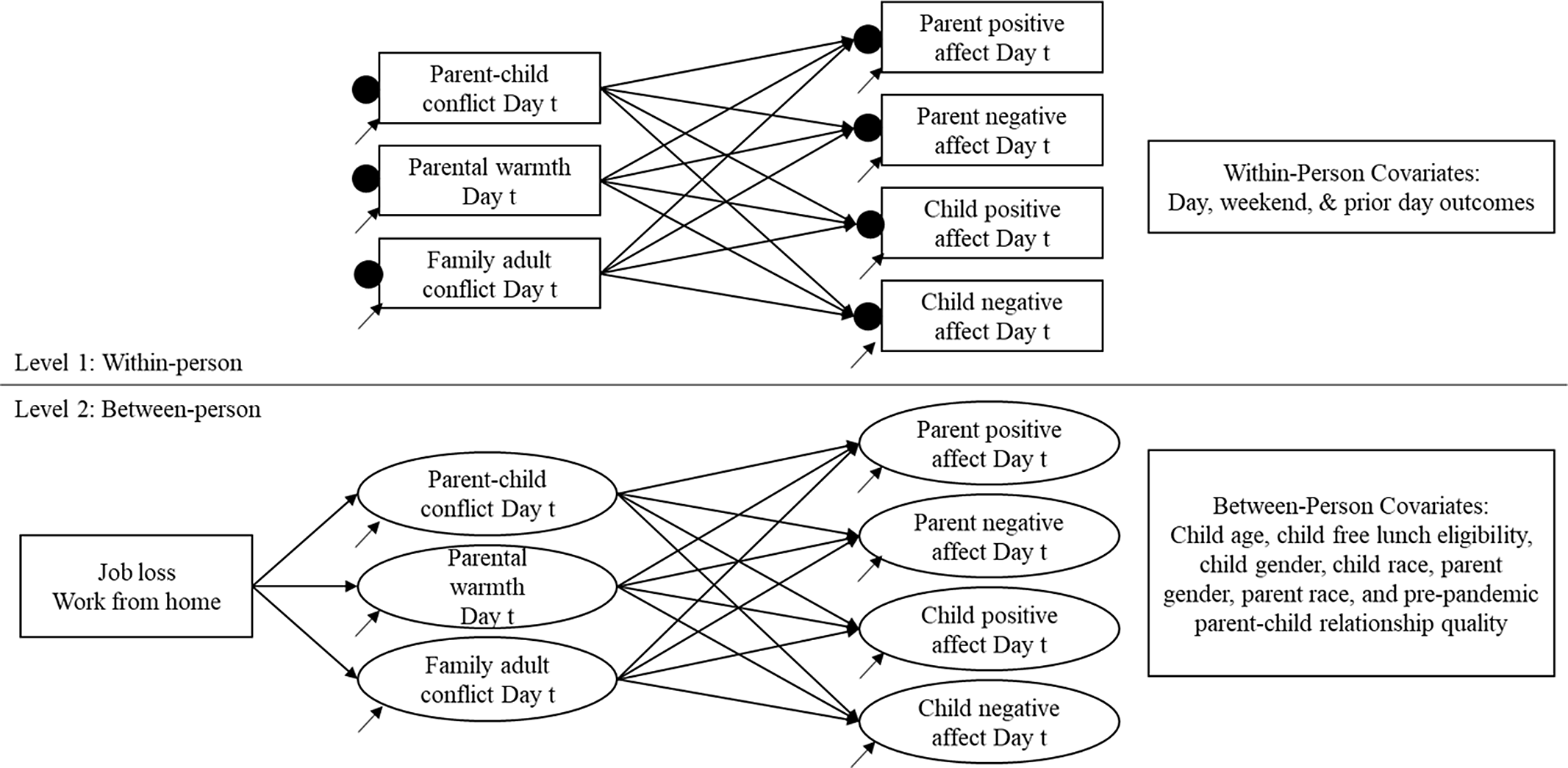
Using Mplus version 8.3 (Muthén & Muthén, Reference Muthén and Muthén2017), we estimated two multilevel models in which we assigned time to Level 1 (i.e., daily level) and participants to Level 2 (i.e., person level). Both models followed a multilevel structural equation model approach (Preacher et al., Reference Preacher, Zyphur and Zhang2010), though estimating the models with a traditional multilevel approach (e.g., MacKinnon, Reference MacKinnon2012) did not change the pattern of results (see Tables S1–2 in the supplemental document for results). The intraclass correlations justified our modeling approach, as approximately 35% and 65% of each outcome’s variance were at the daily and person levels, respectively. The two multilevel models differed in that parental job loss was a between-person predictor in Model 1 and parental WFH was a between-person predictor in Model 2 (i.e., both indicators of job status were time-invariant). In each model, both outcomes (i.e., children’s and parents’ positive and negative affect) and mediators (i.e., parent–child conflict, parental warmth, adult conflict) were within-person time-varying variables. When distinguishing between Levels 1 and 2, we examined whether between-person differences in parental employment status predicted within-person changes in parent and child same-day affect when participants reported more or less family conflict and warmth at the within-person level. Considering the number of outcomes and mediators in our analyses, we used the Benjamini–Hochberg false discovery rate (FDR) method to account for multiple testing (Benjamini & Hochberg, Reference Benjamini and Hochberg1995). We report p-values when the FDR-corrected p-values were below .05.
To answer our first research question, we tested main and mediation effects. Main effects included estimates for our daily-level mediators regressed on our person-level predictors (i.e., A paths) and estimates for our daily-level outcomes regressed on our daily-level mediators (i.e., B paths). Then, we used the “Model Constraint” command in Mplus to estimate the indirect effects of predictors on outcomes via mediators (the product of A and B paths). For our B paths, we examined the main effects of our daily-level mediators on same-day outcomes.
For our second research question, we tested whether the main effects varied by SES. In doing so, we regressed all mediators and dependent variables on our interaction terms (i.e., job loss × SES, WFH × SES) in Models 1 and 2, respectively. All analyses controlled for Level 1 and 2 covariates as well as prior-day adjustment outcomes. To determine effect sizes, we examined the total variance explained in our outcomes (i.e., R 2 values) and standardized effect size estimates (ES) using the STDYX and STY commands in Mplus for continuous and categorical predictors, respectively. Please see Figure 1 for a visual depiction of our multilevel models.
Visual description of the multilevel models.
Missing data
The amount of missing data at both the daily and person levels were relatively low. Of the possible 18,415 daily-diary assessments (29 days, 635 children and parents), there was only 6.6% (n = 441) and 5.2% (n = 350) missing data at the daily level for children and parents, respectively. There were varying levels of missing data at the family level: 100% of families (i.e., both parent and child) completed the baseline and demographic surveys; 49% of children and 58% of parents missed only one daily-diary entry; 12% of children and 10% of parents missed 2–3 daily entries; and 6% of children and 3% of parents missed 4–5 daily entries. On average, children and parents each completed 24–25 out of 29 daily-diary entries.
According to Little’s missing completely at random (MCAR) test, data were MCAR, χ 2(9) = 14.91, p = .09. After examining the missing data patterns, we found that participants with complete data did not differ from those with missing data on key constructs or demographic characteristics. Because it allowed us to retain all parent–child dyads in analyses, full-information maximum likelihood estimation was used to address missing data.
Results
Descriptive statistics
Table 1 presents means, standard deviations, and correlations among all study constructs. Notably, 15% of parents lost a job due to the COVID-19 pandemic, and 41% of parents transitioned to WFH during the study period. Without controlling for covariates, we found that parental job loss was associated with greater parent–child conflict (r = .08, p < .05) and greater inter-adult conflict (r = .07, p < .05). WFH was associated with greater parental warmth (r = .08, p < .05). In addition, parents in families who qualified for free lunch were more likely to experience job loss (22% vs. 11%) and less likely to WFH (25% vs. 74%) than parents of families who did not qualify for free lunch.
Descriptive statistics (Mean, S.D.) and zero-order bivariate correlations among key constructs
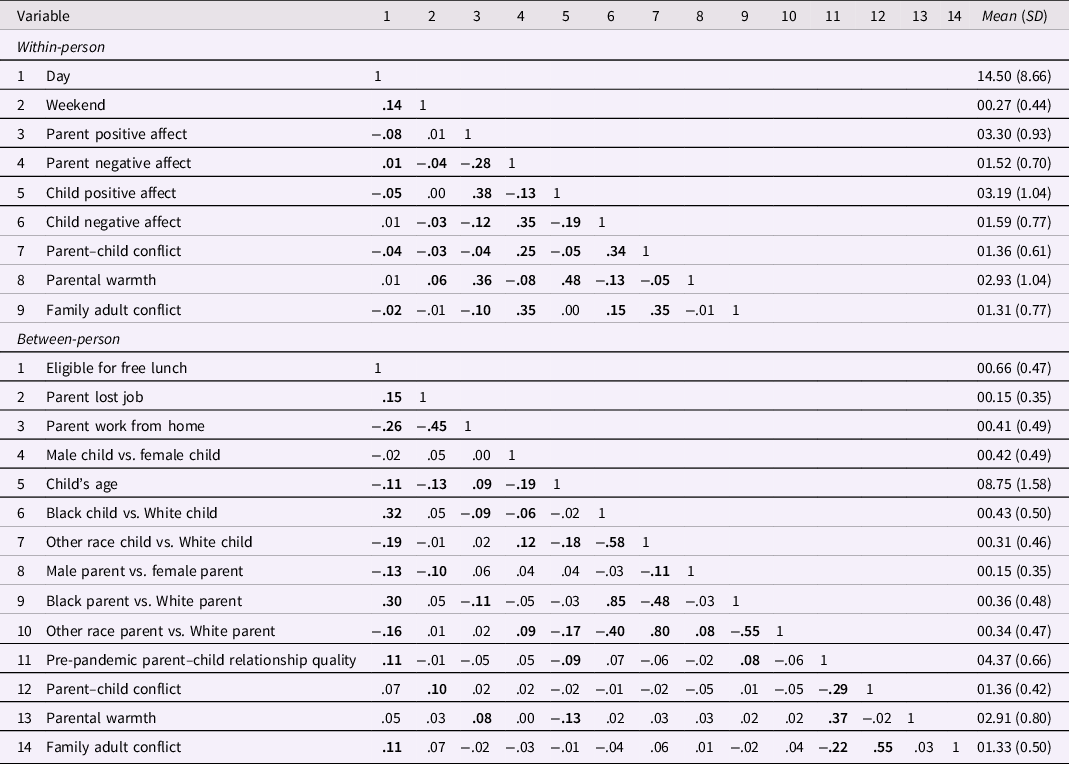
Note: Bold values indicate p-values < .05; non-bolded values indicate p-values .05 and greater.
Employment status and family relational dynamics
As shown in Tables 2 and 3, after we controlled for Level 1 and 2 covariates, parental job loss predicted greater parent–child conflict (b = 0.12, SE = 0.05, p < .05, 95% CI [0.02, 0.23], ES = 0.10) and inter-adult conflict (b = 0.12, SE = 0.06, p < .05, 95% CI [0.01, 0.23], ES = 0.09). Additionally, WFH predicted greater parental warmth (b = 0.18, SE = 0.07, p < .01, 95% CI [0.06, 0.31], ES = 0.12).
Direct effect of family job loss on same-day parent affect and child affect via same-day family relational dynamics
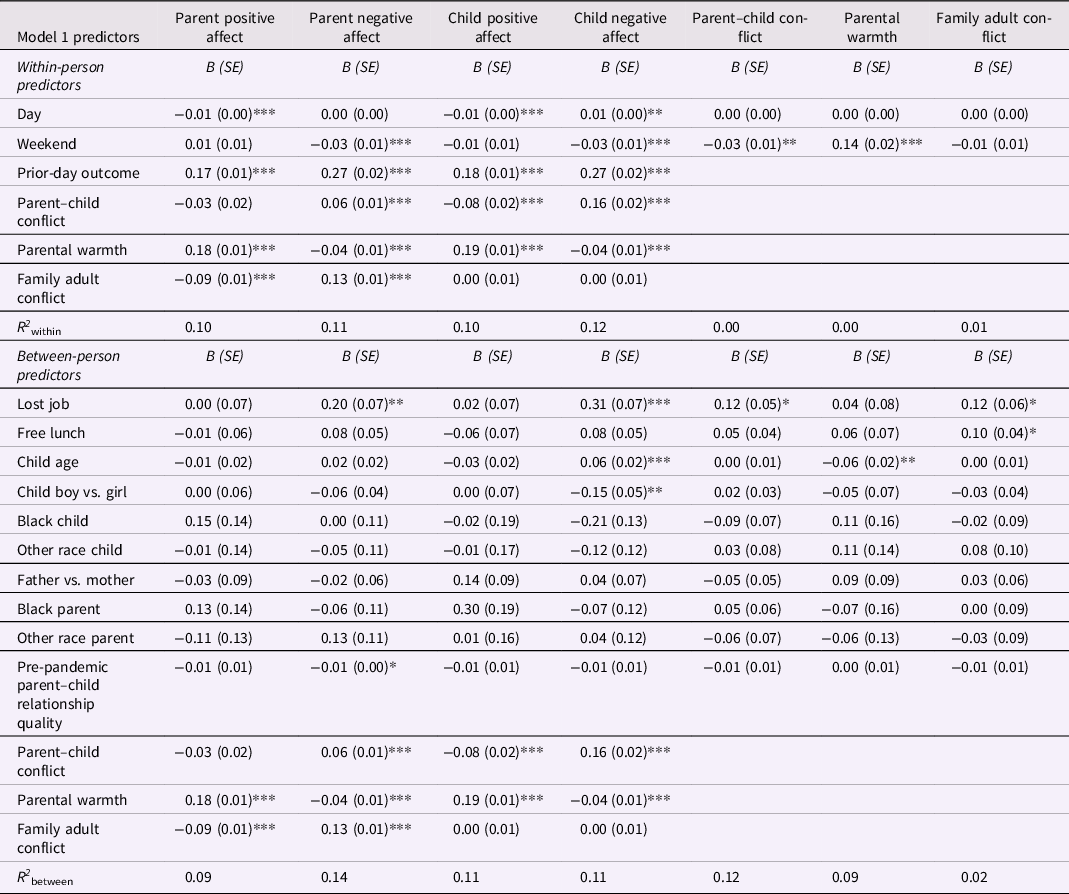
Note. * p < .05, ** p < .01, *** p < .001.
Direct effect of family work from home on same-day parent affect and child affect via same-day family relational dynamics
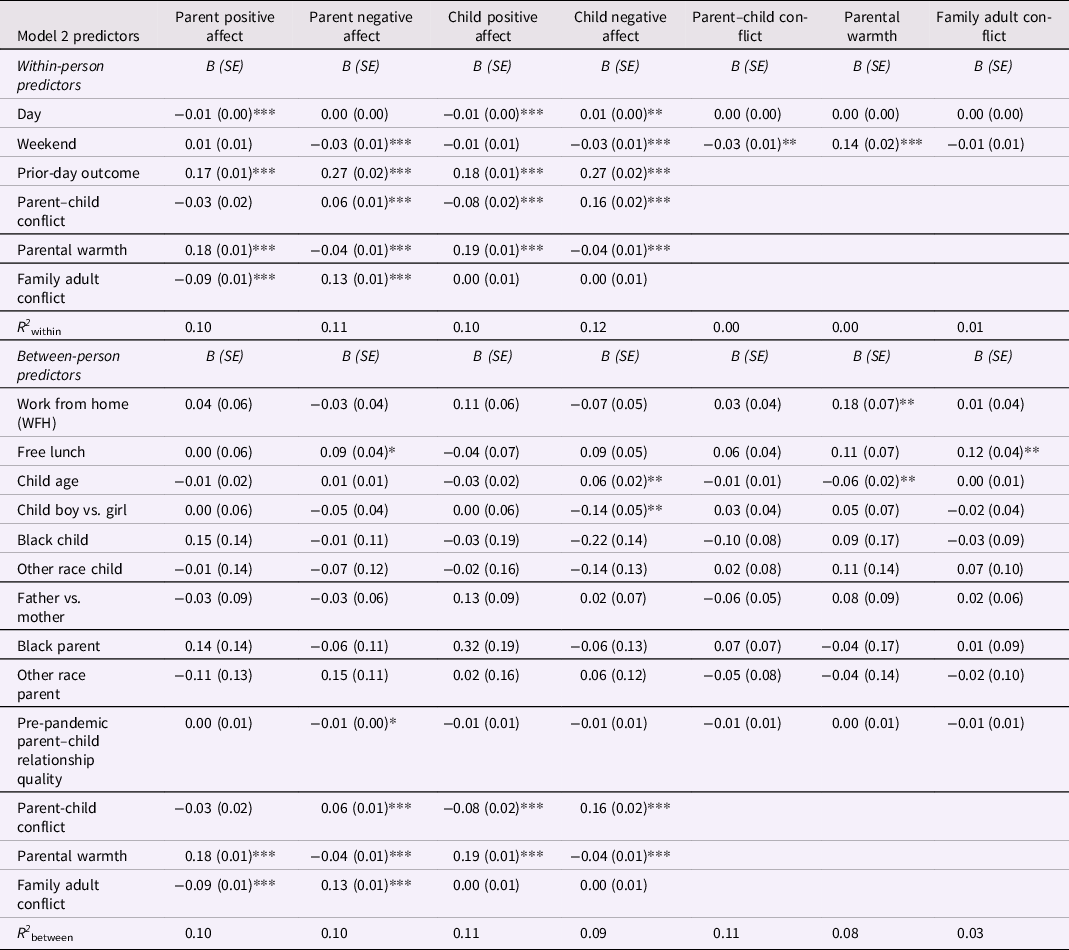
Note. *p < .05, **p < .01, ***p < .001.
Family relational dynamics and individual affect
As shown in Tables 2 and 3, on days when parent–child conflict was higher relative to person-specific averages across the study period, both parents and children reported more negative affect (parent negative affect: b = 0.06, SE = 0.01, p < .001, 95% CI [0.03, 0.09], ES = 0.06; child negative affect: b = 0.16, SE = 0.02, p < .001, 95% CI [0.13, 0.19], ES = 0.16) and children reported less positive affect (b = −0.08, SE = 0.02, p < .001, 95% CI [−0.12, −0.05], ES = −0.06). On days when parental warmth was higher relative to person-specific averages across the study period, both parents and children experienced more positive affect (parent positive affect: b = 0.18, SE = 0.01, p < .001, 95% CI [0.16, 0.20], ES = 0.21; child positive affect: b = 0.19, SE = 0.01, p < .001, 95% CI [0.17, 0.22], ES = 0.22) and less negative affect (parent negative affect: b = −0.04, SE = 0.01, p < .001, 95% CI [−0.06, −0.03], ES = −0.07; child negative affect: b = −0.04, SE = 0.01, p < .001, 95% CI [−0.06, −0.03], ES = −0.06). Finally, on days when inter-adult conflict was higher relative to person-specific averages across the study period, parents reported more negative affect (b = 0.13, SE = 0.01, p < .001, 95% CI [0.10, 0.15], ES = 0.18) and less positive affect (b = −0.09 SE = .01, p < .001, 95% CI [−0.11, −0.06], ES = −0.09). Inter-adult conflict did not predict child affect.
Indirect effects of employment status on affect via family relational dynamics
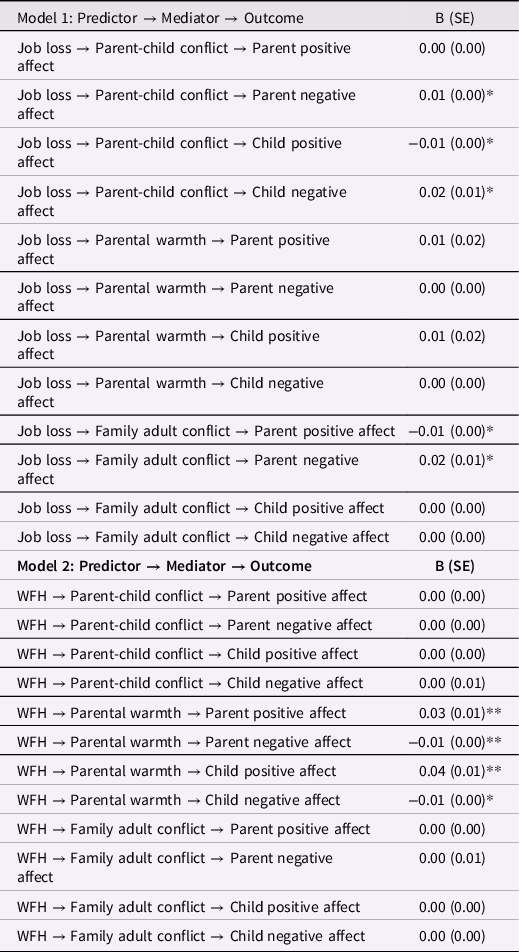
As shown in Table 4, COVID-19 job loss was associated with less parent positive affect via greater inter-adult conflict (b = −0.01, SE = 0.00, p < .05, 95% CI [−0.02, −0.01], ES = −0.01) and more parent negative affect via greater parent–child conflict (b = 0.01, SE = 0.00, p < .05, 95% CI [0.01, 0.02], ES = 0.01) and inter-adult conflict (b = 0.02, SE = 0.01, p < .05, 95% CI [0.01, 0.03], ES = 0.01). Parents who experienced job loss also demonstrated greater parent–child conflict, which in turn was associated with less child positive affect (b = −0.01, SE = 0.00, p < .05, 95% CI [−0.02, −0.01], ES = −0.01) and more child negative affect (b = 0.02, SE = 0.05, p < .001, 95% CI [0.01, 0.02], ES = 0.01).
List of indirect effects of family job loss and work from home on same-day parent and child affect via same-day family relational dynamics
Note. *p < .05, **p < .01, ***p < .001. WFH = Parent works from home.
Parent’s WFH status was linked to greater parental warmth, which in turn was linked to higher levels of parental positive affect (b = 0.03, SE = 0.01, p < .01, 95% CI [0.01, 0.06], ES = 0.02) and lower levels of parental negative affect (b = −0.01, SE = .00, p < .01, 95% CI [−.02, −.01], ES = −0.01). Parents’ WFH status was also linked to greater parental warmth, which in turn was linked to more child positive affect (b = 0.04, SE = 0.01, p < .01, 95% CI [0.01, 0.06], ES = 0.02) and less child negative affect (b = −0.01, SE = .00, p < .05, 95% CI [−0.02, −0.01], ES = −0.01). The model fit the data well [job loss model: χ 2(51) = 906.57, p < .001, RMSEA = .04, CFI = .84, SRMRwithin = .03, SRMRbetween = .08; WFH model: χ 2(51) = 902.54, p < .001, RMSEA = .04, CFI = .84, SRMRwithin = .03, SRMRbetween = .09].
SES differences
Although SES (i.e., qualification for free lunch program) moderated the means of our key constructs, the links between these constructs did not vary by SES, χ 2(30) = 35.04, p = ns.
Sensitivity analyses
We tested whether our moderation effect results changed when we used family household income as the SES indicator. When we used family household income as a continuous variable, the moderation effects remained the same. We also tested whether our results remained the same when running separate models for child and parent reports of parent–child conflict and parental warmth. The patterns of findings remained the same, thereby providing justification for our decision to combine both child and parent reports of family relationships into single composites. We also examined the main effects of daily-level mediators on next-day affective outcomes (see Tables S3–4 in the supplemental document for results). Although the overall patterns of the results held, most next-day effects were either smaller or non-significant relative to the same-day effects.
Discussion
COVID-19 caused unparalleled disruptions in family life that exacted an especially heavy toll on families living in economic disadvantage, especially at the onset of the pandemic (Cassinat et al., Reference Cassinat, Whiteman, Serang, Dotterer, Mustillo, Maggs and Kelly2021; Lopez et al., Reference Lopez, Hart and Katz2021). Even adults who escaped major financial ramifications faced substantial stress associated with shifting work and home responsibilities (Eales et al., Reference Eales, Ferguson, Gillespie, Smoyer and Carlson2021). Considering families’ shifting social and economic rules and routines, scholars and practitioners have emphasized the need to understand how COVID-19 has influenced family dynamics and well-being (Masten, Reference Masten2021). Using dyadic parent–adolescent data and a daily-diary approach, this longitudinal study investigated how parental employment status (i.e., job loss and WFH) was linked to parents’ and children’s daily affect indirectly through family functioning (i.e., parent–adolescent conflict, inter-adult conflict, and parental warmth) and whether these links varied by family SES.
Results revealed that parental employment changes were linked to family dynamics, and family dynamics were connected to both parents’ and adolescents’ daily positive and negative affect. Facets of family dynamics also mediated longitudinal links between parents’ employment status and daily affect among both parents and adolescents, though the mediation pathways differed by employment status and dimension of family dynamics. Specifically, COVID-19 job loss was indirectly related to poorer parental emotional adjustment (i.e., more negative and less positive affect) via parent–adolescent and inter-adult conflict. Similarly, parental unemployment’s indirect association with worse adolescent affective well-being operated through its connection with parent–adolescent conflict. WFH indirectly predicted enhanced parent and child emotional well-being via its positive connections with parental warmth. These findings not only highlight key factors shaping family members’ well-being during COVID-19, but they also inform a growing body of research about the psychosocial consequences of parental job loss and WFH arrangements.
Parental employment and family relational dynamics
In alignment with models of family risk and resilience (Masten, Reference Masten2021; Prime et al., Reference Prime, Wade and Browne2020; Robinson et al., Reference Robinson, Schulz, Ball, Chiaraluce, Dodel, Francis, Huang, Johnston, Khilnani, Kleinmann, Kwon, McClain, Ng, Pait, Ragnedda, Reisdorf, Ruiu, Xavier da Silva, Trammel and Williams2021) and family stress (Masarik & Conger, Reference Masarik and Conger2017; Neppl et al., Reference Neppl, Senia and Donnellan2016), family stress processes were implicated in the relations between parental job loss and curtailed family functioning. Research has illustrated that heightened economic pressure often leads to elevated parental distress, which has in turn been associated with increased animosity between parents and children and a higher likelihood of harsh parenting (Conger et al., Reference Conger, Wallace, Sun, Simons, McLoyd and Brody2002; McLoyd, Reference McLoyd1990). In fact, researchers have shown that parents who lost their job were nearly five times more likely to engage in coercive or emotionally abusive practices in the home (Lawson et al., Reference Lawson, Piel and Simon2020). Pandemic-related stress, such as that experienced from job loss, has indeed been associated with increased conflict between parents and their partners that in turn affects the cohesion of the entire family (Peltz et al., Reference Peltz, Crasta, Daks and Rogge2021).
Conversely, WFH was associated with greater parental warmth. Although this finding may seem counterintuitive given literature on the negative mental health impacts of competing professional and childrearing responsibilities for WFH parents (McCrory Calarco et al., Reference McCrory Calarco, Meanwell, Anderson and Knopf2020), it is supported by extant literature on job and parental characteristics. For instance, certain job-related assets (e.g., job security, schedule flexibility, financial stability, professional autonomy) may have buffered against psychological distress, thus potentially deterring maladaptive parenting behaviors (Heinrich, Reference Heinrich2014; Perry-Jenkins et al., Reference Perry-Jenkins, Laws, Sayer and Newkirk2020). In addition, Prime et al. (Reference Prime, Wade and Browne2020) noted that parental efforts aimed at promoting a positive family outlook can serve as important sources of resilience during COVID-19 social disruptions. Parents with the psychological flexibility to adapt to life changes and an appreciation of increased family time may have been able to better manage COVID-19 stress (McCrory Calarco et al., Reference McCrory Calarco, Meanwell, Anderson and Knopf2020). Some parents even reported that spending more time with their children provided an emotional reprieve from pandemic-related stress. These positive shifts are reflective of the heterogeneity in COVID-19-related research and results documented by Eales et al. (Reference Eales, Ferguson, Gillespie, Smoyer and Carlson2021). Although transitions to WFH required parents to rapidly find ways to balance their shifting professional lives and changing family ecology, the initial stress of adapting to WFH arrangements may have paved the way for family resilience through increased warmth and togetherness.
Family relational dynamics and emotional well-being
Analyses unearthed consistent links between each marker of family functioning (i.e., parent–adolescent conflict, inter-adult conflict, and parental warmth) and parents’ and adolescents’ emotional well-being. These specific dimensions of family functioning not only have independent links with adolescent emotions, but they also coalesce meaningfully to reflect the general family emotional climate that shapes the psychological well-being of both adolescents and parents (Peltz et al., Reference Peltz, Crasta, Daks and Rogge2021; Skinner et al., Reference Skinner, Godwin, Alampay, Lansford, Bacchini, Bornstein, Deater-Deckard, Di Giunta, Dodge, Gurdal, Pastorelli, Sorbring, Steinberg, Tapanya and Yotanyamaneewong2021). Moreover, family dynamics are fundamental factors predicting the long-term well-being of parents and parenting quality (Fincham & Beach, Reference Fincham and Beach1999). While parental warmth tends to support children’s enhanced adjustment, for parents, it is tied to dispositional traits (e.g., emotional control, self-efficacy) and contextual factors (e.g., social support) that promote better psychological well-being (Izzo et al., Reference Izzo, Weiss, Shanahan and Rodriguez-Brown2014). Inter-parental conflict, on the other hand, shapes parents’ psychological functioning while also contributing to negative parenting behaviors and disrupted parent–adolescent attachments (Fincham & Beach, Reference Fincham and Beach1999; Peltz et al., Reference Peltz, Crasta, Daks and Rogge2021).
Although several studies have found longitudinal connections between family processes and youth emotional well-being (Cheung et al., Reference Cheung, Tang and Tang2011; Gross et al., Reference Gross, Shaw and Moilanen2008), we did not observe a link between inter-adult conflict and adolescent affect. Two potential protective factors – social support and appraisal skills – might account for this resilience. According to Prime et al. (Reference Prime, Wade and Browne2020), supportive familial and extrafamilial relationships (e.g., siblings, friends) can guard youth’s psychological well-being against threats posed by COVID-19-related family stressors. Indeed, children manage multiple stressors better when they receive positive familial and/or extrafamilial support (Lai et al., Reference Lai, Lewis, Livings, Greca and Esnard2017; Shahar et al., Reference Shahar, Cohen, Grogan, Barile and Henrich2009). Adaptive cognitive appraisal likewise buoys youth resilience to negative life events (Bonanno & Diminich, Reference Bonanno and Diminich2013; Wang, Scanlon, et al., Reference Wang, Scanlon, Hua and Del Toro2021; Wang, Scanlon, et al., Reference Wang, Scanlon, Hua, Zhang, Belmont and Del Toro2022). Specifically, adolescents might view inter-adult conflict as deriving primarily from pandemic-related stress (i.e., an external stressor) rather than dysfunction within the family system. Taken together, these findings illustrate the importance of considering both individual and contextual factors to understand how to foster family and youth resilience during times of adversity.
The role of SES
Neither the direct effects of parental employment status nor the mediation effects of family dynamics on child and parent well-being were moderated by family SES; yet, our findings do shed some light on the struggles of low-income families during COVID-19. The pandemic has disproportionately affected low-income households in the USA (Bertrand et al., Reference Bertrand, Briscese, Grignani and Nassar2020; Kinder & Ross, Reference Kinder and Ross2020; Lopez et al., Reference Lopez, Hart and Katz2021; Martin et al., Reference Martin, Markhvida, Hallegatte and Walsh2020). Our results indicated that when compared to parents in higher-income families, parents in low-income families were three times less likely to WFH and twice as likely to experience job loss. Our results also suggest that job loss may incite negative family relational dynamics whereas WFH may foster parental warmth. Taken together, it should come as no surprise that parent-adolescent and inter-adult conflict levels were higher among low-income families in our sample. In alignment with Lopez et al. (Reference Lopez, Hart and Katz2021), we present additional evidence that low-income families experienced greater adversity during the pandemic while having fewer resources to contend with said adversity.
As a rich body of research illustrates, economically disadvantaged families face an array of distal risk factors (i.e., economic instability, parents’ work characteristics) that imperil family functioning and, in turn, parent and youth well-being. For instance, parents in low-income families were more susceptible to layoffs and furloughs, as these individuals are more likely to work hourly or customer-facing jobs. During the pandemic, though, some of these blue-collar roles were labeled as “essential workers.” While parents in these roles may have avoided job loss or furlough, their continued financial stability was dependent on potential exposure to the virus at their workplace. On the fly, these parents had to figure out ways to balance out-of-home work responsibilities, facilitate children’s transition into remote learning, and reduce the likelihood of transmitting the virus to their family members. Such hardships can quickly cascade into disrupted family functioning and decreased mental health (e.g., Eales et al., Reference Eales, Ferguson, Gillespie, Smoyer and Carlson2021; Gadassi Polack et al., Reference Gadassi Polack, Sened, Aubé, Zhang, Joormann and Kober2021; Schmidt et al., Reference Schmidt, Kramer, Brose, Schmiedek and Neubauer2021).
Limitations
While this study provides a longitudinal glimpse into the influence of family dynamics in the link between COVID-19’s economic impacts and the emotional well-being of children and parents, several limitations should be considered. First, data for this study was collected during the early stages of the pandemic. It is likely that as the pandemic progressed, families continued to contend with employment shifts and economic adversity. As such, future studies should seek to examine whether and how our findings hold, diminish, or strengthen over time and in other samples.
Moreover, this study mainly focused on same-day effects (vs. next-day effects). The overall patterns of next-day effects were similar to same-day effects, but next-day effects were either smaller than same-day effects or non-significant. These findings make intuitive sense, as same-day family processes during the pandemic have been more strongly linked to same-day (vs. next day) psychological outcomes (Wang, Del Toro, et al., Reference Wang, Del Toro, Scanlon, Schall, Zhang, Belmont, Voltin and Plevniak2021; Wang, Henry, et al., Reference Wang, Henry, Del Toro, Scanlon and Schall2021); however, the magnitude of these same-day effect sizes may be due to our large sample size and use of repeated measures. Replication studies are needed to determine whether the observed effects on psychological and behavioral outcomes hold in other samples. In addition, we opted for shorter measures in the name of minimizing daily participant burden, but future research may benefit from including multidimensional scales to assess parenting, family climate, and mental health. It may be wise for future designs to use more thorough measurement instruments in exchange for a longitudinal design with less frequent data collection points over a longer period of time.
Furthermore, causal inference should be interpreted carefully, as we are unable to rule out the possibility that other parental characteristics (e.g., human capital, mental health) contributed to the observed family processes. For example, future research may want to examine whether certain job-related assets (e.g., schedule flexibility, professional autonomy) protect against parents’ psychological distress and whether these assets vary between those working in-person and those WFH. Finally, using eligibility for reduced-price and free school meals as a proxy for family SES may not fully capture family economic circumstances. Though this convention is widely used in psychological studies, future studies should consider income instability (i.e., unpredictable income fluctuations/loss) and wealth holdings as alternative family SES indicators.
Conclusion
Using parent and child dyadic daily-diary data from a racially and socioeconomically diverse US sample, this study indicated that COVID-19’s effect on parental employment status (distal contextual factors) influenced family inter-relations (proximal family processes), which in turn were linked to parent and child emotional well-being. In accord with insights from psychological science, parental warmth and positive family relationships promoted better mental health for both parents and adolescents. Our results also imply that the flexibility, autonomy, and work-life balance afforded by WFH arrangements are beneficial to family functioning during times of adversity. To promote healthy family relationships during parental job transitions, clinicians and social workers can routinely emphasize best practices for managing stress, neutralizing family conflict, and supporting children’s emotional needs. Moreover, employers have a responsibility to their employees, especially those with family caregiving responsibilities, to consider the impact of WFH on employee work-life balance and overall well-being when developing future policies regarding remote work.
Our findings also add to the litany of research indicating that the well-being of millions of American families hinges on a multipronged policy and intervention response to the pandemic and its curtailment of the US economy. Government and public health entities play a fundamental role in family resiliency by enacting policies that limit the impact of widespread disasters on a family’s financial status (Dooley et al., Reference Dooley, Bandealy and Tschudy2020). As we put the COVID-19 pandemic behind us, at-risk families still need substantive financial, health, and educational supports that stabilize income for parents who lost their jobs (e.g., supplemental unemployment insurance) as well as equitable access to individual mental health treatment and family-based services. Clinicians and social workers should work closely together during treatment planning to match family needs with pertinent government programs and subsidized resources, especially during times of economic uncertainty. By focusing on how and to what extent macro-structural factors affect proximal processes within families, employers, policymakers, and practitioners have the potential to preserve and build upon family resilience, even in the face of a global pandemic.
Supplementary material
The supplementary material for this article can be found at https://doi.org/10.1017/S0954579422001213
Acknowledgements
We would like to thank the dedicated members of the Motivation Center at the University of Pittsburgh for their assistance in data collection as well as our participants for their continued contributions to our longitudinal work.
Funding statement
This work was supported by Spencer Foundation (Grant number 15231).
Conflicts of interest
None.


 Open access

