

INTRODUCTION
The giant squid Architeuthis dux Steenstrup, 1857 is an enigmatic deep-water cephalopod inhabiting temperate oceans and adjacent subpolar and subtropical waters worldwide (Cherel, Reference Cherel2003; Nesis, Reference Nesis2003; Winkelmann et al., Reference Winkelmann, Campos, Strugnell, Cherel, Smith, Kubodera, Allcock, Kampmann, Schroeder, Guerra, Norman, Finn, Ingrao, Clarke and Gilbert2013; Roper et al., Reference Roper, Judkins, Voss, Shea, Dawe, Ingrao, Rothman and Roper2015; Wada et al., Reference Wada, Kubodera, Yamada and Terakado2015). Its biology and distribution remain obscure, despite recent technological advances, which allowed in-situ giant squid observations (Kubodera & Mori, Reference Kubodera and Mori2005; Schrope, Reference Schrope2013), and numerous records from all major oceans (Nesis et al., Reference Nesis, Amelekhina, Boltachev and Shevtsov1985; Re et al., Reference Re, Baron, Beron, Gosztonyi, Kuba, Monsalve and Sardella1998; Cherel, Reference Cherel2003; Martins & Alvarez Perez, Reference Martins and Alvarez Perez2009; Winkelmann et al., Reference Winkelmann, Campos, Strugnell, Cherel, Smith, Kubodera, Allcock, Kampmann, Schroeder, Guerra, Norman, Finn, Ingrao, Clarke and Gilbert2013; Roper et al., Reference Roper, Judkins, Voss, Shea, Dawe, Ingrao, Rothman and Roper2015).
Life history characteristics of the giant squid are largely unknown, despite the species probably being one of the largest marine animals. Anecdotal reports of total length (TL) often approach extreme values of several tens of metres (Heuvelmans, Reference Heuvelmans1968; Paxton, Reference Paxton2016); however, scientific literature documents considerably smaller sizes. Even scientific records of A. dux that ranged within 15–20 m TL (Kirk, Reference Kirk1888; Berzin, Reference Berzin1971, Reference Berzin1972) are commonly challenged (Grist & Jackson, Reference Grist and Jackson2007; McClain et al., Reference McClain, Balk, Benfield, Branch, Chen, Cosgrove, Dove, Gaskins, Helm, Hochberg, Lee, Marshall, McMurray, Schanche, Stone and Thaler2015; Paxton, Reference Paxton2016). There is also disagreement on giant squid lifespan: estimates of longevity range from 2–3 years (Gauldie et al., Reference Gauldie, West and Förch1994; Lipiński, Reference Lipiński1997; Lordan et al., Reference Lordan, Collins and Perales-Raya1998; Grist & Jackson, Reference Grist and Jackson2007) to over 35 years (Landman et al., Reference Landman, Cochran, Cerrato, Mak, Roper and Lu2004).
In the Indian Ocean, the first report of A. dux dates back to the 19th century (Vélain, Reference Vélain1877), while the number of occurrences currently exceeds 100 records (Yukhov, Reference Yukhov1974, Reference Yukhov2014; Clarke, Reference Clarke1980; Mikhalev et al., Reference Mikhalev, Savusin, Kishiyan and Ivashin1981; Nesis et al., Reference Nesis, Amelekhina, Boltachev and Shevtsov1985; Cherel, Reference Cherel2003; GBIF, 2016; OBIS, 2016). The majority of regional A. dux encounters originate from temperate and sub-Antarctic waters, most of which correspond to remains recovered from predators’ stomachs (usually from the sperm whale Physeter macrocephalus and various shark species), but some specimens were found floating at the surface or stranded (Vélain, Reference Vélain1877; Yukhov, Reference Yukhov1974, Reference Yukhov2014; Clarke, Reference Clarke1980; Mikhalev et al., Reference Mikhalev, Savusin, Kishiyan and Ivashin1981; Cherel, Reference Cherel2003). To date, the largest reported Indian Ocean giant squids reached 2200–2300 mm in dorsal mantle length (DML) either measured or estimated from reference parts such as the lower beak (Cherel, Reference Cherel2003; Yukhov, Reference Yukhov2014).
Only two giant squid occurrences have so far been documented in the tropical area of the Indian Ocean: around Mauritius (Staub, Reference Staub1993) and Reunion Island (Cherel, Reference Cherel2003). Several giant squids from the Mozambique Channel, mentioned in Yukhov (Reference Yukhov2014), lack georeferencing data, corresponding measurements and other details. The global distribution of giant squid, reported in Roper & Boss (Reference Roper and Boss1982), also indicates a single record of the giant squid in the northern Indian Ocean; however no sampling details were provided. Here, we document the occurrence of the biggest giant squid ever discovered in the Indian Ocean, recovered in 2016 off Reunion Island.
MATERIALS AND METHODS
Squid collection
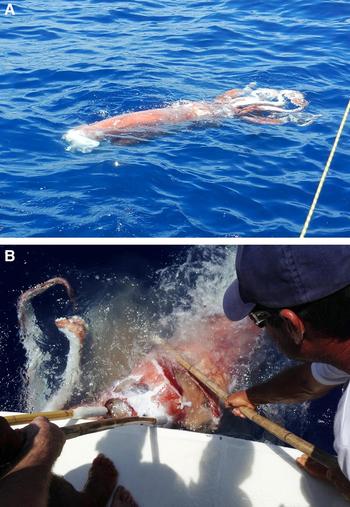
A squid specimen of several metres long (Figure 1A, B), lacking the distal part of the mantle (including the fin), was found floating at the surface waters off Saint Gilles, Reunion Island by the game fishing vessel ‘Maeva 4’ (12 m length overall) on 4 March 2016. The precise GPS position was not recorded, but coordinates were estimated to be 21°03′S 55°08′E from eyewitness statements of ‘5–6 nautical miles off Saint-Gilles’. Digital photographs were taken by fishermen and used for morphological examination. Although dead, the squid did not manifest any signs of decomposition and possessed natural skin pigmentation. Due to the size and weight of the specimen and lack of suitable equipment, the vessel's crew and fishermen were unable to pull the squid onboard undamaged. Only the head with tentacles were recovered using regular fishing gaffs. Squid remains were transported to shore, where it was stored in the freezer at −18°C. The squid was donated by the fishermen to University of Reunion Island for further examination.
The giant squid Architeuthis dux specimen at the surface, off Saint Gilles, Reunion Island on 4 March 2016. (A) Free-floating squid; (B) Attempts to pull the specimen on board by the crew of FV ‘Maeva 4’.
Sampling
Frozen remains of the specimen were stored for 102 days in the freezer before examination. The squid was thawed for 24 h at ambient temperature before sampling and measurements. Intact parts were measured with a calliper or measuring tape. The buccal mass, together with the beak, was removed from the mollusc's head prior to beak extraction. Before its preservation in 70% alcohol, the beak lower rostral length (LRL) was measured with a digital Vernier calliper with an accuracy of 0.01 mm. Muscle tissues were sampled from the individual once thawed and stored in 96% alcohol for genetic sequencing and species identification.
Genetic analysis
Genomic DNA was extracted from 20 mg of muscle tissue, after an overnight digest, using the automated KingFisher Duo Prime Purification System by ThermoScientific following the manufacturer's protocol (Thermo Fisher Scientific, USA). A 313 bp region of the mitochondrial cytochrome c oxidase I gene (COI) was amplified using the forward mlCOIintF- [5′ GGWACWGGWTGAACWGTWTAYCCYCC 3′] (Leray et al., Reference Leray, Yang, Meyer, Mills, Agudelo, Ranwez, Boehm and Machida2013) and reverse jgHCO2198- [5′ TAIACYTCIGGRTGICCRAARAAYCA 3′] (Geller et al., Reference Geller, Meyer, Parker and Hawk2013) primer combination (see online Electronic Supplement 2 for laboratory specifications).
Sequence similarity searches on the query DNA sequence were done using the BLASTn search implemented on the NCBI nucleotide database (Madden, Reference Madden, Beck, Benson, Coleman, Hoeppner, Johnson, Maglott, Mizrachi, Morris, Ostell, Pruitt, Rubinstein, Sayers, Sirotkin and Tatusova2013) and the Hidden Markov Model (HMM) alignment tool implemented on the BOLD reference database (Ratnasingham & Hebert, Reference Ratnasingham and Hebert2007).
Size reconstruction
Reconstruction of animal size from reference parts is a common approach used for damaged or digested specimens (Clarke, Reference Clarke1980, Reference Clarke1986; Hansel et al., Reference Hansel, Duke, Lofy and Gray1988; Cherel, Reference Cherel2003; Staudinger et al., Reference Staudinger, Juanes and Carlson2009; Potier et al., Reference Potier, Ménard, Benivary and Sabatié2011). We used the giant squid beak as a reference part for further size reconstruction of the entire individual based on published allometric equations. We focused on the DML and the TL reconstruction since the former is a ‘reference’ length for cephalopod measurements (Roper & Voss, Reference Roper and Voss1983) while TL is commonly used for demonstration of extreme size of the giant squid among cephalopods (e.g. McClain et al., Reference McClain, Balk, Benfield, Branch, Chen, Cosgrove, Dove, Gaskins, Helm, Hochberg, Lee, Marshall, McMurray, Schanche, Stone and Thaler2015; Paxton, Reference Paxton2016). The most robust allometric equations were selected from the literature based on the following three criteria: statistical significance (if provided by the authors), large sample size, and the A. dux size range covering extreme sizes of reference parts and entire squid.
The lower rostral length was used as a predictor of the DML based on Roeleveld (Reference Roeleveld2000) (1) and Paxton (Reference Paxton2016) (2) equations:
 $${\rm LRL} = 11.2 \times {\rm lo}{\rm g}_{10}{\rm DML} - 19.3\;\left( {{\rm values}\;{\rm are}\;{\rm in}\;{\rm mm}} \right)$$
 $${\rm DML} = e^{( - 1.168 + 98.031 \times {\rm LRL})}({\rm values}\;{\rm are}\;{\rm in}\;{\rm m)}$$
The total length was extrapolated from the DML based on the following relationships: Paxton (Reference Paxton2016) (3) and McClain et al. (Reference McClain, Balk, Benfield, Branch, Chen, Cosgrove, Dove, Gaskins, Helm, Hochberg, Lee, Marshall, McMurray, Schanche, Stone and Thaler2015) (4):
 $${\rm TL} = 0.006 + 5.117\;{\rm DML}\;({\rm values}\;{\rm are}\;{\rm in}\;{\rm m)}$$
 $${\rm TL} = 1.59 \times {\rm DM}{\rm L}^{1.98}({\rm values}\;{\rm are}\;{\rm in}\;{\rm m)}$$
Records of Indian Ocean occurrences of A. dux from GBIF (GBIF, 2016), OBIS (OBIS, 2016) and other published records (Vélain, Reference Vélain1877; Yukhov, Reference Yukhov1974; Roper & Boss, Reference Roper and Boss1982; Staub, Reference Staub1993; Cherel, Reference Cherel2003) were used for mapping regional giant squid distribution. The Indian Ocean area is considered here following the official description of the International Hydrographic Organization: from the Asian Continent to Antarctica, with its western and eastern borders positioned at 20°E off South Africa and 146°55′E off Southern Australia respectively (IHO, 1953).
RESULTS
Remains description and identification
The mantle, tentacles and tips of six out of eight arms were missing from the preserved remains. The head was split in two parts at the level of the eyes at the moment of squid recovery (Figure 1A, B). Measurements used for length estimates (i.e. LRL) are presented in Table 1; other measurements taken from intact parts are summarized in the Electronic Supplement 1, Table E-1. Based on the external morphology of the individual (examined from photographs and preserved remains) and on the beak morphology (Clarke, Reference Clarke1986; Xavier & Cherel, Reference Xavier and Cherel2009), the specimen was identified as the giant squid Architeuthis dux. Injuries visible on squid remains, while drifting at the surface (Figure 1A), clearly reflected an external impact: the tail and fin were missing, and the terminal part of the mantle showed naked muscles without skin.
Details of the measurements of Architeuthis dux found off Reunion Island and comparisons with other large Indian Ocean giant squid individuals. LRL is lower rostral length, DML is dorsal mantle length, and TL is total length. Estimates marked by ‘P’ are based on Paxton (Reference Paxton2016) equations, estimates marked by ‘R’ are derived using Roeleveld (Reference Roeleveld2000) regression, and ‘MC’ corresponds to McClain et al. (Reference McClain, Balk, Benfield, Branch, Chen, Cosgrove, Dove, Gaskins, Helm, Hochberg, Lee, Marshall, McMurray, Schanche, Stone and Thaler2015) equation.

a Estimated, see paper text for details.
b Apparently standard length.
c No exact geographic position presented in the source. Specimen cannot be attributed either to Pacific or Indian Ocean.
d Not an Indian Ocean record (Yukhov, 2016 personal communication).
Genetics
A 313 bp region of the mtDNA COI gene was isolated in the specimen and the sequence was deposited in the NCBI database (accession number: KY614519). The squid query sequence returned 100% sequence similarity to the mtDNA COI region of the whole mitochondrial reference genomes and partial mtDNA COI reference sequences of Architeuthis dux stored in GenBank (Winkelmann et al., Reference Winkelmann, Campos, Strugnell, Cherel, Smith, Kubodera, Allcock, Kampmann, Schroeder, Guerra, Norman, Finn, Ingrao, Clarke and Gilbert2013; Benson et al., Reference Benson, Clark, Karsch-Mizrachi, Lipman, Ostell and Sayers2014; Kameda et al., Reference Kameda, Kubodera and Wada2015).
Occurrences
The present record of a giant squid complements previous records off the Mascarene Islands and is the third georeferenced occurrence of this species in the tropical Indian Ocean (north of the tropic of Capricorn: 23°26′13.6″S) (Staub, Reference Staub1993; Cherel, Reference Cherel2003) (Figure 2).
The geographic positions of Architeuthis dux Steenstrup, 1857 records from the Indian Ocean. This study's record is the star; Published records: the Reunion Island record from Cherel (Reference Cherel2003)* is the grey dot, the Staub’ (Reference Staub1993)* record off Mauritius Island is the black dot, the black squares and snowflake are from Roper & Boss (Reference Roper and Boss1982)**. The snowflake represents a single northern Indian Ocean record. The oblique crosses are data from GBIF (2016), full triangles are OBIS (2016), and crosses are from Cherel (Reference Cherel2003). The full diamond is from the Vélain (Reference Vélain1877)*** record of a stranded giant squid; the empty triangle is from Wendy West, unpublished data; the empty diamonds are from Yukhov (2016, personal communication, earlier presented as a map in Yukhov, Reference Yukhov1974). For references marked with *, the positions of the observations were estimated from the description published in the original paper. For references marked by **, positions were estimated from the original map presented in the paper. For references marked by ***, positions mark the central position of the island where stranding occurs. The 200 m isobath (dark line) and bathymetry from 1000 to 5000 m (in 1000 m steps, light lines) are shown. Coastline and bathymetry data are from GEBCO (2016).

DISCUSSION
The dorsal mantle length of A. dux reported here (3060 mm, estimated from equation (1)) exceeds the DML of the other Mascarene Islands specimens (Staub, Reference Staub1993; Cherel, Reference Cherel2003) (Table 1). Cherel (Reference Cherel2003) also estimated DML from Roeleveld's (Reference Roeleveld2000) equation (1); however, direct size comparisons are less reliable with the specimen from Staub (Reference Staub1993) due to the ambiguous information on how measurements were taken. Comparisons of the giant squid proportions with human personages, depicted next to the specimen in photographs, suggest that Staub (Reference Staub1993) probably measured standard length (i.e. the length from the posterior end of the mantle to the tip of the arms) which was referred to as a ‘body measurement’ (‘son corps mesurait’) in the original paper.
In this study, the A. dux DML is 28% longer than the longest one reported by Cherel (Reference Cherel2003) from the Kerguelen Archipelago (Table 1). On a global scale, our DML estimates based on Roeleveld's (Reference Roeleveld2000) equation exceeds ‘longest reliably measured’ DML (2794 mm) (Kirk, Reference Kirk1880 in Paxton, Reference Paxton2016) reported to date, and may represent the largest giant squid ever discovered. However, Paxton (Reference Paxton2016) suggested that Roeleveld's (Reference Roeleveld2000) equation overestimates DML, at least for large individuals. Based on Paxton's (Reference Paxton2016) regression formula, the DML estimate for our A. dux is 2153 mm (99% PI 1500–2950 mm), which makes it the largest specimen ever reported in the Indian Ocean (Table 1) and place it among the 12 largest giant squids (DML above 2000 mm) reported globally (Kirk, Reference Kirk1880, Reference Kirk1882; Frost, Reference Frost1936 in Sweeney & Roper, Reference Sweeney and Roper2001; Keil, Reference Keil1963 in Sweeney & Roper, Reference Sweeney and Roper2001; Gauldie et al., Reference Gauldie, West and Förch1994; Norman & Lu, Reference Norman and Lu1997).
The extrapolation of TL based on DML estimates is highly uncertain; therefore we present TL estimates only for comparison purposes with other published giant squid size records and as an indicator of a potential extreme upper range of TL. The extrapolated TL (11,025–15,664 mm) of the giant squid reported here (Table 1) exceeds the TL of an individual stranded on Saint Paul Island (7150 mm) (Vélain, Reference Vélain1877) and the biggest known Indian Ocean giant squid (9000 mm) reported by Berzin (Reference Berzin1971) (originally incorrectly stated as having a TL of 19 m). Paxton's (Reference Paxton2016) challenge of the 19 m TL size was validated by Dr Valentin YukhovFootnote 1 (2016, personal communication) who participated in the discovery of the Berzin’ (Reference Berzin1971) individual in the stomach of a sperm whale. This 19 m total length instead of 9 m appeared to be a misprint in Berzin (Reference Berzin1971) (Yukhov, 2016, personal communication), later reproduced in the English translation (Berzin, Reference Berzin1972) and referenced in several papers on giant squid biology (Sweeney & Roper, Reference Sweeney and Roper2001; Paxton, Reference Paxton2016). Taking these considerations into account, size estimates of the recovered specimen described here rank at the higher end of the TL range, with the largest giant squid ever measured to be the specimen stranded on the New Zealand coast in 1887 (Kirk, Reference Kirk1888)Footnote 2, with 684 inches (17,374 mm) in TL.
Together with individuals reported by Staub (Reference Staub1993) and Cherel (Reference Cherel2003), our record is the third northernmost occurrence of giant squid observed to date in the Indian Ocean. Besides an A. dux global occurrences map that appeared in Roper & Boss (Reference Roper and Boss1982) (which was missing sampling details), giant squid have never been reported from equatorial waters nor from the northern hemisphere of the Indian Ocean. The presence of a giant squid off India as mentioned by Coro et al. (Reference Coro, Magliozzi, Ellenbroek and Pagano2015) and based on Silas (Reference Silas and Rao1968, Reference Silas1985) is obviously erroneous: the original Silas (Reference Silas and Rao1968, Reference Silas1985) papers did not show any record of A. dux encounters in Indian waters in their ocean-wide accounts of various squid species.
Global ocean records of the giant squid in the tropics are only known from the eastern tropical Atlantic (Nigmatullin, Reference Nigmatullin1976; Nesis et al., Reference Nesis, Amelekhina, Boltachev and Shevtsov1985), demonstrating apparently the capacity of errant individuals to penetrate into tropical waters via deep, cold-water currents. The principal area of the Indian Ocean giant squid distribution seems to correspond with subtropical and temperate waters of the southern hemisphere (Figure 2) (Vélain, Reference Vélain1877; Yukhov, Reference Yukhov1974, 2016, personal communication; Clarke, Reference Clarke1980; Cherel, Reference Cherel2003; GBIF, 2016; OBIS, 2016) lying between the North Subtropical Front and the Polar Front (Kostianoy et al., Reference Kostianoy, Ginzburg, Lebedev, Frankignoulle and Delille2003, Reference Kostianoy, Ginzburg, Frankignoulle and Delille2004). Our findings suggest that the distribution of A. dux is much wider than the ‘bi-subtropical distribution’ described by Nesis (Reference Nesis2003). The nutrient-poor waters of the Indian Ocean Subtropical Gyre province, characterized by high heat content, deep propagation of warm waters and oligotrophic conditions (Jayne & Marotzke, Reference Jayne and Marotzke2002; Gouretski & Koltermann, Reference Gouretski and Koltermann2004; Longhurst, Reference Longhurst2007), likely represent the northern border of the giant squid habitat in the Indian Ocean.
The majority of Indian Ocean A. dux have been described from squid remains discovered in predators' stomachs, mainly sperm whales (Clarke, Reference Clarke1980; Mikhalev et al., Reference Mikhalev, Savusin, Kishiyan and Ivashin1981; Nesis et al., Reference Nesis, Amelekhina, Boltachev and Shevtsov1985; Yukhov, Reference Yukhov2014) and to a lesser extent sleeper sharks Somniosus sp. (Cherel, Reference Cherel2003), swordfish Xiphias gladius (Wendy WestFootnote 3, unpublished data) and several albatross species Diomedea spp. (Cherel et al., Reference Cherel, Weimerskirch and Trouvé2002; Cherel, Reference Cherel2003). Similarly, two A. dux remains found floating at the surface (Cherel, Reference Cherel2003) also showed signs of predation by sperm whales and an unknown predator. We suggest that the giant squid described here was severely mutilated due to predation. The whole tail of the specimen was most likely severed by a predator, rather than other means of injury (e.g. propeller of a vessel), given the preferences of giant squid to deep-water habitats (Kubodera & Mori, Reference Kubodera and Mori2005) and visible patterns of tissue damage (Figure 1A). Injuries at the mantle tip (Figure 1A) suggest predation by a large animal, probably a sperm whale, as they are known to prey on giant squid and regularly occur within the region (Clarke, Reference Clarke1980; Jefferson et al., Reference Jefferson, Leatherwood and Webber1993; Mannocci et al., Reference Mannocci, Laran, Monestiez, Dorémus, Van Canneyt, Watremez and Ridoux2014), or possibly a great white shark (Carcharodon carcharias), which occasionally visit Reunion Island waters (Zuffa et al., Reference Zuffa, Van Grevelynghe, De Maddalena and Storai2002; Jaquemet, unpublished data). Smaller predators such as squid or fish leave predation marks that differ in size and shape from the ones observed here (Chapman et al., Reference Chapman, Sharples, Brogan, Desurmont, Beverly and Sokimi2006; Lowry et al., Reference Lowry, de Castro, Mara, Whitenack, Delius, Burgess and Motta2009; Papastamatiou et al., Reference Papastamatiou, Wetherbee, O'Sullivan, Goodmanlowe and Lowe2010).
The present record complements the current knowledge on A. dux distribution and biology on regional and global scales. We document a rare occurrence of giant squid in tropical waters of the Indian Ocean and one of the largest individuals ever reported worldwide. Architeuthis dux remains an enigmatic species requiring more scientific efforts to address the current challenges in the understanding of its natural history, its role in ocean ecosystems and the potential threats to its conservation, especially those due to human activities (Guerra et al., Reference Guerra, González, Pascual and Dawe2011; Leite et al., Reference Leite, Campbell, Versiani, Nunes and Thiele2016).
SUPPLEMENTARY MATERIAL
The supplementary material for this article can be found at https://doi.org/10.1017/S0025315417001588.
ACKNOWLEDGEMENTS
We are grateful to Loïc Jauneau, the captain and Joel Mussard, the deckhand of FV ‘Maeva 4’ for their effort to collect the giant squid individual. Specific thanks to Thibaut Thellier for the preservation of the specimen and for providing photographs and information associated with A. dux capture. Thomas Poirout and Sophie Bureau (Université de La Réunion) helped in meristic counts and morphometric measurements. Thanks to Yves Cherel (CNRS, France) for the comparative measurements of the beak and the validation of the species identification based on beak morphology. Tom Gilbert (Geological Museum, Copenhagen, Denmark) provided support in genetic identification. Charles G. M. Paxton (University of St Andrews, UK) provided DML and PI estimates from LRL based on his regression formula. Particular thanks are due to Dr Valentin Yukhov who shared detailed data on the historical occurrences of giant squid in sperm whale stomachs in the Indian Ocean, and to Wendy West for her data on giant squid beaks occurrence in swordfish stomachs. Finally, we thank Anne-Elise Nieblas who provided editing of the English. The insightful comments of two anonymous referees improved the manuscript.