


The United States Supreme Court has long been the subject of concerns that the exercise of judicial power by unelected judges threatens majoritarian governance. These concerns, often called the “counter-majoritarian difficulty” (Bickel Reference Bickel1962), intensified in the twentieth century amid growing judicial supremacy.
In political science, the most prominent answer to the question of the countermajoritarian difficulty has come from a school of thought sometimes called “regime theory” (see Gillman Reference Gillman, Caldeira, Kelemen and Whittington2008; Graber Reference Graber2008; Keck Reference Keck2007; Novkov Reference Novkov2015). Regime theory answers that there is rarely a countermajoritarian difficulty because the court is generally aligned with a democratically elected “dominant regime” in the national government. When the court does exercise judicial authority to shape public policy, it does so in ways that support its aligned regime, such as legitimating policy achievements, overcoming subnational opposition, or addressing intracoalitional conflicts. Through this court–party relationship, regime theory contends, the exercise of judicial power is accountable to the public.
Building on recent critiques, we argue that regime theory’s arguments about court–party relations and the countermajoritarian difficulty depend on historically specific scope conditions pertaining to the dynamics of party politics. Regime theory best explains the long New Deal era of the 1930s–60s, when interparty competition and intraparty cohesion were both low. Since the 1960s, we have witnessed a period of growing and sustained interparty competition and increasing intraparty cohesion. Under these conditions, we argue that regime theory’s expectations no longer hold.
We offer a revised theory of court–party relations that is attuned to longitudinal change in these scope conditions. We begin by preserving the core insight of regime theory: there is a relationship between party coalitions and Supreme Court justices, maintained by the appointment process and other coalition-building efforts. Under conditions of high interparty competition, however, there is no longer a dominant regime, and the court is aligned with one of two competitive party coalitions. In this context, the court’s exercise of judicial power can benefit its aligned coalition in different ways: achieving controversial or countermajoritarian policy goals and curbing policy implementation by the opposing coalition. Furthermore, high intraparty cohesion enables more cohesive party policy agendas and facilitates the supply of judges who more reliably align with those agendas. In this context, rather than resolving intracoalitional conflicts, the court more reliably advances the cohesive commitments of its aligned coalition. Thus, we argue that under contemporary conditions, judicial power does pose a countermajoritarian difficulty, as it can enable the court’s aligned coalition to achieve policy goals while minimizing electoral accountability.
The remainder of the article proceeds as follows. First, we review the arguments and findings of regime theory and build on recent critiques of its applicability to the contemporary period. Second, we argue that regime theory assumes that interparty competition and intraparty cohesion are low, and show that each has increased since the mid-twentieth century. Third, we present our revised theory of court–party relations and its implications for the countermajoritarian difficulty. Fourth, we analyze illustrative examples during three periods (1930s–60s, 1970s–90s, and 2000s–present) to show how the exercise of judicial power serves different purposes for the aligned coalition as these scope conditions change. Finally, we discuss how contemporary court–party relations raise serious concerns about the countermajoritarian difficulty.
Regime Theory Revisited
Critics of federal judicial power in the US have long argued that powerful courts create a problem for democratic governance: unelected judges can wield their authority to strike down or transform legislation enacted by elected officials in the legislative and executive branches (Brutus 1788; Friedman Reference Friedman1998). These concerns were famously termed the “counter-majoritarian difficulty” by Alexander Bickel (Reference Bickel1962, 18), who argued that judicial review is a “deviant institution in a democratic society.” For centuries, critics of judicial power have argued that a powerful judiciary can and does act counter to majoritarian preferences (Friedman Reference Friedman2000; Reference Friedman2001; Reference Friedman2002a; Reference Friedman2002b).Footnote 1 Today, controversial exercises of judicial power continue to invite similar concerns from legal scholars and commentators (see, e.g., Bowie Reference Bowie2021; Coleman and Hunter Reference Coleman and Hunter2024; Dionne Reference Dionne2022; Murray Reference Murray2022; Tushnet and Belkin Reference Tushnet and Belkin2023).
The most prominent response to the countermajoritarian difficulty among political scientists has come from a school of thought known as “regime theory” or the “regime politics” approach (for reviews, see Gillman Reference Gillman, Caldeira, Kelemen and Whittington2008; Graber Reference Graber2008; Keck Reference Keck2007; Novkov Reference Novkov2015).Footnote 2 The central argument of regime theory is that the Supreme Court tends to exercise judicial power in alignment with the goals of dominant democratically elected coalitions, or “regimes,” in the national government.Footnote 3 The link between democratic politics and judicial power flows through parties: the court is not directly accountable to the electorate, but rather is aligned with governing parties in the other branches that are responsive to electoral majorities.Footnote 4
The forerunner of regime theory is Robert Dahl’s (Reference Dahl1957) assessment of “the Supreme Court as a national policy-maker.”Footnote 5 Examining instances where the Supreme Court declared federal legislation unconstitutional, Dahl found that it rarely struck down laws that were supported by the governing coalition in Congress. He identified the basic mechanism explaining this outcome as partisan actors in governing coalitions appointing justices aligned with their goals. The main function of judicial policy making, Dahl (Reference Dahl1957, 294) argued, “is to confer legitimacy on the fundamental policies of the successful [governing] coalition.”
Since the 1990s, political scientists and legal scholars have built on Dahl’s findings to develop regime theory. In key studies, Graber (Reference Graber1993), Whittington (Reference Whittington2005), and Tushnet (Reference Tushnet, Kahn and Kersch2006) analyze highly salient exercises of judicial power to show that the Supreme Court was often invited to intervene by political actors in dominant regimes. Several studies examine episodes often cast as examples of countermajoritarian judicial action—including the Lochner-era rulings on economic regulation between the 1900s and 1930s (Gillman Reference Gillman1993; Lovell Reference Lovell2003),Footnote 6 the Warren Court’s rulings on civil rights and liberties during the 1950s and 1960s (McMahon Reference McMahon2004; Powe Reference Powe2000), and the Rehnquist Court’s rulings on federalism and criminal justice during the 1980s and 1990s (Clayton and Pickerill Reference Clayton and Pickerill2006; Pickerill and Clayton Reference Pickerill and Clayton2004)—and instead argue that these decisions were the result of deferral, invitation, or cultivation by dominant regimes. Other studies explore how regimes actively strengthened judicial power: Gillman (Reference Gillman2002; Reference Gillman, Kahn and Kersch2006) shows how partisan elites have used judicial reforms and appointments to entrench their programs and Whittington (Reference Whittington2007) shows how presidents are generally incentivized to delegate authority over constitutional controversies to the Supreme Court. Most recently, Whittington’s (Reference Whittington2019) comprehensive historical analysis of judicial review argues that the court uses it to advance a common project of governance with partisan allies in the elected branches.
To explain why we do observe the exercise of judicial review and other forms of significant judicial policy making, regime theory studies have detailed how judicial intervention can be helpful to the goals of the court’s aligned coalition. The literature’s findings on this front can be summarized into four, distinct but not mutually exclusive, main functions:Footnote 7
-
• First, the court can legitimate policy achievements (see Dahl Reference Dahl1957; Powe Reference Powe2000; Whittington Reference Whittington2019). It can uphold policies enacted by the coalition in the face of legal challenges (e.g., Heart of Atlanta Motel v. U.S. 1964) or more broadly develop legal frameworks to support the coalition’s policies (e.g., Wickard v. Filburn 1942).Footnote 8
-
• Second, the court can overcome opposition from subnational actors (see McMahon Reference McMahon2004; Powe Reference Powe2000; Tushnet Reference Tushnet, Kahn and Kersch2006; Whittington Reference Whittington2005). It can enforce national policies on recalcitrant subnational governments (e.g., McCulloch v. Maryland 1819) or facilitate policy change otherwise blocked by them (e.g., Baker v. Carr 1962).Footnote 9
-
• Third, the court can address intracoalitional conflicts (see Frymer Reference Frymer2003; Graber Reference Graber1993; Whittington Reference Whittington2005; Reference Whittington2019). When faced with “an internally divisive policy question,” party leaders can leave the issue for the courts in order “to avoid the need to take a position, and to deny responsibility for the outcome” (Zackin Reference Zackin2012). The court can resolve such conflicts without requiring party leaders to directly address the dispute, by supporting one faction (e.g., Dred Scott v. Sanford 1857) or compromising between factional views (e.g., Planned Parenthood v. Casey 1992).Footnote 10
-
• Fourth, the court can enable avoidance of extrapartisan issues (see Graber Reference Graber1993). It can give aligned politicians in the elected branches an opportunity to avoid taking positions or actions when conflicts arise on issues where parties do not have clear positions (e.g., Roe v. Wade 1973).Footnote 11 By delegating to the court, party leaders can avoid devoting resources and attention to such conflicts.
There is one context where regime theory expects conflict between the court and elected branches: periods of regime transition, where a court aligned with the previous regime may resist the new regime’s policies. The paradigmatic example is the court’s opposition to the New Deal from 1933 to 1936. Dahl (Reference Dahl1957, 285) contended that while this conflict was “truly exceptional,” the court’s policy views “are never for long out of line” with the dominant governing coalition, as the latter eventually appoints new justices. Whittington (Reference Whittington2007, 74, 43) also finds that court–regime conflict is most likely “[a]s the old regime collapses,” but conditions Dahl’s view, arguing that “[t]he implications of electoral change for judicial action depend heavily on the particular substance of dominant institutional and policy commitments.” The key takeaway is that such periods of confrontation, which may pose countermajoritarian difficulties, are short-lived exceptions.
In sum, regime theory argues that concerns about the countermajoritarian difficulty are misplaced because federal judicial power operates within democratic politics, articulating and advancing the goals of dominant regimes (which are in turn responsive to electoral majorities) rather than defiantly thwarting majoritarian governance. Through judicial appointments and other mechanisms of strengthening judicial power, partisan elites in dominant regimes are able to build an aligned and collaborative court. This court, then, can exercise judicial power in ways that meaningfully support the goals of the dominant regime. While congruence may not be perfect and lag periods sometimes introduce confrontation, regime theorists observed a general pattern where the court acts as a partner of a dominant regime.
We note that some regime theorists, such as Graber (Reference Graber1993), have recognized that this court–regime relationship need not always result in majoritarian governance, especially when dominant regimes delegate extrapartisan issues that they prefer to avoid to the court (i.e., the fourth function summarized above). Such actions do not raise a “countermajoritarian difficulty,” but rather what Graber describes as a “nonmajoritarian difficulty” where the court acts in the absence of issue salience in party politics.Footnote 12 We recognize that nonmajoritarian judicial action may well pose problems for democratic accountability and legitimacy. In the limited scope of this article, however, we focus on the more acute countermajoritarian difficulty that regime theory has considered and dismissed.
Recently, some regime theorists and other scholars have observed that the theory’s expectations do not explain contemporary exercises of judicial power well. Gillman (Reference Gillman2021, 407) observes that regime theory’s lessons may not hold in “an era of severe party polarization, increasing ideological coherence between the parties, and persistently divided government.” Similarly, Graber (Reference Graber, Orren and Compton2018, 248–50) notes that “no dominant party [has] emerged” amid extended conditions of polarization and gridlock, troubling the empirical bases of prior theories of legislative deference to the judiciary (see also Graber Reference Graber2017). McMahon (Reference McMahon2024, 195) observes that today’s court is “more removed from the results of democracy,” and Bridge (Reference Bridge and McMahon2025, 1161–62) invites “scholars of regime politics to think about how coalitional politics work under new norms of polarization, partisanship, and pluralism.” Baumgardner and TerBeek (Reference Baumgardner and TerBeek2022, 149–50) argue that today’s Supreme Court is “not a Dahlian court” because it is “not part of a dominant national alliance,” and invite scholars to engage in theory building for “a new age of judicial politics.”
In this article, we answer this call for theory building by critiquing and revising regime theory. We argue that regime theory relies on two unstated assumptions about party politics. It assumes that there are low levels of interparty competition and intraparty cohesion. In the next section, we discuss how these assumptions act as scope conditions for regime theory and show how they have eroded since the mid-twentieth century.
Scope Conditions for Regime Theory
Interparty Competition
The first unstated assumption that we identify in regime theory is that a dominant regime exists, which implies that there is a low level of interparty competition. Regime theory studies use alternative terms such as “dominant regime,” “dominant national coalition,” “dominant governing coalition,” and so on, but typically assume that one party coalition establishes dominance by winning most elections, gaining durable control of the elected branches, and incentivizing the opposing coalition to move closer to its principles and agendas to compete.
While low levels of interparty competition have been common in US political history, we are currently in an extended period of high interparty competition. To illustrate changes in levels of interparty competition, we reproduce a modified version of Lee’s (Reference Lee2016) index of party competition for control of national governing institutions. This index takes the average of the Democratic Party’s two-party vote share for president, two-party share of House seats, and two-party share of Senate seats, and subtracts 0.5 from this average.Footnote 13 Positive values represent greater Democratic strength and negative values represent greater Republican strength. Figure 1 shows this index from 1860 to 2024, with bars shaded to indicate unified or divided control of government.
Index of Two-Party Competition for Control of Federal Government
Note: For sources and calculation details, see the online supplemental information. For data replication sets, see Snead and Ramanathan (Reference Snead and Ramanathan2026).

Figure 1 Long description
The x axis displays election years from 1860 to 2020, while the y axis shows the two-party competition index ranging from negative 0.2 to positive 0.2. Bars extend above and below the zero line. Three color codes are used: black for divided government, light blue for unified D, and red for unified R. From 1860 to 1900, red bars dominate below zero, indicating unified R control and lower competition. Between 1900 and 1940, black and blue bars appear, with blue bars rising above zero, reflecting periods of unified D control and higher competition. From 1940 to 1980, blue bars are prominent above zero, with intermittent black bars. After 1980, black bars increase, showing more divided government, while red and blue bars are less frequent and shorter. The legend at the bottom identifies the color coding for government control.
The prevalent pattern since the 1860s has been extended dominance by one party, with four exceptions. In the first, between the mid-1870s and the mid-1890s, interparty competition was intense and divided government was common. In the second, during the 1910s, Democrats briefly won unified control of government by taking advantage of an intraparty rift among Republicans. In the third, during the 1950s, Republicans briefly interrupted a long period of Democratic dominance under the presidency of Dwight Eisenhower.
The fourth period of competitiveness started roughly in 1968 and extends through the present. After 1968, divided government became much more common as Republicans became more successful in presidential elections while Democrats retained majorities in Congress. By the 1980s, control of the Senate had become highly competitive as well, auguring “a protracted era of partisan parity” (Lee Reference Lee2016, 18). By the mid-1990s, all three elected branches regularly featured highly competitive elections, and no party has been able to maintain unified control of government for more than four years.
When interparty competition is low, one party coalition can become a “dominant regime” by holding a persistent electoral advantage and regularly gaining unified control of government, as Republicans did at the turn of the twentieth century and as Democrats did between the 1930s and 1960s. These dominant regimes can persist even through brief competitive periods, especially if that competitiveness reflects acquiescence to the dominant party’s agenda.Footnote 14 But when interparty competitiveness endures for an extended period of time, as in the 1870s–90s and in the contemporary period, neither party coalition can become a dominant regime. The absence of a dominant regime in the elected branches requires a retheorizing of court–party relations.Footnote 15
Intraparty Cohesion
The second unstated assumption we identify in regime theory is that there are significant cleavages within the dominant regime, which implies that there is a low level of intraparty cohesion. According to several regime theory studies, the presence of intraparty cleavages explains many important instances of judicial policy making (this argument is made most prominently by Whittington Reference Whittington2005; Reference Whittington2019).
For much of US history, major political parties were decentralized and comprised a vast array of interests and ideologies (Noel Reference Noel2016; Pierson and Schickler Reference Pierson and Schickler2020). After the onset of the New Deal, new ideological coalitions of “liberals” and “conservatives” found their primary homes in opposing parties (Rotunda Reference Rotunda1986; Sinclair Reference Sinclair1977), but intraparty factional conflict remained and conservative Democrats and liberal Republicans persisted. Gradually, these factions declined in size and influence as party activists, intellectual elites, and public opinion drove internal cohesion in both parties (Hopkins, Schickler, and Azizi Reference Hopkins, Schickler and Azizi2022; Noel Reference Noel2014; O’Brian Reference O’Brian2024; Rosenfeld Reference Rosenfeld2017). By the 1990s, the two parties had become much more internally cohesive as coalitions of liberals and conservatives (Brewer Reference Brewer, Maisel, Berry and Edwards2010). This cohesion has been reinforced by an increasingly party-aligned interest group environment, the decline of clientelistic subnational party organizations, tighter integration between state and national parties, and the rise of nationalized party-aligned news media (Krimmel Reference Krimmel2017; Reference Krimmel2024; Pierson and Schickler Reference Pierson and Schickler2024).
For one measure of changes in intraparty cohesion, we can turn to NOMINATE scores, which reduce roll-call voting behavior in Congress to two dimensions. These scores offer a measure of the (dis)similarity of each member to their colleagues.Footnote 16 In the mid-twentieth century, members of each party were internally divided along the second dimension. But since the 1970s, dispersion on the second dimension has declined precipitously, and almost all conflict in Congress can be explained by one dimension that maps onto party lines (McCarty, Poole, and Rosenthal [Reference McCarty, Poole and Rosenthal2006] 2016, chap. 2). The reduction of intraparty cleavages is also reflected in the decreasing within-party standard deviation of NOMINATE scores (Hetherington Reference Hetherington2009, 421–22).
We do not claim that all intraparty disagreement has disappeared or that the internal cohesion of both parties has increased symmetrically. Indeed, scholars such as Grossmann and Hopkins (Reference Grossmann and Hopkins2015, 119) have documented an asymmetry where “the Republican Party is primarily the agent of an ideological movement … while the Democratic Party is better understood as a coalition of social groups seeking concrete government action.” Our point is simply that each party is more internally cohesive today than it was in the mid-twentieth century. This change in intraparty cohesion troubles the assumptions of regime theory and requires a retheorizing of court–party relations.
A Revised Theory of Court–Party Relations
We begin by retaining a core insight of regime theory: justices on the Supreme Court tend to be aligned with and responsive to party coalitions in other branches, rather than operating independently from partisan politics. Instead of assuming a relationship between the court and a dominant governing coalition or regime, however, we allow for the possibility that the court may be durably aligned with a nondominant party coalition. Building on this insight, we theorize that the court’s relationship to party coalitions depends on levels of interparty competition and intraparty cohesion. These conditions affect the nature of the court–party alignment and how the court exerts its authority vis-à-vis its aligned party coalition.
The nature of the alignment between the court and a party coalition is dependent on these conditions. When interparty competition is low, as regime theory assumes, one party can become a dominant regime and use appointments to construct an aligned Supreme Court. If a newly dominant party encounters an opposed court, it can discipline the court through legislative overrides, gradual replacement of justices, or court-curbing efforts. When interparty competition is high, however, the court’s alignment with a party depends more on timing: the party that more often holds the presidency and the Senate when strategically valuable vacancies occur can secure and maintain an aligned court, even when the elected branches regularly rotate partisan control. When both interparty competition and intraparty cohesion are high, parties have higher incentives and more capacity to nominate reliably aligned justices (see McMahon Reference McMahon2024).Footnote 17
The functions of judicial action for the court’s aligned coalition also depend on these conditions. Consider the functions observed by regime theory that we summarized above. Two of these functions—legitimating policy achievements and overcoming opposition from subnational actors—are contingent on the presence of a dominant regime that has the capacity to execute a policy agenda through the elected branches. The court’s role is to assist the implementation of that agenda, by conferring legitimacy on it or enforcing it against entrenched opposition by subnational actors. A third function—addressing intracoalitional conflicts—assumes that there are sufficient conflicts within the party coalition such that the court can play a helpful role by removing those conflicts from the elected branches and addressing them. The final function—enabling avoidance of extrapartisan issues—is not contingent on either interparty competition or intraparty competition.
We theorize that under contemporary conditions, judicial policy making serves very different functions for the court’s aligned coalition, as summarized in table 1. High intraparty cohesion means that resolving intracoalitional conflicts is no longer an important role for the court to play. High interparty competition means that legislative and administrative action are more difficult for parties, amid regularly alternating control of the elected branches and more prevalent divided government.
Theoretical Expectations about the Functions of Judicial Power

Table 1 Long description
The table has three columns: Conditions, Status of aligned party coalition, and Functions of judicial policy making for the aligned party coalition. The first row lists regime theory conditions defined as low interparty competition and low intraparty cohesion, with the status being a dominant regime. The functions for this coalition are to legitimate policy achievements, overcome opposition from subnational actors, address intracoalitional conflicts, and enable avoidance of extrapartisan issues. The second row lists present-day conditions defined as high interparty competition and high intraparty cohesion, with the status being a nondominant coalition. The functions for this coalition are to achieve controversial or countermajoritarian policy goals, curb policy implementation by the opposing coalition, and enable avoidance of extrapartisan issues.
In such a context, we theorize that the court can help its aligned coalition in two distinct ways. First, it can help the aligned party to achieve controversial or countermajoritarian policy goals that are difficult or risky to pursue through legislation or administrative action. Second, it can help the aligned party to curb policy implementation by the opposing coalition, since control of the court persists even when control of elected branches alternates. One function observed by regime theory—enabling avoidance of extrapartisan issues—still applies under these conditions.
Importantly, these different functions of judicial policy making for an aligned party coalition have implications for the countermajoritarian difficulty. Under regime theory conditions, significant exercises of judicial policy making are not countermajoritarian because they generally support a party coalition that is dominant in the elected branches. The democratic legitimacy that the aligned party wins through electoral dominance undergirds the court’s actions. Judicial policy making may help to entrench the party’s agenda or resolve thorny problems of intraparty factionalism or subnational resistance, but it does not pose a direct threat to majoritarian governance. But under present-day conditions, the role that we theorize the court as playing raises serious normative concerns. Here, the court can help to achieve policy goals for an aligned party that is not dominant. Even as that party alternatingly loses elections, it can deploy its alignment with the court to advance controversial goals or curb opponents’ policy agendas. By doing so, the court directly undermines majoritarian governance.
In the next section, we offer an initial application of our theory by discussing court–party relations in three periods: (1) the 1930s–60s, which met regime theory conditions; (2) the 1970s–90s, where interparty competition had become commonplace and intraparty cohesion was starting to increase; and (3) the 2000s–present, where both interparty competition and intraparty cohesion are high. In each period, we describe the court–party alignment and examine illustrative cases to show how the functions of judicial policy making for its aligned coalition changed.Footnote 18
Applying the Theory
Low Interparty Competition and Low Intraparty Cohesion: The Stone, Vison, and Warren Courts
The Stone, Vison, and Warren Courts served during the long New Deal era, when a heterogeneous Democratic Party coalition dominated national politics. During the 36-year period between 1933 and 1968, the Democratic Party held the presidency for 28 years and control of Congress for 32. Republicans were briefly competitive in the 1950s, winning two presidential elections and control of Congress for one term, but this competitiveness was partly the result of national party elites’ acceptance of many core New Deal commitments (Harris Reference Harris1997; Smemo Reference Smemo2024). The Democratic Party coalition’s dominance during this period clearly qualifies it as the kind of “dominant regime” envisioned by regime theorists.
During this period, the Democratic regime sought to protect the economic commitments of the New Deal while facing regional divides on the issues of Black civil rights and organized labor (Katznelson and Mulroy Reference Katznelson and Mulroy2012; Skowronek Reference Skowronek1993). Four Democratic presidents appointed justices who would support liberal economic and social policies (McMahon Reference McMahon2000, 28–29; Powe Reference Powe2000, 5–17), and typically favored the party’s northern urban liberal wing on civil rights (McMahon Reference McMahon2000, 29–30). Eisenhower, the only Republican president during this era, prioritized electoral and reputational considerations—rather than policy goals—in his Supreme Court appointments, sometimes leading to the appointment of known liberals (Cameron and Kastellec Reference Cameron and Kastellec2023, 79–81; Devins and Baum Reference Devins and Baum2017, 337; Whittington Reference Whittington2019, 218–19). Democratic appointments, paired with Eisenhower’s inconsistency in appointing conservative justices, led to the Stone, Vinson, and Warren Courts being comprised of majorities who favored the commitments of New Deal liberalism. These justices exercised judicial power in ways we would expect given their alignment with the dominant regime. The court frequently legitimated Democrats’ policy achievements, helped to overcome subnational opposition to federal policy, and addressed issues that split the Democratic coalition.
Legitimating Policy Achievements
The most straightforward role that the Supreme Court can play for a dominant governing coalition is to legitimate its policy achievements. Dahl’s (Reference Dahl1957, 294) analysis of judicial review, a forerunner of regime theory, argues that “[t]he main task of the Court is to confer legitimacy on the fundamental policies of the successful coalition.” The court can provide such legitimacy to the coalition’s policies by upholding statutes against legal challenges or developing legal frameworks to support them. Such conferral of legitimacy supports the governing coalition because it constructs a constitutional “order” or “vision” to support the coalition’s policy goals (McMahon Reference McMahon2000; Tushnet Reference Tushnet, Kahn and Kersch2006; Whittington Reference Whittington2019) and instructs lower courts on how to handle legal challenges (Whittington Reference Whittington2019, 19).
This function of the court is evident in the Stone and Vinson Courts’ cases upholding New Deal economic policies. After Democrats took control of the national government in 1933, the court initially challenged their radical new economic legislation, but after 1937, it began to reliably align with the governing coalition.Footnote 19 By the time of Harlan Stone’s first term as chief justice in 1941, Franklin D. Roosevelt had appointed seven justices to the court. This reconstituted court reinterpreted constitutional constraints on federal power as it batted away legal challenges to New Deal economic policies. In US v. Darby Lumber Co. (1941), Wickard v. Filburn (1942), and dozens of subsequent cases, the court “emphasized judicial deference to Congress’s plausibly rational decisions” and ruled that Congress “was constitutionally empowered to exercise sweeping discretion over private property and economic activities” (Whittington Reference Whittington2019, 211).Footnote 20 These cases replaced unfavorable precedents and legitimized New Deal policies within “a new constitutional order” that envisioned much broader authority for the federal government (Whittington Reference Whittington2019, 210).
The Warren Court’s civil rights decisions in the 1960s also reflect its role in legitimating its aligned party’s policy achievements. The Civil Rights Act of 1964 and the Voting Rights Act of 1965 were signature achievements for national Democrats. When these statues faced legal challenges, the court affirmed their constitutionality. For example, Heart of Atlanta Motel v. U.S. (1964) and Katzenbach v. McClung (1964) ruled that the public accommodations provisions of the Civil Rights Act were valid under the Commerce Clause,Footnote 21 and South Carolina v. Katzenbach (1966) ruled that the Voting Rights Act’s “preclearance” provisions were valid under the Fifteenth Amendment.Footnote 22 These rulings legitimated the statutes and laid the groundwork for lower courts to facilitate their enforcement (Powe Reference Powe2000, chaps. 9–10; Whittington Reference Whittington2019, 221–22). In other cases, the court assisted Democrats’ civil rights policy making by overturning precedents that limited federal authority to enact and enforce antidiscrimination protections. For example, in Jones v. Alfred H. Mayer Co. (1968), the court overturned precedent to rule that regulating discrimination in private property sales was a valid exercise of federal power under the Thirteenth Amendment.Footnote 23
Overcoming Opposition from Subnational Actors
Despite the sustained electoral success of national Democrats during the long New Deal era, pockets of subnational opposition to aspects of their agenda remained. Subnational governments clashed with national Democrats on a range of issues, including racial segregation, contraception, school prayer, and criminal procedure. Acting in alignment with national Democrats in Congress and the White House, the Supreme Court helped to overcome subnational opposition to federal government authority. As Whittington (Reference Whittington2005, 586) argues, the court can help its aligned coalition to impose its “shared constitutional agenda on recalcitrant state actors.” Judicial action is particularly helpful in achieving such an outcome when federalism enables “ideological outliers and members of the out-party to consolidate and exercise governmental power over limited geographic jurisdictions” or when subnational outliers control veto points in the national legislative process (586–89).
The Vinson and Warren Courts’ civil rights jurisprudence helped to overcome southern states’ resistance to the growing anti–Jim Crow consensus among liberal Democrats who led the national party. Driven by a mix of electoral, institutional, and foreign policy concerns, the Roosevelt and Truman administrations clashed with southern state governments and sought to attack Jim Crow through the Justice Department (McMahon Reference McMahon2004, chaps. 5–6). In alignment with these efforts, the court chipped away at the white primary in U.S. v. Classic (1941) and Smith v. Allwright (1944) and at segregation in higher education and transportation in cases such as Mitchell v. U.S. (1941), Sweatt v. Painter (1950), and Henderson v. U.S. (1950).Footnote 24 Eventually, in Brown v. Board of Education (1954), the court attacked the separate-but-equal standard that undergirded much of the Jim Crow order.Footnote 25 When southern states resisted school desegregation, the court asserted federal and judicial supremacy over state governments in Cooper v. Aaron (1958), ruling no state officials had the authority to nullify or evade its ruling in Brown. Footnote 26 The bulk of the court’s civil rights jurisprudence during the 1940s to mid-1960s targeted distinctively southern forms of disenfranchisement and segregation, seeking to “impos[e] a national consensus on a handful of southern outliers” (Klarman Reference Klarman2006, 453; see also Powe Reference Powe2000, 490).
The Warren Court also acted as a partner to national Democrats on issues of contraception and organized prayer in schools. By the 1960s, contraception bans were largely confined to northeastern states with large Catholic populations, even though Catholics were not especially supportive of them. Crafting a constitutional rationale for a right to privacy in Griswold v. Connecticut (1965), the court struck down state contraception bans and brought these outlier states into alignment with national standards (Powe Reference Powe2000, 372–76).Footnote 27 Similarly, organized school prayer was mostly confined to a few southern and eastern states. By striking down school prayer exercises on First Amendment grounds in Engle v. Vitale (1962) and Abingdon School District v. Schempp (1963), the court imposed national standards on state governments (359–63).Footnote 28
Even the Warren Court’s criminal procedure jurisprudence, which elicited more public controversy, was aligned with national Democrats’ efforts to standardize and professionalize law enforcement. These cases sought to impose the standards of national law enforcement on state and local governments (Powe Reference Powe2000, 492), an interest shared by liberals in the administration and Congress (Tushnet Reference Tushnet, Kahn and Kersch2006, 123–24). Some cases, like the civil rights cases, targeted outlier southern states. For example, Gideon v. Wainwright (1963) ruled that the Sixth Amendment right to counsel applies to states, bringing five southern states into line with the nationwide norm of providing indigent defendants with counsel (Powe Reference Powe2000, 380).Footnote 29 Other cases had a broader impact. For example, the ruling in Mapp v. Ohio (1961) that states are bound by the Fourth Amendment prohibition on unreasonable searches and seizures affected half of states, and the ruling in Miranda v. Arizona (1966) that the Fifth Amendment requires that suspects be informed of their legal rights affected all states (394).Footnote 30 In these cases’ immediate aftermath, congressional court-curbing efforts were concentrated among southern Democrats and Republicans. As crime became more politically salient in the late 1960s, liberals retreated across institutions: some northern Democrats in Congress joined conservatives in passing punitive crime-control legislation and the Warren Court’s criminal procedure rulings became more cautious and mixed (Bridge Reference Bridge2024, chap. 4).
Addressing Intracoalitional Conflict
The Democratic Party coalition of the long New Deal era was heterogeneous, with a regional cleavage dividing the party into northern and southern factions. Southern Democrats were a minority faction, but held important veto points in Congress and in the party organization. The factions were most prominently opposed on issues of civil rights and organized labor, but also disagreed on other questions like legislative apportionment. Party leaders such as Presidents Franklin D. Roosevelt, Harry Truman, and John F. Kennedy each took some pro–civil rights positions but moved cautiously for fear of alienating the southern wing of the party. In this context, the Supreme Court sometimes exercised judicial power to resolve intracoalitional disputes in favor of the northern faction, enabling party leaders to overcome southern control of veto points in Congress while avoiding direct responsibility for action.
The court’s civil rights jurisprudence illustrates this role well. In addition to imposing national policy on subnational outliers as discussed above, the civil rights cases also directly addressed the core cleavage between northern and southern Democrats. Judicial action offered national party leaders a way to advance factional interests without the difficulties of open conflict in Congress. For example, the Roosevelt administration’s Department of Justice advanced civil rights litigation as part of an effort to curb the party’s southern faction, enabling the administration to “appease newly Democratic African American voters while still avoiding conflict with southern Democrats—both voters and members of Congress—by not openly supporting civil rights legislation” (McMahon Reference McMahon2004, 15). In the late 1940s, the Truman administration filed amici curiae briefs supporting civil rights in several cases at the court, again countering southern Democrats even as legislative efforts on civil rights sputtered (24–60). When the court ruled against de jure segregated schools in Brown (1954), it aligned with the growing pro–civil rights position of northern Democrats while protecting party leaders from direct responsibility for that decision. By making the first national move, the court allowed “Democratic politicians to play to their own local constituencies”: northern liberals could praise the decision while southerners could denounce it (Whittington Reference Whittington2019, 592).
The court played a similar role in cases dealing with the uneven apportionment of legislative districts by population. Such malapportionment gave rural areas more electoral strength than urban ones in Congress and in state legislatures. Since northern Democrats drew their strength primarily from cities, malapportionment disempowered them relative to southern Democrats and Republicans. Malapportionment was most egregious in southern states, with some population disparities across districts reaching ratios of 99:1 (Powe Reference Powe2000, 241). Redressing malapportionment was a difficult problem for northern Democrats: their southern copartisans could successfully resist any congressional action by allying with Republicans. In the early 1960s, national Democratic party elites encouraged judicial action on apportionment and allied interest groups pursued litigation (Whittington Reference Whittington2005, 588–89). The court ruled that malapportionment was justiciable in Baker v. Carr (1962), opening the door for further action. With the Kennedy administration urging the most egalitarian possible apportionment standard, the court crafted a “one person, one vote” standard for state legislative and congressional districts in Gray v. Sanders (1963), Wesberry v. Sanders (1964), and Reynolds v. Sims (1964) (Powe Reference Powe2000, 241–52).Footnote 31 The court’s action now placed the burden of action on opponents of reform; when a coalition of southern Democrats and Republicans attempted to rebuff the court’s jurisdiction over state legislative apportionment in 1964, they were stymied by a northern Democratic filibuster (252–55). The apportionment cases show how the court can intervene on issues that divide its aligned party coalition, in this case favoring “the specific project of liberal Democrats” (Whittington Reference Whittington2005, 588).
Growing Interparty Competition and Intraparty Cohesion: The Burger and Rehnquist Courts
The 1968 election marked the beginning of growing interparty competition in federal elections. Republicans first became competitive in presidential elections, winning six out of nine between 1968 and 2000. Democrats initially maintained majorities in Congress, but the Senate became competitive after 1980 and the House became competitive after 1994. Increased competitiveness and the prevalence of divided government meant that neither party coalition could become a “dominant regime.” During this period, intraparty cohesion also gradually began to increase, with clearer ideological sorting following the consolidation of the racial realignment, but meaningful cleavages remained within both parties.
Republican success in presidential elections began a gradual remaking of the Supreme Court. In his four appointments to the court, Richard Nixon looked toward “tempering judicial liberalism as a means of dismantling the New Deal Democratic coalition,” focusing on appointing judges who would rule conservatively on key electoral issues such as law and order and school desegregation (McMahon Reference McMahon2011, 7). Gerald Ford, a moderate Republican, sought an “easy confirmation” and appointed John Paul Stevens, whose lack of any “apparent ideological slant” would generate little controversy (Whittington Reference Whittington2007, 225). Ronald Reagan sought to transform the court with more conservative judges who shared the party’s growing opposition to “the modern Court’s nationalist vision of federalism” (277).
Despite efforts by Nixon, Reagan, and George H. W. Bush to move the court rightward, each of these presidents were constrained by the heterogeneity of the Republican Party coalition and the frequent Democratic majorities in the Senate. In this context, nominees perceived as ideologically extreme were sometimes rejected by the Senate (e.g., Clement Haynsworth, G. Harrold Carswell, and Robert Bork), while several perceived moderates were appointed. Reagan’s promise to appoint a woman to the court meant that the pool of candidates was smaller and less reliably conservative, contributing to the selection of the relatively moderate Sandra Day O’Connor (Cameron and Kastellec Reference Cameron and Kastellec2023, 235). Following the contentious fight over the Bork nomination in the Democratic-controlled Senate in 1987, Reagan and Bush sought out less controversial nominees in Anthony Kennedy and David Souter (Devins and Baum Reference Devins and Baum2017, 339–40).Footnote 32 The result of such appointments was a court whose composition reflected the ideological heterogeneity of its aligned party coalition, comprising both conservatives and moderates (McMahon Reference McMahon2011; Tushnet Reference Tushnet2005).
As the underlying conditions of low interparty conflict and low intraparty cohesion begin to erode during this period, we observe the court performing different functions vis-à-vis its aligned coalition. Like in previous periods, we observe the court addressing intracoalitional conflicts. However, close electoral competition reduced the supply of policy achievements through the legislative process for the court to affirm and enforce. Instead, we observe the court increasingly advancing controversial or countermajoritarian policies on behalf of its aligned party and curbing policy implementation by the opposing coalition. The extent of these functions was, however, tempered by intraparty heterogeneity both on the court and in Congress.
Achieving Controversial or Countermajoritarian Policy Goals
Amid frequent divided government, the flow of major legislation seen during the New Deal and Great Society eras slowed. Liberals were unable to enact major new reforms, conservatives often failed to retrench the previous era’s major liberal statutes through legislation, and major regulatory policy mostly came in the form of reauthorizations or amendments of existing statutes. In this environment, the Burger and Rehnquist Courts advanced conservative interpretations of existing statutes, enabling some retrenchment of major liberal policies that had evaded conservative Republicans in the legislative process (Eskridge Reference Eskridge1991; Hasen Reference Hasen2013).
This function is well illustrated in the court’s employment discrimination cases in the late 1980s. Federal employment discrimination law had been enacted in Title VII of the Civil Rights Act of 1964 and the Equal Employment Opportunity Act of 1972, in a legislative effort driven by northern Democrats and supported in milder form by liberal and moderate Republicans (Chen Reference Chen2009). Conservative Republicans, who opposed the law, found it difficult to retrench it legislatively since Democrats maintained majorities in at least one chamber throughout the 1980s. However, the Republican-aligned court was able to partially retrench the law through a series of cases that targeted its most controversial enforcement mechanisms (Dodd Reference Dodd and Dodd2018, 229–32). For example, the court made it harder to pursue disparate impact claims in Wards Cove Packing Co. (1989), increased the standard for proving discriminatory motives in Price Waterhouse v. Hopkins (1989), and limited the ability to sue for damages in racial harassment cases in Patterson v. McLean Credit (1989).Footnote 33
Notably, Congress responded to these controversial cases: the Civil Rights Act of 1991 explicitly restored some of the protections that had been struck down by the court. This congressional override was made possible by remaining intraparty heterogeneity: liberal and moderate Republicans joined Democrats to pursue a legislative response, which was initially vetoed by President Bush in 1990 before he signed a weaker version in 1991 (Congressional Quarterly 1991). As intraparty cohesion increased, such legislative overrides would become much more difficult and the court’s ability to achieve controversial or countermajoritarian policy goals would increase dramatically.
Curbing Policy Implementation by the Opposing Coalition
Amid heightened interparty competition, it is more likely that the court serves alongside elected branches controlled by the unaligned, opposing coalition. When this occurs, the court can continue to support its aligned coalition by curbing the opposing coalition’s policy implementation.
We observe this type of exercise of judicial power most clearly in the Rehnquist Court’s challenges to policy implementation by the Clinton administration. For six of his eight years in office, President Clinton governed alongside a Republican majority in the House of Representatives. This sustained period of divided government meant that liberal policy change was often implemented through executive action. Republicans lacked the necessary majorities in Congress to rebuke the administration’s executive actions or retrench the statutes on which they were based, but could often rely on the court to undermine executive actions instead.
The Rehnquist Court’s voting rights jurisprudence provides an illustrative example. Republican presidents during the 1970s and 1980s had curtailed robust administrative enforcement of the Voting Rights Act as the party grew increasingly wary of strong federal action on voting rights (Johnson Reference Johnson2021; Jones and Polsky Reference Jones and Polsky2021; Rhodes Reference Rhodes2017, chaps. 2–3). Upon taking office, the Clinton administration did pursue robust enforcement, stringently reviewing redistricting plans and rejecting those that did not create sufficient majority-minority districts. The Rehnquist Court acted as a reliable partner to Republicans by curbing the Clinton administration’s efforts (Snead Reference Snead2024). The court overturned administrative actions in a series of cases (Shaw v. Reno 1993, Miller v. Johnson 1995, and Bush v. Vera 1996), ruling that the Department of Justice had exceeded its statutory and constitutional authority in requiring the drawing of congressional districts with majority-minority populations.Footnote 34 The court also limited the department’s authority under the “preclearance” provision of the Voting Rights Act that required certain jurisdictions to receive federal approval for changes to election laws (Reno v. Bossier Parish I 1997 and Reno v. Bossier Parish II 2000).Footnote 35
The Rehnquist Court also exercised judicial review to curb the implementation of liberal policy goals that had been achieved through legislation during the brief two-year period of unified control of government at the start of the Clinton administration. For example, in Printz v. United States (1997), the court nullified provisions of the Brady Handgun Violence Protection Act of 1993 that had required local law enforcement to conduct background checks on handgun purchasers.Footnote 36 In US v. Morrison (2000), the court nullified provisions of the Violence Against Women Act of 1994 that had permitted victims of gender-based violence to sue in federal court.Footnote 37
Printz and Morrison illustrate how the court can advance its aligned coalition’s policy goals even as that coalition is unable to marshal control of government in the elected branches to retrench statutes through legislation. However, these cases are also emblematic of the Rehnquist Court stopping short of drastic retrenchment or legal transformation. Rather than adopt a broad, sweeping reading of gun rights under the Second Amendment (which would come later), the court limited the Brady Act on highly technical grounds. The Violence Against Women Act was subsequently amended and reauthorized several times in ways that preserved a strong federal role. Overall, Rehnquist Court exercises of judicial review tended to be “fairly modest … and readily circumvented” (Whittington Reference Whittington2019, 262).
Addressing Intracoalitional Conflicts
Although intraparty cohesion among Republicans was rising during this period, there remained important cleavages on a range of issues, especially during the 1970s and 1980s. The court continued to help resolve such intracoalitional conflicts for its aligned party, as it had during the previous period.
An illustrative example is the court’s intervention in voting rights debates during the 1970s and 1980s. Although the Voting Rights Act was reauthorized by large bipartisan majorities in 1970 and 1975, behind-the-scenes negotiations and committee debates showed that Republicans were split over continued support for voting rights enforcement (Berman Reference Berman2015; Johnson Reference Johnson2021; Jones and Polsky Reference Jones and Polsky2021; Rhodes Reference Rhodes2017). One major conflict was over the proper standard for racial discrimination under Section 2: moderate Republicans supported a “results” or “totality of circumstances” standard under which disparate outcomes could be used as evidence of discrimination in a voting policy, while conservative Republicans pushed for an “intent” standard that required evidence of a discriminatory purpose in the enactment of the policy.
The Supreme Court addressed this conflict in Mobile v. Bolden (1980), siding with the party’s conservative wing and ruling that Section 2 required an intent standard.Footnote 38 In the subsequent debate over the reauthorization of the Voting Rights Act in 1982, intracoalitional conflict shaped the congressional response. Within the Reagan administration, “career” officials in the Department of Justice urged the president to support a reversal of Mobile, while an ideologically conservative wing (including future chief justice John Roberts) pushed for the intent standard. In Congress, moderates and conservatives were similarly split, with the former willing to form a majority with Democrats and the latter holding influence in the crucial Senate Judiciary Committee. Ultimately, Senator Bob Dole helped to broker a compromise between the two camps, with a bill that reversed Mobile’s intent standard while providing that a lack of proportionate representation was not sufficient evidence of discrimination (Johnson Reference Johnson2021).
The partisan environment structured both the use of judicial power in Mobile and the congressional response. Given a lack of consensus within the Republican party coalition, the Mobile case presented an opportunity for the Burger Court to address an ongoing area of conflict within its aligned coalition—similar to the role that the Warren Court played for Democrats who were regionally divided over civil rights in the 1940s and 1950s. In this case, however, moderate Republicans were able to counter the court’s support of their intraparty rivals by building a coalition with Democrats.
High Interparty Competition and High Intraparty Cohesion: The Roberts Court
Since the mid-1990s, national politics has featured persistently high levels of interparty competition and intraparty cohesion. As both parties have become more internally cohesive, they have relied on partisan affiliations and cues to appoint more reliably aligned judges (Bonica and Sen Reference Bonica and Sen2021, 110–14; Cameron and Kastellec Reference Cameron and Kastellec2023, 88–97; Hasen Reference Hasen2019; McMahon Reference McMahon2024, 70–71). Given the frequent changes in control of the presidency and the Senate, judicial selection to federal courts has been contingent on the timing of vacancies. Republicans have retained an edge in Supreme Court appointments as a result of fortunate timing and willingness to exercise their control of veto points, appointing 11 of the 16 justices who have served on the Roberts Court. As a result, despite the absence of a dominant regime in the elected branches, the Supreme Court has been reliably aligned to one party coalition.
The Republican-appointed majority on the Roberts Court has reflected the commitments of a more ideologically cohesive Republican Party. Its judicial agenda has been organized by the conservative legal movement, which developed new legal frameworks and cultivated judicial candidates (Hollis-Brusky Reference Hollis-Brusky2014; Teles Reference Teles2008).Footnote 39 The dynamics of party politics enable the selection of reliable judges: Republican presidents no longer have to worry about accommodating consistent Democratic majorities in the Senate (as Nixon or Reagan did) or liberals in their own party (as Eisenhower did). Presidents George W. Bush and Donald Trump consistently sought “ideologues” for judicial nominees (McMahon Reference McMahon2024, 70–71).Footnote 40 They both relied on the Federalist Society, the hub of the conservative legal movement, to select and vet nominees (Devins and Baum Reference Devins and Baum2017, 342; Hollis-Brusky and Parry Reference Hollis-Brusky and Parry2021). Even as interparty competition meant that Senate majorities were almost always narrow, the high level of intraparty cohesion enabled Republicans to remain unified in blocking Barack Obama’s nominee in 2016 and confirming Trump’s three first-term nominees despite several controversies.
As we theorize above, the Supreme Court plays different roles for its aligned coalition under conditions of high interparty competition and intraparty cohesion. The court has advanced contentious and countermajoritarian policy goals for its aligned coalition and curbed policy implementation by their opponents. Compared with the Burger and Rehnquist Courts, the Roberts Court has done so more assertively given its more reliably conservative composition and the diminished threat of congressional overrides (Hasen Reference Hasen2013). We do note that the Roberts Court can be demarcated into two periods: one from 2005 to 2018 with a 5–4 conservative majority largely controlled by “swing” justice Anthony Kennedy, and one from 2018 to the present with a 6–3 majority, where the median justice has alternatingly been Roberts, Brett Kavanaugh, or Amy Coney Barrett—all more reliable conservatives than Kennedy. The court has been an even more reliable partner for its aligned coalition during the latter period.
Achieving Controversial or Countermajoritarian Policy Goals
During frequent divided government, both parties are persistently at risk of losing control of elected branches due to marginal electoral shifts, and therefore face difficulties advancing and consolidating their policy goals. In this context, the court can assist its aligned party by advancing contentious or even countermajoritarian policy goals that would be difficult or risky to enact through the legislative process. Major decisions in the issue areas of campaign finance, voting rights, and abortion illustrate how the Roberts Court has served this function for its aligned party.
The court’s decision in Citizens United v. FEC (2010) overturned restrictions on independent political spending enacted in the Bipartisan Campaign Reform Act (BCRA) of 2002.Footnote 41 Despite the statute’s name, the bulk of Republicans had opposed it and had sought to weaken it during the legislative process (Corrado Reference Corrado and Malbin2003; Mutch Reference Mutch2014). With Americans broadly supportive of campaign finance restrictions (Cerda and Daniller Reference Cerda and Daniller2023), national Republicans were unwilling or unable to repeal or retrench the BCRA in Congress. Instead, echoing the “serious constitutional concerns” that President George W. Bush (Reference Bush2002) voiced even as he signed the bill, Republican politicians and aligned interest groups challenged the law in the courts. The court initially upheld the BCRA in McConnell v. FEC (2003),Footnote 42 but the 5–4 majority in this case collapsed when Justice O’Connor was replaced by the more reliably conservative Justice Samuel Alito in 2006. In Citizens United, the court struck down provisions of the BCRA on First Amendment grounds, achieving a policy goal for its aligned party that would have been much more controversial to pursue legislatively given public opinion on the issue.
The court similarly achieved a controversial policy goal that the Republican Party supported but could not accomplish legislatively in the domain of voting rights. While they broadly opposed voting rights by this period, Republicans were reluctant to take legislative action to undermine the Voting Rights Act due to fears that it would damage the party’s public standing (Jones and Polsky Reference Jones and Polsky2021; Rhodes Reference Rhodes2017). In 2006, even as most congressional Republicans voted to reauthorize the Voting Rights Act and President Bush signed it, they articulated views on the unconstitutionality of the law, subtly inviting litigation and signaling their opposition to the court (Jones Reference Jones2018). In Shelby County v. Holder (2013), Abbott v. Perez (2018), Brnovich v. DNC (2021), and Louisiana v. Callais (2026), the court struck down the act’s preclearance formula and curtailed the ability to address vote dilution and vote denial.Footnote 43 These decisions shifted policy outcomes toward Republicans’ preferences, achieving a goal that elected partisans feared would be controversial.
In addition to reviewing federal statutes, the court can also help its aligned coalition to achieve controversial policy goals by reinterpreting contested constitutional provisions. An illustrative example is the court’s ruling in Dobbs v. Jackson Women’s Health (2022), which overturned the constitutional right to an abortion guaranteed in Roe v. Wade (1973).Footnote 44 While Roe was decided when national parties had yet to establish clear positions on abortion, the parties had become polarized on the issue over the next three decades (Graber Reference Graber1993; Karol Reference Karol2009, chap. 3; Karol and Thurston Reference Karol and Thurston2020; O’Brian Reference O’Brian2024). As their antiabortion position consolidated, national Republican politicians pursued limited legislative action to restrict abortion access (e.g., by banning federal spending on abortion procedures), but the relative popularity of Roe constrained their willingness to pursue a broad challenge. In the judicial arena, positions on abortion became a litmus test in the evaluation of judicial candidates (Cameron and Kastellec Reference Cameron and Kastellec2023). In several cases during the 1980s and 1990s, the Supreme Court chipped away at access to abortion (Webster v. Reproductive Health Services 1989, Planned Parenthood v. Casey 1992, and Stenberg v. Carhart 2000).Footnote 45 By the 2020s, intraparty cohesion had helped to place reliable conservatives on the bench, and the court’s decision in Dobbs achieved the controversial and countermajoritarian position of its aligned party.
The court’s actions in these cases are not well explained by regime theory, which would expect that significant judicial policy making is aligned with a dominant regime. Instead, in the contemporary period, the court’s decisions have brought public policy closer to the preferences of its nondominant aligned party, achieving policy goals that Republicans have found difficult to pursue legislatively due to their lack of durable congressional majorities or significant public opposition. Afterward, narrow majorities and gridlock in Congress have enabled Republicans to successfully block efforts to override the court through the veto-riddled legislative process. These decisions are countermajoritarian because they enable new policy change without the backing of an electorally accountable governing coalition. Even though these policy changes are highly contested between the parties, the court’s decisions set a high threshold for reversal that is very difficult to achieve amid high interparty competition. Contemporary partisan dynamics, then, have empowered the Roberts Court to play a role that was rarely observed in prior periods: the successful advancement of countermajoritarian policy change through judicial action.
Curbing Policy Implementation by the Opposing Coalition
The court can also assist its aligned coalition by curbing policy implementation by the opposing coalition. The court can do so by undermining statutes passed during the opposing coalition’s rare opportunities for legislative action and curtailing the administrative actions it pursues when faced with legislative gridlock. The veto-riddled legislative process means that Congress faces difficulties overturning court decisions even when the opposing coalition has control of government.
The court can curb policy implementation by the opposing coalition through its exercise of judicial review, as illustrated in NFIB v. Sebelius (2012), which significantly curtailed the expansion of Medicaid enacted in the Affordable Care Act of 2010.Footnote 46 The act was the signature legislative achievement of the Democratic Party during the brief period of 2009–10 when it held unified control of government. The statute immediately faced several legal challenges from Republicans and allied interest groups (Gluck, Regan, and Turret Reference Gluck, Regan and Turret2020). In NFIB v. Sebelius, the court narrowly upheld some provisions of the statute, but nullified a key provision that expanded Medicaid to more recipients by ruling that it was unconstitutionally coercive toward state governments. The decision achieved a policy change that Republican politicians found difficult to enact through the legislative process.
The court’s role in curbing policy implementation by the opposing coalition is even more evident in its cases on administrative action, which has taken on greater importance as a policy-making approach in an era of legislative gridlock. The Roberts Court has struck down administrative actions pursued by Democratic administrations in numerous cases on environmental protection (West Virginia v. EPA 2022 and Sackett v. EPA 2023), student loan relief (Biden v. Nebraska 2023), workplace safety (NFIB v. DOL/OSHA 2022), and more.Footnote 47 By reshaping existing administrative law doctrines, the court has significantly increased its authority over agency action. In Loper Bright v. Raimondo (2024), the court struck down the Chevron doctrine, a 40-year precedent that guided courts to be deferential to reasonable agency actions when statutes were ambiguous.Footnote 48 In a series of cases during 2022 and 2023, it also developed a new framework called the “major questions doctrine” that enables courts to strike down agency actions in the absence of explicit congressional authorization (Deacon and Litman Reference Deacon and Litman2023; Ramanathan and Snead Reference Ramanathan and Snead2025). Taken together, these changes durably shift authority from federal agencies to courts, enabling the Roberts Court to aid its aligned coalition by curbing administrative action taken by Democratic presidents, and binding lower courts to legal standards that require greater scrutiny of administrative innovation.
Once again, these cases underscore how the contemporary conditions of party politics enable the court to act in a countermajoritarian manner for an extended period of time. Consider, for example, how different the Roberts Court’s role is compared with the Hughes Court in the mid-1930s, which struck down several major New Deal legislative and administrative actions. In that period, the presence of a dominant Democratic regime meant that Congress could pass new legislation and credibly pressure the court. Today, in the absence of a dominant regime, persistent divided government and narrow legislative majorities make it much more difficult for Congress to respond when the court strikes down legislation or administrative actions. These conditions enable the court to push policy change in the direction of its aligned coalition’s preferences, even as control of the elected branches alternates frequently between parties.
The Dog that Doesn’t Bark
What is perhaps most notable about the jurisprudence of the Roberts Court is the rarity with which it exercises judicial power in the form that regime theory describes. Consider the three functions of the court for its aligned party that we discuss in the above section on the long New Deal era. First, the earlier court legitimated policy achievements of its aligned coalition. In contrast, the Roberts Court has yet to affirm nationally salient legislation championed by aligned Republicans—partly because few such pieces of legislation ever pass in contemporary conditions. The very absence of a dominant regime, in other words, means that there is not a robust set of legislative achievements for the court to legitimate. The Roberts Court has periodically affirmed its aligned party’s administrative actions when they have faced challenges, but the partisan environment means we should interpret these cases differently: rather than providing a constitutional framework for a nationally dominant coalition’s policy agenda, the court instead facilitates administrative authority for aligned presidents while curbing administrative authority for presidents from the opposing coalition.
Second, the earlier court helped its aligned coalition to overcome opposition from subnational actors to its national policy agenda (e.g., the Warren Court’s decisions in Brown in 1954 and Griswold in 1965). The Roberts Court has often taken the mechanically similar action of nullifying subnational policies opposed by Republicans in areas such as gun control (McDonald v. Chicago 2010; New York State Rifle and Pistol Association v. Bruen 2022) and mandatory agency fees for public sector workers (Janus v. AFSCME 2018).Footnote 49 Writing about cases overturning state laws in earlier periods, Whittington (Reference Whittington2005, 587) notes that the court “used the power of judicial review to bring states into line with the nationally dominant constitutional vision” (emphasis added). In contrast, rather than imposing a “nationally dominant constitutional vision” on recalcitrant localities, the Roberts Court is curbing state-level policy implementation by a nationally competitive opposing coalition.
Third, the earlier courts addressed intracoalitional conflicts for their aligned party. The Roberts Court can still play this role, but we expect it to be much rarer due to the high intraparty cohesion of the contemporary Republican Party. This cohesion reduces the prevalence of cleavages on salient issues, leaving few intracoalitional conflicts for the court to resolve. One may point to the pro-choice positions taken by Senators Susan Collins and Lisa Murkowski in regard to abortion rights, but these positions make them extreme outliers in their party. In the instances where more meaningful intracoalitional conflicts within the Republican Party persist, the court could still resolve those conflicts in favor of one faction. A prominent recent example is Learning Resources v. Trump (2026), where the court rejected President Trump’s attempt to impose several tariffs under the International Emergency Economic Powers Act of 1977, against the background of opposition from some prominent Republican Party elites to the administration’s tariff policy (see, e.g., Millhiser Reference Millhiser2025; Mineiro Reference Mineiro2025).Footnote 50
Counterfactual: Why Regime Theory Cannot Explain the Roberts Court
We close by rejecting two potential alternate accounts of the Roberts Court that would fit with regime theory. The first alternative account is that the Roberts Court is actually acting in alignment with a dominant Republican regime, and thus our normative concerns about the countermajoritarian exercise of judicial power are overstated. This alternative account is undercut by the persistence of competitive elections. As noted above, neither party has been able to achieve unified control of government for long since 1968, and control of all branches has been closely contested since the mid-1990s. As Skowronek (Reference Skowronek1993) argues, truly dominant regimes may be a relic of American history. Even as Republicans gained unified control of government in the 2024 elections, they did so with narrow popular vote margins in the presidential election (both nationally and in tipping-point states) and narrow majorities in both chambers of Congress. There is limited evidence to suggest that the Republican Party has crafted—or is on the cusp of crafting—a dominant regime.
The second alternative account is that we are merely in a “lag” period similar to the Hughes Court that struck down a flurry of New Deal legislation from 1933 to 1936. Proponents of this account would argue that we are on the cusp of an ascendant Democratic regime. If this were the case, Democratic majorities in subsequent electoral cycles would either override these decisions in Congress or appoint sufficient justices to overturn the most unfavorable Roberts Court decisions. Once again, the long duration of robust interparty competition challenges this alternative account. It is possible that electoral competition decreases and Democrats win durable control of Congress and the presidency in the future. Should a future dominant Democratic regime eventually arrive, the Roberts Court will nevertheless have operated without serious rebuke for far longer than previous periods in which the court was not aligned with nationally dominant coalitions. The Federalist Court backed down in the face of the Jeffersonian regime, the Taney Court failed to curb Lincoln’s agenda, and the Hughes Court was able to obstruct the New Deal agenda for just three years. Each of these examples demonstrate that the Roberts Court has exerted significant authority in a distinctive manner—without connection to a dominant regime and in countermajoritarian ways—for much longer than a mere “lag” period.
Discussion and Conclusion
The Supreme Court’s ability to exercise significant policy-making authority has long raised normative concerns about democratic accountability—concerns that have grown louder in recent years. The predominant response from political scientists to this “countermajoritarian difficulty” has argued that the court’s relationship to the elected branches assuages such concerns. This school of thought, known as regime theory, argues that the court acts as a partner to the dominant governing coalition or “regime” in the elected branches. Exploring significant episodes of judicial policy making, regime theorists argued that the court generally exercised its authority in alignment with the dominant regime—by legitimating its policy achievements, overcoming opposition from subnational actors, addressing intracoalitional conflicts, and enabling avoidance of extrapartisan issues. Since these exercises of judicial power were aligned with an electorally accountable governing coalition, regime theorists argued, normative concerns about a countermajoritarian difficulty were assuaged.
Recently, however, scholars have questioned regime theory’s ability to explain judicial politics amid contemporary conditions of persistent polarization, legislative gridlock, and divided government (Baumgardner and TerBeek Reference Baumgardner and TerBeek2022; Bridge Reference Bridge and McMahon2025; Gillman Reference Gillman2021; Graber Reference Graber2017; Reference Graber, Orren and Compton2018; McMahon Reference McMahon2024). We build on these critiques, arguing that regime theory has unstated scope conditions about the dynamics of party politics: it assumes low levels of interparty competition and intraparty cohesion. These conditions, which held in the long New Deal era that regime theory best explains, enabled the presence of a heterogenous dominant governing coalition to which the court was aligned and supportive. Since the mid-twentieth century, however, both these conditions have gradually eroded. For over two decades, interparty competition and intraparty cohesion have been persistently high.
We theorize that the court’s relationship with political parties is conditional on levels of interparty competition and intraparty cohesion. We retain regime theory’s central insight that the court is aligned with a party coalition. Under the condition of high interparty competition, however, this aligned coalition is not a dominant regime but rather one of two highly competitive coalitions. Under the condition of high intraparty cohesion, the aligned coalition can also supply a more coherent agenda and more reliable judicial appointments. Under these conditions, the court now plays very different roles for its aligned coalition: it advances controversial or countermajoritarian policy change and curbs policy implementation by the opposing coalition.Footnote 51 These functions do raise a countermajoritarian difficulty: not only does the court enact significant policy change without the backing of a dominant regime in the elected branches, it does so in a way that thumbs the scale in favor of one of two highly competitive parties.
In this article, we have sought to develop this revised theory of court–party relations, to illustrate it by exploring key examples over three periods since the long New Deal era, and to highlight its implications for the countermajoritarian difficulty. We acknowledge that our approach leaves several related lines of inquiry unexplored. First, our analysis begins with the long New Deal era and leaves prior eras unexplored. Second, we focus narrowly on judicial policy making, leaving aside many other outcomes of interest such as the development of judicial supremacy, doctrinal change, or changes in modes of action (e.g., increasing use of the shadow docket). Third, we have not explored disagreement within coalitions on the court, such as differences in legal philosophies or rare divergences in voting behavior (see, e.g., TerBeek Reference TerBeek2025). Fourth, we have analyzed the countermajoritarian difficulty in terms of the court’s relationship to the elected branches, sidestepping a parallel literature that instead assesses the court’s responsiveness to public opinion (see Epstein and Martin Reference Epstein and Martin2010). We invite future research to assess or extend our theory of court–party relations along these fronts.
We close by stressing the normative significance of the countermajoritarian difficulty, joining recent scholarship that raises the alarm about the court’s role in democratic politics and policy making (see, e.g., Box-Steffensmeier, Davis, and Hitt Reference Box-Steffensmeier, Davis and Hitt2025; McMahon Reference McMahon2024; Novkov Reference Novkov2023; Reference Novkov2024). Today, even if its control of the elected branches is inconsistent and marginal, a party coalition aligned with the court can advance controversial agendas via judicial power while opposing coalitions find it near impossible to assemble veto-proof majorities to respond to the court. Unlike in previous eras, this exercise of judicial power does not carry the tacit endorsement of a dominant governing coalition that draws democratic legitimacy from persistent electoral majorities. Indeed, alignment with the court affords today’s Republican Party outsized and asymmetric authority relative to the Democratic Party, despite both parties’ regularly competitive performance in elections (relatedly, see Pierson and Schickler Reference Pierson and Schickler2024, chap. 6). These normative concerns are magnified by the ideological distance between the parties, which means the court is delivering on a policy agenda that is highly contested. That very competitive and polarized environment also makes it difficult for Congress to discipline or override the court, eroding the mechanisms of accountability that previously curbed controversial or countermajoritarian exercises of judicial power.
The US Supreme Court is among the most powerful constitutional courts in the world (Taylor et al. Reference Taylor, Shugart, Lijphart and Grofman2014). When the court acts as a partner to a dominant regime, as it did during the long New Deal era, the potential for this power to be exercised in a countermajoritarian manner is limited. But under contemporary party dynamics, judicial power does indeed entail a countermajoritarian difficulty that undermines democratic accountability in the US.
Supplementary material
To view supplementary material for this article, please visit http://doi.org/10.1017/S1537592726104800.
Acknowledgments
We are grateful to Emily Zackin, Mark Graber, Carol Nackenoff, and participants at the 2024 American Political Science Association Annual Meeting, the 2024 Midwestern Political Science Association Annual Meeting, the 2024 Northeastern Political Science Association Annual Meeting, and the American Political Development working group for their thoughtful feedback on drafts of this article. We also thank anonymous reviewers for insightful comments that have strengthened the article.
Data replication
Data replication sets are available in Harvard Dataverse at: https://doi.org/10.7910/DVN/DGEVDG

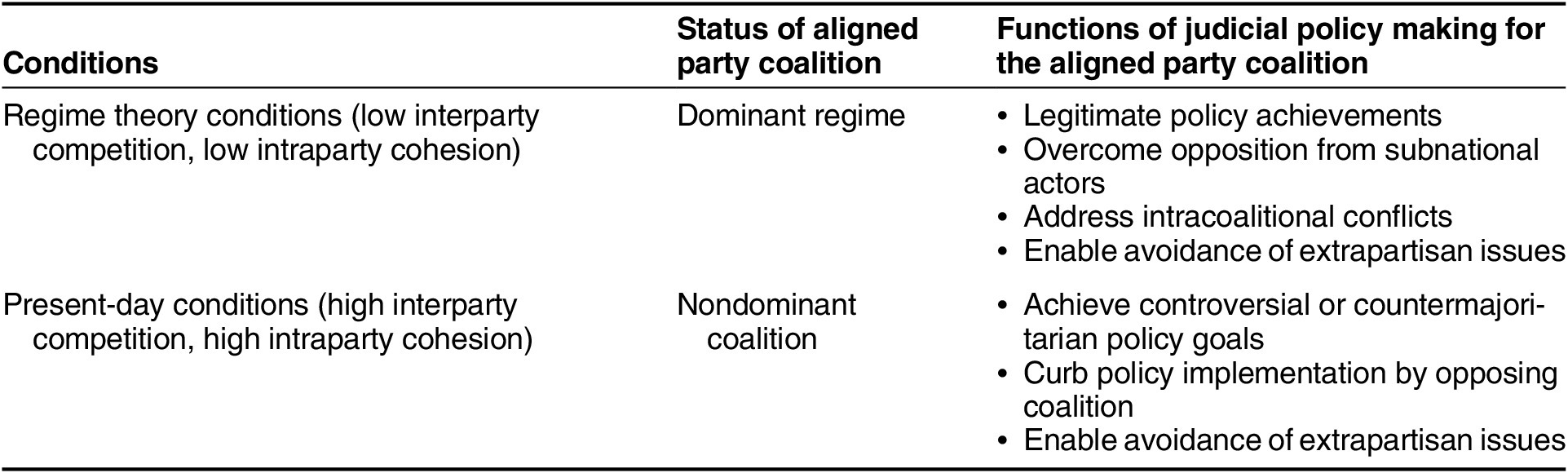


 Open access

