





Introduction
Parental mentalizing refers to caregivers’ capacity to treat their children as psychological agents with their own feelings, wishes, and desires (Sharp & Fonagy, Reference Sharp and Fonagy2008; Slade, Reference Slade2005; Slade et al., Reference Slade, Sadler, Eaves and Webb2023; Zeegers et al., Reference Zeegers, Colonnesi, Stams and Meins2017). Studies have amply demonstrated that effective parental mentalizing is associated with sensitive parenting, attachment security, and better child sociocognitive skills (Aldrich et al., Reference Aldrich, Chen and Alfieri2021; Devine & Hughes, Reference Devine and Hughes2018; Miller et al., Reference Miller, Kim, Boldt, Goffin and Kochanska2019; Zeegers et al., Reference Zeegers, Colonnesi, Stams and Meins2017), whereas impairments in parental mentalizing have been associated with disruptive caregiving behaviors (e.g., intrusive and hostile behavior), difficulties regulating parents’ own and their infants’ distress, and negative child outcomes such as insecure attachment, anxiety, and externalizing problems (Borelli et al., Reference Borelli, Lai, Smiley, Kerr, Buttitta, Hecht and Rasmussen2021; Camoirano, Reference Camoirano2017; Ensink et al., Reference Ensink, Borelli, Roy, Normandin, Slade and Fonagy2019).
Impairments in mentalizing are considered to typically manifest in contexts of high stress and arousal, particularly within attachment relationships (Luyten & Fonagy, Reference Luyten and Fonagy2015). Research has indicated that with increasing stress the neural regions underlying the ability for balanced or controlled mentalizing tend to become deactivated, and more posterior brain regions responsible for automatic, but biased, processing of social information are activated (Luyten & Fonagy, Reference Luyten and Fonagy2015; Nolte et al., Reference Nolte, Bolling, Hudac, Fonagy, Mayes and Pelphrey2013). Hence, it is hypothesized that with increasing arousal, there is a biobehavioral switch from more controlled mentalizing, characterized by slow, conscious reflection, to more automatic mentalizing, characterized by rapid and often biased assumptions about self and others (Luyten et al., Reference Luyten, Campbell, Allison and Fonagy2020; Luyten & Fonagy, Reference Luyten and Fonagy2015; Luyten et al., Reference Luyten, Malcorps, Fonagy, Ensink, Bateman and Fonagy2019). Early adversity and insecure attachment are hypothesized to impact three key parameters involved in this switch: (a) the point at which an individual switches from controlled to automatic mentalizing, (b) the extent of the loss of the capacity for controlled mentalizing, and (c) the duration of the loss of controlled mentalizing (Luyten et al., Reference Luyten, Campbell, Allison and Fonagy2020). Given the high co-occurrence of insecure attachment and childhood trauma in individuals with borderline personality disorder (BPD) (Agrawal et al., Reference Agrawal, Gunderson, Holmes and Lyons-Ruth2004; Leichsenring et al., Reference Leichsenring, Fonagy, Heim, Kernberg, Leweke, Luyten, Salzer, Spitzer and Steinert2024; Smith & South, Reference Smith and South2020), it is hypothesized that individuals with BPD features might be more susceptible to the impact of stress on mentalizing. Mothers with features of BPD also demonstrate more severe difficulties with (parental) mentalizing (Hestbaek et al., Reference Hestbaek, Kretzschmar, Krasnik, Smith-Nielsen, Juul, Væver and Simonsen2024; Marcoux et al., Reference Marcoux, Bernier, Séguin, Boike Armerding and Lyons-Ruth2017) and report experiencing motherhood as significantly more stressful and less satisfying than mothers without BPD (Eyden et al., Reference Eyden, Winsper, Wolke, Broome and MacCallum2016).
However, surprisingly few studies have experimentally investigated the impact of attachment-related stress on (parental) mentalizing. Given that the influence of stress and emotional arousal on mentalizing is a fundamental pillar of the mentalizing framework and mentalization-based treatment (MBT), this gap in the research is notable. In addition, considerable evidence highlights (a) the high stress levels commonly experienced during parenthood—especially, although not exclusively, among parents with a history of insecure attachment, adversity and/or (borderline) personality disorder features—and (b) the strong association between parenting stress and various negative outcomes for children. From this perspective, there is a clear need for more research on the relationship between stress and parental mentalizing, and their associations with trauma, attachment, and (borderline) personality disorder features, as this may also allow us to better understand the mechanisms underlying the intergenerational transmission of psychopathology.
This is the first study to experimentally investigate the impact of attachment-related stress on parental mentalizing in a sample of community mothers using a simulated baby task. The simulated baby allows us to focus on one specific type of attachment-related stress, namely stress in the parent–child relationship within the context of early parenting. Henceforth, we will refer to this as child-related stress. We also used an innovative approach to assess both biological and subjective markers of acute arousal to investigate their relation with stress-related changes in mentalizing. In addition, attachment insecurity, childhood trauma, and features of BPD were investigated as potential predictors of both arousal and parental mentalizing.
In what follows, we first summarize research on the impact of stress on (parental) mentalizing, including research on the neural mechanisms involved. Next, we discuss the specific challenges parents face during the perinatal period, which may negatively affect their mentalizing capacities. Finally, we present the current study and outline its hypotheses.
The impact of attachment-related distress on mentalizing
Theorizing around the impact of stress on mentalizing largely stems from research regarding the impact of arousal on the neural regions that underlie the ability for controlled and automatic mentalizing (Lieberman, Reference Lieberman2007; Luyten & Fonagy, Reference Luyten and Fonagy2015). Controlled mentalizing refers to conscious, verbal, and nuanced consideration about the self and others that is supported by neural regions such as the lateral prefrontal cortex (PFC), medial PFC, lateral parietal cortex, medial parietal cortex, medial temporal lobe, and rostral anterior cingulate cortex (Frith & Frith, Reference Frith and Frith2003; Monticelli et al., Reference Monticelli, Zeppa, Mammi, Penner, Melcarne, Zenga and Garbossa2021). Automatic mentalizing, by contrast, refers to unconscious, rapid, reflexive processing of social information, and is driven by the amygdala, basal ganglia, ventromedial PFC, lateral temporal cortex, and dorsal anterior cingulate cortex (Chavez, Reference Chavez, Gilead and Ochsner2021; Frith & Frith, Reference Frith, Frith, Gilead and Ochsner2021).
Studies have demonstrated a curvilinear relation between PFC performance and arousal. Within adaptive ranges of stress/arousal, PFC functions improve with increased cortical activation (Arnsten et al., Reference Arnsten, Raskind, Taylor and Connor2015; Mayes, Reference Mayes2000). However, as the level of stimulation increases, there is a deactivation and decreased function of critical areas in the PFC, whereas the posterior cortex, amygdala, and hippocampus become activated, enhancing more automatic processes that support fight/flight responses (Arnsten et al., Reference Arnsten, Raskind, Taylor and Connor2015). It is hypothesized that as a result, with increasing stress, explicit and nuanced reflection becomes more difficult and there is a reliance on more rapid (and often biased) assumptions about self and others (Luyten & Fonagy, Reference Luyten and Fonagy2015). Such a switch is expected to occur especially in the context of attachment-related arousal (Nolte et al., Reference Nolte, Bolling, Hudac, Fonagy, Mayes and Pelphrey2013; Rutherford et al., Reference Rutherford, Goldberg, Luyten, Bridgett and Mayes2013).
Very few studies have experimentally investigated these assumptions. Three studies found reduced accuracy on the Reading the Mind in the Eyes Test (RMET), a task that assesses mentalizing based on external facial features (the eye region), following attachment-related distress. In these studies, distress was induced using personalized imagery or attachment-activating picture tests and was compared with general stress induction (Fizke et al., Reference Fizke, Buchheim and Juen2013; Nolte et al., Reference Nolte, Bolling, Hudac, Fonagy, Mayes and Pelphrey2013; Tang et al., Reference Tang, Liu, Wang and Chen2021). Nolte et al. (Reference Nolte, Bolling, Hudac, Fonagy, Mayes and Pelphrey2013) also found that attachment-related distress led to reduced reaction times compared with general distress, which may indicate a faster, more reflexive style of mentalizing when under attachment stress. However, Tang et al. (Reference Tang, Liu, Wang and Chen2021) failed to replicate these reaction-time findings in two experimental studies focusing on the impact of attachment threat on mentalizing as assessed with the RMET. Moreover, as each of these studies used only the RMET—which focuses primarily on assessing the ability to infer mental states from external features, specifically expressions in the eye region—the generalizability of these findings to other mentalizing contexts remains uncertain.
There is also a dearth of experimental studies in this context concerning the impact of stress on parental mentalizing specifically. The few studies that have been done in this area found that lower levels of parental mentalizing measured before stress induction were related to lower maternal sensitivity and lower tolerance of infant distress measured after a stressful parent–child task (Krink et al., Reference Krink, Muehlhan, Luyten, Romer and Ramsauer2018; Rutherford et al., Reference Rutherford, Goldberg, Luyten, Bridgett and Mayes2013, Reference Rutherford, Booth, Luyten, Bridgett and Mayes2015). In addition, lower levels of parental mentalizing measured after a stressful parent–child task were associated with more overcontrolling maternal behaviors during that task (Borelli et al., Reference Borelli, Hong, Rasmussen and Smiley2017). However, none of these studies investigated whether stress leads to changes in parental mentalizing. A number of studies have explicitly assessed whether stress leads to impairments in parental mentalizing based on self-report questionnaires; their findings suggest that higher levels of stress are associated with lower levels of parental mentalizing (Håkansson et al., Reference Håkansson, Watten, Söderström and Øie2019; Malcorps et al. Reference Malcorps, Vliegen, Fonagy and Luyten2024; McMahon & Meins, Reference McMahon and Meins2012; Nijssens et al., Reference Nijssens, Bleys, Casalin, Vliegen and Luyten2018), and that this association is specific to stress related to the child or parenting, but not to general stress (Håkansson et al., Reference Håkansson, Watten, Söderström and Øie2019; Rutherford et al., Reference Rutherford, Goldberg, Luyten, Bridgett and Mayes2013). In this context, Steele et al. (Reference Steele, Townsend and Grenyer2020) found that parents with high levels of BPD traits (N = 69) reported significantly greater parenting stress, insecure attachment, childhood trauma, and difficulties in parental mentalizing, as well as reduced certainty about their child’s thoughts and feelings, compared with parents with low BPD traits (N = 216). Furthermore, parenting stress assessed with the Parenting Stress Index was strongly correlated with BPD traits as measured with the Personality Inventory for DSM-V (r = .45) and mentalizing difficulties measured using the Parental Reflective Functioning Questionnaire (r = .65). However, as these were all cross-sectional studies, none of them addresses issues related to causality.
Hence, it is clear that there is a need for more experimental research on the impact of stress and arousal on changes in parental mentalizing. Moreover, given our increasing knowledge of the neurobiology of stress and mentalizing, it is also important that these studies incorporate physiological measures of stress reactivity to improve our understanding of the biopsychosocial processes involved at multiple levels of the stress response.
Factors impacting the mentalizing switch
Neurobiological research has demonstrated that insecure attachment and exposure to chronic stress/trauma in general may impact three essential parameters in the arousal-related switch from prefrontal to posterior cortical systems: (a) the threshold at which the switch happens, (b) the strength of the relation between stress and the activation of neural circuits involved in controlled vs. automatic mentalizing, and (c) the time to recover from stress (Luyten & Fonagy, Reference Luyten and Fonagy2015). Based on these findings, it can therefore be expected that insecure attachment and trauma play an important moderating role in the switch from controlled to automatic mentalizing (Long et al., Reference Long, Verbeke, Ein-Dor and Vrtička2020). To date, however, there is almost no experimental research that has investigated the relations between attachment/trauma and stress-related changes in (parental) mentalizing.
Regarding the extent of the mentalizing loss, two studies found a moderating effect of attachment insecurity on RMET accuracy. Fizke et al. (Reference Fizke, Buchheim and Juen2013) found that the effect of attachment distress on RMET accuracy was significantly greater for individuals with disorganized attachment than for individuals with organized attachment. Tang et al. (Reference Tang, Liu, Wang and Chen2021) reported that a decrease in reaction time on the RMET after attachment distress was greater for individuals with higher levels of attachment avoidance (when placed under cognitive strain).
Concerning the impact of childhood trauma, there is ample evidence from neurobiological studies that trauma impacts neurobiological systems implicated in both stress and mentalizing (Fonagy et al., Reference Fonagy, Campbell and Luyten2023; McCrory et al., Reference McCrory, De Brito and Viding2011). In addition, research suggests that childhood trauma is associated both with general impairments in mentalizing (Cicchetti et al., Reference Cicchetti, Rogosch, Maughan, Toth and Bruce2003; Quek et al., Reference Quek, Newman, Bennett, Gordon, Saeedi and Melvin2017; Tessier et al., Reference Tessier, Normandin, Ensink and Fonagy2016; Yang & Huang, Reference Yang and Huang2024) and with more specific problems in relation to mentalizing about traumatic experiences (Berthelot et al., Reference Berthelot, Savard, Lemieux, Garon-Bissonnette, Ensink and Godbout2022; Ensink et al., Reference Ensink, Berthelot, Bernazzani, Normandin and Fonagy2014), referred to as trauma reflective functioning (Berthelot et al., Reference Berthelot, Ensink, Bernazzani, Normandin, Luyten and Fonagy2015; Borelli et al., Reference Borelli, Cohen, Pettit, Normandin, Target, Fonagy and Ensink2019; Ensink et al., Reference Ensink, Normandin, Plamondon, Berthelot and Fonagy2016).
Early parenthood: Elevated stress and high demands on mentalizing?
Research conducted in early parenthood (0–3 years) might be particularly important in investigating the potential impact of stress on parental mentalizing. Although early parenthood is often depicted only in positive terms, it also associated with considerable changes and thus potentially stress: the transition to parenthood necessitates adjustments in parents’ lives and relationships to accommodate the arrival of the child, and parents need to acquire a new range of skills in a short period of time, while often struggling with sleep deprivation and having to adopt a new work–life balance. Many parents report feeling stressed and overwhelmed during these years (McCarthy et al., Reference McCarthy, Houghton and Matvienko-Sikar2021; Nyström & Öhrling, Reference Nyström and Öhrling2004; Saxbe et al., Reference Saxbe, Rossin-Slater and Goldenberg2018). This is particularly the case for parents with a history of insecure attachment and/or adversity. Research in parents with BPD, for instance, has shown that these parents typically report higher levels of parenting stress and often dramatically lower levels of parenting satisfaction and efficacy (Eyden et al., Reference Eyden, Winsper, Wolke, Broome and MacCallum2016; Hugill et al., Reference Hugill, Berry and Fletcher2017; Madsen et al., Reference Madsen, Smith-Nielsen, Egmose, Lange and Vaever2022; Petfield et al., Reference Petfield, Startup, Droscher and Cartwright-Hatton2015). Neuroendocrine research during the perinatal period has demonstrated that elevated stress levels, particularly higher maternal cortisol levels, are in turn linked to less optimal parenting behaviors, as evidenced in higher levels of intrusiveness and decreased reciprocity compared with parents with lower levels of stress (Erhart et al., Reference Erhart, Watamura, Olsavsky, Dufford, Tribble, Yeh and Kim2025; Finegood et al., Reference Finegood, Blair, Granger, Hibel and Mills-Koonce2016). Such heightened stress might have enduring effects on the child’s own developing capacity for stress and emotion regulation. Indeed, findings on adrenocortical synchrony indicate that when a mother experiences elevated stress, her child’s cortisol levels increase in a synchronized manner, and over time this might render a child vulnerable to the impact of maternal stress physiology (Feldman, Reference Feldman2019, Reference Feldman2020).
During these transformative early parenting years, parental mentalizing may play an important role for the wellbeing of parents and their children (Wendelboe et al., Reference Wendelboe, Reijman, Madsen, Støve, Stuart, Smith-Nielsen and Væver2024; Zeegers et al., Reference Zeegers, Colonnesi, Stams and Meins2017). Parental mentalizing is thought to be centrally involved in parents’ abilities to learn to understand their child’s preferences, sensitivities, and behaviors. Given the limited expressive abilities of children at this stage, parents must continually interpret their child’s bodily, verbal, and non-verbal cues, and adopt their child’s perspective to determine their needs and wants (Shai et al., Reference Shai, Dollberg and Szepsenwol2017). In relation to stress during this life phase, research indicates that various stressors inherent to early parenting can challenge the capacity to mentalize. For instance, infant crying (Firk & Großheinrich, Reference Firk and Großheinrich2024; Rutherford et al., Reference Rutherford, Bunderson, Bartz, Haitsuka, Meins, Groh and Milligan2021), early regulatory challenges such as difficulties with sleep, feeding, or managing distress (Taubner, Reference Taubner2020), and early experiences of separation (Mellenius et al., Reference Mellenius, Korja, Kalland, Huttunen, Sourander, Salo, Westerlund-Cook and Junttila2023) have all been shown to strain parental mentalizing. However, at the same time, high levels of parental mentalizing abilities may serve as an important buffer during this period, helping parents tolerate and cope with these stressors effectively (Rutherford et al., Reference Rutherford, Goldberg, Luyten, Bridgett and Mayes2013, Reference Rutherford, Booth, Luyten, Bridgett and Mayes2015; Schultheis et al., Reference Schultheis, Mayes and Rutherford2019). It is evident that further research is crucial to deepen our understanding of the potential role of parental mentalizing in early parenthood.
The present study
The current preregistered study (https://osf.io/wr53u) aimed to investigate the impact of experimentally induced child-focused stress on parental mentalizing using an ecologically valid experimental design that makes use of a computer-controlled baby simulator (BSIM) in a sample of 29 community mothers. Mothers were asked to take care of a BSIM in a low-stress (i.e., the BSIM is easy to soothe) and a high-stress (i.e., the BSIM is impossible to soothe) condition. After each stress condition, mothers’ levels of parental mentalizing were assessed using a questionnaire. At baseline and during and after the low- and high-stress conditions, subjective and biological arousal levels were assessed using the Felt Arousal Scale and a smart watch that tracked participants’ galvanic skin response, respectively. Mothers also completed a number of self-report questionnaires assessing insecure attachment, childhood trauma, and BPD features at baseline.
Given the research literature reviewed above, we formulated four hypotheses:
-
1. Hypothesis 1: Stress induction by the BSIM task predicts an increase in parental mentalizing difficulties as assessed by the Parental Mentalizing Difficulties Questionnaire from the low-stress to the high-stress condition.
-
2. Hypothesis 2: Stress induction by the BSIM task leads to an increase in subjective arousal, as assessed by the Felt Arousal Scale, and biological arousal, as measured by galvanic skin response, from the low-stress to the high-stress condition.
-
3. Hypothesis 3: Stress-related changes in parental mentalizing difficulties from the low-stress to the high-stress condition, as assessed by the Parental Mentalizing Difficulties Questionnaire, will be associated with significant increases in subjective arousal (as assessed by the Felt Arousal Scale) and biological arousal (as measured by galvanic skin response).
-
4. Hypothesis 4: Stress-related changes in parental mentalizing between the low-stress condition and the high-stress condition, assessed with the Parental Mentalizing Difficulties Questionnaire, are expected to be associated with attachment insecurity, childhood trauma, and BPD features (as assessed by the Experience in Close Relationships- Revised – Short Form, Childhood Trauma Questionnaire, and Personality Assessment Inventory – Borderline Features Scale, respectively).
Methods
Participants and procedures
Participants were community mothers who were: (a) female at birth, (b) the mother of a child between 0 and 2 years of age, and (c) sufficiently fluent in Dutch. All participants received financial compensation for the time spent on the study in the form of a gift certificate for a children’s store, to the value of €25. The final sample consisted of 29 female participants who all identified as women. Twenty participants were primiparous, 7 participants had 2 children, and 2 participants had 3 children. The mean age of the youngest child was 13.62 months (SD = 5.88). All participants were highly educated: 13 participants had obtained a professional bachelor’s degree (corresponding to a US college degree), 15 a master’s degree, and 1 a PhD. Participants were recruited through advertisements in midwives’ and gynecologists’ offices (posters, flyers) and social media (Facebook, Instagram, LinkedIn). Participants were screened for postnatal depression; two participants met criteria for postnatal depression (sum score on the Edinburgh Postnatal Depression Scale ≥13) following the cutoff of Cox et al. (Reference Cox, Holden and Sagovsky1987).
Procedure
Baby simulator paradigm
The study manipulated the participants’ level of stress by having them interact with a BSIM. The BSIM is made of soft vinyl and can emit pre-recorded sounds from a young infant (including crying, coughing, and drinking sounds) (Rutherford et al., Reference Rutherford, Booth, Luyten, Bridgett and Mayes2015). More information and pictures of the BSIM can be found at https://www.realityworks.com/product/realcare-baby/?v=d3dcf429c679 . It can be programed to various crying schedules and can track care events and mishandling actions using motion sensors. The BSIM comes with a software package that runs on a computer, which allows it to be controlled from a second room. For this study, the BSIM was programed to emit additional pre-recorded baby sounds such as breathing, moaning, babbling, and sneezing.
The study design is depicted in Figure 1. At the start of the experiment, the participants were seated in a room designed to resemble a baby/children’s room, including a changing cushion with spare pajamas and diapers, a high chair, a baby carrier/car seat, a play mat, and numerous baby and child toys. The experimenter (SM) then brought the BSIM into the room and went through a standardized instruction and demonstration phase.
Experimental design.

Participants were instructed to care for the BSIM as they would care for their own child once the experimenter left the room. They were told that the BSIM would respond to their facial expressions, voice, and handling just as a real infant would. The experimenter explained that the BSIM’s behavior is quite unpredictable, making it possible that it might sleep, interact and seek the mother’s attention, or become upset. In the event that the BSIM started to cry, mothers were asked to soothe the BSIM. Furthermore, participants were informed that they could stop the task at any point by ringing a bell left in the room.
During these instructions, the BSIM was placed on the lap of the experimenter and was programed to be calm and to breathe audibly during the first part of the instructions, to start to babble and ask for attention after 1 minute and 45 s, and to start to cry after approximately 2 minutes and 45 s. Similar to the instructions phase of Rutherford et al. (Reference Rutherford, Booth, Luyten, Bridgett and Mayes2015), in this crying phase a predefined setting was used where the presentation of a microchipped feeding bottle synchronizes with the BSIM and makes the crying stop. This demonstration illustrated that the BSIM could be calm and interactive, could become upset, and could be soothed when its needs were met.
The stress-induction task employed a within-subject design with all participants completing a low-stress condition (5 minutes duration) and a high-stress condition (20 minutes duration). We built on the existing protocol of Rutherford et al. (Reference Rutherford, Goldberg, Luyten, Bridgett and Mayes2013), which overlaps with the high-stress condition, described below.
First, in the low-stress condition, the BSIM did not show any signs of distress, but was pre-programmed to sleep, breathe audibly, coo, cough, and babble. The low-stress condition lasted 5 minutes and was included as a baseline condition. Next, in the high-stress condition, unbeknown to the participants, the BSIM was pre-programmed to start to cry and to be inconsolable. The BSIM cried with increasing intensity throughout the 20-minute condition, in cycles of 255 s of crying followed by 10 s of silence. The pre-programmed settings of the BSIM ensured that the sequence of events was consistent for every participant.
Assessment of mentalizing
Immediately after each BSIM condition, participants were asked to complete the Parental Mentalizing Difficulties Questionnaire (PMDQ). This 14-item questionnaire was based on the Parental Reflective Functioning Questionnaire (Luyten et al., Reference Luyten, Mayes, Nijssens, Fonagy and Eapen2017) and the Reflective Functioning Scale as developed for the Adult Attachment Interview and adapted for the Parent Development Interview (Fonagy et al., Reference Fonagy, Target, Steele and Steele1998; Slade et al., Reference Slade, Bernbach, Grienenberger, Levy and Locker2005). The PMDQ was developed to be specifically applicable to the BSIM procedure with items referring to both maladaptive mentalizing (e.g., “Sam [the BSIM] hates me,” “Sam only behaved the way he did because I am a bad mother”) and adaptive mentalizing (e.g,. “I was able to understand or ‘read’ Sam’s behavior,” “I attempted to imagine what Sam needed from me”). The maladaptive mentalizing items consist of a series of items reflecting three non-mentalizing modes: psychic equivalence, teleological mode, and pretend mode (Fonagy et al., Reference Fonagy, Luyten and Bateman2015). The adaptive items consist of a series of items that assess the parent’s interest in the BSIM’s mind, their persistence in reflecting about the BSIM’s mental states, and their feelings of competence in understanding the BSIM’s behavior. A preliminary examination of the PMDQ in the current sample (see Online Supplement for more details) revealed a single underlying factor for the questionnaire items, termed “parental mentalizing difficulties.” These items showed high internal consistency (Cronbach’s alpha = .81) and test–retest reliability (r = .74). Preliminary evidence for its construct validity was demonstrated by strongly significant correlations with the “prementalizing modes” and “interest and curiosity” subscales of the Parental Reflective Functioning Questionnaire (PRFQ; Luyten et al., Reference Luyten, Mayes, Nijssens, Fonagy and Eapen2017), a well-validated measure of parental mentalizing, as well as highly significant correlations with the Dutch version of the Parenting Stress Index.
Assessment of Arousal
Acute subjective arousal was measured using the Felt Arousal Scale (FAS; Svebak & Murgatroyd, Reference Svebak and Murgatroyd1985) at baseline, and immediately after the low-stress and high-stress BSIM conditions. The FAS involves individuals rating a single item, asking participants to rate their level of arousal on a Likert-type scale ranging from 1 to 6. The prompt reads: “Estimate how aroused you currently feel. By ‘arousal’ we mean how ‘worked-up’ you feel or the level of ‘physical activation’ you are currently experiencing. High arousal may manifest in various ways, such as excitement, anxiety, or anger, while low arousal may be experienced as relaxation, boredom, or calmness.”
Acute biological arousal was assessed as the participant’s galvanic skin response (GSR), which was continuously measured using the Chillband+ wearable device from the Interuniversity Microelectronics Centre Leuven (IMEC), a renowned research and development hub that works closely with the University of Leuven. The initial analysis of biological data was done by IMEC, providing processed biological data and a reliability coefficient (RC) on a per-minute basis. The processed data included various GSR variables (i.e., magnitude, duration, area of the response, tonic activity, phasic activity, and total activity). For the current study we opted to use the phasic activity variable, expressed in microsiemens, which represents the short-term fluctuations or rapid changes in electrical conductivity of the skin in response to specific stimuli or events (e.g., an experimental stressor). Through the use of timestamps derived from video recordings, the research team delineated distinct time frames for the baseline, low-stress, and high-stress periods for individual participants. To account for the varying durations of these three timeframes (baseline: 10–15 minutes, low-stress: 5 minutes, high-stress: 20 minutes), the average value of phasic activity of each specific timeframe was calculated. For every time frame, only the per-minute parameters were included that had a RC >0.80.
Baseline questionnaires
The Childhood Trauma Questionnaire – Short Form (CTQ; Bernstein et al., Reference Bernstein, Stein, Newcomb, Walker, Pogge, Ahluvalia, Stokes, Handelsman, Medrano, Desmond and Zule2003) is a 25-item questionnaire that measures exposure to early childhood abuse and neglect. It consists of five dimensions: emotional abuse, sexual abuse, physical abuse, emotional neglect, and physical neglect. Answers are rated on a 5-point Likert scale structured to reflect the frequency of maltreatment experiences (0 = never, 4 = very often). In the current sample, we used the CTQ Total Score, which comprises the sum score of the five subscales. Cronbach’s alpha for CTQ Total was 0.89.
The Experiences of Close Relationships – Short Form (ECR; Wei et al., Reference Wei, Russell, Mallinckrodt and Vogel2007) is a 12-item questionnaire that measures adult attachment styles. The short form consists of two subscales, Attachment Anxiety (defined as involving a fear of interpersonal rejection or abandonment, an excessive need for approval from others, and distress when one’s partner is unavailable or unresponsive) and Attachment Avoidance (defined as involving fear of dependence and interpersonal intimacy, an excessive need for self-reliance, and reluctance to self-disclose). Answers are rated on a 7-point Likert scale ranging from 1 (strongly disagree) to 7 (strongly agree). In the current sample Cronbach’s alpha for ECR Anxiety was 0.84 and for ECR Avoidance it was 0.68.
The Personality Assessment Inventory – Borderline Features Scale (PAI-BOR; Morey & Ambwani, Reference Morey and Ambwani2008) is a 24-item questionnaire that assesses four BPD features—affective instability, identity problems, negative relationships and self-harm—using six items per subscale. All items are rated on a 4-point scale (0 to 3; false, slightly true, mainly true, very true). In the current study, we used only the PAI-BOR Total Score, which represents a sum of the 24 items. Cronbach’s alpha for PAI-BOR Total was 0.86.
The Parental Reflective Functioning Questionnaire (PRFQ; Luyten et al., Reference Luyten, Mayes, Nijssens, Fonagy and Eapen2017) is an 18-item self-report questionnaire consisting of three factors: (a) the Prementalizing Modes (PM) subscale assesses a non-mentalizing stance of parents toward their child, consisting of severely biased and often malevolent assumptions about the internal world of their child, (b) the Certainty of Mental States (CM) subscale focuses on parents’ capacity to recognize the opacity of mental states, and (c) the Interest and Curiosity (IC) subscale assesses the presence or absence of active curiosity about, and willingness to understand, the mental states of the child. All items are scored on a 7-point Likert scale, ranging from 1 (completely disagree) to 7 (completely agree). In the current sample, Cronbach’s alpha was 0.85 for CM, 0.61 for IC, and 0.47 for PM. In the current study, the PRFQ was used only for the preliminary validation of the PMDQ.
Statistical analyses
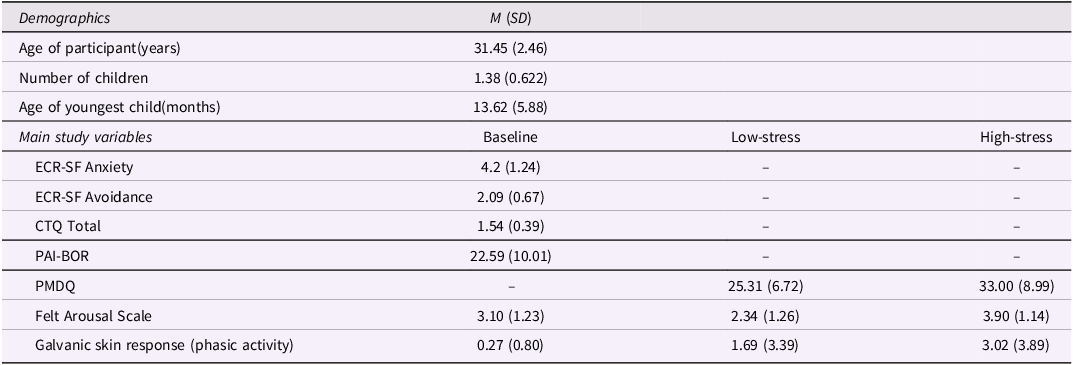
Before testing the main hypotheses, the means and standard deviations of all main study variables were calculated (Table 1). Normality testing was done for all parameters, and if necessary a log-transformation of skewed variables was executed.
Demographic information, means, and standard deviations of main study variables
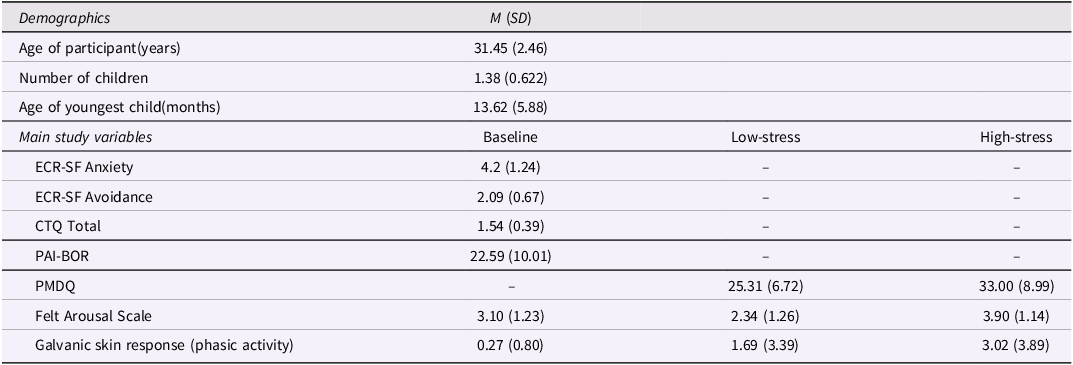
Note. ECR-SF = Experiences in Close Relationship – Short Form; CTQ = Childhood Trauma Questionnaire; PMDQ = Parental Mentalizing Difficulties Questionnaire; PAI-BOR = Personality Assessment Inventory – Borderline Features Scale.
To test the first hypothesis, paired-sample t-tests were run to establish whether there were significant differences in the level of mentalizing difficulties in the low- and high-stress conditions. Cohen’s d, with Hedges’ corrections for small sample sizes, was calculated as a metric for effect size. As preregistered, the sample size was calculated using G*Power to detect significant stress-related changes in mentalizing difficulties between the low- and high-stress conditions for the primary Hypothesis 1, with power 0.9, a medium effect size of Cohen’s d = .50, and α = 0.05. For a repeated-measures ANOVA with a within-person design, a single group, and the aforementioned parameters, the total sample size required was estimated to be n = 28.
For the second hypothesis, repeated-measures ANOVAs were used to compare the measurements of biological and subjective arousal between the baseline, low-stress, and high-stress conditions, with repeated contrasts with Bonferroni adjustment for multiple comparisons. As Mauchly’s test indicated that the assumption of sphericity had been violated for subjective arousal, χ2 (2) = 7.590, p <0.05, the degrees of freedom were corrected using Huynh–Feldt estimates of sphericity (ε = .85). Partial eta squared (η2 ) was used as an indicator of effect size.
To test the third hypothesis, correlation analyses were conducted, to assess (a) the relations between subjective, biological arousal measurements, and mentalizing difficulties in both the low- and high-stress conditions, and (b) the differential scores (Δ scores) denoting the differences between subjective and biological arousal and mentalizing difficulties comparing the low- and high-stress conditions. Finally, to test the fourth hypothesis, correlation analyses were conducted to explore whether attachment anxiety/avoidance, childhood trauma, and features of BPD were associated with differential scores (Δ scores) of subjective, biological stress, and mentalizing. The correlations calculated to test hypotheses 3 and 4 were seen as exploratory. Participants’ level of education and number of children were considered as potential covariates. However, as neither parameters showed significant associations with any of the dependent variables (i.e., subjective and biological arousal, parental mentalizing difficulties, attachment, trauma, and BPD features), these variables were not controlled for in the final analyses.
Results
Hypothesis 1: stress induction by the BSIM task predicts an increase in parental mentalizing difficulties as assessed by the PMDQ from the low-stress to the high-stress condition
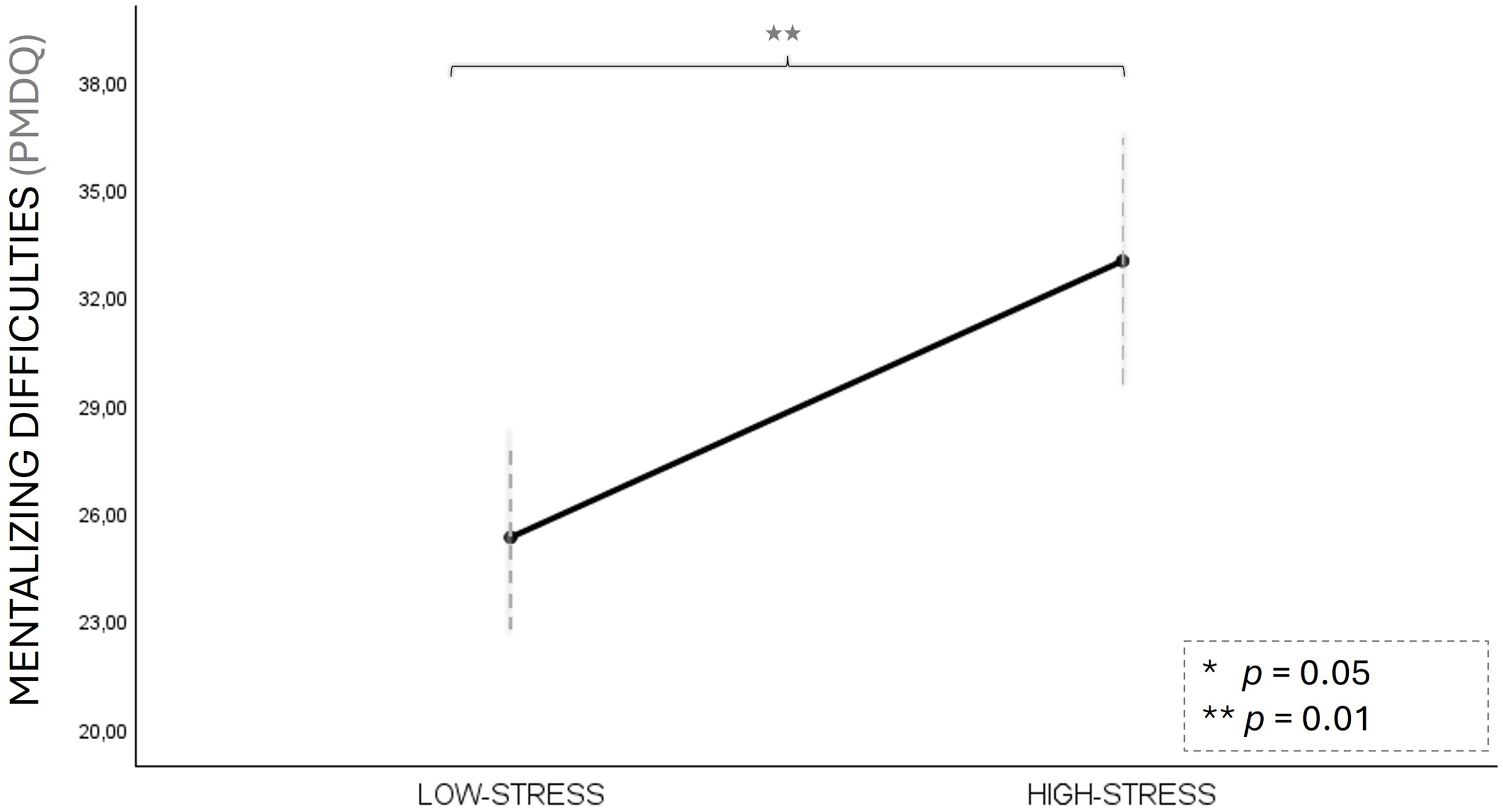
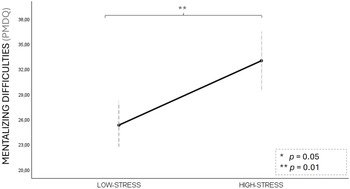
As illustrated in Figure 2, a significant increase in parental mentalizing difficulties from the low-stress to the high-stress condition was found, t(28) = 6.840, p <0.001, Cohen’s d with Hedges’ correction = 6.22 (representing a large effect size). These findings imply that the experimental induction of child-focused distress using the BSIM resulted in greater mentalizing difficulties during the high-stress condition compared with the low-stress condition.
Mentalizing difficulties (PMDQ) in the low-stress and high-stress conditions.
Hypothesis 2: stress induction by the BSIM task leads to an increase in subjective arousal, as assessed by the FAS, and biological arousal, as measured by galvanic skin response, from the low-stress to the high-stress condition
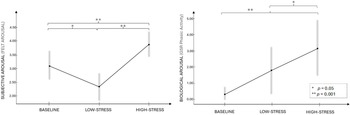
Subjective arousal levels changed from baseline to the low-stress and high-stress conditions (F(1.68; 28) = 23.801, p <0.001, η2 = 0.46), representing a large effect size. As can be seen in Figure 3 (left panel), repeated contrasts indicated that participants reported significantly higher levels of subjective arousal in the high-stress condition compared with both baseline (p <0.01) and the low-stress condition (p <0.01). Surprisingly, participants reported significantly lower levels of subjective arousal in the low-stress condition compared with baseline.
Subjective arousal (Felt Arousal Scale; left panel) and biological arousal (galvanic skin response (GSR), phasic activity; right panel) at baseline and in the low-stress and high-stress conditions.
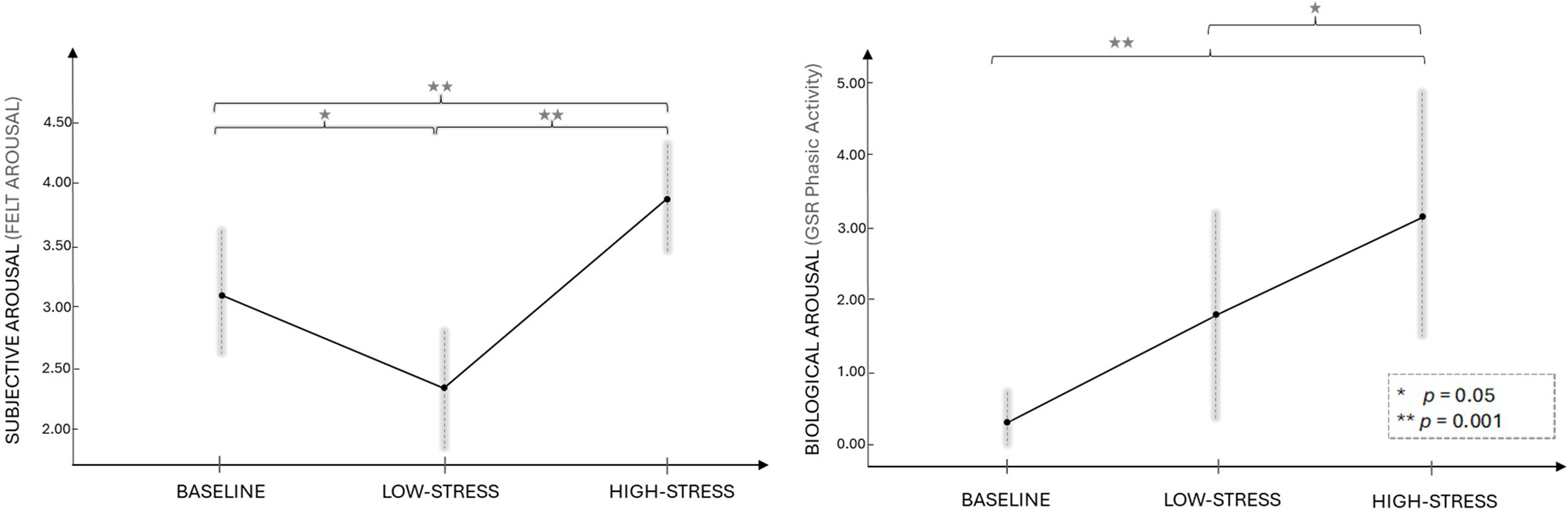
Biological arousal levels assessed in terms of GSR phasic activity also varied significantly across the three conditions, F(2;23) = 10.404, p <0.001, η2 = 0.311, indicating a large effect size. As illustrated in Figure 3 (right panel), participants exhibited significantly higher levels of skin conductance in the high-stress condition compared with both baseline (p <0.01) and the low-stress condition (p <0.05); no significant difference was observed between baseline and the low-stress condition (p = 0.074).
Hypothesis 3: stress-related changes in parental mentalizing difficulties from the low-stress to the high-stress condition, as assessed by the PMDQ, will be associated with significant increases in subjective arousal (as assessed by the FAS) and biological arousal (as measured by galvanic skin response)
In the low-stress condition, parental mentalizing difficulties were weakly correlated with the level of biological arousal (GSR phasic activity, r = 0.172, p = 0.421), and showed only a trend for an association with the level of subjective arousal (FAS, r = 0.336, p = 0.074). By contrast, in the high-stress condition, parental mentalizing difficulties were significantly correlated with the level of subjective stress (FAS, r = 0.41, p = 0.03) and showed a trend toward an association with the level of biological arousal (GSR phasic activity, r = 0.38, p = 0.07).
The difference score of parental mentalizing difficulties between the high- and low-stress conditions (i.e., PMDQHigh–Low ) was significantly correlated with the difference scores of both subjective arousal (FASHigh–Low, r = 0.47, p = 0.01) and biological arousal (GSR phasicHigh–Low, r = 0.41, p = 0.04). These latter results suggest that the extent of stress-related changes in parental mentalizing difficulties between the low-stress condition and the high-stress condition was associated with the extent of the increase in subjective and biological stress from the low- to the high-stress condition. In other words, the stronger the increase in arousal levels from the low- to the high-stress condition, the greater the difficulties mothers had with parental mentalizing.
Hypothesis 4: Stress-related changes in parental mentalizing between the low-stress condition and the high-stress condition, assessed with the PMDQ, are expected to be associated with attachment insecurity, childhood trauma, and BPD features (as assessed by the ECR, CTQ, and PAI-BOR, respectively).
Pearson correlations between the mentalizing parameters (PMDQ) and the different predictors are presented are presented in Table 2. CTQ Total scores were associated with both higher PMDQ scores in the high-stress condition (p = 0.05) and a greater increase in PMDQ scores between the low- and the high-stress condition (p = 0.04). In addition, ECR Anxiety was positively associated with PMDQ scores in the high-stress condition, although this association showed only a non-significant trend (p = 0.06). Contrary to expectations, attachment avoidance and borderline features did not show significant correlations with parental mentalizing difficulties assessed with the PDMQ in either the low- or the high-stress condition, or with the difference scores between the two conditions.
Pearson correlations between the level of parental mentalizing difficulties, childhood traumatic experiences, anxious and avoidant attachment, and borderline personality disorder features

Note. P-values are indicated in brackets; * denotes correlations significant at the 0.05 level; PMDQ = Parental Mentalizing Difficulties; Low = low-stress condition; High = high-stress condition; High–Low = Difference score between high-stress and low-stress conditions; CTQ = Childhood Trauma Questionnaire; ECR = Experiences of Close Relationships – Short Form; PAI-BOR = Personality Assessment Index – Borderline Personality Features Scale.
Discussion
Despite the central role of stress and emotional arousal in the mentalizing framework (Bateman et al., Reference Bateman, Unruh, Fonagy, Bateman and Fonagy2024; Luyten & Fonagy, Reference Luyten and Fonagy2015), the specific impact of stress on parental mentalizing remains underexplored. Therefore, the current study aimed to experimentally investigate the impact of child-focused stress on parental mentalizing ability by using a computer-controlled BSIM in an experiment in which mothers from a community sample, with a child between 0 and 2 years of age, were subjected to both a low- and a high-stress condition.
The main finding of this study was that the induction of child-focused stress, using a BSIM, led to a significant increase in parental mentalizing difficulties in mothers. These results are consistent with one of the main assumptions of the mentalizing approach to parental mentalizing, that is, that an increase in attachment-related arousal leads to a switch from controlled or nuanced mentalizing to automatic or more emotionally biased reflection about self and others (Luyten et al., Reference Luyten, Campbell, Allison and Fonagy2020; Luyten & Fonagy, Reference Luyten and Fonagy2015; Luyten et al., Reference Luyten, Malcorps, Fonagy, Ensink, Bateman and Fonagy2019). The results of this study are also in line with the findings from Nolte et al. (Reference Nolte, Bolling, Hudac, Fonagy, Mayes and Pelphrey2013) and Tang et al. (Reference Tang, Liu, Wang and Chen2021), who showed that the induction of attachment-related stress led to decreased accuracy in other-focused mentalizing, as assessed by the RMET. Furthermore, studies conducted by Fuchs and Taubner (Reference Fuchs and Taubner2019) and Fizke et al. (Reference Fizke, Buchheim and Juen2013) suggest that merely activating the attachment system (e.g., through recalling positive or negative attachment-related memories) is not sufficient to compromise mentalizing abilities. In both studies, there were no statistically significant differences in mentalizing accuracy before and after the activation of the attachment system. The induction of substantial attachment-related stress, for example, through salient infant cries as used here, thus seems necessary to lead to actual decreases in the capacity for accurate and nuanced mentalizing.
As expected, mothers had significantly higher levels of both subjective and biological arousal after the high-stress condition compared with both baseline and the low-stress condition. This observation indicated that the high-stress condition was successful in inducing stress. Unexpectedly, there was a significant decrease in the level of subjective arousal between baseline and the low-stress condition, whereas this was not apparent in the measures of biological arousal. It might be that participants experienced subjective anticipatory stress at baseline—that is, knowing that they were participating in a stress study in which they possibly would be evaluated on their parenting qualities might lead to raised stress levels at the beginning of the paradigm. A second possible explanation is that the low-stress condition with the BSIM had a more calming effect. In the first interaction, the BSIM was rather pleasant—laughing, cooing, and babbling—and did not show any signs of distress. Indeed, a number of mothers also reported in the interview following the low-stress condition that the interaction made them feel good, nostalgic, and more relaxed.
On a more observational level, we were very surprised by how, immediately after the demonstration by the experimenter (SM), most mothers were able to suspend reality and took care of the BSIM in a realistic and very loving way. Many of them immediately started using pet names for the BSIM (“Are we going to spend some time together, sweetie?”, “What do you want today, honey?”), sang songs, rocked the BSIM endlessly, let the BSIM do tummy time, told stories, and so on. Even though in the interview some mothers approached the interaction more rationally, mentioning that the BSIM is “only a doll,” many of the mothers made statements like “she just wanted her mummy” (approaching the experimenter as the mother of the BSIM), “look, now she hears a familiar voice” (as the experimenter re-enters the room); “obviously he couldn't calm down with a stranger.” These statements suggest that on a more unconscious level participants thought of the BSIM as a baby with preferences and feelings, who can respond to and be soothed by attachment figures.
Notably, the items of the PMDQ suggest that mothers in the high-stress condition felt both more compelled to mentalize and strained in their ability to keep mentalizing. On the one hand, mothers showed an increase in scores on items relating to their interest and curiosity in the mental states of the BSIM (e.g., “I thought about what my own son needs when he behaves likes this”). On the other hand, mothers also scored significantly higher on items related to the difficulty maintaining their mentalizing (e.g., “I wanted to quit and ring the bell”; “As the interaction went on I found it harder to keep thinking about what Sam felt or needed”) or completely losing the ability to reflect about self and others (“Sam’s behavior completely upset and confused me,” “I had the feeling that I was losing contact with my own body”). These findings are consistent with the switch model of (parental) mentalizing (Fonagy & Luyten, Reference Fonagy and Luyten2009), suggesting that with increasing stress, parents are forced to continue to mentalize, but they eventually reach the point where their capacity for controlled and balanced mentalizing begins to collapse. Compared with the low-stress condition, the high-stress condition provides more of a need to mentalize. The interaction is longer and the cues given out by the BSIM are more urgent and distressing. This context requires participants to actively reflect on what might be underlying the crying and fussing of the BSIM. At the same time, the BSIM’s crying is almost continuous and so there are no rewarding moments where the participant experiences that she is able to correctly “read” the child’s behavior. As a result, it becomes very hard for participants to continue mentalizing.
Interestingly, a number of mothers also demonstrated an increase in scores on “non-mentalizing” items, such as “Sam hates me” and “Sam only behaves in this way because I am a bad mother,” consistent with the notion of a collapse in adaptive mentalizing under stress. These items were purposefully included in the questionnaire because they represent a “psychic equivalence” mode of thinking. In this mode, thoughts and feelings are experienced as excessively real and certain, and negative intentions are projected on to the self or on to the child, even when the child is too young to purposefully behave in a certain way (Fonagy & Bateman, Reference Fonagy, Bateman, Bateman and Fonagy2019). Studies of maternal mind-mindedness (MMM), a concept akin to parental mentalizing, have indicated that these non-mentalizing moments in which the mind of a child is read poorly or in which the parent’s own mental states are projected on to the child (defined as non-attuned mind-related comments in the MMM coding) are fairly rare but seem to be highly predictive of future infant–parent attachment and the socioemotional development of the child (McMahon & Bernier, Reference McMahon and Bernier2017; Meins, Reference Meins2013). Therefore, future research is needed to investigate whether these particular non-mentalizing items are related to less sensitive maternal behavior or child socioemotional functioning.
A second set of findings of this study relates to the association between stress and mentalizing difficulties. In particular, this is, to our knowledge, the first study to show that increases in both subjective and biological stress from the low-stress to the high-stress condition were related to increases in mentalizing difficulties. To our knowledge, only two previous studies that investigated the impact of stress on mentalizing included biological measures of arousal. A study by Rutherford et al. (Reference Rutherford, Booth, Luyten, Bridgett and Mayes2015) that made use of a BSIM paradigm (corresponding to our high-stress condition) showed that participants’ blood pressure measured directly after the BSIM paradigm and after a recovery period of 10 minutes was negatively related to PRFQ-IC scores measured at baseline. In a study investigating the relationships between stress reactivity, maternal mentalizing, and overcontrolling behavior during a stressful parent–child task, Borelli et al. (Reference Borelli, Hong, Rasmussen and Smiley2017) found that maternal cortisol levels during stress recovery were positively related to maternal child-focused reflective functioning measured after the stress task. However, neither study included pre–post measures of both mentalizing and (biological) arousal as the current study did, and therefore they were not able to measure the incremental increase in mentalizing difficulties with increasing arousal. The association found in the current study also aligns with the biobehavioral switch model of mentalizing, which posits that increasing levels of arousal lead to a progressive decrease in the ability for controlled mentalizing (Luyten & Fonagy, Reference Luyten and Fonagy2015).
Finally, the preliminary results of this study propose an association between childhood trauma, attachment anxiety, and the interplay between stress and mentalizing. Higher levels of attachment anxiety were associated with greater difficulties in mentalizing under the high-stress condition, whereas this association was not statistically significant for attachment avoidance. However, as these associations were exploratory, further research is needed to replicate these findings. Attachment anxiety refers to a hyperactivating attachment strategy in which individuals are particularly sensitive to attachment cues (especially those signaling rejection) and tend to amplify emotions and stress, which might consequently undermine their ability to keep mentalizing (Luyten & Fonagy, Reference Luyten and Fonagy2015). Previous studies examining the impact of stress on mentalizing have found evidence for the amplification of emotions but not for decreased mentalizing ability. For instance, in the study of Tang et al. (Reference Tang, Liu, Wang and Chen2021), participants with high levels of attachment anxiety demonstrated more intense negative emotions after an attachment-related stress condition compared with a general stress condition, but no effect of attachment anxiety was found on either the accuracy or the reaction time of other-focused mentalizing. In a study by Fuchs and Taubner (Reference Fuchs and Taubner2019), which assessed mentalizing using the MASC before and after activation of the attachment system, the recollection of negative attachment memories had no apparent effects on participants’ mentalizing ability.
In contrast, attachment avoidance was not related to mentalizing difficulties in the current study. This may be consistent with the view that attachment avoidance represents a deactivating attachment strategy in which emotions are defensively suppressed, and as a potential result neural systems involved in controlled mentalizing may be kept “online” for longer compared with those with high levels of attachment anxiety (Luyten & Fonagy, Reference Luyten and Fonagy2015). Indeed, Tang et al. (Reference Tang, Liu, Wang and Chen2021) demonstrated that when the cognitive load of their experiment was increased (making use of a 2-back task paradigm), participants with high levels of attachment avoidance demonstrated a shorter reaction time following attachment-related stress, which might indicate a faster, more reflexive, and thus more automatic style of mentalizing. The authors hypothesize that the depletion of cognitive resources interferes with the deactivation of the attachment system. In addition to the downregulation of emotions that sustains mentalizing for longer, another potential reason for the lack of correlation between attachment avoidance and mentalizing difficulties in the present study is the generally low scores and limited variability of ECR avoidance scores within this sample (M = 2.09, SD = 0.67).
The study of Fizke et al. (Reference Fizke, Buchheim and Juen2013) suggests that not attachment style (e.g., anxious vs. avoidant attachment, reflecting a characteristic pattern in the way individuals form and maintain bonds with others) but attachment organization (e.g., organized vs. disorganized attachment, reflecting the coherence of attachment strategies or lack thereof) might be key in the relationship between stress and mentalizing. They found that following the activation of the attachment system, only participants with a disorganized attachment representation showed a decrease in other-focused mentalizing, but no decreased mentalizing abilities were found for the categorization of secure versus insecure attachment. It might be that for these participants the mere activation of the attachment system elicits high levels of stress or threat, which consequently might undermine their mentalizing ability.
Higher levels of childhood trauma were also related to both more parental mentalizing difficulties in the high-stress condition and a greater increase in mentalizing difficulties from the low- to the high-stress condition. To the best of our knowledge, the impact of childhood trauma on pre- to post-stress measures of mentalizing has not been experimentally investigated. However, a number of studies have shown that participants’ level of mentalizing with regard to traumatic experiences was significantly lower compared with mentalizing with regard to other attachment experiences, which indirectly suggests that high levels of arousal associated with traumatic experiences may impede mentalizing (Ensink et al., Reference Ensink, Berthelot, Bernazzani, Normandin and Fonagy2014). If further replicated, these relationships would be consistent with the long-standing assumption that early adversity is associated with a faster breakdown of mentalizing difficulties in stressful circumstances. More generally, childhood trauma is thought to both hinder the development of mentalizing and emotion regulation abilities and leave individuals more susceptible to mentalizing disruptions during heightened emotional states or arousal (Berthelot et al., Reference Berthelot, Savard, Lemieux, Garon-Bissonnette, Ensink and Godbout2022; Ensink et al., Reference Ensink, Berthelot, Bernazzani, Normandin and Fonagy2014; Luyten & Fonagy, Reference Luyten, Fonagy, Bateman and Fonagy2019; Yang & Huang, Reference Yang and Huang2024). Growing up in an environment characterized by neglect or abuse often deprives children of the interactions necessary to experience and practice mentalizing skills. Moreover, when parents frequently misinterpret or negatively reflect their child’s mental states, or engage in frightening behaviors, children may adaptively avoid exploring their own and others’ mental states (Luyten & Fonagy, Reference Luyten, Fonagy, Bateman and Fonagy2019). Empirical evidence has consistently shown that individuals with histories of childhood adversity tend to perform worse on various mentalizing tasks (Cicchetti et al., Reference Cicchetti, Rogosch, Maughan, Toth and Bruce2003; Ensink et al., Reference Ensink, Normandin, Target, Fonagy, Sabourin and Berthelot2015; Pears & Fisher, Reference Pears and Fisher2005). Secondly, individuals with a history of early adversity may struggle to engage in “relational referencing,” a process that enables a person to rely on the perspective of a trusted other to reframe overwhelming experiences and facilitate the mentalizing of what was previously unmentalizable, particularly in emotionally intense or stressful situations. This in turn might lead these individuals to miss out on opportunities for co-regulation, leaving them feeling deeply alone and stuck in non-mentalizing modes (Berthelot et al., Reference Berthelot, Savard, Lemieux, Garon-Bissonnette, Ensink and Godbout2022; Luyten & Fonagy, Reference Luyten, Fonagy, Bateman and Fonagy2019), and make them more prone to act out these unmentalized feelings, including in relationships with their child (Berthelot et al., Reference Berthelot, Ensink, Bernazzani, Normandin, Luyten and Fonagy2015; Borelli et al., Reference Borelli, Cohen, Pettit, Normandin, Target, Fonagy and Ensink2019; Ensink et al., Reference Ensink, Normandin, Plamondon, Berthelot and Fonagy2016).
Finally, contrary to our hypothesis, BPD features were not associated with parental mentalizing difficulties in either stress condition, nor with the increase in mentalizing difficulties between the low- and high-stress conditions. Further research is needed in this context, as these findings are not consistent with research studies suggesting both impairments in mentalizing and increased stress reactivity in mothers with BPD features. Perhaps the low levels of BPD features in the current sample, with only two participants showing “significant BPD traits” according to the cutoff proposed by Morey (Reference Morey1991) (≥38) and no participants meeting the threshold for “BPD functioning” (≥60), might account for these findings.
Clinical implications
This study provides potentially valuable insights into the impact of stress on parental mentalizing abilities, highlighting important areas for clinical intervention, particularly in early parenthood. First, if further replicated, these findings suggest the benefit of psychoeducation for young parents concerning the effects of (child-related) distress on their capacity to reflect on themselves and their child. For example, it may be beneficial to educate new parents about how emotionally charged interactions with their young children—such as dealing with an infant that is crying despite the parents having tried every soothing strategy—may lead to considerable stress and subsequent negative, “black-and-white” thinking about themselves and their child. Importantly, findings from this study in a relatively well-functioning group of mothers suggest that these thoughts and feelings reflect a very common response to stress.
Second, there is increasing evidence supporting the effectiveness of intervention programs aimed at strengthening parental mentalizing abilities, such as Minding the Baby (Slade et al., Reference Slade, Sadler, Eaves and Webb2023), MBT-P (Nijssens et al., Reference Nijssens, Luyten, Bales, Midgley and Vrouva2012), Mothering from the Inside Out (Suchman et al., Reference Suchman, DeCoste, McMahon, Dalton, Mayes and Borelli2017), and the Lighthouse Parenting Programme (Byrne et al., Reference Byrne, Sleed, Midgley, Fearon, Mein, Bateman and Fonagy2019), developed for parents at increased risk for psychopathology. The findings of this study suggest that early-intervention programs targeting parental mentalizing could benefit a broader group of parents. In this context, it is also important to stress that the findings of the current study underscore the need for explicit attention to stress regulation within these interventions, such as strategies to self-soothe, regulate emotions alongside the child, or cope when immediate support from others is unavailable (Schultheis et al., Reference Schultheis, Mayes and Rutherford2019).
Limitations of the study
A first limitation is the sample size. This study was set up as a pilot study with a community sample to investigate whether the experimental design was feasible and would be effective to investigate whether an induction of child-focused stress leads to a change in parental mentalizing. As this was the primary aim of the study, the study was powered to detect significant stress-related changes in mentalizing difficulties between the low- and high-arousal conditions, but might have been underpowered for correlation analyses. Therefore, we discuss only correlations of moderate effect size (r ≥ .30) in the analyses and discussion. Additionally, we view these associations as exploratory, and we will reinvestigate these in a larger clinical study.
Secondly, the current sample represents a convenience sample, recruited through advertisements in midwives’ and gynecologists’ offices (posters, flyers) and social media (Facebook, Instagram, LinkedIn). The majority of mothers found out about the study through these social media channels, which potentially explains the high education levels and relatively low levels of psychopathology in the sample. A recent study by Engelke et al. (Reference Engelke, Calvano, Pohl, Winter and Renneberg2025) that compared a large online convenience sample of parents (N = 4967) with a representative group of parents (N = 1024) showed that the convenience sample was more typically highly educated and had higher socioeconomic status, but also reported higher levels of parenting stress, compared with the representative sample. Future studies should therefore actively attempt to reach a more representative sample of parents.
In addition, this study employed a newly developed self-report questionnaire to assess parental mentalizing difficulties. Although the questionnaire showed high correlations with existing questionnaires that measure mentalizing and related constructs, further research into its reliability and validity is warranted. It would also be of great interest to further investigate performance-based parental mentalizing measures before and after the child-focused stress induction. As described in the OSF registration, we aim to use this design to also code adaptive and maladaptive mentalizing in both the mother–BSIM interaction and an interview following each condition in which we explicitly prompt for the thoughts and feelings the mothers experienced throughout the BSIM conditions about themselves, the BSIM, and their own child. To achieve this, we will draw on established coding systems for online and offline mentalizing, such as MMM and the Reflective Functioning Scale.
Conclusions
In line with other studies (Rutherford et al., Reference Rutherford, Goldberg, Luyten, Bridgett and Mayes2013, Reference Rutherford, Booth, Luyten, Bridgett and Mayes2015), the current study demonstrates that a computer-controlled BSIM can effectively induce both stress and realistic caregiving behaviors in mothers. Moreover, to the best of our knowledge, this is the first study to show that the induction of child-focused distress significantly impaired mothers’ ability to mentalize. These mentalizing difficulties were closely associated with increases in both subjective and biological arousal, suggesting that mothers who experience greater physiological and emotional responses to stressors are also more likely to struggle with mentalizing during stressful situations. In addition, mothers with higher attachment anxiety and greater early adversity showed the most pronounced mentalizing difficulties under stress. Taken together, these findings suggest that these mothers are especially sensitive to the impact of stress on mentalizing. They also underscore the importance of considering the impact of stress on parental mentalizing in infant mental health prevention and early intervention programs.
Supplementary material
The supplementary material for this article can be found at https://doi.org/10.1017/S0954579425100424.
Acknowledgments
We would like to express our sincere gratitude to all the mothers who participated in the study. Moreover, we extend our thanks to Karlien Vanhonsebrouck, whose assistance as a master’s thesis student was invaluable in carrying out the experimental design.
Funding statement
This work was supported by the Research Foundation – Flanders (https://www.fwo.be , project number: 1249823N).
Competing interests
The authors declare none.
Preregistration
This study was preregistered on January 11, 2024, at the Open Science Framework (OSF; https://osf.io/wr53u ). The preregistration includes the study design, hypotheses, materials, power analysis, and planned statistical analyses. All analyses reported in the manuscript were conducted as preregistered, with the exception of exploratory analyses examining associations between the main study variables and participants’ level of education and number of children. These additional analyses were conducted in response to reviewer suggestions and were not part of the original preregistration.
Data availability
Due to the sensitive nature of the data and because participants did not provide consent for public data sharing, the raw data are not publicly available. However, requests for data access will be considered on a case-by-case basis, provided that confidentiality and anonymity can be fully maintained.




 Open access

