





1. Introduction
Digital technologies have opened up new and exciting possibilities for second language (L2) learning (Kukulska-Hulme, Reference Kukulska-Hulme2009). The widespread use of increasingly powerful handheld mobile devices such as smartphones and tablets has brought to the market thousands of mobile apps for L2 learners, extending the field of computer-assisted language learning (CALL) to incorporate mobile-assisted language learning (MALL) as a new way of L2 learning. Like CALL, MALL enables autonomous, self-directed learning by allowing learners to adapt the pace and contents to their needs. However, MALL expands the flexibility of CALL, emphasising spontaneity and continuity of learning through small-size and more portable devices. MALL users can potentially choose not only the time but also the location for study and access learning materials and resources from multiple devices, such as smartphones, laptop/desktop computers, and tablets (e.g. Burston, Reference Burston2014a; Pegrum, Reference Pegrum2014).
Language tools that can be used to support L2 learning, such as digital/online dictionaries and translators, as well as commercial stand-alone language learning apps specifically designed for L2 learning, such as Duolingo, Babbel, Busuu, and many others, are becoming increasingly popular among users of all ages. However, despite the potential of MALL for lifelong learning, most research in the field has focused on younger learners, typically school or university students. Research on MALL has examined the learners’ experiences in a variety of activities and interventions in both formal and informal contexts (for reviews, see Burston, Reference Burston2014b, Reference Burston2015; Shadiev, Hwang & Huang, Reference Shadiev, Hwang and Huang2017), including the evaluation of learning outcomes and user satisfaction of popular language learning apps (e.g. Loewen et al., Reference Loewen, Crowther, Isbell, Kim, Maloney, Miller and Rawal2019; Rosell-Aguilar, Reference Rosell-Aguilar2018; Vesselinov & Grego, Reference Vesselinov and Grego2012, Reference Vesselinov and Grego2016). Evaluation studies have yielded mixed results in terms of learning gains, but learners’ attitudes towards the integration of mobile technology in L2 learning as well as their perceptions of language learning apps were generally positive across studies. However, while younger people, especially “digital natives”, are likely to feel comfortable with mobile learning (m-learning) and voluntarily turn to language learning apps to assist their L2 learning, the extent to which older adults who were not raised with these technologies engage in MALL, their perceptions as to how suitable language learning apps are in meeting their unique needs as late-life learners, and the factors that may influence their voluntary use of such apps remain open questions. In this study, we addressed these questions by focusing on seniors (aged 60+) residing in Germany.
1.1 The potential of mobile learning for older adults
As the population in Western countries is rapidly ageing, more and more older adults are searching for chances to continue learning, and Germany is no exception (Nuissl & Pehl, Reference Nuissl and Pehl2004). Nowadays, the growing ubiquity of mobile devices, their multifunctional features, portability, social connectivity, multimedia support, personalisation, and advanced communication capabilities make them a useful tool for autonomous, lifelong learning (e.g. Pegrum, Reference Pegrum2014). Research in older adults’ education (i.e. educational gerontology or geragogy) suggests that late-life learning is qualitatively different from learning in younger years and emphasises the heterogenicity and wide range of needs of senior learners. Older learners value peer teaching and collaborative learning, and appear to perform best when encouraged to plan, self-regulate, and control their learning process (e.g. Creech & Hallam, Reference Creech and Hallam2015; Findsen & Formosa, Reference Findsen and Formosa2011). M-learning holds in principle a great potential for satisfying the multiple needs of older learners, as it not only enables informal “anytime-anywhere learning” but also allows learners to potentially create their own learning experience by accessing a variety of multimedia materials, interact and engage in collaborative learning, research, and perform multiple tasks across time and space (Jin, Kim & Baumgartner, Reference Jin, Kim and Baumgartner2019). The accessibility and communication capabilities of current mobile devices can increase seniors’ chances and motivation to learn while reducing marginalisation and isolation by promoting social participation. Additionally, the advantage of learning on the go can foment a more active lifestyle in older adulthood. In sum, the potential of m-learning, if effectively realised and understood, could improve the learning experiences of millions of older adults.
However, there are certain challenges to overcome in order to facilitate the adoption of m-learning among older adults. Even though the use of mobile technology is growing especially fast among seniors, they are still relatively low in technology adoption compared to younger generations (Magsamen-Conrad & Dillon, Reference Magsamen-Conrad and Dillon2020). Many seniors face several barriers related to the use of digital technology and mobile devices, such as lack of knowledge and confidence, feelings of inadequacy, and scepticism towards technological innovations (Vaportzis, Giatsi Clausen & Gow, Reference Vaportzis, Giatsi Clausen and Gow2017), which may prevent them from taking full advantage of the advanced features in their smartphones. For example, many seniors do not watch videos or download apps to customise their devices (Berenguer et al., Reference Berenguer, Goncalves, Hosio, Ferreira, Anagnostopoulos and Kostakos2017) or to support their learning (Morrison & McCutheon, Reference Morrison and McCutheon2019). Moreover, older adults hold ambivalent attitudes towards m-learning (Jin et al., Reference Jin, Kim and Baumgartner2019). These factors may discourage older adults from voluntarily turning to mobile apps to achieve their learning goals.
1.2 MALL in older adults
Language learning in older adulthood offers multiple benefits in our increasingly multilingual societies and may even reduce age-related cognitive decline (Klimova, Reference Klimova2018). As such, given the potential of m-learning for seniors, MALL can be a promising way to facilitate L2 learning among them. An informal, independent, flexible, learner-centred style via language learning apps such as Duolingo or Babbel would be in principle more suitable and/or attractive for seniors than teacher-centred traditional language courses. However, despite the extensive research conducted in the field of MALL, studies exploring the use of mobile technology for L2 learning by non-traditional learners such as older adults are scarce. Research on MALL has mainly focused on school and university students, who typically use their mobile devices informally beyond the classroom to complement formal class instruction (e.g. Burston, Reference Burston2014b; Lai & Zheng, Reference Lai and Zheng2018) and generally hold positive attitudes towards language learning apps (e.g. Rosell-Aguilar, Reference Rosell-Aguilar2018; Vesselinov & Grego, Reference Vesselinov and Grego2016).
Following Lai and Zheng (Reference Lai and Zheng2018), informal, self-directed MALL is characterised by three core features: (1) personalisation, allowing for learners’ autonomy in customising their anytime-anywhere learning experience; (2) connectivity, enabling enhanced communication with peer learners and native speakers of the target language; and (3) authenticity, facilitating contextualised, real-world practice. Under a geragogical lens, these three characteristics align broadly with three objectives that are thought to allow for a gratifying and effective learning experience in older adulthood (Creech & Hallam, Reference Creech and Hallam2015): (1) person-centred objectives lead to autonomy and reflection and aim at improving learners’ living conditions by training their mental and physical abilities, preserving their independence, and ensuring access to current and new hobbies; (2) fellow-centred objectives lead to social affirmation and a sense of belonging; they relate to social skills, the ability to engage with others, and the opportunity for mutual empowerment; and (3) matter-centred objectives lead to a sense of purpose and potential for further development by focusing on the ability to set priorities, and accepting and overcoming new challenges.
However, despite the potential benefits of MALL for older learners, they remain an under-researched population in the field and little is yet known about seniors’ voluntary interactions with mobile apps for language learning. To our knowledge, Wang and Christiansen (Reference Wang and Christiansen2019) is the only published study to date that specifically focuses on older adults’ self-directed use of commercial language learning apps. The authors followed a mixed-methods approach to examine the learning experiences of 55 Chinese L2 learners of English during 17 weeks via various apps, including Hello English and Duolingo. Although their results are encouraging, with learners showing high motivation, persistence, and positive attitudes towards MALL, many participants were too young (M = 51 years, age range: 40–81, SD = 8) to take these results as representative of the senior population. Moreover, the learning environment was rather controlled and artificial, for example, in that the apps were preselected by the researchers, participants were required to own a smartphone to take part in the study, and they received instructions and support via a chat over the course of the study period.
No studies have yet examined to what extent older adults engage in MALL on their own, how they use and perceive existing language learning apps, or what factors may influence adoption of such apps among them.
1.3 The current study
We aimed at addressing this gap by conducting a mixed-methods study exploring informal, self-directed MALL in older adulthood. Data from a web-based survey and a series of interviews were collected with the main goal of examining seniors’ use and attitudes towards language learning apps. The survey data were further analysed to examine what characteristics of older digital users modulate the use and perceptions of language learning apps. Additionally, we sought to determine seniors’ language learning practices to gain insight into their needs as late-life L2 learners. The following two research questions were addressed:
-
1. To what extent do seniors engage in MALL and what are their perceptions of language learning apps?
-
2. Which factors favour/disfavour the adoption of MALL in older adulthood?
2. Research methods
2.1 Data collection
We used a mixed-methods approach with an emphasis on quantitative data collected through a survey and individual interviews. The survey should provide us with data from a large number of participants. The qualitative interview data were meant to give us additional information from individual participants as to their engagement in MALL.
A questionnaire (see supplementary materials A) was constructed to obtain a quantitative overview of seniors’ demographic, linguistic, and technological profiles, their language learning practices, as well as their experience with language tools and language learning apps. The questionnaire was created in Google Forms and contained 29 questions of four different types (checklist, multiple choice, Likert scale, and short/paragraph answer). The questionnaire was designed to take approximately 10–15 minutes to complete. Participants completed it remotely.
A semi-structured interview (see supplementary materials B) was additionally created to tap deeper into seniors’ profiles and attitudes towards digital technology, their experiences with language tools and language learning apps, and their language learning practices as late-life learners. The interview’s template contained mostly open-ended questions and was conceived as a dynamic guide, adaptable on the go to each participant and situation. The interviews were led by two researchers with each participant individually in one single session that lasted for about one hour. The session was conducted in person, either in English or German depending on the interviewee’s native language (L1). Informed consent was given by all participants to be audio-/video-recorded during the interview.
2.2 Data analysis
2.2.1 Web-based survey
Prior to analysis, the survey dataset was checked for completeness and variables were recoded if necessary. Descriptive statistics (e.g. means, percentages) were first calculated to examine seniors’ demographic, linguistic, and technological profiles, their L2 learning practices, and extent of use of language tools and language learning apps.
To explore what participant factors modulate seniors’ adoption of language learning apps, a linear regression model was fit to the questionnaire data using R (R Core Team, 2016). Significant variable selection was achieved via a stepwise regression procedure with backward elimination, and the best fitting model was determined based on the AIC criterion (James, Witten, Hastie & Tibshirani, Reference James, Witten, Hastie and Tibshirani2013). Obtained p values were adjusted by applying Bonferroni correction as a way of controlling for multiple comparisons (Bonferroni, Reference Bonferroni1936).
2.2.2 Interviews
The interview responses were first selectively transcribed, separately by the two interviewers, with respect to remarks and statements made by the interviewees relevant to the topics addressed in this study. In addition, written notes taken during the interview were included. Next, quantifiable data (i.e. participants’ profiles, language learning practices, extent of use of language tools and language learning apps) were extracted and introduced into a spreadsheet over which descriptive statistics were calculated in R. Finally, each interview recording was examined a second time by a third researcher to identify and transcribe any potentially missing relevant information. Interviewees’ remarks were translated into English when necessary. Due to space limitations, we include only a selection of the interviewees’ responses in the main text (see section 3.1; for additional quotes, see supplementary materials C).
2.3 Participants
Typically retired senior adults aged 60 years or above were targeted for participation in this study. Participants were also preselected to include digital users who were in principle interested in L2 learning. The web-based survey was advertised online in the newsletter of the Langenscheidt customer community (courtesy of the Langenscheidt publishing house) and on the websites of several senior computer clubs in Germany (with the permission of their coordinators). A total of 210 older adults responded to the survey; two incomplete questionnaires were removed, leaving data from 208 participants for analysis. For the follow-up interviews, a separate group of seniors residing in the Potsdam/Berlin area who had previously participated in linguistic experiments at the Potsdam Research Institute for Multilingualism were randomly recruited through our database via email invitations and phone calls. The individual, face-to-face interviews were conducted with 22 older adults; one additional senior, who had initially agreed to be interviewed, cancelled her participation.
The demographic details and occupation profile of the two participant groups are shown in Table 1. Both groups were similar with respect to sex, age, and level of education (see Table 1). The great majority had grown up monolingual, with German as their L1 (surveyed respondents: 88%, n = 183; interviewees: 91%, n = 20), but 96% (n = 200) of the surveyed participants and all interviewees reported some knowledge of at least one L2 (M of spoken L2s: 2.36 [SD = 1.15, range: 0–5 L2s] and 3.18 [SD = 1.43, range: 1–6 L2s] for the surveyed and the interviewed participants, respectively).
Participants’ demographic information and occupation profile

Note. Percentages may add to more than 100% because multiple responses were allowed for some of the questions.
Both participant groups were asked to indicate the devices they own as well as difficulties or specific barriers to technology use, self-perceived level of command in the use of digital technology (i.e. digital literacy), and openness towards new developments. Interviewees were additionally asked to report on their selective use of devices for different tasks.
An overview of our participants’ use of and barriers to technology is given in Table 2. The distribution of digital devices was similar across groups, with a high rate of smartphone usage (see Table 2, “Owned devices”). In these respects, our participants are not very different from the general population in Germany, where 96% of the population has internet access and 76%, 75%, and 38% are laptop/desktop computer, smartphone, and tablet users, respectively (deutschland.de, 2019). Smartphones were used mainly for communication, navigation and GPS, quick information search, and social media. Laptop/desktop computers were typically reserved for more serious, complicated, or time-consuming tasks, including language learning. Despite common barriers, approximately one third of our participants reported no difficulties at all in the use of digital technology (see Table 2, “Barriers to technology use”).
Participants’ use of and barriers to technology
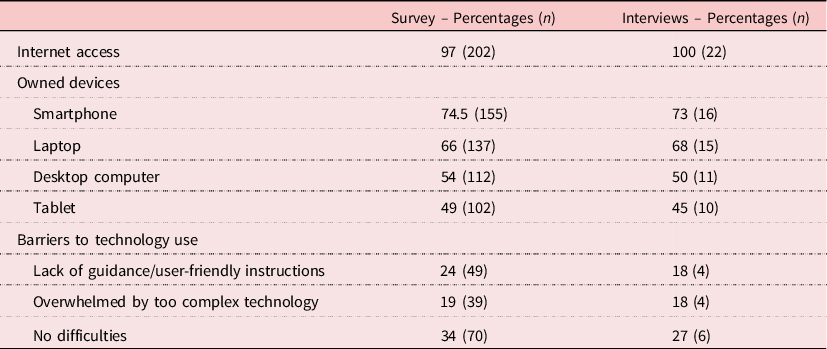
Note. Percentages may add to more than 100% because multiple responses were allowed.
Surveyed respondents’ mean digital literacy and interest in new advancements are shown in Table 3. In-depth questions related to the interviewees’ technological profiles revealed a more mixed picture in terms of digital literacy for this group, as almost half of the interviewees (n = 10) relied on younger relatives or friends for help with their digital devices. A few of the interviewees even reported limited interest in technological innovations, although they acknowledged using their devices for researching their interests, staying informed, or for communication purposes. Most of our participants felt nevertheless relatively confident and enthusiastic with technology. Some interviewees had even made a considerable effort in learning to use various communication platforms to stay in contact with relatives living abroad; others acknowledged the internet as their main source of information (see supplementary materials C, section 1, for quotes on this topic).
Survey respondents’ digital literacy and interest in new developments (n = 208)
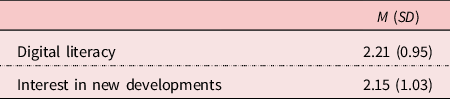
Note. The items were rated on a 5-point Likert scale (1 = “very good command”/“very interested”; 5 = “very bad command”/“not interested”).
To summarise, our participants were relatively confident, active users of digital resources and mobile devices in their everyday life, held positive attitudes towards technology, and were generally open to new advancements. As long as the benefits of adopting a particular innovation were clear to them, our participants were willing to learn using it.
3. Results
3.1 Extent of engagement in MALL and perceptions of language learning apps
To address our first research question, we asked participants about their preferred and most frequently used digital/online language tools and language learning apps to support their language learning practices (see Table 4). Participants who were currently using or had tried out language learning apps in the past (henceforth, users of language learning apps) were asked to evaluate their experience with these apps. Surveyed respondents rated their user satisfaction via a 5-point scale (1 = “very satisfied”; 5 = “very disappointed”). Interviewees were prompted to describe their experiences with language learning apps and to elaborate on their opinions as users.
Participants’ use of online/digital resources for L2 learning
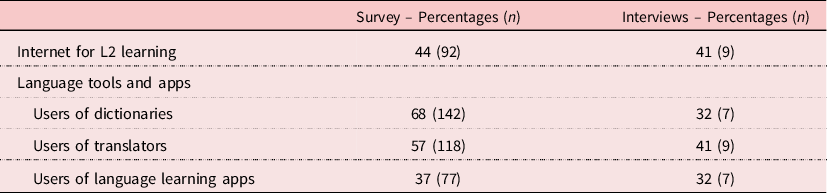
Note. Percentages may add to more than 100% because multiple responses were allowed.
The use of language tools and online resources for L2 learning was widespread among our participants. Over a third of them were or had also been users of language learning apps (see Table 4). However, not even half of the surveyed users of language learning apps rated their experience positively (“very satisfied”: 6.5%, n = 5; “satisfied”: 32.5%, n = 25; M = 3.27, SD = 0.87). Interviewees’ attitudes towards the integration of digital technology and mobile devices in L2 learning were generally positive, and many of them regarded language learning apps as a promising development but not one they were necessarily eager to try out themselves due to various reasons, especially the lack of interaction and personal contact when learning through an app (e.g. “If I used a [language learning] application, interaction with others would be important for me. Firstly, because I would have a communication partner and secondly because the pressure to learn would be stronger so as not to disappoint the other person.”). Among the interviewees, Babbel was the most popular app, followed by Duolingo and Rosetta Stone. Still, none of them were using a language learning app at the time of data collection and those who had tried one in the past were reluctant to keep using it. Users of language learning apps expressed disappointment (e.g. “I didn’t like it. I don’t know, it was not my world. I tried the app two or three times and then I dropped out. I need to see the words I’m learning, but studying a sentence with all the possible combinations … I don’t really give so much importance to it. I was somehow disappointed.”), dissatisfaction with the learning materials and teaching quality (e.g. “I found it was not accurate, that was one of the problems. It was just not so useful. It’s the right idea, but in the end it was just not so good and so I dropped out. I found some things misleading and very difficult for a beginner. It didn’t seem to teach anything.”), or scepticism (e.g. “Online courses or apps are interrupted by other things. We are not disciplined enough for learning this way. With a plan at a Volkshochschule [an adult education centre] it works better. You have to overcome your own laziness.”). Some preferred learning in a group course (e.g. “The app that I used … I’m sure it was fine. But I couldn’t hold out without a teacher. Learning languages in a group is simply more fun!”); others already had their own learning system (e.g. “I have tried Babbel and Busuu, but I prefer books and to read. I feel I learn more in my own way.”). Other interviewees felt that language learning apps did not meet their needs; a few complained about the apps’ complexity and/or price, or mentioned technical problems. Among the interviewees, only two users reviewed their experience positively; at the same time, however, they considered that to really learn a language, just an app is not enough. For instance, one of them remarked, “I liked the first lessons with Babbel very much but I missed explanations about how the grammar is composed. That would certainly have been better in an adult education course. To learn a new language completely I would take a [traditional language] course. But if I want to travel and learn a few expressions in the language, the offered basics of the [language learning] applications are sufficient for me” (see supplementary materials C, section 2, for additional comments on this topic).
3.2 Factors affecting the adoption of MALL
To address our second research question, we conducted inferential statistics on the survey data to measure the linear relationship (i.e. correlation) between a number of independent variables (i.e. potential predictors) on each of the two following measures (i.e. dependent variables, DV): (1) Use of language learning apps, a categorical yes/no variable that refers to whether participants had experience with language learning apps; and (2) Perception of language learning apps, a 5-point-scale variable that quantifies the level of user satisfaction with language learning apps. For this latter measure, only the users of language learning apps (n = 77) were included in the analysis. Given the exploratory purpose of the analysis and the large number of predictors, potential multicollinearity among them was assessed prior to analysis. First, the variance inflation factor (VIF) was calculated per variable. A VIF equal to 2.5 or higher was taken as an indicator of high collinearity (Johnston, Jones & Manley, Reference Johnston, Jones and Manley2018). Next, a pairwise correlation matrix was computed to identify pairs of correlated predictor variables. Due to collinearity, five initially considered predictors were excluded from analysis and two were averaged into a composite variable. A separate linear model was performed on each DV that included the following predictors: (1) sociodemographic (age, gender, country of birth, level of education, occupation), (2) language background/L2 learning (number of spoken L1s and L2s, motivations and methods for L2 learning), (3) activity/social patterns (average time spent at home vs. outside, regular activities, level of social interaction), and (4) technology (owned digital devices, language tools used, self-rated digital literacy, and interest in new developments).
Table 5 summarises the statistical outcomes from the models on Use of language learning apps and Perception of language learning apps, respectively, after the stepwise regression procedure was applied. As we were interested in a preliminary exploration of potential predictors for our two DVs, we report here significant effects found for variables with both Bonferroni-corrected and uncorrected p values.
Statistical outcomes on “Use of language learning apps” and “Perception of language learning apps” after automatic variable selection was applied
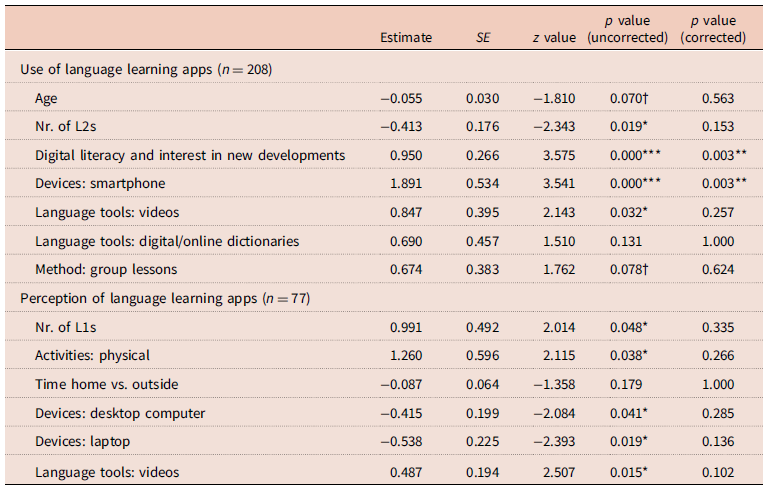
Note. Bonferroni-corrected and uncorrected p values are shown. The symbols *, **, and *** indicate α-levels lower than .05, .01, and .001, respectively; marginal significance with an α-level of less than .10 is indicated by †.
A robust effect of seniors’ self-confidence in the use of digital technology and openness to new developments was observed that positively correlated with their likelihood of trying out language learning apps; that is, the higher older adults’ digital literacy and interest in new advancements, the higher the probability of them learning a language through an app. A second factor affecting positively seniors’ use of such apps was smartphone ownership (see Table 5, “Use of language learning apps”). Additionally, less robust effects were found for a few other variables on both use and perceptions of language learning apps. On the one hand, the number of L2s that a senior speaks affected app use negatively (see Table 5, “Use of language learning apps”). By contrast, watching online videos (e.g. YouTube) as a resource for L2 learning correlated positively with both DVs (see Table 5, “Use of language learning apps” and “Perception of language learning apps”). Furthermore, bilingualism (i.e. having grown up with more than one language) and being physically active had a positive impact on satisfaction levels (see Table 5, “Perception of language learning apps”). Additionally, owning laptop/desktop computers correlated negatively with seniors’ user satisfaction (see Table 5, “Perception of language learning apps”). These two effects are likely to mirror the positive effect of smartphone ownership on app use and may indicate that existing apps are optimised for mobile devices rather than for desktop environments. Finally, for app use, we observed a negative effect of age (i.e. as age increases, the likelihood of app use decreases), and a positive effect of traditional language courses as a method for language learning (see Table 5, “Use of language learning apps”). However, given that these two latter effects emerged only for the variables’ uncorrected p values and came out statistically marginal, they will not be further discussed.
3.3 Additional insights: Language learning practices in older adults
In addition to our two main research questions on MALL, we sought to gain insight into seniors’ needs and demands as late-life L2 learners by examining their language learning practices (see Table 6). Participants were asked to report on their recent engagement in L2 learning as well as whether (and if so, how) they perceived that learning had changed over the years. As Table 6 shows, over half of our participants were or had been recently engaged in L2 learning.
Learning practices of participants engaged in L2 learning after retirement or in the past five years

Note. Percentages may add to more than 100% because multiple responses were allowed.
Most L2 learners were more interested in training or improving in a previously learnt L2 than in acquiring a new one (see Table 6, “Prior L2 knowledge”). Many of them perceived that learning had turned more difficult over the years and that this had affected their L2 learning strategies. They acknowledged learning slower, forgetting faster, and having trouble memorising. A few of them attributed these changes to differences between short- and long-term memory or noticed increased difficulty when learning on their own. These factors may discourage seniors from learning a completely new language; refreshing a previously acquired L2 seems simply easier. However, some interviewees also admitted that the lack of pressure or a higher motivation can compensate for age-related changes. Our learners prioritised the practical use of the L2 in real situations, for example, to communicate when travelling abroad (see Table 6, “Goals” and “Motivations”), which explains why English was by far the most spoken L2 (surveyed respondents: 87.5%, n = 182; interviewees: 77%, n = 17). Over half of our L2 learners were or had been receiving formal instruction with a teacher (group course, surveyed respondents: n = 74, interviewees: n = 7; private lessons, surveyed participants: n = 12, interviewees: n = 0), but almost the same amount chose to learn exclusively on their own through self-teaching methods that also involved the use of online/digital resources (see Table 6, “Instructional methods”). A few of the interviewed L2 learners reported relying more nowadays on their own learning system than on a teacher’s approach; others did not explicitly note substantial age-related changes in their learning approaches but appreciated the variety of online resources currently available to establish real-life contact with their L2s (see supplementary materials C, section 3, for quotes on this topic).
4. Discussion
The main purpose of this study was to gain insight into seniors’ (aged 60+) voluntary engagement in MALL and the factors predicting their adoption of language learning apps. Additionally, we sought to determine seniors’ L2 learning practices. In what follows, we discuss our findings in light of previous research on m-learning and (older) adult education.
4.1 Extensive use of digital technology but limited MALL
Our participants’ extensive use of digital technology and mobile devices aligns with previous findings suggesting that seniors are in general open and willing to adopt technology notwithstanding certain barriers (Vaportzis et al., Reference Vaportzis, Giatsi Clausen and Gow2017). Although a few interviewees reported low interest in technological innovations, they were all daily users of at least a device that granted internet access and none of them denied the communication and information advantages that digital technologies have brought into their lives. Our results show that seniors are willing to invest time and effort in learning to use technology as long as they can use it to improve aspects of their lives or to satisfy specific needs such as learning, staying informed, and keeping contact with their families and friends.
Our participants were, however, reluctant to use language learning apps. Given the potential of MALL for older learners, along with the high number of self-learners and the widespread use of other language tools and mobile apps among our participants, the limited use of language learning apps and negative opinions of the users may seem surprising. On the one hand, participants generally acknowledged advantages in integrating (mobile) technology into language learning; many even made daily use of translators in their smartphones and/or had abandoned paperback dictionaries in favour of digital ones. On the other hand, they considered that language learning apps were not for them and those who had tried them dropped out easily. Older adults have been characterised as selective users of technology (Rousseau & Rogers, Reference Rousseau and Rogers1998) and will not fully adopt an innovation unless they perceive a clear benefit to themselves (Heinz et al., Reference Heinz, Martin, Margrett, Yearns, Franke, Yang, Wong and Chang2013). As one interviewee put it, “I don’t tend to buy or use a new thing just because it’s out there if it doesn’t have any use for me”. In other words, if seniors do not see an added value in learning through an app, they will be reluctant to use one. But why do seniors not see much benefit in using language learning apps?
Language learning apps like Duolingo or Babbel have millions of users, and several evaluation studies on these apps conducted with younger learners have reported high levels of user satisfaction (e.g. Vesselinov & Grego, Reference Vesselinov and Grego2016). Our results suggest that the reality for seniors is quite different, and we may question whether existing language learning apps meet the principles of geragogy. As mentioned earlier, the three objectives for effective learning in older adulthood, person-, fellow-, and matter-centred objectives (Creech & Hallam, Reference Creech and Hallam2015), can be mapped onto the three features of self-directed MALL: personalisation, connectivity, and authenticity (Lai & Zheng, Reference Lai and Zheng2018). Are these features effectively manifested in the m-learning experiences of older adults? Although Lai and Zheng (Reference Lai and Zheng2018) did not examine language learning apps specifically, they found that authenticity and connectivity manifested less clearly in the MALL experience than personalisation. If this is correct, current MALL may lack components that are crucial for senior L2 learners. The comments of our interviewees support this conjecture. First, many of them mentioned the lack of social interaction and personal contact as discouraging factors for using language learning apps. This could be interpreted as a perceived lack of connectivity. Some interviewees were also dissatisfied with the learning materials, and/or with the way content is delivered or taught by language learning apps, which could be translated into a perceived lack of authenticity. Second, our interviewees did not seem to acknowledge personalisation advantages when evaluating their experience with language learning apps. Personalisation refers to the potential flexibility of m-learning in terms of mobility, accessibility, and adaptability. Language learning is regarded as a task that demands extra attentional and cognitive resources, a task for which senior learners tend to use desktop computers or laptops at home. Older adults may therefore not be interested in the mobility aspect of the personalisation dimension because they do not have as strong a need for learning anywhere as their younger counterparts. Personalisation entails, as well, the potential of a customised learning experience adapted to the needs of the learner. A few of our interviewees, however, felt that existing language learning apps did not meet their needs or did not fit with their learning style. In their review of language learning applications, Heil, Wu, Lee and Schmidt (Reference Heil, Wu, Lee and Schmidt2016) pointed out that current apps indeed offer little adaptation to the learner’s individual needs (see also Burston, Reference Burston2014a, Reference Burston2014b). Given the heterogeneity of older adults, many of them may have specific requirements or learning habits that language learning apps have not yet accommodated. This may lead some older learners to perceive such apps as not suitable for them at all.
To sum up, the comments of our interviewees revealed a perceived lack of the three core features of self-directed MALL in existing language learning apps. A poor manifestation of connectivity and authenticity in the general use of mobile devices for language learning was previously found by Lai and Zheng (Reference Lai and Zheng2018) for university students, who nevertheless considered mobile devices as most useful in supporting anytime-anywhere learning. While connectivity –and to a lesser degree, authenticity– seem strongly weighted features for older L2 learners, their disinterest for the mobility advantage of MALL along with the apps’ lack of adaptability to individual needs may contribute to decreasing the importance of the personalisation feature for senior, relative to younger, L2 learners.
4.2 Factors predicting the adoption of MALL
The statistical analyses on the survey data revealed effects of several factors that modulate the likelihood of use and perceptions of language learning apps by senior users. Our main finding suggests that older individuals who keep themselves curious are more likely to try out language learning apps. Curiosity, desire for learning, and openness to new experiences decrease with age, but previous research has emphasised the importance of maintaining these traits in older adulthood, as they appear to play a crucial role in preserving mental, cognitive, and physical health, and in enhancing memory and learning (Sakaki, Yagi & Murayama, Reference Sakaki, Yagi and Murayama2018). As adoption of new technology requires learning, seniors who are in general ready to learn new things may be more likely to experiment with language learning apps. On a related note, bilingualism and physical activity were found to positively correlate with user satisfaction levels. The benefits of bilingualism for the ageing brain in decelerating cognitive decline and reducing the risk of impairments like dementia or Alzheimer’s disease have been repeatedly shown (Bialystok & Sullivan, Reference Bialystok and Sullivan2017). Similarly, an active lifestyle involving exercise is a sign of healthy ageing (McPhee et al., Reference McPhee, French, Jackson, Nazroo, Pendleton and Degens2016). All these effects suggest that a healthy, active, and happy ageing has a positive impact on seniors’ adoption of language learning apps, as they may be more open to take advantage and fully enjoy the MALL experience.
Additionally, watching online videos to support L2 learning was found to increase both the participants’ likelihood of use and their satisfaction levels with language learning apps. Regarding the effect on usage probability, older learners who often search for videos online to practise listening comprehension in their L2 are probably more exposed to promotional videos advertising language learning apps, or to other types of online adverts targeted towards L2 learners, compared to those who do not use video-sharing platforms such as YouTube. Seniors often remain unaware of the possibilities and benefits that existing technology can bring to them (Heinz et al., Reference Heinz, Martin, Margrett, Yearns, Franke, Yang, Wong and Chang2013). As such, targeted online adverts may be a useful way to show older adults about the existence and potential benefits of language learning apps. However, this in turn presupposes a certain level of engagement with technology. As for the effect on user satisfaction, we speculate that multimedia-oriented seniors may enjoy learning via visually attractive multimedia language learning apps more than text-oriented individuals. Recently, it has been argued that multimodal, interactive, real-life L2 content increases engagement of different brain areas in both hemispheres, which helps to improve both L2 learning and cognitive abilities (Li & Jeong, Reference Li and Jeong2020; Li & Lan, Reference Li and Lan2021). MALL, by allowing learners to access and interact with real-life content in multiple formats, may be especially beneficial for older learners. Language learning apps need to effectively exploit that potential and enable as much immersion in real-life L2 environments as possible.
Seniors’ owned devices also affected the probability of app use and satisfaction levels. Although smartphone ownership favoured app use, owning laptop/desktop computers decreased user satisfaction. On the one hand, the former positive effect suggests that seniors who feel comfortable using their smartphones, perhaps in a similar fashion to younger adults (e.g. for anytime-anywhere learning), may find m-learning attractive. On the other hand, these positive and negative effects taken together may reflect design issues (e.g. in terms of usability or accessibility) with desktop or web-based versions of current language learning apps, as these are optimised for m-learning and intended to run on mobile devices rather than on desktop environments. This may result in dissatisfied computer-based users.
4.3 Language learning practices
Our participants’ L2 learning practices (see Table 6) connect with four pillars of adult learning: (1) use of accumulated experience and enhancement of prior knowledge, (2) application of newly acquired knowledge in real-life situations, (3) intrinsically motivated learning, and (4) autonomy and self-direction (Knowles, Reference Knowles1980). Our results suggest that in older L2 learners these tendencies may be accentuated or altered by factors such as memory decline and later-life circumstances. The decline in short-term memory makes learning of, for example, new vocabulary a more effortful process than in younger years. Consequently, seniors may find it comparatively easier to recover or reactivate a previously studied L2 than to learn a new one; at the same time, putting new knowledge into practice may be especially helpful for older learners to consolidate it. Moreover, compared to younger working adults, who often strive for a highly sophisticated level of proficiency due to extrinsic motivators such as professional or career-related reasons (Morrison & McCutheon, Reference Morrison and McCutheon2019), retired learners are mostly driven by personal interest and rather aim for a practical use of the language (e.g. for travelling). Our results further indicate that seniors are certainly willing to learn by themselves, but the popularity of group courses shows that they enjoy working together with other people as well, which turns L2 learning in older adulthood into a social event (Ware et al., Reference Ware, Damnee, Djabelkhir, Cristancho, Wu, Benovici, Pino and Rigaud2017). Seniors value collaborative learning, peer support, and group discussions (e.g. Jin et al., Reference Jin, Kim and Baumgartner2019), and peer teaching appears a highly effective method for them (Findsen & Formosa, Reference Findsen and Formosa2011). Indeed, a wish for social interaction in the learning context was often expressed by our L2 learners, and as previously mentioned, a perceived lack of this component may be one of the factors discouraging older L2 learners from engaging in MALL. However, MALL is rapidly evolving, and today it holds great potential for interaction and collaborative learning (Burston, Reference Burston2014a; Jin et al., Reference Jin, Kim and Baumgartner2019; Kukulska-Hulme & Viberg, Reference Kukulska-Hulme and Viberg2018). Highlighting this potential to seniors and assessing their requirements as late-life L2 learners may be necessary to facilitate MALL adoption among them.
5. Conclusion
As the population in Western nations is quickly ageing and rapidly evolving mobile technology is transforming the way we learn languages, there is a growing necessity for understanding seniors’ adoption of mobile devices for L2 learning in order to ensure their continuous access to learning opportunities, especially as COVID-19 has accelerated the trend towards a digital learning environment. In this study, we reported the results of a web-based survey and a series of interviews aimed at investigating to what extent older adults (aged 60+) residing in Germany engage in MALL, their perceptions of language learning apps, and the factors that may predict their adoption of such apps. Our results indicate that current language learning apps may not cover seniors’ multiple demands despite the potential benefits of MALL for late-life learning. From the statistical analyses of the survey data, several factors emerged that are likely to modulate the use and satisfaction levels of older L2 learners with language learning apps. Our main finding suggests that self-confident, technologically savvy seniors who are open to new advancements are more likely to engage in language learning via an app compared to their less tech-oriented peers.
In order to exploit the potential of MALL for lifelong learning and facilitate the full inclusion of seniors as mobile language learners, future implementations of language learning apps should address older learners’ requirements. First, the apps should be approachable also by less tech-savvy seniors; they should be easy to handle, provide accessible, user-friendly help with initial set-up, and ensure continuous support. App developers and designers should also consider seniors’ lifestyle, unique later-life circumstances, and L2 learning practices. For example, the apps should promote real-life practice opportunities to increase motivation and help to consolidate knowledge, and the training should mainly aim for a practical use of the language rather than for its perfect mastery. Furthermore, seniors may prefer to use their desktop/laptop computers for learning; hence, designers should take care that the desktop versions of the apps are attractive, engaging, and easy to use for seniors. The apps should also offer adaptation possibilities to multiple learning environments and study habits; they should increase connectivity opportunities and make learning a truly collaborative experience. Finally, we need to ensure that older adults understand the multiple benefits of MALL for their lives, as for seniors to adopt an innovation, those benefits must outweigh the effort required to learn using it.
Finally, we would like to point out a number of limitations of the current study and suggest directions for future research. First, our results are likely to be specific to a country such as Germany where mobile infrastructure is highly developed and the use of smartphones is widespread among older adults. Second, our participants were well educated, had an interest in language learning, and a high profile of technology use. Therefore, we may expect even lower engagement in MALL for the average older population. Given the lack of research on MALL in older adulthood, the current findings constitute a starting point for addressing the requirements of senior mobile L2 learners. However, future research may want to investigate the adoption of MALL among a broader range of older adults, in other countries, and in different sociocultural contexts. Finally, we did not focus on specific language learning apps or specific linguistic domains trained with such apps. Further research is warranted to examine different aspects of MALL in older adulthood, the reasons why seniors select specific apps, and the impact of different apps on seniors’ language learning abilities in different target languages.
MALL has emerged as a field of study that offers exciting opportunities for interdisciplinary research, where findings from the language sciences can contribute to the development of new products from which our ageing populations may benefit. We hope that the current study provides a step forward in that direction.
Supplementary material
To view supplementary material referred to in this article, please visit https://doi.org/10.1017/S0958344021000276
Acknowledgements
The authors would like to thank Juan García, Marian Jenke, and Yulia Kurennaia for their valuable contributions to this project. We thank our colleagues of the Potsdam Research Institute for Multilingualism for fruitful discussion at different stages of this work, and Daniel Schad and João Veríssimo for providing statistical advice. We are also grateful to Ping Li and three anonymous reviewers for their insightful comments on an earlier version of this manuscript. This research has been supported by an Alexander-von-Humboldt Professorship awarded to Harald Clahsen (Potsdam Research Institute for Multilingualism), which is gratefully acknowledged.
Ethical statement
The present study was approved by the ethics committee of the University of Potsdam (application 44/2017). All collected data were anonymised and processed exclusively within the project. Survey respondents were volunteers; interviewees received 10 euro for their participation. There were no conflicts of interest.
About the authors
Cecilia Puebla is a PhD candidate in the International Experimental and Clinical Linguistics programme at the University of Potsdam and researcher at the Potsdam Research Institute for Multilingualism. Her research interests include native and non-native language processing and technology-enhanced language learning.
Tiphaine Fievet holds a master’s degree in linguistics from the University of Potsdam. Their research interests focus on the psycholinguistics and neurolinguistics of second language acquisition. More specifically, they are interested in exploring the relation between morphology and second language word processing.
Marilena Tsopanidi holds a master’s degree in linguistics from the University of Potsdam. Her research interests include psycholinguistic aspects of language processing, morphology, and effects of ageing on language processing.
Harald Clahsen is a professor of psycholinguistics at the University of Potsdam and director of the Potsdam Research Institute for Multilingualism. He is a fellow of the British Academy and of the Academia Europaea. He has published 10 books and more than 150 research articles on first and second language acquisition, developmental and acquired language disorders, and on language processing. He has been the coordinator of several large research projects and is the co-editor of the international journal Bilingualism: Language and Cognition.
Author ORCIDs
Cecilia Puebla, https://orcid.org/0000-0002-2152-997X
Tiphaine Fievet, https://orcid.org/0000-0003-3482-7439
Marilena Tsopanidi, https://orcid.org/0000-0002-6335-6181
Harald Clahsen, https://orcid.org/0000-0002-6190-1318


 Open access

