





Introduction
The Arctic sea-ice system is going through a transition, from a multi-year to a thinner, seasonal, first-year ice system (Comiso, Reference Comiso2002; Maslanik and others, Reference Maslanik, Stroeve, Fowler and Emery2011; Meier and others, Reference Meier2014). In wintertime, the thinner sea ice becomes more vulnerable to changes in the atmospheric boundary conditions, such as air temperature, wind speed and precipitation. These changes are often associated with storm activity. Most severe storms occur during the Arctic winter and they originate from the North Atlantic Ocean (Zhang and others, Reference Zhang, Walsh, Zhang, Bhatt and Ikeda2004; Sorteberg and Walsh, Reference Sorteberg and Walsh2008). They enter the Arctic Ocean via the Fram Strait and the Barents Sea region and bring pulses of heat and moisture further north, reducing the heat loss from the ocean to the atmosphere and hindering sea-ice growth (Graham and others, Reference Graham2019).
A number of studies has been carried out on investigating the relation between storms and sea-ice retreat in autumn and summer (Screen and others, Reference Screen, Simmonds and Keay2011; Zhang and others, Reference Zhang, Lindsay, Schweiger and Steele2013; Babb and others, Reference Babb, Galley, Barber and Rysgaard2016). Due to the scarcity of continuous winter observations in the Arctic Ocean, winter studies rely on atmospheric reanalyses and remote-sensing products. Atmospheric reanalyses suffer from large air temperature biases during winter, and substantial precipitation spreads among different simulation products (Lindsay and others, Reference Lindsay, Wensnahan, Schweiger and Zhang2014; Boisvert and others, Reference Boisvert, Webster, Petty, Markus, Bromwich and Cullather2018). Remote-sensing products for sea-ice thickness retrievals, rely on accurate information of snow depth on sea ice. Uncertainties in the amount of snow on sea ice can induce large errors in acquiring sea-ice thickness (Giles and others, Reference Giles, Laxon, Wingham, Wallis, Krabill, Leuschen, McAdoo, Manizade and Raney2007; Haapala and others, Reference Haapala, Lensu, Dumont, Renner, Granskog and Gerland2013; Ricker and others, Reference Ricker, Hendricks, Perovich, Helm and Gerdes2015). This was especially evident in the Norwegian young sea ICE (N-ICE2015) study region (King and others, Reference King, Skourup, Hvidegaard, Rösel, Gerland, Spreen, Polashenski, Helm and Liston2018). Therefore, winter observations become very valuable for understanding the new Arctic sea-ice system.
The N-ICE2015 is the most comprehensive, multidisciplinary campaign in the Atlantic sector of the Arctic Ocean including winter observations. N-ICE2015 observations provide a unique testbed to investigate closer the influence of the storm activity on the sea-ice growth evolution in winter. During the N-ICE2015 campaign (Granskog and others, Reference Granskog, Fer, Rinke and Steen2018), frequent storms and thick snow on sea ice were observed from January to March 2015 north of Svalbard (Graham and others, Reference Graham2019). In this study, we aim to examine the effect of snow and storm-induced warming events on Arctic sea-ice thermodynamic growth in winter. We do this by performing a modelling sensitivity study guided by observations collected during the N-ICE2015 campaign. In this study we focus on the interaction between the sea ice and the atmosphere. For that purpose we apply a low ocean heat flux, representative of deep Arctic basin conditions.
Materials and Methods
Observations during the N-ICE2015 campaign
During the winter part of the N-ICE2015 campaign, the R/V Lance was tethered to two different ice floes (Floe 1 and 2) north of Svalbard and moved passively with the ice drift. Comprehensive observations of sea-ice thickness and snow depth were collected from snow buoys, ice mass-balance buoys (IMBs), electromagnetic induction (EM) surveys (ground-based) and snow probe measurements (Rösel and others, Reference Rösel, Itkin, King, Divine, Wang, Granskog, Krumpen and Gerland2018). Even though air temperature was mostly below −30°C, sea-ice thickness increased only slightly during the observation period. This was attributed to the thick snow (Rösel and others, Reference Rösel, Itkin, King, Divine, Wang, Granskog, Krumpen and Gerland2018) that provided thermal insulation to the sea ice, and to the frequent synoptic storms that brought pulses of heat and moisture in the region (Cohen and others, Reference Cohen, Hudson, Walden and Granskog2017). In this study, we aim to investigate the relative importance of these two factors (snow and frequent warming events caused by storms) for the thermodynamic growth of sea ice.
Six major winter storms occurred during the N-ICE2015 campaign (Cohen and others, Reference Cohen, Hudson, Walden and Granskog2017). The storms were characterised by a considerable pressure drop, and a large increase in the air temperature, wind speed and relative humidity (Fig. 1). In most cases near-surface air temperatures rose by more than 20°C in 48 h (Cohen and others, Reference Cohen, Hudson, Walden and Granskog2017). The net longwave radiative flux rose from ~−60 to 0 W m−2 in 12 h (Walden and others, Reference Walden, Cohen, Murphy, Hudson and Granskog2017). The atmospheric boundary layer became warmer than the ice and snow surface, triggering downward conductive heat fluxes that warmed the snow and the upper layers of sea ice (Graham and others, Reference Graham2019). The average wind speed throughout the winter was 6.8 m s−1, and at instances it rose above 20 m s−1 during the major storms (Cohen and others, Reference Cohen, Hudson, Walden and Granskog2017). On 18 February, Floe 1 broke up. R/V Lance had to relocate, and it reached Floe 2 on 23 February. The meteorological measurements were interrupted during this period.
Meteorological forcing used to perform the model experiments. The N-ICE2015 observations of air temperature , relative humidity and wind speed are in blue. The same parameters modified to remove the effect of storms are in red. The shaded areas denote the storm period based on Cohen and others (Reference Cohen, Hudson, Walden and Granskog2017).

The model experiments
We used HIGHTSI, a 1-D, high resolution, thermodynamic ice and snow model (Launiainen and Cheng, Reference Launiainen and Cheng1998), to assess the effect of the storms and snow load on the winter sea-ice growth. HIGHTSI has been used widely in sea-ice modelling applications in the Arctic Ocean, and has been extensively validated against observations (Cheng and others, Reference Cheng, Zhang, Vihma, Johansson, Bian, Li and Wu2008, Reference Cheng, Mäkynen, Similä, Rontu and Vihma2013; Wang and others, Reference Wang, Shi, Gerland, Granskog, Renner, Li, Hansen and Martma2013, Reference Wang, Cheng, Wang, Gerland and Pavlova2015; Merkouriadi and others, Reference Merkouriadi, Cheng, Graham, Rösel and Granskog2017). HIGHTSI resolves the evolution of snow depth, sea-ice thickness and temperature profiles in response to prescribed meteorological forcing.
Data from the winter part of the N-ICE2015 campaign (22 January–15 March) were used to guide the model experiments. We used snow and sea-ice thickness and temperature profile data from one of the N-ICE2015 IMBs (SIMBA_2015a) to initiate the experiments (Provost and others, Reference Provost, Sennéchael, Miguet, Itkin, Rösel, Koenig, Villacieros-Robineau and Granskog2017; Rösel and others, Reference Rösel, Itkin, King, Divine, Wang, Granskog, Krumpen and Gerland2018). In situ observations from the N-ICE2015 campaign including air temperature (2 m), wind speed (10 m), relative humidity (2 m) (Fig. 1) and downward longwave radiative flux (Fig. 2b) were used to force HIGHTSI (Hudson and others, Reference Hudson, Cohen and Walden2015, Reference Hudson, Cohen and Walden2016). Upward longwave radiative flux observations are also available and they were used to validate HIGHTSI modelled values. There was a very good agreement between the observed and the modelled upward longwave radiative flux (Fig. 2a). The downward solar radiative flux is available only from 3 March onward. The values remained small and the effect on the surface heat balance is negligible, therefore solar radiation was neglected in the experiments. When R/V Lance was relocated in late February to Floe 2, weather conditions remained stable without storm events. During this time, we applied linear interpolation to all parameters, to fill the gaps in the observational data.
Upward and downward longwave radiative flux used to perform the model experiments. The N-ICE2015 observations are in blue. The modified fluxes to remove the effect of storms are in red. The lighter coloured lines are the modelled upward longwave radiative fluxes.

To examine the effect of storms on the thermodynamic growth of sea ice, we created two meteorological forcing datasets. One is based on the meteorological data collected during N-ICE2015 that were characterized by frequent storms (Fig. 1). In the other one we manually removed the effect of storms on the observed parameters, by cycling through observations from the cold and calm periods (Days 24–33). Time series of air temperature, wind speed, relative humidity and downward longwave radiative flux were artificially created (Figs 1 and 2 in red) and were used as model forcing to investigate the sea-ice growth without the warming effect of storms. During the calm and cold periods, average air temperature, wind speed, relative humidity and net longwave radiative flux values were −33.6°C, 5.5 m s−1, 70.8% and −41.3 W m−2, respectively. These values are quite representative of the Arctic Ocean in winter (Wang and others, Reference Wang, Graham, Wang, Gerland and Granskog2019).
Initial snow density was assumed to be uniform (350 kg m−3) for the entire snowpack. The densification of snow was considered according to Anderson (Reference Anderson1976). The snow depth during the experiments was kept constant for simplicity. A constant snow depth is not realistic; however, even though storms brought precipitation at N-ICE2015, in some locations the snow depth did not increase much, due to wind-blown snow (Rösel and others, Reference Rösel, Itkin, King, Divine, Wang, Granskog, Krumpen and Gerland2018). We conducted experiments with four snow depths (h s): h s = 0.50, 0.30 0.15 and 0 m and an ice thickness of 1.3 m, which is representative of a typical ice thickness during N-ICE2015. The initial snow and ice temperature profiles were taken from the SIMBA_2015a IMB (Provost and others, Reference Provost, Sennéchael, Miguet, Itkin, Rösel, Koenig, Villacieros-Robineau and Granskog2017). For the experiments in which we used thinner initial snow depths, the snow temperature profiles were adapted by preserving the observed initial temperature gradient between the snow surface and the snow/ice interface. A snow depth of 0.50 m corresponded to the snow conditions that were observed at the start of the N-ICE2015 campaign (22 January). hs = 0.30 m of snow corresponds to the climatological mean based on the snow climatology by Warren and others (Reference Warren, Rigor, Untersteiner, Radionov, Bryazgin, Aleksandrov and Colony1999). h s = 0.15 m is considered a typical value of the western Arctic (Webster and others, Reference Webster, Rigor, Nghiem, Kurtz, Farrell, Perovich and Sturm2014). Finally, we performed a snow-free experiment as a reference, in order to isolate the warming effect of storms. We repeated the same experiments for initial ice thicknesses (h 0i) of 0.5 and 2.0 m, to examine the sensitivity of our results to different initial ice thickness conditions. The time step of our experiments was 15 min.
Our purpose was not to reproduce the N-ICE2015 observations, but to conduct an idealistic, sensitivity study representative for the ice pack in the deep Amundsen basin during this period. For this reason, we kept a constant, low ocean heat flux (Fw = 1 Wm−2), representative of the conditions in the deep basin (McPhee and others, Reference McPhee, Kikuchi, Morison and Stanton2003). We did not allow for snow-ice formation (which would have been the case for the largest snow depth), as widespread negative freeboard without flooding was observed (Rösel and others, Reference Rösel, Itkin, King, Divine, Wang, Granskog, Krumpen and Gerland2018). Detailed information on the model parameterizations are given in Table 1.
Model parameters and constants used in this study

Results
The simulated temperature profiles inside the ice and snow, with and without the effect of the storms, and for different snow depths, are shown in Figure 3. The pulses of heat brought by the storms have a clear signature in the snow temperature profiles (Fig. 3, left panels). Under a thick snow cover (h s = 0.5 m) the heat pulses are strongly modulated in the ice temperature profiles, and they are observed mainly at the ice surface (Fig. 3). The insulation properties of snow are clearly demonstrated in Figure 3. Under snow-free conditions the average sea-ice surface temperature decreased by ~23°C, compared to the case with 0.5 m deep snow cover.
Simulated ice and snow temperature profiles with (left) and without (right) the effect of storms for different snow depth scenarios, h s = 0.5, 0.3, 0.15 and 0 m.

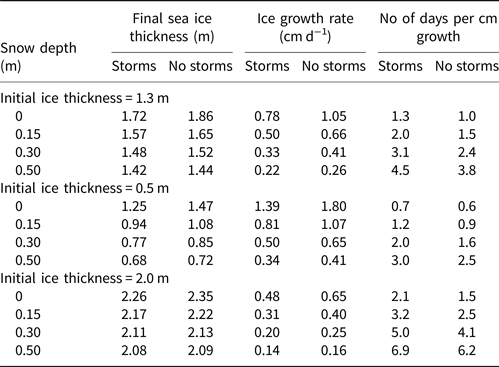
The simulated sea-ice thickness evolution with and without the effect of the storms, and for different snow depth scenarios (h s = 0.5, 0.3, 0.15 and 0) is shown in Figure 4. All experiments start on 22 January (day 22) and run until 15 March (day 74). The initial ice thickness in all of the experiments was 1.30 m, taken from N-ICE2015 observations (SIMBA_2015a). The results show that the sea-ice growth is mainly controlled by the snow depth. Under snow-free conditions and without the effect of storms, sea-ice grows 0.21 m thicker (+13%) than for 0.15 m of snow, 0.34 m thicker (+22%) than for 0.30 m of snow, and 0.42 m thicker (+29%) than for 0.50 m of snow. When the effect of storms is taken into account, under snow-free conditions the sea ice grows 0.15 m thicker (+10%) than for 0.15 m of snow, 0.25 m thicker (+17%) than for 0.30 m of snow and 0.30 m thicker (+21%) than for 0.50 m of snow.
Simulated sea-ice thickness evolution with (blue) and without (red) the effect of storm-induced warming events for an initial ice thickness of 1.3 m, for different snow depths: h s = 0.5 m, 0.3, 0.15 and 0 m. Snow depth remains unchanged within the same experiment.

The effect of snow on the sea-ice growth is dominant. The effect of storms becomes more important with less snow on sea ice. For 1.3 m initial sea-ice thickness and 0.5 m of snow depth, the storms reduce the final sea-ice thickness only by 0.02 m (−1.4%). Under snow-free conditions the effect of storms maximizes, and the final sea-ice thickness is reduced by 0.14 m (−7.7%). Under snow-free conditions it takes 1 d to grow 1 cm of sea ice without the effect of the storms, and 1.3 d with the effect of the storms. For 0.5 m of snow depth it takes 3.8 d to grow 1 cm of sea ice without the effect of the storms, and 4.5 d with the effect of the storms.
The effect of both the snow and the storms in reducing the rate of sea-ice growth becomes more important in thinner ice conditions (h 0i = 0.5 m) and less important in thicker ice conditions (h 0i = 2 m). However, regardless of the initial ice thickness conditions, the effect of snow is always dominant. Results from all model experiments are summarized in Table 2.
Results from all model experiments
Discussion and Conclusions
We performed a modelling sensitivity study using a 1-D sea ice and snow thermodynamic model (HIGHTSI), to examine the relative effect of storms and snow for Arctic sea-ice growth in winter. Observational data from the N-ICE2015 campaign were used to guide the model experiments. During the winter part of the N-ICE2015 campaign (22 January–15 March) six major storm events occurred, which brought pulses of heat and moisture in the area (Fig. 1). On 22 January, the snow on sea ice was exceptionally thick (~0.5 m). By 15 March, both the snow depth and the sea-ice thickness increased only slightly (Rösel and others, Reference Rösel, Itkin, King, Divine, Wang, Granskog, Krumpen and Gerland2018). In this sensitivity experiment we evaluate the impact of storms and snow in the evolution of the sea-ice growth, (i) by adjusting the thickness of snow on sea ice and (ii) by removing the effect of storms from the meteorological forcing. We do not take into account the increased ocean heat fluxes that occurred during some storms (Peterson and others, Reference Peterson, Fer, McPhee and Randelhoff2017). Instead, we use values representative of the deep Arctic basin in winter (McPhee and others, Reference McPhee, Kikuchi, Morison and Stanton2003), away from the warm Atlantic water inflow. Neither have we accounted for snow-ice formation that was also evident, especially for the thickest snow covers (Provost and others, Reference Provost, Sennéchael, Miguet, Itkin, Rösel, Koenig, Villacieros-Robineau and Granskog2017).
Our results show that sea-ice growth is mainly controlled by the snow depth on sea ice. The effect of storm warming events becomes more important with less snow on sea ice. For 1.3 m initial ice thickness and 0.5 m snow, similar to what was observed during N-ICE2015, the reducing effect of storms in sea-ice growth is relatively small, i.e. the difference in the final sea-ice thickness was only reduced by 0.02 m (−1.4%) due to the effect of the storms. Sea-ice growth rate was reduced from 0.26 to 0.22 cm d−1 (−15%). In the extreme case of snow-free conditions, the difference in the final thermodynamic sea-ice thickness caused by the storms was 0.14 m (−7.5%). Sea-ice growth rate was reduced from 1.05 to 0.78 cm d−1 (−50%).
Snow depth on the other hand is strongly affecting sea-ice growth in winter. Without the effect of the storms, 0.5 m of snow cover reduced the final sea-ice thickness by 0.42 m (−23%) compared to snow-free conditions. Sea-ice growth rate was reduced from 1.05 to 0.26 cm d−1 (−75%). With the effect of storms, 0.5 m of snow reduced the final sea-ice thickness by 0.30 m (−17%) compared to snow-free conditions. Sea-ice growth rate was reduced from 0.78 to 0.22 cm d−1 (−72%).
We repeated the same experiments with different initial sea-ice thickness (h 0i = 0.5 and 2 m), to examine how that would affect our results (Table 2). To summarize, for 1.3 m initial ice thickness the reducing effect of storms on the sea-ice growth ranged from −1.4 to −7.5%, and the reducing effect of snow ranged from −17 to −23%. For lower initial ice thickness (h 0i = 0.5 m) the reducing effect of storms on the sea-ice growth becomes more important (−6 to −15%), but so does the reducing effect of snow (−46 to −51%). While, for greater initial ice thickness (h 0i = 2 m), the reducing effect of storms becomes less important (from −0.5 to −3.8%), but so does the reducing effect of snow (from −8 to −11%).
We should note once more that the ocean heat flux was kept low on purpose in our experiments (1 W m−2), in order to simulate conditions of the deep Arctic basin and to isolate the effect of sea ice and atmosphere interactions. Observations from the IMBs deployed during N-ICE2015 capture the complete effect of the atmosphere and ocean along the drift path of the buoy. Specifically, for SIMBA_2015a sea-ice thickness decreased by 0.13 m in 30 d, due to the large ocean heat flux when the ice drifted over warm Atlantic water, where ocean heat fluxes are much larger than in the deep basin. Clearly, in this region the effect of the ocean heat flux is large, but it is likely limited to the Atlantic water pathway (Graham and others, Reference Graham2019). It is also indirectly created by the increased under ice mixing caused by ice drifting and high winds. The examination of a fully coupled atmosphere-ice-ocean system is needed.
This study shows that the thermodynamic effect of warming events to the sea-ice growth is strongly connected to the snow depth on sea ice. We should note that, naturally, snowfall and storms are complementing factors that often coincide in time. However, the snow depth on sea ice does not uniformly increase after a storm event (Rösel and others, Reference Rösel, Itkin, King, Divine, Wang, Granskog, Krumpen and Gerland2018). That is because, under strong winds, snow is blown away and redeposited around pressure ridges and ice blocks, which serve as topographic obstructions to the wind (Liston and others, Reference Liston, Polashenski, Rösel, Itkin, King, Merkouriadi and Haapala2018). Also, snow can be lost to leads which often form during storms. In this study, we use observations and model data to demonstrate the dual, insulating effect of snow on winter sea-ice growth. Building on previous work (Merkouriadi and others, Reference Merkouriadi, Cheng, Graham, Rösel and Granskog2017, Reference Merkouriadi, Liston, Graham and Granskog2020), we show that snow inhibits sea-ice growth. However, snow also reduces the effect of warm atmospheric temperatures during storms. These results emphasize the need for improved understanding and representation of snow as a critical component of the Arctic atmosphere-ice-ocean system (Webster and others, Reference Webster, Gerland, Holland, Hunke, Kwok, Lecomte, Massom, Perovich and Sturm2018).
Acknowledgements
This work has been supported through the Norwegian Polar Institute's Centre for Ice, Climate and Ecosystems (ICE) through the N-ICE project, the Research Council of Norway (grant 254765) and the Academy of Finland (grant number 317999).


 Open access

