


Fast foods such as commercial burgers, pizza, fried foods and potato chips are energy-dense and high in saturated fat, and consequently, the Australian Dietary Guidelines recommend people limit their intake of these foods(1). Fast food consumption is associated with increased energy intake and poorer diet quality among children and adolescents(Reference Powell and Nguyen2–Reference French, Story and Neumark-Sztainer4). There are also data to suggest a link between fast food consumption and weight gain in young people(Reference Niemeier, Raynor and Lloyd-Richardson5,Reference Duffey, Gordon-Larsen and Jacobs6) , although the evidence is not as strong and consistent as found for adults(7). As dietary patterns appear to track from adolescence into adulthood(Reference Mikkila, Rasanen and Raitakari8,Reference Craigie, Lake and Kelly9) , it is crucial that efforts are made to address unhealthy eating behaviours such as frequent fast food consumption among young people, to improve their future health outcomes.
An understanding of which factors are most strongly associated with adolescents’ consumption of fast foods is needed to identify at-risk groups and inform the development of targeted interventions. There has been some prior research on demographic and behavioural correlates of fast food consumption in this population segment. For example, Gopinath and colleagues found males were more likely than females to eat take away foods at least once a week during adolescence and that weekly consumption of these foods was associated with lower mean intake of fruits and vegetables(Reference Gopinath, Flood and Burlutsky10). French et al. found a greater proportion of female adolescents (cf. male adolescents) reported never visiting a fast food restaurant in the past week and that frequency of fast food restaurant use was positively associated with poorer food choices (e.g. higher intake of soft drinks and lower intake of fruits and vegetables), television viewing and student employment(Reference French, Story and Neumark-Sztainer4). Short sleep duration has also been found to be associated with increased odds of fast food consumption among adolescents(Reference Kruger, Reither and Peppard11). However, to our knowledge, no previously published study has included sleep duration when investigating independent associations of key healthy (i.e. vegetables, fruits) and unhealthy (i.e. sugary drinks, snack foods) eating behaviours, physical activity and/or commercial television viewing with adolescent fast food consumption. Time spent watching commercial television (rather than screen time generally) is especially of interest given fast foods are one of the most frequently advertised food groups on television(Reference Kelly, Chapman and King12,Reference Powell, Szczypka and Chaloupka13) , and food marketing exposure is positively associated with adolescents’ food choices and eating behaviours, including consuming fast food(Reference Scully, Wakefield and Niven14).
In addition to demographic and behavioural factors which operate at the individual level, the social ecological model(Reference Glanz, Rimer and Viswanath15) highlights other levels of influence (interpersonal, organisational, community, public policy) which may also be driving young people’s fast food consumption. Previous research in this area has mainly focused on exploring social (e.g. family, peers) and/or environmental (e.g. affordability, accessibility) influences(Reference Denney-Wilson, Crawford and Dobbins16,Reference Svastisalee, Pagh Pedersen and Schipperijn17) . Denney-Wilson and colleagues found convenience and value for money were strong influences on consumption in boys, while preferring eating at a fast food outlet to home and choosing to ‘upsize’ at fast food outlets where possible were most strongly associated with consumption in girls(Reference Denney-Wilson, Crawford and Dobbins16). Svastisalee et al. observed a link between student-perceived access to fast food outlets and at least weekly fast food intake among boys only(Reference Svastisalee, Pagh Pedersen and Schipperijn17). Nonetheless, there is much scope to increase our knowledge of which social/environmental factors are particularly important to target when designing interventions to reduce adolescents’ fast food consumption.
The present study aims to examine the relationship between frequent consumption of fast food and demographic characteristics, weight status and selected health behaviours among Australian adolescents. We also aim to explore the extent to which social/environmental factors are associated with adolescent fast food consumption given their potential for change through education and/or policy.
Method
Design and procedure
We used data from the second round of the National Secondary Students’ Diet and Activity (NaSSDA) survey conducted in Australia between June 2012 and November 2013. The NaSSDA survey employs a stratified two-stage probability design to achieve a nationally representative cross-sectional sample of students in years 8–11 (ages 12–17 years). Schools are randomly selected from the three education sectors (government, Catholic and independent) in each state and territory at the first stage of sampling and classes selected within schools at the second stage. Informed parent/carer consent is required for students to participate in the study, which involves students completing a web-based questionnaire in their regular class groups and having their anthropometric measurements taken in a confidential setting.
We obtained approval for the study from Cancer Council Victoria’s Human Research Ethics Committee, relevant State/Territory education authorities and school principals. Where selected schools declined to participate, they were replaced in the sample by a school with similar characteristics (e.g. same education sector, similar location based on postcode). A total of 196 secondary schools were surveyed nationally (school response rate = 21 %), with data collected from 11 044 students (student response rate = 53 %). Common reasons for non-participation by schools were competing demands on curriculum time, prior commitments to other studies and limited computer availability.
Measures
Fast food consumption
We assessed students’ consumption of fast food by asking ‘How often do you have meals or snacks such as burgers, pizza, chicken or chips from places like McDonald’s, Hungry Jacks/Burger King, Pizza Hut, KFC, Red Rooster or local take away food places?’ Response options included: ‘Never’; ‘Less than once a week’; ‘About 1–2 times a week’; ‘About 3–4 times a week’; ‘About 5–6 times a week’; ‘About once a day’ and ‘2 or more times a day’. While information on the reliability and validity of this question is not available, similar self-report frequency-based questions have been used to assess fast food consumption with adolescent populations in other studies(Reference Gopinath, Flood and Burlutsky10,Reference Svastisalee, Pagh Pedersen and Schipperijn17–Reference Hardy, Mihrshahi and Drayton19) . Such single-item questions have been shown to be suitable for identifying individuals with high take away food intakes among young adults(Reference Cook, McCook and Petocz20,Reference Smith, McNaughton and Gall21) . They also provide a practical alternative to more comprehensive dietary assessment tools that lack feasibility when conducting large school-based surveys. As per Braithwaite et al. (Reference Braithwaite, Stewart and Hancox18), we categorised students into the following three groups based on their reported frequency of consuming fast food: less than weekly (‘infrequent’); about 1–2 times a week (‘frequent’) and at least 3–4 times a week (‘very frequent’).
Demographic characteristics
We collected data on students’ sex, school year level and residential postcode. We estimated socio-economic position (SEP) according to the Australian Bureau of Statistics’ Index of Relative Socio-Economic Disadvantage, based on students’ residential postcode(22). Using the national deciles to create quintiles, we categorised students as low SEP (first and second quintiles), medium SEP (third and fourth quintiles) or high SEP (fifth quintile). We also used postcode of residence to classify the geographic location of students as metropolitan or rural/regional according to the Australian Statistical Geography Standard Remoteness Structure(23). We asked students to record the amount of money they have available to spend on themselves (e.g. from pocket money, part-time job) during a typical week using the following pre-coded response categories: ‘None’; ‘Less than $10 per week’; ‘$10–19 per week’; ‘$20–39 per week’; ‘$40–59 per week’; ‘$60–79 per week’; ‘$80–99 per week’ and ‘$100 per week or more’. Finally, we asked students whether they work at a fast food outlet or take away food place.
Weight status
Trained researchers took direct measurements of students’ height and weight in accordance with standardised protocols(Reference Davies, Roodveldt and Marks24). Following computation of BMI (weight/height2), we categorised students as healthy weight/underweight or overweight/obese using internationally recognised cut-off points for BMI for overweight in childhood(Reference Cole, Bellizzi and Flegal25).
Eating behaviours
To assess students’ consumption of key healthy and unhealthy foods, we used a number of short dietary questions developed by the New South Wales (NSW) Centre for Public Health Nutrition(Reference Flood, Webb and Rangan26). These questions have been shown to discriminate between different categories of intake among children aged 10–12 years(Reference Gwynn, Flood and D’Este27). Using pre-coded response categories, students indicated how many daily servings of vegetables (excluding potatoes, hot chips and fried potatoes) and fruits (excluding juice), and how much soft drink, cordials or sports drinks (i.e. sugary drinks), they usually consume. We then binary coded responses to each of these questions to indicate low intake (≤1 daily serving) of vegetables and fruit respectively and high intake (≥4 cups/week) of sugary drinks. We also asked students to indicate how often they eat four types of snack foods: (i) ice cream, icy poles or ice blocks; (ii) potato crisps/chips or other salty snacks; (iii) confectionery and (iv) sweet foods. Response options included ‘Never’, ‘Less than once a week’, ‘About 1–2 times a week’, ‘About 3–4 times a week’, ‘About 5–6 times a week’, ‘About once a day’ and ‘2 or more times a day’. Following the approach of previous studies(Reference Hu, Rimm and Stampfer28-Reference Ball, MacFarlane and Crawford30), we subsequently assigned each response option a weekly equivalent value and then summed students’ responses for the four snack food items (range 0–56 times/week). Given the Australian Dietary Guidelines recommend limiting intake of foods containing added sugars, added salt and saturated fat(1), we classified students with a score of ≥14 times/week (equivalent to snacking two or more times daily on average) as having high intake of snack foods.
Physical activity
Using the 60 min moderate-to-vigorous physical activity screening measure which has been shown to be reliable (intraclass correlation, 0·77) and correlate well (r = 0·40, P < 0·001) with accelerometer data(Reference Prochaska, Sallis and Long31), students recorded the number of days over the past week they were physically active for a total of 60 min or more per day. We subsequently binary coded these responses to categorise students as engaging in low levels of physical activity (≤3 d/week) or not (≥4 d/week).
Commercial television viewing
We asked students to indicate how long they spent (in hours and minutes) watching commercial television on a typical school day, Saturday and Sunday. Following computation of a weighted average daily time spent watching commercial television, we dichotomised these values to indicate those students who were exceeding daily recommendations for recreational screen time (i.e. watching for more than 2 h per day)(32).
Sleep duration
We asked students to record what time they went to bed and turned the lights out last night and what time they woke up that morning, or, if either time was not ‘usual’, what time they usually go to bed on a school night and/or wake up on a school day. We then derived sleep duration by calculating the difference between students’ usual wake-up time on a school day and usual bedtime on a school night. Based on sleep guidelines to promote optimal health in teenagers(Reference Paruthi, Brooks and D’Ambrosio33), we dichotomised sleep duration to identify students who slept for less than the recommended minimum of 8 h on a usual school night.
Social/environmental influences on fast food consumption
Using items from the NSW Schools Physical Activity and Nutrition Survey(Reference Booth, Okely and Denney-Wilson34) plus some additional items specifically developed to examine accessibility and social norms, we asked students to indicate their level of agreement (from 1 = ‘strongly disagree’ to 5 = ‘strongly agree’) with the following eight statements: (i) ‘There are fast food/take away outlets near where I live’ (additional item); (ii) ‘There are fast food/take away outlets near my school’ (additional item); (iii) ‘I go to fast food outlets with my family’; (iv) ‘I go to fast food outlets with my friends’; (v) Everyone my age eats fast food’ (additional item); (vi) ‘Fast food is good value for money’; (vii) ‘At a fast food outlet, if I can ‘upsize’ I usually do’ and (viii) ‘At fast food outlets, I choose the low fat or healthy option if available’. Although not validated, these items were informed by the social ecological model(Reference Glanz, Rimer and Viswanath15) and a review of the literature(Reference Denney-Wilson, Crawford and Dobbins16,Reference Svastisalee, Pagh Pedersen and Schipperijn17,Reference Story, Neumark-Sztainer and French35) , with a particular focus on identifying influences on adolescent fast food consumption likely to be most amenable to change through education or policy. We subsequently collapsed responses to each item into those who agreed v. those who disagreed or neither agreed nor disagreed.
Statistical analyses
We analysed data using Stata/MP V.14.2. The final sample for analyses comprised students who had recorded their fast food consumption and for whom complete demographic information was available (n 8392). Missing values on all other variables were treated listwise in our analyses. We used multilevel logistic regression models with a random effect for school to adjust standard errors for correlations both within and between schools. The first model examined the association (reported as OR) between having consumed fast food at least weekly (i.e. dependent variable) and demographic, weight status and behavioural factors (i.e. potential correlates). The second model examined the association between potential social/environmental influences and having consumed fast food at least weekly. Both models adjusted for state/territory and school type (government, Catholic and independent), while we also controlled for demographic characteristics and weight status in the model looking at social/environmental influences. As the characteristics associated with very frequent fast food consumption may differ from those associated with weekly consumption, as a sensitivity analysis, we ran multilevel multinomial logistic regression models treating fast food consumption as a three-category variable (less than weekly (referent category), about 1–2 times a week, at least 3–4 times a week), and report relative risk ratios (RRR) from these analyses. These results are presented in a supplementary table in Additional file 1. Where the pattern of results for the very frequent fast food consumers (≥3–4 times weekly) was found to be different to what was observed among weekly fast food consumers in our primary analyses, this is noted in the text. Given the large sample size, we applied a conservative significance level of P < 0·01.
Results
Of the students included in our analyses, 51 % were male and there was a slightly lower proportion of Year 11 students (20 %) compared to the other year levels (Years 8 and 9: 27 % each; Year 10: 26 %). Just over one-third (35 %) of students resided in a low SEP neighbourhood and 29 % were from a high SEP neighbourhood (compared with 34 % low and 25 % high for the Australian population(36)). Fifty-eight percent of students lived in a metropolitan location (compared with 69 % for the Australian population(37)). During a typical week, 31 % of students had less than $AU 10 to spend on themselves, 40 % had between $AU 10 and $AU 39 and 29 % had $AU 40 or more. One in ten students (10 %) reported working at a fast food outlet or take away food place.
Demographic and behavioural correlates of fast food consumption
Overall, 62 % of students reported consuming fast food less than once a week, while 29 % indicated they eat fast food about 1–2 times a week. A further 9 % of students reported consuming fast food at least 3–4 times a week. Table 1 shows the fast food consumption distributions for each demographic characteristic.
Demographic characteristics by fast food consumption among Australian secondary school students
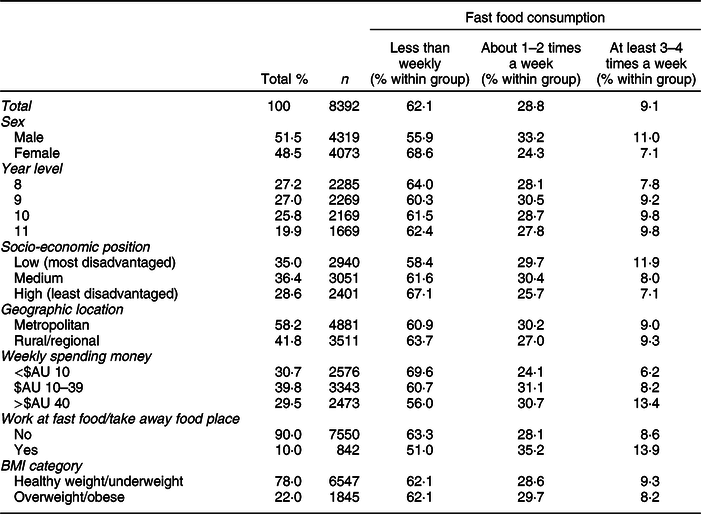
Note: Percentages are rounded so may not sum to 100 %.
Table 2 shows that students were more likely to eat fast food on a weekly basis if they were male (OR = 1·72; 95 % CI: 1·55, 1·91; P < 0·001), from a low (OR = 1·49; 95 % CI: 1·27, 1·75; P < 0·001) or medium (OR = 1·32; 95 % CI: 1·14, 1·52; P < 0·001) SEP neighbourhood (cf. a high SEP neighbourhood), living in a metropolitan location (OR = 1·51; 95 % CI: 1·30, 1·75; P < 0·001), had between $AU 10–39 (OR = 1·53; 95 % CI: 1·35, 1·72; P < 0·001) or at least $AU 40 (OR = 1·69; 95 % CI: 1·47, 1·94; P < 0·001) available in weekly spending money (cf. less than $AU 10) and worked at a fast food/take away food place (OR = 1·60; 95 % CI: 1·35, 1·89; P < 0·001). Being overweight did not significantly increase the odds of students consuming fast food at least weekly (P = 0·174). However, we found independent associations between weekly fast food consumption and six of the seven health behaviours examined. Specifically, students who reported low intake of vegetables (OR = 1·42; 95 % CI: 1·27, 1·59; P < 0·001) and high intake of sugary drinks (OR = 2·45; 95 % CI: 2·17, 2·78; P < 0·001) and snack foods (OR = 2·37; 95 % CI: 2·08, 2·70; P < 0·001) were more likely to eat fast food on a weekly basis, as were students who engaged in low levels of physical activity (OR = 1·24; 95 % CI: 1·12, 1·37; P < 0·001), watched more than 2 h per day of commercial television (OR = 1·53; 95 % CI: 1·38, 1·70; P < 0·001) and slept for less than 8 h on a usual school night (OR = 1·29; 95 % CI: 1·14, 1·44; P < 0·001).
Results from a multilevel logistic regression model examining demographic and behavioural correlates of fast food consumption among Australian secondary school students (n 8284)
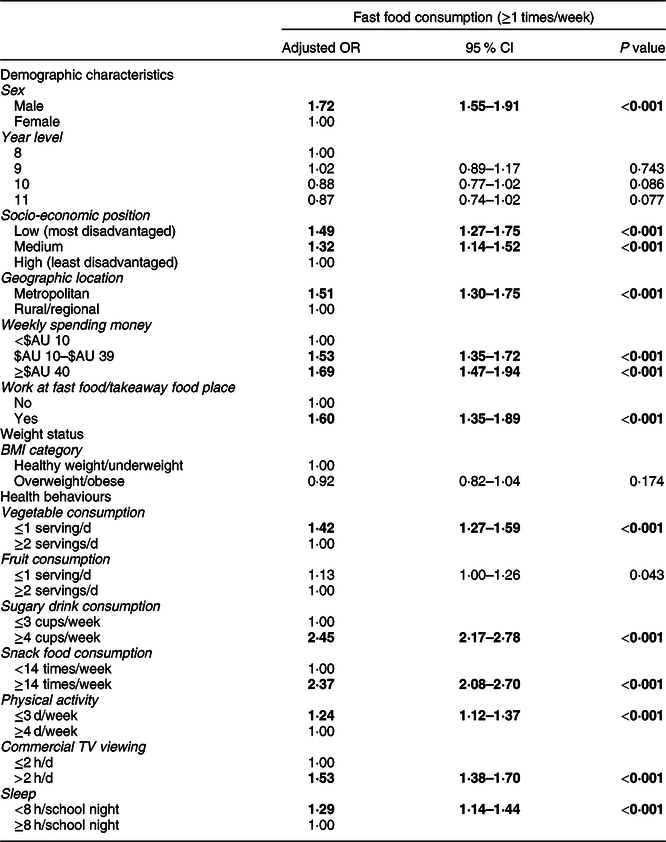
TV, television.
Notes: Bolded results are statistically significant at P < 0·01. ORs are adjusted for all other covariates listed in the table, school-level clustering, state/territory and school type.
Our sensitivity analyses found broadly similar results among the very frequent fast food consumers, with just a few notable exceptions. Compared with students residing in high SEP neighbourhoods, those living in medium SEP neighbourhoods did not have significantly increased risk of consuming fast food at least 3–4 times a week (P = 0·211); nor did students engaging in low levels of physical activity (P = 0·019). We also note the association between fast food consumption and both sugary drink and snack food consumption was stronger among students who reported eating fast food at least 3–4 times a week (see Additional file 1).
Social/environmental influences on fast food consumption
Around half of all students agreed there are fast food/take away outlets near their school (56 %) and where they live (50 %) and that everyone their age eats fast food (55 %). A higher proportion of students agreed they go to fast food outlets with their friends (44 %) than their family (25 %). One in four students believed fast food is good value for money (25 %) and that they choose the low fat or healthy option at fast food outlets if available (24 %). Eighteen percent of students agreed they usually ‘upsize’ at fast food outlets where possible.
As Table 3 highlights, agreement by students that they go to fast food outlets with their family (OR = 2·19; 95 % CI: 1·95, 2·45; P < 0·001) and friends (OR = 1·62; 95 % CI: 1·45, 1·81; P < 0·001) was independently associated with increased odds of consuming fast food at least weekly. Similarly, students were more likely to eat fast food on a weekly basis if they agreed that fast food is good value for money (OR = 1·29; 95 % CI: 1·14, 1·45; P < 0·001) and that, if they can, they usually ‘upsize’ at fast food outlets (OR = 1·57; 95 % CI: 1·37, 1·79; P < 0·001). However, agreeing that they choose the low fat or healthy fast food option was associated with decreased odds of students reporting they eat fast food on a weekly basis (OR = 0·53; 95 % CI: 0·47, 0·60; P < 0·001).
Results from a multilevel logistic regression model examining social/environmental influences associated with fast food consumption among Australian secondary school students (n 8085)

Notes: Bolded results are statistically significant at P < 0·01. ORs are adjusted for all other covariates listed in the table, demographic characteristics, weight status, school-level clustering, state/territory and school type.
Results from our sensitivity analyses showed the same pattern of associations among very frequent fast food consumers (see Additional file 2).
Discussion
The results of the present study indicate 38 % of Australian secondary students surveyed consume fast food at least once a week, a figure comparable to an earlier prospective study of Sydney schoolchildren at ages 12 and 17 years (35 % and 44 %, respectively)(Reference Gopinath, Flood and Burlutsky10). However, a lower estimate (24 %) was reported in a more recent New South Wales school survey(Reference Hardy, Mihrshahi and Drayton19) (most likely due to mandatory kilojoule menu labelling in chain restaurants having been enforced in this state since 2012(38)), while a higher estimate (51 %) was found in an international study of almost 200 000 adolescents from thirty-six countries (although it should be noted their study used a different tool to the current study to measure fast food consumption and there was considerable variation (range: 15 %–79 %) between countries)(Reference Braithwaite, Stewart and Hancox18). We found evidence to suggest demographic sub-groups such as males and those residing in lower SEP neighbourhoods are more likely to be frequent consumers of fast food and that weekly fast food consumption is independently associated with other unhealthy eating (low vegetable intake and high sugary drink and snack food intake) and leisure (low physical activity and higher commercial television viewing) behaviours as well as short sleep duration.
The finding that male adolescents are more likely than female adolescents to eat fast food at least weekly is consistent with previous research from Australia(Reference Gopinath, Flood and Burlutsky10) and overseas(Reference French, Story and Neumark-Sztainer4,Reference Svastisalee, Pagh Pedersen and Schipperijn17) . This pattern may be due to a combination of factors such as boys having higher energy requirements(Reference Gidding, Dennison and Birch39) and stronger preferences for fatty foods(Reference Cooke and Wardle40) and girls moderating their intake of fast food because of higher concern about their weight(Reference Sweeting and West41). Students living in low or medium compared with high SEP areas were at higher risk of being frequent fast food consumers; although our sensitivity analyses only found an effect for the low SEP group among very frequent consumers. Gopinath and colleagues’ Sydney-based prospective study found no temporal associations between parental education or parental employment status at baseline and students eating take away meals once or more per week at the 5-year follow-up(Reference Gopinath, Flood and Burlutsky10). To better explicate the relationship between SEP and adolescent fast food consumption, further studies are needed which include both area- and individual-level socio-economic indicators and explore different categorisations of intake (e.g. at least weekly, ≥3–4 times weekly).
Students living in metropolitan locations were more likely than their rural/regional counterparts to be frequent fast food consumers, possibly reflecting their greater access to fast food outlets. For example, studies conducted in Australia(Reference Thornton, Lamb and Ball42), New Zealand(Reference Pearce, Blakely and Witten43) and the United States(Reference Zenk and Powell44) indicate schools in urban settings are in closer proximity to fast food outlets than schools in regional areas. In line with previous research, we also found that students with higher amounts of weekly spending money were more likely to be frequent fast food consumers(Reference Darling, Reeder and McGee45), as were those who worked part-time at a fast food outlet or take away food place(Reference Jo and Hyun46). A potential explanation for the latter finding is that employers may be incentivising regular fast food consumption through the offer of staff discounts. While fast food outlets play a role in encouraging youth employment – one in ten students we surveyed reported working at such outlets – it is important that working at such establishments does not negatively impact employees’ eating behaviours. Improving the healthiness of foods offered in fast food settings is one strategy that could help minimise this risk.
Frequent fast food consumption and measured weight status were unrelated in our study. As has been postulated by other study authors who have not observed a positive association between fast food consumption and BMI among adolescents(Reference Gopinath, Flood and Burlutsky10,Reference Braithwaite, Stewart and Hancox18) , this finding may be due to students who are overweight under-reporting their fast food eating behaviour or perhaps avoiding fast food as a method of controlling their weight. In addition, there may be differences by weight status in the amount of food students consume when eating at fast food places. For practical reasons, we measured fast food consumption using a self-reported single item question which is subject to social desirability and recall bias and only allowed us to assess frequency of consumption rather than quantify the amounts and types of fast food consumed. More longitudinal studies using rigorous dietary assessment tools (e.g. 24-h recall, FFQ) are needed to determine if and how fast food consumption may contribute to excess weight gain during adolescence.
Concerningly, our study indicates that adolescents who are frequent fast food consumers are also more likely to be engaging in other unhealthy eating behaviours. Previous research undertaken in the United States found past week fast food restaurant use to be positively associated with daily servings of soft drinks and inversely associated with daily servings of fruit and vegetables among a sample of almost 5000 grade 7–12 students(Reference French, Story and Neumark-Sztainer4). Eating take away foods on a weekly basis was also associated with lower mean intake of fruits and vegetables, but not more frequent soft drink consumption, in a prospective study of 699 Sydney schoolchildren(Reference Gopinath, Flood and Burlutsky10). Neither of these studies included consumption of snack foods which was shown to be one of the strongest independent behavioural correlates (along with sugary drinks) of weekly fast food consumption in our study. The apparent clustering of unhealthy eating behaviours among adolescents suggests interventions targeting the diet as a whole, rather than those focusing specifically on limiting fast food consumption, are needed to have a meaningful impact on overall diet quality in this population segment.
Our finding that higher commercial television viewing (>2 h/d) was linked to frequent fast food consumption is not unexpected given fast foods are among the most frequently advertised food products on Australian television(Reference Smithers, Haag and Agnew47). Indeed, there is a large body of evidence on the effects of food marketing on young people’s food preferences, purchases and consumption(Reference Cairns, Angus and Hastings48,Reference Cairns, Angus and Hastings49) . Problematically, the current voluntary self-regulatory advertising codes in Australia are narrow in scope, only applying to children up to 12 or 14 years and not adequately covering all forms of media and promotional strategies (e.g. digital marketing, sport sponsorship)(Reference Hickey, Mandelbaum and Bloom50). Government regulation of fast food marketing and sponsorship that is likely to appeal to children and adolescents in either its content or placement (e.g. during peak television viewing times, on websites and mobile applications such as YouTube, Facebook and Instagram) would provide better protection for young people. The removal of fast food advertising within sport settings may also, importantly, differentially reach male adolescents – who are more likely to be frequent fast food consumers – given their higher participation rates in organised sport(51) and higher attendance rates at sporting events(52).
There was evidence from our study that short sleep duration (<8 h/school night) is associated with adolescent fast food consumption, with this relationship particularly strong among very frequent consumers. In a large cross-sectional survey of American adolescents, short-duration sleepers (defined as <7 h/night) had increased odds of consuming fast food two or more times per week compared with those who reported getting more than 8 h of sleep per night(Reference Kruger, Reither and Peppard11). More broadly, a recent systematic review showed an association between sleep deficiency and unhealthy eating habits in children(Reference Cordova, Barja and Brockmann53). While the direction of causality and interaction of other behaviours such as television viewing time is yet to be established, the growing body of evidence regarding the link between sleep and diet quality(Reference Cordova, Barja and Brockmann53) suggests there is value in encouraging adolescents to get adequate sleep alongside educating them about healthy dietary practices.
The results from our study point to several social/environmental factors that may be particularly important to target when designing interventions to reduce adolescent fast food consumption. Specifically, we found evidence of strong links between going to fast food outlets with family and friends and being a frequent fast food consumer. Students who usually choose to ‘upsize’ at a fast food outlet were also more likely to consume these foods on a weekly basis. Given the appeal of fast food outlets as a social gathering place for adolescents, strategies aimed at creating alternative spaces for young people to safely meet or modifying this food environment by placing restrictions on portion sizes and the sale of ‘value’ meals should be explored. Making unhealthy fast food meals less affordable could be especially effective with very frequent fast food consumers, based on our sensitivity analyses. As might be expected, students who agreed they choose the low fat or healthy option where available were less likely to be a frequent fast food consumer. This suggests that initiatives focused on increasing the number of healthier menu options available or making it easier for consumers to identify healthier options likely need to be implemented alongside policies that address the portion sizes and affordability of unhealthy fast foods to prompt behavioural changes in those adolescents most at risk.
Students’ perceived proximity to fast food outlets where they live was not significantly associated with their frequency of consuming fast food. Students’ fast food consumption was also unrelated to them agreeing there are fast food outlets near their school. This latter finding is consistent with a 2014 systematic review which concluded that there was very limited evidence that the retail food environment around schools influenced school children’s food purchases and consumption(Reference Williams, Scarborough and Matthews54). Interestingly, a US study of over 2700 adolescents examining whether students who live or attend school near higher numbers of fast food restaurants eat more frequently from these places found an effect only for adolescent males living in areas with greater access to fast food restaurants(Reference Forsyth, Wall and Larson55). Their study objectively measured fast food restaurant exposure, whereas our study assessed the perceived environment. Future studies that use both types of measurements would help further elucidate the conditions under which the location of fast food outlets impacts on adolescent consumption of fast food.
Several study limitations should be acknowledged. As a cross-sectional study, we are unable to draw any causal inferences about the observed associations. Also, our analyses are based on self-reported data which is subject to recall and social desirability bias. The school (21 %) and student (53 %) response rates were low, which may have compromised the representativeness of the sample obtained – although as the current study primarily examined associations between variables, a slightly unrepresentative sample is not of major concern. Removing some of the barriers to survey participation for schools, such as the requirement by many education authorities that researchers use active rather than passive parental consent procedures for low risk studies, would improve both school and student participation rates. Finally, due to survey length constraints, we were limited in the range of social/environmental influences on fast food intake that could be assessed. Other factors not explored in the present study but captured in the social ecological model, such as the home food environment and parenting practices, may also play a role in shaping young people’s eating behaviours and should be investigated in future studies.
Conclusion
With few previous studies having examined potential demographic and behavioural correlates of fast food consumption among adolescents, the findings from this large, national survey of Australian secondary school students make an important contribution to the research area. In particular, the apparent clustering of frequent fast food consumption with other unhealthy lifestyle behaviours is concerning and warrants further exploration to understand these complex inter-relationships. Interventions that reach identified at-risk groups are needed to reduce fast food consumption among young people at the population level. Policies placing restrictions on the portion sizes of fast food may also help adolescents limit their intake.
Acknowledgements
Acknowledgements: The authors thank the school principals, teachers and students who participated in the study, and I-view who were responsible for fieldwork co-ordination. Financial support: The NaSSDA survey was jointly funded by state Cancer Councils through Cancer Council Australia, the National Heart Foundation of Australia and the State and Territory Government Health Departments. M.W. is supported by a Principal Research Fellowship from the National Health and Medical Research Council. The funders had no role in the design, analysis or writing of this article. Conflict of interest: None. Authorship: All authors have contributed to the present paper by being involved in conceiving and designing the study or in analysis and interpretation of the data and in writing and revising the paper. Ethics of human subject participation: The NaSSDA study was approved by the Human Research Ethics Committee of Cancer Council Victoria. In addition, approval was obtained from the education authority for each sector in each State and Territory, as well as the principal at each selected school.
Supplementary material
For supplementary material accompanying this paper visit https://doi.org/10.1017/S1368980019004208.



