





This article presents an exploratory written corpus study of a phonological pattern in Uyghur (Turkic; China) whereby a vowel reduction process converts harmonic vowels into transparent vowels, rendering the vowel harmony pattern opaque. Opaque patterns are of interest to phonological theory because of the challenges they pose for learning and for certain classes of phonological models. In particular, opacity has been a persistent difficulty for strictly parallel phonological models such as classical Optimality Theory (Prince & Smolensky [1993] Reference Prince and Smolensky2004), which do not straightforwardly predict its existence.
The article has two primary goals. The first is to put claims about opacity in Uyghur on a stronger empirical footing by presenting new data. Uyghur provides a valuable opportunity to study an opaque pattern at scale using text data, because both vowel reduction and harmony are reflected orthographically. The data show that although opaque harmony is the majority pattern, there is variability in rates of opacity both within and between roots: roots sometimes trigger surface-apparent harmony (McCarthy Reference McCarthy1999).Footnote 1 Rates of opacity are correlated with factors like token frequency and the presence of certain derivational suffixes.
The second goal is to highlight challenges these data pose for standard theories of opacity, which do not predict such variability. I will outline an analysis that is compatible with the data, where observed variation emerges as the result of conflict between lexical knowledge of the harmonising class of a root and sensitivity to surface phonotactic constraints. In addition to accounting for the various correlates of opacity observed in the corpus, this analysis can be implemented in a strictly parallel model using a constraint that mandates paradigm uniformity in the harmony system (Rebrus & Törkenczy Reference Rebrus, Törkenczy, Hulst and Lipták2017, Reference Rebrus and Törkenczy2021; Rebrus et al. Reference Rebrus, Szigetvári, Törkenczy, Elkins, Hayes, Jo and Siah2023). This aligns with previous proposals that lexical factors play a fundamental role in opaque phenomena (Łubowicz Reference Łubowicz2003; Mielke et al. Reference Mielke, Armstrong and Hume2003; Sanders Reference Sanders2003; Green Reference Green2004; Pater Reference Pater and Parker2010; Nazarov Reference Nazarov2019).
§1 provides background on phonological opacity. §2 describes the processes of backness harmony and vowel reduction in Uyghur, and how they interact to produce opacity. §3 presents the results of a large written corpus study looking at rates of opacity. §4 presents an analysis of the corpus data. Finally, §5 discusses implications for theories of opacity in general, some limitations of the work presented here, alternative analyses, and how future research might proceed.
1. Phonological opacity
Opacity is a type of structured phonological exceptionality. Kiparsky (Reference Kiparsky and Dingwall1971, Reference Kiparsky and Fujimura1973) defines it as follows:

Opacity arises when either a conditioned alternation appears not to occur despite its conditions being met, or appears to occur when its conditions have not been met.
Kiparsky (Reference Kiparsky and Fujimura1973) associates opacity of types (1a) and (1b) with counterfeeding and counterbleeding rule orders, respectively. In counterfeeding opacity, the structural conditions for rule $\mathbb {R}$
to apply are created by a different rule
$\mathbb {R}$
to apply are created by a different rule $\mathbb {P}$
that applies after
$\mathbb {P}$
that applies after $\mathbb {R}$
; hence, the necessary conditions are not met when
$\mathbb {R}$
; hence, the necessary conditions are not met when $\mathbb {R}$
applies. Changing the rule ordering such that
$\mathbb {R}$
applies. Changing the rule ordering such that $\mathbb {P}$
applies before
$\mathbb {P}$
applies before $\mathbb {R}$
would produce a feeding order where
$\mathbb {R}$
would produce a feeding order where $\mathbb {R}$
applies transparently to the conditioning environment produced by
$\mathbb {R}$
applies transparently to the conditioning environment produced by $\mathbb {P}$
.
$\mathbb {P}$
.
In counterbleeding opacity, the conditions for $\mathbb {R}$
are met when it applies, but are subsequently altered by a different rule
$\mathbb {R}$
are met when it applies, but are subsequently altered by a different rule $\mathbb {Q}$
that applies after
$\mathbb {Q}$
that applies after $\mathbb {R}$
. Changing the rule ordering such that
$\mathbb {R}$
. Changing the rule ordering such that $\mathbb {Q}$
applies before
$\mathbb {Q}$
applies before $\mathbb {R}$
would produce a bleeding order where
$\mathbb {R}$
would produce a bleeding order where $\mathbb {R}$
transparently fails to apply because
$\mathbb {R}$
transparently fails to apply because $\mathbb {Q}$
removes its conditioning environment.
$\mathbb {Q}$
removes its conditioning environment.
More recently, interest in opacity has stemmed from debates on the merits of serial models such as SPE-style rules (Chomsky & Halle Reference Chomsky and Halle1968) vs. parallel models such as Optimality Theory (Prince & Smolensky [1993] Reference Prince and Smolensky2004). Parallel models have difficulty correctly predicting cases of counterbleeding opacity, which generally produce faithfulness violations with no corresponding markedness repairs to motivate them. They also have difficulty with most types of counterfeeding opacity, which fail to repair a markedness violation whose repair is evident elsewhere.
A number of theoretical mechanisms have been proposed to handle these cases, including mechanisms that incorporate some degree of serialism into OT, such as sympathy (McCarthy Reference McCarthy1999), Stratal OT (Kiparsky Reference Kiparsky2000; Bermúdez-Otero Reference Bermúdez-Otero, Spenader, Eriksson and Dahl2003; Nazarov & Pater Reference Nazarov and Pater2017; Bermúdez-Otero Reference Bermúdez-Otero, Hannahs and Bosch2018), candidate chain theory (McCarthy Reference McCarthy2007) and serial markedness reduction (Jarosz Reference Jarosz, Kingston, Moore-Cantwell, Pater and Staubs2014), as well as purely parallel mechanisms, such as constraint conjunction (Kirchner Reference Kirchner1996), paradigm uniformity (Steriade Reference Steriade, Broe and Pierrehumbert2000), language-specific constraints (Pater Reference Pater2014) or indexed constraints (Pater Reference Pater and Parker2010; Nazarov Reference Nazarov2019, Reference Nazarov, Baek, Takahashi and Yeung2020, Reference Nazarov, Ettinger, Pavlick and Prickett2021). The need for such bespoke mechanisms has been seen as a point in favour of serial models, which handle these cases of opacity without issue (e.g., Vaux Reference Vaux, Vaux and Nevins2008).
Although counterfeeding and counterbleeding orderings are the best known configurations that result in opacity, the typologies of opacity enumerated in Baković (Reference Baković2007, Reference Baković, Goldsmith, Riggle and Yu2011) and Baković & Blumenfeld (Reference Baković and Blumenfeld2019) show that these orderings are neither sufficient nor necessary conditions for opacity. They identify a number of cases of overapplication opacity that are not predicted by SPE-style rule ordering, and some which are only able to be described by parallel models. Thus, the characterisation of opacity as a unique challenge for parallel models is a simplification, though accurate in broad strokes.
In light of the lack of a unified account of opacity from either serial or parallel theories, Baković (Reference Baković2007) suggests that the field focus on Kiparsky’s claim that opaque patterns are more difficult to learn than transparent ones. The basic motivation for this claim is that phonological processes that interact in an opaque fashion make it difficult to generalise about these processes: opaque forms constitute exceptions to otherwise robust generalisations. Kiparsky (Reference Kiparsky and Dingwall1971) supports this claim by presenting a number of cases of historical change where an opaque process is reanalysed as a non-opaque one.
Subsequent research has presented evidence that opaque processes are learned as phonemic contrasts or lexicalised patterns rather than productive rules (e.g., Hooper Reference Hooper1976; Mielke et al. Reference Mielke, Armstrong and Hume2003; Sanders Reference Sanders2003; Sumner Reference Sumner2003; Bowers Reference Bowers2019; Zhang Reference Zhang2019), though evidence also exists that some opaque processes are applied productively in language games and other contexts (e.g., Donegan & Stampe Reference Donegan, Stampe and Dinnsen1979; Al-Mozainy Reference Al-Mozainy1981; Vaux Reference Vaux, Goldsmith, Riggle and Yu2011) as well as in behavioural experiments (Farris-Trimble & Tessier Reference Farris-Trimble and Tessier2019).
2. Opacity in Uyghur backness harmony
Uyghur is a southeastern Turkic language spoken by over 12 million people in the Xinjiang Uyghur Autonomous Region in the People’s Republic of China, neighbouring countries, such as Kazakhstan and Kyrgyzstan, and various diasporic communities (Engesæth et al. Reference Engesæth, Yakup and Dwyer2010; Nazarova & Niyaz Reference Nazarova and Niyaz2013). It has SOV word order with highly agglutinative morphology that is almost exclusively suffixing.
The opaque phenomenon under consideration arises from the interaction of two independent processes: backness harmony and vowel reduction. I will introduce these processes separately before demonstrating how their interaction leads to opacity. The reader is referred to Mayer et al. (Reference Mayer, McCollum and Eziz2022b) for a more detailed description of Uyghur phonology.
2.1. Segments involved in backness harmony
Like most Turkic languages, Uyghur has backness harmony (Lindblad Reference Lindblad1990; Hahn Reference Hahn, Boltz and Shapiro1991a, Reference Hahnb; Abdulla et al. Reference Abdulla, Ebeydulla and Raxman2010; Engesæth et al. Reference Engesæth, Yakup and Dwyer2010). Harmony is most evident in alternations between suffix allomorphs, where, broadly speaking, segments in the suffix must agree in backness with the rightmost vowel of the roots they attach to. It may also be observed to a lesser extent in static root forms (particularly native Turkic roots), but extensive borrowing has led to many disharmonic roots.
Segments that participate in backness harmony are shown in Table 1. The underlined vowels in Table 1a act as harmony triggers (i.e., they determine the backness of suffixes attached to roots containing them), while the non-underlined vowels are transparent to harmony. The harmonising consonants in Table 1b may also serve as harmony triggers, though they tend to be weaker than vowels. This article will focus primarily on harmony driven by vowels. In addition to serving as triggers of harmony, the harmonising vowels and consonants both emerge as the outcome of harmony in harmonising suffixes.
Harmonising segments in Uyghur

2.2. A description of Uyghur backness harmony
The examples of harmony below include the locative suffix /-DA/ (surface forms: [-tɑ], [-dɑ], [-tæ] and [-dæ]), the plural suffix /-lAr/ (surface forms: [-lɑr] and [-lær]), or the dative suffix /-GA/ (surface forms: [-qɑ], [-ʁɑ], [-kæ] and [-gæ]). I assume that /A/ is unspecified for the feature [back], /D/ for [voice] and /G/ for both (Archangeli Reference Archangeli1988). Voicing alternations in the initial segment are caused by voice assimilation, and are orthogonal to harmony.
The basic characterisation of backness harmony is that suffixes must agree in backness with the rightmost harmonising root vowel, front /y ø æ/ or back /u o ɑ/.


The vowels /i e/ are transparent to harmony. They do not serve as harmony triggers, but allow the harmonic value of preceding segments to ‘pass through’ them.


Roots without any harmonising segments typically take back suffixes, but some take front suffixes (see McCollum Reference McCollum2021; Mayer et al. Reference Mayer, Major, Yakup, Jurgec, Duncan, Elfner, Kang, Kochetov, O’Neill, Ozburn, Rice, Sanders, Schertz, Shaftoe and Sullivan2022a).


Back suffixes appear to be the unmarked class in Uyghur. There has been a general diachronic shift in the population of neutral roots towards back suffixes (Lindblad Reference Lindblad1990), and recent loanwords that lack harmonising segments typically take back suffixes (Mayer et al. Reference Mayer, McCollum and Eziz2022b).
2.3. Vowel reduction
The second process that contributes to opacity in the Uyghur harmony system is vowel reduction or raising, which raises the low vowels /ɑ æ/ to [i] in medial open syllables in derived environments.Footnote 2


The underlying form cannot in general be predicted from forms where vowel reduction could have applied, as many words have underlying /i/ in these positions, as in /tɑksi/ ‘taxi’ or /æsli/ ‘origin’. Certain roots resist raising categorically, particularly loanwords where the final vowel was long in the source language (Nazarova & Niyaz Reference Nazarova and Niyaz2013); in the current article, I focus on roots that undergo raising.
2.4. Opaque interactions between backness harmony and vowel reduction
Vowel reduction has the potential to introduce opaque behaviour into the vowel harmony system. Consider, for example, the root /ɑʁinæ/ ‘friend’. The final vowel undergoes raising when it occurs in a derived word-medial open syllable:

What happens when the vowel in the suffix must harmonise with the final vowel in the root, like in the form /ɑʁinæ-DA/ ‘friend-loc’? There are two possibilities: opaque harmony, according to the underlying form of the root, and surface-apparent harmony, according to the raised form of the root. We will set aside for a moment the question of which of these we actually see in Uyghur, and briefly explore some theoretical consequences of each realisation.
A rule ordering where harmony precedes raising predicts the opaque form [ɑʁinidæ]:

This opacity is precisely the kind that classical OT has difficulty accounting for: there is an explicit markedness violation (failure to harmonise), with no apparent motivation (cf. forms like /tɑksi-DA/ $\to $
[tɑksidɑ] ‘taxi-loc’).
$\to $
[tɑksidɑ] ‘taxi-loc’).
If raising instead precedes backness harmony, we would expect the form [ɑʁini-dɑ] with surface-apparent harmony:

This outcome can be predicted by both serial and parallel models.
2.5. Modelling opacity in serial and parallel models
The kind of opacity shown in (11) is straightforward to represent in serial rule-based models: the rule that drives harmony is simply ordered before the rule that drives raising. An analysis under such a model is fundamentally identical to the derivation in (11).
This pattern poses challenges for an analysis in classical OT. I will assume a simple markedness constraint that motivates vowel harmony, which is a combination of the local and non-local Agree constraints used by Hayes et al. (Reference Hayes, Zuraw, Siptar and Londe2009):

The following constraints will drive raising:


*Unreduced is shorthand for a more detailed analysis of the pressures that drive vowel reduction (for vowel reduction in general, see Crosswhite Reference Crosswhite2001 and de Lacy Reference de Lacy2002; for vowel reduction in Uyghur, see McCollum Reference McCollum, Baek, Takahashi and Yeung2020 and Mayer Reference Mayer2021b: Appendix E).
When it is relevant, I will also employ a constraint that prevents specified [back] values from being altered:

ID[back] prevents underlyingly specified vowels in roots and certain harmony-blocking suffixes from being altered. This constraint is not violated when a segment underspecified for backness in the input is assigned a backness value in the output, nor is it violated when /æ ɑ/ are raised to [i]: assuming that [i] is unspecified for backness, these processes violate Dep and Max constraints, respectively, which are low-ranked and omitted from the tableaux below.
These constraints allow Classical OT to derive only surface harmony, as shown in (17), where the sad face indicates the candidate that should have won, and the bomb indicates the candidate that does win. Suppose that we want to derive opaque harmony for the suffixed form /ɑʔilæ-lAr/ ‘family-pl’. The desired candidate [ɑʔili-lær] is harmonically bounded by the winning *[ɑʔili-lɑr], and so will never be the optimal candidate under any ranking.

An analysis using Stratal OT succeeds in capturing this opacity (Kiparsky Reference Kiparsky2000; Bermúdez-Otero Reference Bermúdez-Otero, Spenader, Eriksson and Dahl2003, Reference Bermúdez-Otero, Hannahs and Bosch2018). Stratal OT divides the grammar into several strata (e.g., the stem, the word and the phrase) and assigns each of these levels a separate OT grammar with differing constraint rankings. The outputs of lower strata serve as the inputs to higher strata. We can capture the opaque pattern here by proposing that vowel harmony occurs at a lower stratum than vowel reduction, as in (18). At the word stratum, shown in (18a), the constraint driving raising is ranked below its corresponding faithfulness constraint, meaning harmony applies but raising does not. The output from the word stratum serves as the input to the tableau for the phrase stratum in (18b). At this stratum, the constraint driving raising is now ranked above its corresponding faithfulness constraint, meaning raising can apply.

I employ this formalism here because it is widely used in the contemporary literature, and because there is evidence in Uyghur that raising can apply at the level of the phrase, suggesting that it belongs to a higher stratum than backness harmony (specifically, it appears to be a post-lexical process; Kiparsky Reference Kiparsky1982). For example, in phrases like Adil Hesenge berdi ‘Adil gave it to Hesen’, the dative -ge [-gæ] may raise to -gi [-gi] in rapid speech (Hahn Reference Hahn1991b: 53).
To summarise, rule-based analyses predict opaque harmony straightforwardly, while strictly parallel analyses predict only surface-apparent harmony. Modifications to strictly parallel models that incorporate some degree of serialism, such as those listed in §2.1, also predict opaque harmony, though they differ in their attribution of the particular mechanism responsible for it. For example, while Stratal OT captures opaque patterns by positing multiple derivational strata with different constraint rankings, candidate chain theory (McCarthy Reference McCarthy2007) does so by evaluating candidate chains (roughly analogous to derivations) rather than candidates.
2.6. Past work on opacity in Uyghur
Which of these patterns do we observe in Uyghur? Pedagogical materials do not generally discuss these cases in any detail, since roots that can generate opaque harmony are a relatively small slice of the lexicon. Those that do discuss them suggest that opacity is the correct outcome (e.g., Hahn Reference Hahn1991b: §4.3.5). Hahn describes this in terms of roots falling into a particular ‘harmonic category’, with vowel reduction processes ‘disguising’ the most salient clue to this category: the final vowel of the root.
As is typical for opaque phenomena (Kiparsky Reference Kiparsky and Dingwall1971, Reference Kiparsky and Fujimura1973; Mielke et al. Reference Mielke, Armstrong and Hume2003), the rule ordering that produces opaque harmony reflects the relative diachronic development of each process. Backness harmony is an ancient property of Turkic languages (e.g., Clauson Reference Clauson1972), while raising is a newer phenomenon in Uyghur; Chagatay, the closest direct ancestor to Uyghur, appears to have had no such raising process (Bodrogligeti Reference Bodrogligeti2001). Opaque harmony thus maintains historical patterns of root backness at the cost of surface disharmony.
The exception to this is that certain derivational suffixes in Uyghur, such as the diminutive  and the adjectival suffix
  , have been described as triggering surface-apparent harmony in raised forms (Hahn Reference Hahn1991b; Halle et al. Reference Halle, Vaux and Wolfe2000; Vaux Reference Vaux2000; Hall & Ozburn Reference Hall and Ozburn2019):Footnote
3
, have been described as triggering surface-apparent harmony in raised forms (Hahn Reference Hahn1991b; Halle et al. Reference Halle, Vaux and Wolfe2000; Vaux Reference Vaux2000; Hall & Ozburn Reference Hall and Ozburn2019):Footnote
3

We will return to these suffixes below.
Uyghur speakers I have worked with agree that opaque harmony is the correct outcome. However, in addition to the suffixes above, speakers have identified certain forms where surface-apparent harmony is mandatory (e.g.,  $\to $
[ærzinigæ] ‘cheap (ones)-3.poss-dat’), or where both surface-apparent and opaque harmony are acceptable (e.g.,
$\to $
[ærzinigæ] ‘cheap (ones)-3.poss-dat’), or where both surface-apparent and opaque harmony are acceptable (e.g.,  $\to $
[æziniʁɑ]/[æzinigæ] ‘call to prayer-3.poss-dat’). These forms demonstrate that although opaque harmony occurs in the vast majority of cases, we cannot always predict whether a root or stem will trigger surface-apparent or opaque harmony. These few elicited observations of variability were one of the motivations for the corpus study presented below.
$\to $
[æziniʁɑ]/[æzinigæ] ‘call to prayer-3.poss-dat’). These forms demonstrate that although opaque harmony occurs in the vast majority of cases, we cannot always predict whether a root or stem will trigger surface-apparent or opaque harmony. These few elicited observations of variability were one of the motivations for the corpus study presented below.
Theoretical work on the interaction between vowel reduction and harmony has claimed that there is an asymmetry between vowels (Halle et al. Reference Halle, Vaux and Wolfe2000; Vaux Reference Vaux2000; Hall & Ozburn Reference Hall and Ozburn2019): raised /æ/ is opaque and continues to behave as a front vowel trigger (with the suffixes above constituting notable exceptions), while raised /ɑ/ is transparent, behaving identically to underlying /i/. However, these claims have been based on only eight data points collected from a single speaker, and the empirical validity of these data is unclear (see Mayer Reference Mayer2021b: §3.3.7). One of the main goals of this article is to put claims about opacity in Uyghur on a stronger empirical footing.
In addition to answering an important empirical question, obtaining a better understanding of this pattern is valuable from a theoretical perspective: opaque patterns, such as the one in (11), are not predicted to exist by many strictly parallel phonological models, and, indeed, the Uyghur pattern has been used to argue in favour of serial models (Vaux Reference Vaux2000). The remainder of this article will present a large-scale corpus study that examines the empirical facts of opacity in Uyghur and explore some of the theoretical implications of its results.
3. A corpus study of opacity in Uyghur backness harmony
In order to investigate the interaction of vowel reduction and backness harmony, I performed a corpus study using three large text corpora.Footnote 4
Uyghur uses three different orthographies depending on where it is written: Perso-Arabic, Cyrillic or Latin. In each of these, the alternations conditioned by the raising and harmony processes are represented orthographically.Footnote 5 Hence, text corpora allow us to gather large-scale empirical data on their interaction.
The first corpus was generated from the Uyghur-language Web site of Radio Free Asia (RFA; https://www.rfa.org/uyghur/). RFA is a U.S.-sponsored non-profit news organisation. The second was generated from the Web site of Uyghur Awazi (Uyghur Voice; https://uyguravazi.kazgazeta.kz/), an Uyghur-language newspaper published in Almaty, Kazakhstan. The third was generated from Uyghur Akadémiyisi (Uyghur Academy; https://www.akademiye.org/ug/), a legal research organisation that publishes articles on Uyghur culture and politics.
Corpora were generated from the Web sites using Web scrapers – software that, given a starting URL, instructions for how to navigate between pages, and instructions for which information to retrieve from each page, can download content from all pages on a site, or multiple sites. Such programs allow corpora to be generated from publicly available Internet resources, in formats that are useful to researchers.
There are separate Web scrapers for each of the Web sites, which are linked in the GitHub repository for this article (see fn. 3). These scrapers were written by undergraduate research assistants at the Los Angeles and Irvine campuses of the University of California, in collaboration with the author.
A summary of the contents of each corpus is shown in Table 2.Footnote 6 In addition to the contents of each article, the scrapers retrieved the author, the date and the URL.
Summary of corpora

3.1. Parsing the corpora
In order to extract information about the interaction between backness harmony and vowel reduction from the corpus, I modified an existing Uyghur morphological transducer to detect the backness of suffix forms (https://github.com/apertium/apertium-uig; Littell et al. Reference Littell, Tian, Ruochen, Sheikh, Mortensen, Levin, Tyers, Hayashi, Horwood, Sloto, Tagtow, Black, Yang, Mitamura and Hovy2018; Washington et al. Reference Washington, Salimzianov, Tyers, Gökirmak, Ivanova, Kuyrukçu and Kubedinova2019). This transducer is part of Apertium, a free and open-source rule-based machine translation platform (https://www.apertium.org).
The transducer maps from surface forms to underlying analyses that consist of roots plus morphological tags indicating the backness of any harmonising suffixes. For example, if the input is the surface form qizingizgha ‘to your daughter’, the output analysis will be  . This indicates that the root is qiz, a noun
  , and that it is suffixed with the second person singular possessive marker in its formal form -ingiz
  ,Footnote
7
followed by the dative suffix in its back form -gha
,Footnote
7
followed by the dative suffix in its back form -gha  .
.
The output of the transducer was used to count the frequency of front or back suffixes for each root. Words for which the transducer was unable to produce a valid parse were excluded from analysis. Simple text processing comparing the parsed root and surface forms was used to detect whether vowel reduction occurred and to extract phonotactic properties of the roots and tokens.
Additional details of the transducer and data processing, including numerical validation, are presented in Appendix A.
3.2. Quantitative results
3.2.1. Comparing harmonic and disharmonic roots
In this section, I consider only tokens where (a) the rightmost two harmonising elements of the root are vowels; (b) the underlying final vowel in the root is either /æ/ or /ɑ/; (c) the final vowel undergoes raising; and (d) the raised vowel is followed by at least one harmonising suffix. The rightmost two harmonising vowels were chosen as the domain of analysis because the rightmost harmonising vowel in a stem almost invariably predicts suffix backness (see Mayer Reference Mayer2021b: ch. 4). When this vowel is reduced to transparent [i], the second-rightmost harmonising vowel has the potential to influence suffix backness. The effect of any preceding harmonising vowels on suffix backness appears to be negligible.
Figure 1 breaks down parsed roots into four classes according to their rightmost two harmonising vowels: two back vowels (BB; 774 roots; e.g., /bɑlɑ/ ‘child’, /mɑʃinɑ/ ‘vehicle, machine’), a back vowel followed by a front vowel (BF; 311 roots; e.g., /ɑdæt/ ‘custom’, /ɑʔilæ/ ‘family’), a front vowel followed by a back vowel (FB; 7 roots; e.g., /ærzɑn/ ‘cheap’, /kæsipdɑʃ/ ‘colleague’), and two front vowels (FF; 528 roots; e.g., /sypæt/ ‘quality’, /mæsilæ/ ‘problem’). The BF and FB classes have the potential to produce opaque harmony.
Suffix harmony choice in tokens where the final root vowel raises, broken down by root class. Token counts are overlaid on each category.

The FB class has very few roots and tokens compared to the others. Roots with this shape are relatively uncommon, and those that do exist tend not to undergo raising.Footnote
8
Figure 2 breaks down BF roots and FB roots by their individual rates of front vs. back suffixes. In both cases, we see that roots are typically categorical in whether they take back or front suffixes, while a smaller number ( $n=101$
) show variation between the two (see Zuraw Reference Zuraw2016).
$n=101$
) show variation between the two (see Zuraw Reference Zuraw2016).
Histograms showing the distribution of rates of back suffix application in BF and FB roots. Note that for raised BF roots, a back suffix constitutes surface-apparent harmony and a front suffix constitutes opaque harmony, while for raised FB roots, it is the opposite.

For an example of such variation, consider the root idare  ‘office, bureau’. When used with the auxiliary verb qilmaq ‘do’, it can also mean ‘to rule’ or ‘to govern’. This root has an overall frequency in the corpora of 1,122 per million words and occurs in its raised form idari [idɑri] in 74
 % of tokens. The high frequency of the raised allomorph is likely due to the contexts in which this word tends to be used: since it’s common to talk about an office relating to a person or entity, the root is often realised with the 3.poss suffix [-si], as in ürümchi sayaset idarisi
‘Ürümchi Tourism Office’. When it occurs in its raised form with a harmonising suffix attached, it displays opaque harmony in about 89
% of tokens. The high frequency of the raised allomorph is likely due to the contexts in which this word tends to be used: since it’s common to talk about an office relating to a person or entity, the root is often realised with the 3.poss suffix [-si], as in ürümchi sayaset idarisi
‘Ürümchi Tourism Office’. When it occurs in its raised form with a harmonising suffix attached, it displays opaque harmony in about 89 % of cases (913 tokens) and surface-apparent harmony in about 11
 % of cases (113 tokens). The examples in (20) show tokens of
  from the RFA corpus in its unsuffixed form in (20a), with opaque harmony in (20b), and with surface-apparent harmony in (20c).

Because the final two vowels in BB and FF roots agree in backness, opaque harmony and surface harmony predict the same surface form. These roots almost categorically take the expected suffix forms.Footnote
9
Disharmonic FB and BF roots behave similarly to BB and FF roots, respectively, but both show higher rates of surface-apparent harmony. Chi-squared tests show significantly different rates of back suffix choice between BB and FB roots (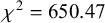 $\chi ^2 = 650.47$
;
$\chi ^2 = 650.47$
; $\mathrm {d.f.}=1$
;
$\mathrm {d.f.}=1$
; $p < 0.0001$
) and between FF and BF roots (
$p < 0.0001$
) and between FF and BF roots (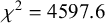 $\chi ^2 = 4597.6$
;
$\chi ^2 = 4597.6$
; $\mathrm {d.f.}=1$
;
$\mathrm {d.f.}=1$
; $p < 0.0001$
). Thus, the quality of the harmonising vowel preceding the raised vowel, and not just the underlying quality of the raised vowel, affects suffix choice: when the backness of the preceding vowel conflicts with the backness of the raised vowel, the suffix is more likely to agree with the preceding vowel.
$p < 0.0001$
). Thus, the quality of the harmonising vowel preceding the raised vowel, and not just the underlying quality of the raised vowel, affects suffix choice: when the backness of the preceding vowel conflicts with the backness of the raised vowel, the suffix is more likely to agree with the preceding vowel.
3.2.2. Opacity in derivational suffixes
Recall that previous work on opacity in Uyghur has suggested that certain derivational suffixes like the dimunitive  and the adjectival suffix
  behave idiosyncratically, preferring surface-apparent harmony. Manual inspection of the corpus data revealed a similar pattern for the suffix
  ‘writings of’ (as in /bɑburnɑmæ/ ‘the writings of Babur’). Figure 3 breaks down harmony rates in the set of BF roots by suffix.Footnote
10
The suffix
‘writings of’ (as in /bɑburnɑmæ/ ‘the writings of Babur’). Figure 3 breaks down harmony rates in the set of BF roots by suffix.Footnote
10
The suffix  rarely displays opaque harmony, aligning with observations made in the literature.
  and
and  display higher rates of opaque harmony, but not as high as the general population of BF roots.
Suffix choice in raised BF roots broken down by root-final derivational suffix. ‘Other BF’ refers to BF roots that do not end in one of the three derivational suffixes. Token counts are overlaid on each category. The tokens of  included here all have a preceding B vowel, as in
  ‘park’.

3.3. Predicting opacity
In order to identify potential factors that contribute to rates of opacity, I fitted a Bayesian mixed-effects logistic regression model to the set of raised BF and FB tokens with at least one harmonising suffix attached (for discussion of the use of logistic regression in modelling categorical corpus data, see Speelman Reference Speelman, Glynn and Robinson2014). This is a proper subset of the tokens described in the previous section, omitting the BB and FF roots. The model was fitted in R (R Core Team 2017) using the brms package (Bürkner Reference Bürkner2017).
Bayesian models treat the statistical parameters of the model as random variables and use sampling techniques to estimate the posterior distribution over parameter values given the observed data and prior beliefs about credible parameter values (see, e.g., Kruschke Reference Kruschke2014; Nicenboim & Vasishth Reference Nicenboim and Vasishth2016). The model here uses the default, weakly informative priors.
A Bayesian analysis is used for two reasons. First, the equivalent frequentist model often fails to converge with the random effects structure used here. Second, large sample sizes can lead to significant p-values for trivially small effects (e.g., Lin et al. Reference Lin, Lucas and Shmueli2013). I focus accordingly on reporting effect sizes: that is, the values of the coefficients of the fitted model. In addition to point estimates of these coefficients, Bayesian models also provide interpretable estimates of the range of credible values.Footnote 11
The dependent variable was coded as either opaque harmony (1) or surface-apparent harmony (0). An opaque response was defined as a back suffix attached to a raised FB root, or a front suffix attached to a raised BF root.
The independent variables were selected based on previous work on Uyghur or other languages with similar vowel harmony systems:
-
• The log token frequency of the root in the corpora, normalised to count per million words. This was included as a predictor because frequency is often an important driver of phonological variability (e.g., Coetzee & Kawahara Reference Coetzee and Kawahara2012; Coetzee Reference Coetzee2016).
-
• The proportion of tokens of the root that are raised. This is defined as the number of tokens of a root containing the raised allomorph divided by the total number of tokens of that root.
For example, the root
 ‘disaster’ occurs 1,719 times in the corpus. Of these tokens, 544 are in forms that exhibit raising (e.g., [ɑpit-i] ‘disaster-3.poss’) and 1,175 are in unraised forms (e.g., [ɑpæt-lær] ‘disaster-pl’). Thus, the proportion of raised tokens for this root is
$544/1,719 = 0.32$
.
‘disaster’ occurs 1,719 times in the corpus. Of these tokens, 544 are in forms that exhibit raising (e.g., [ɑpit-i] ‘disaster-3.poss’) and 1,175 are in unraised forms (e.g., [ɑpæt-lær] ‘disaster-pl’). Thus, the proportion of raised tokens for this root is
$544/1,719 = 0.32$
.This variable was included based on the observation by Hahn (Reference Hahn1991b) that raised forms obscure the harmonic class of a root (i.e., whether it takes front or back suffixes). That is, unraised tokens provide evidence of the harmonic class of the root in the form of the final vowel, while raised tokens (particularly those with non-harmonising suffixes) do not.
-
• The identity of the underlying raised vowel (F or B). This allows us to test the proposal that raised
is more likely to display surface-apparent harmony than raised (Vaux Reference Vaux2000). -
• The distance between the rightmost two harmonising root vowels, counted in segments. Previous work on Uyghur (Mayer Reference Mayer, Ettinger, Pavlick and Prickett2021a) and languages with similar harmony systems (Hayes et al. Reference Hayes, Zuraw, Siptar and Londe2009; Rebrus & Törkenczy Reference Rebrus, Törkenczy, Hulst and Lipták2017, Reference Rebrus and Törkenczy2021) suggests that the influence of a vocalic harmony trigger in the root decreases as greater numbers of transparent segments intervene between it and the following suffix. In a root like /ɑpæt/ ‘disaster’, this distance is 1; in /pɑʔɑlijæt/ ‘activity’, it is 3.
-
• The distance between the root and the first harmonising suffix. This is calculated as the number of morphological tags between the final tag of the root and the tag of the first harmonising suffix. For example, /ɑpæt-i-GA/ ‘disaster-3.poss-dat’ has a distance of 1 (the non-harmonising 3.poss intervenes between the root and the harmonising dat); /ɑpæt-GA/ ‘disaster-dat’ has a distance of 0. Rebrus & Törkenczy (Reference Rebrus, Törkenczy, Hulst and Lipták2017, Reference Rebrus and Törkenczy2021) found no influence of this factor on harmonising behaviour in Hungarian.
-
• Whether the root ends in one of the three derivational suffixes discussed above. This was operationalised as three dummy-coded variables that took the value 1 if the root ends in
, and , respectively, and 0 if not.
 ‘disaster’ occurs 1,719 times in the corpus. Of these tokens, 544 are in forms that exhibit raising (e.g., [ɑpit-i] ‘disaster-
 is more likely to display surface-apparent harmony than raised
  (Vaux
(Vaux  ,
,  and
and  , respectively, and 0 if not.
Random intercepts were defined for:
-
• A nested effect of author within corpus. This controls for different rates of opacity across sources and individual writers.Footnote 12 A nested effect is used because authors are unique within corpora.
-
• Root identity. This controls for the idiosyncratic tendencies of roots that are not captured by the dependent variables.
The results shown in Table 3 show two common summary statistics for the coefficients in Bayesian models:Footnote
13
the mean, or most credible, value of each coefficient, and the 95 % credible interval (95
 % CI), which is the range in which the central 95
 % of the sampled coefficient values fall given the model and data set. Expressed in slightly different terms, the 95
 % CI tells us that the model estimates that there is a 95
 % chance that the true value of this parameter falls within this range, given the data. A 95
 % CI that does not include zero is interpreted as meaningful, since it indicates that the directionality of the effect is highly credible. In addition, the 95
 % CI provides a measurement of uncertainty about the effect size. See Appendix B for more details on the model.
Results from a mixed-effects logistic regression model whose coefficients were estimated using Bayesian inference. The 95\% credible interval shows the central range in which 95 % of the sample values occur. Credible intervals that do not contain zero are interpreted as a meaningful directional effect, and are marked with *

These results suggest several frequency-related influences on opacity rates: more frequent roots are more likely to harmonise opaquely, but roots that frequently occur in their raised forms, where the underlying identity of the final vowel is obscured, are less likely to harmonise opaquely.
There are also phonological contributions. The model shows that the underlying identity of the raised vowel is a significant predictor of opaque harmony, with underlying back vowels being less likely to harmonise opaquely (roughly aligning with the claims in Vaux Reference Vaux2000). The distance between the rightmost two harmonising vowels in the root is also positively correlated with rates of opacity: as the disharmonic vowel in the root becomes further from the suffix, its influence decreases.
Finally, there is also evidence for morphological influences on opacity rates. The three derivational suffixes described above each produce greater rates of surface-apparent harmony than are seen in the general population of roots, and the specific rates vary between suffixes.
The number of non-harmonic suffixes directly between a root and the closest harmonic suffix was correlated with more surface-apparent harmony, which is unexpected given results from Rebrus & Törkenczy (Reference Rebrus, Törkenczy, Hulst and Lipták2017, Reference Rebrus and Törkenczy2021). Because the majority of roots that can generate opacity are BF roots, this tendency might reflect an increased preference for the use of the default back suffix forms as distance between root and harmonising suffix increases.
4. An analysis of opacity in the corpus
Given the quantitative results described above, a model of opacity in Uyghur that is descriptively adequate (in the sense articulated by Chomsky Reference Chomsky1965) should be able to account for the following properties:
-
• The majority of raised tokens harmonise opaquely, but cases of surface-apparent harmony also exist.
-
• The rate of opaque harmony varies across roots. This variation is correlated with a number of phonological and morphological factors, as well as frequency.
In this section, I will outline a simple parallel model that can account for these factors.
4.1. Phonological and lexical effects in backness harmony
Backness harmony is typically treated as driven by surface phonological constraints (e.g., van der Hulst Reference van der Hulst and Aronoff2016): whether a root takes front or back suffix allomorphs depends on which variant will minimise resulting surface disharmony by some criteria, as in the simple model presented in §2.5. I will refer to this as the phonological component of backness harmony.
There are cases in Uyghur, however, where surface phonological properties are not sufficient to determine harmonising behaviour (see Mayer et al. Reference Mayer, McCollum and Eziz2022b for a more detailed description). For example, the pair of words  ‘secret’ and
  ‘one’ are nearly identical; however,
  takes back suffixes (e.g., [sir-lɑr] ‘secret-pl’), while
  takes front suffixes (e.g., [bir-gæ] ‘one-dat’). Whether such roots take front or back suffixes cannot be predicted from their acoustic properties (Mayer et al. Reference Mayer, Major, Yakup, Jurgec, Duncan, Elfner, Kang, Kochetov, O’Neill, Ozburn, Rice, Sanders, Schertz, Shaftoe and Sullivan2022a). Similarly, while the majority of roots that contain no harmonising vowels and a velar consonant /k g/ take front suffixes (e.g., [kir-gæ] ‘dirt-dat’), a smaller number take back suffixes (e.g., [gips-qɑ] ‘plaster-dat’).
Hayes (Reference Hayes2016) uses the term zones of variation to describe similar roots in Hungarian. Because their harmonic class is at best partially predictable from phonological properties, speakers disproportionately rely on lexical knowledge: that  takes back suffixes while
  takes front suffixes must simply be memorised as a fact about each root. I will refer to this as the lexical component of backness harmony. A consequence is that such roots typically display higher degrees of variability in suffix choice, particularly in wug tests, where lexical knowledge is absent.
The effect of lexical information on backness harmony systems has been analysed on the basis of Harmonic Uniformity (Rebrus & Törkenczy Reference Rebrus, Törkenczy, Hulst and Lipták2017, Reference Rebrus and Törkenczy2021; Rebrus et al. Reference Rebrus, Szigetvári, Törkenczy, Elkins, Hayes, Jo and Siah2023). This is a paradigm uniformity constraint which requires that the harmonic class of a root remain consistent across its extended paradigm (see, e.g., Steriade Reference Steriade, Broe and Pierrehumbert2000 for more on paradigm uniformity). This constraint can override phonological processes that might otherwise apply. Rebrus and colleagues have provided evidence for this constraint on the basis of a variety of phenomena in the Hungarian backness harmony system. Here, we will focus on one particular consequence of Harmonic Uniformity: the harmonic class of a root should be consistent across its suffixed forms. That is, the same root should not take back forms of one harmonising suffix and front forms of another.
Speakers learn the lexical and phonological components of phonological systems simultaneously (Zuraw Reference Zuraw2000, Reference Zuraw2010). In the vast majority of cases in Uyghur and Hungarian backness harmony, these components favour the same suffix choices. In a smaller number of cases, such as the zones of variation described above, the phonological component is less informative and lexical knowledge plays a larger role. The opaque forms discussed in this article are cases where the phonological and lexical components actively conflict: in a case like  ‘disaster-3.poss-dat’, the phonological component favours [ɑpitiʁɑ] because it displays surface-apparent harmony, while the lexical component favours the disharmonic [ɑpitigæ] because it is consistent with the paradigmatic harmonising behaviour of
  . In the following sections, I will demonstrate how Harmonic Uniformity can be used to predict the variable rates of opacity found in Uyghur.
4.2. Modelling gradience in opacity using Harmonic Uniformity
The models described below will use Maximum Entropy Harmonic Grammar (henceforth MaxEnt; Goldwater & Johnson Reference Goldwater, Johnson, Spenader, Eriksson and Dahl2003), a generalisation of Optimality Theory with numeric constraint weights (Pater Reference Pater2009). Higher weights indicate a greater penalty for constraint violation. MaxEnt uses these weights and violation profiles to compute probability distributions over output candidates. See Appendix C for more details.
The phonological component of backness harmony will be modelled using variants of the simple VAgree constraint introduced in §2.5. The constraints *Unraised and ID[height], described in the same section, will be used to model vowel raising.
Lexical knowledge about the harmonic class of individual roots is modelled using the constraint HarmonicUniformity:

I make a minor theoretical innovation here to allow this constraint to generate the variability in rates of opacity seen in Uyghur. Rebrus and collaborators divide roots into three harmonic classes: front roots, which consistently take front suffixes; back roots, which consistently take back suffixes; and vacillators, which take either. While this tripartite distinction is useful for capturing backness harmony patterns in broad strokes, it does not provide a mechanism to predict root-specific variation.
Instead, I propose that the violations of HarmonicUniformity are scaled based on certainty in the harmonic class of a root. That is, for roots where the harmonic class is certain, attaching a suffix that conflicts with its harmonic class will incur a large violation of HarmonicUniformity, while attaching a suffix that agrees with it will incur no penalty. For roots whose harmonic class is uncertain, violations of HarmonicUniformity will be similar between front and back suffixes, and thus phonological factors will play a greater role in deciding suffix backness. Under this conception, vacillating roots are those where certainty in the harmonic class is low.
It is natural to think of certainty in terms of a probability distribution over the harmonic classes front and back given a root x. I notate this distribution as  , and occasionally use the abbreviated form
  when the identity of the root is clear from context. Roots that categorically take front suffixes will have
  (and accordingly
  ); roots that categorically take back suffixes will have
  (and accordingly
  ); and maximally ambiguous roots will have
  . Concretely, both front and back suffix forms will violate HarmonicUniformity, but the violations of each are scaled by certainty that the root falls into the opposite harmonic class: violations of front-suffixed forms are scaled by
  and violations of back-suffixed forms are scaled by
  .
.
Let’s look at an example. Suppose the root  ‘family’ has
  and the root
  ‘resident’ has
  . The tableaux in (22) show the output of a simple MaxEnt model fitted only to these data points, demonstrating how scaling the violations of HarmonicUniformity by these probabilities produces variability in whether harmony is opaque or surface-apparent. For
  , in (22a), the certainty of harmonic class is so great that it overrides the violation of surface harmony. For
  , in (22b), where there is less certainty in class membership, we see variability.

Note that if  , or if the weight of HarmonicUniformity were 0, the output would be entirely determined by violations of VAgree; conversely, if the weight of VAgree were 0, the output would be determined entirely by lexical knowledge, and the predicted probability of [ɑhɑli-lær] in (22b) would be higher.
4.3. Calculating

The previous section showed how varying degrees of certainty in the harmonic class produce different rates of opacity across roots. We now turn to the question of how we determine  . That is, what properties are speakers sensitive to when determining the harmonic class of a root?
I propose a simple and rather coarse model that encodes some of the factors that may determine certainty in the harmonic class of a root based on the results of the corpus study. The key piece of evidence is, of course, the distribution of the root: that is, do we typically see this root with front suffixes or back suffixes? This can be thought of as the driving factor behind lexical knowledge of root harmonising class.
In addition, however, there are general properties of roots that fall into each harmonic class that can be used to infer the harmonic class of a root, even in the absence of clear distributional evidence: namely, the phonotactic properties of the root and its morphological composition, both mediated by frequency. These factors are enumerated below:
-
• In addition to suffixed forms, evidence for harmonic class comes from the phonotactic properties of the root. Some phonotactic properties of roots are highly predictive of harmonic class: if a root ends in a back vowel, you can be quite certain that it will belong to the class of back harmonisers, even if you have never encountered a suffixed form. Other properties are more weakly predictive, such as the presence of harmonising consonants in the root, as described briefly in §4.1.
-
• The morphological composition of the root is also important: certain derivational suffixes are more prone to surface-apparent harmony than others. This may relate to whether these derived forms are treated as roots in their own right, in which case opaque harmony might be expected, or as roots with disharmonic suffixes, in which case surface-apparent harmony may be preferred.
-
• Prior biases: Back harmony is the default class in Uyghur, and speakers may encode an overall preference for this class (Mayer Reference Mayer, Ettinger, Pavlick and Prickett2021a).
The frequency-based effects observed in the corpus study connect to each of these factors. Frequent exposure to a root provides greater evidence of which suffixes it takes, as well as greater knowledge of its phonotactic properties. Roots that typically show up in raised forms (particularly with non-harmonising suffixes) do not provide as much exposure to their final vowel, and accordingly are more prone to surface-true harmony. And the relative frequency of root and derived forms has been shown to predict morphological decomposability (e.g., Hay Reference Hay2001), although I do not pursue this idea further in this article. Thus, frequency plays an important role in this model, similar to other models of phonological variability (e.g., Coetzee & Kawahara Reference Coetzee and Kawahara2012; Coetzee Reference Coetzee2016).
The next section presents a modelling study that validates the claims made above.
4.4. Validating the model
To validate this proposal, I fitted six simple MaxEnt models to the set of tokens from the corpora of roots whose final two harmonising segments were BB, BF, FB and FF, and which had at least one harmonising suffix. Note that this is a broader set of tokens than used in the statistical analysis in §3: it includes tokens in contexts that do not produce raising (such as  $\to $
[ɑpætlær] ‘disaster-pl’, tokens that categorically fail to raise in typical raising contexts (such as
$\to $
[ɑpætlær] ‘disaster-pl’, tokens that categorically fail to raise in typical raising contexts (such as  $\to $
[dunjɑsi] ‘world-3.poss’), and roots that are structurally ineligible for raising in any suffixed form (such as
$\to $
[dunjɑsi] ‘world-3.poss’), and roots that are structurally ineligible for raising in any suffixed form (such as  ‘disloyal’, which will never raise because it has a final complex coda, or
  ‘teacher’, which will never raise because its final harmonising vowel is not in the final syllable). This data set consisted of a total of 767,761 tokens. For simplicity, tokens for each root were aggregated based on whether they had front or back suffixes. This means the models do not consider the identity or number of suffixes, merely their backness.
The rationale behind choosing these particular six models is to deconstruct the various potential influences on backness harmony and gauge which factors play the greatest role in predicting suffix choice. The models are:
-
1. A surface-oriented model of harmony which contains the VAgree constraint defined in (13). This constraint mandates surface-apparent harmony. This model is only sensitive to the identity of the final surface harmonic vowel when determining suffix choice.
-
2. An input-oriented model that contains the constraint VAgreeUnderlying. This constraint mandates harmony with the underlying form of the final vowel. This model is only sensitive to the identity of the final underlying harmonic vowel when determining suffix choice.
-
3. A lexical model. This contains the HarmonicUniformity constraint defined in (21), with violations scaled according to
for each root. This model is only sensitive to certainty in lexical harmonic class when determining suffix choice. -
4. An input–surface model that combines the constraints in the input-oriented and surface-oriented models. This model allows independent contributions from the identity of both the underlying and surface final harmonising vowel when determining suffix choice.
-
5. A lexical–surface model that combines the constraints in the lexical and surface-oriented models. This model allows independent contributions from the identity of the surface final harmonising vowel and certainty in lexical harmonic class when determining suffix choice. This corresponds to the analysis presented above.
-
6. A lexical–input–surface model, which combines the constraints in the lexical, surface-oriented, and input-oriented models. This model allows independent contributions from the identity of both the underlying and surface final harmonising vowels, as well as the certainty in lexical harmonic class when determining suffix choice.
 for each root. This model is only sensitive to certainty in lexical harmonic class when determining suffix choice.
All of the models above include the *Unraised and ID[height] constraints defined in (14) and (15). A violation of ID[height] was assessed for any form that exhibited raising. Violations of *Unraised were assessed when vowel raising did not occur in a context where it should have applied (i.e., a low vowel in a derived, word-medial open syllable). However, for roots that categorically resist raising (i.e., that never exhibited raising in the corpus), no violation was assessed.
In order to estimate  for each root, I trained a mixed-effects logistic regression model to predict the likelihood of observing each root with a back suffix based on properties of the root.Footnote
14
The fixed effects in the model include a three-way interaction between final vowel identity, log root token frequency and the proportion of raised tokens of the root, as well as the pairwise interactions of these variables. The model also includes three separate binary dummy-coded predictor variables corresponding to whether the root ends with the suffix
for each root, I trained a mixed-effects logistic regression model to predict the likelihood of observing each root with a back suffix based on properties of the root.Footnote
14
The fixed effects in the model include a three-way interaction between final vowel identity, log root token frequency and the proportion of raised tokens of the root, as well as the pairwise interactions of these variables. The model also includes three separate binary dummy-coded predictor variables corresponding to whether the root ends with the suffix  ,
,  or
or  . Finally, the model includes a random intercept for root identity. This allows root-specific deviations from population-level trends to be encoded (i.e., idiosyncratic harmonising behaviour of particular roots). I do not explicitly encode a bias towards back suffixes into the model. The separation of the fixed, population-level effects from the lexically specific random effects is crucial for the model to be able to generalise to unseen roots. More will be said about this in §5. The dependent variable in the regression was the proportion of back suffixes taken by the root.Footnote
15
The coefficients of the model fitted to the entire data set can be found in Appendix D.
. Finally, the model includes a random intercept for root identity. This allows root-specific deviations from population-level trends to be encoded (i.e., idiosyncratic harmonising behaviour of particular roots). I do not explicitly encode a bias towards back suffixes into the model. The separation of the fixed, population-level effects from the lexically specific random effects is crucial for the model to be able to generalise to unseen roots. More will be said about this in §5. The dependent variable in the regression was the proportion of back suffixes taken by the root.Footnote
15
The coefficients of the model fitted to the entire data set can be found in Appendix D.
Models were fitted using the R package maxent.ot (Mayer et al. Reference Mayer, Tan and Zuraw2024). In order to prevent overfitting, k-fold cross validation was used, with $k=10$
. This means that instead of fitting the grammar to the entire data set, the tokens were randomly partitioned into ten subsets. One of the subsets (10
$k=10$
. This means that instead of fitting the grammar to the entire data set, the tokens were randomly partitioned into ten subsets. One of the subsets (10 % of the data) was held out, and the model was trained on the remaining nine subsets (90
 % of the data). The trained model was then applied to predict the held-out subset and the log-likelihoods of the model applied to the training and test sets were recorded. This process was repeated ten times, with each subset being held out once. The same partitions were used for each model.
For the lexical models, the logistic regression model used to approximate  was fitted only to the training data in each case. It is important to note, however, that the predictor variables in the model, log root token frequency and the proportion of raised tokens, were calculated based on counts from the entire corpus. This includes unsuffixed tokens and tokens without harmonising suffixes, which are not included in the current analysis. This means that the values of these variables for each root were consistent across all folds, but the coefficients of the model that dictate how these properties are related to suffix backness differed depending on the training data. The models were configured to use root-specific random effects when they made predictions for roots found in the training data, but to make predictions using population-level effects when they encountered new roots.
L2 regularisation was used to prevent overfitting (Goldwater & Johnson Reference Goldwater, Johnson, Spenader, Eriksson and Dahl2003). For each model, the default value of each constraint, $\mu $
, was set to 0.
$\mu $
, was set to 0. $\sigma $
, which determines how strongly deviations from the default value are penalized, was chosen based on a simple search over a range of values: 500, 200, 100, 50, 20, 10, 1, 0.5, 0.2, 0.1, 0.05, 0.02, 0.01 and 0.001. The results below correspond to the values of
$\sigma $
, which determines how strongly deviations from the default value are penalized, was chosen based on a simple search over a range of values: 500, 200, 100, 50, 20, 10, 1, 0.5, 0.2, 0.1, 0.05, 0.02, 0.01 and 0.001. The results below correspond to the values of $\sigma $
for each model that produced the highest log-likelihood on the held-out data.
$\sigma $
for each model that produced the highest log-likelihood on the held-out data.
Table 4 shows for each model the mean and standard deviation of the log-likelihoods across the training and test sets for each of the ten folds, as well as the optimal value of $\sigma $
. Higher log-likelihoods indicate better model fit and lower standard deviations indicate greater model stability across folds. Because of the large data set, the choice of
$\sigma $
. Higher log-likelihoods indicate better model fit and lower standard deviations indicate greater model stability across folds. Because of the large data set, the choice of $\sigma $
was not particularly important so long as it was large enough to allow the weights to fit the data effectively. All simulations where
$\sigma $
was not particularly important so long as it was large enough to allow the weights to fit the data effectively. All simulations where $\sigma \geq 1$
produced similar results.
$\sigma \geq 1$
produced similar results.
Mean log-likelihood (LL) for the training and test sets across each of the ten folds and the optimal value of $\sigma $
. The lexical–surface model (in bold) obtains the best performance on the held-out test folds with the fewest number of constraints
$\sigma $
. The lexical–surface model (in bold) obtains the best performance on the held-out test folds with the fewest number of constraints

Of the six models tested, the lexical–surface model, which is sensitive to the lexical class of the root as well as the surface properties of the word, achieves the best performance with the fewest number of constraints. Three specific comparisons are particularly insightful: (1) that this model performs better than the lexical model indicates that there is a pressure towards surface-apparent harmony; (2) that it performs better than the input–surface model indicates that suffix choice is sensitive to lexical factors, such as root frequency and the proportion of raised tokens rather than simply underlying final vowel identity; and (3) that it performs identically to the lexical–input–surface model indicates that an additional constraint mandating harmony with the backness of the underlying harmonising vowel is unnecessary given the HarmonicUniformity constraint.
Although the improvement in log-likelihood between the input–surface and lexical–surface models is perhaps modest, it is important to keep in mind that roots that have the potential to produce opaque harmony are a relatively small proportion of this data set, and the roots within that class that display variability in opacity are even fewer.
5. Discussion
Based on the results of the corpus and modelling studies, this paper suggests that the opacity observed in Uyghur backness harmony is mediated by both surface constraints on backness harmony and pressure for a root to display consistent harmonising behaviour across its extended paradigm (Rebrus & Törkenczy Reference Rebrus, Törkenczy, Hulst and Lipták2017, Reference Rebrus and Törkenczy2021; Rebrus et al. Reference Rebrus, Szigetvári, Törkenczy, Elkins, Hayes, Jo and Siah2023). When certainty in the harmonic class of a root is high, this can override conflicts with phonological generalisations; conversely, when certainty in harmonic class is low, a greater influence of surface harmony constraints may be observed. This analysis is not only able to model root-specific rates of opacity, but also accounts for the relation of these rates to factors such as frequency and morphological composition.
This account aligns with proposals that some cases of opacity are driven by paradigm uniformity (Steriade Reference Steriade, Broe and Pierrehumbert2000), such as Canadian raising in certain dialects of English (Hayes Reference Hayes, Kager, Pater and Zonneveld2004) and several processes in Tiberian Hebrew (Green Reference Green2004) and Polish (Sanders Reference Sanders2003; Łubowicz Reference Łubowicz2003). A clearer understanding of the relation between paradigm uniformity and opacity may help to further unify at least some of the variegated types of opaque phenomena that have been observed to date (Baković Reference Baković, Goldsmith, Riggle and Yu2011; Baković & Blumenfeld Reference Baković and Blumenfeld2019).
An additional consequence of this treatment of opacity is that it allows the Uyghur data to be analysed using a strictly parallel model. If a paradigm uniformity account is indeed correct, the inability of parallel models to represent this opaque phenomenon as a purely phonological process may be seen as a point in their favour, rather than a failure.
In the remainder of this section, I will touch on some concerns with the current model, alternative analyses and possible directions for future research.
5.1. Generalisation
One of the central goals of phonological theory is to account for generalisation from attested data to novel forms, such as is observed in wug-test studies (Berko Reference Berko1958). Although the proposal made in this paper hinges on lexical knowledge of root harmonising class, it also predicts generalisation to unattested roots based on the population-level properties of attested roots: in addition to learning the specific harmonic classes of attested items, speakers also learn the properties of roots that fall into each class. The claim made here is that, by relying on these generalisations about lexical classes, speakers can estimate the harmonic class of a new root even with only a single exposure. Indeed, the simple model of  presented in the previous section predicts that a B-final root observed once in its unraised form will have a 0.9997 probability of being a back harmoniser. In forms with such obvious clues to their harmonic class, the estimated effects of frequency and the proportion of raised forms from the corpus data are subtle.
This raises the question of how the claims in this paper might be tested experimentally if tokens with surface-apparent harmony are unlikely to be encountered without a large sample. I have two thoughts on this.
First, it may be the case that the model presented here overestimates the subtlety of these effects because it is trained on a relatively restricted genre of text, namely, newspaper and academic articles. Since such products are typically reviewed by an editor, surface-apparent forms, which are non-standard, are likely to be corrected prior to publication. It may be the case that these forms are more frequent in colloquial speech or writing, and therefore perhaps more amenable to simple wug-testing.
Second, even if this is not the case, there may be more nuanced ways of testing this phenomenon. Even if Uyghur speakers are highly consistent in producing opaque harmony on novel words, they might exhibit frequency-driven differences in language processing tasks (see Ellis Reference Ellis2002 for an overview of such effects). For example, an unexpected suffix form on a highly frequent word might be more surprising or disruptive than one on a word they have only seen once. This effect might be tested using online behavioural measures, such as eye-tracking, reading time or electroencephalography. It may also be the case that certainty in harmonic class is mediated by recency of exposure. One might test for this by asking participants to produce a suffixed form of a root immediately after seeing its unsuffixed form vs. seeing it in its raised form without a harmonic suffix, or to do a similar task in a priming study where they are primed with either raised or unraised forms of a root. If certainty in harmonic class is mediated by both recency and frequency, one might expect high-frequency roots to be more resistant to disruption by recent exposure to raised forms than low-frequency roots. I leave these as interesting areas for future research, in Uyghur or in other backness harmony languages where lexical factors are relevant.
5.2. Pathological roots
When considering root-specific behaviour in the Hungarian vowel harmony system, Hayes & Londe (Reference Hayes and Londe2006) note that an acceptable analysis must preclude the existence of pathological examples like a simple back root (e.g., the hypothetical  ) categorically taking front suffixes. The current model allows for this pathology, to the extent that it is possible to define
  in such a way that this behaviour would be predicted.
Setting aside the question of how such a pathological root could arise in Uyghur in the first place, even in a case where there is sudden massive and unequivocal distributional evidence for  as a front harmoniser, the model predicts that its long-term survival would be uncertain for two reasons:
-
1. The phonological component exerts pressure for surface harmony based on general patterns in the language.
-
2. A root like
would be highly atypical within the class of Uyghur front roots.
 would be highly atypical within the class of Uyghur front roots.
 Both of these factors predict that  would be produced with back suffixes at least some of the time, particularly for speakers with low exposure to the root who rely more on knowledge of the general properties of front harmonisers than on root-specific knowledge. Over generations this variation would decrease
  , resulting in a gradual drift towards back suffixation.
The model’s predictions for the future of opacity in Uyghur are less clear. Although total surface-apparent harmony would be preferable from the perspective of the phonology, the zones of variation in the harmony system preclude a total shift away from lexical factors.
5.3. Alternative analyses using serial models
Analyses of opacity that use serial variants of classical OT grammars, such as Stratal OT, do not straightforwardly predict the kind of variability in rates of opacity seen in the corpus here. It is possible, however, to generate variation between opaque and transparent outcomes by introducing weighted constraints or variable constraint ranking into these models.Footnote 16 For example, Stratal OT can be made probabilistic by specifying a MaxEnt grammar for each stratum rather than a classical OT grammar (Nazarov & Pater Reference Nazarov and Pater2017). In terms of the Stratal OT analysis presented in (18), if the weighting of ID[back] is allowed to vary probabilistically in the phrase stratum as a function of individual lexical items, this model can produce opaque outcomes when ID[back] is weighted higher than VAgree and transparent outcomes when it is ranked lower. Similarly, a Serial Markedness approach (Jarosz Reference Jarosz, Kingston, Moore-Cantwell, Pater and Staubs2014) could encode this variation by making the constraints that force extrinsic ordering of processes variably ranked (Jarosz Reference Jarosz, Hansson, Farris-Trimble, McMullin and Pulleyblank2016; Prickett & Jarosz Reference Prickett, Jarosz, Bennett, Bibbs, Brinkerhoff, Kaplan, Rich, Rysling, Handel and Cavallaro2021) in a way that is sensitive to lexical identity.
It is beyond the scope of this paper to consider these alternatives in any depth, but it will be important to compare their predictions against the account provided here. I will make two brief comments, however, on why the parallel account presented here may provide greater explanatory value.
First, in addition to the need for strata or serial constraint evaluation to model opacity and the variability therein, these serial analyses will still require some mechanism to encode the lexical aspects of harmony in Uyghur, namely, the need to memorise the harmonising class of roots that fall in zones of variation. The parallel analysis presented here is somewhat more parsimonious in that it attributes both phenomena to the same lexical factors.
Second, it is not clear to me how the relation between root frequency and constraint weighting can be motivated in these models. For example, the probabilistic Stratal OT analysis requires that the weight of ID[back] be scaled up for high-frequency forms and down for low-frequency forms. This runs counter to most accounts of frequency effects in phonology, where high-frequency forms are typically less faithful than their low-frequency counterparts (e.g., Coetzee & Kawahara Reference Coetzee and Kawahara2012; Coetzee Reference Coetzee2016). Some account of this discrepancy will be important. By contrast, the relation between frequency and opacity is clear in the model presented in this paper: increased exposure to a root provides greater certainty about its harmonic class.
5.4. Limitations of the corpus
Because this is a corpus study, it is necessarily exploratory and does not constitute hypothesis confirmation (see Roettger (Reference Roettger2019) for more on this distinction). Exploratory analyses are most valuable as a tool for hypothesis generation. It will be important to test the predictions made by the model proposed here in controlled, experimental contexts, as described in §5.1.
As well, because this study uses corpora where authorship cannot be uniquely determined, it does not tell us to what extent the variability we observe happens at the level of the individual or in aggregate across the population as the result of dialect variation. This is a particular concern because the corpora do not come from the same region: the Awazi corpus is written for Uyghurs living in Kazakhstan, while the other two corpora are written for Uyghurs living in China and the diaspora. The results of this study do, however, tell us where we might expect variation, either within or across speakers, or both. The sources of this variation can be carefully determined using more granular corpus or experimental studies.
5.5. A closing remark on corpus methodologies
In addition to its empirical and theoretical contributions, this paper demonstrates the value of taking a more holistic and comprehensive empirical approach to linguistic data collection and analysis. The Internet has allowed for the proliferation of large amounts of textual data, even for languages that, like Uyghur, have relatively small populations of users. Computational tools, such as Web scrapers and morphological transducers, can allow us to marshal the complexity inherent in such large data sets, and provide access to new types of empirical data that allow us to supplement other data sources and measure phonological patterns writ large. Such tools will become increasingly important as phonological theory continues to develop.
A. The Uyghur morphological transducer
This appendix describes the morphological transducer used to analyse the corpora in this paper.
The transducer is a modified version of the apertium-uig transducer (Littell et al. Reference Littell, Tian, Ruochen, Sheikh, Mortensen, Levin, Tyers, Hayashi, Horwood, Sloto, Tagtow, Black, Yang, Mitamura and Hovy2018; Washington et al. Reference Washington, Salimzianov, Tyers, Gökirmak, Ivanova, Kuyrukçu and Kubedinova2019). This is implemented using finite-state transducers (FSTs): specifically, within the Helsinki Finite State Technology framework (HFST; Linden et al. Reference Linden, Silfverberg, Axelson, Hardwick, Pirinen, Mahlow and Pietrowski2011). An FST is a finite-state automaton (FSA) that contains two tapes – in this case, one corresponding to underlying analyses and one to surface forms. Each transition or arc in the transducer has a symbol corresponding to each tape. Either tape may be designated as the input. The transducer reads the input and takes the appropriate transitions between states. The symbols on the transitions corresponding to the output tape are written to an output buffer. If the transducer reaches a valid output state after consuming the entire input, then the contents of the output buffer are returned.
Any SPE-style system that uses sequences of rewrite rules to map from underlying analyses to surface forms can be implemented as an FST (Johnson Reference Johnson1972; Kaplan & Kay Reference Kaplan and Kay1994). In practice, this poses several problems, the most serious of which is that although the mapping from an underlying analysis to a surface form is deterministic given a set of rules, the inverse is not true in general. In fact, it is possible for a given surface form to correspond to a large, or even infinite, number of underlying analyses under certain rule systems. This quickly becomes intractable for any practical implementation of a morphological transducer. The two-level morphology framework (Koskenniemi Reference Koskenniemi1983, Reference Koskenniemi1984, Reference Koskenniemi and Karsson1986; Beesley & Karttunen Reference Beesley and Karttunen2003), which is implemented in HFST, was designed to mitigate these issues.
Two-level morphology divides the mapping between underlying analyses and surface forms into two stages. The first stage maps between a morphological analysis and an abstract morphophonological form, which allows a minimal representation of roots and suffixes. For example, the analysis  will map to
  at this level, where > represents a morpheme boundary and
  and
and  are essentially archiphonemes. It is this stage that solves the problem of overgeneration of underlying analyses: every valid underlying root must be explicitly encoded in the transducer.
The output of the first level then serves as input to the next level, which maps abstract morphophonological forms to surface forms. In this case, the phonological rules specified in the transducer will map  to gh and
  to a, producing the surface form qizgha ‘to a girl’. (I use Latin orthography throughout this appendix rather than IPA, since it more closely reflects the input to the transducer.)
In HFST, the first stage is implemented using the lexc formalism, while the second is implemented using the twolc formalism. The rules specified at these levels are compiled into FSTs, which are then compose-intersected to form a single transducer. This transducer will only accept or propose underlying roots that are specified in the lexicon. Unfortunately, this introduces a degree of brittleness, since the transducer will not recognise any forms that are not present in the lexicon, and has no means by which to ‘guess’ the underlying form from the surface form unless augmented with additional tools.
The transducer can also map in the opposite direction: between surface forms and underlying analyses that consist of roots plus morphological tags. To repeat the example used in §3.1, if the input is the surface form qizingizgha ‘to your daughter’, the output analysis will be  . This indicates that the root is qiz, a noun
  , and that it is suffixed with the second person singular possessive marker in its formal form
  , followed by the dative suffix
  .
.
A.1. Modifying the transducer
I modified this transducer to detect the harmonic quality of suffixes when mapping from surface to underlying forms.Footnote
17
While a form like qizingizgha maps to  under the original transducer, it maps to
  under this modified system, indicating that the dative suffix surfaces in one of its back harmonising forms (-qa or -gha) rather than one of its front harmonising forms (-ke or -ge).
The modified transducer splits each tag corresponding to a harmonising suffix into three different forms corresponding to front variants (e.g.,  ), back variants (e.g.,
  ) and ambiguous variants (e.g.,
  ). These tags are mapped to more restricted, though still abstract, morphological forms in the first stages. For example,
  will map to
  , while
  will map to
  .
.
The second stage has been modified to map the newly introduced archiphonemes at the first stage to a restricted set of surface forms with corresponding backness. For example, it maps  and
and  only to front allophones, and
  and
and  only to back allophones. In addition, the restrictions that the phonological component of the transducer imposes on harmony have been lifted. The original transducer, for example, would reject a form like
  , ‘horses’, for being disharmonic. The modified transducer will simply interpret this as an instance of the front form of the plural suffix.
In a few cases, multiple parses that correspond to identical surface parses were removed from the transducer for simplicity. Take the word doktur ‘doctor’ as an example. This noun may be parsed as a nominal (appropriate in cases like doktur chong ‘the doctor is old’), as a copular form (appropriate in cases like Adil doktur ‘Adil is a doctor’), and so on. Because such distinctions are not relevant for the current project, all but the nominal parse was removed.
Finally, the vowel raising processes described in §2.3 can obscure the harmonising quality of suffixes; for example, the surface realization of  ‘friend-pl-1sg.poss’ is [dostlirim], which does not allow the backness of the plural morpheme to be determined. In such cases, the modified transducer does not attempt to guess the backness of the suffix (i.e., to report either
  or
or  ), but will instead remain agnostic, simply reporting
  . This paper only uses tokens where the harmonic value of at least one suffix is unambiguous.
A.2. Interpreting and sanitising the transducer output
Applying the transducer to the corpus produces one or more possible parses for each word that the transducer is able to recognise. The transducer was able to successfully analyse about 2.6 million of the 4.2 million words in the Uyghur Awazi corpus (61 %), about 7 million of the 8 million words in the RFA corpus (87
 %), and about 1.8 million of the 2.4 million words in the Uyghur Academy Corpus (75
 %). The typical reason the transducer would fail to parse a word is because the root is not included in the transducer’s list of valid roots; this is a key limitation of rule-based parsers. Tokens for which the transducer produced no parse were discarded.
Additional filtering was done to sanitise the data produced by the transducer. One challenge that arises is how to deal with multiple analyses in cases where they provide conflicting information about the root. The surface form orgini, for example, could correspond to underlying  ‘organ-3.poss’ or to
  ‘harvest-pfv-3.poss’ (though the latter is unlikely because it corresponds to the front form of /-GAn/ attached to an unambiguously back root). I take a maximally conservative approach and discard all tokens for which such ambiguous parses are possible.
In addition, a number of suffixes are harmony blockers. Such suffixes, like the progressive suffix  in (23), block harmony by failing to harmonise, and impose their own harmonic values on the following suffixes. Such suffixes are often historically derived from multi-word constructions (Mayer et al. Reference Mayer, McCollum and Eziz2022b).

I discard tokens containing such suffixes.
Finally, a number of spurious parses were omitted based on manual inspection of the results. Particular attention was paid to tokens reflecting surface-apparent harmony to ensure these were not overcounted.
B. Additional details on statistical models
The Bayesian models were fit using the default parameters of the brm function. Figure B1 shows samples from the posterior for each coefficient.
Plot of samples from the posterior for each model parameter. The dark areas are the mean values, and the shaded areas are the 95 % credible intervals.

The R package DHARMa (Hartig Reference Hartig2022) was used to apply standard residual diagnostics to the model (Figure B2). The diagnostics show that the model satisfies tests for outliers, uniformity and zero inflation (not pictured), but shows significant underdispersion. This means that the residual variance in the data is smaller than expected under the fitted model (see Figure B3). The significance of this test tells us that, because of the large number of data points, we can be fairly certain that the model is underdispersed. However, this is not a concern for two reasons. First, the dispersion parameter is about 0.93, indicating that there is 7 % lower variance in the observed data than predicted by the model. This is quite a small deviation. Second, underdispersion produces more conservative parameter estimates from the model (Hartig Reference Hartig2022), so we may still be confident in the interpretation of the model presented in the article.
Output of DHARMa model checks run on the Bayesian logistic regression model.

Histogram comparing simulated model residual standard deviations against the residual standard deviation from the fitted model.

C. Maximum Entropy Optimality Theory
In a Maximum Entropy Optimality Theory grammar, each constraint is associated with a real-valued weight that represents its strength. In a grammar with N constraints, the weight of the ith constraint can be notated $w_i$
. The function
$w_i$
. The function $C_i(x, y)$
returns the number of times an output candidate y for the input x violates the ith constraint. The harmony
$C_i(x, y)$
returns the number of times an output candidate y for the input x violates the ith constraint. The harmony $H(x, y)$
of an output candidate y given the input x is:
$H(x, y)$
of an output candidate y given the input x is:
 $$ \begin{align*}H(x, y) = \sum_{i}^{N} w_i C_i(x, y),\end{align*} $$
where higher values of $H(x, y)$
are associated with more severe constraint violations. The probability of an output candidate y given input x is
$H(x, y)$
are associated with more severe constraint violations. The probability of an output candidate y given input x is
 $$ \begin{align*}P(y\vert x) = \frac{\mathrm{exp}(-H(x, y))}{\sum_{z \in \Omega} \mathrm{exp}(-H(z,y))},\end{align*} $$
where $\Omega $
is the set of all possible output candidates given the input x.
$\Omega $
is the set of all possible output candidates given the input x.
The likelihood of a data set under a MaxEnt model can be calculated by multiplying together the probabilities assigned to each token by the model (or summing them in log space). It is also straightforward to learn constraint weights that optimise fit to a dataset (see Hayes & Wilson Reference Hayes and Wilson2008 for more details on this learning procedure).
D. P(hc = B|x) model coefficients
The coefficients of the model used to estimate  in §4.4 are shown in Table D1. It is important to note that these are the coefficients learned when the model is fitted to the entire data set. These will differ slightly from the coefficients learned during the k-fold cross-validation process, though not substantially. p-values are not reported because this model is being used only for predictive purposes.
Coefficients from the mixed-effects logistic regression model for approximating  when it is fitted to the entire data set

The coefficients correspond to the expected effects: the final vowel of the root has a substantial predictive effect on  , and this effect is strengthened the more frequent the root and weakened the more often it occurs in raised forms. As well, the three exceptional suffixes all increase
  , which corresponds to surface-apparent harmony in those suffixed forms.
Abbreviations
1sg.poss = first-person singular possessive, 3.poss = third-person possessive, 3sg.pst = third-person singular past, acc = accusative, dat = dative, dim = diminutive, ger = gerund, loc = locative, pfv = perfective, pl = plural, prog = progressive.
Data availability statement
The corpora and code used in the statistical analysis and MaxEnt model can be found at https://github.com/connormayer/uyghur_corpora. The modified transducer used to parse the corpus can be found at https://github.com/connormayer/apertium-uig/tree/vowel_harmony.
Acknowledgements
I thank Bruce Hayes, Kie Zuraw, Adam McCollum, Tim Hunter, Eric Baković, Travis Major, Canaan Breiss, and the attendees of AMP 2020, mfm 2022, UCLA Phonology Seminar and the Berkeley Phorum for their feedback at various stages of this project; Jonathan Washington for his help with the Apertium transducer; Tyler Carson, Daniela Zokaeim and Rutvik Gandhasri for their work on the Web scrapers; and Gülnar Eziz, Mahire Yakup, Gulnisa Nazarova and other members of the Uyghur community for sharing their language and culture with me.
Funding statement
This work was supported by the Social Sciences and Humanities Research Council of Canada.
Competing interests
The author declares that there are no competing interests regarding the publication of this article.
Ethical standards
The research meets all ethical guidelines, including adherence to the legal requirements of the study country.
 ‘-mate’, as in [xizmætdɑʃ] ‘officemate’. This suffix may display idiosyncractic harmonising behaviour in a similar way to the suffixes discussed in the next section, but there is insufficient data to determine this.
 % increase in the odds.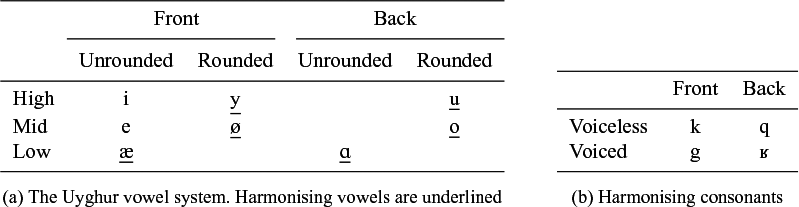

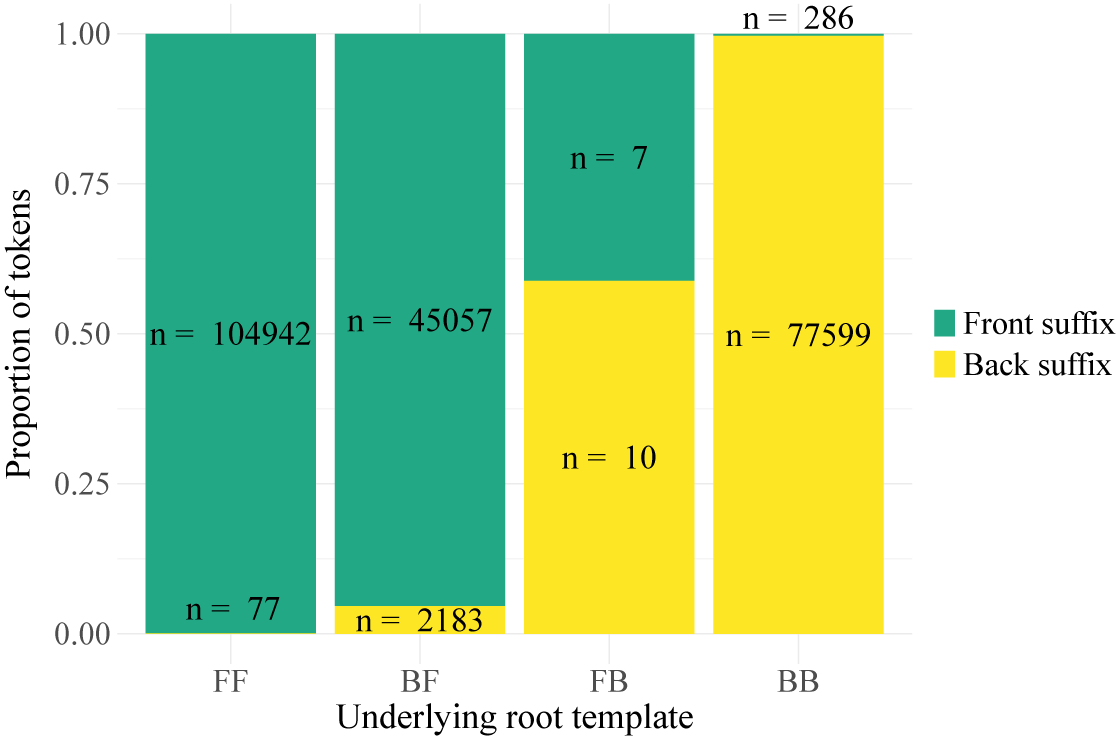
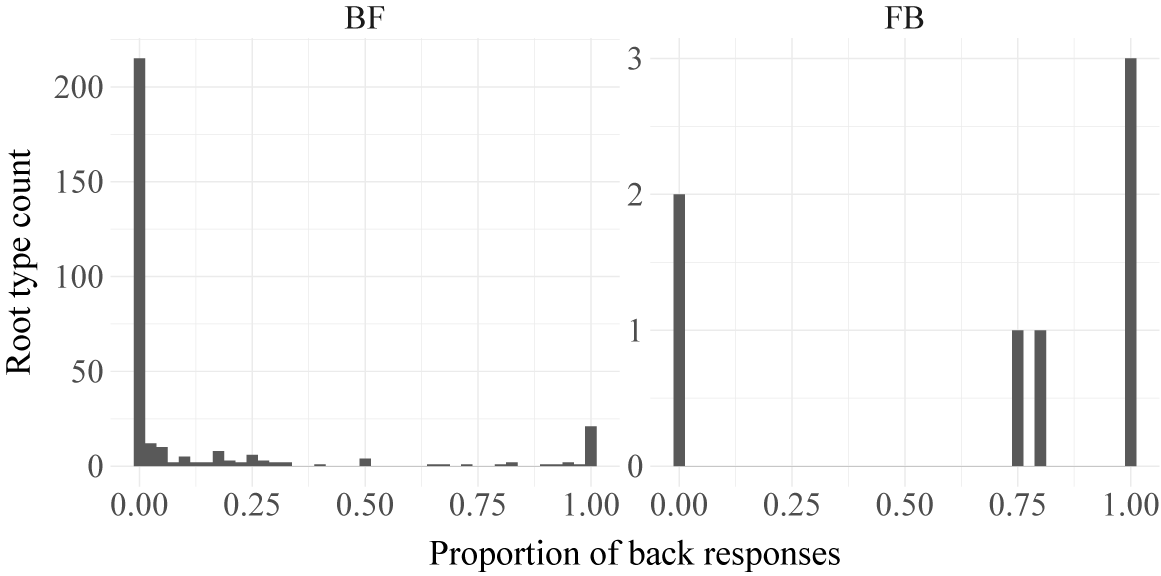
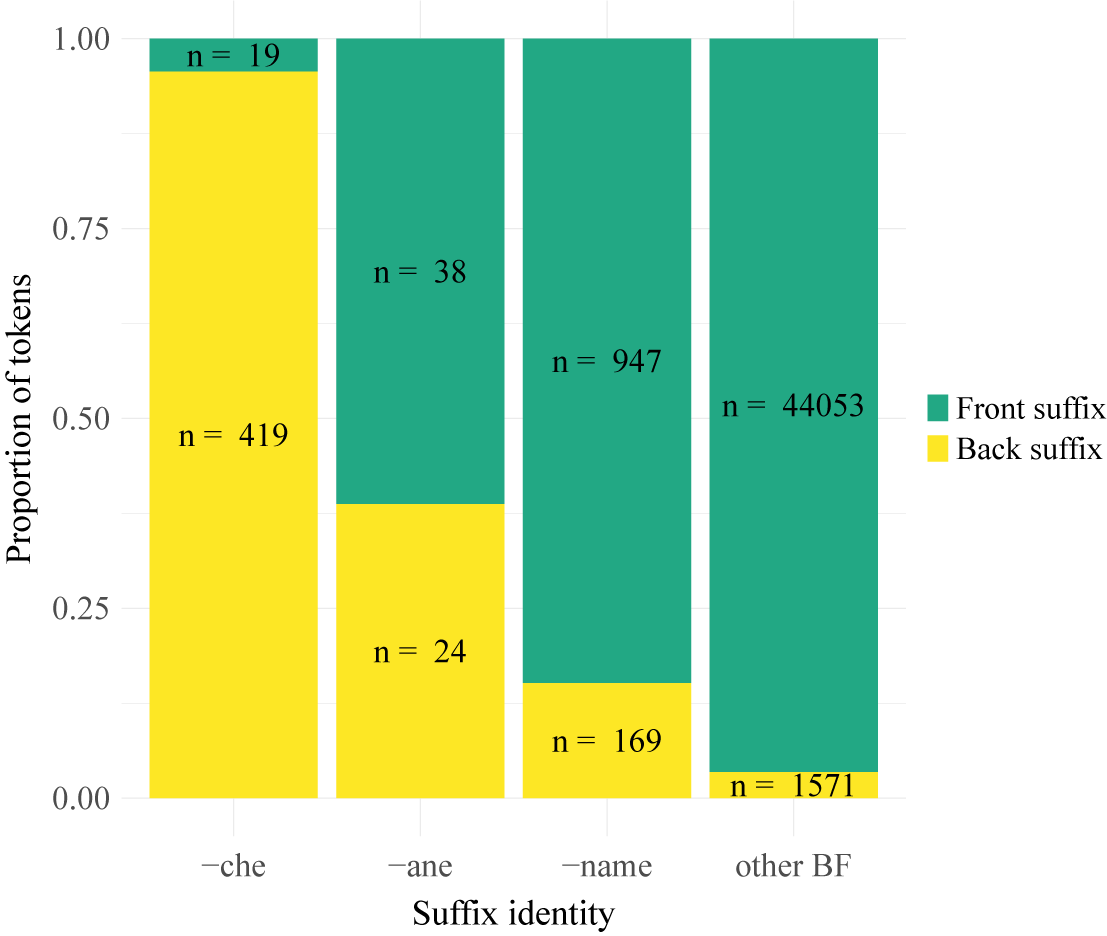
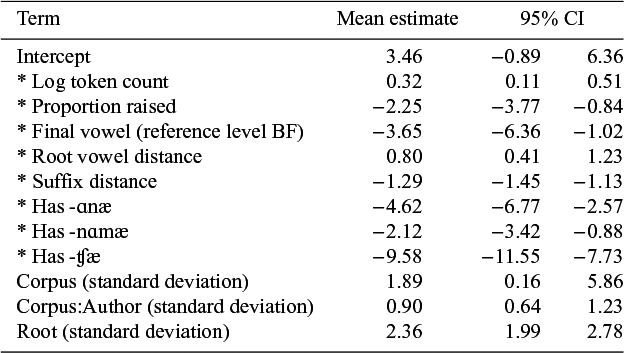
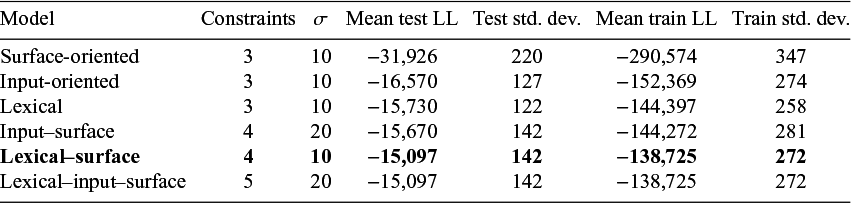

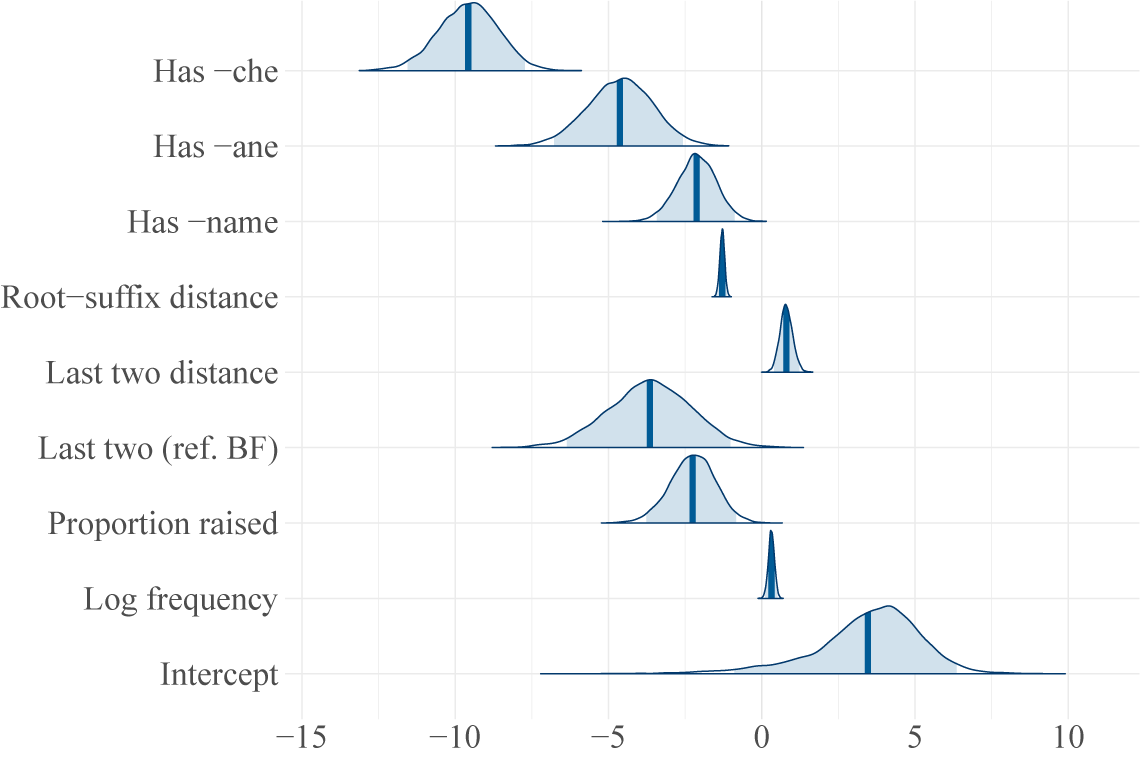
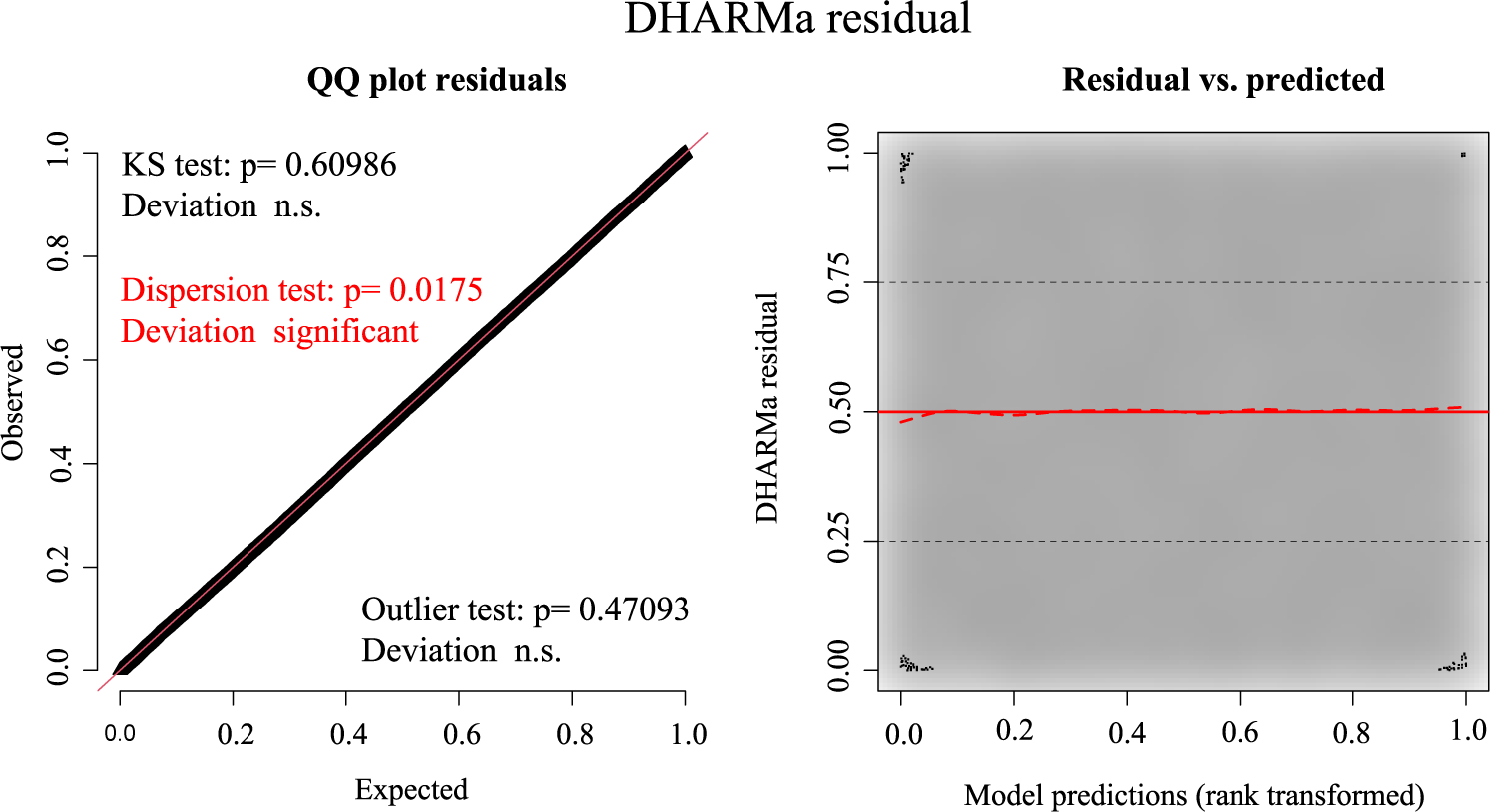
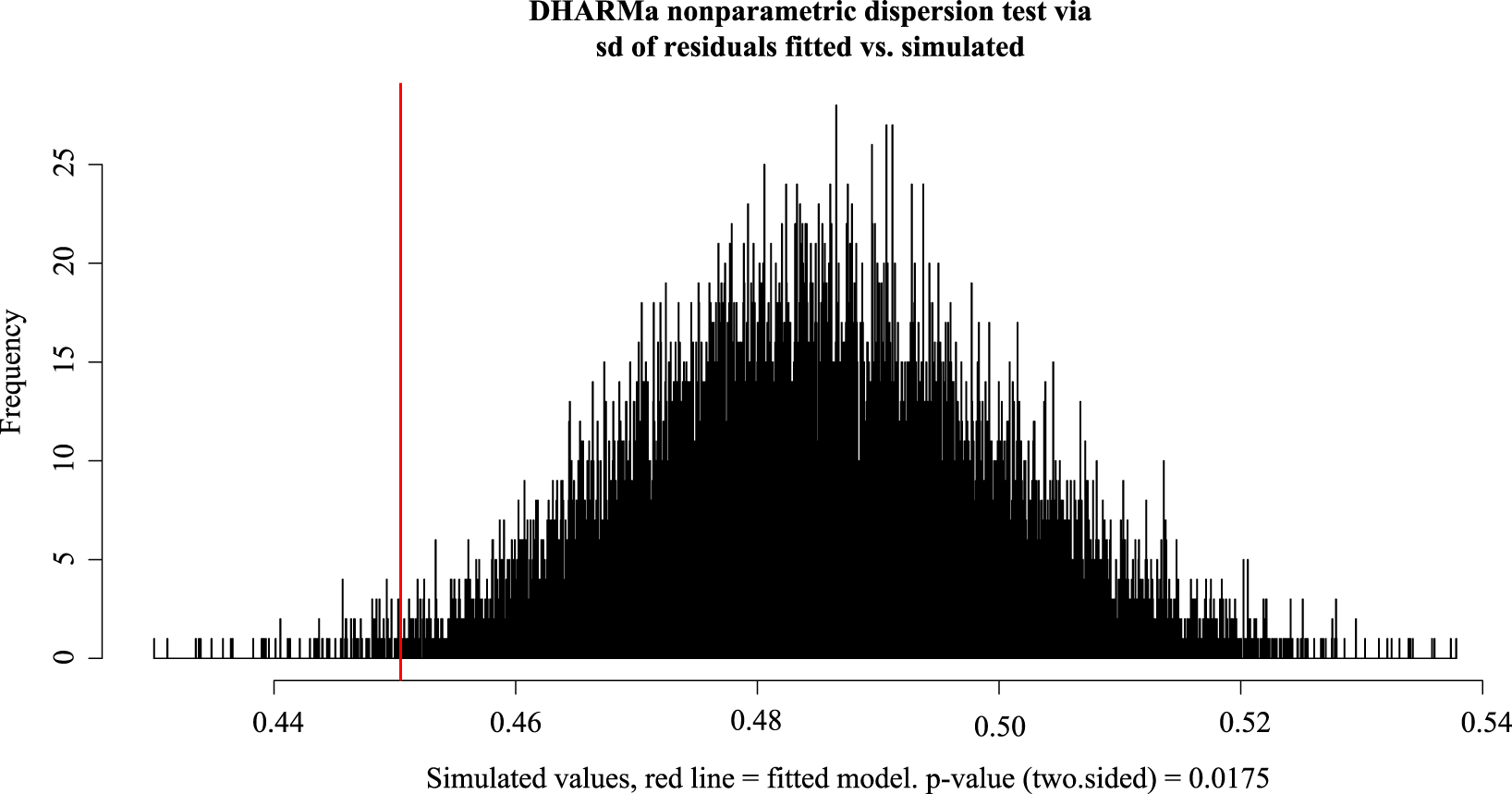
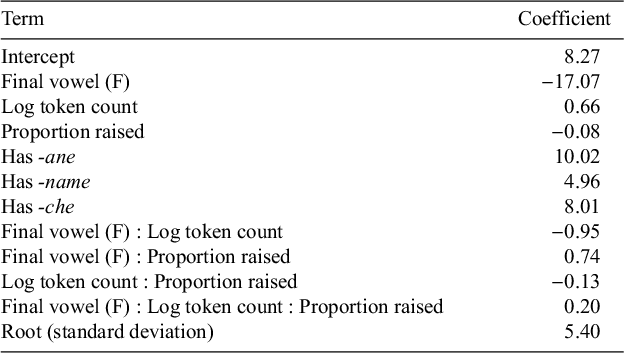

 Open access

