


1. Introduction: finding your role in a sociotechnical ecosystem
Engineering is fundamental to addressing the challenges of our time. It is a very significant part of the world’s economy and a major source of employment in many countries. Engineering is also extremely heterogenous encompassing a wide variety of tasks and activities. There is a huge need for interaction with people outside of engineering as well as people and resources in organisations and across supply chains. Still the stereotype of engineering can be simplistic, as a technical subject grounded in science. While this is not wrong, it misses many of the subtleties and opportunities engineering presents. This paper argues that engineering is a rich ecosystem in which a wide variety of people can find a satisfying career. The paper considers a different way to look of aspects of engineering practice: the tasks, the roles, the identities, the personalities and the values of engineers. Rather than exhaustively looking at the very rich literature pertinent to the topic, the paper will look at sustainability and women in engineering to show how these different concepts play out in the positions of individual engineers.
There has been a growing recognition that engineering design is a sociotechnical process and that the resulting products have sociotechnical aspects and considerations (Reference Bauer and HerderBauer & Herder, 2009). Engineers need to connect knowledge, based on science and technology, with knowledge about humans and society. Thus the role of engineers is to learn to identify and formulate a problem and develop an appropriate solution, and then communicate with other actors in the value chain. Engineers in practice have a sociotechnical identity that combines social, technical, and managerial skills (Reference FaulknerFaulkner, 2007); they rely on their relational skills building on their technical skills, which are often valued higher (Reference Lagesen and SørensenLagesen & Sorensen, 2009; Reference FaulknerFaulkner, 2000). Yet the perceived stereotypical engineer is a man who is technically and mathematically capable and rational, and who does not take into account human or social elements in the context of his work (Reference CockburnCockburn, 2009; Reference HatmakerHatmaker, 2012). The technical and social aspects of engineering can appear inauthentic for women, when how an engineer and how a women should act collide (Reference FaulknerFaulker, 2007). A generation ago, Reference FletcherFletcher (1999) showed that if female design engineers engaged in relational behaviour that went beyond the technically necessary, they were devalued for doing so, even if the women themselves felt it made their actions more efficient. To operate in a sociotechnical context a variety of different people with different skills are needed. This paper argues that in highlighting this lies an opportunity to enable a wider variety of people to find fulfilling roles in engineering that align with their skills, strengths and values. Showing the richness and diversity of role and opportunities in engineering is a way to attract diverse talent to engineering and retain it.
While some engineers or engineering designers work on their own, the overwhelming majority of engineering system design is done in different teams, eithers within the same organisation or across the supply chain. Purely mechanical products still exist, but most products now require design expertise from a variety of different engineering disciplines including mechanical, systems, electrical, material, and software engineering and increasingly require skills in data analysis and user experience design. As most companies hold at least some responsibility for products from the identification of the needs to the final disposal of the product they also consider service, repair and maintenance processes; or subcontract for them. Engineering design is embedded in the wider product development process, which also includes activities such as manufacturing, testing and R&D. The interaction between engineering design and new product development can be conceptualised in different ways which are beyond the scope of this paper (see Reference Dekkers, Chang and KreutzfeldtDekkers et al. 2013) and are addressed by different research communities. However, all indicate the many different roles, tasks and positions that engineers can have in these processes. In recent years academic research has focused on the integration of AI and big data into engineering in terms of the use of AI in design processes to improve products and their maintenance directly, but also learning for the design of future products (see Reference CooperCooper, 2024). This will have a profound impact on engineering practice and change the role of many engineers in their organisations. But even if practice is changing the need for a range of skills and personalities will remain.
The paper argues for the hypothesis that engineering requires a broad range of people: this gives everybody a possibility to find something that they are good at and passionate about. Section 3 argues that design of complex modern products requires the collaboration of many different people not only from a range of disciplines and backgrounds, but also people with different personalities and values. We can think of the products, their development teams and the tools, the methods and processes that they deploy as components of ecosystems, that act in conjunction without all the individuals needing to be completely aligned, provided all have a place in the ecosystem. In Section 4 this paper we illustrate this point with two examples: sustainability in engineering companies and women in engineering companies.
2. Methodology
This paper sets out a preliminary framework for characterising the place of individuals in the engineering ecosystem based on a multitude of preexisting sources that have informed the authors’ thinking. The authors have conducted empirical studies in engineering companies over many years, focusing on design processes and communication in design (e.g. Reference Eckert, Isaksson, Lebjioui, Earl and EdlundEckert et al, 2020) as well as sustainable design and sustainable product development (e.g. Reference Hallstedt, Isaksson, Nylander, Andersson and KnutsHallstedt et al., 2023). They have also run and attended numerous workshops with practitioners on design processes and sustainable design; and got to know many practitioners well. While many of these conversations were not recorded, they revealed the motivations and concerns of practitioners engaged in different engineering roles. The authors have also convened the design society “women in engineering” seminars, where both academics and practitioners talked freely about their careers in engineering and the enablers and barriers they faced. The seminar recordings will be revisited to analyse the themes of this paper.
3. Engineering as an ecosystem of products, people and process
The diversity in engineering can be described in terms of an ecosystem. The concept originated in biology where the idea of a net ecosystem metabolism allowed the comparison of ecosystems over time and with each other (Reference OdumOdum, 1956). The business community picked the idea up in the 1990s and looked at ecosystems from four different perspectives (Reference Tsujimoto, Kajikawa, Tomita and MatsumotoTsujimoto et al., 2018): industrial ecology, focusing on the optimisation, sustainability and symbiosis of industrial ecosystems; business ecosystems, which look at organisational boundaries and the identification of business niches; product platform management, which looks at the stability and evolvability of the products; and multi-actor networks, which emphasise the embeddedness, resilience and evolvability of the systems of actors. According to Reference MooreMoore (1993,1996) ecosystems progress through four phases – birth, expansion, leadership, and self-renewal (or death). Throughout the life cycle of an ecosystem different roles become prominent at different times: “leadership roles (‘ecosystem leader’ and ‘dominator’), direct value creation roles (‘supplier’, ‘assembler’, ‘complementor’, and ‘user’), value creation supports roles (‘expert’ and ‘champion’), and entrepreneurial ecosystem roles (‘entrepreneur’, ‘sponsor’, and ‘regulator’) (Reference Dedehayir, Mäkinen and OrttDedehayir et al. (2018)).
3.1. The task: engineering as multiple interconnected and nested ecosystems
Engineering is involved in the creation of a very wide variety of products, which address human needs and market opportunities on many different levels of complexity from simple consumer products to complex products like cars or aircraft to systems of systems like entire transport systems. While it is not always practically possible, engineers have a choice in what products they work on and how these align to their personal interests and values.
Modern products are interconnected in many ways: across time to their predecessor and successor products, across product families through shared product platforms, along supply chains and across supply chains with products that use the same parts or manufacturing facilities; or are related through common solution principles. They are also sometimes connected through use with other products required to achieve the same goal in a system of systems. Increasingly, connections are also generated through the reuse of systems, components and materials in different products. Decisions made for one product and in one organization have much wider implications for other products as well. It also means that the formal and informal interfaces between the different connected systems have to be negotiated and maintained. This gives rise to many different roles in engineering organisations, many of which depend on soft and social skills.
As Figure 1 illustrates, within an organisation, product development is also embedded in context specific ecosystems (Gericke and Eckert, in press), characterised by an unique combination of its elements: the specific products or product families including their underlying technologies and business model, the people involved in product development, the processes and methods(Reference Gericke, Eckert, Campean, Clarkson, Flening, Isaksson, Kipouros, Kokkolaras, Köhler, Panarotto and WilmsenGericke et al., 2020) used in designing them and the ICT environment that supports the process as a whole or the individual activities.
Product development ecosystem (Reference Gericke and EckertGericke and Eckert, 2026)

Figure 1 Long description
A diagram of the product development ecosystem. The diagram is divided into several interconnected sections. The central part of the diagram features four overlapping circles labeled ICT, Product, Methods, and People, each representing a key component of the ecosystem. Surrounding this central section are various labels that describe different aspects of the ecosystem. On the left side, the labels include Context, Methods, and Process. Context is further divided into Macroeconomic, Microeconomic, and Corporate. Methods include Design methods and Management methods. Process includes Activities and Processes. On the right side, the labels include ICT Environment, Product, and People. ICT Environment includes IT-tools, Data & Data-models, and AI-applications. Product includes Technical systems, Technologies, and Business models. People include Individuals and Teams. The diagram illustrates how these different components and aspects interact within the product development ecosystem.
An ecosystem is not static, but a dynamic system in which elements are added, removed or adapted when there is a need (Reference Gericke, Eckert, Campean, Clarkson, Flening, Isaksson, Kipouros, Kokkolaras, Köhler, Panarotto and WilmsenGericke et al., 2020). Product development ecosystems must be resilient – and many are. However, like natural ecosystems, they can be sensitive to change. People operating in these ecosystems become familiar with the terminology, tools and representations used in these ecosystems; and learn to operate successfully within these ecosystems. This is not always easy and requires considerable effort by individuals. Larry Bucciarelli uses the term object worlds to refer to the worlds of individual effort where an engineer, working for the most part alone, applies his or her expertise to particular tasks appropriate to his or her discipline”. “I claimed that different participants, with different competencies, skills, responsibilities and interests, inhabit different worlds. As such, while admittedly working on the same object of design, they see the object differently” (Reference BucciarelliBucciarelli, 2002).
3.2. The personal strength: variety of people
Engineering is greatly enriched by the variety of people who work in engineering and in engineering teams. An exhaustive review of different classification schemes for people goes beyond the scope of this paper. For example, the well-known Reference BelbinBelbin (1981) classification distinguishes between nine different distinct roles:
-
• Action-oriented roles:
-
○ shapers, who challenge and push teams;
-
○ implementors, who turn ideas into actions and carry out tasks; and
-
○ completer finishers, who ensure that tasks are finished to a required standard.
-
-
• Thought-oriented roles:
-
○ plant, generating ideas and solutions;
-
○ monitor evaluators, who analyse and evaluate situations; and
-
○ specialists, who provide in-depth knowledge and expertise.
-
-
• People-oriented roles:
-
○ coordinators, who focus on objectives, organise and delegate;
-
○ team workers, who help teams cooperate and do what the team needs; and
-
○ resource investigators, who find ideas to bring back to the team.
-
These roles can change, and people can choose to adopt particular roles, but they help people to identify how they see themselves and what they enjoy doing. These different roles can be found in most engineering processes, for example the action-oriented roles map well to conceptual engineering, detailed engineering and test engineering roles. Belbin himself (Reference Belbin1981) argued that teams require a mixture of personalities adopting different roles to function well.
Reference SternbergSternberg (1988) argued that people are happiest in jobs where they can focus on the types of thinking that they prefer, which is not necessarily what they are good at. He employed an analogy to the division of responsibility in the political system of the United States, to distinguish between legislative thinking – planning, creating, working out how things should be; executive thinking – following procedures to achieve results; and judicial thinking – judging and evaluating. People can also prefer thinking at a detailed local level or at a systemic global level. Their habits of mind can be hierarchical, organising goals, tasks and priorities in a clear order; oligarchic, preferring to work on a small number of priorities; monarchic, preferring to focus on one topic; or anarchic, preferring to think without a clear structure.
Most of these thinking preferences can be met in most engineering processes. For example, somebody who enjoys the detailed execution of tasks in a structured manner might enjoy detailed design, whereas big picture thinking and idea generation is required for conceptual engineering roles. These cognitive preferences and thinking styles indicate a propensity for different roles in engineering.
3.3. Roles in engineering
Most people have multiple roles at the same time in their personal and professional lives, for example somebody might be a design engineer, a team leader and an expert on sustainability at the same time. Reference HatmakerHatmaker (2012) conducted a semi structured interview study with 44 female and 14 male US engineers, with different backgrounds and roles, on how women engineers experience and identify construction. Hatmaker identified the following roles:
-
• The techno role: science, math, problem solving, technical skills, and mechanical abilities.
-
• The administrator: strategy and the business side of work.
-
• The coordinator: getting the process done and organising it.
-
• The communicator: social interaction and information exchanges both verbally and in writing.
-
• The relater: establishing connections and building trust in work relationships within teams, supply chains and with clients.
-
• The caretaker: concerns for others at work and nurturing them, especially direct reports.
While all the engineers in the sample set had a techno role, the other roles featured more strongly in the narratives provided by female engineers. However, all engineers combined these different roles to a certain extent in three distinct configurations:
-
• Role balancing, where participants distanced themselves from certain roles while embracing others. In particular, female engineers distanced themselves from their techno roles partly in response to perceived stereotypes about engineering, and embraced the more social roles.
-
• Role grafting, where participants incrementally built upon the core technical role and saw other roles as a prerequisite to or enabler for their own or others’ technical roles.
-
• Role swapping, where one role was located at the core of the engineer’s identity while others were peripheral This did not involve an active distancing from or building on a technical role.
Engaging with the multiple roles varies as people move through their careers. As engineers move into more managerial roles, they have to take up non-technical roles.
Engineering designers often have multiple roles, as engineering design links so many other activities occurring in a product development process, such as upfront activities like marketing and product planning and downstream manufacturing activities, as well as working with analysis or testing engineering. Therefore, engineering designers usually have a communicator role beside a technical role. Many engineering designers also take on relater roles as they work with different teams or outside the organisation. The ability of engineering designers to take these different roles on also gives them influence in the wider engineering organisation as they increase their knowledge base.
3.4. The identity of engineers
Role is closely intertwined with identity. Role looks at the situation’s interaction structure while identity enables people to enact their roles through their subjective experience (Reference Barley, Arthur, Hall and LawrenceBarley, 1989). Identity is shaped by many different professional and private roles throughout a person’s life. Identity is a complex concept, that is looked at from many different perspectives by different research communities in social science and beyond (Reference Patrick and BorregoPatrick & Borrego, 2016). There is no single accepted definition of identity, but it is mostly seen as a combination of personal and social identity, e.g. from a Sociocultural Theory perspective identity combines the intimate or personal world with the collective space of cultural forms and social relations (Reference TonsoTonso, 2006 based on Reference HollandHolland, 2001). People usually hold multiple identities simultaneously, where one becomes more salient than others at different times. For example, multiple identity theory postulates four modes of identity based on the social and cultural factors: i) innate nature identity, ii) institutional identity bestowed by an institution, iii) discourse identity formed through interaction with others, and iv) affinity identity belonging to a group (Reference GeeGee, 2000). There are marked gender differences in identity, for example a study by Reference Cass, Hazari, Cribbs, Sadler and SonnertCass et al. (2011) found a significant difference between male and female students when using a math identity as an indicator of choosing engineering as a final degree subject. While the body of research on engineering identity is steadily increasing, it is still fragmented and mainly focused on students (Reference Rodriguez, Lu and BartlettRodriguez et al., 2018). As people carry multiple roles, their identity is more defined by some then by others. When roles are balanced then one becomes dominant in defining the identity of the person. A person’s identity is a combination of their self-identity and the identity that others associate with them. If these are misaligned people can become dissatisfied.
3.5. Value: guiding engineers in their choices
Engineering involves the deliberate or unintended expression of ethics and values (see Reference Friedman and HendryFriedman & Hendry, 2019). Value sensitive design: Shaping technology with moral imagination. Mit Press. Engineering involves the deliberate or unconscious expression of ethics and values, and has value-laden consequences. Active consideration of ethics, values and societal needs will be required for a transition to greater sustainability and prosperity in the future, while playing a crucial role in both assuring and threatening peace through the weapons systems that are now being developed. There is a place in engineering for people of all political and ideological persuasions and values. This does not imply that engineers are not responsible for acting in a responsible and ethical way as individuals. In response, codes of conduct are being developed, e.g. by the Swedish Engineering Association (2025) or Royal Society of Engineering (2023). Ethical values are a potential source of conflict in engineering projects, for example sustainability principles encourage lightweight solutions that require less materials and less energy, while safety principles encourage stronger solutions and back-up systems. This is in practice often resolved through the choice of different materials, which in turn can have ethical issues associated with how they are mined or recycled.
Reference van de PoelPoel (2015) points out that Engineering is guided by external values, i.e., values deriving from the social impact of technology, and internal values in this case to the engineer’s process. Values can be intrinsic values that are good in themselves or for their own sake, while instrumental values are those that help to achieve other values. While it is sometimes argued that technology is per se value free, so that the moral responsibility lies with those who deploy technology, technical products typically at least have instrumental values. Van de Poel points out that the interval values of technological enthusiasm, efficiency and effectiveness and some of the -ilities, like reliability and robustness, are often seen by engineers as value neutral, but do at least have instrumental value. By contrast he sees safety, health, human well-being and sustainability as external values. Reference Friedman, Kahn, Borning, Huldtgren, Doorn, Schuurbier, van de Poel and GormanFriedman et al. (2013) offers a longer list in the context of information and communication technologies (ICTs): human welfare, ownership and property, privacy, freedom from bias, universal usability, trust, autonomy, informed consent, accountability, identity, calmness and environmental sustainability. Others offer more specific lists of engineering values, for example Engineers Without Borders (2025) focuses on curiosity, equality, inclusivity and sustainability; or the Royal Academy of Engineering on (2025): progressive leadership, diversity and inclusion, excellence everywhere, collaboration first, creativity and innovation.
Some roles are strongly influenced by value, e.g. sustainability or safety, voluntary and social issues, while others are more focused on instrumental values. For example, many detailed design tasks need to be carried out effectively and efficiently to assure that the whole product can be delivered.
3.6. Spaces in the ecosystem of engineering
Multiple dimensions of being an engineer

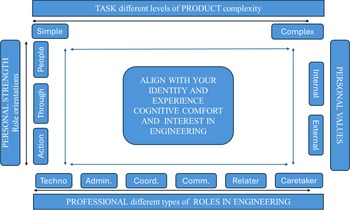
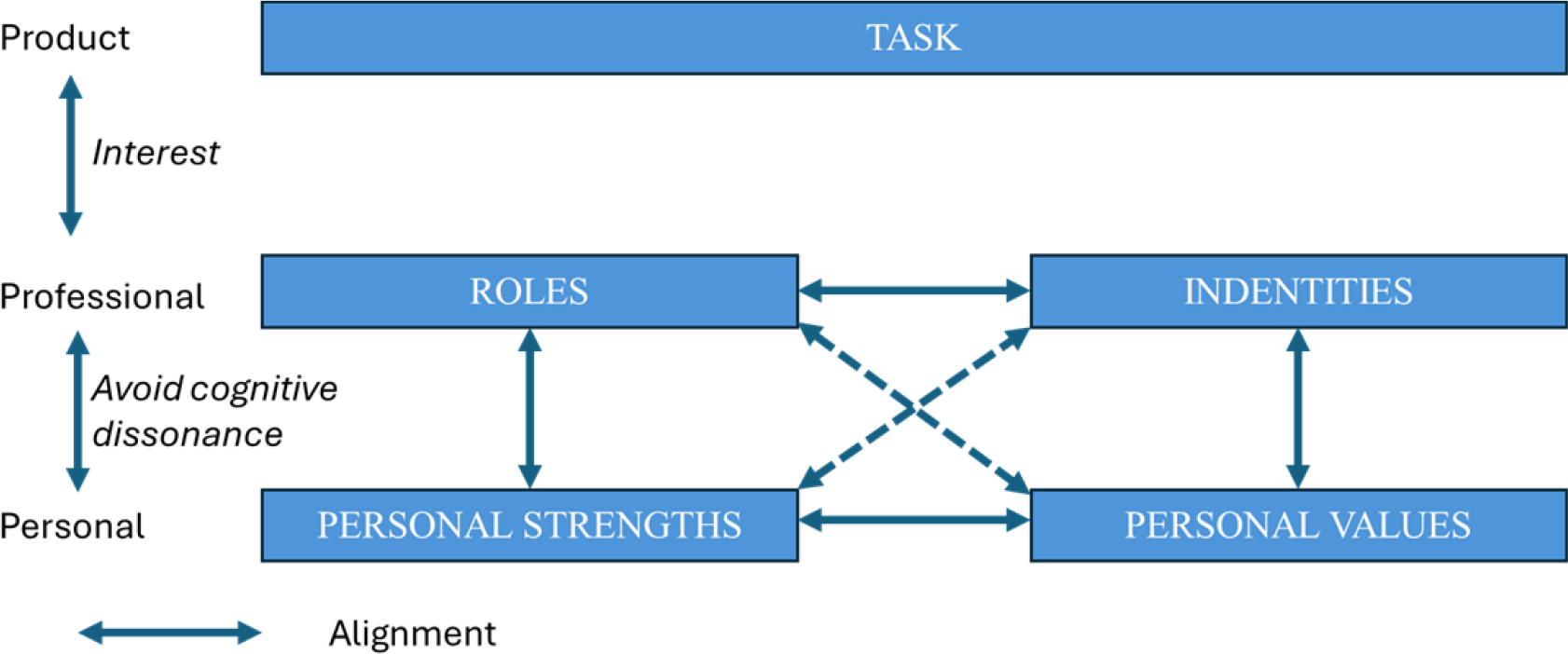
Engineering is a highly complex activity that is usually carried out by different individuals with different abilities and preferences, see Figure 2. Everybody has a particular role in the organisation, personal thinking preference and form of thinking, but also a particular identity defined by social and cultural factors. The roles in engineering give a diversity to a person as most engineers take several roles, maybe dependent on their values. This section has introduced several dimensions that differentiate the lived experience of individual engineers. Everybody has a particular role in the organisation, but also a particular identity. For example, some team leaders might strongly identify with their technical work, while others might have technical roles, but see themselves as a team player or team enabler. Like all people, engineers have personal strengths and sets of personal values. An important element is to avoid an obvious misalignment between the different aspects, see Figure 3. Similarly, it is important that roles and tasks are aligned to maintain interest in the role. The next section will discuss how individuals can position themselves on two examples, sustainability and women in engineering.
Interrelated dimension of the engineering ecosystem

People evolve over their careers as they gain experience through the tasks that they are assigned to and the roles they have. They also learn what they enjoy and lose interest in topics. Therefore, the roles that suit an individual change over a career evolve and need to be considered at career decision points.
4. Finding a suitable place in the engineering ecosystem
The paper set out to argue that everyone can find a career that they enjoy in engineering, if they are mindful of their strengths, values and preferences. This section looks at this in more detail by providing a taste of what this positioning could look like in the context of sustainability and women in engineering. Within each of these areas there is a huge variety of issues and people. The examples are based on a combination of real people that the authors have encountered.
4.1. Sustainability
Most engineering companies have roles dedicated to sustainability, such as sustainability managers or sustainability specialists. Some also have teams dedicated to sustainability issues, such as sustainability reporting and environmental assessments, while other organisations have roles with sustainability responsibility in wide variety of teams. All engineering tasks have a direct or indirect effect on sustainability so that most engineers need to consider sustainability to a greater or lesser extent. The people who take up sustainability roles typically have a very deep concern for sustainability or are driven to take these roles by the values they possess. However, other people also value sustainability highly without working on outwardly sustainability focused roles. For example, the first author encountered an engineer who took a position with an oil company on the grounds that marginal improvements in the sustainability and safety of oil production can have a huge global impact on sustainability; and later had a role where he avoided a major oil spill through careful repair and maintenance of the platform.
Within sustainability roles there is also a great variety to suit the interests and talents of different people. Somebody who enjoys big picture thinking and strategic planning can apply for a sustainability strategy role, whereas somebody who enjoys judging and evaluating can do sustainability risk assessments, while somebody who enjoys administrating can look at compliance roles and sustainability reporting. People who enjoy teaching could look for an internal training role and thus identify as a sustainability educator. People that like problem solving while at the same time have an interest in nature and value biodiversity can look for a role in product development or as an ecodesigner.
4.2. Women in engineering
Women in engineering cover a huge spectrum of abilities and the authors of this paper do not wish to stereotype women in engineering. Therefore, the comments in this section are based on the Design Society Women in Engineering talks. Four of the five speakers had engineering undergraduate degrees and all obtained PhDs in engineering design or related areas. However, all felt in some ways as an outsider to engineering because they had to fight against stereotypical assumptions of engineers as highly technically motivated males. They all shared an interested in engineering design as a complex process where different talents can be integrated and flourish. They have found themselves in leadership roles, because they want others in their environment to cooperate productively. Enabling teams to work productively and positively is a huge part of each of their identities.
All the speakers were mothers, who had worked while their children grew up. Being a mother was a huge part of their identities, but also shaped them in their professional identities. They were comfortable or at least used to holding multiple roles and identities simultaneously. They had all been able to find roles that suited their personal strengths. To varying degrees they had to work to persuade others that their differences could also be their strengths. For example, one of them is a highly reflective practitioner who listens and thinks deeply about engineering design processes. She found a role where she needed to bring engineers from different disciplines together and align their processes. This role involves understanding the viewpoints of different people and explaining them to each other.
Their soft skills from outside of engineering served them well in their different roles as professional engineers. In their cases, these involved social and communication skills as well as organisational skills. These soft skills are vital for almost all engineering roles including technical roles.
5. Discussion
This paper has argued that engineers can find roles that fulfil them as people according to their values, strengths and interests and enable them to find roles they can identify with. Nevertheless, engineering has an image problem, where public perception is focused on technical competence.
Not all current and future needs of industry will be met by the training many engineering students receive at the moment (Reference Eckert and IsakssonEckert & Isaksson, 2025), as the scope of engineering broadens and companies need to respond faster. This will require engineers with technical skills and broader skills. This mix of skills is also discussed in education or trade literature under the label of the T-shaped engineer, i.e. a mixture of general knowledge and in-depth technical knowledge grounded in one discipline and or pi-shaped engineers, i.e. technical expertise plus system thinking skills, or technical expertise and multiple areas of deep expertise. However, the scope or in particular around broader skills breadth of knowledge is unclear in the discussion of T shaped engineers. In the US context Reference TranquilloTranquillo (2017) argues in an educational context for the inclusion of humanities courses in engineering degrees to achieve sufficient breadth of engineering education. Reference Dekoninck and BridgeDekoninck and Bridge (2023) used a set of skills compiled using the UKSPEC (Engineering Council, 2013) to show that novice engineers typically had in-depth knowledge in a narrow field of expertise and some broad knowledge, whereas expert engineers had broadened their general knowledge and their specialist knowledge. Maybe because of its lack of definition the concept of the T-shape engineer has received a lot of traction in industry. For example, Tim Brown, the CEO of Ideo, argued that it is an essential characteristic of a design engineer to have T shaped skills (Reference HansenHansen, 2010). However, from the point of view of a company the critical issue is that all areas of knowledge are covered and that enough overlap exists between different people to ensure that they can interact.
Engineers are still recruited to many universities based on the foundations for the technical skills, i.e. their ability in maths and physics. Soft skills or values are rarely considered in recruitment and not balanced against the technical abilities that engineering students require and which attract many of the students. Degrees are often heavily advertised through cool technical gadgets that students will be able to interact with, rather than the changes in society they can enable by being engineers. This runs the risk that many potential students are lost to engineering, in particular in areas like sustainability. Anecdotal evidence would indicate that many girls are attracted to degree subjects by the desire to make a difference, but don’t consider engineering one such subject. Conversely other students might be put off by moral arguments or appeals to values, but would be attracted to working on issues like sustainability, if they are presented as issues to address or problems to solve. This of course needs to be balanced by teaching sufficient technical skills. A greater contextualisation of courses in the engineering ecosystem can help students to select suitable modules and to choose their preferred skill combinations.
This raises the question how is it possible to generate an inclusive engineering culture in universities and in industry? The working practices of engineers are largely invisible to people outside engineering, but also to some extent within large organisations. In the absence of role models, stereotypes of engineering practice prevail. University, industry and professional organisations have begun to work on descriptions of role models for engineering students in particular women and people from ethnic minorities. Students need role models to understand how their contribution to engineering could look like; and help them to find suitable roles that align with their values and strengths. Similarly, engineers in industry need support to identify roles they want to carry out. This is particularly important as female students display lower academic self-confidence despite generally higher academic achievement (Reference Chachra and KilgoreChachra & Kilgore, 2009). This requires a culture that celebrates the strengths of individuals and showcases their contribution to the whole. Some organisations are extremely good at valuing individuals and acknowledging how they contribute the success of products and ultimately profits. It also requires training for all as greater heterogeneity can also lead to problems in processes.
Engineering design plays a very important role to bringing people with different backgrounds together. Understanding engineering design an integrator of different academic disciplines, tasks and personal strengths can also be a way of recruiting new and different talent to engineering design. Design for X approaches are often based explicitly on values, but are not the only way to work on a particular value in an engineering capacity. Engineering design also involves understanding the needs of different stakeholders associated with the product life cycle. Finding out about use patterns and stakeholder needs requires soft skills or other non-technical skills.
6. Conclusion
This paper has argued that technical engineering knowledge and competencies is only one aspect of the skills that are required in engineering projects. Many roles require a broader knowledge base and the ability to interact with and motivate people with different skills. People are attracted to some roles because of personal strengths and values. This raised the question how universities and attract and train people who enable this mix of skills and abilities. Engineering depends on an ecosystem of people who work together and complement each other. This is also a great opportunity for everybody to find their niche in which they can prosper. To enjoy a role, it needs to align with personal identity, strengths and values; and people need to feel appreciated for who they are. This topic merits both greater theoretical depths and the more thorough empirical studies, which we hope to carry out in the future.
At present there are few tools available to help engineers to explore this. This is a matter of both enabling individuals to recognise their values and strengths and showcasing potential roles. Collectively this is an important element of making engineering an attractive career to young women, but also other groups who would not consider engineering traditionally.
Acknowledgement
Financial support from GENIE – Gender Initiative for Excellence, at Chalmers University of Technology is gratefully acknowledged. Sincere thanks to the participants and presenters to the Women in Engineering talk series, organized through the Design Society during 2025.


 Open access

