


Introduction
Taiwan is a rapidly aging society. According to the National Development Council (2020), the country will soon be a so-called super-aged society with more than 20 per cent of the population age 65 and over. While Indigenous peoples in Taiwan have almost a decade shorter life expectancy than the national average, even among Indigenous peoples, the percentage of the Indigenous population age 65 and over exceeded seven per cent in 2015 (Council of Indigenous Peoples, 2016). According to the active aging policies on the agenda in Taiwan, Canada, and elsewhere, people are increasingly expected to age in an active manner (Brooks-Cleator & Lewis, Reference Brooks-Cleator and Lewis2020). For the past 20–30 years, policy documents on aging and care describe active aging as a variation of other terms, such as positive aging, successful aging, and healthy aging (Jacobsen, Reference Jacobsen2015; Ranzijn, Reference Ranzijn2010; Walker, Reference Walker2008). Taiwan follows the definition of active aging from the World Health Organization (WHO) (2002, p. 12), which says that “Active aging is the process of optimizing opportunities for health, participation and security in order to enhance quality of life as people age.” In other words, this approach aims to solve the challenges relating to the increasing care needs among the aging population through health optimization among older people. So far, the actions chosen by the Taiwanese authorities to meet this aim include fall prevention measures, recommendations for a healthy diet, dental hygiene, tobacco control and regular screenings, as well as sports and exercise (Health Promotion Administration at the Ministry of Health and Welfare, 2016).
The long-term care (LTC) system in Taiwan has been beneficial to some extent, at least for the majority population. For example, nursing homes, community, and home-based care services for older persons have become more available (Chou, Kröger, & Pu, Reference Chou, Kröger and Pu2015). In addition, Taiwan’s LTC 2.0 plan includes day clubs as a preventive measure to provide services to Indigenous older adults. So far, however, for most Indigenous peoples, the LTC system has been culturally insensitive and thus unhelpful (Wang, Reference Wang2013; Wang & Tsai, Reference Wang, Tsai, Baines, Bennett, Goodwin and Rawsthorne2019). For example, it is challenging to promote home care in Indigenous communities (Wang & Yang, Reference Wang and Yang2017). Scholars have argued that the reason for this is that Taiwan built the LTC system to reflect Han Chinese ideology at the outset and excluded the Indigenous ways of care (Gao, Reference Gao2021; Wang, Reference Wang2013; Wang & Yang, Reference Wang and Yang2017). This lack of cultural safety corresponds with what Ryan et al. called “the cultural hegemony of Western knowledge over Indigenous knowledge” (Reference Ryan, Jackson, Gabel, King, Masching and Thomas2020, p. 307). In this way, Taiwan’s LTC system risks worsening social injustices rather than healing them by not meeting the specific care needs of different Indigenous peoples (Gao, Reference Gao2021).
In 1995, Taiwan established the Council of Indigenous Peoples (CIP) to respond to the needs of Indigenous societies through more holistic, respectful, and coherent services (Li, Reference Li2003). However, the CIP still has very little power and hardly receives any budget. Therefore, it has not been able to address structural issues or develop a care system based on Indigenous perspectives (Wang, Reference Wang and Lu2011, pp. 6–7). Instead, the CIP has reproduced categories of mainstream social services and segregated Indigenous peoples into target groups – for example, women, older adults, youth, and children (Li, Reference Li2003, p. 172). In 2006, 40 day clubs for older people were established, and only 14 years later, by 2020, this number had multiplied by more than 10 to 430 clubs. Local churches often run the day clubs with extended assistance from volunteers. The government touts these day clubs as a panacea to solve the LTC problem for the Indigenous older adult population through preventing and/or delaying disability (Council of Indigenous Peoples, 2017). In addition, these clubs aim to contribute to promoting social rights and cultural rights among the Indigenous peoples, for example, through developing and providing care services according to traditions of Indigenous peoples (Gao, Reference Gao2021). However, it should be noted that these day clubs are only mandated to provide social care services for relatively healthy older persons. Thus, once an Indigenous older person becomes frail and needs intensive care, the Ministry of Health and Welfare is supposed to take charge of delivering the necessary health care services. Nevertheless, at that stage, only a very low percentage of the Taiwanese population (Indigenous and non-Indigenous alike) has access to professional health care services, home-based care services, or nursing homes (Chou et al., Reference Chou, Kröger and Pu2015). Therefore, the primary solution for families with intensive-care needs, even in rural or indigenous parts of Taiwan, is to hire a migrant live-in carer (Munkejord, Ness, & Gao, Reference Munkejord, Ness and Gao2021; Munkejord, Ness, & Silan, Reference Munkejord, Ness and Silan2021). Moreover, public LTC services lately have included Adult Foster Care, which is supposed to become an alternative service for frail Indigenous older people to “age in place” in the village. However, according to Yaisikana (Reference Yaisikana2021), Indigenous ways of being and knowing, so far, have been excluded from the design of the Adult Foster Care service, which reveals that the LTC is still often shaped as a form of “welfare colonization” (see also Chang & Bihau, Reference Chang and Bihau2019).
Hence, in Taiwan, the LTC system marginalizes Indigenous peoples. For instance, local cultural knowledge is rendered irrelevant when employing public care worker (e.g., in home care or community-care services) (Gao, Reference Gao2021), and services are still not adapted to local values and customs (Ru, Reference Ru2018; Wang, Reference Wang2018; Wu, Reference Wu2015). In this sense, research may play a vital role in disrupting the cultural hegemony embedded in “active aging” (Brooks-Cleator & Lewis, Reference Brooks-Cleator and Lewis2020; Ryan et al., Reference Ryan, Jackson, Gabel, King, Masching and Thomas2020). Moreover, researchers should commit “epistemic disobedience” by questioning the colonial, capitalistic, Eurocentric approaches in research as argued by Mignolo (Reference Mignolo2009) and Berdai Chaouni, Claeys, van den Broeke, and De Donder (Reference Berdai Chaouni, Claeys, van den Broeke and De Donder2021).
One such example of asserting epistemic disobedience against the imbalanced power relationship manifests in the increasing emphasis on “cultural safety” over “formal competence” (Baskin et al., Reference Baskin, Hare, Peltier, Lougheed, Chabbert and Boudreau2020; Pon, Reference Pon2009). Cultural safety was first known as a Maori approach called Kawa Whakaruruhau (Ramsden, Reference Ramsden2002). Williams (Reference Williams1999, p. 213) defined culturally safe services as services provided in an environment “where there is no assault, challenge, or denial of their [health care service users’] identity, of who they are and what they need. It is about shared respect, shared meaning, shared knowledge, and experience, of learning together with dignity, and truly listening.” Instead of nursing regardless of color or creed, the prerequisite of such cultural safe environment requires nurses to be “mindful” of the characteristics and traits and make people diverse and different, including the impact of colonial context (Papps & Ramsden, Reference Papps and Ramsden1996). This study explores and expands conceptualizations of cultural safety through exploring the participants’ experiences of active aging within the context of the day club. Our research questions are: (a) What were the main formal activities supposed to promote active aging in a day club for older Tayal women and men in the northern Tayal territory? (b) How were these formal activities experienced and discussed by the participants at the day club? (c) What local concepts of active aging were highlighted as necessary by the participants themselves?
Four themes regarding how the Tayal day club achieves “active aging” are analysed in the data. As explicated in the results section, these were (a) information meetings about health and illness and (b) physical activities; (c) Cisan, which refers to social care through gathering and chatting about anything, preferably in the Tayal language; and (d) Malahang, which refers to interrelational care between people, land, and handicrafts.
Context: The Tayal People in Taiwan
The Tayal belong to the Indigenous peoples who are part of the Formosan branch of the Austronesian language family. They have lived in Taiwan for thousands of years (Blundell, Reference Blundell2009; Kuan, Reference Kuan, Iwabuchi, Kim and Hsia2016). In the 1980s, the Tayal collaborated with other Indigenous peoples and began engaging in activism and movements to reclaim their names, lands, and right to (re)learn to speak and write their languages. Indigenous peoples in Taiwan have a shared history of dispossession: They suffered from several colonial invasions, including Dutch, Spanish, Japanese, and Han Chinese settlers, and during specific periods colonizers have treated them as no more than animals (Wu, Reference Wu2019). Japan classified the Tayal as “raw savages,” performed a series of military “pacification” measures on them (see Kuan, Reference Kuan, Iwabuchi, Kim and Hsia2016), and ended up confiscating 85 per cent of the Indigenous land (Adam, Reference Adam2018). Only four years after the Japanese left Taiwan in 1945, the Kuomintang (Chinese Nationalist Party) seized power. Since then, the colonization of the Tayal and other Indigenous peoples has continued via Chinese governmental structures, the educational system, and laws, comprising continued marginalization of the Indigenous cultures, languages, and cosmologies (Chen, Reference Chen2020; Silan & Munkejord, Reference Silan and Munkejord2022). Taiwan officially apologized for its wrongdoings in 2016, but the process of decolonization is only beginning.
Materials and Methods
Design, Recruitment, and Data Collection
This study utilizes a qualitative design. The first author collected the data. First, between 2015 and 2018, she did several shorter periods of participant observation and interviews at a local day club in the Tayal territory. The researcher joined the day club activities with the older participants; here they will be called either participants or Bnkis (“Elder” in Tayal). The plural form “Elders” in Tayal would be Bbnkis. The word Bnkis has spiritual weight and has significance in Tayal’s cultural continuity: Bnkis not only refers to venerable persons but also can include ancestors and ancestral spirits. In terms of simplicity, in this study, we use Bnkis to refer to Elder in both singular and plural forms.
The first author conducted the second round of fieldwork in 2019 as a follow-up. She interviewed seven Bnkis, six of whom had attended the day club when the first author did participant observation. In the interviews, Bnkis were asked to talk about themselves and their everyday experiences, focusing on Tayal identity and well-being. They were also asked to describe the local day club, what activities they liked and disliked, and why. The interviews were mainly conducted in Mandarin Chinese, as most of the Bnkis were used to converse in Mandarin Chinese with the younger generation due to the lingering stigmatization and marginalization of the Indigenous languages in Taiwan.
Participants
All participants were in the age range of 70 to 90. According to the local tradition, most of the participants lived with their spouses (if they were not widowed) in the same household with the oldest sons and their families. A few participants lived independently, while children and grandchildren came to visit regularly.
Methodological Reflections
Drawing on constructivist-grounded theory (Charmaz, Reference Charmaz2006), the observations from the day club as well as conversations and interviews with the Bnkis were considered not simply as “data collection,” but rather as a process of co-creation of knowledge in partnership between researchers and participant(s). Thus, by taking part in the day club activities, the researcher learned the importance of being patient, diligent, and humble, and she gradually became more acquainted with the Tayal culture and language, being, and knowing. She adapted and embraced the lifestyle and rhythm of life of the Bnkis and tried to understand as much as possible about their perceptions and relations with humans, mountains, rivers, and landscapes by listening and observing in a non-intrusive way (Atkinson, Reference Atkinson2002).
Analysis
To analyse the perceptions and experiences of the Bnkis, we used a reflexive thematic approach (Braun & Clarke, Reference Braun and Clarke2006) based on Indigenous foundations (e.g., in line with Denzin, Lincoln, & Smith, Reference Denzin, Lincoln and Smith2008; Kovach, Reference Kovach2010; Smith, Reference Smith2012). The first author repeatedly listened to the audio files and read the transcripts and field notes to probe the central themes in the Bnkis’ stories. Then, both authors met for two digital analysis workshops to discuss the data and specify our research questions and main findings (Braun & Clarke, Reference Braun and Clarke2006, Reference Braun and Clarke2019). As mentioned in the introduction, we identified four themes concerning how “active aging” occurred in the context of the Tayal day club. Two of the themes were formal activities promoting “active aging” at the day club. These were (a) information meetings about health and illness and (b) physical activities. In addition, we identified two themes that appeared even more central for healthy and active aging for the Bnkis themselves. These were (c) Cisan, which refers to social care through gathering and chatting about anything, preferably in the Tayal language; and (d) Malahang, which refers to interrelational care between people, land, and handicrafts.
Ethical Considerations
Informed oral consent was obtained from all participants before taking part in this project. We told the participants that they could withdraw from the project at any time. The participant observation field notes and the interview transcripts and audio were stored securely. In this study, pseudonyms were used to protect the identity of the participants. The Norwegian Centre for Research Data approved this project (grant number 287301).
Research Team and Division of Tasks
The research team was composed of an Indigenous researcher (first author) and an “allied other” (second author) who drew from decolonizing perspectives, such as being cognizant of colonial legacies and historical trauma, and the aim to transform the conception of aging while elevating Elders’ ways of knowing and being. While the first author collected and transcribed the data and did the primary job of analysing the data, the second author participated in all the project phases and contributed to refining the data analysis. The two authors collaborated on writing and revising the article.
Findings
Setting
As Christianity is a widespread religion among the Indigenous peoples in Taiwan (Gao, Reference Gao2021; see also, Simon, Reference Simon, Huang, Davies and Fell2021), many Indigenous day clubs are run by local churches. This was also the case for the day club, the Tribal Cultural Health Station (Bùluò wénhuà jiànkāng zhàn in Mandarin), where the research for this study took place. The day club opened in 2014. The budget was received from the CIP via the municipality. Consequently, the day club was required to report on their activities to both the CIP and the municipal social and health care office. In the beginning, the day club was open three days a week, gradually extending to five days a week. Some of our participants chose to attend only two days a week. In the day club, the participants shared a warm meal and took part in various physical, cultural and spiritual activities. The physical activities involved games such as stacking cups, aerobics, and fall prevention training. The cultural activities entailed becoming reacquainted with Tayal totems and traditional clothes, watching Tayal documentaries and re-learning traditional dances, and learning about other cultures (e.g., through Taiwanese traditional music, contact across generations). In practice, children from the local preschool and elementary school were sometimes invited to the day club to interact with the Bnkis. The spiritual activities included singing church songs or joining church services. Occasionally, lessons on health, healthy nutrition, illness, and how to correctly use various medicines were provided.
Practising Active Aging in the Day Club
The following section discusses (a) information meetings about health and illness and (b) physical activities, (c) Cisan, and (d) Malahang. The following section provides context and quotes from the Bnkis that illustrate the meaning of the first two themes, which were formal activities, and the remaining two, which were Tayal concepts of active aging.
Information Meetings About Health and Illness
The day club immersed its participants in a biomedical rehabilitation perspective. Sometimes the participants were expected to take part in physical activities and gymnastics, as elaborated below. At other times, they were expected to listen to lectures about active aging and given instruction on how to delay disabilities. One day, a program coordinator from a hospital announced, You should attend sessions like this and learn to stay healthy, so you don’t become disabled too early; he was giving a health promotion lecture to the Bnkis. He emphasized that they were responsible for their health. If they made good choices in terms of healthy nutrition, that is, avoiding alcohol and not engaging in physical activities, that would significantly decrease their risk of disabilities or frailties in old age.
On another occasion, when the researcher was present, a pharmacist came to inform the guests about health and illness. Bnkis could not read and the pharmacist began her presentation. Halfway into her rapid and complicated speech, a Bnkis who arrived late sat down at the back of the room. She frowned at the pharmacist on the stage, who continued to talk, although most of the Bnkis had fallen asleep. When the pharmacist finished, the Bnkis woke up again, and some asked questions about how to use the medicines that the doctors gave them. The pharmacist did not respond to specific questions; instead, she said: You should listen to your doctors, and added, You should only take the government-approved drugs with serial numbers. When the pharmacist left, one of the other participants ironically noted, Normally I come here to socialize; today I came for a class. Another Bnkis explained to the researcher:
They teach us all kinds of things. They come to teach us, and we must listen. We don’t have any choice. It does not matter whether I like or dislike it. It is all the same. We must listen to them all.
Physical Activities
In addition to teaching the Bnkis about health, illness, and medication, the long-term plan of the day club reflected the primary goal of the day club, which was to promote the bodily functioning of the Bnkis through several physical activities, including games such as stacking cups, aerobics, and fall prevention training. On one occasion, when the researcher was present, a professional instructor came to lead an aerobics class with the Bnkis (Figure 1). The following extract from the field notes may give us a glimpse into this session:
A woman in her mid-40s was instructing chair-based strength exercises with a bright orange resistant band in her hands. The participants of the day club rocked and swayed as the fitness instructor engaged the seniors in mobility-improving, fall-preventing exercises: Rotate torsos! Extend the legs! Squeeze the chest! Lift the arms! With the instructor’s chanting through her behind-the-head headset mic, the eleven Bnkis—10 women and one man—clapped their hands and then slowly raised their hands above their heads.
Fitness instructor instructing Bnkis at the day club during the field trip in 2017. Photo courtesy of Wasiq Silan.
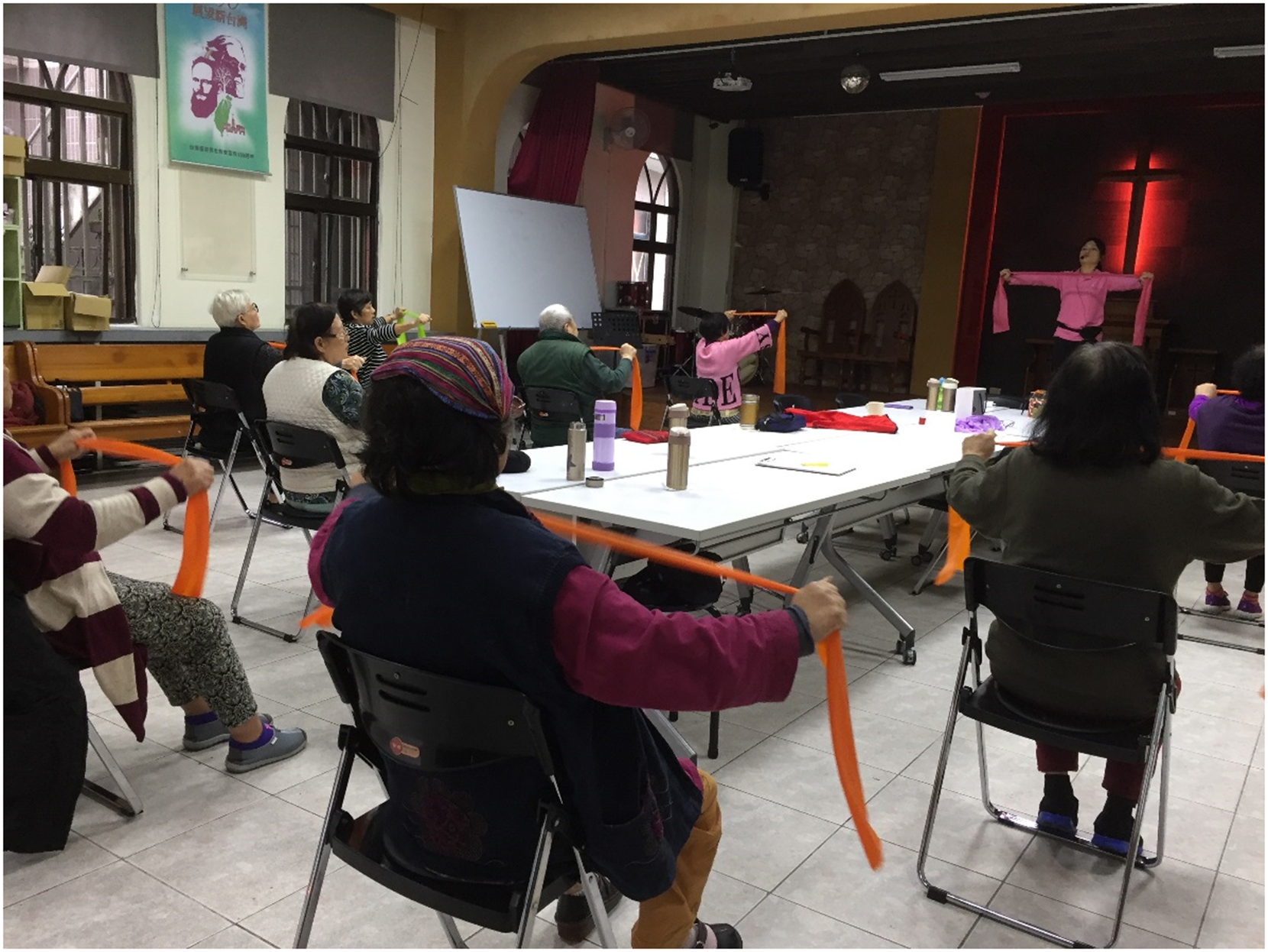
The instructor, a Tayal registered nurse from a hospital 20 kilometers outside the community, later explained to the researcher that she had designed the exercises according to the national guidelines for physical fitness. When prompted by the researcher, the instructor shared that although having Tayal heritage herself, she did not have much time or energy to reflect on how Tayal culture informs the physical exercises she offered to the various target groups due to her demanding workload.
However, the physical exercise sessions were often not led by a professional instructor. Instead, the care workers at the day club were in charge. The care workers had only received basic training as nurse aides and were usually busy preparing food or doing paperwork. They often turned on an exercise video (featuring everything from fitness instructors from popular culture to nursing home videos) and asked the Bnkis to follow. During our fieldwork, typically, only a handful of the Bnkis would follow the movements in the videos. The others retired to socialize, either because they preferred to talk or, in some cases, because they could not do the swift movements shown in the video. One such Bnkis explained to the fieldworker, My legs are very sore. I must keep walking around [rather than following the aerobics videos], so they will not be too sore. However, some of the Bnkis in better physical condition were more engaged in following videos and sometimes encouraged others to do the same. Tamu, a Bnkis who was almost 90 years old, noted:
[The day club] activities are all good, especially for the aged people. We can move our bodies and train our brains via making toys with our hands. I think all activities are the same, I like them, all of them. If there are activities for groups, I have taken part in them all.
While some participants liked physical activities, others felt alienated and said that these activities were not adapted to their preferences. Sayoko commented, We are [treated] like little children! These are lessons for little children. This statement revealed a strong desire to be treated the same as other adults. Another Bnkis, Yaway, shared a story about a situation where she had been forced to take part in a physical activity, which in fact had ended with her falling and getting injured:
I told them that I could not step my feet in the squares they drew. I did not want to play because my legs hurt. They ignored me and said, Come exercise a bit! I was in pain, and they kept pushing me, saying, Come on, give it a try! Exercise, exercise! They should not have forced me because my legs hurt. They should have considered that I am more than 80 years old so I should be the one to decide if I want to participate or not. In the end I fell after being pushed to play. I was so angry! They kept forcing me and then I ended by falling! They should be responsible for that. It is infuriating!
This story illustrates that the care workers, when they want to activate the participants at the day club, may sometimes end up pushing the Bnkis too hard, resulting in accidents and even injuries.
It should also be added that the day club members all regularly attended a competition for indigenous day clubs that takes place twice a year in New Taipei City. During these competitions, the municipal authority expected the Bnkis of the different day clubs to perform aerobics. Contrary to the state’s story that frames the competition as a “fight for group honor, [to] reignite passion and energy,” we found that the Bnkis in the day club had mixed feelings. Indeed, the competition provided a space where Bnkis could gather and socialize with people from other day clubs. However, the municipality designed the competition program for Bnkis who were in better bodily condition. At one such competition observed by the first author, an aerobics instructor opened the competition with choreography so complex and swift that most of the Bnkis from the day clubs in the Tayal territory were unable to follow.
Expanding Active Aging through Cisan
Although the Bnkis had mixed feelings about some of the day club activities, they appreciated the opportunity to reconnect with their cultural background. One of the participants who talked about the importance of connecting to other older Tayal was Amuy. Amuy did not come very often to the Club, the researcher noted. When asked why this was the case, Amuy explained that, just as in the old days, she was still a busy woman and simply did not have time to come very often. She shared that until a few years back, she ran a shop on the main road in the village aimed at tourists, selling traditional wines, delicacies, and other local specialties. Although she had left the business to her family some years ago, she still liked to sit in the shop, watching the customers and sometimes engaging in conversations with them. Socializing was what she valued about taking part in the day club as well:
When we get together (here in the day club), we can Cisan. We can chat and be happy. We talk about everything. Indigenous people are like this. Cisan. We talk about absolutely everything.
This quote reveals that Cisan is about reconnecting with each other and about strengthening social relationships through Sli’, which means “gathering.” Amuy was happy to gather and Cisan with the familiar faces, although sometimes she had difficulties putting names to them. She said:
I don’t remember everyone’s names. They told me, but I forget very fast. They told me their husbands’ names, I forget that very fast, too. They told me someone has passed away, and I forget who it was.
Although Amuy struggled with her memory, that did not seem to bother her or the other participants. With Cisan, the day club became a safe place to get old. Struggling with memories was not seen as a cognitive deficit, but something all the Bnkis shared. The key was to get together and reconnect. Thus, one of the other participants noted:
I am happy to get old here, seeing so many gathering here from different villages. We used to see each other a lot before, but not so much anymore. I cherish the moments when we can talk and tell stories about our lives. We say things like, Oh, you are in good shape or Jeez, we used to have such hardships in life. Indeed, the state, and the Council of Indigenous Peoples, is very good for us old people because they bring us together in this club.
Another Bnkis echoed:
It is not bad at all to go to the day club. We are all very happy there. We are getting old, so it is great to have an opportunity to gather with friends and talk.
In different ways, the participants emphasized that sharing through storytelling, Cisan, and gathering (Sli’) were important for them. Reconnecting to the Tayal language, which several of them had not spoken for decades (Silan & Munkejord, Reference Silan and Munkejord2022) was also part of this. Amuy, for instance, who was married to a Chinese man and who was engaged in tourism, had spoken the Tayal language only occasionally with her siblings and some other relatives. She shared that it felt so good to go to the day club and return to her own roots:
If the others speak shāndì huà [Tayal], we communicate in shāndì huà. That is good. Then we can communicate very rapidly. If you cannot speak shāndì huà, then we can switch back to guó yǔ [Mandarin Chinese]. Shāndì huà is what I was born with. Puqing kai. It is my root.
Expanding Active Aging Through Malahang
The day club gave the Bnkis an opportunity to Cisan and reconnect with each other, centre the values of being Tayal, and engage in Malahang, which means caring for the land, animals, traditional activities, and people across generations. One of the care workers at the day club explained that she hoped that the Bnkis would find the day club to be an intergenerational space for Tayal culture. She said that they would invite children from the local school so that the Bnkis could teach them how to make traditional Tayal food, such as mochi, a traditional dish made of millet and sticky rice where one starts by pounding the ingredients in a big mortar. The care worker commented that bringing the children to the day club helped the Bnkis remember the past and share experiences from their childhood. This activity happened a couple of times during our fieldwork. On one of these occasions, the Bnkis felt reserved in the beginning. However, once the children had shared their own names and the names of their parents and grandparents, the atmosphere loosened up. One of the pupils brought some traditional marinated fish and pork, which the Bnkis appreciated greatly. When tasting the traditional food, described as mouth-watering, one of the Bnkis noted: We used to have a lot of banana trees in the village. My mother used to smoke the banana into crispy snacks. I really wish to revive the food that we used to make.
The participant emphasized the importance of becoming grounded by sharing and eating Tayal food. Another activity that was conceptualized as Malahang by several Bnkis was a session with an enthusiastic handicraft teacher, who came to share with the Bnkis her passion for ramie. The ramie is a plant traditionally used by Tayal for spinning thread, dyeing, and weaving. In their childhood, all the participants had seen their parents and grandparents wearing clothes made from ramie. During this session, Bnkis got some bark to feel and work with. They were asked to scrape off some fiber, twist a little thread, and make a pair of earrings while the teacher showed how to do it. The feel of the ramie cast a spell on several of the Bnkis. When holding the ramie bark and scraping the fibers, Amuy shared that her parents had told her how to harvest and process ramie when she was a young girl. The other participants remembered details about how to dye the ramie fiber in different colors. Amuy noted that it felt so good to touch the ramie because it was completely different from nylon!, adding: Ramie gives me more power.
A third activity that was conceptualized as Malahang by several Bnkis was interacting with the preacher who led services at the day club once a week, and who sometimes participated in activities or had lunch together with the Bnkis. The preacher was Tayal, familiar with the Tayal way of life, including hunting, fishing, making traditional handicrafts such as mouth harps and drums and Tayal law called Gaga (see Silan & Munkejord, Reference Silan and Munkejord2022). Several Bnkis liked to listen to the preacher talking about Tayal ways of life, as it revived their own memories.
Yaway explained to the researcher that, Malahang is care. Malahang is a prerequisite in our lives, and we experience it in the church, in the children, and when planting vegetables. Similarly, a participant noted that he needed to uphold the Malahang with the mountains and engage in activities such as hunting and trapping. Some of the participants shared that their feet were sore when they were at home, and they felt tired. When they went up to their ancestral land in the mountains where their family had traditionally grown fruits and vegetables, it was like a heavy veil was lifted. They felt a sense of wholeness, belonging, and continuity. Despite this, and despite the focus on physical activities as a central part of the weekly program of this day club, the Bnkis never went as a group from the day club to the mountains to pick fruits and vegetables, fish, or to be in the landscapes of their ancestors.
Discussion
Disempowering Active Aging: Welfare Colonization?
Critical voices in social gerontology have pointed out that there are severe limitations in the dominant Euro-American biomedical programs of aging well (Brooks-Cleator & Lewis, Reference Brooks-Cleator and Lewis2020; Ryan et al., Reference Ryan, Jackson, Gabel, King, Masching and Thomas2020). In line with this critique, this study indicates that the Bnkis in the day club where this study took place, regularly had to listen to sessions about health and illness. While information meetings are not bad per se, the content shared during these sessions was likely to be irrelevant at best and alienating at worst. Thus, too complicated formal lessons on health and illness, and aerobic sessions with far too rapid movements, may be reminiscent of what Wang (Reference Wang, Teyra and Ru2018, p. 174) calls “welfare colonization.” This entails that Taiwan continues its colonization by carrying out social welfare that disregards the Bnkis’ distinctive needs and Tayal’s knowledge, reinforcing “Indigenous dependency on outsiders and status of learned helplessness.” Indeed, aging and care researchers have asserted that the measures aimed at promoting people to age actively may be harmful if they narrowly reflect an epidemiological approach (Ryan et al., Reference Ryan, Jackson, Gabel, King, Masching and Thomas2020), a dominant biomedical knowledge system (Brooks-Cleator & Lewis, Reference Brooks-Cleator and Lewis2020), or are expressed through a positivist paradigm (Braun, Browne, Ka’opua, Kim, & Mokuau, Reference Braun, Browne, Ka’opua, Kim and Mokuau2014). The practice of “active aging” framework in local day clubs Taiwan, in other words, so far lacks cultural safety.
Active Aging Grounded in a Tayal Perspective: Cisan and Malahang
Thus, while physical activities and information about health and well-being may be relevant and vital, this study indicates that if the Bnkis had been given a voice, they might have preferred different physical exercises. The activities that may be more culturally safe would be, for instance, occasional trips to the traditional lands of their ancestors in the nearby mountains, where they could pick vegetables or fruit and prepare a simple traditional meal such as smoked banana chips. On the land, they could engage in trapping, fishing, traditional singing, and dancing, or doing traditional activities, such as working with ramie.
The concepts of Cisan and Malahang were significant in the Bnkis’ stories about active and meaningful aging. Being embedded in a relational and spiritual context, Cisan signifies care for someone through strengthening social relationships and talking together in a supportive way, preferably in the Tayal language, whereas Malahang means caring relationships among people as well as between people, handicrafts, and the land. Both Cisan and Malahang speak to the important messages conveyed by Indigenous Elders in previous research, such as interconnectedness of generations and relationships (Rowe et al., Reference Rowe, Baldry and Earles2015), establishing trust and rapport within the community (Frigault & Giles, Reference Frigault and Giles2020) and reinforcing eldership, which is key to cultural continuity (Brooks-Cleator & Lewis, Reference Brooks-Cleator and Lewis2020). Indigenous notions of health are important to consider when devising strategies for active aging (Ryan et al., Reference Ryan, Jackson, Gabel, King, Masching and Thomas2020). Moreover, research indicates that a culturally safe approach is essential for developing meaningful health care services not only in Taiwan, but also in various Indigenous contexts in different parts of the world, such as among Alaska Native Elders (Brooks-Cleator & Lewis, Reference Brooks-Cleator and Lewis2020), Inuvialuit Elders (Frigault & Giles, Reference Frigault and Giles2020), and Native Hawaiians with dementia (Browne, Ka’opua, Jervis, Alboroto, & Trockman, Reference Browne, Ka’opua, Jervis, Alboroto and Trockman2017), to mention a few.
Conclusion
This study shows that the Bnkis taking part in a local day club had ambivalent experiences of the physical activities and information sessions about health and illness, and that some of these sessions were carried out in a way that was culturally unsafe to the participants. At the same time, this study elucidates Tayal-centred care concepts by introducing Cisan and Malahang. These findings are relevant for developing Indigenous-led health and well-being systems and indigenizing policies worldwide.
Previous research has identified collective trauma as a cumulative form of emotional and psychological wounding across generations, which takes a toll on the well-being of Indigenous peoples (Braun et al., Reference Braun, Browne, Ka’opua, Kim and Mokuau2014; Brave Heart, Chase, Elkins, & Altschul, Reference Brave Heart, Chase, Elkins and Altschul2011; Czyzewski, Reference Czyzewski2011; Evans-Campbell, Reference Evans-Campbell2008; Walters et al., Reference Walters, Mohammed, Evans-Campbell, Beltrán, Chae and Duran2011).
If long-term care services continue to neglect Indigenous peoples’ perspectives on health, care, and well-being, welfare colonization will continue to worsen the cumulative losses inflicted by colonialism (Wang, Teyra, & Ru, Reference Ru2018). Although the president in Taiwan Tsai Ing-wen has acknowledged that long-term care should henceforth be developed in relation to the local circumstances of the Indigenous Elders across Taiwan, limited progress has been made so far. Thus, more decolonizing work is needed in the field of aging and care to counter welfare colonization, such as transforming “active aging” to “harmonious aging” (Liang & Luo, Reference Liang and Luo2012). Harmonious aging refers to a new paradigm that sees aging as holistic, dialectic, context-driven, and relationship-based. Truly listening to and learning from the voices of Indigenous Elders, as illustrated in this study, are only the first step to developing long-term care services more adapted to Indigenous cultural values, linguistic competencies, and cosmologies.
Acknowledgements
We are deeply grateful to those who helped make this article possible. To the Bnkis we have had the privilege of knowing. We are inspired by your unwavering resistance to the dominant forces of coloniality. We are also grateful for our dear colleagues Associate Prof. Tove Mentsen Ness and Terhi H. Holster at Nord University, and Associate Prof. Grete Mehus, Lecturer June Eira and Prof. Jan-Erik Henriksen at UiT the Artic University of Norway for their valuable comments to an earlier draft of this article.



