





Introduction
Interaction is a key component of second language (L2) teaching and learning as it provides speakers with opportunities to experience input (Gass & Mackey, Reference Gass, Mackey, VanPatten and Williams2015), negotiate for meaning (Long, Reference Long, Ritchie and Bhatia1996), receive feedback (Mackey, Gass, & McDonough, Reference Mackey, Gass and McDonough2000), notice language structure (Schmidt & Frota, Reference Schmidt, Frota and Day1986), and produce output (Swain, Reference Swain and Hinkel2005), all through meaningful communication. Researchers have focused on various features of interaction that could make it more or less beneficial for L2 speakers (Loewen & Sato, Reference Loewen and Sato2018), including the nature of a speaking task (e.g., information-gap vs. opinion-gap), composition of speakers (e.g., dyads vs. small groups), their relative language skill (e.g., expert vs. novice), and interactional behaviors (e.g., engagement, responsiveness). Other researchers have examined various pragmalinguistic features of interactional competence, such as compliments, requests, and disagreements (Eskildsen & Kasper, Reference Eskildsen, Kasper and Taguchi2019); explored the social dynamics of interaction for speakers varying in gender, status, and formality (Bayley & Escalante, Reference Bayley, Escalante and Geeslin2022); and investigated different conversational routines, including turn-taking, topic abandonment, and many forms of verbal and nonverbal feedback (Gardner, Reference Gardner2019).
One notable gap in this rich L2 interaction literature concerns interlocutors’ beliefs about the impressions they make on each other, which are collectively known as metaperceptions. Unlike self-perceptions, which are speakers’ beliefs about themselves, metaperceptions are speakers’ beliefs about how other people perceive them. First language (L1) speakers often show biased metaperceptions (e.g., underestimating how they are perceived by their interlocutors), and such biases seem to have real-life consequences in the sense that speakers avoid asking for help or abstain from future interaction (Boothby, Cooney, Sandstrom, & Clark, Reference Boothby, Cooney, Sandstrom and Clark2018). In this study, we examined interlocutor metaperceptions in paired conversations between L1 and L2 university students, targeting the domains of interpersonal liking, speaking skill, and interactional behavior, to determine the role of metaperception in students’ assessment of their future communication behaviors. Our goal was to explore potential barriers to communication stemming from metaperception.
Background literature
What are metaperceptions and why do they matter?
Broadly defined as impressions people believe they make on others, metaperceptions form part of the knowledge system capturing people’s understanding of themselves and their social world (Carlson & Barranti, Reference Carlson, Barranti, Hall, Mast and West2016). Metaperceptions, which should be distinguished from people’s self-views or their perceptions about themselves (Wallace & Tice, Reference Wallace, Tice, Leary and Tangney2012), require people to create and entertain a “theory of mind” to understand the perspective of another person toward themselves. Metaperceptions are important because they shape people’s identities, relationships, and behaviors (Kenny, Reference Kenny2019). For example, if employees believe that they are respected by their superiors and liked by their colleagues, these employees might be motivated to volunteer an opinion or put in extra work effort (Byron & Landis, Reference Byron and Landis2020). Similarly, individuals in need of assistance might be reluctant to appeal for help if they feel that their request might be misperceived as an imposition (Dungan, Munguia Gomez, & Epley, Reference Dungan, Munguia Gomez and Epley2022; Zhao & Epley, Reference Zhao and Epley2021). Indeed, speakers who accurately view how their friends, acquaintances, family members, or casual observers perceive them experience multiple benefits, such as more confident public speaking (Kleinlogel, Renier, Schmid Mast, & Toma, Reference Kleinlogel, Renier, Schmid Mast and Toma2020), increased interpersonal liking in platonic and dating scenarios (Tissera, Gazzard Kerr, Carlson, & Human, Reference Tissera, Gazzard Kerr, Carlson and Human2021), and greater relationship quality (Cameron & Vorauer, Reference Cameron and Vorauer2008).
Some metaperceptions are generally accurate, meaning that people have a good sense of how they are seen through the eyes of their interlocutors. According to a meta-analysis of 26 studies (Carlson & Kenny, Reference Carlson, Kenny, Vazire and Wilson2012), interlocutors provide fairly realistic estimates of how they are perceived in terms of their personality (e.g., extraversion, conscientiousness), competence (e.g., intelligence, leadership), and personal and emotional states (e.g., attractiveness, happiness), where highly observable traits such as talkativeness tend to elicit the most accurate metaperceptions. However, other social attributes, including interpersonal liking and popularity, are characterized by metaperceptions that are consistently underestimated. This tendency, called the liking gap, occurs when people systematically underestimate the extent to which others like them. In an initial investigation of the liking gap, Boothby et al. (Reference Boothby, Cooney, Sandstrom and Clark2018) paired previously unacquainted interlocutors with instructions to speak for about 5 min using several icebreaker questions. Following the conversation, each speaker evaluated how much they liked their partner (actual liking) and provided a metaperception judgment as to how much their partner liked them. There was a reliable liking gap, where L1 speakers consistently believed that their conversation partners liked them less than how they were actually perceived, and this gap was greater for speakers who scored higher on the personality variable of shyness. Most strikingly, the liking gap was independent of conversation length, occurring in interactions lasting between 5 min and several hours, and it persisted for several months among students who communicated with each other daily. A similar liking gap was reported for L1-speaking children by Wolf, Nafe, and Tomasello (Reference Wolf, Nafe and Tomasello2021), where children as young as 5 years of age underestimated the degree to which they were liked, and this gap grew progressively larger between the ages of 5 and 11. Comparable levels of underestimation were also observed during small group interaction and work team conversation (Mastroianni, Cooney, Boothby, & Reece, Reference Mastroianni, Cooney, Boothby and Reece2021).
The liking gap is a particularly interesting phenomenon to document because of its relevance to interlocutor behavior. There is a growing body of evidence suggesting that people’s metaperception bias, including their tendency to underestimate interpersonal liking, has real-life consequences (Byron & Landis, Reference Byron and Landis2020; Cameron & Vorauer, Reference Cameron and Vorauer2008; Sandstrom & Boothby, Reference Sandstrom and Boothby2021). For example, for engineering students working in small teams, how much they believed their interlocutors liked them predicted whether they were willing to ask for help, give advice, and collaborate on another project; and for workplace employees, their metaperception of interpersonal liking additionally predicted how they assessed their team’s effectiveness and job satisfaction (Mastroianni et al., Reference Mastroianni, Cooney, Boothby and Reece2021). Thus, given that 59% of adults in Elsaadawy and Carlson’s (Reference Elsaadawy and Carlson2022) sample of nearly 2,500 participants demonstrated negative interpersonal liking gaps, feeling uncertain as to how they were perceived by others, many people might be disadvantaged if their negative impressions prevent them from otherwise beneficial future actions such as giving advice, seeking collaborations, and performing jobs.
In an initial investigation of the liking gap in L2 interaction, Trofimovich, Lindberg, Bodea, Le, Zheng, McDonough (Reference Trofimovich, Lindberg, Bodea, Le, Zheng and McDonough2023) recently demonstrated that a comparable negative bias exists for international students communicating in a shared L2. After engaging in a paired academic discussion task for 10 min, 76 L2 university students consistently underestimated the degree to which they were liked by their conversation partners. Besides the liking gap, Trofimovich et al. (Reference Trofimovich, Lindberg, Bodea, Le, Zheng and McDonough2023) also reported similar gaps in interlocutor metaperception of speaking skills (e.g., how fluently and comprehensibly they spoke) and interactional behavior (e.g., how well they collaborated). However, only the female L2 students appeared to draw on metaperception in expressing interest in future interaction with the same conversation partner (regardless of the partner’s gender). The women who were feeling especially uncertain as to how likeable they were seen by their interlocutors and how much their interlocutors appreciated their interactional behavior expressed less desire to interact with those interlocutors in the future. These initial findings suggested that the liking gap is a phenomenon generalizable to L2 communication, and that some speakers’ metaperceptions are related to their willingness to engage in future interactions with an interlocutor.
How are metaperceptions relevant to L2 speakers?
Our focus on metaperception was motivated through social psychological work in L1 communication (Carlson & Barranti, Reference Carlson, Barranti, Hall, Mast and West2016; Sandstrom & Boothby, Reference Sandstrom and Boothby2021), which corresponds to how we set up this study through our review of background literature. However, metaperception and its consequences for L2 speakers clearly intersect with the constructs of speaker engagement and willingness to communicate, which are central to L2 learning and examined in our own prior work (e.g., Dao & McDonough, Reference Dao and McDonough2018; Taylor Reid & Trofimovich, Reference Taylor Reid and Trofimovich2018; Trofimovich, Tekin, & McDonough, Reference Trofimovich, Tekin and McDonough2021). Because the discussion of these concepts was added to this manuscript a posteriori through revision following peer review, we purposely do not extensively discuss these topics as part of the conceptual foundations of this study to reflect our research process as it unfolded. In brief, however, speaker engagement encompasses a person’s context- and situation-dependent action with respect to another person, situation, or task (Mercer, Reference Mercer, Gao, Davison and Leung2019). In interaction, more specifically, a speaker can show engagement with an interlocutor in multiple ways, such as by contributing conversation-relevant content, elaborating or clarifying ideas, expressing approval or disapproval through backchanneling or nodding, or displaying emotion through laughter and facial expressions (Hiver, Al-Hoorie, Vitta, & Wu, Reference Hiver, Al-Hoorie, Vitta and Wu2024). With its many manifestations, engagement in interaction therefore provides L2 speakers with various types of information which they can draw on in forming metaperceptions, including how much their interlocutor likes them and appreciates their linguistic skill and interactional behavior.
In terms of potential consequences of metaperceptions, they can be understood broadly within the construct of willingness to communicate, typically defined as a speaker’s comfort level in initiating communication with interlocutors (MacIntyre, Dörnyei, Clément, & Noels, Reference MacIntyre, Dörnyei, Clément and Noels1998). As a dynamic, context-relevant construct, willingness to communicate encompasses both stable characteristics, such as a speaker’s predisposition to engage in interaction (e.g., self-esteem, extraversion), and changeable variables, such as a speaker’s relationship with potential interlocutors and the topic of interaction (Syed, Memon, Chachar, Zameer, & Shah, Reference Syed, Memon, Chachar, Zameer and Shah2022). From this perspective, L2 speakers’ desire to engage in or abstain from a future interaction with an interlocutor might be driven by their immediate experience with that interlocutor through a decision which is “action-oriented, adaptive, and [involves] feelings of personal welfare” (MacIntyre, Reference MacIntyre2020, Reference MacIntyrep. 125). Such a decision might reflect, at least in part, L2 speakers’ metaperception, or the degree to which they believe that their interlocutor likes them and appreciates their linguistic skill and interactional behavior.
The current study
Considering the scarcity of prior work on metaperception in L2 communication and given the potential impact of speakers’ metaperceptions on their future behavior, in this study, we sought to investigate this issue further. Motivated through previous social psychological work in L1 communication (Boothby et al., Reference Boothby, Cooney, Sandstrom and Clark2018) and cognizant of a potentially important role of metaperception and its consequences for L2 speakers, we extended the initial investigation by Trofimovich et al. (Reference Trofimovich, Lindberg, Bodea, Le, Zheng and McDonough2023) to study the role of metaperceptions in L2–L1 communication. Because Trofimovich et al. (Reference Trofimovich, Lindberg, Bodea, Le, Zheng and McDonough2023) focused on paired interactions between university students interacting in a shared L2, it is unclear whether L2 speakers might underestimate interpersonal liking with other types of interlocutors, including L1 speakers. Furthermore, unlike in previous work with L1 speakers (Mastroianni et al., Reference Mastroianni, Cooney, Boothby and Reece2021), in the participant sample targeted by Trofimovich et al. (Reference Trofimovich, Lindberg, Bodea, Le, Zheng and McDonough2023), all L2 speakers demonstrated a reliable liking gap as a group but metaperception predicted future interaction behaviors only for female L2 students. Therefore, it is important to determine if the consequences of biased metaperception might differ depending on who the speaker is communicating with or might apply to some but not all L2 speakers, as these initial findings might suggest.
We focused on international L2 university students because they represent a large proportion of the university student population in Canada (where this study was conducted), with over 800,000 international students registered in 2023 (CBIE, 2023). In addition, international students commonly report feelings of exclusion and isolation and experience difficulty building meaningful social relationships, especially with L1-speaking peers (Fritz, Chin, & DeMarinis, Reference Fritz, Chin and DeMarinis2008). For example, half of the 182 US-based international students surveyed by Rajapaksa and Dundes (Reference Rajapaksa and Dundes2002) had no American friends, and only 10% of the 77 Canada-based international students investigated by Zhou and Zhang (Reference Zhou and Zhang2014) reported spending time with local peers outside instruction. International students also avoid participating in group discussions, often afraid to reveal their language challenges or create misunderstandings, and L2 speakers frequently report feelings of insecurity and anxiety and express negative attitudes and stereotypes (indicative of explicit or implicit social biases) that can make them unwilling to initiate and maintain L2 communication (Tatar, Reference Tatar2005; Wang, Ahn, Kim, & Lin-Siegler, Reference Wang, Ahn, Kim and Lin-Siegler2017). Thus, if metaperception exacerbates barriers to student communication, it is important to understand both the severity and the scope of these barriers.
In addition to interpersonal liking, we focused on two additional measures targeting students’ metaperceptions of their speaking skill (beliefs about how their partners evaluated their speech in terms of its fluency and comprehensibility) and their interactional behavior (beliefs about how their partners assessed their conversational behaviors such as turn-taking and responsiveness). These measures were inspired through L1 communication work, where speakers tend to overestimate how harshly their conversational ability is perceived by interlocutors, for instance, in terms of not contributing enough content or not knowing how to strike up a conversation (Sandstrom & Boothby, Reference Sandstrom and Boothby2021; Welker, Walker, Boothby, & Gilovich, Reference Welker, Walker, Boothby and Gilovich2023). These measures also broadly reflect the linguistic and behavioral dimensions of speaker engagement, such as the quality and quantity of language produced and the degree of interlocutor collaboration in dialogue (Dao & McDonough, Reference Dao and McDonough2018; Trofimovich et al., Reference Trofimovich, Tekin and McDonough2021). For university-level students, the metajudgments of speaking skill and interactional behavior likely encompass the linguistic and communicative capital that students need to succeed in academic and personal interaction (Neumann, Kozak, & Gil, Reference Neumann, Kozak and Gil2023).
Considering that previous investigations of the liking gap revealed personality variables (e.g., shyness) as moderators of interlocutors’ tendency to underestimate their interpersonal liking (Boothby et al., Reference Boothby, Cooney, Sandstrom and Clark2018), we included students’ personality traits (e.g., open-mindedness, negative emotionality), along with other individual difference variables capturing their demographic and linguistics profiles (speakers’ age and their self-rated English use), in our statistical analyses on the assumption that speakers’ ratings of each other might vary as a function of their age, the extent of their regular English use, and specific personality traits (Boothby et al., Reference Boothby, Cooney, Sandstrom and Clark2018; Sandstrom & Boothby, Reference Sandstrom and Boothby2021). Because L2 speakers’ gender emerged as a moderator of their metaperceptions in Trofimovich et al. (Reference Trofimovich, Lindberg, Bodea, Le, Zheng and McDonough2023), we similarly explored participants’ self-reported gender in relation to their judgments of interpersonal liking, speaking skill, and interactional behavior. Finally, when modeling potential consequences of students’ metaperceptions, before exploring the unique contribution of each metajudgment, we accounted for each speaker’s liking of their interlocutor, on the assumption that the speaker’s desire to engage in a future interaction with that interlocutor would be driven, first and foremost, by the affect they feel toward them (Elsaadawy & Carlson, Reference Elsaadawy and Carlson2022; Mastroianni et al., Reference Mastroianni, Cooney, Boothby and Reece2021).
In light of the robust interpersonal liking gaps reported in prior research for child and adult L1 speakers across different contexts, including paired interactions and small-group discussions between previously unacquainted and familiar interlocutors (Boothby et al., Reference Boothby, Cooney, Sandstrom and Clark2018; Carlson & Kenny, Reference Carlson, Kenny, Vazire and Wilson2012; Elsaadawy & Carlson, Reference Elsaadawy and Carlson2022), and for university students communicating in a shared L2 (Trofimovich et al., Reference Trofimovich, Lindberg, Bodea, Le, Zheng and McDonough2023), we expected that both L1 and L2 speakers would underestimate the extent to which they are liked by their interlocutor. Consistent with how L1 speakers feel insecure about their communication skills (Sandstrom & Boothby, Reference Sandstrom and Boothby2021; Welker et al., Reference Welker, Walker, Boothby and Gilovich2023) and in line with preliminary evidence that at least some L2 speakers show similar insecurity in L2 conversation (Trofimovich et al., Reference Trofimovich, Lindberg, Bodea, Le, Zheng and McDonough2023), we anticipated that both L1 and L2 speakers would also underestimate how their speaking and interactional performance is seen by interlocutors. And in terms of the potential consequences of metaperceptions, we expected that L1 speakers as in Mastroianni et al. (Reference Mastroianni, Cooney, Boothby and Reece2021) and some L2 speakers as in Trofimovich et al. (Reference Trofimovich, Lindberg, Bodea, Le, Zheng and McDonough2023) might demonstrate metajudgments of interpersonal liking that are associated with their interest in future interaction with the same interlocutor. However, considering that L2 speakers likely face stronger linguistic challenges and generally experience larger cultural differences and perceived intercultural bias than L1 speakers (Gluszek & Dovidio, Reference Gluszek and Dovidio2010), we expected potential consequences of metaperception for future communication to be more pronounced for L2 speakers than for L1 speakers. Our study was guided by two research questions:
-
1. Do L1 and L2 students’ metaperceptions of interpersonal liking, speaking skill, and interactional behavior (perceived ratings) differ from how they are evaluated by their interlocutors (actual ratings) after engaging in an academic discussion task?
-
2. Do L1 and L2 students’ metaperceptions of interpersonal liking, speaking skill, and interactional behavior predict their desire to engage in future interaction with their interlocutors?
Method
Participants
The initial sample of participants included 60 university students, all recruited through social media outlets for students. There were 30 L1 English speakers and 30 L2 English speakers, and half of the students in each cohort described themselves as female and half as male. The students were invited to the testing session in groups of two, with the constraints that (a) there was one L1 speaker and one L2 speaker per dyad, (b) the two students had not known each other previously, and (c) there was an even gender composition across all dyads (10 female–female, 10 male–male, 10 mixed). In the end, one student dyad (female–female) was eliminated from the analysis because they disclosed their prior acquaintance (see Appendix A for a summary of interlocutor composition in terms of the students’ self-reported gender, L1, and age). Consequently, the final dataset included 58 students with a mean age of 24.25 years (SD = 6.65, range = 18–53). Even though speakers’ discipline might influence the degree to which they feel confident as to how they are perceived by their interlocutors (e.g., engineers might be overconfident; social scientists might feel underconfident), we did not control a speaker’s discipline as a variable; instead, we recruited a sample with the broadest distribution of various fields of university study. The students were enrolled in undergraduate (39) or graduate (19) degree programs from over 30 different study disciplines at an English-medium university in Montreal, Canada.
With the exception of three students (two from South Africa, one from the United States), the L1 English speakers were all Canadian who grew up speaking English from early childhood. They reported high familiarity with L2 English accents (M = 94.84, SD = 7.91), where 100 meant “highly familiar,” and cited French as the most commonly known language, which was expected in the bilingual French–English context of Montreal. All L2 speakers were international students, with a length of residence in Canada of less than 2 years (M = 8.29 months, SD = 6.69). The L2 speakers represented eight linguistic backgrounds, with Mandarin (9), Farsi (5), Arabic (4), and Turkish (3) the most common. As for their L2 English proficiency, they reported having studied English for a mean of 11.33 years (SD = 4.70) and having taken English-medium university coursework for a mean of 1.82 years (SD = 1.81). Of the L2 speakers who reported their most recent standardized scores, their mean International English Language Testing System score (n = 17) was 7.12 (SD = 0.55) and their mean Test of English as a Foreign Language Internet-based Test score (n = 6) was 101.83 (SD = 10.24), which corresponds to the C1 level (proficient user) in the Common European Framework of Reference for Languages. All L2 speakers also used a 100-point scale to assess their L2 skills, providing a mean score of 71.76 (SD = 20.33) for speaking and 81.81 (SD = 20.78) for listening, where 100 indicated “very competent.”
Materials
To simulate naturalistic classroom dialogue, an academic discussion task was used to prompt a conversation between the paired students (all study materials and data are available via the OSF at https://osf.io/8xzdu). They were provided with two different academic texts presenting opposing viewpoints on a debatable topic of general interest (nature vs. nurture), selected to ensure that specialized knowledge would not disadvantage either speaker (see Appendix B in the supporting information online). The texts were simplified summaries of two research studies, with one text emphasizing the role of genetics in determining one’s personality and the other highlighting the influence of environment in shaping personality traits. The texts were relatively short (189 and 204 words) to ensure that the students focused more on interaction than reading. On the back of each text, they were provided with five identical discussion questions (e.g., Which side do you agree with in the nature versus nurture debate? Are personality traits the result of nature or nurture?) to help guide their discussion. The assignment of each text to either the L1- or L2-speaking student was counterbalanced across all student dyads.
An online questionnaire administered through the LimeSurvey online interface (https://www.limesurvey.org) elicited the students’ impressions of the interaction, their interest in engaging in future communication, and their background information. For the students’ impressions of the interaction, we focused on each student’s perception of their partner and each student’s metaperception of how their partner felt about them, assessing three dimensions (interpersonal liking, speaking skill, and interactional behavior). There were four statements per dimension (see Appendix C in the supporting information online), for a total of 12 statements targeting each student’s perception (i.e., capturing the student’s own perspective, as in I liked the student) and 12 statements focusing on their metaperception (capturing the student’s view of their partner’s perspective, as in I think the student liked me).
The interpersonal liking dimension targeted how much each student liked their partner (e.g., I like the student, I would like to get to know the student better) and, for metaperception, how much the student believed their partner liked them (e.g., I think the student liked me, I think the student would like to get to know me better). These items, which were identical to those used by Boothby et al. (Reference Boothby, Cooney, Sandstrom and Clark2018) and Trofimovich et al. (Reference Trofimovich, Lindberg, Bodea, Le, Zheng and McDonough2023), meant to capture each student’s general perceptions of interpersonal liking. The two additional dimensions were the same as in Trofimovich et al. (Reference Trofimovich, Lindberg, Bodea, Le, Zheng and McDonough2023). The speaking skill dimension captured each student’s perception of how well their partner spoke (e.g., I liked how fluently the student spoke, I liked how easy the student was to understand) and, for metaperception, how much the student believed their partner liked the student’s speaking performance (e.g., I think the student liked how fluently I spoke, I think the student liked how easy I was to understand). Finally, the interactional behavior dimension targeted each student’s perception of how collaborative their partner was during the conversation (e.g., I liked how well the student responded to my ideas, I liked how the student gave me chances to talk) and, for metaperception, how much the student believed their partner appreciated the student’s collaborative behavior (I think the student liked how well I responded to their ideas, I think the student liked how I gave them chances to talk). These statements elicited consistent responses across all evaluated dimensions in prior work, with high reliability estimates reported for interpersonal liking (Cronbach’s α = .85–.94) in Boothby et al. (Reference Boothby, Cooney, Sandstrom and Clark2018) and Trofimovich et al. (Reference Trofimovich, Lindberg, Bodea, Le, Zheng and McDonough2023) and for speaking skill and interactional behavior (Cronbach’s α = .88–.97) in Trofimovich et al. (Reference Trofimovich, Lindberg, Bodea, Le, Zheng and McDonough2023). To indicate their opinion for each statement, the students used a 100-point sliding scale (0 = “strongly disagree,” 100 = “strongly agree”).Footnote 1 To facilitate comparisons between the present dataset and previous L2-focused work on metaperception, the scale was identical to that used by Trofimovich et al. (Reference Trofimovich, Lindberg, Bodea, Le, Zheng and McDonough2023).
To assess the potential for a future interaction between the two students, we captured the students’ desire to engage in various academic activities with their partner through their responses to nine additional statements (see Appendix C). Inspired by prior work on the consequences of metaperception bias (e.g., Mastroianni et al., Reference Mastroianni, Cooney, Boothby and Reece2021), these nine statements were identical to those used by Trofimovich et al. (Reference Trofimovich, Lindberg, Bodea, Le, Zheng and McDonough2023), who reported high reliability (Cronbach’s α = .94) across these statements in a sample of 76 participants. Because university students are primarily engaged in academic activities as part of their studies, most statements focused on each student’s desire to participate in joint academic activities (joining group discussions, codelivering a presentation, belonging to a study group), in communication about academic topics (asking for explanations of a concept or term, and in emailing questions about course content, asking for advice on assignments, requesting to share notes), with two statements targeting interactions outside coursework (spending free time outside class, giving open and honest advice). To indicate their judgment about each statement, the students used a similar 100-point sliding scale (0 = “never,” 100 = “definitely”). Finally, a background questionnaire was used to elicit the students’ background and demographic information, and a 30-item personality survey (Soto & John, Reference Soto and John2017) was administered to capture five key personality traits for the students (extraversion, agreeableness, conscientiousness, negative emotionality, open-mindedness), each measured through statements accompanied by a 5-point scale (1 = “strongly disagree,” 5 = “strongly agree”).
Procedure
All data collection was conducted in accordance with an approved ethics certificate (30001284) from the researchers’ university. Data collection was conducted in person in a quiet multiroom laboratory at the researchers’ university. Each session was carried out with one L1–L2 dyad, with one of two researchers assigned to each participant. To preclude pretask interaction between the students, each was immediately escorted to separate individual rooms upon arrival, where they signed the consent form. Once ready, the researchers brought the students into a larger shared room, seating them at a table across from each other. The materials for the academic discussion tasks were given to the students on paper, in which they were instructed to read the text first and then start a discussion about the topic, with guiding questions available on the back of the paper, serving as prompts if needed. After giving out instructions, the researchers left the room, allowing the students to complete the task unobserved. After reading the texts, the students had the autonomy to decide when to start the discussion and the content of the discussion by themselves. The interaction was recorded by a voice recorder placed on the table out of sight to avoid distractions, and the students were informed about the recording before signing the consent form. The conversation lasted for 10 min, excluding reading time, allowing the students to express their understanding of the text and exchange their opinions freely. After the 10-min mark was reached by each conversation, the researcher returned to the room and instructed the students to return to their individual rooms to complete online questionnaires about their perceptions of the interaction (with perceptions about their partner elicited before metaperceptions), background information, and personality questionnaire. The students were left alone in the room to complete the questionnaire without distraction, and the researchers stayed outside the room to provide help as needed. The total testing time ranged from 40 to 50 min, and each student was compensated 30 CAD for their participation.
Data analysis
In terms of the students’ assessments of each other, there were two sets of ratings per participant: each student’s actual rating (i.e., as assessed by their partner) and their metaperception or perceived rating (i.e., how they believed their partner assessed them). Because the students’ responses to the four statements per rated dimension (interpersonal liking, speaking skill, interactional behavior) demonstrated high internal consistency (Cronbach’s α), each student’s evaluations were averaged across the four relevant statements to derive a single actual and a single perceived score per dimension (i.e., by averaging across the four items): actual interpersonal liking (α = .87), perceived interpersonal liking (α = .86), actual speaking skill (α = .93), perceived speaking skill (α = .92), actual interactional behavior (α = .86), and perceived interactional behavior (α = .88). In terms of the future consequences of interaction, based on nine responses per student, there was high consistency across the nine items (α = .90), so a single mean composite score was computed per student. The scores for the five personality traits were derived per student by averaging across the six items targeting each trait, using the test guidelines (Soto & John, Reference Soto and John2017): extraversion (α = .60), agreeableness (α = .61), conscientiousness (α = .75), negative emotion (α = .84), and open-mindedness (α = .52). These internal consistency values were generally lower than those reported previously (α = .73–.84) in scale validation research (Soto & John, Reference Soto and John2017), likely because the present dataset was smaller. Because no interaction lasted under 10 min and the researchers stopped each conversation at the 10-min mark, conversations were identical in duration across all dyads, meaning that interaction length did not need to be controlled as a variable.
To address the research questions, we computed linear mixed-effects models in R (version 4.2.2, R Core Team, 2023) using the lme4 package (version 1.1-31, Bates, Maechler, Bolker, & Walker, Reference Bates, Maechler, Bolker and Walker2015). Compared to traditional analyses of variance, mixed-effects models offer several advantages such as the ability to capture multiple sources of variation (both fixed and random), to analyze unbalanced datasets, and to allow for unequal variances between groups (Linck & Cunnings, Reference Linck and Cunnings2015). In light of these advantages and considering that previous datasets that motivated our work were also analyzed through mixed-effects models (Boothby et al., Reference Boothby, Cooney, Sandstrom and Clark2018; Trofimovich et al., Reference Trofimovich, Lindberg, Bodea, Le, Zheng and McDonough2023), we therefore opted for similar analytical tools in this study. For the first research question, which asked whether L1 and L2 speakers differed in their actual versus perceived assessments of the interaction, we computed three sets of models. In each model, interpersonal liking, speaking skill, and interactional behavior were the outcome variables whereas rating type (actual vs. perceived), speaker status (L1 vs. L2), and speaker and partner gender (female vs. male), and their interaction served as fixed-effects predictors, with random intercepts for speakers (58) nested within pairs (29). All models included several fixed effects as speaker-level control covariates (five personality traits plus speakers’ age and their self-rated weekly English use), on the assumption that the students’ ratings of each other might vary as a function of their age, the extent of their regular English use, and specific personality traits (e.g., agreeableness, open-mindedness). Because L1 speakers’ English proficiency was at ceiling and no objective proficiency measure was administered to all participants, we could not include proficiency as a control covariate in the full dataset. However, in a post hoc analysis, we computed correlations between the students’ self-rated English speaking and listening scores and their perceived and actual ratings. Because no association reached or surpassed the benchmark for a small association (|.25|), there was little evidence in our data that the students’ English proficiency contributed to their perceived and actual ratings.
To address the second research question, which focused on relationships between speakers’ perceived ratings and their desire to interact with their conversation partner in the future, we computed linear mixed-effects models, where the composite measure of future consequences of interaction served as the outcome variable and the students’ perceived ratings (in terms of interpersonal liking, speaking skill, and interactional behavior) were used as fixed-effects predictors, with random intercepts for speaker and listener gender. In each model, we also entered the students’ actual ratings of their partners (in terms of how much they liked them, their speaking, and their interactional behavior) as a control covariate, on the assumption that the composite measure of future consequences would be associated with the students’ actual perceptions of their partner rather than the students’ metaperceptions.
We used the maximum likelihood method to fit the models, with fit assessed through pairwise likelihood ratio tests comparing simpler to more complex models (Barr, Levy, Scheepers, & Tily, Reference Barr, Levy, Scheepers and Tily2013). Random slope models were examined, separately for speakers and pairs, but modeling these parameters did not improve model fit, so only the random intercepts of speakers and pairs were entered in the final models. For fixed-effects predictors, we forward-tested the predictors in an exploratory fashion and explored the interactions only when the inclusion of a predictor improved model fit. To estimate the significance of each predictor, we obtained p values through MuMIn package in R (version 1.47.1, Bartoń, Reference Bartoń2020) and examined 95% confidence intervals (CIs) to check the statistical significance of each parameter (interval does not cross zero). Correlation strength was interpreted based on field-specific guidelines (Plonsky & Oswald, Reference Plonsky and Oswald2014) for small (.25), medium (.40), and large (.60) effects, and probability values for correlation coefficients were adjusted using the Holm-Bonferroni method.
Results
Perceived versus actual ratings
The first research question targeted the L1 and L2 speakers’ perceived and actual ratings. As shown in Table 1, the three rated dimensions (interpersonal liking, speaking skill, interactive behavior) generally showed medium-strength associations for perceived and actual ratings (r = .30–.63), and these relationships appeared stronger for L1 speakers (r = .36–.63) than for L2 speakers (r = .30–.51). Considering that these rated measures shared only 9–40% of the variance, they captured sufficiently distinct evaluative dimensions. As summarized separately for each dimension (Tables 2–4), the speakers’ actual ratings (as assessed by their partner) were generally higher than the speakers’ perceived ratings (perceptions of their partner’s assessment, or metaperceptions), and some dimensions, such as interactional behavior, tended to be evaluated higher than others, especially speaking skill.
Intercorrelations between three sets of perceived and actual ratings for L1 speakers (below diagonal) and L2 speakers (above diagonal)

* p < .05 (two-tailed).
*** p < .001 (two-tailed).
Descriptive statistics for interpersonal liking ratings by speaker group

Descriptive statistics for speaking skill ratings by speaker group

** p < .01 (two-tailed).
Descriptive statistics for interactional behavior ratings by speaker group

Interpersonal liking
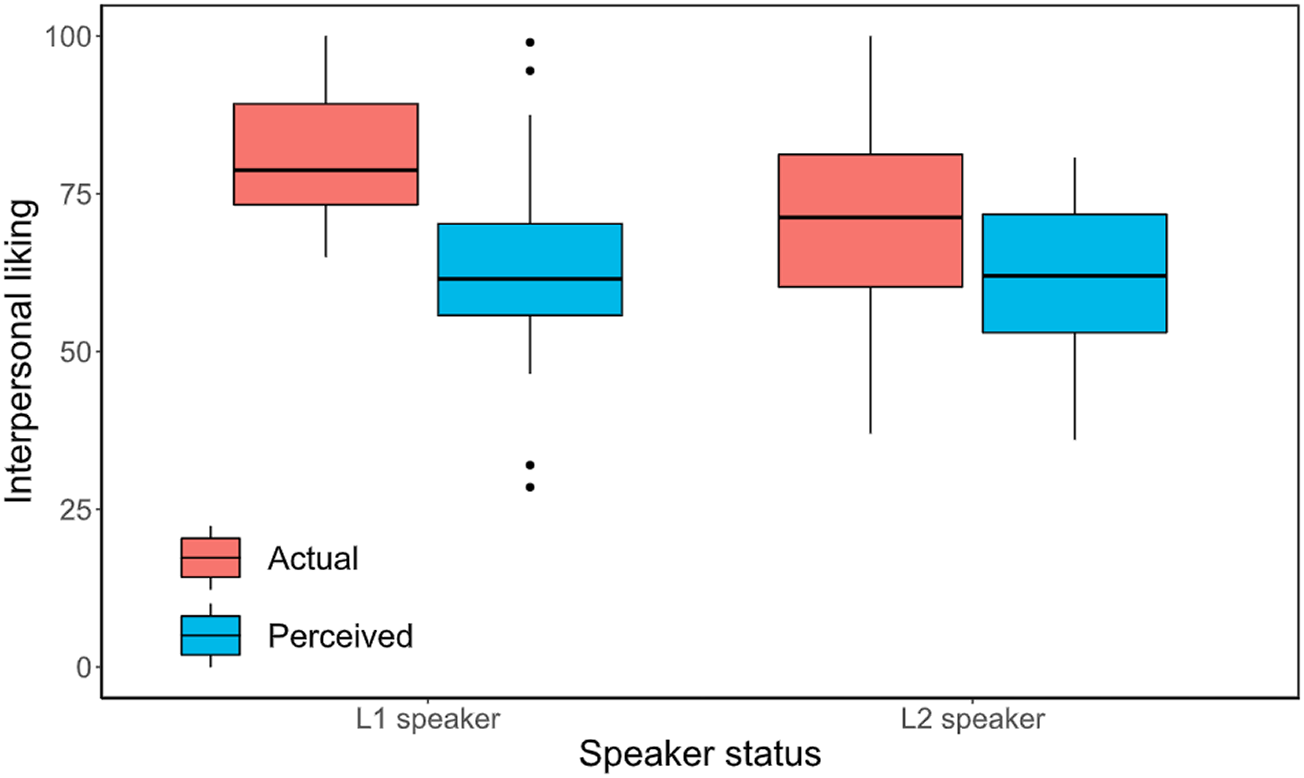
The initial model for interpersonal liking revealed a significant effect of rating type (perceived vs. actual), estimate = –14.89, SE = 2.41, t = –6.17, p < .001, 95% CI [–19.64, –10.14], where the speakers tended to underestimate how much their partner liked them by approximately 15 points on a 100-point scale. Adding a fixed effect of speaker status (L1 vs. L2) improved model fit, χ2(1) = 6.14, p = .013, indicating that L2 speakers’ ratings were generally lower than L1 speakers’ ratings. However, the interaction term between rating type and speaker status did not improve the model, χ2(1) = 1.95, p = .163, which meant that the effect of rating type was similar across L1 and L2 speakers. The inclusion of speaker and partner gender (female vs. male) or any interaction involving these terms similarly did not improve model fit, χ2(2) < 0.68, p > .711. Finally, the inclusion of control covariates did not improve model fit either, χ2(7) = 8.80, p = .267, and did not change the pattern of findings. In essence, all speakers (regardless of their own or their partner’s self-reported gender) tended to underestimate how much their partner liked them, although the rating gap between the perceived and actual ratings tended to be larger for L1 speakers than for L2 speakers (see Figure 1). The final model (summarized in Appendix D in the supporting information online) accounted for 29% of variance through fixed effects and explained a total of 40% variance through both fixed and random effects.
Boxplots for ratings of actual and perceived interpersonal liking by speaker status.

Speaking skill
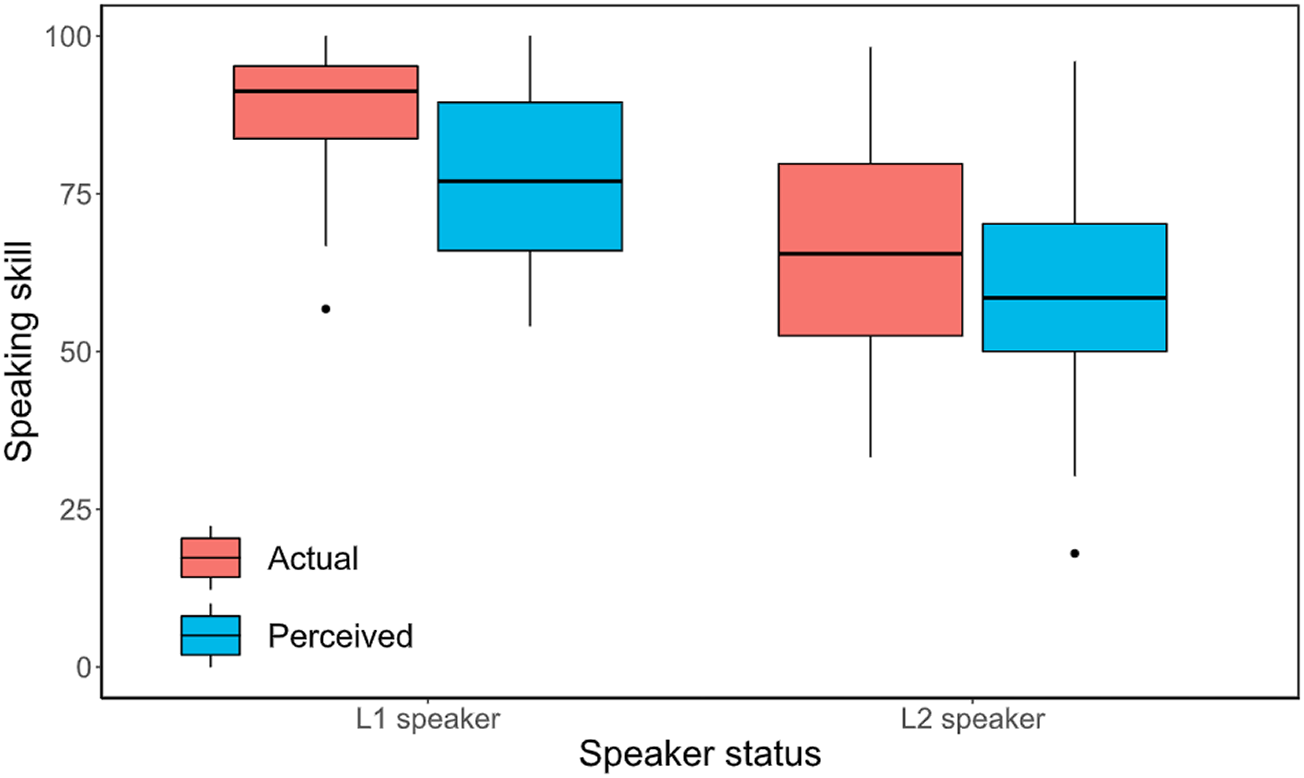
The initial model for speaking skill similarly yielded a significant effect of rating type, estimate = –8.59, SE = 2.79, t = –3.08, p = .003, 95% CI [–14.10, –3.08], where the speakers tended to underestimate their partner’s rating by approximately 9 points. Adding a fixed effect of speaker status improved model fit, χ2(1) = 33.40, p < .001, indicating that speaking skill was (predictably) lower for L2 speakers than for L1 speakers. However, the interaction term between rating type and speaker status did not improve the model, χ2(1) = 0.17, p = .677, which meant that the effect of rating type was comparable for L1 and L2 speakers. The inclusion of speaker and partner gender (female vs. male) or any interaction involving these terms similarly did not improve model fit, χ2(2) < 2.38, p > .305. Finally, the inclusion of control covariates did not improve model fit either, χ2(7) = 7.18, p = .410, and did not change the pattern of findings. As with interpersonal ratings, all speakers (regardless of their own or their partner’s self-reported gender) tended to underestimate how much their partner assessed their speaking skill (see Figure 2). The final model (see Appendix D) accounted for 35% of variance through fixed effects and explained a total of 42% variance through both fixed and random effects.
Boxplots for ratings of actual and perceived speaking skill by speaker status.

Interactional behavior
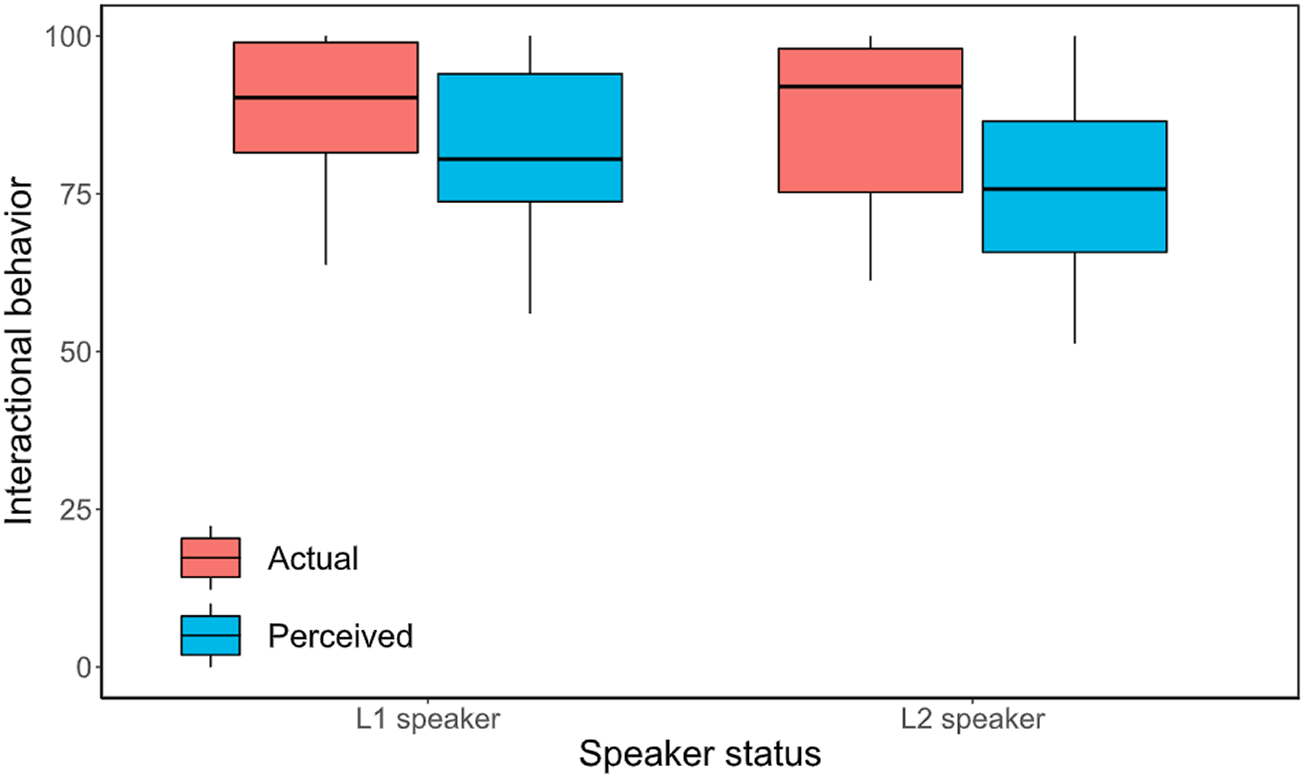
The initial model for interactional behavior similarly yielded a significant effect of rating type, estimate = –8.84, SE = 2.12, t = –4.17, p < .001, 95% CI [–13.02, –4.66], where the speakers tended to underestimate their partner’s rating by approximately 9 points. Adding a fixed effect of speaker status improved model fit, χ2(1) = 4.35, p = .037, indicating that interaction behavior was rated lower for L2 speakers than for L1 speakers. As with the other rated dimensions, the interaction term between rating type and speaker status did not improve the model, χ2(1) = 1.06, p = .302, which suggested that the effect of rating type was similar across L1 and L2 speakers. Likewise, the inclusion of speaker and partner gender (female vs. male) or any interaction involving these terms did not improve model fit, χ2(2) < 2.56, p > .279. Finally, the inclusion of control covariates did not improve model fit either, χ2(7) = 0.83, p = .997, and did not change the pattern of findings. As with the other rated dimensions, all speakers (regardless of their own or their partner’s self-reported gender) tended to underestimate how much their partner assessed their interaction behavior, although the rating gap between the perceived and actual ratings tended to be larger for L2 speakers than for L1 speakers (see Figure 3). The final model (shown in Appendix D) accounted for 13% of variance through fixed effects and explained a total of 35% variance through both fixed and random effects.
Boxplots for ratings of actual and perceived interactional behavior by speaker status.

Consequences for future interaction
The second research question asked whether the speakers’ perceived scores (i.e., how well they thought their partner evaluated them) predicted future consequences of interaction, as assessed through a composite measure across nine items targeting speakers’ desire to engage in communication with their partners. The speakers generally expressed fairly strong desire to interact with each other in the future, where the L1 speakers’ mean composite score was 73.42 on a 100-point scale (SD = 15.71, range = 35–100) and the L2 speakers’ mean composite score was 77.62 (SD = 12.05, range = 55–100). However, as shown through substantial SD and range values, individual speakers expressed a range of opinions. In line with our study’s focus on L1 versus L2 speaker comparisons, we tested the relationship between the speakers’ perceived scores and their composite measure of predicted future interaction separately for L1 and L2 speakers, while treating speakers’ and their interaction partners’ self-reported gender as random effects.
For L1 speakers, after controlling for those speakers’ actual perceptions of their partners, the composite measure of future consequences was predicted only by perceived interpersonal liking, estimate = 0.68, SE = 0.23, t = 3.03, p = .006, 95% CI [0.20, 1.10], but not by perceived speaking skill, estimate = 0.30, SE = 0.17, t = 1.73, p = .096, 95% CI [–0.03, 0.63], or perceived interactional behavior, estimate = 0.34, SE = 0.29, t = 1.16, p = .259, 95% CI [–0.20, 0.94]. In essence, how much L1 speakers perceived that their L2-speaking partners liked them (regardless of speakers’ own or their partners’ gender) significantly predicted their desire to engage in future interaction with those partners, where lower perceived ratings were associated with less desire for future interaction. In contrast, for L2 speakers, after controlling for those speakers’ actual perceptions of their partners, the composite measure of future consequences was not predicted by any of the three perceived ratings: interpersonal liking, estimate = 0.07, SE = 0.18, t = 0.38, p = .706, 95% CI [–0.28, 0.42], speaking skill, estimate = 0.17, SE = 0.12, t = 1.51, p = .144, 95% CI [–0.05, 0.40], or interactional behavior, estimate = 0.13, SE = 0.17, t = 0.77, p = .447, 95% CI [–0.18, 0.49]. Thus, L2 speakers’ metaperceptions were not associated with their desire for future interaction with their L1-speaking partners (for full models, see Appendix D). As illustrated in Figure 4, only L1 speakers’ future interactive behaviors were linked to how strongly they believed they were liked (metaperceptions, orange trendline), after controlling for those speakers’ actual liking of their partners (blue trendline).
Scatterplot of speakers’ assessments of future consequences of interaction as a function of their actual perceptions of their partners (I like partner, displayed in blue) and their perceived liking by their partners (I think partner likes me, metaperception, displayed in orange), separately by speaker status (L1 vs. L2), with the trendlines (using the GAM smoothing function) illustrating the best fit to the data.

Discussion
Building on prior research into the social dynamics of communication, we examined L1 and L2 speakers’ metaperceptions of interpersonal liking, speaking skill, and interactional behavior, exploring whether these judgments predict speakers’ willingness to engage in future interaction with each other in an academic context. The findings revealed consistent gaps in speakers’ judgments of interpersonal liking, speaking skill, and interactional behavior, inasmuch as previously unacquainted L1- and L2-speaking interlocutors, irrespective of their own or their partners’ gender, systematically underestimated how they were assessed by their partner. While this metaperception bias was statistically similar between L1 and L2 speakers, there was a tendency for L1 speakers to show a larger gap for interpersonal liking but for L2 speakers to exhibit a larger gap for interactional behavior. After accounting for speakers’ actual ratings of their partner (i.e., how much they liked the partner), only L1 speakers’ interest in engaging in future interaction was predicted by their metaperceptions of interpersonal liking.
Metaperception bias in interaction
The present study extends previous L1–L1 and L2–L2 communication research (Boothby et al., Reference Boothby, Cooney, Sandstrom and Clark2018; Mastroianni et al., Reference Mastroianni, Cooney, Boothby and Reece2021; Trofimovich et al., Reference Trofimovich, Lindberg, Bodea, Le, Zheng and McDonough2023; Wolf et al., Reference Wolf, Nafe and Tomasello2021) by showing a consistent metaperception bias for speakers to underestimate how much they are liked by their interaction partner when they communicate in mixed L1–L2 dyads. The magnitude of L2 speakers’ liking gap (–12) was comparable to the gap reported by Trofimovich et al. (Reference Trofimovich, Lindberg, Bodea, Le, Zheng and McDonough2023) in L2–L2 conversations (–14), whereas the gap for L1 speakers (–18) was in fact greater than that reported by Boothby et al. (Reference Boothby, Cooney, Sandstrom and Clark2018) in L1–L1 interaction (–0.65 on a 7-point scale, or a 9.3% difference). The trend for L1 speakers to show greater metaperception bias was unanticipated, considering that L2 speakers (as less proficient language users) tend to be less sensitive to verbal and nonverbal cues, such as facial expressions, body movements, and pragmalinguistic signals (Techentin, Cann, Lupton, & Phung, Reference Techentin, Cann, Lupton and Phung2021; Tian & McCafferty, Reference Tian and McCafferty2021), which provide speakers with subtle clues as to how their interlocutor feels about them (Donnelly, Moon, & Critcher, Reference Donnelly, Moon and Critcher2022). However, as shown in Table 2, it was L1 speakers who appeared less attuned to the interpersonal dynamics of interaction. Whereas all speakers underestimated their likeability to a similar degree, L2 speakers’ actual assessments of L1 speakers were on average more generous (82 on a 100-point scale) than L1 speakers’ assessments of L2 speakers (73). In the end, not only did L1 speakers doubt how well they were liked, but also they were actually perceived as more likeable compared to how much they liked their L2-speaking partners back.
These subtle differences notwithstanding, a general conclusion emerging from this dataset is that an interpersonal liking gap is a robust phenomenon, attested in various types of communication involving children, adults, and various combinations of L1 and L2 speakers (Boothby et al., Reference Boothby, Cooney, Sandstrom and Clark2018; Mastroianni et al., Reference Mastroianni, Cooney, Boothby and Reece2021; Trofimovich et al., Reference Trofimovich, Lindberg, Bodea, Le, Zheng and McDonough2023; Wolf et al., Reference Wolf, Nafe and Tomasello2021). In fact, this dataset included an arguably larger proportion of speakers (84.5%, or 49 of the 58 participants, comprising 24 L2 speakers and 25 L1 speakers) underestimating their interpersonal liking, compared to 75% of L2 speakers in Trofimovich et al. (Reference Trofimovich, Lindberg, Bodea, Le, Zheng and McDonough2023) and 59% of L1 speakers in Elsaadawy and Carlson’s (Reference Elsaadawy and Carlson2022) dataset of over 2,000 observations, implying that L1–L2 interaction might be especially prone to eliciting liking gaps. The increased tendency for interlocutors to underestimate their liking might stem from greater between-speaker differences in L1–L2 interaction, compared to L1–L1 and L2–L2 conversations where speakers might be more closely matched. For instance, L1 speakers communicating with each other, just as L2 interlocutors using a lingua franca, not only share a common identity but also experience comparable levels of linguistic challenge as L1 or L2 speakers. When such similarities are reduced, as would be the case in L1–L2 conversations, interlocutors might feel especially insecure as to how they are perceived by their partner, leading to a greater tendency to underestimate interpersonal liking.
In addition to the liking gap, both L1 and L2 speakers showed a metaperception bias to underestimate their speaking skill (in terms of accuracy, fluency, and comprehensibility) and interactional behavior (in terms of collaborativeness, responsiveness, and turn-taking). These findings imply that biased metaperception extends beyond such attributes as speaker personality, competence, and likeability (Carlson & Kenny, Reference Carlson, Kenny, Vazire and Wilson2012) to encompass conversation-relevant language and interaction skills. Considering that L1 speakers often express an overly negative view of how their conversational ability is assessed by their interlocutor and believe that the interlocutor enjoys the conversation significantly less than they do (Sandstrom & Boothby, Reference Sandstrom and Boothby2021), it is reasonable that L1 and L2 speakers interacting with each other should similarly feel uncertain as to how their language and interaction skills are perceived by their partner. A critical view of one’s interactional performance—as seen through the eyes of the interlocutor—is also consistent with the attested tendency for speakers to engage in a distorted, self-focused, and anxiety-laden interpretation of their own behaviors in social interaction (Welker et al., Reference Welker, Walker, Boothby and Gilovich2023) and with the inherent complexity and ambiguity of conversations, where speakers are often reluctant to provide verbal or nonverbal feedback out of politeness or the desire to avoid discord (Brown & Levinson, Reference Brown and Levinson1987).
Unlike Trofimovich et al. (Reference Trofimovich, Lindberg, Bodea, Le, Zheng and McDonough2023) where only female L2 students showed biased metaperceptions of their speaking skill and interactional behavior when communicating with another L2 speaker, this study revealed metaperception gaps for all interlocutors regardless of their status as L1 or L2 speakers and their self-reported gender. As explained by Trofimovich et al. (Reference Trofimovich, Lindberg, Bodea, Le, Zheng and McDonough2023), female L2 students in their study elicited particularly generous assessments from their partners (both women and men), because those female students were more proficient speakers and communicators than male students, which effectively amplified the magnitude of women’s bias making them particularly underconfident about their language and interaction skills. By contrast, in this dataset, women and men did not differ in how they were assessed by their interlocutors in terms of their speaking skill and interaction behavior, so metaperception bias did not vary by gender. It may well be that gender effects might be amplified or minimized for different speakers depending on the identity of their interlocutor. When interacting with fellow L2 speakers, for example, female L2 speakers might feel especially underconfident about their language and interaction skills compared to male L2 speakers (Trofimovich et al., Reference Trofimovich, Lindberg, Bodea, Le, Zheng and McDonough2023). However, when L2 speakers communicate with L1 speakers, who might be perceived as having superior language and communication skills, all L2 speakers (regardless of gender) might feel similarly underconfident. In fact, consistent with this explanation, L2 speakers showed a (nonsignificant) trend to feel particularly underconfident about their interactional behavior, which is not unexpected considering that L2 speakers were paired with L1 English speakers. In essence, it appears that most interlocutors (L1 and L2 speakers alike) might at some point feel insecure about how they themselves or their interactive behaviors are seen through the eyes of their interlocutor, where different variables (e.g., interlocutors’ gender, L1 or L2 interlocutor status) alter the dynamics of a given conversation to intensify a speaker’s metaconcerns (e.g., about their likeability or their contribution to dialogue).
Consequences of metaperception bias
In terms of potential consequences of metaperception bias, we found a significant association between L1 speakers’ metaperceptions of interpersonal liking and their desire to interact with an L2-speaking interlocutor, where L1 speakers who felt less certain as to how likeable they were seen by their partners expressed less desire to interact with those partners in the future. This finding contributes to a growing body of evidence suggesting that L1 speakers frequently rely on their metaperception of interpersonal liking in guiding their future actions, such as providing assistance, giving advice, participating in group activities, and assessing work effectiveness and job satisfaction (Cameron & Vorauer, Reference Cameron and Vorauer2008; Dungan et al., Reference Dungan, Munguia Gomez and Epley2022; Mastroianni et al., Reference Mastroianni, Cooney, Boothby and Reece2021). At a broader level, this finding offers an insight into why L1-speaking university students might avoid interacting with fellow L2 students. Some avoidance behaviors may be driven by L1 speakers’ implicit or explicit biases against L2 speakers (Spencer-Rodgers & McGovern, Reference Spencer-Rodgers and McGovern2002), where L2 speakers are sometimes perceived as less trustworthy, educated, and competent based on their accents (McDonough, Trofimovich, Tekin, & Sato, Reference McDonough, Trofimovich, Tekin and Sato2022; Taylor Reid, Trofimovich, & O’Brien, Reference Taylor Reid, Trofimovich, O’Brien, Sardegna and Jarosz2022; Teló, Trofimovich, & O’Brien, Reference Teló, Trofimovich and O’Brien2022), which might inhibit at least some L1 speakers from seeking contact with an L2-speaking interlocutor. In other cases, as implied by the findings of this study, L1 speakers might feel especially insecure about how much they are liked by their L2-speaking interlocutor, so they avoid communicating with that interlocutor in the future. If metaperception is indeed confirmed as a factor in avoidance behaviors for students in an academic setting, such behaviors (including the underlying metaperception bias) would appear to be relatively easy to address, for instance, through awareness-raising or intervention activities (Sandstrom, Boothby, & Cooney, Reference Sandstrom, Boothby and Cooney2022).
Whereas L1 speakers showed a well-attested pattern of relying on their metaperception of interpersonal liking to guide their potential future interaction behavior (Mastroianni et al., Reference Mastroianni, Cooney, Boothby and Reece2021), L2 speakers did not seem to factor metaperception into their desire to communicate. This finding contradicted our prediction, where we expected potential consequences of metaperception to be more pronounced for L2- than for L1-speaking interlocutors, and diverged from the results of Trofimovich et al. (Reference Trofimovich, Lindberg, Bodea, Le, Zheng and McDonough2023), where only female L2 students factored metaperception into their decision for future interaction with fellow L2 students. One reason for why metajudgments of interpersonal liking might be of less consequence for L2 speakers (or might matter only for some L2 speakers and in certain situations) relates to how speakers perceive a conversation’s goals relative to their interaction partner. Some conversations are high in relational goals, such as building or maintaining a personal relationship, while other encounters are informationally important as they require speakers to exchange content. The discussion task mimicked a typical academic information exchange in which speakers’ objective was primarily to share information to complete the task rather than to make a good first impression. It may well be that L2 speakers prioritized the information exchange component of the task over its rapport building aspects, so metaperception was of little consequence, especially if they primarily considered interaction with L1 speakers as language practice required for academic success (Chao, Hegarty, Angelidis, & Lu, Reference Chao, Hegarty, Angelidis and Lu2017). By contrast, L1 speakers may have largely seen interaction in social terms, so its relational aspect was salient to them, insofar as metaperception predicted their future intent to communicate.
Another reason for why metajudgments of interpersonal liking might have been of less consequence for L2 speakers comes from the sociolinguistic context of this study. In Montreal (Quebec), located in a majority French-speaking province of Canada, L1 English speakers are a minority whose status is often similar to those of recent immigrants (Corbeil, Chavez, & Pereira, Reference Corbeil, Chavez and Pereira2010; Jean-Pierre, Reference Jean-Pierre2018). In fact, from over 45,000 students currently enrolled in the university where this study was conducted, only 9% represent Canada-born students from outside Quebec (who presumably speak L1 English), while 24% of the student body are international. In essence, L1 English speakers are a minority in both the university and the broader society, so they might not be the persons with whom L2 speakers might desire to create future social bonds or whose approval might especially matter to them, particularly if L2 students are concurrently learning French and are trying to integrate into the majority French-speaking culture. Clearly, the social dynamics of interaction, in terms of how they impact interlocutor metaperception and its potential consequences, are complex, influenced by task-, person-, and context-specific variables. For example, even though they were better speakers and communicators, some female L2 students in Trofimovich et al. (Reference Trofimovich, Lindberg, Bodea, Le, Zheng and McDonough2023) may have felt particularly insecure about the impressions they make on their interlocutor so they were unwilling to pursue future interaction. Similarly, in this study, some L1 English-speaking students may have felt particularly sensitive about the impressions they make on their L2-speaking peers, so they expressed less interest in future communication. To understand and promote positive benefits of interaction, it therefore remains for future work to determine the specific conditions which make some speakers, but not others, especially vulnerable to negative consequences of metaperception.
Practical implications
The present findings offer several tentative practical implications. Having conversations with L1 speakers is an important part of social life and a key aspect of learning for L2 speakers residing abroad, especially those pursuing academic study, where collaboration in group projects and classroom discussions is necessary (Tatar, Reference Tatar2005). Considering the widespread nature of interlocutor bias in metaperceptions and its potential impact on future interaction, it is important for instructors to be aware of the presence of various perception “gaps” in their classrooms. Instructors, for example, could incorporate activities that target metaperception bias, such as providing unambiguous and explicit feedback, encouraging peer evaluations, and promoting self-reflection focusing on speaking and communication skills (Kleinlogel et al., Reference Kleinlogel, Renier, Schmid Mast and Toma2020). Equally important is the need for instructors to boost the confidence and self-efficacy of L2 speakers by assuring them that they are often more likable and proficient in their language skills than they perceive themselves to be, which may in turn increase their motivation for interaction and learning. Moreover, while current efforts to improve intercultural communication primarily focus on interventions for L2 speakers, it is crucial for instructors and administrators to shift their attention to L1 speakers, given that these speakers’ intent for future action has been consistently associated with their metaperception. One straightforward strategy would be to organize and implement conversational, interpersonal-exchange activities for L1 and L2 speakers from various backgrounds. Despite the persistence of liking and other metaperception gaps, having structured, ongoing conversations can encourage speakers to engage in accurate metaperception. As they get to know one another and learn to provide and interpret various signals (e.g., laughter, backchanneling, verbal affirmation), interlocutors might develop a clearer sense of how they are perceived by their conversation partners, which in turn may lead to greater motivation for future interactions (Welker et al., Reference Welker, Walker, Boothby and Gilovich2023).
Limitations and future directions
It is important to address several limitations when interpreting the present findings. First, these findings are based on a relatively small sample size of speakers recruited and tested in Montreal, a culturally diverse city with French as the official language. As an “official language community in a minority situation” (Corbeil et al., Reference Corbeil, Chavez and Pereira2010, Reference Corbeil, Chavez and Pereirap. 8), L1 English speakers in this context might feel insecure about their language and interaction skills due to their experiences of stigmatization (Jean-Pierre, Reference Jean-Pierre2018), despite the study being conducted in an English-medium environment. Therefore, the results might be different if the study were conducted in another linguistic context, using other tasks, and languages. Additionally, the study was carried out in a controlled lab setting instead of a classroom and involved an experimental manipulation rather than observation of real-life conversations, with interlocutors’ desire to engage in future interaction captured through a questionnaire. Because intention does not always lead to action, to better understand real-life consequences of metaperception, future studies could incorporate a follow-up questionnaire or track students’ actual conversations with classmates through a longitudinal design.
This study focused on metaperception bias and its consequences, while also controlling for some interindividual differences, such as personality, age, and language use. In future work, researchers might wish to explore other interindividual differences, such as interlocutors’ academic discipline, socioeconomic status, and ethnicity in relation to their metaperceptions, which was outside our focus here, and to investigate the role of specific variables, such as speakers’ language proficiency, which we were unable to address. Additionally, it would be useful to examine how diversity in interlocutors’ race and ethnicity—as they intersect with other facets of their identity—influences their perceptions of each other, the interaction success, and their future prosocial behaviors, such as continuing interaction, seeking advice, or collaborating on common projects. Considering that individuals bring unique traits and experiences to social interaction, it would also be invaluable to examine the role of other socioaffective variables, including speakers’ general and language-related anxiety, depression, and acculturative stress as well as their attitudes, stereotypes, and implicit social biases, in shaping people’s metaperception and ultimately their interactive experience. Similarly, future work needs to clarify speakers’ gender effects on their metaperception, investigating which interlocutor characteristics mitigate or exacerbate potential gender differences in how speakers perceive each other during interaction. Finally, it would be essential for future work to explore ways to mitigate distorted metaperception to facilitate communication, including in academic settings.
Conclusion
This study examined metaperception bias in L1–L2 dyadic interaction between previously unacquainted university students to determine if interlocutors’ metaperceptions could help explain potential communication barriers between them. Consistent with prior work, our findings revealed that both L1 and L2 speakers underestimated the impressions they made on their speaking partner in terms of their likeability, speaking skill, and interactional behavior. However, only metaperceptions of liking were associated with speakers’ desire to engage in future interaction, and only for L1 speakers, where those speakers who had a more negative view of how likeable they seemed to their partner expressed less interest in interacting with that partner in the future. The current study contributes to the understanding of the dynamics of L1–L2 interaction by highlighting the importance of addressing metaperception biases and their impact as a way of fostering effective academic communication.
Declaration of Competing interest
The authors declare none.
Supplementary material
The supplementary material for this article can be found at http://doi.org/10.1017/S0272263124000469.
Data availability statement
The experiment in this article earned Open Data and Materials badges for transparent practices. The data and materials are available at https://osf.io/8xzdu.






 Open access

