





Introduction
The World Health Organization (WHO) Age-Friendly Cities Framework highlights the importance of neighbourhoods and social connections in supporting healthy aging (WHO, n.d.). Immigrant older adults face unique social needs when aging in place, often shaped by cultural, linguistic, and economic challenges. Their ability to thrive in a community depends on access to culturally and linguistically sensitive services, availability of supportive social networks, and familial support systems (Koehn et al., Reference Koehn, Ferrer and Brotman2022; Rosenwohl-Mack et al., Reference Rosenwohl-Mack, Schumacher, Fang and Fukuoka2020). Immigrant older adults in Canada have higher rates of loneliness than the general population (De Jong Gierveld et al., Reference De Jong Gierveld, Pas and Keating2015; Ho et al., Reference Ho, Pullenayegum, Burnes and Fuller-Thomson2022; Islam & Gilmour, Reference Islam and Gilmour2023). Loneliness is influenced by general risk factors, such as health and socioeconomic status, and immigrant-specific factors, such as language proficiency, discriminatory experiences, and transnational and local sense of belonging (De Jong Gierveld et al., Reference De Jong Gierveld, Pas and Keating2015; Koehn et al., Reference Koehn, Ferrer and Brotman2022; Rosenwohl-Mack et al., Reference Rosenwohl-Mack, Schumacher, Fang and Fukuoka2020). Neighbourhood social conditions and family dynamics, such as family support and intergenerational relationships, are shown to influence loneliness in immigrant older adults, but the ways these factors intersect are less clear (Joshi et al., Reference Joshi, Finney and Hale2024). Neighbourhoods, defined loosely as the geographical space in proximity to where older adults live, are critical sites of social interaction to combat loneliness (Baek et al., Reference Baek, Kim, Park and Ryu2024; Jing et al., Reference Jing, Dahlberg, Canter and Plater-Zyberk2024). Older Chinese immigrants experience social exclusion and reduced participation in social activities within their neighbourhood environments (Gao et al., Reference Gao, Dupre and Bosman2021). Similarly, Arab and South Asian older immigrants are reported to lack opportunities for community engagement, which increases loneliness (Joshi et al., Reference Joshi, Finney and Hale2024; Salma & Salami, Reference Salma and Salami2020). Overall, there is strong evidence in Canada that belonging to non-European immigrant groups is associated with higher rates of loneliness in older age (De Jong Gierveld et al., Reference De Jong Gierveld, Pas and Keating2015; Ho et al., Reference Ho, Pullenayegum, Burnes and Fuller-Thomson2022; Islam & Gilmour, Reference Islam and Gilmour2023). A focus on neighbourhood environments is warranted for older adults who report high rates of social exclusion and loneliness (Yang & Moorman, Reference Yang and Moorman2021).
Previous studies in immigrant populations have identified key factors that influence loneliness, which include the presence or absence of family support, language barriers, and length of residence in the host country (Au et al., Reference Au, Murad-Kassam, Mukanoheli and Idrees2024a; Jing et al., Reference Jing, Dahlberg, Canter and Plater-Zyberk2024). There is, however, a lack of evidence that looks at how these factors interact with neighbourhood characteristics and the ways these factors might alter the impact of the neighbourhood on loneliness. For example, the presence of strong family support might mean that neighbourhood social connections are less relevant to older immigrants since it is well documented that family relationships are central to the well-being of this population (De Jong Gierveld et al., Reference De Jong Gierveld, Pas and Keating2015; Koehn et al., Reference Koehn, Ferrer and Brotman2022; Rosenwohl-Mack et al., Reference Rosenwohl-Mack, Schumacher, Fang and Fukuoka2020). Length of residence in the host country and mainstream language fluency can influence familiarity and ability to engage with one’s neighbourhood (Au et al., Reference Au, Murad-Kassam, Mukanoheli and Idrees2024a). With higher acculturation, via better language fluency and longer residence in the host country, older immigrants might experience higher social integration in their local neighbourhoods and, thus, less risks for loneliness. The socio-ecological model on loneliness (Jing et al., Reference Jing, Dahlberg, Canter and Plater-Zyberk2024) presents loneliness and social isolation among racialized and immigrant older adults as a multidimensional issue that is shaped by individual, interpersonal, community, and structural factors. While health and social support impact all older adults, this model draws from a review of the literature to highlight ethnicity and immigration-specific challenges, including discrimination, cultural differences, language barriers, and intergenerational tensions (Jing et al., Reference Jing, Dahlberg, Canter and Plater-Zyberk2024). Time- and place-related factors, such as age at migration, length of residence, and transnational ties, further influence experiences of loneliness (Jing et al., Reference Jing, Dahlberg, Canter and Plater-Zyberk2024). Using this socio-ecological model on loneliness, we identify key neighbourhood and non-neighbourhood factors that warrant exploration in this study.
Neighbourhood cohesion
Neighbourhood cohesion is defined as the perceived social support, collective efficacy, and access to resources for individuals who are members of a neighbourhood (Mao et al., Reference Mao, Wu, Chi, Yang and Dong2020). Neighbourhood cohesion reduces loneliness (Baek et al., Reference Baek, Kim, Park and Ryu2024) with varied impacts seen based on gender (Hajek et al., Reference Hajek, Kretzler, Walther, Aarabi, Zwar and König2023), language fluency (Kemppainen et al., Reference Kemppainen, Kemppainen, Fokkema, Wrede and Kouvonen2023), and ethnocultural background (Lam, Reference Lam2022). Women are at higher risks of loneliness, while lack of fluency in the dominant language of the host society and belonging to a minority ethnocultural group can result in actual and perceived social exclusion. In one study, supportive relationships with neighbours were not found to influence loneliness, but a sense of belonging to the local community was significantly associated with reduced loneliness, which points to differing pathways by which neighbourhoods shape loneliness in this population (De Jong Gierveld et al., Reference De Jong Gierveld, Pas and Keating2015). For immigrant older adults who come from collectivist communities, the role of neighbourhood cohesion might be of heightened importance in relation to loneliness, but this has not been extensively explored in the literature.
Ethnic enclave
An ethnic enclave refers to a geographical area in which a particular ethnic group is spatially clustered with social and economic distinctions from the majority group (Lim et al., Reference Lim, Yi, Lundy De La Cruz and Trinh-Shevrin2017). Ethnic enclaves are important for immigrant older adults, especially those with lower levels of acculturation, to facilitate higher social cohesion and access to culturally and linguistically compatible services and amenities (Chen et al., Reference Chen, Hu, Xu and Xie2022; Koehn et al., Reference Koehn, Ferrer and Brotman2022). There is, however, conflicting evidence on the ways that ethnic density impacts loneliness (De Witte & van Regenmortel, Reference De Witte and van Regenmortel2022). Ethnic enclaves could be protective via increasing opportunities for social connections or could increase loneliness by limiting exposure to mainstream society and supports (De Witte & van Regenmortel, Reference De Witte and van Regenmortel2022). The role of ethnic enclaves in loneliness is likely dependent on a range of associated factors such as family support to meet social needs, language barriers that could restrict social contacts to within-ethnic enclaves, and length of residency in the host country which is tied to the degree of integration in wider society (Au et al., Reference Au, Murad-Kassam, Mukanoheli and Idrees2024a).
Neighbourhood safety
Loneliness and neighbourhood safety show variable associations which are partially due to lack of a consistent definition of perceived neighbourhood safety (Lam, Reference Lam2022). Research has shown that older immigrants can express positive attitudes about living in ethnic enclaves, even when they live in socioeconomically disadvantaged areas with objectively poorer safety conditions (Van der Greft et al., Reference van der Greft, Musterd and Thissen2016). Racism and discrimination are also experienced by racialized immigrant older adults with negative impacts on perceptions of neighbourhood safety (Koehn et al., Reference Koehn, Ferrer and Brotman2022; Rehmani et al., Reference Rehmani, Abdi, Ben Mabrouk, Zhao, Salami, Jones, Tong and Salma2023). Safety is a critical dimension of neighbourhoods that requires exploration due to racialized immigrant older adults often experiencing both economic and social exclusion, which renders them at risk for living in economically disadvantaged neighbourhoods or being exposed to discriminatory incidents.
Transportation accessibility
Accessible neighbourhoods and age-friendly transportation to access third spaces such as community centres, libraries, shopping districts, and cafés are essential to tackle loneliness (Jing et al., Reference Jing, Dahlberg, Canter and Plater-Zyberk2024; Lőrinc et al., Reference Lőrinc, Kilkey, Ryan and Tawodzera2022). Access to ethnoculturally relevant amenities, services, and programs within neighbourhoods contributes to immigrant older adults’ well-being (Tong et al., Reference Tong, Walsh, Bouchard, Lai and Liamputtong2020). Conversely, language barriers and discrimination prevent older immigrants from using public transportation (Chen et al., Reference Chen, Hu, Xu and Xie2022), which contributes to loneliness by reducing access to spaces that facilitate social engagement. Immigrant older adults’ capacity to use transportation to meet their needs for socialization likely has an impact on their loneliness, especially if desirable social spaces are outside their neighbourhoods of residence.
Family support
Family support is one of the most important factors in the socio-ecological model to influence loneliness in immigrant older adult populations due to the centrality of family relationships in their lives after migration (Joshi et al., Reference Joshi, Finney and Hale2024). Family can also be a source of conflict, overdependence, and elder abuse (Georgeou et al., Reference Georgeou, Schismenos, Wali, Mackay and Moraitakis2023). Chinese family relationships traditionally centre on filial piety and reciprocity, where adult children shoulder responsibilities for parents’ care and older adults take on household and caregiving responsibilities (Gao et al., Reference Gao, Dupre and Bosman2021). Such reciprocal relationships are generally shown to reduce loneliness, but this is not universal with loneliness increasing in some instances of multigenerational living (Wright-St Clair & Nayar, Reference Wright-St Clair and Nayar2020). Further research on family support as it intersects with community-level supports to reduce loneliness in these populations is warranted, especially with regard to the way family support can or cannot compensate for lack of other types of neighbourhood supports.
Language barriers and length of residency
Other key factors influencing immigrant older adults’ loneliness are language barriers and length of residence in the host country. Loneliness is found to increase with poorer mainstream language proficiency, which is due to several integrated factors that include the inability to access recreation and social programs, less opportunity to engage in work or volunteering, and communication barriers to socializing with others (Tsuchiya et al., Reference Tsuchiya, Taylor, Bacong and Niño2024; Wright-St Clair & Nayar, Reference Wright-St Clair and Nayar2020). Other influences on loneliness include migrating at an older age, which is linked to the highest consistent levels of loneliness (Georgeou et al., Reference Georgeou, Schismenos, Wali, Mackay and Moraitakis2023; Sun et al., Reference Sun and Newendorp2024), and migrating from countries that differ culturally and linguistically from the host country (Lam, Reference Lam2022).
Alberta and Ontario are two Canadian provinces with high rates of immigration from East Asian, South Asian, and Arab countries (Statistics Canada, 2023). This study aims to determine the impact of neighbourhood-level factors on loneliness in immigrant older adults who identify as Arab, East Asian, or South Asian and who reside in one of five major urban areas. To gain a more comprehensive understanding of these relationships, we also include factors well known to influence loneliness in our model, drawing from the pre-existing socio-ecological model on loneliness (Jing et al., Reference Jing, Dahlberg, Canter and Plater-Zyberk2024), and we observe how the role of neighbourhood factors changes as a result. The study models to be tested are described below:
-
• Loneliness in immigrant older adults is negatively predicted by neighbourhood factors such as neighbourhood cohesion, neighbourhood safety, involvement in one’s own ethnic community, and independence from transportation to meet others (model 1).
-
• These factors are important protectors against loneliness in immigrant older adults even after the following established predictors are added to the model as control variables: family support, length of residence, mainstream language proficiency, and gender (model 2).
Methods
A cross-sectional design was used to collect data, using validated measures, on the determinants of loneliness and social connectedness in immigrant older adults. The study was completed in 2022–2023 and is phase one of a larger multiphase project (Guruge et al., Reference Guruge, Sidani and Team2024) that aims to generate knowledge and interventions to enhance the social connectedness of immigrant older adults in Canada.
Recruitment and data collection
Immigrant older adults were eligible if they were 60 years of age or older; were immigrants to Canada; self-identified as belonging to East Asian (Mandarin-speaking), South Asian (Punjabi-speaking), or Arab (Arabic-speaking) countries; resided in one of the nine cities in Canada included in this study; and were able to provide informed consent. According to Statistics Canada (2023), an ‘immigrant’ is defined as a person who is, or has ever been, a landed immigrant or permanent resident. This individual has been granted the right to live in Canada permanently by immigration authorities. Immigrants who have obtained Canadian citizenship by naturalization are included in this group. In each city, immigrant-serving organizations that served a large number of one or more of the target groups (Punjabi-, Arab-, and Mandarin-speaking) were invited as partners on the project. Organizations that volunteered to support the project were then provided with orientation to data collection targets and strategies, and research assistants worked with service providers to facilitate recruitment. Active strategies, like referrals by service providers and snowball sampling, and passive methods, such as flyers and local media ads to recruit older immigrants, were used simultaneously. This combined approach was deemed the most appropriate as these agencies had strong connections to local immigrant communities and were adept at identifying more isolated older community members (Northwood et al., Reference Northwood, Leung, Sidani, Guruge and Guruge2024). Potential participants who expressed interest in the project were invited by the service providers to contact the research team and, then, a follow-up phone or in-person conversation was scheduled to explain the study in more detail and obtain informed consent. Quota sampling ensured diverse representation of immigrant communities in each participating city. The questionnaire that was delivered to participants was first translated from English to Arabic, Punjabi, and Mandarin and then validated by bilingual community members. The questionnaire was delivered in the language of choice of participants to ensure that older adults who were not fluent in Canada’s official languages could also participate. Participants completed the questionnaire independently using a digital format or paper format, or a bilingual researcher assisted the participant with completing the questionnaire via phone or at an in-person location that was convenient to that participant. In-person locations included participants’ homes, local coffee shops, and immigrant-serving organizations. Participants were given a $30 gift card as an incentive and, if required, an additional $10 for transportation costs.
Predictors selection
While loneliness is a complex social and emotional experience influenced by numerous variables, we focus on the role of neighbourhood characteristics on immigrant older adults’ loneliness. Upon review of the literature (Jing et al., Reference Jing, Dahlberg, Canter and Plater-Zyberk2024; Lam, Reference Lam2022; Lőrinc et al., Reference Lőrinc, Kilkey, Ryan and Tawodzera2022; Tong et al., Reference Tong, Walsh, Bouchard, Lai and Liamputtong2020), we identified four possible predictors associated with neighbourhoods: ethnic enclave (involvement with the community of origin), neighbourhood cohesion, neighbourhood safety, and reliance on transportation to meet others. In addition, we examined the associations of neighbourhood factors, after controlling for four covariates: family support, length of stay in Canada, English language proficiency, and gender. These covariates are also consistently reported to influence loneliness in immigrant older adults (Georgeou et al., Reference Georgeou, Schismenos, Wali, Mackay and Moraitakis2023; De Witte & van Regenmortel, Reference De Witte and van Regenmortel2022; Islam & Gilmour, Reference Islam and Gilmour2023; Jing et al., Reference Jing, Dahlberg, Canter and Plater-Zyberk2024; Lam, Reference Lam2022; Tsuchiya et al., Reference Tsuchiya, Taylor, Bacong and Niño2024). Including these covariates in regression analysis allowed us to estimate the unique effects of the neighbourhood factors of interest. After checking the reliability of the scales measuring the selected predictors and eliminating problematic items (e.g. items with low item–rest correlations), we applied partial credit modelling (Masters, Reference Masters1982) to obtain continuous scale scores from the responses to categorical items. Continuous scale scores were used as predictors or outcome variables in regression analyses (see the Data Analysis section for details).
Variables and measures
The questionnaire included questions assessing demographic characteristics (Statistics Canada, 2020) and validated self-report instruments measuring contextual factors, including neighbourhood-level factors, and indicators of social well-being.
Loneliness was measured by the well-established Revised University of California, Los Angeles (UCLA) Loneliness Scale (Russell et al., Reference Russell, Peplau and Cutrona1980). The 20-item questionnaire, using a 4-point Likert scale (1 = never to 4 = often), asked participants about their satisfaction with social interactions. Negatively worded items were reverse-coded so that higher item-level scores represented high loneliness for all items (e.g. how frequently they experienced particular feelings, such as ‘I feel in tune with people around me’, using a reversed Likert scale, ranging from 1 = often to 4 = never). The total scale score based on the sum of all item-level scores ranged between 20 and 72, with higher scores quantifying higher levels of loneliness. All items in the scale showed good item–rest correlations, suggesting that the items were sufficiently aligned with each other. The reliability, measured through coefficient alpha, was α = 0.90, indicating high internal consistency for the scale.
Ethnic enclave was conceptualized as the level of involvement in the ethnic community. It was measured by four items, used by Jang et al. (Reference Jang, Park, Chiriboga, Yoon, An and Kim2015), with a 4-point Likert scale ranging from ‘1 = Strongly disagree’ to ‘4 = Strongly agree’ (e.g. ‘I participate in the events and activities in my ethnic community-that is, Arabic/Mandarin/Punjabi-speaking’). After removing one item with poor item–rest correlation, the scale indicated a reliability of 0.87.
Neighbourhood cohesion was operationalized with six items initially developed by Mao et al. (Reference Mao, Wu, Chi, Yang and Dong2020) with a 4-point rating scale ranging from ‘1 = Strongly disagree’ to ‘4 = Strongly agree’ (e.g. ‘most people in this area/neighbourhood can be trusted’). After dropping one item with poor item–rest correlation, the scale reaches sufficient reliability, with a coefficient α of 0.72.
Neighbourhood safety was measured using seven questionnaire items, with a 4-point Likert response scale ranging from ‘1 = Strongly disagree’ to ‘4 = Strongly agree’ (e.g. ‘I feel comfortable walking alone in my area/neighbourhood at night’). These items were informed by the neighbourhood scale (Mao et al., Reference Mao, Wu, Chi, Yang and Dong2020). Reliability reached Cronbach’s alpha of 0.68, approximating the critical threshold of 0.7 (Kline, Reference Kline2013). Although this scale does not quite meet the minimum reliability required for exploratory analysis, given the lack of availability of other more precise measures and the fact that it is an important characteristic of neighbourhoods, it was included in the model.
To measure reliance on transportation to meet others, one item adapted from the Canadian Longitudinal Study on Aging (n.d.) asked to rate the level of agreement with the following statement: ‘My ability to see others outside my household is dependent on access to transportation’ on a 4-point scale ranging from ‘0 = Strongly disagree’ to ‘3 = Strongly agree’. Given that all response options were fairly well represented, distances between response options were assumed to be equal and the predictor was treated as a continuous variable. This construct could be considered a proxy for the presence of a support network in the local community as if access to transportation is deemed unnecessary to see others, the ‘others’ must be in the neighbourhood.
Perceived family support was measured using three items assessing participants’ beliefs about the role of family when facing challenges (e.g. ‘When one has problems, one can count on the help of relatives’) on a 5-point scale ranging from ‘1 = Strongly disagree’ to ‘5 = Strongly agree’. With the reliability of α = 0.90, the scale reaches satisfactory reliability.
Length of residence was reported as the number of years lived in Canada. Due to a high predominance of recent immigrants in the sample, a logarithmic transformation was applied to improve the shape of the distribution. Language proficiency was measured by three items asking participants to evaluate how well they could understand, speak, and write in English on a 5-point Likert scale ranging from ‘1 = Not at all’ to ‘5 = Excellent’. These items were adapted from Statistics Canada (2022). In our sample, the scale reached the reliability of α = 0.96.
Data analysis
For this sub-analysis of neighbourhood characteristics and loneliness, we selected the sample residing in two Canadian provinces, Alberta and Ontario (Toronto, Hamilton, London, Edmonton, and Calgary). All data pre-processing and analysis steps were performed in R (R Core Team, 2023). We used multiple linear regression (MLR) to test how the selected variables contributed to explaining feelings of loneliness in immigrant older adults residing in the two Canadian provinces. MLR uses the least squares method to capture the linear relationships between a target outcome and a set of predictors. MLR considers the effects of multiple predictors simultaneously, thereby calculating the unique contribution of each predictor on the target variable. Initially, we only examined the relationships between loneliness and factors related to neighbourhoods. This preliminary analysis allowed us to explore the direct associations between the variables of interest and the outcome without accounting for any other potential sources of variation. Subsequently, we introduced control variables into the regression model to account for their effects and improve the accuracy of parameter estimates. Therefore, the final regression model included both neighbourhood factors and control variables, allowing us to examine the unique contributions of neighbourhood factors while controlling for the effects of control variables.
Data pre-processing
All measures indicated acceptable levels of skewness and kurtosis, but a few outliers were present in the data. Loneliness was the only variable normally distributed. While the normality of predictors is not an assumption of MLR, this technique can be sensitive to outliers. All predictors showed a low proportion of missingness, ranging from 0% to 8.5%, and only in one case, no score for loneliness was available. After exploring missing data patterns and conducting sensitivity analysis, we opted to standardize the data to reduce the influence of outliers and to use multiple imputation with chained equation (MICE) with five imputed data sets to avoid reducing our already-small sample size. Standardization ensures comparability of results by removing the influence of variable scales on MLR estimations and helps reduce the impact of extreme values.
MICE adopts an iterative process to address missingness. First, multiple copies of the original data set are created, and then, in each copy, missing values for each variable are imputed conditionally on values in other variables. Each imputed data set reflects one plausible set of missing values, reducing bias. Lastly, the analysis model is run on each imputed dataset, and results from each iteration are pooled to obtain estimates that account for the uncertainty due to missing data. We used the packages ‘mice’ (van Buuren & Groothuis-Oudshoorn, Reference van Buuren and Groothuis-Oudshoorn2011) and ‘miceadd’ (Robitzsch & Grund, Reference Robitzsch and Grund2024) to perform these operations and obtain the associated statistics. Absolute values of the correlations between all variables ranged between 0 and 0.41 (see Supplementary Material and Table 1), raising no multicollinearity concerns. In addition, homoscedasticity and normality of residuals were checked before interpreting model results.
Descriptive statistics for continuous study variables (n = 435)

Note: Ngbh = neighbourhood.
Length of stay is the logarithm transformation of the number of years lived in Canada.
Results
Sample description
In total, 447 immigrant older adults from five Canadian cities participated in the questionnaire. After deleting responses with over 50% missingness across variables of interest, a sample of 435 participants were retained for data analysis. Participants were current residents in one of the two major provinces in Ontario (65.3%) and Alberta (34.7%): Toronto (45.98%), Hamilton (5.06%), London (14.25%), Edmonton (20.69%), and Calgary (14.02%). Most participants were women (60.46%), and their age ranged between 53 and 88 (M = 69.8, SD = 6.71). 46.90% of participants spoke Mandarin, 27.82% completed the questionnaire in Arabic, and 25.29% in Punjabi. On average, participants had been living in Canada for 16.5 years (SD = 13.94). Almost 25% of participants had immigrated in the last 5 years, and about 30% had been living in the country for 20 years or more. Table 1 reports descriptive statistics in this sample for all variables included in the model.
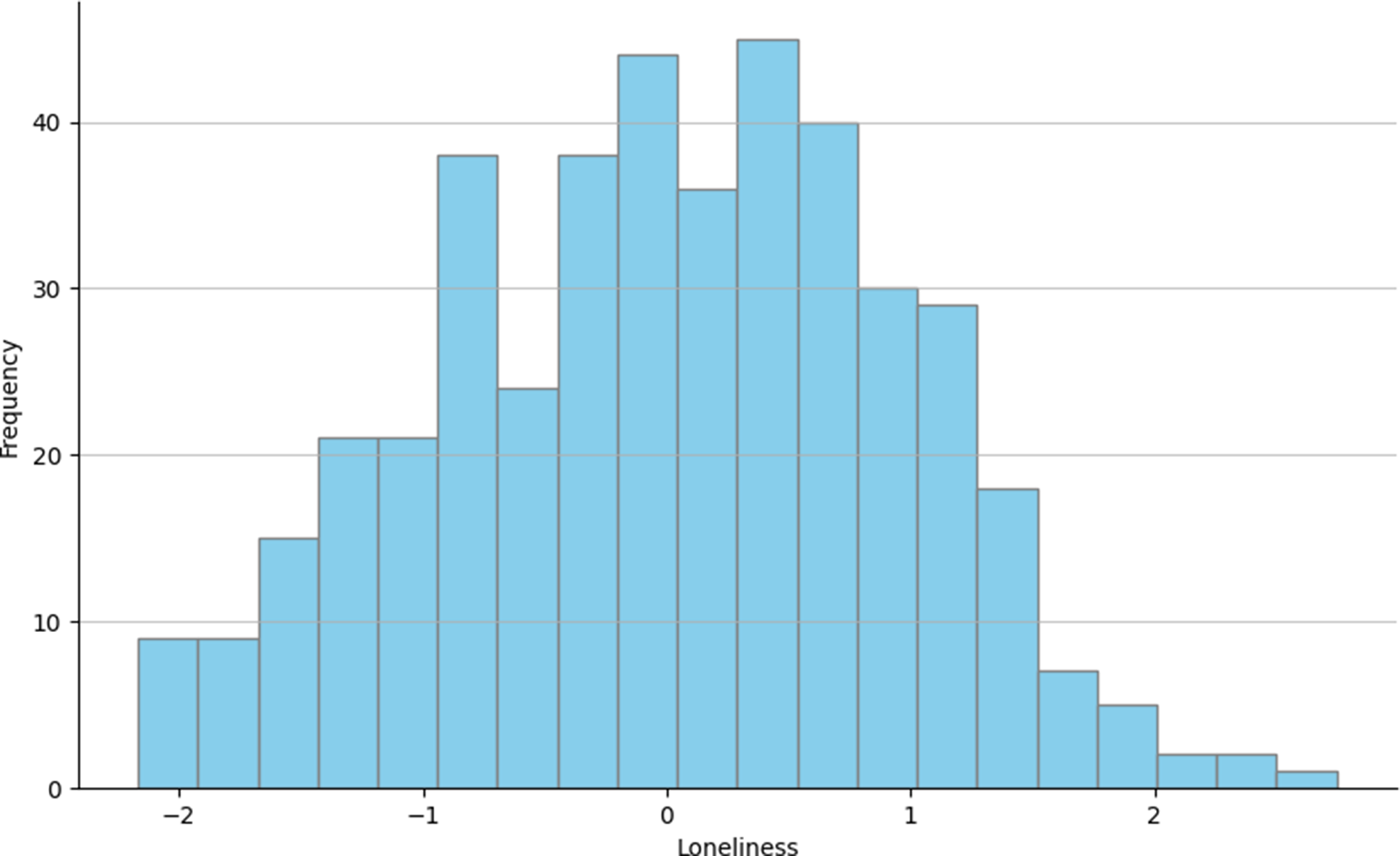
Taking a closer look at the distribution of our target variables (Figure 1), it can be observed that it is approximately normal: most participants report middle levels of loneliness, and fewer obtain high or low scores which mirrors the findings of the larger study across nine Canadian cities (Guruge et al., Reference Guruge, Sidani and Team2024). On the other hand, the distribution of English proficiency scores is left-skewed, indicating that most participants do not feel confident in their abilities to understand, speak, or write in the mainstream language in their new country. In addition, it is important to note that 71.49% of participants reported agree or strongly agree to being reliant on transportation to meet others.
Distribution of loneliness scores in the study sample (n = 435).

Results
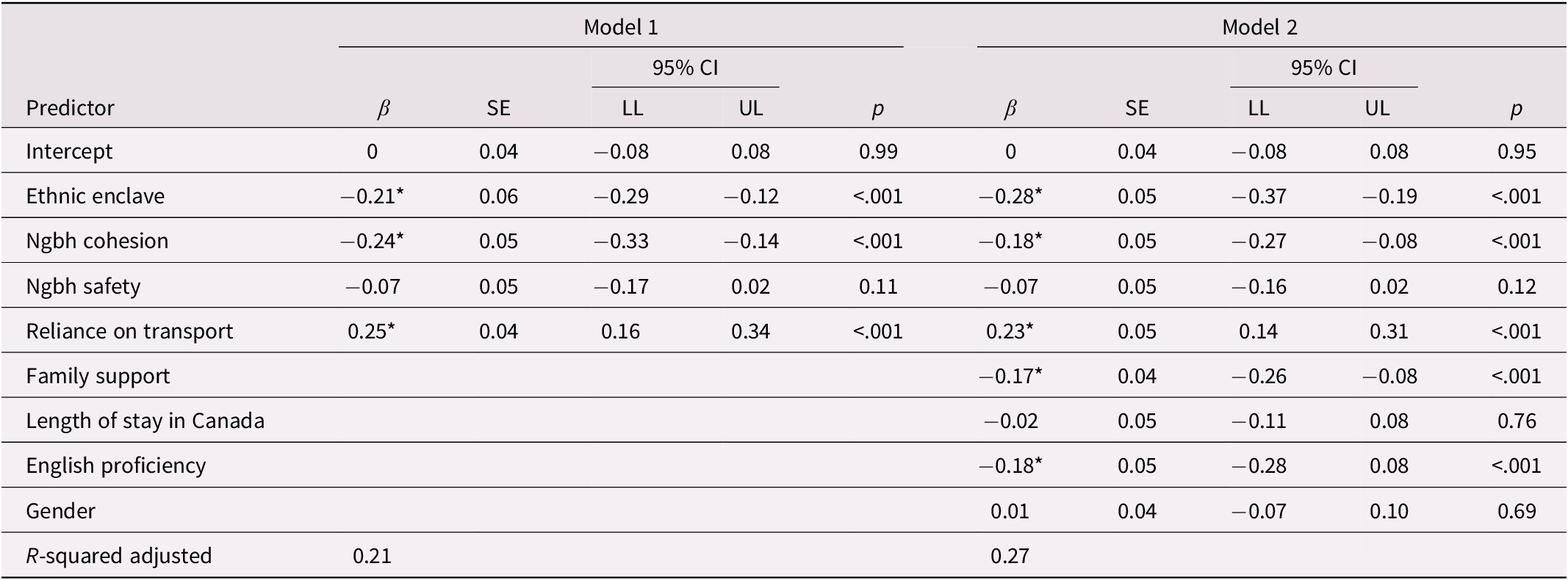
Table 2 reports MLR estimates pooled from all separate model estimations on the five MICE-imputed data sets.
MLR testing the role of neighbourhood factors in the prediction of loneliness: Before (model 1), and after (model 2), controlling for other demographic and contextual variables
Note: Transport = transportation; Ngbh = neighbourhood; β = standardized regression coefficient; SE = standard error; CI = confidence interval; LL = lower limit; UL = upper limit.
*p < 0.001.
Model 1
When only neighbourhood factors are considered, the model predicts loneliness (F(4, 430) = 28.67, p < .001), explaining 20.90% of the total variance. In particular, the perception of neighbourhood cohesion and not having to rely on transportation to meet others (a proxy for the presence of a support network in the neighbourhood) appear to be the most influential variables in the model. When all other variables are held constant, one standard deviation increase in perceived neighbourhood cohesion is associated with a decrease of almost a quarter of a standard deviation (β = −0.24) in loneliness. On the contrary, those who rely on transportation to meet others suffer higher levels of loneliness (on average, 0.25 of a SD) compared to their peers who do not feel reliant on transportation for their social interactions.
In addition, ethnic enclaves also show a unique contribution to the model, with feelings of loneliness decreasing as immigrants report higher levels of engagement with their own ethnic community. On the other hand, neighbourhood safety does not appear to be significantly associated with loneliness.
Model 2
Model 2 analysed the unique contributions of neighbourhood factors when control variables were accounted for. Overall, this model predicts loneliness (F(8, 426) = 20.23, p < .001), explains almost 30% of its variance (pooled adjusted R-squared = 0.27), with a significant improvement from model 1 (F(4,425) = 10.9, p < .001).
Model results show that, of the controls, only family support and English proficiency offer a statistically significant contribution to the prediction, each being associated with a reduction in loneliness. The role of neighbourhood factors remains significant when the selected control variables are accounted for. When all other variables are held constant and controls are accounted for, maintaining relationships within ethnic enclaves is associated with the largest reductions in feelings of loneliness (one SD increase in ethnic enclaves is associated with a decrease in loneliness of over a quarter of an SD). On the other hand, when the control variables are considered, the magnitude of the target’s association with neighbourhood cohesion and reliance on transportation is slightly reduced.
Discussion
There is conflicting evidence on the ways neighbourhood factors and personal factors intersect to influence loneliness in immigrant older adults (Au et al., Reference Au, Murad-Kassam, Mukanoheli and Idrees2024a). This study showcases the role of family support, neighbourhood cohesion, and co-ethnic community relationships in reducing loneliness which we expand on in the discussion below. Assumptions persist that immigrant older adults rely primarily on family support to meet emotional and social needs (Au et al., Reference Au, Hilario, Meherali and Salma2024b; Lőrinc et al., Reference Lőrinc, Kilkey, Ryan and Tawodzera2022). In our study, when immigrant older adults’ perceptions of cohesion within their neighbourhood increase, loneliness tends to decrease; this association remains significant even after the effects of family support and language proficiency are accounted for. This finding suggests that neighbourhood cohesion alone might contribute to alleviating loneliness in older immigrants. Relationships within families and among neighbours and co-ethnic communities are crucial for fostering social connectedness among older adults which, in turn, is protective for loneliness (Su et al., Reference Su, Yang, Dong and Zhang2022). While family plays a central role, this study highlights that nonfamily-related factors, such as neighbourhood environments, are also critical in reducing loneliness. Neighbourhood-level interventions that enhance social connectedness and belonging are important, and these interventions must attend to the cultural and linguistic needs of immigrant populations.
Immigrant older adults who maintain higher social engagement within their co-ethnic community tend to score lower in loneliness. This factor remains significant in model 2, meaning that these co-ethnic relationships are important regardless of how much support an older immigrant already receives from their family, how well they mastered the new language, or the perceived level of neighbourhood cohesion. This finding is aligned with previous literature, on the benefits of strong co-ethnic relationships to foster a sense of belonging (Gao et al., Reference Gao, Dupre and Bosman2021; Georgeou et al., Reference Georgeou, Schismenos, Wali, Mackay and Moraitakis2023). Other studies suggest that co-ethnic relationships and high co-ethnic density can decrease bridging capital with mainstream communities (Chen et al., Reference Chen, Hu, Xu and Xie2022; Kemppainen et al., Reference Kemppainen, Kemppainen, Fokkema, Wrede and Kouvonen2023; Lőrinc et al., Reference Lőrinc, Kilkey, Ryan and Tawodzera2022), which could, in turn, further increase feelings of loneliness. Future studies should look deeper into the role of co-ethnic relationships in preventing loneliness for older immigrants in Canada, for example, via exploring possible non-linear relationships between these constructs and their interactions with other factors related to integration in host communities. The majority of questionnaire participants in the current study arrived in Canada relatively recently, within the past 12 years, which might explain the finding of co-ethnic community relationships being important for alleviating loneliness. Being newer to Canada might mean immigrant older adults experience more intense cultural barriers, irrespective of language fluency, that prevent integration into mainstream society and, thus, limits social interactions to co-ethnic community members.
Family support of older adults is a cultural expectation built on filial piety and intergenerational reciprocity (Au et al., Reference Au, Hilario, Meherali and Salma2024b; Nasir et al., Reference Nasir, Hand and Huot2022). While families might compensate for a lack of neighbourhood support for older immigrants, a systematic review of neighbourhood experiences in this population shows inconclusive evidence of the added protective role of family in the context of ethnic enclaves (Au et al., Reference Au, Murad-Kassam, Mukanoheli and Idrees2024a). In contrast, this study shows that immigrant older adults with a higher level of involvement with co-ethnic community tend to feel less lonely. This is true even after the effect of family support is considered, suggesting that family members and relations with co-ethnic community play distinct roles in preventing loneliness (Gao et al., Reference Gao, Dupre and Bosman2021). Interestingly, the magnitude of this association increases slightly in model 2; this encourages further research to explore possible interaction effects between ethnic enclaves and our controls. Absence of family support might motivate older immigrants to seek support from the broader community, which then becomes more important as a driver of loneliness, but further research is needed on the impacts of family support versus community support. Generally, co-ethnic community support continues to be important for immigrant older adults’ well-being, which necessitates creating community-level initiatives that foster these valued relationships, while also bolstering opportunities for wider community connections. Policies and programs that maximize immigrant older adults’ access to transportation are also essential for well-being since co-ethnic community contact might occur outside of the neighbourhoods where older adults reside. Also, policies that support funding and infrastructure to create co-ethnic spaces for immigrant communities are essential, while simultaneously attending to the barriers for wider social integration in this population.
The association between loneliness and neighbourhood safety shows mixed results (Lam, Reference Lam2022) and, in our sample, this neighbourhood factor was not found to predict loneliness. However, there are varying perceptions of what neighbourhood safety means which could impact how it is measured (Lam, Reference Lam2022). This might be a reason why neighbourhood safety, as conceptualized in the questionnaire, was not significantly associated with loneliness in our dataset. More qualitative work exploring perceptions of safety can help inform future research in this area.
Transportation can be measured via a range of indicators related to accessibility, affordability, and appropriateness, and these indicators differ in their impacts on neighbourhood-level mobility (Hansmann et al., Reference Hansmann, Deemer and Robert2024). In this study, immigrant older adults who were reliant on transportation to meet others tend to report higher levels of loneliness. The standardized coefficients suggest that the unique contribution of this variable is slightly reduced after considering the effect of family support. This change might be explained by the fact that part of family support could consist of providing transportation. Understanding the dynamic interactions of these factors is essential for promoting the well-being of immigrant older adults and facilitating successful aging in place (Rosenwohl-Mack et al., Reference Rosenwohl-Mack, Schumacher, Fang and Fukuoka2020). The interrelationships among individual, interpersonal, neighbourhood-level, and family-level factors and loneliness should be further explored in this population. Additionally, while this article focuses on the personal and neighbourhood social factors shaping loneliness in immigrant older adults, the built environment of neighbourhoods also impacts loneliness. Age-friendly environments with well-designed sidewalks, transportation options, and mixed-use spaces support social participation and reduce isolation (Lyu & Forsyth, Reference Lyu and Forsyth2022). Future studies should explore the ways built environments influence loneliness in immigrant populations and the interactive effects with social and personal dimensions.
Strengths and limitations
There is a lack of studies in Canada that look at neighbourhood factors influencing immigrant older adults’ well-being, and the majority of existing studies are smaller qualitative case studies (Au et al., Reference Au, Murad-Kassam, Mukanoheli and Idrees2024a). This study draws from a unique dataset about older immigrants across cities to look at the experiences and drivers of loneliness, and the questionnaire was delivered in languages other than English to ensure participation of non-English-speaking immigrants. When interpreting study results, it is important to acknowledge the limitations in our sample data in relation to generalizability. First, our sample is limited to responses from immigrant older adults belonging to three specific language groups, which make up a large portion of the overall immigrant population living in Canada (Statistics Canada, 2023). Our findings might not generalize to older immigrants from other ethnic or linguistic backgrounds who do not have as large a presence in their new country, or who immigrated to different areas of the country. Since recruitment occurred through immigrant-serving agencies, these organizations are more likely to support newcomers (new immigrants) or those who arrived in Canada as older adults versus those who arrived young and have been in Canada for a long period of time. Additionally, recruiting through immigrant-serving agencies means that participants might already be connected to services and programs that reduce loneliness (Guruge et al., Reference Guruge, Sidani and Team2024). Moreover, the limited size of our sample forced us to be conservative with the effects tested for in our models. We prioritized the inclusion of contextual factors rather than indicators of self-perceived psychological and physical health, which are found to strongly predict loneliness (Dahlberg et al., Reference Dahlberg, McKee, Frank and Naseer2022), as these could have overshadowed the effect of other variables in our sample. In addition, MLR only captures linear relationships between predictors and the target; however, there could be complex interactions between predictors that are not accounted for in the model. With larger sample sizes, it would be possible to include more predictors and test interactions and mediation effects. Finally, there were some notable limitations in the measures used from the questionnaire: ideally, we would measure length of residence in a neighbourhood, in addition to length of residence in Canada, but this measure was not captured in the questions. The measure of transportation is not comprehensive by looking at acceptability, affordability, and availability and, thus, we cannot exclude the possibility of other forms and features of transportation impacting neighbourhood social engagement. With evidence that immigrant older adults’ preferred third spaces include access to co-ethnic community that might be outside their neighbourhoods, a more focused analysis of transportation influences on social engagement in this population is warranted.
Conclusion
Immigrant older adults in Canada experience feelings of loneliness at a higher rate compared to the general population. While constructs such as health, socioeconomic status, and sense of belonging have been established to reduce loneliness, less is known about the role of neighbourhood-level factors in this population. This study investigated the role of neighbourhood cohesion, safety, ethnic enclaves, and reliance on transportation in predicting loneliness in older immigrants from East Asian, South Asian, and Arab countries living in five major Canadian cities. Family support and language proficiency were confirmed to be important protective factors against loneliness for immigrant older adults. Even after these effects were accounted for, neighbourhood factors showed significant associations with loneliness. In particular, when immigrant older adults maintain a higher level of involvement in their co-ethnic communities, when they do not have to rely on transportation to meet others, and when they perceive social cohesion in the neighbourhood, they tend to experience less loneliness. These findings highlight the importance of designing neighbourhood spaces and services that support social engagement and reduce barriers to movement for older immigrants. Polices and funding models that cultivate the creation and access to communal neighbourhood spaces for immigrant older adults are essential, especially for those from ethnocultural and linguistic minority groups. Finally, immigrant and older adult service providers must consider older immigrants’ social needs beyond the family unit and provide support to engage in the wider community. We encourage future research that investigates how individual, interpersonal, neighbourhood-level, and family-level factors interact to influence loneliness for immigrant older adults.
Supplementary material
The supplementary material for this article can be found at http://doi.org/10.1017/S0714980825100068.
Acknowledgements
The authors would like to acknowledge the participants who participated in the Inclusive Communities for Older Immigrants study.
Financial support
This work was supported by funding from the Social Sciences and Humanities Research Council (SSHRC Project Grant, Ref number 895-2020-1022) and funding from the Canadian Institute for Health Research (CIHR Project Grant, Ref number 183916).
Competing interests
The authors have no competing interests to declare.
Ethics statement
Ethics approval for this work was granted by the second, third, and last authors’ institutional review boards (University of Alberta Pro00121121; University of Calgary REB22-0358; Toronto Metropolitan University REB 2021-545-1).



 Open access

