





1 Introduction
Let ${\mathbb F}_q$
denote the finite field with q elements where q is a prime power. For each positive integer n, write
${\mathbb F}_q$
denote the finite field with q elements where q is a prime power. For each positive integer n, write ${\mathrm M}_n({\mathbb F}_q)$
for the algebra of
${\mathrm M}_n({\mathbb F}_q)$
for the algebra of $n\times n$
matrices over
$n\times n$
matrices over ${\mathbb F}_q$
.
${\mathbb F}_q$
.
Definition 1.1. Given a matrix $\Delta \in {\mathrm M}_n({\mathbb F}_q)$
, a subspace W of
$\Delta \in {\mathrm M}_n({\mathbb F}_q)$
, a subspace W of ${\mathbb F}_q^n$
has
${\mathbb F}_q^n$
has $\Delta $
-profile
$\Delta $
-profile $\mu =(\mu _1,\mu _2,\ldots )$
if
$\mu =(\mu _1,\mu _2,\ldots )$
if
 $$ \begin{align*} \dim (W+\Delta W+\cdots +\Delta^{j-1}W)=\mu_1+\mu_2+\cdots+\mu_{j} \text{ for }j\geq 1. \end{align*} $$
Let $\sigma (\mu ,\Delta )$
denote the number of subspaces with
$\sigma (\mu ,\Delta )$
denote the number of subspaces with $\Delta $
-profile
$\Delta $
-profile $\mu $
. The
$\mu $
. The $\Delta $
-profile of a subspace was referred to as ‘dimension sequence’ by Bender, Coley, Robbins, and Rumsey [Reference Bender, Coley, Robbins and Rumsey6, p. 2] who proposed the following combinatorial problem.
$\Delta $
-profile of a subspace was referred to as ‘dimension sequence’ by Bender, Coley, Robbins, and Rumsey [Reference Bender, Coley, Robbins and Rumsey6, p. 2] who proposed the following combinatorial problem.
Problem 1.2. Given $\mu $
and
$\mu $
and $\Delta $
, determine
$\Delta $
, determine $\sigma (\mu ,\Delta )$
.
$\sigma (\mu ,\Delta )$
.
They showed, by a beautiful probabilistic argument involving Möbius inversion on the lattice of subspaces, that the quantities $\sigma (\mu ,\Delta )$
for
$\sigma (\mu ,\Delta )$
for $\mu $
varying satisfy a system of equations (see Theorem 5.2). They solved these equations in two special cases to obtain elegant product formulas. If
$\mu $
varying satisfy a system of equations (see Theorem 5.2). They solved these equations in two special cases to obtain elegant product formulas. If $\Delta $
is regular nilpotent (nilpotent with one-dimensional null space), then
$\Delta $
is regular nilpotent (nilpotent with one-dimensional null space), then
 $$ \begin{align} \sigma(\mu,\Delta) = \prod_{i\geq 2}q^{\mu_i^2}{\mu_{i-1} \brack \mu_i}_q. \end{align} $$
When $\Delta $
is simple (has irreducible characteristic polynomial),
$\Delta $
is simple (has irreducible characteristic polynomial),
 $$ \begin{align} \sigma(\mu,\Delta) = \frac{q^n-1}{q^{\mu_1}-1}\prod_{i\geq 2}q^{\mu_i^2-\mu_i}{\mu_{i-1} \brack \mu_i}_q. \end{align} $$
They remarked that these formulas do not appear to have simple counting proofs.
A few years later, Niederreiter [Reference Niederreiter30, p. 11] proposed the following problem in connection with his multiple recursive matrix method for pseudorandom number generation.
Problem 1.3. Let $m,\ell $
be positive integers. Given an element
$m,\ell $
be positive integers. Given an element $\alpha \in {\mathbb F}_{q^{m\ell }}$
such that
$\alpha \in {\mathbb F}_{q^{m\ell }}$
such that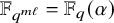 ${\mathbb F}_{q^{m\ell }}={\mathbb F}_q(\alpha )$
, determine the number of m-dimensional
${\mathbb F}_{q^{m\ell }}={\mathbb F}_q(\alpha )$
, determine the number of m-dimensional ${\mathbb F}_q$
-subspaces W of
${\mathbb F}_q$
-subspaces W of ${\mathbb F}_{q^{m\ell }}$
such that
${\mathbb F}_{q^{m\ell }}$
such that
 $$ \begin{align} {\mathbb F}_{q^{m\ell}}=W\oplus \alpha W\oplus \cdots \oplus \alpha^{\ell-1}W. \end{align} $$
It is not difficult to see that Niederreiter’s problem is equivalent to determining $\sigma (\mu ,\Delta )$
in the case where
$\sigma (\mu ,\Delta )$
in the case where $\mu $
is a partition of
$\mu $
is a partition of $m\ell $
with all parts equal to m and
$m\ell $
with all parts equal to m and $\Delta $
is an
$\Delta $
is an $m\ell \times m\ell $
matrix with irreducible characteristic polynomial. However, Niederreiter does not seem to have been aware of the results of the authors of [Reference Bender, Coley, Robbins and Rumsey6] and the same is true for several subsequent papers which discuss the problem of Niederreiter. Niederreiter’s problem has interesting connections with finite projective geometry and group theory [Reference Ghorpade and Ram16]. Several special instances of Problem 1.2 have been solved in the literature [Reference Aggarwal and Ram2, Reference Arora, Ram and Venkateswarlu4, Reference Chen and Tseng11, Reference Ghorpade and Ram15, Reference Ghorpade and Ram16, Reference Prasad and Ram31, Reference Prasad and Ram32, Reference Prasad and Ram34, Reference Ram and Schlosser35]. The consideration of subspace profiles when
$m\ell \times m\ell $
matrix with irreducible characteristic polynomial. However, Niederreiter does not seem to have been aware of the results of the authors of [Reference Bender, Coley, Robbins and Rumsey6] and the same is true for several subsequent papers which discuss the problem of Niederreiter. Niederreiter’s problem has interesting connections with finite projective geometry and group theory [Reference Ghorpade and Ram16]. Several special instances of Problem 1.2 have been solved in the literature [Reference Aggarwal and Ram2, Reference Arora, Ram and Venkateswarlu4, Reference Chen and Tseng11, Reference Ghorpade and Ram15, Reference Ghorpade and Ram16, Reference Prasad and Ram31, Reference Prasad and Ram32, Reference Prasad and Ram34, Reference Ram and Schlosser35]. The consideration of subspace profiles when $\Delta $
is a regular diagonal operator has recently led to a new proof of the Touchard-Riordan formula concerned with crossings of chord diagrams [Reference Prasad and Ram34]. In the special case where
$\Delta $
is a regular diagonal operator has recently led to a new proof of the Touchard-Riordan formula concerned with crossings of chord diagrams [Reference Prasad and Ram34]. In the special case where $\Delta $
is a diagonal matrix, the quantity
$\Delta $
is a diagonal matrix, the quantity $\sigma (\mu ,\Delta )$
can be expressed as a sum over semistandard tableaux. The study of subspace profiles in this case has interesting connections with multiset Mahonian statistics, q-Whittaker symmetric functions and the q-rook theory of Garsia and Remmel. We refer to [Reference Ram and Schlosser35] for these results on diagonal operators.
$\sigma (\mu ,\Delta )$
can be expressed as a sum over semistandard tableaux. The study of subspace profiles in this case has interesting connections with multiset Mahonian statistics, q-Whittaker symmetric functions and the q-rook theory of Garsia and Remmel. We refer to [Reference Ram and Schlosser35] for these results on diagonal operators.
In this paper we solve Problem 1.2 in full generality by giving an explicit formula for $\sigma (\mu ,\Delta )$
for arbitrary
$\sigma (\mu ,\Delta )$
for arbitrary $\mu $
and
$\mu $
and $\Delta $
. The fact that the theory of symmetric functions can be leveraged to answer the counting problem is a very recent development. In addition to the results of Bender, Coley, Robbins, and Rumsey, our primary tools are ideas from the theory of symmetric functions and some previous results for diagonal operators. We show that Problem 1.2 admits a compact solution involving q-Whittaker functions, a class of symmetric functions that occur as specializations of Macdonald polynomials. The q-Whittaker functions occur as joint eigenfunctions of q-deformed Toda chain Hamiltonians with support in the positive Weyl chamber (see Etingof [Reference Etingof13] or Ruijsenaars [Reference Ruijsenaars36]). The following theorem (appearing later as Theorem 5.3) is our main result.
$\Delta $
. The fact that the theory of symmetric functions can be leveraged to answer the counting problem is a very recent development. In addition to the results of Bender, Coley, Robbins, and Rumsey, our primary tools are ideas from the theory of symmetric functions and some previous results for diagonal operators. We show that Problem 1.2 admits a compact solution involving q-Whittaker functions, a class of symmetric functions that occur as specializations of Macdonald polynomials. The q-Whittaker functions occur as joint eigenfunctions of q-deformed Toda chain Hamiltonians with support in the positive Weyl chamber (see Etingof [Reference Etingof13] or Ruijsenaars [Reference Ruijsenaars36]). The following theorem (appearing later as Theorem 5.3) is our main result.
Theorem 1.4. For each partition $\mu $
,
$\mu $
,
 $$ \begin{align*} \sigma(\mu,\Delta)=(-1)^{\sum_{j\geq 2}\mu_j} q^{\sum_{j\geq 2}{\mu_j \choose 2}}\langle F_\Delta(x),\widetilde{W}_{\mu}(x;q)\, h_{n-|\mu|} \rangle, \end{align*} $$
for each prime power q and each matrix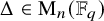 $\Delta \in {\mathrm M}_n({\mathbb F}_q)$
.
$\Delta \in {\mathrm M}_n({\mathbb F}_q)$
.
Here $\langle \cdot ,\cdot \rangle $
denotes the Hall scalar product while
$\langle \cdot ,\cdot \rangle $
denotes the Hall scalar product while $h_\lambda $
and
$h_\lambda $
and $\widetilde {W}_\lambda $
denote the complete homogeneous and dual (with respect to the Hall scalar product) q-Whittaker symmetric functions, respectively. In addition,
$\widetilde {W}_\lambda $
denote the complete homogeneous and dual (with respect to the Hall scalar product) q-Whittaker symmetric functions, respectively. In addition, $F_\Delta (x)$
is a symmetric function depending on conjugacy class invariants of the matrix
$F_\Delta (x)$
is a symmetric function depending on conjugacy class invariants of the matrix $\Delta $
that can be expressed in terms of plethystic substitutions involving modified Hall–Littlewood functions (see Proposition 2.11). The ideas used in the proof of Theorem 1.4 are elementary and combinatorial; the arguments do not use representation theoretic or geometric techniques.
$\Delta $
that can be expressed in terms of plethystic substitutions involving modified Hall–Littlewood functions (see Proposition 2.11). The ideas used in the proof of Theorem 1.4 are elementary and combinatorial; the arguments do not use representation theoretic or geometric techniques.
We show that several symmetric functions such as the power sum symmetric functions, the complete homogeneous symmetric functions, products of modified Hall–Littlewood functions, and certain products of q-Whittaker functions are of the form $F_\Delta (x)$
for suitably chosen
$F_\Delta (x)$
for suitably chosen $\Delta $
(see Section 2). In the case where
$\Delta $
(see Section 2). In the case where $\mu $
is a partition of n, the theorem above entails new combinatorial interpretations of the coefficients in the q-Whittaker expansion of each of these symmetric functions (Corollary 4.4).
$\mu $
is a partition of n, the theorem above entails new combinatorial interpretations of the coefficients in the q-Whittaker expansion of each of these symmetric functions (Corollary 4.4).
In Section 6, we use our results to derive an explicit formula for the number of anti-invariant subspaces with respect to a linear operator, a notion that goes back to Barría and Halmos [Reference Barría and Halmos5]. An application of our results to Krylov subspace theory is considered in Section 7. Given positive integers k and $\ell $
, we assign a probability
$\ell $
, we assign a probability $\psi _{k,\ell }(\Delta )$
to each matrix
$\psi _{k,\ell }(\Delta )$
to each matrix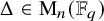 $\Delta \in {\mathrm M}_n({\mathbb F}_q)$
(see Equation (7.1)). Obtaining bounds on the probability
$\Delta \in {\mathrm M}_n({\mathbb F}_q)$
(see Equation (7.1)). Obtaining bounds on the probability $\psi _{k,\ell }(\Delta )$
is a difficult and important problem (Brent, Gao and Lauder [Reference Brent, Gao and Lauder8, p. 277]) whose resolution is critical for understanding and evaluating the efficiency of several algorithms that rely on Krylov subspace methods. Examples of such algorithms include the Number Field Sieve, used in integer factorization, and the block Wiedemann algorithm of Coppersmith [Reference Coppersmith12]. In general, such algorithms have applications in many mathematical areas, including quadrature methods, the analytic theory of continued fractions, expansions of infinite series, orthogonalization algorithms, and the mathematical underpinnings of quantum mechanics (Liesen and Strakoš [Reference Liesen and Strakoš27, p. 8]). In Theorem 7.1, we derive an explicit formula for the probability
$\psi _{k,\ell }(\Delta )$
is a difficult and important problem (Brent, Gao and Lauder [Reference Brent, Gao and Lauder8, p. 277]) whose resolution is critical for understanding and evaluating the efficiency of several algorithms that rely on Krylov subspace methods. Examples of such algorithms include the Number Field Sieve, used in integer factorization, and the block Wiedemann algorithm of Coppersmith [Reference Coppersmith12]. In general, such algorithms have applications in many mathematical areas, including quadrature methods, the analytic theory of continued fractions, expansions of infinite series, orthogonalization algorithms, and the mathematical underpinnings of quantum mechanics (Liesen and Strakoš [Reference Liesen and Strakoš27, p. 8]). In Theorem 7.1, we derive an explicit formula for the probability $\psi _{k,\ell }(\Delta )$
in terms of dual q-Whittaker functions.
$\psi _{k,\ell }(\Delta )$
in terms of dual q-Whittaker functions.
This article is organized as follows. In Section 2, we begin with a brief overview of the algebra of symmetric functions and its various bases. We show how to associate a symmetric function $F_\Delta (x)$
with each matrix
$F_\Delta (x)$
with each matrix $\Delta $
and give several examples. We also prove the existence of a formula which expresses
$\Delta $
and give several examples. We also prove the existence of a formula which expresses $\sigma (\mu ,\Delta )$
in terms of
$\sigma (\mu ,\Delta )$
in terms of $F_\Delta (x)$
. In Section 3, we consider diagonal operators and q-Whittaker functions which will later play an integral part in the derivation of a formula for
$F_\Delta (x)$
. In Section 3, we consider diagonal operators and q-Whittaker functions which will later play an integral part in the derivation of a formula for $\sigma (\mu ,\Delta )$
. Section 4 is concerned with a formula for
$\sigma (\mu ,\Delta )$
. Section 4 is concerned with a formula for $\sigma (\mu ,\Delta )$
when
$\sigma (\mu ,\Delta )$
when $\mu $
is a partition of the ambient vector space dimension. This formula is derived by setting up a system of equations and using a linear algebraic approach. We also give combinatorial finite-field interpretations for coefficients in the q-Whittaker expansions of various symmetric functions. Finally, in Section 5, we use the equations of Bender, Coley, Robbins, and Rumsey to determine
$\mu $
is a partition of the ambient vector space dimension. This formula is derived by setting up a system of equations and using a linear algebraic approach. We also give combinatorial finite-field interpretations for coefficients in the q-Whittaker expansions of various symmetric functions. Finally, in Section 5, we use the equations of Bender, Coley, Robbins, and Rumsey to determine $\sigma (\mu ,\Delta )$
for arbitrary
$\sigma (\mu ,\Delta )$
for arbitrary $\mu $
and
$\mu $
and $\Delta $
. Applications to anti-invariant subspaces and Krylov subspace methods are considered in Sections 6 and 7, respectively.
$\Delta $
. Applications to anti-invariant subspaces and Krylov subspace methods are considered in Sections 6 and 7, respectively.
2 Generating function for flags of invariant subspaces
We begin with a brief overview of symmetric functions, focusing on some relevant facts; the primary references are Macdonald [Reference Macdonald29] and Stanley [Reference Stanley38, Chap. 7]. A weak composition of an integer n is a sequence $\alpha =(\alpha _1,\alpha _2,\ldots )$
of nonnegative integers with sum n. A partition of n is a weak composition of n in which the sequence of integers is weakly decreasing. If
$\alpha =(\alpha _1,\alpha _2,\ldots )$
of nonnegative integers with sum n. A partition of n is a weak composition of n in which the sequence of integers is weakly decreasing. If $\lambda $
is a partition of n, we write
$\lambda $
is a partition of n, we write $\lambda \vdash n$
. Nonzero terms in the sequence
$\lambda \vdash n$
. Nonzero terms in the sequence $\lambda $
are called parts of
$\lambda $
are called parts of $\lambda $
and the number of parts of
$\lambda $
and the number of parts of $\lambda $
is denoted
$\lambda $
is denoted $\ell (\lambda )$
. It is customary to ignore trailing zeroes in weak compositions and partitions. For instance, the weak compositions
$\ell (\lambda )$
. It is customary to ignore trailing zeroes in weak compositions and partitions. For instance, the weak compositions $(3,1,2,0,1,0,0,\ldots )$
,
$(3,1,2,0,1,0,0,\ldots )$
, $(3,1,2,0,1,0)$
, and
$(3,1,2,0,1,0)$
, and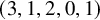 $(3,1,2,0,1)$
are all considered equivalent. For a weak composition
$(3,1,2,0,1)$
are all considered equivalent. For a weak composition $\alpha $
, write
$\alpha $
, write $|\alpha |$
for the sum
$|\alpha |$
for the sum $\sum _{i\geq 1}\alpha _i$
.
$\sum _{i\geq 1}\alpha _i$
.
Let ${\mathbb Q}(t)$
denote the field of rational functions in an indeterminate t. Denote by
${\mathbb Q}(t)$
denote the field of rational functions in an indeterminate t. Denote by $\Lambda _{{\mathbb Q}(t)}$
the algebra of formal symmetric functions in infinitely many variables
$\Lambda _{{\mathbb Q}(t)}$
the algebra of formal symmetric functions in infinitely many variables $x=(x_1,x_2,\ldots )$
with coefficients in
$x=(x_1,x_2,\ldots )$
with coefficients in ${\mathbb Q}(t)$
. The algebra
${\mathbb Q}(t)$
. The algebra $\Lambda _{{\mathbb Q}(t)}$
admits several natural bases indexed by integer partitions: the monomial symmetric functions
$\Lambda _{{\mathbb Q}(t)}$
admits several natural bases indexed by integer partitions: the monomial symmetric functions $m_\lambda $
, the elementary symmetric functions
$m_\lambda $
, the elementary symmetric functions $e_\lambda $
, the power sum symmetric functions
$e_\lambda $
, the power sum symmetric functions $p_\lambda $
, the complete homogeneous symmetric functions
$p_\lambda $
, the complete homogeneous symmetric functions $h_\lambda $
and the Schur functions
$h_\lambda $
and the Schur functions $s_\lambda $
. The ring of symmetric functions is also equipped with an involutory automorphism
$s_\lambda $
. The ring of symmetric functions is also equipped with an involutory automorphism $\omega $
which satisfies
$\omega $
which satisfies
 $$ \begin{align} \omega e_\lambda= h_\lambda;\quad \omega h_\lambda= e_\lambda;\quad \omega s_\lambda= s_{\lambda'}. \end{align} $$
Here, and throughout this paper, $\lambda '$
denotes the partition conjugate to
$\lambda '$
denotes the partition conjugate to $\lambda $
.
$\lambda $
.
The q-Whittaker functions $W_\lambda (x;t)$
and Hall–Littlewood functions
$W_\lambda (x;t)$
and Hall–Littlewood functions $P_\lambda (x;t)$
are two more bases of
$P_\lambda (x;t)$
are two more bases of $\Lambda _{{\mathbb Q}(t)}$
. Both occur as specializations of a more general class of two-parameter symmetric functions, the Macdonald polynomials
$\Lambda _{{\mathbb Q}(t)}$
. Both occur as specializations of a more general class of two-parameter symmetric functions, the Macdonald polynomials $P_\lambda (x;q,t)$
. More precisely,
$P_\lambda (x;q,t)$
. More precisely, $P_\lambda (x;t)=P_\lambda (x;0,t)$
and
$P_\lambda (x;t)=P_\lambda (x;0,t)$
and $W_\lambda (x;t)=P_\lambda (x;t,0)$
. The ring of symmetric functions is endowed with the Hall scalar product
$W_\lambda (x;t)=P_\lambda (x;t,0)$
. The ring of symmetric functions is endowed with the Hall scalar product $\langle \cdot , \cdot \rangle $
with respect to which the bases
$\langle \cdot , \cdot \rangle $
with respect to which the bases $m_\lambda $
and
$m_\lambda $
and $h_\lambda $
are dual. The dual basis of the Hall–Littlewood functions
$h_\lambda $
are dual. The dual basis of the Hall–Littlewood functions $P_\lambda (x;t)$
with respect to the Hall scalar product consists of the transformed Hall–Littlewood functions
$P_\lambda (x;t)$
with respect to the Hall scalar product consists of the transformed Hall–Littlewood functions $H_{\lambda }(x;t)$
. They are related to the q-Whittaker functions (Bergeron [Reference Bergeron7, p. 5]) by
$H_{\lambda }(x;t)$
. They are related to the q-Whittaker functions (Bergeron [Reference Bergeron7, p. 5]) by
 $$ \begin{align} \omega H_{\lambda'}(x;t)=W_{\lambda}(x;t). \end{align} $$
One also has the dual identity $\omega P_{\lambda }(x;t)=\widetilde {W}_{\lambda '}(x;t)$
, the latter denoting the dual basis of
$\omega P_{\lambda }(x;t)=\widetilde {W}_{\lambda '}(x;t)$
, the latter denoting the dual basis of $W_\lambda (x;t)$
with respect to the Hall scalar product. The modified Hall–Littlewood functions are indexed by integer partitions and defined by
$W_\lambda (x;t)$
with respect to the Hall scalar product. The modified Hall–Littlewood functions are indexed by integer partitions and defined by $ \tilde {H}_{\lambda }(x;t)=t^{n(\lambda )} H_{\lambda }(x;t^{-1}),$
where
$ \tilde {H}_{\lambda }(x;t)=t^{n(\lambda )} H_{\lambda }(x;t^{-1}),$
where $n(\lambda )=\sum _{i\geq 1}(i-1)\lambda _i$
. The modified Hall–Littlewood function also satisfies
$n(\lambda )=\sum _{i\geq 1}(i-1)\lambda _i$
. The modified Hall–Littlewood function also satisfies
 $$ \begin{align*} \tilde{H}_\lambda(x;t)=\sum_{\mu}\tilde{K}_{\mu\lambda}(t)s_\mu, \end{align*} $$
where $s_\mu $
denotes a Schur function and
$s_\mu $
denotes a Schur function and $\tilde {K}_{\mu \lambda }(t)$
is a modified Kostka–Foulkes polynomial, defined as the generating polynomial of the cocharge statistic on semistandard tableaux of shape
$\tilde {K}_{\mu \lambda }(t)$
is a modified Kostka–Foulkes polynomial, defined as the generating polynomial of the cocharge statistic on semistandard tableaux of shape $\mu $
and content
$\mu $
and content $\lambda $
:
$\lambda $
:
 $$ \begin{align*} \tilde{K}_{\mu\lambda}(t)=\sum_{\mathcal{T} \in \mathrm{SSYT}(\mu,\lambda)}t^{\mathrm{cocharge{(\mathcal{T})}}}. \end{align*} $$
For prime power q, the specialization $\tilde {K}_{\lambda \mu }(q)$
coincides with the value taken by the character of the irreducible unipotent
$\tilde {K}_{\lambda \mu }(q)$
coincides with the value taken by the character of the irreducible unipotent $\mathrm {GL}_n({\mathbb F}_q)$
-representation indexed by
$\mathrm {GL}_n({\mathbb F}_q)$
-representation indexed by $\lambda $
on the unipotent conjugacy class with Jordan form partition
$\lambda $
on the unipotent conjugacy class with Jordan form partition $\mu $
(Lusztig [Reference Lusztig28, Eq. (2.2)]).
$\mu $
(Lusztig [Reference Lusztig28, Eq. (2.2)]).
For a formal power series F, denote by $p_k[F]$
the series obtained by substituting each indeterminate appearing in F by its kth power. For an arbitrary symmetric function
$p_k[F]$
the series obtained by substituting each indeterminate appearing in F by its kth power. For an arbitrary symmetric function $g\in \Lambda _{{\mathbb Q}(t)}$
, the plethystic substitution
$g\in \Lambda _{{\mathbb Q}(t)}$
, the plethystic substitution $g[F]$
is the series obtained by writing g as a polynomial in the power sum symmetric functions
$g[F]$
is the series obtained by writing g as a polynomial in the power sum symmetric functions $p_r$
and then substituting
$p_r$
and then substituting $p_r[F]$
for each
$p_r[F]$
for each $p_r$
appearing in g. The reader is referred to Haglund [Reference Haglund19, p. 19] or Haiman [Reference Haiman20, p. 13] for further details on plethystic notation.
$p_r$
appearing in g. The reader is referred to Haglund [Reference Haglund19, p. 19] or Haiman [Reference Haiman20, p. 13] for further details on plethystic notation.
For each nonnegative integer n, define the q-analogs $[n]_q:=1+q+\cdots +q^{n-1}\text { and }[n]_q!:=[1]_q[2]_q\cdots [n]_q.$
For a weak composition
$[n]_q:=1+q+\cdots +q^{n-1}\text { and }[n]_q!:=[1]_q[2]_q\cdots [n]_q.$
For a weak composition $\alpha $
of n, the q-multinomial coefficient is defined by
$\alpha $
of n, the q-multinomial coefficient is defined by
 $$ \begin{align*} {n \brack \alpha}_q:=\frac{[n]_q!}{\prod_{i\geq 1}[\alpha_i]_q!}. \end{align*} $$
The above notation for q-multinomial is distinct from the notation ${n \brack \lambda }$
defined in Macdonald [Reference Macdonald29, p. 44, Ex. 1] in terms of hook-lengths and contents of the partition
${n \brack \lambda }$
defined in Macdonald [Reference Macdonald29, p. 44, Ex. 1] in terms of hook-lengths and contents of the partition $\lambda $
.
$\lambda $
.
Our objective, in this section, is to show that $\sigma (\mu ,\Delta )$
can be expressed in terms of suitably defined flags of invariant subspaces of
$\sigma (\mu ,\Delta )$
can be expressed in terms of suitably defined flags of invariant subspaces of $\Delta $
. We begin with a definition.
$\Delta $
. We begin with a definition.
Definition 2.1. Given a matrix $\Delta \in {\mathrm M}_n({\mathbb F}_q)$
and a weak composition
$\Delta \in {\mathrm M}_n({\mathbb F}_q)$
and a weak composition $\alpha =(\alpha _1,\ldots ,\alpha _\ell )$
of n, let
$\alpha =(\alpha _1,\ldots ,\alpha _\ell )$
of n, let $X_{\alpha }(\Delta )$
denote the number of flags
$X_{\alpha }(\Delta )$
denote the number of flags $ (0)=W_0\subseteq W_1\subseteq \cdots \subseteq W_\ell ={\mathbb F}_q^n$
of
$ (0)=W_0\subseteq W_1\subseteq \cdots \subseteq W_\ell ={\mathbb F}_q^n$
of $\Delta $
-invariant subspaces satisfying
$\Delta $
-invariant subspaces satisfying $\dim W_i/W_{i-1}=\alpha _i$
for
$\dim W_i/W_{i-1}=\alpha _i$
for $1\leq i\leq \ell $
.
$1\leq i\leq \ell $
.
Example 2.2. If $\Delta =cI$
where I denotes the
$\Delta =cI$
where I denotes the $n\times n$
identity matrix and
$n\times n$
identity matrix and $c\in {\mathbb F}_q$
, then
$c\in {\mathbb F}_q$
, then $X_\alpha (\Delta )={n \brack \alpha }_q,$
a q-multinomial coefficient.
$X_\alpha (\Delta )={n \brack \alpha }_q,$
a q-multinomial coefficient.
The collection of $\Delta $
-invariant subspaces of
$\Delta $
-invariant subspaces of ${\mathbb F}_q^n$
forms a partially ordered set (poset) with respect to inclusion. A lattice is a poset in which each pair of elements has a unique least upper bound (or join) and a unique greatest lower bound (or meet). The above poset on
${\mathbb F}_q^n$
forms a partially ordered set (poset) with respect to inclusion. A lattice is a poset in which each pair of elements has a unique least upper bound (or join) and a unique greatest lower bound (or meet). The above poset on $\Delta $
-invariant subspaces is a lattice with the join and meet operations given by subspace sum and intersection, respectively. Denote this lattice by
$\Delta $
-invariant subspaces is a lattice with the join and meet operations given by subspace sum and intersection, respectively. Denote this lattice by $\mathcal {L}(\Delta )$
. It is well-known that the lattice
$\mathcal {L}(\Delta )$
. It is well-known that the lattice $\mathcal {L}(\Delta )$
is self-dual [Reference Brickman and Fillmore9].
$\mathcal {L}(\Delta )$
is self-dual [Reference Brickman and Fillmore9].
For subspaces $U,W\in \mathcal {L}(\Delta )$
let
$U,W\in \mathcal {L}(\Delta )$
let $[U,W]$
denote the interval consisting of all subspaces
$[U,W]$
denote the interval consisting of all subspaces $S\in \mathcal {L}(\Delta )$
satisfying
$S\in \mathcal {L}(\Delta )$
satisfying $U\subseteq S\subseteq W$
. The interval
$U\subseteq S\subseteq W$
. The interval $[U,W]$
is naturally isomorphic to the lattice of invariant subspaces of the induced operator
$[U,W]$
is naturally isomorphic to the lattice of invariant subspaces of the induced operator $\hat {\Delta }$
on the quotient
$\hat {\Delta }$
on the quotient $W/U$
defined by
$W/U$
defined by $\hat {\Delta }(w+U)=\Delta w+U$
. Therefore every interval in
$\hat {\Delta }(w+U)=\Delta w+U$
. Therefore every interval in $\mathcal {L}(\Delta )$
is self-dual. The next proposition shows that
$\mathcal {L}(\Delta )$
is self-dual. The next proposition shows that $X_\alpha (\Delta )$
depends only on the integer partition obtained by sorting the coordinates of
$X_\alpha (\Delta )$
depends only on the integer partition obtained by sorting the coordinates of $\alpha $
in weakly decreasing order.
$\alpha $
in weakly decreasing order.
Proposition 2.3. If $\alpha $
and
$\alpha $
and $\alpha '$
are weak compositions such that the coordinates of
$\alpha '$
are weak compositions such that the coordinates of $\alpha '$
are a permutation of the coordinates of
$\alpha '$
are a permutation of the coordinates of $\alpha $
, then
$\alpha $
, then $X_\alpha (\Delta )=X_{\alpha '}(\Delta ).$
Proof. We may assume that the permutation taking $\alpha $
to
$\alpha $
to $\alpha '$
involves only finitely many coordinates. Since each such permutation is obtained by a series of transpositions of adjacent elements, it suffices to prove the proposition when
$\alpha '$
involves only finitely many coordinates. Since each such permutation is obtained by a series of transpositions of adjacent elements, it suffices to prove the proposition when $\alpha '$
is obtained from
$\alpha '$
is obtained from $\alpha $
by swapping two adjacent coordinates, say
$\alpha $
by swapping two adjacent coordinates, say $\alpha _i$
and
$\alpha _i$
and $\alpha _{i+1}$
. Let
$\alpha _{i+1}$
. Let $\mathcal {F}_\alpha (\Delta )$
denote the collection of all flags counted by
$\mathcal {F}_\alpha (\Delta )$
denote the collection of all flags counted by $X_\alpha (\Delta )$
. We will construct an explicit bijection between
$X_\alpha (\Delta )$
. We will construct an explicit bijection between $\mathcal {F}_\alpha (\Delta )$
and
$\mathcal {F}_\alpha (\Delta )$
and $\mathcal {F}_{\alpha '}(\Delta )$
. Consider a flag
$\mathcal {F}_{\alpha '}(\Delta )$
. Consider a flag
 $$ \begin{align*}(0)= W_0\subseteq \cdots \subseteq W_{i-1}\subseteq W_i\subseteq W_{i+1}\subseteq\cdots \subseteq W_\ell={\mathbb F}_q^n\end{align*} $$
in $\mathcal {F}_\alpha (\Delta )$
. The interval
$\mathcal {F}_\alpha (\Delta )$
. The interval $[W_{i-1},W_{i+1}]\subseteq \mathcal {L}(\Delta )$
is self-dual and
$[W_{i-1},W_{i+1}]\subseteq \mathcal {L}(\Delta )$
is self-dual and $\dim W_{i+1}/W_{i-1}=\alpha _i+\alpha _{i+1}$
. Self-duality implies the existence of a bijection
$\dim W_{i+1}/W_{i-1}=\alpha _i+\alpha _{i+1}$
. Self-duality implies the existence of a bijection $\phi :[W_{i-1},W_{i+1}]\to [W_{i-1},W_{i+1}]$
which takes each invariant subspace U with
$\phi :[W_{i-1},W_{i+1}]\to [W_{i-1},W_{i+1}]$
which takes each invariant subspace U with $\dim U/W_{i-1}=\alpha _i$
to a unique invariant subspace
$\dim U/W_{i-1}=\alpha _i$
to a unique invariant subspace $U'$
satisfying
$U'$
satisfying $\dim U'/W_{i-1}=\alpha _{i+1}$
. The map
$\dim U'/W_{i-1}=\alpha _{i+1}$
. The map
 $$ \begin{align*} (W_0,\ldots, W_{i-1}, W_i, W_{i+1},\ldots, W_\ell)\mapsto (W_0,\ldots, W_{i-1}, \phi(W_i), W_{i+1},\ldots, W_\ell) \end{align*} $$
is clearly a bijection between $\mathcal {F}_\alpha (\Delta )$
and
$\mathcal {F}_\alpha (\Delta )$
and $\mathcal {F}_{\alpha '}(\Delta )$
.
$\mathcal {F}_{\alpha '}(\Delta )$
.
To study flags of invariant subspaces it will be convenient to introduce a generating function in infinitely many variables $x=(x_1,x_2,\ldots )$
.
$x=(x_1,x_2,\ldots )$
.
Definition 2.4. For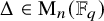 $\Delta \in {\mathrm M}_n({\mathbb F}_q)$
, the invariant flag generating function
$\Delta \in {\mathrm M}_n({\mathbb F}_q)$
, the invariant flag generating function $F_{\Delta }(x)$
is defined by
$F_{\Delta }(x)$
is defined by
 $$ \begin{align} F_{\Delta}(x):=\sum_{\alpha }X_{\alpha}(\Delta)x^{\alpha}, \end{align} $$
where the sum is taken over all inequivalent weak compositions $\alpha $
of n and
$\alpha $
of n and $x^{\alpha }$
denotes the product
$x^{\alpha }$
denotes the product $x_1^{\alpha _1}x_2^{\alpha _2}\cdots $
.
$x_1^{\alpha _1}x_2^{\alpha _2}\cdots $
.
It is important to take the sum over inequivalent weak compositions of n since contributions from compositions obtained from $\alpha $
by padding zeroes would make the coefficient of
$\alpha $
by padding zeroes would make the coefficient of $x^\alpha $
infinite. The following result is an easy consequence of Proposition 2.3 and the definition of the monomial symmetric function
$x^\alpha $
infinite. The following result is an easy consequence of Proposition 2.3 and the definition of the monomial symmetric function $m_\lambda $
.
$m_\lambda $
.
Proposition 2.5. For each matrix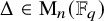 $\Delta \in {\mathrm M}_n({\mathbb F}_q)$
,
$\Delta \in {\mathrm M}_n({\mathbb F}_q)$
,
 $$ \begin{align} F_\Delta(x)=\sum_{\lambda}X_{\lambda}(\Delta)m_{\lambda}, \end{align} $$
where the sum is taken over all partitions $\lambda $
of n.
$\lambda $
of n.
Example 2.6. If $\Delta \in {\mathrm M}_n({\mathbb F}_q)$
is simple (it has irreducible characteristic polynomial), then the only
$\Delta \in {\mathrm M}_n({\mathbb F}_q)$
is simple (it has irreducible characteristic polynomial), then the only $\Delta $
-invariant subspaces are the zero subspace and
$\Delta $
-invariant subspaces are the zero subspace and ${\mathbb F}_q^n$
. Therefore
${\mathbb F}_q^n$
. Therefore $F_\Delta (x)=\sum _{i\geq 1}x_i^n=p_n$
, the power sum symmetric function.
$F_\Delta (x)=\sum _{i\geq 1}x_i^n=p_n$
, the power sum symmetric function.
Example 2.7. If $\Delta \in {\mathrm M}_n({\mathbb F}_q)$
is regular nilpotent (nilpotent with one-dimensional null space), then there is precisely one
$\Delta \in {\mathrm M}_n({\mathbb F}_q)$
is regular nilpotent (nilpotent with one-dimensional null space), then there is precisely one $\Delta $
-invariant subspace of dimension k for each
$\Delta $
-invariant subspace of dimension k for each $0\leq k\leq n$
. In this case
$0\leq k\leq n$
. In this case $F_\Delta (x)=\sum _{\alpha }x^\alpha =h_n$
, the complete homogeneous symmetric function.
$F_\Delta (x)=\sum _{\alpha }x^\alpha =h_n$
, the complete homogeneous symmetric function.
The following lemma follows from Kirillov [Reference Kirillov23] where it is stated for unipotent operators.
Lemma 2.8. The invariant flag generating function of a nilpotent matrix over ${\mathbb F}_q$
with Jordan form partition
${\mathbb F}_q$
with Jordan form partition $\lambda $
is
$\lambda $
is $\tilde {H}_{\lambda }(x;q)$
.
$\tilde {H}_{\lambda }(x;q)$
.
Proof. Let $N\in {\mathrm M}_n({\mathbb F}_q)$
be nilpotent with Jordan form partition
$N\in {\mathrm M}_n({\mathbb F}_q)$
be nilpotent with Jordan form partition $\lambda $
, and set
$\lambda $
, and set $u:=I+N$
. Then u is unipotent, and its Jordan block sizes are again given by the same partition
$u:=I+N$
. Then u is unipotent, and its Jordan block sizes are again given by the same partition $\lambda $
. By Kirillov’s formula for unipotent operators [Reference Kirillov23, Eq. (0.4)], we have
$\lambda $
. By Kirillov’s formula for unipotent operators [Reference Kirillov23, Eq. (0.4)], we have $F_u(x)=\tilde {H}_\lambda (x;q)$
, the modified Hall-Littlewood function evaluated at q (Kirillov uses the notation
$F_u(x)=\tilde {H}_\lambda (x;q)$
, the modified Hall-Littlewood function evaluated at q (Kirillov uses the notation $Q^{\prime }_\lambda (x;t)$
for the transformed Hall-Littlewood function
$Q^{\prime }_\lambda (x;t)$
for the transformed Hall-Littlewood function $H_\lambda (x;t)$
). A subspace W of
$H_\lambda (x;t)$
). A subspace W of ${\mathbb F}_q^n$
is N-invariant if and only if it is u-invariant. It follows that a flag is N-invariant if and only if it is u-invariant, and therefore
${\mathbb F}_q^n$
is N-invariant if and only if it is u-invariant. It follows that a flag is N-invariant if and only if it is u-invariant, and therefore $X_\alpha (N)=X_\alpha (u)$
for every
$X_\alpha (N)=X_\alpha (u)$
for every $\alpha $
. Consequently,
$\alpha $
. Consequently, $F_N(x)=F_u(x)$
, and the result follows.
$F_N(x)=F_u(x)$
, and the result follows.
Our objective now is to determine the invariant flag generating function for an arbitrary matrix $\Delta \in {\mathrm M}_n({\mathbb F}_q)$
. Recall that the action of
$\Delta \in {\mathrm M}_n({\mathbb F}_q)$
. Recall that the action of $\Delta $
on
$\Delta $
on ${\mathbb F}_q^n$
defines an
${\mathbb F}_q^n$
defines an ${\mathbb F}_q[t]$
-module structure on
${\mathbb F}_q[t]$
-module structure on ${\mathbb F}_q^n$
in which the action of t on a column vector v is given by
${\mathbb F}_q^n$
in which the action of t on a column vector v is given by $t\cdot v=\Delta v$
. By the structure theorem for finitely generated modules over a principal ideal domain, this module is isomorphic to a direct sum
$t\cdot v=\Delta v$
. By the structure theorem for finitely generated modules over a principal ideal domain, this module is isomorphic to a direct sum
 $$ \begin{align} \bigoplus_{i=1}^k \bigoplus_{j=1}^{\ell_i}\frac{{\mathbb F}_q[t]}{(g_i^{\lambda_{i,j}})}, \end{align} $$
where $g_i(t)\in {\mathbb F}_q[t]$
are distinct monic irreducible polynomials and the sequence
$g_i(t)\in {\mathbb F}_q[t]$
are distinct monic irreducible polynomials and the sequence $\lambda ^i=(\lambda _{i,1},\lambda _{i,2},\ldots ,\lambda _{i,\ell _i})$
is an integer partition for each
$\lambda ^i=(\lambda _{i,1},\lambda _{i,2},\ldots ,\lambda _{i,\ell _i})$
is an integer partition for each $1\leq i\leq k$
. Let
$1\leq i\leq k$
. Let $d_i$
denote the degree of
$d_i$
denote the degree of $g_i$
for
$g_i$
for $1\leq i\leq k$
. The submodule
$1\leq i\leq k$
. The submodule $\bigoplus _{j=1}^{\ell _i}{\mathbb F}_q[t]/(g_i^{\lambda _{i,j}})$
is referred to as the
$\bigoplus _{j=1}^{\ell _i}{\mathbb F}_q[t]/(g_i^{\lambda _{i,j}})$
is referred to as the $g_i$
-primary component (or
$g_i$
-primary component (or $g_i$
-primary part) of the module and corresponds to the maximal invariant subspace of
$g_i$
-primary part) of the module and corresponds to the maximal invariant subspace of $\Delta $
on which the restriction of
$\Delta $
on which the restriction of $\Delta $
has characteristic polynomial a power of
$\Delta $
has characteristic polynomial a power of $g_i$
.
$g_i$
.
Definition 2.9. With $d_i$
and
$d_i$
and $\lambda _i$
as above, the similarity class type of the matrix
$\lambda _i$
as above, the similarity class type of the matrix $\Delta $
is the multiset
$\Delta $
is the multiset $\tau =\{(d_1,\lambda ^1),(d_2,\lambda ^2),\ldots ,(d_k,\lambda ^k)\}$
. The size of
$\tau =\{(d_1,\lambda ^1),(d_2,\lambda ^2),\ldots ,(d_k,\lambda ^k)\}$
. The size of $\tau $
is the integer
$\tau $
is the integer $\sum _{i=1}^k d_i|\lambda ^i|$
.
$\sum _{i=1}^k d_i|\lambda ^i|$
.
The notion of similarity class type can be traced back to the work of Green [Reference Green17] who studied the characters of the finite general linear groups. Considering similarity class types allows for a q-independent classification of conjugacy classes in these groups.
Example 2.10. Consider $n\times n$
matrices over
$n\times n$
matrices over ${\mathbb F}_q$
.
${\mathbb F}_q$
.
-
2.10.1 A simple matrix (a matrix with characteristic polynomial irreducible of degree n; equivalently ${\mathbb F}_q^n$
is a cyclic
${\mathbb F}_q[t]$
-module) has
${\mathbb F}_q^n \cong {\mathbb F}_q[t]/(f)$
for a single irreducible f of degree n. Thus there is one primary component with exponent
$1$
, so the type is
$\{(n,(1))\}$
.
${\mathbb F}_q^n$
is a cyclic
${\mathbb F}_q[t]$
-module) has
${\mathbb F}_q^n \cong {\mathbb F}_q[t]/(f)$
for a single irreducible f of degree n. Thus there is one primary component with exponent
$1$
, so the type is
$\{(n,(1))\}$
. -
2.10.2 A scalar matrix
$\Delta =aI$
has minimal polynomial
$t-a$
and acts diagonally with eigenvalue a. Equivalently, as an
${\mathbb F}_q[t]$
-module we have so the
$$\begin{align*}{\mathbb F}_q^n \cong \big({\mathbb F}_q[t]/(t-a)\big)^{\oplus n}, \end{align*}$$
$(t-a)$
-primary component consists of n blocks of size
$1$
, that is, the partition
$(1^n)$
. Hence the type is
$\{(1,(1^n))\}$
.
-
2.10.3 A regular nilpotent matrix (a single nilpotent Jordan block of size n) has
${\mathbb F}_q^n \cong {\mathbb F}_q[t]/(t^n)$
. Thus the only irreducible involved is
$f(t)=t$
(degree
$1$
) and the corresponding partition is
$(n)$
, so the type is
$\{(1,(n))\}$
.


From a combinatorial viewpoint, one advantage of working with types is that several combinatorial invariants of a matrix often depend only on its type. We will soon see that this viewpoint is particularly convenient in the context of invariant flag generating functions. We have the following explicit formula for $F_\Delta (x)$
.
$F_\Delta (x)$
.
Proposition 2.11. If $\Delta \in {\mathrm M}_n({\mathbb F}_q)$
is a matrix of similarity class type
$\Delta \in {\mathrm M}_n({\mathbb F}_q)$
is a matrix of similarity class type $\tau =\{(d_i,\lambda ^i)\}_{1\leq i\leq k}$
, then
$\tau =\{(d_i,\lambda ^i)\}_{1\leq i\leq k}$
, then
 $$ \begin{align} F_{\Delta}(x)=\prod_{i=1}^k\tilde{H}_{\lambda^i}(x_1^{d_i},x_2^{d_i},\ldots;q^{d_i})=\prod_{i=1}^k p_{d_i}[\tilde{H}_{\lambda^i}(x;t)]{\Big|_{t=q}}, \end{align} $$
where $p_r$
denotes the power sum symmetric function. Here, the plethystic substitution
$p_r$
denotes the power sum symmetric function. Here, the plethystic substitution $p_{d_i}[\tilde {H}_{\lambda ^i}(x;t)]$
is performed before evaluating at
$p_{d_i}[\tilde {H}_{\lambda ^i}(x;t)]$
is performed before evaluating at $t=q$
.
$t=q$
.
Proof. Since $\mathcal {L}(\Delta )$
is the product of the invariant subspace lattices corresponding to its primary parts (Brickman and Fillmore [Reference Brickman and Fillmore9, Thm. 1]), we briefly justify the resulting factorization of invariant flag generating functions. Write
$\mathcal {L}(\Delta )$
is the product of the invariant subspace lattices corresponding to its primary parts (Brickman and Fillmore [Reference Brickman and Fillmore9, Thm. 1]), we briefly justify the resulting factorization of invariant flag generating functions. Write
 $$\begin{align*}{\mathbb F}_q^n = V_1\oplus\cdots\oplus V_k,\qquad \Delta=\Delta_1\oplus\cdots\oplus\Delta_k, \end{align*}$$
where each $V_i$
is
$V_i$
is $\Delta $
-invariant and
$\Delta $
-invariant and $\Delta _i$
denotes the restriction of
$\Delta _i$
denotes the restriction of $\Delta $
to
$\Delta $
to $V_i$
(the primary part of type
$V_i$
(the primary part of type $\{(d_i,\lambda ^i)\}$
). Then a subspace W of
$\{(d_i,\lambda ^i)\}$
). Then a subspace W of $ {\mathbb F}_q^n$
is
$ {\mathbb F}_q^n$
is $\Delta $
-invariant if and only if
$\Delta $
-invariant if and only if $W=\bigoplus _{i=1}^k (W\cap V_i)$
and each
$W=\bigoplus _{i=1}^k (W\cap V_i)$
and each $W\cap V_i$
is
$W\cap V_i$
is $\Delta _i$
-invariant, yielding the lattice isomorphism
$\Delta _i$
-invariant, yielding the lattice isomorphism $\mathcal {L}(\Delta )\cong \mathcal {L}(\Delta _1)\times \cdots \times \mathcal {L}(\Delta _k)$
.
$\mathcal {L}(\Delta )\cong \mathcal {L}(\Delta _1)\times \cdots \times \mathcal {L}(\Delta _k)$
.
Now let $0=W_0\subseteq W_1\subseteq \cdots \subseteq W_r={\mathbb F}_q^n$
be a
$0=W_0\subseteq W_1\subseteq \cdots \subseteq W_r={\mathbb F}_q^n$
be a $\Delta $
-invariant flag and set
$\Delta $
-invariant flag and set $W^{(i)}_j:=W_j\cap V_i$
. Then each
$W^{(i)}_j:=W_j\cap V_i$
. Then each $(W^{(i)}_j)_{j=0}^r$
is a
$(W^{(i)}_j)_{j=0}^r$
is a $\Delta _i$
-invariant flag (allowing equalities), we have
$\Delta _i$
-invariant flag (allowing equalities), we have $W_j=\bigoplus _{i=1}^k W^{(i)}_j$
, and
$W_j=\bigoplus _{i=1}^k W^{(i)}_j$
, and
 $$\begin{align*}\dim(W_j/W_{j-1})=\sum_{i=1}^k \dim\bigl(W^{(i)}_j/W^{(i)}_{j-1}\bigr)\qquad(1\le j\le r). \end{align*}$$
Consequently the monomial weight of a $\Delta $
-invariant flag factors as the product of the weights of the corresponding
$\Delta $
-invariant flag factors as the product of the weights of the corresponding $\Delta _i$
-invariant flags, and summing over all flags gives
$\Delta _i$
-invariant flags, and summing over all flags gives
 $$ \begin{align} F_\Delta(x)=\prod_{i=1}^k F_{\Delta_i}(x). \end{align} $$
If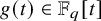 $g(t)\in {\mathbb F}_q[t]$
is an irreducible polynomial of degree d, then we claim that
$g(t)\in {\mathbb F}_q[t]$
is an irreducible polynomial of degree d, then we claim that ${\mathbb F}_q[t]/(g^r)$
is isomorphic to
${\mathbb F}_q[t]/(g^r)$
is isomorphic to $\mathbb {F}_{q^d}[u]/(u^r)$
. To see this, let
$\mathbb {F}_{q^d}[u]/(u^r)$
. To see this, let $K:={\mathbb F}_q[t]/(g)\cong {\mathbb F}_{q^d}$
and set
$K:={\mathbb F}_q[t]/(g)\cong {\mathbb F}_{q^d}$
and set $R:={\mathbb F}_q[t]/(g^r)$
. Let
$R:={\mathbb F}_q[t]/(g^r)$
. Let $u\in R$
denote the image of
$u\in R$
denote the image of $g(t)$
; then
$g(t)$
; then $u^r=0$
and
$u^r=0$
and $R/(u)\cong K$
. Thus we have the isomorphism
$R/(u)\cong K$
. Thus we have the isomorphism
 $$\begin{align*}R \cong K[u]/(u^r)\cong {\mathbb F}_{q^d}[u]/(u^r), \end{align*}$$
where u is a new indeterminate.
Under this identification, a $\Delta _i$
-invariant flag is the same as a u-invariant flag in an
$\Delta _i$
-invariant flag is the same as a u-invariant flag in an ${\mathbb F}_{q^{d_i}}$
-vector space. When such a flag is regarded over
${\mathbb F}_{q^{d_i}}$
-vector space. When such a flag is regarded over ${\mathbb F}_q$
, each successive quotient has dimension multiplied by
${\mathbb F}_q$
, each successive quotient has dimension multiplied by $d_i$
, so the monomial weights in
$d_i$
, so the monomial weights in $F_{\Delta _i}(x)$
acquire the substitution
$F_{\Delta _i}(x)$
acquire the substitution $x_j\mapsto x_j^{d_i}$
. Likewise, all q-enumerations over
$x_j\mapsto x_j^{d_i}$
. Likewise, all q-enumerations over ${\mathbb F}_{q^{d_i}}$
involve
${\mathbb F}_{q^{d_i}}$
involve $q^{d_i}$
, which explains the parameter change
$q^{d_i}$
, which explains the parameter change $q\mapsto q^{d_i}$
. In view of Equation (2.5) and Lemma 2.8, this yields
$q\mapsto q^{d_i}$
. In view of Equation (2.5) and Lemma 2.8, this yields
 $$ \begin{align*} F_{\Delta_i}= \tilde{H}_{\lambda^i}(x_1^{d_i},x_2^{d_i},\ldots;q^{d_i})=p_{d_i}[\tilde{H}_{\lambda^i}(x;t)]{\Big|_{t=q}}, \end{align*} $$
and the result follows.
The expression for $F_\Delta (x)$
in Proposition 2.11 is a product of symmetric functions where the parameter t is specialized to a prime power q. Rather than specializing the parameter, one can work directly with the parametric versions
$F_\Delta (x)$
in Proposition 2.11 is a product of symmetric functions where the parameter t is specialized to a prime power q. Rather than specializing the parameter, one can work directly with the parametric versions $\tilde {H}_\lambda (x;t)$
by considering similarity class types instead of matrices. For a similarity class type
$\tilde {H}_\lambda (x;t)$
by considering similarity class types instead of matrices. For a similarity class type $\tau =\{(d_1,\lambda ^1),(d_2,\lambda ^2),\ldots ,(d_k,\lambda ^k)\},$
define
$\tau =\{(d_1,\lambda ^1),(d_2,\lambda ^2),\ldots ,(d_k,\lambda ^k)\},$
define
 $$ \begin{align} F_{\tau}(x;t):=\prod_{i=1}^k p_{d_i}[\tilde{H}_{\lambda^i}(x;t)]. \end{align} $$
Given a prime power q and a matrix $\Delta \in {\mathrm M}_n(\mathbb {F}_{q})$
with similarity class type
$\Delta \in {\mathrm M}_n(\mathbb {F}_{q})$
with similarity class type $\tau $
, it is clear that
$\tau $
, it is clear that ${F_\Delta (x)=F_{\tau }(x;q)}$
. With this approach statements about matrices can be restated in terms of similarity class types. For instance, instead of the quantity
${F_\Delta (x)=F_{\tau }(x;q)}$
. With this approach statements about matrices can be restated in terms of similarity class types. For instance, instead of the quantity $X_\lambda (\Delta )$
, one considers
$X_\lambda (\Delta )$
, one considers $X_\lambda (\tau )$
defined as the coefficient of the monomial
$X_\lambda (\tau )$
defined as the coefficient of the monomial $m_\lambda $
in
$m_\lambda $
in $F_\tau (x;t)$
as in Equation (2.8). Although our statements will often involve matrices, it is useful to keep in mind the corresponding statements for similarity class types and we will give such examples.
$F_\tau (x;t)$
as in Equation (2.8). Although our statements will often involve matrices, it is useful to keep in mind the corresponding statements for similarity class types and we will give such examples.
Remark 2.12. For arbitrary $\tau $
and q, there may be no matrix of similarity class type
$\tau $
and q, there may be no matrix of similarity class type $\tau $
over
$\tau $
over ${\mathbb F}_q$
. Indeed, if
${\mathbb F}_q$
. Indeed, if $\tau =\{(d_1,\lambda ^1),\dots ,(d_k,\lambda ^k)\}$
and
$\tau =\{(d_1,\lambda ^1),\dots ,(d_k,\lambda ^k)\}$
and
 $$\begin{align*}m_d:=\#\{\,i: d_i=d\,\}, \end{align*}$$
then realizing $\tau $
over
$\tau $
over ${\mathbb F}_q$
requires choosing
${\mathbb F}_q$
requires choosing $m_d$
distinct monic irreducible polynomials of degree d in
$m_d$
distinct monic irreducible polynomials of degree d in ${\mathbb F}_q[t]$
for each d that occurs in
${\mathbb F}_q[t]$
for each d that occurs in $\tau $
. When such choices exist, one constructs a matrix of type
$\tau $
. When such choices exist, one constructs a matrix of type $\tau $
by taking a block diagonal matrix whose i-th block has rational canonical form with invariant factors determined by
$\tau $
by taking a block diagonal matrix whose i-th block has rational canonical form with invariant factors determined by $(f_i,\lambda ^i)$
.
$(f_i,\lambda ^i)$
.
For a fixed $\tau $
, a matrix of type
$\tau $
, a matrix of type $\tau $
exists over
$\tau $
exists over ${\mathbb F}_q$
for all sufficiently large prime powers q, since for each fixed degree d the number of monic irreducible polynomials of degree d in
${\mathbb F}_q$
for all sufficiently large prime powers q, since for each fixed degree d the number of monic irreducible polynomials of degree d in ${\mathbb F}_q[t]$
tends to infinity with q (in fact it grows on the order of
${\mathbb F}_q[t]$
tends to infinity with q (in fact it grows on the order of $q^d/d$
), so eventually there are enough distinct choices for every d appearing in
$q^d/d$
), so eventually there are enough distinct choices for every d appearing in $\tau $
.
$\tau $
.
As a small-field obstruction, over ${\mathbb F}_2$
there is only one monic irreducible quadratic, namely
${\mathbb F}_2$
there is only one monic irreducible quadratic, namely $t^2+t+1$
. Hence no matrix over
$t^2+t+1$
. Hence no matrix over ${\mathbb F}_2$
can have a type requiring two distinct degree-
${\mathbb F}_2$
can have a type requiring two distinct degree- $2$
primary parts, for example
$2$
primary parts, for example $\tau =\{(2,(1)),(2,(1))\}$
.
$\tau =\{(2,(1)),(2,(1))\}$
.
We now give examples of various symmetric functions which arise as $F_\Delta (x)$
for some
$F_\Delta (x)$
for some $\Delta $
. In Section 4 we will see that a combinatorial interpretation can be given for the coefficients in the q-Whittaker expansions of each of these functions. The next two examples show that the power sum and homogeneous symmetric functions arise as invariant flag generating functions.
$\Delta $
. In Section 4 we will see that a combinatorial interpretation can be given for the coefficients in the q-Whittaker expansions of each of these functions. The next two examples show that the power sum and homogeneous symmetric functions arise as invariant flag generating functions.
Example 2.13. A matrix is regular semisimple if its characteristic polynomial is a product of distinct irreducible polynomials $g_i(t)(1\leq i\leq k)$
over
$g_i(t)(1\leq i\leq k)$
over ${\mathbb F}_q$
. This recovers Example 2.10.1 in the special case
${\mathbb F}_q$
. This recovers Example 2.10.1 in the special case $k=1$
and
$k=1$
and $\deg (g_1)=n$
. Let
$\deg (g_1)=n$
. Let $\lambda =(\lambda _1,\ldots ,\lambda _k)$
denote the integer partition obtained by arranging the degrees of the
$\lambda =(\lambda _1,\ldots ,\lambda _k)$
denote the integer partition obtained by arranging the degrees of the $g_i$
in weakly decreasing order. The invariant flag generating function is given by
$g_i$
in weakly decreasing order. The invariant flag generating function is given by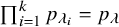 $\prod _{i=1}^k p_{\lambda _i}=p_\lambda $
.
$\prod _{i=1}^k p_{\lambda _i}=p_\lambda $
.
Example 2.14. A matrix is regular split if its minimal polynomial is equal to its characteristic polynomial and each is a product of linear factors: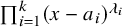 $\prod _{i=1}^k (x-a_i)^{\lambda _i}$
(this generalizes the regular nilpotent case of Example 2.10.3). In this case the invariant flag generating function is
$\prod _{i=1}^k (x-a_i)^{\lambda _i}$
(this generalizes the regular nilpotent case of Example 2.10.3). In this case the invariant flag generating function is $\prod _{i=1}^k h_{\lambda _i}=h_\lambda .$
The following is a simultaneous generalization of Examples 2.7 and 2.14.
Example 2.15. A matrix is triangulable if it is similar to an upper triangular matrix. Triangulability is characterized by the minimal polynomial being a product of linear factors [Reference Hoffman, Kunze and Algebra21, Sec. 6.4] over ${\mathbb F}_q$
. For such a matrix
${\mathbb F}_q$
. For such a matrix $\Delta $
, we have
$\Delta $
, we have $d_i=1$
in the decomposition (2.5) above for
$d_i=1$
in the decomposition (2.5) above for $1\leq i\leq k$
. Since
$1\leq i\leq k$
. Since $p_1[f]=f$
for any symmetric function f, it follows from Proposition 2.11 that
$p_1[f]=f$
for any symmetric function f, it follows from Proposition 2.11 that
 $$ \begin{align*} F_\Delta(x)=\prod_{i\geq 1} \tilde{H}_{\lambda^i}(x;q). \end{align*} $$
The next example will prove useful later on in the proof of Theorem 4.2.
Example 2.16. Let $\Delta \in {\mathrm M}_n({\mathbb F}_q)$
be a diagonalizable matrix with characteristic polynomial
$\Delta \in {\mathrm M}_n({\mathbb F}_q)$
be a diagonalizable matrix with characteristic polynomial ${\prod _{i=1}^k (x-a_i)^{\nu _i}}$
for some partition
${\prod _{i=1}^k (x-a_i)^{\nu _i}}$
for some partition $\nu $
of n and distinct elements
$\nu $
of n and distinct elements $a_i\in {\mathbb F}_q(1\leq i\leq k).$
Since
$a_i\in {\mathbb F}_q(1\leq i\leq k).$
Since $\Delta $
acts by a scalar multiple of the identity on each eigenspace, it follows from Example 2.2 that
$\Delta $
acts by a scalar multiple of the identity on each eigenspace, it follows from Example 2.2 that $F_\Delta (x)=\prod _{i\geq 1}F_{\nu _i}$
where, for each positive integer m,
$F_\Delta (x)=\prod _{i\geq 1}F_{\nu _i}$
where, for each positive integer m,
 $$ \begin{align} F_m:=\sum_{\lambda \vdash m}{m \brack \lambda}_qm_{\lambda}=W_{(m)}(x;q), \end{align} $$
is a one row q-Whittaker function (see Macdonald [Reference Macdonald29, p. 323, Eq. (4.9); $t\to 0$
] and [Reference Macdonald29, p. 314, Ex. 1;
$t\to 0$
] and [Reference Macdonald29, p. 314, Ex. 1; $t\to 0$
] for the last equality above). Therefore
$t\to 0$
] for the last equality above). Therefore $ F_\Delta (x)=\prod _{i\geq 1} W_{(\nu _i)}(x;q).$
Our immediate goal is to show that the number of subspaces with a given $\Delta $
-profile can be expressed in terms of
$\Delta $
-profile can be expressed in terms of $F_\Delta (x)$
. Write
$F_\Delta (x)$
. Write $\Delta ^{-1}W$
to denote the inverse image of a subspace W of
$\Delta ^{-1}W$
to denote the inverse image of a subspace W of ${\mathbb F}_q^n$
.
${\mathbb F}_q^n$
.
Definition 2.17. Let r be a positive integer and suppose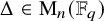 $\Delta \in {\mathrm M}_n({\mathbb F}_q)$
. Given partitions
$\Delta \in {\mathrm M}_n({\mathbb F}_q)$
. Given partitions $\lambda =(\lambda _1,\ldots ,\lambda _r)$
and
$\lambda =(\lambda _1,\ldots ,\lambda _r)$
and $\nu =(\nu _1,\ldots ,\nu _r)$
, denote by
$\nu =(\nu _1,\ldots ,\nu _r)$
, denote by $\phi (\lambda ,\nu ;\Delta )$
the number of flags
$\phi (\lambda ,\nu ;\Delta )$
the number of flags $W_1\supseteq W_2\supseteq \cdots \supseteq W_r$
of subspaces of
$W_1\supseteq W_2\supseteq \cdots \supseteq W_r$
of subspaces of ${\mathbb F}_q^n$
such that
${\mathbb F}_q^n$
such that
 $$ \begin{align*} \dim W_i=\lambda_i &\qquad\text{ for } 1\leq i\leq r,\\ \dim (W_i\cap \Delta^{-1}W_i)=\nu_i &\qquad\text{ for } 1\leq i\leq r,\\ W_i \cap \Delta^{-1}W_i\supseteq W_{i+1} &\qquad\text{ for }1\leq i\leq r-1. \end{align*} $$
Note that $\phi (\lambda ,\lambda ;\Delta )$
is just equal to the number of flags
$\phi (\lambda ,\lambda ;\Delta )$
is just equal to the number of flags $W_1\supseteq W_2\supseteq \cdots \supseteq W_r$
of
$W_1\supseteq W_2\supseteq \cdots \supseteq W_r$
of $\Delta $
-invariant subspaces such that
$\Delta $
-invariant subspaces such that $\dim W_i=\lambda _i$
for
$\dim W_i=\lambda _i$
for $1\leq i\leq r$
. Therefore
$1\leq i\leq r$
. Therefore $\phi (\lambda ,\lambda ;\Delta )$
is equal to
$\phi (\lambda ,\lambda ;\Delta )$
is equal to $X_\alpha (\Delta )$
for a suitably chosen
$X_\alpha (\Delta )$
for a suitably chosen $\alpha $
.
$\alpha $
.
The following lemma shows that $\sigma (\mu ,\Delta )$
can be expressed in the form
$\sigma (\mu ,\Delta )$
can be expressed in the form $\phi (\lambda ,\nu ;\Delta )$
for suitably chosen
$\phi (\lambda ,\nu ;\Delta )$
for suitably chosen $\lambda $
and
$\lambda $
and $\nu $
[Reference Prasad and Ram33, Prop. 4.6].
$\nu $
[Reference Prasad and Ram33, Prop. 4.6].
Lemma 2.18. Given a partition $\mu =(\mu _1,\ldots ,\mu _k)$
, let
$\mu =(\mu _1,\ldots ,\mu _k)$
, let $m_i=\mu _1+\cdots +\mu _i$
for
$m_i=\mu _1+\cdots +\mu _i$
for $1\leq i\leq k$
. We have
$1\leq i\leq k$
. We have
 $$ \begin{align*} \sigma(\mu,\Delta)=\phi(\pi,\delta;\Delta), \end{align*} $$
where $\pi =(m_k,m_{k-1},\ldots ,m_1)$
and
$\pi =(m_k,m_{k-1},\ldots ,m_1)$
and $\delta =(m_k,m_{k-1}-\mu _k,m_{k-2}-\mu _{k-1},\ldots ,m_1-\mu _2)$
.
$\delta =(m_k,m_{k-1}-\mu _k,m_{k-2}-\mu _{k-1},\ldots ,m_1-\mu _2)$
.
Theorem 2.19. For each partition $\mu $
and each partition
$\mu $
and each partition $\lambda $
of n, there exist polynomials
$\lambda $
of n, there exist polynomials $g_{\mu \lambda }(t)\in {\mathbb Z}[t]$
, such that
$g_{\mu \lambda }(t)\in {\mathbb Z}[t]$
, such that
 $$ \begin{align*} \sigma(\mu,\Delta)=\sum_{\lambda \vdash n}g_{\mu \lambda}(q)X_\lambda(\Delta), \end{align*} $$
for every prime power q and every matrix $\Delta \in {\mathrm M}_n({\mathbb F}_q)$
.
$\Delta \in {\mathrm M}_n({\mathbb F}_q)$
.
Proof. Chen and Tseng [Reference Chen and Tseng11, Lemma 2.7] (see [Reference Aggarwal and Ram3, Lemma 2.7] for a more general result) proved that the quantities $\phi (\pi ,\delta ;\Delta )$
satisfy a recursion in which the base cases are of the form
$\phi (\pi ,\delta ;\Delta )$
satisfy a recursion in which the base cases are of the form $\phi (\eta ,\eta ;\Delta )$
for partitions
$\phi (\eta ,\eta ;\Delta )$
for partitions $\eta $
of n. For
$\eta $
of n. For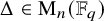 $\Delta \in {\mathrm M}_n({\mathbb F}_q)$
, this recursion involves coefficients that are products of q-binomial coefficients (with possible sign) that depend only on the partitions
$\Delta \in {\mathrm M}_n({\mathbb F}_q)$
, this recursion involves coefficients that are products of q-binomial coefficients (with possible sign) that depend only on the partitions $\pi ,\delta $
, and n. Since q-binomial coefficients are polynomials with integer coefficients, iterating the recursion a finite number of times to compute
$\pi ,\delta $
, and n. Since q-binomial coefficients are polynomials with integer coefficients, iterating the recursion a finite number of times to compute $\phi (\pi ,\delta ;\Delta )$
yields an expansion of the form
$\phi (\pi ,\delta ;\Delta )$
yields an expansion of the form
 $$ \begin{align} \phi(\pi,\delta;\Delta)=\sum_{\eta\vdash n} c_{\pi,\delta}^{\eta}(q)\,\phi(\eta,\eta;\Delta), \end{align} $$
where each coefficient $c_{\pi ,\delta }^{\eta }(q)\in {\mathbb Z}[q]$
depends only on
$c_{\pi ,\delta }^{\eta }(q)\in {\mathbb Z}[q]$
depends only on $\pi ,\delta $
, and n (but not on
$\pi ,\delta $
, and n (but not on $\Delta $
). By Lemma 2.18, the quantity
$\Delta $
). By Lemma 2.18, the quantity $\sigma (\mu ,\Delta )$
can also be expressed in the form given by the right-hand side of Equation (2.10). Since each
$\sigma (\mu ,\Delta )$
can also be expressed in the form given by the right-hand side of Equation (2.10). Since each $\phi (\eta ,\eta ;\Delta )$
is of the form
$\phi (\eta ,\eta ;\Delta )$
is of the form $X_\lambda (\Delta )$
for some partition
$X_\lambda (\Delta )$
for some partition $\lambda $
, the result follows.
$\lambda $
, the result follows.
3 Diagonal operators and q-Whittaker functions
We wish to determine the polynomials $g_{\mu \lambda }(t)$
appearing in Theorem 2.19. This is accomplished by setting up a system of linear equations in Section 4. Diagonalizable operators play a central role in this analysis and we begin by discussing some relevant results.
$g_{\mu \lambda }(t)$
appearing in Theorem 2.19. This is accomplished by setting up a system of linear equations in Section 4. Diagonalizable operators play a central role in this analysis and we begin by discussing some relevant results.
Definition 3.1. The type of a diagonalizable matrix is the integer partition obtained by sorting the dimensions of its eigenspaces in weakly decreasing order.
Note that a diagonalizable matrix of type $\nu $
over
$\nu $
over ${\mathbb F}_q$
exists if and only if the number of parts of
${\mathbb F}_q$
exists if and only if the number of parts of $\nu $
is at most q. The following result was proved in [Reference Ram and Schlosser35, Thm. 4.21].
$\nu $
is at most q. The following result was proved in [Reference Ram and Schlosser35, Thm. 4.21].
Theorem 3.2. For each pair $\mu ,\nu $
of integer partitions of n, there exist polynomials
$\mu ,\nu $
of integer partitions of n, there exist polynomials $b_{\mu \nu }(t)\in {\mathbb Z}[t]$
such that
$b_{\mu \nu }(t)\in {\mathbb Z}[t]$
such that
 $$ \begin{align*} \sigma(\mu,\Delta)=(q-1)^{\sum_{j\geq 2}\mu_j}q^{\sum_{j\geq 2}{\mu_j \choose 2}}b_{\mu\nu}(q), \end{align*} $$
for each prime power q and each diagonal matrix $\Delta \in {\mathrm M}_n({\mathbb F}_q)$
of type
$\Delta \in {\mathrm M}_n({\mathbb F}_q)$
of type $\nu $
.
$\nu $
.
The polynomials $b_{\mu \nu }(t)$
satisfy the following recurrence relation [Reference Ram and Schlosser35, Cor. 5.2] which was derived by considering the decomposition of the open Schubert cells in the Grassmannian according to subspace profiles with respect to a diagonal operator.
$b_{\mu \nu }(t)$
satisfy the following recurrence relation [Reference Ram and Schlosser35, Cor. 5.2] which was derived by considering the decomposition of the open Schubert cells in the Grassmannian according to subspace profiles with respect to a diagonal operator.
Proposition 3.3. If $\mu ,\nu $
are partitions of the same size with
$\mu ,\nu $
are partitions of the same size with $\nu =(\nu _1,\ldots ,\nu _k),$
then
$\nu =(\nu _1,\ldots ,\nu _k),$
then
 $$ \begin{align*} b_{\mu\nu}(t)=\sum_{\substack{\rho:\mu/\rho\ \mathrm{is\ a\ horizontal}\\ \mathrm{strip\ of\ size}\ \nu_k}}\theta_{\mu/\rho}(t)b_{\rho \tilde{\nu}}(t) , \end{align*} $$
where $\tilde {\nu }$
denotes the partition obtained by deleting the last part of
$\tilde {\nu }$
denotes the partition obtained by deleting the last part of $\nu $
and
$\nu $
and
 $$ \begin{align} \theta_{\mu/\rho}(t):=\frac{[|\mu|-|\rho|]_t!}{[\mu_1-\rho_1]_t!} \prod_{i\geq 1}{\rho_{i}-\rho_{i+1} \brack \mu_{i+1}-\rho_{i+1}}_t. \end{align} $$
Note that $ \theta _{\mu /\rho }(t)=0$
unless the skew diagram
$ \theta _{\mu /\rho }(t)=0$
unless the skew diagram $\mu /\rho $
is a horizontal strip (see Macdonald [Reference Macdonald29, p. 5] for the definition).
$\mu /\rho $
is a horizontal strip (see Macdonald [Reference Macdonald29, p. 5] for the definition).
Remark 3.4. It follows from Proposition 3.3 that $b_{\mu \nu }(t)$
can be written as a sum over semistandard tableaux of shape
$b_{\mu \nu }(t)$
can be written as a sum over semistandard tableaux of shape $\mu $
and content
$\mu $
and content $\nu $
(the precise formula is in [Reference Ram and Schlosser35, Definition 3.7]). In particular,
$\nu $
(the precise formula is in [Reference Ram and Schlosser35, Definition 3.7]). In particular, $b_{\mu \nu }(t)=0$
unless
$b_{\mu \nu }(t)=0$
unless $\mu \geq \nu $
in the dominance order (see Stanley [Reference Stanley38, Sec. 7.2] for the definition). It also follows from the form of
$\mu \geq \nu $
in the dominance order (see Stanley [Reference Stanley38, Sec. 7.2] for the definition). It also follows from the form of $\theta _{\mu /\rho }(t)$
that
$\theta _{\mu /\rho }(t)$
that $b_{\mu \nu }(t)$
is a polynomial in t with nonnegative integer coefficients which is nonzero whenever
$b_{\mu \nu }(t)$
is a polynomial in t with nonnegative integer coefficients which is nonzero whenever $\mu \geq \nu $
.
$\mu \geq \nu $
.
The polynomials $b_{\mu \nu }(t)$
can also be obtained from a statistic on a suitably defined class of set partitions. The fact that these polynomials can be expressed in terms of both set partition statistics and semistandard tableaux has led to an elementary correspondence between these two classical combinatorial classes [Reference Ram and Schlosser35, Section 2]. This correspondence yields a way to associate a set partition statistic to each Mahonian statistic on multiset permutations. The polynomials
$b_{\mu \nu }(t)$
can also be obtained from a statistic on a suitably defined class of set partitions. The fact that these polynomials can be expressed in terms of both set partition statistics and semistandard tableaux has led to an elementary correspondence between these two classical combinatorial classes [Reference Ram and Schlosser35, Section 2]. This correspondence yields a way to associate a set partition statistic to each Mahonian statistic on multiset permutations. The polynomials $b_{\mu \nu }(t)$
also have several interesting specializations. In particular, when
$b_{\mu \nu }(t)$
also have several interesting specializations. In particular, when $\mu =(m,m)$
and
$\mu =(m,m)$
and $\nu =(1^{2m})$
the polynomial
$\nu =(1^{2m})$
the polynomial $b_{\mu \nu }(t)$
coincides with the Touchard-Riordan generating polynomial for chord diagrams by their number of crossings. For more on this topic and some connections with q-rook theory, the reader is referred to [Reference Ram and Schlosser35]. Here we discuss a connection between these polynomials and q-Whittaker functions.
$b_{\mu \nu }(t)$
coincides with the Touchard-Riordan generating polynomial for chord diagrams by their number of crossings. For more on this topic and some connections with q-rook theory, the reader is referred to [Reference Ram and Schlosser35]. Here we discuss a connection between these polynomials and q-Whittaker functions.
Though they were originally studied by Macdonald [Reference Macdonald29], the name q-Whittaker was coined by Gerasimov, Lebedev, and Oblezin [Reference Gerasimov, Lebedev and Oblezin14]. As noted earlier, the q-Whittaker functions $W_\lambda (x;t)$
form a basis for
$W_\lambda (x;t)$
form a basis for $\Lambda _{{\mathbb Q}(t)}$
. They interpolate between the Schur functions and the elementary symmetric functions:
$\Lambda _{{\mathbb Q}(t)}$
. They interpolate between the Schur functions and the elementary symmetric functions:
 $$ \begin{align*} W_\lambda(x;0)=s_{\lambda}(x), \qquad W_\lambda(x;1)=e_{\lambda'}(x). \end{align*} $$
They also expand positively in the Schur basis,
 $$ \begin{align} W_{\mu}=\sum_{\lambda}K_{\lambda'\mu'}(t)s_\lambda, \end{align} $$
where $K_{\lambda \mu }(t)$
denotes a Kostka–Foulkes polynomial (Bergeron [Reference Bergeron7, Eq. (3.8)]). In a representation theoretic context, the q-Whittaker functions arise in the setting of the graded Frobenius characteristic of the cohomology ring of Springer fibers. We refer to the survey article of Bergeron [Reference Bergeron7] for more on q-Whittaker functions.
$K_{\lambda \mu }(t)$
denotes a Kostka–Foulkes polynomial (Bergeron [Reference Bergeron7, Eq. (3.8)]). In a representation theoretic context, the q-Whittaker functions arise in the setting of the graded Frobenius characteristic of the cohomology ring of Springer fibers. We refer to the survey article of Bergeron [Reference Bergeron7] for more on q-Whittaker functions.
The polynomials $b_{\mu \nu }(t)$
are closely related to the coefficients in the monomial expansion of the q-Whittaker function
$b_{\mu \nu }(t)$
are closely related to the coefficients in the monomial expansion of the q-Whittaker function $W_\lambda $
. More precisely, we have the following proposition [Reference Ram and Schlosser35, Thm. 5.3].
$W_\lambda $
. More precisely, we have the following proposition [Reference Ram and Schlosser35, Thm. 5.3].
Proposition 3.5. For partitions $\mu $
and
$\mu $
and $\nu $
,
$\nu $
,
 $$ \begin{align*} b_{\mu\nu}(t)=\frac{\prod_{i\geq 1}[\nu_i]_t!}{\prod_{i\geq 1}[\mu_i-\mu_{i+1}]_t!}\langle W_\mu,h_\nu\rangle. \end{align*} $$
Remark 3.6. The symmetric functions $\widetilde {W}_\lambda $
defined by
$\widetilde {W}_\lambda $
defined by
 $$ \begin{align} \widetilde{W}_\lambda(x;t)=\frac{(1-t)^{-\lambda_1}}{\prod_{i\geq 1}[\lambda_i-\lambda_{i+1}]_t!}W_\lambda[X(1-t)] \end{align} $$
are dual to the q-Whittaker functions with respect to the Hall scalar product (Bergeron [Reference Bergeron7]). We have the following dual of Equation (2.2):
 $$ \begin{align} \omega P_{\lambda'}(x;t)= \widetilde{W}_\lambda(x;t). \end{align} $$
Proposition 3.7. For each partition $\nu =(\nu _1,\ldots ,\nu _k)$
,
$\nu =(\nu _1,\ldots ,\nu _k)$
,
 $$ \begin{align*} \prod_{i=1}^k W_{(\nu_i)} =\sum_{\mu}(1-t)^{|\mu|-\mu_1}b_{\mu\nu}(t)W_{\mu}. \end{align*} $$
Proof. We claim that
 $$ \begin{align} \langle f,g\rangle=\langle f[X(1-t)], g\left[\frac{X}{1-t}\right]\rangle, \end{align} $$
for symmetric functions f and g. To see this, it suffices to prove the above identity for the power sum basis, $f=p_\lambda $
and
$f=p_\lambda $
and $g=p_\mu $
. The claim now follows from the equations,
$g=p_\mu $
. The claim now follows from the equations,
 $$\begin{align*}p_\lambda[X(1-t)]=\prod_{i}(1-t^{\lambda_i})p_{\lambda_i}[X],\qquad p_\mu\!\left[\frac{X}{1-t}\right]=\prod_i\frac{1}{1-t^{\mu_i}}p_{\mu_i}[X], \end{align*}$$
and the fact that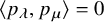 $\langle p_\lambda ,p_\mu \rangle =0$
for
$\langle p_\lambda ,p_\mu \rangle =0$
for $\lambda \neq \mu $
. By Proposition 3.5,
$\lambda \neq \mu $
. By Proposition 3.5,
 $$ \begin{align*} b_{\mu\nu}(t)&=\frac{\prod_{i\geq 1}[\nu_i]_t!}{\prod_{i\geq 1}[\mu_i-\mu_{i+1}]_t!}\langle W_\mu,h_\nu\rangle \\ &=\frac{\prod_{i\geq 1}[\nu_i]_t!}{\prod_{i\geq 1}[\mu_i-\mu_{i+1}]_t!} \langle W_\mu[X(1-t)],h_\nu\left[\frac{X}{1-t}\right]\rangle \\ &=(1-t)^{\mu_1}\prod_{i\geq 1}[\nu_i]_t!\, \langle \widetilde{W}_\mu,\prod_{i=1}^kh_{\nu_i}\left[\frac{X}{1-t}\right]\rangle , \end{align*} $$
where the last equality follows from Equation (3.3). For each positive integer k, we have $h_k=\omega e_k=\omega P_{(1^k)}$
by Macdonald [Reference Macdonald29, p. 209, Eq. 2.8]. Since
$h_k=\omega e_k=\omega P_{(1^k)}$
by Macdonald [Reference Macdonald29, p. 209, Eq. 2.8]. Since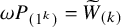 $\omega P_{(1^k)}=\widetilde {W}_{(k)}$
by Equation (3.4),
$\omega P_{(1^k)}=\widetilde {W}_{(k)}$
by Equation (3.4),
 $$ \begin{align*} b_{\mu\nu}(t)&=(1-t)^{\mu_1}\prod_{i\geq 1}[\nu_i]_t! \langle \widetilde{W}_\mu,\prod_{i=1}^k\widetilde{W}_{(\nu_i)}\left[\frac{X}{1-t}\right]\rangle \\ &=(1-t)^{\mu_1-|\mu|} \langle \widetilde{W}_\mu,\textstyle\prod_{i=1}^kW_{(\nu_i)}\rangle, \end{align*} $$
again by Equation (3.3). It follows that $(1-t)^{|\mu |-\mu _1}b_{\mu \nu }(t)$
is the coefficient of
$(1-t)^{|\mu |-\mu _1}b_{\mu \nu }(t)$
is the coefficient of $W_\mu $
in the q-Whittaker expansion of
$W_\mu $
in the q-Whittaker expansion of $\prod _{i=1}^kW_{(\nu _i)}$
.
$\prod _{i=1}^kW_{(\nu _i)}$
.
4 Full profiles
In this section we obtain an explicit formula for $\sigma (\mu ,\Delta )$
when
$\sigma (\mu ,\Delta )$
when $\mu $
is a partition of n. Arbitrary profiles are considered in Section 5.
$\mu $
is a partition of n. Arbitrary profiles are considered in Section 5.
Let $a_{\mu \lambda }(t)$
and
$a_{\mu \lambda }(t)$
and $\tilde {a}_{ \mu \lambda }(t)$
denote the transition coefficients between the Hall–Littlewood functions and the elementary symmetric functions:
$\tilde {a}_{ \mu \lambda }(t)$
denote the transition coefficients between the Hall–Littlewood functions and the elementary symmetric functions:
 $$ \begin{align} e_{\mu}=\sum_{\lambda}a_{\mu\lambda}(t)P_{\lambda}(x;t) \text{ and } P_{\mu}(x;t)=\sum_{\lambda}\tilde{a}_{\mu\lambda}(t)e_{\lambda}. \end{align} $$
It is known that $a_{\mu \lambda }(1)$
is equal to the number of
$a_{\mu \lambda }(1)$
is equal to the number of $(0,1)$
-matrices with row sums
$(0,1)$
-matrices with row sums $\mu $
and column sums
$\mu $
and column sums $\lambda $
. In fact, one can view the polynomials
$\lambda $
. In fact, one can view the polynomials $a_{\mu \lambda }(t)$
as the generating polynomial for a suitably defined combinatorial statistic on
$a_{\mu \lambda }(t)$
as the generating polynomial for a suitably defined combinatorial statistic on $(0,1)$
-matrices (Macdonald [Reference Macdonald29, p. 211]). On the other hand, the polynomials
$(0,1)$
-matrices (Macdonald [Reference Macdonald29, p. 211]). On the other hand, the polynomials $\tilde {a}_{\mu \lambda }(t)$
do not have nonnegative coefficients in general and do not appear to have a nice combinatorial description. A very intricate explicit formula for
$\tilde {a}_{\mu \lambda }(t)$
do not have nonnegative coefficients in general and do not appear to have a nice combinatorial description. A very intricate explicit formula for $\tilde {a}_{\mu \lambda }(t)$
was found by Lassalle and Schlosser [Reference Lassalle and Schlosser25, Thm. 7.5] who gave an expression for the more general two-parameter coefficients in the elementary expansion of Macdonald polynomials. Recall that the Kostka numbers
$\tilde {a}_{\mu \lambda }(t)$
was found by Lassalle and Schlosser [Reference Lassalle and Schlosser25, Thm. 7.5] who gave an expression for the more general two-parameter coefficients in the elementary expansion of Macdonald polynomials. Recall that the Kostka numbers $K_{\lambda \mu }$
arise as coefficients in the monomial expansion of the Schur function,
$K_{\lambda \mu }$
arise as coefficients in the monomial expansion of the Schur function, $ s_\lambda =\sum _{\mu } K_{\lambda \mu }m_{\mu }.$
The following lemma (Kirillov [Reference Kirillov23, Eq. (0.3)]) expresses the polynomials
$ s_\lambda =\sum _{\mu } K_{\lambda \mu }m_{\mu }.$
The following lemma (Kirillov [Reference Kirillov23, Eq. (0.3)]) expresses the polynomials $a_{\mu \lambda }(t)$
above in terms of Kostka numbers and Kostka–Foulkes polynomials.
$a_{\mu \lambda }(t)$
above in terms of Kostka numbers and Kostka–Foulkes polynomials.
Lemma 4.1. We have $a_{\mu \lambda }(t)=\sum _{\eta }K_{\eta '\mu }K_{\eta \lambda }(t).$
For each partition $\lambda $
, let
$\lambda $
, let $\epsilon _\lambda =(-1)^{|\lambda |-\ell (\lambda )}$
, where
$\epsilon _\lambda =(-1)^{|\lambda |-\ell (\lambda )}$
, where $\ell (\lambda )$
denotes the number of parts of
$\ell (\lambda )$
denotes the number of parts of $\lambda $
. The following theorem is the main result of this section.
$\lambda $
. The following theorem is the main result of this section.
Theorem 4.2. For each partition $\mu $
of n,
$\mu $
of n,
 $$ \begin{align*} \sigma(\mu,\Delta)=\epsilon_{\mu'}\, q^{\sum_{j\geq 2}{\mu_j \choose 2}}\sum_{\lambda \vdash n}\tilde{a}_{\mu' \lambda}(q)X_\lambda(\Delta), \end{align*} $$
for every prime power q and every matrix $\Delta \in {\mathrm M}_n({\mathbb F}_q)$
.
$\Delta \in {\mathrm M}_n({\mathbb F}_q)$
.
Proof. Define
 $$ \begin{align} \tilde{\sigma}(\mu,\Delta):=\epsilon_{\mu}q^{-\sum_{j\geq 2}{\mu^{\prime}_j \choose 2}}\sigma(\mu',\Delta), \end{align} $$
and note that the theorem is equivalent to $\tilde {\sigma }(\mu ,\Delta )=\sum _{\lambda }\tilde {a}_{\mu \lambda }(q)X_\lambda (\Delta )$
. To prove this, it suffices to show that
$\tilde {\sigma }(\mu ,\Delta )=\sum _{\lambda }\tilde {a}_{\mu \lambda }(q)X_\lambda (\Delta )$
. To prove this, it suffices to show that
 $$ \begin{align*} X_\lambda(\Delta)= \sum_{\mu}a_{\lambda \mu}(q) \tilde{\sigma}(\mu,\Delta), \end{align*} $$
since the matrices $(\tilde {a}_{\lambda \mu }(q))$
and
$(\tilde {a}_{\lambda \mu }(q))$
and $(a_{\lambda \mu }(q))$
for
$(a_{\lambda \mu }(q))$
for $\lambda $
and
$\lambda $
and $\mu $
varying over partitions of n are mutually inverse to each other. In view of Theorem 2.19, it suffices to show that Theorem 4.2 holds for sufficiently large prime powers q. Fix a prime power
$\mu $
varying over partitions of n are mutually inverse to each other. In view of Theorem 2.19, it suffices to show that Theorem 4.2 holds for sufficiently large prime powers q. Fix a prime power $q\geq n$
and, for each partition
$q\geq n$
and, for each partition $\nu $
of n, let
$\nu $
of n, let $\Delta _{\nu }$
be a diagonal matrix of type
$\Delta _{\nu }$
be a diagonal matrix of type $\nu $
over
$\nu $
over ${\mathbb F}_q$
. Given a partition
${\mathbb F}_q$
. Given a partition $\lambda $
of n, consider the system of equations
$\lambda $
of n, consider the system of equations
 $$ \begin{align} X_\lambda(\Delta_\nu)= \sum_{\mu}y_{\mu}\, \tilde{\sigma}(\mu,\Delta_\nu), \end{align} $$
in the variables $y_{\mu }$
as
$y_{\mu }$
as $\nu $
varies over all partitions of n. We claim that the system has a unique solution given by
$\nu $
varies over all partitions of n. We claim that the system has a unique solution given by $y_{\mu }=a_{\lambda \mu }(q)$
. To prove the claim, it suffices to show that the determinant
$y_{\mu }=a_{\lambda \mu }(q)$
. To prove the claim, it suffices to show that the determinant $(\tilde {\sigma }(\mu ,\Delta _\nu ))$
for
$(\tilde {\sigma }(\mu ,\Delta _\nu ))$
for $\mu $
and
$\mu $
and $\nu $
varying over partitions of n is nonsingular and Equation (4.3) holds for
$\nu $
varying over partitions of n is nonsingular and Equation (4.3) holds for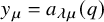 $y_{ \mu }=a_{\lambda \mu }(q)$
.
$y_{ \mu }=a_{\lambda \mu }(q)$
.
Consider the determinant $D=\det (\tilde {\sigma }(\mu ,\Delta _\nu ))$
whose rows and columns are indexed by partitions
$D=\det (\tilde {\sigma }(\mu ,\Delta _\nu ))$
whose rows and columns are indexed by partitions $\mu ,\nu $
of n, respectively, in lexicographic order (so that
$\mu ,\nu $
of n, respectively, in lexicographic order (so that $(1^n)$
comes first and
$(1^n)$
comes first and $(n)$
comes last). By Theorem 3.2 and the defining equation (4.2) for
$(n)$
comes last). By Theorem 3.2 and the defining equation (4.2) for $\tilde {\sigma }(\mu ,\Delta )$
, it follows that D is equal to the determinant
$\tilde {\sigma }(\mu ,\Delta )$
, it follows that D is equal to the determinant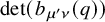 $\det (b_{\mu '\nu }(q))$
up to sign and a power of
$\det (b_{\mu '\nu }(q))$
up to sign and a power of $(q-1)$
. By permuting the rows of the determinant, it is clear that
$(q-1)$
. By permuting the rows of the determinant, it is clear that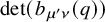 $\det (b_{\mu '\nu }(q))$
equals
$\det (b_{\mu '\nu }(q))$
equals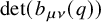 $\det (b_{\mu \nu }(q))$
up to sign. By Remark 3.4,
$\det (b_{\mu \nu }(q))$
up to sign. By Remark 3.4, $b_{\mu \nu }(q)=0$
unless
$b_{\mu \nu }(q)=0$
unless $\mu \geq \nu $
in the dominance order and
$\mu \geq \nu $
in the dominance order and $b_{\mu \mu }(q)\neq 0$
for each prime power q. Thus the matrix
$b_{\mu \mu }(q)\neq 0$
for each prime power q. Thus the matrix $(b_{\mu \nu }(q))$
is lower triangular with nonzero diagonal entries. Therefore it is nonsingular, implying that D is nonsingular.
$(b_{\mu \nu }(q))$
is lower triangular with nonzero diagonal entries. Therefore it is nonsingular, implying that D is nonsingular.
We use monomial generating functions to prove that Equation (4.3) holds for $y_{ \mu }=a_{\lambda \mu }(q)$
. Accordingly, let
$y_{ \mu }=a_{\lambda \mu }(q)$
. Accordingly, let $m_\lambda $
denote the monomial symmetric function indexed by the partition
$m_\lambda $
denote the monomial symmetric function indexed by the partition $\lambda $
. The monomial generating function of the left-hand side of Equation (4.3) is given by
$\lambda $
. The monomial generating function of the left-hand side of Equation (4.3) is given by
 $$ \begin{align*} \sum_{\lambda}X_\lambda(\Delta_\nu)m_{\lambda}=\prod_{i\geq 1}W_{(\nu_i)}(x;q), \end{align*} $$
by Example 2.16. On the other hand, the monomial generating function for the right-hand side of Equation (4.3) with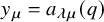 $y_{\mu }=a_{\lambda \mu }(q)$
is given by
$y_{\mu }=a_{\lambda \mu }(q)$
is given by
 $$ \begin{align*} \sum_{\lambda}\sum_{\mu}a_{\lambda \mu}(q) \tilde{\sigma}(\mu,\Delta_\nu)m_\lambda &=\sum_{\mu}\tilde{\sigma}(\mu,\Delta_\nu)\sum_{\lambda}a_{\lambda \mu}(q) m_\lambda. \end{align*} $$
By Lemma 4.1, the last expression above is equal to
 $$ \begin{align*} \sum_{\mu}\tilde{\sigma}(\mu,\Delta_\nu)\sum_{\lambda}\sum_{\eta}K_{\eta\lambda}K_{\eta'\mu}(q)m_\lambda&=\sum_{\mu}\tilde{\sigma}(\mu,\Delta_\nu)\sum_{\eta}K_{\eta'\mu}(q)s_\eta\\ &=\sum_{\mu}\tilde{\sigma}(\mu,\Delta_\nu)W_{\mu'}(x;q), \end{align*} $$
where the last equality follows from Equation (3.2). By Theorem 3.2, the last sum above is equal to
 $$ \begin{align*} \sum_{\mu} \epsilon_\mu (q-1)^{\sum_{j\geq 2}\mu^{\prime}_j}b_{\mu'\nu}(q) W_{\mu'}(x;q) &=\sum_{\mu} (1-q)^{|\mu|-\mu^{\prime}_1}b_{\mu'\nu}(q) W_{\mu'}(x;q)\\ &= \prod_{i=1}^k W_{(\nu_i)}(x;q), \end{align*} $$
by Proposition 3.7. This completes the proof.
The theorem can be restated in the following alternate form using the Hall scalar product.
Theorem 4.3. For each partition $\mu $
of n,
$\mu $
of n,
 $$ \begin{align*} \sigma(\mu,\Delta) &=\epsilon_{\mu'}\, q^{\sum_{j\geq 2}{\mu_j \choose 2}}\langle F_\Delta(x) , \widetilde{W}_{\mu}(x;q)\rangle, \end{align*} $$
for every prime power q and every matrix $\Delta \in {\mathrm M}_n({\mathbb F}_q)$
.
$\Delta \in {\mathrm M}_n({\mathbb F}_q)$
.
Proof. By applying the $\omega $
involution to Equation (4.1), one obtains
$\omega $
involution to Equation (4.1), one obtains $ \omega P_{\mu '}(x;t)=\sum _{\lambda }\tilde {a}_{\mu '\lambda }(t)h_{\lambda }$
. Since
$ \omega P_{\mu '}(x;t)=\sum _{\lambda }\tilde {a}_{\mu '\lambda }(t)h_{\lambda }$
. Since $\langle m_\lambda ,h_\mu \rangle =\delta _{\lambda \mu }$
, Theorem 4.2 can be written as
$\langle m_\lambda ,h_\mu \rangle =\delta _{\lambda \mu }$
, Theorem 4.2 can be written as
 $$ \begin{align*}\sigma(\mu,\Delta)=\epsilon_{\mu'}\, q^{\sum_{j\geq 2}{\mu_j \choose 2}}\langle F_\Delta(x) , \omega P_{\mu'}\rangle.\end{align*} $$
The result now follows from Equation (3.4).
Theorem 4.3 gives the following combinatorial interpretation for the coefficients in the q-Whittaker expansion of the invariant flag generating function $F_{\tau }(x;t)$
(see Equation (2.8)) associated to a similarity class type
$F_{\tau }(x;t)$
(see Equation (2.8)) associated to a similarity class type $\tau $
.
$\tau $
.
Corollary 4.4. For each similarity class type $\tau =\{(d_1,\lambda ^1),(d_2,\lambda ^2),\ldots ,(d_k,\lambda ^k)\}$
of size n,
$\tau =\{(d_1,\lambda ^1),(d_2,\lambda ^2),\ldots ,(d_k,\lambda ^k)\}$
of size n,
 $$ \begin{align*} F_\tau(x;t)=\prod_{i=1}^k p_{d_i}[\tilde{H}_{\lambda^i}(x;t)]=\sum_{\mu\vdash n}\epsilon_{\mu'}t^{-\sum_{j\geq 2}{\mu_j \choose 2}}\sigma(\mu,\tau) W_\mu(x;t), \end{align*} $$
where $\sigma (\mu ,\tau )$
denotes the number of subspaces which have profile
$\sigma (\mu ,\tau )$
denotes the number of subspaces which have profile $\mu $
with respect to a matrix of similarity class type
$\mu $
with respect to a matrix of similarity class type $\tau $
over the finite field
$\tau $
over the finite field $\mathbb {F}_t$
for sufficiently large prime powers t.
$\mathbb {F}_t$
for sufficiently large prime powers t.
In view of the examples considered in Section 2, Corollary 4.4 gives a combinatorial finite-field interpretation for the coefficients in the q-Whittaker expansion of the power sum symmetric functions, the complete homogeneous symmetric functions, products of modified Hall–Littlewood functions, and products of single-part q-Whittaker functions.
Example 4.5. Specializing Corollary 4.4 to the regular nilpotent and simple similarity class types and using Equations (1.1) and (1.2), we obtain the following expansions for homogeneous and power sum symmetric functions:
 $$ \begin{align*} h_n&=\sum_{\mu \vdash n}(-1)^{n-\mu_1}\left(\prod_{i\geq 2}t^{\mu_i+1 \choose 2}{\mu_{i-1} \brack \mu_i}_t\right) W_\mu(x;t),\\ p_n&=\sum_{\mu \vdash n}(-1)^{n-\mu_1}\frac{t^n-1}{t^{\mu_1}-1}\left(\prod_{i\geq 2}t^{\mu_i \choose 2}{\mu_{i-1} \brack \mu_i}_t\right) W_\mu(x;t). \end{align*} $$
The q-Whittaker functions have recently arisen in the work of Karp and Thomas [Reference Karp and Thomas22] in the context of counting certain partial flags compatible with a nilpotent endomorphism over a finite field. They also obtain an elegant probabilistic bijection between nonnegative integer matrices and pairs of semistandard tableaux. It would be interesting to relate their work to the counting problem considered in this paper.
5 Arbitrary profiles
An explicit formula for $\sigma (\mu ,\Delta )$
when
$\sigma (\mu ,\Delta )$
when $\mu $
is a partition of the ambient vector space dimension was obtained in Theorem 4.2. In this section we extend the result to arbitrary partitions
$\mu $
is a partition of the ambient vector space dimension was obtained in Theorem 4.2. In this section we extend the result to arbitrary partitions $\mu $
.
$\mu $
.
Lemma 5.1. For each partition $|\mu |\leq n$
, there exists a unique homogeneous symmetric function
$|\mu |\leq n$
, there exists a unique homogeneous symmetric function $G_{\mu }(x;t)\in \Lambda _{{\mathbb Q}(t)}$
of degree n, such that
$G_{\mu }(x;t)\in \Lambda _{{\mathbb Q}(t)}$
of degree n, such that
 $$ \begin{align*} \sigma(\mu,\Delta)=\langle F_\Delta(x),G_{\mu}(x;q) \rangle, \end{align*} $$
for every prime power q and each matrix $\Delta \in {\mathrm M}_n({\mathbb F}_q)$
.
$\Delta \in {\mathrm M}_n({\mathbb F}_q)$
.
Proof. By Theorem 2.19, there exist polynomials $g_{\mu \lambda }(t)\in {\mathbb Z}[t]$
, depending only on
$g_{\mu \lambda }(t)\in {\mathbb Z}[t]$
, depending only on $\mu $
and
$\mu $
and $\lambda $
, such that
$\lambda $
, such that
 $$ \begin{align*} \sigma(\mu,\Delta)=\sum_{\lambda \vdash n}g_{\mu \lambda}(q)X_\lambda(\Delta), \end{align*} $$
for each prime power q and each matrix $\Delta \in {\mathrm M}_n({\mathbb F}_q)$
. If we define
$\Delta \in {\mathrm M}_n({\mathbb F}_q)$
. If we define $ G_{\mu }(x;t):=\sum _{\lambda \vdash n}g_{\mu \lambda }(t)h_\lambda ,$
then the duality of the bases
$ G_{\mu }(x;t):=\sum _{\lambda \vdash n}g_{\mu \lambda }(t)h_\lambda ,$
then the duality of the bases $m_\lambda $
and
$m_\lambda $
and $h_\lambda $
with respect to the Hall scalar product implies that
$h_\lambda $
with respect to the Hall scalar product implies that $ \sigma (\mu ,\Delta )=\langle F_\Delta (x),G_{\mu }(x;q) \rangle ,$
proving existence. To show uniqueness, suppose
$ \sigma (\mu ,\Delta )=\langle F_\Delta (x),G_{\mu }(x;q) \rangle ,$
proving existence. To show uniqueness, suppose $G_{\mu }(x;t)$
and
$G_{\mu }(x;t)$
and $\tilde {G}_{\mu }(x;t)$
are homogeneous symmetric functions of degree n satisfying
$\tilde {G}_{\mu }(x;t)$
are homogeneous symmetric functions of degree n satisfying
 $$ \begin{align*} \langle F_\Delta(x), G_{\mu}(x;q)\rangle=\langle F_\Delta(x), \tilde{G}_{\mu}(x;q)\rangle, \end{align*} $$
for every prime power q and every matrix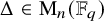 $\Delta \in {\mathrm M}_n({\mathbb F}_q)$
. Fix q and allow
$\Delta \in {\mathrm M}_n({\mathbb F}_q)$
. Fix q and allow $\Delta $
to vary over nilpotent matrices in
$\Delta $
to vary over nilpotent matrices in ${\mathrm M}_n({\mathbb F}_q)$
. Since
${\mathrm M}_n({\mathbb F}_q)$
. Since $F_\Delta (x)=\tilde {H}_\lambda (x;q)$
when
$F_\Delta (x)=\tilde {H}_\lambda (x;q)$
when $\Delta $
is nilpotent with Jordan partition
$\Delta $
is nilpotent with Jordan partition $\lambda $
, the bilinearity of the Hall scalar product yields
$\lambda $
, the bilinearity of the Hall scalar product yields
 $$ \begin{align*} \langle \tilde{H}_\lambda(x;q), G_{\mu}(x;q)-\tilde{G}_{\mu}(x;q)\rangle=0, \end{align*} $$
for each partition $\lambda $
of n. The relations
$\lambda $
of n. The relations $ \tilde {H}_\lambda (x;q)=\sum _{\mu }\tilde {K}_{\mu \lambda }(q)s_\mu ,$
are upper triangular with the diagonal entries
$ \tilde {H}_\lambda (x;q)=\sum _{\mu }\tilde {K}_{\mu \lambda }(q)s_\mu ,$
are upper triangular with the diagonal entries $\tilde {K}_{\mu \mu }(q)$
being powers of q. Therefore, the
$\tilde {K}_{\mu \mu }(q)$
being powers of q. Therefore, the $\tilde {H}_\lambda (x;q)$
form a basis for homogeneous symmetric functions in
$\tilde {H}_\lambda (x;q)$
form a basis for homogeneous symmetric functions in $\Lambda _{{\mathbb Q}(t)}$
of degree n. It follows that
$\Lambda _{{\mathbb Q}(t)}$
of degree n. It follows that $G_{\mu }(x;q)=\tilde {G}_{\mu }(x;q)$
. Since this holds for each prime power q, it follows that
$G_{\mu }(x;q)=\tilde {G}_{\mu }(x;q)$
. Since this holds for each prime power q, it follows that $G_{\mu }(x;t)=\tilde {G}_\mu (x;t)$
, proving uniqueness.
$G_{\mu }(x;t)=\tilde {G}_\mu (x;t)$
, proving uniqueness.
The following result of Bender, Coley, Robbins and Rumsey was derived by a probabilistic argument and shows that $\sigma (\mu ,\Delta )$
satisfies a remarkably simple system of equations.
$\sigma (\mu ,\Delta )$
satisfies a remarkably simple system of equations.
Theorem 5.2 [Reference Bender, Coley, Robbins and Rumsey6, Eq. (4)].
Let n be a positive integer and suppose $\nu $
is a partition with
$\nu $
is a partition with $|\nu |<n$
. For each matrix
$|\nu |<n$
. For each matrix $\Delta \in {\mathrm M}_n({\mathbb F}_q),$
 $$ \begin{align*} \sum_{\mu:|\mu|\leq n} (-1)^{\mu_1}q^{-\mu \cdot \nu+{\mu_1 \choose 2}} \sigma(\mu,\Delta)=0, \end{align*} $$
where the sum is taken over all partitions $\mu $
of size at most n (including the empty partition) and
$\mu $
of size at most n (including the empty partition) and $\mu \cdot \nu :=\sum _{j\geq 1}\mu _j\nu _j.$
Note that the system of equations in Theorem 5.2 is indexed by partitions $\nu $
of size at most n. Bender, Coley, Robbins and Rumsey used these equations to derive an explicit formula for
$\nu $
of size at most n. Bender, Coley, Robbins and Rumsey used these equations to derive an explicit formula for $\sigma (\mu ,\Delta )$
in the cases where
$\sigma (\mu ,\Delta )$
in the cases where $\Delta $
is simple or regular nilpotent. Our approach is to use Theorem 5.2 to solve for
$\Delta $
is simple or regular nilpotent. Our approach is to use Theorem 5.2 to solve for $\sigma (\mu ,\Delta )$
for partitions satisfying
$\sigma (\mu ,\Delta )$
for partitions satisfying $|\mu |<n$
using the formula already obtained for
$|\mu |<n$
using the formula already obtained for $\sigma (\mu ,\Delta )$
in Theorem 4.2 when
$\sigma (\mu ,\Delta )$
in Theorem 4.2 when $|\mu |=n$
. The following theorem is our main result.
$|\mu |=n$
. The following theorem is our main result.
Theorem 5.3. For each partition $\mu $
,
$\mu $
,
 $$ \begin{align*} \sigma(\mu,\Delta)=\epsilon_{\mu'}\, q^{\sum_{j\geq 2}{\mu_j \choose 2}}\langle F_\Delta(x),\widetilde{W}_{\mu}(x;q)\, h_{n-|\mu|} \rangle, \end{align*} $$
for each prime power q and each matrix $\Delta \in {\mathrm M}_n({\mathbb F}_q)$
.
$\Delta \in {\mathrm M}_n({\mathbb F}_q)$
.
Proof. By Lemma 5.1, there is a unique symmetric function $C_{\mu }(x;t)$
of degree n such that
$C_{\mu }(x;t)$
of degree n such that
 $$ \begin{align} \sigma(\mu,\Delta)=(-1)^{\sum_{j\geq 2}\mu_j}q^{\sum_{j\geq 2}{\mu_j \choose 2}}\langle F_\Delta(x),C_\mu(x;q) \rangle, \end{align} $$
for each prime power q and each matrix $\Delta \in {\mathrm M}_n({\mathbb F}_q)$
. We wish to show that
$\Delta \in {\mathrm M}_n({\mathbb F}_q)$
. We wish to show that $C_\mu (x;t)=\widetilde {W}_{\mu }(x;t)h_{n-|\mu |}$
, where
$C_\mu (x;t)=\widetilde {W}_{\mu }(x;t)h_{n-|\mu |}$
, where $\widetilde {W}_\lambda $
denotes the dual q-Whittaker function indexed by
$\widetilde {W}_\lambda $
denotes the dual q-Whittaker function indexed by $\lambda $
. Consider the coefficients
$\lambda $
. Consider the coefficients $c_{\eta \mu }(t)$
defined by
$c_{\eta \mu }(t)$
defined by
 $$ \begin{align} C_{\mu}(x;t)=\sum_{\eta\vdash n}c_{\eta\mu}(t)\widetilde{W}_{\eta}(x;t), \end{align} $$
When $\mu $
is a partition of n, it follows from Theorem 4.3 that
$\mu $
is a partition of n, it follows from Theorem 4.3 that $C_{\mu }=\widetilde {W}_{\mu }$
; therefore
$C_{\mu }=\widetilde {W}_{\mu }$
; therefore
 $$ \begin{align} c_{\eta\mu}(t)=\delta_{\eta\mu} \quad (|\mu|=n), \end{align} $$
where $\delta $
denotes the Kronecker delta. Substituting the expression (5.1) for
$\delta $
denotes the Kronecker delta. Substituting the expression (5.1) for $\sigma (\mu ,\Delta )$
into the equations in Theorem 5.2, we obtain
$\sigma (\mu ,\Delta )$
into the equations in Theorem 5.2, we obtain
 $$ \begin{align*} \sum_{\mu:|\mu|\leq n} (-1)^{|\mu|}q^{-\mu \cdot \nu+\sum_{j\geq 1}{\mu_j \choose 2}} \langle F_\Delta(x),C_\mu(x;q)\rangle=0, \end{align*} $$
for each partition $|\nu |<n.$
Fix
$|\nu |<n.$
Fix $\nu $
with
$\nu $
with $|\nu |<n$
and set
$|\nu |<n$
and set
 $$\begin{align*}S_{\nu,q}(x):=\sum_{\mu:|\mu|\leq n} (-1)^{|\mu|}q^{-\mu \cdot \nu+\sum_{j\geq 1}{\mu_j \choose 2}}\, C_\mu(x;q). \end{align*}$$
Then $\langle F_\Delta (x),S_{\nu ,q}(x)\rangle =0$
for every
$\langle F_\Delta (x),S_{\nu ,q}(x)\rangle =0$
for every $\Delta \in {\mathrm M}_n({\mathbb F}_q)$
. By varying
$\Delta \in {\mathrm M}_n({\mathbb F}_q)$
. By varying $\Delta $
over nilpotent matrices, it follows that
$\Delta $
over nilpotent matrices, it follows that $\langle \tilde {H}_\lambda (x;q),S_{\nu ,q}(x)\rangle =0$
for each partition
$\langle \tilde {H}_\lambda (x;q),S_{\nu ,q}(x)\rangle =0$
for each partition $\lambda $
of n. Since
$\lambda $
of n. Since $\tilde {H}_\lambda (x;q)$
is a basis for homogeneous symmetric functions in
$\tilde {H}_\lambda (x;q)$
is a basis for homogeneous symmetric functions in $\Lambda _{{\mathbb Q}(t)}$
of degree n, this forces
$\Lambda _{{\mathbb Q}(t)}$
of degree n, this forces $S_{\nu ,q}(x)=0$
. As this holds for each prime power q, the identity continues to hold after replacing q by an indeterminate t; in other words,
$S_{\nu ,q}(x)=0$
. As this holds for each prime power q, the identity continues to hold after replacing q by an indeterminate t; in other words,
 $$ \begin{align*} \sum_{\mu:|\mu|\leq n} (-1)^{|\mu|}t^{-\mu \cdot \nu+\sum_{j\geq 1}{\mu_j \choose 2}} C_\mu(x;t)=0 \quad (|\nu|<n). \end{align*} $$
By Equation (5.2), the expression on the left-hand side above can be written as
 $$ \begin{align*} &\sum_{\mu:|\mu|\leq n} (-1)^{|\mu|}t^{-\mu \cdot \nu+\sum_{j\geq 1}{\mu_j \choose 2}} \sum_{\eta\vdash n}c_{\eta\mu}(t)\widetilde{W}_{\eta}(x;t)\\ &\quad=\sum_{\eta\vdash n}\sum_{\mu:|\mu|\leq n} (-1)^{|\mu|}t^{-\mu \cdot \nu+\sum_{j\geq 1}{\mu_j \choose 2}} c_{\eta\mu}(t)\widetilde{W}_{\eta}(x;t). \end{align*} $$
Since the Hall-Littlewood functions $P_\lambda (x;t) (\lambda \vdash n)$
are linearly independent and
$P_\lambda (x;t) (\lambda \vdash n)$
are linearly independent and $\omega $
is an automorphism of
$\omega $
is an automorphism of $\Lambda _{{\mathbb Q}(t)}$
, it follows that the dual q-Whittaker functions
$\Lambda _{{\mathbb Q}(t)}$
, it follows that the dual q-Whittaker functions $\widetilde {W}_{\eta }(x;t)=\omega P_{\eta '}(x;t)$
are also linearly independent. Consequently,
$\widetilde {W}_{\eta }(x;t)=\omega P_{\eta '}(x;t)$
are also linearly independent. Consequently,
 $$ \begin{align*} \sum_{\mu:|\mu|\leq n} (-1)^{|\mu|}t^{-\mu \cdot \nu+\sum_{j\geq 1}{\mu_j \choose 2}} c_{\eta\mu}(t)=0 \quad \text{ for }|\nu|<n, |\eta|=n. \end{align*} $$
By Equation (5.3), this is equivalent to
 $$ \begin{align*} \sum_{\mu:|\mu|< n} (-1)^{|\mu|}t^{-\mu \cdot \nu+\sum_{j\geq 1}{\mu_j \choose 2}} c_{\eta\mu}(t)+ (-1)^{n}t^{-\eta \cdot \nu+\sum_{j\geq 1}{\mu_j \choose 2}} =0 \quad (|\nu|<n), \end{align*} $$
for each partition $\eta $
of n. The idea now is to solve the above system of equations for the
$\eta $
of n. The idea now is to solve the above system of equations for the $c_{\eta \mu }(t)$
with
$c_{\eta \mu }(t)$
with $|\mu |<n$
. Note that the number of unknowns is equal to the number of equations, namely the number of integer partitions of size less than n. We claim that the system has a unique solution given by
$|\mu |<n$
. Note that the number of unknowns is equal to the number of equations, namely the number of integer partitions of size less than n. We claim that the system has a unique solution given by
 $$ \begin{align} c_{\eta\mu}(t)=\psi_{\eta/\mu}(t):=\prod_{i\geq 1}{\eta_i-\eta_{i+1}\brack \eta_i-\mu_i}_t. \end{align} $$
Observe that $\psi _{\eta /\mu }(t)$
vanishes unless
$\psi _{\eta /\mu }(t)$
vanishes unless $\eta /\mu $
is a horizontal strip. Moreover, the only partition
$\eta /\mu $
is a horizontal strip. Moreover, the only partition $\mu $
of n for which
$\mu $
of n for which $\eta /\mu $
is a horizontal strip is
$\eta /\mu $
is a horizontal strip is $\mu =\eta $
. Therefore,
$\mu =\eta $
. Therefore, $\psi _{\eta /\mu }(t)=\delta _{\eta \mu }$
when
$\psi _{\eta /\mu }(t)=\delta _{\eta \mu }$
when $\mu $
is a partition of n, in accordance with Equation (5.3). Therefore, to prove the claim, it suffices to show the following.
$\mu $
is a partition of n, in accordance with Equation (5.3). Therefore, to prove the claim, it suffices to show the following.
-
1. The determinant with entries
$(-1)^{|\mu |}t^{-\mu \cdot \nu +\sum _{j\geq 1}{\mu _j \choose 2}}$
for
$\mu ,\nu $
varying over integer partitions of size less than n is nonzero. -
2. For each partition
$\eta $
of n, for each partition
$$ \begin{align*} \sum_{\mu:|\mu|\leq n} (-1)^{|\mu|}t^{-\mu \cdot \nu+\sum_{j\geq 1}{\mu_j \choose 2}} \psi_{\eta/\mu}(t)=0, \end{align*} $$
$\nu $
of size less than n.


The last two statements above are proved in Corollaries 5.5 and 5.7, respectively. From Equation (5.2), we obtain
 $$ \begin{align*} C_{\mu}(x;t)&=\sum_{\eta\vdash n}\psi_{\eta/\mu}(t)\widetilde{W}_{\eta}(x;t)=\widetilde{W}_{\mu}(x;t)h_{n-|\mu|}, \end{align*} $$
where the last equality follows by writing the Pieri rule for Hall–Littlewood functions as $P_{\mu '}e_{n-|\mu |}=\sum _{\eta \vdash n}\psi _{\eta /\mu }(t)P_{\eta '}$
(Macdonald [Reference Macdonald29, p. 340, Eq. (6.24)]) and applying
$P_{\mu '}e_{n-|\mu |}=\sum _{\eta \vdash n}\psi _{\eta /\mu }(t)P_{\eta '}$
(Macdonald [Reference Macdonald29, p. 340, Eq. (6.24)]) and applying $\omega $
. The result now follows by Equation (5.1).
$\omega $
. The result now follows by Equation (5.1).
We now prove the two claims made in the proof of Theorem 5.3. We introduce some notation, following Buck, Coley, and Robbins [Reference Buck, Coley and Robbins10], to state the relevant results. Let $\mathcal {P}$
denote the set of all partitions of nonnegative integers. Given partitions
$\mathcal {P}$
denote the set of all partitions of nonnegative integers. Given partitions $\lambda =(\lambda _1,\lambda _2,\ldots )$
and
$\lambda =(\lambda _1,\lambda _2,\ldots )$
and $\mu =(\mu _1,\mu _2,\ldots )$
in
$\mu =(\mu _1,\mu _2,\ldots )$
in $\mathcal {P}$
, write
$\mathcal {P}$
, write $\lambda \subseteq \mu $
to mean
$\lambda \subseteq \mu $
to mean $\lambda _i\leq \mu _i$
for each
$\lambda _i\leq \mu _i$
for each $i\geq 1$
. With respect to the ordering
$i\geq 1$
. With respect to the ordering $\subseteq $
, the set
$\subseteq $
, the set $\mathcal {P}$
forms a distributive lattice called Young’s lattice, denoted Y (Stanley [Reference Stanley38, Sec. 7.2]). An order ideal I in Y is a subset
$\mathcal {P}$
forms a distributive lattice called Young’s lattice, denoted Y (Stanley [Reference Stanley38, Sec. 7.2]). An order ideal I in Y is a subset $I\subseteq Y$
such that if
$I\subseteq Y$
such that if $\mu \in I$
and
$\mu \in I$
and $\lambda \subseteq \mu $
for some
$\lambda \subseteq \mu $
for some $\lambda \in Y$
, then
$\lambda \in Y$
, then $\lambda \in I$
. Given a partition
$\lambda \in I$
. Given a partition $\lambda =(\lambda _1,\lambda _2,\ldots )$
, the shift operator is defined by
$\lambda =(\lambda _1,\lambda _2,\ldots )$
, the shift operator is defined by $\mathrm {sh}(\lambda ):=(\lambda _2,\lambda _3,\ldots )$
. To each pair
$\mathrm {sh}(\lambda ):=(\lambda _2,\lambda _3,\ldots )$
. To each pair $(i,j)$
of nonnegative integers, we associate an indeterminate
$(i,j)$
of nonnegative integers, we associate an indeterminate $x_{i,j}$
. Given a pair of partitions
$x_{i,j}$
. Given a pair of partitions $\lambda $
and
$\lambda $
and $\mu ,$
associate a monomial by
$\mu ,$
associate a monomial by
 $$ \begin{align*} x_\lambda^\mu=\prod_{k\geq 1}x_{k,\lambda_k}^{\mu_k}. \end{align*} $$
For partitions $\lambda ,\mu $
, write
$\lambda ,\mu $
, write $\lambda \lessdot \mu $
if
$\lambda \lessdot \mu $
if $\lambda \subseteq \mu $
and the partitions
$\lambda \subseteq \mu $
and the partitions $\lambda $
and
$\lambda $
and $\mu $
differ in precisely one coordinate. If they differ in the rth coordinate, let
$\mu $
differ in precisely one coordinate. If they differ in the rth coordinate, let $\delta _x(\mu ,\lambda )$
denote the difference
$\delta _x(\mu ,\lambda )$
denote the difference $x_{r,\mu _r}-x_{r,\lambda _r}$
. Buck, Coley, and Robbins [Reference Buck, Coley and Robbins10, Thm. 2] proved the following nice product formula for the determinant with entries
$x_{r,\mu _r}-x_{r,\lambda _r}$
. Buck, Coley, and Robbins [Reference Buck, Coley and Robbins10, Thm. 2] proved the following nice product formula for the determinant with entries $x^\mu _{\lambda }.$
Lemma 5.4. If $I\subset Y$
is a finite order ideal, then
$I\subset Y$
is a finite order ideal, then
 $$ \begin{align*} \det(x_\lambda^\mu)_{\lambda,\mu\in I}=\pm\prod_{\lambda \in I}x_\lambda^{\mathrm{sh}(\lambda)}\prod_{\substack{ \lambda,\mu\in I\\\lambda \lessdot \mu}} \delta_x(\mu,\lambda). \end{align*} $$
Corollary 5.5. Let $I\subset Y$
denote the order ideal consisting of all integer partitions of size less than n. The determinant with entries
$I\subset Y$
denote the order ideal consisting of all integer partitions of size less than n. The determinant with entries $(-1)^{|\mu |}t^{-\mu \cdot \nu +\sum _{j\geq 1}{\mu _j \choose 2}}$
for
$(-1)^{|\mu |}t^{-\mu \cdot \nu +\sum _{j\geq 1}{\mu _j \choose 2}}$
for $\mu ,\nu \in I$
is nonzero.
$\mu ,\nu \in I$
is nonzero.
Proof. Let $A=(a_{\mu \nu })_{\mu ,\nu \in I}$
denote the matrix with entries
$A=(a_{\mu \nu })_{\mu ,\nu \in I}$
denote the matrix with entries
 $$\begin{align*}a_{\mu\nu}=(-1)^{|\mu|}\,t^{-\mu\cdot\nu+\sum_{j\ge1}\binom{\mu_j}{2}}. \end{align*}$$
For each fixed $\mu \in I$
, factoring
$\mu \in I$
, factoring $(-1)^{|\mu |}\,t^{\sum _{j\ge 1}\binom {\mu _j}{2}}$
out of the
$(-1)^{|\mu |}\,t^{\sum _{j\ge 1}\binom {\mu _j}{2}}$
out of the $\mu $
-th row scales the determinant by the nonzero factor
$\mu $
-th row scales the determinant by the nonzero factor $\prod _{\mu \in I}(-1)^{|\mu |}t^{\sum _{j\ge 1}\binom {\mu _j}{2}}$
. Hence
$\prod _{\mu \in I}(-1)^{|\mu |}t^{\sum _{j\ge 1}\binom {\mu _j}{2}}$
. Hence $\det (A)\neq 0$
if and only if
$\det (A)\neq 0$
if and only if $\det (t^{-\mu \cdot \nu })_{\mu ,\nu \in I}\neq 0$
. If we set
$\det (t^{-\mu \cdot \nu })_{\mu ,\nu \in I}\neq 0$
. If we set $x_{i,j}=t^{-j}$
in Lemma 5.4, then
$x_{i,j}=t^{-j}$
in Lemma 5.4, then $x_{\nu }^\mu =t^{-\mu \cdot \nu }$
which is nonzero. For
$x_{\nu }^\mu =t^{-\mu \cdot \nu }$
which is nonzero. For $\mu \lessdot \nu $
, the quantity
$\mu \lessdot \nu $
, the quantity $\delta _x(\mu ,\nu )$
is also nonzero, being a difference of distinct integer powers of t. The result follows from these observations.
$\delta _x(\mu ,\nu )$
is also nonzero, being a difference of distinct integer powers of t. The result follows from these observations.
Lemma 5.6. Let $\psi _{\eta /\mu }(t)$
be as defined in Equation (5.4). For all partitions
$\psi _{\eta /\mu }(t)$
be as defined in Equation (5.4). For all partitions $\nu $
and
$\nu $
and $\eta $
,
$\eta $
,
 $$ \begin{align*} &\sum_{\mu}(-1)^{|\mu|}t^{-\mu \cdot \nu+\sum_{j\geq 1}{\mu_j \choose 2}}\psi_{\eta/\mu}(t)\\ &\qquad\qquad\qquad=(-1)^{|\eta|}(1-t)^{\eta_1}t^{-\eta\cdot \nu+\sum_{j \geq 1}{\eta_j \choose 2}}\prod_{i\geq 1}{\nu_i-\eta_{i+1} \brack \eta_i-\eta_{i+1}}_t[\eta_i-\eta_{i+1}]_t!, \end{align*} $$
where the sum is taken over all partitions $\mu $
such that
$\mu $
such that $\eta /\mu $
is a horizontal strip.
$\eta /\mu $
is a horizontal strip.
Proof. Let $s(\eta ,\nu )$
denote the sum in the statement of the lemma. Note the sum is unchanged when taken over all integer partitions
$s(\eta ,\nu )$
denote the sum in the statement of the lemma. Note the sum is unchanged when taken over all integer partitions $\mu $
since
$\mu $
since $\psi _{\eta /\mu }(t)$
automatically vanishes unless
$\psi _{\eta /\mu }(t)$
automatically vanishes unless $\eta /\mu $
is a horizontal strip. We proceed by induction on the length
$\eta /\mu $
is a horizontal strip. We proceed by induction on the length $\ell (\eta )$
of
$\ell (\eta )$
of $\eta $
. When
$\eta $
. When $\eta $
is the empty partition, the left-hand side of the identity equals 1. Since
$\eta $
is the empty partition, the left-hand side of the identity equals 1. Since $[0]_t!=1$
, the right-hand side reduces to 1 as well and the result holds in this case. Now suppose the result is true for
$[0]_t!=1$
, the right-hand side reduces to 1 as well and the result holds in this case. Now suppose the result is true for $\ell (\eta )=\ell -1$
and let
$\ell (\eta )=\ell -1$
and let $\eta $
be a partition with
$\eta $
be a partition with $\ell $
parts. By conditioning on the first part k of
$\ell $
parts. By conditioning on the first part k of $\mu $
, write the sum
$\mu $
, write the sum $s(\eta ,\nu )$
as
$s(\eta ,\nu )$
as
 $$ \begin{align*} s(\eta,\nu)&=\sum_{\mu}(-1)^{|\mu|}t^{-\mu \cdot \nu+\sum_{j\geq 1}{\mu_j \choose 2}}\prod_{i\geq 1}{\eta_i-\eta_{i+1}\brack \eta_i-\mu_i}_t\\ &=\sum_{k=\eta_2}^{\eta_1}(-1)^k t^{-k\nu_1+{k \choose 2}}{\eta_1-\eta_2\brack \eta_1-k}_t\sum_{\tilde{\mu}}(-1)^{|\tilde{\mu}|}t^{-\tilde{\mu} \cdot \tilde{\nu}+\sum_{j\geq 1}{\tilde{\mu}_j \choose 2}}\psi_{\tilde{\eta}/\tilde{\mu}}, \end{align*} $$
where $\tilde {\lambda }$
denotes the partition obtained by removing the first part of
$\tilde {\lambda }$
denotes the partition obtained by removing the first part of $\lambda $
and the sum is taken over all partitions
$\lambda $
and the sum is taken over all partitions $\tilde {\mu }$
. The inner sum above is equal to
$\tilde {\mu }$
. The inner sum above is equal to $s(\tilde {\eta },\tilde {\nu })$
. Therefore,
$s(\tilde {\eta },\tilde {\nu })$
. Therefore,
 $$ \begin{align*} s(\eta,\nu)= s(\tilde{\eta},\tilde{\nu})\sum_{k=\eta_2}^{\eta_1}(-1)^k t^{-k\nu_1+{k \choose 2}}{\eta_1-\eta_2\brack \eta_1-k}_t. \end{align*} $$
With $j=k-\eta _2$
, we obtain
$j=k-\eta _2$
, we obtain
 $$ \begin{align} s(\eta,\nu)&=(-1)^{\eta_2}s(\tilde{\eta},\tilde{\nu})\sum_{j=0}^{\eta_1-\eta_2}(-1)^j t^{-(j+\eta_2)\nu_1+{j+\eta_2 \choose 2}}{\eta_1-\eta_2\brack j}_t \notag \\ &=(-1)^{\eta_2}t^{-\eta_2\nu_1+{\eta_2\choose 2}}s(\tilde{\eta},\tilde{\nu})\sum_{j=0}^{\eta_1-\eta_2}(-1)^j t^{j(\eta_2-\nu_1)+{j \choose 2}}{\eta_1-\eta_2\brack j}_t. \end{align} $$
By applying the q-binomial theorem [Reference Stanley39, Eq. (1.87)]
 $$ \begin{align*} (1-x)(1-tx)\cdots (1-t^{n-1}x)=\sum_{j=0}^n (-1)^jt^{j \choose 2} {n \brack j}_tx^j, \end{align*} $$
with $n=\eta _1-\eta _2$
and
$n=\eta _1-\eta _2$
and $x=t^{-(\nu _1-\eta _2)}$
, the sum in Equation (5.5) above becomes
$x=t^{-(\nu _1-\eta _2)}$
, the sum in Equation (5.5) above becomes
 $$ \begin{align*} &\left(1-\frac{1}{t^{\nu_1-\eta_2}}\right)\left(1-\frac{1}{t^{\nu_1-\eta_2-1}}\right)\cdots \left(1-\frac{1}{t^{\nu_1-\eta_1+1}}\right)\\ &\quad =\frac{(t-1)^{\eta_1-\eta_2}}{t^{(\nu_1-\eta_2)(\eta_1-\eta_2)-{\eta_1-\eta_2 \choose 2}}}{\nu_1-\eta_2 \brack \eta_1-\eta_2}_t[\eta_1-\eta_2]_t!. \end{align*} $$
By the inductive hypothesis,
 $$ \begin{align*} s(\tilde{\eta},\tilde{\nu})=(-1)^{|\tilde{\eta}|}(1-t)^{\eta_2}t^{-\tilde{\eta}\cdot \tilde{\nu}+\sum_{j \geq 2}{{\eta}_j \choose 2}}\prod_{i\geq 2}{\nu_i-{\eta}_{i+1} \brack{\eta}_i-{\eta}_{i+1}}_t[{\eta}_i-{\eta}_{i+1}]_t!. \end{align*} $$
By substituting the above expression for $s(\tilde {\eta },\tilde {\nu })$
into Equation (5.5), a straightforward calculation shows that
$s(\tilde {\eta },\tilde {\nu })$
into Equation (5.5), a straightforward calculation shows that
 $$ \begin{align*} s(\eta,\nu)&=(-1)^{\eta_2}t^{-\eta_2\nu_1+{\eta_2\choose 2}}s(\tilde{\eta},\tilde{\nu})\frac{(t-1)^{\eta_1-\eta_2}}{t^{(\nu_1-\eta_2)(\eta_1-\eta_2)-{\eta_1-\eta_2 \choose 2}}}{\nu_1-\eta_2 \brack \eta_1-\eta_2}_t[\eta_1-\eta_2]_t!\\ &= (-1)^{|\eta|}(1-t)^{\eta_1}t^{-\eta\cdot \nu+\sum_{j \geq 1}{\eta_j \choose 2}}\prod_{i\geq 1}{\nu_i-\eta_{i+1} \brack \eta_i-\eta_{i+1}}_t[\eta_i-\eta_{i+1}]_t!, \end{align*} $$
completing the inductive step and the proof.
Corollary 5.7. For partitions $\nu ,\eta $
satisfying
$\nu ,\eta $
satisfying $|\nu |<|\eta |=n$
, we have
$|\nu |<|\eta |=n$
, we have
 $$ \begin{align*}\sum_{\mu:|\mu|\leq n}(-1)^{|\mu|}t^{-\mu \cdot \nu+\sum_{j\geq 1}{\mu_j \choose 2}}\psi_{\eta/\mu}(t)=0. \end{align*} $$
Proof. Follows from Lemma 5.6 since the product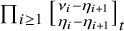 $\prod _{i\geq 1}{\nu _i-\eta _{i+1} \brack \eta _i-\eta _{i+1}}_t$
vanishes unless
$\prod _{i\geq 1}{\nu _i-\eta _{i+1} \brack \eta _i-\eta _{i+1}}_t$
vanishes unless $\nu _i\geq \eta _i$
for each
$\nu _i\geq \eta _i$
for each $i\geq 1$
.
$i\geq 1$
.
6 Partial profiles and anti-invariant subspaces
Definition 6.1. Given a matrix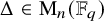 $\Delta \in {\mathrm M}_n({\mathbb F}_q)$
, a subspace
$\Delta \in {\mathrm M}_n({\mathbb F}_q)$
, a subspace $W\subseteq {\mathbb F}_q^n$
has partial
$W\subseteq {\mathbb F}_q^n$
has partial $\Delta $
-profile
$\Delta $
-profile $\rho =(\rho _1,\rho _2,\ldots ,\rho _r)$
if
$\rho =(\rho _1,\rho _2,\ldots ,\rho _r)$
if
 $$ \begin{align*} \dim (W+\Delta W+\cdots +\Delta^{j-1}W)=\rho_1+\rho_2+\cdots+\rho_{j} \text{ for }1\leq j\leq r. \end{align*} $$
Let $\pi (\rho ,\Delta )$
denote the number of subspaces with partial
$\pi (\rho ,\Delta )$
denote the number of subspaces with partial $\Delta $
-profile
$\Delta $
-profile $\rho $
.
$\rho $
.
Example 6.2. We have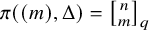 $\pi ((m),\Delta )={n \brack m}_q$
for each
$\pi ((m),\Delta )={n \brack m}_q$
for each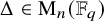 $\Delta \in {\mathrm M}_n({\mathbb F}_q)$
and
$\Delta \in {\mathrm M}_n({\mathbb F}_q)$
and $m\geq 0$
.
$m\geq 0$
.
Note that $\pi ((m,0),\Delta )$
is the number of m-dimensional
$\pi ((m,0),\Delta )$
is the number of m-dimensional $\Delta $
-invariant subspaces which is distinct from
$\Delta $
-invariant subspaces which is distinct from $\pi ((m),\Delta )$
in general. Therefore, we think of
$\pi ((m),\Delta )$
in general. Therefore, we think of $\rho $
as a tuple rather than an integer partition. It is evident that the number of subspaces with
$\rho $
as a tuple rather than an integer partition. It is evident that the number of subspaces with $\Delta $
-profile
$\Delta $
-profile $\mu =(\mu _1,\ldots ,\mu _k)$
equals the number of subspaces with partial
$\mu =(\mu _1,\ldots ,\mu _k)$
equals the number of subspaces with partial $\Delta $
-profile
$\Delta $
-profile $(\mu _1,\ldots ,\mu _k,0)$
.
$(\mu _1,\ldots ,\mu _k,0)$
.
Definition 6.3 [Reference Knüppel and Nielsen24, p. 1].
Given $\Delta \in {\mathrm M}_n({\mathbb F}_q)$
and a positive integer t, a subspace W of
$\Delta \in {\mathrm M}_n({\mathbb F}_q)$
and a positive integer t, a subspace W of ${\mathbb F}_q^n$
is said to be t-fold
${\mathbb F}_q^n$
is said to be t-fold $\Delta $
-anti-invariant if
$\Delta $
-anti-invariant if
 $$ \begin{align*} \dim(W+\Delta W+\cdots+\Delta^t W)=(t+1)\dim W. \end{align*} $$
Thus an m-dimensional $\Delta $
-anti-invariant subspace is precisely one with partial
$\Delta $
-anti-invariant subspace is precisely one with partial $\Delta $
-profile
$\Delta $
-profile $(m^{t+1})$
. Anti-invariant subspaces were originally defined with
$(m^{t+1})$
. Anti-invariant subspaces were originally defined with $t=1$
by Barría and Halmos [Reference Barría and Halmos5], motivated by earlier work of Hadwin, Nordgren, Radjavi, and Rosenthal [Reference Hadwin, Nordgren, Radjavi and Rosenthal18] on the weak density of certain sets of operators on Banach spaces. Barría and Halmos determined the maximum possible dimension of an anti-invariant subspace. Another proof of their result was given by Sourour [Reference Sourour37]. This result was extended to arbitrary t by Knüppel and Nielsen [Reference Knüppel and Nielsen24].
$t=1$
by Barría and Halmos [Reference Barría and Halmos5], motivated by earlier work of Hadwin, Nordgren, Radjavi, and Rosenthal [Reference Hadwin, Nordgren, Radjavi and Rosenthal18] on the weak density of certain sets of operators on Banach spaces. Barría and Halmos determined the maximum possible dimension of an anti-invariant subspace. Another proof of their result was given by Sourour [Reference Sourour37]. This result was extended to arbitrary t by Knüppel and Nielsen [Reference Knüppel and Nielsen24].
Theorem 6.4. Given $\rho =(\rho _1,\ldots ,\rho _r)$
with
$\rho =(\rho _1,\ldots ,\rho _r)$
with $\rho _r\neq 0$
and
$\rho _r\neq 0$
and $\Delta \in {\mathrm M}_n({\mathbb F}_q)$
, the number of subspaces with partial
$\Delta \in {\mathrm M}_n({\mathbb F}_q)$
, the number of subspaces with partial $\Delta $
-profile
$\Delta $
-profile $\rho $
is given by
$\rho $
is given by
 $$ \begin{align*} \pi(\rho,\Delta)=\langle \omega F_\Delta(x), G_\rho\rangle, \end{align*} $$
where
 $$ \begin{align*} G_\rho=(-1)^{\sum_{j\geq 2}\rho_j}q^{\sum_{j\geq 2}{\rho_j\choose 2}}\sum_{\substack{\eta \vdash n\\ \ell(\eta)=r}}\psi_{\eta/\rho}(q)P_{\eta'}(x;q). \end{align*} $$
Proof. We have
 $$ \begin{align*} \pi(\rho,\Delta)&=\sum_{\substack{\mu:|\mu|\leq n\\ \mu_i=\rho_i (1\leq i\leq r)}}\sigma(\mu,\Delta)\\ &=\sum_{\substack{\mu:|\mu|\leq n\\ \mu_i=\rho_i (1\leq i\leq r)}}(-1)^{\sum_{j\geq 2}\mu_j}\, q^{\sum_{j\geq 2}{\mu_j \choose 2}}\langle \omega F_\Delta(x),P_{\mu'}(x;q)\, e_{n-|\mu|} \rangle, \end{align*} $$
by Theorem 5.3. Therefore $\pi (\rho ,\Delta )=\langle \omega F_\Delta (x),G_\rho \rangle ,$
where
$\pi (\rho ,\Delta )=\langle \omega F_\Delta (x),G_\rho \rangle ,$
where
 $$ \begin{align*} G_\rho=\sum_{\substack{\mu:|\mu|\leq n\\ \mu_i=\rho_i (1\leq i\leq r)}}(-1)^{\sum_{j\geq 2}\mu_j}\, q^{\sum_{j\geq 2}{\mu_j \choose 2}}P_{\mu'}(x;q)\, e_{n-|\mu|}. \end{align*} $$
By the Pieri rule for Hall–Littlewood functions, we have $P_{\mu '}e_{n-|\mu |}=\sum _{\eta \vdash n}\psi _{\eta /\mu }P_{\eta '}.$
It follows that
$P_{\mu '}e_{n-|\mu |}=\sum _{\eta \vdash n}\psi _{\eta /\mu }P_{\eta '}.$
It follows that
 $$ \begin{align*} G_\rho&=\sum_{\substack{\mu:|\mu|\leq n\\ \mu_i=\rho_i (1\leq i\leq r)}}(-1)^{\sum_{j\geq 2}\mu_j}\, q^{\sum_{j\geq 2}{\mu_j \choose 2}} \sum_{\eta\vdash n}\psi_{\eta/\mu}(q)P_{\eta'}(x;q)\\ &=\sum_{\eta\vdash n}\sum_{\substack{\mu:|\mu|\leq n\\ \mu_i=\rho_i (1\leq i\leq r)}}(-1)^{\sum_{j\geq 2}\mu_j}\, q^{\sum_{j\geq 2}{\mu_j \choose 2}} \psi_{\eta/\mu}(q) P_{\eta'}(x;q). \end{align*} $$
Write $\mu =(\rho _1,\ldots ,\rho _r,\bar {\mu }_1,\bar {\mu }_2,\ldots )$
and
$\mu =(\rho _1,\ldots ,\rho _r,\bar {\mu }_1,\bar {\mu }_2,\ldots )$
and $\bar {\eta }=(\eta _{r+1},\eta _{r+2},\ldots )$
,
$\bar {\eta }=(\eta _{r+1},\eta _{r+2},\ldots )$
, $\bar {\mu }=(\ \bar {\mu }_1,\bar {\mu }_2,\ldots )$
. If we define
$\bar {\mu }=(\ \bar {\mu }_1,\bar {\mu }_2,\ldots )$
. If we define
 $$\begin{align*}\psi^{(r)}_{\eta/\rho}(q):=\prod_{i=1}^{r}{\eta_i-\eta_{i+1}\brack \eta_i-\rho_i}_q, \end{align*}$$
then $\psi _{\eta /\mu }(q)=\psi ^{(r)}_{\eta /\rho }(q)\cdot \psi _{\bar {\eta }/\bar {\mu }}(q).$
The coefficient of
$\psi _{\eta /\mu }(q)=\psi ^{(r)}_{\eta /\rho }(q)\cdot \psi _{\bar {\eta }/\bar {\mu }}(q).$
The coefficient of $P_{\eta '}(x;q)$
in
$P_{\eta '}(x;q)$
in $G_\rho $
equals
$G_\rho $
equals
 $$ \begin{align*} &\sum_{\substack{\mu:|\mu|\leq n\\ \mu_i=\rho_i (1\leq i\leq r)}}(-1)^{\sum_{j\geq 2}\mu_j}\, q^{\sum_{j\geq 2}{\mu_j \choose 2}} \psi_{\eta/\mu}(q)\\ &\qquad=(-1)^{\sum_{j\geq 2}\rho_j}\, q^{\sum_{j\geq 2}{\rho_j \choose 2}}\, \psi^{(r)}_{\eta/\rho}(q)\sum_{\bar{\mu}:|\bar{\mu}|\leq n-|\rho|} (-1)^{\sum_{j\geq 1}\bar{\mu}_j}\, q^{\sum_{j\geq 1}{\bar{\mu}_j \choose 2}} \psi_{\bar{\eta}/\bar{\mu}}(q). \end{align*} $$
If $\bar {\eta }$
is not the empty partition, then the inner sum vanishes by Corollary 5.7 with
$\bar {\eta }$
is not the empty partition, then the inner sum vanishes by Corollary 5.7 with $\nu =\emptyset $
. If
$\nu =\emptyset $
. If $\bar {\eta }=\emptyset $
, then
$\bar {\eta }=\emptyset $
, then $\psi _{\bar {\eta }/\bar {\mu }}(q)=0$
unless
$\psi _{\bar {\eta }/\bar {\mu }}(q)=0$
unless $\bar {\mu }=\emptyset $
, so the inner sum equals
$\bar {\mu }=\emptyset $
, so the inner sum equals $1$
. Moreover, since
$1$
. Moreover, since $\rho _r\neq 0$
, the condition
$\rho _r\neq 0$
, the condition $\eta /\rho $
being a horizontal strip forces
$\eta /\rho $
being a horizontal strip forces $\ell (\eta )=r$
, and in this case
$\ell (\eta )=r$
, and in this case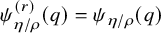 $\psi ^{(r)}_{\eta /\rho }(q)=\psi _{\eta /\rho }(q)$
. It follows that
$\psi ^{(r)}_{\eta /\rho }(q)=\psi _{\eta /\rho }(q)$
. It follows that
 $$ \begin{align*} G_\rho=(-1)^{\sum_{j\geq 2}\rho_j}q^{\sum_{j\geq 2}{\rho_j\choose 2}}\sum_{\substack{\eta \vdash n\\ \ell(\eta)=r}}\psi_{\eta/\rho}(q)P_{\eta'}(x;q), \end{align*} $$
proving the result.
Corollary 6.5. Given $\Delta \in {\mathrm M}_n({\mathbb F}_q)$
and a positive integer t, the number of t-fold
$\Delta \in {\mathrm M}_n({\mathbb F}_q)$
and a positive integer t, the number of t-fold $\Delta $
-anti-invariant subspaces of dimension m is given by
$\Delta $
-anti-invariant subspaces of dimension m is given by
 $$ \begin{align*} (-1)^{mt}q^{t{m \choose 2}} \langle \omega F_\Delta(x),P_{((t+1)^m,1^{n-m(t+1)})}(x;q) \rangle, \end{align*} $$
for $m(t+1)\leq n$
.
$m(t+1)\leq n$
.
Proof. For $\rho =(m^{t+1})$
, there is a unique partition
$\rho =(m^{t+1})$
, there is a unique partition $\eta $
of n with
$\eta $
of n with $t+1$
parts such that
$t+1$
parts such that $\eta /\rho $
is a horizontal strip, namely
$\eta /\rho $
is a horizontal strip, namely $\eta =( n-mt,m^t)$
. In this case it is straightforward to verify that
$\eta =( n-mt,m^t)$
. In this case it is straightforward to verify that $\psi _{\eta /\rho }(q)=1$
and the result follows.
$\psi _{\eta /\rho }(q)=1$
and the result follows.
7 Application to Krylov subspace methods
Let $\Delta \in {\mathrm M}_n({\mathbb F}_q)$
and consider a subset
$\Delta \in {\mathrm M}_n({\mathbb F}_q)$
and consider a subset $S=\{v_1,\ldots ,v_k\}$
of column vectors in
$S=\{v_1,\ldots ,v_k\}$
of column vectors in ${\mathbb F}_q^n$
. The truncated Krylov subspace of order
${\mathbb F}_q^n$
. The truncated Krylov subspace of order $\ell $
generated by S is defined by
$\ell $
generated by S is defined by
 $$ \begin{align*} \mathrm{Kry}(\Delta,S,\ell):=W+\Delta W+\cdots+\Delta^{\ell-1}W, \end{align*} $$
where $W=W_S$
denotes the subspace spanned by S. Let
$W=W_S$
denotes the subspace spanned by S. Let $\psi _{k,\ell }(\Delta )$
denote the probability of selecting a k-tuple of vectors uniformly at random from
$\psi _{k,\ell }(\Delta )$
denote the probability of selecting a k-tuple of vectors uniformly at random from ${\mathbb F}_q^n$
such that the truncated Krylov subspace of order
${\mathbb F}_q^n$
such that the truncated Krylov subspace of order $\ell $
spanned by them is all of
$\ell $
spanned by them is all of ${\mathbb F}_q^n$
. Thus
${\mathbb F}_q^n$
. Thus
 $$ \begin{align} \psi_{k,\ell}(\Delta):=\frac{1}{q^{nk}}|\{(v_1,\ldots,v_k)\in ({\mathbb F}_q^n)^k : \mathrm{ Kry}(\Delta,\{v_1,\ldots,v_k\};\ell)={\mathbb F}_q^n\}|. \end{align} $$
Computing $\psi _{k,\ell }(\Delta )$
is essential for analyzing a class of algorithms that solve large, sparse linear systems over finite fields, commonly encountered in number theory and computer algebra (Watkins [Reference Watkins40]). These algorithms, collectively referred to as Krylov subspace methods, have origins that can be traced back to contributions by Lagrange, Euler, Gauss, Hilbert, and von Neumann, among others (Liesen and Strakoš [Reference Liesen and Strakoš27, p. 8]). For instance, the linear algebra step in the Number Field Sieve, a well-known algorithm for large integer factorization, depends on Krylov subspace methods (Lenstra, Lenstra, Manasse and Pollard [Reference Lenstra, Lenstra, Manasse and Pollard26]). Another example is Wiedemann’s algorithm, which is employed to determine the minimal polynomials of large matrices over finite fields (Liesen and Strakoš [Reference Liesen and Strakoš27, p. 19]). The quantity
$\psi _{k,\ell }(\Delta )$
is essential for analyzing a class of algorithms that solve large, sparse linear systems over finite fields, commonly encountered in number theory and computer algebra (Watkins [Reference Watkins40]). These algorithms, collectively referred to as Krylov subspace methods, have origins that can be traced back to contributions by Lagrange, Euler, Gauss, Hilbert, and von Neumann, among others (Liesen and Strakoš [Reference Liesen and Strakoš27, p. 8]). For instance, the linear algebra step in the Number Field Sieve, a well-known algorithm for large integer factorization, depends on Krylov subspace methods (Lenstra, Lenstra, Manasse and Pollard [Reference Lenstra, Lenstra, Manasse and Pollard26]). Another example is Wiedemann’s algorithm, which is employed to determine the minimal polynomials of large matrices over finite fields (Liesen and Strakoš [Reference Liesen and Strakoš27, p. 19]). The quantity $\psi _{k,\ell }(\Delta )$
plays a key role in evaluating the effectiveness of these algorithms, and determining bounds on this probability represents a challenging and crucial task in the field (Brent, Gao, and Lauder [Reference Brent, Gao and Lauder8, p. 277]). We give an explicit formula for this probability as a scalar product of the flag generating function
$\psi _{k,\ell }(\Delta )$
plays a key role in evaluating the effectiveness of these algorithms, and determining bounds on this probability represents a challenging and crucial task in the field (Brent, Gao, and Lauder [Reference Brent, Gao and Lauder8, p. 277]). We give an explicit formula for this probability as a scalar product of the flag generating function $F_{\Delta }$
with a suitably defined symmetric function.
$F_{\Delta }$
with a suitably defined symmetric function.
Theorem 7.1. For each matrix $\Delta \in {\mathrm M}_n({\mathbb F}_q)$
, we have
$\Delta \in {\mathrm M}_n({\mathbb F}_q)$
, we have $\psi _{k,\ell }(\Delta )=\langle F_\Delta (x),G(n,k,\ell )\rangle ,$
where
$\psi _{k,\ell }(\Delta )=\langle F_\Delta (x),G(n,k,\ell )\rangle ,$
where
 $$ \begin{align*} G(n,k,\ell)= q^{-nk}\sum_{\substack{\mu\vdash n \\ \ell(\mu)\leq \ell }} (-1)^{n-\mu_1}(q-1)^{\mu_1}q^{\sum_{j\geq 1}{\mu_j \choose 2}}{k \brack \mu_1}_q [\mu_1]_q! \widetilde{W}_{\mu}(x;q). \end{align*} $$
Proof. The number of tuples $(v_1,\ldots ,v_k)$
of vectors in
$(v_1,\ldots ,v_k)$
of vectors in ${\mathbb F}_q^n$
which span a fixed subspace of dimension m is given by
${\mathbb F}_q^n$
which span a fixed subspace of dimension m is given by
 $$ \begin{align*} (q^k-1)(q^k-q)\cdots (q^k-q^{m-1})={k \brack m}_q(q-1)^mq^{m \choose 2}[m]_q!. \end{align*} $$
If W denotes the subspace spanned by $(v_1,\ldots ,v_k)$
, then
$(v_1,\ldots ,v_k)$
, then $\mathrm {Kry}(\Delta ,\{v_1,\ldots ,v_k\},\ell )={\mathbb F}_q^n$
precisely when the
$\mathrm {Kry}(\Delta ,\{v_1,\ldots ,v_k\},\ell )={\mathbb F}_q^n$
precisely when the $\Delta $
-profile of W is a partition of n with at most
$\Delta $
-profile of W is a partition of n with at most $\ell $
parts. It follows that
$\ell $
parts. It follows that
 $$ \begin{align*} \psi_{k,\ell}(\Delta)&= q^{-nk}\sum_{m=0}^k {k \brack m}_q(q-1)^m q^{m \choose 2}[m]_q!\sum_{\substack{\mu\vdash n \\ \mu_1=m\\ \ell(\mu)\leq \ell }} \sigma(\mu,\Delta)\\ &=q^{-nk}\sum_{m=0}^k {k \brack m}_q(q-1)^m q^{m \choose 2}[m]_q!\sum_{\substack{\mu\vdash n \\ \mu_1=m\\ \ell(\mu)\leq \ell }} \epsilon_{\mu'}q^{\sum_{j\geq 2}{\mu_j \choose 2}}\langle F_\Delta(x),\widetilde{W}_{\mu}(x;q)\rangle, \end{align*} $$
by Theorem 4.3. Therefore, $\psi _{k,\ell }(\Delta )=\langle F_{\Delta },G(n,k,\ell )\rangle ,$
where
$\psi _{k,\ell }(\Delta )=\langle F_{\Delta },G(n,k,\ell )\rangle ,$
where
 $$ \begin{align*} G(n,k,\ell)&=q^{-nk}\sum_{m=0}^k {k \brack m}_q(q-1)^m q^{m \choose 2}[m]_q!\sum_{\substack{\mu\vdash n \\ \mu_1=m\\ \ell(\mu)\leq \ell }} \epsilon_{\mu'}q^{\sum_{j\geq 2}{\mu_j \choose 2}}\widetilde{W}_{\mu}(x;q)\\ &=q^{-nk}\sum_{\substack{\mu\vdash n \\ \ell(\mu)\leq \ell }} (-1)^{n-\mu_1}(q-1)^{\mu_1}q^{\sum_{j\geq 1}{\mu_j \choose 2}}{k \brack \mu_1}_q [\mu_1]_q! \widetilde{W}_{\mu}(x;q).\\[-57pt] \end{align*} $$
8 Recent developments
Denote by $[n]$
the set of the first n positive integers. A Hessenberg function is a weakly increasing function
$[n]$
the set of the first n positive integers. A Hessenberg function is a weakly increasing function ${\mathsf m}:[n]\to [n]$
satisfying
${\mathsf m}:[n]\to [n]$
satisfying ${\mathsf m}(i)\geq i$
for each
${\mathsf m}(i)\geq i$
for each $ i\in [n]$
. For a linear operator
$ i\in [n]$
. For a linear operator $\Delta $
on
$\Delta $
on ${\mathbb F}_q^n,$
the Hessenberg variety is defined by
${\mathbb F}_q^n,$
the Hessenberg variety is defined by
 $$ \begin{align*} \mathscr{H}({\mathsf m},\Delta):= \{\text{complete flags } V_1\subseteq V_2\subseteq \cdots \subseteq V_n={\mathbb F}_q^n: \Delta V_i\subseteq V_{{\mathsf m}(i)}\text{ for } i\in [n]\}. \end{align*} $$
Drawing on results in this paper, the following theorem was proved in joint work with Abreu and Nigro [Reference Abreu, Nigro and Ram1].
Theorem 8.1. For each operator $\Delta $
on
$\Delta $
on ${\mathbb F}_q^n$
, the number of
${\mathbb F}_q^n$
, the number of ${\mathbb F}_q$
-rational points on the Hessenberg variety
${\mathbb F}_q$
-rational points on the Hessenberg variety $\mathscr {H}({\mathsf m},\Delta )$
is given by
$\mathscr {H}({\mathsf m},\Delta )$
is given by
 $$ \begin{align*}|\mathscr{H}({\mathsf m},\Delta)|=\langle F_\Delta(x), \omega X_{G({\mathsf m})}(x;q)\rangle, \end{align*} $$
where $X_{G({\mathsf m})}(x;t)$
denotes the chromatic quasisymmetric function of the unit interval graph
$X_{G({\mathsf m})}(x;t)$
denotes the chromatic quasisymmetric function of the unit interval graph $G({\mathsf m})$
associated to
$G({\mathsf m})$
associated to ${\mathsf m}$
.
${\mathsf m}$
.
This result entails an expression for the Poincaré polynomials of complex Hessenberg varieties involving modified Hall–Littlewood functions.
Acknowledgments
I thank Per Alexandersson, Amritanshu Prasad, and Michael Schlosser for some helpful discussions. I also thank two anonymous referees for their careful reading of the manuscript and constructive suggestions.
Competing interests
The author has no competing interests to declare.
Funding statement
This research was partially supported by a MATRICS grant MTR/2017/000794 awarded by the Science and Engineering Research Board and an Indo-Russian project DST/INT/RUS/RSF/P41/2021.
Ethical standards
The research meets all ethical guidelines, including adherence to the legal requirements of the study country.
Author contributions
The author is solely responsible for the content of this article.


 Open access

