




Introduction
Climate change (CC) poses a notable challenge to agricultural systems, particularly for smallholder farmers who rely heavily on natural resources to sustain their livelihoods (Cohn et al., Reference Cohn, Newton, Gil, Kuhl, Samberg, Ricciardi, Manly and Northrop2017). Climate variability, including changes in rainfall patterns, temperature, and extreme weather events, can negatively affect crop yields and farmers’ well-being (Zamasiya, Nyikahadzoi and Mukamuri, Reference Zamasiya, Nyikahadzoi and Mukamuri2017). In response, farmers have been exposed to several solutions and adapted their practices to mitigate the impacts of CC while facilitating sustainable food production, including sustainable agriculture (SA) concepts (Setsoafia, Ma and Renwick, Reference Setsoafia, Ma and Renwick2022).
Sustainable agriculture practices (SAPs) can be depicted in several forms (Velten et al., Reference Velten, Leventon, Jager and Newig2015). Nevertheless, it can be simplified as practices that involve techniques to conserve natural resources, such as soil, water, and biodiversity, while enabling ecological processes that support food production. These practices include agroforestry, conservation agriculture, and integrated crop-livestock systems (Zeweld et al., Reference Zeweld, Van Huylenbroeck, Tesfay, Azadi and Speelman2018). Research has shown that these practices promote climate resilience and mitigate CC by improving soil health, enhancing water retention, increasing biodiversity, and reducing greenhouse gas emissions (Zeweld et al., Reference Zeweld, Van Huylenbroeck, Tesfay, Azadi and Speelman2018; Rakotovao et al., Reference Rakotovao, Chevallier, Chapuis-Lardy, Deffontaines, Mathe, Ramaro, Rakotoniamonjy, Lepage, Masso, Albrecht and Razafimbelo2021).
Despite conceivable advantages, farmers’ adoption of SAPs must be improved in many parts of the world. Some farmers perceive SA as a risky, expensive, and time-consuming technique and require access to the necessary resources, such as finance and technical support, to effectively implement the practice (Roesch-McNally, Garrett and Fery, Reference Roesch-McNally, Garrett and Fery2020). A previously published study indicates that farmers are more interested in practices that can boost productivity, reduce costs, and diversify income sources while mitigating the impacts of CC (Makate, Makate and Mango, Reference Makate, Makate and Mango2017). Meanwhile, farmers in Germany were found to be influenced by a ‘hedonic motivation’ in inventing ‘smart’ products and adopting SAPs (Schukat and Heise, Reference Schukat and Heise2021).
One of the critical aspects of SAPs is the effective use of resources. Circular economy (CE) emphasizes the regenerative use of resources and the reduction of waste and pollution through closed-loop systems (Kirchherr, Reike and Hekkert, Reference Kirchherr, Reike and Hekkert2017). Hence, the introduction of CE in agriculture, often called circular agriculture (CA), glimpses an excellent deal for farmers to adopt SAPs. CA involves the integration of CE principles into agricultural systems to promote sustainable food production by providing economic gains, enhancing resource use, and reducing waste (Velasco-Muñoz et al., Reference Velasco-Muñoz, Mendoza, Aznar-Sánchez and Gallego-Schmid2021).
Some studies have been conducted in a regional scope about farmers’ views on strengthening their resilience to CC by incorporating CE and SAPs. Nevertheless, only a limited study comprehends what has been examined so far and exposes the uniqueness of each region's implementation of the practice. We, therefore, developed research questions as follows:
1. What influences farmers’ decision to adapt and mitigate CC?
2. What are the challenges in implementing CE and SAPs at the farm level?
3. How can policies support farmers’ transition toward SA?
This study's structure is organized as follows. After the introductory part, our method of selecting and screening the literature was explained. Following the method is the result of our analysis. We explained the result section in two sub-sections: developed and developing countries. Then, we answered this study's research questions in the discussion section. At the end of this paper, we provided conclusions, study limitations, and further research recommendations.
Material and methods
The review followed the PRISMA-P protocol to conduct Systematic Literature Review, as illustrated in Figure 1. We utilized Scopus and Web of Science (WOS) as our scientific databases and a set of search keywords: circular economy, climate change, adaptation and mitigation, sustainable agriculture, farmers, and policy and regulations, to collect the necessary literature. Keywords are executed based on field tags ‘TS’ or to search the title, abstract, and author keywords within a record in WOS and ‘Title, Abstract, and Keyword’ in Scopus search settings in December 2022.
Systematic literature review under the PRISMA-P protocol.
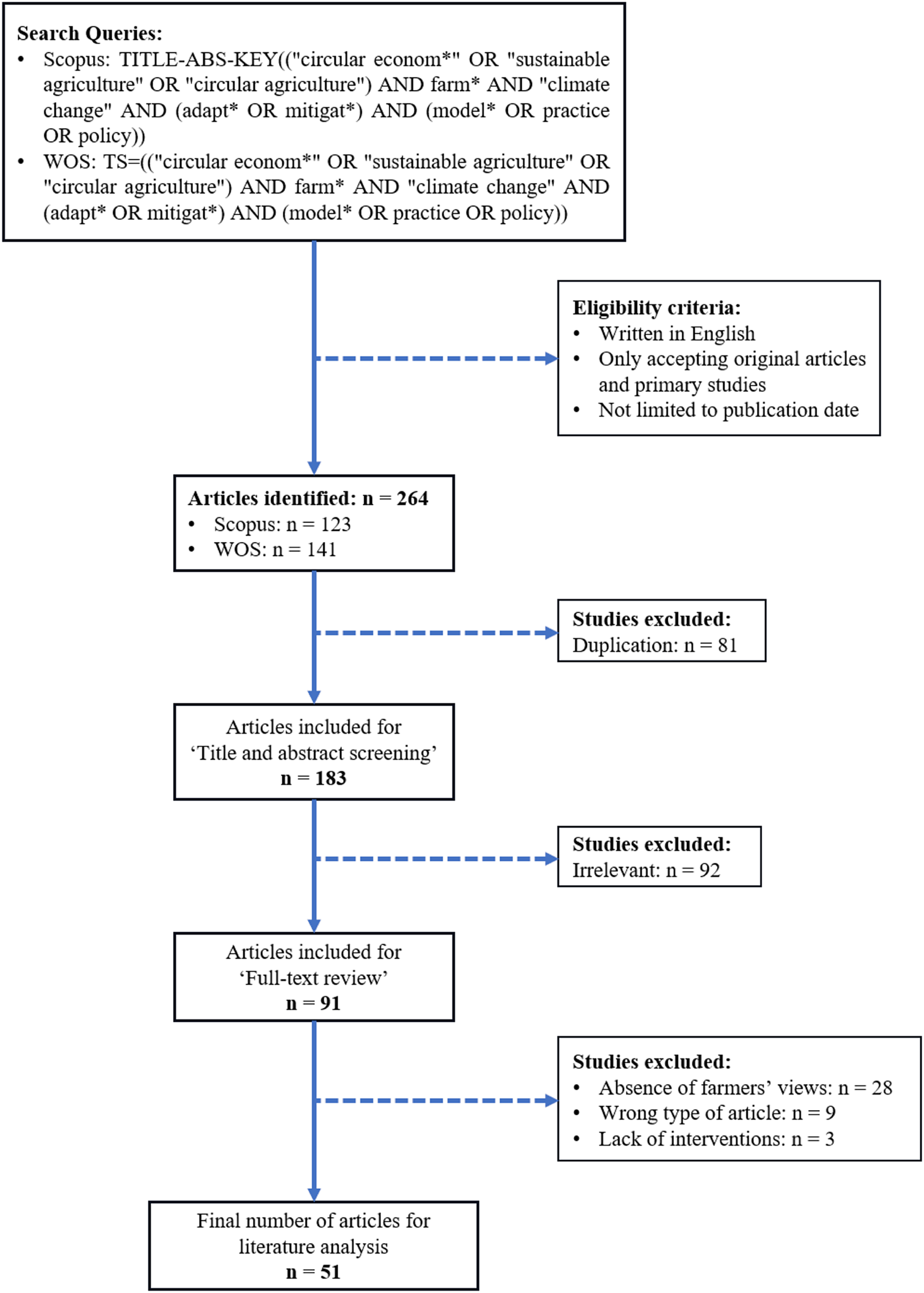
As for the additional criteria, we select only primary studies or original articles published in English. Books, book chapters, conference papers, and review articles were excluded. Then, the selection resulted in a total of 123 articles from Scopus and 141 articles from WOS. After combining literature from both databases and sorting out 81 duplications, 183 original articles were ready for the next steps of the review: abstract and full-text reviews.
During these advanced reviews, we employed the following PICO criteria as a basis for sorting out the literature:
– Participants (P): farmers, smallholder/small-scale farmers
– Interventions (I): policy and regulations, incentives, subsidies, innovations
– Comparisons (C): before and after intervention
– Outcome (O): farmers’ resilience on CC, sustainable production, better on-farm income, farmers’ improved adoption of SAPs
Our analysis specifically focused on identifying farmers’ views on CE and SAPs to strengthen their resilience on CC and increase farm productivity. Hence, we excluded research with limited findings to those topics and ones with more technical approaches instead of elaborating farmers’ socioeconomic perspectives on related practices. As we reached the final number of selections (Fig. 1), at least two authors contributed to evaluating articles in each step of the review.
Results
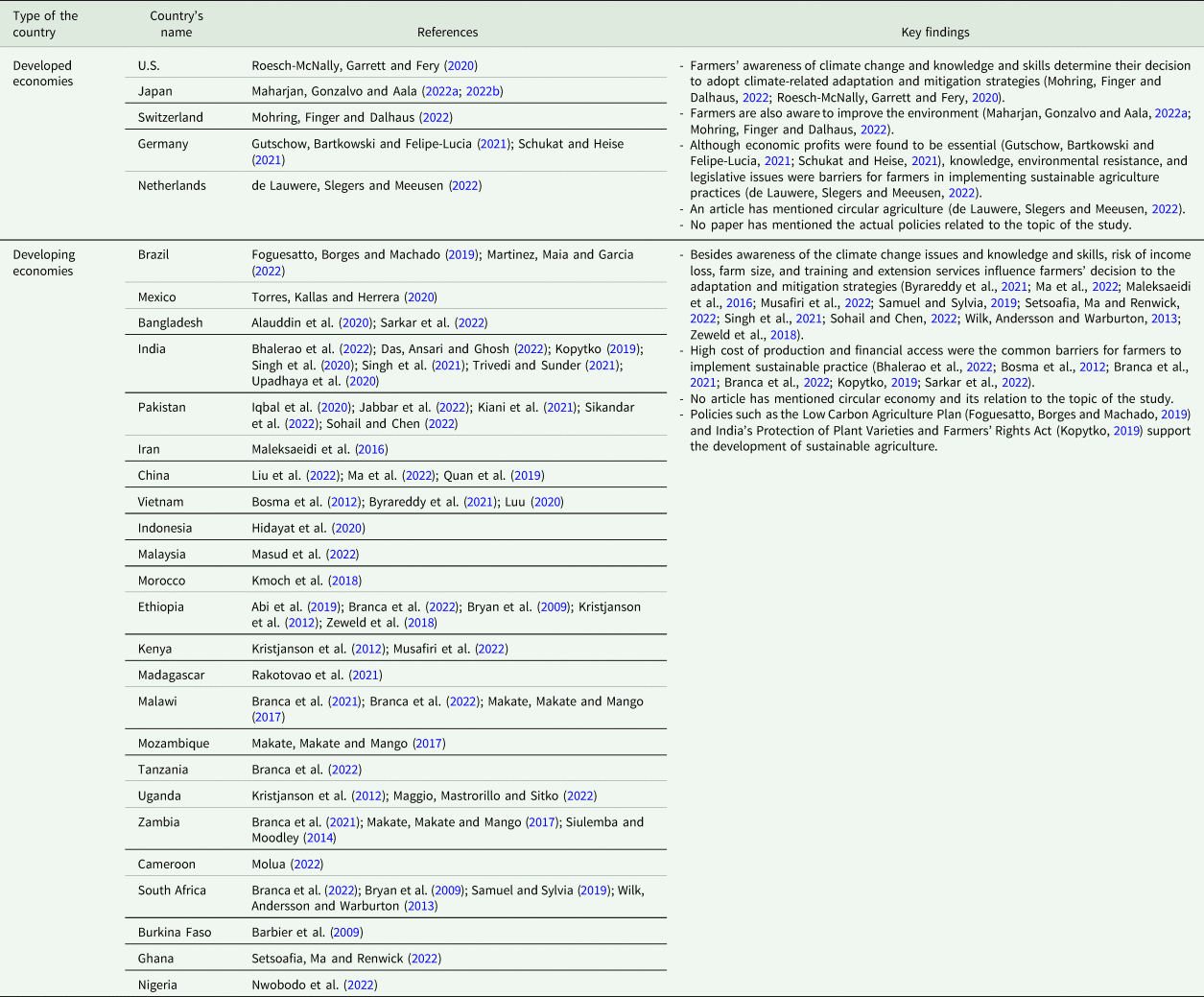
Following our review analysis, we classified 51 final articles based on the country's economic development level, as seen in Table 1. We followed the classification from the Department of Economic and Social Affairs of the United Nations (The United Nations, 2022). In the initial part of this section, we briefly explained the number of literatures in developed vs developing countries and the most studied country. Then, we explained our findings based on farmers’ situation in each country. The list of our literature can be seen in Appendix 1.
Study reference based on the country's economic development level
Overview
The topic of CE and SAPs has been studied for a while. In the focus of our study, the first few papers have been published in 2009 (Barbier et al., Reference Barbier, Yacouba, Karambiri, Zorome and Some2009; Bryan et al., Reference Bryan, Deressa, Gbetibouo and Ringler2009). The publications related to this topic have exponentially increased since 2018 and peaked in 2022. From these articles, only seven (14%) have been conducted in developed countries. Forty-four articles (86%) studied developing countries.
This review has selected studies conducted in almost all continents in the world. There are studies from Asia, Africa, North America, South America, and Europe. From these continents, a total of 29 countries have been studied. Africa was the most studied continent, with 14 countries in the review. Second is the continent of Asia (9 countries). Among all these continents, India (Asia) is the most studied country with seven related articles followed by Pakistan (Asia) and Ethiopia (Africa) with five articles each country.
Farmers in developed countries
Farmers in developed countries were concerned about CC and its impact on their farm yield. Hence, they understand the importance of adaptation and mitigation strategies (Maharjan, Gonzalvo and Aala, Reference Maharjan, Gonzalvo and Aala2022a; Mohring, Finger and Dalhaus, Reference Mohring, Finger and Dalhaus2022; Roesch-McNally, Garrett and Fery, Reference Roesch-McNally, Garrett and Fery2020). Some farmers perceived these importances to shift to environmental-friendly practices (Maharjan, Gonzalvo and Aala, Reference Maharjan, Gonzalvo and Aala2022a; Mohring, Finger and Dalhaus, Reference Mohring, Finger and Dalhaus2022). Nevertheless, these practices may not be economically profitable (Gutschow, Bartkowski and Felipe-Lucia, Reference Gutschow, Bartkowski and Felipe-Lucia2021).
In the U.S., small-scale farmers agreed to shift their farming practices to encounter climate uncertainties and aimed for long-term farming benefits. However, their limited knowledge and skills to deal with the issue must be addressed (Roesch-McNally, Garrett and Fery, Reference Roesch-McNally, Garrett and Fery2020).
In Japan, a study found that some farmers perceived environmental conservation agriculture (ECA) as a strategy to mitigate CC. Limiting the use of pesticides or chemical substances will benefit the environment, according to participants with high concerns about biodiversity and ecological resources (Maharjan, Gonzalvo and Aala, Reference Maharjan, Gonzalvo and Aala2022a). In another study, Maharjan, Gonzalvo and Aala (Reference Maharjan, Gonzalvo and Aala2022b) found that ECA has allowed Japanese farmers to earn higher profits by direct selling to consumers.
Regarding European studies, field observation and experiments among farmers in Switzerland found that they adapt to extreme heat by reducing their insecticide use. It allows farmers to overcome the excessive effect of the insecticide that could damage their farms. Besides that, this practice results in lower total costs of crop production (Mohring, Finger and Dalhaus, Reference Mohring, Finger and Dalhaus2022).
Gutschow, Bartkowski and Felipe-Lucia (Reference Gutschow, Bartkowski and Felipe-Lucia2021) found that implementing diversified crop rotations as a CC mitigation strategy could be more economically viable. According to a survey among German farmers, most environmental-friendly practices are not perceived as a ‘business-viable’ strategy as they limit revenue margins and threaten the agribusiness's survival level (Gutschow, Bartkowski and Felipe-Lucia, Reference Gutschow, Bartkowski and Felipe-Lucia2021). On the other hand, smart farming provides more resource-efficient, sustainable, and profitable production for German farmers (Schukat and Heise, Reference Schukat and Heise2021). Hence, it receives a positive perception among surveyed farmers. According to their study, economic benefit and resource effectiveness have influenced their behavioral intention to use ‘smart’ tools.
In the Netherlands, a study by de Lauwere, Slegers and Meeusen (Reference de Lauwere, Slegers and Meeusen2022) mentioned about CA. They found that economic value is not the only factor when Dutch farmers highly perceive CA. Instead, they were motivated by social and environmental values. Nevertheless, the knowledge barrier limits farmers’ transition toward CA. Environmental resistance due to excessive use of chemicals in the past and legislative issues make the effort more challenging for Dutch farmers.
Farmers in developing countries
Like those in developed countries, farmers in developing countries anticipated CC impacts on their farmland (Makate, Makate and Mango, Reference Makate, Makate and Mango2017; Molua, Reference Molua2022). Farmers perceive climate variability as a crucial stressor to ecological and socioeconomic issues (Singh et al., Reference Singh, Singh, Kumar, Sheoran, Sharma, Stringer, Quinn, Kumar and Singh2020). Farm income is expected to be lost without an adaptation strategy (Kristjanson et al., Reference Kristjanson, Neufeldt, Gassner, Mango, Kyazze, Desta, Sayula, Thiede, Forch, Thornton and Coe2012; Liu et al., Reference Liu, Liu, Rui, Zhang and Zhao2022; Molua, Reference Molua2022). Nevertheless, CC adaptation issues should be addressed based on the specific socioeconomic conditions of a region (Bryan et al., Reference Bryan, Deressa, Gbetibouo and Ringler2009; Liu et al., Reference Liu, Liu, Rui, Zhang and Zhao2022; Setsoafia, Ma and Renwick, Reference Setsoafia, Ma and Renwick2022).
Most of the selected papers in developing countries have been studied in the continent of Africa (n = 14). From northern Africa, Kmoch et al. (Reference Kmoch, Pagella, Palm and Sinclair2018) found the importance of a local knowledge approach to match the specific area or socioeconomic conditions and strengthen local innovation processes for Moroccan farmers’ adaptation to climate uncertainties.
Regarding studies in sub-Saharan Africa (Western, Central, Eastern, and Southern Africa), some researchers incorporated multiple countries as their study area (Branca et al., Reference Branca, Arslan, Paolantonio, Grewer, Cattaneo, Cavatassi, Lipper, Hillier and Vetter2021; Branca et al., Reference Branca, Cacchiarelli, Haug and Sorrentino2022; Bryan et al., Reference Bryan, Deressa, Gbetibouo and Ringler2009; Kristjanson et al., Reference Kristjanson, Neufeldt, Gassner, Mango, Kyazze, Desta, Sayula, Thiede, Forch, Thornton and Coe2012; Makate, Makate and Mango, Reference Makate, Makate and Mango2017). Meanwhile, some researches have been done in a single country (Abi et al., Reference Abi, Kessler, Oosterveer and Tolossa2019; Barbier et al., Reference Barbier, Yacouba, Karambiri, Zorome and Some2009; Musafiri et al., Reference Musafiri, Kiboi, Macharia, Ng'etich, Kosgei, Mulianga, Okoti and Ngetich2022; Rakotovao et al., Reference Rakotovao, Chevallier, Chapuis-Lardy, Deffontaines, Mathe, Ramaro, Rakotoniamonjy, Lepage, Masso, Albrecht and Razafimbelo2021; Maggio, Mastrorillo and Sitko, Reference Maggio, Mastrorillo and Sitko2022; Molua, Reference Molua2022; Nwobodo et al., Reference Nwobodo, Nwokolo, Iwuchukwu, Ohagwu and Ozioko2022; Samuel and Sylvia, Reference Samuel and Sylvia2019; Setsoafia, Ma and Renwick, Reference Setsoafia, Ma and Renwick2022; Siulemba and Moodley, Reference Siulemba and Moodley2014; Wilk, Andersson and Warburton, Reference Wilk, Andersson and Warburton2013; Zeweld et al., Reference Zeweld, Van Huylenbroeck, Tesfay, Azadi and Speelman2018).
Barbier et al. (Reference Barbier, Yacouba, Karambiri, Zorome and Some2009) found that farmers in Burkina Faso have adopted several techniques to increase yield and reduce its variability. Growing land scarcity and new market opportunities are why farmers adopt those practices. Meanwhile, Rakotovao et al. (Reference Rakotovao, Chevallier, Chapuis-Lardy, Deffontaines, Mathe, Ramaro, Rakotoniamonjy, Lepage, Masso, Albrecht and Razafimbelo2021) utilized several scenarios related to agroecology in Madagascar and found that the practice can help increase smallholder farmers’ productivity and profitability in the long run while mitigating CC. Nwobodo et al. (Reference Nwobodo, Nwokolo, Iwuchukwu, Ohagwu and Ozioko2022) found that economic benefits such as financial inclusion schemes can be considered to motivate Nigerian farmers to adopt a ‘greener’ practice. Moreover, the level of knowledge also influences farmers’ implementation of SAPs.
Bryan et al. (Reference Bryan, Deressa, Gbetibouo and Ringler2009) chose farmers in South Africa and Ethiopia as their study participants. They found that improved agricultural technologies, water storage facilities, irrigation, and crop varieties may increase practices related to CC adaptation at the farm level. Moreover, farmers’ access to extension services and financial support is essential. Regarding South Africa, Wilk, Andersson and Warburton (Reference Wilk, Andersson and Warburton2013) found that high costs of production inputs, limited access to knowledge, and agricultural techniques affect small-scale farmers’ adaptive capacity. Meanwhile, Samuel and Sylvia (Reference Samuel and Sylvia2019) found that farmers’ awareness of climate issues, irrigation access, and the extension officers’ frequency of visits influence farmers’ adaptation strategies.
Kristjanson et al. (Reference Kristjanson, Neufeldt, Gassner, Mango, Kyazze, Desta, Sayula, Thiede, Forch, Thornton and Coe2012) found that climate issues were vital to farmers’ adaptation to SAPs in Ethiopia, Kenya, Uganda, and Tanzania. Musafiri et al. (Reference Musafiri, Kiboi, Macharia, Ng'etich, Kosgei, Mulianga, Okoti and Ngetich2022) found that despite their awareness of CC's drivers and effects, Kenyan smallholders’ capacity to adapt has been limited by unpredictable weather patterns, financial constraints, and lack of agricultural training. Their study also found that farmers’ groups have negatively influenced smallholders’ adaptation practice. In Uganda, a study found that organic fertilizer and maize-legume intercropping as a single package can improve the value of crop production and resilience toward high-temperature deviations. The study argued that an increase in farmers’ level of strategy adoption would increase the overall benefits (Maggio, Mastrorillo and Sitko, Reference Maggio, Mastrorillo and Sitko2022).
Maggio's findings were supported by Setsoafia, Ma and Renwick (Reference Setsoafia, Ma and Renwick2022). They found that adopting the whole practice by improving seeds, fertilizers, and conserving soil and water can stimulate better impacts than a partial adoption of single or two practices. Ghanaian farmers’ decision to adopt SAPs has been affected by the household's socio-demographical aspects, plot-level characteristics, extension services, and locations. In Cameroon, Molua (Reference Molua2022) found that market access, farming experience, farm size, land tenure security, access to extension, and agroforestry practice enhanced farmers’ potential to adapt to climate issues.
In addition to studies conducted in Ethiopia, Zeweld et al. (Reference Zeweld, Van Huylenbroeck, Tesfay, Azadi and Speelman2018) found that Ethiopian farmers’ adoption of land management practices (agroforestry, crop rotation, and compost) has been influenced by their attitudes, access to information, educational level, group membership, social capital, risk attitudes, and labor supply. Moreover, Abi et al. (Reference Abi, Kessler, Oosterveer and Tolossa2019) added to the literature about Ethiopian farmers that their awareness to reduce drought can be elevated through an adapted training for mass-mobilization approach. Their findings found that farmers who followed the training were better at mitigating future drought and more aware of the possible impacts of drought on farmland.
In Zambia, Siulemba and Moodley (Reference Siulemba and Moodley2014) found no difference between farmers’ genders regarding their practice of managing natural resources. The study also found that larger families engage better in SAPs than smaller ones. Furthermore, Makate, Makate and Mango (Reference Makate, Makate and Mango2017) conducted a study in the multiple countries of Malawi, Mozambique, and Zambia. They have found that farmers’ perception of CC results in a shift to more conservation practices, including Integrated Soil Fertility Management. This method, which utilizes inorganic fertilizers, compost manure, and farmyard manure, is essential for the sustainable intensification of agriculture in sub-Saharan Africa (Makate, Makate and Mango, Reference Makate, Makate and Mango2017; Vanlauwe et al., Reference Vanlauwe, Wendt, Giller, Corbeels, Gerard and Nolte2014).
Branca et al. (Reference Branca, Arslan, Paolantonio, Grewer, Cattaneo, Cavatassi, Lipper, Hillier and Vetter2021) also studied farmers in Malawi and Zambia. They found that according to the socioeconomic characteristics, applying suitable technology for a climate-smart agriculture practice requires high up-front costs. Nevertheless, they argue that farmers will receive significant economic returns when they switch their conventional practices to climate-smart ones (Branca et al., Reference Branca, Arslan, Paolantonio, Grewer, Cattaneo, Cavatassi, Lipper, Hillier and Vetter2021). Another study was conducted by Branca et al. (Reference Branca, Cacchiarelli, Haug and Sorrentino2022); this time, they chose Ethiopia, Malawi, South Africa, and Tanzania as their study areas. They found that farmers with better financial and food-secure status are likelier to adopt agricultural technology innovations. Following their previous study in Malawi and Zambia, this time, they argue that technology packages need to consider the complexity and diversity of the smallholder farming systems (Branca et al., Reference Branca, Cacchiarelli, Haug and Sorrentino2022).
Regarding situations in the continent of Asia, Alauddin et al. (Reference Alauddin, Sarker, Islam and Tisdell2020) found that alternate wetting and drying irrigation can help Bangladeshi farmers save water resources and irrigation costs while increasing crop yield. Farmers’ adoption of this technique was affected by the age and education level of the household head, access to weather information, land ownership, typography, and soil type. Sarkar et al. (Reference Sarkar, Wang, Rahman, Azim, Memon and Qian2022) found that necessary resources, knowledge, skills, and training facilities can improve Bangladeshi farmers’ adoption of SAPs.
Farmers in India perceived climate variability as crucial to ecological, socioeconomic, and political issues (Singh et al., Reference Singh, Singh, Kumar, Sheoran, Sharma, Stringer, Quinn, Kumar and Singh2020). Natural conservation and financial access were determinants for farmers to adopt sustainable techniques (Kopytko, Reference Kopytko2019). Remunerative markets (agritourism, contract farming, and integrated food processing) can help support farmers’ financial sustainability (Trivedi and Sunder, Reference Trivedi and Sunder2021). Singh et al. (Reference Singh, Patel, Tiwari and Singh2021) found that flood-recession farming can upscale community livelihood and food security and improve environmental conditions near the river. Farmers’ adoption of this strategy was affected by the farmers’ skills and the invention of new technologies. Subsequently, farmers affected by declining water availability and soil fertility adopted low-cost measures to sustain their livelihoods (Bhalerao et al., Reference Bhalerao, Rasche, Scheffran and Schneider2022). Farmers in India produce foods while practicing SA by modifying their farming system based on traditional beliefs (Upadhaya et al., Reference Upadhaya, Barik, Kharbhih, Nongbri, Debnath, Gupta and Ojha2020). Moreover, Das, Ansari and Ghosh (Reference Das, Ansari and Ghosh2022) found that Indian farmers prefer to adopt climate-smart agriculture through indigenous technical knowledge.
Meanwhile, Pakistan has strong linkages between farmers’ knowledge and adaptation strategies, food security, risk assessment, and livelihood assets (Sohail and Chen, Reference Sohail and Chen2022). According to their study, farmers are expected to reduce risks as low as possible at any time. Regarding farmers’ knowledge and adaptation strategies, Jabbar et al. (Reference Jabbar, Liu, Wang, Zhang, Wu and Peng2022) found that the Farmer Field Schools improve farmers’ adoption of SAPs. Moreover, farmers’ participation in the program was influenced by the usage rate of information and communications technology, land tenure status, and extension services. A study by Iqbal et al. (Reference Iqbal, Abbas, Naqvi, Rizwan, Samie and Ahmed2020) found that small dams can be a priority for risk management strategy as this country also experiences water shortages. Regardless, Kiani et al. (Reference Kiani, Sardar, Khan, He, Bilgic, Kuslu and Raja2021) found that Pakistani farmers experienced a significant loss of farm income due to crop diversification practices. The agricultural diversification strategy was environmentally safe yet financially unviable and required excessive implementation time (Kiani et al., Reference Kiani, Sardar, Khan, He, Bilgic, Kuslu and Raja2021). Sikandar et al. (Reference Sikandar, Erokhin, Xin, Sidorova, Ivolga and Bobryshev2022) argued that foreign aid is one of the solutions to improve a positive relationship between SAPs and farm production.
Climate warming and low farming incomes motivate Chinese farmers to adopt SAPs (Liu et al., Reference Liu, Liu, Rui, Zhang and Zhao2022). Other than that, the cultivated area's size, cognition skills, and the accessibility of information influence farmers’ adaptation decisions (Quan et al., Reference Quan, Li, Song, Zhang and Wang2019). Chinese farmers’ choice of crop variety depends on the risk of income loss, where they prefer a variety with low potential yield reduction (Ma et al., Reference Ma, Qu, Khan and Zhang2022). Quan et al. (Reference Quan, Li, Song, Zhang and Wang2019) also found that limited adaptation strategies to CC may result in false practices, such as excessive irrigation and chemical application, and negatively affect wheat yields.
In Vietnam, Bosma et al. (Reference Bosma, Nhan, Udo and Kaymak2012) examined implementing the rice-fish farming system. Findings show that this system will provide farmers with a higher farm income and productivity. However, higher input costs are needed than conventional farming systems, and farmers with better access to financial support are more likely to adopt the new farming systems. Byrareddy et al. (Reference Byrareddy, Kouadio, Mushtaq, Kath and Stone2021) found that Vietnamese farmers who implement a combination of mulching and irrigation practices experienced a better adaptation to climate issues than those adopting only the irrigation system. In this case, the adoption of mulching practices was influenced by the farming experience during the drought season. A study by Luu (Reference Luu2020) investigated that Vietnamese farmers’ adoption of climate-smart agriculture is determined by educational level, social capital, access to credit, farmland size, tenure status, extension service, and market constraint. Farmers with large production scales are more financially capable and likely to afford climate-smart agriculture technology.
In Malaysia, a study by Masud et al. (Reference Masud, Akhtar, Al Mamun, Uddin, Siyu and Yang2022) found that economic, social, natural, and institutional barriers limit farmers’ adaptation to CC. Financial accessibility and price stability of all agricultural inputs are needed to improve farmers’ adaptation practices. Moreover, a study by Maleksaeidi et al. (Reference Maleksaeidi, Karami, Zamani, Rezaei-Moghaddam, Hayati and Masoudi2016) in Iran found that farm households’ resilience to CC can be increased by improving knowledge management.
In South America, a study by Foguesatto, Borges and Machado (Reference Foguesatto, Borges and Machado2019) investigated Brazilian farmers’ adaptation and mitigation of CC by examining their pro-environmental behavior. Farmers classified as ‘eco-centric farmers’ use their sense of environmental and cultural concerns in implementing pro-environmental behavior. On the other hand, their study explained that farmers who use economic value as their drivers for pro-environmental behavior will be attracted by financial incentives to adopt sustainable practices. The latter type of farmer was also found in a study in Mexico (Torres, Kallas and Herrera, Reference Torres, Kallas and Herrera2020). Torres et al. found that Mexican farmers prefer adaptation rather than mitigation actions due to the ‘instant’ benefit once it is adopted. In short, farmers prioritized actions that provide short-run economic benefits.
Discussion
Factors affecting farmers’ decision to adapt and mitigate climate change
CC is expected to happen globally, meaning that farmers in developed and developing countries may suffer from climate uncertainties. Farmers in both types of countries are aware of the CC's impact on their farm production, and the importance of adaptation and mitigation strategies (Maharjan, Gonzalvo and Aala, Reference Maharjan, Gonzalvo and Aala2022a; Mohring, Finger and Dalhaus, Reference Mohring, Finger and Dalhaus2022; Musafiri et al., Reference Musafiri, Kiboi, Macharia, Ng'etich, Kosgei, Mulianga, Okoti and Ngetich2022; Roesch-McNally, Garrett and Fery, Reference Roesch-McNally, Garrett and Fery2020; Samuel and Sylvia, Reference Samuel and Sylvia2019). Regardless, farmers in developed countries may think beyond current impact of the CC. They are more likely to be engaged with mitigation strategies to improve the environment (Maharjan, Gonzalvo and Aala, Reference Maharjan, Gonzalvo and Aala2022a).
The similarity between two farmers can be seen through knowledge and skills. Farmers were influenced by the level of knowledge and skill to adopt strategies to adapt and mitigate CC (Maleksaeidi et al., Reference Maleksaeidi, Karami, Zamani, Rezaei-Moghaddam, Hayati and Masoudi2016; Roesch-McNally, Garrett and Fery, Reference Roesch-McNally, Garrett and Fery2020; Singh et al., Reference Singh, Patel, Tiwari and Singh2021; Sohail and Chen, Reference Sohail and Chen2022; Wilk, Andersson and Warburton, Reference Wilk, Andersson and Warburton2013). Local or indigenous-based knowledge management was found to be preferred by farmers in developing countries (Das, Ansari and Ghosh, Reference Das, Ansari and Ghosh2022; Kmoch et al., Reference Kmoch, Pagella, Palm and Sinclair2018). We argue that a local knowledge approach could be helpful for smallholder farmers to engage with location-specific adaptation strategies, and to improve adaptation options based on innovations in their area. One of the examples we found from our analysis is the Integrated Soil Fertility Management for an intensification strategy in sub-Saharan Africa (Makate, Makate and Mango, Reference Makate, Makate and Mango2017; Vanlauwe et al., Reference Vanlauwe, Wendt, Giller, Corbeels, Gerard and Nolte2014). Literature may support our argument considering that socioeconomic conditions in specific locations are necessary when addressing CC adaptation strategies (Bryan et al., Reference Bryan, Deressa, Gbetibouo and Ringler2009; Liu et al., Reference Liu, Liu, Rui, Zhang and Zhao2022; Setsoafia, Ma and Renwick, Reference Setsoafia, Ma and Renwick2022).
It is understandable that farmers in developed countries have a bigger chance to improve their agricultural practices into a more environment-friendly ones. One of the reasons is farmland size and ownership. Unlike in developed economies, most agricultural fields in developing economies are cultivated by smallholder-type of farmers. Farmers who own small scale of agricultural land were more vulnerable to CC compared to farmers with larger land ownerships; hence, affecting their capacity to adopt strategies (Luu, Reference Luu2020; Molua, Reference Molua2022; Quan et al., Reference Quan, Li, Song, Zhang and Wang2019; Wilk, Andersson and Warburton, Reference Wilk, Andersson and Warburton2013).
Following the explanation in the previous paragraph, farmers in developing countries are more likely to avoid the risk of adopting adaptation strategies (Byrareddy et al., Reference Byrareddy, Kouadio, Mushtaq, Kath and Stone2021; Ma et al., Reference Ma, Qu, Khan and Zhang2022; Sohail and Chen, Reference Sohail and Chen2022; Zeweld et al., Reference Zeweld, Van Huylenbroeck, Tesfay, Azadi and Speelman2018). Their initiatives to conduct ‘experiments’ could be limited considering the smaller farmland size and the risk of losing their main source of income. Farmers in this type of countries may not have a full ownership of the farmland. Some land tenure-schemes were found, including farming without owning the land or land leasing. Farmers could use this type of scheme as an alternative to the purchase of land for agriculture. However, this can also affect their engagement to certain CC adaptation and mitigation strategies, considering that they have less risk of land sustainability compared to those who own the land (Adenuga, Jack and McCarry, Reference Adenuga, Jack and McCarry2021).
Training and extension services may help farmers to build their capacity to adopt CC's adaptation and mitigation strategies, especially in developing economies (Abi et al., Reference Abi, Kessler, Oosterveer and Tolossa2019; Musafiri et al., Reference Musafiri, Kiboi, Macharia, Ng'etich, Kosgei, Mulianga, Okoti and Ngetich2022; Samuel and Sylvia, Reference Samuel and Sylvia2019; Setsoafia, Ma and Renwick, Reference Setsoafia, Ma and Renwick2022). Training or capacity-building programs should modify the concept of SAPs to their traditional or local beliefs. Farmers in developing countries tend to prefer local-based knowledge. We believe this effort shall improve their acceptance of the program and the practice. Farmer Field Schools might be a great example of moderating indigenous knowledge and techniques and new perspectives on conducting SA (Jabbar et al., Reference Jabbar, Liu, Wang, Zhang, Wu and Peng2022).
Furthermore, extension services can help farmers in creating farmer groups. Farmer groups can help smallholder farmers encountering CC issues through collective work (Musafiri et al., Reference Musafiri, Kiboi, Macharia, Ng'etich, Kosgei, Mulianga, Okoti and Ngetich2022). However, training sets and extension services must be adapted to each location's socioeconomic characteristics. The reason is due to the uniqueness of the location. For example, Musafiri et al. (Reference Musafiri, Kiboi, Macharia, Ng'etich, Kosgei, Mulianga, Okoti and Ngetich2022) found that Kenyan farmers perceive farmer groups to provide value addition and commercialization of farming activities. These farmers did not perceive farmer groups as a medium to help them mitigate CC. Nevertheless, these efforts are essential in improving farmers’ adoption of CE and sustainable practices.
Challenges in implementing circular economy and sustainable practices
Conventional practices are known for the high intensity of agriculture inputs to produce a high number of yields without considering the long-term impact of the practice, especially on the environment. Farmers, unfortunately, were linked with this type of imbalance practice between economic and ecological trade-offs. A more sustainable practice yet resource-effective is required to overcome these issues.
Several practices provide farmers in developed and developing countries with opportunities to implement SA and CE. Agriculture practice should be ecologically and economically profitable in developed economies, where farmers tend to be more aware of conserving natural resources (Maharjan, Gonzalvo and Aala, Reference Maharjan, Gonzalvo and Aala2022a). ECA allows farmers to improve environmental resources and biodiversity (Maharjan, Gonzalvo and Aala, Reference Maharjan, Gonzalvo and Aala2022a). In addition, farmers will likely receive higher profits if they incorporate direct selling to consumers (farmers-to-consumers) in their agribusiness (Maharjan, Gonzalvo and Aala, Reference Maharjan, Gonzalvo and Aala2022b).
Meanwhile, farmers in developing countries also delivered examples of sustainable practices. Practices such as using organic fertilizer and intercropping maize and legumes (Maggio, Mastrorillo and Sitko, Reference Maggio, Mastrorillo and Sitko2022) and combining mulching and irrigation with farming activities can help farmers adapt to CC (Byrareddy et al., Reference Byrareddy, Kouadio, Mushtaq, Kath and Stone2021). Remunerative markets, such as agritourism or contract farming, and the rice-fish farming system can generate high farm income and productivity, hence providing farmers with financial sustainability (Bosma et al., Reference Bosma, Nhan, Udo and Kaymak2012; Trivedi and Sunder, Reference Trivedi and Sunder2021). Moreover, agroecology or flood recession farming can also provide such benefits while mitigating CC and improving environmental conditions (Rakotovao et al., Reference Rakotovao, Chevallier, Chapuis-Lardy, Deffontaines, Mathe, Ramaro, Rakotoniamonjy, Lepage, Masso, Albrecht and Razafimbelo2021; Singh et al., Reference Singh, Patel, Tiwari and Singh2021). Regarding location-specific practice, Integrated Soil Fertility Management benefits farmers in sub-Saharan Africa in intensifying their agriculture sustainably (Makate, Makate and Mango, Reference Makate, Makate and Mango2017; Vanlauwe et al., Reference Vanlauwe, Wendt, Giller, Corbeels, Gerard and Nolte2014).
Regardless of the possible benefits, farmers in both types of countries have been experiencing issues implementing SAPs. Gutschow, Bartkowski and Felipe-Lucia (Reference Gutschow, Bartkowski and Felipe-Lucia2021) found that diversifying crop rotations is not economically viable, according to farmers in a developed country. Findings from the developing world by Kiani et al. (Reference Kiani, Sardar, Khan, He, Bilgic, Kuslu and Raja2021) show a significant loss of farm income due to similar practices.
From these examples, environmentally beneficial practices must be improved to offer farmers economic gains and time-effective management. Such barriers to gaining more profits will impact how farmers perceive and adapt to innovations, especially in the developing world. Farmers attracted to innovation tend to analyze their peer's situations after implementing a system (Martinez, Maia and Garcia, Reference Martinez, Maia and Garcia2022). Nevertheless, farmers who experience economic profits when adopting new practices will have a better perception. This situation also shows how important it can be to address economic profits and new market opportunities for SA development. Studies in developed and developing countries show farmers’ acceptance of these benefits (Barbier et al., Reference Barbier, Yacouba, Karambiri, Zorome and Some2009; Schukat and Heise, Reference Schukat and Heise2021).
Another challenge farmers face is the high production cost, especially farmers in the developing economies. A climate-smart agriculture practice requires a considerable investment to apply for a suitable technology (Branca et al., Reference Branca, Arslan, Paolantonio, Grewer, Cattaneo, Cavatassi, Lipper, Hillier and Vetter2021). A similar case exists in the rice-fish farming system (Bosma et al., Reference Bosma, Nhan, Udo and Kaymak2012). Therefore, efficiently managing resources and costs is essential in developing SA at the farm level. This concept can be found in the CE (Kirchherr, Reike and Hekkert, Reference Kirchherr, Reike and Hekkert2017).
Interestingly, the term ‘circular economy’ or ‘circular agriculture’ is barely mentioned in our literature. Only a study by de Lauwere, Slegers and Meeusen (Reference de Lauwere, Slegers and Meeusen2022) has mentioned the terms. However, several practices implemented by farmers in developed and developing countries may have applied the ‘circular’ concept. For example, ‘smart farming’ provides a more resource-efficient, sustainable, and profitable production among farmers in developed countries (Schukat and Heise, Reference Schukat and Heise2021). In a developing country, alternate wetting and drying irrigation can help farmers manage water resources and irrigation costs efficiently while increasing crop yield (Alauddin et al., Reference Alauddin, Sarker, Islam and Tisdell2020). These examples show that using less or reusing/recycling agriculture resources means farmers need less production cost, which aligns with the concept of CA (Velasco-Muñoz et al., Reference Velasco-Muñoz, Mendoza, Aznar-Sánchez and Gallego-Schmid2021). Additionally, achieving lower production costs has allowed farmers to increase their profit margin (Kirchherr, Reike and Hekkert, Reference Kirchherr, Reike and Hekkert2017), especially when gaining premiums is possible.
Policy support to sustainable agriculture development
Institutional support through legislative and government bodies may influence SA development at the farm level. Regarding this matter, policies can directly and indirectly affect farmers’ implementation of sustainable practices, and farmers in developed and developing countries experience the issue. For example, government obligations demotivate Dutch farmers with high initiatives for sustainable practices. These farmers see their farms as businesses, though the current regulation seems to lack incentives, and they argue that it is more suitable for a conventional farming system (de Lauwere, Slegers and Meeusen, Reference de Lauwere, Slegers and Meeusen2022). In Pakistan, inconsistent public policies have notably distracted agricultural productivity and farmers’ livelihood. Farmers have identified the issue of inconsistencies as their highest source of risk (Iqbal et al., Reference Iqbal, Abbas, Naqvi, Rizwan, Samie and Ahmed2020).
A study from Indonesia provides an example of what Iqbal et al. found in Pakistan. Hidayat et al. (Reference Hidayat, Iskandar, Gunawan and Partasasmita2020) mentioned the Green Revolution program during the 1970s. The program, which was a national mandatory, has shifted the traditional ecological knowledge-based practices to high-productivity-minded farming systems. However, the program produces debatable outputs: increased farm production and profitability but highly dependent on chemical applications. Despite receiving economic benefits, this program may not apply to the current situation where global markets demand more sustainably earned agriculture yields.
Another policy example can be seen in India's Protection of Plant Varieties and Farmers’ Rights Act. Regarding this policy, Kopytko (Reference Kopytko2019) found that it aimed to help farmers in India practice sustainable seed innovation. An issue was to decide whether to recognize farmers or the community belongs to the farmer. Also, Kopytko acknowledged the differences between benefits received by plant breeders and farmers. Thus, improvements have been made to ensure the Act benefits the awardee of breeding new varieties.
Furthermore, government bodies can support farmers with attractive policies in terms of providing them economic profit and environmental conservations. In this case, Brazil's Low Carbon Agriculture Plan may be an excellent example of a policy that can serve both objectives. Foguesatto, Borges and Machado (Reference Foguesatto, Borges and Machado2019) argue that this program will not only help reduce the environmental impacts of their activities but also provide credits to invest in the agricultural system as proof of incentives-benefits.
With our limited scope of policy evaluations regarding the implementation of CE and SA at the farm level, further research should quantitatively analyze the effect of several public policies on farmers’ implementation of the practice in developed and developing countries. An exciting finding from Sikandar et al. (Reference Sikandar, Erokhin, Xin, Sidorova, Ivolga and Bobryshev2022) worth mentioning is the effect of foreign aid farmers need in developing countries to successfully connect SAPs and high agricultural production. In addition, our findings admitted narrow literature on policy mentioning CE and farmers.
Framework development
Based on the discussion in the previous three subsections, a framework has been created to clearly understand the issue of CC and SA at the farm level (Fig. 2). The framework explained how farmers’ adoption of CC adaptation and mitigation is connected to farmers’ implementation of CE and SAPs and is determined by two factors for farmers in developed and developing countries and three factors for a particular developing country's case. Furthermore, institutional and external supports such as policies could help improve the issue.
Framework developed from the study results.
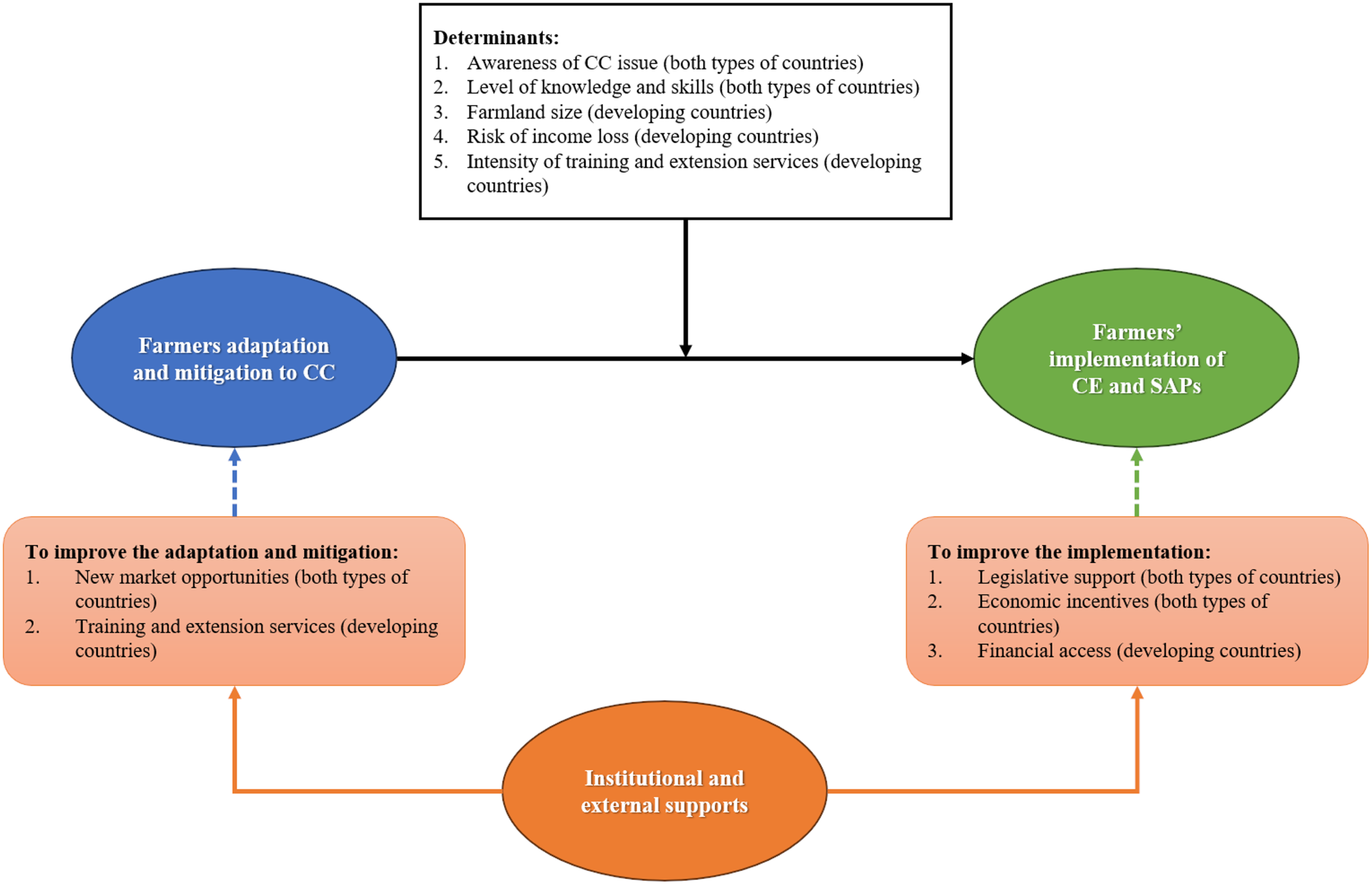
The framework, as seen in Figure 2, also provides ideas for policymakers to enhance future farmers’ take on CC and its adaptation and mitigation strategies to develop an accountable solution for each location. For example, awareness of the CC issue and the level of knowledge and skill for farmers in developing countries can be improved by providing training and extension services. Moreover, farmers in developing countries are vulnerable to the risk of income loss. Thus, providing them with financial access will be crucial. On the other hand, farmers in developed countries might be interested in new market opportunities and economic incentives.
Our framework can be a basis for further study recommendations. The researcher may conduct a case-based study on crucial points such as (1) developing new market opportunities that are beneficial for many parties, (2) identifying types of effective methods for training and extension services, and (3) providing incentive schemes that are suitable for specific locations.
Conclusions
Based on the literature analysis, awareness of CC issues and the level of knowledge and skills can be significant in farmers’ adoption of CC adaptation and mitigation in developed and developing countries. Meanwhile, farmers, particularly in developing countries, often mention farmland size, the level of risks, and the intensity of training and extension services as their deciding factors to the adaptation and mitigation strategies. Subsequently, implementing CE and SAPs among farmers in developing countries depends on technological costs and financial access. Therefore, government and institutional roles are essential in constructing new markets that are accessible to farmers. Moreover, policies supporting the creation of organizational bodies or farmer groups will complete the efforts.
Our review and analysis of the literature's main findings can help stakeholders, especially government and institutions related to agriculture, to develop programs and policies to support farmers’ transition toward SA. With the emergence of climatic issues in agriculture, this study encouraged stakeholders to improve farmers’ knowledge and skills through training and extension services, especially for farmers in developing countries.
Further research exploring the most effective training methods to improve farmers’ knowledge and skills to adapt and mitigate CC can be crucial. Research may also identify schemes for providing incentives and financial support for farmers regarding their implementation of CE and sustainable practices. Moreover, research incorporating multiple study areas will help understand the importance of location-specific solutions. In addition, a more detailed policy evaluation is needed to investigate how much government support has been given to help farmers implement better agriculture.
Despite this study's importance in understanding farmers’ strategies and practices to adapt and mitigate CC, we acknowledged that our Boolean queries extract only a limited number of studies from developed countries. This concern results in limited comparison between farmers’ situation in developed and developing countries. Therefore, our review is instead to investigate each country's situation without comparing one-to-one issues due to the imbalanced number of references. Another concern is regarding case-based studies written in non-English language which we decided not to be included in this review study.
Supplementary material
The supplementary material for this article can be found at https://doi.org/10.1017/S1742170524000097
Author contributions
The first author named is lead and corresponding author. We describe each author's contributions to the paper as follows: conceptualization: J. T., Y. S. H., and Á. T.; funding acquisition: J. T.; investigation: all authors; methodology: Y. S. H. and Á. T.; supervision: Á. T. and J. T.; writing – original draft: Y. S. H.; writing – review and editing: G. K., Z. G., J. T., and Á. T. All authors have read and approved the final manuscript.
Funding statement
This study was funded by the research project OTKA K 143370 ‘Agricultural climate change adaptation and circular economic behavior’. Y. S. H. thanks the support of the Stipendium Hungaricum Scholarship and the Tempus Public Foundation. Á. T. thanks the support of the János Bolyai Research Scholarship of the Hungarian Academy of Sciences.
Competing interests
None.


 Open access

