





Introduction
Effective combinations of herbicide-based and cultural weed control tactics are needed to foster sustainable weed management approaches within conservation tillage systems (Liebman Reference Liebman and Zimdahl2018; Mortensen et al. Reference Mortensen, Egan, Maxwell, Ryan and Smith2012; Norsworthy et al. Reference Norsworthy, Ward, Shaw, Llewellyn, Nichols, Webster, Bradley, Frisvold, Powles, Burgos, Witt and Barrett2012). Cover crops are increasingly integrated and incentivized in annual cropping systems to improve soil health and target conservation goals (Schipanski et al. Reference Schipanski, Barbercheck, Douglas, Finney, Haider, Kaye, Kemanian, Mortensen, Ryan, Tooker and White2014), which represents an opportunity to optimize their performance as a cultural weed management tactic in no-till systems. Cover crops are an effective cultural weed control tactic in the US Northeast, particularly when utilized in combination with herbicide-based tactics (Bunchek et al. Reference Bunchek, Wallace, Curran, Mortensen, VanGessel and Scott2020; Vollmer et al. Reference Vollmer, VanGessel, Johnson and Scott2020; Wallace et al. Reference Wallace, Curran and Mortensen2019).
Currently, there is increasing interest in intensifying cover-crop management within the northeastern United States by using planting green tactics in no-till systems. Planting green is the delay of cover-crop termination until after cash crop planting (Reed et al. Reference Reed, Karsten, Curran, Tooker and Duiker2019), which enables more growth and biomass production than typical 10- to 14-d pre-plant burndown termination tactics. The most common crop sequence in which planting green tactics are used is no-till planting of soybean into cereal rye. In the northeastern United States, delaying termination of cereal rye by 10 to 14 d can result in significant biomass gains (Mirsky et al. Reference Mirsky, Curran, Mortensen, Ryan and Shumway2009; Reed and Karsten Reference Reed and Karsten2022), which has been shown to correlate directly with weed suppression levels (Nord et al. Reference Nord, Curran, Mortensen, Mirsky and Jones2011, Reference Nord, Ryan, Curran, Mortensen and Mirsky2012).
Intensification of cover-crop management with use of planting green tactics may facilitate a reduction in herbicide inputs while maintaining crop protection goals. However, the efficacy of reduced-herbicide programs will depend on (i) species traits such as herbicide-resistance level, emergence periodicity, and seed mass (Beam et al. Reference Beam, Cahoon, Haak, Holshouser, Mirsky and Flessner2021; Bunchek et al. Reference Bunchek, Wallace, Curran, Mortensen, VanGessel and Scott2020; Ficks et al. Reference Ficks, Lowry and Wallace2022), and (ii) the method of herbicide input reduction, including elimination of preemergence applications, a postemergence pass, or a reduction in the total number of active ingredients utilized within a growing season. In theory, high-residue cover-crop surface mulches provide early-season weed suppression, which is the intended management goal when applying preemergence herbicides at or near cash crop planting. Consequently, excluding preemergence herbicides when delaying termination of cover crops may be a viable strategy for reducing herbicide inputs, and would encourage adoption of an IPM framework, where early-season scouting permits the grower to plan postemergence herbicide application passes.
Region- and system-specific research is needed to understand the viability of planting green as an IWM tactic, as well as the agronomic trade-offs that will affect adoption rates. Cropping systems that integrate annual or perennial forage phases may provide opportunities to reduce herbicide inputs within summer annual grain crops, because asynchronous disturbance events created by planting and harvesting winter annual or perennial forages within the rotation disrupt life cycles of summer annual weed species (Cavigelli et al. Reference Cavigelli, Teasdale and Conklin2008; Davis et al. Reference Davis, Hill, Chase, Johanns and Liebman2012; Weisberger et al. Reference Weisberger, Nichols and Liebman2019). Within the US Northeast, herbicide banding and high-residue, inter-row cultivation can be viable tactics to reduce herbicide inputs in corn (Zea mays L.) and soybean phases of a grain and forage cropping system (Snyder et al. Reference Snyder, Curran, Karsten, Malcolm, Duiker and Hyde2016; Summers et al. Reference Summers, Karsten, Curran and Malcolm2021). However, constraints based on labor and equipment have led few producers to express interest in adopting these tactics. In contrast, there is significant interest in delayed cover-crop termination tactics within no-till grain production systems (Reed et al. Reference Reed, Karsten, Curran, Tooker and Duiker2019), which may be adopted in more diverse grain and forage cropping systems as a method for reducing herbicide inputs.
We conducted a field experiment to evaluate the potential for delayed cereal rye termination (i.e., planting green) to facilitate elimination of soil-applied residual (preemergence) herbicides within a soybean phase of a diverse 6-yr grain–forage rotation within a long-term cropping systems study in Pennsylvania. This IWM strategy was compared to standard pre-plant termination of cover crops (14 to 21 d) and herbicide programs (two-pass program with preemergence herbicides). We hypothesized that use of planting green tactics without preemergence herbicides would maintain weed control and soybean yield performance, while contributing to herbicide resistance management goals, including reduced recruitment rates of summer annual weed species and size of individuals at the time of postemergence herbicide applications.
Materials and Methods
Experimental Design and Field Operations
A field experiment was conducted at the Pennsylvania State University Russell E. Larson Agricultural Research Center (RELARC) near Rock Springs, PA (40.118333°N, 76.427500°W) in the soybean phase of the Pennsylvania State University Sustainable Dairy Cropping Systems Project for three growing seasons (2019–2021). This cropping system experiment involves a 6-yr rotation, including a 3-yr annual grain/forage phase and a 3-yr perennial forage phase [alfalfa (Medicago sativa L.) – orchardgrass (Dactylis glomerata L.)] that is imposed with a full-entry design and four replicate blocks, where each crop phase is present each year in main plots (18 m by 30 m). Two alternative weed management treatments (Standard, IWM) are imposed at the split-plot level (9 m by 30 m) using a single-factor, paired comparison. In the 3-yr annual grain/forage phase, the Standard treatment included a corn silage/corn silage/cereal rye–soybean phase, and the IWM treatment included a corn silage/sorghum sudangrass (Sorghum bicolor × S. bicolor var. sudanese)/cereal rye (Secale cereale L.)–soybean phase.
Within the soybean phase, weed management treatments included the following: (i) Standard: cereal rye termination (14 to 21 d pre-plant, DPP) and a two-pass herbicide program that included preemergence herbicides; and (ii) IWM: delayed cereal rye termination (1 d post-plant) and a one-pass herbicide program (postemergence only; Table 1). At the postemergence application timing (35–42 d after planting, DAP), an IPM approach was carried out by scouting weeds and adjusting the herbicide program accordingly based on the emerged weed community. Given that glyphosate was the planned postemergence application, scouting focused on the presence of either glyphosate-resistant species or species that require the addition of herbicides with other sites of action in combination with glyphosate to achieve adequate control.
Herbicide inputs across treatments (Standard and integrated weed management, IWM) and crop growing season (2019–2021). Standard treatments include products applied 14 to 21 d pre-plant for cover-crop termination and weed control, preemergence soil-applied residuals (preemergence) applied 1 d after planting (DAP), and a postemergence pass 35–42 DAP. IWM treatments include cover-crop termination 1 DAP and a postemergence pass 35–42 DAP.

Cereal rye (‘Aroostook’) was established each fall before the soybean phase with a no-till drill (Great Plains, Salina, KS) in early October using a 135 kg ha–1 seeding rate in both treatments (Table 2). Because weather conditions across years were variable, cereal rye was terminated 21 DPP in 2019 and 2021 growing seasons and 14 DPP in the 2020 growing season within the Standard treatment (Table 2). Soybeans were planted using a John Deere 1720 MaxEmerge no-till planter (Deere & Company, Moline, IL) at a rate of 371,000 seeds ha–1 in 76-cm-wide rows (Table 2). Soybean trait platforms differed among years as a result of regional availability (2019–2020, Xtend®; 2021, XtendFlex®; Bayer Crop Science, Leverkusen, Germany). Cereal rye was roll-crimped and soybean planted in a single pass in the IWM treatment using ZRX integrated roller-crimpers and double-disk row cleaners (Dawn Equipment, Sycamore, IL). The roll-crimper was not used in the Standard treatment at soybean planting. We suggest that residue management and planter configuration differences between treatments represent best-management practices currently being utilized by early adopters of planting green tactics (Reed et al. Reference Reed, Karsten, Curran, Tooker and Duiker2019).
Field operations dates and environmental conditions for each experimental year.
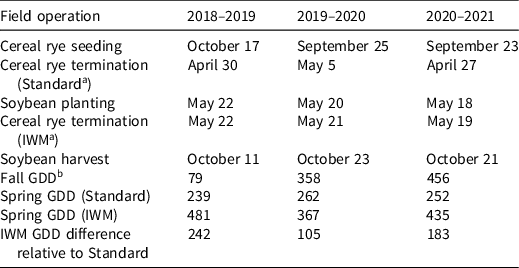
a Standard treatment consisted of cereal rye termination 14 to 21 d pre-plant, preemergence herbicide applied 1 d after planting (DAP), postemergence herbicide 35–42 DAP; IWM treatment was cereal rye termination 1 DAP, postemergence herbicide 35–42 DAP.
b Abbreviation: GDD, cumulative growing degree days; base temperature set at 4.4 C (Mirsky et al. Reference Mirsky, Curran, Mortensen, Ryan and Shumway2011) and calculated from seeding to termination date.
Data Collection
Aboveground cereal rye biomass was collected in two randomly placed 0.25-m2 quadrats per split plot one day prior to cover-crop termination. Cereal rye residue and soybean biomass was collected just prior to the postemergence application at the V4 soybean growth stage within one randomly placed 0.5-m2 quadrat. Biomass samples were oven-dried at 65 C for 7 d and weighed. Soybean stand counts were conducted at the V4 soybean growth stage in a representative 2.66 m of the middle two rows per split plot. Soybean yields were evaluated by harvesting the middle two rows of each split plot with a small-plot harvester and moisture corrected to 13.5%.
Soil moisture conditions were monitored in split plots to better characterize effects of delayed cover-crop termination on soybean growing conditions and early-season weed dynamics. We measured soil volumetric water content (%VWC) at a 7.62-cm depth in three random inter-row locations per split plot on a weekly interval for 14 wk after soybean planting using a Campbell Scientific HydroSense II soil moisture probe (Campbell Scientific, Inc., Logan, UT).
Weed abundance was evaluated in two different sampling zones. The effect of Standard and IWM treatments on weed abundance was evaluated in mid-August each year within each split plot by harvesting aboveground weed biomass from two randomly placed 0.25-m2 quadrats in the center planting pass, corresponding with soybean yield strips. Samples were sorted to species, oven-dried at 65 C for 7 d, and weighed. As a result of field scouting prior to postemergence applications, horseweed density, and heights were additionally sampled from two randomly placed 0.25-m2 quadrats per split plot 35–42 DAP in 2020 and 2021; horseweed sampling was not conducted in 2019, because there were no emerged populations at the postemergence herbicide application timing.
In addition, preemergence herbicide exclusion subplots (1 m2) were established within each split plot to isolate the effect of delayed cover-crop termination on suppression of summer annual weeds. Artificial weed seedbanks were seeded each December following cereal rye seeding to create preemergence herbicide exclusion subplots using 800 redroot pigweed (Amaranthus retroflexus L.) seeds and 200 large crabgrass [Digitaria sanguinalis (L.) Scop.] seeds from local populations. At the time of preemergence applications within the Standard treatment, subplots were covered with a plastic tarp, allowed to dry following the application, and then removed. Density and height of large crabgrass and redroot pigweed populations were recorded within subplots at the V4 soybean growth stage, just prior to postemergence herbicide applications.
Statistical Analysis
Statistical analyses were conducted using R v. 3.6.1 (R Core Team 2019). For each response, variable, mixed-effects models were fit using weed management treatment (Standard, IWM), site-year, and their interaction as fixed effects, and block as a random effect. Biomass data (cereal rye, weeds, soybean), soybean population and yield, and soil %VWC data were analyzed using linear mixed-effect models in the nlme package (Pinheiro et al. Reference Pinheiro, Bates, Debroy and Sarkar2019). A repeated-measures ANOVA with an autoregressive correlation structure was used to test for interactions between sampling date and management strategy in models of soil %VWC by experimental year. Soil %VWC was expressed as the difference relative to the Standard treatment, sampling date was fit as a fixed effect, and a plot identifier was used as the within-subject term. Summer annual weed and horseweed density data were analyzed with generalized linear mixed-effect models (GLMMs) using a negative binomial distribution and a log link function (glmer.nb) in the lme4 package (Bates et al. Reference Bates, Maechler, Bolker and Walker2015). Significance of fixed effects within GLMMs was evaluated using log-likelihood ratio tests (Wald χ) to compare full versus reduced models using the anova function. The emmeans package was used to obtain least-square means on the response scale and pairwise comparisons for significant interactions (Lenth Reference Lenth2019). Back-transformed means (± SE) are presented in results.
Results and Discussion
Cereal Rye Performance
Greater aboveground cereal rye biomass at termination was observed in the IWM treatment compared to the Standard treatment (14 to 21 d pre-plant termination) in 2 of 3 yr (F = 10.9; P < 0.01; Figure 1A). However, the magnitude of the response varied among years. We observed a 63% increase in cereal rye biomass production within the IWM treatment in 2019, but only a 22% and 33% increase in 2020 and 2021, respectively. Differences in magnitude may be partially explained by differences in cumulative growing degree days (GDD) between termination timings. Delayed termination in the IWM treatments resulted in a 242, 105, and 183 GDD increase in 2019, 2020, and 2021, respectively, compared to the Standard treatment (Table 2).
The effect of experimental year (2019–2021) and integrated weed management (IWM) treatment (Standard, IWM) on (A) cereal rye aboveground biomass at termination and (B) cereal rye surface residue at the V4 soybean growth stage. Standard treatment was cereal rye termination 14 to 21 d pre-plant, preemergence herbicide applied 1 d after planting (DAP), postemergence herbicide 35–42 DAP; IWM treatment was cereal rye termination 1 DAP, postemergence herbicide 35–42 DAP. Pairwise comparisons with a significant treatment (Trt)-by-year interaction are displayed (NS, nonsignificant at P < 0.05; * P < 0.05; ** P < 0.01; *** P < 0.001).

Previous research has shown that delaying termination of cereal rye is an effective means for significantly increasing biomass potential within the US Northeast. Mirsky et al. (Reference Mirsky, Curran, Mortensen, Ryan and Shumway2011) reported that cereal rye biomass increased approximately 2,000 kg ha–1 for each 10-d incremental delay in spring termination. A recent study has reported 76% to 96% increases in cereal rye biomass production when delaying termination by 10 to 14 d during the same time-period (late April through mid-May) within the Northeast (Reed and Karsten Reference Reed and Karsten2022). Within this study, termination timings were based on targeted soybean planting date (May 15–20), and in 2 yr (2020–2021) Standard pre-plant termination of cereal rye occurred after initiation of stem elongation, which significantly increases biomass accumulation. We attribute more moderate increases (22% to 33%) in biomass accumulation to these phenological patterns.
The IWM treatment also resulted in greater surface residue biomass compared to the Standard treatment at the V4 soybean growth stage in 2 of 3 yr (F = 12.8; P < 0.001), with the magnitude of difference in each year closely tracking biomass patterns observed at the time of termination (Figure 1B). The average mass loss in cereal rye residue from termination until the V4 growth stage ranged from 17% to 28% in the IWM treatments, with greater variation in mass loss observed in the Standard treatments (10% to 74%) across years.
Cereal rye residue persistence is an important factor that contributes to weed suppression potential and is mediated by total biomass production and the C:N ratio at termination (Poffenbarger et al. Reference Poffenbarger, Mirsky, Teasdale, Spargo, Cavigelli and Kramer2015). Relative humidity and precipitation in the first 60 d following cover-crop termination are important drivers of cereal rye decomposition, with both soil moisture and N availability to soil microorganisms limiting decomposition rates during the growing season (Thapa et al. Reference Thapa, Tully, Reberg-Horton, Cabrera, Davis, Fleisher, Gaskin, Hitchcock, Poncet, Schomberg, Seehaver, Timlin and Mirsky2022). It is likely that differences in C:N ratios and precipitation patterns between cereal rye termination timings among years contributed to the observed variability in surface residue mass loss within Standard treatments in our 3-yr study.
Indirect Effects on Soil Moisture
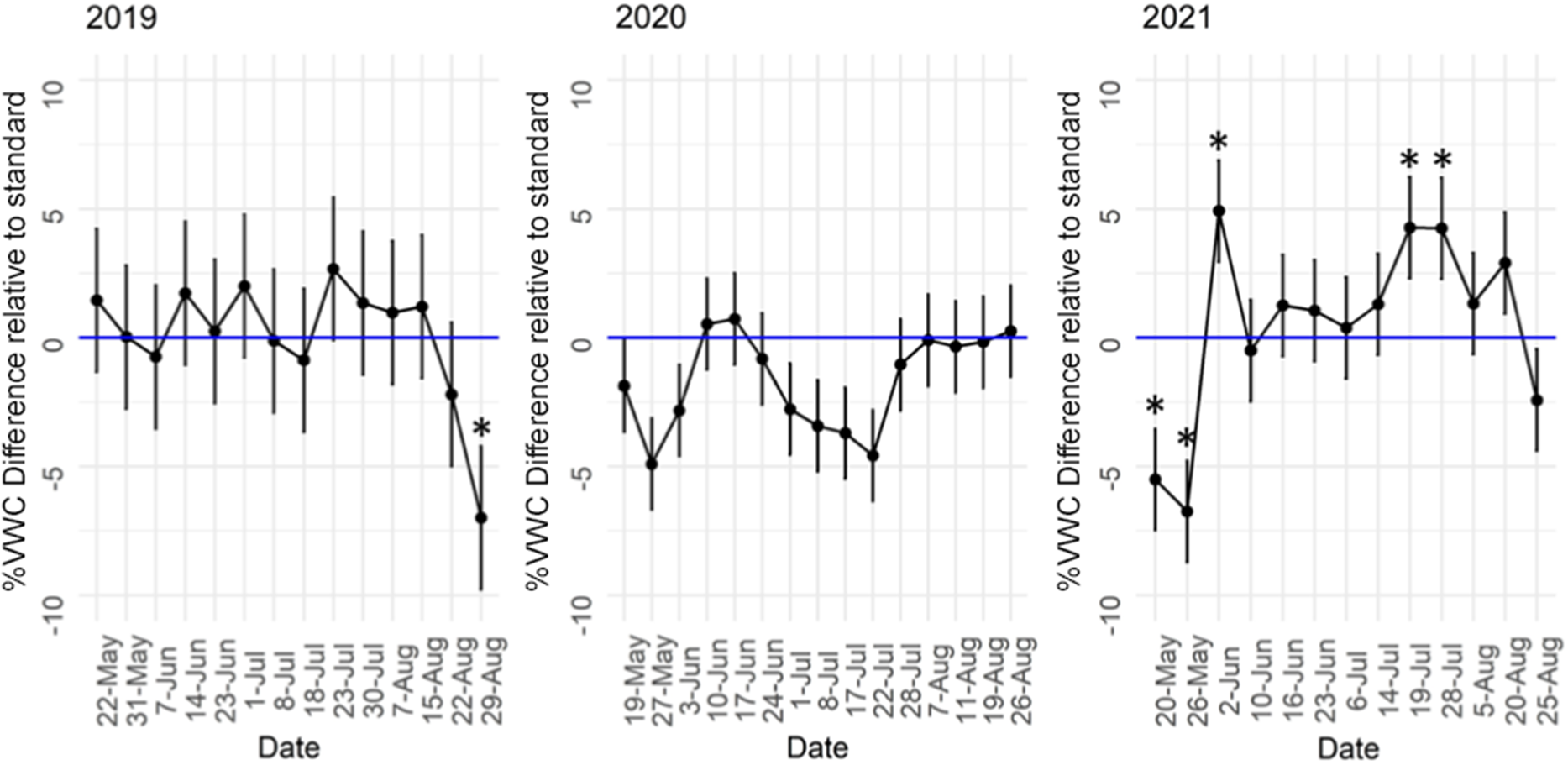
Delaying cereal rye termination can influence soil moisture dynamics by creating early-season soil moisture deficits due to greater transpiration loss and later-season soil moisture conservation due to prevention of evaporative loss due to greater surface mulch persistence (Williams et al. Reference Williams, Mortensen and Doran1998; Reed et al. Reference Reed, Karsten, Curran, Tooker and Duiker2019). This trend was observed in only the 2021 growing season, where comparatively lower %VWC was observed within the IWM treatment at dates closest to planting, and greater %VWC was observed at multiple dates in June and July (Figure 2). Relative to other study years, 2021 received above-average (30-yr) precipitation across the growing season and soil moisture fluctuated between 15% and 30% VWC. In comparison, precipitation was below 30-yr averages by mid-June in 2020 and reached drought-level status through the month of July, with soil moisture declining from 30% VWC in mid-June to 10% by mid-July (Table 3). Though not statistically significant, trends suggest that %VWC was lower in the IWM planting green treatment during this drought period.
Effect of IWM treatment on soil volumetric water content (VWC%; 7.6-cm depth) relative to the Standard treatment across three growing seasons (2019–2021). Standard treatment was cereal rye termination 14 to 21 d pre-plant, preemergence herbicide applied 1 d after planting (DAP), postemergence herbicide 35–42 DAP; IWM treatment was cereal rye termination 1 DAP, postemergence herbicide 35–42 DAP. Data are treatment means (± 1 SE) averaged across replicates. Asterisks indicate significant %VWC differences (P < 0.05) relative to Standard termination timing.
Total monthly precipitation and average monthly temperature in each soybean growing season compared to 30-yr averages (1981–2010) at Rock Springs, PA.

Soybean Performance
Soybean populations within the IWM treatment did not differ compared to the Standard treatment, but populations did vary among years (F = 4.3; P < 0.05; Figure 3A). Soybean biomass was greater (F = 16.9; P < 0.01) in the IWM treatment compared to the Standard treatment at the V4 growth stage (Figure 3B). Though the magnitude of the effect was small, the relationship was consistent among years. Field observations suggest that early-season soybean growth rates were reduced due to flumioxazin injury, which was applied only in the Standard treatment. Flumioxazin, a component of the soil-applied herbicide treatment, can result in ephemeral injury to emerging soybeans, particularly in lower residue environments (J.M. Wallace, personal observation). Weed management treatment effects on soybean grain yield differed among years (F = 4.1; P < 0.05). The Standard treatment resulted in greater soybean yield (2,587 kg ha–1) than the IWM treatment (1,873 kg ha–1) in 2020, but yields were similar in other years (Figure 3C).
The effect of experimental year (2019–2021) and integrated weed management (IWM) treatment (Standard, IWM) on soybean (A) population and (B) aboveground biomass at the V4 growth stage, and (C) soybean grain yield. Standard treatment was cereal rye termination 14–21 d pre-plant, preemergence herbicide applied 1 d after planting (DAP), postemergence herbicide 35–42 DAP; IWM treatment was cereal rye termination 1 DAP, postemergence herbicide 35–42 DAP. Pairwise comparisons with a significant treatment (Trt)-by-year interaction are displayed (NS, nonsignificant at P < 0.05; * P < 0.05; ** P < 0.01; *** P < 0.001).

Recent soybean research has found either no effect (Reed et al. Reference Reed, Karsten, Curran, Tooker and Duiker2019) or a small yield penalty (3% to 4%; Reed and Karsten Reference Reed and Karsten2022) when planting green. In both studies, delaying rye termination until soybean planting resulted in cooler soil temperatures compared to Standard pre-plant termination tactics, which corresponded to observations of delayed soybean seedling emergence and maturation. Reduced soybean populations due to inadequate seed placement and closure of seed furrows have historically been a constraint to no-till planting into high levels of cover-crop surface mulch (Liebl et al. Reference Liebl, Simmons, Wax and Stoller1992; Mirsky et al. Reference Mirsky, Ryan, Teasdale, Curran, Reberg-Horton, Spargo, Wells, Keene and Moyer2013; Williams et al. Reference Williams, Mortensen and Doran1998). We attribute the lack of difference in populations between treatments to improved planter technologies, including integrated roller-crimpers on parallel linkage coupled with double-disk row cleaners, as well as automatic adjustment of hydraulic downforce pressure on individual row units. Improved planter technologies should further increase relative fitness of emerging soybean seedlings relative to co-emerging weed species within surface mulch residues (Mohler Reference Mohler1996; Ficks et al. Reference Ficks, Lowry and Wallace2022; Williams et al. Reference Williams, Mortensen and Doran1998).
Weed Control Performance
The IWM treatment resulted in 58% fewer herbicide inputs, as measured by the number of active ingredients applied, compared to the Standard treatment over the 3-yr study (Table 1). Variation in the selection of postemergence herbicide inputs was primarily driven by abundance of glyphosate-resistant horseweed populations. In 2019, no additional active ingredients were mixed with glyphosate programs because of minimal recruitment of horseweed at the study, whereas cloransulam-methyl was applied in 2020 in dicamba-tolerant soybean (Xtend®) and glufosinate was applied in 2021 in dicamba/glufosinate-tolerant soybean (XtendFlex®) to target emerged horseweed populations.
Just prior to postemergence applications (35–42 DAP), the IWM treatment resulted in greater total horseweed density (χ2 = 14.9; P < 0.001) and the density of horseweed plants that exceeded recommended size-based height thresholds (10 cm; χ2 = 20.1; P < 0.001) compared to the Standard treatment in 2020 and 2021 (Figure 4A, B). Peak weed biomass did not differ (F = 1.1; P = 0.31) between IWM and Standard treatments (Figure 4C). Mean biomass levels in mid-August were below 50 kg ha–1 within each treatment and year. The most discernible species-level trend between treatments was greater abundance of horseweed and large crabgrass within IWM treatments. The trend toward greater total peak biomass within IWM treatment in 2020 can be attributed to reduced efficacy of cloransulam-methyl treatments on horseweed relative to 2021, when use of a glufosinate-tolerant soybean variety permitted use of postemergence glufosinate applications and resulted in acceptable levels of horseweed control.
The effect of experimental year (2019–2021) and integrated weed management (IWM) treatment (Standard, IWM) on horseweed (A) total density and (B) horseweed individuals >10 cm height 35–42 d after planting (DAP), and (C) total peak weed biomass. Standard treatment consisted cereal rye termination 14 to 21 d pre-plant, preemergence herbicide applied 1 d after planting (DAP), postemergence herbicide 35–42 DAP; IWM treatment was cereal rye termination 1 DAP, postemergence herbicide 35–42 DAP.

Fall-sown cereal rye can significantly reduce horseweed populations at the time of a pre-plant burndown application (Bunchek et al. Reference Bunchek, Wallace, Curran, Mortensen, VanGessel and Scott2020; Essman et al. Reference Essman, Loux, Lindsey, Dobbels and Regnier2020; Schramski et al. Reference Schramski, Sprague and Renner2021; Wallace et al. Reference Wallace, Curran and Mortensen2019). However, field observations suggest that greater horseweed populations in planting green treatments 35–42 DAP resulted from the lack of an effective pre-plant burndown active ingredient to control the population cohort that had emerged in fall and persisted in the cereal rye cover crop, whereas Standard treatments included 2,4-D ester in pre-plant burndown applications. Use of Enlist® soybean traits permits use of 2,4-D choline when terminating cereal rye in a planting green scenario (1 DAP), but additional research is needed to understand how roll-crimped surface residues affect weed control efficacy for horseweed cohorts near the soil surface where foliar coverage may be compromised (Wallace et al. Reference Wallace, Curran and Mortensen2019).
Surface Mulch Effect on Weed Suppression
Preemergence-herbicide exclusion subplots were utilized to isolate the effect of the surface mulch differences between treatments on recruitment and early-season growth rates of summer annual grass and broadleaf weed species. No difference in redroot pigweed total density or individuals exceeding size thresholds were detected between treatments (P < 0.05) just prior to postemergence applications (35–42 DAP), though a trend toward lower densities in the IWM treatment was observed (Figure 5A, B). Treatment effects differed across years in analysis of large crabgrass total density just prior to postemergence applications (χ2 = 16.7; P < 0.001), where greater densities were observed in IWM treatments in 2 of 3 yr (Figure 5C), but no differences were observed in analysis of the number of large crabgrass individuals exceeding size-based thresholds just prior to postemergence applications (Figure 5D). Based on field observations, large crabgrass recruitment patterns can be attributed, in part, to greater in-row disturbance within IWM treatments. Large crabgrass recruitment was concentrated within areas disturbed by row cleaning, which tended to be more aggressive within IWM than the Standard treatment. Row cleaning in combination with roll-crimping is carried out to optimize soybean seed placement and establishment rates but necessarily creates in-row soil disturbance that influences weed recruitment rates. Future research should consider strategies for balancing such trade-offs when utilizing planting green tactics in higher cover-crop residue systems.
The effect of experimental year (2019–2021) and integrated weed management (IWM) treatment (Standard, IWM) on redroot pigweed (A) density and (B) individuals >10 cm height, and large crabgrass (C) density and (D) individuals >10 cm height 35–42 d after planting (DAP). Standard treatment was cereal rye termination 14 to 21 d pre-plant, preemergence herbicide applied 1 d after planting (DAP), postemergence herbicide 35–42 DAP; IWM treatment was cereal rye termination 1 DAP, postemergence herbicide 35–42 DAP. Pairwise comparisons with a significant treatment (Trt)-by-year interaction are displayed (NS, nonsignificant at P < 0.05; * P < 0.05; ** P < 0.01; *** P < 0.001).

Delaying cereal rye termination can reduce total summer annual weed densities (Nord et al. Reference Nord, Curran, Mortensen, Mirsky and Jones2011) and size of individual weeds at key within-season herbicide application timings (Bunchek et al. Reference Bunchek, Wallace, Curran, Mortensen, VanGessel and Scott2020). In our experiment, moderate increases (22% to 63%) in cereal rye biomass likely contributes to the lack of strong trends in summer annual weed recruitment rates between treatments. However, several factors can influence the magnitude of the effect beyond differences in biomass accumulation, including seedbank size, species traits, and indirect effects of delayed termination on pedoclimatic factors influencing weed seedbank dynamics. For example, Nord et al. (Reference Nord, Ryan, Curran, Mortensen and Mirsky2012) demonstrated that weed seedbank density levels mediate the effects of cereal rye biomass and termination timings on weed suppression potential, with greater relative weed suppression levels observed when seedbank density was low (<300 seeds m–2). Small-seeded broadleaf species, such as redroot pigweed, are more susceptible to seedling mortality during the establishment phase in cereal surface mulch than summer annual grass species (Ficks et al. Reference Ficks, Lowry and Wallace2022). Germination periodicity also mediates surface residue effects on population recruitment at the species level (Nord et al. Reference Nord, Curran, Mortensen, Mirsky and Jones2011). Cover-crop surface residues affect microsite conditions that mediate weed seed dormancy and germination cues in the upper soil profile within no-till systems, including %VWC and soil temperature (Nichols et al. Reference Nichols, Verhulst, Cox and Govaerts2015; Williams et al. Reference Williams, Mortensen and Doran1998). For example, Reed et al. (Reference Reed, Karsten, Curran, Tooker and Duiker2019) reported that soil was 7% to 24% drier and 0.9 C cooler when delaying termination of cereal rye until soybean planting compared to earlier pre-plant termination timings. Delayed termination also influences cereal rye C:N ratios, which can indirectly affect fitness of nitrophilic weeds, including redroot pigweed, in no-till soybean systems (Wells et al. Reference Wells, Reberg-Horton, Smith and Grossman2013). Finally, Champagne et al. (Reference Champagne, Wallace, Curran and Baraibar2019) reported that the level of in-row disturbance that results from planter configurations in high-residue no-till systems can influence summer annual weed recruitment rates.
Management Implications
Previous northeastern United States studies have shown that there is a positive relationship between cover-crop biomass and several ecosystem services, including weed suppression and N retention (Finney et al. Reference Finney, White and Kaye2016; Mirsky et al. Reference Mirsky, Spargo, Curran, Reberg-Horton, Ryan, Schomberg and Ackroyd2017). Earlier fall planting dates, supplementing fall N fertility, and delaying termination are all means for increasing cereal rye biomass potential (Mirsky et al. Reference Mirsky, Spargo, Curran, Reberg-Horton, Ryan, Schomberg and Ackroyd2017). In this study, we investigated delayed cereal rye termination as an IWM tactic that facilitates reduced herbicide inputs in a soybean phase of a diversified grain–forage system. Use of delayed cover-crop termination and postemergence herbicide programs reduced the number of herbicide active ingredients used in the soybean phase by >50% without influencing late-season weed abundance, which can be used as an indicator of weed seedbank returns. This result, however, should be viewed in context of our study system. First, herbicide exclusion microplots suggest that surface mulch levels resulting from planting green did not significantly reduce summer annual weed recruitment compared to Standard pre-plant germination, which we attribute to only moderate gains (22% to 63%) in biomass. Recent meta-analyses suggest that greater than 5,000 kg ha–1 of aboveground biomass is needed to reduce weed biomass by 75% (Nichols et al. Reference Nichols, Martinez-Feria, Weisberger, Carlson, Basso and Basche2020). In comparison, total aboveground biomass in planting green treatments ranged from 3,800 to 6,300 kg ha–1 in our study, exceeding this theoretical threshold (5,000 kg ha–1) in only 1 of 3 yr. Although considerable context is required to relate weed suppression potential to cover-crop biomass thresholds, it is instructive to note that cereal rye biomass production following a 14- to 21-d delay in termination was still lower than what is commonly viewed as the threshold necessary for season-long weed suppression when relying on cover-crop surface mulch as a stand-alone weed control tactic.
Our results highlight several factors that should be considered to accurately characterize short- and long- term net returns when adopting planting green tactics. First, reductions in herbicide inputs (58% over the 3-yr study) achieved via use of cultural tactics such as planting green have the potential to significantly decrease costs of production. However, we suggest that reduced herbicide use without (i) a loss in weed control efficacy and (ii) increase in weed seedbank returns is more likely to be achieved when soybean is produced in diverse crop rotations, such as forage–grain systems, which are more likely to select for higher diversity and lower abundance weed communities (Davis et al. Reference Davis, Hill, Chase, Johanns and Liebman2012). Nonetheless, our results underscore the importance of integrating nonchemical tactics with effective herbicide sites of action. In our study, additional active ingredients in postemergence application passes were needed to control glyphosate-resistant horseweed and increased early-season horseweed competition could have contributed, in part, to the observed yield reduction in 1 of 3 yr within the IWM treatment. Within forage–grain systems, future research may also consider contrasting net returns from using planting green tactics to reduce herbicide inputs with harvesting cereal rye for forage prior to no-till planting soybean, which is frequently utilized in a corn silage sequence (Binder et al. Reference Binder, Karsten, Beegle and Dell2020) but has been less explored in a soybean sequence (Crowley et al. Reference Crowley, VanEs, Gomez and Ryan2018). Finally, cost savings from reduced herbicide use may offset yield penalties driven by variable environmental conditions when planting green into higher residue cereal rye biomass. In our study, the IWM treatment resulted in lower soybean yield in only 1 yr when drought conditions occurred throughout late June and July. Field-based observations suggest that greater early-season water use in the IWM treatment could have exacerbated later-season drought impacts on soybean yield. In conclusion, we suggest that the mediating effects of soil moisture dynamics on crop–weed competition that results from delayed termination tactics is an important factor that requires more research to inform adaptive cover-crop management decision making in no-till systems.
Practical Implications
Delaying cover-crop termination until at or after cash crop planting (i.e., planting green) represents a departure from long-held pre-plant burndown management recommendations. The benefit of planting green is the gain in cover-crop biomass production, which can result in better early-season weed suppression. This study focused on planting green in a cereal rye–soybean crop sequence within a grain–forage production system. Delaying cereal rye termination resulted in reduced soil moisture availability at the time of planting, which can be an agronomic benefit in wet springs, but may reduce soybean yields in dry growing seasons. Soybean populations were similar among planting green and Standard termination (14- to 21-d pre-plant burndown) tactics in our study, which we attribute to planter modifications designed to achieve optimal seed placement in higher levels of surface residues. Our research also shows that planting green may facilitate reductions in use of soil-applied herbicides without affecting soybean yield in the absence of glyphosate- or multiple herbicide–resistant summer annual weed species. However, careful consideration should be given to best-management practices for preventing evolution of resistance to postemergence herbicides. Ideally, cover-crop surface residues should reduce the size of emerged weed populations and the number of large individuals (>10 cm) within a population at the time of postemergence applications. Our study also demonstrated that scouting is necessary to design the appropriate pre-plant burndown application program when delaying cereal rye termination. Glyphosate-resistant horseweed populations that persisted in the understory of cereal rye stands were not adequately controlled and required additional inputs at the postemergence application timing. In summary, planting green is an adoption-ready integrated weed management (IWM) tactic but requires adaptive management decision making to balance weed control and conservation management goals.
Acknowledgments
This was supported by The Pennsylvania University College of Agriculture Sciences, LTAR ARS USDA 58-8070-8-008. No conflicts of interest have been declared. The authors would like to thank Tosh Mazzone, Jared Adam, Kaleb Wolfe, Tom Adams, and graduate and undergraduate students who provided assistance to complete this experiment.


 Open access

