





Introduction
Early adolescence is marked by significant social, emotional, and neural changes and is the peak age of onset for a range of pathology (Kessler et al., Reference Kessler, Berglund, Demler, Jin, Merikangas and Walters2005). Internalizing disorders (e.g., anxiety, depression) are the most common mental health diagnoses in adolescence, with prevalence estimates ranging from 15 to 30% (Beesdo et al., Reference Beesdo, Knappe and Pine2009; Merikangas et al., Reference Merikangas, He, Burstein, Swanson, Avenevoli, Cui, Benjet, Georgiades and Swendsen2010). Internalizing disorders in adolescence are associated with a range of poor outcomes (e.g., worse health, academic, and social functioning) and increased risk of internalizing disorders in adulthood (Copeland et al., Reference Copeland, Alaie, Jonsson and Shanahan2021). Previous studies have primarily focused on clinical cutoffs and diagnostic-level symptoms as predictors of risk for internalizing disorders. A critical next step is to identify more specific risk factors, including transdiagnostic mechanisms, which may uniquely confer risk for the development of internalizing disorders (Norton & Paulus, Reference Norton and Paulus2017). One such transdiagnostic factor is anxiety sensitivity (AS), or the fear of anxiety-related physical symptoms (e.g., rapid heart rate, nausea) and the fear of associated negative outcomes, such physical (e.g., heart attack), social (e.g., rejection), and/or psychological (e.g., “going crazy”) consequences (Silverman et al., Reference Silverman, Fleisig, Rabian and Peterson1991; Taylor, S. Reference Taylor2014).
Notably, AS is not considered symptomatology itself, but rather a potential link in the causal chain that leads to the later development of internalizing disorders in youth (Schmidt et al., Reference Schmidt, Keough, Mitchell, Reynolds, MacPherson, Zvolensky and Lejuez2010; Epkins, Reference Epkins2016) and adults (Kaczkurkin et al., Reference Kaczkurkin, Fitzgerald, Tyler and Asnaani2018). AS is also shown to predict trait anxiety and risk of other transdiagnostic dimensions, including emotion regulation, or one’s ability to implement psychological and behavioral strategies to interpret and manage emotions (Gross, Reference Gross2002; Mathews et al., Reference Mathews, Kerns and Ciesla2014; Olatunji & Wolitzky-Taylor, Reference Olatunji and Wolitzky-Taylor2009; Tull et al., Reference Tull, Rodman and Roemer2008). Thus, the examination of AS, specifically, has the power to provide unique insight into the development of deficits in emotion regulation, and ultimately internalizing disorders, before such pathways have crystallized. For example, a recent study found that emotion regulation mediated the relationship between AS and social anxiety in a sample of adolescents (Esmailian et al., Reference Esmailian, Mohamadkhani and Hasani2021). AS and emotion regulation also appear to have unique and interactive impacts on future internalizing symptoms, such as worry and panic (Allan et al., Reference Allan, Norr, Macatee, Gajewska and Schmidt2015). Although this work supports the idea that AS and emotion regulation play key roles in the development of internalizing disorders, more work is needed to fully elucidate this potential pathway.
A key vulnerability factor for the development of internalizing disorders in youth is the level of parent internalizing symptoms present in the home (Cole & Deater-Deckard, Reference Cole and Deater-Deckard2009; McRae et al., Reference McRae, Stoppelbein, O’Kelley, Fite and Greening2018). Children of parents with anxiety disorders are over three times more likely to develop pathological anxiety themselves (Hirshfeld-Becker et al., Reference Hirshfeld-Becker, Micco, Simoes and Henin2008; Micco et al., Reference Micco, Henin, Mick, Kim, Hopkins, Biederman and Hirshfeld-Becker2009). Although genetic heritability accounts for 30–40% of this relationship, a significant portion of such risk is due to environmental influences (Eley, Reference Eley2001; Gross & Hen, Reference Gross and Hen2004). Specifically, parents provide an environment in which unique, emotion-related learning experiences can impact the development of their childrens’ affective responsivity and the regulation of such responses (Fisak & Grills-Taquechel, Reference Fisak and Grills-Taquechel2007; Morris et al., Reference Morris, Criss, Silk and Houltberg2017; Silvers, Reference Silvers2022). For example, recent theoretical and empirical work posits that parents’ internalizing symptoms impact adolescent emotion regulation capacity, which in turn impacts risk for adolescent emotion dysregulation and subsequent anxiety (Morris et al., Reference Morris, Silk, Steinberg, Myers and Robinson2007; Hare et al., Reference Hare, Feeney and Parent2022; Nolte et al., Reference Nolte, Guiney, Fonagy, Mayes and Luyten2011; Perlman et al., Reference Perlman, Lunkenheimer, Panlilio and Pérez-Edgar2022). As proposed by Morris and colleagues (Reference Morris, Silk, Steinberg, Myers and Robinson2007), parent characteristics (e.g., anxiety symptoms) are observed by children in the home. In turn, this influences how children learn to express and manage their own emotions. In the context of the present study, we theorize that parental anxiety sensitivity manifests as increased awareness and sensitivity to physiological aspects of anxiety (Silverman et al., Reference Silverman, Fleisig, Rabian and Peterson1991) and children learn to model this increased vigilance and responsivity. In support of this hypothesis is work by Suveg and colleagues (Reference Suveg, Shaffer, Morelen and Thomassin2011) in which childrens’ emotion regulation capacity mediated the relationship between general parent psychopathology and childrens’ internalizing symptoms. Parental AS also contributes to risk for anxiety in children, likely through modeling of anxiety-driven behaviors (Drake & Kearney, Reference Drake and Kearney2008). Moreover, AS in youth is impacted by parentalAS, and this transmission is thought to be promoted via modeling and reinforcement processes (Stassart et al., Reference Stassart, Dardenne and Etienne2017). Together, evidence suggests that parents’ characteristics (e.g., AS) play a key role in the development of emotion dysregulation, or deficits in emotion regulation capacity, in their offspring.
The field has begun to outline the neural mechanisms linked to disturbances in emotion regulation during early adolescence (Ahmed et al., Reference Ahmed, Bittencourt-Hewitt and Sebastian2015). Meta-analytic evidence suggests that changes in emotion regulation capacity during adolescence are linked to the development of both the prefrontal cortex (PFC) (Pozzi et al., Reference Pozzi, Vijayakumar, Byrne, Bray, Seal, Richmond, Zalesky and Whittle2021) and amygdala (Ashworth, Brooks, & Schioth Reference Ashworth, Brooks and Schiöth2021). Moreover, recent research has sought to identify potential neural mechanisms by which parenting factors may influence their adolescents’ affective processes (Pozzi et al., Reference Pozzi, Vijayakumar, Byrne, Bray, Seal, Richmond, Zalesky and Whittle2021). For example, parents’ anxiety symptoms have been shown to be associated with greater anterior insula activation in adolescents during an error processing task, suggesting youth of anxious parents may experience heightened emotional reactivity (Cosgrove et al., Reference Cosgrove, Kerr, Aupperle, Ratliff, DeVille, Silk and Morris2019). Parental characteristics impact parenting practices (e.g., displays of negative affect or warmth) and have downstream effects on their offsprings’ brain activation, including regions supporting emotion regulation (Morris et al., Reference Morris, Criss, Silk and Houltberg2017). Parenting styles have been associated with youth activation in regions associated with emotional salience and regulation (Butterfield et al., Reference Butterfield, Silk, Lee, Siegle, Dahl, Forbes, Ryan, Hooley and Ladouceur2021; Marusak et al., Reference Marusak, Thomason, Sala-Hamrick, Crespo and Rabinak2018). Recent studies also show links between parental internalizing symptoms and alterations in amygdala structure (Albar & Sattar, Reference Albar and Sattar2022) and connectivity (Donnici et al., Reference Donnici, Long, Dewey, Letourneau, Landman, Huo and Lebel2021). The influence of parents’ internalizing disorders on their children’s amygdalar function may be a key mechanism by which parent pathology impacts their child’s regulatory capacity and related pathology development, given that amygdala is a central part of the affective response system and shows consistent disturbances in internalizing disorders. Taken together, this work provides preliminary evidence that parent anxiety-related characteristics can impact the development of affect-related systems. However, no work has elucidated how unique parental traits (e.g., AS) impact the brain circuitry supporting the regulation of emotion in their children, which is particularly relevant, given the established association between parent characteristics and emotion dysregulation in their offspring.
Present Study
The present study tested whether parental anxiety sensitivity influenced activation in key emotion regulation-related brain circuitry while their early adolescent children were asked to either regulate or react to either negative or neutral stimuli. We specifically examined parental AS, rather than a specific diagnostic category, as the field has increasingly recognized that dimensional transdiagnostic risk factors can provide greater insight into distinct mechanisms that contribute to the development of internalizing disorders (Insel et al., Reference Insel, Cuthbert, Garvey, Heinssen, Pine, Quinn, Sanislow and Wang2010; Norton & Paulus, Reference Norton and Paulus2017). In order to ensure that findings were not driven by the children’s own AS, we controlled for adolescent AS, thus isolating the unique effects of parental AS on youth neural mechanisms of emotion regulation. In doing so, our goal is to better inform potential ways in which parent anxiety-related characteristics may impact the overall family environment and subsequent relationships with emotion regulation development in youth. We hypothesized that adolescents of parents with greater AS would show weaker PFC recruitment when asked to regulate (vs. react to) responses to negative (vs. neutral) stimuli, compared to adolescents of parents with lower AS. Additionally, we hypothesized that greater parental AS would be associated with greater amygdala activation when adolescents are asked to react (vs. regulate) to negative (vs. neutral) stimuli.
Methods
Participants
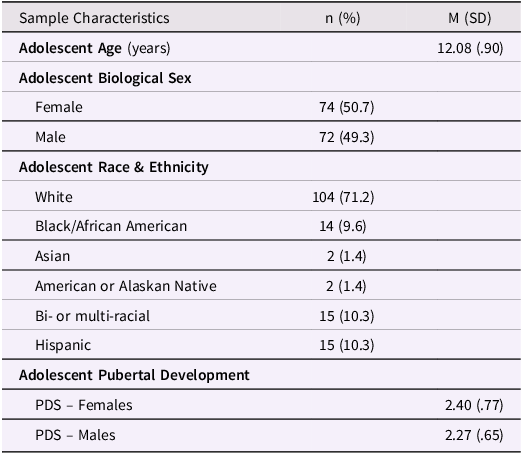
Participants were recruited from Delaware and surrounding areas. Inclusion criteria were: fluency in English, age 11–13 for females, and age 12–14 for males. The difference in ages by sex was due to the fact that females tend to enter puberty earlier than males (Brix et al., Reference Brix, Ernst, Lauridsen, Parner, Støvring, Olsen and Ramlau-Hansen2019; Tanner, Reference Tanner1962), and changes in affective circuitry have been linked to pubertal processes (Blakemore et al., Reference Blakemore, Burnett and Dahl2010; Ladouceur, Reference Ladouceur2012; Peper & Dahl, Reference Peper and Dahl2013). Thus, equating across biological sexes by approximate pubertal stage (vs. age) is more likely to equate the groups on the processes of interest. Exclusion criteria were: major medical or neurological illness, current psychosis, and/or any MRI contraindication (e.g., metal in body). Use of the Pubertal Development Scale (PDS; Petersen et al., Reference Petersen, Crockett, Richards and Boxer1988) confirmed that the mean scores (see Table 1) for both boys and girls fell within the Prepubertal stage of development.
Sample demographic information

Note. N = 146; Data on race and ethnicity was missing for 9 (6.2%) and 7 (4.8%) participants, respectively; PDS = Pubertal Development Scale.
A total of 172 participants completed the functional Magnetic Resonance Imaging (fMRI) task and self-report measures. However, 26 participants were excluded following QA procedures (e.g., excessive motion, less than 3 usable runs). Our final sample for the present analyses consisted of 146 adolescents (M/SDage = 12.08/.90; 50.7% female). Approximately 71% of the sample was White, 10% Black or African American, 1.4% Asian, 1.4% American Indian or Alaska Native, and 10% bi- or multi-racial, with approximately 10% of the sample identifying as Hispanic. Data on race and ethnicity were missing for 9 (6.2%) and 7 participants (4.8%), respectively. Approximately 4% (n = 6) of adolescents were taking psychotropic medications and 18.5% (n = 27) had previously received therapy for anxiety, as reported by their caregiver. Data on psychotropic medication and therapy engagement were missing for 7 participants (4.8%). Parents (M/SDage = 41.95/6.52) were approximately 98% biological mothers. Parent educational attainment was as follows: 3.7% <12th grade, 20% High School/GED, 11.9% Associate’s degree, 35.6% Bachelor’s degree, 21.5% Master’s degree, 7.4% Doctorate or professional degree. Reported annual family household income was as follows: 1.5% <$5,000, 1.5% $5,000-9,999, 5.2% $16,000-24,999, 4.4% $25,000-34,999, 8.9% $35,000-49,999, 19.3% $50,000-74,999, 14.8% $75,000-99,999, 31.9% $100,000-149,000, 10.4% $150,000-299,000, 0.7% >$300,000. Household income data was missing or reported as “I do not know” for 2 (1.5%) families. Informed consent/assent was obtained for all participants and the University’s Institutional Review Board approved all study protocols and procedures.
Self-report measures
The 18-item Anxiety Sensitivity Index (ASI; Taylor et al., Reference Taylor, Zvolensky, Cox, Deacon, Heimberg, Ledley, Abramowitz, Holaway, Sandin, Stewart, Coles, Eng, Daly, Arrindell, Bouvard and Cardenas2007) was administered to parents to assess their fear of arousal-related sensations (e.g., “When I have trouble thinking clearly, I worry that there is something wrong with me”). Participants were asked to rate the extent to which they agreed with each item from 0 (“Very little”) to 4 (“Very much”). Items were summed to create total scores (M/SD = 16.84/12.16). This continuous total score variable was used in all analyses.
The 18-item Childhood Anxiety Sensitivity Index (CASI; Silverman et al., Reference Silverman, Fleisig, Rabian and Peterson1991) was administered to adolescents to assess their fear of arousal-related sensations (e.g., “It scares me when I have trouble getting my breath”). Participants were asked to rate the extent to which they agreed with each item from 1 (“None”) to 3 (“A lot”). Items were summed to create total scores (M/SD = 28.41/6.92). This continuous total score variable was used in all analyses.
fMRI task
During fMRI data collection, adolescents completed a well-validated emotion regulation task (Peirce, Reference Peirce2007; Silvers et al., Reference Silvers, McRae, Gabrieli, Gross, Remy and Ochsner2012, Reference Silvers, Insel, Powers, Franz, Helion, Martin and Ochsner2017). The task was an adapted version of the Cognitive Reappraisal task described in Silvers et al. (Reference Silvers, Insel, Powers, Franz, Helion, Martin and Ochsner2017). The first modification of our task was that we opted to remove the ‘Look’ condition. The second modification was that our task utilized a 4-point scale to assess negative affect, whereas the original task used a 5-point scale. In the task, adolescents were presented with negative and neutral social images and participants were instructed to either embrace their natural responses (react condition) or to engage in cognitive reappraisal via distancing (regulate condition). Task instructions were provided prior to entering the scanner, including brief training in reappraisal and a practice administration (detailed task instructions and sample images are included in Supplementary Materials Appendix A). See Silvers and colleagues (2017) for additional task-related information and details (A visual depiction of the task can be found in Supplementary Figure S1).
Adolescents completed three runs of the task within the scanner, amounting to a total run time of 15 minutes. Each run consisted of 20 trials. Across all three runs, adolescents were presented with a total of 30 neutral and 30 negative images. For each trial, a cue was presented for 2 s instructing participants whether to regulate or react during that trial, after which an image was presented for 8 s. Fixation crosses of variable duration were presented after the picture presentation and rating (when applicable). Trial order and fixation duration were created using a pseudo-genetic algorithm to optimize the separability of effects (Lake et al., Reference Lake, Spielberg, Infantolino, Crocker, Yee, Heller and Miller2019). PsychoPy was used to run the present task when adolescents were in the scanner (Peirce, Reference Peirce2007).
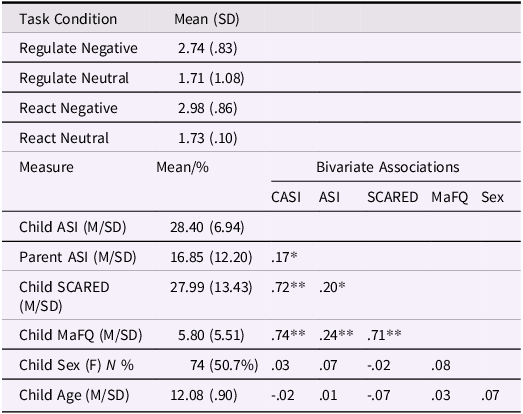
Following some trials, participants were asked to rate how bad they were feeling using a 4-point Likert scale from 1 “Not bad all” to 4 “Very bad.” Descriptive statistics of mean negative affect ratings for each condition (e.g., regulate negative, regulate neutral, react negative, react neutral) are provided in Table 2. Affect ratings are mean scores averaged across all three task runs.
Descriptive statistics and bivariate associations

Note. N = 146; Sex: Male = 1, Female = 2; ASI = Anxiety Sensitivity Index; CASI = Child ASI; SCARED = Screen for Child Anxiety Related Disorders (Birmaher et al., Reference Birmaher, Khetarpal, Brent, Cully, Balach, Kaufman and Neer1997); MaFQ = Mood and Feelings Questionnaire – Short Form (Messer et al., Reference Messer, Angold, Costello, Loeber, Van Kammen and Stouthamer-Loeber1995); *p < .05, **p < .001.
MRI acquisition and preprocessing
Data were collected via a Siemens 3T Magnetom Prisma scanner with a 64-channel head coil. Acquisition parameters were consistent with those used in the Human Connectome Project (HCP) (Van Essen et al., Reference Van Essen, Ugurbil, Auerbach, Barch, Behrens and Bucholz2012) and Adolescent Brain Cognitive Development Study (Hagler et al., Reference Hagler, Hatton, Cornejo, Makowski, Fair, Dick, Sutherland, Casey, Barch, Harms, Watts, Bjork, Garavan, Hilmer, Pung, Sicat, Kuperman, Bartsch, Xue and Dale2019). fMRI: 3 runs of multi-band EPI with a MB factor of 8 (TR = .829s, spatial resolution = 2 mm isotropic, TE = 40 ms). For all participants, the 1st and 3rd runs were collected with anterior→posterior (AP) phase encoding. For 55 participants (37.4%), the 2nd run only was collected with posterior→anterior (PA) phase encoding. The change to all runs being AP was made when we observed that, for some participants, regions of susceptibility (e.g., in orbitofrontal cortex) differed for AP and PA runs, such that moderately sized regions were excluded when only using voxels that contained data across all three runs (see below for the method employed to compensate for this issue). T1: Volume-navigated multi-echo MPRAGE (VNAV-T1) (.8 mm isotropic, TI = 1000 ms, TR = 2500 ms, TEs = 1.8 ms, 3.6 ms, 5.39 ms, 7.18 ms). Using FSL (Jenkinson et al., Reference Jenkinson, Beckmann, Behrens, Woolrich and Smith2012) and ANTS (Avants et al., Reference Avants, Tustison, Song, Cook, Klein and Gee2011), fMRI data were motion and fieldmap corrected, spatially smoothed (FWHM = 5 mm), and registered to each participant’s T1 via boundary-based registration. Next, ICA-AROMA was used to estimate and remove remaining motion-related variance. Because ICA-AROMA uses masks that are in the same space as the MNI152 template that comes standard with FSL, we computed non-linear registrations of the T1s to that template via ANTS, which were used within ICA-AROMA. However, component removal occurs in functional space (Pruim et al., Reference Pruim, Mennes, van Rooij, Llera, Buitelaar and Beckmann2015), and thus the fMRI data remained in functional space. Finally, fMRI data were temporally high-pass filtered and intensity-normalized.
A number of quality control steps were performed during preprocessing, including visual inspection of the accuracy of all brain extractions (e.g., T1, fieldmap magnitude image), fMRI fieldmap corrections, and all registrations, and remediative action was taken when necessary. Furthermore, to ensure that ICA-AROMA successfully removed all visible motion related variance, we computed DVARS on the timeseries after motion components had been removed and flagged any runs in which more than five volumes had a DVARS value that deviated by ≥ .5. Flagged runs were visually inspected for remaining motion-related variance and, if found, we examined the ICA components not identified by ICA-AROMA. Components that appeared motion-related were added to ICA-AROMA’s original list and component removal was redone on the original data, after which the DVARS process described above was redone to determine if sufficient motion-related variance was removed.
Next, the fMRI timeseries for each run were regressed on predictors modeling (i) the cue period (two predictors, modeling the regulate and react conditions), (ii) the image period (four predictors, modeling regulate negative, regulate neutral, react negative, react neutral), and (iii) the rating period (one predictor), all of which were convolved with a gamma function to account for the hemodynamic response. Contrasts of the beta maps for the image period predictors were created to model the three effects of interest: stimulus valence (negative vs. neutral, across regulation levels), regulation condition (regulate vs. react, across valence levels), and the valence X regulation interaction (regulate vs. react for negative stimuli contrasted against regulate vs. react for neutral).
For use in group-level analyses, we computed non-linear ANTS registrations to a more recent version of the MNI152 template, which we herein refer to as the MNI2009a template. This template was created by the same group and using the same data as FSL’s standard template, but with improved methodology, creating a more robust template. After transforming the contrast beta maps (for each run) to MNI2009a space, within-participant second-level fixed-effects analyses were computed to estimate average effects for each contrast across the three runs. This was carried out after the transformation to MNI2009a space, rather than in each participant’s anatomical space, because the results are mathematically equivalent, with one exception. Specifically, error is added each time a transformation is applied, and thus less error is introduced by concatenating the functional→anatomical and anatomical→MNI2009a transformations, creating a single functional→MNI2009a transformation.
As mentioned above, moderately sized regions would be excluded in those participants with a PA 2nd run if we retained only those voxels that were present across all three runs, due to the presence of non-overlapping regions of susceptibility across AP and PA runs. However, at least two runs of data were available for a large percentage of the voxels in the areas that would be excluded. Thus, we developed a procedure to dually optimize the reliability of the beta estimates (i.e., by averaging across as many runs as possible) and spatial coverage (i.e., by including voxels even if one of the runs did not contain usable data). Details on this procedure are included in Supplementary Materials Appendix B.
Group analyses
Outliers ( > three standard deviations) on key study variables (e.g., ASI, CASI, betas for each fMRI contrast across participants, for each voxel) were identified and reigned in using the median absolute deviation (from the median) as our estimate of standard deviation (Hampel, Reference Hampel2001) (for more detail, see Supplementary Materials Appendix B). With the exception of amygdala (see below), between-participant third-level analyses were carried out using FSL’s RANDOMISE (Winkler et al., Reference Winkler, Ridgway, Webster, Smith and Nichols2014). Threshold-free cluster enhancement (Smith & Nichols, Reference Smith and Nichols2009) was used to avoid selecting a cluster-defining threshold, while retaining the advantages of the information gained from the spatial structure. The predictor of interest was parent ASI (a continuous variable), and covariates of no interest were adolescents’ sex assigned at birth, handedness, age at scanning, CASI, and a variable that specified whether a PA run was included (vs. all AP runs). Adolescent CASI scores were used as a covariate to isolate the unique effects of parent ASI on emotion regulation-related neural mechanisms.
A sample-specific mask was constructed that limited the voxels under consideration to PFC gray matter. First, a sample-specific gray matter mask was constructed by using FSL’s FAST to segment each participant’s T1 (which had already been transformed into MNI2009a standard space), after which the estimated gray matter masks were binarized and the mean (across the sample) for each voxel was computed, resulting in a sample-specific probabilistic gray matter mask (in MNI2009a space). This mask was thresholded at .5 to ensure that a majority of participants had gray matter in a given voxel, while maintaining room for minor registration variability. To limit the voxels under consideration to PFC, a PFC mask was created using a digitized version of the Brodmann atlas (Pijnenburg et al., Reference Pijnenburg, Scholtens, Ardesch, de Lange, Wei and van den Heuvel2021). Specifically, the masks for Brodmann Areas 8, 9, 10, 11, 24, 25, 32, 33, 44, 45, 46, & 47 were merged to create a single PFC mask. Because the Brodmann atlas is rather conservative in the extent of each ROI, this PFC mask was dilated by two voxels using fslmaths to ensure that no sample specific gray matter within PFC was excluded. Finally, the probabilistic gray matter mask was multiplied by the PFC mask, creating a sample-specific PFC gray matter mask.
Although RANDOMISE corrects for multiple comparisons at a voxel (vs. cluster) level, description of the findings at the voxel level would be overly cumbersome (voxelwise maps will be available on the author’s website https://sites.udel.edu/jmsp/tools_data/). In order to convey the findings in a more interpretable manner, we followed the recommendations on FSL’s website. Specifically, we identified spatially contiguous clusters using FSL’s “cluster” command, with no correction for multiple comparisons applied at this stage (as this had already been done in RANDOMISE) (Jenkinson et al., Reference Jenkinson, Beckmann, Behrens, Woolrich and Smith2012). To probe significant interactions, we extracted the mean beta across each identified cluster for the relevant individual conditions and used partial correlations to examine lower-level relationships (i.e., correlations within the regulation factor) in SPSS (V.28; IBM, 2021).
Given that the susceptibility of amygdala to image artifacts will differ spatially across individuals, large portions of amygdala may be excluded when examining only those voxels that are present across all participants, as is done in RANDOMISE. However, the majority of the amygdala was present for each participant individually. To retain this variance, we computed participant-specific amygdala masks by segmenting each participant’s T1 via FSL’s FIRST tool. The individualized left and right amygdala masks were used to extract the mean beta across all voxels present in a given (left or right amygdala) mask, separately for each task condition. These values were entered into repeated-measures GLMs in SPSS with two repeated factors (regulation and stimulus valence) and the same predictors used in the RANDOMISE analyses.
Results
Descriptive statistics and bivariate correlations
Descriptive statistics and bivariate correlations of key study variables are provided in Table 2. Sample distributions of adolescent and parent anxiety sensitivity scores can be found in Supplementary Figures S2–3.
Manipulation check of task conditions
There was a significant main effect of valence (F = 152.84, p < .001), such that adolescents reported greater negative mood after viewing negative (M = 2.87, SD = 0.81) vs. neutral stimuli (M = 1.70, SD = 1.01). In addition, there was a significant main effect of regulation (F = 19.08, p < .001), such that adolescents reported greater negative mood in the react condition (M = 2.35, SD = 0.76) vs. the regulate condition (M = 2.23, SD = 0.83). We also observed a significant 2-way interaction (i.e., valence X regulation). Paired t-tests were used to examine the average difference in self-reported mood ratings during regulate vs. react conditions within each valence condition separately (i.e., negative and neutral). There was a significant mean difference across regulation conditions within negative (t = −5.25, p < .001), such that adolescents reported greater negative mood during react conditions (M = 2.99, SD = 0.86) than regulate conditions (M = 2.74, SD = 0.84). Consistent with previous studies (Silvers et al., Reference Silvers, McRae, Gabrieli, Gross, Remy and Ochsner2012, Reference Silvers, Insel, Powers, Franz, Helion, Martin and Ochsner2017), this suggests that adolescents effectively employed the cognitive reappraisal strategy to decrease the impact of negative stimuli on their negative affect. As expected, there was not a significant difference across regulate conditions within neutral (react: M = 1.00, SD = .09; regulate: M = 1.71, SD = 1.08; t = −0.43, p < .668). Together, these results suggest that the negative stimuli altered participants’ mood, and employing cognitive reappraisal significantly reduced participants’ negative mood.
Parent anxiety sensitivity X valence X regulation interaction
No voxels survived correction for multiple comparisons when examining the effect of Parent Anxiety Sensitivity on the Valence X Regulation Interaction within the PFC mask (p-values ranged from .38 to .50).
Parent anxiety sensitivity x valence interaction
No voxels survived correction for multiple comparisons on the Parent Anxiety Sensitivity X Valence Interaction within the PFC mask (p-values ranged from .55 to .75).
Parent anxiety sensitivity x regulation interaction
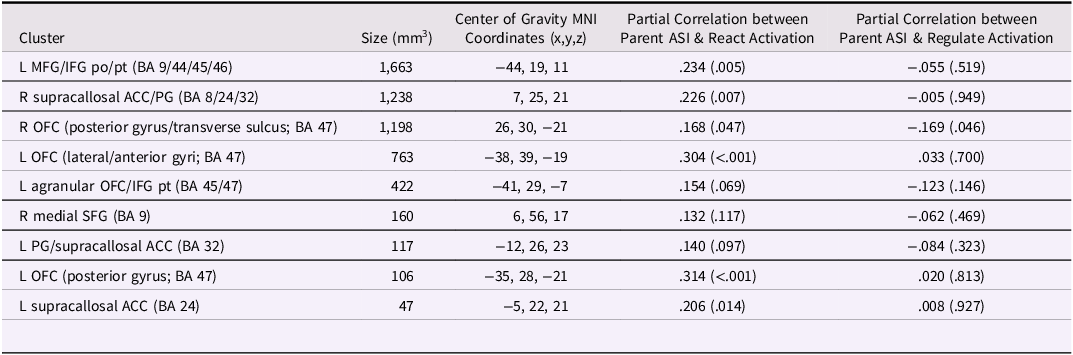
Voxelwise analyses revealed significant 2-way interactions between parent ASI and the regulation factor (e.g., regulate vs. react) in several regions (Table 3; Figure 1). Results identified 11 clusters, two of which were not examined further due to their small size (< 35 voxels; one 33 voxel cluster located in the right transverse gyrus of the orbitofrontal cortex [BA 47], one 34 voxel cluster located in right paracingulate [BA 9]). Interactions were probed by first extracting the mean beta across each cluster separately for each participant and condition, and second computing partial correlations between parent ASI and fMRI activation within each level of the regulation factor. The same covariates of no interest that were used in the initial model were partialled out. Several clusters evidenced the same pattern of simple slopes, and thus we present only one scatterplot for each pattern (remaining scatterplots are in Supplementary Materials).
Clusters showing a 2-way interaction between parent Anxiety Sensitivity Index and the regulation contrast. Note. R = Right; Clusters are shown in descending order of size. (A) Left middle frontal gyrus/inferior frontal gyrus (lime green), (B) Right supracallosal anterior cingulate/paracingulate (magenta), (C) Right orbitofrontal cortex (peach), (D) Left orbitofrontal cortex (teal), (E) Left agranular orbitofrontal cortex/inferior frontal gyrus (red), (F) Right medial superior frontal gyrus (yellow), (G) Left paracingulate/supracallosal anterior cingulate (green), (H) Left orbitofrontal cortex (pink), (I) Left supracallosal anterior cingulate (orange).

Regions in which parental Anxiety Sensitivity Index scores interacted with the Regulate vs. React task comparison

Note. Values in the last two columns reflect partial correlations and associated p-values (in parentheses); ASI = Anxiety Sensitivity Index; L = Left; R = Right; BA = Brodmann Area; SFG = superior frontal gyrus; MFG = middle frontal gyrus; IFG = inferior frontal gyrus; po = pars opercularis; pt = pars triangularis; PG = paracingulate gyrus; ACC = anterior cingulate cortex; FP = frontal pole; OFC = orbitofrontal cortex.
Probing the interactions revealed significant positive partial correlations between parent ASI and activation during react trials, but no significant relationships during regulate (see Figure 2 scatterplot), in the clusters in (i) left middle (MFG)/inferior frontal gyri (IFG) pars opercularis and triangularis (BA 9/44/45/46), (ii) right supracallosal anterior cingulate cortex (ACC)/paracingulate gyrus (PG) (BA 8/24/32), (iii) lateral and anterior gyri of left orbitofrontal cortex (OFC) (BA 47), (iv) posterior gyrus of left OFC (BA 47), and (v) left supracallosal ACC (BA 24). The partial correlations between parent ASI and activation in the clusters in (i) left agranular OFC/IFG pars triangularis (BA 45/47), (ii) right medial superior frontal gyrus (SFG) (BA 9), and (iii) left PG/supracallosal ACC (BA 32) were not significant in either condition (Figure 3). The partial correlations between parent ASI and activation in the cluster located in the right posterior gyrus/transverse sulcus of OFC (BA 47) were significant for both conditions (positive for react, negative for regulate) (Figure 4). Region of interest analyses in amygdala were not significant.
Condition-specific relationships between parent anxiety sensitivity and activation in the cluster in right supracallosal anterior cingulate/paracingulate. Note. Before plotting, variables were residualized with respect to child sex assigned at birth, handedness, age at scanning, and adolescent anxiety sensitivity, along with whether the phase-encode direction was consistent across runs. Residualized parent anxiety sensitivity was positively associated with residualized activation during react demands (thicker blue line), but not during regulate demands (red line). Similar patterns of simple slopes were observed for the cluster in left middle/inferior frontal gyrus and two clusters in left orbitofrontal cortex.

Condition-specific relationships between parent anxiety sensitivity and activation in the cluster in left agranular orbitofrontal cortex/inferior frontal gyrus activation Note. OFC = orbitofrontal cortex; IFG = inferior frontal gyrus. The partial correlation between parental anxiety sensitivity and activation in left agranular OFC/IFG was not significant for either condition. A similar pattern of simple slopes was observed for the clusters in right medial superior frontal gyrus and left paracingulate/anterior cingulate.

Condition-specific relationships between parent anxiety sensitivity and activation in the cluster in right orbitofrontal cortex activation. Note. OFC = orbitofrontal cortex. The partial correlation between parental anxiety sensitivity and activation in the right OFC was significantly different from zero during both conditions.

In order to determine whether the removal of CASI-related variance was driving any of the effects, RANDOMISE was rerun without the inclusion of CASI as a covariate (see Supplementary Materials Appendix C). Although there were differences with regard to specific voxels, all regions identified in the main analyses were also significant when CASI was not excluded, indicating that including CASI as a covariate did not remove any substantive variance from parent ASI. We also reran all follow-up analyses without CASI included, and all associations remained significant, with the exception of right OFC during the regulate condition, which became p = .059 (see Supplementary Table S1 and Figure S4).
Discussion
The goal of the present study was to advance our understanding of the mechanisms by which anxiety-related parent factors influence adolescent emotion regulation. We examined the relationship between parent levels of a key transdiagnostic factor, anxiety sensitivity (AS), and brain activation in their adolescents while these youth performed an explicit emotion regulation task. Specifically, adolescents viewed negative- or neutrally-valenced stimuli and were asked to either react (i.e., allow themselves to embrace any emotions that the stimuli evoked) or regulate their affective response (via distancing). We found that parent AS was related to regulation-related differences in adolescent activation in several region, including the superior (SFG), middle (MFG), and inferior (IFG) frontal gyri, supracallosal anterior cingulate cortex (scACC), paracingulate gyrus (PG), and orbitofrontal cortex (OFC). Contrary to our hypotheses, these effects were largely driven by differences in brain activation when adolescents were asked to embrace their emotional reaction(s) and were independent of stimulus valence. The lack of a significant effect of stimulus valence on neural activation was surprising, however, previous work suggests that individuals with higher AS may be more likely to negatively evaluate potentially ambiguous stimuli as threatening (Lilley & Cobham, Reference Lilley and Cobham2005). In line with this work, results from the present study suggest that youth of parents with higher AS may interpret negative and neutral stimuli similarly.
Notably, the present findings were observed whether or not adolescent AS was partialed out, and thus are not driven by either adolescent AS or the removal of such variance. These results highlight that parental characteristics (e.g., AS) are associated with adolescent emotion regulation-related neural activation, over and above adolescents’ own anxiety sensitivity. Together, present findings suggest that at-risk adolescents (i.e., adolescents of parents with greater AS) show disturbances in the circuitry supporting the regulation of emotion, which may in turn increase the risk for developing future internalizing pathology.
Given that these regions were identified via the use of parent AS, rather than the adolescent’s own AS, there are multiple ways that our findings can be interpreted. For example, our findings may represent latent vulnerabilities for the later development of AS in youth. If so, this could be driven by shared genetic variance, given the established heritability of AS (Stein et al., Reference Stein, Jang and Livesley1999), and/or the impact of children modeling their affective responses on what they observe in their higher AS parent(s) (Morris et al., Reference Morris, Criss, Silk and Houltberg2017). Another interpretation is that at-risk youth may adapt to their environment in ways that support their ability to effectively manage their parents’ heightened sensitivity, and our findings may reflect such adaptation. These potential interpretations and results are consistent with previous work showing parent emotion socialization has downstream effects on neural mechanisms of emotion regulation in youth (Cosgrove et al., Reference Cosgrove, Kerr, Ratliff, Moore, Misaki, DeVille and Morris2020). Below, we discuss these possibilities in the context of the specific brain regions involved and the condition-dependent patterns observed.
Interactions driven by the react condition
As illustrated in Figure 2, there was a significant positive association between parent AS and activation during the react condition, whereas the slope was relatively flat during regulate, in clusters located in left dorsolateral prefrontal cortex (dlPFC), bilateral scACC, and left OFC. When asked to embrace their emotional reactions to the stimuli, adolescents with higher-AS parents recruited these regions to a greater extent than those with lower-AS parents. Previous work has established associations between the regions of dlPFC observed herein and processes crucial for maintaining goals, including attention and working memory (Cieslik et al., Reference Cieslik, Seidler, Laird, Fox and Eickhoff2016). Moreover, scACC activation is implicated in top-down attentional control in adolescents (Hwang et al., Reference Hwang, Ghuman, Manoach, Jones and Luna2014) and these regions of OFC are associated with determining the value of stimuli relative to one’s current state (Thomas et al., Reference Thomas, Higgs, Dourish, Hansen, Harmer and McCabe2015). Activation of this combination of regions may reflect top-down evaluation of the relevance and value of the observed stimuli. Thus, our findings could indicate that having a higher-AS parent is linked to the direction of attention to, and the subsequent valuation of, environmental stimuli. Given that individuals with higher AS attend and react to stimuli that elicit anxiety-related sensations, the children of such individuals likely observe this heightened reactivity in their parents and may interpret it as a social signal of potential danger. Subsequently, these children may model this behavior, exhibiting greater attention to the motivational value of their surroundings, which is consistent with the observed pattern of brain activation. This interpretation is further supported by work showing that parents play a key role in their children’s fear and emotional learning and neurodevelopment (Silvers et al., Reference Silvers, Callaghan, VanTieghem, Choy, O'Sullivan and Tottenham2021). Together, our findings extend the current literature highlighting intergenerational transmission of anxiety-related risk factors through youth neurodevelopment (Silvers et al., Reference Silvers, Callaghan, VanTieghem, Choy, O'Sullivan and Tottenham2021; Baartmans et al., Reference Baartmans, van Steensel, Kossakowski, Klein and Bögels2024).
An alternative interpretation suggests that parents with higher AS may attempt to engage in regulation strategies, such as suppression, in response to their natural affective reactivity (Kashdan et al., Reference Kashdan, Zvolensky and McLeish2008). In turn, adolescents of these parents may also be engaging in more automatic forms of emotion regulation (e.g., suppression) when told to embrace their natural affective responses, evidenced by greater neural activation during react trials. Unfortunately, no qualitative data was collected regarding how adolescents responded during the react condition, and this is an important future area of research.
The fact that associations with parent AS were near zero during the regulate condition may indicate that adolescents with higher AS parents have a typical range of modulatory capacity when explicitly asked to do so. However, they may be less likely to engage in such control, given that they observe their parents failing to do so. In other words, the influence of parent AS on adolescent emotion regulation does not appear to be via their regulatory capacity, but potentially on the likelihood that they engage such control. This is a potentially crucial finding, because it suggests that, if these adolescents are taught to engage in explicit regulation with greater frequency, they are likely to be just as successful as their peers. In turn, this may reduce the intergenerational transfer of anxiogenic factors such as AS.
Interaction driven by both react and regulate conditions
Parent AS was significantly associated with activation in the posterior gyrus and transverse sulcus of right OFC during both the react and regulate conditions (Figure 4). Similar to the clusters discussed in the previous section, adolescents with higher-AS parents recruited this region to a greater extent than those with low-AS parents when asked to embrace their emotional response. Importantly, adolescents with higher-AS parents also evidenced weaker recruitment of this region when explicitly asked to regulate their affect, relative to those with low-AS parents. In fact, this was the only cluster in which a significant relationship with parent AS was found for the regulate condition, and the only cluster that was moderated by parent AS in both conditions. Thus, this region could play a unique role in the intergenerational influence of parent AS.
Similar to the regions of left OFC discussed above, this area of right OFC is implicated in the assessment and evaluation of environmental stimuli (Thomas et al., Reference Thomas, Higgs, Dourish, Hansen, Harmer and McCabe2015). Consistent with our interpretation above, this finding in the react condition suggests that adolescents with higher-AS parents appear to be engaging in valuation of stimuli to a greater extent than their peers. However, the question remains as to why adolescents with higher-AS parents would evidence weaker recruitment of this region when asked to explicitly regulate their affect. One interpretation is that this reflects effective down-regulation of their initial heightened reactivity. A critique of this interpretation stems from the fact that, if suppression of this region is needed for regulation, why is such suppression not observed in adolescents with low-AS parents? The answer to this critique is that hyperactivation of this region during react is observed only in those with higher-AS parents, and thus suppression of this activity is not needed by those with low-AS parents.
A pattern of slopes similar to that observed in right OFC was evident in clusters in left agranular OFC/IFG pars triangularis, left paracingulate/supracallosal ACC, and right medial SFG. However, parent AS was not significantly associated with activation in these clusters in either react or regulate. Therefore, although it is possible that inferences similar to that discussed above for right OFC also apply to these regions, at this point we cannot do so given the lack of significant evidence.
Clinical implications
Findings from the present study suggest potential targets for clinical interventions. As noted above, adolescents of parents with higher AS may actually be able to effectively engage in emotion regulation when explicitly told to do so. Considering this possibility suggests it may be a particularly fruitful treatment target to coach adolescents on when to engage in emotion regulation as opposed to how to engage in such regulation in the face of salient stimuli. Our results also underscore the important role that parent functioning has on adolescent emotion regulation, and potential downstream effects on the onset and maintenance of internalizing disorders. Parents’ own AS may be a critical intervention target, and changes may have an impact on effective emotion regulation in their children. Indeed, parent anxiety management (plus child-focused cognitive-behavioral therapy) has proven to be an effective treatment for decreasing future internalizing in children (Cobham et al., Reference Cobham, Dadds and Spence1998, Reference Cobham, Dadds, Spence and McDermott2010).
Strengths and limitations
The present study has several key strengths. First, the sample size is relatively large for a community developmental imaging study (N = 146). Second, the present study utilized an explicit emotion regulation task, rather than many previous studies wherein they presented affectively valenced stimuli and assumed that regulation was occurring (or failing to). Our paradigm allows us to disentangle valence-related reactivity from regulation-related engagement. Third, examining the influence of parent characteristics on youth emotion regulation is an essential step for the field, given the strong relationships between parent and child functioning. Indeed, this work may lead to a translational impact on the overall family climate, parenting practices, and youth emotional socialization. Finally, the examination of a transdiagnostic dimension (as opposed to diagnostic group differences) promotes the generalizability and utility of the present findings, as many individuals experience significant distress and impairment related to internalizing symptoms without reaching full diagnostic criteria.
Several limitations must be considered when interpreting the present results. Although the sample size is relatively large, it is predominately white and non-Hispanic, making the generalizability of the findings to other sociodemographic groups less clear. Cross-sectional analysis was used, limiting our ability to identify potential causal or temporal mechanisms in the relationship between parent anxiety sensitivity and child emotion regulation. Indeed, it remains unclear when the impact of parent AS on childrens’ emotion regulation occurs. Not a limitation, per se, but it should be noted that approximately 18% of the adolescent participants had previously received therapy for anxiety and this engagement may have impacted adolescents’ anxiety sensitivity and associated study findings. Finally, the parent sample predominantly consisted of biological mothers, limiting our ability to understand the role that biological fathers or other primary caregivers may play in childrens’ emotion regulation development.
Future directions
Future work examining the relationship between parent AS or parenting styles, such as parental warmth or harshness, is an important next step to further understand the role of parents on their childrens’ development of emotion regulatory capabilities. Advancing our understanding of the relationships between parents’ and childrens’ emotion regulation would allow us to parse the impact of both genetic and environmental factors on emotion regulation development. Further, given important development in emotion regulation both earlier and later than our sample ages, future longitudinal research has the potential utility to critically inform etiological models of psychopathology. Implementing longitudinal research would also allow for the exploration of factors (e.g., adolescent emotion regulation) as potential prospective mechanisms of parent-child transmission of internalizing pathology (Perlman et al., Reference Perlman, Lunkenheimer, Panlilio and Pérez-Edgar2022). It is also essential to further examine these relationships at different developmental stages to determine how the impact of parent traits and behaviors may fluctuate across childhood and adolescence. Relatedly, it is important for future work to consider the potential role of pubertal development (e.g., hormonal changes) on neural and affective processes. While the present study focused on anxiety sensitivity as a key transdiagnostic mechanism of interest, future research should examine the neural substrates of emotion regulation as they relate to internalizing symptoms to further inform etiological models of internalizing disorders. Given that the majority of parents in the present study were biological mothers, more work is needed to explore the relationships between other primary caregivers (e.g., fathers) and adolescent neural mechanisms of emotion regulation. Advanced imaging techniques such as hyperscanning (Nguyen, Hoehl, & Vrticka, Reference Nguyen, Hoehl and Vrtička2021; Nguyen et al., Reference Nguyen, Bánki, Markova, Hoehl, Hunnius and Meyer2020) would provide unique insight into the impact of direct processes, such as modeling, by which risk for anxiety-related pathology may be passed from parents to their children. (Perlman et al., Reference Perlman, Lunkenheimer, Panlilio and Pérez-Edgar2022; Reindl et al., Reference Reindl, Gerloff, Scharke and Konrad2018). Finally, although the utilization of a PFC-specific mask was informed by previous literature, future examination of a whole brain analysis may provide additional insights into emotion regulation-related neural mechanisms related to parental anxiety sensitivity.
Conclusion
In summary, parents’ AS appears to have a crucial impact in the neural mechanisms supporting emotion regulation in their adolescent children. The regions identified herein are implicated in attentional and affective processes. Significant associations between parent AS and adolescents’ emotion-regulation related neural circuitry, above and beyond children’s own AS, suggests that parents’ anxiety sensitivity is a unique risk factor in the development of youth emotion dysregulation. Together, our results have the potential to inform etiological models of emotion regulation and internalizing and suggest parents are a key intervention target or protective factor against emotion dysregulation in adolescence.
Supplementary material
The supplementary material for this article can be found at https://doi.org/10.1017/S0954579425000227.
Acknowledgements
The National Science Foundation; National Institute of General Medical Sciences; National Institute of Mental Health
Funding statement
This work was supported by the National Science Foundation (LDC, grant number 2021317035); the National Institute of General Medical Sciences (JMS, grant number P20GM103653 9030); and the National Institute of Mental Health (JMS, grant number 1R01MH123470).
Competing interests
The authors declare none.



 Open access

