


I. Introduction
Between 1870 and 1890, the U.S. railroad network would more than triple in terms of mileage. This massive burst of construction greatly facilitated the movement of goods and people, bringing in migrants to settle ever westward territories while shipping goods across the United States. Another important part of the American narrative from the latter half of the 1800s was the entry of California into the Union in 1850, spurred by the gold rush that began in 1848. Within a short amount of time, migrants to the area realized that the California climate was ideal for viticulture and established vineyards. Within a short amount of time, California’s advantages in producing wine relative to the rest of the United States became apparent; by 1870, Census of Agriculture data suggested that California was producing the majority of wine made in the United States. The establishment of a domestic wine industry would be the prelude to an eventually globally recognized brand, with California wines being found around the world by the end of the century. This rise of the California wine is reflected in both the surge in production of wine as well as in the exponential growth of wine trade flows.
Despite the clear importance of California in facilitating the growth of a U.S. wine industry capable of exporting to the rest of the world, there is no evidence available for what ports were responsible for the shipping out of U.S. wine for exports, nor for where imported wines from abroad were brought to. This lack of evidence is due in large part to a lack of available data on imports and exports at the port level for wine or indeed any other products. In addition, because of this lack of data, there is little empirical evidence on what role railroads played in bringing American wines to foreign markets (and vice versa) via ports.Footnote 1
I overcome these challenges by digitizing port-level trade flows data for wine from U.S. government publications for the period from 1870 to 1900. I use these data to study whether improved access to wine-growing areas spurred by the expansion of the U.S. railroad network led to changes in wine exports for affected ports. I find that wine access spurred affected ports to export more wine, measured both in value of exports and in gallons. My results suggest that the building of the railroad shrank the costs needed to ship goods to ports, which then led to those ports exporting wine to global markets. In this manner, the railroad can be seen to have played a major role in the eventual establishment of California as a major player in the global wine market.
My paper relates to previous work investigating the determinants of wine trade flows. Most relevant of these works is Ayuda et al. Reference Ayuda, Ferrer-Perez and Pinilla(2020), who estimate gravity models to explore which factors affected wine exports and imports from 1848 to 1938. Puga et al. Reference Puga, Sharafeyeva and Anderson(2022) estimate gravity models for wine trade flows from 1962 to 2019, particularly with a focus to studying wine trade between countries with varying degrees of winegrape variety similarity. Bouet et al. Reference Bouet, Emlinger and Lamani(2017) analyze the determinants of Cognac trade flows. Like these works, my paper in part aims to understand the determinants of wine imports and exports. My paper adds to this existing work by introducing a spatial, within-country component to these trade flows. I also digitize historical wine trade flows data to address this question, and focus on a historical period during which the United States massively ramped up its wine exports and California wines in particular became increasingly well known globally.
My paper also contributes to work that has studied the effects of the U.S. railroad expansion in the 1800s and to the effects of railroads more generally. Fogel Reference Fogel(1964), in his seminal work, focused on the role of rail in shipping agricultural goods and argued that railroads did not play as large a role in building the United States as some had thought previously, using a social savings approach; his argument, in summary, was that the increase in transport costs from a hypothetical removal of the entire railroad network would be small, and smaller still if other transport technologies were able to expand coverage to take up some of the slack. Donaldson and Hornbeck Reference Donaldson and Hornbeck(2016) revisit the same question using an updated approach, instead concluding that the expansion of the railroad network had large effects on agricultural land values. Much other work has studied the effects of railroads in the United States. Atack et al. Reference Atack, Bateman, Haines and Margo(2010) show that railroad expansion in the U.S. Midwest during the mid-1800s had a large, positive effect on urbanization. Chan Reference Chan(2024) finds, using linked U.S. Census data to track individuals over their lifetimes, that positive shocks to market access brought about by the expansion of the railroad network had significant effects on later-life outcomes for affected children. Other works on the effects of railroads’ effects on U.S. outcomes in the 19th and early 20th century include Fishlow (Reference Fishlow1965); Hodgson (Reference Hodgson2018), and Atack Reference Atack(2013). In the context of 1800s Sweden, Berger Reference Berger(2019) finds that railroads had a stimulating effect on rural industrialization. Similar to these works, my paper uses variation in railroad expansions as a natural experiment. In contrast to this past work, however, I instead focus on the effects of railroad-induced market access changes on ports’ propensity to export or import wine, which has remained an unstudied topic to the best of my knowledge.
II. Background
Wine production in the United States had occurred to varying degrees even before independence. Arguably the most important development in the U.S. wine industry, however, was the acquisition of California and its entry into the Union. Shortly after its acquisition by the United States, gold was discovered in California, which greatly sped its entry into the Union as a full state in 1850. Its entry into the Union, coupled with the excitement over the discovery of gold, led to large influxes of migrants into California. This large influx has been credited in part with the development of the Californian wine industry. A PBS article on the history of the U.S. wine industry (PBS, 2017), for example, stated that the male-heavy gender ratio of the new migrants, the foreign background of these migrants (which generally was more wine-friendly), and a realization that California’s climate was ideal for vineyards led to a rapid development of the California wine sector. Initially developed to satisfy local demand for wine, by 1870, California was producing almost 60% of all wine in the United States.Footnote 2 This rapid rise and subsequent dominance of California in U.S. wine production have persisted to the modern era, with California accounting for 80% of U.S. wine production in 2023.Footnote 3
Against the remarkable growth of California as a wine supplier for the United States and eventually the world, American wine consumption on a per capita basis stayed surprisingly stable from 1870 to 1900. Data from the Annual Database of Wine Markets by Anderson and Pinilla Reference Anderson and Pinilla(2024) show that per capita wine consumption started and ended the period at 1.5 L per person, although it did peak at 1.8 L per person in 1879–1881. The evidence from the Annual Database of Wine Markets clearly demonstrates that wine consumption was not dramatically increasing during the late 19th century.
The narrative of the U.S. railroad network’s development in the 1800s is also one of rapid growth. In the 1820s, some of the very first commercial rail lines began to be constructed in the Northeast. Initially, much railroad construction was focused in this part of the United States, connecting many of the major population centers at the time. The South, on the other hand, began similarly developing railroads to help shuttle agricultural goods such as cotton from rural areas to ports, where they would then be shipped to global markets. Because of this different objective in the South, coupled with the fact that the tracks laid in this region were incompatible with those laid in other parts of the country, growth in mileage was stymied.
One of the most valuable uses of the railroad, however, came in its ability to connect the eastern portions of the United States with its ever-expanding territory west of the Mississippi River. In particular, with the addition of California as a new state in 1850, the desire to construct a transcontinental railroad became larger. Such a railroad was finally completed in 1869, fully connecting New York to San Francisco and shortening by orders of magnitude the travel time needed to go from coast to coast. The expansion of the network was not finished with the completion of a transcontinental line, however. Between 1870 and 1890, the mileage of track in the United States more than tripled.Footnote 4 One reason for the rapidity of growth in mileage was that railroad expansion driven by competition between so-called railroad tycoons.Footnote 5 While the practices of these businessmen were often morally indefensible, one outcome of the ever-escalating competition between these tycoons is that the railroad network was very quickly expanded across the country.Footnote 6 Much of this new track served to further increase the density of the network throughout the country. Although track density was the most apparent in the Northeast, this larger network was also particularly useful in reducing freight costs for shipping goods to and from the Midwest and the West, increasing those regions’ access to large domestic markets such as the cities on the eastern seaboard.
III. Data and methodology
A. Data
All variables denoted in dollar values are converted to 1890 USD using the GDP deflator from Johnston and Williamson Reference Johnston and Williamson(2022). For summary statistics of the variables used in the regression analysis, see Table 1.
Summary statistics

Notes: Summary statistics calculated on estimation sample of customs districts only. asinh() refers to the inverse hyperbolic sine transformation.
1. Trade data
The trade data used in this paper are from publications produced by the U.S. government. These publications are known as the Foreign Commerce and Navigation of the United States. Published annually, these tomes compile a large series of tables covering international trade and shipping for that given year.Footnote 7 These publications are available via Hathitrust to those with a valid subscription but were previously not usable for econometric analysis due to the publications only being available as non-machine readable PDFs. Crucially, the publications contain customs district level trade flows data, both in aggregate and disaggregated by product.
Customs districts are subnational divisions of the United States, each of which is assigned the responsibility of collecting tariffs charged on imported goods within the district. It is these districts for which the Foreign Commerce and Navigation publications produce subnational trade statistics. One issue with these districts is that they are not exactly analogous to ports, since in principle they cover a wider area. Fortunately, each customs district typically has a single port of entry, which is a town or city that operates as the headquarters of that district. I assign each customs district to the county in which the port of entry is located. While one might be concerned that doing so omits the rest of the district from my analysis, which could be important, prior work in Chan Reference Chan(forthcoming) showed that the effects of trade shocks on customs districts did not radiate out to even adjacent counties. In addition, given that this paper studies the effects of access to U.S.-produced wine on ports, if it were important to measure wine access for the entire district instead of just the port of entry, then this would introduce measurement error into my measures of wine access; this should attenuate my results toward zero and make it more challenging to estimate significant effects.
Perhaps the most important reason for using ports of entry as the basis for the location of districts is that it is logistically infeasible to construct a time-consistent definition of customs districts as a whole, since there appears to only exist one map of customs districts during the 19th century. This means that one cannot crosswalk customs districts over time using methods common in economic history, such as that in Hornbeck Reference Hornbeck(2010). Fortunately, customs districts always appear to have the same port of entry over time, and almost every customs district has a single port of entry.Footnote 8 Using ports of entry as the location of customs districts is thus the most reasonable compromise that allows for a mapping of customs districts to other geographies.
District-level wine exports have been specifically transcribed and cleaned for use in this paper. In all years, both quantities and dollar values of wine imports and exports are reported. Quantities are denoted either in dozens of bottles for bottled wine or gallons for wine store in casks or other containers. I convert all quantities to gallons, using a conversion of 0.2 gallons per bottle. In later years, champagne is broken out as a separate category for wines; to maintain consistency, I recombine champagne to form a single aggregated product definition for all wines reported in the Navigation tables. For one table in the descriptive analysis, I also transcribe and make use of wine exports by destination country for 1870 and 1900 from the same source.
In order to map customs districts from the trade data to U.S. counties, I make use of the district-to-county mapping developed in Chan Reference Chan(forthcoming). This approach maps the locations of each district’s port of entry to the 1890 county it is located in.
I make two sample restrictions to the sample of districts. First, I keep only districts listed in all four sample years in the wine trade flows data. This is to mitigate concerns of district exit and entry; in practice, this issue only affects small districts, as large districts are relatively stable. Second, I keep only districts for which there is nonzero wine trade flows for at least one of the sample years. The second restriction removes districts for which there would be no identifying variation, given the district fixed effects to be included in the regressions.
2. County-level data
I obtain county-level data on wine production for 1870 in gallons from Haines and ICPSR Reference Haines(2010), which compiles county-level aggregate tables from the U.S. Censuses, including the Censuses of Agriculture. As county boundaries can shift over time, I make use of the crosswalking procedure from Hornbeck Reference Hornbeck(2010) to convert all counties to 1890 county boundary definitions, which are the county definitions in which the county-to-county transport costs (described below) are provided in. The conversion to 1890 county boundaries also facilitates the use of the customs district-to-county mapping from Chan Reference Chan(forthcoming), which was produced using 1890 counties as the basis for the crosswalk.
3. County-to-county transport costs
I use the county-to-county transport costs database from Donaldson and Hornbeck Reference Donaldson and Hornbeck(2016). This database compiles, for each decennial year between 1830 and 1920, the freight cost of shipping goods between any two county pairs. This database builds in part on GIS data on the U.S. historical railroad network compiled by Atack Reference Atack(2016). Counties are denoted using 1890 county boundary definitions. Freight costs are calculated by the authors using GIS methods, taking into account a variety of potential transportation methods, such as wagon, rail, and rivers. Importantly, these freight costs shift over time because as the U.S. railroad network expands, this reduces freight costs between counties for which travel has been made easier due to the expansions. This shifting of costs will generate variation in reductions to freight costs between districts and wine-producing regions which will vary by district and time.
B. Methodology
1. Wine access
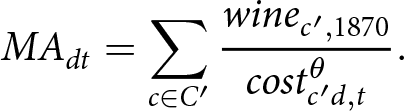
To measure a custom district’s access to wine production in the United States, I adopt a measure of market access as is typically used in the literature. This measure of wine access will capture, for a given customs district, its average access to wine-producing regions using a combination of those regions’ output of wine in 1870 and the transportation cost of those regions to that given district. Specifically, I make use of the market access measure as used in Donaldson and Hornbeck Reference Donaldson and Hornbeck(2016) and Chan Reference Chan(2022) but replace population with wine production in gallons:
 \begin{equation}
MA_{dt}=\sum_{c \in C^{\prime}} \frac{wine_{c^{\prime},1870}}{cost_{c^{\prime}d,t}^\theta}.
\end{equation}
\begin{equation}
MA_{dt}=\sum_{c \in C^{\prime}} \frac{wine_{c^{\prime},1870}}{cost_{c^{\prime}d,t}^\theta}.
\end{equation} Access to wine for a given district d in year t is given by the above equation.  $wine_{c^{\prime},1870}$ is the production of wine in a county c′, in gallons, for the year 1870. $cost_{c^{\prime},t}$ is the transport cost of that same county c′ to the district d in year t.Footnote 9 This transport cost is obtained from Donaldson and Hornbeck Reference Donaldson and Hornbeck(2016) and varies over time as the railroad network becomes more developed and travel times and costs decline as a result. This cost is taken to the power of θ, which is an elasticity parameter from the model of Donaldson and Hornbeck Reference Donaldson and Hornbeck(2016). As in Donaldson and Hornbeck Reference Donaldson and Hornbeck(2016) and Chan Reference Chan2022, I set this elasticity to be 7.22.
Put plainly, a district’s wine access is the sum over all counties’ (other than the county of that district) wine production in gallons, scaled by how costly it is to reach those counties from the district in question. As each county’s wine production is fixed to 1870 levels, a district’s wine access varies only when that district becomes “closer” to wine-producing regions via reductions in transport costs from railroad expansion.
2. Specification
The empirical analysis uses fixed effects regressions to evaluate the determinants of wine trade flows at the customs district level. To that end, I estimate specifications of the following form:
 \begin{equation}
asinh(y_{dt})=\beta_0+\beta_1*asinh(x_{dt})+\gamma_d+\delta_t+\epsilon_{dt}.
\end{equation}
\begin{equation}
asinh(y_{dt})=\beta_0+\beta_1*asinh(x_{dt})+\gamma_d+\delta_t+\epsilon_{dt}.
\end{equation}ydt is a wine trade flows variable for a given district d in year t, such as wine exports in gallons. I also examine wine exports denoted in dollar value, converted to 1890 USD. xdt is a regressor of interest for district d in year t, which will chiefly be my measure of wine access.
asinh() is the inverse hyperbolic sine transformation. I use this monotonic transformation on all continuous left- and right-hand side variables to help account for skewness in the variables. This transformation has a key advantage over the more commonly used log transformation as the inverse hyperbolic sine transformation allows for zero values in the untransformed variable.
Each regression also includes district fixed effects to account for time-invariant unobservable characteristics that could in themselves explain wine trade flows at a district level, such as distance from California, time-invariant demand for wine imports, or innate wine-growing capability. I also include year fixed effects.
Finally, standard errors are clustered by district.
IV. Results
A. Descriptive analysis
I first turn to a descriptive analysis of wine trade flows at the district level. This will help to fix ideas about the changing nature of wine export and imports across the geography of the United States. Given that the data are novel and previously unused, this analysis will also provide readers with a clearer view of this new data source and provide some underlying trends which the regression analysis will help partly explain.
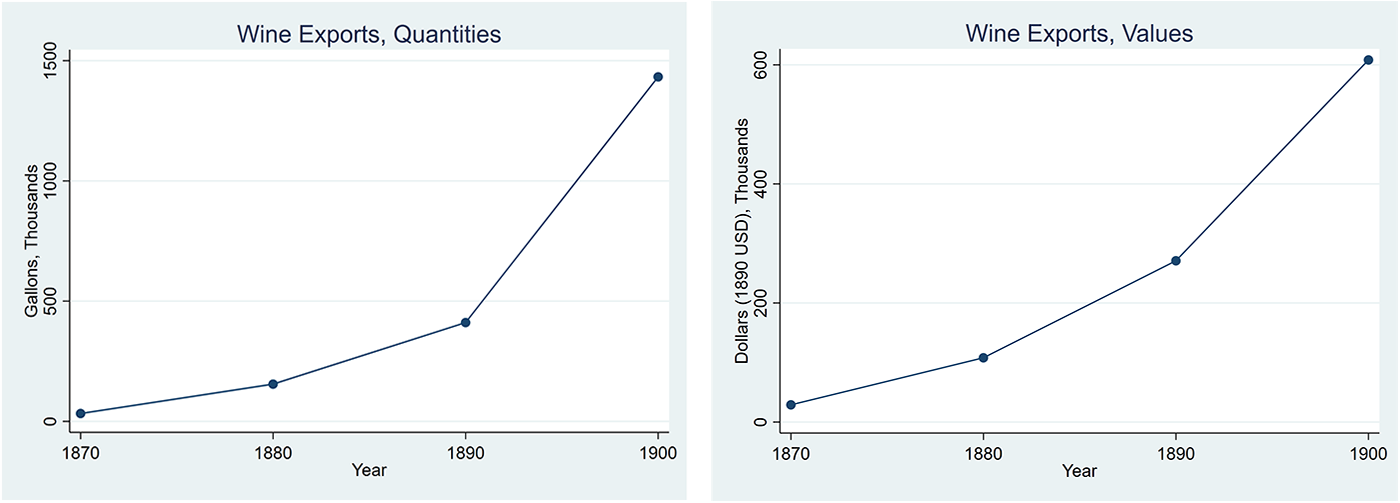
First, Figure 1 presents the evolution of wine exports over the sample period from 1870 to 1900. Wine exports clearly exhibit strong growth during this time period, with a slight acceleration in this growth between 1890 and 1900. The overall picture, however, is one where wine exports are growing. The growth in exports appears to be consistent with aggregate trends in wine consumption in the United States as well. Data from Anderson and Pinilla Reference Anderson and Pinilla(2024) show that aggregate wine consumption in the United States increased from approximately 59,000 kL in 1870 to 97,000 kL in 1900. This increase, however, is driven in large part by increases to the U.S. population; in per capita terms, as discussed previously in the Section 2, wine consumption stayed relatively flat during this time.
U.S. wine exports over time.
The figure presented U.S. exports of wine at a national, aggregate level. In Table 2, I turn to a discussion of the spatial distribution of wine exports across districts. One important note for this table is that, unlike in the econometric analysis, I use the customs districts as given from the original Navigation documents and do not crosswalk them to form consistent districts or drop any districts that disappear over time; this is done to provide the most full picture of wine trade flows possible in the descriptive analysis. In practice, since most of these districts in the top 10 are large districts who are present throughout the sample period, there should be little difference between using consistent districts only and using the full set.Footnote 10
Top 10 districts for wine exports
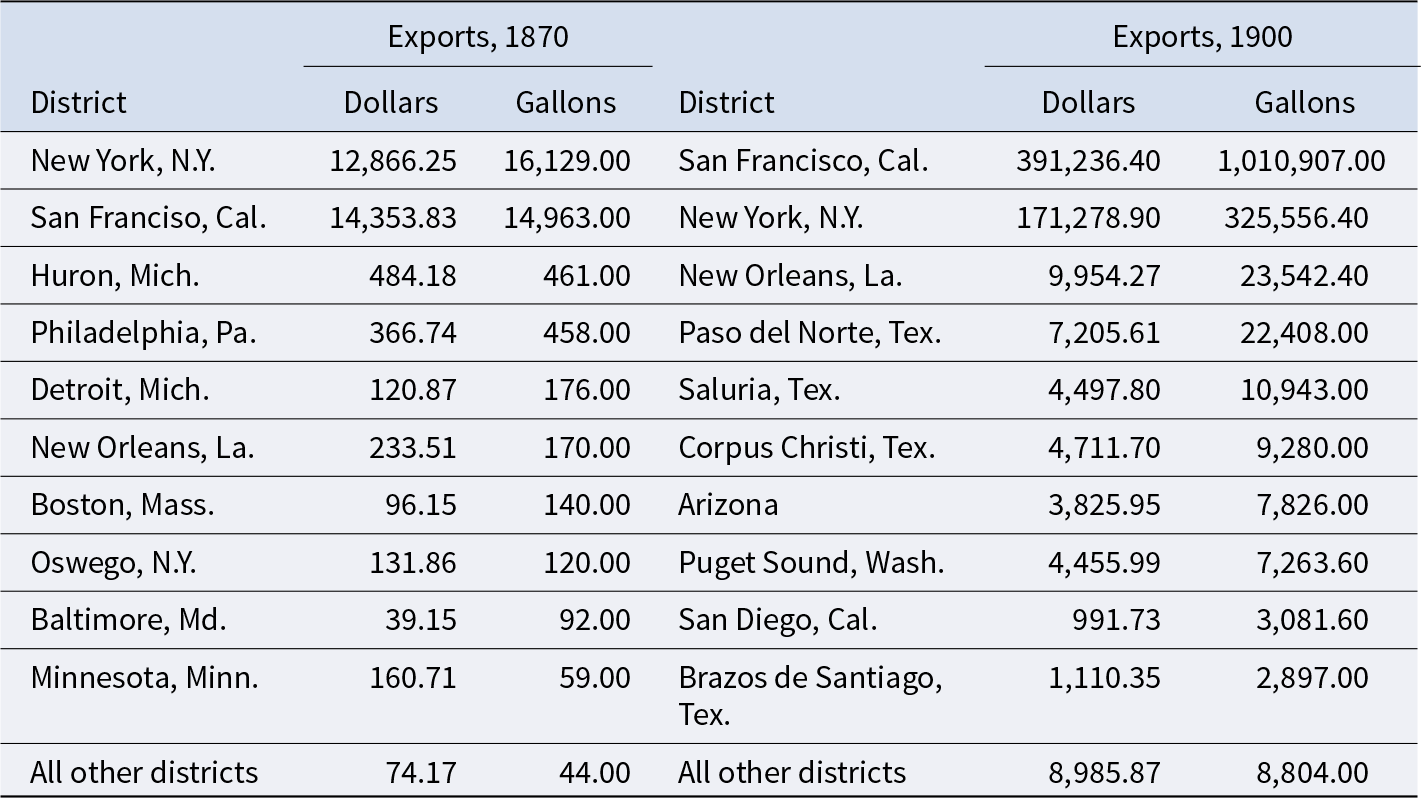
Notes: Data based on digitized table from U.S. Foreign Commerce and Navigation publications, digitized by author. All dollar values are converted to 1890 USD using a GDP deflator.
The two panels of the table present the top 10 customs districts in terms of wine exports (in gallons), as well as a residual category for all other districts, for the years 1870 and 1900. Consistent with Figure 1, exports exhibit a very large amount of growth in terms of dollars and gallons. The top exporting district in 1870 exported only 16,129 gallons; by 1900, the top district exported over 1 million gallons. More interestingly, the list of top 10 districts is not very consistent over time. This stands in stark contrast to the consistency of district rankings when examining total trade flows, as in Chan Reference Chan(forthcoming). Most notably, in 1870, New York was the top exporting district, although San Francisco was not far behind in terms of gallons and was actually slightly ahead in terms of export value.Footnote 11 By 1900, however, this ordering had flipped and San Francisco had become the leading exporting district of U.S. wines. San Francisco also exceeded New York’s exports of wines by a considerably margin, more than tripling the gallons exported by New York. This implies that, as the United States’s major port on the west coast, changes had occurred in the intervening period to shift the gateway to the world for wine toward the Pacific and closer to the wine-growing areas of California. This change was not purely reflective of a growing dominance of California in U.S. wine production either; in 1870, California’s wine production in gallons was already 58.6% of all U.S. production. By 1900, this proportion had only slightly increased to 66.6%.
This shift toward San Francisco was possibly driven by changes in shipping costs. The United Kingdom was the United States’s top export destination in both 1870 and 1900 (for total exports). The cost of shipping provisions from New York to London changed from 600 pence per ton in 1874 to 331 pence per ton in 1889. The freight cost for general goods to be shipped from San Francisco to London changed from 848.4 pence per ton in 1873 to 398.4 pence per ton in 1889. In this comparison, the shipping cost data are obtained from Jacks and Pendakur Reference Jacks and Pendakur(2010) and provisions and general goods have been chosen as the goods to be shipped from New York and San Francisco, respectively, as being the most comparable across origins and also the most similar to wine of the available shipping costs from Jacks and Pendakur Reference Jacks and Pendakur(2010). The data suggest that there may have been, in a proportional sense, a modestly larger decrease in freight costs for goods headed from San Francisco to the United Kingdom relative to goods being shipped from New York. Both origins, however, saw meaningfully large reductions in freight costs. Although limited by data availability, this exercise suggests that differential changes to freight costs between the east and west coasts of the United States were not the main culprit behind the shift toward San Francisco as the United States’s major wine export port from 1870 to 1900.
One likely explanation for the westward shift is a shifting of where U.S.-produced wine exports were headed between 1870 and 1900. Table 3 presents wine exports for the top 10 destination countries in 1870 and 1900. In this table, I do not attempt to ensure consistent definitions of countries across the 2 years; instead, I have used the countries as given in the original source. In 1870, reported in Panel A of Table 3, one can see that England is the top destination for wine exports, receiving over 9,000 USD of wine and making up 32% of total U.S. wine exports. Other top 10 destinations, however, are largely in the Americas and Asia. France, for example, is the only other European country to enter the top 10. By 1900, this pattern appears to be even more severe. The United Kingdom, as it is reported in 1900, now receives almost 100,000 USD of wine, which represents a large increase over the 9,000 USD of wine that England received in 1870. The total share of exports, however, is only 16%, implying a diversification of destinations away from the United Kingdom during this period. Other destinations in Asia and the Americas saw significantly more growth, with destinations like Hawaii (known as the Sandwich Islands in 1870) having 66 times the export value in 1900 that they had in 1870. The picture depicted by Table 3 is, therefore, one where U.S. wine is principally exported to the Americas and Asia, with this relationships strengthening over the sample period. In this light, the shift toward San Francisco as the main export hub for U.S. wine is unsurprising.
Top 10 destinations for U.S. wine exports, 1870 and 1900
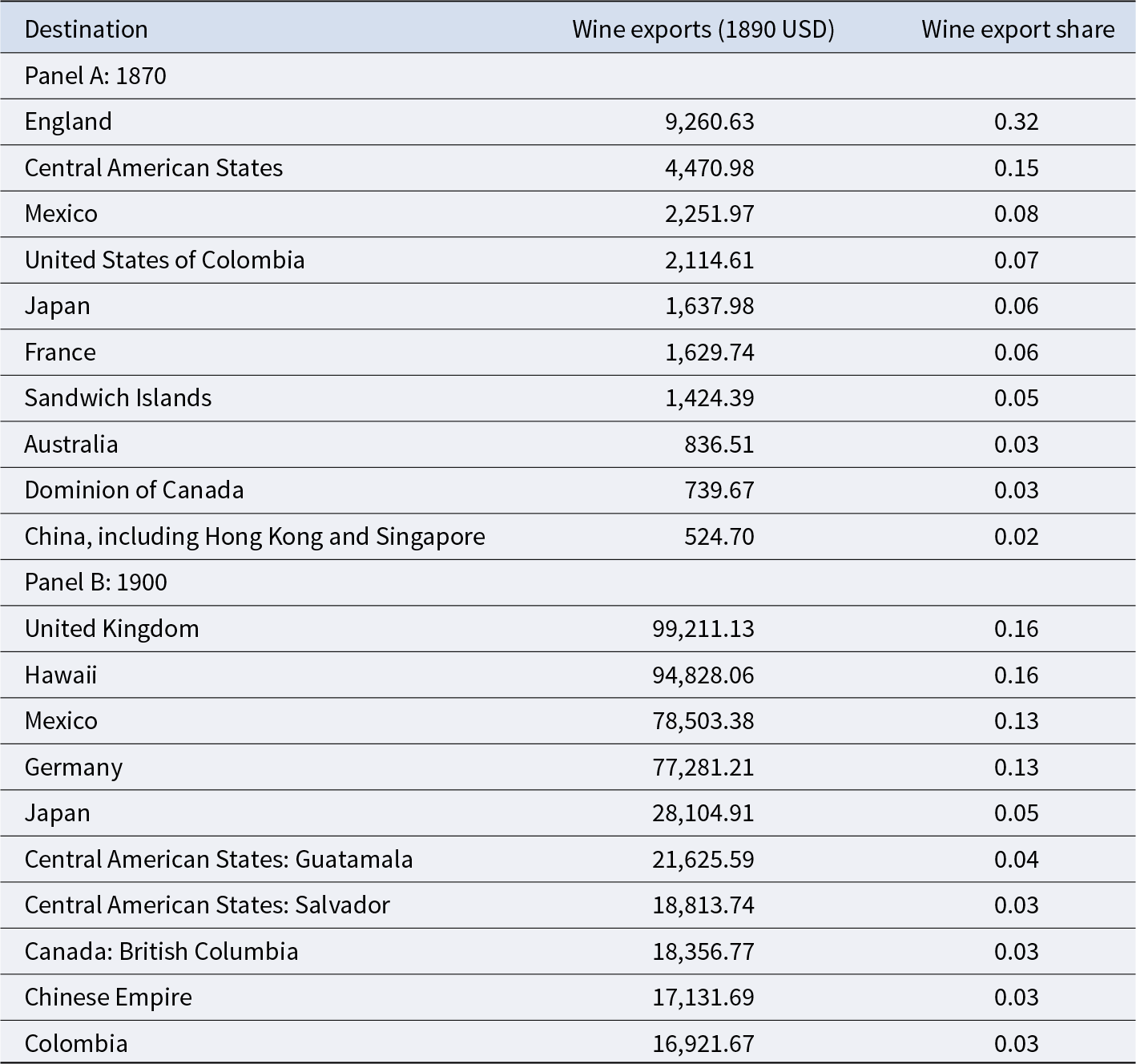
Notes: Data based on digitized table from U.S. Foreign Commerce and Navigation publications, digitized by author. All dollar values are converted to 1890 USD using a GDP deflator. All residual-type destinations originally reported in the original texts (i.e. “all other countries”) have been dropped for the rankings.
Taken together, the descriptive analysis in Table 2 suggests a few conclusions one can draw from the data. First, there is significant change in the distribution of wine exports over time, unlike what is observed in the overall trade data for all goods. In addition, San Francisco becomes the top exporter of wine by 1900. In the regression analysis, I aim to investigate whether changes in access to wine-growing regions due to railroad expansions can help explain some of this shifting in port-level wine trade flows.
B. Regression analysis
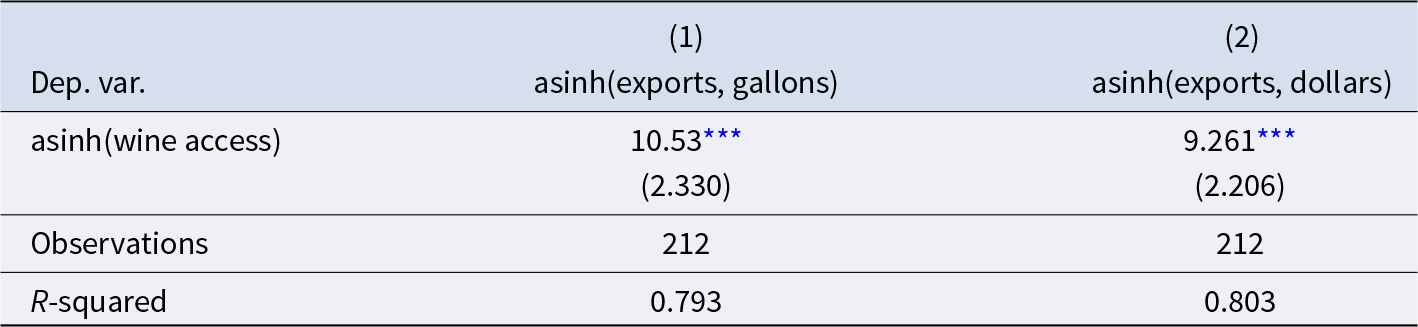
I next turn to the main regression analysis. Table 4 reports the estimates of the effects of wine access on wine exports. Columns 1 and 2 focus first on wine exports denoted in gallons and dollars, respectively. I find that a customs district’s access to wine-producing regions has a strong and statistically significant effect on that district’s wine exports, whether they are measured in gallons or in dollars. This implies that whether a port has easy access to wine-producing regions is an important determinant of whether that port exports wine. Importantly, the inclusion of district fixed effects means that all time-invariant characteristics of a district, such as proximity to historical wine-consuming countries, are controlled for. The effects of wine access are instead estimated using only variation in access to wine producers occurring over time, within a given district. For a sense of how large the estimated effects are, I consider a one deviation increase in the transformed measure of wine access. A one standard deviation increase in wine access (0.432) translates to an increase in (transformed) exports in gallons of 1.3 standard deviations; this implies that access to wine regions had an economically meaningful impact on wine exports.
Access to wine-growing regions and exports
Notes:
*** p < 0.01, **p < 0.05, *p < 0.1. asinh() refers to the inverse hyperbolic sine transformation. All specifications include district fixed effects and year fixed effects. Standard errors clustered by district.
Taken together, the results from Table 4 show that the expansion of the U.S. railroad network played an important role in the spatial distribution of wine exports across American ports. Specifically, the building of the railroads allowed for wine producers to become better connected to some ports, which allowed those ports to export more wine.
V. Conclusion
This paper studies the effects of railroad-induced improvements in access to wine-producing regions for U.S. ports. I find that ports which saw improvements to wine access increased their wine exports. What is clear is that the building of the railroad greatly affected which the ports shipped out American wines, and the amount that those ports exported. One implication of my findings is, therefore, that the global recognition of Californian wines can in part be attributed to the railroad’s facilitation of those wines’ reaching world markets through ports.
The regression analysis helps connect why some of the shifts in port-level exports in wine occurred between 1870 and 1900. For example, the rise of the prominence of the Texan ports by 1900 could be connected to the growth in rail connectivity between wine-producing regions and Texas during the intervening period. On the other hand, some questions remain. For example, San Francisco was essentially neck-to-neck with New York in terms of wine exports in 1870 but had pulled ahead by a wide margin by 1900. Given that San Francisco was already in close proximity to California wine producers relative to New York, railroad growth in the intervening years should have disproportionately benefitted New York’s wine exports. One obvious potential reason for why this did not occur could be the further shift westward and toward non-European destinations for U.S. wines. The reasons for this shift, however, are left to future research.
Acknowledgments
I thank the editor, Karl Storchmann, and an anonymous referee for providing suggestions which greatly improved the quality of the paper.
Competing interests
The author(s) declare none.


 Open access

