





Introduction
Eating disorders (EDs) are clinical disorders characterized by problematic eating habits and unhealthy perceptions of one’s body size and weight, which often result in significant psychosocial impairment (American Psychiatric Association, 2022). The prevalence of these syndromes has been increasing in recent years (Santomauro et al., Reference Santomauro, Melen, Mitchison, Vos, Whiteford and Ferrari2021; Wu et al., Reference Wu, Liu, Li, Ma and Wang2020), with epidemiological studies indicating that they are particularly prevalent among females (Qian et al., Reference Qian, Wu, Liu, Zhu, Jin, Zhang, Wan, Li and Yu2022). It has been suggested that the prevalence could peak in young adult females (Ward et al., Reference Ward, Rodriguez, Wright, Austin and Long2019). Consistently, a 20-year longitudinal study has found that restrictive dieting and extreme physical exercise, typical symptoms of some EDs, are more severe during emerging adulthood compared with other life stages, such as adulthood and midlife (Keel et al., Reference Keel, Baxter, Heatherton and Joiner2007). Overall, previous research suggests that EDs among young adult females represent a relevant public issue, implying the need to better understand the potential risk factors to improve prevention and clinical interventions (Barakat et al., Reference Barakat, McLean, Bryant, Le, Marks, Touyz and Maguire2023; Silén & Keski-Rahkonen, Reference Silén and Keski-Rahkonen2022).
The term “mentalizing” — also known as reflective functioning (RF) — refers to the ability to understand one’s own and others’ behaviors in connection with mental states (Fonagy et al., Reference Fonagy, Gergely, Jurist and Target2002). This ability is fundamental for self-regulation, allowing individuals to identify, process and express their feelings (Jurist, Reference Jurist2005, Reference Jurist2018). Also, previous research has shown that failures in mentalizing are implicated in a broad array of mental disorders and clinical symptoms (e.g., Barberis et al., Reference Barberis, Cannavò, Calaresi and Verrastro2023; Santoro et al., Reference Santoro, Midolo, Costanzo and Schimmenti2021; Sloover et al., Reference Sloover, van Est, Janssen, Hilbink and van Ee2022; Wagner-Skacel et al., Reference Wagner-Skacel, Riedl, Kampling and Lampe2022), including EDs (Simonsen et al., Reference Simonsen, Jakobsen, Grøntved and Kjaersdam Telléus2020; Zeeck et al., Reference Zeeck, Taubner, Gablonski, Lau, Zipfel, Herzog, Wild, Friederich, Resmark, Giel, Teufel, Burgmer, Dinkel, Herpertz, Löwe, Tagay, von Wietersheim, De Zwaan, Zettl, Meier and Hartmann2022). Failures in mentalizing can be categorized as hypo- and hypermentalizing. Hypomentalizing involves an inability to accurately represent one’s own or others’ mental states, particularly regarding their potential complexity. In contrast, hypermentalizing refers to the interpretation of behaviors in terms of mental states without relying on sufficient observable evidence. Thus, hypo- and hypermentalizing reflect excessive uncertainty and certainty about mental states, respectively (Fonagy et al., Reference Fonagy, Luyten, Moulton-Perkins, Lee, Warren, Howard, Ghinai, Fearon and Lowyck2016). Previous research investigating levels of hypo- and hypermentalizing in individuals with EDs compared to healthy controls has shown inconsistent findings. For example, Corsi et al. (Reference Corsi, Cardi, Sowden, Coll, Cascino, Ricca, Treasure, Bird and Monteleone2021) have found that women with a ED exhibit higher levels of both hypo- and hypermentalizing compared to healthy controls, although some group differences became nonsignificant when accounting for anxiety and depression. Furthermore, three studies have found that individuals with EDs exhibited higher levels of hypomentalizing — but not hypermentalizing — than healthy controls (Cucchi et al., Reference Cucchi, Hampton and Moulton-Perkins2018; Kjaersdam Telléus et al., Reference Kjaersdam Telléus, Simonsen, Jakobsen, Dalgaard, Rasmussen and Nilsson2024; Sarig-Shmueli et al., Reference Sarig-Shmueli, Kurman, Talmon, Yoeli, Gur, Stein and Rothschild-Yakar2023). Additionally, there is some evidence suggesting that hypomentalizing predicts an increased risk of developing EDs among adolescents from the community (Quattropani et al., Reference Quattropani, Geraci, Lenzo, Sardella and Schimmenti2022). Although the literature suggests that failures in mentalizing are associated with ED symptoms, further research is needed to clarify the specific role of hypo- and hypermentalizing in ED symptoms.
It is noteworthy that adequate mentalizing abilities represent a developmental achievement resulting from interactions with sensitive and responsive caregivers who properly mentalize children’s mental states (Camoirano, Reference Camoirano2017; Luyten et al., Reference Luyten, Nijssens, Fonagy and Mayes2017). Conversely, childhood trauma may hinder the development of the abilities in representing and reflecting on one’s own and others’ mental states (Doba et al., Reference Doba, Saloppé, Choukri and Nandrino2022; Schimmenti, Reference Schimmenti2017). In fact, repeated exposure to child abuse and neglect may lead to reduced abilities in identifying one’s own emotions based on bodily states, increasing the likelihood of experiencing overwhelming feelings related to childhood trauma in adulthood (Schimmenti & Caretti, Reference Schimmenti and Caretti2016). Accordingly, individuals who have been exposed to childhood trauma may be unable to cognitively represent and regulate their own feelings, exhibiting a high risk for psychopathology (Midolo et al., Reference Midolo, Santoro, Ferrante, Pellegriti, Russo, Costanzo and Schimmenti2020).
Previous meta-analytic findings have shown that the prevalence of child abuse and neglect is significantly higher in patients with EDs than healthy controls, and that childhood abuse is positively associated with the severity of ED symptoms in clinical samples (Caslini et al., Reference Caslini, Bartoli, Crocamo, Dakanalis, Clerici and Carrà2016; Molendijk et al., Reference Molendijk, Hoek, Brewerton and Elzinga2017; Pignatelli et al., Reference Pignatelli, Wampers, Loriedo, Biondi and Vanderlinden2017). Additionally, a recent systematic review has found that childhood trauma is associated with specific biological and clinical features in individuals with EDs, including alterations in neuroanatomical structures and the endogenous stress response system, earlier onset of EDs, greater severity of ED behaviors, and increased comorbidities, among other features (Rossi et al., Reference Rossi, Cassioli, Dani, Marchesoni, Monteleone, Wonderlich, Ricca and Castellini2024). Research has revealed that various psychological vulnerabilities may mediate the relationships between certain childhood traumatic experiences and ED symptoms, including maladaptive eating behaviors. For example, Musetti et al. (Reference Musetti, Gagliardini, Lenzo and Cella2023) have found that failures in mentalizing may mediate the relationships between childhood emotional maltreatment and maladaptive eating behaviors in adults from the community. Other studies have examined the potential mediating role of psychological vulnerabilities closely linked to uncertainty about mental states, such as alexithymia — i.e., a psychological trait characterized by difficulties in identifying and describing feelings and a tendency to focus on external stimuli rather than one’s inner world (Taylor et al., Reference Taylor, Bagby and Parker1991) — and emotion dysregulation. Findings regarding the mediating effects of alexithymia on the relationships between childhood traumatic experiences and ED symptoms are inconsistent. For example, Barone et al. (Reference Barone, Carfagno, Cascino, Landolfi, Colangelo, Della Rocca and Monteleone2023) have found that the alexithymic feature concerning difficulties identifying feelings mediates the positive association between emotional abuse and ED symptoms in women with an ED. However, alexithymic features had no significant effects on the relationships between childhood traumatic experiences and ED symptoms in healthy women. Minnich et al. (Reference Minnich, Gordon, Kwan and Troop-Gordon2017) have found that alexithymia mediates the relationships between childhood emotional and physical neglect and increased levels of drive for muscularity in both women and men. Also, results have revealed that alexithymia mediates the relationships between childhood emotional and physical neglect and increased levels of binge eating symptoms in women but not in men. Strodl and Wylie (Reference Strodl and Wylie2020) have found no evidence that alexithymic features such as difficulties identifying and describing feelings mediate the relationships between childhood trauma and maladaptive eating behaviors in a sample from the community. Other studies have found that emotion dysregulation is a significant mediating variable in the relationships between childhood traumatic experiences and ED symptoms both in individuals with anorexia nervosa (Racine & Wildes, Reference Racine and Wildes2015) and female undergraduates (Burns et al., Reference Burns, Fischer, Jackson and Harding2012; Moulton et al., Reference Moulton, Newman, Power, Swanson and Day2015).
In line with previous literature, it could be hypothesized that the excessive uncertainty about mental states mediates the relationship between childhood trauma and ED risk. In fact, failures in mentalizing might lead individuals to develop unhealthy eating habits and to focus on their own bodies as a means of achieving a sense of mastery and control over painful emotional states (Robinson & Skårderud, Reference Robinson, Skårderud, Bateman and Fonagy2019; Skårderud, Reference Skårderud2007a, b). Specifically, individuals who have been exposed to repeated childhood traumatic experiences might develop ED symptoms as a result of the difficulty to process overwhelming trauma-related mental states.
The current study aimed at investigating the relationships between childhood trauma, failures in mentalizing, observed as uncertainty about mental states, and ED risk among young adult females. Accordingly, we tested the potential mediating role of uncertainty about mental states in the relationship between childhood trauma and ED risk through a structural equation modeling (SEM). As previous literature suggests that the body mass index (BMI) is associated with heightened ED symptoms (e.g., Cella et al., Reference Cella, Iannaccone and Cotrufo2020; Lev-ari et al., Reference Lev-Ari, Zohar and Bachner-Melman2021), BMI was included as a covariate in SEM. It was expected that a) childhood trauma was positively associated with both uncertainty about mental states and ED risk, b) uncertainty about mental states was positively associated with ED risk, and c) uncertainty about mental states had a mediating effect on the relationship between childhood trauma and ED risk.
Method
Participants and procedures
The study sample comprised 409 Caucasian young adult females aged between 18 and 30 years old (M = 23.45; SD = 2.76). The highest education qualifications attained by participants included a primary school certificate for 7 individuals (1.7%), a middle school diploma for 184 individuals (45.0%), a high school diploma for 203 individuals (49.6%), and a Bachelor’s or a Master’s degree for 15 individuals (3.7%). All participants were unmarried. Many of them reported being involved in a romantic relationship (n = 373, 91.2%), with 154 cohabiting with their partners (37.7%). Additionally, 31 participants reported not being involved in a romantic relationship (7.6%), and 5 participants reported being divorced (1.2%). Almost all participants were students (n = 327; 80%), 52 were unemployed (12.7%), 17 were full-time employed (4.2%), 10 were freelancers (2.4%), and 3 were housewives (0.7%). Participants reported a mean BMI of 22.62 (SD = 4.35), which falls within the normal range according to the classification of underweight, overweight, and obesity in adults provided by the World Health Organization (WHO Consultation on Obesity (1999: Geneva, Switzerland) & World Health Organization, 2000). Specifically, 267 participants (65.3%) reported BMI scores within the normal range (18.50 – 24.99), 83 participants (20.3%) reported BMI scores in the overweight range (≥ 25.00), and 59 participants (14.4%) reported BMI scores in the underweight range (< 18.50).
Participants were recruited through advertisements disseminated on social media platforms such as Facebook and WhatsApp. Each advertisement included a hyperlink to an anonymous online survey, which comprised an informed consent form, a sociodemographic schedule, and self-report instruments. The sociodemographic schedule and self-report instruments were administered exclusively to individuals who had signed the informed consent form. Participants voluntarily agreed to participate in the study and did not receive any form of compensation. Inclusion criteria encompassed being a young adult female whose age fell within the range of 18 to 30 years old. The Ethics Committee “Comitato Etico Ricerca Psicologica” of the Centre for Research and Psychological Intervention (“Centro di Ricerca e Intervento Psicologico”) of the University of Messina provided the ethical clearance for the study (code: 2464). All procedures of the study were carried out in accordance with the Declaration of Helsinki.
Measures
All participants were asked to complete a sociodemographic schedule in order to collect information on sex, age, level of education, marital status, employment status, weight and height.
The BMI was assessed by dividing the weight in kilograms by the square of the height in meters.
The Childhood Trauma Questionnaire-Short Form (CTQ-SF; Bernstein et al., Reference Bernstein, Stein, Newcomb, Walker, Pogge, Ahluvalia, Stokes, Handelsman, Medrano, Desmond and Zule2003; Italian validation by Sacchi et al., Reference Sacchi, Vieno and Simonelli2018) is a 28-item self-report instrument assessing childhood traumatic experiences. Each item is rated on a 5-point Likert scale (1 = “Never true”; 5 = “Very often true”). The CTQ-SF includes five 5-item scales that evaluate different types of childhood traumatic experiences, including emotional abuse, physical abuse, sexual abuse, emotional neglect, and physical neglect, and a 3-item scale that evaluates the tendency to deny or minimize childhood traumatic experiences. An example of an item is: “People in my family said hurtful or insulting things to me” (evaluating emotional abuse). The CTQ-SF has shown adequate psychometric properties, such as structural and construct validity (Georgieva et al., Reference Georgieva, Tomas and Navarro-Pérez2021). Consistent with the objectives of the current study, we employed the scores on CTQ-SF scales to examine the relationships between childhood traumatic experiences and failures in mentalizing, and between childhood traumatic experiences and ED risk. Accordingly, the 3-item scale assessing the degree of denial or minimization of childhood traumatic experiences was not used. In this study, Cronbach’s alpha was .88 for emotional abuse, .84 for physical abuse, .94 for sexual abuse, .92 for emotional neglect, and .69 for physical neglect.
The Reflective Functioning Questionnaire (RFQ; Fonagy et al., Reference Fonagy, Luyten, Moulton-Perkins, Lee, Warren, Howard, Ghinai, Fearon and Lowyck2016; Italian validation by Morandotti et al., Reference Morandotti, Brondino, Merelli, Boldrini, De Vidovich, Ricciardo, Abbiati, Ambrosi, Caverzasi, Fonagy and Luyten2018) is an 8-item self-report instrument that assesses difficulties in mentalizing abilities. Participants were asked to rate their agreement for each item on a 7-point Likert scale (1 = “Strongly disagree”; 7 = “Strongly agree”). An example of an item is: “Sometimes I do things without really knowing why.” The RFQ comprises two subscales that evaluate the certainty and the uncertainty about mental states. Each subscale consists of six items. The Italian version of the RFQ has shown a two-factor structure, and both RFQ subscales demonstrated satisfactory psychometric characteristics, including construct validity and reliability (Morandotti et al., Reference Morandotti, Brondino, Merelli, Boldrini, De Vidovich, Ricciardo, Abbiati, Ambrosi, Caverzasi, Fonagy and Luyten2018). We employed the uncertainty about mental states scale to evaluate the failures in mentalizing. In the current study, Cronbach’s alpha of this scale was .77.
The Eating Disorder Inventory-3 (EDI-3; Garner, Reference Garner2004; Italian validation by Giannini et al., Reference Giannini, Pannocchia, Dalle Grave and Muratori2008) is a 91-item self-report instrument that assesses symptoms and psychological features related to EDs. Participants were asked to rate the items on a 6-point scale. The responses to each item are then recoded into a 5-point scale (from 0 to 4). The EDI-3 includes three primary scales that evaluate ED symptoms, specifically drive for thinness (7 items), bulimia (8 items), and body dissatisfaction (10 items) scales, and nine primary scales that evaluate psychological features related to EDs, namely low self-esteem (6 items), personal alienation (7 items), interpersonal insecurity (7 items), interpersonal alienation (7 items), interoceptive deficits (9 items), emotional dysregulation (8 items), perfectionism (6 items), asceticism (7 items), and maturity fear (8 items). Also, the EDI-3 comprises two composite indices: the Eating Disorder Risk Composite scale (EDRC) and the General Psychological Maladjustment Composite scale (GPMC). The EDRC index is derived from scores on the EDI-3 scales evaluating ED symptoms, and the GPMC index is derived from scores on the EDI-3 scales evaluating psychological features related to EDs. An example of an item is: “I am terrified of gaining weight” (evaluating drive for thinness). The EDI-3 demonstrated satisfactory psychometric properties, including validity and reliability, in both general and clinical populations (Clausen et al., Reference Clausen, Rosenvinge, Friborg and Rokkedal2011; Nyman-Carlsson et al., Reference Nyman-Carlsson, Engström, Norring and Nevonen2015; Punzi et al., Reference Punzi, Tieri, Girelli and Petti2023). We employed the drive for thinness, bulimia, and body dissatisfaction scales, along with the EDRC index, to investigate the potential predictive role of childhood trauma and uncertainty about mental states in increasing ED risk. In this study, Cronbach’s alpha was .94 for drive for thinness, .88 for bulimia, .90 for body dissatisfaction, and .95 for EDRC.
Statistical analysis
Descriptive statistics were computed for all variables of the study. Associations between BMI, childhood traumatic experiences, uncertainty about mental states, and ED risk were examined through Pearson’s r correlation coefficients. SEM analysis was performed to test the following model: a) childhood trauma predicts increased levels of both uncertainty about mental states and ED risk; b) uncertainty about mental states predicts increased levels of ED risk; and c) uncertainty about mental states is a mediating variable in the positive association between childhood trauma and ED risk. Additionally, the effects of childhood trauma and uncertainty about mental states on ED risk were investigated while controlling for the effects of BMI. Thus, BMI was included as a potential predictor of ED risk. Mardia’s tests of multivariate skewness and kurtosis were preliminarily performed to examine data distribution. Due to non-normal distribution of the data, we employed the diagonally weighted least squares estimation method. The mediating model included scores on CTQ-SF scales (i.e., emotional abuse, physical abuse, sexual abuse, emotional neglect, and physical neglect) as indicators of a latent variable for childhood trauma, scores on RFQ items as indicators of a latent variable for failures in mentalizing, scores on drive for thinness, bulimia and body dissatisfaction scales as indicators of a latent variable for ED risk, and scores on BMI as an observed variable. The goodness of fit of the model was evaluated through the chi-square/degrees of freedom ratio (χ2/df), for which a value less than 2 indicates a good fit, the comparative fit index (CFI) and the Tucker-Lewis index (TLI), for which values greater than .95 indicate a good fit, and root mean-square error of approximation (RMSEA), for which a value less than .06 indicate a good fit, and the standardized root-mean-square residual (SRMR), for which a value less than .08 indicates an acceptable model (Hooper et al., Reference Hooper, Coughlan and Mullen2008; Hu & Bentler, Reference Hu and Bentler1999). The significance of the indirect effect of uncertainty about mental states in the model was further assessed using 5,000 bootstrap samples. The critical level of significance was determined by setting the p-value at .05. If the value of 0 is not contained between the upper and lower limits of the 95% confidence interval, the indirect effect is considered statistically significant. Mardia’s tests were computed using the R Package psych (Revelle, Reference Revelle2024), whereas SEM was performed using the R Package lavaan (Rosseel, Reference Rosseel2012).
Results
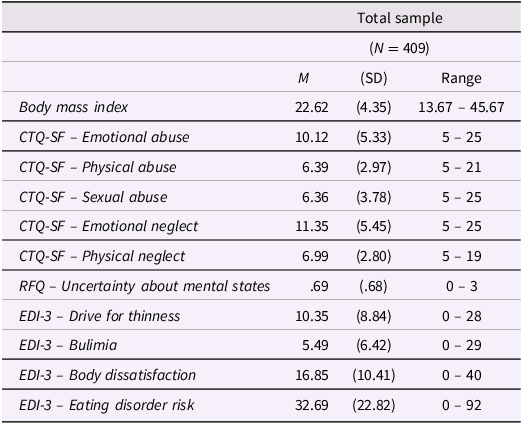
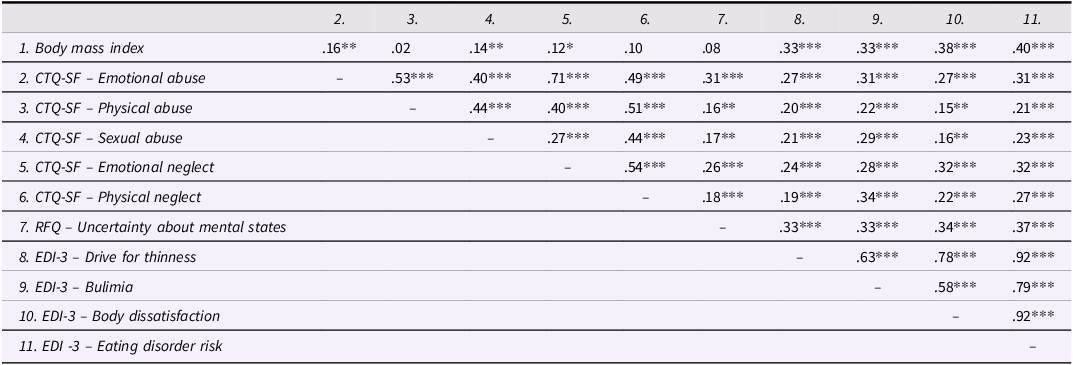
Descriptive statistics are reported in Table 1. Participants reported a mean EDRC score below the recommended cut-off of 75 (Garner, Reference Garner2004), which has been used in previous research employing the Italian version of the EDI-3 (Segura-García et al., Reference Segura-García, Aloi, Rania, Ciambrone, Palmieri, Pugliese, Ruiz Moruno and De Fazio2015). These findings suggest that participants did not exhibit clinically significant levels of ED symptoms, as expected in a sample from the community. Pearson’s r correlation coefficients among the investigated variables are displayed in Table 2. Childhood traumatic experiences, uncertainty about mental states and ED risk, including drive for thinness, bulimia and body dissatisfaction symptoms, were significantly and positively associated with each other. BMI was significantly associated with increased levels of emotional abuse, sexual abuse, emotional neglect, and ED risk, including all ED symptoms.
Descriptive statistics

Note: CTQ-SF = Childhood Trauma Questionnaire-Short Form; RFQ = Reflective Functioning Questionnaire; EDI-3 = Eating Disorder Inventory-3.
Pearson’s r correlations among the investigated variables
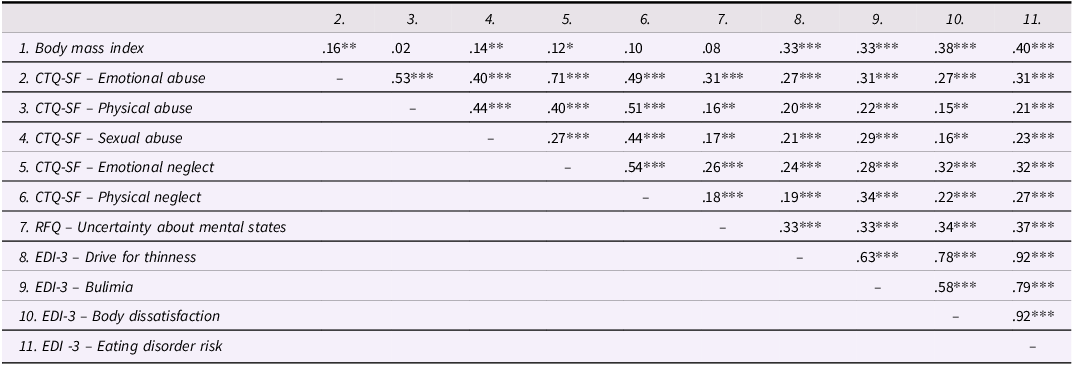
Note: CTQ-SF = Childhood Trauma Questionnaire-Short Form; RFQ = Reflective Functioning Questionnaire; EDI-3 = Eating Disorder Inventory-3; * p < .05; **p < .01; ***p < .001.
SEM analysis showed that childhood trauma was a significant positive predictor of both uncertainty about mental states and ED risk, that uncertainty about mental states was a significant positive predictor of ED risk, and that uncertainty about mental states partially mediated the association between childhood trauma and ED risk (indirect effect: β = .127, SE = .032, p < .001, 95% C.I. [.063 – .190]; total effect: β = .423, SE = .051, p < .001, 95% C.I. [.324 – .522]). Furthermore, BMI was significantly associated with heightened levels of ED risk. Goodness-of-fit indices suggest that the tested model fitted well: χ2/df = 1.700 (χ2 = 147.932, df = 87, p < .001), CFI = .976, TLI = .971, RMSEA = .041 [90% C.I.: .030 – .053], SRMR = .065. Standardized estimates of the model are displayed in Figure 1.
Structural equation model of the relationships among childhood trauma, uncertainty about mental states, and eating disorder risk. Note: Body mass index was a significant covariate in the model (β = .42, p < .001); all estimates are significant at p < .001).

Discussion
The purpose of this study was to examine the relationships between childhood trauma, uncertainty about mental states and ED risk in a sample of young adult females.
Correlation analyses showed significant positive associations between all types of childhood trauma (i.e., emotional abuse, physical abuse, sexual abuse, emotional neglect, and physical neglect) and uncertainty about mental states. These findings are consistent with previous studies showing that child abuse and neglect are associated with difficulties in representing one’s own and other’s mental states (Berardelli et al., Reference Berardelli, Sarubbi, Sarli, Rogante, Del Casale, Erbuto, Innamorati, Lester and Pompili2022; Martin-Gagnon et al., Reference Martin-Gagnon, Normandin, Fonagy and Ensink2023; Schimmenti, Reference Schimmenti2017; Yang & Huang, Reference Yang and Huang2024). Childhood trauma evokes painful emotions that may overcome the individual’s capacity to integrate their bodily correlates and mental states in coherent and unitary representations, leading to impairments in mentalizing abilities (Schimmenti & Caretti, Reference Schimmenti and Caretti2016). Also, all types of traumatic experiences were associated with increased severity of ED symptoms (i.e., drive for thinness, bulimia, and body dissatisfaction). There is consistent evidence showing higher rates of child abuse and neglect among individuals with EDs in comparison to healthy control (Caslini et al., Reference Caslini, Bartoli, Crocamo, Dakanalis, Clerici and Carrà2016; Pignatelli et al., Reference Pignatelli, Wampers, Loriedo, Biondi and Vanderlinden2017). Finally, positive associations were found between uncertainty about mental states and the severity of ED symptoms, supporting previous research showing that individuals with EDs exhibit difficulties in mentalizing (Sacchetti et al., Reference Sacchetti, Robinson, Bogaardt, Clare, Ouellet-Courtois, Luyten, Bateman and Fonagy2019; Simonsen et al., Reference Simonsen, Jakobsen, Grøntved and Kjaersdam Telléus2020). In fact, poor ability to adequately attribute meaning to one’s subjective experience based on mental states might lead individuals to resort on ED symptoms as a dysfunctional attempt to deal with unprocessed emotional states (Robinson & Skårderud, Reference Robinson, Skårderud, Bateman and Fonagy2019). Thus, young adult females might engage in restriction of food intake, binge eating, or compensatory behaviors to temporarily achieve a sense of regulation over their feelings and modulate their intensity (Schaefer et al., Reference Schaefer, Engel and Wonderlich2020; Skårderud, Reference Skårderud2007a, b).
SEM analysis showed that childhood trauma was a significant predictor of increased ED risk, and that uncertainty about mental states has a significant mediating effect on this association. These findings extend previous literature on the mediating factors in the relationship between childhood trauma and the development of EDs (Rabito-Alcón et al., Reference Rabito-Alcón, Baile and Vanderlinden2021), suggesting that uncertainty about mental states may partly explain the relationship between childhood trauma and ED risk among young adult females. From a developmental perspective, ED symptoms can be understood as attempts to maintain a sense of inner cohesion in the face of overwhelming and unprocessed emotional states stemming from early experiences of child abuse and neglect. Additionally, it is noteworthy that childhood trauma may impair social information processing mechanisms that inform mentalizing processes, such as the adequate identification and interpretation of interpersonal cues (Lau & Waters, Reference Lau and Waters2017; McLaughlin & Lambert, Reference McLaughlin and Lambert2017). Consequently, the pervasive sense of lack of control and/or incompetence in navigating social contexts might increase the ED risk in young adult females who have been exposed to childhood trauma (Cannavò et al., Reference Cannavò, Cella, Calaresi, Verrastro and Barberis2023; Harrison et al., Reference Harrison, Tchanturia, Naumann and Treasure2012). It is noteworthy that the role of childhood trauma and uncertainty about mental states in ED risk was investigated while accounting for the effects of BMI. Consistent with previous research (Cella et al., Reference Cella, Iannaccone and Cotrufo2020; Lev-ari et al., Reference Lev-Ari, Zohar and Bachner-Melman2021), results revealed that higher BMI was associated with an increased risk of EDs.
There are some limitations to acknowledge in the current study. First, the cross-sectional design of the study limits the possibility to ascertain the causal relationships among the investigated variables. Therefore, longitudinal research on this topic is recommended. Second, the use of self-report measures might result in biased findings due to social desirability, misattribution of meanings for certain terms, or specific psychological characteristics, despite the adoption well-validated instruments. Future studies could address these limitations by assessing the variables of interest through interviews, such as the Childhood Experience of Care and Abuse (CECA; Bifulco et al., Reference Bifulco, Brown and Harris1994; Bifulco & Schimmenti, Reference Bifulco and Schimmenti2019) for childhood trauma or the Reflective Functioning Scale (RFS; Fonagy et al., Reference Fonagy, Target, Steele and Steele1998) for mentalizing abilities, as well as through instruments based on specific tasks, such as the Movie for the Assessment of Social Cognition (MASC; Dziobek et al., Reference Dziobek, Fleck, Kalbe, Rogers, Hassenstab, Brand, Kessler, Woike, Wolf and Convit2006; Fossati et al., Reference Fossati, Borroni, Dziobek, Fonagy and Somma2018) for mentalizing abilities. Third, the sample of the study included young adult females from the community, limiting the generalizability of our findings to patients with EDs. On the other hand, participants were recruited through advertisement on social media platforms, reducing the representativeness of the sample compared to general population. In fact, this methodological approach may have resulted in a high proportion of participants with an interest in the topic of the current study (Lehdonvirta et al., Reference Lehdonvirta, Oksanen, Räsänen and Blank2021). Therefore, future studies might investigate the role of childhood trauma and failures in mentalizing in both non-clinical and clinical samples, utilizing various sampling methods. It could also be useful to test our hypotheses on the relationships between childhood trauma, failures in mentalizing, and ED risk in other life stages besides young adulthood, and among males. Moreover, future research might investigate the role of other potential mediators that could further explain the relationships between childhood trauma, failures in mentalizing and ED risk, such as defense mechanisms (Musetti et al., Reference Musetti, Gagliardini, Lenzo and Cella2023). As previous research has shown that various aspects of failures in mentalizing are implicated in EDs, such as imbalances between affective and cognitive mentalization or between self-oriented and other-oriented mentalization (Gagliardini et al., Reference Gagliardini, Gullo, Tinozzi, Baiano, Balestrieri, Todisco, Schirone and Colli2020), future research could also explore the role of other facets as potential mediators in these relationships.
Its limitations notwithstanding, the current study suggests that young adult females who have been exposed to childhood trauma and are prone to exhibit failures in mentalizing are vulnerable to developing ED symptoms. This finding has relevant clinical implications for the assessment and treatment of ED symptoms. In fact, it is advisable for clinicians to carefully evaluate the potential role of childhood traumatic experiences and failures in mentalizing in EDs symptoms among young adult females. Also, clinical interventions based on fostering mentalizing and emotion regulation abilities might be fundamental for reducing the risk of developing EDs among young adult females who have been exposed to childhood trauma.
Data availability statement
The data that support the findings of this study are available from the corresponding author, G.S., upon reasonable request.
Acknowledgments
None.
Funding statement
This research received no specific grant from any funding agency, commercial, or not-for-profit sectors.
Competing interests
The author(s) declare none.


 Open access

