


Introduction
Barnyardgrass [Echinochloa crus-galli (L.) Beauv.] has become resistant to a number of herbicides that were once effective in U.S. rice production systems, including several acetolactate synthase–inhibiting herbicides, clomazone, and quinclorac (Heap Reference Heap2018). To avoid reliance on the few remaining effective options, alternative herbicides targeting different sites of action should be explored. A lack of new herbicide discovery in recent years has led to the evaluation of herbicides currently labeled in other crops for use in rice.
Very-long-chain fatty acid (VLCFA)-inhibiting herbicides (WSSA Group 15) are not currently labeled for use in U.S. rice but have been used successfully in Asian rice production (Chauhan Reference Chauhan2012; Rao et al. Reference Rao, Johnson, Sivaprasad, Ladha and Mortimer2007). This herbicide site of action includes the chloroacetamide, oxyacetamide, and pyrazole chemical families, which contain several herbicides used in U.S. row crops, including S-metolachlor, pyroxasulfone, acetochlor, and flufenacet. The Group 15 herbicides inhibit cell division in developing shoots and roots of annual grasses and small-seeded broadleaves but do not affect emerged species (Babczinski et al. Reference Babczinski, Watanabe, Nakatani, Yoshiumura, Hanai, Tenetani and Shimizu2011). Therefore, they should be applied after rice germination but before weed germination. The weed control spectrum of these herbicides indicates that they have potential to control or suppress problematic weeds in the early stages of the growing season if crop tolerance can be established.
Palmer amaranth (Amaranthus palmeri S. Watson), barnyardgrass, large crabgrass [Digitaria sanguinalis (L.) Scop.], goosegrass [Eleusine indica (L.) Gaertn.], and other annual grasses have been effectively controlled by acetochlor in corn (Zea mays L.) and cotton (Gossypium hirsutum L.) (Cahoon et al. Reference Cahoon, York, Jordan, Everman, Seagroves, Braswell and Jennings2015; Janak and Grichar Reference Janak and Grichar2016; Krausz et al. Reference Krausz, Young, Kapusta and Matthews2000; Riar et al. Reference Riar, Norsworthy, Johnson, Starkey and Lewis2011). Furthermore, only five weeds have become resistant to this herbicide site of action worldwide (Heap Reference Heap2018). There are several commercialized formulations of acetochlor currently on the market, two of the more popular products being Warrant® and Harness® (Monsanto, 800 N. Lindbergh Boulevard, St Louis, MO 63167). Although both acetochlor formulations are produced and sold by Monsanto, they differ in several properties.
Warrant® contains acetochlor at 360 g ai L−1 and is labeled for use in U.S. soybean [Glycine max (L.) Merr.], cotton, corn, and grain sorghum [Sorghum bicolor (L.) Moench]. Harness® contains acetochlor at 840 g ai L−1 and is labeled for use in field corn, silage corn, sweet corn (Zea mays L. var. saccharate), popcorn (Zea mays L. var. everta), and several nonfood perennial bioenergy crops. The active ingredient of encapsulated herbicides like Warrant® is often enclosed in a shell-like matrix of organic and inorganic polymers, which protects against degradation and results in a slow, gradual release of the herbicide (Guo et al. Reference Guo, Yang, Yan, Li, Qian, Li, Xiao and He2014; Li et al. Reference Li, Li and Dong2008; Rao Reference Rao2000). In contrast, the active ingredient in emulsifiable concentrate (EC) herbicide formulations is often blended with organic solvents and surfactants to form an emulsion when diluted in water and is readily available for plant uptake upon activation (Rao Reference Rao2000). For microencapsulated (ME) formulations of herbicides, the polymer shell will imbibe water from the soil and in turn release herbicide into the soil profile via diffusion (Guo et al. Reference Guo, Yang, Yan, Li, Qian, Li, Xiao and He2014). For EC formulations, the herbicide will simply desorb from soil colloids and enter the soil solution, where it can be readily taken up by germinating plants.
With a soil-applied PRE herbicide, a delayed, continuous release of herbicide through soil can offer longer residual weed control compared with a non-encapsulated formulation (Rao Reference Rao2000). However, the length of residual activity is dependent upon several factors, including herbicide rate, environmental conditions, soil characteristics, and perhaps most importantly, soil moisture (Carter Reference Carter2000; Dhareesank et al. Reference Dhareesank, Kobayashi and Usui2006; Jursik et al. Reference Jursik, Soukup, Holec, Andr and Hamouzova2015; Kotoula-Syka et al. Reference Kotoula-Syka, Hatzios, Berry and Wilson1997). Soil moisture influences herbicide absorption, translocation, and metabolism in plants and thus affects weed control and crop phytotoxicity (Chauhan and Johnson Reference Chauhan and Johnson2011).
Godwin (Reference Godwin2017) conducted several studies in 2015 and 2016 to evaluate rice tolerance following early-season applications of various VLCFA-inhibiting herbicides. Pyroxasulfone, S-metolachlor, pethoxamid, and ME acetochlor were applied delayed PRE (DPRE), at spiking, 1- to 2-leaf, and 3- to 4-leaf rice. Pyroxasulfone and S-metolachlor caused unacceptable levels of rice injury across rate or application timing and generally had negative effects on shoot density, height, maturity, and yield. In contrast, rice exhibited adequate tolerance to pethoxamid and acetochlor when application timings were delayed to the 1- to 4-leaf stage, although soil moisture relative to application timing affected rice injury, as demonstrated by Chauhan and Johnson (Reference Chauhan and Johnson2011). Because there is limited research available on rice tolerance to acetochlor formulations, and none particularly on the EC formulation, experiments were conducted to determine the influence of acetochlor formulation and rate on rice tolerance to PRE, DPRE, and 1- to 2-leaf (early POST [EPOST]) rice timings.
Materials and Methods
Experimental Sites
Experiments were conducted in 2016 on an Immanuel silt loam (fine-silty, mixed, active, thermic Oxyaquic Glossudalfs) at the University of Arkansas Pine Bluff (UAPB) Farm near Lonoke, AR, and in 2017 on a Dewitt silt loam (fine, smectic, thermic Typic Albaqualfs) at the Rice Research and Extension Center (RREC) near Stuttgart, AR, and in both years on a Calloway silt loam (fine-silty, mixed, active, thermic Aquic Fraglossudalfs) at the Pine Tree Research Station (PTRS) near Colt, AR (Table 1).
Chemical and physical soil properties at experimental sites in 2016 and 2017.a

a Abbreviations: OM, organic matter; PTRS, Pine Tree Research Station near Colt, AR; RREC, Rice Research and Extension Center near Stuttgart, AR; UAPB, University of Arkansas Pine Bluff Farm near Lonoke, AR.
Experimental Setup and Data Collection
The experimental design was a three-factor factorial, randomized complete block with four replications. Factor A consisted of formulation (ME as Warrant® and EC as Harness®). Factor B consisted of rate (1,050 [1X] and 2,100 [2X] g ai ha−1 based on labeled rate for corn). Factor C consisted of application timing (PRE, DPRE approximately 5 d after planting, and EPOST at 1- to 2-leaf rice). A nontreated control was added for comparison. The imidazolinone-resistant (Clearfield™, BASF, Research Triangle Park, NC) cultivar ‘CL151’ was drill seeded at 72 seeds m−1 of row, with 18 cm between rows, in 1.8 by 5.2 m plots. Plots were maintained weed-free throughout the growing season using PRE-applied clomazone at 336 g ai ha−1 at all locations, with POST applications of propanil at 4,480 g ai ha−1 and cyhalofop at 313 g ai ha−1 plus 1% v/v crop oil concentrate at both the UAPB and RREC and quinclorac 280 g ai ha−1 and sequential applications of imazethapyr at 70 g ai ha−1 plus 0.25% v/v nonionic surfactant both years at PTRS (Table 2). Each location was fertilized and managed according to University of Arkansas Extension recommendations (Hardke Reference Hardke2012). Acetochlor treatments were applied using a CO2-pressurized backpack sprayer calibrated to deliver 143 L ha−1. Dates of planting, herbicide application, and harvest at each experimental site in 2016 and 2017 are shown in Table 3.
Sources of herbicides and adjuvants used in study.

Planting, herbicide application, and harvest dates for trials in 2016 and 2017.a

a Abbreviations: DPRE, delayed PRE; EPOST, early POST; PTRS, Pine Tree Research Station near Colt, AR; RREC, Rice Research and Extension Center near Stuttgart, AR; UAPB, University of Arkansas Pine Bluff Farm near Lonoke, AR.
Estimates of crop injury from acetochlor were assessed at 2 wk after each treatment (WAT) and 4 wk after flooding (WAF) on a scale of 0 to 100%, with 0 being no injury and 100 being crop death. Bleaching caused by the clomazone application to all study sites was not included in injury evaluations. A 5-cm-depth permanent flood was established when rice reached the 5- to 6-leaf stage, and the flood was maintained until 2 wk after 50% heading. Shoot density per meter of row and rice height measurements of three random plants per plot were taken 3 wk after EPOST applications at the PTRS and RREC in 2017 and converted to a percentage relative to the average of the nontreated at each location. Estimates of days delayed to 50% rice heading were collected three times weekly when 50% heading was observed in the nontreated. Rice grain was harvested from the center four rows of each plot at physiological maturity using a small-plot combine, and rough rice yields were adjusted to 12% moisture.
Statistical Analysis
Data for some parameters were not found to be normally distributed, via a significant Shapiro-Wilk test. Therefore, all data were subjected to ANOVA as a three-factor factorial using the GLIMMIX procedure in SAS v. 9.4 (SAS Institute, Cary, NC 27513), assuming beta distribution for rice injury, gamma distribution for relative shoot density and plant height, negative binomial distribution for delayed maturity, and lognormal distribution for relative yield (Gbur et al. Reference Gbur, Stroup, McCarter, Durham, Young, Christman, West and Kramer2012). To assess the behavior of acetochlor over a variety of environments, data were analyzed jointly, with replication nested within location and considered random effects in the model. Box-and-whisker plots were used to visually capture how the interaction of acetochlor formulation, application timing, and rate affected crop response across the four environments. For crop responses in which the three-factor interaction was significant, mean separation based on Fisher’s protected LSD (α = 0.05) was used to identify differences among means within the box-and-whisker plots.
Results and Discussion
Rainfall
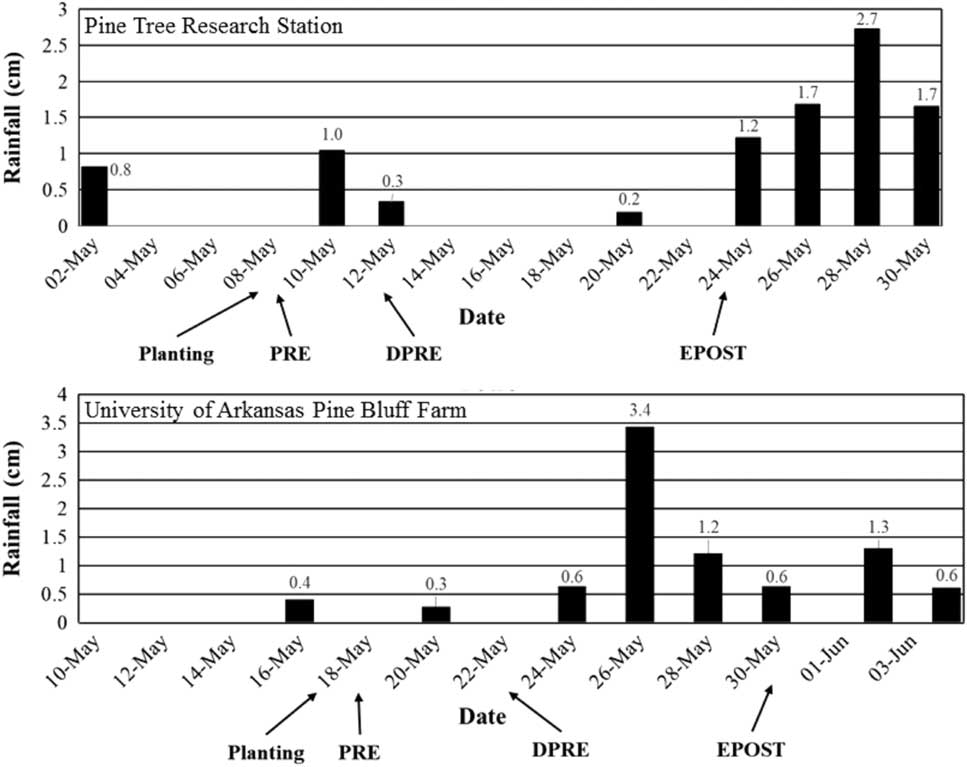
Amount and timing of rainfall in relation to acetochlor application varied among locations and years (Figures 1 and 2). Performance of soil-applied herbicides is influenced by several factors, including soil characteristics and soil moisture (Jones et al. Reference Jones, Banks and Radcliffe1990; Kern et al. Reference Kern, Meggitt and Penner1975). Each research location had a silt loam soil with comparable organic matter and clay content (Table 1). In 2016, rice was planted into relatively dry soil and received 1.4 and 0.9 cm of rainfall within 7 d after planting at the PTRS and UAPB sites, respectively (Figure 1). In contrast, rice was planted into adequate moisture in 2017 and then received an additional 2.5 and 4.0 cm of rainfall within 7 d after planting at PTRS and RREC, respectively (Figure 2).
Rainfall amount and dates in 2016 at the Pine Tree Research Station near Colt, AR, and the University of Arkansas Pine Bluff Farm near Lonoke, AR. Abbreviations: DPRE, delayed PRE; EPOST, early POST.
Rainfall amount and dates in 2017 at the Pine Tree Research Station near Colt, AR, and the Rice Research and Extension Center near Stuttgart, AR. Abbreviations: DPRE, delayed PRE; EPOST, early POST.
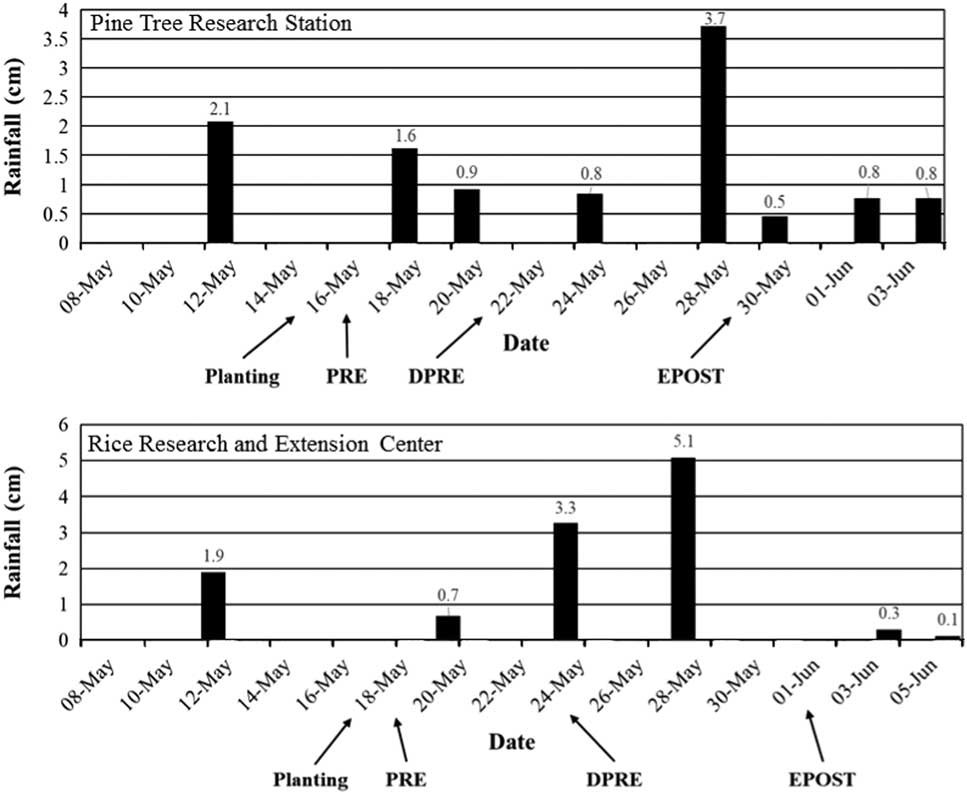
Dry conditions before planting, in addition to marginal rainfall over the next 7 d, limited the availability of acetochlor in soil solution and resulted in reduced rice injury in 2016 (unpublished data). In contrast, rainfall events occurred immediately before or following PRE and DPRE applications in 2017, which allowed acetochlor to rapidly desorb from soil colloids and enter soil solution, where it was absorbed by germinating rice. When VLCFA-inhibiting herbicides such as acetochlor are taken up by developing shoots and roots, they inhibit lipid biosynthesis in susceptible species and result in dead or permanently stunted plants, particularly when exposed at early growth stages (Matthes et al. Reference Matthes, Schmalfuss and Böger2014; Schmalfuss et al. Reference Schmalfuss, Matthes, Knuth and Böger2000).
Rice Response to Acetochlor Formulation, Timing, and Rate
All evaluated responses were influenced by at least one significant two-way interaction or main effect for all three factors (Table 4). Similar to findings by Godwin (Reference Godwin2017), rice injury following early-season applications of ME acetochlor generally decreased as application timing was delayed. When averaged over main effects, rice was most tolerant when treated with the ME formulation versus the EC formulation of acetochlor. The most severe injury to rice resulted from EC acetochlor applied PRE at 2,100 g ha−1 at 2 WAT (Table 5).
Significance of P-values for factor main effects and interactions for rice injury, relative shoot density, relative plant height, days to 50% heading, and rough rice yield averaged over site-years.a, b, c

a Abbreviations: Form, formulation; WAF, weeks after flooding; WAT, weeks after treatment.
b Asterisks (*) indicate significant treatment effects.
c Injury, 50% heading date, and yield are averaged over four locations. Shoot density and height are averaged over two locations.
Influence of acetochlor formulation, application timing, and rate on rice injury and plant height.a, b, c, d

a Abbreviations: DPRE, delayed PRE; EC, emulsifiable concentrate; EPOST, early POST; Form, formulation; ME, microencapsulated; WAF, weeks after flooding; WAT, weeks after treatment.
b Means within a column followed by the same lowercase letter are not different according to Fisher’s protected LSD (α = 0.05). Means for nonsignificant interactions for INJ 2 WAT and relative height are presented for informational purposes.
c Rice injury and relative height were averaged over four and two locations, respectively.
d Average height of nontreated plots was 19 cm.
EC formulated acetochlor was more injurious to rice than ME acetochlor at 2 WAT (Table 5). The increased injury is likely due to the rapid release of acetochlor from the EC formulation compared with a slower release from the ME formulation. In each case, rainfall or irrigation move herbicide below the soil surface and into soil solution, where herbicide molecules can be adsorbed to soil colloids or absorbed by germinating seeds. However, in EC formulations, most of the applied herbicide is immediately available for uptake upon activation by rainfall or irrigation. Conversely, the polymer shell of an ME formulation offers protection from degradation processes and allows a slow release of herbicide over time, depending on the composition and thickness of the polymer (Guo et al. Reference Guo, Yang, Yan, Li, Qian, Li, Xiao and He2014). The EC formulation allows for more herbicide to be available for absorption closer to application time, and at earlier growth stages, when rice is more vulnerable to the herbicide. Hence, rice was most tolerant to EPOST application timings, and tolerance generally increased as application timing was delayed.
Trends remained consistent at 4 WAF, when the greatest injury resulted from applications of EC acetochlor, and injury generally decreased as application timing was delayed and at the lower acetochlor rate (Table 5). Regardless of formulation or application timing, rice treated with the higher rate of acetochlor caused increased injury relative to the lower rate. Generally, PRE and DPRE applications produced >25% rice injury, with the exception being when ME acetochlor was applied DPRE, where observed injury was comparable to that of EPOST applications. At 4 WAF, rice was most tolerant to EPOST applications of either formulation (11% to 18% injury) or DPRE applications of ME acetochlor (21% injury).
Measurements of shoot density, relative to the nontreated, were influenced by an interaction of all three factors and corroborated the trends observed in estimates of rice injury (Table 4; Figure 3). Regardless of rate, relative shoot densities were highest when either formulation was applied EPOST or when ME acetochlor was applied DPRE. Shoot densities relative to the control were <50% for all other treatments, suggesting that they should be avoided to prevent significant crop loss. Rate seemed to have a greater effect on injury at earlier application timings, as shoot densities were reduced by the higher rate of acetochlor when applied to rice PRE or DPRE compared with EPOST. The gradual release of ME acetochlor may allow it to be applied earlier (DPRE), whereas EC acetochlor should only be applied EPOST to minimize reduction in shoot density. In addition, the higher rate of ME acetochlor may improve weed control without reducing rice shoot density relative to the lower rate; however, increased injury and reduction in shoot density may be associated with the higher rate, as seen in other crops (Geier et al. Reference Geier, Stahlman, Regehr and Olson2009; Figure 3).
Percent shoot density relative to the nontreated averaged over site-years at the Pine Tree Research Station, Rice Research and Extension Center, and University of Arkansas Pine Bluff Farm. The three-way interaction of formulation, application timing, and acetochlor rate was significant; hence, means of bars with the same letter are not significantly different according to Fisher’s protected LSD (α = 0.05). Average shoot density for the nontreated was 46 shoots m−1. Abbreviations: DPRE, delayed PRE; EPOST, early POST; 1X, 1,050 g ai ha−1; 2X, 2,100 g ai ha−1.
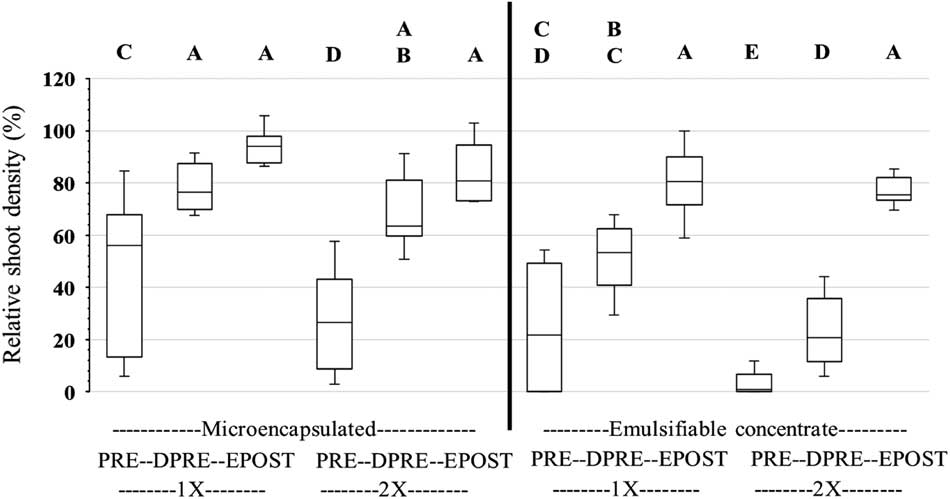
Measurements of plant height relative to the nontreated plots followed trends similar to estimates of rice injury and relative shoot density (unpublished data). A main effect for all three factors influenced relative height where EC acetochlor, DPRE application timings, and the 2,100 g ai ha−1 rate caused the greatest reduction (Tables 4 and 5). Contrary to injury estimates, there were minimal differences in relative height among most treatments because of variability in these data (unpublished data), indicating that injury in these plots was mainly manifested as reduced shoot density (Figure 3).
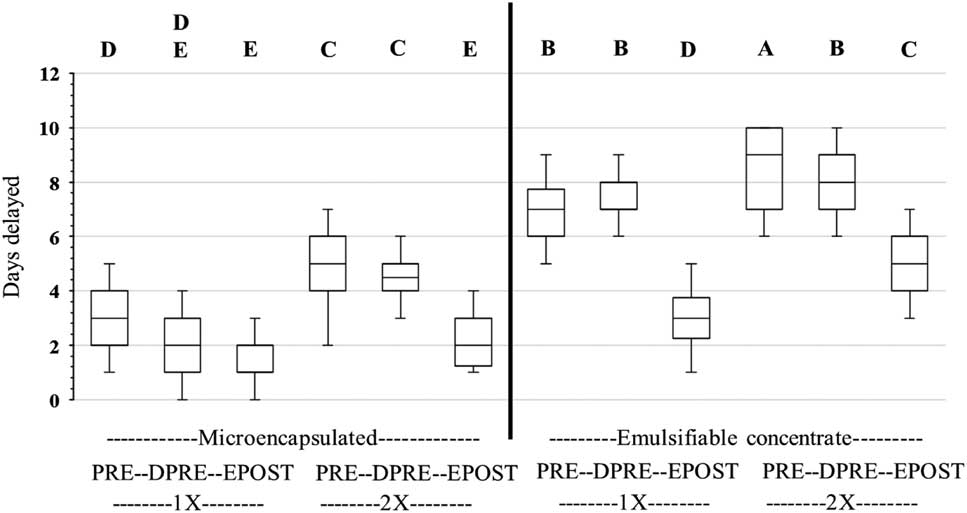
A 1- to 10-d delay in days to 50% heading relative to the nontreated was often observed in association with damage to rice earlier in the year (Figure 4). Rice maturity was delayed few days in ME acetochlor plots compared with EC acetochlor plots. In addition, treatments that caused severe rice injury earlier in the season had longer delays in maturity than rice that did not experience early-season injury. Acetochlor applied PRE was responsible for rice injury at 2 WAT and 4 WAF and was also responsible for the greatest number of days delay in reaching 50% heading (Table 3; Figure 4). Delays in rice heading are generally unfavorable for growers due to the cost of extending irrigation schedules and crop damage from inclement weather later in the summer.
Days delayed to 50% heading relative to the nontreated averaged over site-years at the Pine Tree Research Station, Rice Research and Extension Center, and University of Arkansas Pine Bluff Farm. The three-way interaction of formulation, application timing, and acetochlor rate was significant; hence, means of bars with the same letter are not significantly different according to Fisher’s protected LSD (α = 0.05). Abbreviations: DPRE, delayed PRE; EPOST, early POST; 1X, 1,050 g ai ha−1; 2X, 21,00 g ai ha−1.
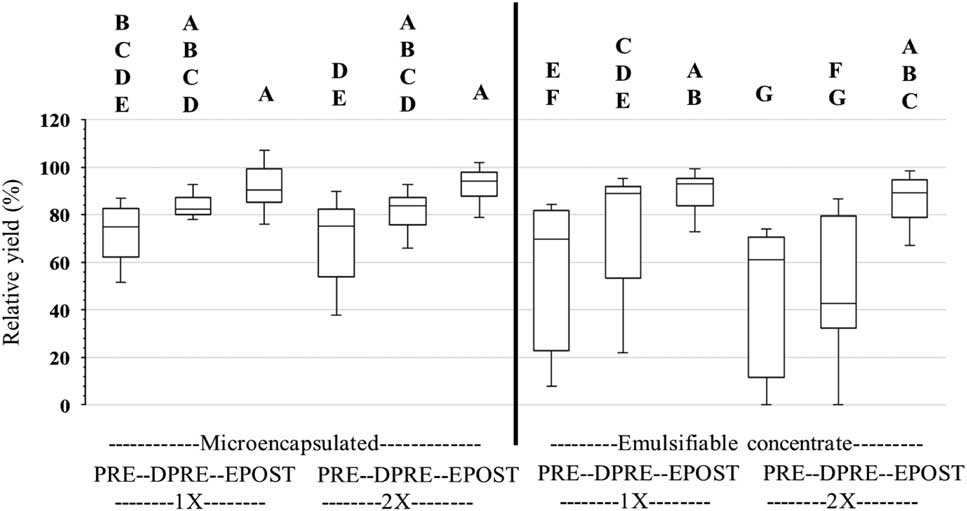
Rough rice yields generally increased as application timing was delayed when compared with the PRE timing, regardless of formulation or rate (Figure 5). The slow release of acetochlor in the ME formulation, in addition to delayed timing for the EPOST application, allowed rice to become well established before being exposed to herbicide, which resulted in decreased early-season injury and ultimately increased yield compared with the PRE timing.
Percent yield relative to the nontreated averaged over site-years at the Pine Tree Research Station, Rice Research and Extension Center, and University of Arkansas Pine Bluff Farm. The three-way interaction of formulation, application timing, and acetochlor rate was significant; hence, means of bars with the same letter are not significantly different according to Fisher’s protected LSD (α = 0.05). Average yield of the nontreated was 9,400 kg ha−1. Abbreviations: DPRE, delayed PRE; EPOST, early POST; 1X, 1,050 g ai ha−1; 2X, 2,100 g ai ha−1.
Conclusions
In the given environments, rice was most tolerant to applications of ME acetochlor at the EPOST timing. EC acetochlor sometimes caused greater crop injury and reduced shoot density and plant height, with delayed maturity and decreased yield. Increased rice tolerance to the ME formulation may be attributed to the gradual release of herbicide following an activating rainfall. The elapsed time between application of ME acetochlor and herbicide absorption allows rice to develop uninhibited and even emerge before being exposed to lethal doses of herbicide, thus reducing its susceptibility.
Practical Implications
EC acetochlor resulted in unacceptable rice injury and is not a viable option for weed control in rice, even when applied EPOST. Conversely, ME acetochlor applied EPOST should be further evaluated for tolerance across additional environments and as a component of rice weed control programs. These results coincide with those of Godwin (Reference Godwin2017). However, data presented here indicate that even when ME acetochlor is applied, increased rice injury is associated with PRE and DPRE applications. Soil moisture at planting and near time of application can play a significant role in the level of crop injury observed. For example, a PRE application of ME acetochlor that is activated >7 d after application would likely cause minimal rice injury. However, the same application followed by significant rainfall or immediate flushing could be devastating to rice emergence and growth, as seen in other research (JKN, unpublished data), and therefore could never be recommended PRE or DPRE. Should ME acetochlor be granted a label for use in U.S. rice, it should be applied to 1- to 2-leaf rice at 1,050 g ai ha−1 to ensure adequate crop tolerance.
Acknowledgments
Funding for this research was provided by the Arkansas Rice Research and Promotion Board. No conflicts of interests have been declared.


 Open access

