





Introduction
More than half of U.S. children experience significant adversity by the time they reach adulthood (Finkelhor, Ormrod, et al., Reference Finkelhor, Ormrod and Turner2009; Finkelhor, Turner, et al., Reference Finkelhor, Turner, Ormrod and Hamby2009; McLaughlin et al., Reference McLaughlin, Green, Alegría, Costello, Gruber, Sampson and Kessler2012). This includes experiences involving threat, which involve actual harm or threat of harm to survival (e.g., physical abuse or witnessing violence), and deprivation, characterized by reductions in social and/or cognitive inputs and stimulation (e.g., neglect, parental separation) (Mclaughlin et al., Reference McLaughlin, Sheridan and Lambert2014; Sheridan & McLaughlin, Reference Sheridan and McLaughlin2014). Both types of experiences are associated with increased risk for psychopathology, including internalizing and externalizing symptoms (Clark et al., Reference Clark, Caldwell, Power and Stansfeld2010; Cohen et al., Reference Cohen, Brown and Smaile2001; Green et al., Reference Green, McLaughlin, Berglund, Gruber, Sampson, Zaslavsky and Kessler2010; Kessler et al., Reference Kessler, McLaughlin, Green, Gruber, Sampson, Zaslavsky, Aguilar-Gaxiola, Alhamzawi, Alonso, Angermeyer, Benjet, Bromet, Chatterji, de Girolamo, Demyttenaere, Fayyad, Florescu, Gal and Gureje2010; McLaughlin et al., Reference McLaughlin, Green, Alegría, Costello, Gruber, Sampson and Kessler2012). Although the association between childhood adversity and the development of psychopathology has been widely replicated, much remains unknown about the precise mechanisms through which early adversity influences mental health outcomes across development and resilience factors that may buffer against psychopathology following childhood adversity. Better characterizing potential mechanisms and moderators is critical for developing interventions and bolstering existing strategies to prevent or mitigate psychopathology following adversity experiences.
Adversity and reward processing
One candidate mechanism that has been widely studied in the link between adversity and psychopathology is reward processing, a complex set of neural, psychological, and behavioral responses that organize behavior to achieve rewards (Olino, Reference Olino2016). Several aspects of reward processing have been routinely highlighted in the clinical literature, including reward sensitivity and approach motivation. Sensitivity to reward value reflects the degree to which behavioral reward-related responses scale with reward value. Approach motivation reflects an organism’s ability to assess the value of reward and exert effort to obtain a reward. These two constructs have been identified as both mechanisms and moderators in the association between adversity experiences and psychopathology in prior work (Dennison et al., Reference Dennison, Sheridan, Busso, Jenness, Peverill, Rosen and McLaughlin2016; Kasparek et al., Reference Kasparek, Jenness and McLaughlin2020; Sheridan et al., Reference Sheridan, McLaughlin, Winter, Fox, Zeanah and Nelson2018; Wismer Fries & Pollack, Reference Wismer Fries and Pollak2017).
Childhood adversity has been linked with both behavioral and neural indices of approach motivation and sensitivity to reward value; however, the magnitude and direction of associations vary by adversity type (see Oltean et al., Reference Oltean, Şoflău, Miu and Szentágotai-Tătar2022 for a meta-analysis). Deprivation – characterized by institutionalization, material deprivation, and neglect – is consistently associated with blunted behavioral approach motivation and reduced behavioral sensitivity to reward value compared to youth who have not experienced deprivation (Bounoua et al., Reference Bounoua, Church and Sadeh2021; Dennison et al., Reference Dennison, Rosen, Sambrook, Jenness, Sheridan and McLaughlin2019; Kasparek et al., Reference Kasparek, Jenness and McLaughlin2020; Sheridan et al., Reference Sheridan, McLaughlin, Winter, Fox, Zeanah and Nelson2018; Wismer Fries & Pollak, Reference Wismer Fries and Pollak2017). Youth who have experienced deprivation also demonstrate reduced responsiveness to reward in the fronto-striatal valuation network, including the ventral striatum, putamen, and pallidum, in response to appetitive stimuli (Boecker et al., Reference Boecker, Holz, Buchmann, Blomeyer, Plichta, Wolf, Baumeister, Meyer-Lindenberg, Banaschewski, Brandeis and Laucht2014; Goff et al., Reference Goff, Gee, Telzer, Humphreys, Gabard-Durnam, Flannery and Tottenham2013; Hanson et al., Reference Hanson, Hariri and Williamson2015; for review see Hanson et al., Reference Hanson, Williams, Bangasser and Peña2021). In contrast, studies examining associations of exposure to threat – such as abuse or witnessing domestic or community violence – with behavioral and neural reward processing outcomes have produced less consistent results. Some studies have demonstrated poorer performance on reward learning tasks (Hanson et al., Reference Hanson, van den Bos, Roeber, Rudolph, Davidson and Pollak2017) and blunted approach motivation (Guyer et al., Reference Guyer, Kaufman, Hodgdon, Masten, Jazbec, Pine and Ernst2006; Kasparek et al., Reference Kasparek, Jenness and McLaughlin2020) among threat-exposed youth. Others have observed no association of threat experiences with approach motivation (Bounoua et al., Reference Bounoua, Church and Sadeh2021) or behavioral sensitivity to reward value (Armbruster-Genç et al., Reference Armbruster-Genç, Valton, Neil, Vuong, Freeman, Packer, Kiffin, Roiser, Viding and McCrory2022; Dennison et al., Reference Dennison, Sheridan, Busso, Jenness, Peverill, Rosen and McLaughlin2016, 2019; Kasparek et al., Reference Kasparek, Jenness and McLaughlin2020). This ambiguity is mirrored in the developmental neuroscience literature, with some studies observing blunted responsivity in canonical reward processing regions (e.g., left pallidum and left putamen) in adults with childhood threat experiences (Dillon et al., Reference Dillon, Holmes, Birk, Brooks, Lyons-Ruth and Pizzagalli2009) and other studies observing heightened responsivity in the ventral striatum to appetitive stimuli among threat-exposed youth (Dennison et al., Reference Dennison, Sheridan, Busso, Jenness, Peverill, Rosen and McLaughlin2016).
Reward processing and psychopathology
Variability in reward processing at both behavioral and neural levels has been consistently linked with both concurrent and future psychopathology. Studies examining behavioral reward processing among depressed individuals consistently find blunted approach motivation (Morris et al., Reference Morris, Bylsma, Yaroslavsky, Kovacs and Rottenberg2015) and blunted sensitivity to reward value (Pizzagalli et al., Reference Pizzagalli, Iosifescu, Hallett, Ratner and Fava2008; Vrieze et al., Reference Vrieze, Pizzagalli, Demyttenaere, Hompes, Sienaert, Boer, Schmidt and Claes2013). Similarly, depressed individuals demonstrate blunted neural responsivity to rewarding stimuli in striatal regions (Forbes & Dahl, Reference Forbes and Dahl2012; Luking et al., Reference Luking, Pagliaccio, Luby and Barch2016; Zhang et al., Reference Zhang, Chang, Guo, Zhang and Wang2013). These blunted patterns of neural and behavioral reward processing have additionally been observed in adolescents previously diagnosed with depression (Fischer et al., Reference Fischer, Ellwood-Lowe, Colich, Cichocki, Ho and Gotlib2019; Forbes et al., Reference Forbes, Shaw and Dahl2007) and have been linked with heightened risk for developing depression among adolescents (Gotlib et al., Reference Gotlib, Hamilton, Cooney, Singh, Henry and Joormann2010). Perhaps the most convincing evidence for this link comes from longitudinal studies showing that adolescents who demonstrate blunted neural responses to reward are more likely to develop depression over time (Bress et al., Reference Bress, Foti, Kotov, Klein and Hajcak2013; Nelson et al., Reference Nelson, Perlman, Klein, Kotov and Hajcak2016). Given the robust literature spanning adolescence and adulthood, blunted reward processing across behavioral and neural levels appears to be a meaningful risk factor for depression.
Both behavioral and neural indices of reward processing have also been linked with externalizing psychopathology. Studies examining trait-level measures (Gudiño et al., Reference Gudiño, Nadeem, Kataoka and Lau2012; Hundt et al., Reference Hundt, Kimbrel, Mitchell and Nelson-Gray2008) and behavioral measures (Fosco et al., Reference Fosco, Meisel, Weigard, White and Colder2022) of sensitivity to reward value demonstrate positive associations with externalizing problems among adolescents. Similarly, correlational studies link heightened responsivity in the ventral striatum, caudate, and nucleus accumbens, all brain regions implicated in reward valuation, with heightened externalizing problems among youth (Bjork et al., Reference Bjork, Chen, Smith and Hommer2010; Gatzke-Kopp et al., Reference Gatzke-Kopp, Beauchaine, Shannon, Chipman, Fleming, Crowell, Liang, Aylward and Johnson2009; Hawes, Reference Hawes2022) and adults (Buckholtz et al., Reference Buckholtz, Treadway, Cowan, Woodward, Benning, Li, Ansari, Baldwin, Schwartzman, Shelby, Smith, Cole, Kessler and Zald2010). Adolescents diagnosed with various externalizing problems also demonstrate difficulty suppressing reward-related neural responses to stimuli that previously predicted reward (Gatzke-Kopp et al., Reference Gatzke-Kopp, Beauchaine, Shannon, Chipman, Fleming, Crowell, Liang, Aylward and Johnson2009). Evidence from these studies seems to suggest that heightened neural sensitivity to reward value may be a risk factor for externalizing problems. However, other studies have demonstrated the opposite: that blunted reward sensitivity may be associated with externalizing problems. For example, one prior study has found that blunted behavioral approach motivation is associated with greater externalizing problems in adolescents (Kasparek et al., Reference Kasparek, Jenness and McLaughlin2020). Several studies examining neural responsivity in striatal regions among children, adolescents, and adults exhibiting high levels of disinhibition and externalizing problems find blunted responsivity in these brain regions (Büchel et al., Reference Büchel, Peters, Banaschewski, Bokde, Bromberg, Conrod, Flor, Papadopoulos, Garavan, Gowland, Heinz, Walter, Ittermann, Mann, Martinot, Paillère-Martinot, Nees, Paus and Pausova2017; Joyner et al., Reference Joyner, Bowyer, Yancey, Venables, Foell, Worthy, Hajcak, Bartholow and Patrick2019; Plichta & Scheres, Reference Plichta and Scheres2014; Scheres et al., Reference Scheres, Milham, Knutson and Castellanos2007). Due to mixed findings with respect to behavioral and neural reward processing and externalizing psychopathology, further work is needed to clarify this association.
Childhood adversity, reward processing, and psychopathology
Given the associations of childhood adversity with reward processing, and between reward processing and psychopathology, some studies have examined whether reward processing is a mechanism explaining the link between adversity and psychopathology. Existing evidence has implicated reward processing as a mechanism underlying the association between experiences of deprivation and increased depression symptoms (Sheridan et al., Reference Sheridan, McLaughlin, Winter, Fox, Zeanah and Nelson2018; Dennison et al., Reference Dennison, Rosen, Sambrook, Jenness, Sheridan and McLaughlin2019; Hanson et al., Reference Hanson, Hariri and Williamson2015) and externalizing problems (Hanson et al., Reference Hanson, van den Bos, Roeber, Rudolph, Davidson and Pollak2017). In contrast, other studies have provided evidence for reward processing as a moderator of the association of childhood adversity with psychopathology, such that children who have experienced adversity but have elevated reward sensitivity are at lower risk of both depression and externalizing problems than children with lower reward sensitivity. In one study, threat experiences were associated with increased depression symptoms only in youths with low and moderate levels of behavioral and neural sensitivity to reward value, but not high-reward sensitivity (Dennison et al., Reference Dennison, Sheridan, Busso, Jenness, Peverill, Rosen and McLaughlin2016). In a recent study, we observed a similar moderating role of behavioral sensitivity to reward, such that childhood threat experiences were positively associated with externalizing problems at low and moderate levels of behavioral reward sensitivity but not at high levels of reward sensitivity (Kasparek et al., Reference Kasparek, Jenness and McLaughlin2020). Thus, high sensitivity to reward after experiencing threat in childhood may buffer adolescents from developing both internalizing and externalizing psychopathology. In contrast, one prior study found that heightened behavioral approach motivation may strengthen the association between threat experiences and externalizing problems (Gudiño et al., Reference Gudiño, Nadeem, Kataoka and Lau2012).
Present study
The present study examined associations of both threat and deprivation experiences with behavioral (e.g., approach motivation and reward reactivity) and neural (e.g., fronto-striatal resting-state functional connectivity) indices of reward processing, as well as the links between these measures of reward processing with later psychopathology in a large sample of adolescents followed over the course of two years. The primary aim of the study is to clarify whether these indices of reward processing mediate or moderate the prospective association of threat and deprivation experiences with depression and externalizing symptoms, which have the strongest links with reward processing. We expand on prior work by utilizing a sample recruited for variability in threat and deprivation experiences, measuring these experiences continuously in line with dimensional models of adversity (McLaughlin et al., Reference McLaughlin, Sheridan and Lambert2014, Reference McLaughlin, Sheridan, Humphreys, Belsky and Ellis2021), and including both behavioral and neural indices of reward processing as predictors of changes in both depression and externalizing symptoms over time. Our hypotheses, methods, and analytic plan were preregistered on Open Science Framework prior to analyzing the data (https://osf.io/z58by). As we found no significant associations related to fronto-striatal resting-state functional connectivity that survived correction for multiple comparisons, all imaging-related methods, and results have been moved to the Supplemental Material.
Method
Participants and procedure
Participants were part of a longitudinal study of youth followed from age 36 months in the Seattle, Washington area (Lengua et al., Reference Lengua, Moran, Zalewski, Ruberry, Kiff and Thompson2015). Children and a caregiver were recruited from a university hospital birth registry, daycares, preschools, health clinics, and charitable agencies to facilitate a uniform distribution across socioeconomic status based on annual family income. For the present study, contact was attempted with all participants who participated in the most recent prior wave of data collection for the original longitudinal study, who were between 10 and 13 years of age (n = 228; M age = 11.58 years, SD = .48). All participants completed comprehensive measures of adversity and psychopathology. A total of 211 participants (93%) had usable data with which to estimate models including behavioral reward processing variables; 131 (58%) completed an MRI scan and had usable data with which to estimate models involving resting-state functional connectivity (see fMRI preprocessing in the Supplemental Material for details). All 228 participants were recontacted approximately 1–2 years later, at which point 206 participants (90%) completed follow-up psychopathology measures (M age = 13.68 years, SD = .35). The racial/ethnic composition of the baseline sample approximates that of the greater-Seattle area: White (n = 145, 64%), Black (n = 28, 12%), Latinx (n = 25, 11%), Asian (n = 18, 8%), and Other (n = 11, 5%). All procedures for the first wave of data collection were approved by the institutional review board at the University of Washington; procedures for the second wave of data collection were approved by the institutional review board at Harvard University. Informed consent and assent were obtained from caregivers and children at each wave, respectively.
Materials and measures
Threat and deprivation indices were operationalized consistent with prior work in this sample and prior preregistered definitions of these constructs (e.g., Weissman et al., Reference Weissman, Rosen, Colich, Sambrook, Lengua, Sheridan and McLaughlin2022). All adversity variables were assessed when participants were 10–13 years old.
Threat
To quantify threat, we used a composite of the number, frequency, and severity of violent experiences. First, we created an indicator of the number of distinct types of violence experienced by the child. To do so we created a count of exposure to five types of interpersonal violence: physical abuse, sexual abuse, domestic violence, witnessing a violent crime, or being a victim of a violent crime. Each exposure was counted if it was endorsed by the caregiver or child on the University of California, Los Angeles, PTSD Reaction Index (PTSD-RI, Steinberg et al., Reference Steinberg, Brymer, Decker and Pynoos2004, Reference Steinberg, Brymer, Kim, Briggs, Ippen, Ostrowski, Gully and Pynoos2013). We additionally coded physical abuse, sexual abuse, and domestic violence as present if they were endorsed by either the participant on the Childhood Experiences of Care and Abuse Interview (CECA) or the caregiver on the Juvenile Victimization Questionnaire. Second, we created a measure of the frequency of violence exposure by summing frequency ratings of witnessed and experienced violence from the Violence Exposure Scale for Children-Revised. Third, we created a measure of violence severity by summing the severity scores from the Childhood Trauma Questionnaire (CTQ; Bernstein et al., Reference Bernstein, Fink, Handelsman, Foote, Lovejoy, Wenzel, Sapareto and Ruggiero1994, Reference Bernstein, Ahluvalia, Pogge and Handelsman1997) Physical and Sexual Abuse subscales. To create the final composite for threat experiences, we first standardized each of these three sub-scales and then averaged them together.
Deprivation
To quantify deprivation, we used a composite of cognitive, emotional, and material forms of deprivation.
Cognitive deprivation was quantified using the Home Observation Measurement of the Environment–Short Form (Totsika & Sylva, Reference Totsika and Sylva2004). This measure assesses numerous forms of cognitive stimulation, including the presence of learning materials in the home, the child’s engagement with activities outside the home, the degree of parent-child interaction, and parent scaffolding of child learning. The original scoring assesses the degree of cognitive stimulation. Because we were interested in quantifying cognitive deprivation, we reversed-scored the measure. The HOME items are scored dichotomously such that the presence of a stimulating activity or experience is coded as 1 and the absence is coded as 0. To create a cognitive deprivation measure, we created a binary score of the 19 cognitive stimulation items such that the presence of each item reflecting cognitive stimulation was scored as a 0 and the absence was scored as a 1. We then z-scored this variable to create a final cognitive deprivation variable.
Emotional deprivation was quantified by creating a composite of several scales assessing the emotional neglect of the child by caregivers. These included the Emotional Neglect items from the neglect assessment in the CECA Interview (Bifulco et al., Reference Bifulco, Brown and Harris1994) as well as the Emotional Neglect subscale of the Multidimensional Neglectful Behavior Scale (MNBS) (Straus & Kantor, Reference Straus and Kantor2005). The CECA neglect scale includes items that assess both emotional and physical neglect. We included only items assessing emotional neglect. These include items 2, 3, 5, 8, 11, 12, 13, and 14. We created a total sum score for each of these scales, standardized each scale (i.e., created a z-score), and averaged these two z-scores together to create the final composite score of emotional deprivation.
Material deprivation was quantified using the Physical Needs subscale of the MNBS, the 4-item Household Food Insecurity Scale (Blumberg et al., Reference Blumberg, Bialostosky, Hamilton and Briefel1999), and the Physical Neglect subscale of the CTQ. Because each of these items are on similar scales and had a nearly identical range in our dataset, we took the mean of these three scales and then created a z-score from this average to create a composite score of material deprivation.
To create a composite reflecting all three types of deprivation, we took the mean of the cognitive, emotional, and material deprivation standardized scores.
Depression symptoms
Depression symptoms were measured during both waves of data collection. During the first wave, participants completed the Children’s Depression Inventory-II (CDI-II; Kovacs, Reference Kovacs2011), a widely-used self-report measure of depression symptoms validated for use with children and adolescents. The CDI-II consists of 28 items, with response options for each item phrased to parallel a three-point severity scale ranging from 0 to 2 (e.g., “I am sad once in a while (0),” “I am sad many times (1),” “I am sad all the time (2)”). During the second wave, participants again completed the CDI-II in a single-session virtual visit. To derive depression symptom scores, the 28 items of the CDI-II were summed for each participant. Given a right-skewed count distribution, this variable was then transformed into a proportion score reflecting severity endorsed relative to the highest possible severity of symptoms (i.e., constrained between 0 and 1) to render a healthier distribution and better facilitate appropriate model selection. The CDI-II has good validity and reliability (Bae, Reference Bae2012). We focused on self-report measures of depression symptoms given evidence that youth report more depressive symptoms than their caregivers and that youth self-reports of internalizing symptoms have higher validity than caregiver reports (Aebi et al., Reference Aebi, Kuhn, Banaschewski, Grimmer, Poustka, Steinhausen and Goodman2017; Cantwell et al., Reference Cantwell, Lewinsohn, Rohde and Seeley1997; Moretti et al., Reference Moretti, Fine, Haley and Marriage1985).
Externalizing symptoms
Participants and their caregivers individually completed the Youth Self-Report (YSR) and Child Behavioral Checklist (CBCL), respectively, at both waves of data collection (Achenbach, Reference Achenbach1991). The YSR and CBCL were chosen because they are widely used to assess youth behavioral and emotional problems and each measure uses extensive normative data to generate age- and sex-standardized estimates of symptom severity. The Externalizing Problems composite subscale used in the present study includes aggressive behaviors (e.g., “gets into fights,” “disobeys at home/school”) and rule-breaking behaviors (e.g., “runs away,” “sets fires”). Both caregiver- and youth-reported externalizing problems were examined (Bird et al., Reference Bird, Gould and Staghezza1992; Grills & Ollendick, Reference Grills and Ollendick2002). We used the highest composite T-score reported between participants and their caregivers, consistent with prior operationalizations of this variable (Kasparek et al, Reference Kasparek, Jenness and McLaughlin2020).
Behavioral reward processing
Participants completed a child-friendly version of the monetary incentive delay task that depicts cartoon animal piñatas (Helfinstein et al., Reference Helfinstein, Kirwan, Benson, Hardin, Pine, Ernst and Fox2013; see Figure S1 in the Supplemental Material). Each piñata contains a variable number of stars (0, 1, 2, or 4). Children are instructed to hit the piñata as quickly as possible to earn the stars within and told that the number of stars they earn will determine whether or not they receive a monetary bonus. On each trial, children make a speeded response to a target in order to earn the stars inside the piñata. Each trial is composed of three stages: anticipation, response, and feedback. In the anticipation stage, children see a cue indicating the size of the potential reward (the number of stars within the piñata) for that trial. The bottom portion of the piñata containing the stars is revealed at the top of the screen, but the children cannot yet hit it. In the response stage, children can earn the stars for that trial by responding quickly once the target reappears. During this stage, the piñata drops to the middle of the screen and children press the spacebar on a keyboard as quickly as they can to hit the piñata. In the outcome stage, children see and hear feedback indicating whether or not their response was fast enough to receive the reward. For successful trials (i.e., hits), the piñata cracks open and the stars are deposited into a basket at the bottom of the screen. On unsuccessful trials (i.e., misses), children see the intact piñata swing to the side of the screen with the stars still inside. The task was designed to be visually appealing and engaging for children. In order to incentivize performance, all children were told they would receive $10 of bonus money if they earned enough stars. Upon completion, all children received the $10 irrespective of performance.
Prior to the task, participants played a practice round of the task comprised of 22 trials. During this practice task, the response window for hitting the target piñata was 250–300ms. Performance on the practice task was used to determine the length of the response window to be used for each participant in the final task, consistent with prior work (Helfinstein et al., Reference Helfinstein, Kirwan, Benson, Hardin, Pine, Ernst and Fox2013; Kasparek et al., Reference Kasparek, Jenness and McLaughlin2020). This was done to make the task equally challenging for all children despite individual differences in processing speed and baseline reaction time. However, once the task commenced, display time was no longer manipulated based on the participant’s performance during the task, meaning that each child had the opportunity to improve their performance throughout the task. During the final task, the cue first appeared at 1,500ms, followed by a cue-free anticipatory period that varied between 1,000–2,000ms. The target appeared for a variable duration based on performance on the practice trials (see Supplemental Material for details), followed by a delay period with a duration such that the target period and delay period combined to a total of 1,500ms. Finally, the feedback appeared for 1,500ms. The practice task consisted of six task runs of 22 trials each, for a total of 132 trials. Trials were divided evenly between the four incentive levels for a total of 33 trials at each incentive level.
From this task, we operationalized two different reward processing variables. Consistent with the definition of approach motivation as involving the regulation of behaviors that result in reward achievement (Olino, Reference Olino2016) and prior studies using this task (Dennison et al., Reference Dennison, Rosen, Sambrook, Jenness, Sheridan and McLaughlin2019; Kasparek et al., Reference Kasparek, Jenness and McLaughlin2020), we interpreted the total number of stars earned on the behavioral reward task to indicate the child’s effortful engagement with the task, and ability to regulate their behavior to achieve the maximum reward (i.e., a global index of motivation to obtain reward). Given a left-skewed count distribution, this variable was transformed into a proportion of total stars earned (i.e., constrained between 0 and 1). We also examined behavioral sensitivity to reward value by calculating differences in reaction time (RT) to high-reward trials (i.e., four stars) compared with the low- and no-reward trials (i.e., zero, one, and two stars), averaged across all trials in the task. This construct measures the degree to which children modulate their behavior in response to varying reward values on a trial-by-trial basis and has been used in both child and adult studies of reward processing (Guyer et al., Reference Guyer, Kaufman, Hodgdon, Masten, Jazbec, Pine and Ernst2006; Kasparek et al., Reference Kasparek, Jenness and McLaughlin2020; Olino, Reference Olino2016; Pizzagalli et al., Reference Pizzagalli, Holmes, Dillon, Goetz, Birk, Bogdan, Dougherty, Iosifescu, Rauch and Fava2009; van Hulst et al., Reference van Hulst, Zeeuw, Lupas, Bos, Neggers and Durston2015). A positive score indicates greater behavioral sensitivity to reward value (i.e., faster RT on high- compared with low- or no-reward trials).
Analysis Plan
All analyses were performed using R (Version 4.0.3, 2023). Our goal was to examine whether threat and deprivation experiences were associated with variability in behavioral indices of reward processing. We also evaluated whether individual differences in behavioral indices of reward processing may mediate or moderate associations of threat and deprivation experiences with longitudinal psychopathology outcomes. We first estimated models separately for threat and deprivation, followed by adjusted models in which both threat and deprivation were included, following recommendations for examining unique contributions of distinct dimensions of adversity (McLaughlin & Sheridan, Reference McLaughlin and Sheridan2016). Models examining longitudinal psychopathology outcomes control for baseline symptoms. All models include age at the time of assessment and sex as covariates. Standardized regression coefficients are reported throughout when possible.
We first examined associations of threat and deprivation with prospective depression and externalizing symptoms. Second, we examined associations of threat and deprivation with behavioral approach motivation and behavioral sensitivity to reward value. Next, we examined associations of approach motivation and sensitivity to reward value with longitudinal psychopathology outcomes. For models in which the proportion of depression symptoms endorsed out of the max score or approach motivation (i.e., proportion of total stars earned on the task) were the outcome variables, we used beta regression via the betareg package and thus unstandardized betas are reported. For all other models, linear regression via the glm() package was used.
Lastly, we conducted a series of mediation and moderation analyses. We used the mediation package in R (Tingley et al., Reference Tingley, Yamamoto, Hirose, Keele and Imai2014) to estimate the significance of indirect effects using a bootstrapping approach (10,000 iterations) that provides confidence intervals for indirect effects. We estimated indirect effects for all models, regardless of whether the direct path (i.e., c path) was significant, consistent with recommendations in modern approaches to mediation analysis (Hayes, Reference Hayes2009; MacKinnon et al., Reference MacKinnon, Fairchild and Fritz2007; Rucker et al., Reference Rucker, Preacher, Tormala and Petty2011; Shrout & Bolger, Reference Shrout and Bolger2002). Interaction effects were estimated to examine whether associations of threat and deprivation with psychopathology were moderated by behavioral indices of reward processing. Main effects, covariates, and interaction terms were entered simultaneously. Significant interactions were probed with simple-slopes analysis at the mean and at 2 SD and 1 SD above and below the mean of the moderator variable (McCabe et al, Reference McCabe, Kim and King2018). We used the p.adjust function in R to run false discovery rate (FDR) corrections for multiple comparisons for each hypothesis in which multiple tests were performed per standard procedure (Benjamini & Yekutieli, Reference Benjamini and Yekutieli2001). FDR-corrected p values are reported.
Results
Descriptive statistics
Means, standard deviations, and intercorrelations for all variables are given in Table 1.
Descriptive statistics and intercorrelations for main analyses

* p < .05.
** p < .01
*** p < .001.
Adversity and psychopathology
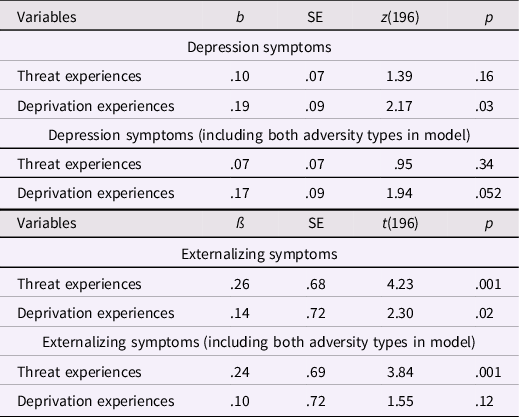
Deprivation was positively associated with prospective depression symptoms (b = .19, p = .03), but only at a trend-level when including both adversity dimensions in the model (b = .17, p = .053). Threat (β = .26, p < .001) and deprivation experiences (β = .14, p = .02) were positively associated with prospective externalizing symptoms, but only threat experiences remained a significant predictor (β = .24, p < .001) upon including both adversity dimensions in the model (See Table 2).
Adversity associations with longitudinal psychopathology
Adversity and reward processing
Greater threat experiences were negatively associated with sensitivity to reward value (β = −.14, p = .04), which persisted at a trend-level after including deprivation in the model (β = −.14, p = .054) (See Fig. 1). Neither threat nor deprivation experiences (ps > .05) were associated with approach motivation (See Table 3).
Association of threat experiences with behavioral sensitivity to reward value. The x-axis reflects the Z-score of threat experiences including the frequency, severity, and chronicity of experiences. Higher scores represent more (severe) threat experiences. The y-axis represents the difference between average response times on high vs low/no-reward trials on a MID task for each participant.

Adversity associations with behavioral reward processing

Reward processing and psychopathology
Sensitivity to reward value was negatively associated with prospective depression symptoms (b = -.003, p = .02) but not externalizing symptoms (p > .05) (See Fig. 2). Approach motivation was not associated with longitudinal depression nor externalizing symptoms (ps > .05) (See Table 4).
Association of behavioral sensitivity to reward value with prospective depression (a) and externalizing symptoms (b).

Associations of behavioral reward processing with longitudinal psychopathology

Reward processing as a mediator
We observed a significant indirect effect of threat experiences on prospective depression symptoms through behavioral sensitivity to reward value (b = .18, 95% CI = [.01, .49]), indicating that sensitivity to reward value mediated the association of threat experiences with increases in depression symptoms over time.
Reward processing as a moderator
Sensitivity to reward value moderated the association of deprivation with prospective externalizing symptoms, controlling for baseline symptoms (β = −.17, SE = .02, t (181) = −2.62, p = .01); this interaction remained significant after controlling for threat experiences (β = −.16, SE = .01, t (180) = −2.71, p = .01). Simple-slopes analysis revealed that the association between deprivation experiences and externalizing symptoms was positive and significant at low and moderate levels of reward reactivity but became nonsignificant at high levels of sensitivity to reward value (See Fig. 3). No other interactions were observed (ps > .05) (See Table 5).
Association between deprivation experiences (a) and deprivation experiences (controlling for threat) (b) and externalizing symptoms with behavioral reward sensitivity as a moderator. Simple slopes are provided for levels of the moderator 2 SD and 1 SD below the mean, at the mean, and 1 SD and 2 SD above the mean. Each graphic shows the computed 95% confidence region (shaded area), the observed data (grey dots), the maximum and minimum values of the outcome (dashed horizontal lines), and the crossover point (diamond). CI = confidence interval; PTCL = percentile.

Adversity by reward processing interactions predicting longitudinal psychopathology

Discussion
Childhood experiences of adversity, including both deprivation and threat, have been consistently linked with risk for depression and externalizing symptoms (Clark et al., Reference Clark, Caldwell, Power and Stansfeld2010; Cohen et al., Reference Cohen, Brown and Smaile2001; McLaughlin et al., Reference McLaughlin, Green, Alegría, Costello, Gruber, Sampson and Kessler2012). Alterations in reward processing at both behavioral and neural levels have been highlighted as both a potential mechanism linking these early adverse experiences with various psychopathology outcomes and at times a moderator buffering the association of early adversity with psychopathology at high levels of reward processing (Dennison et al., Reference Dennison, Sheridan, Busso, Jenness, Peverill, Rosen and McLaughlin2016; Sheridan et al., Reference Sheridan, McLaughlin, Winter, Fox, Zeanah and Nelson2018; 2019, Gudiño et al., Reference Gudiño, Nadeem, Kataoka and Lau2012; Hanson et al., Reference Hanson, Hariri and Williamson2015; Kasparek et al., Reference Kasparek, Jenness and McLaughlin2020). First, we demonstrate that reduced sensitivity to reward value may be a mechanism linking early threat experiences with future increases in symptoms of depression, consistent with previous studies (Sheridan et al., Reference Sheridan, McLaughlin, Winter, Fox, Zeanah and Nelson2018; Dennison et al., Reference Dennison, Rosen, Sambrook, Jenness, Sheridan and McLaughlin2019, Hanson et al., Reference Hanson, Hariri and Williamson2015). Second, we extend prior work by demonstrating that reduced behavioral sensitivity to reward value moderates the association of deprivation experiences with externalizing symptoms, such that youth who exhibit high levels of reward sensitivity after early-life deprivation are buffered against developing externalizing problems over time. Combined with our prior work (Kasparek et al., Reference Kasparek, Jenness and McLaughlin2020), this highlights heightened reward sensitivity as protective against developing externalizing problems after experiences of both deprivation and threat. The present study implicates blunted reward sensitivity as a mechanism underlying threat-related increases in depression symptoms during adolescence, and heightened reward sensitivity as a potential resilience factor that buffers against the emergence of externalizing problems following adversity experiences.
Childhood adversity and reward processing
Greater threat experiences were associated with blunted behavioral sensitivity to reward, consistent with our hypotheses. In a prior study, we demonstrated associations of childhood experiences of threat with reduced approach motivation, indexed by fewer total points earned on a behavioral reward processing task (Kasparek et al., Reference Kasparek, Jenness and McLaughlin2020). Here, we extend this work by showing that youth with greater threat experiences exhibit reduced behavioral sensitivity to reward value as well, consistent with prior work in adults (Dillon et al., Reference Dillon, Holmes, Birk, Brooks, Lyons-Ruth and Pizzagalli2009). Children who have experienced threat often grapple with inconsistency in parenting behaviors, such as heightened levels of punishment and diminished instances of positive reinforcement (Pollak, Reference Pollak2015; Shackman et al., Reference Shackman, Fatani, Camras, Berkowitz, Bachorowski and Pollak2010). Infrequent experiences of positive reinforcement provide the child few opportunities to predict or anticipate reward, which may in turn lead to diminished organized behavior to successfully acquire rewards – consistent with the decreased sensitivity to reward value we observed here in children with greater threat experiences. Similarly, inconsistent experiences of positive reinforcement and/or punishment from caregivers may make it difficult for children to learn which behaviors are likely to result in reward as opposed to punishment by producing weaker stimulus-response associations and making it more difficult for them to establish contingencies between their behavior and rewards. Indeed, children who experience threat exhibit slower instrumental learning for both positive and negative outcomes (Harms et al., Reference Harms, Shannon Bowen, Hanson and Pollak2018). Difficulty learning which cues are associated with reward may further contribute to reduced behavioral sensitivity to reward value in children who experienced greater threat. The lack of association of threat experiences with approach motivation and deprivation experiences with either measure of reward processing may be attributable to the difference in variability and severity of adversity experiences in the present community sample, where adverse experiences cover the full spectrum of frequency and severity – from mild to severe – as opposed to prior samples recruited specifically for severe forms of threat (Hanson et al., Reference Hanson, van den Bos, Roeber, Rudolph, Davidson and Pollak2017; Kasparek et al., Reference Kasparek, Jenness and McLaughlin2020) and deprivation (Sheridan et al., Reference Sheridan, McLaughlin, Winter, Fox, Zeanah and Nelson2018).
Reward processing and psychopathology
Low behavioral sensitivity to reward value was associated with greater increases in depression symptoms over time, indicating that youth who were less responsive to high-reward value were more likely to develop worsening depression symptoms over time. Prior cross-sectional work has demonstrated blunted approach motivation (Morris et al., Reference Morris, Bylsma, Yaroslavsky, Kovacs and Rottenberg2015) and blunted sensitivity to reward value (Pizzagalli et al., Reference Pizzagalli, Iosifescu, Hallett, Ratner and Fava2008; Vrieze et al., Reference Vrieze, Pizzagalli, Demyttenaere, Hompes, Sienaert, Boer, Schmidt and Claes2013) among depressed individuals. Other studies have found that blunted sensitivity to high-reward values were associated with heightened risk of developing depression in a clinical sample of adolescents (Forbes et al., Reference Forbes, Shaw and Dahl2007; Gotlib et al., Reference Gotlib, Hamilton, Cooney, Singh, Henry and Joormann2010). The present study adds to a growing literature highlighting blunted sensitivity to reward value as a developmental risk factor for heightened depression symptoms during early adolescence.
Reward processing as a mediator
Reduced behavioral sensitivity to reward value mediated the longitudinal association of childhood threat experiences with increases in depression symptoms, suggesting that changes in reward processing may be a mechanism underlying threat-related depression symptoms during adolescence. Prior work has also observed blunted reward processing to be a mechanism linking both threat and deprivation experiences with depression using self-report measures of reward sensitivity (Miu et al., Reference Miu, Bîlc, Bunea and Szentágotai-Tătar2017), and using similar behavioral reward sensitivity metrics and activation in striatal brain regions during reward processing tasks (Sheridan et al., Reference Sheridan, McLaughlin, Winter, Fox, Zeanah and Nelson2018; Dennison et al., Reference Dennison, Rosen, Sambrook, Jenness, Sheridan and McLaughlin2019; Hanson et al., Reference Hanson, Hariri and Williamson2015). This study extends these findings in a large community sample using behavioral indices of sensitivity to reward value and motivation to pursue reward and a longitudinal design. Together with evidence from prior studies, these findings strengthen evidence that blunted reward processing may thus constitute a mechanism linking multiple types of early adverse experiences with depression symptoms specifically.
This mechanistic pathway highlights that interventions designed to target reward processing specifically may be effective early intervention strategies that can be leveraged to prevent the development of depression following early experiences of adversity. One such intervention is behavioral activation, which focuses on systematic behavior change to address a lack of positive reinforcement, low motivation, and avoidant behaviors characteristic of depression (Dimidjian et al., Reference Dimidjian, Barrera, Martell, Muñoz and Lewinsohn2011; Kanter et al., Reference Kanter, Manos, Bowe, Baruch, Busch and Rusch2010). Behavioral activation has long been established as an effective treatment for depression in adults (for meta-analysis see Ekers et al., Reference Ekers, Webster, Van Straten, Cuijpers, Richards and Gilbody2014), and has more recently garnered preliminary support as an effective treatment for depression in adolescents (McCauley et al., Reference McCauley, Gudmundsen, Schloredt, Martell, Rhew, Hubley and Dimidjian2016; for review see Martin & Oliver, Reference Martin and Oliver2019). Beyond its promise as a treatment for depression, we have argued that behavioral activation may also be a useful preventive intervention buffering against the development of depression in youth who have experienced adversity in childhood (McLaughlin et al., Reference McLaughlin, DeCross, Jovanovic and Tottenham2019; Rith-Najarian et al., Reference Rith-Najarian, Triplett, Weisz and McLaughlin2021). We are unaware of empirical research evaluating whether behavioral activation may indeed be effective at preventing depression in youths who have experienced adversity. This remains an important topic for future research.
Reward processing as a moderator
In addition to mediating the association of threat experiences with prospective depression symptoms, behavioral sensitivity to reward value moderated the association of deprivation experiences with longitudinal externalizing symptoms. Specifically, the association between early deprivation experiences and externalizing symptoms was positive and significant at low and moderate levels of reward reactivity but absent at high levels of sensitivity to reward value across the sample. Deprived environments are characterized by reductions in stimulation and interactions with caregivers, including positive and rewarding experiences, reducing opportunities for learning (McLaughlin et al., Reference McLaughlin, Sheridan and Nelson2017). Responsive caregiving teaches children that caregivers are associated with soothing, warmth, and the removal of distress. Children deprived of responsive caregiving are less able to reliably elicit these types of developmentally normative rewards from their environment, such as positive attention and emotional bonds. Importantly, reductions in positive caregiving experiences and unpredictable contingencies between behavior and reward is a common feature of environments characterized by both threat and deprivation. This lack of positive experience may reduce motivation to pursue rewarding stimuli or sensitivity to reward, although here we observed a main effect only of threat experiences on behavioral sensitivity to reward. Still, other studies have found reduced approach motivation and sensitivity to reward value in children exposed to more extremely deprived environments (e.g., Sheridan et al., Reference Sheridan, McLaughlin, Winter, Fox, Zeanah and Nelson2018).
Here, children who experienced deprivation but nevertheless maintained high-reward sensitivity were protected against future externalizing problems. Youths with lower sensitivity to reward may get less pleasure or satisfaction from common rewarding experiences such as interpersonal bonds, supportive relationships, or pleasurable activities and begin to pursue higher-value sources of reward. This may include highly appetitive but risky incentives (e.g., substance use, unsafe sex, etc.) that contribute to externalizing problems. In contrast, youths who maintain high sensitivity to reward may be less motivated to pursue these highly rewarding yet risky sources of reward, reducing the likelihood of developing externalizing behaviors. In this way, heightened reward sensitivity may be a resilience factor, effectively buffering against the emergence of externalizing symptoms following adverse experiences. In a prior study, we demonstrated a similar moderating effect of behavioral sensitivity to reward on the associations of early threat experiences with externalizing symptoms (Kasparek et al., Reference Kasparek, Jenness and McLaughlin2020). Together with this prior work, this finding demonstrates that heightened behavioral sensitivity to reward may buffer against developing worsening externalizing symptoms following childhood experiences of both threat and deprivation. Building on the intervention work highlighted above, these findings raise the intriguing possibility that early interventions designed to boost reward sensitivity may also have the potential to prevent externalizing behaviors in addition to depression. This possibility remains to be examined in future research.
Limitations
The strengths of the present study include a large community sample with variability in threat and deprivation experiences, longitudinal study design, inclusion of multiple measures of reward processing, and preregistered hypotheses and analytic plans. These strengths should be considered alongside several methodological limitations. For example, because we did not recruit a clinical sample, we focus here on symptom-level outcomes. While this may be ideal for questions related to risk of developing psychopathology, we are unable to speak to diagnostic outcomes specifically, which may be of interest. Future work should examine these questions in clinical populations to determine whether effects found herein translate to clinically-relevant levels of symptom severity. In addition, the reward processing task used in the present study enables measurement of approach motivation and reward reactivity but is not appropriate for indexing other important aspects of reward processing, such as reward responsiveness and reward learning (Olino, Reference Olino2016). In addition, the task did not include loss or punishment trials, limiting our ability to compare how reward and punishment sensitivity may differentially relate to psychopathology outcomes among youth who have experienced a range of early adverse experiences. Future studies should aim to include both gain and loss trials and tasks that can speak to these other important reward-processing indices. Furthermore, although it is common practice to use RT-difference scores to assess individual differences in behavioral sensitivity to reward (Guyer et al., Reference Guyer, Kaufman, Hodgdon, Masten, Jazbec, Pine and Ernst2006; Olino, Reference Olino2016; Pizzagalli et al., Reference Pizzagalli, Holmes, Dillon, Goetz, Birk, Bogdan, Dougherty, Iosifescu, Rauch and Fava2009; van Hulst et al., Reference van Hulst, Zeeuw, Lupas, Bos, Neggers and Durston2015), low test–retest reliability of RT in behavioral tasks is a potential limitation of this approach (Balota & Yap, Reference Balota and Yap2011).
Though the two-timepoint design of the present study strengthened inference related to changes in psychopathology symptoms, it also limits the interpretability of our mediation result. Specifically, adversity experiences and reward processing were measured at the first wave of data collection. Although our assessments focus on experiences of adversity prior to the study visit, we cannot definitely conclude that adversity experiences temporally preceded changes in reward processing. Future studies should aim to replicate these results using at least three distinct timepoints to better establish the temporal unfolding of these associations and a more stringent test of mediation. In addition, we did not observe a direct association of threat experiences with longitudinal depression symptoms, meaning the direct path of our mediation model was not significant. Modern approaches to mediation analysis emphasize that requiring a significant direct effect reduces power to detect indirect effects, and that it is appropriate to examine a mediation analysis even when the direct effect does not reach conventional thresholds of statistical significance (Hayes, Reference Hayes2009; MacKinnon et al., Reference MacKinnon, Fairchild and Fritz2007). Still, a lack of direct effect warrants careful interpretation of the result. For example, it could indicate that other unaccounted-for variables may constitute additional indirect effects, perhaps with opposite signs, that when combined with the observed indirect effect, yield a total effect that is nonsignificant (Hayes, Reference Hayes2009). Finally, although we examined whether the functional connectivity of reward processing circuits was similarly associated with experiences of adversity and later psychopathology, we found no associations of fronto-striatal resting-state functional connectivity with any of these outcomes. Given recent evidence indicating that sample sizes substantially larger than the one reported here are required to detect reliable associations between resting-state functional connectivity and behavioral outcomes and that associations of these neural metrics with psychopathology are small in magnitude (Marek et al., Reference Marek, Tervo-Clemmens, Calabro, Montez, Kay, Hatoum, Donohue, Foran, Miller, Hendrickson, Malone, Kandala, Feczko, Miranda-Dominguez, Graham, Earl, Perrone, Cordova and Doyle2022), we were likely underpowered to detect these associations.
Conclusion
Here we demonstrate evidence for both a mediating and moderating role of behavioral sensitivity to reward value in the association between adverse childhood experiences and increases in both internalizing and externalizing symptoms over time during adolescence. Specifically, blunted behavioral reward sensitivity emerged as a significant mediator of the association of threat experiences with increases in depression symptoms over time, suggesting that blunted reward processing may serve as a mechanism underlying associations of adversity with depression specifically. In contrast, blunted reward sensitivity moderated the prospective association of deprivation experiences with externalizing symptoms, such that deprivation was associated with externalizing problems only for children with lower levels of reward sensitivity but not for youths with high behavioral sensitivity to reward value. These findings shed light on the complex interplay between adverse childhood experiences, behavioral reward processing, and the emergence of psychopathology, providing valuable insights into potential avenues for intervention and prevention strategies.
Supplementary material
The supplementary material for this article can be found at https://doi.org/10.1017/S0954579423000962.
Acknowledgments
This work was supported by the National Institute of Mental Health at the National Institute of Health, U.S.A. (R01-MH106482, R56-MH119194, and R37-MH119194 to K.A.M), the National Institute of Child Health and Human Development (R01HD054465 to L.J.L.), and the National Science Foundation Graduate Research Fellowship (DGE1745303 to S.W.K.).
Author contribution
The larger study that provided data for the present study was conceived by K.A.M., M.A.S, and L.J.L. The aims and hypotheses of this study were conceived by S.W.K. and K.A.M. Testing and data collection were performed by S.W.K, research staff members, and graduate students. S.W.K., A.G-P., and L.C.H. performed the data analysis and interpretation under the supervision of K.A.M. S.W.K. drafted the paper with help from A.G-P., and L.C.H. L.J.L., M.A.S., and K.A.M. provided critical revisions. All authors approved the final version of the paper for submission.
Competing interests
None.


 Open access

