




Non-technical Summary
The Caribbean contains thousands of islands, each containing a unique assemblage of animals. These islands combined host one of most diverse faunal assemblages on Earth but they have been put at risk with the arrival of humans to the region, a risk we cannot accurately assess without an understanding of animal diversity before human arrival. Such research requires studying the fossil record, especially those from the last few thousand years (i.e., Holocene). Although scientific studies on the diversity and fossil record of some Caribbean islands have been published, especially on larger islands like Cuba and Hispaniola, little is known or published on the many thousands of smaller islands throughout the region. For this study, we describe the Holocene fossils from the tiny island of Sombrero (0.38 km2). Sombrero is one of the northernmost islands of the Lesser Antilles and is a barren limestone slab that was extensively mined for bird guano. Only four migratory bird species and three lizard species are presently found on Sombrero, and only one known extinction—a tortoise—has been reported. The fossils found on this island include fish, five lizards, a snake, a tortoise, an anuran, and two birds. Considering that this island is relatively young (less than 2.5 million years old) and small, it is surprising that it contained so many land vertebrates. The fossil record from Sombrero along with that from other islands in the Lesser Antilles provide evidence into the role that small islands played in the origin of diversity of life in the Caribbean.
Introduction
Of the 25 biodiversity hotspots identified by Myers et al. (Reference Myers, Mittermeier, Mittermeier, da Fonseca and Kent2000), the Caribbean ranks sixth in the number of plant and animal species that it contains, while only representing 29,840 km² of land area. Much of that diversity is also unique to the Caribbean, with 100% of the amphibian species, 95% of the reptile species, and 74% of the mammal species being endemic (Myers et al., Reference Myers, Mittermeier, Mittermeier, da Fonseca and Kent2000). Because of this unique density, since the 19th century, the biodiversity of the Caribbean has been the focus of many zoological studies. Many of the early biodiversity studies were mostly accounts, intended to record the richness of the taxa represented in the region, but more recent work has expanded into conservation of Caribbean diversity, especially in the face of anthropogenic effects (e.g., Hedges et al., Reference Hedges, Cohen, Timyan and Yang2018; Kemp et al., Reference Kemp, Mychajliw, Wadman and Goldberg2020; Kemp, Reference Kemp2023). Those works have highlighted the deleterious impact of anthropogenically-induced forces, e.g., deforestation and the introduction of invasive species (e.g., cats, mongoose, and rodents; Kemp et al., Reference Kemp, Mychajliw, Wadman and Goldberg2020). Many of those impacts also happened at an alarming rate, with, e.g., a nearly 95% reduction of Haiti’s original forest land cover from 1988 to 2016 (Hedges et al., Reference Hedges, Cohen, Timyan and Yang2018). Additionally, Caribbean mammalian extinction during the prehistoric Holocene is the highest in the world (MacPhee and Flemming, Reference MacPhee, Flemming and MacPhee1999; Woods and Sergile, Reference Woods and Sergile2001; Turvey, Reference Turvey2009). Unfortunately, for many Caribbean islands, much of our understanding of preanthropogenic populations is derived from 18th-century zoological reports, likely producing a significant underestimate of faunal and floral changes (Bochaton et al., Reference Bochaton, Grouard, Cornette, Ineich, Lenoble, Tresset and Bailon2015). However, the fossil record from the Quaternary of the Caribbean offers a more accurate window into prehuman diversity, with the karstic geology of many of the islands having excellent potential for fossil preservation. Indeed, recent reports over the past couple of decades utilized this record, demonstrating the severity of extinctions in the Caribbean (Biknevicius et al., Reference Biknevicius, McFarlane and MacPhee1993; Pregill et al., Reference Pregill, Steadman and Watters1994; Steadman et al., Reference Steadman, Almonte Milan and Mychajliw2019; Viñola-López and Almonte, Reference Viñola-López and Almonte2022). An increasing understanding of the fossil record of the entire Caribbean not only creates a more complete record of diversity for the region, but it also can better demonstrate the deleterious effects that humans are having on these islands (Kemp et al., Reference Kemp, Mychajliw, Wadman and Goldberg2020; Orihuela et al., Reference Orihuela, Viñola, Vázquez, Mychajliw, de Lara, Lorenzo and Soto-Centeno2020; Bochaton et al., Reference Bochaton, Paradis, Bailon, Grouard, Ineich, Lenoble, Lorvelec, Tresset and Boivin2021b; Bochaton, Reference Bochaton2022). Although our understanding of past diversity in the Caribbean is improving, there are > 700 islands in the region, from most of which there is little information available about their past biodiversity. The high rates of endemism and unique evolutionary history observed, even on the small islands and banks, make each of them meritorious of their own study (Leidy, Reference Leidy1868; Powell and Henderson, Reference Powell and Henderson2005; Bochaton et al., Reference Bochaton, Paradis, Bailon, Grouard, Ineich, Lenoble, Lorvelec, Tresset and Boivin2021b). Undescribed fossils collected in 1964 from Sombrero, currently housed in the Division of Vertebrate Paleontology of the Florida Museum of Natural History, offer new insights into the diversity and biogeographic history of the Lesser Antilles.
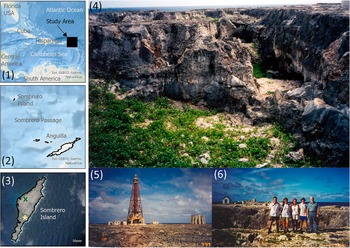
Located near the border between the Lesser Antilles and the Greater Antilles lies the small island of Sombrero, just northwest of the Anguilla Bank, 18°35’20”N, 63°25’33”W (Fig. 1) (Daltry, Reference Daltry1999; Cornée et al., Reference Cornée, De Min, Lebrun, Quillévéré and Melinte-Dobrinescu2023). The currently exposed surface on this island is only 0.38 km2, and presently it hosts only three land vertebrates—Pholidoscelis corvinus (Cope, Reference Cope1861); Anolis gingivinus Cope, Reference Cope1864; and Sphaerodactylus sp. indet. (Lazell, Reference Lazell1964; Schwartz and Thomas, Reference Schwartz and Thomas1975; Daltry, Reference Daltry1999; Wright, Reference Wright2011; Powell and Henderson, Reference Powell and Henderson2012). Even though it is relatively small, for many species of seabirds—Sula leucogaster (Boddaert, Reference Boddaert1783), Anous stolidus (Linnaeus, Reference Linnaeus1758), Onychoprion anaethetus (Scopoli, Reference Scopoli1786), Onychoprion fuscatus (Linnaeus, Reference Linnaeus1766)—it is considered one of the most important islands for breeding in the eastern Caribbean (Pierce, Reference Pierce1998). There is no evidence of Amerindians occupying Sombrero and it was not populated permanently until the middle of the 19th century (Lawrence, Reference Lawrence1867). Economically valuable reserves of guano were identified in the mid-1800s, having been long deposited by seabird populations. Dynamite was used to extract the guano, scouring the surface, and creating a flat, no-longer sombrero-like surface that is barren and heavily pitted. The guano reserves were depleted by 1890 and until 2001, the only human occupants on the island were lighthouse keepers (Fig. 1) (Lazell, Reference Lazell1964; Daltry, Reference Daltry1999; Powell and Henderson, Reference Powell and Henderson2012). Now automated, the lighthouse is unmanned and the island uninhabited since 2001 (Anguilla Archaeological and Historical Society, 2017).
Maps and photographs of Sombrero with insert illustrating Sombrero’s location in relation to surrounding islands: (1) the Caribbean region, with the study area indicated; (2) the northern Lesser Antilles; (3) satellite image of Sombrero island showing locations of the lighthouse (*) and the old mines (x); (4) remnants of a guano quarry; (5) lighthouse and supporting infrastructure; (6) Michael Ivie and his research team standing near a quarry. Photo credit to Justin Runyon.

A geologically young island, Sombrero has only had terrestrial exposure since the Pleistocene, and currently has only one known reported extinction, the tortoise Chelonoidis sombrerensis (Leidy, Reference Leidy1868) (Auffenberg, Reference Auffenberg1967; Ogden et al., Reference Ogden, Gladfelter, Ogden and Gladfelter1985; Kemp, Reference Kemp2023). Here, we report on the microfossils collected by Walter Auffenberg and J.C. Dickinson from fissure fills along the northern part of Sombrero, which were unstudied until now and currently represent the best fossil collection from the island. These fossils document the presence of multiple groups of reptiles and an amphibian that are absent in the modern fauna of Sombrero.
Materials and methods
The fossils described here come from a bag of sediment with matrix and fossils collected by Walter Auffenberg and J.C. Dickinson in 1964 from a breccia in boulder near the old dynamite tower, northeast of the lighthouse on Sombrero (Auffenberg, Reference Auffenberg1964). In his fieldnotes, Auffenberg (Reference Auffenberg1964) indicated that the breccia contained remains of birds, tortoises, and lizards. Therefore, it is very likely that the microvertebrates described here come from a single locality. Specimens of Chelonoidis sombrerensis (a humerus and shell elements) recovered during this expedition and described in detail by Auffenberg (Reference Auffenberg1967), come from a consolidated breccia-filled fissure near the windward cliff, northwest of Point Elliott, but no other vertebrate taxa were found there (Auffenberg, Reference Auffenberg1964). The tortoise specimens were considered Pleistocene in age by Auffenberg (Reference Auffenberg1967) but no detail for the age determination was provided. The specimens collected by Auffenberg and Dickinson are well mineralized and often covered by a carbonated layer mixed with red clay, similar to that observed on Quaternary fossils elsewhere in the Caribbean (unpublished field data, L.W. Viñola-López, 2022). Some specimens of Chelonoidis sombrerensis described by Auffenberg (Reference Auffenberg1967) were completely encased within hard, consolidated sediment composed of a clay matrix (Auffenberg, Reference Auffenberg1964).
Specimens of reference
For comparison and taxonomic placement, we used skeletons from extant taxa housed at the Division of Zooarchaeology of the Florida Museum of Natural History (Haemulon sp. indet., UF-Z-4491), the Division of Herpetology of the Florida Museum of Natural History—Eleutherodactylus leoncei Shreve and Williams, Reference Shreve and Williams1963, UF-Herp-99358; Ctenosaura similis (Gray, Reference Gray, Griffith and Pidgeon1831), UF-Herp-48750; Cyclura carinata Harlan, Reference Harlan1825, UF-Herp-32675; Cyclura cornuta (Bonnaterre, Reference Bonnaterre1789), UF-Herp-51408; Iguana delicatissima Laurenti, Reference Laurenti1768, UF-Herp-15778; Iguana iguana (Linnaeus, Reference Linnaeus1758), UF-Herp-49243, 149744; Anolis richardii Duméril and Bibron, Reference Duméril and Bibron1837, UF-Herp-144546; Leiocephalus carinatus Gray, Reference Gray1827, UF-Herp-175478; Sphaerodactylus argus Gosse, Reference Gosse1850, UF-Herp-11955; Pholidoscelis taeniurus Cope, Reference Cope1862, UF-Herp-99572; Ameiva ameiva (Linnaeus, Reference Linnaeus1758), UF-Herp-144537—and the Division of Ornithology of the Florida Museum of Natural History—Geranoaetus melanoleucus (Viellot, Reference Vieillot1819), UF-O-38062; and Buteo jamaicensis (Gmelin, Reference Gmelin1788), UF-O-41079. Characters used for preliminary taxonomic assignment were taken from Berkovitz and Shellis (Reference Berkovitz and Shellis2016) and Bochaton et al. (Reference Bochaton, Grouard, Cornette, Ineich, Lenoble, Tresset and Bailon2015).
Photography
Images of the microfossils were captured using a Hayear 34MP digital microscope camera with uniform top-lighting provided by a lens-mounted LED (light emitting diode) ring light. Depth of field was increased by taking a series of images at different focal distances and blending them together (image stacking) using Helicon Focus software v. 8.2.18 (https://www.heliconsoft.com/heliconsoft-products/helicon-focus/). Digital noise was smoothed and features sharpened with Topaz Photo AI software v. 1.5.0. (https://www.techspot.com/downloads/7551-topaz-photo-ai.html).
Geographic considerations
For much of the late 20th century, the Herpetofaunal Stability Hypothesis was utilized by many Quaternary herpetological studies for assigning taxonomic placement to fossils. As demonstrated by a series of studies, North American paleoherpetofaunal communities appeared to change little over the last million years when compared to modern faunas (Brewer, Reference Brewer, Mead and Meltzer1985; Holman, Reference Holman1989, Reference Holman1995). As such, with minimal morphological comparison, authors assigned fossils to modern taxa simply based on shared geographic ranges between the fossil locality and modern species ranges (Gibbons et al., Reference Gibbons, Scott, Ryan, Buhlmann and Tuberville2000; Lannoo, Reference Lannoo2005). More recently, studies on comparative herpetofaunal anatomy and fossil biogeography have provided evidence against the Herpetofaunal Stability Hypothesis, casting doubt on the ability to assign fossils to modern contiguous taxa (Norell, Reference Norell1989; Kennedy and Bhullar, Reference Kennedy and Bhullar2008; Bell et al., Reference Bell, Gauthier and Bever2010). Although more work is required to support or refute this hypothesis, because this island is geographically and temporally restricted, we have chosen to utilize the assumptions on which the Herpetofaunal Stability Hypothesis is based in instances where the fossils potentially match taxa known from the area today. Such assumptions will only be used for species assignments and will be clearly indicated in the Remarks sections.
Sombrero island size reconstruction throughout time
The exposed extent of Sombrero and Anguilla islands during the late Pleistocene into the early Holocene was assessed using bathymetry contours surrounding Sombrero and Aguilla. Bathymetry was derived from the General Bathymetric Chart of the Oceans (GEBCO) 2024 Grid (https://www.gebco.net/data_and_products/gridded_bathymetry_data/, accessed 7 September 2024). A geographically-referenced TIF image file of bathymetry values surrounding Sombrero and Anguilla was downloaded from GEBCO (https://www.gebco.net/data-products-gridded-bathymetry-data/gebco2024-grid). The TIF data cell values were based on a 450 m × 450 m grid. The spatially-enabled TIF was ingested into ESRI’s ArcGIS Pro v. 3.5 (Environmental Systems Research Institute, https://www.esri.com/en-us/arcgis/products/arcgis-pro/overview). Next, the spatial image was projected from WGS84 geographic coordinates to UTM Complex Zone 20 North, units in meters. ArcGIS’s spatial analysis tool Contour was used to convert the bathymetry from cell values to bathymetry polygons at 30 m intervals (-30 m, -60 m, -90 m, and -120 m), and from there to reconstruct island size during the Last Glacial Maximum, the terminal Pleistocene, early Holocene, and middle Holocene (Peltier and Fairbanks, Reference Peltier and Fairbanks2006; Peros et al., Reference Peros, Collins, Martínez-López, López and Sosa2023). The perimeter for each bathymetric depth and the area encompassed between these contours was calculated. Total combined area at each depth was also calculated. The present shoreline of Sombrero was digitized using ESRI’s ArcGIS World Imagery Basemap (https://services.arcgisonline.com/ArcGIS/rest/services/World_Imagery/MapServer) and its area calculated. Present-day Anguilla’s spatial outline was obtained from the Humanitarian Data Exchange (https://data.humdata.org/dataset/cod-ab-aia, accessed 7 September 2024).
Repositories and institutional abbreviations
All of the specimens of living and fossil vertebrates examined during this study are housed at the Florida Museum of Natural History (FLMNH), Gainesville (UF). Other institutional abbreviations used throughout the text are: Academy of Natural Sciences of Drexel University, Philadelphia (ANSP), Museum of Comparative Zoology, Harvard University, Cambridge, Massachusetts (MCZ), and The Natural History Museum, London (BMNH).
Systematic paleontology
Clade Osteichthyes Huxley, Reference Huxley1880
Class Actinopteri Cope, Reference Cope1871
Family Haemulidae Gill, Reference Gill and Kingsley1885
Haemulidae gen. indet. sp. indet.
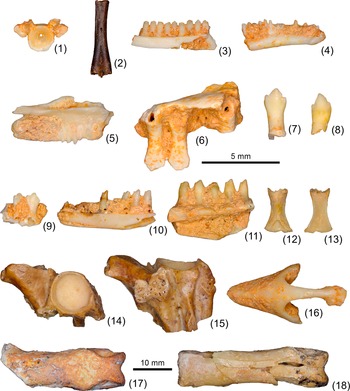
Fossils from the Pleistocene deposits of Sombrero: (1) UF 545894, Haemulidae gen. indet. sp. indet., vertebra in anterior view; (2) UF 545891, Anura indet., diaphysis of tibiofibula in medial view; (3−5) Anolis sp. indet.: (3) UF 545877, partial right dentary in lingual view; (4) UF 545878, partial left dentary in lingual view; (5) UF 545899, left maxilla in lingual view; (6−8) Iguanidae gen. indet. sp. indet.: (6) UF 545871, partial maxilla; (7) UF 545873, tooth; (8) UF 545874, teeth in lingual view; (9) UF 545880, Leiocephalus sp. indet., dentary fragment in lingual view; (10) UF 545885, Pholidoscelis corvinus right partial dentary in lingual view; (11) UF 545886, Pholidoscelis corvinus (Cope, Reference Cope1861), partial right dentary in lingual view; (12, 13) UF 545882, Sphaerodactylus sp. indet., frontal, in ventral (12) and dorsal (13) views; (14, 15) UF 545889, Colubridae gen. indet. sp. indet., partial presacral vertebra, in anterior (14) and ventral (15) views; (16) UF 545890, Melanospiza bicolor (Linnaeus, Reference Linnaeus1766), rostrum in dorsal view; (17, 18) Accipitridae gen. indet. sp indet., phalanges in dorsal view: (17) UF 545897; (18) UF 545898,. Scale bars = 5 mm (1−16); 10 mm (17, 18).

Materials
Four vertebrae (UF 545892−545895).
Remarks
Each vertebra contains an amphicoelous centrum and attachments for hemal and neural arches, with the presence of a notochordal pit allowing for assignment to Osteichthyes. UF 545894 bears paired lateral processes that allow for placement to the anteriormost vertebrae, and are morphologically similar to either the family Centrarchidae or Haemulidae. However, considering the marine and Caribbean origin for these vertebrae, the assignment to Haemulidae is more likely.
Class Amphibia Gray, Reference Gray1825
Order Anura Fischer von Waldheim, Reference Fischer von Waldheim1813
Anura indet.
Materials
A partial tibiofibula (UF 545891).
Remarks
Partially preserved, the single specimen includes the diaphysis with the tibiofibular foramen well preserved on both sides. The epiphyses are not preserved, and the sulcus intermedius is only preserved on one end of the fossil that, considering the position of the tibiofibular foramen, is probably the proximal epiphysis. By comparison with other anuran taxa, the foramen is medially located on one side and proximal on the other. The sulcus intermedius that is preserved is deeper and wider on the ventral than on the dorsal side. Laterally, there are subtle crests that run along the diaphysis. The small fragment of tibiofibula is not assigned to any specific anuran taxa due to lack of diagnostic features in the preserved portion of the fossil. It is similar to Eleutherodactylus Duméril and Bibron, Reference Duméril and Bibron1841 in size and Eleutherodactylus is the only native taxon of this size in the region. However, the fossil is robust and has the lateral crests in the diaphyses that are seen in toads of the genus Peltophryne Fitzinger, Reference Fitzinger1843. Because of the uncertainty, we refer this specimen to Anura indet.
Class Reptilia Laurenti, Reference Laurenti1768
Order Squamata Oppel, Reference Oppel1811
Family Anolidae Cocteau, Reference Cocteau1836
Genus Anolis Daudin, Reference Daudin1802
Lectotype
Adult male, BMNH 1946.8.29.15, designated by Lazell (Reference Lazell1980).
Materials
A partial frontal (UF 545876), a partial right dentary (UF 545877), a partial left dentary (UF 545878), and a left maxilla (UF 545899).
Remarks
This is the most commonly found taxon in the sample, and the dentaries and maxilla can be assigned to Anolis based on the presence of medial and posterior tricuspid teeth with very reduced lateral cusps, whereas the anterior teeth are monocuspid. Living anoles collected on Sombrero have been referred to Anolis gingivinus (Lazell, Reference Lazell1964; Powell and Henderson, Reference Powell and Henderson2012), a species described originally from the Anguilla Bank. However, Daltry (Reference Daltry1999) noticed some morphological differences between the populations from Sombrero and Anguilla that suggest that they could represent different species. In the first report of this anole in Sombrero, Lazell (Reference Lazell1964) also noticed marked ecological differences between the Sombrero and Anguilla populations but considered the possibility that Anolis gingivinus might have recently been introduced in Sombrero. These fossils suggest that Anolis was present on the island likely before the arrival of humans, but direct comparison with skeletal remains of the extant populations on Sombrero is necessary to determine if they are conspecific.
Family Iguanidae Oppel, Reference Oppel1811
Iguanidae gen. indet. sp. indet.
Materials
An edentulous dentary (UF 545869), a partial vertebra (UF 545870), two maxillae fragments (UF 545871, 545872), and three isolated teeth (UF 545873−545875).
Remarks
The largest lizards found in the Caribbean all belong to the group Iguanidae (sensu Conrad, Reference Conrad2008). The distal teeth of Iguana Laurenti, Reference Laurenti1768 are pleurodont and flared distally, containing three to eight cusps. There is marked heterodonty within dentigerous elements of Iguania, with mesial teeth being more unicuspid and recurved. Two genera of Iguanidae can be found in the Caribbean; Iguana Laurenti, Reference Laurenti1768 with a natural distribution across the Lesser Antilles, Cyclura Harlan, Reference Harlan1825 occurring in the Greater Antilles and Bahamas (Censky et al., Reference Censky, Hodge and Dudley1998). The teeth on UF 545871 and UF 545872 are large, spatulate-shaped, and have multiple cusps (more than three) like the teeth of Cyclura and Iguana. However, these specimens are highly eroded, the cusps poorly visible, and without additional material, it is not possible to assign them to genus. However, the three additional isolated teeth (UF 545873−545875) are large and tricuspid, outside of the dental variation found within Cyclura and Iguana species. UF 545874 has a marked curvature, suggesting a more mesial placement, whereas UF 545873 is straight and likely distal. The genus Ctenosaura Wiegmann, Reference Wiegmann1828 includes tricuspid teeth resembling morphologically the specimens described here, however, that taxon is only found today on the Caribbean islands nearest the Colombian coast, with no record in the Caribbean Archipelago (Malone et al., Reference Malone, Reynoso and Buckley2017). Although the specimens could belong to a giant form of Leiocephalus Gray, Reference Gray1827, they partially preserve a cusplet between the central and lateral cusps, which is present in Ctenosaura but not in Leiocephalus. Furthermore, the more mesial curved tooth is tricuspid like those of Ctenosaura whereas the anterior curved teeth of Leiocephalus are monocuspid. Because of the size of Sombrero, it seems unlikely that two large-bodied iguanids would co-occur and, given the morphological ambiguity seen within these iguanid materials, our ability to assign them to any lower-order classification is limited (Berkovitz and Shellis, Reference Berkovitz and Shellis2016).
Family Leiocephalidae Frost and Etheridge, Reference Frost and Etheridge1989
Genus Leiocephalus Gray, Reference Gray1827
Materials
Three dentary fragments (UF 545879−545881).
Remarks
The teeth of Leiocephalus are tricuspid and can be separated from those of Anolis and other tricuspid lizards in the region because they are flared distally. In Leiocephalus, the central cusp is clearly delimited from the lateral cusps, which are large and well separated from the midline, whereas in Anolis, the secondary ones are considerably smaller and closer to the central cusp. Leiocephalus can be separated from other iguanids in the region because its teeth are significantly smaller than those of Cyclura and Iguana and are spatulate-shaped, usually with more than three cusps. Leiocephalus has not been reported before from Sombrero Island, but historical specimens and fossil remains of at least three different species are known from elsewhere in the Lesser Antilles, including the nearby Anguilla Bank (Etheridge, Reference Etheridge1964; Pregill et al., Reference Pregill, Steadman, Olson and Grady1988; Kemp and Hadly, Reference Kemp and Hadly2016, Bochaton et al., Reference Bochaton, Charles and Lenoble2021a) and two other extinct species of Leiocephalus also were described from Puerto Rico. However, given the fragmentary nature of the specimens described here, it is not possible to assess specific affinity.
Family Teiidae Gray, Reference Gray1827
Genus Pholidoscelis Fitzinger, Reference Fitzinger1843
Type species
Ameiva major Duméril and Bibron, Reference Duméril and Bibron1839.
Pholidoscelis corvinus (Cope, Reference Cope1861)
Syntypes
The type series of this species includes the specimens ANSP 9115-30 and MCZ 10525, 5531, 3613, and 52215-16.
Materials
A frontal (UF 545883), three dentary fragments (UF 545884−545886), and two partial maxillae (UF 545887, 545888).
Remarks
The specimens are assigned to the genus Pholidoscelis because the dentary has an open Meckelian canal, bicuspid middle teeth, and monocuspid distal teeth with rounded apices. Also, from ventral view, the dentary curves laterally. The maxilla fragments lack ornamentation and also possess comparably large, rounded posterior teeth. These diagnostic characters are shared with other members of the family Teiidae (Gauthier et al., Reference Gauthier, Kearney, Maisano, Rieppel and Behlke2012), but taking into account that the only known genus of this family present in the region is Pholidoscelis, we refer the fossils to this genus. Similarly, the fossils are referred to Pholidoscelis corvinus because it is the only species present there today and is endemic to Sombrero, where it seems to be relatively abundant (Tucker et al., Reference Tucker, Hedges, Colli, Pyron and Sites2017; Richardson, Reference Richardson2023). Phylogenetic analysis indicates that Pholidoscelis corvinus is nested in the Pholidoscelis plei group that includes other species from the Lesser Antilles and is more closely related to Pholidoscelis corax (Censky and Paulson, Reference Censky and Paulson1992) from Little Scrub Island on the Anguilla Bank (Tucker et al., Reference Tucker, Hedges, Colli, Pyron and Sites2017).
Family Sphaerodactylidae Underwood, Reference Underwood1954
Genus Sphaerodactylus Wagler, Reference Wagler1830
Materials
A frontal (UF 545882).
Remarks
The isolated frontal is assigned to the genus Sphaerodactylus based on its small size and closed olfactory canal on the ventral side. Only one species of Sphaerodactylus has been reported from Sombrero, which was considered conspecific with Sphaerodactylus sputator (Sparrman, Reference Sparrman1784) from the Anguilla Bank (Powell and Bauer, Reference Powell and Bauer2012). Although most authors recognized a close relationship of the Sombrero gecko with Sphaerodactylus sputator, they also considered it a distinct undescribed species (Lazell, Reference Lazell1964; Daltry, Reference Daltry1999; Hodge et al., Reference Hodge, Powell, Censky, Hailey, Wilson and Horrocks2011; Powell and Henderson, Reference Powell and Henderson2012). Surveys have found this Sphaerodactylus in several areas of Sombrero, usually under stones (Daltry, Reference Daltry1999). Daltry (Reference Daltry1999) also reported that one of the Anolis gingivinus collected by them regurgitated the torso of a Sphaerodactylus.
Family Colubridae Oppel, Reference Oppel1811
Colubridae gen. indet. sp. indet.
Materials
A cervical vertebra fragment (UF 545889).
Remarks
A partial anterior trunk (cervical) vertebra is preserved ventrally and anteriorly. It includes the centrum and anterior part of the right prezygapophysis, which are dorsally worn but do show evidence of the presence of an auxiliary process. The centrum cotyle is rounded and well preserved. Ventrally, the hemal keel is well developed and of increasing depth posteriorly, developing into a hypapophysis. Because the posterior end of the vertebra is broken, it is not possible to determine the complete length of the hypapophysis. There are two ventral foramina, one on each side of the hypapophysis, along the well-developed subcentral ridges. Laterally, the parapophyses and diapophyses are preserved, with the parapophyses being wider and more anteroventrally oriented than the diapophyses. This cervical vertebra is assigned to Colubridae based on the presence of a combination of characters including the clear presence of a broken auxiliary process of the prezygapophysis (weakly developed and of different appearance than in viperids), the overall elongated shape of the centrum, which is short and stout as seen in other families, and a well-developed hypapophysis (Auffenberg, Reference Auffenberg1963; Holman, Reference Holman2000).
Class Aves Linnaeus, Reference Linnaeus1758
Order Passeriformes Linnaeus, Reference Linnaeus1758
Family Thraupidae Cabanis, Reference Cabanis1847
Genus Melanospiza Ridgway, Reference Ridgway1897
Type species
Loxigilla richardsoni Cory, Reference Cory1886.
Melanospiza bicolor (Linnaeus, Reference Linnaeus1766)
Type Specimens
Described by Linnaeus (Reference Linnaeus1766) as Fringilla bicolor based on Catesby’s (Reference Catesby, Innys and Manby1729−1732, pl. 37) illustration and descriptions but no physical type specimen exists.
Materials
A rostrum (UF 545890).
Remarks
The specimen is referred to Melanospiza because of its small size and because it has a wide rostrum with straight sides. The specimen also lacks a bulge anterior to the contact between the nasal and maxilla, which is present on Tiaris olivaceus Swainson, Reference Swainson1827. Of the two species within Melanospiza—Melanospiza bicolor, Melanospiza richardsoni (Cory, Reference Cory1886)—only the former is widely distributed across the Caribbean region and has been reported from fossil deposits in Hispaniola and Anguilla, whereas Melanospiza richardsoni has only been reported from Saint Lucia (Bernstein, Reference Bernstein1965; Pregill et al., Reference Pregill, Steadman and Watters1994; Burns et al., Reference Burns, Shultz, Title, Mason, Barker, Klicka, Lanyon and Lovette2014).
Order Accipitriformes Vieillot, Reference Vieillot1816
Family Accipitridae Vieillot, Reference Vieillot1816
Accipitridae gen. indet. sp indet.
Materials
Two pedal phalanges; a digit I, phalanx I (UF 545897), and a digit III, phalanx I (UF 545898).
Remarks
The specimens belong to an accipitri with robust phalanges resembling those of Geranoaetus melanoleucus. The distal width of digit I (11.2 mm) and total length of digit III (37.37 mm) are ~10% and 24.9% larger than previously reported values for G. melanoleucus (see Steadman et al., Reference Steadman, Almonte Milan and Mychajliw2019) and significantly larger than those of Buteo jamaicensis, the largest extant accipitrid in the region. Although digit I might still be within the size range of G. melanoleucus, these fossil phalanges likely represent different accipitrids. The phalanges each have a pit for the flexor on the distal region like in other accipitrids. Based on the differences in proportion between the two phalanges, they belonged to different individuals and likely to different taxa. Several extinct large accipitrids have been described from upper Quaternary deposits from the Greater Antilles and the Bahamas but have not been recorded yet from the Lesser Antilles (Suárez and Olson, Reference Suárez and Olson2021; Suárez, Reference Suárez2022).
Discussion
Fossil fauna from Sombrero and its affinities
As a small island deprived of vegetative cover, Sombrero today has a low diversity of vertebrates composed of three lizards (Pholidoscelis corvinus, Anolis gingivinus, Sphaerodactylus sp. indet.) found permanently on the island and 36 species of birds (Lawrence, Reference Lawrence1867; Lazell, Reference Lazell1964; Schwartz and Thomas, Reference Schwartz and Thomas1975; Daltry, Reference Daltry1999; Powell and Henderson, Reference Powell and Henderson2012). Most of the birds are sporadic visitors from the larger nearby islands but at least six seabird species nest in large numbers on Sombrero—Sula dactylatra Lesson, Reference Lesson1831, Sula leucogaster, Sterna dougallii Montagu, Reference Montagu1813, Thalasseus maximus (Boddaert, Reference Boddaert1783), Anous stolidus, Phaethon aethereus Linnaeus, Reference Linnaeus1758 (Townsend, Reference Townsend1998). Sombrero has been considered the most important nesting ground of seabirds in the eastern Caribbean (Pierce, Reference Pierce1998). Based on the large volumes of guano extracted from the mines between 1856 and 1890 (3,000 tons every year by 1876; Christian, Reference Christian1998), the island was likely an important nesting site for seabirds for thousands of years. Therefore, it is surprising that in our sample, there were no fossils of any of the bird species known commonly to nest on Sombrero. Nonetheless, Julien (Reference Julien1878) reported that among the samples collected from Sombrero, Jeffries Wyman identified remains of seabirds from the more superficial deposits. At the same time, the vertebral fragments of small fishes in our sample probably were part of the food brought to the nesting grounds by the birds. In our small collection of fossils, there are at least 11 vertebrate species, including an indeterminate bony fish, five lizard taxa, a snake, a tortoise, an anuran, and two birds.
The first description of fossils from Sombrero was provided by Leidy (Reference Leidy1868) who named Chelonoidis (Emys Duméril, Reference Duméril1805) sombrerensis based on the posterior lobe of a plastron, today deposited at ANSP. That publication was followed by that of Julien (Reference Julien1878) who reported on a collection of some seabird, tortoise, and iguanid remains collected from the northern excavation on the island but he was seemingly unaware of Leidy’s work. Auffenberg (Reference Auffenberg1967) was the last one to report on newly collected fossils from Sombrero but focused only on the tortoises. Chelonoidis Fitzinger, Reference Fitzinger1835 is more commonly found in late Pleistocene and Holocene deposits across the Greater Antilles and the Bahamas but are scarce in the Lesser Antilles (Ray, Reference Ray1964; Lazell, Reference Lazell1993; Kehlmaier et al., Reference Kehlmaier, Albury, Steadman, Graciá, Franz and Fritz2021; Viñola-López and Almonte, Reference Viñola-López and Almonte2022). It is unclear whether Chelonoidis sombrerensis is more closely related to tortoises in the radiations from the western or the eastern Caribbean, but until more fossils from the Lesser Antilles are collected, this will be difficult to evaluate. Sombrero lies near the contact between the Greater and the Lesser Antilles, and both island groups could have been contributing sources for the species there. Similarly, Leiocephalus had and has a wide distribution across the Antilles but the poor preservation of the specimens from Sombrero do not allow us to evaluate their relationship with other Caribbean taxa. This is also the case of the fossil colubrid snake and anuran reported here. The three extant genera of lizards that are today found on the island, Anolis, Pholidoscelis, and Sphaerodactylus are also found in the fossil assemblage. If these fossils are conspecific with the species on Sombrero today, it indicates that they were not introduced by humans, as Lazell (Reference Lazell1964) tentatively suggested for the anole and gecko. These three species have a closer relationship with other lizards from the nearby Anguilla Bank (Lazell, Reference Lazell1964; Tucker et al., Reference Tucker, Hedges, Colli, Pyron and Sites2017). Although we lack direct radiometric dates of the fossils, the preservation and degree of mineralization of these specimens suggest that they are likely subfossil and precede the very recent human settlement in the mid-19th century.
Some of the most puzzling fossils from the island are those of at least one large iguanid of unclear relationships. To the west of Sombrero, Cyclura is distributed across the Greater Antilles whereas native populations of Iguana are located in numerous islands in the Lesser Antilles (Breuil et al., Reference Breuil, Schikorski, Vuillaume, Krauss, Morton, Corry, Bech, Jelić and Grandjean2020; Reynolds et al., Reference Reynolds, Miller, Pasachnik, Knapp, Welch, Colosimo, Gerber, Drawert and Iverson2022). Some of the isolated tricuspid fossil teeth differ from the multicuspid distally-flared teeth of Cyclura and Iguana but resemble those of Ctenosaura. However, the last genus is found in Mexico, Central America, and a few islands on the Caribbean coast off of the mainland (Malone et al., Reference Malone, Reynoso and Buckley2017). Fossils of large accipitrids like those reported here are reported from late Quaternary deposits in the Greater Antilles and Bahamas but have not been found so far in the Lesser Antilles (Steadman et al., Reference Steadman, Almonte Milan and Mychajliw2019; Suárez, Reference Suárez2022). The fossils from the Greater Antilles document several radiations of large diurnal raptors that specialized on feeding on native vertebrates. Although native mammals are unknown from Sombrero, the large amount of guano extracted indicates that the island was likely an important nesting ground for bird for long periods of time. Therefore, it is possible that the large accipitrid preyed on seabird colonies as well as some of the larger reptiles on the island like Chelonoidis sombrerensis and the iguana. The considerable size reduction of Sombrero associated with changes in sea level, reduction of bird nesting size, and extinction of Chelonoidis sombrerensis and the iguana could have been associated with the loss of the accipitrid.
Faunal colonization and extinction on a small island
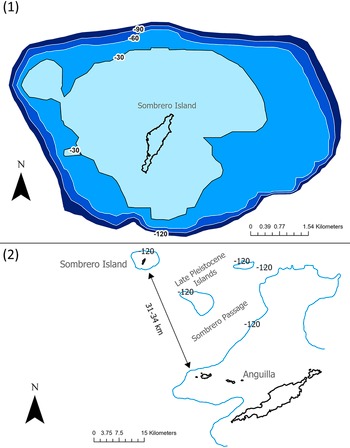
The fossils from Sombrero offer good insight into how faunal assemblages come together on small islands and evolve over time. Because Sombrero is on its own carbonate platform separated from other island banks, its fauna must have arrived by overwater dispersion either from the Greater or the Lesser Antilles. Furthermore, the limestone on which the island is built is Pleistocene in age, constraining the subaerial exposure of the Sombrero to < 2.5 Mya (Ogden et al., Reference Ogden, Gladfelter, Ogden and Gladfelter1985). The island today has an area of 0.38 km2; during the Last Glacial Maximum (20 ka) in the late Pleistocene with a sea level 120 m below current one, Sombrero had an exposed area of 36 km2 (Fig. 3). The leading edge of this paleoisland was still separated by 31−34 km from the edge of the fully exposed Anguilla Bank. In the Sombrero Passage, which separates Anguilla and Sombrero, there were another two islands exposed that are currently submerged. In the latest Pleistocene (12 ka), sea level increases caused an area reduction to ~29 km2. With rapid sea level increase in the early Holocene (10 ka), its area further decreased to 16 km2 and by the middle Holocene (6 ka), when sea level reached values similar to current ones, Sombrero was likely close to its current size. In < 14 ka, Sombrero island lost nearly 99% of its area, which more than likely had a profound impact on its biota.
(1) Reconstruction of Sombrero size at 120 m, 90 m, 60 m, and 30 m below current sea level, based on bathymetric data. (2) Coastal outline of Sombrero, the lost Sombrero Passage islands, and northern Anguilla Bank during the Last Glacial Maximum in the late Pleistocene.

Eight of the fossils and living vertebrates found (Chelonoidis sombrerensis, Anolis gingivinus, Pholidoscelis corvinus, Sphaerodactylus sp. indet., Leiocephalus sp. indet, large iguanid, colubrid snake, and anuran) are completely terrestrial and do not disperse actively through marine barriers, but reached Sombrero in the last 2.5 Ma. If these colonization events were independent from each other, it would result in an average rate of one successful passive dispersal every 312,500 yr. However, given that the exact moment in the Pleistocene when the island became aerially exposed is unknown and that other groups of vertebrates from the nearby islands could also have reached Sombrero (e.g., boids, Oryzomyini rodents), it is possible that the actual dispersal rate was higher.
In the northern Lesser Antilles, there are no large rivers that could produce large vegetation mats and rafts as in the Greater Antilles (Silva-Taboada et al., Reference Silva-Taboada, Suárez Duque and Díaz-Franco2007), suggesting that ‘island-hopping’ must have been driven primarily by large storms and oceanic surface currents moving northwest (Hedges, Reference Hedges, Powell and Henderson1996; Reference Hedges2006).The groups found in the fossil record of the island are examples of good dispersers, meaning that they achieved wide distributions across the Caribbean and are found on islands and island banks that were not connected in the recent geological past. Some of them possess physiological traits and behaviors (e.g., direct development, survival for long periods without food or freshwater) that have been tied with their ability to overcome marine barriers and there is molecular evidence that supports numerous instances of dispersal between islands that were never connected (e.g., de Queiroz, Reference de Queiroz2005; Gerlach et al., Reference Gerlach, Muir and Richmond2006; Heinicke et al., Reference Heinicke, Duellman and Hedges2007; Tucker et al., Reference Tucker, Hedges, Colli, Pyron and Sites2017). This dispersal capacity and their ability to survive even on small relict islands is consistent with molecular and paleontological studies suggesting that ancestors of Leiocephalus, Anolis, and Sphaerodactylus might have dispersed into the Caribbean region before or soon after the islands became permanently exposed in the late Eocene (Heinicke et al., Reference Heinicke, Duellman and Hedges2007; Kumar et al., Reference Kumar, Stecher, Suleski and Hedges2017; Ali and Hedges, Reference Ali and Hedges2021). After the formation of the first Caribbean islands in the late Cretaceous and until the region became more stable in the Eocene, islands (and their biota) had at best an ephemeral life of several million years (Iturralde-Vinent, Reference Iturralde-Vinent2006). Therefore, island hopping is one of the mechanisms used to explain the presence of several of those groups (e.g., Leiocephalus, Anolis) with divergent ages that date back to the Cretaceous and Paleogene. At the same time, the existence of a short-lived landspan or closely spaced group of islands involving the Greater Antilles and the Aves Ridge in the Eocene-Oligocene transition, known as the Greater Antilles Aves Ridge Land Bridge (GAARlandia), has been proposed to explain the origin of numerous extant and extinct South American lineages found in the Caribbean. The degree of exposure and contribution of the Aves Ridge to GAARlandia is a topic of debate (e.g., Iturralde-Vinent and MacPhee, Reference Iturralde-Vinent and MacPhee1999, Reference Iturralde-Vinent and Macphee2023; Iturralde-Vinent, Reference Iturralde-Vinent2006; Ali, Reference Ali2012; Philippon et al., Reference Philippon, Cornée, Münch, Van Hinsbergen and BouDagher-Fadel2020; Ali and Hedges, Reference Ali and Hedges2021; Garrocq et al., Reference Garrocq, Lallemand, Marcaillou, Lebrun and Padron2021), but the presence of a continuous land connection seems to have been highly unlikely (Ali and Hedges, Reference Ali and Hedges2021). Furthermore, Ali and Hedges (Reference Ali and Hedges2021) argued that the islands exposed on the Aves Ridge would have been too shallow and small to sustain a high diversity of taxa and allow them to disperse. However, the fossils from Sombrero show that small islands can be colonized rapidly by reptiles and amphibians from nearby islands after becoming subaerially exposed. This is also consistent with paleontological studies on other small islands like Marie-Galante that emerged in the middle Pleistocene (Cornée et al., Reference Cornée, De Min, Lebrun, Quillévéré and Melinte-Dobrinescu2023) and also had a high diversity of terrestrial vertebrates (Bochaton et al., Reference Bochaton, Grouard, Cornette, Ineich, Lenoble, Tresset and Bailon2015). Although the geology of the Aves Ridge is still poorly understood, recent work in the northern Lesser Antilles demonstrated the existence of a large land mass (Greater Antilles−northern Lesser Antilles, GrANoLA) exposed in the late Eocene−early Oligocene consistent with GAARlandia (Philippon et al., Reference Philippon, Cornée, Münch, Van Hinsbergen and BouDagher-Fadel2020). Paleomagnetic studies further indicate that the northern Lesser Antilles and the Puerto Rico-Virgin Islands Bank could have been significantly closer to South America and played a significant role in faunal dispersion from South America in the late Eocene (Montheil et al., Reference Montheil, Philippon, Münch, Camps, Vaes, Cornée, Poidras and van Hinsbergen2023).
Fossils from Sombrero not only provide some insight into the colonization of small islands in the Caribbean and elsewhere but also allow us to assess extinction events in these settings. The insular Caribbean is recognized worldwide as one of the island systems most affected by extinction in the late Pleistocene−early Holocene (Turvey et al., Reference Turvey, Duncan, Upham, Harrison and Dávalos2021; Rozzi et al., Reference Rozzi, Lomolino, van der Geer, Silvestro and Lyons2023). Nearly 90% of the native land mammals that inhabited the region are extinct today and most of the remaining species are threatened with extinction or extirpation (Silva-Taboada et al., Reference Silva-Taboada, Suárez Duque and Díaz-Franco2007). Species loss also affected several groups of birds and reptiles across the region, and recent chronological studies showed that those community collapses occurred in multiple waves, the last one following the arrival of Europeans (Orihuela et al., Reference Orihuela, Viñola, Vázquez, Mychajliw, de Lara, Lorenzo and Soto-Centeno2020; Bochaton et al., Reference Bochaton, Charles and Lenoble2021a, Reference Bochaton, Paradis, Bailon, Grouard, Ineich, Lenoble, Lorvelec, Tresset and Boivinb; Viñola-Lopez et al., Reference Viñola-López, Bloch, Milán and LeFebvre2022). The introduction of invasive species further contributed to the collapse of the native fauna and reshaped the Caribbean biota as we know it today (Kemp et al., Reference Kemp, Mychajliw, Wadman and Goldberg2020; Kemp, Reference Kemp2023).
The understanding of these extinction events varies across regions and taxa in the Caribbean. The Greater Antilles have been more intensively sampled and studied than the Lesser Antilles although in recent years, numerous articles describing the fossil and archaeological fauna of the Lesser Antilles have come to light (e.g., Boudadi-Maligne et al., Reference Boudadi-Maligne, Bailon, Bochaton, Casagrande, Grouard, Serrand and Lenoble2016; Kemp and Hadly, Reference Kemp and Hadly2016; Bochaton et al., Reference Bochaton, Charles and Lenoble2021a, Reference Bochaton, Paradis, Bailon, Grouard, Ineich, Lenoble, Lorvelec, Tresset and Boivinb). Similarly, several comprehensive studies started addressing larger scale extinction and functional-loss patterns across the Caribbean, including some of the smallest islands like Sombrero (Cooke et al., Reference Cooke, Dávalos, Mychajliw, Turvey and Upham2017; Kemp et al., Reference Kemp, Mychajliw, Wadman and Goldberg2020; Kemp, Reference Kemp2023). However, even with these few studies, the fossil fauna from small islands of the Caribbean remains poorly understood due to a lack of collecting and published data. The use of the limited and biased available data from the paleontological and archaeological record can create misconceptions (Bochaton, Reference Bochaton2022), as is the case with Sombrero. More recent articles that discuss Lesser Antillian biodiversity cite Chelonoidis sombrerensis as the only extinct vertebrate from the island, although Julien (Reference Julien1878) reported the presence of a large iguanid. Because of the lack of evidence in the significant loss of functional diversity on Sombrero compared with larger islands, Kemp (Reference Kemp2023) argued that Sombrero and three other small islands are examples of how long-term human impact can create different biodiversity outcomes. However, based on the evidence presented here, there are at least five groups of land vertebrates (four of them reptiles) that disappeared from the island. Whether losses were related to changes of the island’s exposed area through time or human influence is currently unknown without a chronology of extinction. It is worth noting that Julien (Reference Julien1878) did not mention any living reptiles on the island in his mid-19th century study, which suggests that at least the large iguanian and the tortoise were already absent. Furthermore, Julien (Reference Julien1878) reported on the significant impact that humans had on the nesting birds of the island, greatly reducing their populations, and mentioned that feral cats were also on the island at the time. The fossils described here are a good example of how the absence of data is not an indication of the absence of species loss and how small islands are also prone to significant species loss. Similarly, Bochaton et al. (Reference Bochaton, Cochard, Gala, Chalifour and Lenoble2020) reported on the loss of six species of land vertebrates on another very small island located nearby on the Anguilla Bank. Given that all of the taxa described here (Anolis, Pholidoscelis, Leiocephalus, Sphaerodactylus, Chelonoidis, Anura, Iguanidae, Colubridae) are often found across the Caribbean (Powell and Henderson, Reference Powell and Henderson2012), our results could be used as a guide for paleontologists to search for and potentially document other examples of extinction/extirpation, even in the apparent absence of these species in the recorded fossil records of small islands.
Acknowledgments
We want to express our gratitude to M. Ivie from the Montana Entomology Collection at Montana State University for providing us with photos of Sombrero, and W. Suarez for identifying the fossil birds described here. We would also like to thank Collection Managers R. Narducci and R. Hulbert at FLMNH for access to this collection and for cataloging these fossils. Lastly, we are deeply grateful for the edits of C. Bell at the University of Texas in formatting this manuscript. This is University of Florida Contribution to Paleobiology 891.
Competing interests
The authors have no competing interests to declare.

 Open access

