


Introduction
Older adults often experience dancing as a pleasurable activity. For older adults living independently, dancing can provide physical (Liu et al. Reference Liu, Shen and Tsai2021; Machacova et al. Reference Machacova, Vankova, Volicer, Veleta and Holmerova2017), cognitive (Lossing et al. Reference Lossing, Moore and Zuhl2017; Nascimento Reference Nascimento2021), social (Atkins et al. Reference Atkins, Deatrick, Gage, Earley, Earley and Lipman2019; Lossing et al. Reference Lossing, Moore and Zuhl2017) and quality of life benefits (Liu et al. Reference Liu, Shen and Tsai2021). For those living in residential care homes (RCHs), these benefits extend to improvements in balance, mobility (da Silva Borges et al. Reference da Silva Borges, de Souza Vale, Cader, Leal, Miguel, Pernambuco and Dantas2014; Krampe Reference Krampe2013), memory (Kosmat and Vranic Reference Kosmat and Vranic2016), environmental domains of quality of life (Gouvêa et al. Reference Gouvêa, Antunes, Bortolozzi, Marques and Bertolini2017) and decreased depression (Vankova et al. Reference Vankova, Holmerova, Machacova, Volicer, Veleta and Celko2014).
Research investigating dance for older adults has typically drawn from a biomechanical approach, emphasizing cognitive and physical outcomes (Sheppard and Broughton Reference Sheppard and Broughton2020). These outcomes are often attributed to neuron stimulation through physical movement during dance (Dunphy et al. Reference Dunphy, Baker, Dumaresq, Carroll-Haskins, Eickholt, Ercole, Kaimal, Meyer, Sajnani, Shamir and Wosch2019; Nascimento Reference Nascimento2021), while other processes such as performative choreography, instructor verbal guidance and interactions with other dancers are often overlooked. There is now recognition that relying solely on the biomechanical approach may limit our understanding of the benefits of dance. Studies have shown that dancing can elicit memories among middle-aged populations (Giese and Keightley Reference Giese and Keightley2024), emotions in young adults (Kosma et al. Reference Kosma, Erickson and Gremillion2024) and interpersonal connections among people aged 18 to 75 (Atkins et al. Reference Atkins, Deatrick, Gage, Earley, Earley and Lipman2019). The rhythmic integration among the body, music, space, emotion and other dancers makes dance a unique embodied activity. An approach that considers the holistic dance experience may have the potential to provide a more comprehensive understanding of the benefits for older adults.
The significance of embodiment in dance has been explored (Giese and Keightley Reference Giese and Keightley2024; Koch et al. Reference Koch, Mergheim, Raeke, Machado, Riegner, Nolden, Diermayr, von Moreau and Hillecke2016; Kontos et al. Reference Kontos, Grigorovich, Kosurko, Bar, Herron, Menec and Skinner2021; Kosma et al. Reference Kosma, Erickson and Gremillion2024). An embodied approach highlights how all forms of consciousness, such as perceptions, thoughts and emotions, are shaped by the bodily experience of, and interaction with, the environment (Bläsing Reference Bläsing, Fernandes, Evola and Ribeiro2022; Shapiro Reference Shapiro2019). During dance, synchronized body movements between older adults can increase positive affect and perceived social relationships (Keisari et al. Reference Keisari, Feniger-Schaal, Palgi, Golland, Gesser-Edelsburg and Ben-David2022). Similarly, Kosma et al. (Reference Kosma, Erickson and Gremillion2024) reported that during dance-based theatre classes, certain bodily movements allowed participants to experience and express emotions freely during their performance, increasing their enjoyment.
Phenomenological studies have also explored the experiences of dancing for different populations. Employing interpretative phenomenological analysis (IPA) with six middle-aged dancers, Braun and Kotera (Reference Braun and Kotera2022) found that rhythmic interaction with music elicited sensations of past life events experienced through bodily expressions. Kim et al. (Reference Kim, Im, Lee and Heo2023) suggest that dancing motivates middle-aged women to overcome negative experiences of physical limitations and appearance, supporting positive experiences of ageing. Furthermore, dance movement therapy, a therapeutic form of dance used to alleviate physical, social, emotional and cognitive health concerns (Payne Reference Payne and Payne1992), has assisted older women in lowering relocation stress when transitioning to a continuing care retirement community by reconnecting them to their bodies through physical expression and fostering social connections (Kluge et al. Reference Kluge, Tang, Glick, LeCompte and Willis2012). Thus, phenomenological studies have highlighted how dance can generate positive physical, social and emotional experiences.
The lived experience of dance
Conceptualized within phenomenology, lived experiences are the subjective essence of our encounters with the world (Merleau-Ponty Reference Merleau-Ponty2013; van Manen Reference van Manen1997). All lived experiences occur within an individual’s lifeworld. Merleau-Ponty (Reference Merleau-Ponty2013) conceptualized the lifeworld as the unique interconnectedness of all bodily, spatial, temporal and relational aspects of human experience from which all meaning and understanding of our self and surroundings arise. Lived experiences of the lifeworld can be positioned as the lived body, lived time, lived space and lived relations (Merleau-Ponty Reference Merleau-Ponty2013; van Manen Reference van Manen1997). While dancing, all aspects of the lifeworld are uniquely involved. For example, a dancer’s interaction with the space in the dance hall, the interpersonal relations between dance partners as they move together and the synchronization with others to the time of the beat are all experienced through the lived body, offering a distinct way of being that shapes our subjective understanding of ourselves, others and the world (Warburton Reference Warburton2011). It has been suggested that the practical application of the lifeworld in RCHs is a meaningful way to improve care for older adults (Todres et al. Reference Todres, Galvin and Dahlberg2007). Quality of life can be improved when living conditions and activities foster meaningful temporal, spatial, relational, emotional and bodily experiences (Galvin et al. Reference Galvin, Pound, Cowdell, Ellis-Hill, Sloan, Brooks and Ersser2020; Todres et al. Reference Todres, Galvin and Dahlberg2007). Therefore, the lived experiences of dance may offer a means to help nurture the lifeworld of individuals in RCH settings.
The lived body during dance
Merleau-Ponty’s (Reference Merleau-Ponty2013) conceptualization of the lived body offers a nuanced framework for understanding the lived experience of dance for older adults. The lived body is the interpretative point for all aspects of the lifeworld through its connection to its surroundings (Merleau-Ponty Reference Merleau-Ponty2013). The lived body presents a perspective of the body as a subjective being that actively engages with and projects itself into the world rather than a passive object acted upon by external forces (Merleau-Ponty Reference Merleau-Ponty2013). Older adults’ connection to their lived bodies becomes increasingly important by affirming their role in shaping their lived experiences (Eilenberger and Slatman Reference Eilenberger and Slatman2024). Activities such as dance may offer agency and a sense of self despite age-related changes (Almqvist Reference Almqvist2022).
Embodied knowledge
Embodied knowledge is seen in the body’s ability to act in particular situations, such as dancing, bike riding, moving through familiar spaces or socializing with friends (Fuchs Reference Fuchs, Koch, Fuchs, Summa and Müller2012; Tanaka Reference Tanaka, Stenner, Cromby, Motzkau, Yen and Haosheng2011). The lived body is continuously engaged in lived experiences and, therefore, always storing and reinforcing embodied knowledge which provides an acquired understanding of lived space, lived time and lived relations (Fuchs Reference Fuchs, Koch, Fuchs, Summa and Müller2012; Tanaka Reference Tanaka, Stenner, Cromby, Motzkau, Yen and Haosheng2011, 2013, pp. 152–153; Merleau-Ponty Reference Merleau-Ponty2013). Older adults have accumulated vast amounts of embodied knowledge over their lifespan (Ross and Gillett Reference Ross and Gillett2019); however, bodily changes may result in a disruption to this knowledge, affecting one’s sense of self. For example, Fuchs (Reference Fuchs, Koch, Fuchs, Summa and Müller2012) suggests that identity is a form of embodied knowledge. Supporting this view, van Rhyn et al. (Reference van Rhyn, Barwick and Donelly2021) report that older adults aged over 85 experienced disconnection from their identity and sense of self owing to the altered experience of their lived body due to age-related bodily changes. This highlights the importance of the connection with the body to maintain extant embodied knowledge.
The disconnection from embodied knowledge may be heightened for older adults living in RCHs. Transitioning to an RCH is a significant life-changing event. Altered living conditions imposed by changes to space, routines and social structure can impact the connection between the lived body and its embodied knowledge (Fuchs Reference Fuchs, Koch, Fuchs, Summa and Müller2012). Recent studies posit that transitioning to an RCH disrupts older adults’ identity and sense of self (Gautam et al. Reference Gautam, Montayre and Neville2021; Paddock et al. Reference Paddock, Brown Wilson, Walshe and Todd2019; Riedl et al. Reference Riedl, Mantovan and Them2012). Opportunities for older adults living in RCHs to engage the lived body in the continued expression of extant embodied knowledge are imperative to rectify these disruptions and enrich their lifeworlds in order to maintain their sense of self. Meaningful activities such as dance offer such an opportunity (Richard Reference Richard2013; Tanaka Reference Tanaka2013).
Methodology
Interpretative phenomenological analysis is a qualitative research method that aims to understand the meaning and significance individuals attribute to their lived experiences of life events (Smith et al. Reference Smith, Flowers and Larkin2021). Philosophically underpinned by phenomenology, IPA emphasizes the importance of understanding the subjective essence of an experience as it is, rather than fixing it to predefined terms or categories (Smith et al. Reference Smith, Flowers and Larkin2021). In this sense, IPA is linked to a phenomenological epistemology, as meaning is derived directly from experience (Smith et al. Reference Smith, Flowers and Larkin2021).
Within an IPA study, the researcher and the participant engage in a layered interpretation process known as a double hermeneutic. This involves the participant attempting to make sense of their experience, while the researcher attempts to interpret the participant’s sense-making (Smith et al. Reference Smith, Flowers and Larkin2021). Double hermeneutic interpretation highlights these subjective layers when attempting to understand an experience. This process allows the participant’s data to reveal insights and avoids the researcher imposing their prior knowledge into the data (Smith et al. Reference Smith, Flowers and Larkin2021).
This study’s epistemological and philosophical position is grounded in Merleau-Ponty’s (Reference Merleau-Ponty2013) conceptualization of phenomenology. Merleau-Ponty’s (Reference Merleau-Ponty2013) main contention is that the body is central to all experience, meaning, knowledge and understanding of the world. Traditional Western views of philosophy and science are underpinned by dualist assumptions of a separation between the mind and the body (Foglia and Wilson Reference Foglia and Wilson2013; Gefei Reference Gefei2023). Theories of dualism stem from Descartes ([1641] Reference Descartes2017), who argued that the body and the mind are distinct, separate entities. Merleau-Ponty (Reference Merleau-Ponty2013) rejected this concept of mind–body dualism, arguing that the mind is unified and integrated throughout the body. The body, therefore, serves as the vessel to perceive, interpret and act upon all physical, social, spatial, emotional and temporal experiences (Merleau-Ponty Reference Merleau-Ponty2013).
There are several well-established phenomenological approaches to qualitative research, and debate continues regarding their merits and the degrees to which they are genuinely phenomenological. For example, Giorgi’s (Reference Giorgi2012) descriptive phenomenology has been critiqued for being more psychological than phenomenological (Paley Reference Paley2016). Similarly, van Manen (Reference van Manen2017) argues that Smith et al.’s (Reference Smith, Flowers and Larkin2021) IPA approach is more aligned with psychology, suggesting that interpretation of participants’ reflections fails to engage in the pre-reflective essence of experience. However, Smith (Reference Smith2018) has defended IPA as rooted in phenomenology, highlighting its hermeneutic focus and consideration of both reflective and pre-reflective aspects of experience as necessary to interpreting meaning. In this study, hermeneutic interpretation is an essential aspect of accessing embodied experience in older adults through pre-reflective and reflective accounts of lived experience.
Older adults who live in RCHs are a unique population. The various physical and cognitive diagnoses associated with natural ageing and the institutional environment can influence experiences and perceptions of embodiment, temporality, spatiality and social relations (Paddock et al. Reference Paddock, Brown Wilson, Walshe and Todd2019; van Rhyn et al. Reference van Rhyn, Barwick and Donelly2020). The focus on the individual subjective experience of IPA means that it is well-positioned to explore and capture the nuanced experiences of unique populations and situations (Smith et al. Reference Smith, Flowers and Larkin2021). Therefore, an IPA grounded in Merleau-Pontian phenomenology (Merleau-Ponty Reference Merleau-Ponty2013) is suited to explore and understand the dynamics between individual dance experiences, the transitions associated with entering an RCH and the embodied realities of ageing.
Methods
Aim, setting, participants and ethics
This study aimed to understand how older adults use dance to connect with their embodied knowledge to make sense of their lived experiences of living in an RCH. It took place within a privately owned RCH on the east coast of Australia. Purposive sampling was used to recruit residents who regularly attended a weekly dance programme. Residents who had attended for at least six months were considered regular attendees. The lead researcher consulted the activities manager to identify regular attendees, and then visited them individually in their accommodation. After the lead researcher introduced himself and summarized the research, he invited each resident to participate. Interested residents received a participant information sheet to review at their own pace and were informed that the researcher would return in one week to secure their consent.
It was identified that residents in this setting were in a relationship of dependency. Residents may have felt pressured to participate, perceiving negative consequences regarding their care needs if they were to decline or cease participation. To mitigate this ethical issue, the lead researcher avoided the help of staff during recruitment and reminded participants – during recruitment, before giving consent and before data collection – of their right to cease participation without consequence. Staff in the facility had no knowledge of which residents were approached or had consented to participate.
Owing to ethical issues relating to this population’s capacity to provide informed consent to research, a screening process was used during recruitment to mitigate psychological risk and harm. Nine residents interested in participating were screened using the University of California, San Diego Brief Assessment for Capacity to Consent (UBACC) (Jeste et al. Reference Jeste, Palmer, Appelbaum, Golshan, Glorioso, Dunn, Kim, Meeks and Kraemer2007). The UBACC has been demonstrated as a valid and reliable tool to ensure capacity to provide informed consent among older adults (Gilbert et al. Reference Gilbert, Bosquet, Thomas-Antérion, Bonnefoy and Le Saux2017; Jeste et al. Reference Jeste, Palmer, Appelbaum, Golshan, Glorioso, Dunn, Kim, Meeks and Kraemer2007; Padala et al. Reference Padala, Padala, Lensing, Dennis, Bopp, Roberson and Sullivan2017). A human research ethics committee also approved this study, under approval number 2021/059.
The dance programme
A local dance instructor with more than 30 years of jazz and tap dance teaching experience delivered the weekly dance programme in the activities room of the RCH. Each session lasted approximately 50 minutes, beginning with a warm-up of stretches and sensory movements such as rubbing and tapping different parts of the body. The choreography included upper and lower body movements aimed to help improve fine motor skills, elicit memories and cultivate social engagement. All dances were performed seated on chairs arranged in a circle. The instructor encouraged participants to mimic the instructor’s functional, symbolic and performative movements, resulting in various performances of group synchrony (Toohey et al. Reference Toohey, Hutchinson and Moloney2024).
The instructor used verbally guided prompts, such as ‘push’, ‘kick’ or ‘one-and-a-two-and-a’, to encourage participants and keep them in time with the choreography. However, more symbolic guidance was often employed to accompany more performative and symbolic choreography. For example, the choreography of one dance involved breaststroke movements of the arms to symbolize swimming, while the instructor used symbolic verbal guidance to accentuate the experience: ‘Now let’s do some breaststroke and swim through the water’. Another example involved the participants performing movements that symbolized playing cards and throwing dice: ‘Shuffle your cards up, deal them out … now roll the dice!’.
Participants were reminded to rest if the choreography was too strenuous or they became tired. The music included songs from popular musicals of the 1950s, popular modern hits and waltz tunes, which were curated by the instructor on the basis that they would be familiar and enjoyable to the participants. A set list of the music used is presented in the supplementary material.
Data collection and materials
Data were collected between December 2021 and February 2022. Semi-structured interviews with video-stimulated recall were employed. This style of interview has been used effectively with older adults (Davidson et al. Reference Davidson, Worrall and Hickson2008; Paskins et al. Reference Paskins, Sanders, Croft and Hassell2015). The aim of using video to complement the interviews was to facilitate discussion by focusing the participants on their dance experience (Dempsey Reference Dempsey2010; Hansebo and Kihlgren Reference Hansebo and Kihlgren2001). Furthermore, the use of video may have eased participants’ cognitive load by assisting with recall, lowering the risk associated with the inability to remember (Mysyuk and Huisman Reference Mysyuk and Huisman2020).
A voice recorder was used to capture interview audio. During each interview, participants were shown a video excerpt from a previous study on an iPad that depicted them participating in the dance programme (see Toohey et al. Reference Toohey, Hutchinson and Moloney2024). This was followed by open-ended questions. Participants were asked to share their experiences of the dance programme, describing any emotions or bodily sensations they felt in relation to the movement, music and group dynamics. For example, participants were asked: ‘Can you tell me how this movement made your body feel, or any emotions you experienced from it?’. The duration of the interviews was between 30 and 60 minutes. Interviews were transcribed, and each participant was assigned a pseudonym to conceal their identity. A copy of the interview guide is presented in the supplementary material.
Data analysis
Using IPA requires employing an idiographic approach to data analysis that centres the focus on individual subjective experiences. Each participant’s transcript was analysed thoroughly and separately, generating experiential statements that captured each participant’s dance experience before moving to the next transcript. This allowed meaning to reveal itself in its own unique way; such meaning could have been lost in an approach combining the data from several individuals into one dataset (Braun and Clarke Reference Braun and Clarke2006; Kiger and Varpio Reference Kiger and Varpio2020; Smith et al. Reference Smith, Flowers and Larkin2021).
After transcribing the interviews, the lead researcher began a process of data immersion by reading and rereading the transcripts to understand each participant’s experience. During the reading phase, inductive, exploratory notes were taken. Each exploratory note was then condensed into concise experiential statements that captured their meaning (Smith et al. Reference Smith, Flowers and Larkin2021). Experiential statements were clustered based on similarity to form higher-order personal experiential themes. This process was repeated for each transcript in an iterative manner, moving between transcripts to revise prior decisions and to achieve a point of data saturation (Smith et al. Reference Smith, Flowers and Larkin2021). A table of each participant’s personal experiential themes that contributed to the results is provided in the supplementary material. Participants’ personal experiential themes were then clustered by similarity, forming sets of sub-themes, which were arranged into overarching group experiential themes (Smith and Nizza Reference Smith and Nizza2022). Inferences were made based on the similarities and differences between each participant’s experiences (Smith et al. Reference Smith, Flowers and Larkin2021). During the analysis, the lead researcher engaged in a reflexive practice by keeping a reflexive journal and regularly meeting with the other authors, where critical feedback was shared to highlight any assumptions that could cultivate bias within the analysis.
Findings
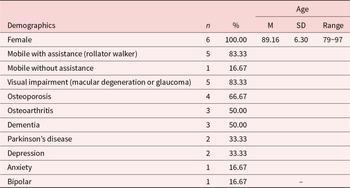
Participant demographics are presented in Table 1. Two males attended the programme, but one declined participation and the other did not demonstrate the capacity to consent; this resulted in a sample of six female participants. Five participants were mobile with the assistance of a rollator walker, and one was mobile without assistance. Participants had a variety of diagnoses, which included visual impairments, osteoporosis, osteoarthritis, dementia, Parkinson’s disease, depression, anxiety and bipolar disorder.
Participant demographics

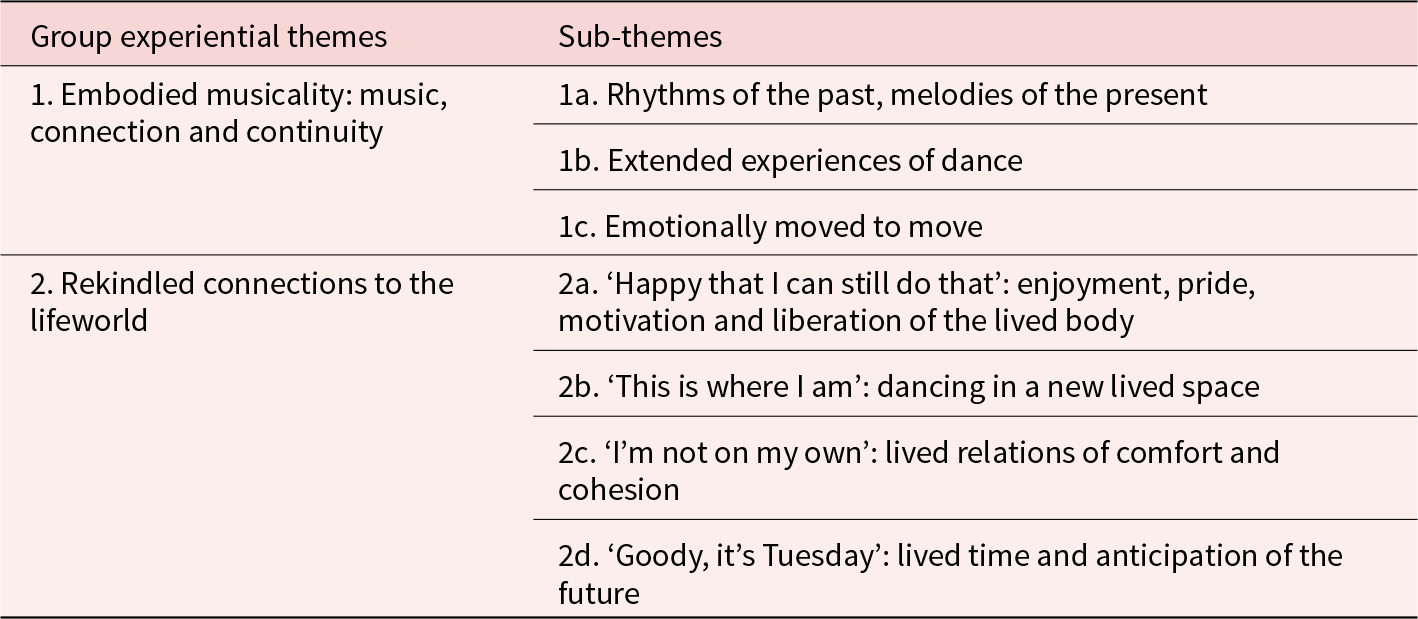
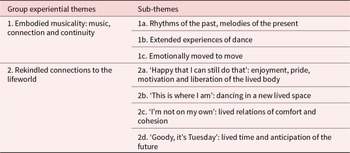
Data analysis revealed two group experiential themes comprising several sub-themes, presented in Table 2. Each theme is presented with the participants’ narratives that shaped its development. Presenting the analysis as such focuses on each theme while acknowledging each participant’s experiences, aligning with the idiographic approach of IPA (Smith et al. Reference Smith, Flowers and Larkin2021; Smith and Nizza Reference Smith and Nizza2022).
Group experiential themes
Embodied musicality: music, connection and continuity
The first group experiential theme focused on the pivotal role of music in shaping participants’ embodied knowledge. Embodied musicality emerges from past musical experiences that contribute to the embodied knowledge of the lived body. This musically orientated embodied knowledge informed the participants’ understanding of their body, their being and their world. Bodily, temporal, spatial, rhythmic and emotional lived experiences of the past were enacted through music and dance performance, affording connection and continuity of their embodied musicality into the present. Three sub-themes – rhythms of the past, extended experiences of dance and emotionally moved to move – that contributed to the overall meaning of embodied musicality are described next.
Rhythms of the past, melodies of the present
Rhythms of the past captured the meaningful role of music in the participants’ lived experiences. Participants linked their bodily knowledge of rhythm and musical history of the past to the present.
Lydia and Grace revealed their musicality by detailing the presence of music in their history and being. Reflecting on her experience of the dance programme, Lydia considered her musical history, pointing out the strong presence of dynamic and ballroom dancing in the familial and social aspects of her life, which were fundamental to her embodied musicality: ‘My father was very musical … he would play for people wanting to dance, he would play weddings … So I’ve come from that background, I suppose it’s in my genes you might think’.
Like Lydia, Grace described how musical talent was ingrained in her family across generations. She understood musicality as being a predisposed characteristic in her family:
Music’s in my family. My father played a musical instrument in the band, and my mother was a soloist in her church choir in her younger days. And its sort of, it’s going through the family, my daughter has the most beautiful contralto voice, and I think some of the grandchildren sing a little. I have a great-granddaughter who’s well and truly into dancing. She’s been going since she was three. She’s now 17 and she’s won so many medals and been to nationals for Fast Tap or whatever they call it. So, music runs in the family.
Reflecting on her lived experiences of musicality, Grace linked her musical history to her embodied musicality and her embodied knowledge of timing and rhythm:
That’s just me. I’m just used to keeping in time, with music, with any sort, because being a Salvo, I have played a timbrel in my day and so, you have to keep in time … being in choirs you have to keep in touch with the leader and the others in the group. So I’m just used to fitting in with time, with music.
Additionally, Grace’s lived body expressed its embodied musicality by displaying bodily knowledge of rhythm: ‘I’ve always loved music, um, and you probably noticed my feet [taps her feet] do a lot’.
Like Grace, Gloria’s lived body demonstrated bodily knowledge of rhythm, which she linked to her family’s musical history: ‘Well, I keep in time because I am from a musical family. You know [taps feet] time is the thing … I was brought up in a musical family, and so I know the beat is the main thing’.
While Amy did not discuss her musical history as much as other participants, her lived body displayed bodily knowledge of rhythm while revealing how music informed her understanding of her body and world: ‘What it’s like? I like to [taps her feet] get tapping to good music. It makes me feel good inside … Music is the source of life, and without music, life would be very, very dull, wouldn’t it?’.
Overall, the participants’ narratives revealed how their musical histories shaped their understanding of their body, their being and their world. This was evident as participants linked their musical histories to their understanding of self and the bodily demonstration of bodily knowledge of rhythm and timing.
Extended experiences of dance
Extended experiences of dance captured how present dance experiences of the lived body connected participants with past experiences of their body, space and time. Bodily sensations of youth were tied to various spatial experiences that emerged from music paired with performative movements. Additionally, some participants identified how the symbolic verbal guidance employed by the instructor contributed to these experiences.
After watching a video of her performance, Lydia described feeling younger, linking her past dance experiences to her embodied musicality: ‘That actually, in some ways, that takes you back to when you were younger. And to think that, you know, you come into an aged care facility. And here we are, again, still doing [laughs] the same thing’.
Lydia then clarified that focusing on the music connected her with her embodied musicality: ‘Well, you’re listening to the music. So, whatever you’re doing has to be in time with the music. So, it actually takes you back to when you were, with me, it takes me back to when I could go dancing’. Similarly, Grace expressed bodily experiences of youth during her dance performance: ‘It makes you feel younger than what you are, you know, being able to kick your legs around’.
Four participants described the combination of the instructor’s symbolic verbal guidance and the performative movements of their lived bodies that evoked bodily and spatial transcendence. Grace recalled: ‘You think that’s where you are, like when they say breaststroke and you’re sort of doing that, and you’re thinking you’re in the water doing the breaststroke’.
Gloria noted that engaging her lived body in dance, paired with the instructor’s symbolic verbal guidance, afforded a transcendent experience of her body and space.
Well, it takes me back to a few years back, you know, I used to ride a bike and that sort of thing I used to do, hard things like that, you know. I was a bike rider and used to go riding my bike regularly, and that often comes into my head and I think this is so gentle [compared] to what I used to do.
Kim also spoke about the experience of the instructor’s symbolic instructions, which afforded her an extension of her lived body: ‘Just the way she tells us to do it … She has us twirling umbrellas and singing in the rain and stuff, you know? She has us doing things … It’s a different world’. While clarifying her response, Kim emphasized a revival of her past bodily experiences through her lived body while dancing: ‘It means I feel like I’m back doing exercise again. Real exercise’.
Polly further emphasized the power of the instructor’s symbolic verbal guidance combined with performative movement to transcend her body and space as she detailed the immersive spatial, bodily and emotional experiences she encountered through her lived body while dancing:
She is so realistic with her imagination. You really feel as if you are in a bit of a dive, and you’re drinking and you’re dealing cards, which is something foreign to a lot of people. And they’re having a drink and then playing on the pool table. And then when you have the win, you know, the exhilaration, you live through the whole experience!
During the dance, participants experienced music, movement and the instructor’s verbal guidance as an extended experience, conjuring feelings of spatial and bodily transcendence. Through this transcendence, participants experienced feelings of past youth, dance and other physical activity.
Emotionally moved to move
The following sub-theme, emotionally moved to move, was a unique personal experiential theme found only in Grace’s narrative. In detailing her dancing experience, Grace retold the rich embodied experiences of music, emotion and movement that created a space where emotions of her past were experienced and explored through her present lived body.
Grace explained how music provided a conduit to channel her emotions and express them through her movements:
If you think about it enough, you can put your mind to what the movement and music is and go with it. Um, I don’t know, that’s how I explain it, I just, you can just put your feeling into the music that’s being played and you can make your movement go with it. So, you know, whether it’s a sad or a happy one.
After rewatching a video of her dance performance, Grace shared how the music elicited conflicting emotions of love and loss that she experienced towards her deceased husband: ‘This is a real love song, it took me back to my marriage days. I guess I feel very loving … Yes [pause] I guess sometimes it was a bit sad’. Grace then revealed how she channelled embodied experiences of love and sadness in life through the music, exploring these emotions through her dance performance:
You are thinking about the words in the song. It did make you feel really, um, as though somebody loved you, um, and that’s what the feelings were when you were going up [raising your arms] and probably hugging at times [embracing yourself] and, you know, going and shedding your love around and all that sort of thing … but there was a lot of meaning in that song so every movement probably meant something, whether it was a happy time or a sad time … but those movements, the sad times would be when for me, when [pause] I’ve lost that, but then the happy times were when you were together and you were happy together … the unhappy times have reminded me [pause] of losing Eric … and the happy times would have been when we were together.
For Grace, dancing was often a deeply emotional and personal experience. She described the reciprocal embodied connection between emotion and dance. Grace felt emotions through the experience of certain movements and songs, while also ‘put[ting her] feeling[s] into the music’ and ‘mak[ing her] movement go with it’. Grace’s narratives reveal the embodied connections among movement, music and emotion during dance.
Rekindled connections to the lifeworld
The second group experiential theme, rekindled connections, highlights how dancing supported and revived aspects of the participants’ lifeworld that had diminished through their experience of ageing and living in an RCH. Meaning was anchored to their lifeworld through the expression of various pieces of embodied knowledge during dance, refreshing connections to their bodily, spatial, temporal and relational experiences. Rekindled connections to the lifeworld comprised four sub-themes: happy I can still do that, this is where I am, I’m not on my own and goody, it’s Tuesday.
Happy that I can still do that: enjoyment, pride, motivation and liberation of the lived body
The connection between the lived experience of dance and the lived body of the participants was captured in the sub-theme happy I can still do that. Dancing afforded participants a meaningful experience of joy, pride, achievement, motivation and physical liberation that strengthened their connection to their lived bodies, fostering bodily agency. When asked why she regularly attended the dance programme, Grace replied: ‘It makes me feel real happy that, at my age, i can still do that’. Grace’s joy elicits a sense of pride in her body’s ability to dance, enacting a strong connection to her lived body.
Like Grace, Lydia revealed a similar connection to her lived body that emerged from feelings of pride and achievement about dancing:
Actually, it lasts quite, well, quite a [pause] yeah, I feel good when I come back. And then if I go to do something, you know, I’m still, I still feel good about it. It’s the actual feeling that at my age, I can still do all of that too, you know, that’s, that’s the other thing.
Gloria also experienced a connection to her lived body through the execution of performative movements and continued learning about music and her body:
I feel like I’ve achieved something by being there. Yeah. In a way, you’re learning all the time, learning what’s happening with the music and the exercise, you know? And I find it very soothing. She’s such a beautiful person who I just, I can relax and do all the exercises with her, you know sort of thing. And I enjoy it and I love it … But you just feel good, feel good, that you’ve done those movements and everything.
Gloria then revealed how dancing, paired with the instructor’s verbal guidance, afforded her a feeling of being free from physical limitations:
It’s hard to describe actually, but I know I always feel good. I mean, those exercises, people wouldn’t think that they help you like they do, but they do. They do. Moving all your joints and everything and, and she’s so gentle. You know a lot of the people giving exercises they’re not, you know the ‘bang bang’ sort of thing. She’s so gentle that you just do it [laughs] you just do it and you don’t even think about it … But [pause] I just feel my whole body, I don’t have any aches or pains. Whereas I used to get aches and pains. I get no aches and pains. So it’s got to be these exercises that are doing it, it’s got to be, all the joints being moved around you know?
Polly expressed how after a dance class she was reconnected to her lived body through energized feelings of motivation:
You definitely feel, in a more, a more positive mood … I came back to my room, I mentioned how I’ve only just moved in, that I was so motivated that I was able to unpack lots of things and find a home for them. I was real wound up, right until I went to lunch because instead of just lying down on the bed and thinking ‘Oh, I’ve had this’ I just got into it and I’ve got it half finished.
Kim shared a profound experience of physical liberation after dance, which gave her a sense of confidence and bodily agency:
I feel I move better because of that … I feel like I just walk straight across to that [rollator walker]. Everybody always brings it over to me, but after I’ve been with Julie, I feel I can walk over to it and get it myself. You know, it’s just she gives me confidence … But I know I’ve got to have it. I can’t be without it. It’s nice to be able to just walk to it sometimes.
In summary, participants shared how dancing rejuvenated connections to their lived body by describing the experiences of enjoyment and pride towards their body. Furthermore, some participants spoke of the motivation, energy and bodily liberation they experienced post-dance, which elicited feelings of satisfaction and bodily confidence.
This is where I am: dancing in a new lived space
This is where I am details three participants’ compelling accounts of spatiality. Phenomenology acknowledges the intimate connection between space and the body, conveying how different spaces affect how we feel and experience our bodies (Merleau-Ponty Reference Merleau-Ponty2013). Meaning is embedded in spaces through lived experiences of the lived body (Fuchs Reference Fuchs, Koch, Fuchs, Summa and Müller2012). The following narratives reveal how the lived experience of dance imbued meaning into the participants’ spatiality, forging connections to their lived space.
In Lydia’s narrative, she referred to her spatiality as ‘in here’, which she contrasted with the ‘outside world’, highlighting the separation experienced towards her previous home. However, Lydia explained that using her body as she did in the past healed this separation. Through dance, her space became meaningful, which helped her connect and adapt to her new home:
I come out of there feeling energized. I’m not, I haven’t been down in the dumps or anything, but I feel energized. And to me, that’s good. Because, I mean, before coming in here, I used to walk that beach with friends, and then we often went for a coffee after it. And those kinds of things I have missed. But doing this. That certainly sorts that out for me … Just the fact that I’m still using my body. Maybe not as much as I did in the outside world, but I’m using it in here. And it helps you adapt to living here. You know because, for most of us, this is the last stop, you might say. And I’m quite happy, so yeah.
Kim expressed an admission of disdain for her spatiality. Her narrative is short, yet powerful. Dance connected Kim with her lived body, which transformed her experience of being confined: ‘You feel as though you can do things, you’re not stuck in the [pause] in the, in the [pause] the little box that you’re in here’.
Gloria explained that dancing gave her a feeling of belonging, strengthening the connection between her body and her space: ‘I mean, I love to do exercises, but all the time with her I feel good! I just feel good, you know, this is where I should be. This is where I am you know?’.
For some participants, dancing was a way to adapt to their lived space of the RCH. Most participants expressed how dancing eased the transition into the RCH, detailing how dance made them feel more comfortable and familiar with their space, substituting for past recreational activities that were difficult to carry out in their new homes.
I’m not on my own: lived relations of comfort and cohesion
The sub-theme I’m not on my own is grounded in the relational experiences of participants during dance. Within phenomenology, relationality is understood as interpersonal experiences that shape our lived experiences (Merleau-Ponty Reference Merleau-Ponty2013). Narratives reveal the meaning that participants attributed to the relationality of the group during dance. Participants noted that the instructor, the music and the group atmosphere were important in alleviating anxiety and embarrassment, and fostering connections with others.
Polly explained that the collective experience while dancing, coupled with the instructor’s confidence, minimized feelings of embarrassment and gave her an experience of joy:
Because she’s not embarrassed, you’re not embarrassed … Yes, [pause] you feel [pause] free. You don’t have any hang-ups or, um, maybe if someone nosy had come to the door and was watching you. And you’re shuffling your cards and drinking and smoking, you’d feel stupid. That would inhibit you, I would think, but because you’re just there and you are all on the same page. You’re all doing the same thing. And you know even that it’s something you wouldn’t do in real life. You, um, you rather enjoy it [laughs] … Because you’re not embarrassed. You’re not, you’re doing it as a group, you’re aware that it’s good for you, good for all of us.
Lydia expressed a similar sentiment to Polly, explaining how the instructor’s guidance made her comfortable within the group: ‘You know, she expresses it well. And she herself is, you know, very fit as you would know. And there’s no anxiety, I can’t see or feel anxiety around me. Everyone seems, you know, quite content’.
Gloria explained how the combination of music and the instructor’s presence during the dance programme shaped her relationality, which made her feel part of a group:
Well, her class, it always makes me feel good. I feel like I’m not on my own. I’m with a group of people. And we all, I’m sure we all feel the same way because she’s just such a gentle person, you know, and, umm, we all love her, I think that’s the best way to explain it. It just feels really good … I never feel as good with anybody else … I don’t know [pause] she has an aura about her, you sort of feel it, well, she’s such a gentle person with the, with the exercises. You know, she’s so gentle. And, yeah, it’s hard to explain, but I don’t get that feeling, like we did exercises this morning with one of the staff, but it’s not the same as when she comes in, you know everyone else, she gets a good crowd there and everyone loves her, I’m sure they do, you know. It’s different from just the ordinary, well, we see all the other staff all the time, and she is gentle the way she talks.
Gloria then emphasized how the instructor’s verbal guidance and music were essential to her relationality towards the group:
It all depends on what she’s saying, you know, I mean, I can’t think now about what she talks about, because she’s always talking and always telling us what we’ve got to do. And everyone does it, you know, and … but a lot of the time, it’s just the music, it’s just the music and I think, the music she picks is ideal for what she does. You know it’s none of this ‘bang bang’ sort of stuff. And everyone enjoys it. Everyone loves it, and it’s gentle music. She’s gentle. And so it makes us feel good and in the group.
Overall, participants expressed feelings of group comfort and cohesion while dancing. The experiences of shared synchronized movements and the leadership of the instructor supported these feelings, creating a positive group atmosphere and cultivating connections among group members.
Goody, it’s Tuesday: lived time and anticipation of the future
Goody, it’s Tuesday captures how participants experience their temporality in relation to dance. Within phenomenology, temporality encompasses the meaning attributed to time and how the past, present and future are experienced (Merleau-Ponty Reference Merleau-Ponty2013; van Manen Reference van Manen1997). Two participants revealed the temporal meaning afforded to them, which was anchored to their dance experience.
Grace described how she anticipated the future, looking forward to each session of the dance programme: ‘I look forward to being able to do things to music, to feel relaxed when it’s finished, and you really look forward to it the next week’.
Kim gave a detailed response regarding her temporality. Her narrative had an underlying tone of angst, suggesting a bleak meaning attributed to her experience of lived time. However, like Grace, Kim looked forward to the dance programme; it afforded her an experience of anticipation that anchored meaning to her temporality:
I’ve lost all sense of time actually [laughs] it floats away from me now. I just [pause] days used to be days that you did things one day and they fade into something else and they fade into something else. But here it’s just, ‘what day is it?’ … I can’t tell you any times or things … It’s something to look forward to, I say, ‘Oh goody, it’s Tuesday’.
For some participants, the anticipation of dancing each week introduced new meaning to their experience of temporality. Grace described looking forward to being able to engage with music each week. Kim described how her sense of time had ‘floated away’ from her; however, dancing had introduced a beacon of positive temporal meaning into her week.
Discussion
The main findings of this study were two group experiential themes that captured how older adults enact their embodied knowledge through synchronized seated dance. Dancing reconnected them to their ageing bodies and sense of identity, projecting meaning into their experiences of RCH life. Participants recounted experiences of bodily, spatial, temporal, social and emotional embodied knowledge, manifested through synchronized seated dance. Dancing afforded embodied experiences that extended perception and action, facilitating expressions of embodied knowledge that would otherwise not have been possible. These were experienced as an extension and continuation of participants’ lived bodies. Exploring embodied knowledge shifts attention from dance’s physical and cognitive benefits towards a bodily understanding of learning, remembering, expression and the intersubjective experience of interacting with others. Understanding dance from this perspective has the potential to yield benefits beyond our current knowledge.
The first theme, embodied musicality, reveals the power of dance to connect older adults with their histories, bodily knowledge and emotions that are associated with music and dance. Embodied musicality reflects Merleau-Ponty’s (Reference Merleau-Ponty2013) concept of the lived body, highlighting the significant role of music in the acquisition and expression of embodied knowledge. Participants expressed their embodied musicality, which afforded them a continuation of their musical identity. Fuchs (Reference Fuchs2020) notes that identity is developed in the lived body through historical engagement with situations, spaces, sounds, habits, attitudes and relationships over time. Similarly, our data posits musical identity as an embodied knowledge developed over time through the lived body’s interaction with music and musical activities such as dance.
Participants demonstrated embodied knowledge of waltzing, rhythm, playing instruments, emotions and other lived experiences associated with music and dance, affirming their musical identity. This finding is important, as maintaining identity for people in RCHs has positive implications for quality of life. Several studies demonstrate how RCH environments can impact identity, hindering autonomy and independence (Heide Reference Heide2022; Paddock et al. Reference Paddock, Brown Wilson, Walshe and Todd2019). Research suggests that preserving identity is critical to maintaining quality of life and aiding the transition to RCHs (Cooney Reference Cooney2011; Heide Reference Heide2022; Walker and Paliadelis Reference Walker and Paliadelis2016). Gautam et al. (Reference Gautam, Montayre and Neville2021) found that when entering RCHs, older adults often construct a new identity to reflect their new environment. Meaningful interventions in RCHs should, therefore, be available to aid this process. Our results indicate that dancing could be a viable strategy to nurture and promote a positive identity for older adults. Additionally, some participants clearly tied some of their experiences to music, illustrating the power of music as a simple technique to continue the identity of older adults.
The second theme, rekindled connections, highlights how participants revived connections to their lifeworld by expressing embodied knowledge through dancing. Transitioning to an RCH alters an individual’s experience of their lifeworld through changes to their home, social relations and routines (Paddock et al. Reference Paddock, Brown Wilson, Walshe and Todd2019). These changes can impede how individuals understand, engage with and experience their world and their body. Dancing afforded participants the opportunity to express embodied knowledge, projecting meaning into their lifeworld.
Participants connected with their lived bodies through experiences of physical liberation, joy and achievement from dancing. Post-dance experiences of bodily agency emerged from their embodied knowledge; one participant felt motivated and energized to organize her living space, while another shared a captivating experience of using her embodied knowledge to walk short distances unassisted. These experiences show how dance can promote an embodied sense of agency through the expressions of the lived body and connections to the lifeworld. Southcott and Joseph (Reference Southcott and Joseph2020) found that a group of older adult dancers exercised their agency through the exploration of their embodied knowledge of their dance skills, body and sense of self. Pirhonen and Pietilä (Reference Pirhonen and Pietilä2018) also suggest that for older adults, agency should not be restricted to physical ability and includes the ability to feel and experience. The results of this study provide evidence that participants experienced bodily agency through physical acting and bodily feelings. Therefore, dancing may effectively support the agency of older adults who choose to continue dancing while living in RCHs.
Older adults entering RCHs face the challenges of a new home. The home is a uniquely special spatial experience, which gathers meaning from a mix of bodily, emotional and social experiences that are fundamental to a sense of being (Cooney Reference Cooney2011; Stones and Gullifer Reference Stones and Gullifer2016; van Manen Reference van Manen1997). The transition from living at home to living in an RCH dramatically disrupts an individual’s spatiality. For example, in our study, participants revealed the experience of their space as being ‘stuck in the box’ or ‘in here’ as opposed to ‘the outside world’. However, participants reported that dance enabled them to generate new meaningful spatial experiences, which provided a positive connection to their lived space, making them feel content and more comfortable in their new home. Studies highlight the link between older adults feeling ‘at home’ in an RCH and their quality of life, suggesting that meaningful activities can enhance this link (Cooney Reference Cooney2011; Hutchinson et al. Reference Hutchinson, Cleland, McBain, Walker, Milte, Swaffer and Ratcliffe2024; Minney and Ranzijn Reference Minney and Ranzijn2016). Dancing affords the expression of past spatial knowledge, projecting meaning and familiarity into new spaces. This is an important finding, suggesting that regular dance participation may aid the process of adapting to a new home in an RCH.
The institutional nature of RCHs can often make it challenging for older adults to continue their previous social networks, altering their lived relations. Our study suggests that group dance connected participants to their lifeworlds through meaningful experiences of relationality. The importance of social connections for this population emphasizes the significance of these findings. Hutchinson et al. (Reference Hutchinson, Cleland, McBain, Walker, Milte, Swaffer and Ratcliffe2024) identified social connections as a vital component of the quality of life for older adults living in RCHs. For independently living older adults, dance has been shown to nurture social connections (Atkins et al. Reference Atkins, Deatrick, Gage, Earley, Earley and Lipman2019). Furthermore, Siette et al. (Reference Siette, Dodds, Surian, Prgomet, Dunn and Westbrook2022) suggest that residents who participate in social activities strengthen social connections, improving quality of life. Participants in this study expressed how dancing in a group provided experiences of group cohesion and belonging while lowering feelings of anxiety and embarrassment. These results are significant for RCH residents whose social networks have been confined, suggesting that dancing effectively forges cohesion among group members and creates meaningful experiences of lived relations. Our results support Siette et al. (Reference Siette, Dodds, Surian, Prgomet, Dunn and Westbrook2022) and Atkins et al. (Reference Atkins, Deatrick, Gage, Earley, Earley and Lipman2019) and suggest that dancing is a valuable intervention for older adults in RCHs, to help them express their embodied social knowledge and strengthen their social connections.
Standardized meals, visitation and rest routines alter the temporal experience of older adults entering RCHs. McKechnie et al. (Reference McKechnie, Jaye, Hale, Tordoff, Robertson, Simpson and Butler2018) and Paddock et al. (Reference Paddock, Brown Wilson, Walshe and Todd2019) suggest that institutional routines can impact older adults negatively, restricting their independence and autonomy around temporal decisions. Balkin et al. (Reference Balkin, Martinsen, Kymre, Kollerup and Grønkjær2023) explored the temporality of older adults in RCHs, revealing that participants orientated their temporality to the present and past but often excluded the future. Furthermore, older adults actively immersed themselves in past experiences, which boosted their wellbeing (Balkin et al. Reference Balkin, Martinsen, Kymre, Kollerup and Grønkjær2023). Desmyter and De Raedt (Reference Desmyter and De Raedt2012) suggest that older adults who anticipate future experiences increase positive emotional states. Our results indicate that dancing introduced meaning to the participants’ experience of temporality as they anticipated and ‘looked forward’ to dancing, introducing a temporal shift that included future orientation. Activities like dance may help enhance older adults’ perception of temporality by supporting a full temporal spectrum of past, present and future, increasing positive emotions.
The observed dance programme’s method for facilitating embodied knowledge must be recognized. The programme was particularly innovative, contributing to the participants’ rich experiences of the lived body. The instructor carefully curated the music to suit the participants’ preferences and consistently provided verbal and physical encouragement. The choreography varied between functional movements, symbolic dances and group-themed interactive routines. All choreography was performed simultaneously, resulting in various forms of embodied group synchrony (Toohey et al. Reference Toohey, Hutchinson and Moloney2024). Synchronous movement between individuals, including dancing, can increase positive affect and influence physical, emotional and social experiences (Basso et al. Reference Basso, Satyal and Rugh2021; Keisari et al. Reference Keisari, Feniger-Schaal, Palgi, Golland, Gesser-Edelsburg and Ben-David2022). These aspects likely enhanced the participants’ engagement more effectively, compared to other physical activities such as aerobics, emphasizing the embodied nature of dance as a meaningful intervention for this population.
The current study aligns with previous phenomenological and embodied dance studies that have observed embodied experiences of joy, confidence and a sense of belonging within different age groups and dance styles. A sample of middle-aged pole dancers expressed that dancing provided support to overcome physical and emotional challenges associated with ageing and enhanced social interactions (Kim et al. Reference Kim, Im, Lee and Heo2023). Moe (Reference Moe2014) reported that female belly dancers aged between 50 and 74 years experienced feelings of joy and bodily confidence. Paglione et al. (Reference Paglione, Kenny, McDonough, Din and White2024) observed a standing dance programme for community-dwelling older adults aged between 71 and 87 years and reported similar experiences of bodily confidence, motivation, a sense of belonging and connections to the past. Additionally, Krekula (Reference Krekula2022) reported that a sample of adults aged between 52 and 81 years experienced embodied expressions of their younger-age identities while dancing. These similarities are notable as they suggest that the embodied benefits observed in more exertive, standing forms of dance can be achieved by older adults in a seated format, making the benefits more accessible.
Our findings suggest that the style of dance is important. Rittiwong et al. (Reference Rittiwong, Reangsing and Schneider2023) and Waugh et al. (Reference Waugh, Youdan, Casale, Balaban, Cross and Merom2024) recommend that dance styles that are culturally relevant are likely to be more meaningful and enjoyable to an older population. Several participants evidenced this as they described how waltzing was meaningful to their dance experience. It is likely that our sample was proficient in waltzing given its popularity in the twentieth century across Australia and Western Europe (Bakka Reference Bakka, Bakka, Buckland, Saarikoski and von Bibra Wharton2020, p. 3; Knowles Reference Knowles2009). Future research may consider whether the embodied benefits of dancing are influenced by an individual’s cultural background and the type of dance employed.
Recommendations for practice
When drafting a dance programme in an RCH, care providers should consider employing the expertise of experienced dance instructors with knowledge of a variety of dance styles to suit the preferences and cultural backgrounds of participants. Careful consideration should be given to the choice of music, the opportunity for performative and symbolic choreography and the use of symbolic verbal guidance to optimize the embodied experiences of the cohort.
The frequency of dance programmes should also be considered. This study found that participants expressed keen anticipation and joy at the prospect of future dance programmes. Increasing the frequency of dance sessions to twice a week may be beneficial for this population; however, more research is needed to confirm this.
Strengths and limitations
This study has demonstrated the potential wealth of benefits of dance for older adults, particularly those living in RCHs. However, there is more to be investigated regarding social interactions, choreography, music, the role of the instructor’s guidance and the cultural preferences of dance. Many of the results pertain to the embodied experiences of music during dance, displaying the potential embodied power of music alone to improve the lives of people living in an RCH. It has been suggested that music can be used as a meaningful delivery method of interventions such as reminiscence therapy (Cuevas et al. Reference Cuevas, Davidson, Mejilla and Rodney2020; Klever Reference Klever2013). This study adds an additional benefit to dance, finding it to be a therapeutic intervention and highlighting its ability to connect people to their bodies, their selves, their world and others, along with alternative embodied activities such as art-making, music groups and other outdoor activities.
A significant limitation of this study was the unsuccessful recruitment of males into the sample, resulting in an all-female sample. Therefore, the results may not reflect the lived experiences of dance and ageing bodies across genders. Future dance studies with older adults may make a concerted effort to recruit males into their samples in order to understand the lived experiences of dance and ageing bodies across genders. Furthermore, the small sample size of this study is a potential limitation in terms of the generalizability of the findings. However, IPA is not used to generalize findings to broader populations but rather to uncover the experiences of a particular group in a particular setting. Older adults living in RCHs are a unique population; therefore, the findings of this study should be applied carefully and supplemented with other extant literature (Smith et al. Reference Smith, Flowers and Larkin2021).
Conclusion
Departing from the typical known benefits of dance, this study has yielded several nuanced implications for older adults in RCHs. Dancing was an effective method for older adults to draw upon their embodied knowledge, strengthening connections to their lifeworld that may have been disrupted when transitioning to life in the RCH. Through dancing, participants engaged their embodied musicality, connecting with their identities and nurturing a sense of self. Participants expressed embodied knowledge of their body, others, time and space through feelings and actions of joy, motivation, bodily confidence and social connections, introducing meaning to their lifeworld within the RCH and fostering agency. Aspects of dance, particularly certain music, performative movement and the instructor’s verbal guidance, were pivotal to the revival and expression of embodied knowledge, which extended their past experiences of their bodies and space into the present. Furthermore, participants’ anticipation of future dance programmes suggests that dance and other meaningful activities can enhance positive feelings of the future, supporting the full spectrum of past, present and future in older adults’ experience of temporality. These findings offer exciting opportunities in terms of intervention, particularly for new residents. Dance appears to be a practical activity to support older adults to continue experiencing a meaningful quality of life as they navigate new spaces, routines, relations and body changes while settling into a new life in an RCH.
Supplementary material
The supplementary material for this article can be found at https://doi.org/10.1017/S0144686X25100299.
Acknowledgements
The authors would like to acknowledge the residents and staff of Sawtell Catholic Care and the Julie Ross Dance Studio.
Competing interests
The authors declare none.
Ethical standards
This study was approved by the Southern Cross University Human Research Ethics Committee, approval number 2021/059.


 Open access

