





1 Introduction
The theory of aperiodic order is concerned with (generalizations of) Delone sets displaying some long-range order while at the same time being far from periodic. Until recently, the theory has mostly been studied in Euclidean space or abelian locally compact groups—we refer the reader to [Reference Baake and Grimm1] for an extensive bibliography in the abelian setting. With any (weighted) Delone set in an abelian locally compact group, one can associate a topological dynamical system, the so-called hull system of the Delone set, and these systems play a central role in the dynamical approach to the study of aperiodic order. A crucial question in this context is how properties of the dynamical system are reflected in the structure of the underlying Delone set and vice versa. For example, it is a famous result of Lagarias and Pleasants in [Reference Lagarias and Pleasants30] that the hull of a linearly repetitive Delone set in ${\mathbb R}^n$
is uniquely ergodic.
${\mathbb R}^n$
is uniquely ergodic.
Recently, the scope of the theory of aperiodic order was extended to the realm of arbitrary (that is, not necessarily abelian) locally compact groups and, even more generally, proper homogeneous metric spaces, cf. [Reference Björklund and Hartnick7, Reference Björklund, Hartnick and Pogorzelski10–Reference Björklund, Hartnick and Pogorzelski12] in collaboration with Björklund. Further recent developments in this area can be found in [Reference Beckus and Pogorzelski5, Reference Björklund and Hartnick8, Reference Björklund and Hartnick9, Reference Björklund, Hartnick and Stulemeijer13, Reference Cordes, Hartnick, Tonić and Machado17, Reference Fish22, Reference Hrushovski28, Reference Machado36–Reference Machado38]. A particular focus has been on (aperiodic) Delone sets in locally compact second countable (lcsc) groups and, more specifically, in constructing interesting examples of such sets. While the original focus of this program was on Delone sets arising from a non-abelian version of Meyer’s cut-and-project construction, our most recent work [Reference Beckus, Hartnick and Pogorzelski4] introduces symbolic substitution techniques to a non-abelian setting. Using these techniques, we are able to construct the first examples of aperiodic linearly repetitive Delone sets in non-abelian Lie groups. By analogy with the Lagarias–Pleasants theorem mentioned above, it is then natural to ask whether the hull dynamical systems of these Delone sets are uniquely ergodic. We will see that the answer to this question is positive for all examples provided in [Reference Beckus, Hartnick and Pogorzelski4], but the proof of this fact will depend on a very peculiar property of our examples, namely exact polynomial growth of the ambient Lie group. Our construction in the companion paper [Reference Beckus, Hartnick and Pogorzelski4] produces linearly repetitive Delone sets inside a certain class of Lie groups called homogeneous Lie groups (see [Reference Folland and Stein23] or [Reference Fischer and Ruzhansky21, Ch. 3] for a more modern treatment). Lie groups from this class turn out to be nilpotent (hence, in particular, amenable) and admit a canonical quasi-isometry class of left-invariant metrics called homogeneous metrics, which induce the given topology.
If G is a homogeneous Lie group with homogeneous metric d, then a subset $\Lambda \subseteq G$
is called a Delone set if there exist
$\Lambda \subseteq G$
is called a Delone set if there exist $R> r > 0$
such that
$R> r > 0$
such that $d(x,y) \geq r$
for all distinct
$d(x,y) \geq r$
for all distinct $x,y \in \Lambda $
and such that every
$x,y \in \Lambda $
and such that every $x \in G$
is at distance at most R from
$x \in G$
is at distance at most R from $\Lambda $
. It is called linearly repetitive if there exists a constant
$\Lambda $
. It is called linearly repetitive if there exists a constant $c_\Lambda \geq 1$
such that every pattern of radius
$c_\Lambda \geq 1$
such that every pattern of radius $\rho $
of
$\rho $
of $\Lambda $
occurs in every ball of radius
$\Lambda $
occurs in every ball of radius $c_\Lambda \rho $
(this is made precise in Definition 4.6 below). By definition, the hull of a linearly repetitive Delone set is its orbit closure with respect to the Chabauty–Fell topology on the space of closed subsets of G. We then have the following generalization of the Lagarias–Pleasents theorem, which we expect to draw interesting connections to questions of spectral convergence via dynamical systems, cf. [Reference Beckus, Bellissard and De Nittis3, Reference Beckus and Pogorzelski5].
$c_\Lambda \rho $
(this is made precise in Definition 4.6 below). By definition, the hull of a linearly repetitive Delone set is its orbit closure with respect to the Chabauty–Fell topology on the space of closed subsets of G. We then have the following generalization of the Lagarias–Pleasents theorem, which we expect to draw interesting connections to questions of spectral convergence via dynamical systems, cf. [Reference Beckus, Bellissard and De Nittis3, Reference Beckus and Pogorzelski5].
Theorem 1.1. (Unique ergodicity from linear repetitivity, homogeneous case)
Let G be a homogeneous Lie group with a homogeneous metric d. Then, the hull of every Delone set in G that is linearly repetitive with respect to d is minimal and uniquely ergodic.
We emphasize that there are plenty of examples to which Theorem 1.1 applies. Indeed, in [Reference Beckus, Hartnick and Pogorzelski4], we were able to construct non-periodic repetitive Delone sets, which are linearly repetitive with respect to a homogeneous metric on the ambient group, in 133 of the 149 families of indecomposable $1$
-connected nilpotent
$1$
-connected nilpotent $7$
-dimensional real Lie groups classified in [Reference Gong25]. In fact, these examples were a key motivation for us to establish Theorem 1.1.
$7$
-dimensional real Lie groups classified in [Reference Gong25]. In fact, these examples were a key motivation for us to establish Theorem 1.1.
We will actually prove a slightly stronger result than Theorem 1.1, which applies to all weighted Delone sets which are almost linearly repetitive (this is made precise below). Minimality of the hull holds in an even wider context, see Proposition 2.4 below, and can be established by adapting ideas from [Reference Frettlöh and Richard24] to the setting of weighted Delone sets. The main contribution of the present article lies in proving unique ergodicity, and it is in this part of the proof that we use the assumption that G is a homogeneous Lie group with homogeneous metric d. As explained in [Reference Beckus, Hartnick and Pogorzelski4], these assumptions imply that the pair $(G,d)$
has exact polynomial growth in the sense of the following definition (Definition 4.3 below).
$(G,d)$
has exact polynomial growth in the sense of the following definition (Definition 4.3 below).
Definition. Let G be an lcsc group with left-Haar measure $m_G$
and let d be an adapted (that is, left-invariant, proper, and locally bounded) metric on G. We say that G has exact polynomial growth with respect to d if there are constants
$m_G$
and let d be an adapted (that is, left-invariant, proper, and locally bounded) metric on G. We say that G has exact polynomial growth with respect to d if there are constants $C> 0$
and
$C> 0$
and $q \geq 0$
such that
$q \geq 0$
such that
 $$ \begin{align*} \lim_{t \to \infty} \frac{m_G(B_t)}{C t^{q}} = 1, \end{align*} $$
where $B_t$
denotes the open ball of radius t around the identity of G.
$B_t$
denotes the open ball of radius t around the identity of G.
Every compactly generated lcsc group which has exact polynomial growth with respect to some metric d as above obviously has polynomial growth in the sense of geometric group theory. Conversely, by a celebrated result of Breuillard [Reference Breuillard14], every compactly generated lcsc group of polynomial growth admits an adapted metric of exact polynomial growth, see Theorem 4.13. If G is moreover a connected Lie group, then this metric can be chosen to be continuous (in fact, Riemannian and, in particular, real-analytic), but it seems to be an open problem whether this is the case in general. It turns out that exact polynomial growth is actually sufficient to establish Theorem 1.1.
Theorem 1.2. (Unique ergodicity from linear repetitivity, exact case)
If an lcsc group G has exact polynomial growth with respect to an adapted metric d, then the hull of every (weighted) Delone set in G that is (almost) linearly repetitive with respect to d is minimal and uniquely ergodic.
We establish Theorem 1.2 in Theorem 4.9 below; note that by the previous remarks, Theorem 1.1 is merely a special case. The assumption that G has exact polynomial growth with respect to d implies that metric balls around the identity form a Følner sequence in G, and even a strong Følner exhaustion sequence in the sense of Definition 3.2 below. Linear repetitivity with respect to d can then be reformulated in terms of this Følner sequence, and this leads to the notion of (almost) tempered repetitivity of a Delone set with respect to a Følner sequence (see Definition 3.5 below). Using this notion, one can reformulate Theorem 1.2 in terms of Følner sequences rather than metrics, and this metric-free formulation actually holds in much greater generality.
Theorem 1.3. (Unique ergodicity from tempered repetitivity)
Let $(T_m)$
be a strong Følner exhaustion sequence in an amenable unimodular lcsc group G and let
$(T_m)$
be a strong Følner exhaustion sequence in an amenable unimodular lcsc group G and let $\Lambda $
be a weighted Delone set in G. If
$\Lambda $
be a weighted Delone set in G. If $\Lambda $
is almost tempered repetitive with respect to
$\Lambda $
is almost tempered repetitive with respect to $(T_m)$
, then the hull of
$(T_m)$
, then the hull of $\Lambda $
is minimal and uniquely ergodic.
$\Lambda $
is minimal and uniquely ergodic.
Theorem 1.2 is indeed a special case of Theorem 1.3, since linear repetitivity with respect to an adapted metric of exact polynomial growth is equivalent to tempered repetitivity with respect to the corresponding strong Følner exhaustion sequence of balls (see Proposition 4.7 below).
It seems to us that Theorem 1.3 is the most natural generalization of the Lagarias–Pleasants theorem to the general amenable case. By Proposition 3.4 below, strong Følner exhaustion sequences exist in all unimodular, amenable lcsc groups, but it is not clear at all in which cases (beyond the case of exact polynomial growth) they can be chosen to be balls with respect to a suitable metric; hence, the need for a metric free formulation. Theorem 1.3 indicates that, in this metric-free context, tempered repetitivity is the correct replacement for linear repetitivity; hence, we would like to advertise this notion.
While Theorem 1.3 is formulated in terms of Delone dynamical system, it is easy to deduce a corresponding unique ergodicity result in the symbolic setting. To formulate such a result, let $\mathcal A$
be a finite alphabet and
$\mathcal A$
be a finite alphabet and $\Gamma $
be a countable amenable group. We refer to an element of
$\Gamma $
be a countable amenable group. We refer to an element of $\mathcal {A}^{\Gamma }$
as a coloring of
$\mathcal {A}^{\Gamma }$
as a coloring of $\Gamma $
by
$\Gamma $
by $\mathcal A$
and equip
$\mathcal A$
and equip $\mathcal A^\Gamma $
with its natural compact metrizable topology, given by the product topology. Given a coloring
$\mathcal A^\Gamma $
with its natural compact metrizable topology, given by the product topology. Given a coloring $C \in \mathcal {A}^{\Gamma }$
, we refer to its orbit closure in
$C \in \mathcal {A}^{\Gamma }$
, we refer to its orbit closure in $\mathcal A^\Gamma $
as the hull of C. Similarly to the case of Delone sets, one can also define the notions of a symbolically tempered repetitive coloring (with respect to a Følner sequence in
$\mathcal A^\Gamma $
as the hull of C. Similarly to the case of Delone sets, one can also define the notions of a symbolically tempered repetitive coloring (with respect to a Følner sequence in $\Gamma $
) or a symbolically linearly repetitive coloring (with respect to a left-invariant metric on
$\Gamma $
) or a symbolically linearly repetitive coloring (with respect to a left-invariant metric on $\Gamma $
), see Definition 5.3 below. In fact, the situation is slightly simpler than in the Delone setting, since for countable groups, the notions of Følner sequence and strong Følner sequence are equivalent by [Reference Pogorzelski and Schwarzenberger47, Lemma 2.7(d)]. In any case, the following result can then be deduced easily from Theorem 1.3, using the fact that colorings of
$\Gamma $
), see Definition 5.3 below. In fact, the situation is slightly simpler than in the Delone setting, since for countable groups, the notions of Følner sequence and strong Følner sequence are equivalent by [Reference Pogorzelski and Schwarzenberger47, Lemma 2.7(d)]. In any case, the following result can then be deduced easily from Theorem 1.3, using the fact that colorings of $\Gamma $
can be identified with certain weighted Delone sets in
$\Gamma $
can be identified with certain weighted Delone sets in $\Gamma $
(see §5 for details).
$\Gamma $
(see §5 for details).
Theorem 1.4. (Unique ergodicity in the symbolic setting)
Let $\Gamma $
be a countable amenable group and let
$\Gamma $
be a countable amenable group and let $\mathcal {A}$
be a finite set. If
$\mathcal {A}$
be a finite set. If $\mathcal {C} \in \mathcal {A}^{\Gamma }$
is symbolically tempered repetitive with respect to a Følner exhaustion sequence, then the hull of
$\mathcal {C} \in \mathcal {A}^{\Gamma }$
is symbolically tempered repetitive with respect to a Følner exhaustion sequence, then the hull of $\mathcal {C}$
is minimal and uniquely ergodic. In particular, if
$\mathcal {C}$
is minimal and uniquely ergodic. In particular, if $\Gamma $
has exact polynomial growth with respect to an adapted metric
$\Gamma $
has exact polynomial growth with respect to an adapted metric $d_{\Gamma }$
and if
$d_{\Gamma }$
and if $\mathcal {C}$
is symbolically linearly repetitive with respect to
$\mathcal {C}$
is symbolically linearly repetitive with respect to $d_{\Gamma }$
, then the hull of
$d_{\Gamma }$
, then the hull of $\mathcal {C}$
is minimal and uniquely ergodic.
$\mathcal {C}$
is minimal and uniquely ergodic.
Let us now discuss some of the ingredients of the proof of Theorem 1.3. As in the cases of Theorems 1.1 and 1.2, the minimality result of Theorem 1.3 can be obtained by adapting arguments from [Reference Frettlöh and Richard24], whereas the unique ergodicity result requires new ideas. Our approach is based on the observation by Damanik and Lenz [Reference Damanik and Lenz19] that in the Euclidean setting, linear repetitivity implies the validity of a uniform sub-additive convergence theorem for certain functions defined on the collection $\mathcal {B}({\mathbb R}^n)$
of all n-dimensional boxes in
$\mathcal {B}({\mathbb R}^n)$
of all n-dimensional boxes in ${\mathbb R}^n$
, which in turn can be used to ensure unique ergodicity. This observation has been refined in many different directions, see e.g. [Reference Besbes, Boshernitzan and Lenz6, Reference Frettlöh and Richard24, Reference Lenz32–Reference Lenz, Schwarzenberger and Veselić35, Reference Pogorzelski43, Reference Pogorzelski45, Reference Pogorzelski and Schwarzenberger47]. A different approach is via strongly almost periodic translation bounded measures, see [Reference Lee, Lenz, Richard, Sing and Strungaru31]. In Theorem 3.1 below, we establish a general version of such a convergence theorem for a large class of amenable groups, which is general enough to allow us to deduce Theorem 1.3 (and thereby also Theorems 1.1, 1.2, and 1.4). While the precise statement of the convergence theorem is rather technical, let us highlight two of the main features of the theorem and its proof.
${\mathbb R}^n$
, which in turn can be used to ensure unique ergodicity. This observation has been refined in many different directions, see e.g. [Reference Besbes, Boshernitzan and Lenz6, Reference Frettlöh and Richard24, Reference Lenz32–Reference Lenz, Schwarzenberger and Veselić35, Reference Pogorzelski43, Reference Pogorzelski45, Reference Pogorzelski and Schwarzenberger47]. A different approach is via strongly almost periodic translation bounded measures, see [Reference Lee, Lenz, Richard, Sing and Strungaru31]. In Theorem 3.1 below, we establish a general version of such a convergence theorem for a large class of amenable groups, which is general enough to allow us to deduce Theorem 1.3 (and thereby also Theorems 1.1, 1.2, and 1.4). While the precise statement of the convergence theorem is rather technical, let us highlight two of the main features of the theorem and its proof.
-
• The theorem works for general amenable unimodular lcsc groups and for a rather general class of weight functions. To achieve this, the study of n-dimensional boxes in ${\mathbb R}^n$
is replaced by the Ornstein–Weiss machinery of
$\varepsilon $
-quasi-tilings [Reference Ornstein and Weiss41] and more specifically its variant from [Reference Pogorzelski and Schwarzenberger47].
${\mathbb R}^n$
is replaced by the Ornstein–Weiss machinery of
$\varepsilon $
-quasi-tilings [Reference Ornstein and Weiss41] and more specifically its variant from [Reference Pogorzelski and Schwarzenberger47]. -
• There is no requirement that the Delone set under consideration has finite local complexity (FLC). A consequence of this is that Theorem 1.2 also holds for almost linearly repetitive Delone sets (and Theorem 1.3 also holds for almost tempered repetitive Delone sets). This is achieved using ideas from Frettlöh and Richard [Reference Frettlöh and Richard24]. Roughly speaking, to incorporate non-FLC situations, one has to identify not only patches which are equal up to a translation, but also patches which are close up to a translation. The fact that being
$\delta $
-close for a small
$\delta>0$
is not an equivalence relation creates all kinds of technical difficulties.


It is well known in the abelian setting that uniform sub-additive convergence theorems have applications beyond unique ergodicity of Delone dynamical systems, and this is no different in our more general setting. We demonstrate the strength of our convergence theorem by two such applications: one to Banach densities and one to the integrated densities of states (IDS). We deduce the corresponding theorems along the lines of the corresponding abelian situations.
Upper and lower Banach densities appear as an important combinatorial quantity in many mathematical areas, see for instance a recent example [Reference Downarowicz, Huczek and Zhang20] for countable amenable groups. For sets with enough symmetry, the upper and the lower Banach density may coincide, and one can just refer to the Banach density of a set. In analogy to the abelian realm, this situation occurs for almost tempered repetitive weighted Delone sets. For the definition of the upper and lower Banach density of a weighted Delone set, we refer to §6. Given a weighted Delone set $\Pi $
, we denote by
$\Pi $
, we denote by $\delta _\Pi $
the associated Dirac comb which is a Radon measure on the group.
$\delta _\Pi $
the associated Dirac comb which is a Radon measure on the group.
Corollary 1.5. Let G be an amenable unimodular lcsc group with Haar measure $m_G$
. Suppose that
$m_G$
. Suppose that $\Lambda $
is a weighted Delone set that is almost tempered repetitive with respect to a strong Følner exhaustion sequence
$\Lambda $
is a weighted Delone set that is almost tempered repetitive with respect to a strong Følner exhaustion sequence $(T_m)$
of G. Then, the Banach density
$(T_m)$
of G. Then, the Banach density
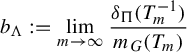 $$ \begin{align*} b_{\Lambda} := \lim_{m \to \infty} \frac{\delta_\Pi(T_m^{-1})}{m_G(T_m)} \end{align*} $$
exists uniformly in $\Pi \in \mathcal {H}_\Lambda $
.
$\Pi \in \mathcal {H}_\Lambda $
.
The implications of our convergence theorem concerning the IDS are a bit more technical to state. We give a sample result in the setting of finitely generated amenable groups $\Gamma $
whose elements are labeled by colors taken from a finite set
$\Gamma $
whose elements are labeled by colors taken from a finite set $\mathcal {A}$
. Since each coloring
$\mathcal {A}$
. Since each coloring $\mathcal {C} \in \mathcal {A}^{\Gamma }$
can be interpreted as a weighted Delone set in
$\mathcal {C} \in \mathcal {A}^{\Gamma }$
can be interpreted as a weighted Delone set in $\Gamma $
, it makes sense to define a version of tempered repetitivity for a coloring. In this context, our convergence theorem allows us to verify a criterion from [Reference Pogorzelski and Schwarzenberger47] which then shows that the IDS for certain pattern-equivariant operators on graphs can be uniformly approximated by finite volume analogs. The precise class of considered operators is defined in Definition 6.2.
$\Gamma $
, it makes sense to define a version of tempered repetitivity for a coloring. In this context, our convergence theorem allows us to verify a criterion from [Reference Pogorzelski and Schwarzenberger47] which then shows that the IDS for certain pattern-equivariant operators on graphs can be uniformly approximated by finite volume analogs. The precise class of considered operators is defined in Definition 6.2.
Corollary 1.6. Let $\Gamma $
be a finitely generated amenable group and let
$\Gamma $
be a finitely generated amenable group and let $\mathcal {C} \in \mathcal {A}^{\Gamma }$
be a coloring of the group by a finite set
$\mathcal {C} \in \mathcal {A}^{\Gamma }$
be a coloring of the group by a finite set $\mathcal {A}$
. Suppose that
$\mathcal {A}$
. Suppose that $\mathcal {C}$
is symbolically tempered repetitive as a weighted Delone set with respect to some strong Følner exhaustion sequence
$\mathcal {C}$
is symbolically tempered repetitive as a weighted Delone set with respect to some strong Følner exhaustion sequence $(T_m)$
. Then for every
$(T_m)$
. Then for every $\mathcal {C}$
-invariant self-adjoint operator
$\mathcal {C}$
-invariant self-adjoint operator $H: \ell ^2(\Gamma ) \to \ell ^2(\Gamma )$
and for its integrated density of states
$H: \ell ^2(\Gamma ) \to \ell ^2(\Gamma )$
and for its integrated density of states $N_H: {\mathbb R} \to [0,1]$
, we get
$N_H: {\mathbb R} \to [0,1]$
, we get
 $$ \begin{align*} \lim_{m \to \infty} \| N_H - N_{H_m} \|_{\infty} =0, \end{align*} $$
where the $N_{H_m}$
denote the empirical eigenvalue distribution functions of restrictions
$N_{H_m}$
denote the empirical eigenvalue distribution functions of restrictions $H_m$
of H to a subspace of
$H_m$
of H to a subspace of $\ell ^2(T_m^{-1})$
.
$\ell ^2(T_m^{-1})$
.
This article is organized as follows. In §2, we introduce Delone dynamical systems and recall the equivalence of minimality of these systems and (almost) repetitivity of the underlying set. Section 3 is devoted to the main convergence theorem, cf. Theorem 3.1, which is stated and proven for so-called admissible weight functions defined on hulls of almost tempered weighted Delone sets. From this, we derive in §4 the unique ergodicity of the hulls of almost tempered repetitive weighted Delone sets, as stated in Theorem 1.3. Moreover, we derive Theorems 1.2 and 1.1 from Theorem 1.3, cf. Theorem 4.9. Section 5 is devoted to symbolic systems over a finite set and the proof of Theorem 1.4. The aforementioned applications including the proofs of the Corollaries 1.5 and 1.6 are carried out in §6. Appendices A and B contain proofs of some technical lemmas on almost sub-additive weight functions and topological aspects of dynamical systems induced by weighted Delone sets.
2 Preliminaries on Delone dynamical systems
2.1 Delone dynamical systems
We recall that a subset P of a metric space $(X,d)$
is called:
$(X,d)$
is called:
-
1. uniformly discrete if there exists
$r>0$
such that
$d(x,y) \geq r$
for all distinct
$x,y \in P$
; -
2. relatively dense if there exists
$R>0$
such that X is an R-neighborhood of P; -
3. Delone if it is uniformly discrete and relatively dense.


If P is a Delone set, $\sigma \geq 1$
and
$\sigma \geq 1$
and $\alpha : P \to [\sigma ^{-1}, \sigma ]$
is a function, then the pair
$\alpha : P \to [\sigma ^{-1}, \sigma ]$
is a function, then the pair $(P, \alpha )$
is called a weighted Delone set. We consider Delone sets as weighted Delone sets with constant weight
$(P, \alpha )$
is called a weighted Delone set. We consider Delone sets as weighted Delone sets with constant weight $1$
.
$1$
.
Let G be an lcsc group and let d be a metric on G. Following [Reference Cornulier and de la Harpe18], we say that a metric d on G is:
-
• left-invariant if
$d(gh, gk) = d(h,k)$
for all
$g,h, k \in G$
; -
• proper if
$B_t := \{g \in G \mid d(g,e) < t\}$
is relatively compact for all
$t> 0$
; -
• locally bounded if every
$g\in G$
admits a neighborhood of finite diameter with respect to d; -
• adapted if it is left-invariant, proper, and locally bounded.


By [Reference Cornulier and de la Harpe18, Proposition 2.A.9], any continuous proper left-invariant metric generates the topology on G. We observe that if d and $d'$
are continuous metrics on G which are coarsely equivalent (in the sense of [Reference Cornulier and de la Harpe18, p. 11]), then they define the same class of Delone sets. We will need the following facts concerning such metrics (see [Reference Cornulier and de la Harpe18, §1.D]).
$d'$
are continuous metrics on G which are coarsely equivalent (in the sense of [Reference Cornulier and de la Harpe18, p. 11]), then they define the same class of Delone sets. We will need the following facts concerning such metrics (see [Reference Cornulier and de la Harpe18, §1.D]).
Proposition 2.1. Every lcsc group admits a continuous proper left-invariant metric d. Any such metric is automatically adapted and generates the underlying topology. Moreover, any two adapted metrics on G are coarsely equivalent (even if they are not continuous).
In view of the proposition, we say that a subset $P \subseteq G$
is uniformly discrete, relatively dense, or Delone if it has the corresponding property with respect to some (hence any) continuous adapted metric. For the remainder of this section, we fix an adapted metric d on G. Later on (see §4 below), we will have to choose an adapted metric with very peculiar properties, but for the moment, the precise choice of metric will not matter to us. In view of Proposition 2.1 and the previous considerations, we assume as well that d is continuous, and we make this assumption throughout this and the next section. We then denote by
$P \subseteq G$
is uniformly discrete, relatively dense, or Delone if it has the corresponding property with respect to some (hence any) continuous adapted metric. For the remainder of this section, we fix an adapted metric d on G. Later on (see §4 below), we will have to choose an adapted metric with very peculiar properties, but for the moment, the precise choice of metric will not matter to us. In view of Proposition 2.1 and the previous considerations, we assume as well that d is continuous, and we make this assumption throughout this and the next section. We then denote by
 $$ \begin{align*} B_t := \{g \in G \mid d(g,e) < t\}\quad \text{and}\quad \overline{B}_t := \{g \in G \mid d(g,e) \leq t\} \end{align*} $$
the open, respectively closed, ball around the identity so that $B_s \subseteq \overline {B}_s \subseteq B_t$
for all
$B_s \subseteq \overline {B}_s \subseteq B_t$
for all $s < t$
. The open and closed balls around arbitrary centers
$s < t$
. The open and closed balls around arbitrary centers $g \in G$
are defined as
$g \in G$
are defined as $B_t(g) = gB_t$
and
$B_t(g) = gB_t$
and $\overline {B}_t(g) = g \overline {B}_t $
, respectively. We emphasize that
$\overline {B}_t(g) = g \overline {B}_t $
, respectively. We emphasize that $\overline {B}_r$
may be larger than the closure
$\overline {B}_r$
may be larger than the closure $\overline {B_r}$
of
$\overline {B_r}$
of $B_r$
. For example, in the non-Archimedean case,
$B_r$
. For example, in the non-Archimedean case, $\overline {B_r} = B_r$
since the latter is compact. Due to our continuity assumption on d, we know that
$\overline {B_r} = B_r$
since the latter is compact. Due to our continuity assumption on d, we know that $B_r$
is open and
$B_r$
is open and $\overline {B}_r$
is closed; neither of these statements would be true for a general (that is, possibly discontinuous) adapted metric.
$\overline {B}_r$
is closed; neither of these statements would be true for a general (that is, possibly discontinuous) adapted metric.
By [Reference Björklund and Hartnick7], a subset $P \subseteq G$
is uniformly discrete with respect to d (or any other continuous adapted metric on G) if and only if there exists an open relatively compact subset
$P \subseteq G$
is uniformly discrete with respect to d (or any other continuous adapted metric on G) if and only if there exists an open relatively compact subset $U \subseteq G$
such that
$U \subseteq G$
such that $\#(gU \cap P)\leq 1$
for all
$\#(gU \cap P)\leq 1$
for all $g \in G$
, and relatively dense if and only if there exists a compact subset
$g \in G$
, and relatively dense if and only if there exists a compact subset $K \subseteq G$
such that P is left-K-syndetic in the sense that
$K \subseteq G$
such that P is left-K-syndetic in the sense that $P. K = G$
, where for two subsets
$P. K = G$
, where for two subsets $A,B\subseteq G$
, the notation
$A,B\subseteq G$
, the notation $A.B$
refers to the Minkowski product of A and B. With a slight abuse of notation, we write
$A.B$
refers to the Minkowski product of A and B. With a slight abuse of notation, we write $gA$
for
$gA$
for $\{g\}.A$
, where
$\{g\}.A$
, where $g\in G$
and
$g\in G$
and $A\subseteq G$
. We then say that P is U-uniformly discrete and K-relatively dense, respectively, and refer to a set with both of these properties as a
$A\subseteq G$
. We then say that P is U-uniformly discrete and K-relatively dense, respectively, and refer to a set with both of these properties as a $(U,K)$
-Delone set. Finally, we denote by
$(U,K)$
-Delone set. Finally, we denote by
 $$ \begin{align*} \operatorname{Del}(U,K,\sigma) := \{ (P,\alpha):\, P \text{ is } (U,K)\text{-Delone and } \alpha:P \to [\sigma^{-1},\sigma] \} \end{align*} $$
the collection of weighted Delone sets with uniform parameters $U, K, \sigma $
. Note that G acts on
$U, K, \sigma $
. Note that G acts on $\operatorname {Del}(U,K,\sigma )$
by
$\operatorname {Del}(U,K,\sigma )$
by $g.(P, \alpha ) := (gP, g_*\alpha )$
, where
$g.(P, \alpha ) := (gP, g_*\alpha )$
, where $g_*\alpha (q) := \alpha (g^{-1}q)$
.
$g_*\alpha (q) := \alpha (g^{-1}q)$
.
We will identify each $(P, \alpha ) \in \operatorname {Del}(U,K,\sigma )$
with the associated Dirac comb
$(P, \alpha ) \in \operatorname {Del}(U,K,\sigma )$
with the associated Dirac comb
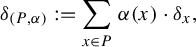 $$ \begin{align*} \delta_{(P, \alpha)} := \sum_{x \in P} \alpha(x) \cdot \delta_x, \end{align*} $$
and thereby think of $\operatorname {Del}(U,K,\sigma )$
as a G-invariant subset of the space of Radon measures on G. We will always equip the latter space with the weak-
$\operatorname {Del}(U,K,\sigma )$
as a G-invariant subset of the space of Radon measures on G. We will always equip the latter space with the weak- $*$
topology. Then by [Reference Baake and Lenz2, Reference Björklund, Hartnick and Pogorzelski11], the subspace
$*$
topology. Then by [Reference Baake and Lenz2, Reference Björklund, Hartnick and Pogorzelski11], the subspace $\operatorname {Del}(U,K,\sigma )$
is compact and the G-action on this space is jointly continuous. The topology induced on the space
$\operatorname {Del}(U,K,\sigma )$
is compact and the G-action on this space is jointly continuous. The topology induced on the space $\operatorname {Del}(U,K,1)$
of (unweighted) Delone sets is precisely the Chabauty–Fell topology (see [Reference Björklund, Hartnick and Pogorzelski11] and also [Reference Müller and Richard39, §2.1] and the references therein).
$\operatorname {Del}(U,K,1)$
of (unweighted) Delone sets is precisely the Chabauty–Fell topology (see [Reference Björklund, Hartnick and Pogorzelski11] and also [Reference Müller and Richard39, §2.1] and the references therein).
We will need yet another description of the topology on $\operatorname {Del}(U,K,\sigma )$
. Given a relatively compact subset
$\operatorname {Del}(U,K,\sigma )$
. Given a relatively compact subset $S \subseteq G$
and two Radon measures
$S \subseteq G$
and two Radon measures $\mu $
and
$\mu $
and $\nu $
on G, we define
$\nu $
on G, we define
 $$ \begin{align} d_S(\mu, \nu) := \inf\{ \delta> 0\,{:}\, | \mu( B_{\delta}(y)) -\nu( B_{\delta}(y)) | \kern1.5pt{<}\kern1.5pt \delta \text{ for all } y \in S \kern1.7pt{\cap}\kern1.7pt (\mathrm{{\operatorname{supp}}}(\mu)\kern1.7pt{\cup}\kern1.7pt \mathrm{{\operatorname{supp}}}(\nu)) \}. \end{align} $$
In particular, using our identification of weighted Delone sets and their corresponding Dirac combs, we define
 $$ \begin{align} d_S(\Lambda, \Pi) := d_S(\delta_\Lambda, \delta_\Pi) \end{align} $$
for weighted Delone sets $\Lambda , \Pi $
. Then, given
$\Lambda , \Pi $
. Then, given $\Lambda \in \operatorname {Del}(U,K,\sigma )$
, the sets
$\Lambda \in \operatorname {Del}(U,K,\sigma )$
, the sets
 $$ \begin{align*} \mathcal{U}_{S, \delta}(\Lambda) := \{ \Pi \in \operatorname{Del}(U,K,\sigma):\, d_S(\Lambda, \Pi) < \delta \} \end{align*} $$
form a neighborhood basis of $\Lambda $
in
$\Lambda $
in $\operatorname {Del}(U,K,\sigma )$
, as
$\operatorname {Del}(U,K,\sigma )$
, as $\delta $
and S vary over all positive real numbers and all relatively compact subsets of G, respectively (cf. Proposition B.1 in Appendix B). In particular, Delone sets
$\delta $
and S vary over all positive real numbers and all relatively compact subsets of G, respectively (cf. Proposition B.1 in Appendix B). In particular, Delone sets $\Pi _n$
converge to
$\Pi _n$
converge to $\Lambda $
in
$\Lambda $
in $\operatorname {Del}(U,K,\sigma )$
if and only if
$\operatorname {Del}(U,K,\sigma )$
if and only if $\lim _{n \to \infty } d_S(\Pi _n, \Lambda ) = 0$
for all relatively compact S.
$\lim _{n \to \infty } d_S(\Pi _n, \Lambda ) = 0$
for all relatively compact S.
Given $\Lambda \in \operatorname {Del}(U,K,\sigma )$
, the orbit closure
$\Lambda \in \operatorname {Del}(U,K,\sigma )$
, the orbit closure $\mathcal {H}_{\Lambda } := \overline {\{ g . \Lambda :\, g \in G\}}$
is compact and the G-action on
$\mathcal {H}_{\Lambda } := \overline {\{ g . \Lambda :\, g \in G\}}$
is compact and the G-action on $\mathcal {H}_{\Lambda }$
is jointly continuous, that is,
$\mathcal {H}_{\Lambda }$
is jointly continuous, that is, $G\curvearrowright \mathcal {H}_{\Lambda }$
is a topological dynamical system over G. We refer to
$G\curvearrowright \mathcal {H}_{\Lambda }$
is a topological dynamical system over G. We refer to $\mathcal H_\Lambda $
as the hull of
$\mathcal H_\Lambda $
as the hull of $\Lambda $
and to
$\Lambda $
and to $G\curvearrowright \mathcal {H}_{\Lambda }$
as a Delone dynamical system.
$G\curvearrowright \mathcal {H}_{\Lambda }$
as a Delone dynamical system.
2.2 Almost repetitivity and minimality
In this subsection, we give a combinatorial characterization of minimality of Delone dynamical systems, generalizing results of [Reference Frettlöh and Richard24] in the unweighted case. Throughout this subsection, we fix a weighted Delone set $\Lambda = (P, \alpha ) \in \operatorname {Del}(U,K,\sigma )$
with associated Dirac comb
$\Lambda = (P, \alpha ) \in \operatorname {Del}(U,K,\sigma )$
with associated Dirac comb $\delta _\Lambda $
. If
$\delta _\Lambda $
. If $S \subseteq T$
are two relatively compact subsets of G and
$S \subseteq T$
are two relatively compact subsets of G and $\nu $
is a Radon measure on T, then we denote by
$\nu $
is a Radon measure on T, then we denote by $\nu |_S$
the restriction of
$\nu |_S$
the restriction of $\nu $
to the Borel
$\nu $
to the Borel $\sigma $
-algebra of S.
$\sigma $
-algebra of S.
Given a relatively compact subset $S \subseteq G$
, we refer to the pair
$S \subseteq G$
, we refer to the pair $\Lambda _S:=({\delta _\Lambda }|_{S}, S)$
as the S-patch of
$\Lambda _S:=({\delta _\Lambda }|_{S}, S)$
as the S-patch of $\Lambda $
. If
$\Lambda $
. If $p = (\mu , S)$
is a patch of
$p = (\mu , S)$
is a patch of $\Lambda $
, we refer to
$\Lambda $
, we refer to $\mu $
as the underlying measure and S as the support of p (which is not to be confused with the support of
$\mu $
as the underlying measure and S as the support of p (which is not to be confused with the support of $\mu $
). For
$\mu $
). For $T \subseteq S$
, we define the restriction of p to T by
$T \subseteq S$
, we define the restriction of p to T by $p|_{T} := (\mu |_{T}, T)$
.
$p|_{T} := (\mu |_{T}, T)$
.
Two patches $p = (\mu , S)$
and
$p = (\mu , S)$
and $q = (\nu , T)$
of
$q = (\nu , T)$
of $\Lambda $
are called equivalent if there exists
$\Lambda $
are called equivalent if there exists $g \in G$
with
$g \in G$
with $g.p := (g_*\mu , gS) = (\nu , T)$
, and an equivalence class of patches is called a pattern. A pattern is said to be of size S for a relatively compact set S if the supports of its patches are translates of S.
$g.p := (g_*\mu , gS) = (\nu , T)$
, and an equivalence class of patches is called a pattern. A pattern is said to be of size S for a relatively compact set S if the supports of its patches are translates of S.
Given $\delta \geq 0$
, we say that two patches
$\delta \geq 0$
, we say that two patches $p = (\mu , S)$
and
$p = (\mu , S)$
and $q = (\nu , T)$
of
$q = (\nu , T)$
of $\Lambda $
are
$\Lambda $
are $\delta $
-similar if there exists
$\delta $
-similar if there exists $g \in G$
such that
$g \in G$
such that $gS = T$
and
$gS = T$
and $d_T(g_*\mu , \nu ) < \delta $
. By definition, two patches are
$d_T(g_*\mu , \nu ) < \delta $
. By definition, two patches are $0$
-similar if and only if they are equivalent. In particular,
$0$
-similar if and only if they are equivalent. In particular, $0$
-similarity is an equivalence relation, whereas
$0$
-similarity is an equivalence relation, whereas $\delta $
-similarity is not a transitive relation for
$\delta $
-similarity is not a transitive relation for $\delta>0$
.
$\delta>0$
.
Given a relatively compact subset $T \subseteq G$
and
$T \subseteq G$
and $\delta \geq 0$
, we say that a pattern
$\delta \geq 0$
, we say that a pattern $[p]$
of
$[p]$
of $\Lambda $
with representative
$\Lambda $
with representative $p = (\mu , S)\ \delta $
-occurs in T if there is some
$p = (\mu , S)\ \delta $
-occurs in T if there is some $g \in G$
such that
$g \in G$
such that $gS \subseteq T$
and p is
$gS \subseteq T$
and p is $\delta $
-similar to
$\delta $
-similar to $\Lambda _{gS}$
. If
$\Lambda _{gS}$
. If $\delta =0$
, we simply say that
$\delta =0$
, we simply say that $[p]$
occurs in T. Similarly, a patch
$[p]$
occurs in T. Similarly, a patch $p=(\mu ,S)$
(
$p=(\mu ,S)$
( $\delta $
-)occurs in a patch
$\delta $
-)occurs in a patch $q=(\nu ,T)$
if there is some
$q=(\nu ,T)$
if there is some $g\in G$
such that
$g\in G$
such that $gS\subseteq T$
and p is (
$gS\subseteq T$
and p is ( $\delta $
-)similar to
$\delta $
-)similar to $q|_{gS}$
.
$q|_{gS}$
.
Definition 2.2. A function $\varrho : (0,1) \times [1, \infty ) \to [1, \infty )$
is called an almost repetitivity function for
$\varrho : (0,1) \times [1, \infty ) \to [1, \infty )$
is called an almost repetitivity function for $\Lambda $
if for every
$\Lambda $
if for every $\delta \in (0,1)$
and all
$\delta \in (0,1)$
and all $R \geq 1$
, every pattern of
$R \geq 1$
, every pattern of $\Lambda $
of size
$\Lambda $
of size $B_R\ \delta $
-occurs in
$B_R\ \delta $
-occurs in $B_{\varrho (\delta , R)}(h)$
for all
$B_{\varrho (\delta , R)}(h)$
for all $h \in G$
. If such a function exists, then
$h \in G$
. If such a function exists, then $\Lambda $
is called almost repetitive.
$\Lambda $
is called almost repetitive.
Note that $\varrho (\delta ,R)\geq R$
for all
$\varrho (\delta ,R)\geq R$
for all $\delta>0$
.
$\delta>0$
.
Remark 2.3. Some authors define linear repetitivity by asking the above condition to hold for all $R\geq r_0$
, where
$R\geq r_0$
, where $r_0>0$
is an arbitrary constant, whereas we insist here that
$r_0>0$
is an arbitrary constant, whereas we insist here that $r_0 =1$
. While the two possible definitions are a priori different, this difference is irrelevant for us. Namely, we can always rescale the metric by a constant to achieve that the condition holds with
$r_0 =1$
. While the two possible definitions are a priori different, this difference is irrelevant for us. Namely, we can always rescale the metric by a constant to achieve that the condition holds with $r_0=1$
. The reader is invited to check that all our results are invariant under such rescalings, and hence all our theorems hold true for either definition. In view of this fact, we will always assume
$r_0=1$
. The reader is invited to check that all our results are invariant under such rescalings, and hence all our theorems hold true for either definition. In view of this fact, we will always assume $r_0 = 1$
to keep the notation simple.
$r_0 = 1$
to keep the notation simple.
Proposition 2.4. Let $\Lambda $
be a weighted Delone set in G. Then,
$\Lambda $
be a weighted Delone set in G. Then, $\Lambda $
is almost repetitive if and only if the associated Delone dynamical system
$\Lambda $
is almost repetitive if and only if the associated Delone dynamical system $G \curvearrowright \mathcal H_\Lambda $
is minimal.
$G \curvearrowright \mathcal H_\Lambda $
is minimal.
Proof. We closely follow the proof of [Reference Frettlöh and Richard24, Theorem 3.11].
Suppose the hull of $\Lambda = (P, \alpha )$
is minimal. Let
$\Lambda = (P, \alpha )$
is minimal. Let $R \geq 1$
and fix
$R \geq 1$
and fix $\Pi = (Q,\beta ) \in \mathcal {H}_{\Lambda }$
. Assume that
$\Pi = (Q,\beta ) \in \mathcal {H}_{\Lambda }$
. Assume that $0 <\varepsilon < R$
. We further choose
$0 <\varepsilon < R$
. We further choose $R^{\prime } \geq R$
such that
$R^{\prime } \geq R$
such that $B_{R^{\prime }} \cap Q = \overline {B}_R \cap Q$
. We set
$B_{R^{\prime }} \cap Q = \overline {B}_R \cap Q$
. We set
 $$ \begin{align*} \mathcal{U}_{R,\varepsilon} ( \Pi) = \{ \Theta \in \mathcal{H}_{\Lambda}:\, d_{B_{R^{\prime}}}(\Theta,\Pi)<\varepsilon\}. \end{align*} $$
Then, $\mathcal {U}_{R,\varepsilon } ( \Pi )$
is a neighborhood of
$\mathcal {U}_{R,\varepsilon } ( \Pi )$
is a neighborhood of $\Pi $
in the weak-
$\Pi $
in the weak- $\ast $
-topology, cf. Proposition B.1. By minimality of
$\ast $
-topology, cf. Proposition B.1. By minimality of $\Lambda $
, every element in
$\Lambda $
, every element in $\mathcal {H}_{\Lambda }$
has a dense orbit. This gives
$\mathcal {H}_{\Lambda }$
has a dense orbit. This gives
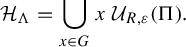 $$ \begin{align*} \mathcal{H}_{\Lambda} = \bigcup_{x \in G} x \, \mathcal{U}_{R,\varepsilon} ( \Pi ). \end{align*} $$
By compactness of the hull, we find finitely many $x_1, x_2, \ldots , x_{\ell }$
such that
$x_1, x_2, \ldots , x_{\ell }$
such that $\mathcal {H}_{\Lambda } \subseteq \bigcup _{j=1}^{\ell } x_j \, \mathcal {U}_{R,\varepsilon } ( \Pi )$
. We now choose
$\mathcal {H}_{\Lambda } \subseteq \bigcup _{j=1}^{\ell } x_j \, \mathcal {U}_{R,\varepsilon } ( \Pi )$
. We now choose $\varrho _1(R)> 0$
such that
$\varrho _1(R)> 0$
such that $x_j \in B_{\varrho _1(R)}$
for all
$x_j \in B_{\varrho _1(R)}$
for all $1 \leq j \leq \ell $
. This means that for all
$1 \leq j \leq \ell $
. This means that for all $h \in G$
, there is some
$h \in G$
, there is some $h^{*} \in B_{\varrho _1(R)}$
such that
$h^{*} \in B_{\varrho _1(R)}$
such that $h.(P,\alpha ) = h^{*}.(D,\gamma )$
and
$h.(P,\alpha ) = h^{*}.(D,\gamma )$
and $(D,\gamma )$
is some element in
$(D,\gamma )$
is some element in $\mathcal {U}_{R,\varepsilon }(\Pi )$
. This also gives
$\mathcal {U}_{R,\varepsilon }(\Pi )$
. This also gives $D \cap B_{R^{\prime }} = h^{*\, -1} h\, P \cap B_{R^{\prime }}$
. Since the patches
$D \cap B_{R^{\prime }} = h^{*\, -1} h\, P \cap B_{R^{\prime }}$
. Since the patches $(\delta _{(Q \cap B_{R^{\prime }}, \beta _{| Q \cap B_{R^{\prime }}})}, B_{R^{\prime }})$
and
$(\delta _{(Q \cap B_{R^{\prime }}, \beta _{| Q \cap B_{R^{\prime }}})}, B_{R^{\prime }})$
and $( \delta _{(D \cap B_{R^{\prime }}, \gamma _{| D \cap B_{R^{\prime }}})}, B_{R^{\prime }})$
are
$( \delta _{(D \cap B_{R^{\prime }}, \gamma _{| D \cap B_{R^{\prime }}})}, B_{R^{\prime }})$
are $\varepsilon $
-similar, the left-invariance of the metric tells us that also
$\varepsilon $
-similar, the left-invariance of the metric tells us that also $( \delta _{(Q \cap B_{R^{\prime }}, \beta _{| Q \cap B_{R^{\prime }}})}, B_{R^{\prime }})$
is
$( \delta _{(Q \cap B_{R^{\prime }}, \beta _{| Q \cap B_{R^{\prime }}})}, B_{R^{\prime }})$
is $\varepsilon $
-similar to the
$\varepsilon $
-similar to the $R^{\prime }$
-patch of P centered at
$R^{\prime }$
-patch of P centered at $h^{-1}h^{*}$
. We will now show that
$h^{-1}h^{*}$
. We will now show that $h^{-1}h^{*} B_R B_{\varepsilon } \subseteq B_{\varrho _1(R) + 2R}(h^{-1})$
. The condition
$h^{-1}h^{*} B_R B_{\varepsilon } \subseteq B_{\varrho _1(R) + 2R}(h^{-1})$
. The condition $\varepsilon < R$
gives
$\varepsilon < R$
gives $B_R B_{\varepsilon } \subseteq B_{2R}$
. Further, we have
$B_R B_{\varepsilon } \subseteq B_{2R}$
. Further, we have $h^{*}B_{2R} \subseteq B_{\varrho _1(R)}B_{2R} \subseteq B_{\varrho _1(R) + 2R}$
. Hence, we obtain
$h^{*}B_{2R} \subseteq B_{\varrho _1(R)}B_{2R} \subseteq B_{\varrho _1(R) + 2R}$
. Hence, we obtain $h^{-1}h^{*}B_RB_{\varepsilon } \subseteq B_{\varrho _1(R) + 2R}(h^{-1})$
, as claimed. Since
$h^{-1}h^{*}B_RB_{\varepsilon } \subseteq B_{\varrho _1(R) + 2R}(h^{-1})$
, as claimed. Since $\Pi $
was chosen arbitrarily, this shows that for all possible
$\Pi $
was chosen arbitrarily, this shows that for all possible $B_R$
-patterns
$B_R$
-patterns $[p]$
of
$[p]$
of $\Lambda $
and for each
$\Lambda $
and for each $h \in G$
, there is some R-patch of
$h \in G$
, there is some R-patch of $\Lambda $
contained in
$\Lambda $
contained in $B_{\varrho _1(R) + 2R}(h)$
which is
$B_{\varrho _1(R) + 2R}(h)$
which is $\varepsilon $
-similar to a representative of
$\varepsilon $
-similar to a representative of $[p]$
. A straightforward compactness argument shows that there is a finite number of patterns
$[p]$
. A straightforward compactness argument shows that there is a finite number of patterns $[p_k]$
such that every
$[p_k]$
such that every $B_{R}$
-patch of
$B_{R}$
-patch of $\Lambda $
is
$\Lambda $
is $\varepsilon $
-similar to a representative of one of the
$\varepsilon $
-similar to a representative of one of the $[p_k]$
. Hence, repeating the above procedure finitely many times, we can set
$[p_k]$
. Hence, repeating the above procedure finitely many times, we can set $\varrho (R) := \max _{k} \varrho _k(R) + 2R$
and we find that
$\varrho (R) := \max _{k} \varrho _k(R) + 2R$
and we find that $\Lambda $
is almost repetitive with almost repetitivity function
$\Lambda $
is almost repetitive with almost repetitivity function $\varrho $
.
$\varrho $
.
Conversely, assume by contradiction that $\Lambda = (P,\alpha )$
is almost repetitive but
$\Lambda = (P,\alpha )$
is almost repetitive but $\mathcal {H}_\Lambda $
is not minimal. Let
$\mathcal {H}_\Lambda $
is not minimal. Let $\Pi = (Q,\beta ) \in \mathcal {H}_{\Lambda }$
and
$\Pi = (Q,\beta ) \in \mathcal {H}_{\Lambda }$
and $\{g.\Pi :\,g\in G\}$
is not dense in
$\{g.\Pi :\,g\in G\}$
is not dense in $\mathcal {H}_{\Lambda }$
. This implies
$\mathcal {H}_{\Lambda }$
. This implies $\Lambda \notin \mathcal {H}_{\Pi }$
as well as
$\Lambda \notin \mathcal {H}_{\Pi }$
as well as $\mathcal {H}_{\Pi } \subsetneq \mathcal {H}_{\Lambda }$
. We fix a compact neighborhood
$\mathcal {H}_{\Pi } \subsetneq \mathcal {H}_{\Lambda }$
. We fix a compact neighborhood $\mathcal {V} \subseteq \mathcal {H}_{\Lambda }$
of
$\mathcal {V} \subseteq \mathcal {H}_{\Lambda }$
of $\Lambda $
containing the set
$\Lambda $
containing the set $\{\Theta \in \mathcal {H}_{\Lambda }:\, d_{B_{1/\varepsilon }} ( \Theta ,\, \Lambda ) < \varepsilon \} $
for some small
$\{\Theta \in \mathcal {H}_{\Lambda }:\, d_{B_{1/\varepsilon }} ( \Theta ,\, \Lambda ) < \varepsilon \} $
for some small $\varepsilon> 0$
such that
$\varepsilon> 0$
such that $\mathcal {V} \cap \mathcal {H}_{\Pi } = \emptyset $
. We now take a compact set
$\mathcal {V} \cap \mathcal {H}_{\Pi } = \emptyset $
. We now take a compact set $K \subseteq G$
with
$K \subseteq G$
with $B_{1/\varepsilon }(e) \subseteq \mathring {K}$
and define
$B_{1/\varepsilon }(e) \subseteq \mathring {K}$
and define ${T_{K, \varepsilon }( \Lambda ) = \{g \in G:\, d_{\mathring {K}}(g . \Lambda , \Lambda ) < \varepsilon \}}$
.
${T_{K, \varepsilon }( \Lambda ) = \{g \in G:\, d_{\mathring {K}}(g . \Lambda , \Lambda ) < \varepsilon \}}$
.
Claim. The set $T_{K, \varepsilon }( \Lambda )$
is right-relatively dense.
$T_{K, \varepsilon }( \Lambda )$
is right-relatively dense.
Assuming the validity of the claim for a moment, we see
 $$ \begin{align*} G.\Lambda = ( K^{\prime}T_{K, \varepsilon}(\Lambda)).\Lambda \subseteq K^{\prime}.\mathcal{V} \end{align*} $$
for some compact set $K^{\prime } \subseteq G$
. By compactness of
$K^{\prime } \subseteq G$
. By compactness of $\mathcal {V}$
and the continuity of the G-action, we find that the set
$\mathcal {V}$
and the continuity of the G-action, we find that the set $K^{\prime }.\mathcal {V}$
is compact. Hence, we arrive at
$K^{\prime }.\mathcal {V}$
is compact. Hence, we arrive at $\mathcal {H}_{\Lambda } \subseteq K^{\prime }.\mathcal {V}$
. We get that
$\mathcal {H}_{\Lambda } \subseteq K^{\prime }.\mathcal {V}$
. We get that $\Pi = x.\Theta $
for some
$\Pi = x.\Theta $
for some $x \in K^{\prime }$
and some
$x \in K^{\prime }$
and some $\Theta \in \mathcal {V}$
. Thus,
$\Theta \in \mathcal {V}$
. Thus, $\Theta = x^{-1}\Pi $
contradicting the fact that
$\Theta = x^{-1}\Pi $
contradicting the fact that ${\mathcal {V} \cap \mathcal {H}_{\Pi } = \emptyset }$
.
${\mathcal {V} \cap \mathcal {H}_{\Pi } = \emptyset }$
.
It remains to show the claim. For this, we proceed along the lines of [Reference Frettlöh and Richard24, proof of Lemma 3.6, implication (iii) ⇒ (i)]. To this end, find some $r \geq 1$
such that
$r \geq 1$
such that $\mathring {K} \subseteq B_r$
and set
$\mathring {K} \subseteq B_r$
and set $R:= \varrho (\varepsilon , r)$
, where
$R:= \varrho (\varepsilon , r)$
, where $\varrho $
is an almost repetitivity function of
$\varrho $
is an almost repetitivity function of $\Lambda $
. We fix a countable cover of G of the form
$\Lambda $
. We fix a countable cover of G of the form $G = \bigcup _{i=1}^{\infty } B_R(g_i)$
. By almost repetitivity, for all
$G = \bigcup _{i=1}^{\infty } B_R(g_i)$
. By almost repetitivity, for all $i \in {\mathbb N}$
, we find
$i \in {\mathbb N}$
, we find $x_i \in G$
such that
$x_i \in G$
such that $x_i^{-1}B_r \subseteq B_{R}(g_i)$
and
$x_i^{-1}B_r \subseteq B_{R}(g_i)$
and $d_{B_r}( x_i\Lambda , \Lambda ) = d_{x_i^{-1}B_r} ( \Lambda , x_i^{-1}\Lambda ) < \varepsilon $
. Now to show the claim, it clearly suffices to show that
$d_{B_r}( x_i\Lambda , \Lambda ) = d_{x_i^{-1}B_r} ( \Lambda , x_i^{-1}\Lambda ) < \varepsilon $
. Now to show the claim, it clearly suffices to show that $T_{r,\varepsilon }:= \{x_i:\, i \in {\mathbb N}\} \subseteq T_{K, \varepsilon }(\Lambda )$
is right-relatively dense in G. For each
$T_{r,\varepsilon }:= \{x_i:\, i \in {\mathbb N}\} \subseteq T_{K, \varepsilon }(\Lambda )$
is right-relatively dense in G. For each $b \in B_r$
, we have
$b \in B_r$
, we have $x_i^{-1}b \subseteq B_R(g_i)$
for all
$x_i^{-1}b \subseteq B_R(g_i)$
for all $i \in {\mathbb N}$
. This shows that
$i \in {\mathbb N}$
. This shows that ${G = \bigcup _{i=1}^{\infty } B_{2R}(x_i^{-1}b) = \bigcup _{i=1}^{\infty } x_i^{-1} B_{2R}(b)}$
. For some fixed
${G = \bigcup _{i=1}^{\infty } B_{2R}(x_i^{-1}b) = \bigcup _{i=1}^{\infty } x_i^{-1} B_{2R}(b)}$
. For some fixed $b \in B_r$
, we define
$b \in B_r$
, we define
 $$ \begin{align*} K^{\prime} := \overline{\{ g \in G:\, g^{-1}b \in B_{2R}(b)\}}. \end{align*} $$
This set is clearly compact. We will show $K^{\prime } T_{r,\varepsilon } = G$
. Take
$K^{\prime } T_{r,\varepsilon } = G$
. Take $h \in G$
. This gives
$h \in G$
. This gives $h^{-1}b \in x_i^{-1}B_{2R}(b)$
for some
$h^{-1}b \in x_i^{-1}B_{2R}(b)$
for some $i \in {\mathbb N}$
. This yields
$i \in {\mathbb N}$
. This yields
 $$ \begin{align*} h &\in \{ g \in G:\, g^{-1}b \in x_i^{-1}B_{2R}(b)\} = \{ g \in G:\, x_i g^{-1}b \in B_{2R}(b)\} \\ &= \{ y \in G:\, y^{-1}b \in B_{2R}(b)\} \cdot x_i \subseteq K^{\prime} T_{r, \varepsilon}. \end{align*} $$
Since h was chosen arbitrarily, the proof of the claim is finished.
While almost repetitivity arises naturally in the study of minimality of Delone dynamical systems, a more classical notion is the following one.
Definition 2.5. A function $\varrho : [1,\infty ) \to [1, \infty )$
is called a repetitivity function for
$\varrho : [1,\infty ) \to [1, \infty )$
is called a repetitivity function for $\Lambda $
if for all
$\Lambda $
if for all $R \geq 1$
, every pattern of
$R \geq 1$
, every pattern of $\Lambda $
of size
$\Lambda $
of size $B_R$
occurs in
$B_R$
occurs in $B_{\varrho (R)}(h)$
for all
$B_{\varrho (R)}(h)$
for all $h \in G$
. If such a function exists, then
$h \in G$
. If such a function exists, then $\Lambda $
is called repetitive.
$\Lambda $
is called repetitive.
Remark 2.6. Similarly as for the almost repetitivity function, we have $\varrho (R)\geq R$
and we assume
$\varrho (R)\geq R$
and we assume $R\geq 1$
.
$R\geq 1$
.
We say that $\Lambda = (P, \alpha )\in \operatorname {Del}(U,K,\sigma )$
has finite local complexity (FLC) if for ever compact set S, the set
$\Lambda = (P, \alpha )\in \operatorname {Del}(U,K,\sigma )$
has finite local complexity (FLC) if for ever compact set S, the set $\{(x^{-1}. \Lambda )|_S :\, x\in P\}$
is finite.
$\{(x^{-1}. \Lambda )|_S :\, x\in P\}$
is finite.
Proposition 2.7. Let $\Lambda \in \operatorname {Del}(U,K,\sigma )$
be of finite local complexity. If
$\Lambda \in \operatorname {Del}(U,K,\sigma )$
be of finite local complexity. If $\Lambda $
is almost repetitive, then
$\Lambda $
is almost repetitive, then $\Lambda $
is repetitive.
$\Lambda $
is repetitive.
Proof. Without loss of generality, we assume that $e\in U$
. Since
$e\in U$
. Since $\Lambda = (P,\alpha )$
is of finite local complexity, the set
$\Lambda = (P,\alpha )$
is of finite local complexity, the set
 $$ \begin{align*} P(r):= \{ (x^{-1}.\Lambda)|_{B_{r}} :\, x\in P \} \end{align*} $$
is finite for each $r>0$
. In particular, if
$r>0$
. In particular, if $r>0$
is such that the topological boundary
$r>0$
is such that the topological boundary $\overline {B_r}\setminus B_r$
is not intersecting
$\overline {B_r}\setminus B_r$
is not intersecting $x^{-1}P$
for any
$x^{-1}P$
for any $x\in P$
, then there is a
$x\in P$
, then there is a $\delta>0$
such that
$\delta>0$
such that ${x^{-1}P\cap \partial _{B_{\delta _1}}(B_{r}) = \emptyset} $
holds for all
${x^{-1}P\cap \partial _{B_{\delta _1}}(B_{r}) = \emptyset} $
holds for all $x\in P$
, where
$x\in P$
, where
 $$ \begin{align*} \partial_{B_{\delta_1}}(B_{r}) := \{g \in G:\, B_{\delta_1}g \cap B_{r} \neq \emptyset \, \wedge\, B_{\delta_1}g \cap (G \setminus B_{r}) \neq \emptyset\} \end{align*} $$
is the $B_{\delta _1}$
boundary of the topological boundary of
$B_{\delta _1}$
boundary of the topological boundary of $B_r$
.
$B_r$
.
Let $R>0$
be fixed. Since
$R>0$
be fixed. Since $\Lambda $
is K-relatively dense and of finite local complexity, we can choose an
$\Lambda $
is K-relatively dense and of finite local complexity, we can choose an $R_1>0$
and a
$R_1>0$
and a $\delta _1>0$
such that:
$\delta _1>0$
such that:
-
(a) for each
$x\in G$
, there is a
$y_x\in P$
satisfying
$x\in B_{R_1}(y_x)$
; -
(b) for all
$y\in P$
, we have
$y^{-1}P\cap \partial _{B_{\delta _1}}(B_{R+R_1}) = \emptyset $
.


Consider an R-patch $p:=\Lambda _{B_R(x)}$
for
$p:=\Lambda _{B_R(x)}$
for $x\in G$
. Let
$x\in G$
. Let $y_x\in P$
be such that
$y_x\in P$
be such that $x\in B_{R_1}(y_x)$
. Now consider the patch
$x\in B_{R_1}(y_x)$
. Now consider the patch
 $$ \begin{align*} p':=(y_x^{-1}\cdot\Lambda)_{B_{R+R_1}} = y_x^{-1}\cdot (\Lambda|_{B_{R+R_1}(y_x)}). \end{align*} $$
By construction, p occurs in $p'$
. Let
$p'$
. Let $0<\delta <\min \{\delta _1,\sigma ^{-1}\}$
be such that
$0<\delta <\min \{\delta _1,\sigma ^{-1}\}$
be such that $B_\delta \subseteq U$
and
$B_\delta \subseteq U$
and
 $$ \begin{align*} q_1,q_2\in P(R+R_1) \text{ with } d_{B_{R+R_1}}(\delta_{(q_1,B_{R+R_1})},\delta_{(q_2,B_{R+R_1})})\leq\delta \Longrightarrow q_1=q_2. \end{align*} $$
The latter is possible as $P(R+R_1)$
is finite.
$P(R+R_1)$
is finite.
Let $h\in G$
. Since
$h\in G$
. Since $\Lambda $
is almost repetitive,
$\Lambda $
is almost repetitive, $p'\ \delta /2$
-occurs in
$p'\ \delta /2$
-occurs in $B_{\varrho (\delta /2,R+R_1)}(h)$
, where
$B_{\varrho (\delta /2,R+R_1)}(h)$
, where $\varrho $
is an almost repetitivity function for
$\varrho $
is an almost repetitivity function for $\Lambda $
. Thus, there is a
$\Lambda $
. Thus, there is a $g\in G$
such that
$g\in G$
such that $gB_{R+R_1}\subseteq B_{\varrho (\delta /2,R+R_1)}(h)$
and
$gB_{R+R_1}\subseteq B_{\varrho (\delta /2,R+R_1)}(h)$
and $d_{B_{R+R_1}}( \delta _{p'}, \delta _{g^{-1}\cdot q_h}) <\delta /2$
, where
$d_{B_{R+R_1}}( \delta _{p'}, \delta _{g^{-1}\cdot q_h}) <\delta /2$
, where $q_h:=\Lambda _{B_{R+R_1}(g)}$
. Thus,
$q_h:=\Lambda _{B_{R+R_1}(g)}$
. Thus,
 $$ \begin{align*} &d_{B_{R+R_1}}( p', g^{-1} q_h)\\ &\quad = \inf\left\{ \varepsilon>0 :\!\! \begin{array}{c} |\delta_{y_g^{-1}\cdot \Lambda}|_{B_{R+R_1}}(B_{\varepsilon}(y)) - g^{-1}_{\ast}\delta_{\Lambda}|_{B_{R+R_1}(g)}(B_\varepsilon(y))| <\varepsilon\\ \text{ for all } y\in (y_x^{-1}P\cap B_{R+R_1})\cup (g^{-1}P\cap B_{R+R_1}) \end{array} \!\!\right\} <\delta/2 \end{align*} $$
holds. By construction, $\delta _{p'}$
has support on
$\delta _{p'}$
has support on $\{e\}$
, namely,
$\{e\}$
, namely, $\delta _{p'}(e)>\sigma ^{-1}$
. Hence, there is a unique
$\delta _{p'}(e)>\sigma ^{-1}$
. Hence, there is a unique $y_g\in P$
and
$y_g\in P$
and $g'\in B_{\delta /2}$
such that
$g'\in B_{\delta /2}$
such that $g=y_g g'$
using that
$g=y_g g'$
using that $\delta <\sigma ^{-1}$
, P is
$\delta <\sigma ^{-1}$
, P is $B_\delta $
-uniformly discrete, and
$B_\delta $
-uniformly discrete, and $d_{B_{R+R_1}} ( \delta _{p'}, \delta _{g^{-1}.q_h})<\delta /2$
. Due to condition (b), we conclude
$d_{B_{R+R_1}} ( \delta _{p'}, \delta _{g^{-1}.q_h})<\delta /2$
. Due to condition (b), we conclude $\delta _{y_g^{-1}\cdot \Lambda }|_{B_{R+R_1}} = \delta _{y_g^{-1}\cdot \Lambda }|_{B_{R+R_1}(g')}$
and so
$\delta _{y_g^{-1}\cdot \Lambda }|_{B_{R+R_1}} = \delta _{y_g^{-1}\cdot \Lambda }|_{B_{R+R_1}(g')}$
and so
 $$ \begin{align*} g^{-1}\cdot q_h = g^{\prime-1} ( \delta_{y_g^{-1}\cdot\Lambda}|_{B_{}{R+R_1}(g')}, B_{R+R_1}(g')) = g^{\prime-1} ( \delta_{y_g^{-1}\cdot\Lambda}|_{B_{}{R+R_1}}, B_{R+R_1}(g')). \end{align*} $$
By construction, $(y_g^{-1}\cdot \Lambda )_{B_{R+R_1}}$
occurs in
$(y_g^{-1}\cdot \Lambda )_{B_{R+R_1}}$
occurs in $B_{\varrho (\delta /2,R+R_1)+\delta /2}(h)$
since
$B_{\varrho (\delta /2,R+R_1)+\delta /2}(h)$
since $g'\in B_{\delta /2}$
. Invoking that
$g'\in B_{\delta /2}$
. Invoking that $\delta <\sigma ^{-1}$
, P is
$\delta <\sigma ^{-1}$
, P is $B_\delta $
-uniformly discrete,
$B_\delta $
-uniformly discrete, $g'\in B_{\delta /2}$
, and
$g'\in B_{\delta /2}$
, and $d_{B_{R+R_1}}(\delta _{p'}, \delta _{g^{-1}\cdot q_h} )<\delta /2$
, we derive
$d_{B_{R+R_1}}(\delta _{p'}, \delta _{g^{-1}\cdot q_h} )<\delta /2$
, we derive
 $$ \begin{align*} d_{B_{R+R_1}}\big(\delta_{p'}, \delta_{(y_g^{-1}\cdot\Lambda)_{B_{R+R_1}}}\!\big)\leq\delta. \end{align*} $$
Thus, $(y_g^{-1}\cdot \Lambda )_{B_{R+R_1}}=p'$
follows by the choice of
$(y_g^{-1}\cdot \Lambda )_{B_{R+R_1}}=p'$
follows by the choice of $\delta $
and since
$\delta $
and since $(y_g^{-1}\cdot \Lambda )|_{B_{R+R_1}}, p'\in P(R+R_1)$
. Since p occurs in
$(y_g^{-1}\cdot \Lambda )|_{B_{R+R_1}}, p'\in P(R+R_1)$
. Since p occurs in $p'$
and
$p'$
and $(y_g^{-1}\cdot \Lambda )_{B_{R+R_1}}$
occurs in
$(y_g^{-1}\cdot \Lambda )_{B_{R+R_1}}$
occurs in $B_{\varrho (\delta /2,R+R_1)+\delta /2}(h)$
, we conclude that p occurs in
$B_{\varrho (\delta /2,R+R_1)+\delta /2}(h)$
, we conclude that p occurs in $B_{\varrho (\delta /2,R+R_1)+\delta /2}(h)$
.
$B_{\varrho (\delta /2,R+R_1)+\delta /2}(h)$
.
Hence, the map $\varrho ':(0,\infty )\to (0,\infty )$
defined by
$\varrho ':(0,\infty )\to (0,\infty )$
defined by $\varrho '(R):=\varrho (\delta /2,R+R_1)+\delta /2$
defines a repetitivity function. Note here that in the previous considerations,
$\varrho '(R):=\varrho (\delta /2,R+R_1)+\delta /2$
defines a repetitivity function. Note here that in the previous considerations, $\delta $
and
$\delta $
and $R_1$
depend on R but not on h.
$R_1$
depend on R but not on h.
Remark 2.8. Note that if $\Lambda = (P,\alpha )$
is repetitive, then
$\Lambda = (P,\alpha )$
is repetitive, then $\Lambda $
necessarily has FLC since
$\Lambda $
necessarily has FLC since $B_{\varrho (R)}(h)\cap P$
is uniformly bounded in
$B_{\varrho (R)}(h)\cap P$
is uniformly bounded in $h\in G$
. Furthermore, every repetitive
$h\in G$
. Furthermore, every repetitive $\Lambda $
is almost repetitive, which can be seen by setting
$\Lambda $
is almost repetitive, which can be seen by setting $\varrho (\delta ,R):=\varrho (R)$
for
$\varrho (\delta ,R):=\varrho (R)$
for $R \geq 1$
. In other words, for Delone sets, we have the equivalence
$R \geq 1$
. In other words, for Delone sets, we have the equivalence
 $$ \begin{align*} \Lambda \text{ is repetitive}\ {\iff}\ (\Lambda \text{ is almost repetitive}) \quad \text{and} \quad (\Lambda \text{ has FLC}). \end{align*} $$
3 An abstract ergodic theorem
3.1 Statement of the theorem
Throughout this section, G will denote an amenable unimodular lcsc group. We fix a Haar measure $m_G$
on G. The goal of this section is to explain and prove the following theorem.
$m_G$
on G. The goal of this section is to explain and prove the following theorem.
Theorem 3.1. (Uniform sub-additive convergence theorem)
Assume that:
-
•
$\Lambda $
is a weighted Delone set in G with hull
$\mathcal {H}_\Lambda $
; -
•
$(T_m)$
is a strong Følner exhaustion sequence in G; -
•
$\Lambda $
is almost tempered repetitive with respect to
$(T_m)$
; -
• w is an admissible weight function on G over
$\mathcal {H}_\Lambda $
.


Then, there exists $I_w \in {\mathbb R}$
(depending on
$I_w \in {\mathbb R}$
(depending on $\Lambda $
and w, but independent of
$\Lambda $
and w, but independent of $(T_m)$
) such that
$(T_m)$
) such that
 $$ \begin{align*} \lim_{m \to \infty} \sup_{\Pi \in \mathcal{H}_{\Lambda}} \bigg| \frac{w(T_m, \Pi)}{m_G(T_m)} - I_w \bigg| = 0. \end{align*} $$
Theorem 3.1 will be proved in §3.4 after introducing all the required terminology. Tempered repetitivity with respect to a strong Følner exhaustion sequence will be defined in §3.2 and admissible weight functions will be discussed in §3.3.
3.2 Strong Følner exhaustion sequences and tempered repetitivity
We recall that amenability of G is equivalent to the existence of a Følner sequence, that is, a sequence $(T_m)$
of compact subsets of G of positive Haar measure such that for all compact subsets
$(T_m)$
of compact subsets of G of positive Haar measure such that for all compact subsets $K \subseteq G$
,
$K \subseteq G$
,
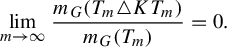 $$ \begin{align*} \lim_{m\to\infty} \frac{m_G(T_m\triangle KT_m)}{m_G(T_m)}=0. \end{align*} $$
In fact, one can choose a Følner sequence with additional properties. Given relatively compact subsets $L, S \subseteq G$
, we denote by
$L, S \subseteq G$
, we denote by
 $$ \begin{align*} \partial_L(S) := \{g \in G:\, Lg \cap S \neq \emptyset \, \wedge\, Lg \cap (G \setminus S) \neq \emptyset\} \end{align*} $$
the L-boundary of S, as defined in [Reference Ornstein and Weiss41].
Definition 3.2. A Følner sequence $(T_m)$
is called a strong Følner exhaustion sequence if:
$(T_m)$
is called a strong Følner exhaustion sequence if:
-
(i)
$(T_m)$
is a strong Følner sequence in the sense of [Reference Pogorzelski and Schwarzenberger47], that is, for all compact subsets
$K \subseteq G$
,
$$ \begin{align*} \lim_{m \to \infty} \frac{m_G(\partial_{K}(T_m))}{m_G(T_m)} = 0; \end{align*} $$
-
(ii)
$(T_m)$
is a strong exhaustion sequence, that is,
$\{e\} \subseteq T_m \subseteq \mathring {T}_{m+1}$
and
$\bigcup _{m} T_m = G$
.


Remark 3.3. We point out that by [Reference Pogorzelski, Richard and Strungaru46, Proposition 5.7], the notion of a strong Følner sequence is equivalent to the concept of a van Hove sequence. The latter has been used prominently in the literature on aperiodic order in locally compact abelian groups.
Proposition 3.4. Every amenable unimodular group G admits a strong Følner exhaustion sequence.
Proof. Building on the uniform Følner condition proven in [Reference Ornstein and Weiss41], one observes that G admits a strong Følner sequence $(S_n)$
, cf. [Reference Pogorzelski44, Lemma 2.8]. Moreover, the sequence
$(S_n)$
, cf. [Reference Pogorzelski44, Lemma 2.8]. Moreover, the sequence $(S_n)$
can be turned into a strong Følner exhaustion sequence by the usual construction (cf. [Reference Greenleaf26]). By
$(S_n)$
can be turned into a strong Følner exhaustion sequence by the usual construction (cf. [Reference Greenleaf26]). By $\sigma $
-compactness of G, we can now choose an exhaustion of G by compact subsets
$\sigma $
-compactness of G, we can now choose an exhaustion of G by compact subsets $(K_n)$
containing the identity. Set
$(K_n)$
containing the identity. Set $T_1 := S_1$
and choose
$T_1 := S_1$
and choose $m_1$
such that
$m_1$
such that $T_1 \subseteq \mathring {K}_{m_1}$
. Then choose
$T_1 \subseteq \mathring {K}_{m_1}$
. Then choose $\ell \in {\mathbb N}$
large enough such that
$\ell \in {\mathbb N}$
large enough such that $m_G(\partial _{K_{m_1}}(S_{\ell })) \leq \tfrac 12 m_G(S_{\ell })$
. Thus, there is an
$m_G(\partial _{K_{m_1}}(S_{\ell })) \leq \tfrac 12 m_G(S_{\ell })$
. Thus, there is an $h \in G$
such that
$h \in G$
such that $K_{m_1}h \subseteq S_{\ell }$
. If we now set
$K_{m_1}h \subseteq S_{\ell }$
. If we now set $T_2:= S_{\ell }h^{-1}$
, then
$T_2:= S_{\ell }h^{-1}$
, then $T_1 \subseteq \mathring {K}_{m_1} \subseteq T_2$
. One now proceeds by induction to construct the desired strong Følner exhaustion sequence
$T_1 \subseteq \mathring {K}_{m_1} \subseteq T_2$
. One now proceeds by induction to construct the desired strong Følner exhaustion sequence $(T_m)$
.
$(T_m)$
.
From now on, $\mathcal T = (T_m)$
denotes a strong Følner exhaustion sequence in G and
$\mathcal T = (T_m)$
denotes a strong Følner exhaustion sequence in G and $\Lambda $
denotes a weighted Delone set in G.
$\Lambda $
denotes a weighted Delone set in G.
Definition 3.5. The repetitivity index for $\Lambda $
with respect to
$\Lambda $
with respect to $\mathcal {T}$
is the function
$\mathcal {T}$
is the function $ \mathcal {R}_{\Lambda }^{\mathcal {T}}: [0,1) \times {\mathbb N} \to {\mathbb N} \cup \{ +\infty \}$
given by
$ \mathcal {R}_{\Lambda }^{\mathcal {T}}: [0,1) \times {\mathbb N} \to {\mathbb N} \cup \{ +\infty \}$
given by
 $$ \begin{align*} \mathcal{R}_{\Lambda}^{\mathcal{T}}(\delta, m) \kern1.5pt{:=}\kern1.5pt \inf \{ n \in {\mathbb N}\,{:}\, \text{every pattern of } \Lambda \text{ of size } \mathring{T}_m^{-1}\,\delta\text{-occurs in } h\mathring{T}_n^{-1} \text{ for all } h \kern1.5pt{\in}\kern1.5pt G \}, \end{align*} $$
where, by convention, $\inf \emptyset = \infty $
. We then define the repetitivity portion of
$\inf \emptyset = \infty $
. We then define the repetitivity portion of $\Lambda $
with respect to
$\Lambda $
with respect to $\mathcal {T}$
as
$\mathcal {T}$
as
 $$ \begin{align*} \zeta:[0,1) \to [0,1],\,\, \zeta(\delta):= \inf_{m \in {\mathbb N}} \frac{m_G(T_m)}{m_G(T_{\mathcal{R}^{\mathcal{T}}_{\Lambda}(\delta, m)})}, \end{align*} $$
where we use the convention that $\zeta (\delta ) = 0$
if there is some
$\zeta (\delta ) = 0$
if there is some $m \in {\mathbb N}$
such that
$m \in {\mathbb N}$
such that $\mathcal {R}^{\mathcal {T}}_{\Lambda }(\delta , m) = \infty $
. We say that
$\mathcal {R}^{\mathcal {T}}_{\Lambda }(\delta , m) = \infty $
. We say that $\Lambda $
is almost tempered repetitive with respect to
$\Lambda $
is almost tempered repetitive with respect to $\mathcal {T}$
if
$\mathcal {T}$
if $\zeta (\delta )> 0$
for all
$\zeta (\delta )> 0$
for all $\delta> 0$
. We say that
$\delta> 0$
. We say that $\Lambda $
is tempered repetitive with respect to
$\Lambda $
is tempered repetitive with respect to $\mathcal {T}$
if
$\mathcal {T}$
if $\zeta (0)> 0$
.
$\zeta (0)> 0$
.
Remark 3.6. Some comments on the definition are in order.
-
(i) Since
$(T_m)$
displays asymptotic invariance from the left, we use patterns arising from the inverse sequence
$(T_m^{-1})$
in the above definitions. In certain situations of interest, one can choose the
$T_m$
to be symmetric, for instance, if they arise as certain closed balls with respect to a suitable adapted metric, cf. §4.2. -
(ii) Almost tempered repetitivity is the condition on Delone sets which will enable the proof of our ergodic theorem. The terminology ‘tempered’ is chosen because in the literature, it refers to a growth condition of Følner sequences used in the proofs of ergodic theorems.
-
(iii) Since the repetitivity index is monotonically decreasing in
$\delta $
, tempered repetitivity implies almost tempered repetitivity. -
(iv) If
$\Lambda $
is tempered repetitive, then
$\mathcal {R}_{\Lambda }^{\mathcal {T}}(0,m) < \infty $
for all
$m \in {\mathbb N}$
, and if
$\Lambda $
is almost tempered repetitive, then
$\mathcal {R}_{\Lambda }^{\mathcal {T}}(\delta ,m) < \infty $
for all
$m \in {\mathbb N}$
and
$\delta>0$
. This can be used to establish minimality of the associated Delone dynamical system.


Proposition 3.7. (Minimality)
A weighted Delone set $\Lambda $
is almost repetitive if and only if
$\Lambda $
is almost repetitive if and only if $\mathcal {R}_{\Lambda }^{\mathcal {T}}(\delta , m) < \infty $
for all
$\mathcal {R}_{\Lambda }^{\mathcal {T}}(\delta , m) < \infty $
for all $\delta> 0$
and all
$\delta> 0$
and all $m \in {\mathbb N}$
. In particular, every almost tempered repetitive Delone set is almost repetitive, and hence the associated Delone dynamical system is minimal.
$m \in {\mathbb N}$
. In particular, every almost tempered repetitive Delone set is almost repetitive, and hence the associated Delone dynamical system is minimal.
Proof. We note that by the properties of a strong exhaustion sequence, we find for all $r> 0$
some
$r> 0$
some $\ell (r) \in {\mathbb N}$
such that
$\ell (r) \in {\mathbb N}$
such that $\overline {B}_r \subseteq \mathring {T}_{\ell (r)}$
and for each
$\overline {B}_r \subseteq \mathring {T}_{\ell (r)}$
and for each $s \in {\mathbb N}$
, we find some
$s \in {\mathbb N}$
, we find some $L(s) \in {\mathbb N}$
such that
$L(s) \in {\mathbb N}$
such that $T_s \subseteq B_{L(s)}$
. Moreover, by the left-invariance of the metric
$T_s \subseteq B_{L(s)}$
. Moreover, by the left-invariance of the metric $d_G$
, we have
$d_G$
, we have ${B_l = B_l^{-1}}$
and
${B_l = B_l^{-1}}$
and $\overline {B}_l = \overline {B}_l^{-1}$
for all
$\overline {B}_l = \overline {B}_l^{-1}$
for all $l> 0$
. Thus, the condition
$l> 0$
. Thus, the condition $\mathcal {R}_{\Lambda }^{\mathcal {T}}(\delta , l) < \infty $
for all
$\mathcal {R}_{\Lambda }^{\mathcal {T}}(\delta , l) < \infty $
for all $\delta> 0$
and all
$\delta> 0$
and all $l \in {\mathbb N}$
implies for a given
$l \in {\mathbb N}$
implies for a given $R \geq 1$
, every
$R \geq 1$
, every $B_R$
-pattern
$B_R$
-pattern $\delta $
-occurs in each ball of radius
$\delta $
-occurs in each ball of radius $L ( \mathcal {R}_{\Lambda }^{\mathcal {T}}(\delta , \ell (R)) )$
. Conversely, for
$L ( \mathcal {R}_{\Lambda }^{\mathcal {T}}(\delta , \ell (R)) )$
. Conversely, for $m \in {\mathbb N}$
, we have that every
$m \in {\mathbb N}$
, we have that every $\mathring {T}_m^{-1}$
-pattern must
$\mathring {T}_m^{-1}$
-pattern must $\delta $
-occur in every ball of radius
$\delta $
-occur in every ball of radius $\varrho (\delta , L(m))$
(with
$\varrho (\delta , L(m))$
(with $\varrho $
denoting an almost repetitivity function), whence also in each
$\varrho $
denoting an almost repetitivity function), whence also in each $h\mathring {T}_M^{-1}$
with
$h\mathring {T}_M^{-1}$
with $M = \ell ( \varrho (\delta , L(m)))$
.
$M = \ell ( \varrho (\delta , L(m)))$
.
The following example shows that (almost) tempered repetitivity depends crucially on the underlying strong Følner exhaustion sequence.
Example 3.8. Consider the Delone set $D = {\mathbb Z}$
(seen as weighted Delone set with constant weight
$D = {\mathbb Z}$
(seen as weighted Delone set with constant weight $1$
) in
$1$
) in $G = {\mathbb R}$
. Then, D is tempered repetitive with respect to the sequence
$G = {\mathbb R}$
. Then, D is tempered repetitive with respect to the sequence ${\mathcal {T} = (\overline {B}_m)_m}$
, where
${\mathcal {T} = (\overline {B}_m)_m}$
, where $\overline {B}_l$
is the closed ball around
$\overline {B}_l$
is the closed ball around $0$
with radius l with respect to the Euclidean metric. Now consider the sequence
$0$
with radius l with respect to the Euclidean metric. Now consider the sequence ${\mathcal {T}^{\prime } = (\overline {B}_{r_m})_m}$
with
${\mathcal {T}^{\prime } = (\overline {B}_{r_m})_m}$
with $r_1 := 1$
and
$r_1 := 1$
and ${r_{m+1} := 2^{r_m}}$
for
${r_{m+1} := 2^{r_m}}$
for $m \geq 1$
. Note that an open ball with integer radius
$m \geq 1$
. Note that an open ball with integer radius $M \in {\mathbb N}$
and integer center contains
$M \in {\mathbb N}$
and integer center contains $2M-1$
points of
$2M-1$
points of ${\mathbb Z}$
, while balls of the same size around a non-integer center contain
${\mathbb Z}$
, while balls of the same size around a non-integer center contain $2M$
points of
$2M$
points of ${\mathbb Z}$
. This implies
${\mathbb Z}$
. This implies $\mathcal {R}_D^{\mathcal {T}^{'}}(M) \geq M+1$
for all
$\mathcal {R}_D^{\mathcal {T}^{'}}(M) \geq M+1$
for all $M \in {\mathbb N}$
. However, we have
$M \in {\mathbb N}$
. However, we have $\lim _m ({2r_m - 1})/({2r_{m+1} - 1}) = 0$
. Hence, D is not (almost) tempered repetitive with respect to
$\lim _m ({2r_m - 1})/({2r_{m+1} - 1}) = 0$
. Hence, D is not (almost) tempered repetitive with respect to $\mathcal {T}^{\prime }$
.
$\mathcal {T}^{\prime }$
.
3.3 Weight functions and
$\varepsilon $
-quasi-tilings

For the purpose of the following definition, we denote by $ \mathcal {RK}(G)$
the set of all relatively compact subsets of G. We also denote by X a compact metrizable space on which G acts jointly continuously; in our applications,
$ \mathcal {RK}(G)$
the set of all relatively compact subsets of G. We also denote by X a compact metrizable space on which G acts jointly continuously; in our applications, $G \curvearrowright X$
will always be a Delone dynamical system.
$G \curvearrowright X$
will always be a Delone dynamical system.
Definition 3.9. A function $w: \mathcal {RK}(G) \times X \to {\mathbb R}$
is called an almost sub-additive weight function over X if:
$w: \mathcal {RK}(G) \times X \to {\mathbb R}$
is called an almost sub-additive weight function over X if:
-
(W1)
$w(\emptyset , x) = 0$
for all
$x \in X$
(normalization); -
(W2) there is a compact
$J \subseteq G$
and an
$\eta> 0$
such that for all
$$ \begin{align*} | w(L,x) - w(K,x) | \leq \eta\cdot ( m_G(L \setminus K) + m_G(\partial_J(L)) + m_G(\partial_J(K)) ) \end{align*} $$
$x \in X$
and all
$K, L \in \mathcal {RK}(G)$
with
$K \subseteq L$
(almost-monotonicity);
-
(W3) there is a compact subset
$B \subseteq G$
and a
$\theta \geq 0 $
such that for any finite collection of pairwise disjoint
$K_i \in \mathcal {RK}(G)$
, we have for all
$$ \begin{align*} w\bigg( \bigsqcup_{i} K_i,\,x \bigg) \leq \sum_{i} w(K_i, x) + \theta \cdot \sum_{i} m_G(\partial_B(K_i)) \end{align*} $$
$x \in X$
(almost sub-additivity);
-
(W4) there is a compact subset
$I \subseteq G$
and a
$\vartheta \geq 0$
such that for each
$x \in X$
,
$K\in \mathcal {RK}(G)$
, and
$h\in G$
, we have
$$ \begin{align*} | w(K,x) - w(Kh^{-1},hx) | \leq \vartheta\cdot m_G(\partial_I(K)) \quad \operatorname{(almost-equivariance)}\kern-1.5pt. \end{align*} $$


Remark 3.10. If $w: \mathcal {RK}(G) \times X \to {\mathbb R}$
is any function satisfying properties (W1) and (W2), then for every relatively compact subset
$w: \mathcal {RK}(G) \times X \to {\mathbb R}$
is any function satisfying properties (W1) and (W2), then for every relatively compact subset $L \subseteq G$
and every
$L \subseteq G$
and every $x \in X$
, we have the boundedness property
$x \in X$
, we have the boundedness property
 $$ \begin{align*}|w(L, x)| \leq \eta \cdot ( m_G(L) + m_G(\partial_J(L)) ).\end{align*} $$
From this inequality, we deduce that if $w: \mathcal {RK}(G) \times X \to {\mathbb R}$
is an almost sub-additive weight function and
$w: \mathcal {RK}(G) \times X \to {\mathbb R}$
is an almost sub-additive weight function and $\mathcal {RK}(G)_+$
denotes the set of relatively compact sets of positive Haar measure, then we can define functions
$\mathcal {RK}(G)_+$
denotes the set of relatively compact sets of positive Haar measure, then we can define functions $w^{+}, w^{-}: \mathcal {RK}(G)_+ \times X \to {\mathbb R}$
by
$w^{+}, w^{-}: \mathcal {RK}(G)_+ \times X \to {\mathbb R}$
by
 $$ \begin{align} w^{+}(S, x) := \sup_{g \in G} \frac{w(Sg, x)}{m_G(S)}, \quad w^{-}(S,x) := \inf_{g \in G} \frac{w(Sg, x)}{m_G(S)}. \end{align} $$
We will study these functions for a particular class of almost sub-additive weight functions over a Delone dynamical system.
Definition 3.11. Let $\mathcal H_\Lambda $
be the hull of a weighted Delone set
$\mathcal H_\Lambda $
be the hull of a weighted Delone set $\Lambda $
in G. Then, an almost sub-additive weight function over
$\Lambda $
in G. Then, an almost sub-additive weight function over $\mathcal H_\Lambda $
is called an admissible weight function provided:
$\mathcal H_\Lambda $
is called an admissible weight function provided:
-
(W5) if
$(T_m)$
is any strong Følner exhaustion sequence, then for all
$\varepsilon>0$
, there is a
$\delta> 0$
and
$m_0\in {\mathbb N}$
such that for all
$m\geq m_0$
, where
$$ \begin{align*} d_{T_m^{-1}}(\Pi, \Phi) \leq \delta \Longrightarrow |w(T_m, \Phi) -w(T_m, \Pi)|\leq \varepsilon \cdot m_G(T_m), \end{align*} $$
$d_{T_m^{-1}}(\Pi , \Phi )$
is defined as in equation (2).


Remark 3.12. Let $(X,d)$
be a compact metric space on which G acts continuously. Then, we can study almost sub-additive weight functions that additionally satisfy the following.
$(X,d)$
be a compact metric space on which G acts continuously. Then, we can study almost sub-additive weight functions that additionally satisfy the following.
-
(W5*) If
$(T_m)_{m\in {\mathbb N}}$
is a strong Følner exhaustion sequence and d is a metric generating the topology of X, then for all
$\varepsilon>0$
, there is an
$m_0\in {\mathbb N}$
such that for all
$m\geq m_0$
, one can find
$\delta _m> 0$
such that
$$ \begin{align*} d(x,y) \leq \delta_m \Longrightarrow |w(T_m, x) -w(T_m, y)|\leq \varepsilon m_G(T_m). \end{align*} $$


This condition has the advantage that it can be defined for general (that is, not necessarily Delone) dynamical systems. While it is sufficient for the proof of the Ornstein–Weiss type lemma (Lemma 3.17), it is not sufficient for the proof of our main theorem.
Let us sketch an argument how axiom (W5) implies axiom (W5 $^\ast $
) for
$^\ast $
) for $X:= \mathcal H_\Lambda $
. First, we can define a metric
$X:= \mathcal H_\Lambda $
. First, we can define a metric $d_{\ast }$
on
$d_{\ast }$
on $\mathcal {H}_\Lambda $
by
$\mathcal {H}_\Lambda $
by
 $$ \begin{align*} d_{\ast}(\Phi,\Pi) := &\min\{ c_\ast,\, \inf\{\delta>0 :\, |\delta_\Phi(B_\delta(y)) -\delta_\Pi(B_\delta(y))|<\delta\\& \qquad \ \text{for all } y\in (B_{1/\delta}\cap P)\cup (B_{1/\delta}\cap Q) \}\}, \end{align*} $$
where $\Phi :=(P,\alpha ),\Pi :=(Q,\beta )\in \mathcal {H}_\Lambda $
, and
$\Phi :=(P,\alpha ),\Pi :=(Q,\beta )\in \mathcal {H}_\Lambda $
, and $c_\ast>0$
is chosen in such a way that
$c_\ast>0$
is chosen in such a way that $B_{c_\ast }\subseteq U$
and
$B_{c_\ast }\subseteq U$
and $c_\ast <(2\sigma )^{-1}$
. Now, the metric
$c_\ast <(2\sigma )^{-1}$
. Now, the metric $d_{\ast }$
generates the topology of
$d_{\ast }$
generates the topology of $\mathcal H_\Lambda $
by Proposition B.1 in Appendix B, and axiom (W5) implies axiom (W5
$\mathcal H_\Lambda $
by Proposition B.1 in Appendix B, and axiom (W5) implies axiom (W5 $^*$
) for this specific choice of metric. However, a straightforward computation shows that if axiom (W5
$^*$
) for this specific choice of metric. However, a straightforward computation shows that if axiom (W5 $^\ast $
) holds for some metric d on
$^\ast $
) holds for some metric d on $\mathcal {H}_\Lambda $
defining the topology, then it holds for any such metric. We thus conclude that indeed axiom (W5) implies axiom (W5
$\mathcal {H}_\Lambda $
defining the topology, then it holds for any such metric. We thus conclude that indeed axiom (W5) implies axiom (W5 $^\ast $
) for
$^\ast $
) for $X:= \mathcal H_\Lambda $
.
$X:= \mathcal H_\Lambda $
.
At this point, we have defined all the terms in the statement of Theorem 3.1. We now turn to its proof.
3.4
$\varepsilon $
-quasi-tilings and the proof of the abstract ergodic theorem

Our proof of Theorem 3.1 will follow the same strategy as the proofs in [Reference Frettlöh and Richard24, Reference Lagarias and Pleasants30]. The main difference is that we have to replace box tilings in Euclidean space with the $\varepsilon $
-quasi tile machinery which was developed by Ornstein and Weiss [Reference Ornstein and Weiss41]. We use the formulation as in [Reference Pogorzelski and Schwarzenberger47] and recall the necessary definition.
$\varepsilon $
-quasi tile machinery which was developed by Ornstein and Weiss [Reference Ornstein and Weiss41]. We use the formulation as in [Reference Pogorzelski and Schwarzenberger47] and recall the necessary definition.
Definition 3.13. Let $A \subseteq G$
be a relatively compact subset and
$A \subseteq G$
be a relatively compact subset and $\varepsilon> 0$
. Set
$\varepsilon> 0$
. Set $N(\varepsilon ):=\lceil -\log ({\varepsilon }/({1-\varepsilon }))\rceil $
and let
$N(\varepsilon ):=\lceil -\log ({\varepsilon }/({1-\varepsilon }))\rceil $
and let $S_1, \ldots , S_{N(\varepsilon )}$
be compact subsets of G and let
$S_1, \ldots , S_{N(\varepsilon )}$
be compact subsets of G and let $C_1^A, \ldots , C_{N(\varepsilon )}^A$
be finite subsets.
$C_1^A, \ldots , C_{N(\varepsilon )}^A$
be finite subsets.
We say that A is $\varepsilon $
-quasi tiled by the prototiles
$\varepsilon $
-quasi tiled by the prototiles $S_i^{\varepsilon }$
with center sets
$S_i^{\varepsilon }$
with center sets $C_i^A$
if the following conditions are satisfied.
$C_i^A$
if the following conditions are satisfied.
-
(T1)
$S_i^\varepsilon C_i^A \subseteq A$
for
$1\leq i\leq N(\varepsilon )$
. -
(T2) For each
$1\leq i\leq N(\varepsilon )$
and every
$c\in C_i^A$
, there is a measurable set
${\widetilde {S}}_i^\varepsilon (c)\subseteq S_i^\varepsilon c$
satisfying:-
•
$(1-\varepsilon )m_G(S_i^\varepsilon c) \leq m_G({\widetilde {S}}_i^\varepsilon (c)) \leq m_G(S_i^\varepsilon c)$
; -
•
$\bigcup _{c\in C_i^A}S_i^\varepsilon c = \bigsqcup _{c\in C_i^A} {\widetilde {S}}_i^\varepsilon (c)$
, where the latter union consists of pairwise disjoint sets.
-
-
(T3)
$S_i^\varepsilon C_i^A \cap S_j^\varepsilon C_j^A =\emptyset $
for
$1\leq i < j\leq N(\varepsilon )$
. -
(T4)
$m_G(\bigsqcup _{i=1}^{N(\varepsilon )} S_i^\varepsilon C_i^A) \geq (1-2\varepsilon ) m_G(A)$
.


The following theorem guarantees the existence of certain $\varepsilon $
-quasi-tilings. It is a weaker statement than [Reference Pogorzelski and Schwarzenberger47, Theorem 4.4(a)] and a slightly stronger version of [Reference Ornstein and Weiss41, Theorem 6]. Given relatively compact subsets
$\varepsilon $
-quasi-tilings. It is a weaker statement than [Reference Pogorzelski and Schwarzenberger47, Theorem 4.4(a)] and a slightly stronger version of [Reference Ornstein and Weiss41, Theorem 6]. Given relatively compact subsets $S, T \subseteq G$
and
$S, T \subseteq G$
and $\delta>0$
, we will say that T is
$\delta>0$
, we will say that T is $(S,\delta )$
-invariant if
$(S,\delta )$
-invariant if
 $$ \begin{align*} {m_G(\partial_S(T))} < \delta \cdot m_G(T). \end{align*} $$
Theorem 3.14. (Existence of
$\varepsilon $
-quasi tilings)

Let $0<\varepsilon <1/10$
and
$0<\varepsilon <1/10$
and $N(\varepsilon ):= \lceil -\log ({\varepsilon }/({1-\varepsilon }))\rceil $
. Then for every amenable unimodular lcsc group G, strong Følner exhaustion sequence
$N(\varepsilon ):= \lceil -\log ({\varepsilon }/({1-\varepsilon }))\rceil $
. Then for every amenable unimodular lcsc group G, strong Følner exhaustion sequence $(S_l)_{l\in {\mathbb N}}$
, and natural number n, there exist sets
$(S_l)_{l\in {\mathbb N}}$
, and natural number n, there exist sets $S_1^\varepsilon , \ldots , S_{N(\varepsilon )}^\varepsilon $
with the following properties:
$S_1^\varepsilon , \ldots , S_{N(\varepsilon )}^\varepsilon $
with the following properties:
-
(i)
$S_i^\varepsilon \in \{S_l \,:\, l\geq \max \{i,n\}\}$
; -
(ii)
$S_n\subseteq S_1^\varepsilon \subseteq \cdots \subseteq S_{N(\varepsilon )}^\varepsilon $
; -
(iii) there is some
$\delta _0> 0$
such that for every
$( S^{\varepsilon }_{N(\varepsilon )} S^{\varepsilon \, -1}_{N(\varepsilon )}, \delta _0 )$
-invariant compact set
${A \subseteq G}$
, there are finite sets
$C_i^A \subseteq A$
such that A is
$\varepsilon $
-quasi tiled by the prototiles
$S_i^{\varepsilon }$
with center sets
$C_i^A$
.


We give some remarks on $\varepsilon $
-quasi tilings.
$\varepsilon $
-quasi tilings.
Remark 3.15.
-
(i) According to condition (T3), the set A can be
$\varepsilon $
-quasi tiled by
$S_i^\varepsilon \,,\, 1\leq i\leq N(\varepsilon )\,$
such that tiles of different type do not overlap. However, tiles of the same type might overlap, see condition (T2). However, condition (T2) asserts that these sets are
$\varepsilon $
-disjoint, which means one can remove from them portions of measure at most
$\varepsilon $
to obtain disjoint sets. -
(ii) In fact, these trimmed sets can be proven to maintain certain invariance conditions, cf. [Reference Pogorzelski and Schwarzenberger47, part (b) of Theorem 4.4]. More precisely, for a given compact
$B \subseteq G$
and
$0 < \zeta < \varepsilon $
, we can make sure that
$m_G(\partial _B(S_i^{\varepsilon })) / m_G(S_i^{\varepsilon }) \leq \zeta ^2$
and
$m_G(\partial _B(\tilde {S}_i^{\varepsilon }(c))) / m_G(\tilde {S}_i^{\varepsilon }(c)) \leq 4\zeta $
for all
$1 \leq i \leq N(\varepsilon )$
and all
$c \in C_i^m$
. We will need this latter fact only once in this paper, namely for the proof of Lemma 3.16 which is given in Appendix A. -
(iii) Given any strong Følner exhaustion sequence
$(A_m)$
, the theorem implies that for a given
$\varepsilon $
, one finds sets
$S_i^{\varepsilon }$
(
$1 \leq i \leq N(\varepsilon )$
) extracted from a strong Følner exhaustion sequence (which possibly is
$(A_m)$
itself), along with
$M \in {\mathbb N}$
, such that for all
${m \geq M}$
, one finds finite sets
$C_i^m \subseteq A_m$
such that conditions (T1)–(T4) hold true for
$A= A_m$
and
$C_i^A = C_i^m$
. -
(iv) The assertion (T4) given above is weaker than [Reference Pogorzelski and Schwarzenberger47, condition (iv) in Definition 4.1], which provides precise quantitive information on the portion of A covered by the sets
$S_i^{\varepsilon } C_i^A$
for a fixed
$1 \leq i \leq N(\varepsilon )$
. As shown in [Reference Pogorzelski and Schwarzenberger47, Remark 4.3], these estimates result in assertion (T4).


The proof of Theorem 3.1 rests on two lemmas whose proofs build on known techniques used in the context of sub-additive and almost-additive Ornstein–Weiss type lemmas, see e.g. [Reference Ceccherini-Silberstein, Coornaert and Krieger16, Reference Gromov27, Reference Krieger29, Reference Ornstein and Weiss41]. For the sake of self-containment, we give their proofs in Appendix A. The first lemma shows that weight functions are compatible with respect to $\varepsilon $
-quasi tilings of Følner sets.
$\varepsilon $
-quasi tilings of Følner sets.
Lemma 3.16. Let G be an amenable unimodular lcsc group. Let $0 < \varepsilon < 1/10$
and a strong Følner exhaustion sequence
$0 < \varepsilon < 1/10$
and a strong Følner exhaustion sequence $(S_n)$
be given. Suppose further that
$(S_n)$
be given. Suppose further that $v:\mathcal {RK}(G) \to {\mathbb R}$
is a function for which there are
$v:\mathcal {RK}(G) \to {\mathbb R}$
is a function for which there are $\eta (v), \theta (v) \geq 0$
as well as compact subsets
$\eta (v), \theta (v) \geq 0$
as well as compact subsets $J, B \subseteq G$
such that:
$J, B \subseteq G$
such that:
-
(w1)
$v(\emptyset ) = 0$
; -
(w2)
$| v(L) - v(K) | \leq \eta (v)\, ( m_G(L \setminus K) + m_G(\partial _J(L)) + m_G(\partial _J(K)) ) $
for all
$K, L \in \mathcal {RK}(G)$
with
$K \subseteq L$
; -
(w3)
$ v(\sqcup _i K_i) \leq \sum _i v(K_i) \, + \, \theta (v) \sum _i m_G(\partial _B(K_i)) $
for finitely many pairwise disjoint sets
$K_i \in \mathcal {RK}(G)$
.


Then, for every compact subset $I \subseteq G$
, there is some
$I \subseteq G$
, there is some $m_{I} \in {\mathbb N}$
such that for every
$m_{I} \in {\mathbb N}$
such that for every $n \geq m_{I}$
, one finds
$n \geq m_{I}$
, one finds $(I, \varepsilon )$
-invariant sets
$(I, \varepsilon )$
-invariant sets $S_i^{\varepsilon } \in \{S_l:\, l \geq \max \{n,i\}\}$
(
$S_i^{\varepsilon } \in \{S_l:\, l \geq \max \{n,i\}\}$
( $1 \leq i \leq N(\varepsilon ) = \lceil ({-\varepsilon })/({\log (1-\varepsilon )}) \rceil $
) as well as
$1 \leq i \leq N(\varepsilon ) = \lceil ({-\varepsilon })/({\log (1-\varepsilon )}) \rceil $
) as well as $\delta _0> 0$
such that each compact subset
$\delta _0> 0$
such that each compact subset $A \subseteq G$
which is
$A \subseteq G$
which is $( S_{N(\varepsilon )}^{\varepsilon }S_{N(\varepsilon )}^{\varepsilon \, -1}, \delta _0 )$
-invariant and at the same time
$( S_{N(\varepsilon )}^{\varepsilon }S_{N(\varepsilon )}^{\varepsilon \, -1}, \delta _0 )$
-invariant and at the same time $(L, \varepsilon )$
-invariant for
$(L, \varepsilon )$
-invariant for $L \in \{J,B,I\}$
can be
$L \in \{J,B,I\}$
can be $\varepsilon $
-quasi tiled by prototiles
$\varepsilon $
-quasi tiled by prototiles $S_i^{\varepsilon }$
and finite center sets
$S_i^{\varepsilon }$
and finite center sets $C_i^A$
for
$C_i^A$
for $1 \leq i \leq N(\varepsilon )$
such that, in addition, one has
$1 \leq i \leq N(\varepsilon )$
such that, in addition, one has
 $$ \begin{align*} \frac{v(A)}{m_G(A)} \leq \frac{1}{m_G(A)} \sum_{i=1}^{N(\varepsilon)} \sum_{c \in C_i^A} v( S_i^{\varepsilon}c ) \, + \, ( 8 \eta(v) + 2\theta(v) ) \cdot \varepsilon. \end{align*} $$
The second lemma is about convergence of the functions $w^+$
from equation (3).
$w^+$
from equation (3).
Lemma 3.17. Let $w: \mathcal {RK}(G) \times X \to {\mathbb R}$
be an almost sub-additive weight function and
$w: \mathcal {RK}(G) \times X \to {\mathbb R}$
be an almost sub-additive weight function and $(T_m)$
be a strong Følner exhaustion sequence in G. Then, the limits
$(T_m)$
be a strong Følner exhaustion sequence in G. Then, the limits
 $$ \begin{align*} I^+_w(x) = \lim_{m \to \infty} {w^+}(T_m, x) \end{align*} $$
exist for all $x \in X$
. Moreover, the limits do not depend on the sequence
$x \in X$
. Moreover, the limits do not depend on the sequence $(T_m)$
. If, in addition, w satisfies condition (W5
$(T_m)$
. If, in addition, w satisfies condition (W5 $^\ast $
) and if the action
$^\ast $
) and if the action $G \curvearrowright X$
is minimal, then there is a value
$G \curvearrowright X$
is minimal, then there is a value $I^+_w \in {\mathbb R}$
such that
$I^+_w \in {\mathbb R}$
such that
 $$ \begin{align*} \lim_{m \to \infty} \sup_{x \in X} | {w^+}(T_m, x) - I_w^{+} | = 0. \end{align*} $$
Remark 3.18. If $-w$
instead of w is a sub-additive weight function (in particular, if w is actually additive), then the corresponding statements hold for
$-w$
instead of w is a sub-additive weight function (in particular, if w is actually additive), then the corresponding statements hold for $w^{-}$
instead of
$w^{-}$
instead of $w^+$
.
$w^+$
.
Proof of Theorem 3.1
Let $w: \mathcal {RK}(G) \times \mathcal {H}_{\Lambda } \to {\mathbb R}$
be an admissible weight function and define
$w: \mathcal {RK}(G) \times \mathcal {H}_{\Lambda } \to {\mathbb R}$
be an admissible weight function and define $w^+$
and
$w^+$
and $w^-$
by equation (3).
$w^-$
by equation (3).
By Proposition 3.7, the dynamical system $G \curvearrowright X$
is minimal. However, the function w satisfies axiom (W5) and therefore also axiom (W5
$G \curvearrowright X$
is minimal. However, the function w satisfies axiom (W5) and therefore also axiom (W5 $^\ast $
) by Remark 3.12, and hence the strong form of Lemma 3.17 applies. We conclude that the limit
$^\ast $
) by Remark 3.12, and hence the strong form of Lemma 3.17 applies. We conclude that the limit $\nu ^{+} = \lim _{n \to \infty } w^{+}(T_m,\Pi )$
exists uniformly over
$\nu ^{+} = \lim _{n \to \infty } w^{+}(T_m,\Pi )$
exists uniformly over $\Pi $
and is independent of the choices of
$\Pi $
and is independent of the choices of $\Pi \in \mathcal {H}_{\Lambda }$
and the strong Følner exhaustion sequence.
$\Pi \in \mathcal {H}_{\Lambda }$
and the strong Følner exhaustion sequence.
Moreover, we define $\nu ^{-}(\Pi ) := \liminf _{n \to \infty } w^{-}(T_n, \Pi )$
for
$\nu ^{-}(\Pi ) := \liminf _{n \to \infty } w^{-}(T_n, \Pi )$
for $\Pi \in \mathcal {H}_{\Lambda }$
. It follows from Lemma A.1 in Appendix A that
$\Pi \in \mathcal {H}_{\Lambda }$
. It follows from Lemma A.1 in Appendix A that $\nu ^{-} = \nu ^{-}(\Pi )$
is independent of the choice of
$\nu ^{-} = \nu ^{-}(\Pi )$
is independent of the choice of $\Pi \in \mathcal {H}_{\Lambda }$
and that the limit inferior is realized by one subsequence
$\Pi \in \mathcal {H}_{\Lambda }$
and that the limit inferior is realized by one subsequence $(n_l)$
of the integers simultaneously for all
$(n_l)$
of the integers simultaneously for all $\Pi $
. In light of that, it suffices to prove that
$\Pi $
. In light of that, it suffices to prove that
 $$ \begin{align*} \nu^{+} = \lim_{n \to \infty} w^{+}(T_m,\Lambda) \leq \liminf_{n \to \infty} w^{-}(T_m, \Lambda) = \nu^{-}. \end{align*} $$
To this end, we fix a subsequence $(m_l)$
of the integers such that
$(m_l)$
of the integers such that $\lim _{l \to \infty } w^{-}(T_{m_l}, \Lambda ) = \nu ^{-}$
. For the sake of simpler notation, we set
$\lim _{l \to \infty } w^{-}(T_{m_l}, \Lambda ) = \nu ^{-}$
. For the sake of simpler notation, we set $T_l^{\prime } := T_{m_l}$
for all
$T_l^{\prime } := T_{m_l}$
for all $l \in {\mathbb N}$
. We assume by contradiction that
$l \in {\mathbb N}$
. We assume by contradiction that $\nu ^{-} < \nu ^{+}$
. Let
$\nu ^{-} < \nu ^{+}$
. Let $0 < \varsigma < ({\nu ^{+} - \nu ^{-}})/{4}$
and choose
$0 < \varsigma < ({\nu ^{+} - \nu ^{-}})/{4}$
and choose $L_{\varsigma } \in {\mathbb N}$
such that
$L_{\varsigma } \in {\mathbb N}$
such that $|\nu ^{-} - w^{-}(T^{\prime }_l,\, \Lambda )| < \varsigma $
for all
$|\nu ^{-} - w^{-}(T^{\prime }_l,\, \Lambda )| < \varsigma $
for all $l \geq L_{\varsigma }$
. Then, for
$l \geq L_{\varsigma }$
. Then, for $l \geq L_{\varsigma }$
, one finds
$l \geq L_{\varsigma }$
, one finds $g_l \in G$
such that
$g_l \in G$
such that ${w(T_l^{\prime } g_l, \Lambda )}/{m_G(T_l^{\prime })} \leq w^{-}(T_l^{\prime },\Lambda ) + \varsigma $
. Combined with the previous estimate and with the choice of
${w(T_l^{\prime } g_l, \Lambda )}/{m_G(T_l^{\prime })} \leq w^{-}(T_l^{\prime },\Lambda ) + \varsigma $
. Combined with the previous estimate and with the choice of $\varsigma $
, we conclude from
$\varsigma $
, we conclude from $4 \varsigma < \nu ^{+} - \nu ^{-}$
that
$4 \varsigma < \nu ^{+} - \nu ^{-}$
that
 $$ \begin{align} \frac{w(T_l^{\prime}g_l,\, \Lambda )}{m_G(T_l^{\prime})} \leq \nu^{-} + 2\varsigma \leq \nu^{+} - 2 \varsigma \end{align} $$
for all $l \geq L_{\varsigma }$
. Writing
$l \geq L_{\varsigma }$
. Writing $\Lambda = (P,\alpha )$
, we define the
$\Lambda = (P,\alpha )$
, we define the $S^{-1}_l$
-patches
$S^{-1}_l$
-patches $q_l:= \Lambda _{S_l^{-1}}$
with inverse support
$q_l:= \Lambda _{S_l^{-1}}$
with inverse support $S_l := T_l^{\prime } g_l = T_{m_l} g_l$
. Using axiom (W5), we find some
$S_l := T_l^{\prime } g_l = T_{m_l} g_l$
. Using axiom (W5), we find some $0< \delta < 1$
and an
$0< \delta < 1$
and an $m_0 \in {\mathbb N}$
such that for all
$m_0 \in {\mathbb N}$
such that for all $l \geq m_0$
, the condition
$l \geq m_0$
, the condition $d_{S^{-1}_{l}}(\Pi , \Phi ) \leq \delta $
implies
$d_{S^{-1}_{l}}(\Pi , \Phi ) \leq \delta $
implies $|w(S_{l}, \Pi ) - w(S_{l},\Phi )| < \varsigma m_G(S_{l})$
for
$|w(S_{l}, \Pi ) - w(S_{l},\Phi )| < \varsigma m_G(S_{l})$
for $\Pi , \Phi \in \mathcal {H}_{\Lambda }$
. We fix this
$\Pi , \Phi \in \mathcal {H}_{\Lambda }$
. We fix this $\delta $
and take an arbitrary
$\delta $
and take an arbitrary $h \in G$
. Since
$h \in G$
. Since $\Lambda $
is almost tempered repetitive with respect to
$\Lambda $
is almost tempered repetitive with respect to $\mathcal {T} = (T_m)$
, the pattern arising from the patches
$\mathcal {T} = (T_m)$
, the pattern arising from the patches $q_l$
must
$q_l$
must $\delta $
-occur in
$\delta $
-occur in $h^{-1}T^{-1}_{\mathcal {R}^{\mathcal {T}}_{\Lambda }(\delta , m_l)}$
, where
$h^{-1}T^{-1}_{\mathcal {R}^{\mathcal {T}}_{\Lambda }(\delta , m_l)}$
, where $\mathcal {R}^{\mathcal {T}}_{\Lambda }$
is the repetitivity index for
$\mathcal {R}^{\mathcal {T}}_{\Lambda }$
is the repetitivity index for $\Lambda $
with respect to
$\Lambda $
with respect to $\mathcal {T}$
. This means that there must be some element
$\mathcal {T}$
. This means that there must be some element $\widetilde {g}_{l,h} \in G$
such that
$\widetilde {g}_{l,h} \in G$
such that $S_l \widetilde {g}_{l,h} \subseteq T_{\mathcal {R}^{\mathcal {T}}_{\Lambda }(\delta , m_l)}h$
and
$S_l \widetilde {g}_{l,h} \subseteq T_{\mathcal {R}^{\mathcal {T}}_{\Lambda }(\delta , m_l)}h$
and $d_{S_l^{-1}}( \Lambda ,\, \widetilde {g}_{l,h}\cdot \Lambda ) \leq \delta $
. This yields
$d_{S_l^{-1}}( \Lambda ,\, \widetilde {g}_{l,h}\cdot \Lambda ) \leq \delta $
. This yields
 $$ \begin{align*} | w(S_l, \Lambda) - w(S_l,\, \widetilde{g}_{l,h} \Lambda) | \leq \varsigma m_G(S_l) \end{align*} $$
for $l \geq m_0$
. Furthermore, increasing
$l \geq m_0$
. Furthermore, increasing $m_0$
if necessary and invoking axiom (W4), we find that
$m_0$
if necessary and invoking axiom (W4), we find that
 $$ \begin{align} | w(S_l, \Lambda) - w(S_l\widetilde{g}_{l,h},\, \Lambda) | \leq \frac{11}{10} \varsigma m_G(S_l) \end{align} $$
for $l \geq m_0$
. We point out that
$l \geq m_0$
. We point out that $m_0$
only depends on parameters given by the weight function w and on
$m_0$
only depends on parameters given by the weight function w and on $\varsigma $
but not on objects constructed in the proof. Given h as above, define
$\varsigma $
but not on objects constructed in the proof. Given h as above, define ${A_{l,h}:= T_{\mathcal {R}^{\mathcal {T}}_{\Lambda }(\delta , m_l)}h \setminus S_l \widetilde {g}_{l,h}} $
. We will distinguish the following two cases.
${A_{l,h}:= T_{\mathcal {R}^{\mathcal {T}}_{\Lambda }(\delta , m_l)}h \setminus S_l \widetilde {g}_{l,h}} $
. We will distinguish the following two cases.
-
(A) There is some
$0 < \kappa _{\Lambda }(\delta ) < 1$
such that
${m_G(T_{m_l})}/{m_G(T_{\mathcal {R}^{\mathcal {T}}_{\Lambda }(\delta , m_l)})} \leq \kappa _{\Lambda }(\delta )$
for all
$l \in {\mathbb N}$
. -
(B) There is some subsequence
$(T_{m_{l_k}})_k$
such that
$\lim _{k \to \infty } ({m_G(T_{m_{l_k}})}/ {m_G(T_{\mathcal {R}^{\mathcal {T}}_{\Lambda }(\delta , m_{l_k})})}) = 1$
.


We will cover both of these cases separately and, in both cases, we will obtain $\nu ^{+} \leq \nu ^{+} - c(\varsigma )$
for some
$\nu ^{+} \leq \nu ^{+} - c(\varsigma )$
for some $c(\varsigma )> 0$
, which is clearly a contradiction. We start with case (A).
$c(\varsigma )> 0$
, which is clearly a contradiction. We start with case (A).
Case (A). Invoking the general relations
 $$ \begin{align*} \partial_L(C \setminus D) \subseteq \partial_L(C) \cup \partial_L(D), \quad \partial_L(C)g = \partial_L(Cg) \end{align*} $$
for sets $C,D,L \in \mathcal {RK}(G)$
and
$C,D,L \in \mathcal {RK}(G)$
and $g \in G$
, we find
$g \in G$
, we find
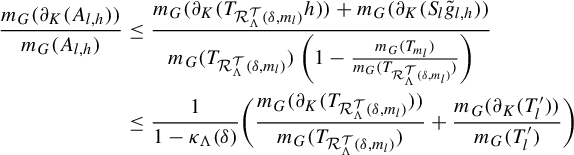 $$ \begin{align} \frac{m_G(\partial_K(A_{l,h}))}{m_G(A_{l,h})}&\leq \frac{m_G(\partial_K(T_{\mathcal{R}^{\mathcal{T}}_{\Lambda}(\delta, m_l)}h)) + m_G(\partial_K(S_l {\tilde{g}}_{l,h}))}{m_G(T_{\mathcal{R}^{\mathcal{T}}_{\Lambda}(\delta, m_l)})\, \bigg(1-\frac{m_G(T_{m_l})}{m_G(T_{\mathcal{R}^{\mathcal{T}}_{\Lambda}(\delta, m_l)})}\bigg)} \nonumber \\ &\leq \frac{1}{1-\kappa_{\Lambda}(\delta)}\bigg(\frac{m_G(\partial_K(T_{\mathcal{R}^{\mathcal{T}}_{\Lambda}(\delta, m_l)}))}{m_G(T_{\mathcal{R}^{\mathcal{T}}_{\Lambda}(\delta, m_l)})} + \frac{m_G(\partial_K(T^{\prime}_l))}{m_G(T^{\prime}_l)}\bigg) \end{align} $$
for all relatively compact sets $K \subseteq G$
. This shows that the left-hand side of the above inequality tends to
$K \subseteq G$
. This shows that the left-hand side of the above inequality tends to $0$
uniformly in h if l tends to infinity. In particular, the sequences
$0$
uniformly in h if l tends to infinity. In particular, the sequences $(A_{l,h})_l$
are strong Følner sequences for all
$(A_{l,h})_l$
are strong Følner sequences for all $h \in G$
. Now, let
$h \in G$
. Now, let $0 < \varepsilon < 1/10$
and choose some
$0 < \varepsilon < 1/10$
and choose some ${n_{\varepsilon } \geq \max \{m_0, L_{\varsigma }\}}$
such that
${n_{\varepsilon } \geq \max \{m_0, L_{\varsigma }\}}$
such that
 $$ \begin{align*} | \nu^{+} - w^{+}(T_n, \Lambda) | < \varepsilon \end{align*} $$
for all $n \geq n_{\varepsilon }$
. We also make sure that
$n \geq n_{\varepsilon }$
. We also make sure that $n_{\varepsilon }$
is chosen large enough such that
$n_{\varepsilon }$
is chosen large enough such that
 $$ \begin{align} \frac{m_G(\partial_L(T_n))}{m_G(T_n)} < \varepsilon \quad \text{for all } n \geq n_{\varepsilon}, \end{align} $$
where $L \in \{ J,B,I\}$
and
$L \in \{ J,B,I\}$
and $J,B,I$
are the compact subsets of G determined by w as of axioms (W2), (W3), and (W4). We fix
$J,B,I$
are the compact subsets of G determined by w as of axioms (W2), (W3), and (W4). We fix $n \geq n_{\varepsilon }$
and we apply Lemma 3.16 to find prototile sets
$n \geq n_{\varepsilon }$
and we apply Lemma 3.16 to find prototile sets
 $$ \begin{align*} \{e \} \subseteq T_n \subseteq S_1^{\varepsilon} \subseteq \cdots \subseteq S_{N(\varepsilon)}^{\varepsilon}, \quad S_i^{\varepsilon} \in \{ T_k: k \geq \max\{ i,n \} \}, \end{align*} $$
as well as $M \in {\mathbb N}$
with
$M \in {\mathbb N}$
with $M \geq n$
such that for all
$M \geq n$
such that for all $l \geq M$
, we have
$l \geq M$
, we have $m_l \geq n$
and for all
$m_l \geq n$
and for all $h \in G$
, we find a finite set
$h \in G$
, we find a finite set $C_i^{l,h} \subseteq A_{l,h}$
for each
$C_i^{l,h} \subseteq A_{l,h}$
for each $1 \leq i \leq N(\varepsilon )$
such that the properties (T1)–(T4) from Definition 3.13 are satisfied and at the same time, we obtain
$1 \leq i \leq N(\varepsilon )$
such that the properties (T1)–(T4) from Definition 3.13 are satisfied and at the same time, we obtain
 $$ \begin{align*} \frac{w(A_{l,h},\, \Lambda )}{m_G(A_{l,h})} \leq \sum_{i=1}^{N(\varepsilon)} \sum_{c \in C_i^{l,h}} \frac{ w( S_i^{\varepsilon}c, \Lambda )}{m_G(A_{l,h})} \, +\, t_1 \cdot \varepsilon, \end{align*} $$
where the constant $t_1 \geq 0$
only depends on the parameters
$t_1 \geq 0$
only depends on the parameters $\eta , \theta , \vartheta $
given by the definition of the weight function w. We emphasize at this point that the fact that the parameters
$\eta , \theta , \vartheta $
given by the definition of the weight function w. We emphasize at this point that the fact that the parameters $n, M$
(and hence also l) can be chosen independently of h is justified by the observation that the validity of Lemma 3.16 depends on the invariance properties of
$n, M$
(and hence also l) can be chosen independently of h is justified by the observation that the validity of Lemma 3.16 depends on the invariance properties of $A_{l,h}$
with respect to the prototile sets, combined with the fact that
$A_{l,h}$
with respect to the prototile sets, combined with the fact that $\lim _l m_G(\partial _{K}(A_{l,h}))/m_G(A_{l,h}) = 0$
uniformly over h for all
$\lim _l m_G(\partial _{K}(A_{l,h}))/m_G(A_{l,h}) = 0$
uniformly over h for all $K \in \mathcal {RK}(G)$
.
$K \in \mathcal {RK}(G)$
.
Exploiting the sub-additivity property (W3) of w and recalling $A_{l,h}:= T_{\mathcal {R}^{\mathcal {T}}_{\Lambda }(\delta , m_l)}h \setminus S_l \widetilde {g}_{l,h}$
, we find with the estimates in equations (6) and (7), as well as with
$A_{l,h}:= T_{\mathcal {R}^{\mathcal {T}}_{\Lambda }(\delta , m_l)}h \setminus S_l \widetilde {g}_{l,h}$
, we find with the estimates in equations (6) and (7), as well as with $l \geq M$
, that
$l \geq M$
, that
 $$ \begin{align*} \frac{w( T_{\mathcal{R}^{\mathcal{T}}_{\Lambda}(\delta, m_l)}h, \Lambda )}{m_G(T_{\mathcal{R}^{\mathcal{T}}_{\Lambda}(\delta, m_l)})}\!\leq\! \frac{m_G(S_l)}{m_G(T_{\mathcal{R}^{\mathcal{T}}_{\Lambda}(\delta, m_l)})} \cdot \frac{w( S_l \widetilde{g}_{l,h}, \Lambda )}{m_G(S_l)}\! +\! \frac{m_G(A_{l,h})}{m_G(T_{\mathcal{R}^{\mathcal{T}}_{\Lambda}(\delta, m_l)})} \cdot \frac{w( A_{l,h}, \Lambda )}{m_G(A_{l,h})}\! +\! t_2 \cdot \varepsilon \end{align*} $$
for some constant $t_2 \geq 0$
which only depends on the sub-additivity parameter
$t_2 \geq 0$
which only depends on the sub-additivity parameter $ \theta $
of w and on
$ \theta $
of w and on $\delta $
. Recall that
$\delta $
. Recall that $l \geq M \geq m_0$
. Thus, we can combine the latter inequality with the inequality (5) and
$l \geq M \geq m_0$
. Thus, we can combine the latter inequality with the inequality (5) and $m_G(S_l)=m_G(T^{\prime }_l)$
to obtain
$m_G(S_l)=m_G(T^{\prime }_l)$
to obtain
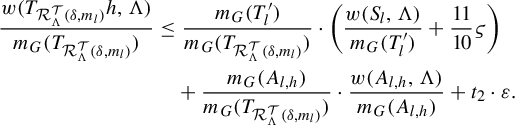 $$ \begin{align*} \frac{w( T_{\mathcal{R}^{\mathcal{T}}_{\Lambda}(\delta, m_l)}h, \Lambda )}{m_G( T_{\mathcal{R}^{\mathcal{T}}_{\Lambda}(\delta, m_l)})} &\leq \frac{m_G(T^{\prime}_l)}{m_G(T_{\mathcal{R}^{\mathcal{T}}_{\Lambda}(\delta, m_l)})} \cdot \bigg( \frac{w(S_l, \Lambda)}{m_G(T_l^{\prime})} + \frac{11}{10} \varsigma \bigg)\\ &\quad + \frac{m_G(A_{l,h})}{m_G(T_{\mathcal{R}^{\mathcal{T}}_{\Lambda}(\delta, m_l)})} \cdot \frac{w( A_{l,h}, \Lambda )}{m_G(A_{l,h})} + t_2 \cdot \varepsilon. \end{align*} $$
Invoking the sub-additivity induced by the above $\varepsilon $
-quasi tilings and using the basic inequality
$\varepsilon $
-quasi tilings and using the basic inequality $m_G(A_{l,h}) \leq m_G(T_{\mathcal {R}^{\mathcal {T}}_{\Lambda }(\delta , m_l)})$
, the latter inequality transforms to
$m_G(A_{l,h}) \leq m_G(T_{\mathcal {R}^{\mathcal {T}}_{\Lambda }(\delta , m_l)})$
, the latter inequality transforms to
 $$ \begin{align*} \frac{w(T_{\mathcal{R}^{\mathcal{T}}_{\Lambda}(\delta, m_l)}h, \Lambda )}{m_G(T_{\mathcal{R}^{\mathcal{T}}_{\Lambda}(\delta, m_l)})} &\leq \frac{m_G(T^{\prime}_l)}{m_G(T_{\mathcal{R}^{\mathcal{T}}_{\Lambda}(\delta, m_l)})} \cdot \bigg(\frac{w(S_l, \Lambda)}{m_G(T_l^{\prime})} + \frac{11}{10} \varsigma \bigg) \\ & \quad + \frac{m_G(A_{l,h})}{m_G(T_{\mathcal{R}^{\mathcal{T}}_{\Lambda}(\delta, m_l)})} \cdot \sum_{i=1}^{N(\varepsilon)} \sum_{c \in C_i^{l,h}} \frac{m_G(S_i^{\varepsilon}c)}{m_G(A_{l,h})} \frac{ w( S_i^{\varepsilon}c, \Lambda )}{m_G(S_i^{\varepsilon}c)} + (t_1 + t_2) \cdot \varepsilon. \end{align*} $$
Note that the tiling properties (T1)–(T4) from Definition 3.13 yield
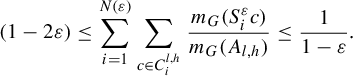 $$ \begin{align*} (1- 2 \varepsilon) \leq \sum_{i=1}^{N(\varepsilon)} \sum_{c \in C_i^{l,h}} \frac{m_G(S_i^{\varepsilon}c)}{m_G(A_{l,h})} \leq \frac{1}{1-\varepsilon}. \end{align*} $$
Furthermore, inequality (4) leads to
 $$ \begin{align*} \frac{m_G(T^{\prime}_l)}{m_G(T_{\mathcal{R}^{\mathcal{T}}_{\Lambda}(\delta, m_l)})} \cdot \bigg( \frac{w(S_l, \Lambda)}{m_G(T_l^{\prime})} + \frac{11}{10} \varsigma \bigg) \leq \frac{m_G(T^{\prime}_l)}{m_G(T_{\mathcal{R}^{\mathcal{T}}_{\Lambda}(\delta, m_l)})} \cdot \bigg( \nu^{+} - \frac{9}{10} \varsigma \bigg) \end{align*} $$
for $l \geq M \geq L_{\varsigma }$
. Recall that we have chosen
$l \geq M \geq L_{\varsigma }$
. Recall that we have chosen $n \geq n_{\varepsilon }$
and
$n \geq n_{\varepsilon }$
and $S_i^{\varepsilon } \in \{ T_k: k \geq \max \{ i,n \} \}$
. Thus,
$S_i^{\varepsilon } \in \{ T_k: k \geq \max \{ i,n \} \}$
. Thus,
 $$ \begin{align*} \frac{w(S_i^{\varepsilon}c,\, \Lambda )}{m_G(S_i^{\varepsilon}c)} \leq w^+(S_i^{\varepsilon},\Lambda) \leq \nu^{+} + \varepsilon \end{align*} $$
holds for all $1 \leq i \leq N(\varepsilon )$
, all
$1 \leq i \leq N(\varepsilon )$
, all $l \geq M$
, each
$l \geq M$
, each $h \in G$
, and each
$h \in G$
, and each $c \in C_i^{l,h}$
.
$c \in C_i^{l,h}$
.
Since $\Lambda $
is almost tempered repetitive, the repetitivity portion
$\Lambda $
is almost tempered repetitive, the repetitivity portion $\zeta :[0,1) \to [0,1]$
of
$\zeta :[0,1) \to [0,1]$
of $\Lambda $
with respect to
$\Lambda $
with respect to $\mathcal {T} = (T_m)$
is positive everywhere and, in particular, we have
$\mathcal {T} = (T_m)$
is positive everywhere and, in particular, we have
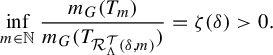 $$ \begin{align*} \inf_{m \in {\mathbb N}} \frac{m_G(T_m)}{m_G(T_{\mathcal{R}^{\mathcal{T}}_{\Lambda}(\delta, m)})} = \zeta(\delta)> 0. \end{align*} $$
We set $a_{\varepsilon } := (1-2\varepsilon )$
if
$a_{\varepsilon } := (1-2\varepsilon )$
if $\nu ^+ \leq 0$
, and
$\nu ^+ \leq 0$
, and $a_{\varepsilon } := (1-\varepsilon )^{-1}$
if
$a_{\varepsilon } := (1-\varepsilon )^{-1}$
if $\nu ^{+}> 0$
and
$\nu ^{+}> 0$
and $t_3 := t_1 + t_2$
. Since
$t_3 := t_1 + t_2$
. Since $a_{\varepsilon } \nu ^{+} - \nu ^{+}\geq 0$
, we finally derive from the above estimates
$a_{\varepsilon } \nu ^{+} - \nu ^{+}\geq 0$
, we finally derive from the above estimates
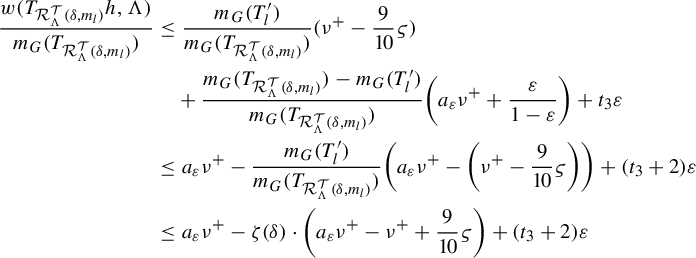 $$ \begin{align*} \frac{w( T_{\mathcal{R}^{\mathcal{T}}_{\Lambda}(\delta, m_l)}h, \Lambda )}{m_G(T_{\mathcal{R}^{\mathcal{T}}_{\Lambda}(\delta, m_l)})} &\leq \frac{m_G(T^{\prime}_l)}{m_G(T_{\mathcal{R}^{\mathcal{T}}_{\Lambda}(\delta, m_l)})} ( \nu^{+} - \frac{9}{10} \varsigma )\\ &\quad + \frac{m_G(T_{\mathcal{R}^{\mathcal{T}}_{\Lambda}(\delta, m_l)}) - m_G(T_l^{\prime})}{m_G(T_{\mathcal{R}^{\mathcal{T}}_{\Lambda}(\delta, m_l)})} \bigg( a_{\varepsilon} \nu^{+} + \frac{\varepsilon}{1-\varepsilon} \bigg) + t_3 \varepsilon \\ &\leq a_{\varepsilon}\nu^{+} - \frac{m_G(T^{\prime}_l)}{m_G(T_{\mathcal{R}^{\mathcal{T}}_{\Lambda}(\delta, m_l)})}\bigg(a_{\varepsilon} \nu^{+} - \bigg( \nu^{+} - \frac{9}{10}\varsigma \bigg) \bigg) + (t_3 + 2)\varepsilon \\ &\leq a_{\varepsilon}\nu^{+} - \zeta(\delta) \cdot \bigg( a_{\varepsilon} \nu^{+} - \nu^{+} + \frac{9}{10}\varsigma \bigg) + (t_3 + 2)\varepsilon \end{align*} $$
for all $l \geq M$
and all
$l \geq M$
and all $h \in G$
, where the tempered repetitivity was used in the last step. Thus, taking the supremum over all
$h \in G$
, where the tempered repetitivity was used in the last step. Thus, taking the supremum over all $h \in G$
on the left-hand side of the latter inequality and sending
$h \in G$
on the left-hand side of the latter inequality and sending $l \to \infty $
, we find that
$l \to \infty $
, we find that
 $$ \begin{align*} \nu^{+} \leq a_{\varepsilon}\nu^{+} - \zeta(\delta) \cdot \bigg( a_{\varepsilon} \nu^{+} - \nu^{+} + \frac{9}{10}\varsigma \bigg) + (t_3 + 2)\varepsilon. \end{align*} $$
By sending $\varepsilon \to 0$
, we obtain
$\varepsilon \to 0$
, we obtain $\nu ^{+} \leq \nu ^{+} - 9/10 \zeta (\delta ) \varsigma $
and since both
$\nu ^{+} \leq \nu ^{+} - 9/10 \zeta (\delta ) \varsigma $
and since both $\varsigma $
and
$\varsigma $
and $\zeta (\delta )$
are positive numbers, we have arrived at a contradiction. Hence, we conclude
$\zeta (\delta )$
are positive numbers, we have arrived at a contradiction. Hence, we conclude $\nu ^{+} = \nu ^{-}$
in case (A).
$\nu ^{+} = \nu ^{-}$
in case (A).
Case (B) is much easier to handle. We assume with no loss of generality that
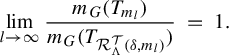 $$ \begin{align*} \lim_{l \to \infty} \frac{m_G(T_{m_l})}{m_G(T_{\mathcal{R}^{\mathcal{T}}_{\Lambda}(\delta, m_l)})}~=~1. \end{align*} $$
Then, there is some $M_{\varsigma } \in {\mathbb N}$
such that
$M_{\varsigma } \in {\mathbb N}$
such that $\sup _{h \in G} m_G(A_{l,h}) (m_G(T_{\mathcal {R}^{\mathcal {T}}_{\Lambda }(\delta , m_l)}))^{-1} < {\varsigma }/{5\eta }$
for all
$\sup _{h \in G} m_G(A_{l,h}) (m_G(T_{\mathcal {R}^{\mathcal {T}}_{\Lambda }(\delta , m_l)}))^{-1} < {\varsigma }/{5\eta }$
for all $l \geq M_{\varsigma }$
, where
$l \geq M_{\varsigma }$
, where $\eta> 0$
is the boundedness constant of w as of axiom (W2). Increasing
$\eta> 0$
is the boundedness constant of w as of axiom (W2). Increasing $M_{\varsigma }$
if necessary, we can assume that
$M_{\varsigma }$
if necessary, we can assume that $\sup _{h \in G} m_G( \partial _L(A_{l,h})) (m_G(T_{\mathcal {R}^{\mathcal {T}}_{\Lambda }(\delta , m_l)}))^{-1} < ({1}/{10})\varsigma (\max \{1,\eta ,\theta \})^{-1}$
and
$\sup _{h \in G} m_G( \partial _L(A_{l,h})) (m_G(T_{\mathcal {R}^{\mathcal {T}}_{\Lambda }(\delta , m_l)}))^{-1} < ({1}/{10})\varsigma (\max \{1,\eta ,\theta \})^{-1}$
and ${m_G(\partial _L(S_l))}/{m_G(S_l)} < {1}/{10} \varsigma (\max \{1,\theta \})^{-1}$
for all
${m_G(\partial _L(S_l))}/{m_G(S_l)} < {1}/{10} \varsigma (\max \{1,\theta \})^{-1}$
for all ${L \in \{ J,B,I \}}$
and each
${L \in \{ J,B,I \}}$
and each $l \geq M_{\varsigma }$
, where
$l \geq M_{\varsigma }$
, where $J,B,I \subseteq G$
are compact and
$J,B,I \subseteq G$
are compact and $\theta \geq 0$
depend on the weight function
$\theta \geq 0$
depend on the weight function $w$
. We now fix
$w$
. We now fix $l \geq M_{\varsigma }$
. By the choice of
$l \geq M_{\varsigma }$
. By the choice of $\widetilde {g}_{l,h}$
, inequalities (4) and (5) together with
$\widetilde {g}_{l,h}$
, inequalities (4) and (5) together with $m_G(S_l)=m_G(T^{\prime }_l)$
imply
$m_G(S_l)=m_G(T^{\prime }_l)$
imply
 $$ \begin{align*} \frac{w( S_l \widetilde{g}_{l,h} ,\, \Lambda )}{m_G(S_l)} \leq \frac{w(S_l,\, \Lambda )}{m_G(S_l)} + \frac{11}{10} \varsigma \leq \nu^{+} - \frac{9}{10}\varsigma \end{align*} $$
for all $l \geq M_{\varsigma }$
and each
$l \geq M_{\varsigma }$
and each $h \in G$
. Then,
$h \in G$
. Then, $m_G(\partial _L(C)) = m_G(\partial _L(Cg))$
, the sub-additivity property (W3) with constant
$m_G(\partial _L(C)) = m_G(\partial _L(Cg))$
, the sub-additivity property (W3) with constant $\theta \geq 0$
(given by
$\theta \geq 0$
(given by $w$
), and the imposed invariance conditions imply
$w$
), and the imposed invariance conditions imply
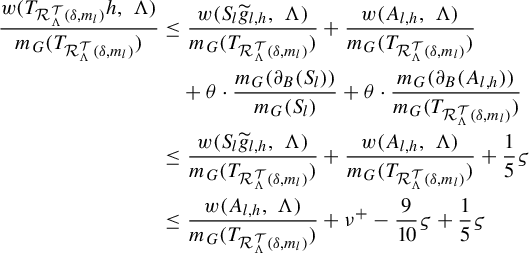 $$ \begin{align*} \frac{w( T_{\mathcal{R}^{\mathcal{T}}_{\Lambda}(\delta, m_l)}h ,\, \Lambda)}{m_G(T_{\mathcal{R}^{\mathcal{T}}_{\Lambda}(\delta, m_l)})} &\leq \frac{w(S_l \widetilde{g}_{l,h},\, \Lambda )}{m_G(T_{\mathcal{R}^{\mathcal{T}}_{\Lambda}(\delta, m_l)})} + \frac{w(A_{l,h},\, \Lambda )}{m_G(T_{\mathcal{R}^{\mathcal{T}}_{\Lambda}(\delta, m_l)})}\\ &\quad + \theta \cdot \frac{m_G(\partial_{B}(S_l))}{m_G(S_l)} + \theta \cdot \frac{m_G(\partial_B(A_{l,h}))}{m_G(T_{\mathcal{R}^{\mathcal{T}}_{\Lambda}(\delta, m_l)})} \\ &\leq \frac{w(S_l \widetilde{g}_{l,h},\, \Lambda )}{m_G(T_{\mathcal{R}^{\mathcal{T}}_{\Lambda}(\delta, m_l)})} + \frac{w(A_{l,h},\, \Lambda )}{m_G(T_{\mathcal{R}^{\mathcal{T}}_{\Lambda}(\delta, m_l)})} + \frac{1}{5}\varsigma \\ &\leq \frac{w(A_{l,h},\, \Lambda )}{m_G(T_{\mathcal{R}^{\mathcal{T}}_{\Lambda}(\delta, m_l)})} + \nu^{+} - \frac{9}{10}\varsigma + \frac{1}{5}\varsigma \end{align*} $$
for all $l \geq M_{\varsigma }$
and all
$l \geq M_{\varsigma }$
and all $h \in G$
. Invoking Remark 3.10 with constant
$h \in G$
. Invoking Remark 3.10 with constant $\eta> 0$
applied to
$\eta> 0$
applied to $w(A_{l,h},\, \Lambda )$
, then the invariance condition on
$w(A_{l,h},\, \Lambda )$
, then the invariance condition on $A_{l,h}$
and the implications explained at the beginning of the proof of Case (B) yield
$A_{l,h}$
and the implications explained at the beginning of the proof of Case (B) yield
 $$ \begin{align*} \frac{w( T_{\mathcal{R}^{\mathcal{T}}_{\Lambda}(\delta, m_l)}h ,\, \Lambda)}{m_G(T_{\mathcal{R}^{\mathcal{T}}_{\Lambda}(\delta, m_l)})} &\leq \eta \cdot \frac{m_G(A_{l,h})}{m_G(T_{\mathcal{R}^{\mathcal{T}}_{\Lambda}(\delta, m_l)})} + \eta \cdot \frac{m_G(\partial_J(A_{l,h}))}{m_G(T_{\mathcal{R}^{\mathcal{T}}_{\Lambda}(\delta, m_l)})} + \nu^{+} - \frac{9}{10}\varsigma + \frac{1}{5}\varsigma \\ &\leq \frac{1}{5} \varsigma + \frac{1}{10} \varsigma + \nu^{+} - \frac{9}{10} \varsigma + \frac{1}{5} \varsigma = \nu^{+} - \frac{2}{5} \varsigma \end{align*} $$
for all $l \geq M_{\varsigma }$
and all
$l \geq M_{\varsigma }$
and all $h \in G$
. Thus, by taking first the supremum over all
$h \in G$
. Thus, by taking first the supremum over all $h \in G$
and then sending
$h \in G$
and then sending $l \to \infty $
, we arrive at
$l \to \infty $
, we arrive at
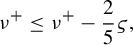 $$ \begin{align*} \nu^{+} \leq \nu^{+} - \frac{2}{5}\varsigma, \end{align*} $$
which is a contradiction since $\varsigma> 0$
.
$\varsigma> 0$
.
4 Unique ergodicity
4.1 Unique ergodicity from tempered repetitivity
We are now in a position to deduce Theorem 1.3 from our abstract sub-additive convergence theorem, Theorem 3.1. The idea to connect ergodicity properties of dynamical systems $G \curvearrowright X$
to the existence of limits of the form
$G \curvearrowright X$
to the existence of limits of the form $\lim _{m \to \infty } {w(T_m,\Lambda )}/{m_G(T_m)}$
for some class of almost-additive functions
$\lim _{m \to \infty } {w(T_m,\Lambda )}/{m_G(T_m)}$
for some class of almost-additive functions $w:\mathcal {RK}(G) \times X \to {\mathbb R}$
and strong Følner exhaustion sequence
$w:\mathcal {RK}(G) \times X \to {\mathbb R}$
and strong Følner exhaustion sequence $(T_m)$
is well established in the abelian case [Reference Damanik and Lenz19, Reference Frettlöh and Richard24, Reference Lagarias and Pleasants30, Reference Lenz32]. While the proof of the sub-additive convergence theorem was more complicated in the non-abelian case than in the abelian case, the application to the unique ergodicity statement is not much different, and hence we will be brief.
$(T_m)$
is well established in the abelian case [Reference Damanik and Lenz19, Reference Frettlöh and Richard24, Reference Lagarias and Pleasants30, Reference Lenz32]. While the proof of the sub-additive convergence theorem was more complicated in the non-abelian case than in the abelian case, the application to the unique ergodicity statement is not much different, and hence we will be brief.
For the remainder of this subsection, we work in the setting of Theorem 1.3. Thus, $\mathcal T = (T_m)$
is a strong Følner exhaustion sequence in an amenable unimodular lcsc group G and
$\mathcal T = (T_m)$
is a strong Følner exhaustion sequence in an amenable unimodular lcsc group G and $\Lambda $
is a weighted Delone set in G, which is almost tempered repetitive with respect to
$\Lambda $
is a weighted Delone set in G, which is almost tempered repetitive with respect to $\mathcal T$
. We then denote by
$\mathcal T$
. We then denote by $\mathcal H_\Lambda $
the hull of
$\mathcal H_\Lambda $
the hull of $\Lambda $
. To apply Theorem 3.1 in this context, we need to construct suitable weight functions.
$\Lambda $
. To apply Theorem 3.1 in this context, we need to construct suitable weight functions.
Given $f \in C(\mathcal {H}_{\Lambda })$
, we define the mapping
$f \in C(\mathcal {H}_{\Lambda })$
, we define the mapping
 $$ \begin{align} w_f: \mathcal{RK}(G) \times \mathcal{H}_{\Lambda} \to {\mathbb R}, \quad w(T, \Pi):= \int_T f(g.\Pi)\, dm_G(g). \end{align} $$
Proposition 4.1. For every $f \in C(\mathcal {H}_{\Lambda })$
, the function
$f \in C(\mathcal {H}_{\Lambda })$
, the function $w_f$
given by equation (8) is an almost sub-additive weight function over
$w_f$
given by equation (8) is an almost sub-additive weight function over $\mathcal H_\Lambda $
.
$\mathcal H_\Lambda $
.
Proof. We have to check axioms (W1)–(W4): axiom (W1) holds by the convention of the empty integral being equal to $0$
. Furthermore, axiom (W2) holds with
$0$
. Furthermore, axiom (W2) holds with $J = \emptyset $
and
$J = \emptyset $
and ${\eta = \| f\|_{\infty }}$
. The additivity of the integral yields axiom (W3) (which holds as an equality) with
${\eta = \| f\|_{\infty }}$
. The additivity of the integral yields axiom (W3) (which holds as an equality) with $B = \emptyset $
and
$B = \emptyset $
and $\theta = 0$
. As for axiom (W4), a straightforward integral substitution allows us to choose
$\theta = 0$
. As for axiom (W4), a straightforward integral substitution allows us to choose $\vartheta = 0$
and
$\vartheta = 0$
and $I = \emptyset $
.
$I = \emptyset $
.
The key step is now to show that for $f \in C(\mathcal {H}_{\Lambda })$
, the weight function
$f \in C(\mathcal {H}_{\Lambda })$
, the weight function $w_f$
is actually admissible, that is, that it also satisfies axiom (W5). We will use the fact that, by the same proof as in the abelian case [Reference Frettlöh and Richard24, Reference Müller and Richard39], a metric generating the weak-
$w_f$
is actually admissible, that is, that it also satisfies axiom (W5). We will use the fact that, by the same proof as in the abelian case [Reference Frettlöh and Richard24, Reference Müller and Richard39], a metric generating the weak- $*$
-topology on
$*$
-topology on $\mathcal {H}_\Lambda $
is defined via
$\mathcal {H}_\Lambda $
is defined via
 $$ \begin{align*} d_{\ast}(\Phi,\Pi) := \min&\{ c_\ast,\, \inf\{\delta>0 :\, |\delta_\Phi(B_\delta(y))-\delta_\Pi(B_\delta(y))| <\delta\\ &\ \ \text{for all } y\in (B_{1/\delta}\cap P)\cup (B_{1/\delta}\cap Q) \}\}, \end{align*} $$
where $\Phi :=(P,\alpha ),\Pi :=(Q,\beta )\in \mathcal {H}_\Lambda $
and
$\Phi :=(P,\alpha ),\Pi :=(Q,\beta )\in \mathcal {H}_\Lambda $
and $c_\ast>0$
are such that
$c_\ast>0$
are such that $B_{c_\ast }\subseteq U$
and
$B_{c_\ast }\subseteq U$
and ${c_\ast <(2\sigma )^{-1}}$
. We will use this metric in the proof of the following lemma.
${c_\ast <(2\sigma )^{-1}}$
. We will use this metric in the proof of the following lemma.
Lemma 4.2. For every $f\in \mathcal {C}(\mathcal {H}_\Lambda )$
, the weight function
$f\in \mathcal {C}(\mathcal {H}_\Lambda )$
, the weight function $w_f$
is admissible with respect to any strong Følner exhaustion sequence
$w_f$
is admissible with respect to any strong Følner exhaustion sequence $(T_m)$
.
$(T_m)$
.
Proof. We fix $f\in \mathcal {C}(\mathcal {H}_\Lambda )$
, a strong Følner exhaustion sequence
$f\in \mathcal {C}(\mathcal {H}_\Lambda )$
, a strong Følner exhaustion sequence $(T_m)$
, and some
$(T_m)$
, and some $\varepsilon> 0$
throughout. We then have to show the existence of some
$\varepsilon> 0$
throughout. We then have to show the existence of some $\delta>0$
and an
$\delta>0$
and an $m_0\in {\mathbb N}$
such that for all
$m_0\in {\mathbb N}$
such that for all $m\geq m_0$
, we have the implication
$m\geq m_0$
, we have the implication
 $$ \begin{align} d_{T_m^{-1}}(\Pi,\Theta)\leq \delta \Longrightarrow |w_f(T_m, \Pi) -w_f(T_m, \Theta)|\leq \varepsilon \cdot m_G(T_m)\,. \end{align} $$
Since f is uniformly continuous on the compact space $\mathcal {H}_{\Lambda }$
, there is a
$\mathcal {H}_{\Lambda }$
, there is a $0<\delta <c_\ast $
such that the condition
$0<\delta <c_\ast $
such that the condition $d_{\ast }(\Pi ,\Theta ) \leq \delta $
implies
$d_{\ast }(\Pi ,\Theta ) \leq \delta $
implies $|f(\Pi ) - f(\Theta )| \leq {\varepsilon }/{3}$
. Since
$|f(\Pi ) - f(\Theta )| \leq {\varepsilon }/{3}$
. Since $(T_m)$
is a strong Følner exhaustion sequence and
$(T_m)$
is a strong Følner exhaustion sequence and $B:=B_{1/\delta }\in \mathcal {RK}(G)$
, we find some
$B:=B_{1/\delta }\in \mathcal {RK}(G)$
, we find some $m_0 \in {\mathbb N}$
such that
$m_0 \in {\mathbb N}$
such that ${m_G(\partial _B(T_m))}/{m_G(T_m)}\leq {\varepsilon }/{3\|f\|_\infty }$
and
${m_G(\partial _B(T_m))}/{m_G(T_m)}\leq {\varepsilon }/{3\|f\|_\infty }$
and $B \subseteq T_m$
for all
$B \subseteq T_m$
for all $m\geq m_0$
. It follows that for all
$m\geq m_0$
. It follows that for all $\Theta \in \mathcal {H}_{\Lambda }$
,
$\Theta \in \mathcal {H}_{\Lambda }$
,
 $$ \begin{align*} &\bigg|\!\int_{T_m} f(g.\Theta)\, dg-\int_{T_m\setminus\partial_B(T_m)} f(g.\Theta)\, dg\bigg| \leq \int_{\partial_B(T_m)} |f(g.\Theta)|\, dg\\ &\quad \leq \|f\|_\infty m_G(\partial_B(T_m)) \leq \frac{\varepsilon}{3} m_G(T_m). \end{align*} $$
Note that since $e \in B$
and
$e \in B$
and $B=B^{-1}$
, we deduce
$B=B^{-1}$
, we deduce $Bg \subseteq T_m$
for
$Bg \subseteq T_m$
for $g \in T_m \setminus \partial _B(T_m)$
. Let
$g \in T_m \setminus \partial _B(T_m)$
. Let $\Theta ,\Pi \in \mathcal {H}_\Lambda $
such that
$\Theta ,\Pi \in \mathcal {H}_\Lambda $
such that $d_{T^{-1}_m}(\Pi ,\Theta )\leq \delta $
. Thus, we conclude
$d_{T^{-1}_m}(\Pi ,\Theta )\leq \delta $
. Thus, we conclude $d_{g^{-1}B^{-1}}(\Pi ,\Theta )\leq \delta $
, and hence
$d_{g^{-1}B^{-1}}(\Pi ,\Theta )\leq \delta $
, and hence $d_{B}(g.\Pi , g.\Theta )=d_{B^{-1}}(g.\Pi , g.\Theta )\leq \delta $
for all
$d_{B}(g.\Pi , g.\Theta )=d_{B^{-1}}(g.\Pi , g.\Theta )\leq \delta $
for all $g\in T_m\setminus \partial _B(T_m)$
. Since
$g\in T_m\setminus \partial _B(T_m)$
. Since $\delta <c_\ast $
,
$\delta <c_\ast $
, $d_{\ast }(g.\Pi ,g.\Theta )<\delta $
follows by the definition of
$d_{\ast }(g.\Pi ,g.\Theta )<\delta $
follows by the definition of $d_\ast $
for all
$d_\ast $
for all $g\in T_m\setminus \partial _B(T_m)$
. Thus,
$g\in T_m\setminus \partial _B(T_m)$
. Thus, $g\in T_m\setminus \partial _B(T_m)$
yields
$g\in T_m\setminus \partial _B(T_m)$
yields $|f(g.\Pi )-f(g.\Theta )|\leq {\varepsilon }/{3}$
and we arrive at
$|f(g.\Pi )-f(g.\Theta )|\leq {\varepsilon }/{3}$
and we arrive at
 $$ \begin{align*} \bigg|\!\int_{T_m\setminus\partial_B(T_m)} f(g.\Pi)\, dg-\int_{T_m\setminus\partial_B(T_m)} f(g.\Theta)\, dg\bigg| &\leq \int_{T_m\setminus\partial_B(T_m)} |f(g.\Pi)-f(g.\Theta)| \, dg \\ &\leq \frac{\varepsilon}{3}\, m_G(T_m\setminus\partial_B(T_m)) \leq \frac{\varepsilon}{3}\, m_G(T_m){.} \end{align*} $$
Now, equation (9) follows from the triangle inequality.
We can now prove unique ergodicity for almost tempered repetitive Delone sets $\Lambda $
in G.
$\Lambda $
in G.
Proof of Theorem 1.3
Suppose that $\Lambda $
is almost tempered repetitive with respect to the strong Følner exhaustion sequence
$\Lambda $
is almost tempered repetitive with respect to the strong Følner exhaustion sequence $(T_m)$
. Let
$(T_m)$
. Let $f \in C(\mathcal {H}_{\Lambda })$
. Since
$f \in C(\mathcal {H}_{\Lambda })$
. Since $w_f$
, as considered above, is an admissible weight function, we deduce from Theorem 3.1 that there is a number
$w_f$
, as considered above, is an admissible weight function, we deduce from Theorem 3.1 that there is a number $I(f) \in {\mathbb R}$
such that
$I(f) \in {\mathbb R}$
such that
 $$ \begin{align*} I(f) = \lim_{n \to \infty} \frac{w_f(T_m, \Pi)}{m_G(T_m)} = \lim_{m \to \infty} \frac{1}{m_G(T_m)} \int_{T_m} f(g.\Pi)\, dg \end{align*} $$
for all $\Pi \in \mathcal {H}_{\Lambda }$
. We claim that for an arbitrary G-invariant Borel probability measure
$\Pi \in \mathcal {H}_{\Lambda }$
. We claim that for an arbitrary G-invariant Borel probability measure $\nu $
on
$\nu $
on $\mathcal {H}_{\Lambda }$
, we get
$\mathcal {H}_{\Lambda }$
, we get $I(f) = \int _{\mathcal {H}_{\Lambda }} f\, d\nu $
. Indeed, combining the latter limit relation with the dominated convergence theorem, Fubini’s theorem, and the G-invariance of
$I(f) = \int _{\mathcal {H}_{\Lambda }} f\, d\nu $
. Indeed, combining the latter limit relation with the dominated convergence theorem, Fubini’s theorem, and the G-invariance of $\nu $
, we arrive at
$\nu $
, we arrive at
 $$ \begin{align*} I(f) &= \int_{\mathcal{H}_{\Lambda}} \lim_{m \to \infty} \frac{1}{m_G(T_m)} \int_{T_m} f(g.\Pi)\, dg \, d\nu(\Pi)\\ &= \lim_{m \to \infty} \frac{1}{m_G(T_m)} \int_{T_m} \int_{\mathcal{H}_{\Lambda}} f(g.\Pi)\, d\nu(\Pi)\, dg \\ &= \lim_{m \to \infty} \frac{1}{m_G(T_m)} \int_{T_m} \int_{\mathcal{H}_{\Lambda}} f(\Pi)\, d\nu(\Pi) \, dg = \int_{\mathcal{H}_{\Lambda}} f(\Pi)\, d\nu(\Pi). \end{align*} $$
This shows that for any two G-invariant Borel probability measures $\nu _1$
and
$\nu _1$
and $\nu _2$
, we obtain
$\nu _2$
, we obtain
 $$ \begin{align*} \int_{\mathcal{H}_{\Lambda}} f(\Pi)\, d\nu_1(\Pi) = I(f) = \int_{\mathcal{H}_{\Lambda}} f(\Pi)\, d\nu_2(\Pi) \end{align*} $$
for all $f \in C(\mathcal {H}_{\Lambda })$
. This, in turn, is equivalent to
$f \in C(\mathcal {H}_{\Lambda })$
. This, in turn, is equivalent to $\nu _1 = \nu _2$
. Therefore, the hull of
$\nu _1 = \nu _2$
. Therefore, the hull of $\Lambda $
is uniquely ergodic. It is also minimal by Proposition 3.7.
$\Lambda $
is uniquely ergodic. It is also minimal by Proposition 3.7.
4.2 Metrics of exact polynomial growth and linear repetitivity
In the previous subsection, we have established Theorem 1.3 which asserts that every tempered repetitive weighted Delone set with respect to a strong Følner exhaustion sequence in an lcsc amenable group is uniquely ergodic and minimal. While the notion of a Delone set was originally defined using a (continuous) adapted metric on G, it does not depend on any choice of metric on G, but only on G as a topological group. The same metric independence thus holds for the statement of the theorem. In the present subsection, we would now like to relate tempered repetitivity to the more classical notion of linear repetitivity; this notion, unlike the previous ones, does depend on a choice of metric. To obtain a metric version of Theorem 1.3, we will have to choose a metric with the additional property of exact polynomial volume growth. As we will see in Theorem 4.13 below, such metrics exist on all compactly generated groups of polynomial growth (e.g., word metrics with respect to compact generating sets), but it seems to be unknown in which generality they can be chosen to be continuous. For this reason, we insist for the remainder of this section that d is an adapted metric on G, which is not necessarily continuous. We still use the same notation as before concerning open and closed balls, but we emphasize that without the continuity assumption, $B_t$
need not be open and
$B_t$
need not be open and $\overline {B}_t$
need not be closed in the topology of G. However, left-invariance of d still implies that
$\overline {B}_t$
need not be closed in the topology of G. However, left-invariance of d still implies that
 $$ \begin{align} B_rB_s \subseteq B_{r+s} \quad \text{and} \quad \overline{B}_r \overline{B}_s \subseteq \overline{B}_{r+s} \quad \text{for all } r,s>0. \end{align} $$
Since d is locally bounded, we may choose $r_0$
such that
$r_0$
such that $B_{r_0}$
contains an open identity neighborhood. We claim that then
$B_{r_0}$
contains an open identity neighborhood. We claim that then
 $$ \begin{align} \overline{B_r} \subseteq \mathring{\overline{B_{s}}} \quad\text{and}\quad \overline{B_r} \subseteq B_{r+ r_0}\quad \text{for all } r> 0 \text{ and }s \geq r+r_0. \end{align} $$
Indeed, the former follows from the fact that every $x \in \overline {B_r}$
admits an open neighborhood which is contained in
$x \in \overline {B_r}$
admits an open neighborhood which is contained in $xB_{r_0} \subseteq \overline {B_r} \overline {B_{r_0}} \subseteq \overline {B_{r+r_0}} \subseteq \overline {B_s}$
. For the latter, if
$xB_{r_0} \subseteq \overline {B_r} \overline {B_{r_0}} \subseteq \overline {B_{r+r_0}} \subseteq \overline {B_s}$
. For the latter, if $x \in \overline {B_r}$
, then there exist
$x \in \overline {B_r}$
, then there exist $x_n \in B_r$
such that
$x_n \in B_r$
such that $x_n \to x$
and hence
$x_n \to x$
and hence $x_n^{-1}x \in B_{r_0}$
for some sufficiently large
$x_n^{-1}x \in B_{r_0}$
for some sufficiently large $n_0$
, that is,
$n_0$
, that is, $x \in x_{n_0}^{-1}B_{r_0} \subseteq B_rB_{r_0} \subseteq B_{r+r_0}$
.
$x \in x_{n_0}^{-1}B_{r_0} \subseteq B_rB_{r_0} \subseteq B_{r+r_0}$
.
If d is continuous, then $B_t$
is open and
$B_t$
is open and $\overline {B}_t$
is closed, and we have
$\overline {B}_t$
is closed, and we have
 $$ \begin{align} B_s \subseteq \overline{B_s} \subseteq \overline{B}_s \subseteq \mathring{\overline{B}_t} \subseteq \overline{B}_t \quad \text{for all}\; t>s>0. \end{align} $$
Also, if $K \subseteq G$
is compact and d is continuous, then there exists
$K \subseteq G$
is compact and d is continuous, then there exists $r_K> 0$
such that
$r_K> 0$
such that ${K \subseteq B_{r_K}}$
. This latter property is invariant under coarse equivalence, and hence holds for all adapted pseudo-metrics on G, even if they are discontinuous by Proposition 2.1. We will be interested in metrics with the following special property (see [Reference Nevo40, §4.4] for background information).
${K \subseteq B_{r_K}}$
. This latter property is invariant under coarse equivalence, and hence holds for all adapted pseudo-metrics on G, even if they are discontinuous by Proposition 2.1. We will be interested in metrics with the following special property (see [Reference Nevo40, §4.4] for background information).
Definition 4.3. (Groups with exact polynomial growth with respect to a metric)
Let G be an lcsc group and let d be an adapted metric on G. We say that G has exact polynomial growth with respect to d if there are constants $C> 0$
and
$C> 0$
and $q \geq 0$
such that
$q \geq 0$
such that
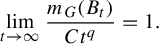 $$ \begin{align*} \lim_{t \to \infty} \frac{m_G(B_t)}{C t^{q}} = 1. \end{align*} $$
Note that exact polynomial growth is a property of the pair $(G,d)$
, not just of the (topological) group G. It is also not invariant under replacing d by a coarsely equivalent metric, and hence G may have exact polynomial growth with respect to some adapted metrics, but not for others. Note that exact polynomial growth implies that for all
$(G,d)$
, not just of the (topological) group G. It is also not invariant under replacing d by a coarsely equivalent metric, and hence G may have exact polynomial growth with respect to some adapted metrics, but not for others. Note that exact polynomial growth implies that for all $r>0$
, we have
$r>0$
, we have
 $$ \begin{align} \lim_{t \to \infty} \frac{m_G(B_{t+r})}{m_G(B_{t})} = \lim_{t \to \infty} \frac{m_G(B_{t+r})}{m_G(B_{t})} \frac{Ct^q}{C(t+r)^q} = 1. \end{align} $$
The following observation is crucial for our purposes. Though it is well known to experts (see e.g. [Reference Nevo40, Proposition 4.13] or [Reference Breuillard14, Corollary 1.10] for a slightly different formulation), we give a proof for the sake of being self-contained.
Proposition 4.4. (Balls as Følner sequences)
Let G be an lcsc group that has exact polynomial growth with respect to some adapted metric d. Assume that either:
-
(a) d is continuous and
$T_n := \overline {B}_{r_n}$
, where
$(r_n)_{n \in \mathbb N}$
is any strictly monotone sequence with
$\lim _n r_n = \infty $
; or -
(b)
$T_n := \overline {B_{r_n}}$
, where
$r_{n+1} - r_n> r_0$
for all
$n \in \mathbb N$
, where
$r_0>0$
is chosen such that
$B_{r_0}$
contains an open identity neighborhood.


Then $(T_n)_{n \in \mathbb N}$
is a strong Følner exhaustion sequence.
$(T_n)_{n \in \mathbb N}$
is a strong Følner exhaustion sequence.
Proof. To deal with both cases simultaneously, we set $r_0 :=0$
in Case (a). Note first that in either case, the sets
$r_0 :=0$
in Case (a). Note first that in either case, the sets $T_n$
are compact by continuity, respectively properness of d (whereas closed balls need not be topologically closed, let alone compact, in Case (b)). Moreover, we have
$T_n$
are compact by continuity, respectively properness of d (whereas closed balls need not be topologically closed, let alone compact, in Case (b)). Moreover, we have $T_n \subseteq \mathring {T}_{n+1}$
by equations (12) and (11), respectively, and hence
$T_n \subseteq \mathring {T}_{n+1}$
by equations (12) and (11), respectively, and hence $(T_n)$
is a strong exhaustion sequence in either case.
$(T_n)$
is a strong exhaustion sequence in either case.
Moreover, by the previous remarks, we can find for every compact subset $K \subseteq G$
some
$K \subseteq G$
some $r_K> 0$
with
$r_K> 0$
with $K \subseteq B_{r_K}$
. This yields
$K \subseteq B_{r_K}$
. This yields
 $$ \begin{align*} \partial_KT_n = K^{-1} T_n \cap K^{-1}( G \setminus T_n ) \subseteq B_{r_K}T_n \cap B_{r_K}( G \setminus T_n ). \end{align*} $$
We claim that if $x \in B_{r_n-r_K}$
, then
$x \in B_{r_n-r_K}$
, then $x \not \in \partial _K T_n$
. Indeed, otherwise, we would find
$x \not \in \partial _K T_n$
. Indeed, otherwise, we would find $y \in B_{r_K}$
and
$y \in B_{r_K}$
and $z \in G \setminus T_n$
such that
$z \in G \setminus T_n$
such that $x = yz$
and hence
$x = yz$
and hence $z = y^{-1}x \in B_{r_n} \subseteq T_n$
. However, we deduce that in Case (a), we have
$z = y^{-1}x \in B_{r_n} \subseteq T_n$
. However, we deduce that in Case (a), we have $\partial _KT_n \subseteq B_{r_K} \overline {B}_{r_n} \subseteq \overline {B}_{r_K + r_n} \subseteq B_{r_n + r_K + 1}$
. In Case (b), we can use equation (11) to similarly deduce
$\partial _KT_n \subseteq B_{r_K} \overline {B}_{r_n} \subseteq \overline {B}_{r_K + r_n} \subseteq B_{r_n + r_K + 1}$
. In Case (b), we can use equation (11) to similarly deduce
 $$ \begin{align*} \partial_KT_n \subseteq B_{r_K} \overline{B_{r_n}} \subseteq \overline{B_{r_K + r_n}} \subseteq B_{r_K + r_n + r_0}. \end{align*} $$
Thus, in either case, we have
 $$ \begin{align*} \partial_KT_n \subseteq B_{r_n + r_K + r_0 + 1} \setminus B_{r_n -r_K}. \end{align*} $$
Using equation (13), we obtain
 $$ \begin{align*} \limsup_{n \to \infty} \frac{m_G(\partial_KT_n)}{m_G(T_n)} &\leq \limsup_{n \to \infty} \frac{m_G(B_{r_n + r_K + r_0 + 1} \setminus B_{r_n -r_K})}{m_G({B}_{r_n})} \\ &\leq \lim_{n \to \infty} \frac{m_G(B_{r_n+(r_K+r_0+1)})}{m_G(B_{r_n})}- \lim_{n \to \infty} \frac{m_G(B_{r_n-r_K})}{m_G(B_{(r_n-r_K) + r_K})} = 1 - 1 = 0. \end{align*} $$
This finishes the proof.
We will see that if one restricts attention to strong Følner exhaustion sequences which arise from metrics of exact polynomial growth as above, then our notion of (almost) tempered repetitivity reduces to the more classical and purely metric notion of (almost) linear repetitivity. Let us recall the relevant definitions.
Definition 4.5. Let G be an lcsc group and let d be an adapted metric on G. A weighted Delone set $\Lambda $
in G is called almost linearly repetitive with respect to d if it is almost repetitive and there exists some function
$\Lambda $
in G is called almost linearly repetitive with respect to d if it is almost repetitive and there exists some function $c_{\Lambda }:(0,\infty ) \to (0,\infty )$
such that
$c_{\Lambda }:(0,\infty ) \to (0,\infty )$
such that
 $$ \begin{align*} \varrho(\delta, R) := c_{\Lambda}(\delta) R, \quad (\delta,R)\in(0,\infty)\times [1,\infty) \end{align*} $$
is an almost repetitivity function.
For weighted Delone sets with FLC, it makes sense to work with the following definition.
Definition 4.6. A weighted Delone set $\Lambda $
on G is called linearly repetitive if it is repetitive and there exists a constant
$\Lambda $
on G is called linearly repetitive if it is repetitive and there exists a constant $c_{\Lambda }$
such that
$c_{\Lambda }$
such that $\varrho (R) := c_{\Lambda } R,\, R\in [1,\infty )$
is a repetitivity function.
$\varrho (R) := c_{\Lambda } R,\, R\in [1,\infty )$
is a repetitivity function.
We emphasize that (almost) linear repetitivity is a metric notion, whereas (almost) tempered repetitivity is a notion relative to a given strong Følner exhaustion sequence. However, we have the following relation.
Proposition 4.7. (Linear repetitivity versus tempered repetitivity)
Assume that G is an lcsc group that has exact polynomial growth with respect to some adapted metric d and let $r_0> 0$
such that
$r_0> 0$
such that $B_{r_0}$
is an identity neighborhood. Then, for a weighted Delone set
$B_{r_0}$
is an identity neighborhood. Then, for a weighted Delone set $\Lambda $
in G, the following statements are equivalent:
$\Lambda $
in G, the following statements are equivalent:
-
(i)
$\Lambda $
is almost linearly repetitive with respect to d; -
(ii)
$\Lambda $
is almost tempered repetitive with respect to every strong Følner exhaustion sequence of the form
$\mathcal {T} = (\overline {B_{r_n}})$
with the sequence
$(r_n)$
satisfying
$$ \begin{align*} r_0 \leq \inf_n (r_{n+1} - r_n) \leq \sup_{n}( r_{n+1} - r_n) < \infty; \end{align*} $$
-
(iii)
$\Lambda $
is almost tempered repetitive with respect to the strong Følner exhaustion sequence
$(\overline {B_{nr_0}})$
.


If d is continuous, then we can replace closures of balls by closed balls, the condition in statement (ii), by
 $$ \begin{align*}0< \inf_n (r_{n+1} - r_n) \leq \sup_{n}( r_{n+1} - r_n) < \infty,\end{align*} $$
and the strong Følner exhaustion sequence in statement (iii) by $(\overline {B}_{n})$
.
$(\overline {B}_{n})$
.
If $\Lambda $
has FLC, then we can drop the word ‘almost’ from any of the above equivalences.
$\Lambda $
has FLC, then we can drop the word ‘almost’ from any of the above equivalences.
Remark 4.8. Note that due to part (b) of Proposition 4.4, the sequences appearing in assertions (ii) and (iii) of Proposition 4.7 are indeed strong Følner exhaustion sequences. In the case where the metric is additionally continuous, we find that the closed balls give rise to strong Følner exhaustion sequences by part (a) of Proposition 4.4. Note that the condition on the sequence $(r_n)$
given in assertion (ii) implies that
$(r_n)$
given in assertion (ii) implies that $r_n < r_{n+1}$
for all
$r_n < r_{n+1}$
for all $n \in {\mathbb N}$
, as well as
$n \in {\mathbb N}$
, as well as $r_n \nearrow \infty $
as
$r_n \nearrow \infty $
as $n \to \infty $
. However, even if d is continuous, these two monotonicity conditions are not sufficient for
$n \to \infty $
. However, even if d is continuous, these two monotonicity conditions are not sufficient for $\Lambda $
being tempered repetitive with respect to
$\Lambda $
being tempered repetitive with respect to $\mathcal {T}$
, as can be inferred by Example 3.8.
$\mathcal {T}$
, as can be inferred by Example 3.8.
Proof. Assume that G has exact polynomial growth with respect to d with parameters say $C> 0$
and
$C> 0$
and $q \geq 0$
, and let
$q \geq 0$
, and let $(t_m)$
be any strictly increasing sequence such that
$(t_m)$
be any strictly increasing sequence such that $t_m \nearrow \infty $
as
$t_m \nearrow \infty $
as $m \to \infty $
. We recall from equation (13) that for all
$m \to \infty $
. We recall from equation (13) that for all $c> 0$
, there exists a constant
$c> 0$
, there exists a constant $\gamma> 1$
such that for all
$\gamma> 1$
such that for all $m \in {\mathbb N}$
,
$m \in {\mathbb N}$
,
 $$ \begin{align*} m_G(B_{ct_m + r_0}) = \frac{ m_G(B_{ct_m + r_0})}{m_G(B_{ct_m})} \cdot m_G(B_{ct_m}) \leq \gamma m_G(B_{ct_m}). \end{align*} $$
Then, for every $c^{\prime }> 0$
, we find a constant
$c^{\prime }> 0$
, we find a constant $\beta \geq 1$
such that for all
$\beta \geq 1$
such that for all $m \in {\mathbb N}$
and
$m \in {\mathbb N}$
and $c \in \{1, c'\}$
,
$c \in \{1, c'\}$
,
 $$ \begin{align*} \beta^{-1} C (ct_{m})^{q} \leq m_G(B_{ct_m}) \leq m_G(\overline{B_{c t_{m}}}) \leq m_G(B_{ct_m + r_0})\leq \gamma m_G(B_{ct_m}) \leq \beta C (ct_{m})^q.\end{align*} $$
The same argument also holds for $\overline {B}_{ct_m}$
instead of
$\overline {B}_{ct_m}$
instead of $\overline {B_{c t_{m}}}$
(one can set
$\overline {B_{c t_{m}}}$
(one can set $r_0 = 1$
in this situation).
$r_0 = 1$
in this situation).
(i) $\Longrightarrow $
(ii). Assume that
$\Longrightarrow $
(ii). Assume that $\Lambda $
is almost linearly repetitive with almost repetitivity function
$\Lambda $
is almost linearly repetitive with almost repetitivity function $\varrho (\delta ,R) = c_{\Lambda }(\delta ) \cdot R$
(where
$\varrho (\delta ,R) = c_{\Lambda }(\delta ) \cdot R$
(where $c_{\Lambda } = c_{\Lambda }(0)$
in the FLC case) and let
$c_{\Lambda } = c_{\Lambda }(0)$
in the FLC case) and let $\mathcal T = (T_m)$
, where
$\mathcal T = (T_m)$
, where ${T_m:= \overline {B_{r_m}}}$
. We set
${T_m:= \overline {B_{r_m}}}$
. We set $a:= \inf _m (r_{m+1} - r_m)> 0$
, as well as
$a:= \inf _m (r_{m+1} - r_m)> 0$
, as well as $A := \sup _m (r_{m+1} - r_m) < \infty $
. Then, by the given almost linear repetitivity, we get
$A := \sup _m (r_{m+1} - r_m) < \infty $
. Then, by the given almost linear repetitivity, we get $\mathcal {R}_{\Lambda }^{\mathcal {T}}(\delta , m) \leq a^{-1} c_{\Lambda }(\delta ) r_{m}$
for all
$\mathcal {R}_{\Lambda }^{\mathcal {T}}(\delta , m) \leq a^{-1} c_{\Lambda }(\delta ) r_{m}$
for all $m \in {\mathbb N}$
. Further, we have that
$m \in {\mathbb N}$
. Further, we have that $T_{\mathcal {R}_{\Lambda }^{\mathcal {T}}(\delta , m)} \subseteq \overline {B_{A \mathcal {R}_{\Lambda }^{\mathcal {T}}(\delta , m)}} $
for all
$T_{\mathcal {R}_{\Lambda }^{\mathcal {T}}(\delta , m)} \subseteq \overline {B_{A \mathcal {R}_{\Lambda }^{\mathcal {T}}(\delta , m)}} $
for all $m \in {\mathbb N}$
. In line with the remark made at the beginning of the proof (applied with
$m \in {\mathbb N}$
. In line with the remark made at the beginning of the proof (applied with $t_m = r_m$
and with
$t_m = r_m$
and with $c^{\prime } = A a^{-1} c_{\Lambda }(\delta )$
), we find
$c^{\prime } = A a^{-1} c_{\Lambda }(\delta )$
), we find $\beta = \beta (\delta ) \geq 1$
such that
$\beta = \beta (\delta ) \geq 1$
such that
 $$ \begin{align*} \inf_{m \in {\mathbb N}} \frac{m_G(T_m)}{m_G(T_{\mathcal{R}_{\Lambda}^{\mathcal{T}}(\delta, m)})} \geq \inf_{m \in {\mathbb N}} \frac{\beta(\delta)^{-1} \cdot C r_m^{q} }{m_G(\overline{B_{A a^{-1} c_{\Lambda}(\delta)\cdot r_m}})} \geq \beta(\delta)^{-2} (Aa^{-1})^{-q} c_{\Lambda}(\delta)^{-q}> 0. \end{align*} $$
Hence, the repetitivity portion of $\Lambda $
is bounded from below by
$\Lambda $
is bounded from below by $\zeta (\delta ) \geq \beta (\delta )^{-2} \cdot (Aa^{-1})^{-q} c_{\Lambda }(\delta )^{-q}$
, which is positive. This shows that
$\zeta (\delta ) \geq \beta (\delta )^{-2} \cdot (Aa^{-1})^{-q} c_{\Lambda }(\delta )^{-q}$
, which is positive. This shows that $\Lambda $
is almost tempered repetitive with respect to
$\Lambda $
is almost tempered repetitive with respect to $\mathcal {T}$
. In the continuous case, the same argument works with
$\mathcal {T}$
. In the continuous case, the same argument works with $T_m := \overline {B}_{r_m}$
instead of
$T_m := \overline {B}_{r_m}$
instead of $T_m:= \overline {B_{r_m}}$
.
$T_m:= \overline {B_{r_m}}$
.
(ii) $\Longrightarrow $
(iii). This is obvious since the sequence
$\Longrightarrow $
(iii). This is obvious since the sequence $(r_n)$
with
$(r_n)$
with $r_n = r_0n$
(or
$r_n = r_0n$
(or $r_n = n$
in the continuous case) for all
$r_n = n$
in the continuous case) for all $n \in {\mathbb N}$
satisfies the growth condition given in assertion (ii).
$n \in {\mathbb N}$
satisfies the growth condition given in assertion (ii).
(iii) $\Longrightarrow $
(i). Since the statements are invariant under rescaling the metric, we may assume that
$\Longrightarrow $
(i). Since the statements are invariant under rescaling the metric, we may assume that $r_0 = 1$
to simplify notation. Assume that
$r_0 = 1$
to simplify notation. Assume that $\Lambda $
is almost tempered repetitive with respect to
$\Lambda $
is almost tempered repetitive with respect to $\mathcal {T} = (\overline {B_n}) $
. Now let
$\mathcal {T} = (\overline {B_n}) $
. Now let $R \geq 1$
and
$R \geq 1$
and $m := \lceil R \rceil + 1$
such that
$m := \lceil R \rceil + 1$
such that $m \in {\mathbb N}$
with
$m \in {\mathbb N}$
with $m \geq 2$
and
$m \geq 2$
and $m-2 < R \leq m - 1$
. By assumption, there is a function
$m-2 < R \leq m - 1$
. By assumption, there is a function $\zeta :[0,1) \to [0,1]$
with
$\zeta :[0,1) \to [0,1]$
with $\zeta (\delta )>0$
for all
$\zeta (\delta )>0$
for all $\delta> 0$
(and in the FLC case,
$\delta> 0$
(and in the FLC case, $\zeta (0)> 0$
) such that
$\zeta (0)> 0$
) such that
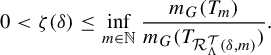 $$ \begin{align*} 0 < \zeta(\delta) \leq \inf_{m \in {\mathbb N}} \frac{m_G(T_m)}{m_G(T_{\mathcal{R}^{\mathcal{T}}_{\Lambda}(\delta, m)})}. \end{align*} $$
Using the considerations made at the beginning of the proof (applied with $t_m =m$
and
$t_m =m$
and $c^{\prime } = 1$
), we obtain
$c^{\prime } = 1$
), we obtain $\beta (\delta ) \geq 1$
such that for all
$\beta (\delta ) \geq 1$
such that for all $m \in {\mathbb N}$
,
$m \in {\mathbb N}$
,
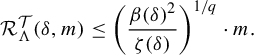 $$ \begin{align*} {\mathcal{R}^{\mathcal{T}}_{\Lambda}(\delta, m)} \leq \bigg(\frac{\beta(\delta)^2}{\zeta(\delta)} \bigg)^{1/q} \cdot m. \end{align*} $$
Note that $m = (m-2) + 2 \leq R + 2R = 3R$
. By the first inclusion given in equation (11) and
$m = (m-2) + 2 \leq R + 2R = 3R$
. By the first inclusion given in equation (11) and $R+1 \leq m$
, we get
$R+1 \leq m$
, we get $B_R \subseteq \mathring {\overline {B_{R+1}}} \subseteq \mathring {\overline {B_m}}$
. It follows from the definition of the repetitivity index that every
$B_R \subseteq \mathring {\overline {B_{R+1}}} \subseteq \mathring {\overline {B_m}}$
. It follows from the definition of the repetitivity index that every $B_R$
-pattern
$B_R$
-pattern $\delta $
-occurs in
$\delta $
-occurs in $h \mathring {T}^{-1}_{\mathcal {R}^{\mathcal {T}}_{\Lambda }(\delta , m)} = \mathring {\overline {B_{{\mathcal {R}^{\mathcal {T}}_{\Lambda }(\delta , m)}}(h)}} \subseteq B_{ \mathcal {R}^{\mathcal {T}}_{\Lambda }(\delta , m) + 1}(h) $
for all
$h \mathring {T}^{-1}_{\mathcal {R}^{\mathcal {T}}_{\Lambda }(\delta , m)} = \mathring {\overline {B_{{\mathcal {R}^{\mathcal {T}}_{\Lambda }(\delta , m)}}(h)}} \subseteq B_{ \mathcal {R}^{\mathcal {T}}_{\Lambda }(\delta , m) + 1}(h) $
for all $h \in G$
, where the latter inclusion follows from the second inclusion in equation (11). We can now choose
$h \in G$
, where the latter inclusion follows from the second inclusion in equation (11). We can now choose $\kappa (\delta )> 0$
large enough such that
$\kappa (\delta )> 0$
large enough such that $( \beta (\delta )^2/\zeta (\delta ))^{1/q} 3R + 1 \leq \kappa (\delta )R$
for all
$( \beta (\delta )^2/\zeta (\delta ))^{1/q} 3R + 1 \leq \kappa (\delta )R$
for all $R \geq 1$
, and then
$R \geq 1$
, and then $\varrho (\delta , R):= \kappa (\delta ) R$
is an almost repetitivity function for
$\varrho (\delta , R):= \kappa (\delta ) R$
is an almost repetitivity function for $\Lambda $
. The special case where d is a continuous metric follows along similar lines, using the inclusions given in equation (12).
$\Lambda $
. The special case where d is a continuous metric follows along similar lines, using the inclusions given in equation (12).
This now allows us to restate Theorem 1.3 in purely metric terms and thereby establish Theorem 1.2 from §1.
Theorem 4.9. Assume that G is an lcsc group that has exact polynomial growth with respect to an adapted metric d. If a weighted Delone set $\Lambda $
in G is almost linearly repetitive with respect to d, then its hull
$\Lambda $
in G is almost linearly repetitive with respect to d, then its hull $\mathcal H_\Lambda $
is minimal and uniquely ergodic.
$\mathcal H_\Lambda $
is minimal and uniquely ergodic.


4.3 Examples of groups with metrics of exact polynomial growth
We have seen in the previous subsection that adapted metrics of exact polynomial growth give rise to strong Følner exhaustion sequences, and allow us to translate the abstract notion of tempered repetitivity into the more concrete notion of linear repetitivity. We now provide some explicit examples of such metrics. Our starting point is the Cygan–Korányi metric on the Heisenberg group.
Example 4.10. Consider the three-dimensional Heisenberg group $G = {\mathbb C} \times {\mathbb R}$
with group law given by
$G = {\mathbb C} \times {\mathbb R}$
with group law given by
 $$ \begin{align*} (z,t) \cdot (w,s) = ( z + w, t+s + \tfrac{1}{2} \operatorname{Im} \overline{z}w ) \end{align*} $$
and note that for $z \in {\mathbb C}$
and
$z \in {\mathbb C}$
and $t \in {\mathbb R}$
, we have
$t \in {\mathbb R}$
, we have
 $$ \begin{align*} (z,t)^{-1} = (-z,-t). \end{align*} $$
The Cygan–Korányi norm $\| \cdot \|: G \to [0, \infty )$
 $$ \begin{align*} \| (z,t) \| := \sqrt[4]{|z|^4 + 16t^2} \end{align*} $$
defines a group norm on the Heisenberg group, cf. [Reference Capogna, Danielli, Pauls and Tyson15, p. 18, inequality (2.12)], which means that the formula
 $$ \begin{align*} d_G(g,h) = \| g^{-1}h\| \end{align*} $$
defines a left-invariant metric $d_G$
on G, called the Cygan–Korányi metric. Since the Cygan–Korányi norm is bounded above and below by suitable powers of the Euclidean norm on
$d_G$
on G, called the Cygan–Korányi metric. Since the Cygan–Korányi norm is bounded above and below by suitable powers of the Euclidean norm on ${\mathbb C} \times {\mathbb R} \cong {\mathbb R}^3$
, and the metric
${\mathbb C} \times {\mathbb R} \cong {\mathbb R}^3$
, and the metric $d_G$
is proper and defines the group topology. Thus,
$d_G$
is proper and defines the group topology. Thus, $d_G$
is continuous and adapted. Using that the Haar measure
$d_G$
is continuous and adapted. Using that the Haar measure $m_G$
on G is the three-dimensional Lebesgue measure, a simple integration via polar coordinates using the substitution
$m_G$
on G is the three-dimensional Lebesgue measure, a simple integration via polar coordinates using the substitution $s = r^2$
yields
$s = r^2$
yields
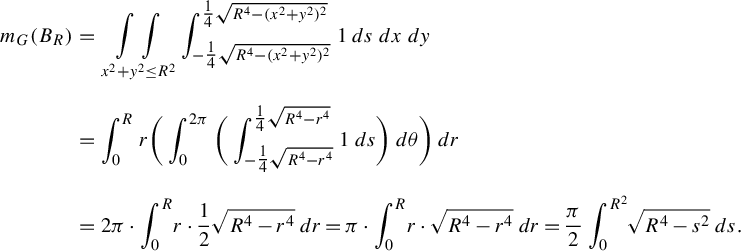 $$ \begin{align*} m_G(B_R) &= \underset{ x^2 + y^2 \leq R^2}{\int \int} \int_{-\tfrac{1}{4} \sqrt{R^4 - (x^2 +y^2)^2}}^{{\tfrac{1}{4} \sqrt{R^4 - (x^2 +y^2)^2}}} 1\, ds\, dx\, dy\\[7pt] & = \int_0^R r \bigg( \int_{0}^{2\pi} \bigg( \int_{-\tfrac{1}{4}\sqrt{R^4 - r^4}}^{\tfrac{1}{4}\sqrt{R^4 - r^4}} 1 \, ds \bigg) \, d\theta \bigg)\, dr \\[7pt] &= 2\pi \kern1.7pt{\cdot} \int_0^R\! r \kern1.7pt{\cdot}\kern1.7pt \frac{1}{2} \sqrt{R^4 \kern1.7pt{-}\kern1.7pt r^4}\, dr \kern1.5pt{=}\kern1.5pt \pi \kern1.7pt{\cdot} \int_0^R\! r \kern1.7pt{\cdot}\kern1.7pt \sqrt{R^4 \kern1.7pt{-}\kern1.7pt r^4}\, dr \kern1.7pt{=}\kern1.7pt \frac{\pi}{2} \int_0^{R^2}\!\kern-1pt \sqrt{R^4 \kern1.7pt{-}\kern1.7pt s^2}\, ds. \end{align*} $$
Since the above integral is equal to the area of the quarter circle with radius $R^2$
, which is
$R^2$
, which is $(R^2)^2 \pi / 4$
, we obtain
$(R^2)^2 \pi / 4$
, we obtain
 $$ \begin{align*} m_G(B_R) = \frac{\pi}{2} \cdot \frac{(R^2)^2 \cdot \pi}{4} = \frac{\pi^2}{8} R^4, \end{align*} $$
and hence,
 $$ \begin{align*} \lim_{t \to \infty} \frac{m_G(B_{t+r} )}{m_G(B_t)} = \lim_{t \to \infty} \frac{(t+r)^4}{t^4} = 1 \quad\text{for all } r> 0. \end{align*} $$
Therefore, the Heisenberg group has exact polynomial growth with respect to the Cygan–Korányi metric $d_G$
.
$d_G$
.
The previous example can be generalized to cover the whole class of homogeneous Lie groups. As explained in [Reference Fischer and Ruzhansky21, Ch. 3], each homogeneous Lie group G comes equipped with a class of continuous adapted metrics, called homogeneous metrics, which are mutually quasi-isometric, and a natural family of dilation automorphisms $(D_\unicode{x3bb} )_{\unicode{x3bb}>0}$
such that
$(D_\unicode{x3bb} )_{\unicode{x3bb}>0}$
such that ${B_t = D_t(B_1)}$
for balls with respect to any homogeneous metric d. By [Reference Fischer and Ruzhansky21, p. 100, equation (3.6)], this implies that
${B_t = D_t(B_1)}$
for balls with respect to any homogeneous metric d. By [Reference Fischer and Ruzhansky21, p. 100, equation (3.6)], this implies that
 $$ \begin{align}m_G(B_t) = m_G(B_1) t^{\kappa},\end{align} $$
where $\kappa $
is a constant depending on G (called the homogeneous dimension of the homogeneous group). We have seen in the case of the Heisenberg group that
$\kappa $
is a constant depending on G (called the homogeneous dimension of the homogeneous group). We have seen in the case of the Heisenberg group that $\kappa = 4$
. It follows immediately from equation (14) that homogeneous groups have exact polynomial growth with respect to homogeneous metrics, and this property also carries over to lattices in such a group (see [Reference Beckus, Hartnick and Pogorzelski4]).
$\kappa = 4$
. It follows immediately from equation (14) that homogeneous groups have exact polynomial growth with respect to homogeneous metrics, and this property also carries over to lattices in such a group (see [Reference Beckus, Hartnick and Pogorzelski4]).
Proposition 4.11. Let G be a homogeneous Lie group. If d is a homogeneous metric on G, then G has exact polynomial growth with respect to d. Similarly, if $\Gamma $
is a lattice in G, then
$\Gamma $
is a lattice in G, then $\Gamma $
has exact polynomial growth with respect to
$\Gamma $
has exact polynomial growth with respect to $d|_{\Gamma \times \Gamma }$
.
$d|_{\Gamma \times \Gamma }$
.
At this point, we can easily deduce Theorem 1.1 from §1.
Proof of Theorem 1.1
In view of Theorem 4.9 and the fact that linear repetitivity implies almost linear repetitivity, we only have to show that every homogeneous metric d is adapted and that G has exact polynomial growth with respect to d. The former follows from [Reference Fischer and Ruzhansky21, Proposition 3.1.37] and the latter follows from Proposition 4.11.
Note that Proposition 4.11 generalizes Example 4.10 since the Cygan–Korányi metric is a homogeneous metric on the Heisenberg group. Our next goal is to characterize all groups which admit an adapted metric of exact polynomial growth.
In geometric group theory, a finitely generated group $\Gamma $
is said to have polynomial growth provided for some (hence any) finite generating set S, there exist constants
$\Gamma $
is said to have polynomial growth provided for some (hence any) finite generating set S, there exist constants $C\geq 1$
and
$C\geq 1$
and $k \in \mathbb N$
such that
$k \in \mathbb N$
such that $|S^n| \leq C \cdot n^k$
for all
$|S^n| \leq C \cdot n^k$
for all $n \in \mathbb N$
. More generally, if G is a compactly generated lcsc group, then we say that G has polynomial growth if for some (hence any) compact symmetric generating set
$n \in \mathbb N$
. More generally, if G is a compactly generated lcsc group, then we say that G has polynomial growth if for some (hence any) compact symmetric generating set $\Omega $
and Haar measure
$\Omega $
and Haar measure $m_G$
on G, there exist constants
$m_G$
on G, there exist constants $C\geq 1$
and
$C\geq 1$
and $k \in \mathbb N$
such that
$k \in \mathbb N$
such that
 $$ \begin{align*} m_G(\Omega^n) \leq C \cdot n^k. \end{align*} $$
We warn the reader that while finitely generated discrete groups of polynomial growth are virtually nilpotent by a celebrated theorem of Gromov, this need not be the case in the compactly generated lcsc groups of polynomial growth. However, such groups are still virtually compact-by-solvable, and hence amenable. A more precise structure theory for compactly generated lcsc groups of polynomial growth was developed only fairly recently by Breuillard [Reference Breuillard14]. One consequence of this structure theory is the following volume growth formula, which is a special case of [Reference Breuillard14, Theorem 1.1].
Theorem 4.12. (Breuillard’s volume growth formula [Reference Breuillard14, Theorem 1.1])
Let G be an lcsc group of polynomial growth. Then, there exists $d(G) \in \mathbb N_0$
and for every compact symmetric generating set
$d(G) \in \mathbb N_0$
and for every compact symmetric generating set $\Omega $
, there exists a constant
$\Omega $
, there exists a constant $c(\Omega )> 0$
such that
$c(\Omega )> 0$
such that
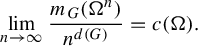 $$ \begin{align} \lim_{n \to \infty} \frac{m_G(\Omega^n)}{n^{d(G)}} = c(\Omega). \end{align} $$
Note that polynomial growth is a property of a (compactly generated) lcsc group G, whereas the definition of exact polynomial growth also involves a choice of metric d. Nevertheless the two notions are closely connected.
Theorem 4.13. (Polynomial growth versus exact polynomial growth, cf. [Reference Breuillard14])
For a compactly generated lcsc group G, the following conditions are equivalent:
-
(i) G has polynomial growth;
-
(ii) G admits an adapted metric d of exact polynomial growth.
Proof. (ii) ${\implies}$
(i). Since the balls
${\implies}$
(i). Since the balls $B_n$
exhaust G and G is compactly generated, it is generated by some ball
$B_n$
exhaust G and G is compactly generated, it is generated by some ball $B_N$
; rescaling the metric by a positive constant if necessary, we may thus assume that G is generated by
$B_N$
; rescaling the metric by a positive constant if necessary, we may thus assume that G is generated by $B_1$
. Now, let
$B_1$
. Now, let $q>0$
be chosen such that d-balls satisfy the condition
$q>0$
be chosen such that d-balls satisfy the condition $\lim _{t \to \infty } ({m_G(B_t)}/{C t^{q}}) = 1$
and pick an integer
$\lim _{t \to \infty } ({m_G(B_t)}/{C t^{q}}) = 1$
and pick an integer $k> q$
. Then, we can find
$k> q$
. Then, we can find $C'> 0$
such that
$C'> 0$
such that $m_G(B_t) < C' t^{k}$
for all
$m_G(B_t) < C' t^{k}$
for all $t\geq 1$
and hence
$t\geq 1$
and hence
 $$ \begin{align*} m_G(B_1^n) \leq m_G(B_n) < C' n^k, \end{align*} $$
which shows that G has polynomial growth.
(i) ${\implies}$
(ii). Let
${\implies}$
(ii). Let $\Omega $
be a compact generating set of G. It then follows from Theorem 4.12 that the word metric
$\Omega $
be a compact generating set of G. It then follows from Theorem 4.12 that the word metric $d_\Omega $
with respect to
$d_\Omega $
with respect to $\Omega $
has exact polynomial growth, and this metric is obviously adapted.
$\Omega $
has exact polynomial growth, and this metric is obviously adapted.
Note that the above proof of the implication (i) ${\implies}$
(ii) does not produce a continuous adapted metric of exact polynomial growth, unless G is discrete to begin with. The remainder of this subsection is devoted to the question for which groups of polynomial growth can one actually produce a continuous adapted metric of exact polynomial growth and will not be needed in what follows. We start our discussion with a simple example.
${\implies}$
(ii) does not produce a continuous adapted metric of exact polynomial growth, unless G is discrete to begin with. The remainder of this subsection is devoted to the question for which groups of polynomial growth can one actually produce a continuous adapted metric of exact polynomial growth and will not be needed in what follows. We start our discussion with a simple example.
If G is a connected Lie group of polynomial growth, then any choice of inner product on the Lie algebra of G will induce a left-invariant Riemannian metric on G, and the corresponding metric d will be continuous and adapted. This metric will have the additional property of being geodesic in the sense that for all $x,x' \in G$
, there exists an isometry
$x,x' \in G$
, there exists an isometry $\gamma $
from an interval
$\gamma $
from an interval $I = [a,b] \subseteq \mathbb R$
to a path in G such that
$I = [a,b] \subseteq \mathbb R$
to a path in G such that $\gamma (a) = x$
and
$\gamma (a) = x$
and $\gamma (b) = x'$
(by a suitable version of the Hopf–Rinow theorem). For an arbitrary compactly generated lcsc group G, one only knows that there exists a continuous adapted metric d on G, which is large-scale geodesic in the sense of [Reference Cornulier and de la Harpe18, pp. 10], but it is unclear under which conditions this metric can be chosen to be geodesic in the strict sense.
$\gamma (b) = x'$
(by a suitable version of the Hopf–Rinow theorem). For an arbitrary compactly generated lcsc group G, one only knows that there exists a continuous adapted metric d on G, which is large-scale geodesic in the sense of [Reference Cornulier and de la Harpe18, pp. 10], but it is unclear under which conditions this metric can be chosen to be geodesic in the strict sense.
Theorem 4.14. (Exact polynomial growth with respect to a continuous metric)
Assume that a compactly generated lcsc group G of polynomial growth admits a geodesic (rather than just a large-scale geodesic) continuous adapted metric d. Then, G has exact polynomial growth with respect to any such metric. In particular, a connected Lie group admits a continuous adapted metric of exact polynomial growth if and only if it has polynomial growth.
For the remainder of this section, we assume that d is a geodesic continuous adapted metric on a compactly generated lcsc group G of polynomial growth. The fact that d is geodesic has the following consequence concerning balls in G.
Lemma 4.15. The equality $\overline {B}_n = \overline {B}_1^n$
holds for all
$\overline {B}_n = \overline {B}_1^n$
holds for all $n \in \mathbb N$
.
$n \in \mathbb N$
.
Proof. Let $x \in \overline {B}_n$
with
$x \in \overline {B}_n$
with $\alpha := \|x\|$
and
$\alpha := \|x\|$
and $m := \lceil \alpha \rceil - 1 \leq n-1$
. Choose a geodesic
$m := \lceil \alpha \rceil - 1 \leq n-1$
. Choose a geodesic $\gamma $
in G with
$\gamma $
in G with $\gamma (0) = e$
and
$\gamma (0) = e$
and $\gamma (\alpha ) = x$
, and for
$\gamma (\alpha ) = x$
, and for $k = 1, \ldots , n$
, define
$k = 1, \ldots , n$
, define $y_k := \gamma (k-1)^{-1}\gamma (k)$
. Then, by the left-invariance of the metric d and the fact that
$y_k := \gamma (k-1)^{-1}\gamma (k)$
. Then, by the left-invariance of the metric d and the fact that $d(e, y_k) = d(\gamma (k-1),\gamma (k)) = 1$
, we get
$d(e, y_k) = d(\gamma (k-1),\gamma (k)) = 1$
, we get
 $$ \begin{align*}x = y_1 \cdots y_m (\gamma(m)^{-1}x) \in \overline{B}_1^{m+1} \subseteq \overline{B}_1^n,\end{align*} $$
and hence $ \overline {B}_n \subseteq \overline {B}_1^n$
. The converse inclusion is immediate from left-invariance and the triangle inequality.
$ \overline {B}_n \subseteq \overline {B}_1^n$
. The converse inclusion is immediate from left-invariance and the triangle inequality.
In view of Breuillard’s volume growth formula, we can prove Theorem 4.14.
Proof of Theorem 4.14
We apply equation (15) to $\Omega := \overline {B}_1$
and use that
$\Omega := \overline {B}_1$
and use that $m_G(\overline {B}_r)= m_G(B_r)$
for all
$m_G(\overline {B}_r)= m_G(B_r)$
for all $r> 0$
. For
$r> 0$
. For $q=d(G)$
and
$q=d(G)$
and $c=c(\Omega )$
as in Theorem 4.12, we obtain with Lemma 4.15 that
$c=c(\Omega )$
as in Theorem 4.12, we obtain with Lemma 4.15 that
 $$ \begin{align*} \lim_{n \to \infty} \frac{m_G(B_n)}{c \cdot n^q} = \lim_{n \to \infty} \frac{m_G(\overline{B}_n)}{c \cdot n^q} = \lim_{n \to \infty} \frac{m_G(\Omega^n)}{c \cdot n^q} = 1. \end{align*} $$
Now, for an arbitrary sequence $(t_n)$
with
$(t_n)$
with $\lim _{n \to \infty } t_n = \infty $
, we have
$\lim _{n \to \infty } t_n = \infty $
, we have
 $$ \begin{align*} 1 = \lim_{n \to \infty} \frac{m_G(B_{\lfloor t_n \rfloor})}{c \cdot ( \lfloor t_n \rfloor )^q} \cdot \lim_{n \to \infty} \frac{c \cdot ( \lfloor t_n \rfloor )^q}{c \cdot ( \lceil t_n \rceil )^q} \leq \liminf_{n \to \infty} \frac{m_G(B_{t_n})}{c \cdot t_n^q}. \end{align*} $$
The converse inequality follows analogously.
Remark 4.16. (Beyond connected Lie groups)
The simple argument used to establish Theorem 4.14 still carries through if d is merely asymptotically geodesic (see [Reference Nevo40, Theorem 14.3]), but it no longer works if d is only assumed to be large-scale geodesic in the sense of [Reference Cornulier and de la Harpe18]. In this case, we can still find positive integers $a,b,c$
such that for all
$a,b,c$
such that for all $x,x' \in G$
, there exist
$x,x' \in G$
, there exist $k \in \mathbb N$
with
$k \in \mathbb N$
with $n \leq a d(x,x') + b$
and
$n \leq a d(x,x') + b$
and $x_0, \ldots , x_k \in G$
with
$x_0, \ldots , x_k \in G$
with $x = x_0$
,
$x = x_0$
, $x' = x_n$
, and
$x' = x_n$
, and $d(x_{i-1}, x_i) \leq c$
for all
$d(x_{i-1}, x_i) \leq c$
for all $i \in \{1, \ldots , k\}$
, but this yields only the weaker statement
$i \in \{1, \ldots , k\}$
, but this yields only the weaker statement
 $$ \begin{align*} \overline{B}_1^n \subseteq \overline{B}_n \subseteq \overline{B}_c^{an+b} \subseteq \overline{B}_c^{(a+b)n} \quad \text{for all }n \in \mathbb N \end{align*} $$
instead of Lemma 4.15. In the notation of Theorem 4.12, this leads to the conclusion that
 $$ \begin{align*} c(\overline{B}_1) \leq \liminf_{n \to \infty} \frac{m_G(B_n)}{n^q} \leq \limsup_{n \to \infty} \frac{m_G(B_n)}{n^q} \leq c(\overline{B}_c^{(a+b)}), \end{align*} $$
which, in the language of [Reference Nevo40], means that G has strict polynomial growth with respect to d. Our argument thus shows that every compactly generated lcsc group G of polynomial growth admits a continuous adapted metric d such that G has strict polynomial growth with respect to d. It seems to be an open problem for which classes of compactly generated lcsc group of polynomial growth can one find a metric, which is both continuous and of exact polynomial growth, see the discussion in [Reference Nevo40, §4.4] and the references therein, in particular, [Reference Breuillard14] and [Reference Pansu42].
5 Symbolic systems
In this section, we describe how the previous considerations carry over to symbolic systems over a finite alphabet and we give the proof of Theorem 1.4.
In the following, $\Gamma $
will denote an amenable, countable, discrete group. For the Haar measure on
$\Gamma $
will denote an amenable, countable, discrete group. For the Haar measure on $\Gamma $
, we fix the normalized counting measure
$\Gamma $
, we fix the normalized counting measure $m_{\Gamma }$
which satisfies
$m_{\Gamma }$
which satisfies $m_{\Gamma }(\{e \}) = 1$
for the identity element
$m_{\Gamma }(\{e \}) = 1$
for the identity element $e \in \Gamma $
. We will additionally assume that
$e \in \Gamma $
. We will additionally assume that $\Gamma $
is a uniform lattice in an amenable lcsc group H, that is,
$\Gamma $
is a uniform lattice in an amenable lcsc group H, that is, $\Gamma $
is a discrete subgroup of H whose quotient
$\Gamma $
is a discrete subgroup of H whose quotient $H/\Gamma $
is compact in the quotient topology. This point of view is useful for constructing Delone sets in the ambient group H via symbolic considerations over
$H/\Gamma $
is compact in the quotient topology. This point of view is useful for constructing Delone sets in the ambient group H via symbolic considerations over $\Gamma $
. Moreover, we do not lose any generality because we can always consider
$\Gamma $
. Moreover, we do not lose any generality because we can always consider $\Gamma $
as a lattice in itself. We will also assume that H carries adapted metric
$\Gamma $
as a lattice in itself. We will also assume that H carries adapted metric $d_H$
and its restriction to
$d_H$
and its restriction to $\Gamma $
gives rise to an adapted
$\Gamma $
gives rise to an adapted $d_{\Gamma }$
on
$d_{\Gamma }$
on $\Gamma $
(which is automatically continuous since
$\Gamma $
(which is automatically continuous since $\Gamma $
is discrete).
$\Gamma $
is discrete).
We further fix a finite set $\mathcal {A}$
, called alphabet, which carries the discrete topology. Then,
$\mathcal {A}$
, called alphabet, which carries the discrete topology. Then, $\mathcal {A}^{\Gamma }$
becomes a compact metrizable space when endowed with the product topology. We will call the elements in
$\mathcal {A}^{\Gamma }$
becomes a compact metrizable space when endowed with the product topology. We will call the elements in $\mathcal {A}^{\Gamma }$
colorings and the elements in
$\mathcal {A}^{\Gamma }$
colorings and the elements in $\mathcal {A}$
are called colors. For any coloring
$\mathcal {A}$
are called colors. For any coloring $\mathcal {C} \in \mathcal {A}^{\Gamma }$
, we can define its translation by
$\mathcal {C} \in \mathcal {A}^{\Gamma }$
, we can define its translation by $\gamma \in \Gamma $
as
$\gamma \in \Gamma $
as $(\gamma. \mathcal {C})(x) = \mathcal {C}(\gamma ^{-1}x)$
for all
$(\gamma. \mathcal {C})(x) = \mathcal {C}(\gamma ^{-1}x)$
for all $x \in \Gamma $
. This leads to the notion of the hull of
$x \in \Gamma $
. This leads to the notion of the hull of $\mathcal {C}$
, defined as
$\mathcal {C}$
, defined as
 $$ \begin{align*} \Omega_{\mathcal{C}}:= \overline{\{ \gamma.\mathcal{C}:\, \gamma \in \Gamma \}}, \end{align*} $$
where the closure is taken in the product topology. Clearly, the hull is a compact metrizable space as well, and $\Gamma $
acts on it via translations. We say that the hull
$\Gamma $
acts on it via translations. We say that the hull $\Omega _{\mathcal {C}}$
is uniquely ergodic if it admits a unique
$\Omega _{\mathcal {C}}$
is uniquely ergodic if it admits a unique $\Gamma $
-invariant probability measure. Every
$\Gamma $
-invariant probability measure. Every $\mathcal {C} \in \mathcal {A}^{\Gamma }$
gives rise to a canonical definition of (colored) patches and patterns. Writing
$\mathcal {C} \in \mathcal {A}^{\Gamma }$
gives rise to a canonical definition of (colored) patches and patterns. Writing $\mathcal {F}(\Gamma )$
for the collection of all finite subsets of
$\mathcal {F}(\Gamma )$
for the collection of all finite subsets of $\Gamma $
, for each
$\Gamma $
, for each $S \in \mathcal {F}(\Gamma )$
, we denote the S-patch of
$S \in \mathcal {F}(\Gamma )$
, we denote the S-patch of $\mathcal {C}$
as the restriction
$\mathcal {C}$
as the restriction $\mathcal {C}_{|S}$
of the map
$\mathcal {C}_{|S}$
of the map $\mathcal {C}$
to the set S. We say that for
$\mathcal {C}$
to the set S. We say that for $S,T \in \mathcal {F}(\Gamma )$
, the corresponding patches of
$S,T \in \mathcal {F}(\Gamma )$
, the corresponding patches of $\mathcal {C}$
are equivalent if there is some
$\mathcal {C}$
are equivalent if there is some $\gamma \in \Gamma $
such that
$\gamma \in \Gamma $
such that $\gamma S = T$
and
$\gamma S = T$
and $\mathcal {C}(\gamma s) = \mathcal {C}(s)$
for all
$\mathcal {C}(\gamma s) = \mathcal {C}(s)$
for all $s \in S$
. Given an S-patch of
$s \in S$
. Given an S-patch of $\mathcal {C}$
, we denote its equivalence class as the pattern of that S-patch. We write
$\mathcal {C}$
, we denote its equivalence class as the pattern of that S-patch. We write $[S]_{\mathcal {C}}$
for the collection of all patterns arising from all
$[S]_{\mathcal {C}}$
for the collection of all patterns arising from all $\gamma S$
-patches in
$\gamma S$
-patches in $\mathcal {C}$
. For
$\mathcal {C}$
. For $p \in [S]_{\mathcal {C}}$
and
$p \in [S]_{\mathcal {C}}$
and $T \in \mathcal {F}(\Gamma )$
, we say that p occurs in T if there are some representative
$T \in \mathcal {F}(\Gamma )$
, we say that p occurs in T if there are some representative $\mathcal {C}_{|xS}$
of p and
$\mathcal {C}_{|xS}$
of p and $\gamma \in \Gamma $
such that
$\gamma \in \Gamma $
such that $\gamma xS \subseteq T $
and
$\gamma xS \subseteq T $
and $\mathcal {C}(\gamma xs) = \mathcal {C}(xs)$
for all
$\mathcal {C}(\gamma xs) = \mathcal {C}(xs)$
for all $s \in S$
. We point out that
$s \in S$
. We point out that $[S]_{\mathcal {C}}$
is finite for some
$[S]_{\mathcal {C}}$
is finite for some $\mathcal {C} \in \mathcal {A}^{\Gamma }$
since
$\mathcal {C} \in \mathcal {A}^{\Gamma }$
since $\mathcal {A}$
is finite, that is,
$\mathcal {A}$
is finite, that is, $\mathcal {C}$
is of finite local complexity with respect to the above equivalence relation of patterns.
$\mathcal {C}$
is of finite local complexity with respect to the above equivalence relation of patterns.
We will now relate symbolic colorings with weighted Delone sets in the ambient group H. To this end, we fix $\sigma \geq 1$
along with an injective map
$\sigma \geq 1$
along with an injective map $\iota : \mathcal {A} \to [\sigma ^{-1}, \sigma ]$
and define the map
$\iota : \mathcal {A} \to [\sigma ^{-1}, \sigma ]$
and define the map
 $$ \begin{align*} \mathcal{I}: \mathcal{A}^{\Gamma} \to \mathrm{Del}(U,K,\sigma), \quad \mathcal{C} \mapsto \sum_{\gamma \in \Gamma} \iota( \mathcal{C}(\gamma) ) \cdot \delta_{\gamma}, \end{align*} $$
where U open and K are chosen such that $\Gamma $
is
$\Gamma $
is $(U,K)$
-Delone in H.
$(U,K)$
-Delone in H.
Lemma 5.1. The map $\mathcal {I}$
is a continuous,
$\mathcal {I}$
is a continuous, $\Gamma $
-equivariant embedding.
$\Gamma $
-equivariant embedding.
Proof. The injectivity of $\mathcal {I}$
is clear from the injectivity of
$\mathcal {I}$
is clear from the injectivity of $\iota $
and uniform discreteness of
$\iota $
and uniform discreteness of $\Gamma $
in H. As for the
$\Gamma $
in H. As for the $\Gamma $
-equivariance, take
$\Gamma $
-equivariance, take $\gamma _0 \in \Gamma $
,
$\gamma _0 \in \Gamma $
, $\mathcal {C} \in \mathcal {A}^{\Gamma }$
, and
$\mathcal {C} \in \mathcal {A}^{\Gamma }$
, and $B \subseteq H$
Borel. Then,
$B \subseteq H$
Borel. Then,
 $$ \begin{align*} \gamma_0.\mathcal{I}(\mathcal{C})(B) &= \mathcal{I}(\mathcal{C})(\gamma_0^{-1}B) = \sum_{\gamma \in \Gamma} \iota ( \mathcal{C}(\gamma) ) \delta_{\gamma}(\gamma^{-1}_0 B) = \sum_{\gamma \in \Gamma} \iota ( \mathcal{C}(\gamma) )\delta_{\gamma_0 \gamma}(B) \\ &= \sum_{\gamma \in \Gamma} \iota ( \mathcal{C}( \gamma_0^{-1}\gamma) ) \delta_{\gamma}(B) = \sum_{\gamma \in \Gamma} \iota((\gamma_0. \mathcal{C})(\gamma)) \delta_{\gamma}(B) = \mathcal{I}(\gamma_0 .\mathcal{C})(B). \end{align*} $$
It remains to show that $\mathcal {I}$
is continuous. To this end, suppose that
$\mathcal {I}$
is continuous. To this end, suppose that $(\mathcal {C}_n)\subseteq \mathcal {A}^\Gamma $
is a sequence and
$(\mathcal {C}_n)\subseteq \mathcal {A}^\Gamma $
is a sequence and $\mathcal {C}$
is an element in
$\mathcal {C}$
is an element in $\mathcal {A}^\Gamma $
such that
$\mathcal {A}^\Gamma $
such that $\lim _{n \to \infty } \mathcal {C}_n = \mathcal {C}$
. Fix a compact neighborhood W of
$\lim _{n \to \infty } \mathcal {C}_n = \mathcal {C}$
. Fix a compact neighborhood W of $\{e\}$
in H with
$\{e\}$
in H with $W \cap \Gamma = \{e\}$
. Since all values of
$W \cap \Gamma = \{e\}$
. Since all values of $\mathcal {I}$
are measures supported on
$\mathcal {I}$
are measures supported on $\Gamma $
, it suffices to show that
$\Gamma $
, it suffices to show that $\lim _{n \to \infty } \mathcal {I}(\mathcal {C}_n)(\varphi ) = \mathcal {I}(\mathcal {C})(\varphi )$
for all
$\lim _{n \to \infty } \mathcal {I}(\mathcal {C}_n)(\varphi ) = \mathcal {I}(\mathcal {C})(\varphi )$
for all $\varphi \in C_c(H)$
with the support of
$\varphi \in C_c(H)$
with the support of $\varphi $
being contained in
$\varphi $
being contained in $KW$
, where
$KW$
, where $K \subseteq \Gamma $
is finite. Indeed, given a finite set K and fixing such
$K \subseteq \Gamma $
is finite. Indeed, given a finite set K and fixing such $\varphi $
, we find
$\varphi $
, we find $n_K \in {\mathbb N}$
such that we have
$n_K \in {\mathbb N}$
such that we have ${\mathcal {C}_n}_{|K} = \mathcal {C}_{|K}$
holds. Therefore,
${\mathcal {C}_n}_{|K} = \mathcal {C}_{|K}$
holds. Therefore, $\mathcal {I}(\mathcal {C}_n)(\varphi ) = \mathcal {I}(\mathcal {C})(\varphi )$
follows for all
$\mathcal {I}(\mathcal {C}_n)(\varphi ) = \mathcal {I}(\mathcal {C})(\varphi )$
follows for all $n \geq n_K$
. This finishes the proof.
$n \geq n_K$
. This finishes the proof.
Proposition 5.2. For any $\mathcal {C} \in \mathcal {A}^{\Gamma }$
, the dynamical systems
$\mathcal {C} \in \mathcal {A}^{\Gamma }$
, the dynamical systems $\Gamma \curvearrowright \Omega _{\mathcal {C}}$
and
$\Gamma \curvearrowright \Omega _{\mathcal {C}}$
and $\Gamma \curvearrowright \mathcal {H}_{\mathcal {I}(\mathcal {C})}$
are topologically isomorphic.
$\Gamma \curvearrowright \mathcal {H}_{\mathcal {I}(\mathcal {C})}$
are topologically isomorphic.
Proof. It suffices to show that the restriction $\tau $
of
$\tau $
of $\mathcal {I}$
to
$\mathcal {I}$
to $\Omega _{\mathcal {C}}$
gives rise to a
$\Omega _{\mathcal {C}}$
gives rise to a $\Gamma $
-equivariant homeomorphism onto
$\Gamma $
-equivariant homeomorphism onto $\mathcal {H}_{\mathcal {I}(\mathcal {C})}$
. It follows from Lemma 5.1 (with
$\mathcal {H}_{\mathcal {I}(\mathcal {C})}$
. It follows from Lemma 5.1 (with $H=\Gamma $
) that
$H=\Gamma $
) that $\tau $
is an injective
$\tau $
is an injective $\Gamma $
-map. Moreover,
$\Gamma $
-map. Moreover, $\tau $
is continuous as a restriction of the map
$\tau $
is continuous as a restriction of the map $\mathcal {I}$
from Lemma 5.1. The restriction of
$\mathcal {I}$
from Lemma 5.1. The restriction of $\tau $
to the orbit
$\tau $
to the orbit $\{\gamma .\mathcal {C}:\, \gamma \in \Gamma \} \subseteq \Omega _{\mathcal {C}}$
is bijective onto its image
$\{\gamma .\mathcal {C}:\, \gamma \in \Gamma \} \subseteq \Omega _{\mathcal {C}}$
is bijective onto its image $\{\gamma .\mathcal {I}(\mathcal {C}):\, \gamma \in \Gamma \} \subseteq \mathcal {H}_{\mathcal {I}(\mathcal {C})}$
. Since
$\{\gamma .\mathcal {I}(\mathcal {C}):\, \gamma \in \Gamma \} \subseteq \mathcal {H}_{\mathcal {I}(\mathcal {C})}$
. Since $\tau (\Omega _{\mathcal {C}})$
must be compact and hence closed as an image of a compact set under a continuous map with values in a Hausdorff space, we must have
$\tau (\Omega _{\mathcal {C}})$
must be compact and hence closed as an image of a compact set under a continuous map with values in a Hausdorff space, we must have $\tau (\Omega _{\mathcal {C}}) = \mathcal {H}_{\mathcal {I}(\mathcal {C})}$
. So
$\tau (\Omega _{\mathcal {C}}) = \mathcal {H}_{\mathcal {I}(\mathcal {C})}$
. So $\tau $
is surjective as well. Since
$\tau $
is surjective as well. Since $\tau $
is a bijective continuous mapping between two compact Hausdorff spaces,
$\tau $
is a bijective continuous mapping between two compact Hausdorff spaces, $\tau $
is indeed a homeomorphism.
$\tau $
is indeed a homeomorphism.
We transfer the repetitivity concepts from Definitions 2.5 and 3.5 to symbolic systems. Since colorings $\mathcal {C} \in \mathcal {A}^{\Gamma }$
are of finite local complexity with respect to the pattern equivalence relation described above, we can find symbolic analogs of (linear) repetitivity and tempered repetitivity. Recall that H carries an adapted metric
$\mathcal {C} \in \mathcal {A}^{\Gamma }$
are of finite local complexity with respect to the pattern equivalence relation described above, we can find symbolic analogs of (linear) repetitivity and tempered repetitivity. Recall that H carries an adapted metric $d_H$
that restricts to an adapted metric
$d_H$
that restricts to an adapted metric $d_{\Gamma }$
on
$d_{\Gamma }$
on $\Gamma $
.
$\Gamma $
.
For $r> 0$
, we denote by
$r> 0$
, we denote by $B^{H}_r(h)$
the collection of points in H with
$B^{H}_r(h)$
the collection of points in H with $d_{H}$
-distance from the identity
$d_{H}$
-distance from the identity $h \in H$
being less or equal than r. We analogously define
$h \in H$
being less or equal than r. We analogously define $B^{\Gamma }_r(\gamma )$
for
$B^{\Gamma }_r(\gamma )$
for $\gamma \in \Gamma $
. If
$\gamma \in \Gamma $
. If $h=e$
or
$h=e$
or $\gamma = e$
, we just write
$\gamma = e$
, we just write $B^{H}_r$
and
$B^{H}_r$
and $B^{\Gamma }_r$
, respectively.
$B^{\Gamma }_r$
, respectively.
Definition 5.3. ((Linear) Repetitivity for symbolic systems)
In the situation above, we say that $\mathcal {C} \in \mathcal {A}^{\Gamma }$
is symbolically repetitive with respect to
$\mathcal {C} \in \mathcal {A}^{\Gamma }$
is symbolically repetitive with respect to $d_{\Gamma }$
if for every
$d_{\Gamma }$
if for every $r \geq 1$
, there is some
$r \geq 1$
, there is some $R= R(r)> 0$
such that every pattern
$R= R(r)> 0$
such that every pattern $p \in [B_r^{\Gamma }]_{\mathcal {C}}$
occurs in
$p \in [B_r^{\Gamma }]_{\mathcal {C}}$
occurs in $B_{R}(\gamma )$
for all
$B_{R}(\gamma )$
for all $\gamma \in \Gamma $
. We say that
$\gamma \in \Gamma $
. We say that $\mathcal {C}$
is symbolically linearly repetitive if it is symbolically repetitive and there is a
$\mathcal {C}$
is symbolically linearly repetitive if it is symbolically repetitive and there is a $C \geq 1$
such that one can choose
$C \geq 1$
such that one can choose $R(r) = Cr$
for all
$R(r) = Cr$
for all $r\geq 1$
.
$r\geq 1$
.
We now fix a Følner exhaustion sequence, that is, a Følner sequence $\mathcal {T} = (T_m)$
in
$\mathcal {T} = (T_m)$
in $\Gamma $
with
$\Gamma $
with $e \in T_m \subsetneq T_{m+1}$
for all
$e \in T_m \subsetneq T_{m+1}$
for all $m \in {\mathbb N}$
. Then,
$m \in {\mathbb N}$
. Then, $\mathcal {T}$
is also a strong Følner sequence by [Reference Pogorzelski and Schwarzenberger47, Lemma 2.7(d)], and hence a strong Følner exhaustion sequence in
$\mathcal {T}$
is also a strong Følner sequence by [Reference Pogorzelski and Schwarzenberger47, Lemma 2.7(d)], and hence a strong Følner exhaustion sequence in $\Gamma $
.
$\Gamma $
.
Definition 5.4. (Tempered repetitivity of symbolic systems)
In the situation described above, we define the repetitivity index $\mathcal {R}^{\mathcal {T}}_{\mathcal {C}}: {\mathbb N} \to {\mathbb N} \cup \{+ \infty \}$
for
$\mathcal {R}^{\mathcal {T}}_{\mathcal {C}}: {\mathbb N} \to {\mathbb N} \cup \{+ \infty \}$
for $\mathcal {C}$
with respect to
$\mathcal {C}$
with respect to $\mathcal {T}$
as
$\mathcal {T}$
as
 $$ \begin{align*} \mathcal{R}^{\mathcal{T}}_{\mathcal{C}}(m) := \inf\{n \in {\mathbb N}\,{:}\ \text{every pattern } p \in [T_m^{-1}]_{\mathcal{C}} \text{ occurs in } \gamma T_n^{-1} \text{ for all } \gamma \in \Gamma\}. \end{align*} $$
We say that $\mathcal {C}$
is symbolically tempered repetitive with respect to
$\mathcal {C}$
is symbolically tempered repetitive with respect to $\mathcal {T}$
if
$\mathcal {T}$
if
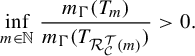 $$ \begin{align*} \inf_{m \in {\mathbb N}} \frac{m_{\Gamma}(T_m)}{m_{\Gamma}( T_{\mathcal{R}^{\mathcal{T}}_{\mathcal{C}}(m)} )}> 0. \end{align*} $$
Proposition 5.5. For $\mathcal {C} \in \mathcal {A}^{\Gamma }$
, we have the following assertions.
$\mathcal {C} \in \mathcal {A}^{\Gamma }$
, we have the following assertions.
-
(a) If
$\mathcal {C}$
is symbolically (linearly) repetitive with respect to
$d_{\Gamma }$
, then
$\mathcal {I}(\mathcal {C})$
is (linearly) repetitive with respect to
$d_{H}$
. -
(b) Let
$H= \Gamma $
and let
$\mathcal {T}$
be a Følner exhaustion sequence. Then,
$\mathcal {C}$
is symbolically tempered repetitive with respect to
$\mathcal {T}$
if and only if
$\mathcal {I}(\mathcal {C})$
is tempered repetitive with respect to
$\mathcal {T}$
.


Remark 5.6. It is not difficult to come up with a more general statement for assertion (b) covering also cases where $H \neq \Gamma $
. This is however a technical point that we do not need for the purposes of this work.
$H \neq \Gamma $
. This is however a technical point that we do not need for the purposes of this work.
Proof. We first prove statement (a). To this end, we fix some $r \geq 1$
along with some r-patch
$r \geq 1$
along with some r-patch $P_{\mathcal {C}} := (\mu ,\, B^H_r(g) )$
of
$P_{\mathcal {C}} := (\mu ,\, B^H_r(g) )$
of $\mathcal {I}(\mathcal {C})$
, where
$\mathcal {I}(\mathcal {C})$
, where $g \in H$
and
$g \in H$
and $\mu = \sum _{\gamma \in \Gamma \cap B_r^H(g)} \iota (\mathcal {C}(\gamma )) \delta _{\gamma }$
, where
$\mu = \sum _{\gamma \in \Gamma \cap B_r^H(g)} \iota (\mathcal {C}(\gamma )) \delta _{\gamma }$
, where $\iota :\mathcal {A} \to (0,\infty )$
is as defined in Lemma 5.1. Let
$\iota :\mathcal {A} \to (0,\infty )$
is as defined in Lemma 5.1. Let $h \in H$
. Since
$h \in H$
. Since $\Gamma \leq H$
is cocompact and
$\Gamma \leq H$
is cocompact and $d_H$
is locally bounded, there is an
$d_H$
is locally bounded, there is an $r_0> 0$
such that
$r_0> 0$
such that $\Gamma B^H_{r_0} = H$
. Hence, there are
$\Gamma B^H_{r_0} = H$
. Hence, there are $\gamma _g,\gamma _{h} \in \Gamma $
such that
$\gamma _g,\gamma _{h} \in \Gamma $
such that $g \in B^H_{r_0}(\gamma _g)$
and
$g \in B^H_{r_0}(\gamma _g)$
and $h \in B^H_{r_0}(\gamma _h)$
. We write
$h \in B^H_{r_0}(\gamma _h)$
. We write $q_{\mathcal {C}}:= \mathcal {C}_{|B^H_r(g) \cap \Gamma } \in \mathcal {A}^{B^H_r(g) \cap \Gamma }$
for the corresponding patch in
$q_{\mathcal {C}}:= \mathcal {C}_{|B^H_r(g) \cap \Gamma } \in \mathcal {A}^{B^H_r(g) \cap \Gamma }$
for the corresponding patch in $\mathcal {C}$
. Then,
$\mathcal {C}$
. Then, $q_{\mathcal {C}}$
occurs in
$q_{\mathcal {C}}$
occurs in
 $$ \begin{align*} \tilde{q}_{\mathcal{C}}:=\mathcal{C}_{|B^H_{r+r_0}(\gamma_g) \cap \Gamma} \in \mathcal{A}^{B^H_{r+r_0}(\gamma_g) \cap \Gamma}. \end{align*} $$
Note that we also used here the fact that $B^H_r B^H_s \subseteq B^H_{r+s}$
for
$B^H_r B^H_s \subseteq B^H_{r+s}$
for $r,s \geq 0$
by the left-invariance of the metric
$r,s \geq 0$
by the left-invariance of the metric $d_H$
. Since
$d_H$
. Since $d_{\Gamma }$
is the restriction of
$d_{\Gamma }$
is the restriction of $d_H$
and since
$d_H$
and since $\mathcal {C}$
is symbolically (linearly) repetitive, there is some
$\mathcal {C}$
is symbolically (linearly) repetitive, there is some $R= R(r + r_0)> 0$
(which in the case of linear repetitivity can be chosen as
$R= R(r + r_0)> 0$
(which in the case of linear repetitivity can be chosen as $R(r) = Cr$
for some universal
$R(r) = Cr$
for some universal $C \geq 1$
) such that the pattern of
$C \geq 1$
) such that the pattern of $\tilde {q}_{\mathcal {C}}$
occurs in
$\tilde {q}_{\mathcal {C}}$
occurs in $B^{\Gamma }_{R(r + r_0)}(\gamma _h)$
. Thus, we find by virtue of Lemma 5.1 that the pattern of
$B^{\Gamma }_{R(r + r_0)}(\gamma _h)$
. Thus, we find by virtue of Lemma 5.1 that the pattern of $P_{\mathcal {C}}$
must occur in
$P_{\mathcal {C}}$
must occur in $B^H_{R(r + r_0) + r_0}(h)$
. We now set
$B^H_{R(r + r_0) + r_0}(h)$
. We now set $R^{\prime }(r) = r_0 + R(r + r_0)$
(and in the linearly repetitive situation, we have
$R^{\prime }(r) = r_0 + R(r + r_0)$
(and in the linearly repetitive situation, we have $C^{\prime }:=r_0+C(1+r_0) \geq C$
such that
$C^{\prime }:=r_0+C(1+r_0) \geq C$
such that $r_0 + C(r + r_0) \leq C^{\prime }r$
for all
$r_0 + C(r + r_0) \leq C^{\prime }r$
for all $r \geq 1$
and define
$r \geq 1$
and define $R^{\prime }(r) = C^{\prime } r$
). In any case, we see that the pattern of
$R^{\prime }(r) = C^{\prime } r$
). In any case, we see that the pattern of $P_{\mathcal {C}}$
occurs in
$P_{\mathcal {C}}$
occurs in $B^H_{R^{\prime }(r)}(h)$
. This finishes the proof.
$B^H_{R^{\prime }(r)}(h)$
. This finishes the proof.
The validity of assertion (b) is clear from the definitions and from Lemma 5.1.
We are now in position to prove the following which contains all assertions claimed in Theorem 1.4 as subcases.
Theorem 5.7. Let $\Gamma $
be a countable amenable group that is co-compactly embedded as a lattice in an lcsc group H carrying an adapted metric
$\Gamma $
be a countable amenable group that is co-compactly embedded as a lattice in an lcsc group H carrying an adapted metric $d_H$
. Let
$d_H$
. Let $\mathcal {A}$
be a finite set and assume that
$\mathcal {A}$
be a finite set and assume that $\mathcal {C} \in \mathcal {A}^{\Gamma }$
. Then the following assertions hold.
$\mathcal {C} \in \mathcal {A}^{\Gamma }$
. Then the following assertions hold.
-
(a) If
$\mathcal {C}$
is symbolically tempered repetitive with respect to some Følner exhaustion sequence, then the hull
$\Omega _{\mathcal {C}}$
is minimal and uniquely ergodic. -
(b) If
$\mathcal {C}$
is symbolically linearly repetitive with respect to the metric
$d_{\Gamma }$
induced by
$d_H$
and if H has exact polynomial growth with respect to
$d_H$
, then the hull is minimal and uniquely ergodic, where
$$ \begin{align*} \mathcal{H}_{\mathcal{I}(\mathcal{C})} = \overline{\{ h.\mathcal{I}(\mathcal{C}):\, h \in H \}}^{w*} \end{align*} $$
$\mathcal {I}(\mathcal {C})$
is defined according to the map of Lemma 5.1.
-
(c) If
$\mathcal {C}$
is symbolically linearly repetitive with respect to some adapted metric
$d_{\Gamma }$
on
$\Gamma $
, and if
$\Gamma $
has exact polynomial growth with respect to
$d_{\Gamma }$
, then the hull
${\Omega }_{\mathcal {C}}$
is minimal and uniquely ergodic.


Proof. We first prove the assertion (a). By Proposition 5.5(b), we find that $\mathcal {I}(\mathcal {C})$
is tempered repetitive as a weighted Delone set over
$\mathcal {I}(\mathcal {C})$
is tempered repetitive as a weighted Delone set over $\Gamma $
with respect to some Følner exhaustion sequence. It follows from Theorem 1.3 that the dynamical system
$\Gamma $
with respect to some Følner exhaustion sequence. It follows from Theorem 1.3 that the dynamical system $\Gamma \curvearrowright \mathcal {H}_{\mathcal {I}(\mathcal {C})}$
is minimal and uniquely ergodic. By Proposition 5.2, these features also carry over to the system
$\Gamma \curvearrowright \mathcal {H}_{\mathcal {I}(\mathcal {C})}$
is minimal and uniquely ergodic. By Proposition 5.2, these features also carry over to the system $\Gamma \curvearrowright \Omega _{\mathcal {C}}$
.
$\Gamma \curvearrowright \Omega _{\mathcal {C}}$
.
To prove the assertion (b), we note first that $\mathcal {I}(\mathcal {C})$
is linearly repetitive with respect to
$\mathcal {I}(\mathcal {C})$
is linearly repetitive with respect to $d_H$
as a weighted Delone set in H by Proposition 5.5(a). Since H has exact polynomial growth with respect to
$d_H$
as a weighted Delone set in H by Proposition 5.5(a). Since H has exact polynomial growth with respect to $d_H$
, we infer from Theorem 4.9 that the system
$d_H$
, we infer from Theorem 4.9 that the system $H \curvearrowright \mathcal {H}_{\mathcal {I}(\mathcal {C})}$
is minimal and uniquely ergodic.
$H \curvearrowright \mathcal {H}_{\mathcal {I}(\mathcal {C})}$
is minimal and uniquely ergodic.
Assertion (c) follows from assertion (b) in the case $H = \Gamma $
, while observing with Proposition 5.2 that the dynamical systems
$H = \Gamma $
, while observing with Proposition 5.2 that the dynamical systems $\Gamma \curvearrowright \Omega _{\mathcal {C}}$
and
$\Gamma \curvearrowright \Omega _{\mathcal {C}}$
and $\Gamma \curvearrowright \mathcal {H}_{\mathcal {I}(\mathcal {C})}$
are topologically isomorphic.
$\Gamma \curvearrowright \mathcal {H}_{\mathcal {I}(\mathcal {C})}$
are topologically isomorphic.
6 Two applications
This section is devoted to the proofs of Corollaries 1.5 and 1.6.
If $(T_m)$
is a (left) Følner sequence, then
$(T_m)$
is a (left) Følner sequence, then $\lim _{m} ({m_G(\partial _K(T_m))}/{m_G(T_m)}) =0$
for every compact
$\lim _{m} ({m_G(\partial _K(T_m))}/{m_G(T_m)}) =0$
for every compact $K \subseteq G$
. To prove Corollary 1.5 and Corollary 1.6, we need that for a suitable boundary notion, a similar fraction goes to zero for
$K \subseteq G$
. To prove Corollary 1.5 and Corollary 1.6, we need that for a suitable boundary notion, a similar fraction goes to zero for $(T_m^{-1})$
which will be a (right) Følner sequence. In light of this, define the (right)-K-boundary of S by
$(T_m^{-1})$
which will be a (right) Følner sequence. In light of this, define the (right)-K-boundary of S by
 $$ \begin{align*} \tilde{\partial}_K(T) := T K^{-1} \cap (G \setminus T) K^{-1}. \end{align*} $$
The following is a simple modification of [Reference Pogorzelski44, Lemma 2.3] for $\partial _K$
replaced by
$\partial _K$
replaced by $\tilde {\partial }_K$
.
$\tilde {\partial }_K$
.
Lemma 6.1. Let $K,L,S,T\subseteq G$
. Then, the following assertions hold true:
$K,L,S,T\subseteq G$
. Then, the following assertions hold true:
-
(a)
$\tilde {\partial }_K(S\cup T) \subseteq \tilde {\partial }_K(T) \cup \tilde {\partial }_K(S)$
; -
(b)
$\tilde {\partial }_K(S\setminus T) \subseteq \tilde {\partial }_K(T) \cup \tilde {\partial }_K(S)$
; -
(c)
$\tilde {\partial }_K(T)\subseteq \tilde {\partial }_L(T)$
if
$K\subseteq L$
; -
(d)
$\tilde {\partial }_K(\tilde {\partial }_L(T)) \subseteq \tilde {\partial }_{KL}(T)$
; -
(e) if
$e\in K$
, then
$xK\subseteq \tilde {\partial }_{K^{-1}}(T)\cup T$
holds for each
$x\in T$
.


Furthermore, if $(T_m)$
is a strong Følner exhaustion sequence, then
$(T_m)$
is a strong Følner exhaustion sequence, then $(T_m^{-1})$
is an exhaustion sequence and for every compact
$(T_m^{-1})$
is an exhaustion sequence and for every compact $K \subseteq G$
,
$K \subseteq G$
,
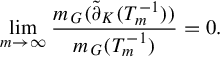 $$ \begin{align*} \lim_{m\to\infty}\frac{m_G(\tilde{\partial}_K(T_m^{-1}))}{m_G(T_m^{-1})} = 0. \end{align*} $$
Proof. Assertions (a)–(c) are immediate from the definition of $\tilde {\partial }_K(T)$
. As for assertion (d), we note that
$\tilde {\partial }_K(T)$
. As for assertion (d), we note that
 $$ \begin{align*} \tilde{\partial}_K(\tilde{\partial}_L(T)) \subseteq \{ g\in G :\, \text{there is an } x\in K \text{ such that } gx\in \tilde{\partial}_L(T) \} = \tilde{\partial}_L(T) K^{-1}. \end{align*} $$
The claim now follows from
 $$ \begin{align*} \tilde{\partial}_L(T) K^{-1} &= ( TL^{-1} \cap (G \setminus T)L^{-1} ) K^{-1} \subseteq TL^{-1}K^{-1} \cap (G \setminus T) L^{-1}K^{-1} \\ &= T ( KL )^{-1} \cap ( G \setminus T )( KL )^{-1}. \end{align*} $$
Assertion (e) is proven as follows. Let $x\in T$
and
$x\in T$
and $g\in xK$
. If
$g\in xK$
. If $g\in T$
, there is nothing to prove. Otherwise,
$g\in T$
, there is nothing to prove. Otherwise, $g\in G\setminus T$
and so
$g\in G\setminus T$
and so $g\in (G\setminus T)K$
as
$g\in (G\setminus T)K$
as $e\in K$
. Since
$e\in K$
. Since $g\in TK$
, we derive
$g\in TK$
, we derive $g\in \partial _{K^{-1}}(T)$
.
$g\in \partial _{K^{-1}}(T)$
.
Suppose $(T_m)$
is a strong Følner exhaustion sequence. Then, clearly,
$(T_m)$
is a strong Følner exhaustion sequence. Then, clearly, $(T_m^{-1})$
is an exhaustion sequence. Since G is unimodular,
$(T_m^{-1})$
is an exhaustion sequence. Since G is unimodular, $m_G(S)=m_G(S^{-1})$
holds for all
$m_G(S)=m_G(S^{-1})$
holds for all $S\in \mathcal {RK}(G)$
. Thus,
$S\in \mathcal {RK}(G)$
. Thus,
 $$ \begin{align*} m_G(\tilde{\partial}_K(T_m^{-1}) ) = m_G( T^{-1}_m K^{-1} \cap (G \setminus T^{-1}_m) K^{-1} ) = m_G( KT_m \cap K (G \setminus T_m)) = m_G( \partial_{K^{-1}}(T_m)) \end{align*} $$
holds for each compact $K \subseteq G$
and
$K \subseteq G$
and $m \in {\mathbb N}$
. Hence,
$m \in {\mathbb N}$
. Hence, $\lim _{m\to \infty } ({m_G(\tilde {\partial }_K(T_m^{-1}))}/{m_G(T_m^{-1})}) = 0$
follows as
$\lim _{m\to \infty } ({m_G(\tilde {\partial }_K(T_m^{-1}))}/{m_G(T_m^{-1})}) = 0$
follows as $(T_m)$
is a strong Følner sequence and
$(T_m)$
is a strong Følner sequence and $m_G(T_m)=m_G(T_m^{-1})$
.
$m_G(T_m)=m_G(T_m^{-1})$
.
6.1 Equality of upper and lower Banach density
The upper and lower Banach densities for a weighted Delone set $\Pi $
along a Følner sequence
$\Pi $
along a Følner sequence $(T_m)$
are defined by
$(T_m)$
are defined by
 $$ \begin{align*} \overline{d}(\Pi) := \limsup_{m\to\infty} \sup_{g\in G} \frac{\delta_{\Pi}(gT_m^{-1})}{m_G(T_m)} \quad\text{and}\quad \underline{d}(\Pi) := \liminf_{m\to\infty} \inf_{g\in G} \frac{\delta_{\Pi}(gT_m^{-1})}{m_G(T_m)}. \end{align*} $$
The above limit inferior and limit superior are actually limits by Lemma 3.17 and Remark 3.18 as the almost sub-additive weight function $w(S,\Pi ):=\delta _{\Pi }(S^{-1})$
is actually additive, see below. Invoking Theorem 3.1, we show in Corollary 1.5 that the upper Banach density and the lower Banach density coincide if
$w(S,\Pi ):=\delta _{\Pi }(S^{-1})$
is actually additive, see below. Invoking Theorem 3.1, we show in Corollary 1.5 that the upper Banach density and the lower Banach density coincide if $\Pi $
is an almost tempered repetitive weighted Delone set.
$\Pi $
is an almost tempered repetitive weighted Delone set.
Proof of Corollary 1.5
Let $\Lambda $
be a weighted Delone set in G that is almost tempered repetitive with respect to a strong Følner exhaustion sequence
$\Lambda $
be a weighted Delone set in G that is almost tempered repetitive with respect to a strong Følner exhaustion sequence $(T_m)$
. We seek to prove that
$(T_m)$
. We seek to prove that
 $$ \begin{align*} b_{\Lambda} := \lim_{m \to \infty} \frac{\delta_{\Pi}(T_m^{-1})}{m_G(T_m)} \end{align*} $$
exists uniformly in $\Pi \in \mathcal {H}_\Lambda $
. Due to Theorem 3.1, it suffices to show that
$\Pi \in \mathcal {H}_\Lambda $
. Due to Theorem 3.1, it suffices to show that $w:\mathcal {RK}(G)\times \mathcal {H}_\Lambda \to \mathbb {R},\, w(K,\Pi ):= \delta _{\Pi }(K^{-1})$
is an admissible (almost sub-)additive weight function. Recall that
$w:\mathcal {RK}(G)\times \mathcal {H}_\Lambda \to \mathbb {R},\, w(K,\Pi ):= \delta _{\Pi }(K^{-1})$
is an admissible (almost sub-)additive weight function. Recall that $\Pi $
is a Radon measure on G. Thus, w satisfies conditions (W1) and (W3) with
$\Pi $
is a Radon measure on G. Thus, w satisfies conditions (W1) and (W3) with $B = \emptyset $
and
$B = \emptyset $
and $\theta =0$
. Recall that
$\theta =0$
. Recall that $h_*\delta _{\Pi }(S):=\delta _{\Pi }(h^{-1}S)$
holds for any
$h_*\delta _{\Pi }(S):=\delta _{\Pi }(h^{-1}S)$
holds for any $h\in G$
and
$h\in G$
and $S\in \mathcal {RK}(G)$
. Let
$S\in \mathcal {RK}(G)$
. Let $K\in \mathcal {RK}(G)$
,
$K\in \mathcal {RK}(G)$
, $h\in G$
, and
$h\in G$
, and $\Pi \in \mathcal {H}_\Lambda $
, then
$\Pi \in \mathcal {H}_\Lambda $
, then
 $$ \begin{align*} w(Kh^{-1},h.\Pi) = h_*\delta_{\Pi}((Kh^{-1})^{-1}) = h_*\delta_{\Pi}(hK^{-1}) = \delta_{\Pi}(K^{-1}) = w(K,\Pi) \end{align*} $$
holds implying condition (W4) with $I = \emptyset $
and
$I = \emptyset $
and $\vartheta =0$
.
$\vartheta =0$
.
Recall that for each $\Pi =(Q,\beta )\in \mathcal {H}_\Lambda $
, Q is a
$\Pi =(Q,\beta )\in \mathcal {H}_\Lambda $
, Q is a $(U,K)$
-Delone set where
$(U,K)$
-Delone set where $e\in U$
holds without loss of generality. Let Q be an arbitrary left-U-uniformly discrete subset of G. It is straightforward to show that there exists a
$e\in U$
holds without loss of generality. Let Q be an arbitrary left-U-uniformly discrete subset of G. It is straightforward to show that there exists a $V\subseteq G$
open (only depending on U) satisfying
$V\subseteq G$
open (only depending on U) satisfying $e\in V$
,
$e\in V$
, $\overline {V}^{-1}=\overline {V}$
, and
$\overline {V}^{-1}=\overline {V}$
, and $x\overline {V}\cap y\overline {V}= \emptyset $
for all
$x\overline {V}\cap y\overline {V}= \emptyset $
for all $x,y\in Q$
and every left-U-uniformly discrete set Q. By assertion (e) of Lemma 6.1, one obtains that for each
$x,y\in Q$
and every left-U-uniformly discrete set Q. By assertion (e) of Lemma 6.1, one obtains that for each $S \in \mathcal {RK}(G)$
and
$S \in \mathcal {RK}(G)$
and $x\in S$
, we have
$x\in S$
, we have $x\overline {V}\subseteq \tilde {\partial }_{\overline {V}}(S)\cup S$
. Thus,
$x\overline {V}\subseteq \tilde {\partial }_{\overline {V}}(S)\cup S$
. Thus,
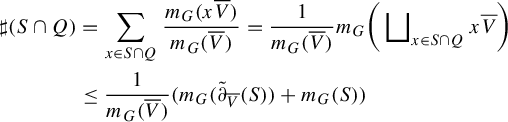 $$ \begin{align*} \sharp (S\cap Q) &= \sum_{x\in S\cap Q} \frac{m_G(x\overline{V})}{m_G(\overline{V})} = \frac{1}{m_G(\overline{V})} m_G\bigg(\bigsqcup\nolimits_{x\in S\cap Q}x\overline{V} \bigg)\\ &\leq \frac{1}{m_G(\overline{V})} ( m_G(\tilde{\partial}_{\overline{V}}(S)) + m_G(S)) \end{align*} $$
follows.
Let $L,K\in \mathcal {RK}(G)$
with
$L,K\in \mathcal {RK}(G)$
with $K\subseteq L$
and
$K\subseteq L$
and $\Pi =(Q,\beta )\in \mathcal {H}_\Lambda $
. Since
$\Pi =(Q,\beta )\in \mathcal {H}_\Lambda $
. Since $\delta _{\Pi }(S)= \sum _{x\in Q} \beta (x)\delta _x(S)$
, we obtain
$\delta _{\Pi }(S)= \sum _{x\in Q} \beta (x)\delta _x(S)$
, we obtain
 $$ \begin{align*} |w(L,\Pi)-w(K,\Pi)| &= \delta_{\Pi}((L\setminus K)^{-1}) \leq \sigma \cdot \sharp ((L\setminus K)^{-1}\cap Q) \\ &\leq \frac{\sigma}{m_G(\overline{V})} ( m_G(\tilde{\partial}_{\overline{V}}(L^{-1})) + m_G(\tilde{\partial}_{\overline{V}}(K^{-1})) + m_G(L\setminus K)), \end{align*} $$
where we used $\beta (x)\leq \sigma $
and
$\beta (x)\leq \sigma $
and $\tilde {\partial }_{\overline {V}}(L^{-1}\setminus K^{-1}) \subseteq \tilde {\partial }_{\overline {V}}(L^{-1}) \cup \tilde {\partial }_{\overline {V}}(K^{-1})$
. By the symmetry of
$\tilde {\partial }_{\overline {V}}(L^{-1}\setminus K^{-1}) \subseteq \tilde {\partial }_{\overline {V}}(L^{-1}) \cup \tilde {\partial }_{\overline {V}}(K^{-1})$
. By the symmetry of $\overline {V}$
and the unimodularity of G, we observe that
$\overline {V}$
and the unimodularity of G, we observe that
 $$ \begin{align*} m_G( \tilde{\partial}_{\overline{V}}(L^{-1}) ) = m_G( L^{-1}\overline{V} \cap (G\setminus L^{-1})\overline{V} ) = m_G(\overline{V}L \cap \overline{V}(G\setminus L) ) = m_G( \partial_{\overline{V}}(L) ) \end{align*} $$
and likewise for K. Hence, $w$
satisfies axiom (W2) with
$w$
satisfies axiom (W2) with $\eta := {\sigma }/{m_G(\overline {V})}$
and
$\eta := {\sigma }/{m_G(\overline {V})}$
and $J:=\overline {V}$
. It remains to prove condition (W5).
$J:=\overline {V}$
. It remains to prove condition (W5).
Let $\varepsilon>0$
and suppose that V is chosen as before. Fix
$\varepsilon>0$
and suppose that V is chosen as before. Fix $0 < \delta < 1$
such that
$0 < \delta < 1$
such that $B_{2\delta }\subseteq V$
and
$B_{2\delta }\subseteq V$
and $\delta <\min \{({\sigma ^{-1}}/{2}), ({m_G(\overline {V})}/{2 + 4\sigma })\varepsilon \}$
. Due to Lemma 6.1, there is an
$\delta <\min \{({\sigma ^{-1}}/{2}), ({m_G(\overline {V})}/{2 + 4\sigma })\varepsilon \}$
. Due to Lemma 6.1, there is an $m_0\in \mathbb {N}$
such that
$m_0\in \mathbb {N}$
such that $m_G(\tilde {\partial }_{\overline {V}^3}(T_m^{-1}))\leq \delta m_G(T_m^{-1})$
holds for
$m_G(\tilde {\partial }_{\overline {V}^3}(T_m^{-1}))\leq \delta m_G(T_m^{-1})$
holds for $m\geq m_0$
. We use properties (a)–(d) subsequently. Let
$m\geq m_0$
. We use properties (a)–(d) subsequently. Let $m\geq m_0$
and
$m\geq m_0$
and $\Pi =(Q,\beta ), \Phi =(P,\alpha )\in \mathcal {H}_\Lambda $
be such that
$\Pi =(Q,\beta ), \Phi =(P,\alpha )\in \mathcal {H}_\Lambda $
be such that $d_{T_m^{-1}}(\Pi ,\Phi )<\delta $
where as defined in the equalities (1) and (2), we have
$d_{T_m^{-1}}(\Pi ,\Phi )<\delta $
where as defined in the equalities (1) and (2), we have
 $$ \begin{align*} d_{T_m^{-1}}(\Phi,\Pi) &= \inf\{ \delta> 0:\, | \delta_{\Phi}( B_{\delta}(x) ) - \delta_{\Pi}( B_{\delta}(x) ) | < \delta\\ &\qquad\ \ \ \ \text{for all } x \in (T_m^{-1} \cap P) \cup (T_m^{-1} \cap Q) \}. \end{align*} $$
Set $S_1:=T_m^{-1}\setminus \tilde {\partial }_{\overline {V}}(T_m^{-1})$
. Thus, for each
$S_1:=T_m^{-1}\setminus \tilde {\partial }_{\overline {V}}(T_m^{-1})$
. Thus, for each $x\in S_1 \cap P$
,
$x\in S_1 \cap P$
, $x\overline {V} \subseteq T_m^{-1}$
follows. Let
$x\overline {V} \subseteq T_m^{-1}$
follows. Let ${x\in S_1 \cap P}$
. Since Q is U-uniformly discrete,
${x\in S_1 \cap P}$
. Since Q is U-uniformly discrete, $B_{\delta }\subseteq V$
and
$B_{\delta }\subseteq V$
and
 $$ \begin{align*} \bigg|\!\sum_{y\in Q\cap B_{2\delta}(x)} \beta(y) - \alpha(x)\bigg| = |\delta_{\Phi}(B_{\delta}(x)) - \delta_{\Pi}(B_{\delta}(x))| <\delta <\sigma^{-1}, \end{align*} $$
we conclude that there is a unique $y_x\in T_m^{-1} \cap Q$
such that
$y_x\in T_m^{-1} \cap Q$
such that $y_x\in B_{\delta }(x)$
and
$y_x\in B_{\delta }(x)$
and $|\alpha (x)-\beta (y_x)|<\delta $
. Let
$|\alpha (x)-\beta (y_x)|<\delta $
. Let $S_2:=T_m^{-1}\setminus \tilde {\partial }_{\overline {V}^2}(T_m^{-1})$
. Then,
$S_2:=T_m^{-1}\setminus \tilde {\partial }_{\overline {V}^2}(T_m^{-1})$
. Then, $y\in S_2 \cap Q$
implies
$y\in S_2 \cap Q$
implies $y\overline {V}\subseteq S_1$
. Thus,
$y\overline {V}\subseteq S_1$
. Thus, $|\delta _{\Pi }(B_\delta (y))-\delta _{\Phi }(B_\delta (y))|<\delta <\sigma ^{-1}$
implies as before that there is a unique
$|\delta _{\Pi }(B_\delta (y))-\delta _{\Phi }(B_\delta (y))|<\delta <\sigma ^{-1}$
implies as before that there is a unique $x_y\in P\cap S_1$
satisfying
$x_y\in P\cap S_1$
satisfying $x_y\in B_\delta (y)$
and
$x_y\in B_\delta (y)$
and $|\alpha (x_y)-\beta (y)|<\delta $
. Consequently,
$|\alpha (x_y)-\beta (y)|<\delta $
. Consequently, ${S_2 \kern1.7pt{\cap}\kern1.7pt Q\kern1.7pt{\subseteq}\kern1.7pt \{y_x\,{:}\, x\kern1.7pt{\in}\kern1.7pt S_1 \kern1.7pt{\cap}\kern1.7pt P\}}$
. Hence,
${S_2 \kern1.7pt{\cap}\kern1.7pt Q\kern1.7pt{\subseteq}\kern1.7pt \{y_x\,{:}\, x\kern1.7pt{\in}\kern1.7pt S_1 \kern1.7pt{\cap}\kern1.7pt P\}}$
. Hence,
 $$ \begin{align*} (T_m^{-1} \cap Q) \subseteq \{y_x:\, x\in S_1 \cap P\} \cup (\tilde{\partial}_{\overline{V}^2}(T_m^{-1}) \cap Q) \end{align*} $$
follows. With this at hand, we derive
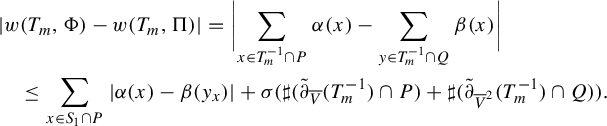 $$ \begin{align*} &| w(T_m,\Phi) - w(T_m,\Pi)| = \bigg|\! \sum_{x\in T_m^{-1}\cap P} \alpha(x) - \sum_{y\in T_m^{-1}\cap Q} \beta(x) \bigg|\\ &\quad\leq \sum_{x\in S_1\cap P} |\alpha(x)-\beta(y_x)| + \sigma( \sharp (\tilde{\partial}_{\overline{V}}(T_m^{-1}) \cap P) + \sharp (\tilde{\partial}_{\overline{V}^2}(T_m^{-1})\cap Q)). \end{align*} $$
By Lemma 6.1(c) and the choice $m_0$
, we have
$m_0$
, we have $m_G(\tilde {\partial }_{\overline {V}}(T_m^{-1}))\leq \delta m_G(T_m^{-1})$
. Since
$m_G(\tilde {\partial }_{\overline {V}}(T_m^{-1}))\leq \delta m_G(T_m^{-1})$
. Since $\sharp (S\cap D )\leq {1}/{m_G(\overline {V})} (m_G(\tilde {\partial }_{\overline {V}}(S)) + m_G(S))$
for any U-uniformly set D and any
$\sharp (S\cap D )\leq {1}/{m_G(\overline {V})} (m_G(\tilde {\partial }_{\overline {V}}(S)) + m_G(S))$
for any U-uniformly set D and any $S\in \mathcal {RK}(G)$
, the previous considerations lead to
$S\in \mathcal {RK}(G)$
, the previous considerations lead to
 $$ \begin{align*} | w(T_m,\Phi) - w(T_m,\Pi)| &\leq \frac{\delta}{m_G(\overline{V})} (m_G(\tilde{\partial}_{\overline{V}}(T_m^{-1})) + m_G(T_m^{-1}))\\ &\quad + \frac{\sigma}{m_G(\overline{V})}( m_G( \tilde{\partial}_{\overline{V}}(\tilde{\partial}_{\overline{V}}(T_m^{-1}))) \\ &\quad + m_G(\tilde{\partial}_{\overline{V}}(T_m^{-1})) + m_G( \tilde{\partial}_{\overline{V}}(\tilde{\partial}_{\overline{V}^2}(T_m^{-1}))) + m_G(\tilde{\partial}_{\overline{V}^2}(T_m^{-1}))). \end{align*} $$
Since $\tilde {\partial }_I(\tilde {\partial }_J(S))\subseteq \tilde {\partial }_{IJ}(S)$
holds by Lemma 6.1(d), the estimate
$\tilde {\partial }_I(\tilde {\partial }_J(S))\subseteq \tilde {\partial }_{IJ}(S)$
holds by Lemma 6.1(d), the estimate
 $$ \begin{align*} | w(T_m,\Phi) - w(T_m,\Pi)| \leq \frac{2+4\sigma}{m_G(\overline{V})} \delta m_G(T_m^{-1}) \leq \varepsilon m_G(T_m) \end{align*} $$
is derived using $m_G(T_m^{-1})=m_G(T_m)$
which holds as G is unimodular. Thus, w satisfies condition (W5).
$m_G(T_m^{-1})=m_G(T_m)$
which holds as G is unimodular. Thus, w satisfies condition (W5).
6.2 Uniform convergence of the IDS
We briefly sketch the model outlined in [Reference Lenz, Schwarzenberger and Veselić35] and in [Reference Pogorzelski and Schwarzenberger47]. To be consistent with the previous sections, we will consider Cayley graphs with a left-invariant metric as well as pattern equivalence defined by left translations. (In the mentioned papers, the authors consider translations from the right but also deal with left Følner sequences.)
We suppose that $\Gamma $
is an amenable countable group generated by a finite symmetric set
$\Gamma $
is an amenable countable group generated by a finite symmetric set $S \subseteq \Gamma $
. For the Haar measure on
$S \subseteq \Gamma $
. For the Haar measure on $\Gamma $
, we fix the normalized counting measure
$\Gamma $
, we fix the normalized counting measure $m_{\Gamma }$
which satisfies
$m_{\Gamma }$
which satisfies $m_{\Gamma }(\{e \}) = 1$
for the identity element
$m_{\Gamma }(\{e \}) = 1$
for the identity element $e \in \Gamma $
.
$e \in \Gamma $
.
Recall for finitely generated groups, Følner sequences $(F_n)$
consist of non-empty finite sets such that for all
$(F_n)$
consist of non-empty finite sets such that for all $s \in S$
, one has
$s \in S$
, one has
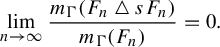 $$ \begin{align*} \lim_{n \to \infty} \frac{m_{\Gamma}( F_n\, \triangle \, sF_n )}{m_{\Gamma}(F_n)} = 0. \end{align*} $$
This definition is equivalent to the notion of strong Følner sequences in the above sense by [Reference Pogorzelski and Schwarzenberger47, Lemma 2.7(d)]. The generating set S comes with a natural left-invariant word metric. Precisely, for $g,h \in \Gamma $
, one defines
$g,h \in \Gamma $
, one defines
 $$ \begin{align*} d_S(g,h) = \min\{L \in {\mathbb N}:\, \text{there are } s_1, s_2, \ldots, s_L \in S \text{ such that } s_1s_2 \cdots s_L = g^{-1}h \}. \end{align*} $$
In the following, we write
 $$ \begin{align*} B^S_n(g) := \{h \in \Gamma:\, d_S(g,h) < n\} \end{align*} $$
for $g \in \Gamma $
and
$g \in \Gamma $
and $n \in {\mathbb N}$
.
$n \in {\mathbb N}$
.
Each group $\Gamma $
generated by a symmetric set S comes with a Cayley graph with vertices given by
$\Gamma $
generated by a symmetric set S comes with a Cayley graph with vertices given by $\Gamma $
and two elements
$\Gamma $
and two elements $g,h \in \Gamma $
are connected by an edge if there exists some
$g,h \in \Gamma $
are connected by an edge if there exists some $s \in S$
such that
$s \in S$
such that $gs = h$
. We write
$gs = h$
. We write $\operatorname {Cay}(\Gamma , S)$
for this graph.
$\operatorname {Cay}(\Gamma , S)$
for this graph.
We consider a coloring $\mathcal {C}\in \mathcal {A}^\Gamma $
of the group
$\mathcal {C}\in \mathcal {A}^\Gamma $
of the group $\Gamma $
which is nothing but a map
$\Gamma $
which is nothing but a map ${\mathcal {C}: \Gamma \to \mathcal {A}}$
, where
${\mathcal {C}: \Gamma \to \mathcal {A}}$
, where $\mathcal {A}$
is a finite set whose elements are called colors. As demonstrated in §5, by assigning to each color in
$\mathcal {A}$
is a finite set whose elements are called colors. As demonstrated in §5, by assigning to each color in $a \in \mathcal {A}$
a different positive number
$a \in \mathcal {A}$
a different positive number $\iota (a)> 0$
, we can identify
$\iota (a)> 0$
, we can identify $\mathcal {C}$
with the weighted Delone set
$\mathcal {C}$
with the weighted Delone set $I(\mathcal {C}):= (\Gamma , \delta _{\mathcal {C}})$
, where
$I(\mathcal {C}):= (\Gamma , \delta _{\mathcal {C}})$
, where $\delta _{\mathcal {C}} := \sum _{x \in \Gamma } \iota (\mathcal {C}(x)) \delta _{\{ x\}} $
on
$\delta _{\mathcal {C}} := \sum _{x \in \Gamma } \iota (\mathcal {C}(x)) \delta _{\{ x\}} $
on $\Gamma $
. Invoking Lemma 5.1 and Proposition 5.2, we consider a coloring
$\Gamma $
. Invoking Lemma 5.1 and Proposition 5.2, we consider a coloring $\mathcal {C}$
both as mappings
$\mathcal {C}$
both as mappings $\Gamma \to \mathcal {A}$
and as weighted Delone sets in the above form. Given
$\Gamma \to \mathcal {A}$
and as weighted Delone sets in the above form. Given $\mathcal {C}$
, we define its hull by
$\mathcal {C}$
, we define its hull by
 $$ \begin{align*} \Omega_{\mathcal{C}} := \overline{\{g.\mathcal{C}:\, g \in \Gamma\}}, \end{align*} $$
where the closure is taken with respect to the product topology in $\mathcal {A}^\Gamma $
induced from the discrete topology on
$\mathcal {A}^\Gamma $
induced from the discrete topology on $\mathcal {A}$
. We now consider a coloring
$\mathcal {A}$
. We now consider a coloring $\mathcal {C}$
that is symbolically tempered repetitive with respect to a strong Følner exhaustion sequence as of Definition 5.4. It follows from Theorem 5.7(a) that
$\mathcal {C}$
that is symbolically tempered repetitive with respect to a strong Følner exhaustion sequence as of Definition 5.4. It follows from Theorem 5.7(a) that $\Gamma \curvearrowright \Omega _{\mathcal {C}}$
is uniquely ergodic. Given a finite set
$\Gamma \curvearrowright \Omega _{\mathcal {C}}$
is uniquely ergodic. Given a finite set ${E \in \mathcal {F}(\Gamma )}$
, we define the E-patch for
${E \in \mathcal {F}(\Gamma )}$
, we define the E-patch for $\mathcal {C}$
as in §5 above.
$\mathcal {C}$
as in §5 above.
Since characteristic functions over the cylinder sets associated with patches are continuous, we derive from Theorem 3.1 (in combination with Proposition 5.2) that for every colored patch $\mathcal {E} := \mathcal {C}_{|E}$
with
$\mathcal {E} := \mathcal {C}_{|E}$
with $E \subseteq \Gamma $
finite, the limits
$E \subseteq \Gamma $
finite, the limits
 $$ \begin{align*} \nu(\mathcal{E}) := \lim_{m \to \infty} \frac{1}{m_{\Gamma}(T_m)} \sum_{x \in T_m} 1_{\mathcal{E}}(x.\mathcal{D}) \end{align*} $$
exist for all $\mathcal {D} \in \Omega _{\mathcal {C}}$
, where for
$\mathcal {D} \in \Omega _{\mathcal {C}}$
, where for $\mathcal {D}^{\prime } \in \Omega _{\mathcal {C}}$
, one has
$\mathcal {D}^{\prime } \in \Omega _{\mathcal {C}}$
, one has $1_{\mathcal {E}}(\mathcal {D}^{\prime }) = 1$
if and only if
$1_{\mathcal {E}}(\mathcal {D}^{\prime }) = 1$
if and only if $ \mathcal {D}_{|E}^{\prime }= \mathcal {E}$
and
$ \mathcal {D}_{|E}^{\prime }= \mathcal {E}$
and $1_{\mathcal {E}}(\mathcal {D}^{\prime }) = 0$
otherwise. This yields
$1_{\mathcal {E}}(\mathcal {D}^{\prime }) = 0$
otherwise. This yields
 $$ \begin{align*} \nu(\mathcal{E}) &:= \lim_{m \to \infty} \frac{1}{m_{\Gamma}(T_m)} \sum_{x \in T_m} 1_{\mathcal{E}}(x.\mathcal{C}) = \lim_{m \to \infty} \frac{m_{\Gamma}(\{x \in T_m:\, (x.\mathcal{C})_{|E} = \mathcal{E}\})}{m_{\Gamma}(T_m)} \\ &= \lim_{m \to \infty} \frac{m_{\Gamma}(\{ x \in T_m:\, \mathcal{C}_{|x^{-1}E} \cong \mathcal{E} \})}{m_{\Gamma}(T_m)}, \end{align*} $$
where we write $\mathcal {C}_{|x^{-1}E} \cong \mathcal {E}$
if the patches
$\mathcal {C}_{|x^{-1}E} \cong \mathcal {E}$
if the patches $\mathcal {C}_{|x^{-1}E}$
and
$\mathcal {C}_{|x^{-1}E}$
and $\mathcal {E}$
are equivalent. With no loss of generality, we will assume that the identity e is contained in E since, otherwise, we can pick
$\mathcal {E}$
are equivalent. With no loss of generality, we will assume that the identity e is contained in E since, otherwise, we can pick $a \in E$
and repeat the above argument with the coloring
$a \in E$
and repeat the above argument with the coloring $\mathcal {D} := a.\mathcal {C}$
and the patch
$\mathcal {D} := a.\mathcal {C}$
and the patch $\mathcal {C}_{|a^{-1}E}$
instead of
$\mathcal {C}_{|a^{-1}E}$
instead of $\mathcal {C}$
and
$\mathcal {C}$
and $\mathcal {E}$
. Furthermore, the sequence
$\mathcal {E}$
. Furthermore, the sequence $(T_m^{-1})$
is a right-Følner sequence, see Lemma 6.1. Thus,
$(T_m^{-1})$
is a right-Følner sequence, see Lemma 6.1. Thus,
 $$ \begin{align*} \lim_{m \to \infty} \frac{m_{\Gamma}(\{ y \in \Gamma: y^{-1}E \subseteq T^{-1}_m \})}{m_{\Gamma}(T_m)} = \lim_{m \to \infty} \frac{m_{\Gamma}(\{ y \in T_m: y^{-1}E \subseteq T^{-1}_m \})}{m_{\Gamma}(T_m)} = 1. \end{align*} $$
Consequently, we arrive at
 $$ \begin{align*} \nu(\mathcal{E}) = \lim_{m \to \infty} \frac{m_{\Gamma}(\{ z \in \Gamma:\, z^{-1}E \subseteq T_m^{-1} \, \wedge\, \mathcal{C}_{|z^{-1}E} \cong \mathcal{E} \})}{m_{\Gamma}(T_m)} \end{align*} $$
for every colored patch $\mathcal {E} := \mathcal {C}_{|E} $
with
$\mathcal {E} := \mathcal {C}_{|E} $
with $E \subseteq \Gamma $
finite. In the setting of [Reference Pogorzelski and Schwarzenberger47, §5] with right translations of patches replaced by left translations of patches, the latter condition is equivalent to
$E \subseteq \Gamma $
finite. In the setting of [Reference Pogorzelski and Schwarzenberger47, §5] with right translations of patches replaced by left translations of patches, the latter condition is equivalent to
 $$ \begin{align} \nu(\mathcal{E}) = \lim_{m \to \infty} \frac{\#^l_{\mathcal{E}}(T_m^{-1})}{m_{\Gamma}(T_m^{-1})} \end{align} $$
for all patches $\mathcal {E} := \mathcal {C}_{|E} $
with
$\mathcal {E} := \mathcal {C}_{|E} $
with $E \subseteq \Gamma $
finite, where
$E \subseteq \Gamma $
finite, where $\#^l_{\mathcal {E}}(T_m^{-1})$
counts the number of occurrences of the pattern of
$\#^l_{\mathcal {E}}(T_m^{-1})$
counts the number of occurrences of the pattern of $\mathcal {E}$
in
$\mathcal {E}$
in $T_m^{-1}$
. Recall that
$T_m^{-1}$
. Recall that $(T^{-1}_m)$
is a right Følner sequence. The setting in [Reference Pogorzelski and Schwarzenberger47] is reversed: there, one deals with right occurrences of colored patterns, with a right-invariant word metric and with left Følner sequences.
$(T^{-1}_m)$
is a right Følner sequence. The setting in [Reference Pogorzelski and Schwarzenberger47] is reversed: there, one deals with right occurrences of colored patterns, with a right-invariant word metric and with left Følner sequences.
We turn to operators on the given left Cayley graph.
For a subset $W \subseteq \Gamma $
, we write
$W \subseteq \Gamma $
, we write $\ell ^2(W, \mathcal {S})$
for the space of functions
$\ell ^2(W, \mathcal {S})$
for the space of functions $u: W \to \mathcal {S}$
satisfying
$u: W \to \mathcal {S}$
satisfying $\sum _{W \in \Gamma } \|u(g)\|^2_{\mathcal {S}} < \infty $
, where
$\sum _{W \in \Gamma } \|u(g)\|^2_{\mathcal {S}} < \infty $
, where $\mathcal {S}$
is a finite dimensional Hilbert space with norm
$\mathcal {S}$
is a finite dimensional Hilbert space with norm $\| \cdot \|_{\mathcal {S}}$
. For a finite set
$\| \cdot \|_{\mathcal {S}}$
. For a finite set $L \subseteq \Gamma $
and an operator
$L \subseteq \Gamma $
and an operator $H: \ell ^2(\Gamma , \mathcal {S}) \to \ell ^2(\Gamma , \mathcal {S})$
, we set
$H: \ell ^2(\Gamma , \mathcal {S}) \to \ell ^2(\Gamma , \mathcal {S})$
, we set
 $$ \begin{align*} H[L]: \ell^2(L, \mathcal{S}) \to \ell^2(L, \mathcal{S}),\quad u \mapsto p_L H i_L\, u, \end{align*} $$
where $i_L: \ell ^2(L, \mathcal {S}) \to \ell ^2(\Gamma , \mathcal {S})$
and
$i_L: \ell ^2(L, \mathcal {S}) \to \ell ^2(\Gamma , \mathcal {S})$
and $p_L: \ell ^2(\Gamma , \mathcal {S}) \to \ell ^2(L, \mathcal {S})$
are the canonical inclusion and projection operators defined as
$p_L: \ell ^2(\Gamma , \mathcal {S}) \to \ell ^2(L, \mathcal {S})$
are the canonical inclusion and projection operators defined as
 $$ \begin{align*} i_L(u)(g) = \begin{cases} u(g) & \text{if } g \in L, \\ 0 & \text{otherwise}, \end{cases} \quad \text{and}\quad p_L(v)(g) = v(g) \quad \text{for all } g \in L. \end{align*} $$
For $g,h \in \Gamma $
, we write
$g,h \in \Gamma $
, we write $H(g,h) := p_{\{g\}}H i_{\{h\}}$
.
$H(g,h) := p_{\{g\}}H i_{\{h\}}$
.
On $\ell ^2(\Gamma , \mathcal {S})$
, we now define the class of operators which is of interest to us.
$\ell ^2(\Gamma , \mathcal {S})$
, we now define the class of operators which is of interest to us.
Definition 6.2. Let $H:\ell ^2(\Gamma , \mathcal {S}) \to \ell ^2(\Gamma , \mathcal {S})$
be a self-adjoint operator with
$H:\ell ^2(\Gamma , \mathcal {S}) \to \ell ^2(\Gamma , \mathcal {S})$
be a self-adjoint operator with $\Gamma , S$
and
$\Gamma , S$
and $\mathcal {S}$
as above. Further, suppose that
$\mathcal {S}$
as above. Further, suppose that $\mathcal {C}: \Gamma \to \mathcal {A}$
is a coloring. We say that H has finite hopping range if there is some
$\mathcal {C}: \Gamma \to \mathcal {A}$
is a coloring. We say that H has finite hopping range if there is some $M \in {\mathbb N}$
such that
$M \in {\mathbb N}$
such that $H(g,h) = 0$
whenever
$H(g,h) = 0$
whenever $d_S(g,h) \geq M$
. We say that H is
$d_S(g,h) \geq M$
. We say that H is $\mathcal {C}$
-invariant if there is some
$\mathcal {C}$
-invariant if there is some $N \in {\mathbb N}$
such that
$N \in {\mathbb N}$
such that $H(xg, xh) = H(g,h)$
for
$H(xg, xh) = H(g,h)$
for $x,g,h \in \Gamma $
that satisfy
$x,g,h \in \Gamma $
that satisfy
 $$ \begin{align*} x ( \mathcal{C}_{|B_N(g) \cup B_N(h)} ) = \mathcal{C}_{|B_N(xg) \cup B_N(xh)}. \end{align*} $$
If H has finite hopping range and is $\mathcal {C}$
-invariant, then we call
$\mathcal {C}$
-invariant, then we call $R:= \max \{M;N\}$
the overall range of H.
$R:= \max \{M;N\}$
the overall range of H.
We now define the eigenvalue counting function for a self-adjoint operator ${A:\mathcal {S} \to \mathcal {S}}$
defined on finite dimensional Hilbert space
${A:\mathcal {S} \to \mathcal {S}}$
defined on finite dimensional Hilbert space $\mathcal {S}$
. Specifically, the cumulative eigenvalue counting function of A is defined by
$\mathcal {S}$
. Specifically, the cumulative eigenvalue counting function of A is defined by
 $$ \begin{align*} \operatorname{ev}(A)(E) := \sum_{\unicode{x3bb} \leq E} \operatorname{mult}(\unicode{x3bb}), \end{align*} $$
where the sum is taken over the set of all eigenvalues of A less or equal than E and $\operatorname {mult}(\unicode{x3bb} )$
is the multiplicity of the eigenvalue
$\operatorname {mult}(\unicode{x3bb} )$
is the multiplicity of the eigenvalue $\unicode{x3bb} $
.
$\unicode{x3bb} $
.
In the following, we fix once and for all a self-adjoint operator $H:\ell ^2(\Gamma , \mathcal {S}) \to \ell ^2(\Gamma , \mathcal {S})$
that has finite hopping range and is
$H:\ell ^2(\Gamma , \mathcal {S}) \to \ell ^2(\Gamma , \mathcal {S})$
that has finite hopping range and is $\mathcal {C}$
-invariant with respect to a coloring
$\mathcal {C}$
-invariant with respect to a coloring $\mathcal {C}: \Gamma \to \mathcal {A}$
with overall range
$\mathcal {C}: \Gamma \to \mathcal {A}$
with overall range $R \in {\mathbb N}$
.
$R \in {\mathbb N}$
.
Given a finite non-empty set $F \subseteq \Gamma $
and
$F \subseteq \Gamma $
and $E \in {\mathbb R}$
, we define
$E \in {\mathbb R}$
, we define
 $$ \begin{align*} H_F := H[F^R] \quad\text{and}\quad \overline{N}(F ): {\mathbb R} \to {\mathbb N}, \quad \overline{N}(F)(E) := \operatorname{ev}( H_F )(E), \end{align*} $$
where $F^R := \{x \in F:\, B^S_{R+1}(x) \subseteq F\}$
. Then, the functions
$F^R := \{x \in F:\, B^S_{R+1}(x) \subseteq F\}$
. Then, the functions
 $$ \begin{align} N_H(F): {\mathbb R} \to [0,1], \quad E \mapsto \frac{\overline{N}(F)(E)}{m_{\Gamma}(F)\operatorname{dim}(\mathcal{S})} \end{align} $$
are elements in the Banach space of bounded right continuous functions on ${\mathbb R}$
with supremum norm, denoted by
${\mathbb R}$
with supremum norm, denoted by $(\operatorname {BRC}({\mathbb R}),\, \| \cdot \|_{\infty } )$
. They denote the empirical eigenvalue distribution of the operators
$(\operatorname {BRC}({\mathbb R}),\, \| \cdot \|_{\infty } )$
. They denote the empirical eigenvalue distribution of the operators $H_F$
for non-empty finite sets
$H_F$
for non-empty finite sets $F \subseteq \Gamma $
. Note that dividing by
$F \subseteq \Gamma $
. Note that dividing by $\operatorname {dim}(\mathcal {S})$
gives the correct normalization to obtain numbers in
$\operatorname {dim}(\mathcal {S})$
gives the correct normalization to obtain numbers in $[0,1]$
since
$[0,1]$
since
 $$ \begin{align*} \operatorname{dim} ( \ell^2(F,\mathcal{S}) ) = m_{\Gamma}(F) \cdot \operatorname{dim}(\mathcal{S}) \end{align*} $$
for finite $F \subseteq \Gamma $
.
$F \subseteq \Gamma $
.
Proof of Corollary 1.6
For the proof of Corollary 1.6, suppose that the coloring ${\mathcal {C}:\Gamma \to \mathcal {A}}$
is symbolically tempered repetitive with respect to
${\mathcal {C}:\Gamma \to \mathcal {A}}$
is symbolically tempered repetitive with respect to $(T_m)$
. Let
$(T_m)$
. Let $H:\ell ^2(\Gamma , \mathcal {S}) \to \ell ^2(\Gamma , \mathcal {S}) $
be a self-adjoint,
$H:\ell ^2(\Gamma , \mathcal {S}) \to \ell ^2(\Gamma , \mathcal {S}) $
be a self-adjoint, $\mathcal {C}$
-invariant finite hopping range operator with overall range
$\mathcal {C}$
-invariant finite hopping range operator with overall range $R \in {\mathbb N}$
. Due to the existence of the frequencies as displayed in equation (16) and taking into account the reversed model as in [Reference Pogorzelski and Schwarzenberger47, §§5 and 7], we obtain from in [Reference Pogorzelski and Schwarzenberger47, Theorem 7.4] that there is some
$R \in {\mathbb N}$
. Due to the existence of the frequencies as displayed in equation (16) and taking into account the reversed model as in [Reference Pogorzelski and Schwarzenberger47, §§5 and 7], we obtain from in [Reference Pogorzelski and Schwarzenberger47, Theorem 7.4] that there is some $N_H \in \operatorname {BRC}({\mathbb R})$
such that
$N_H \in \operatorname {BRC}({\mathbb R})$
such that
 $$ \begin{align*} \lim_{m \to \infty} \| N_{H_m} -N_H \|_{\infty} = 0, \end{align*} $$
where $H_m = H[(T_m^{-1})^R]$
and the
$H_m = H[(T_m^{-1})^R]$
and the $N_{H_m}$
are the empirical eigenvalue distributions as of equation (17).
$N_{H_m}$
are the empirical eigenvalue distributions as of equation (17).
Remark 6.3. Also shown in [Reference Pogorzelski and Schwarzenberger47, Theorem~7.4] is that $N_H$
is the distribution function of a probability measure
$N_H$
is the distribution function of a probability measure $\mu _H$
on
$\mu _H$
on ${\mathbb R}$
.
${\mathbb R}$
.
Acknowledgments
We thank Daniel Lenz for an inspiring discussion on linear repetitive Delone sets and related sub-additive ergodic theorems. Moreover, we are thankful to Christoph Richard for conversations on almost linear repetitivity. We are grateful to Michael Björklund and Amos Nevo for discussions on Følner conditions for balls in groups of polynomial growth. We thank Hung Ninh Ngoc for carrying out explicit volume computations in the Heisenberg group with respect to the Cygan–Korányi metric. This work was partially supported by the Deutsche Forschungsgemeinschaft (BE 6789/1-1 to S.B.)
A Appendix. Weight functions and convergence
In this appendix, we give the proofs of Lemmas 3.16 and 3.17.
Proof of Lemma 3.16
Fix $0 < \varepsilon < 1/10$
, a compact
$0 < \varepsilon < 1/10$
, a compact $I \subseteq G$
, as well as
$I \subseteq G$
, as well as $\zeta = \varepsilon / 16$
. Fix a strong Følner exhaustion sequence
$\zeta = \varepsilon / 16$
. Fix a strong Følner exhaustion sequence $(S_l)$
. We first choose
$(S_l)$
. We first choose $m_I \in {\mathbb N}$
large enough such that
$m_I \in {\mathbb N}$
large enough such that $m_G(\partial _I(S_k)) \leq \varepsilon m_G(S_k)$
for all
$m_G(\partial _I(S_k)) \leq \varepsilon m_G(S_k)$
for all $k \geq m_I$
. Fix
$k \geq m_I$
. Fix $n \in {\mathbb N}$
with
$n \in {\mathbb N}$
with $n \geq m_I$
. Using Theorem 3.14, we find prototiles
$n \geq m_I$
. Using Theorem 3.14, we find prototiles $S_i^{\varepsilon } \in \{ S_l:\, l \geq \max \{i, n \} \}$
for
$S_i^{\varepsilon } \in \{ S_l:\, l \geq \max \{i, n \} \}$
for $1 \leq i \leq N(\varepsilon )$
and
$1 \leq i \leq N(\varepsilon )$
and $\delta _0> 0$
such that every
$\delta _0> 0$
such that every $( S_{N(\varepsilon )}^{\varepsilon } S_{N(\varepsilon )}^{\varepsilon \, -1},\, \delta _0 )$
-invariant compact subset
$( S_{N(\varepsilon )}^{\varepsilon } S_{N(\varepsilon )}^{\varepsilon \, -1},\, \delta _0 )$
-invariant compact subset $A \subseteq G$
can be
$A \subseteq G$
can be $\varepsilon $
-quasi tiled while satisfying the properties (T1)–(T4) given in the statement of Theorem 3.14. So, in the following, we assume that A is
$\varepsilon $
-quasi tiled while satisfying the properties (T1)–(T4) given in the statement of Theorem 3.14. So, in the following, we assume that A is $( S_{N(\varepsilon )}^{\varepsilon } S_{N(\varepsilon )}^{\varepsilon \, -1},\, \delta _0 )$
-invariant and also
$( S_{N(\varepsilon )}^{\varepsilon } S_{N(\varepsilon )}^{\varepsilon \, -1},\, \delta _0 )$
-invariant and also $(L, \varepsilon )$
-invariant, where
$(L, \varepsilon )$
-invariant, where $L \in \{J,B,I\}$
and we fix finite center sets
$L \in \{J,B,I\}$
and we fix finite center sets $C_i^A \subseteq A$
giving rise to an
$C_i^A \subseteq A$
giving rise to an $\varepsilon $
-quasi tiling. By Remark 3.15(ii), we can also make sure that
$\varepsilon $
-quasi tiling. By Remark 3.15(ii), we can also make sure that
 $$ \begin{align} \frac{m_G(\partial_L(S_i^{\varepsilon}))}{m_G(S_i^{\varepsilon})} < \zeta^2, \quad \frac{m_G(\partial_L(\tilde{S}_i^{\varepsilon}(c)))}{m_G(S_i^{\varepsilon})} < 4 \zeta \end{align} $$
for $L \in \{J,B\}$
and for all
$L \in \{J,B\}$
and for all $1 \leq i \leq N(\varepsilon )$
and
$1 \leq i \leq N(\varepsilon )$
and $c \in C_i^A$
.
$c \in C_i^A$
.
We define
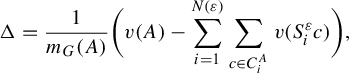 $$ \begin{align*} \Delta = \frac{1}{m_G(A)}\bigg(v(A) - \sum_{i=1}^{N(\varepsilon)} \sum_{c \in C_i^A} v( S_i^{\varepsilon}c ) \bigg), \end{align*} $$
as well as $A_{\varepsilon } := A \setminus \bigcup _{i=1}^{N(\varepsilon )} \bigcup _{c \in C_i^A} \tilde {S}_i^{\varepsilon }(c)$
. We obtain
$A_{\varepsilon } := A \setminus \bigcup _{i=1}^{N(\varepsilon )} \bigcup _{c \in C_i^A} \tilde {S}_i^{\varepsilon }(c)$
. We obtain
 $$ \begin{align*} m_G(A) \cdot \Delta = \bigg( v(A) - \sum_{i,c} v(\tilde{S}^{\varepsilon}_i(c)) - v(A_{\varepsilon}) \bigg) - \sum_{i,c} ( v(S_i^{\varepsilon}c) - v(\tilde{S}^{\varepsilon}_i(c)) ) + v(A_\varepsilon). \end{align*} $$
Furthermore, we use the sub-additivity property (w3) of v, combined with the general inclusions
 $$ \begin{align*} \partial_E(C \cup D) \subseteq \partial_E(C) \cup \partial_E(D), \quad \partial_E(C \setminus D) \subseteq \partial_E(C) \cup \partial_E(D) \end{align*} $$
for general sets $C,D,E \in \mathcal {RK}(G)$
and the triangle inequality to obtain
$C,D,E \in \mathcal {RK}(G)$
and the triangle inequality to obtain
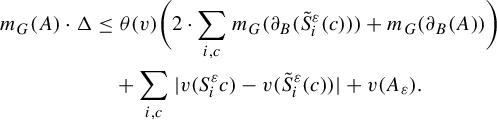 $$ \begin{align*} m_G(A) \cdot \Delta &\leq \theta(v) \bigg( 2 \cdot \sum_{i,c} m_G( \partial_B(\tilde{S}^{\varepsilon}_i(c)) ) + m_G(\partial_{B}(A)) \bigg)\\ &\quad + \sum_{i, c} | v(S_i^{\varepsilon}c) - v(\tilde{S}^{\varepsilon}_i(c) ) | + v(A_\varepsilon). \end{align*} $$
Next, we use the almost monotonicity condition (w2) to find that
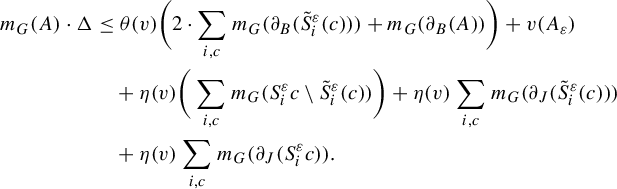 $$ \begin{align*} m_G(A) \cdot \Delta &\leq \theta(v) \bigg( 2 \cdot \sum_{i,c} m_G( \partial_B(\tilde{S}^{\varepsilon}_i(c)) ) + m_G(\partial_{B}(A)) \bigg) + v(A_\varepsilon) \\ &\quad + \eta(v) \bigg( \sum_{i, c} m_G( S_i^{\varepsilon}c \setminus \tilde{S}^{\varepsilon}_i(c) ) \bigg) + \eta(v) \sum_{i, c} m_G( \partial_J(\tilde{S}^{\varepsilon}_i(c)) )\\ &\quad + \eta(v) \sum_{i, c} m_G( \partial_J({S}^{\varepsilon}_i c) ). \end{align*} $$
In view of conditions (w1) and (w2) (and the above set inclusions for boundaries), we also have
 $$ \begin{align*} v(A_{\varepsilon}) \leq |v(A_{\varepsilon})| \leq \eta(v) \bigg( m_G(A_{\varepsilon}) + m_G(\partial_J(A)) + \sum_{i,c} m_G( \partial_J(\tilde{S}^{\varepsilon}_i(c) ) \bigg). \end{align*} $$
Plugging this into the above inequality and using $m_G(S_i^{\varepsilon }c \setminus \tilde {S}_i^{\varepsilon }(c)) < \varepsilon $
along with the invariance conditions on the prototiles, cf. equality (A.1) and
$m_G(S_i^{\varepsilon }c \setminus \tilde {S}_i^{\varepsilon }(c)) < \varepsilon $
along with the invariance conditions on the prototiles, cf. equality (A.1) and $\zeta ^2 \leq 4\zeta $
, we arrive at
$\zeta ^2 \leq 4\zeta $
, we arrive at
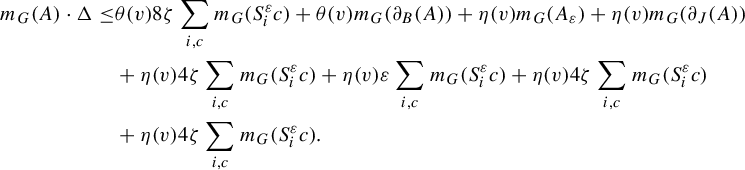 $$ \begin{align*} m_G(A) \cdot \Delta \leq& \theta(v) 8 \zeta \sum_{i,c} m_G(S_i^{\varepsilon}c) + \theta(v)m_G(\partial_B(A)) +\eta(v) m_G(A_{\varepsilon}) + \eta(v) m_G(\partial_J(A))\\ &+ \eta(v) 4\zeta \sum_{i,c} m_G(S_i^{\varepsilon}c) + \eta(v) \varepsilon \sum_{i,c} m_G(S_i^{\varepsilon}c) + \eta(v)4\zeta \sum_{i,c} m_G(S_i^{\varepsilon}c)\\ &+ \eta(v)4\zeta \sum_{i,c} m_G(S_i^{\varepsilon}c). \end{align*} $$
By the tiling property (T4) of Theorem 3.14 and using the fact that $\sum _i \sum _c m_G(S_i^{\varepsilon }c) \leq 2m_G(A)$
, we get
$\sum _i \sum _c m_G(S_i^{\varepsilon }c) \leq 2m_G(A)$
, we get
 $$ \begin{align*} \Delta &\leq 16 \theta(v) \zeta + \theta(v) \frac{m_G(\partial_B(A))}{m_G(A)} + 2 \eta(v) \varepsilon + \eta (v)\frac{m_G(\partial_J(A))}{m_G(A)} + 8 \eta(v) \zeta \\ & \quad + 2 \eta(v) \varepsilon + 8\eta(v)\zeta + 8 \eta(v) \zeta. \end{align*} $$
We finally use the additional invariance assumptions on A, that is, $m_G(\partial _J(A)) \leq \varepsilon m_G(A)$
and
$m_G(\partial _J(A)) \leq \varepsilon m_G(A)$
and $m_G(\partial _B(A)) \leq \varepsilon m_G(A)$
. Hence, the choice
$m_G(\partial _B(A)) \leq \varepsilon m_G(A)$
. Hence, the choice $\zeta = \varepsilon / 16$
finally leads to
$\zeta = \varepsilon / 16$
finally leads to
 $$ \begin{align*} \Delta \leq 2 \theta(v) \cdot \varepsilon + 8 \eta(v) \cdot \varepsilon.\\[-35pt] \end{align*} $$
For the proof of Lemma 3.17, we need another lemma first.
Lemma A.1. Let $w:\mathcal {RK}(G) \times X \to {\mathbb R}$
be an almost sub-additive weight function satisfying (W5
$w:\mathcal {RK}(G) \times X \to {\mathbb R}$
be an almost sub-additive weight function satisfying (W5 $^\ast $
) and assume that
$^\ast $
) and assume that $G \curvearrowright X$
is minimal. Then, for every strong Følner exhaustion sequence
$G \curvearrowright X$
is minimal. Then, for every strong Følner exhaustion sequence $(T_m)$
and for each
$(T_m)$
and for each $\varepsilon> 0$
, there is some
$\varepsilon> 0$
, there is some $m_0 \in {\mathbb N}$
such that
$m_0 \in {\mathbb N}$
such that
 $$ \begin{align*} | w^{+}(T_m, x) - w^{+}(T_m, y) | < \varepsilon, \quad | w^{-}(T_m, x) - w^{-}(T_m, y) | < \varepsilon \end{align*} $$
for all $x,y \in X$
and for all
$x,y \in X$
and for all $m \geq m_0$
.
$m \geq m_0$
.
Proof. Let $\varepsilon> 0$
. We now choose
$\varepsilon> 0$
. We now choose $m_0 \in {\mathbb N}$
such that property (W5
$m_0 \in {\mathbb N}$
such that property (W5 $^\ast $
) of Remark 3.12 holds applied with
$^\ast $
) of Remark 3.12 holds applied with $\varepsilon / 3$
instead of
$\varepsilon / 3$
instead of $\varepsilon $
. If necessary, we increase
$\varepsilon $
. If necessary, we increase $m_0$
such that
$m_0$
such that $m_G(\partial _I(T_m))/m_G(T_m) \leq \varepsilon /(6 \vartheta )$
holds for all
$m_G(\partial _I(T_m))/m_G(T_m) \leq \varepsilon /(6 \vartheta )$
holds for all $m \geq m_0$
, where
$m \geq m_0$
, where $I \subseteq G$
is the compact subset of property (W4) that only depends on w. Let
$I \subseteq G$
is the compact subset of property (W4) that only depends on w. Let $m \geq m_0$
and fix
$m \geq m_0$
and fix $x,y \in X$
. By definition of
$x,y \in X$
. By definition of $w^{+}$
and property (W4) of Definition 3.9, we find and element
$w^{+}$
and property (W4) of Definition 3.9, we find and element $h^m_x \in G$
such that
$h^m_x \in G$
such that
 $$ \begin{align*} \bigg| \frac{w(T_m, h^m_x x)}{m_G(T_m)} - w^{+}(T_m,x) \bigg| < \frac{\varepsilon}{3} + \vartheta\cdot \frac{m_G(\partial_I(T_m))}{m_G(T_m)}. \end{align*} $$
Moreover, since the action $G \curvearrowright X$
is minimal, we find
$G \curvearrowright X$
is minimal, we find $j_m \in G$
such that
$j_m \in G$
such that $d_{X}(h^m_x x, j_m y ) < \delta _m$
(with
$d_{X}(h^m_x x, j_m y ) < \delta _m$
(with $\delta _m> 0$
chosen as in property (W5
$\delta _m> 0$
chosen as in property (W5 $^\ast $
)), and by property (W5
$^\ast $
)), and by property (W5 $^\ast $
), we arrive at
$^\ast $
), we arrive at
 $$ \begin{align*} | w(T_m, h^m_x x) - w(T_m, j_m y)| < \varepsilon/3 m_G(T_m). \end{align*} $$
Putting everything together and using again property (W4), we observe
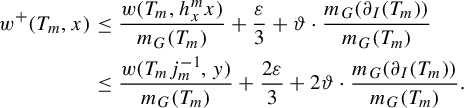 $$ \begin{align*} w^{+}(T_m, x) &\leq \frac{w(T_m, h^m_x x)}{m_G(T_m)} + \frac{\varepsilon}{3} + \vartheta \cdot \frac{m_G(\partial_I(T_m))}{m_G(T_m)} \\ &\leq \frac{w(T_m j_m^{-1}, y)}{m_G(T_m)} + \frac{2\varepsilon}{3} + 2 \vartheta \cdot \frac{m_G(\partial_I(T_m))}{m_G(T_m)}. \end{align*} $$
By definition of $w^+$
and
$w^+$
and $m_G(\partial _I(T_m))/m_G(T_m) < \varepsilon (6\vartheta )^{-1}$
, we conclude
$m_G(\partial _I(T_m))/m_G(T_m) < \varepsilon (6\vartheta )^{-1}$
, we conclude $w^{+}(T_m, x) \leq w^{+}(T_m, y) + \varepsilon $
for all
$w^{+}(T_m, x) \leq w^{+}(T_m, y) + \varepsilon $
for all $m \geq m_0$
. Interchanging the roles of x and y yields the statement for
$m \geq m_0$
. Interchanging the roles of x and y yields the statement for $w^{+}$
. The assertion for
$w^{+}$
. The assertion for $w^{-}$
can be proven in the very same manner and we leave the details to the reader.
$w^{-}$
can be proven in the very same manner and we leave the details to the reader.
We are ready to give the proof of Lemma 3.17.
Proof of Lemma 3.17
It suffices to show
 $$ \begin{align*} \limsup_{m \to \infty} {w^{+}}(T_m, x) \leq \liminf_{m \to \infty} {w^{+}}(T_m, x) \end{align*} $$
for all $x\in X$
. Invoking Remark 3.10, we see that both the above limsup and the liminf are contained in the interval
$x\in X$
. Invoking Remark 3.10, we see that both the above limsup and the liminf are contained in the interval $[-\eta , \eta ]$
for all
$[-\eta , \eta ]$
for all $x \in X$
, where
$x \in X$
, where $\eta \geq 0$
is the constant as of axiom (W2) in Definition 3.9. So fix
$\eta \geq 0$
is the constant as of axiom (W2) in Definition 3.9. So fix $x \in X$
. We find a subsequence
$x \in X$
. We find a subsequence $(S_l)$
of
$(S_l)$
of $(T_m)$
such that
$(T_m)$
such that
 $$ \begin{align*} \liminf_{m\to\infty}w^+(T_m,x) = \lim_{l\to\infty} w^+(S_l,x)\,. \end{align*} $$
By property (W4), there is a compact $I \subseteq G$
and
$I \subseteq G$
and $\vartheta \geq 0$
such that the almost-equivariance property for w is satisfied. Let
$\vartheta \geq 0$
such that the almost-equivariance property for w is satisfied. Let $0<\varepsilon <1/10$
and
$0<\varepsilon <1/10$
and $N(\varepsilon ):=\lceil -\log ({\varepsilon }/{1-\varepsilon })\rceil $
. We apply Lemma 3.16 with
$N(\varepsilon ):=\lceil -\log ({\varepsilon }/{1-\varepsilon })\rceil $
. We apply Lemma 3.16 with $B=B$
,
$B=B$
, $I=I$
,
$I=I$
, $J=J$
,
$J=J$
, $\eta (v) = \eta $
, and
$\eta (v) = \eta $
, and $\theta (v) = \theta $
, where J and
$\theta (v) = \theta $
, where J and $\eta $
describe the almost monotonicity property (W2), and B and
$\eta $
describe the almost monotonicity property (W2), and B and $\theta $
describe the almost sub-additivity property (W3) of w. We choose
$\theta $
describe the almost sub-additivity property (W3) of w. We choose $\ell \in {\mathbb N}$
large enough such that
$\ell \in {\mathbb N}$
large enough such that $m_G(\partial _I(S_l)) \leq \varepsilon m_G(S_l)$
for all
$m_G(\partial _I(S_l)) \leq \varepsilon m_G(S_l)$
for all $l \geq \ell $
. Hence, we find a collection of prototiles
$l \geq \ell $
. Hence, we find a collection of prototiles
 $$ \begin{align*} \{e\}\subseteq S_{n}\subseteq S_1^\varepsilon\subseteq\cdots\subseteq S_{N(\varepsilon)}^\varepsilon \,,\quad S_i^\varepsilon\in\{ S_k \,:\, k\geq \max\{i, \ell\} \} \end{align*} $$
taken from the sequence $(S_l)$
and there is some
$(S_l)$
and there is some $M \in {\mathbb N}$
such that for each
$M \in {\mathbb N}$
such that for each $m \geq M$
, the set
$m \geq M$
, the set $T_m$
can be
$T_m$
can be $\varepsilon $
-quasi tiled by the prototiles
$\varepsilon $
-quasi tiled by the prototiles $S_i^{\varepsilon }$
with center sets
$S_i^{\varepsilon }$
with center sets $C_i^m$
for
$C_i^m$
for $1 \leq i \leq N(\varepsilon )$
and
$1 \leq i \leq N(\varepsilon )$
and
 $$ \begin{align*} \frac{w(T_m,y) }{m_G(T_m)} \leq \frac{1}{m_G(T_m)} \sum_{i=1}^{N(\varepsilon)} \sum_{c \in C_i^m} w(S_i^{\varepsilon}c, y) + (8 \eta + 2 \theta)\, \varepsilon \end{align*} $$
for all $y \in X$
. Further, combining the previous estimate and property (W4) of a weight function gives
$y \in X$
. Further, combining the previous estimate and property (W4) of a weight function gives
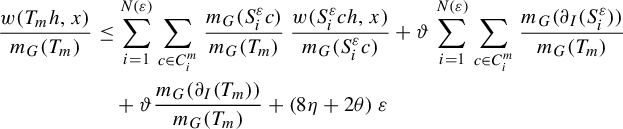 $$ \begin{align*} \frac{w(T_m h,x)}{m_G(T_m)} &\leq \sum_{i=1}^{N(\varepsilon)}\sum_{c\in C_i^m} \frac{m_G(S_i^\varepsilon c)}{m_G(T_m)}\, \frac{w(S_i^\varepsilon c h,x)}{m_G(S_i^\varepsilon c)} + \vartheta \sum_{i=1}^{N(\varepsilon)} \sum_{c \in C_i^m} \frac{m_G(\partial_I(S_i^{\varepsilon}))}{m_G(T_m)} \\ &\quad + \vartheta \frac{m_G(\partial_I(T_m))}{m_G(T_m)} + (8 \eta + 2 \theta)\, \varepsilon \end{align*} $$
for all $h \in G$
and
$h \in G$
and $m \geq M$
. Increasing M if necessary and using
$m \geq M$
. Increasing M if necessary and using $m_G(\partial _I(S_l)) \leq \varepsilon m_G(S_l)$
for
$m_G(\partial _I(S_l)) \leq \varepsilon m_G(S_l)$
for $l\geq \ell $
together with
$l\geq \ell $
together with $\sum _i \sum _c m_G(S_i^{\varepsilon }c) \leq 2m_G(T_m)$
, we arrive at
$\sum _i \sum _c m_G(S_i^{\varepsilon }c) \leq 2m_G(T_m)$
, we arrive at
 $$ \begin{align*} \frac{w(T_m h,x)}{m_G(T_m)} &\leq \sum_{i=1}^{N(\varepsilon)}\sum_{c\in C_i^m} \frac{m_G(S_i^\varepsilon c)}{m_G(T_m)}\, \frac{w(S_i^\varepsilon c h,x)}{m_G(S_i^\varepsilon c)} + ( 8 \eta + 2 \theta + 3 \vartheta ) \varepsilon \end{align*} $$
for all $h \in G$
and
$h \in G$
and $m \geq M$
.
$m \geq M$
.
Let $S^\varepsilon :=S_{i_0}^\varepsilon $
be chosen such that
$S^\varepsilon :=S_{i_0}^\varepsilon $
be chosen such that $w^+(S^\varepsilon ,x)=\max _{1\leq i\leq N(\varepsilon )}w^+(S_i^\varepsilon ,x)$
. Then,
$w^+(S^\varepsilon ,x)=\max _{1\leq i\leq N(\varepsilon )}w^+(S_i^\varepsilon ,x)$
. Then,
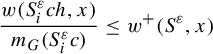 $$ \begin{align*} \frac{w(S_i^\varepsilon c h,x)}{m_G(S_i^\varepsilon c)} \leq w^+(S^\varepsilon,x)\, \end{align*} $$
for all $1 \leq i \leq N(\varepsilon )$
. In addition, the tiling properties (T1)–(T4) listed in Theorem 3.14 lead to
$1 \leq i \leq N(\varepsilon )$
. In addition, the tiling properties (T1)–(T4) listed in Theorem 3.14 lead to
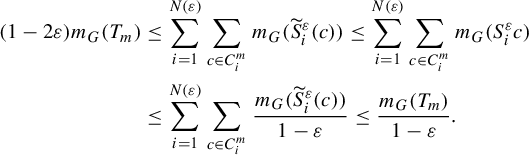 $$ \begin{align*} (1-2\varepsilon) m_G(T_m) &\leq \sum_{i=1}^{N(\varepsilon)}\sum_{c\in C_i^m} m_G(\widetilde{S}_i^\varepsilon (c)) \leq \sum_{i=1}^{N(\varepsilon)}\sum_{c\in C_i^m} m_G(S_i^\varepsilon c)\\ &\leq \sum_{i=1}^{N(\varepsilon)} \sum_{c \in C_i^m} \frac{m_G(\widetilde{S}_i^{\varepsilon}(c))}{1-\varepsilon} \leq \frac{m_G(T_m)}{1-\varepsilon}. \end{align*} $$
Combined with the previous estimate, this yields
 $$ \begin{align*} \frac{w(T_m h,x)}{m_G(T_m)} \leq \max\bigg\{ \frac{1}{1-\varepsilon} w^+(S^\varepsilon,x),\, (1-2\varepsilon) w^+(S^\varepsilon,x) \bigg\} + ( 8 \eta + 2 \theta + 3 \vartheta ) \varepsilon \end{align*} $$
for all $m \geq M$
and
$m \geq M$
and $h \in G$
. (Note that the sign of
$h \in G$
. (Note that the sign of $w^{+}(S^{\varepsilon }, x)$
determines the factor in front of it.) Taking the supremum over
$w^{+}(S^{\varepsilon }, x)$
determines the factor in front of it.) Taking the supremum over $h\in G$
and the limsup in m, we derive
$h\in G$
and the limsup in m, we derive
 $$ \begin{align*} \limsup_{m\to\infty}w^+(T_m,x) \leq \max\bigg\{ \frac{1}{1-\varepsilon} w^+(S^\varepsilon,x),\, (1-2\varepsilon) w^+(S^\varepsilon,x) \bigg\} + ( 8 \eta + 2 \theta + 3 \vartheta ) \varepsilon. \end{align*} $$
We recall that by definition, we have that $S^{\varepsilon } = S_l$
for some
$S^{\varepsilon } = S_l$
for some $l \geq \ell $
. Since
$l \geq \ell $
. Since $\ell $
was chosen arbitrarily but large enough and since
$\ell $
was chosen arbitrarily but large enough and since $(S_l)$
is a subsequence of
$(S_l)$
is a subsequence of $(T_m)$
, where
$(T_m)$
, where $(w^{+}(T_m, x))_m$
attains its limit inferior, we can send
$(w^{+}(T_m, x))_m$
attains its limit inferior, we can send $\ell $
to infinity to see
$\ell $
to infinity to see
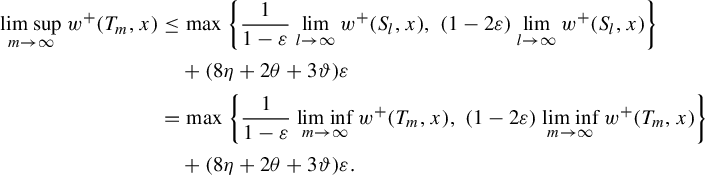 $$ \begin{align} \limsup_{m\to\infty}w^+(T_m,x) &\leq \max\bigg\{ \frac{1}{1-\varepsilon} \lim_{l\to\infty} w^+(S_l,x),\, (1-2\varepsilon)\lim_{l\to\infty} w^+(S_l,x) \bigg\} \nonumber \\ & \quad +( 8 \eta + 2 \theta + 3 \vartheta ) \varepsilon \nonumber\\ &= \max\bigg\{ \frac{1}{1-\varepsilon} \liminf_{m\to\infty} w^+(T_m,x),\, (1-2\varepsilon) \liminf_{m\to\infty} w^+(T_m,x)\bigg\} \nonumber \\ & \quad + ( 8 \eta + 2 \theta + 3 \vartheta ) \varepsilon. \end{align} $$
Sending $\varepsilon \to 0$
gives what was claimed above.
$\varepsilon \to 0$
gives what was claimed above.
We show next that the limits do not depend on the choice of the Følner sequence. To this end, fix two nested Følner sequences $(T_m)$
and
$(T_m)$
and $(T^{\prime }_l)$
. Then, for each
$(T^{\prime }_l)$
. Then, for each $\varepsilon < 1/10$
, each
$\varepsilon < 1/10$
, each $\ell \in {\mathbb N}$
, and large m, the set
$\ell \in {\mathbb N}$
, and large m, the set $T_m$
can be
$T_m$
can be $\varepsilon $
-quasi tiled by the same means as above by prototiles taken from
$\varepsilon $
-quasi tiled by the same means as above by prototiles taken from $(T^{\prime }_l)_{l \geq \ell }$
. Repeating exactly the same arguments as before leads to inequality (A.2) with
$(T^{\prime }_l)_{l \geq \ell }$
. Repeating exactly the same arguments as before leads to inequality (A.2) with $(S_l)$
replaced by
$(S_l)$
replaced by $T^{\prime }_{l}$
. Sending
$T^{\prime }_{l}$
. Sending $\varepsilon \to 0$
shows that the limit with respect to one sequence is less than or equal to the limit with respect to the other sequence. By symmetry, the independence follows.
$\varepsilon \to 0$
shows that the limit with respect to one sequence is less than or equal to the limit with respect to the other sequence. By symmetry, the independence follows.
If $w$
is even a topological weight function,
$w$
is even a topological weight function, $(T_m)$
is a strong Følner exhaustion sequence, and if the action
$(T_m)$
is a strong Følner exhaustion sequence, and if the action $G \curvearrowright X$
is additionally minimal, then the limits
$G \curvearrowright X$
is additionally minimal, then the limits $\lim _{m \to \infty } {w^{+}}(T_m, x)$
must coincide for all
$\lim _{m \to \infty } {w^{+}}(T_m, x)$
must coincide for all $x \in X$
and the convergence must be uniform by Lemma A.1.
$x \in X$
and the convergence must be uniform by Lemma A.1.
B Appendix. Topology of weighted Delone sets
This section is devoted to a particular useful neighborhood basis for the weak- $*$
-topology on spaces of weighted Delone sets.
$*$
-topology on spaces of weighted Delone sets.
We fix an lcsc group G, an open subset $U \subseteq G$
, compact subset
$U \subseteq G$
, compact subset $K \subseteq G$
, and
$K \subseteq G$
, and $\sigma \geq 1$
. We then consider weighted Delone sets in
$\sigma \geq 1$
. We then consider weighted Delone sets in $\operatorname {Del}(U,K,\sigma )$
, that is, subsets of G which are left-U-uniformly discrete and left-K-syndetic with weights in the interval
$\operatorname {Del}(U,K,\sigma )$
, that is, subsets of G which are left-U-uniformly discrete and left-K-syndetic with weights in the interval $[\sigma ^{-1}, \sigma ]$
.
$[\sigma ^{-1}, \sigma ]$
.
Let $S \in \mathcal {RK}(G)$
. Recall the notion
$S \in \mathcal {RK}(G)$
. Recall the notion
 $$ \begin{align*} d_S( \Lambda, \Pi ) &:=& \inf\{ \delta> 0:\, |\delta_\Lambda(B_{\delta}(y)) - \delta_\Pi(B_{\delta}(y))| < \delta \text{ for all } y \in (P \cap S) \cup (Q \cap S) \} \end{align*} $$
for two weighted Delone sets $\Lambda = (P,\alpha )$
and
$\Lambda = (P,\alpha )$
and $\Pi = (Q,\beta )$
.
$\Pi = (Q,\beta )$
.
Proposition B.1. Let $\Lambda $
be a weighted Delone set in G. Then for all
$\Lambda $
be a weighted Delone set in G. Then for all $S \in \mathcal {RK}(G)$
and
$S \in \mathcal {RK}(G)$
and $\delta> 0$
, the set
$\delta> 0$
, the set
 $$ \begin{align*} \mathcal{U}_{S,\delta}(\Lambda) := \{ \Pi\in \operatorname{Del}(U,K,\sigma) :\, d_S(\Lambda, \Pi) < \delta \} \end{align*} $$
is a weak- $*$
-neighborhood of
$*$
-neighborhood of $\Lambda $
. Moreover,
$\Lambda $
. Moreover, $\{ \mathcal {U}_{S,\delta }(\Lambda ): S \in \mathcal {RK}(G),\,\delta> 0 \}$
defines a weak-
$\{ \mathcal {U}_{S,\delta }(\Lambda ): S \in \mathcal {RK}(G),\,\delta> 0 \}$
defines a weak- $*$
-neighborhood basis of
$*$
-neighborhood basis of $\Lambda $
.
$\Lambda $
.
Proof. Let $0 < \delta < \sigma ^{-1}/2$
,
$0 < \delta < \sigma ^{-1}/2$
, $S\in \mathcal {RK}(G)$
, and
$S\in \mathcal {RK}(G)$
, and $\Lambda =(P,\alpha )\in \operatorname {Del}(U,K,\sigma )$
. Define
$\Lambda =(P,\alpha )\in \operatorname {Del}(U,K,\sigma )$
. Define $S':=S.B_1\in \mathcal {RK}(G)$
. Since
$S':=S.B_1\in \mathcal {RK}(G)$
. Since $\sigma \geq 1$
,
$\sigma \geq 1$
, $B_{2\delta }(x)\subseteq S'$
holds for all
$B_{2\delta }(x)\subseteq S'$
holds for all $x\in S$
. There is no loss in generality in assuming that
$x\in S$
. There is no loss in generality in assuming that $e\in U$
and
$e\in U$
and $\delta>0$
is small enough such that
$\delta>0$
is small enough such that $B_{2\delta }(x) \cap B_{2\delta }(y)=\emptyset $
for any
$B_{2\delta }(x) \cap B_{2\delta }(y)=\emptyset $
for any $x,y\in D$
, where D is some U-uniformly discrete set.
$x,y\in D$
, where D is some U-uniformly discrete set.
Set $K:=S'\setminus \bigcup _{x\in P\cap S'} B_{\delta }(x)$
. By Urysohn’s lemma, there is a
$K:=S'\setminus \bigcup _{x\in P\cap S'} B_{\delta }(x)$
. By Urysohn’s lemma, there is a $\phi \in {\mathcal C}_c(G)$
such that
$\phi \in {\mathcal C}_c(G)$
such that $0\leq \phi \leq 1$
,
$0\leq \phi \leq 1$
, $\phi (x)=0$
for all
$\phi (x)=0$
for all $x\in P$
and
$x\in P$
and $\phi |_K = 1$
. Furthermore, for each
$\phi |_K = 1$
. Furthermore, for each $x\in P\cap S'$
, there are
$x\in P\cap S'$
, there are $\phi _x\in {\mathcal C}_c(G)$
such that
$\phi _x\in {\mathcal C}_c(G)$
such that $0\leq \phi _x\leq 1$
,
$0\leq \phi _x\leq 1$
, $\phi _x$
is supported in
$\phi _x$
is supported in $B_{2\delta }(x)$
and
$B_{2\delta }(x)$
and $\phi _x|_{B_\delta (x)}\equiv 1$
. Then, the set
$\phi _x|_{B_\delta (x)}\equiv 1$
. Then, the set
 $$ \begin{align*} \mathcal{V} := \{ \Pi\in \operatorname{Del}(U,K,\sigma) :\, |\delta_{\Lambda(}\psi)-\delta_{\Pi}(\psi)|<\delta \text{ for all } \psi\in\{\phi\}\cup\{ \phi_x :\, x\in P\cap S'\} \} \end{align*} $$
is a weak- $*$
-neighborhood of
$*$
-neighborhood of $\Lambda $
in
$\Lambda $
in $\operatorname {Del}(U,K,\sigma )$
. We will show first that
$\operatorname {Del}(U,K,\sigma )$
. We will show first that $\mathcal {V}\subseteq \mathcal {U}_{S,\delta }(\Lambda )$
showing that
$\mathcal {V}\subseteq \mathcal {U}_{S,\delta }(\Lambda )$
showing that $\mathcal {U}_{S,\delta }(\Lambda )$
is indeed a weak-
$\mathcal {U}_{S,\delta }(\Lambda )$
is indeed a weak- $\ast $
-neighborhood of
$\ast $
-neighborhood of $\Lambda $
.
$\Lambda $
.
Let $\Pi =(Q,\beta )\in \mathcal {V}$
. By definition of
$\Pi =(Q,\beta )\in \mathcal {V}$
. By definition of $\phi $
, we have
$\phi $
, we have $\delta _{\Lambda }(\phi )=0$
. Thus,
$\delta _{\Lambda }(\phi )=0$
. Thus, $|\delta _{\Pi }(\phi )| = |\delta _{\Lambda }(\phi )-\delta _{\Pi }(\phi )|<\delta $
implies
$|\delta _{\Pi }(\phi )| = |\delta _{\Lambda }(\phi )-\delta _{\Pi }(\phi )|<\delta $
implies $ Q\cap S' \subseteq \bigcup _{x\in P\cap S'} B_\delta (x) $
as
$ Q\cap S' \subseteq \bigcup _{x\in P\cap S'} B_\delta (x) $
as $\delta <\sigma ^{-1}$
and
$\delta <\sigma ^{-1}$
and $\phi _{|K} =1 $
.
$\phi _{|K} =1 $
.
By the choice of $\phi _x$
, we have
$\phi _x$
, we have $\delta _{\Lambda }(\phi _x)=\alpha (x)$
for all
$\delta _{\Lambda }(\phi _x)=\alpha (x)$
for all $x \in P \cap S^{\prime }$
. In particular, for each
$x \in P \cap S^{\prime }$
. In particular, for each $x\in P\cap S$
,
$x\in P\cap S$
, $|\delta _{\Lambda }(\phi _x)-\delta _{\Pi }(\phi _x)|<\delta $
and the condition
$|\delta _{\Lambda }(\phi _x)-\delta _{\Pi }(\phi _x)|<\delta $
and the condition $B_{2\delta }(x) \cap B_{2\delta }(y) = \emptyset $
for
$B_{2\delta }(x) \cap B_{2\delta }(y) = \emptyset $
for $x,y \in Q$
with
$x,y \in Q$
with $x \neq y$
implies that there is a unique
$x \neq y$
implies that there is a unique $z_x\in Q\cap B_{2\delta }(x) \subseteq Q\cap S'$
. Since
$z_x\in Q\cap B_{2\delta }(x) \subseteq Q\cap S'$
. Since $Q\cap S' \subseteq \bigcup _{x\in P\cap S'} B_\delta (x)$
, we conclude
$Q\cap S' \subseteq \bigcup _{x\in P\cap S'} B_\delta (x)$
, we conclude $z_x\in Q\cap B_{\delta }(x)$
. Furthermore,
$z_x\in Q\cap B_{\delta }(x)$
. Furthermore, $\phi _x|_{B_\delta (x)}\equiv 1$
yields
$\phi _x|_{B_\delta (x)}\equiv 1$
yields $\phi _x(x) = 1 = \phi _x(z_x)$
. Thus,
$\phi _x(x) = 1 = \phi _x(z_x)$
. Thus,
 $$ \begin{align*} |\delta_{\Lambda}(B_{\delta}(x))-\delta_{\Pi}(B_{\delta}(x))| = |\phi_x(x)\alpha(x) - \phi_x(z_x)\beta(z_x)| = |\delta_{\Lambda}(\phi_x)-\delta_{\Pi}(\phi_x)| < \delta \end{align*} $$
holds for each $x\in P\cap S$
. If
$x\in P\cap S$
. If $y\in Q\cap S$
, there is a unique
$y\in Q\cap S$
, there is a unique $x\in P\cap S'$
such that
$x\in P\cap S'$
such that $y \in B_{\delta }(x)$
. Thus,
$y \in B_{\delta }(x)$
. Thus, $\delta _{\Lambda }(B_{\delta }(x)) = \delta _{\Lambda }(B_{\delta }(y))$
and
$\delta _{\Lambda }(B_{\delta }(x)) = \delta _{\Lambda }(B_{\delta }(y))$
and $\delta _{\Pi }(B_{\delta }(x)) = \delta _{\Pi }(B_{\delta }(y))$
for these choices of x and y. Hence,
$\delta _{\Pi }(B_{\delta }(x)) = \delta _{\Pi }(B_{\delta }(y))$
for these choices of x and y. Hence,
 $$ \begin{align*} |\delta_{\Lambda}(B_{\delta}(y))-\delta_{\Pi}(B_{\delta}(y))| = |\delta_{\Lambda}(B_{\delta}(x))-\delta_{\Pi}(B_{\delta}(x))| = | \delta_{\Lambda}(\phi_x) - \delta_{\Pi}(\phi_x) | < \delta \end{align*} $$
for all $y \in Q \cap S$
and the unique
$y \in Q \cap S$
and the unique $x \in P \cap S^{\prime }$
with
$x \in P \cap S^{\prime }$
with $y \in B_{\delta }(x)$
. Consequently, we have proven that
$y \in B_{\delta }(x)$
. Consequently, we have proven that $\Pi \in \mathcal {V}$
implies
$\Pi \in \mathcal {V}$
implies $d_S(\Lambda ,\Pi )< \delta $
. Thus,
$d_S(\Lambda ,\Pi )< \delta $
. Thus, $\mathcal {U}_{S,\delta }(\Lambda )$
is a weak-
$\mathcal {U}_{S,\delta }(\Lambda )$
is a weak- $\ast $
-neighborhood of
$\ast $
-neighborhood of $\Lambda $
.
$\Lambda $
.
Let $\Lambda =(P,\alpha )\in \operatorname {Del}(U,K,\sigma )$
,
$\Lambda =(P,\alpha )\in \operatorname {Del}(U,K,\sigma )$
, $\phi \in {\mathcal C}_c(G)$
and
$\phi \in {\mathcal C}_c(G)$
and $\varepsilon>0$
. To show that
$\varepsilon>0$
. To show that $\{ \mathcal {U}_{S,\delta }(\Lambda ): S \in \mathcal {RK}(G),\, \delta> 0 \} $
defines a neighborhood basis, it suffices to show that there is an
$\{ \mathcal {U}_{S,\delta }(\Lambda ): S \in \mathcal {RK}(G),\, \delta> 0 \} $
defines a neighborhood basis, it suffices to show that there is an ${S\in \mathcal {RK}(G)}$
and a
${S\in \mathcal {RK}(G)}$
and a $\delta>0$
such that
$\delta>0$
such that
 $$ \begin{align*} \mathcal{U}_{S,\delta}(\Lambda)\subseteq \{\Pi\in \operatorname{Del}(U,K,\sigma) :\, |\delta_{\Lambda}(\phi)-\delta_{\Pi}(\phi)|<\varepsilon\}. \end{align*} $$
Without loss of generality, suppose that $e\in U$
and
$e\in U$
and $B_{2\varepsilon }(x) \cap B_{2\varepsilon }(y) = \emptyset $
for all
$B_{2\varepsilon }(x) \cap B_{2\varepsilon }(y) = \emptyset $
for all $x,y \in D$
with
$x,y \in D$
with $x \neq y$
and for all U-uniformly discrete set D. Let
$x \neq y$
and for all U-uniformly discrete set D. Let $S\in \mathcal {RK}(G)$
be chosen such that it contains the compact support of
$S\in \mathcal {RK}(G)$
be chosen such that it contains the compact support of $\phi $
and
$\phi $
and $S\cap P = S.B_{2\varepsilon } \cap P$
. Set
$S\cap P = S.B_{2\varepsilon } \cap P$
. Set $N:=\sharp (S.B_\varepsilon \cap P)$
. Since
$N:=\sharp (S.B_\varepsilon \cap P)$
. Since $\phi \in {\mathcal C}_c(G)$
, there is a
$\phi \in {\mathcal C}_c(G)$
, there is a $\delta>0$
such that
$\delta>0$
such that $\delta <\min \{\varepsilon ,\sigma ^{-1}, ({\varepsilon }/{2N\|\phi \|_{\infty }})\}$
and
$\delta <\min \{\varepsilon ,\sigma ^{-1}, ({\varepsilon }/{2N\|\phi \|_{\infty }})\}$
and $|\phi (x)-\phi (y)|< {\varepsilon }/{2N\sigma }$
holds for all
$|\phi (x)-\phi (y)|< {\varepsilon }/{2N\sigma }$
holds for all $x,y\in G$
with
$x,y\in G$
with $d_G(x,y)<\delta $
.
$d_G(x,y)<\delta $
.
Let $\Pi =(Q,\beta )\in \mathcal {U}_{S.B_\varepsilon ,\delta }(\Lambda )$
. By the choice of S, each point
$\Pi =(Q,\beta )\in \mathcal {U}_{S.B_\varepsilon ,\delta }(\Lambda )$
. By the choice of S, each point $x \in P \cap S.B_{\varepsilon }$
is necessarily contained in
$x \in P \cap S.B_{\varepsilon }$
is necessarily contained in $P \cap S$
. Hence, for each
$P \cap S$
. Hence, for each $x\in P\cap S.B_\varepsilon = P \cap S$
, the condition
$x\in P\cap S.B_\varepsilon = P \cap S$
, the condition $|\delta _{\Lambda }(B_\delta (x)) - \delta _{\Pi }(B_\delta (x))|<\delta \leq \varepsilon $
implies that there is a unique
$|\delta _{\Lambda }(B_\delta (x)) - \delta _{\Pi }(B_\delta (x))|<\delta \leq \varepsilon $
implies that there is a unique $y_x\in Q\cap S.B_{\varepsilon }\cap B_\delta (x)$
such that
$y_x\in Q\cap S.B_{\varepsilon }\cap B_\delta (x)$
such that $|\alpha (x)-\beta (y_x)|<\delta \leq {\varepsilon }/{2N\| \phi \|_{\infty }}$
. In particular, we have shown that
$|\alpha (x)-\beta (y_x)|<\delta \leq {\varepsilon }/{2N\| \phi \|_{\infty }}$
. In particular, we have shown that $\{y_x\,: x\in P\cap S.B_\varepsilon \} \subseteq Q\cap S.B_\varepsilon $
. We claim the latter two sets are actually equal.
$\{y_x\,: x\in P\cap S.B_\varepsilon \} \subseteq Q\cap S.B_\varepsilon $
. We claim the latter two sets are actually equal.
For indeed, if there was a $y\in Q\cap S.B_\varepsilon $
that is not equal to some
$y\in Q\cap S.B_\varepsilon $
that is not equal to some $y_x$
, then
$y_x$
, then $B_\delta (y)\cap P\subseteq S.B_{2\varepsilon }\cap P$
and this would lead to
$B_\delta (y)\cap P\subseteq S.B_{2\varepsilon }\cap P$
and this would lead to $B_\varepsilon (y)\cap P=\emptyset $
. Thus,
$B_\varepsilon (y)\cap P=\emptyset $
. Thus,
 $$ \begin{align*}|\beta(y)| = |\delta_{\Lambda}(B_\delta(y))-\delta_{\Pi}(B_\delta(y))| <\delta< \sigma^{-1} \end{align*} $$
as $\Pi \in \mathcal {U}_{S.B_\varepsilon ,\delta }(\Lambda )$
, which is a contradiction to
$\Pi \in \mathcal {U}_{S.B_\varepsilon ,\delta }(\Lambda )$
, which is a contradiction to $\Pi \in \operatorname {Del}(U,K,\sigma )$
. Furthermore,
$\Pi \in \operatorname {Del}(U,K,\sigma )$
. Furthermore, ${\Pi \in \mathcal {U}_{S.B_\varepsilon ,\delta }(\Lambda )}$
yields
${\Pi \in \mathcal {U}_{S.B_\varepsilon ,\delta }(\Lambda )}$
yields
 $$ \begin{align*} |\beta(y_x)-\alpha(x)| = |\delta_{\Lambda}(B_\delta(y_x)) - \delta_{\Pi}(B_\delta(y_x))| <\delta \end{align*} $$
for all $x \in P \cap S.B_{\varepsilon }$
. Thus,
$x \in P \cap S.B_{\varepsilon }$
. Thus,
 $$ \begin{align*} |\delta_{\Lambda}(\phi)-\delta_{\Pi}(\phi)| \leq &\sum_{x\in P\cap S.B_\varepsilon} |\alpha(x) \phi(x) - \beta(y_x) \phi(y_x)|\\\leq &\sum_{x\in P\cap S.B_\varepsilon} (|\alpha(x) - \beta(y_x)|\, |\phi(x)| + |\beta(y_x)|\, |\phi(x) - \phi(y_x)|) <\varepsilon, \end{align*} $$
using $d_G(x,y_x)<\delta $
.
$d_G(x,y_x)<\delta $
.


 Open access

