


Introduction
Prevailing narratives argue that conservationists engaging with emotion in decision-making contexts leads to biased and ineffective decisions, and thus less effective conservation. Such narratives are pervasive in the academic literature. For example, Griffin et al. (Reference Griffin, Callen, Klop-Toker, Scanlon and Hayward2020) argued that ‘our emotional systems’ do not ‘provide a reliable basis for making decisions… to ensure the long-term persistence of our planet’ (p. 1139). Similarly, Arias et al. (Reference Arias, Hinsley and Milner-Gulland2021) purported ‘Regardless of education or intelligence, humans are prone to adopting irrational behaviours… and to react in ways that prioritize emotion and empathy over science’ (p. 1123). Conservation practitioners also perpetuate this narrative: Kenny and Osborne (Reference Kenny and Osborne2024) described how emotion intertwined with ecocentric values was perceived as a lack of reliability, objectivity and professionality in decision-making processes. (See Buijs et al., Reference Buijs, Arts, Elands and Lengkeek2011, for another example).
Vilifying emotion within conservation decision-making processes inherently rejects conservationists’ emotional experiences and may limit the transformative potential emotion affords. Many conservationists pursue their careers because of the emotions they feel in relation to nature (Kiik, Reference Kiik2019). As they witness the decline of nature, with insufficient access to financial, emotional and other resources, many conservationists now experience poor mental and emotional health in relation to their work (Pienkowski et al., Reference Pienkowski, Keane, Tickell, de Lange, Hazenbosch and Khanyari2023). Thus, narratives that exclude emotion from decision-making processes deny these emotional experiences and may be affecting conservationists negatively (Fraser et al., Reference Fraser, Pantesco, Plemons, Gupta and Rank2013).
Furthermore, transformative change literature relating to inner and outer transformation (where inner transformation involves shifts in values, beliefs and mindsets, along with the cognitive, emotional and relational capacities that support these alterations, and outer transformation relates to changes in structures, technologies and behaviour; Goldstein et al., Reference Goldstein, Manuel-Navarrete and Schaepke2025) highlights the importance of emotion. For example, emotion can resource and sustain transformative endeavours (Ives et al., Reference Ives, Freeth and Fischer2020), with emotional capacities and learning creating resilience during crises (Woiwode et al., Reference Woiwode, Schäpke, Bina, Veciana, Kunze and Parodi2021). To unlock this potential, a better understanding of the emotional and other worlds of conservationists is needed; i.e. we must engage with conservationists not ‘solely as rational(ist) creatures of expertise but rather as desiring, relating, doubting, anxious, contentious, affective—in other words as human-subjects’ (Boyer, Reference Boyer2008, quoted in Kiik, Reference Kiik2019, p. 392).
Much of the conservation literature portraying emotion as detrimental to decision-making processes relies on studies that may have limited transferability to conservation decision-making contexts. For example, such literature often draws on psychology and decision science studies using experimental set-ups and university students or members of the public as subjects (Griffin et al., Reference Griffin, Callen, Klop-Toker, Scanlon and Hayward2020). Although potentially informative, it should not be assumed that such results automatically apply to the complex, fraught, emotional individuals and contexts of conservationists and conservation decision-making processes.
Although little empirical work has directly investigated the involvement of conservation professionals’ emotion within decision-making processes, those that have reveal emotion is interwoven with such processes. Vining (Reference Vining1992) found that United States Forest Service (USFS) managers had a less emotional reaction regarding a proposed logging expansion compared to members of the public and individuals from environmental groups. However, further discussions revealed that the USFS managers did have emotional reactions to such environmental decisions, otherwise they would not have become conservationists. Vining (Reference Vining1992) hypothesized that they may have become ‘socialized to view emotion as an irrational or biased response’ (p. 28) as a result of their organizational culture and the need for decisions to be legally defensible. Kennedy (Reference Kennedy2000) observed that USFS’s emotional intensity fused boundaries between self and others, causing a lack of clarity regarding people’s own perceptions. Additionally, managers denied, or were reactive to, emotion rather than managing it, sometimes causing conflict and affecting decision-making processes. Kennedy (Reference Kennedy2000) concluded that conservation is ultimately about self- and people management; skills forest managers are not trained in. Neither study deemed conservationists’ emotion in such processes inherently negative.
I argue that pervasive narratives stating emotion is detrimental to decision-making processes, and the lack of empirical research, stems from the roots of conservation and its decision-making approaches. Western conservation emerged from the natural sciences, which were (and are) heavily informed by Enlightenment thinking and associated positivist knowledge traditions. Influenced by Cartesian logics established by Descartes (Reference Descartes1986), the positivist tradition positions emotion, the body, femininity and subjectivity as inferior to superior rationality, the mind, masculinity and objectivity (Plumwood, Reference Plumwood1988). These logics of oppression (Warren, Reference Warren1990) are present in conservation more broadly, but also in conservation decision-making approaches that emerged from, for example, mathematics, fisheries sciences and medicine, which tend to favour the positivist tradition. Despite growing recognition that emotion and reason are not dualistic in nature but are integrated (Damasio, Reference Damasio1994), these deeply ingrained logics continue to privilege rational thought over ‘“irrational” emotionality’ (Lupton, Reference Lupton1998, p. 4).
Interweaving factors demonstrate a great need for further investigation. Powerful and persistent narratives that demonize emotion are arguably rooted in logics of oppression and draw on research with potentially limited transferability. Limited empirical research means existing narratives are not challenged and logics of oppression are reinforced and may be negatively affecting the emotional and mental health of conservationists. Moreover, engaging with emotion may support the transformative changes needed to enable non-human and human nature to flourish. To this end, I aim here, firstly, to explore the involvement of conservationists’ emotion within conservation decision-making processes, and, secondly, to explore if and how externalities are influencing this involvement.
Definitions
I conceptualize emotion as being biological and social, interactional and relational. Emotion is not a purely biological phenomenon but is also shaped by sociocultural practices and environments (Hochschild, Reference Hochschild1983). Additionally, emotion is interactional: human biology is plastic and responsive to wider sociocultural influences; i.e. the biological and social co-produce emotion (Hochschild, Reference Hochschild and Kemper1990). Lastly, emotion is relational. It does not exist as isolated, personal mental states but rather is produced in relations between and among people and places (Ahmed, Reference Ahmed2004; Bondi et al., Reference Bondi, Davidson, Smith, Davidson, Bondi and Smith2005; Sultana, Reference Sultana2011).
Conservation decision-making processes are often described yet the phenomenon itself is rarely defined. Here, I refer to conservation decision-making processes to convey the dynamic, complex feedbacks and flows that determine the implementation of conservation action(s). These processes are defined as the socio-biological processes (i.e. inter alia, cultural, political and ecological processes) that shape the what, when, where and how of conservation action(s). Such processes occur before, during and after conservation action(s) are decided upon. Furthermore, conservation action(s) are defined as action(s) undertaken in the pursuit of conservation aims (which are themselves highly subjective).
Methods
I adopted a mixed methods approach: semi-structured interviews, the diary method and a workshop. All data were collected during May–June 2023.
Sampling
Sixteen conservation professionals were recruited by purposive, convenience and snowball sampling techniques, aiming for variation in relation to area of work (science, policy and/or practice), geographical background, career stage and gender. Recruitment involved searching staff webpages of major conservation organizations and directly contacting individuals who stated they were involved in conservation decision-making processes. I also advertised among existing personal and professional networks as well as asking those interviewed if they could refer others to take part. Conservation professionals recruited to the project had to be taking part in conservation decision-making processes. To ensure this, the professionals were asked to provide details about their role and/or specific instance(s) where they were involved in such processes. Considering the depth of data generated from each professional, the data collection methods used, and the exploratory scope of the study, the sample size provides sufficient richness and complexity (Braun & Clarke, Reference Braun and Clarke2021). Additionally, sample sizes for qualitative research are often, at least in part, determined by pragmatic considerations (Braun & Clarke, Reference Braun and Clarke2021). In this case the research was shaped and constrained by the fact it was part of a 1-year Masters programme.
The conservation professionals and their decision-making processes
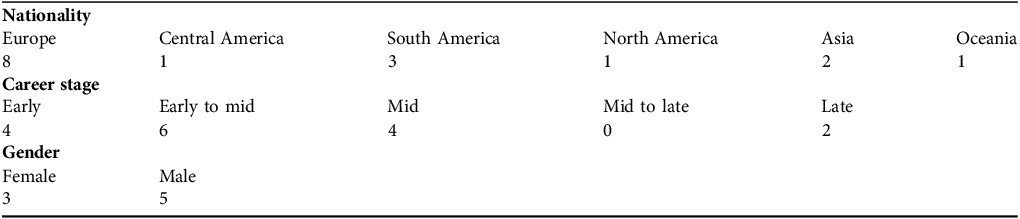
Half of the conservation professionals who took part were European, with most identifying as men and/or being early-career (Table 1). The professionals worked across conservation research, practice and policy (often being involved in more than one of these spheres) at 14 non-governmental organizations, local and national governments and universities. The professionals were involved in three types of broader decision-making processes: policy decisions at the organizational, local, national or international level; conservation action decisions at the regional, community and organizational level; and decisions regarding the outcome of conservation grant applications. All professionals, even those in leadership roles, were collectively involved in decision-making processes with others as opposed to solely making decisions themselves.
The demographic and background characteristics of the 16 conservation professionals who took part in the study. Only eight conservationists responded regarding gender.

Interviews
All 16 professionals took part in a qualitative semi-structured interview (Supplementary Material 1) that facilitated an exploration of the professionals’ thoughts, feelings and beliefs about the specified topic, as well as discussion around personal, and sometimes sensitive, issues (DeJonckheere & Vaughn, Reference DeJonckheere and Vaughn2019). Eleven interviews were conducted online via video and five took place in-person in the UK. The interviews lasted 47–71 minutes. At the beginning of each interview, the conservationist chose one specific example of a conservation decision they were involved in that was particularly vivid to them. This chosen example was drawn on throughout the interview. The interviews were recorded then auto-transcribed using Speechmatics (Speechmatics, 2022) and corrected. Two pilot interviews were conducted beforehand to refine the interview guide in relation to question wording, length and whether the required data were being gathered. These were not recorded or analysed.
Diary method
Three qualitative diary entries were submitted from two professionals. This method gave the professionals the possibility of recording their subjective experiences and emotions at work (Waddington, Reference Waddington2013) in relation to any day-to-day instances of when they felt emotion had been involved in decision-making processes. The diary method included three prompts that mirrored the broad structure of the interview (Supplementary Material 2). The professionals were told the diary entry method was optional, and that they had 1 week from their interview in which to submit entries. The diary entries were 152–359 words.
Workshop
Four professionals attended the in-person workshop in Cambridge, UK, the purpose of which was to reflect on and discuss themes from the preliminary analysis and the project as a whole (Supplementary Material 3). The project reflection used the ORID (Objective, Reflective, Interpretative, Decisional) method, which is based on the Kolb experiential learning cycle (Hogan, Reference Hogan2003). Here, participants reflected on the project (prompted by objective and reflective questions) then abstractly interpreted their experiences (prompted by interpretative questions) and finally decided what to do as a result (prompted by decision questions; Fig. 1). As part of this final stage, we considered if any actions or interventions should be taken in relation to creating spaces where conservation professionals could reflect and share their emotional experiences in relation to conservation decision-making processes. Audio recordings were made of any whole group discussions; these were auto-transcribed via Speechmatics and corrected. The workshop lasted 2 h and 15 min.
The ORID (Objective, Reflective, Interpretative, Decisional) method involves a phased reflection on a project or issue, asking objective, reflective, interpretative and then decisional questions. Each phase relates to a different dimension of learning. Adapted from the Institute of Cultural Affairs (2014).

Analysis
A thematic analysis was conducted on all data gathered (interviews, diary method, workshop) by employing qualitative coding using NVivo (NVivo, 2022), constant comparison and memo-writing. As per Braun & Clarke (Reference Braun and Clarke2006), qualitative coding involved progressing from the identification of explicit, surface-level meanings (i.e. semantic themes) to the underlying ideas, assumptions and conceptualizations present (i.e. latent themes). This identification process organizes the data into meaningful groups. Constant comparison was used to continually compare themes and sub-themes and explore their similarities and differences, to support the development of the analysis (Lewis-Beck et al., Reference Lewis-Beck, Bryman and Liao2003). During these processes, I analytically interpreted the data by writing memos that explicated and explored the patterns identified in the data (Lempert, Reference Lempert2010).
Ethical considerations
All data collection was carried out with informed consent from the professionals. Before the interviews, all participants received a project information sheet containing relevant information about the study and were given the opportunity to ask questions prior to giving their consent. All data collected were anonymized, with each participant assigned a number (P1, etc.), and any sensitive information, such as their place of work, being redacted from transcripts and diary entries. At the beginning of the workshop, all participants were asked to keep confidential both what was said and who was present. Once the analysis had been conducted and the results detailing the themes (emotion as a way of knowing, emotion as a (de)motivator, emotion as a relationship shaper), along with professionals’ quotes, had been written, these were returned to the professionals for checking. This involved asking them if there were any potential breaches of confidentiality and/or anonymity in the results, and whether the results were accurate and resonated with the interviewee’s experiences (Birt et al., Reference Birt, Scott, Cavers, Campbell and Walter2016). Two professionals requested changes to the results section in relation to anonymity and confidentiality concerns.
Results
Emotion as a way of knowing
One key theme identified detailed how conservationists’ emotion prompted learning and acted as a way of knowing during conservation decision-making processes. Here, professionals often described how the intertwinement of emotion (and feeling, with feeling being the subjective and cognizant experience of bodily emotion; APA Dictionary of Psychology, n.d.) with thought prompted such learning and knowing. For example, P11 works with communities to collect ecological data from within protected areas for policy decision-making. At times they were met with hostility from a community member because of negative past experiences with conservation organizations. This initially caused the conservationist to feel ‘lots of frustration and anger at some points’ which led to ‘heated discussions’ with community members. Reflection followed (in the form of thoughts): ‘afterwards you think maybe that was not the best way to address that’ which then ‘helps for future interactions’. Now, with this experience and learning ‘the process has changed as you know, we mature more and we get all these learning experiences’, so they no longer react to the negative emotions being directed at them.
P16 shared an example of how their emotion, in this case suspicion, and thought alerted them to others’ agendas in policy-making scenarios: ‘sometimes you just feel like, something’s happening and then you are like, oh, that’s weird. It doesn’t feel right.’ When this happens in relation to specific individuals, they think ‘let’s research a little bit’ to try and uncover: ‘Who’s that person? Where does that person come from? What’s their agenda…? Do they have real intentions or… are they backed up by a business…’ (see Supplementary Material 4 for further examples).
Emotion as a (de)motivator
Many professionals described emotion as a motivator to engage in conservation decision-making processes. P1, whose employer was commissioned by a local government to investigate the potential lethal control of a certain species recalled having ‘quite a serious discussion about, do we even want to take on this piece of work? Do we want to be involved at all?’ They went forward with the commission as ‘somebody is going to do this work. … And at least if it’s us, we know that it’s going to have been done well and that the outcomes of it are going to be reliable.’ Here, rational and emotional experiences intertwined with the team’s love of this species driving their involvement: ‘we’re here because we like [redact] and we want to conserve them’ and their desire to know that if any decisions regarding lethal control were made, they were made based on the best ecological evidence available. (See Supplementary Material 5 for further examples.)
Emotion also motivated subversive action. For example, P6 spoke about how a new local authority policy they had proposed had been refused by their manager. As this was ‘a passion project’, P6 said they would ‘draw upon that emotion, that passion to not… give up before it’s even happened’ and that they would have ‘no qualms at all about going around the chain of command’. Another participant also acted subversively, prompted by emotion, but this was deemed too sensitive to include here.
Emotion also demotivated conservationists to take actions within the decision-making process. P14 shared how being ‘so passionate and driven’ means they have ‘suffered with my own mental health at times’ and have gotten to the point where ‘your whole body has just gone, right, that’s enough of that then.’ Here, this strong emotion driving involvement in conservation decision-making processes led to burnout. As P14 says ‘we’ve all got edges and we can’t run forever.’ Similarly, P2, who is involved in policy-making processes, described how the literature made them feel ‘really sad and… really despaired’ and like ‘there’s nothing you can do because many others tried and didn’t succeed’. They explained that these feelings ‘demotivate you’. Here, emotion led to the professionals less actively engaging with decision-making processes.
Emotion as a relationship shaper
As with motivation or demotivation, emotion has a dual role in shaping relationships by either hindering or building relationships between people. Some conservationists said sharing their emotion with others involved in decision-making processes can be counterproductive to building relationships, so they hide these emotions. For P14, who worked with farmers aiming to advise them regarding agricultural conservation decisions, it’s ‘really important not to show your frustrations when you’re not getting there’. Similarly, P3 commented that ‘I try not to make it (the frustration) apparent to whoever I’m talking to just because that’s not constructive and… I try and work on sort of building relationships rather than causing them to break down because that’s all too common.’ (See Supplementary Material 6 for a further example.)
However, showing emotion can also enhance relationships between people in decision-making contexts. P14 talked about how they shared difficult emotional exchanges with a particular farmer whereby the farmer had an ‘us and them attitude’. P14 said it was a ‘long, painful experience to be put in’. Eventually P14 spoke to the farmer about this: ‘I just said to him…we’re on the same side. You know, I’m trying to be on your side and you’re putting me on the other side and it’s not nice, I’m not enjoying that.’ P14 described how resolving these difficult emotions, sometimes together, brought about stronger working relationships. They explained that ‘they don’t trust anybody so when they do finally trust you, then it’s kind of gold because they don’t ask anyone else for advice.’ Furthermore, P4 shared how a community suspected that the species of interest was so rare ‘because they were being disturbed by people like me.’ The conservationist responded to these claims ‘in probably quite an emotional way, but that helped convey my sincerity’ and establish trust.
Organizational culture as an influential factor
Although emotion plays vital roles in conservation decision-making processes, conservationists lacked opportunities to reflect on their emotional experiences. This was shown by c. 50% of the conservationists expressing their gratitude for the space and time to do so as part of the project. P8 said ‘…the interview itself was quite a sort of cathartic opportunity to express some ideas and thoughts which don’t really have an outlet but nonetheless they’re there, I was so ready to share them in the interview’. Furthermore, many conservationists spoke about how the topic of the project was completely novel to them: ‘I have never seen or heard anyone talk about emotions in conservation this way’ (P11) and ‘it was totally novel to me in any job that I’ve ever done’ (P8).
Analysis also showed that organizational culture most strongly influenced whether conservation professionals expressed, engaged with, or reflected on, emotion within decision-making processes. Typically, organizational culture permitted engagement with a narrow range of emotional experience; i.e. frustration and venting: ‘I tended to vent with the other people… that worked at [redact]’ (P15), ‘there’s a lot of frustration, venting’ (P6) and ‘…there was a bunch of about 10 of us who all worked on this…so we actually had a kind of collegial kind of way to vent…’ (P7). P7 also recalled how they and their colleagues would ‘vent about it and move on’, demonstrating that deeper engagement or reflection did seem to be enabled or encouraged. Beyond this, the cultural norm was disengagement from emotion; for example P7 who contributed to decisions within the policy-making domain shared: ‘…to work in that sort of adviser role, you really need to dissociate yourself from the emotion of that and you really have to put it on ice and go, right, this is a resource that we’re managing and we have to present really objective advice about it.’ Others spoke about time constraints limiting opportunities to engage with their emotional experiences. P9 commented how it’s ‘not always the case’ that you’re able to ‘take the time to think’, partially due to constraints imposed by donors: ‘Once the money is in the door then you’ve got to keep going.’
Furthermore, the analysis demonstrated that if conservationists are given the space and time to express, engage with, and reflect on their emotional experiences, they can challenge dominant logics of oppression and recognize the roles emotion plays within such processes. For example, P7 initially viewed emotion within conservation decision-making processes as an inherently negative thing, but after taking part in the study they began to see the benefits of acknowledging and engaging with emotion within such processes. Similarly, P8 emphasized that ‘emotion is a key factor driving conservation decision-making and we shouldn’t try and minimize it or bury it or hide it but actually recognize it and address it as a valid and possibly valuable part of the process’. These examples show that despite logics of oppression being embedded within Western conservation organizational culture, if given the space and time, narratives can be remade and empower professionals to engage more consciously with the roles emotion plays in their work. (I specify Western conservation organizational culture from here onwards in recognition that the majority of the professionals interviewed originated from or undertook their day-to-day work in European contexts.)
Discussion
Emotion as a way of knowing
Participants shared how an emotional experience prompted reflection, action and change within conservation decision-making processes as per Kolb’s (Reference Kolb1984) experiential learning model. Concrete experiences bring about reflective observations prompting alternative, abstract conceptualizations of scenarios. From this, new actions can be tested and act as guides for creating new experiences. Here, Kolb (Reference Kolb1984) described learning as ‘the process whereby knowledge is created through the transformation of experience’ (p. 38). Kolb did not specifically refer to emotion instigating the learning cycle, but John Dewey, whose work Kolb built upon, argued emotion is one of the qualities of experience (Dewey, Reference Dewey1938), and thus can prompt such a learning cycle.
The intertwinement of emotion and thought (or cognition) described by the conservationists reflects empirical and conceptual work by scholars such as Damasio and Fals Borda, and contrasts with the prevailing narrative of the emotion–reason dualism. Through neurological studies, Damasio (Reference Damasio1994) determined that cognition and emotion are intertwined: emotion or feeling provide salience about whether our decisions align with our beliefs and desires, enabling people to reason (Damasio, Reference Damasio1994; Taylor, Reference Taylor2001). Without emotion, reasoning would require infinite time and memory capacity, perfect mental models and exploration of the various options ad infinitum (De Sousa, Reference De Sousa1987). More recent studies have shown that the interaction between emotion and reason is bi-directional: thought influences emotion and emotion influences thought (Härtel et al., Reference Härtel, Ashkanasy, Zerbe, Härtel, Zerbe and Ashkanasy2005).
From a related sociological perspective, Fals Borda advanced this argument using the concept sentipensar (think–feel): Fals Borda argues that embracing this interplay of thought and, in this case, feeling has epistemological and ontological implications. (Despite the reference to feeling, as opposed to emotion, I argue this literature is still relevant as feeling is intrinsically linked with emotion.) Fals Borda (Reference Fals Borda, Reason and Bradbury2001) described how sentipensar was required as ‘science appeared in need of a moral conscience, and reason strived to be enriched with sentiment and feeling’ (p. 29). For Fals Borda and other scholars, sentipensar is embodied knowledge that does not discriminate rational and emotional cognition. It emerges from relationships through a ‘reasoning-with (with-everything-that-is and with-the-heart)’ (Cepeda H., Reference Cepeda H2017, p. 26). This has epistemological and ontological implications, as to embrace sentipensar is to embrace pluralistic ways of knowing and being (Escobar, Reference Escobar2019; Lobo & Rodríguez, Reference Lobo and Rodríguez2022), which in turn is posited to have the potential to transform conservation (Wyborn et al., Reference Wyborn, Montana, Kalas, Clement, Davila and Knowles2021) and enable conservation to enact transformative change. Although emotion as a way of learning and knowing has been discussed in various disciplines, this has not yet, to my knowledge, been empirically grounded in conservationists’ experiences nor in conservation decision-making processes.
Emotion as a (de)motivator
The finding that emotion acts as a motivator to engage in conservation decision-making processes aligns with findings from different disciplines. For example, psychology offers cognitive dissonance theory (Festinger, Reference Festinger1957) and protection motivation theory (Rogers, Reference Rogers1975) that implicate emotion as a motivator of action. Within conservation literature, it has previously been argued that an affinity for non-human nature, and the emotion that provokes, motivates people to work in conservation (Vining, Reference Vining1992; Milton, Reference Milton2002).
My study also showed that emotion prompts conservationists to act in subversive ways, which has not been documented before. There is seemingly little research investigating subversive (as opposed to explicitly harmful) activities undertaken by conservationists, which I argue reflects a continual denial of conservationist’s complexity and heterogeneity (Kiik, Reference Kiik2019).
The finding that emotion can demotivate professionals during conservation decision-making processes mirrors existing conservation literature. For example, long-term environmental monitoring scheme managers reported feelings of boredom and weariness that resulted in them leaving their roles and not engaging in such conservation activities (Gabillet et al., Reference Gabillet, Arpin and Prévot2020). Others describe a perceived culture of hopelessness among conservation biologists, where individuals feel their actions do not make a difference and thus they are demotivated from taking action (Swaisgood & Sheppard, Reference Swaisgood and Sheppard2010). In extreme cases, this can lead to eco-paralysis: the inability to respond to environmental challenges because of the perception that they are uncontrollable (Albrecht, Reference Albrecht2011).
Emotion as a relationship shaper
Relationships between conservationists, and other actors, such as local communities, Indigenous Peoples, policymakers and academics, are deemed essential for conservation and conservation decision-making processes (White et al., Reference White, Schmook, Calmé, Giordano, Hausser and Kimmel2023). Emotion, although inherently social, has received little empirical attention with respect to relationships between conservation actors, although some forestry management conflict studies address this. An increased capability for handling emotional public responses and greater acknowledgement of, and openness about, forestry managers’ emotional experiences could act as a uniting force in conservation conflicts rather than a divisive force (Vining & Tyler, Reference Vining and Tyler1999; Buijs & Lawrence, Reference Buijs and Lawrence2013)
Consistent with this, drawing on a set of psychological studies, Graham et al. (Reference Graham, Huang, Clark and Helgeson2008) argued that it is productive to express one’s emotional states within a relationship as this provides the other individual with information about one’s needs and how they can respond in an appropriate way. The authors posited that expressing negative emotion demonstrates trust between individuals and that vulnerabilities will not be taken advantage of, thus developing a sense of intimacy. Thus, my study contributes empirical evidence that emotion is implicated in building relationships that are crucial for conservation decision-making processes.
Transforming organizational cultures to recognize and nurture the roles of emotion
In line with existing research from the USA and Canada (Kennedy, Reference Kennedy2000; Dowdall, Reference Dowdall2023), my study shows that organizational culture influences whether conservation professionals express, engage with, or reflect on, emotion within conservation decision-making processes. Kennedy (Reference Kennedy2000) explained how environmental managers’ implicit and explicit interactions, behaviours and language create rules that govern emotional behaviours and interactions. Dowdall (Reference Dowdall2023) showed how conservation officer’s emotions were managed in line with organizationally mandated display rules; i.e. overt and covert rules exercised by their organization that determined acceptable actions and behaviour. Dowdall (Reference Dowdall2023) continued to say that these display rules could affect the well-being of the officers. However, my study builds on this by demonstrating that not all emotional experiences are equal: although stress and frustration are easily shared between colleagues there is no space or time created for engagement with more nuanced emotional experiences. If conservation professionals are given this space and time (i.e. if organizational culture is changed) they can become free of the inherent logics of oppression that operate in Western conservation cultures, leading to a recognition of the helpful roles emotion plays in conservation decision-making processes.
This ability to change organizational culture and embrace emotionality aligns with research demonstrating that organizational culture can be transformed to create emotionally-inclusive work places. Pizer & Härtel (Reference Pizer and Härtel2005) defined culture as ‘shared assumptions, values, and beliefs of a social group’ (p. 335) and thus as organizations represent social groups where we work, this gives rise to organizational culture. They argued organizational culture can act as a form of social control; i.e. ‘the regulation of individual behaviour by means of group or institutional decisions’ (Chaplin, Reference Chaplin1979, from Pizer & Härtel, Reference Pizer and Härtel2005, p. 341) as culture has the power to meet or deny our emotional needs. This social control could include whether individuals express, engage with, or cultivate reflexivity about emotion or not. Depending on the organizational culture, social control can be used to achieve positive, healthy organizations, or the opposite (Pizer & Härtel, Reference Pizer and Härtel2005).
Thus, based on my findings, I recommend that conservation organizations work towards cultures that recognize and nurture the crucial roles emotion plays within conservation decision-making processes. This could be done by creating spaces and allocating time for conservationists to express, engage with and reflect on the diverse range of their emotional experiences as well as creating healthy, emotional organizational cultures based on confidence, trust, psychological safety and good relationships (Härtel, Reference Härtel, Ashkanasy and Cooper2008). Spaces for this reflection and engagement with emotion could also be created at conferences and within networks, although barriers to achieving this would need to be considered. Furthermore, training around emotional inclusion and intelligence for future and current conservation leaders could be incorporated into degree courses and leadership programmes, to enable conservationists to engage with emotion in a meaningful way. Grassroots social justice organizations may have valuable insights into how this could be done.
My study demonstrates that emotion plays critical roles within conservation decision-making processes, challenging prevailing narratives that conservationists should not engage with emotion during such processes. Emotion provides knowledge and learning opportunities that facilitate personal and organizational understanding as well as adaptable navigation of decision-making contexts. The motivation or demotivation afforded by emotion demonstrates emotion is a crucial force that enables individuals to become part of conservation decision-making processes but can also cause disengagement from such processes. Lastly, due to the relational properties of emotion it is vital for creating and maintaining relationships, which are arguably the foundation of conservation decision-making processes, and of conservation itself. These roles of emotion are described in the wider literature, and in relation to members of the public in conservation decision-making contexts (e.g. Wilson, Reference Wilson2008; Castillo-Huitrón et al., Reference Castillo-Huitrón, Naranjo, Santos-Fita and Estrada-Lugo2020), but have not yet been empirically evidenced in relation to conservation professionals involved in decision-making processes. At a broader level, expressing, engaging with and reflecting on emotion could bring about new ways of being, knowing and doing that could help to transform conservation itself, as well as better equip this field of endeavour to enact transformative change.
Supplementary material
The supplementary material for this article is available at doi.org/10.1017/S0030605325102585
Acknowledgements
I thank wholeheartedly the conservation professionals who shared their truths and made this research possible; Chris Sandbrook for his kindness and support; and the Department of Geography, University of Cambridge (especially Mike Hulme); the Economic and Social Research Council (award reference ES/P000738/1); and Gonville and Caius College whose support (financial and otherwise) allowed me to undertake my MPhil and this research.
Conflicts of interest
None.
Ethical standards
Ethical approval was provided by the Department of Geography Ethics Committee, University of Cambridge (submission number 3197). This research abided by the Oryx guidelines on ethical standards.
Data availability
The data that support the findings of this study are not available to ensure confidentiality and protect the anonymity of those who took part in the study.


 Open access

