





Norway ranks among the countries with the highest incidence rates of colorectal cancer (CRC) among women(1). Numerous dietary factors have been linked to CRC risk. The World Cancer Research Fund (WCRF) has identified robust evidence indicating that physical activity, consumption of whole grains, foods rich in dietary fibre, dairy products and Ca supplements can reduce the risk of CRC(2). Further, WCRF has also established strong associations between increased CRC risk and factors such as processed meat consumption, alcoholic drinks, body fatness and intake of red meat(2). In the context of cancer prevention, it has been demonstrated that adopting a healthy diet and implementing evidence-based strategies, including tobacco avoidance, maintaining a healthy weight and regular physical exercise, can prevent 30–50 % of cancer-related deaths(3).
Previous research on the relationship between diet and CRC has primarily focused on nutrients and specific foods. However, new findings suggest that food processing methods may be important in CRC prevention(Reference Fliss-Isakov, Zelber-Sagi and Ivancovsky-Wajcman4,Reference Romaguera, Fernández-Barrés and Gracia-Lavedán5) . While food processing offers benefits such as food preservation and extended shelf life, certain processing techniques like hydrogenation of vegetable oil and prolonged high-temperature cooking of meats have been associated with adverse health effect(Reference Cheng, Lam and Gopalan6,Reference Dhaka, Gulia and Ahlawat7) . Two pathways for possible adverse effects have been proposed, a direct pathway where ultra-processed foods (UPF) contribute to poor nutritional quality, and high content of substances added or formed during processing(2,Reference Cheng, Lam and Gopalan6,Reference Zhu, Wang and Zhao8–Reference Flemer, Lynch and Brown11) , and an indirect pathway where UPF due to their energy density and effects on appetite regulation lead to overweight and obesity(2,Reference Poti, Braga and Qin12–Reference Hall, Ayuketah and Brychta15) .
Among five different food processing classification systems, Nova was deemed the most specific, coherent and comprehensive(Reference Moubarac, Parra and Cannon16). Nova categorises foods into one of four groups based on the extent and purpose of processing. Group 1 includes minimally processed foods, which are the edible part of plants, animals and fungi, algae, and water (e.g. fruit and eggs), and unprocessed foods that have gone through physical transformation (e.g. pressed juice and dried fruits)(Reference Monteiro, Cannon and Levy17). Group 2 includes processed culinary ingredients, which are substances derived from Group 1 foods (e.g. salt, sugar and honey)(Reference Monteiro, Cannon and Levy17). Group 3 includes processed foods and is made by adding substances from Group 2 to Group 1 foods (e.g. cheese and homemade bread) and may include additives used to preserve or resist microbial contamination(Reference Monteiro, Cannon and Levy17). Group 4, known as UPF, which are ‘formulations made mostly or entirely from substances derived from foods and additives, with little if any intact Group 1 food’ (e.g. mass-produced bread, margarine and breakfast cereals)(Reference Monteiro, Cannon and Moubarac13)(p.9). Given the substantial presence of UPF in the diet of Norwegian households (37 %, measured by purchased dietary energy) (1998)(Reference Monteiro, Moubarac and Levy18), it is important to broaden our approach beyond nutrient analysis and examine the impact of food processing methods on CRC.
A large US study, utilising data from three cohorts comprising a total of 289 658 participants, found that high consumption of UPF was associated with increased risk of CRC among men, but not among women(Reference Wang, Du and Wang19). Additionally, it has been suggested that the replacement of UPF with an equal amount of minimally processed foods reduce the risk of CRC(Reference Kliemann, Rauber and Bertazzi Levy20). Further, findings from four case–control studies consistently demonstrated a statistically significant association between high UPF intake and risk of CRC or adenomas compared with a low UPF intake(Reference Fliss-Isakov, Zelber-Sagi and Ivancovsky-Wajcman4,Reference Romaguera, Fernández-Barrés and Gracia-Lavedán5,Reference El Kinany, Huybrechts and Hatime21,Reference Jafari, Yarmand and Nouri22) . However, results from the NutriNet-Santé prospective cohort, with 104 980 participants, found no association between high intake of UPF and risk of CRC(Reference Fiolet, Srour and Sellem23).
Interestingly, recent research indicates that risk factors for CRC may have varying effects depending on specific subsites within the colorectal tract(Reference Wang, Lo and He24). This could also be the case for UPF, as UPF only was significantly associated with distal colon cancer in the US study (Reference Wang, Du and Wang19). As the findings are mixed, it cannot be concluded whether a high UPF intake is associated with CRC risk. Therefore, we aimed to investigate if there is a difference in association between high and low consumption of UPF and risk of total CRC and CRC subsites in the Norwegian Women and Cancer (NOWAC) study.
Methods
Study population
This study is a prospective cohort and used data from the NOWAC study. Follow-up time was calculated from the date of the initial questionnaire response until emigration, death, diagnosis with any type of cancer or end of follow-up. The end of follow-up was 31 December 2018. This study was conducted according to the guidelines laid down in the Declaration of Helsinki, and all procedures involving human subjects were approved by the Regional Committee for Medical and Health Research Ethics (REK) (ref.nr. 200300119–5). Written informed consent was obtained from all subjects.
NOWAC is an ongoing national population-based prospective cohort with more than 170 000 participants, with parts of it being incorporated within the large multinational study called the European Prospective Investigation into Cancer and Nutrition (EPIC)(Reference Lund, Dumeaux and Braaten25). Initiated in 1991, NOWAC’s primary objective was to investigate the use of oral contraceptives and other risk factors related to breast cancer(Reference Lund, Dumeaux and Braaten25). Over an 11-year period, from 1991 to 2007, women aged between 30 and 70 years were randomly recruited from the Norwegian national population register. Dietary data were collected using semi-quantitative FFQ(Reference Hjartåker, Andersen and Lund26). Additionally, participants provided information on various lifestyle and health factors. Incidence of cancer was registered in the Cancer Registry of Norway, to which NOWAC is linked(Reference Lund, Dumeaux and Braaten25). Likewise, information about emigration and vital status was obtained from the population registry. Validity and reproducibility studies have been conducted within the NOWAC study to assess the accuracy and generalisability of the collected data. Overall, these studies indicate that the dietary data collected through the FFQ in NOWAC is deemed acceptable, reliable and suitable for participant ranking(Reference Hjartåker, Andersen and Lund26–Reference Parr, Veierød and Laake28).
All women that participated in the NOWAC study and who had completed the FFQ were included (n 95 937, cases = 2357). Participants were excluded from the analysis if they had a prior cancer diagnosis (n 4018, cases = 302) before baseline, had died or emigrated before or at the study entry (n 10, cases = 0), had extreme energy intake (≤ 2500 kJ and ≥ 15 000 kJ) (n 1007, cases = 24) or had missing values on confounding or potential mediating variables (13 802, cases = 406). Out of the 95 937 (2357 cases) participants, 18 837 (732 cases) were excluded. In total, 77 100 participants and 1625 cases of CRC were included in this study (see Appendix 1).
Assessment of ultra-processed food consumption
Data on the intake of UPF was generated by recoding the dietary data collected through a semi-quantitative FFQ. The FFQ was designed to assess the participant’s dietary habits over the past year, with emphasis on typical Norwegian food items and fish consumption(Reference Parr, Veierød and Laake28), and only one FFQ per participant was available. Food items without specific quantity questions were converted into grams by using the standardised portion sizes and weights obtained from the Norwegian Weight and Measurement Table(29). Energy and nutrient calculations were done by combining food intake data with data from the Norwegian Food Composition Table(30). To classify the foods reported in the FFQ according to their level of processing, the Nova classification system was used. The classification was done based on the procedures applied in EPIC to assign the Nova categories to each food item, following the guidelines drafted by the International Agency for Research on Cancer (IARC)(Reference Kliemann, Rauber and Bertazzi Levy20,Reference Huybrechts, Rauber and Nicolas31) , papers from the Nova creators(Reference Monteiro, Cannon and Moubarac13,Reference Monteiro, Cannon and Levy32) , information about usual consumption from NOWAC FFQ or data from 24-h recall based on EPIC’s calibration study(Reference Hjartåker, Andersen and Lund26,Reference Slimani, Kaaks and Ferrari33) , as well as knowledge of the Norwegian food market, culinary practices, recipes and information from food producers. Two individuals independently conducted the classification of the foods.
Foods were treated in one of three ways: (1) as single components, (2) as food with fat or (3) as recipes. Foods treated as single components were defined as whole single standing foods or commercial food products and were categorised into a Nova group directly. Foods treated as food with fat were split up as ‘food item’ + ’source of fat’ and classified into a Nova group separately. Foods treated as a recipe were defined as homemade foods and were decomposed and broken down into ingredients and then classified into a Nova group separately. When the FFQ questions were composite (e.g. breakfast cereals that could be either ultra-processed or minimally processed), the food was treated as a recipe, and each ‘ingredient’ was given a Nova code, the weighting was based on consumption frequencies in 24-h dietary recalls and expert knowledge. The foods were grouped based on the Norwegian food grouping system, which has ten main food groups based on a culinary classification(30). An overview of the steps in the classification process can be found in Appendix 2, and a summary of which FFQ items were assigned to the different UPF subgroups can be found in Appendix 3. The amount of UPF by weight (g/d) was used as the main exposure. We chose to express UPF by weight rather than energy to be able to consider UPF that do not provide any energy (such as artificially sweetened beverages) and components that are added or created during processing, such as food additives and neo-formed components. However, we did additional analyses using Nova 4 quartiles based on energy contribution as the exposure.
Outcome
The outcome variable was defined as the incidence of CRC. Cases were defined using the International Statistical Classification of Diseases and Related Health problems, Tenth Revision (ICD-10) codes C18-C20 (ICD-10 C18-C20). The ICD-10 codes were further classified into five groups, total CRC (C18-C20), total colon (C18-C18.9), right-sided colon (C18.0-C18.5), left-sided colon (C18.6 and 18.7) and rectal cancer (C19-C209).
Assessment of covariates
The selection of covariates was done based on existing literature and available data(34). We followed the modified disjunctive cause criterion framework and included all theoretically supported covariates, as long as we had information on these covariates and statistical power to include them(Reference VanderWeele35). Except for age (which came from the National Registry), all covariate and confounding variables were self-reported. The included covariates were age (scale: years), height (scale: cm), smoking status (ordinal: 1 = never, 2 = former 3 = current), physical activity score (ordinal: 1–10 grouped; 1 = inactive (1–4), 2 = moderately active (5–6), 3 = active (7–10))(Reference Borch, Ekelund and Brage36), educational level (ordinal: 1= <10 years, 2 = 10–12 years, 3= >12 years) and menopausal hormone therapy use (ordinal: 0 = current, 1 = previous, 2 = never). Additionally, total energy intake (kJ/d) was included as a confounding factor in an energy-adjusted multivariable model, as it is commonly used in epidemiological studies to adjust for confounding(Reference Willett, Howe and Kushi37). No other food or nutrient variables were adjusted for, as they could comprise a combination of UPF and non-UPF foods and beverages. BMI, processed meat and dietary fibre were not included as covariates, as they were thought to be mediators(2,Reference Poti, Braga and Qin12) . Bread consumption is high in Norway, and whole grain/high-fibre breads are popular, but mostly store-bought, and thereby classified as UPF. Inflammatory bowel disease and long-term use of aspirin were not included due to the unavailability of data in the NOWAC study. Prevalent diabetes could not be adjusted for as the number of cases among diabetics was too low.
Missing answers to food frequency questions were treated as null values, while missing answers on food portion size was imputed as the smallest portion size(Reference Parr, Hjartåker and Scheel38). In this study, a total of 14 809 missing values were identified in 13 802 individuals. Missing values in other variables than dietary variables were excluded. In a sensitivity analysis, we imputed continuous variables with the median values and categorical variables with the mode values and reran the main analyses.
Statistical analysis
All statistical analyses were performed in SPSS Statistics (Release 28.0.0.0 and 29.0.2.0). We used descriptive statistics to describe the study population in terms of diet and lifestyle characteristics (means and standard deviations, medians and p25/p75, or n and percentage distribution, as appropriate). To examine the association between the amount of UPF in the diet and the incidence of CRC, Cox proportional hazard models were used with follow-up time as the primary timescale. Hazard ratios (HR) and 95 % CI with the lowest quartile functioning as a reference group were estimated. P-values under 0·05 were considered significant. The log minus log plot showed no interaction between UPF consumption and time, and the proportional hazard assumption was satisfied.
All covariates that were associated with either the exposure or the outcome were included in the main model as described above. Because of uncertainties of whether total energy intake was correlated with consumption of UPF, multicollinearity was checked. The variance inflation factor value was under 10·00, and energy was kept in the energy-adjusted multivariable model. Three models were constructed: a crude model (adjusted for age), a multivariable model adjusted for all covariates (age, educational level, smoking status, physical activity, menopausal hormone therapy use and height) and a multivariable model adjusted for all covariates and energy. P for trend was calculated by treating the quartiles as categorical variables and utilising the quartile medians as values for the continuous analyses. For the analyses where UPF consumption was estimated based on energy contribution rather than weight, no energy-adjusted models were run, as this exposure encompasses energy.
Analyses were done on total colorectum and its subsites. Lastly, the multivariable energy-adjusted model on CRC was stratified by BMI (over and under 25 kg/m2), dietary fibre (over and under median intake) and processed meat (over and under median intake). The stratification was undertaken to examine if there was any differential association for various population groups, as these may indicate potential mediation and explain the mechanisms behind UPF’s association with CRC. Sensitivity analysis based on the multivariable energy-adjusted model was performed by excluding the first three years of each participant’s follow-up period. Finally, the main analyses were rerun with imputed data.
Results
A total of 95 937 women aged 30–70 years who had completed the FFQ were included from the NOWAC study. Out of the 95 937 participants, 2357 were cases. After exclusion, 77 100 women and 1625 cases were included in the study (Appendix 1). The participants were followed up for an average of 17·4 years.
The quartiles of UPF intake were defined as low intake (<= 274 g/d), medium low intake (275–361 g/d), medium high intake (362–465 g/d) and high intake (> 466 g/d) (see Table 1). When looking at the median intake of Nova (g/d), the amount consumed from Nova group 1, 2 and 4 increased steadily from those with a low UPF intake to those with a high intake. The amount consumed from Nova group 3 was fairly similar across the UPF quartiles. Among participants with a low UPF intake, Nova 1 constituted 83 % of the diet and Nova 4 constituted 10 %. Among participants with a high intake of UPF, Nova 1 constituted 70 % of the diet, while Nova 4 constituted 24 % of the diet.
Distribution of the Nova groups (g/d and % (g/total weight)) intake across quartiles of UPF intake in the NOWAC study

UPF, ultra-processed food; NOWAC, Norwegian Women and Cancer; p, percentile.
Participants with a high UPF intake were more likely to be younger, taller, current smokers, higher educated and have a higher physical activity level compared with participants with a low UPF intake (see Table 2). Additionally, participants with a high UPF intake were less likely to use hormone therapy compared with participants with a low UPF intake. When looking at BMI and self-reported health status, there were no clear trends.
Baseline lifestyle characteristics of the NOWAC study participants according to UPF quartiles

NOWAC, Norwegian Women and Cancer; UPF, ultra-processed food.
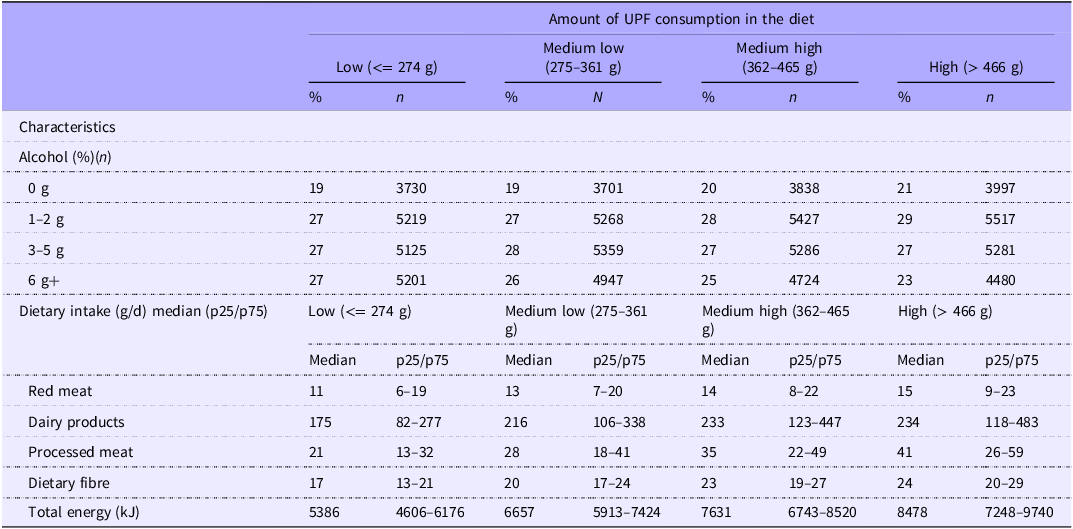
A consistent upward trend was observed in the intake of energy, dairy products, red meat, processed meat and dietary fibre, across the UPF quartiles. Conversely, there was a notable downwards trend in alcohol consumption across the UPF quartiles (see Table 3).
Baseline dietary characteristics of the NOWAC study participants according to UPF quartiles

NOWAC, Norwegian Women and Cancer; UPF, ultra-processed food.
The food groups that made up the largest percentage (% of g/d) of the UPF intake were grains, baked goods, seeds, and nuts (35·5 %) and beverages (21·3 %), and fish and shellfish (12 %) (Appendix 4). The median intake of UPF food groups (g/d) increased across increasing quartiles of UPF consumption, with dairy products as an exception (Appendix 5). The trends were the same for quartiles of UPF based on energy consumption (Appendix 6).
Based on the findings in Table 3, wherein the total energy intake increased across the UPF quartiles, energy intake may potentially act as a confounder. Thus, the results from the multivariable energy-adjusted model will be reported. In the multivariable and energy-adjusted model, a high UPF intake was statistically significantly associated with CRC risk compared with a low UPF intake (HR = 1·24; 95 % CI 1·04, 1·49); P for trend = 0·02) (see Table 4). When evaluating the risk for anatomic subsites of the colorectal tract separately, high consumption of UPF was statistically significantly associated with increased risk of colon cancer (HR 1·31 (95 % CI 1·05, 1·63); P for trend = 0·02). Moreover, high consumption of UPF was associated with a 58 % increased risk of right-sided colon cancer (HR = 1·58; 95 % CI 1·19, 2·09; P for trend < 0·001). High UPF intake was not significantly associated with left-sided colon and rectal cancer.
Risk of colorectal cancer † associated with UPF intake in the NOWAC study

UPF, ultra-processed food; NOWAC, Norwegian Women and Cancer; HR, hazard ratio.
* Multivariable-adjusted = multivariable model adjusted for age, educational level, smoking status, height, menopausal hormone therapy use and physical activity.
** Multivariable and energy-adjusted = Multivariable-adjusted + adjusted for energy intake.
† HR with 95 % CI based on Cox proportional hazards regression.
When UPF consumption was modelled based on energy contribution rather than weight, there was no association with CRC or any of the colorectal subsites. For instance, the multivariable risk for right-sided colon cancer estimated in the highest quartile of UPF (kJoule/d) was (HR = 0·99; 95 % CI 0·80, 1·22; P for trend 0·99) (Appendix 7).
Among participants with a high BMI (≥ 25 kg/m2), a trend similar to that observed in the main analysis was observed, showing a significant association between high UPF intake (g/d) and risk of CRC (HR 1·33; 95 % CI 1·02, 1·74; P for trend = 0·04) (see Table 5). Conversely, no significant trend was observed for participants with a low BMI (< 25 kg/m2). Participants with a low intake of processed meat (< 30 g/d) showed a statistically significant association between high UPF intake and risk of CRC compared with a low UPF (HR1·39; 95 % CI 1·07, 1·80; P for trend = 0·02). While no linear trend was observed for high dietary fibre intake (≥ 21 g/d), a combined high UPF and low dietary fibre intake showed a statistically significant association with an increased risk of CRC compared with a low UPF and fibre intake (HR 1·34; 95 % CI 1·04, 1·73; P for trend = 0·03). Notably, borderline associations were observed across multiple quartiles.
Risk of colorectal cancer † associated with UPF intake (g/d) in strata of BMI, intakes of dietary fibre and processed meat in the NOWAC study

UPF, ultra-processed food; NOWAC, Norwegian Women and Cancer; HR, hazard ratio.
* Multivariable Cox proportional hazard model adjusted for age, educational level, smoking status, physical activity, menopausal hormone use, height and total energy.
† Hazard ratios with 95 % CI based on Cox proportional hazards regression.
The sensitivity analyses, which excluded the first three years of follow-up for all participants, yielded comparable effect estimates to the main models, indicating no substantial impact on the primary analyses and the analysis of CRC subsites when follow-up time was omitted. The main analyses were also rerun with an imputed dataset, and this yielded similar results as the main analyses.
Discussion
This study aimed to investigate the association between UPF intake and risk of CRC in NOWAC. Overall, a high UPF intake was statistically significantly associated with increased CRC risk compared with a low UPF intake among women in NOWAC. Further, the findings suggested that a high UPF intake is associated with right-sided colon cancer and that the right-sided colon explain the association between high UPF intake and CRC risk. No statistically significant associations were found between a high total UPF intake and cancer on the left side of colon or in the rectum compared with low UPF intake. The results indicate that a high BMI and low dietary fibre intake, but not intake of processed meat, may be potential explanations behind the association between a high UPF intake and increased risk of CRC. Analyses based on the energy contribution of UPF rather than the weight did not show any consistent pattern.
Comparison with other studies
Results from this and other studies both offer intriguing parallels and disparities. A French cohort with 105 000 participants found no overall association but a borderline significant association between high UPF intake and risk of CRC(Reference Fiolet, Srour and Sellem23). Other studies showed a statistically significant association between a high intake of UPF and CRC(Reference Romaguera, Fernández-Barrés and Gracia-Lavedán5,Reference El Kinany, Huybrechts and Hatime21) or colorectal adenomas(Reference Fliss-Isakov, Zelber-Sagi and Ivancovsky-Wajcman4), in comparison with a low UPF intake. Further, a large European cohort study found that a substitution of 10 % of UPF with an equal amount of minimal processed food reduced the risk of CRC, showing that reducing UPF and increasing minimally processed food can be an important strategy in preventing CRC. Diverging from the other findings, in a large US cohort study, an association was found among men only contradicting the previous results and suggesting that the impact of UPF as a risk factor for CRC may vary between sexes(Reference Wang, Du and Wang19).
High consumption of UPF has been linked to poorer dietary quality(Reference Moubarac, Batal and Louzada39) and increased risk of weight gain and obesity(Reference Poti, Braga and Qin12,Reference Hall, Ayuketah and Brychta15,Reference Miclotte and Van de Wiele40) which could potentially be underlying factors explaining the association between high intake of UPF and CRC(2). Results in this study suggest that high BMI could be an explaining factor behind the association between high UPF intake and risk of CRC, or that persons with overweight or obesity are particularly vulnerable for possible carcinogenic aspects of UPF. However, previous studies have adjusted for BMI and still got statistically significant estimates(Reference Romaguera, Fernández-Barrés and Gracia-Lavedán5,Reference El Kinany, Huybrechts and Hatime21) . Thus, there might be factors other than BMI, or in addition to BMI, which play a role in explaining the association between high UPF intake and CRC risk. Our study shed some light on the complex relationship between energy intake, BMI, UPF and cancer, but more research is needed to determine potential causality.
In this study, a combination of high UPF and low dietary fibre intake showed a statistically significant association with an increased risk of CRC compared with a low UPF intake. Notably, this association was observed across multiple quartiles, providing support for the existing evidence that low dietary fibre intake is a risk factor for CRC(2). Additionally, findings from a case–control study observed that dietary fibre weakened the significant association between high UPF intake and CRC risk(Reference El Kinany, Huybrechts and Hatime21). Thus, it is worth mentioning that grains, primarily in the form of store-bought bread, made a substantial contribution to UPF intake (35·5 %) in this study. As such store-bought bread, being a substantial component of UPF intake, may contribute to a high intake of fibre, potentially weakening the association between high UPF intake and CRC. Recent studies imply that certain UPF may have beneficial dietary profiles, as supported by a study where 26 % of healthy foods were classified as UPF(Reference Romero Ferreiro, Lora Pablos and Gómez de la Cámara41), and other studies that found that certain subgroups of UPF were associated with lower risk of CRC(Reference Wang, Du and Wang19) and type 2 diabetes(Reference Chen, Khandpur and Desjardins42).
Processed meat, convincingly associated with increased CRC risk, contains potentially carcinogenic substances formed during processing, such as Na nitrites and PAH, which can damage DNA and contribute to CRC(2,Reference Cheng, Lam and Gopalan6,Reference Zhu, Wang and Zhao8) . That a high UPF intake and low processed meat intake exhibited a significant association with increased CRC risk suggests that processed meat does not fully explain the UPF and CRC association. These findings are consistent with a case–control study on UPF intake and colorectal adenomas(Reference Fliss-Isakov, Zelber-Sagi and Ivancovsky-Wajcman4).
Multiple studies examining the association between UPF and CRC have adjusted for unhealthy aspects of dietary intake, such as lipids, Na and Western dietary patterns, yet still found significant associations(Reference Romaguera, Fernández-Barrés and Gracia-Lavedán5,Reference Wang, Du and Wang19,Reference Fiolet, Srour and Sellem23) . These findings could potentially be explained by the presence of non-nutrient components often added or formed during processing of UPF. Such components may include additives, molecules formed during the preparation over high heat and molecules from packaging, as these have been shown to cause oxidative stress or damage to the DNA and further lead to CRC(Reference Cheng, Lam and Gopalan6,Reference Zhu, Wang and Zhao8,Reference Deng, He and Wan9) . Therefore, the mechanisms underlying the association between high UPF intake and CRC risk may extend beyond dietary quality. We opted not to adjust for unhealthy foods or overall dietary quality but performed energy adjustments and stratified analyses as outlined above. High UPF consumers exhibited higher energy intakes, and adjustment for energy intake strengthened the estimates, indicating that energy intake acted as a confounding factor in our analyses. However, when UPF consumption was expressed per unit of energy rather than by weight, no significant associations were observed between UPF intake and CRC. This finding suggests that non-nutrient factors might be contributing to our results.
High UPF intake may impact colorectal subsites differently due to variations in physiology, anatomy, environmental carcinogens and/or genetic mechanisms across the subsites(Reference Li and Lai43). Results from this study support these findings as a statistically significant association with high UPF intake was observed only with right-sided colon cancer. Previous UPF-CRC/adenoma subsite results have been mixed(Reference Fliss-Isakov, Zelber-Sagi and Ivancovsky-Wajcman4,Reference Romaguera, Fernández-Barrés and Gracia-Lavedán5,Reference El Kinany, Huybrechts and Hatime21) . The lack of association between high UPF intake and cancer in the left side of the colon and rectum in this study might be due to fewer cases. Furthermore, recent findings suggests that different risk factors for CRC can have distinct effect even within right- and left-sided colon(Reference Wang, Lo and He24). Still, the subdivision of the colorectal tract into three subsites could have attenuated the association in the current study, potentially leading to under-detection of certain associations with high UPF intake in specific areas of the colorectal tract. Nonetheless, the role of diet on specific colorectal anatomic subsites remains unclear.
Strengths and limitations
There are several strengths in this study. First, it has a prospective cohort design with a large sample size and extended follow-up duration, thereby enhancing the robustness of the risk estimates and minimising selection bias. Moreover, the selection of women from the Norwegian Population Register through random sampling in NOWAC helps mitigate the risk of selection bias. Additionally, a previous study assessing data reproducibility in NOWAC found no major source of selection bias(Reference Parr, Veierød and Laake28). Second, foods were classified according to Nova, using guidelines developed by IARC(Reference Huybrechts, Rauber and Nicolas31) and Monteiro(Reference Monteiro, Cannon and Moubarac13,Reference Monteiro, Cannon and Levy32) , which reduces the chances of misclassification. Third, this study examines the association between UPF intake, expressed by both weight and energy, and risk of cancer in colorectal subsites. Additionally, NOWAC benefits from reliable cancer registry data(Reference Larsen, Småstuen and Johannesen44), and dietary data from NOWAC that is considered good for ranking the participants(Reference Parr, Veierød and Laake28).
Some limitations should be acknowledged. First, dietary data were collected using self-reported FFQ which are less detailed compared with open methods such as 24-h recalls or food diaries. This could introduce systematic error as the use of broad questionnaire surveys might lead to decisions on regular intake based on general consumption standards that differ from actual intake. Due to lack of details in the FFQ, we could not further divide UPF into subgroups and assess potential heterogeneity within the UPF group. Such more detailed analyses, where data allow, are essential. Combined with substitution analyses, they can help disentangle the potential heterogeneous associations of replacing minimally processed foods with UPF in relation to health outcomes. The observed disparity in energy intake between the low and high UPF intake groups can raise questions about potential underreporting in the low UPF intake group and bias. The results emphasise the necessity of adjusting for energy intake.
Second, social desirability bias may have influenced the FFQ data. Third, while the collected dietary data from the FFQ have been validated, the study only assessed foods and nutrients and not information about food processing directly(Reference Parr, Veierød and Laake28). As a result, the validity for food processing might be poorer and misclassification of foods might have occurred. Further, it is worth noting that the Nova system may not be the optimal classification system as it has been criticised for being too heterogenous and imprecise(Reference Gibney, Forde and Mullally45). However, Nova can be regarded as the most widely recognised food processing classification system today, as it is acknowledged in reports from the FAO(46) and included in dietary guidelines in multiple countries(47–49). Further, only baseline data were used and thus participants may have changed their diets over time. Therefore, risk estimates might have been attenuated, since we could not account for within-person dietary variations over time. Fourth, we did not formally test for mediation. Lastly, this study includes only women and uses nutritional data collected in only one country, thereby limiting the generalisability of the findings to men and populations with dissimilar diets.
Implications for public health
UPF has become a hot topic among researchers and consumers. Studies have indicated that UPF may have diverse health effects(Reference Elizabeth, Machado and Zinöcker50). Considering the current evidence and attention surrounding UPF, it is worth discussing whether the term should be utilised in public communication and dietary guidelines, such as the dietary guidelines for the prevention of CRC, as a strategy to reduce the risk of CRC and reach the SDG target 3.4 by 2030(51). However, as the UPF category encompasses foods that are associated with both beneficial and adverse health outcomes(Reference Wang, Du and Wang19,Reference Romero Ferreiro, Lora Pablos and Gómez de la Cámara41) , it may pose a challenge for consumers to determine whether an UPF item is healthy or unhealthy. Therefore, further refinement of the Nova system and development of guidelines to better interpret how UPF with good nutrition quality should be evaluated may be necessary before its use in public communication and dietary guidelines.
Conclusion
In summary, the evidence presented in this study does show a significant association between high UPF intake and increased risk of CRC among women in the NOWAC study. Further, the results suggest a statistically significant association between high UPF intake and increased risk of cancer in the right side of the colon. However, when we modelled UPF based on energy contribution, we found no associations with CRC or its subsites. The underlying mechanisms explaining the association remain unknown, although low dietary fibre intake and high BMI have been implicated. However, other results also suggest that mechanisms extend beyond BMI and dietary quality. Considering the limited number of studies available, it is premature to establish a causal relationship between high UPF intake and CRC risk. Further longitudinal studies investigating the relationship between a high UPF intake, UPF subgroups and CRC risk are needed to determine causality.
Acknowledgements
The authors thank all the participants who contributed information to the NOWAC study.
The study has used data from the Cancer Registry of Norway. The interpretation and reporting of these data are the sole responsibility of the authors, and no endorsement by the Cancer Registry of Norway is intended nor should be inferred. Where authors are identified as personnel of the International Agency for Research on Cancer/WHO, the authors alone are responsible for the views expressed in this article and they do not necessarily represent the decisions, policy or views of the International Agency for Research on Cancer/WHO.
This research received no specific grant from any funding agency, commercial or not-for-profit sectors.
R. M. and G. S. contributed to the Nova classification process, analysis and interpretation of the data; R. M. drafted the manuscript; G. S. drafted the revisions; R. M., G. S. and I. H. critically revised the manuscript. All authors read and approved the final manuscript.
There are no conflicts of interest.
The NOWAC cohort received approval for the collection and storage of the questionnaire information. All data were stored and handled according to the permission provided by the Norwegian Data Protection Authority (ref.nr. 07–00030). Ethical approval for the NOWAC cohort was obtained from the Regional Committee for Medical and Health Research Ethics (REK) (ref.nr. 200300119–5). All participants provided informed consent before study enrolment in NOWAC. Participants have been informed that participation is voluntary and that they at any time can withdraw from the study.
The datasets generated and/or analysed during the current study are not publicly available due to privacy of the data. Information on how to get access to data from the Norwegian Women and Cancer study can be found here: https://uit.no/research/nowac_en#region_783025
Supplementary material
For supplementary material/s referred to in this article, please visit https://doi.org/10.1017/S0007114525105114




 Open access

