




Introduction
On 5 January 1961, Nigeria expelled the French ambassador after France exploded a third atomic device in the Algerian Sahara. This was a bold move—a surprising one, even. Western observers had expected newly independent Nigeria to act as a counterweight to more ‘radical’ states like Ghana. The British especially counted on Nigerian Prime Minister Abubakar Tafawa Balewa.Footnote 1 By all accounts, Balewa was a cool-headed man; his poise had earned him the nickname of ‘Golden Voice’. Yet no other African leader at the time—not even Ghana’s Kwame Nkrumah—matched Balewa’s decision to expel a French ambassador. This act seemed all the more extreme because it involved an African state confronting a European colonial and nuclear power, one that was particularly jealous of its global standing. Indeed the ambassador’s expulsion provoked French President Charles de Gaulle’s unshakable ire. It may well have played a role in Nigeria’s difficulties negotiating with the European Economic Community in the early 1960s, and even French involvement in the Nigerian Civil War years later.Footnote 2
Why did Balewa do it? France’s Saharan nuclear tests were a global event in many respects.Footnote 3 For one, they signified the rise of a fourth nuclear power, after the United States, the USSR, and Great Britain. But they were also an African event. Nowhere on earth did nuclear tests coincide with the decolonization of an entire continent as they did in the case of French tests in the Sahara. It is thus not surprising that these tests would interact with the politics of African independence. The more surprising element is that what seemed like straightforward anti-nuclear and anti-colonial politics had at least as much to do with inter-African dynamics—and, in this specific case, with Nigeria’s relationship with Ghana (Figure 1).
Abubakar Tafawa Balewa and Kwame Nkrumah shaking hands, c. 1959–60 (in the middle, Samuel Akintola, premier of the western region at Nigerian independence on 1 October 1960). Source: Trevor Clark, A Right Honourable Gentleman: Abubakar from the Black Rock (Edward Arnold, 1991), 408–9.

Figure 1 Long description
The image features three men in traditional and formal attire shaking hands. On the left, Abubakar Tafawa Balewa, the first Prime Minister of Nigeria, is dressed in a white traditional outfit. In the middle, Samuel Akintola, the premier of the western region at Nigerian independence, wears a dark traditional outfit. On the right, Kwame Nkrumah, the first Prime Minister of Ghana, is dressed in a light-colored suit with a tie. The background is blurred, focusing attention on the handshake between Balewa and Nkrumah, symbolizing a significant political moment in African history.
By reconstructing the ambassador’s expulsion, this article argues that, for decolonizing states, questions of international affairs uniquely crystallized interactions between domestic and regional politics. When France announced its intention to use the Algerian Sahara for its first nuclear tests, the African continent rose in protest. Nkrumah, as one of Africa’s first independent leaders, was instrumental in sustaining this momentum. He integrated the question of French tests into his pan-Africanist agenda, performing a kind of politics that was supranational in both content and form.
But by intensifying interactions between domestic and regional politics, the practice of foreign affairs paradoxically revealed the limits of inter-African solidarity. Through discussions of mutually agreed upon subjects, like the imperialist nature of French nuclear tests, African countries began accusing each other of subversion.Footnote 4 It is tempting to resolve this paradox by distinguishing ideology from realpolitik or by noting that with time, the nation-state overcame dreams of supranational integration. However, it is more useful to think of inter-African solidarity and inter-African friction as two sides of the same coin.Footnote 5 In Nigeria, Balewa’s domestic critics became adept at turning Nkrumah’s anti-imperialist rhetoric against their own government. They used the Saharan test controversy to undermine the prime minister’s legitimacy, accusing him of lacking ‘dynamism’ in foreign affairs. In return, the government in Lagos, as in many other African capitals, began charging its domestic opposition with subversion.Footnote 6 When African elites spoke of ‘subversion’, they did not necessarily mean superpower-backed agitation, nor even neocolonial infiltration. They also were immediately concerned with their own African neighbours interfering in domestic affairs. So, at the very same time as the transnational nature of African politics helped Africa emerge as a geopolitical unit, it forestalled more institutionalized and lasting forms of supranational integration.
The traction of international affairs on the more localized politics of independence meant that many amongst the first generation of African leaders began experiencing the trials and tribulations of post-colonial politics in the late colonial period—that is, before they became fully sovereign. Nigeria was still a colony when it first engaged with the question of French nuclear testing in 1959. Through this issue, Nigeria’s political class began rehearsing the role it would seek after independence. But despite apparent unity against French tests, Nigerians’ early interest in foreign affairs placed unexpected strains on the already fragile balance of federal politics—a fragility underscored by vicissitudinous talks of regional secession. Thus the question here is not solely about rupture between the colonial and post-colonial state. It is also about continuity in the inter- and intra-African political negotiations which straddled independence.
Perhaps then it is in the late colonial period that we should see the harbinger of the 1970s.Footnote 7 Scholars often frame the turn of the 1960s as a time of optimism.Footnote 8 By contrast, the late 1960s and 1970s are associated with disillusionment, due mostly to economic disappointment.Footnote 9 But the ‘political kingdom’ which Nkrumah famously insisted would bring on the economic one was never secure.Footnote 10 This was not just because forms of colonial domination persisted while Cold War pressures mounted. It was also because the struggle for independence transcended anti-colonialism, producing new political interests and demands internally. The stakes lay not only in ending colonial rule, but in negotiating the distribution of power without it.Footnote 11 If this partly accounts for the widespread tendency towards centralization in the post-colonial state, the intermestic challenge described above explains the reflex to monopolize foreign affairs in particular. This political dynamic in turn helps account for why many leaders, including Nkrumah and Balewa, were out of power, either deposed or assassinated, by the mid-1960s – that is, before economic disillusionment settled in.
All this leads us to a broader historiographical observation. The imperative to write the Global South into modern world history has encouraged scholars to work through two main paradigms—the Cold War and decolonization. The complementarity of these paradigms has increasingly been recognized,Footnote 12 and lends itself to studying the intersections between the nuclear age and the end of empire.Footnote 13
And yet, focusing on the Cold War and decolonization can make us lose sight of dynamics endogenous to the very regions we try to foreground. If Western scholarship has become better at acknowledging the strengths and limits of the Cold War lens,Footnote 14 descriptions of what lies beyond it easily fall back on narratives of transnational anti-colonial solidarity or the Global South’s balancing of East and West. This article instead emphasizes that interactions between domestic and regional politics are key to understanding how African actors navigated this period of unprecedented change.Footnote 15 Reciprocally, recognizing African foreign relations as an important and serious object of global historical enquiryFootnote 16 shows that not all nuclear history is Cold War history—and not all decolonization history is about metropole–colony relations.
Eschewing the unhelpful distinction inherited from contemporary observers between a ‘radical’ Ghana and a ‘moderate’ Nigeria,Footnote 17 the article starts from the simple observation that both countries’ international outlooks centred on Africa.Footnote 18 Likewise, Balewa and Nkrumah faced similar dilemmas in retaining the goodwill of extra-African actors while also consolidating their legitimacy by meeting anti-imperial demands.Footnote 19 More importantly, the article emphasizes the extent to which Ghanaian and Nigerian foreign policies evolved in dialogue with one another.Footnote 20 This feedback loop suggests that while there was Nigerian resistance to supranational integration, Ghana also contributed to undermining its own pan-African ideal.Footnote 21
To the extent that Nigeria and France share no colonial history, this is also a story of entangled imperial endings. Reconstructing the fraught and forgotten beginnings of Franco-Nigerian relations shatters the myth of historical friendship promoted by their current leaders.Footnote 22 The article thus offers contextualization to longer patterns in the reconfiguration of Africa’s international relations, moving beyond narratives of neo-colonialism and the new cold war.Footnote 23
The remaining challenge is the post-colonial African archive, often less rich than for the colonial period. This makes it difficult to assess continuity and change in the years surrounding independence. While relying on British and French colonial, diplomatic, national, political, and atomic archives, this article also uses regional Nigerian archives, newspaper collections from the national archive in Ibadan, Senegalese documents, parliamentary records held at the former Nigerian High Commission, and personal papers of historical West African actors. Conversations with the late Ambassador Omotayo Ogunsulire, who graduated amongst Nigeria’s first cohort of twelve diplomats on the eve of independence, provided a sense of the political atmosphere of the time and helped verify conclusions drawn from sparser post-colonial documentation.
The article follows the overlapping chronologies of French nuclear tests and Nigerian independence. It begins by examining how the prospect of Saharan testing catalysed Nigerian demands for foreign policy engagement even before formal independence, exposing at once lines of fracture domestically and in grassroots alliances transnationally. It then suggests that the start of French nuclear tests in February 1960 united Nigerians in their aspiration to rival Ghana for regional influence, but that Balewa missed an opportunity to lead African opposition to France. Next, it reveals the importance of nuclear issues in Nigeria’s Africa-centred diplomacy after independence in October 1960. The article then demonstrates that the expulsion of the French ambassador in January 1961, following the third French test (but the first to take place after Nigerian independence), signified Balewa’s attempt to consolidate his legitimacy through a spectacular anti-imperial move against France, even as he discreetly signed a defence pact with Britain, the former colonial power. Finally, the article shows how the episode facilitated Nigeria’s diplomatic pivot toward francophone African states while exposing unsustainable contradictions domestically as Balewa centralized foreign policy.
The lead-up to French nuclear tests and Nigeria’s early demand for foreign policy
African anti-nuclear sentiment predated the controversy over France’s plan to test nuclear weapons in the Sahara and intersected with older anti-colonial and Cold War dynamics. The critique of the nuclear order as a racialized one had existed in Black transatlantic thought since the 1945 bombings of Hiroshima and Nagasaki. It was articulated most notably by the Trinidadian pan-Africanist, George Padmore, who became the main strategist behind Nkrumah’s foreign policy.Footnote 24 African unionized workers, students, and women also discussed nuclear issues in international communist-affiliated organizations such as the World Federation of Trade Unions, the World Federation of Democratic Youth, and the Women’s International Democratic Federation.Footnote 25
But the Saharan testing controversy marked a turning point. Anti-nuclear sentiment was reterritorialized beyond anti-colonial and Cold War dynamics to help Africa emerge as a political entity in its own right. The prospect of France using the continent to test nuclear weapons catalysed a distinctly African response that brought nuclear issues from the margins to the mainstream of pan-African discourse. At the same time, French tests revealed lines of fracture which had less to do with nuclear than inter-African politics.
On the eve of independence, Nigeria’s demographic and natural resources positioned it to become a regional hegemon and contender with Ghana, the former sister colony which achieved independence first and was now promoting a vision of pan-African independence. Ready to sign a defence pact with Britain and surrounded by francophone states sceptical of Nkrumah’s overtures, Nigeria encouraged contemporary observers to count it as a moderating pro-Western force.
Throughout the 1950s, a series of constitutional reforms had transferred powers from Britain to Nigeria, and from the federal administration to regional governments and legislatures. By 1959, Nigeria’s three main regions had acquired self-government. They had substantial political competences and economic autonomy vis-à-vis the federal government, which, as we shall see, began eyeing foreign affairs as a domain through which to project power both domestically and regionally.Footnote 26 Each of Nigeria’s regions was dominated by one of the colony’s three major parties, and the leader of that party served as regional premier. In the east, the National Council of Nigeria and the Cameroons (NCNC) held a majority of seats in the regional legislature under the pan-African nationalist, Nnamdi Azikiwe. In the west, it was the Action Group (AG), under Obafemi Awolowo. And in the north, the Northern People’s Congress (NPC) was led by Ahmadu Bello. At the federal level, between 1957 and 1959, the government was a coalition of these three parties, with Balewa, also NPC vice-president, at its head. After the federal elections of December 1959, the NPC and NCNC formed a new coalition, while the AG became the party of opposition.
In February 1959, a motion was brought to the House of Representatives calling on the federal government to make representations to the French against their planned nuclear tests.Footnote 27 This was the first time an issue of foreign affairs was debated. The British still controlled external affairs, so technically, before 1 October 1960, diplomatic questions could be discussed, but the government could do little about them. Prime Minister Balewa initially used the ambiguous constitutional situation to his advantage. While acknowledging the broad sentiments against French plans, he cited Nigeria’s colonial status to justify his inaction.Footnote 28 As time went on, however, this argument did less to absolve Balewa from responsibility, and more to provide ammunition to his critics.
On one level, Nigerian anti-nuclear sentiment was part of a global phenomenon.Footnote 29 The fear of radioactivity was invoked by recalling the US atomic bombings of Japan during the Second World War and its more recent Castle Bravo test which contaminated Japanese fishermen. Laypeople and scientists in Nigeria followed debates about radiation risk and extrapolated their meanings to local contexts. Nigerians worried that if France began testing nuclear weapons in the Sahara, the seasonal Harmattan wind would spread radioactive debris all the way from the desert to the western coast of Africa, harming Nigerians and their environment for generations. As in other countries, anxieties about radiation hazards tended to fixate on natural phenomena, foodstuffs, and symbolic objects: locust swarms in Morocco, milk in the United States, tuna in Japan.Footnote 30
But two factors made it particularly difficult for Nigeria’s political class to ignore grassroots anti-nuclear protests: the political profile of activists and the transnational nature of contestation. First, while women, unionists, academics, and students led anti-nuclear movements globally, in Nigeria these groups’ significance also lay in their having spearheaded anti-colonial action since the interwar period.Footnote 31 However, they remained marginalized from state power even as politics Nigerianized. Women, for instance, were often relegated to social work, absorbed into male-dominated parties, and sometimes even clashed with the government directly.Footnote 32 Their anti-nuclear protests represented a litmus test for the government’s ability and willingness to represent them.
Second, the pattern of anti-nuclear protests revealed Ghana’s influence on Nigerian politics.Footnote 33 Many prominent Nigerians who led organized opposition to French tests had historical links with the broader pan-African movement, whose epicentre was now Accra. University College Ibadan’s Professor Chike Obi (one of the first Africans to hold a PhD in mathematics) was affiliated with the All-African Peoples Conference and organized Nigeria’s first anti-nuclear demonstration, calling for a boycott of French establishments.Footnote 34 Likewise, Olufunmilayo Ransome-Kuti, the anti-colonial activist who attended the first pan-African gathering in Ghana in 1953, Footnote 35 mobilized Nigerian women against French nuclear tests.Footnote 36
The main difference between Nigeria and Ghana was that the Ghanaian leadership more proactively funnelled anti-nuclear sentiment.Footnote 37 In July 1959, Nkrumah wrote an open letter to France formally asking it to forgo its tests. In the letter, Nkrumah claimed to speak for all Africans, positing not only the geopolitical unity of the continent, but also his leadership role within it.Footnote 38 Shortly after, Nigerians residing in Ghana petitioned the British high commissioner asking Britain to oppose French tests.Footnote 39 Nigerian trade unionists also invited their Ghanaian counterparts to Ibadan to develop joint action against France.Footnote 40 As in Ghana, the tactics of choice were petition-writing, boycotts, and protests around French buildings. But if Nigerian anti-nuclear activism seems to have erupted more spontaneously from below, this was partly because Nigerians followed developments in Ghana closely.Footnote 41
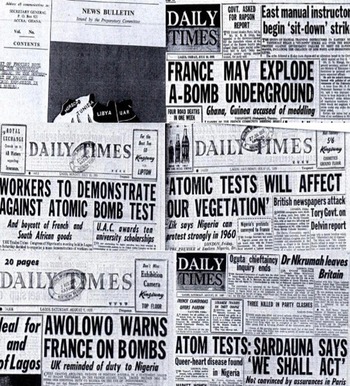
While Ghana understandably had more political and diplomatic leverage as an independent country, Nigerian politicians, across party lines, stepped in to echo the concerns of their constituencies.Footnote 42 By late summer 1959, all regional premiers had condemned French plans (see Figure 2). Most significantly, Ahmadu Bello, northern premier and leader of Balewa’s own party, travelled to Paris to protest.Footnote 43 This directly contradicted Balewa’s claim in parliament that no direct protest could be made until independence. Bello was welcomed by important figures including Raymond Offroy, the Quai’s chargé d’affaires for the French community who would become Nigeria’s French ambassador. Upon returning from Paris, Bello demanded that Balewa lead a protest delegation of regional premiers to London.Footnote 44 The request was echoed in the northern and federal houses.Footnote 45
This selection of cuttings shows reactions to French tests throughout the summer of 1959, from Nkrumah’s protest letter to France, closely followed by Balewa’s first condemnation on 14 July (Bastille Day), and grassroots mobilization, joined by public statements by the three regional premiers. Sources: NAI newspaper collection, apart from top left (‘Text of Protest Note from the Government of Ghana to the Government of France on Atomic Explosion in the Sahara’, AAPC News Bulletin, AS I 165, RAK).

Figure 2 Long description
The image is a collage of Daily Times newspaper front pages from 1959. The headlines prominently feature reactions to French atomic bomb tests. One headline reads 'Workers to demonstrate against atomic bomb test,' another states 'France may explode A-bomb underground,' and another warns 'Atomic tests will affect our vegetation.' The collage includes various dates and issues, highlighting the public and political responses in Nigeria and Ghana. The newspapers also mention significant figures like Dr. Nkrumah and regional premiers, indicating a coordinated effort against the tests.
Faced with this challenge, as well as looming federal elections in December that would decide who would lead Nigeria through independence, Balewa began isolated incursions into foreign affairs.Footnote 46 In an apparent concession to Bello’s demand, the prime minister announced he would head an official protest delegation to London. However, when he visited England in September 1959, he was accompanied by federal government members only. He excluded regional premiers like Bello. The national consensus against French tests belied domestic tensions, particularly between the federal and regional governments. Nigeria’s regions had greatly benefited from successive power devolutions. While the Saharan test controversy seemed to offer regional leaders new leverage, Balewa identified foreign affairs as a domain which he could start carving out as a largely federal concern.
Balewa was more interested in showing he was taking the lead than in genuinely championing the health and political concerns driving Nigerian anti-nuclear sentiment. He confided in Ralph Grey, acting governor-general in Lagos, that he had ‘never personally been alarmed’ about French fallout, but felt ‘politically obliged’ to head a protest delegation to England.Footnote 47 Nigerian and British officials alike largely dismissed the risk of radioactive fallout. During Balewa’s visit, British atomic scientists of international renown confirmed him in his belief that French tests would be safe.Footnote 48 Rather than pushing firmly for representations to the French, Balewa expressed embarrassment that Nigeria created difficulties for the British government on the eve of its own general election.Footnote 49 Ironically, given Nigerian anti-nuclear sentiment’s links with anti-imperial mobilizing, Balewa’s visit became an occasion for Nigerian–British connivance at the highest level. He and his British counterpart, Harold Macmillan, recognized their mutual interest in disarming anti-nuclear sentiment in Nigeria.Footnote 50
What mattered to Balewa at this stage was presenting his visit as an exercise in foreign affairs, conducted successfully by him, as the federal head of government. He expected British help in managing public relations back home, requesting that his visit’s outcome be communicated to regional governors through Grey. In Balewa’s mind, this would signal clearly that as a matter of external affairs, French tests were ‘exclusively the concern of the Government of the Federation’.Footnote 51 This meant not only that Balewa could engage in foreign affairs despite Nigeria’s colonial status, but that only the federal government could.
Balewa probably calculated that asserting federal control over foreign affairs in this way would simultaneously cut the ground from under Nkrumah’s feet. The Nigerian prime minister, who held Nkrumah personally responsible for the panic in his country, was eager to put the whole issue to bed: ‘[e]ven Ghana, which brought us into all this business, is now quiet’, he observed, relieved, after his England visit.Footnote 52
But this moment of respite was short lived. Soon, Nkrumah mocked Balewa publicly for accepting British safety assurances. An editorial from the Ghana Times (the main press organ of Nkrumah’s Convention People’s Party) regretted, in stinging terms, that ‘an African leader of the stature of Alhaji Balewa should have succumbed so easily to lollipops in the form of an assurance to the effect that any nuclear explosion in the Sahara would have no harmful effects on Nigeria, which of course, implies all Africa’.Footnote 53 Contrasting with the subservient Balewa, Nkrumah presented himself as a truly independent leader, one concerned for the welfare of all Africans, not just Ghanaians.
Nkrumah’s criticism of Balewa reverberated through Nigerian politics. His accusation of naïveté was repeated by western premier Obafemi Awolowo, who sought to bolster his own position ahead of the federal elections.Footnote 54 Although Balewa was returned to power after December 1959, with the AG now in opposition and independence fast approaching, challenges to the prime minister’s domestic authority increased, and foreign policy was a particular source of contention.
Thus, by intensifying interactions between domestic and regional dynamics, African engagement with the French nuclear testing controversy produced distinctly local politics. Through the early practice of foreign affairs, Nigerians rehearsed their international role, bringing cohesion to the federation, but also giving civil society, regional premiers, and the opposition new leverage to pressure the federal government on the eve of independence.
The beginning of French tests: A false start for Nigeria’s Africa-focused foreign policy?
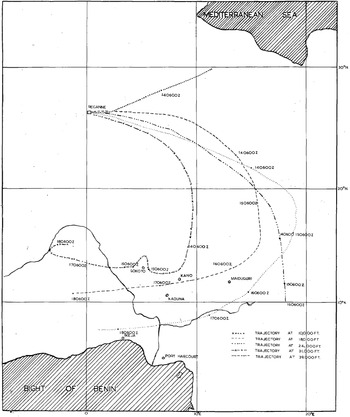
When the French finally exploded their first atomic device in the Algerian Sahara on 13 February 1960, despite overwhelming condemnation in Africa, Nigeria’s federal government was presented with a unique opportunity to consolidate its domestic legitimacy and further its regional ambitions ahead of independence. Shortly after the test, Balewa was privately informed by the British, who had installed a network of fallout monitoring stations in Nigeria after his September 1959 protest visit, that radioactive debris had reached West Africa despite their best predictions (see Figure 3). The data now in Balewa’s possession vindicated concerns Africans had been voicing for months. As the prime minister’s loyalty swung firmly to his people at last, he promised himself to tell Nigerians ‘all the facts’.Footnote 55 The weeks went on, however, and the government failed to use the evidence of radioactive fallout to lobby France to stop its tests, even as these tests brought Nigerians together ahead of their first big stand-off with Ghana on the African scene.
Map showing that French radioactive fallout from the first Saharan test reached West Africa. Source: Extracted from the joint UK–Nigeria Committee Report, KB1725-U, Aldermaston Archives, UK.

Figure 3 Long description
The map illustrates the spread of French radioactive fallout from the first atomic test in the Algerian Sahara. It shows trajectories at various altitudes, marked with dashed and dotted lines, indicating the path taken by the fallout as it moves westward across Africa. Key locations such as Reggane, Kano, Maiduguri, and Port Harcourt are labeled, along with specific times and dates when the fallout reached these areas. The Mediterranean Sea and the Bight of Benin are also marked, providing geographic context. The map uses different line styles to represent trajectories at different altitudes, including 10,000 feet, 18,000 feet, 24,000 feet, 31,000 feet, and 39,000 feet.
The start of French nuclear tests united Nigerians behind the federal government. A few days after France’s second test on 1 April, the issue was debated in the House for the third time. Representatives thought the motion brought by Mr Omisade (Ife, AG) to condemn and protest to France transcended party divides. The government was expected to represent a collective feeling: ‘the Prime Minister has our full mandate, the mandate of the Nation, to do his worst against the worst done to us’.Footnote 56
In uniting behind the federal government, representatives were eager for Nigeria to outpace Ghana and lead African opposition to the French. The mover declared there was ‘a race wandering in Africa South of the Sahara in search of a hero’; this hero was Nigeria.Footnote 57 As Nigerians claimed their special African vocation, they inevitably measured themselves against Ghana. Crucially though, they did this less by countering Ghana’s supposed radicalism than by imitating Ghanaian propositions. Echoing previous Ghanaian proposals, one component of Omisade’s motion called for economic sanctions against France in the form of asset freezes and trade suspension.
Unbeknownst to the House, Balewa had unique data about French fallout which he could have used to argue that with further tests, radioactivity in Nigeria could accumulate, and therefore pose a real risk to African health. But this knowledge cut two ways. By acknowledging the discovery of nuclear fallout in Nigeria, the prime minister could also open himself to unwanted questioning. Balewa was starting to doubt whether telling Nigerians ‘all the facts’ was a good idea after all. He took the floor with a guilty conscience: ‘[a]fter my return [from England] some people started to say: “Well, the Prime Minister accepted the assurances given to him by the British scientists that there would not be any harmful effect upon the health of the people of Nigeria if France explodes a bomb”. I am not a nuclear scientist and I do not suppose any of those people who criticized my mission were nuclear scientists.’Footnote 58
This defensive stance betrayed Balewa’s feeling of responsibility for putting Nigerian lives at risk. But there was something else too. By mentioning the ‘people’ who had mocked him for readily accepting British safety assurances, Balewa made an unmistakable reference to Nkrumah. In a sense, the evidence of fallout had proved the Ghanaian leader right. Now perhaps Balewa’s need to save face competed with his concern about radioactivity.
Time was on Balewa’s side. With independence still a few months away, he made another rhetorical foray into foreign affairs without having to deal with their full implications. The House accepted a motion to protest to France through the ‘appropriate channels’, which still meant through the British.Footnote 59 Yet reversing what he had argued one year before, Balewa stated: ‘[t]hough in name and legally we are not independent, the Prime Minister is really responsible for the defense of the country, and [its] foreign relations’!Footnote 60 Balewa was assuming the foreign minister role, despite Britain’s continued responsibility for the country’s external affairs.Footnote 61 He borrowed from Nkrumah’s playbook, vowing to ‘do everything after we are independent, [and] not only to see that trade and commerce between France and Nigeria is banished or French assets are frozen in Nigeria’.Footnote 62
Balewa stopped short of blaming Britain and its misleading reassurances. British and Nigerian officials still entertained the idea of a special post-colonial relationship. Balewa consulted Britain on foreign policy, and reciprocally, Nigeria held a special place in Britain’s official mind.Footnote 63 Some have suggested, not unreasonably, that the British press helped stoke Nigeria’s self-image as an important African player.Footnote 64 Nigeria’s last governor-general, Sir James Robertson challenged the Commonwealth Relations Office’s policy of treating Ghana and Nigeria equally, lobbying for Nigeria to be considered an ‘old’ Commonwealth country, rather than a ‘new’ one.Footnote 65
But Balewa’s informal incursions into foreign affairs were starting to impact relations with Britain. In the eyes of the colonial metropole, Nigeria no longer appeared ‘a welcome patch of quiet water amongst all the troubled seas’.Footnote 66 After the April debate on French tests, Governor-General Robertson admitted he had taken Nigerian friendship for granted.Footnote 67 Others recalled the premonition of a previous governor-general: ‘if Nigeria is to retain influence among African states after independence it will have to behave like an African state and not like some Western appendage’.Footnote 68
Nigeria’s self-positioning as an important African player was indeed a key factor in London’s miscalculation. The April debate on French nuclear tests seemed to be less about France, or even radiation hazards, than about inter-African politics. In the House, Balewa invited representatives to ‘show that Conference in Accra how we feel in Nigeria’.Footnote 69 Nigeria was about to attend Nkrumah’s Positive Action Conference for Peace and Security in Africa, in its first big appearance on an African stage. Although initially the Conference was framed in response to the start of French tests, Nkrumah expanded the agenda to include items on South Africa and Algeria.Footnote 70 Perhaps this was meant to give the conference continental scope; the British noted that while Saharan tests interested North and West African delegations, Eastern and Central Africans were more concerned with the recent massacre of Black South Africans in Sharpeville.Footnote 71 The new all-encompassing agenda of the Conference unsettled Balewa.Footnote 72 There was clear tension between the two leaders. Balewa bluntly told Robertson that he ‘did not like Nkrumah at all’.Footnote 73 But at the last minute, he sent a cross-party parliamentary delegation to Accra all the same.
With thirty-eight delegates, Nigeria had the largest representation at Nkrumah’s conference despite its colonial status and reputation as a country overwhelmed with domestic considerations. The arrival in Accra of Nigeria’s cross-party delegation, including opposition figures, strengthened the federal government’s image and contrasted with the Ghanaian contingent. Nkrumah was losing patience with pluralism. Already by 1958, his government had introduced a Preventive Detention Act, giving it power to imprison political opponents without trial.Footnote 74 While French nuclear tests might have offered Nkrumah a chance to bring Africans together once more, his ideas for Africa were losing traction outside Ghana too. Conference attendees seemed ready for less Accra-centric politics. This was apparently the passage from Nkrumah’s opening speech that received the most applause: ‘I for one am prepared to serve under any African leader who is able to offer the proper guidance in this great issue of our time [a Union of African states].’Footnote 75
Nigeria was an obvious candidate for a change of guard. The country’s participation in this symbolic African forum strengthened the notion of an Africa-wide polity, while undermining the Ghanaian brand of pan-Africanism. Nigerians challenged their hosts by contrasting Nkrumah’s idealist supranational vision with the pragmatism of their own proposals for economic cooperation.Footnote 76 They also noted that Nkrumah had pulled out of the colonial-era West African common currency and communication systems which he nevertheless advocated for at the continental level.Footnote 77 Thus, while Ghana considered Nigeria as a neo-colonial stooge, Nigerians presented themselves as more genuine than Ghana in their concern for inter-African dialogue – a line rehearsed many times as independence approachedFootnote 78 .
The place of nuclear issues in Nigeria’s projection of African geopolitical unity after independence
In his first UN speech after independence on 1 October 1960, Balewa said Nigeria was ‘ready to learn before we rush into the field of international politics’.Footnote 79 The country wanted friendly relations with all nations, Britain included. Scholars have taken the speech as evidence that Nigerian foreign policy was ‘conservative’, ‘Western-aligned’, ‘introverted’, or at the very least ‘ambiguous’.Footnote 80 But Balewa made it quite clear that friendship with Britain did not mean systematic alignment with the West. A substantial section of the same speech was devoted to the Congo crisis, which, Balewa insisted to rousing applause, should be ‘dealt with primarily by African states’.Footnote 81 He was sceptical of both UN and superpower involvement.
Though temporarily overshadowed by the Congo crisis, after independence French nuclear tests continued to advance Nigeria’s sense of diplomatic purpose as Africa’s most populous nation. The first French ambassador to Nigeria, Raymond Offroy, had previously headed the service within the French Ministry of Foreign Affairs which oversaw relations with the institutions of the French community (comprising France and its African empire).Footnote 82 Offroy’s office systematically omitted references to the Saharan testing controversy when briefing francophone African leaders on international affairs.Footnote 83
The ambassador soon discovered that French nuclear tests were harder to ignore in anglophone Africa. When he visited Nigeria’s Eastern Region in late November, Offroy was compelled to improvise a press conference to address this problem. Back in April 1960, the Eastern House of Assembly, inspired by female protests and Ghanaian proposals for French asset freezes, had unilaterally embargoed French products and companies after the federal government failed to act.Footnote 84 The ban was lifted after independence as a gesture of goodwill, but the local French community remained resentful.Footnote 85
In an awkward attempt to dissipate tensions, Offroy posted himself in front of journalists and began preaching the benefits of the nuclear revolution. With colonial undertones, he likened Nigerians’ ‘irrational’ fear of French tests to vaccine hesitancy.Footnote 86 Offroy presented the French nuclear weapons programme as beneficial for Africans and blamed Nigerians for not recognizing this. Overall the ambassador was proud of his handling of journalists’ questions, but he did leave with the feeling that his audience remained sceptical.
To Offroy’s further confusion, prominent Nigerian politicians who had publicly condemned French nuclear tests failed to raise concerns in private conversations. In the Northern Region, Ahmadu Bello abstained from his habitually fiery language, choosing instead to thank Offroy for the welcome he had received in Paris.Footnote 87 As for Nnamdi Azikiwe, who had just become Nigeria’s first African governor-general, the French noted that his inauguration speech made no mention of nuclear tests.Footnote 88 Apparently, Azikiwe later told a Frenchman in confidence that he should not take all his statements at face value.Footnote 89
The disconnect between Nigerian politicians’ public condemnations and private restraint encouraged Europeans to dismiss African anti-nuclear sentiment as more performative than substantive. Offroy’s carefree negotiations with Paris over his Embassy’s architectural design reflected expectations that France was establishing a long-term relationship with Nigeria. This seems tragically ironic in retrospect; the shallowness of Offroy’s political observations foreshadowed his early departure. The ambassador stressed the need not to vex, humiliate, or mock, but to flatter Nigerians through symbols and personal diplomacy. He thought French diplomatic missions to European capitals like Lisbon utterly divorced from work in ‘those unstable and emotional African states [where] the situation can change completely and rapidly’. He explained: ‘in countries which are under-evolved, … indigenous people harbour many complexes’.Footnote 90 Nigeria’s eventual expulsion of Offroy might have come to him as a vindication of his worldview, but it did not confirm the soundness of his analysis.
Nuclear issues indeed remained central to Nigeria’s post-independence diplomacy. As Nigeria’s new mission in New York prepared for its first UN General Assembly, rumours circulated that France was planning a third nuclear test. When the question was brought yet again to the federal House of Representatives in November 1960, Minister of Defence Muhammadu Ribadu pledged that he would ‘protest vehemently’ should a new test occur.Footnote 91 This was a reiteration of Balewa’s own promise in front of parliament following the second French nuclear test. This time, Ribadu even suggested that Balewa might head a delegation to Paris.
As in preceding debates over French tests, Ghana’s precedent loomed large. Ribadu embraced a motion urging the government to gather the continent’s leaders and form ‘a non-nuclear bloc independent of both East and West’ and prohibit nuclear tests in Africa.Footnote 92 This rhetoric was worthy of Nkrumah. Not only was Nigeria thinking of hosting its own pan-African conference, but it echoed Ghana’s calls to rid Africa of nuclear weapons.Footnote 93
The intertwining of nuclear and African issues was a key component of Nigeria’s diplomacy at the UN, where delegates co-sponsored a resolution to make Africa a nuclear-free zone.Footnote 94 While consistent with the recent parliamentary debate in Nigeria, the resolution also marked a shift to a more general anti-nuclear stance, compared to previous UN debates that had singled out French testing plans. This shift from condemning French tests specifically to calling for a nuclear-weapons free zone made the resolution less contentious, while still asserting the geopolitical unity of Africa.
Gerboise Rouge: Balewa’s attempt to centralize foreign policy
The moment of truth for Balewa’s pledges came when the French conducted their third nuclear test, Gerboise Rouge, in the Sahara on 27 December 1960. The Nigerian Trade Union Congress joined the NCNC in the West African Pilot to swiftly point to Balewa’s April 1960 promise, repeated by Ribadu in November. In turn, the federal government began examining French assets in Nigeria.Footnote 95
When the Nigerians asked Offroy to hand over French information on their last test, Offroy’s response came in the form of yet another press conference. He revealed France had a network of thirty-six monitoring stations throughout Africa, but failed to disclose anything specific about the test.Footnote 96 He also omitted that the French had secretly installed monitoring equipment in Nigeria itself (see Figure 4). True to form, Offroy concentrated on portraying French nuclear power as a force for good. Conveying images of arid deserts becoming plentiful, he promised the French would ‘bring riches and water to the Sahara through nuclear devices’.Footnote 97 In a move that particularly disturbed the British, Offroy quoted from a document co-produced by British scientists and colonial officials during Balewa’s protest visit in September 1959, which argued that French tests would be safe.Footnote 98 Instead of using French data on the latest test, Offroy cited British reassurances which predated the Saharan tests.
Unbeknownst to the British and Nigerians, French officials posted in British colonies like Nigeria received instruments to determine levels of radioactivity in air, soil, vegetation, and milk. Equipment included the latest household appliances such as this Swedish-made vacuum cleaner. To collect vegetation samples, French officials were also instructed to climb to the top of date palms, which was not an easy feat. Source: ‘Notice sur les techniques de prélèvements’, 1809INVA 301, AMAE-Courneuve.

Figure 4 Long description
The image shows a Swedish-made vacuum cleaner used by French officials in Nigeria to collect vegetation samples. The vacuum cleaner is part of a network of monitoring stations set up by France throughout Africa. The equipment was used to determine levels of radioactivity in air, soil, vegetation, and milk. French officials were also instructed to climb to the top of date palms to collect samples, which was not an easy feat. The vacuum cleaner is labeled with various components such as aspirateur, porte filtre, miofiltre, compteur d'impulsions à présélection, totalisateur horaire, tube en Y, and compteur volumétrique.
On the evening of 5 January 1961, Balewa called on Offroy to inform him that Nigeria was cutting diplomatic relations with France. Embassy staff had forty-eight hours to leave the country, and French planes and vessels were barred from using Nigerian airports and ports. Balewa personally handed Offroy a letter in which he expressed ‘the greatest resentment at the unalloyed intransigence of the French Government and the utter disregard with which that Government has treated the feelings of Nigerians on the question of atomic tests in the Sahara Desert’.Footnote 99 Verbally, Balewa told Offroy he had to represent the feelings which—‘rightly or wrongly’—Nigerians unanimously held towards French nuclear tests.Footnote 100 This commentary confirmed African politicians’ pattern of distance-taking when it came to criticizing French tests privately. But whatever Balewa’s personal thoughts, he had pledged several times in front of parliament to take strong measures against France.
The circumstances surrounding Offroy’s dramatic expulsion suggest even more to the story than meets the eye. On the very day Balewa expelled the ambassador, he discreetly signed an unpopular defence pact with Britain, giving the former colonial power rights to use Nigerian airspace, amongst other things, in exchange for military assistance.Footnote 101 The idea of the pact was not new. In 1958, all three major party leaders had committed Nigeria to a post-colonial military agreement with Britain. However, this consensus broke down with the 1959 federal elections.Footnote 102 The oppositional AG party now incorporated the pact into its broader attack on government foreign policy.
Interestingly, it was the outcry about French nuclear tests that had contributed to rendering the Anglo-Nigerian Defence Pact so unpopular.Footnote 103 Charged debates around the nuclear tests amplified local critiques of Europe’s more conventional military presence in Africa, revealing not only the broader repercussions of the French atomic programme, but also the entangled ends of the French and British empires. By late 1960, the Defence Pact had become so contentious that in the weeks between its approval in parliament and its signing, the government banned public meetings in the capital.Footnote 104
While attitudes to French tests and to the Defence Pact were therefore intimately linked, Balewa’s handling of the affair suggests he tried to offset the pact’s unpopularity with the French ambassador’s expulsion. In contrast to his efforts to avoid registering the pact at the UN, Balewa immediately notified the UN Secretary-General of Nigeria’s rupture with France.Footnote 105 Balewa had an interest in British military assistance, but no doubt, he also recognized France was an easier target for anti-imperial gestures than Britain.Footnote 106 If retaliation against France was long in the making, it appears Balewa also saw the third test as an opportunity to prove his anti-imperial credentials and grabbed it.
The agility of Balewa’s move betrayed a more unsettling reality when it came to his attempt to centralize power. He now officially combined his federal prime minister role with the foreign affairs portfolio. On the eve of Offroy’s expulsion, Balewa summoned an emergency cabinet meeting that once again excluded regional premiers despite their requests for consultation. At the meeting, Balewa circulated a memo on French nuclear tests and asked his ministers to discuss it on the spot. Having no prior familiarity with the document, the cabinet’s input was inevitably limited. Alhaji Nuhu Bamalli, minister of state for external affairs, later recalled that Balewa was simply given a vote of confidence to deal with the situation as he saw fit.Footnote 107
Although Bamalli speculated that Offroy’s expulsion was driven by fallout concerns, preliminary sample analysis showed no marked increase in radioactivity after Gerboise Rouge.Footnote 108 This contrasted with the much more spectacular findings of nuclear fallout after the first test in February 1960, which Balewa had known of but done little about. With weaker supporting data, but greater political power, Balewa now opted for strong diplomatic action.
In the expulsion letter, the Nigerian government reserved ‘the right to take sterner measures against France should she explode another bomb in the Sahara’.Footnote 109 When hearing of preparations for yet another test, the government printed an order to expel French citizens.Footnote 110 The French prepared evacuation planes at Cotonou, Fort-Lamy, and Zinder as French families began to flee.Footnote 111 The British pressed Balewa to reconsider, citing risks to foreign investment.Footnote 112 Unbeknownst to Balewa, similar blackmail had occurred in Ghana when Nkrumah considered an asset freeze after the second French test.Footnote 113 The British argued patronizingly that revenge upon innocent foreigners ‘would generally be thought out of keeping with [Balewa’s] own high moral reputation for justice and fair play’.Footnote 114
But Balewa’s strategy included an element of bluff that revealed his skill in balancing domestic expectations with international diplomacy, again defying portrayals of him as a Western stooge. Despite the fear and uncertainty it created, the government’s expulsion list actually showed careful calculation. It mostly targeted French nationals in key banking positions whose departure would not severely disrupt financial activity.Footnote 115 Despite domestic calls for economic sanctions, Balewa subtly balanced the instruments of retaliation at his disposal, choosing spectacular political measures with relatively mild consequences for Nigerians. Yet Balewa smiled enigmatically when French journalists asked him point blank what he would do in the event of a fourth nuclear test. This might well be the last time French journalists attended a press conference in Nigeria, he said.Footnote 116
After Gerboise Verte: Francophone connections and the revenge of domestic politics
No other African country followed Nigeria in taking such extreme retaliation against French tests. Had Balewa gone too far? By the time France conducted its fourth test, Gerboise Verte, on 25 April 1961, the prime minister had abandoned expulsion plans and embarked more clearly on inter-African dialogue. Until then, Lagos had engaged in the Saharan test controversy by pursuing unilateralism and multilateralism together. Although domestic demands for unilateral retaliation persisted after Gerboise Verte, the prime minister sought to consult francophone African heads of state before taking any further action.Footnote 117
Francophone Africa became a key battleground in Balewa’s regional strategy as he continued to rival Nkrumah.Footnote 118 Ghana had sought francophone views after the third test.Footnote 119 But despite Nkrumah’s more explicit ambition to represent Africans continent-wide, francophone states remained suspicious of his plans. Nkrumah’s summer 1959 call for francophone Africans to join him in opposing French nuclear plans had backfired, as they rallied around the French bomb and condemned Ghanaian interference in their countries’ affairs.Footnote 120 This foreshadowed later accusations of inter-African subversion.
Despite the parallel, albeit staggered, paths taken by Balewa and Nkrumah regarding French nuclear tests, the May 1961 Monrovia conference formalized the divide between their two countries. Monrovia was attended by most francophone states, whereas a much smaller gathering in January 1961 had taken place in Casablanca including Ghana, Egypt, Libya, Morocco, Guinea, Mali, and the Provisional Government of the Algerian Republic.Footnote 121 To the eyes of the world, Nigeria and Ghana now belonged to the Monrovia and Casablanca groups, respectively, further entrenching the simplistic notion that Africa was split along a moderate–radical divide. Monrovia increased Balewa’s personal prestige.Footnote 122 It demonstrated the rapprochement between Nigeria and its francophone neighbours, while Balewa was also portrayed in a good light by inviting Casablanca states to join future iterations.
Nigeria took the initiative to add nuclear testing to the Monrovia agenda, which included items on Algeria and Congo, but framed it in terms of general disarmament rather than citing French tests specifically.Footnote 123 This framing privately persuaded Senegal’s Leopold Sédar Senghor that France would not come under attack.Footnote 124 In public, however, Senghor and others suggested Nigeria’s approach was still not generalist enough.Footnote 125 This was the line pushed by French officials who met francophone politicians before the conference to influence their diplomatic stances.Footnote 126
Nigerians recognized France’s enduring sway as a more reluctant decolonizer than Britain. This also applied to francophone Africans’ beliefs about nuclear power. During a visit to Chad, Nigerian Health Minister Alhadj Waziri Ibrahim realized with dismay that Chadians sincerely thought French nuclear tests would benefit them. He criticized France for misleading Africans in this way: ‘Nigeria would not have been the sole country to break off relations with France had members of the Community been objectively informed of the danger which the Saharan tests represent.’Footnote 127
Citing an alleged French promise to end testing on African soil, the second Monrovia resolution called for the cessation of nuclear tests.Footnote 128 This reflected a misunderstanding. The French had indicated that Gerboise Verte would be their last overground test.Footnote 129 This left open the possibility of future tests moving underground, which is indeed what happened.
Ironically, Offroy’s expulsion and the misunderstanding about Gerboise Verte facilitated Nigerian rapprochement with its francophone neighbours. Back in March 1961, an anonymous French businessman had reported after meeting with Nigeria’s finance minister that Nigeria would consider resuming relations if France announced the end of testing. Ideally, the French statement would acknowledge Nigeria’s role.Footnote 130 Although no such statement materialized, after Monrovia, Lagos formally lifted the ban on French aircraft and ships, citing ‘assurances which the French Government gave to the Federal Government and later confirmed to the former members of the French Community that no further nuclear tests will be carried out in the Sahara’.Footnote 131
Nigeria, after all, was surrounded by francophone states. The blockade introduced at the same time as the ambassador’s expulsion had reduced revenue from French imports and port usage while creating difficulties for Chad, Niger, and Dahomey whose trade transited through Lagos. The Cameroonian ambassador to Nigeria saw the blockade’s end as an important shift in the country’s foreign policy, as it manifested ‘the necessary solidarity between peoples who are linked on the same continent by important common interests’.Footnote 132
Together, Nigerian diplomats and their francophone counterparts worked behind the scenes to ease Franco-Nigerian tensions. Based on the erroneous assumption that French tests would stop, Balewa told Senghor he was ready to resume relations with France.Footnote 133 Senghor wrote hastily to Paris, but the reply was unpromising.Footnote 134 As months passed, attempts at reconciliation failed one by one. De Gaulle had taken Offroy’s expulsion personally.Footnote 135 In October 1961, Balewa publicly expressed his wish to resume ties. This was the diplomatic equivalent of an olive branch, for France could not appear to be begging Nigeria to accept its ambassador back. The Quai d’Orsay signalled its openness to restoring relations, but without the president’s assent.Footnote 136 A furious De Gaulle reprimanded his foreign affairs minister.Footnote 137 Chastened, French diplomats avoided further communications with the Nigerians.Footnote 138
If Nigeria managed a rapprochement with francophone states despite De Gaulle’s obstinacy, domestically the contradictions inherent in Balewa’s centralization of foreign policy started catching up with him. The prime minister’s handling of foreign affairs became a main critique formulated not only by the opposition, but also by some fringes of the governing NPC-NCNC coalition. As Akindele has observed, only in foreign affairs did MPs of all parties ‘consistently advocate the establishment of a parliamentary Committee so as to provide for greater legislative scrutiny of government policy’.Footnote 139 The practice of foreign affairs could not be separated from domestic and regional politics.
In a belated attempt to democratize foreign affairs, Balewa invited feedback and ideas at an All Nigerian Peoples’ Conference in Summer 1961.Footnote 140 The government was attacked for lacking ‘dynamism’ in its conduct of African affairs, particularly by the opposition AG. Since the December 1959 elections, the party had multiplied uses of Nkrumah’s rhetoric and begun courting a younger demographic, even drawing supporters from the NPC-NCNC coalition that had emerged victorious from the elections.Footnote 141
In defence of government policy, the newly appointed foreign minister, Jaja Wachuku, listed Nigeria’s international activities since independence: its UN work on the cessation of nuclear tests, its demand for an African member on the UN Security Council, its refusal to consider the Sahara as anything but Algerian. These illustrated both the place of nuclear issues in African politics and Africa’s centrality in Nigerian foreign policy. Above all, Wachuku pointed out, Nigeria had expelled the French ambassador: ‘If that is not dynamic, I do not know what it is.’Footnote 142
For Wachuku, AG calls for a more ‘dynamic’ foreign policy were directly caused by external African influence: ‘there are certain African countries that have been trying to interfere in the internal affairs of this country … There have been attempts to subvert the existing authority.’Footnote 143 Although there was no formal supranational political institution uniting African countries, links between domestic and regional politics caused integration to occur, though often at the cost of internal instability.
Conclusion
Nigeria’s expulsion of the French ambassador was neither a straightforward anti-colonial measure, nor an oddity in an otherwise Western-aligned policy. The episode illustrates that writing the Global South into world history requires moving beyond pre-existing Northern-centric paradigms. The Global South has also produced its own paradigms. In this case, looking beyond the Cold War and decolonization illuminates how questions of foreign (even far-away) affairs increased interactions between domestic and regional politics, with consequences for local trajectories and supranational projects alike.
The Saharan test controversy opened opportunities for Nigerians to rehearse their envisioned African role, while creating new challenges for the federal government. Balewa eventually responded to broad popular demands for engaging with France. But foreign affairs rapidly evolved from a source of consensus to a catalyst for political fractures. This began before independence, especially with the 1959 federal elections which sent the AG into opposition, from where it used foreign affairs and Nkrumah’s rhetoric to attack the government.
With foreign affairs crystallizing unexpected interactions between domestic and regional pressures, Balewa tried to make the most of the small room left to manoeuvre. As with many post-colonial leaders, his reflex was to monopolize foreign policy. His strategy backfired. Instead of creating stability, Balewa’s centralizing tendencies ultimately made him the primary target for criticism. Thus, foreign affairs not only exposed but also deepened the challenges of Nigeria’s independence politics. As Balewa’s contradictions caught up with him, the government was forced to abrogate the Anglo-Nigerian Defence Pact a mere year after it was signed.
If Nigeria’s federal structure made the intermestic challenge exacerbated by French tests particularly difficult to navigate for Balewa, it was hardly exceptional. Two years later, all the elements of this story played out again in Algeria. During the war of independence, Algeria’s Maghrebi neighbours – Tunisia and Morocco – supported the country’s struggle while laying claims to part of its Saharan territory and resources.Footnote 144 Exactly as in Nigeria, the first nuclear test to take place after Algerian independence became the occasion for President Ben Bella to hedge an overt anti-colonial measure with a more discreet neocolonial one: he began nationalizing former settler land while letting France pursue its Saharan tests.
African reactions to French nuclear tests thus illustrate the fundamental tension between aspirations for continental integration based on genuine anti-imperial solidarity and the imperatives of domestic power consolidation. In turn, it emphasizes the importance of the regional within global history. It was this more-local tension that epitomized what the first generation of African leaders increasingly referred to as ‘subversion’ – not necessarily from Cold War or former colonial powers, but the additional threat of neighbouring African states’ interference as well.
Acknowledgments
I thank the peer reviewers, as well as the journal’s editors. Previous versions of this article were presented at workshops at Harvard University and Columbia University. I am grateful for feedback from organizers and attendees, especially the Ernest May Fellows, and Matthew Connelly. Others are acknowledged individually in the footnotes.
Financial support
Research for this article was made possible thanks to the generous support of the Royal Historical Society’s Martin Lynn Scholarship in African History and the Society for the Study of French History.
Competing interests
The author declares none.
Chloë Mayoux is a Postdoctoral Fellow in History and Policy at Harvard University.



 Open access

