


Dietary habits play an important role for health, growth and development in children. Assessment of children's dietary habits is therefore essential in numerous aspects of nutritional research including the development of evidence-based initiatives for use in health promotion. Different approaches have been used to describe dietary habits depending on the study objectives and the quality of data available. Acknowledging that foods are eaten in combination, analyses of the overall dietary pattern may provide a more comprehensive approach to the assessment of dietary intake than simple descriptions of intake levels of individual foods or nutrients(Reference Slattery1, Reference Tucker2).
The use of statistical methods to define dietary patterns in a population has facilitated more extensive analyses of dietary intake, and among the data-driven methods, principal component analysis (PCA) is a frequently used exploratory approach to identify dietary patterns. PCA allows inclusion of many food items and uses the correlations between a large number of variables to identify underlying dimensions in the data. In this way, PCA reduces the dimensionality of the data while retaining as much of the relevant information as possible by creating patterns of food intake(Reference Newby and Tucker3).
Although the use of dietary pattern analysis has been applied most widely in studies of adult populations, several dietary studies have investigated PCA-derived dietary patterns in children and the associations of these patterns with various health outcomes and socio-economic indicators(Reference del Mar Bibiloni, Martínez and Llull4–Reference Moreira, Santos and Padrao7). Furthermore, PCA has been used to assess the stability of dietary patterns over time during childhood as well as in adulthood(Reference Oellingrath, Svendsen and Brantsaeter8–Reference Borland, Robinson and Crozier11).
Previous research in children has shown that snacking and other daily dietary habits differ on weekdays compared with weekend days(Reference Bjelland, Lien and Grydeland12, Reference Cullen, Lara and de Moor13). In our earlier study of Danish children, the intake of key food groups and the dietary energy density was found to differ significantly between weekdays and weekends(Reference Rothausen, Matthiessen and Hoppe14). It therefore seems obvious to consider energy density in relation to dietary intakes between weekdays and weekends further. Little is known about dietary patterns on weekdays and weekends in children, and to the authors' knowledge, no study has used PCA to investigate the dietary patterns that emerge specifically on weekdays and weekend days. As a more holistic approach may provide new insights to this issue, the aim of the present study was to investigate dietary patterns obtained by use of PCA on weekdays and weekend days in a representative sample of Danish children, 4–14 years of age.
Methods
Sample
The present study is based on data from the Danish National Survey of Dietary Habits and Physical Activity 2003–8, which is a nationwide, representative cross-sectional survey. The survey was ongoing, with all seasons being equally represented. The study population comprised a simple random sample of 4–14-year-old children, retrieved from the Central Office of Civil Registration. In comparison with census data from Statistics Denmark, the distribution of sex and age of the participants could be characterised as representative for the Danish population of children aged 4–14 years.
Dietary intake
Dietary intake was recorded every day for seven consecutive days in food diaries with pre-coded response categories, which included open-answer options. Children and their parents were instructed in person by trained interviewers on how to complete the food diaries. The parents were responsible for completing the diaries and for deciding to what extent their children were capable of assisting. The food record was organised according to the typical Danish meal pattern (breakfast, lunch, dinner and in-between meals). Each meal was divided into sections with headings such as beverages, bread, spreadable fats, meat and vegetables to make it easier to find and record the relevant foods, dishes and beverages. For food items not included in the pre-coded food record, the participants wrote the type of food and portion size eaten in open-answer categories. The quantities of foods consumed were given in predefined household measures (cups, spoons, slices, etc.) or estimated from photos in a picture book containing fourteen food photograph series, each series showing four to six different portion sizes. Participants also received a food-recording booklet for the children to take to school or to other places outside their home on the days of assessment as a supplement to the food record. Data were scanned using The Eyes & Hands program (version 5.2, 2005; Readsoft Limited). Intakes of energy, nutrients and food items were calculated for each individual using the software system GIES (version 0.995a; developed at the National Food Institute, Technical University of Denmark), and the Danish Food Composition Databank (version 7; http://www.foodcomp.dk). Validation of the method for children and adults has been described elsewhere(Reference Rothausen, Matthiessen and Groth15, Reference Biltoft-Jensen, Matthiessen and Rasmussen16).
The present study was conducted according to the guidelines laid down in the Declaration of Helsinki and was approved by the Danish Data Protection Agency. The Danish National Committee on Health Research Ethics decided that the Danish National Survey of Dietary Habits and Physical Activity did not require their approval. Written informed consent was obtained from all participants.
Before conducting the PCA, dietary intake data were aggregated into a total of thirty-two food groups based on relevant similarities in the type of food and macronutrient composition. Certain food items that were only consumed sporadically (alcoholic beverages, coffee and tea) were excluded from the analyses. Furthermore, energy density (kJ/100 g) of the diet was calculated for solid food and liquids consumed as food (for example, soups and yogurt). Energy density was included in the PCA together with the other dietary variables, as it may provide an indication of the diet quality and is of importance in relation to energy balance(17, Reference Patterson, Warnberg and Poortvliet18).
Weight status
Information about height and weight was obtained through a personal face-to-face interview with one of the parents, referred to as the responding parent, who was the mother in 87 % of the cases. Prevalence of overweight and obesity in the study sample was defined according to international age- and sex-specific BMI cut-off values for children and adolescents(Reference Cole, Bellizzi and Flegal19) corresponding to BMI values of 25 and 30 kg/m2, respectively, for adults aged ≥ 18 years.
Parental education
The educational level of the responding parent was defined in four categories: (1) basic school (10 years or less of total education); (2) vocational education, upper secondary school (10–12 years); (3) short higher education (13–15 years); (4) long higher education (15+ years). No information about the educational level of the other parent was obtained in the present study.
Definition of weekdays and weekend days
From analyses of dietary habits in the same sample of Danish children, it was previously found that the dietary intakes on Fridays appeared as a mix of the diet on the other weekdays (Monday to Thursday) and weekend days (Saturday to Sunday)(Reference Rothausen, Matthiessen and Hoppe14). In order to obtain more distinct patterns and strengthen the present analyses, weekdays were defined as Monday to Thursday and weekend days as Saturday to Sunday.
Statistical analysis
Due to the wide age range of children in the study population and associated different degrees of parental influence on the diet and diet recording, the main analyses were performed separately for the three age groups 4–6, 7–10 and 11–14 years(Reference Forrestal20). Differences between sex regarding height, weight and BMI were analysed using Student's t test, whereas differences between the age groups regarding height, weight and BMI were analysed using one-way ANOVA and Tukey's post hoc test. Differences regarding parental education and weight status were assessed between sex and between the age groups using the χ2 test and Fisher's exact test.
Dietary patterns were identified for each age group on weekdays and weekend days by use of PCA with varimax rotation(Reference Eriksson, Johansson and Kettaneh-Wold21). Whether to adjust for energy intake before entering foods into a PCA is a matter of debate(Reference Northstone, Ness and Emmett22), and the initial analyses for the present study were conducted with and without adjustment for energy, which showed somewhat similar tendencies. However, the patterns obtained using the unadjusted values seemed to appear slightly more clearly defined, and the further analyses were conducted on the mean intake (g/d).
PCA sequentially creates linear combinations, called components, of the input variables that exhibit maximal possible variance. Used on a correlation matrix, it is a way to explain the overall correlation structure by a few key components, and with dietary data, the components can be perceived as dietary patterns. The correlations of each food item with a dietary pattern are called component loadings. A negative value of a component loading indicates an inverse impact on the pattern. Food variables with component loadings >0·2 or < − 0·2 were considered to have a strong association with the corresponding pattern, and were used to identify and label the specific dietary patterns. The labels summarise characteristic features of the patterns that are general for all three age groups, although some variation in the patterns occurred between the age groups. The chosen number of patterns on weekdays and weekend days was primarily based on examination of the scree plots, and the interpretability of the components. The effect of adding or removing one or more components was also assessed; however, for all three age groups, a solution with two patterns (‘processed’ and ‘health conscious’) was considered as best representing the data.
For each child, a factor score for each of the patterns was calculated. The factor score indicates how closely the child's individual dietary pattern is in agreement with the overall dietary pattern. Positive factor scores indicate higher consumption of the positively loaded food items in a given dietary pattern, while negative factor scores indicate low consumption of the positively loaded food items (and vice versa for the negatively loaded food items).
The derived factor scores were all approximately normally distributed. Pearson's correlation coefficients between these factor scores were calculated to assess the associations between dietary patterns on weekdays and weekend days. Furthermore, the factor scores were used to define groups of children with high agreement for each pattern. In each age group, the children were divided into tertiles for each of the two dietary patterns based on their individual factor scores for the relevant pattern. To clarify further the possible differences between the patterns, groups of children with high agreement for a pattern and also low or intermediate agreement for the other pattern were defined. Thus, within each age group, the group of children with factor scores in the highest tertile for the ‘processed’ pattern and factor scores in the lowest or intermediate tertiles for the ‘health conscious’ pattern was named ‘High PP’. The group of children with factor scores in the highest tertile for the ‘health conscious’ pattern and in the lowest or intermediate tertiles for the ‘processed’ pattern was named ‘High HCP’.
Energy density and intake of fruit and vegetables, sugar-sweetened beverages (SSB) and sweets and chocolate on weekdays and weekend days were compared between the ‘High PP’ and ‘High HCP’ groups in each age group using Student's t test. These variables were selected on the basis of key findings from previous analyses based on indicator variables on weekdays and weekend days in the same population of Danish children(Reference Rothausen, Matthiessen and Hoppe14). Differences between the ‘High PP’ and ‘High HCP’ groups regarding the distribution of sex, weight status and parental educational level were tested using Fisher's exact test.
Data were analysed with the Statistical Package for the Social Sciences software (version 19; IBM SPSS Statistics, Inc.). Statistical differences were considered significant at P< 0·05.
Results
Study population
A total of 1294 children were invited to participate and 1006 (78 %) children accepted. After exclusion of incomplete dietary recordings, data from 784 (61 %) children with seven consecutive days of dietary recording and information about BMI and parental educational level were available for analysis. The characteristics of the study population are presented in Table 1. There were no significant differences between the age groups regarding weight status as overweight or obese and parental education. Within each age group, no sex differences were found regarding height, weight, BMI, weight status as overweight or obese and parental education. On a weekly basis, boys had a significantly higher mean total energy intake than girls in all three age groups (4–6 years: boys 7·87 (sd 1·87) MJ/d v. girls 6·91 (sd 1·34) MJ/d, P< 0·001; 7–10 years: boys 8·79 (sd 1·94) MJ/d v. girls 8·19 (sd 2·03) MJ/d, P= 0·01; 11–14 years: boys 9·57 (sd 2·83) MJ/d v. girls 7·74 (sd 1·99) MJ/d, P< 0·001).
Characteristics of the study population (Mean values and standard deviations or percentages)
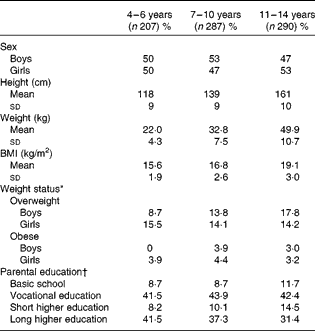
* Weight status according to international cut-off values(Reference Cole, Bellizzi and Flegal19). The presented proportions of overweight children do not include obese children.
† Parental educational level: basic school (10 years or less of total education); vocational education, upper secondary school (10–12 years); short higher education (13–15 years, primarily theoretical); long higher education (15+ years, primarily theoretical).
Dietary patterns
In all three age groups, two distinct dietary patterns were identified on both weekdays and weekend days. The patterns were labelled ‘processed’ and ‘health conscious’ based on the general characteristics of the foods with the highest component loadings within each pattern. The dietary variables with high loadings (>0·2 or < − 0·2) on these patterns are presented in Tables 2–4. The patterns differed slightly between the age groups and between weekdays and weekend days; however, consistently for all age groups and periods, the principal component labelled ‘processed’ was characterised by high positive loadings for energy density, white bread, fat on bread, and jam, honey and chocolate spreads on both weekdays and weekend days. SSB, cakes and biscuits and sweets and chocolate also had high loadings in the ‘processed’ pattern on both weekdays and weekend days for all age groups, except for weekend days in the 4–6-year-olds. The other principal component labelled ‘health conscious’ was consistently characterised by high loadings for fruit, vegetables and water on both weekdays and weekend days for all age groups, whereas the other variables with high component loadings in the ‘health conscious’ pattern varied to some extent between the age groups.
Variables of foods (g/d) and energy density (kJ/100 g) with loadings >|0·2| for the two dietary patterns in children aged 4–6 years (n 207)*

* Food groups with component loadings < |0·2| for both principal components included beverages, light; coarse bread and crisp bread; fish and seafood; French fries; ice cream and desserts; juice; nuts and dried fruits; other breakfast cereals than oatmeal; pies and egg dishes; poultry; red meat, lean; rice, pasta and polenta; soups.
† Dairy products with ≥ 1·5 % fat.
‡ Dairy products with < 1·5 % fat.
Variables of foods (g/d) and energy density (kJ/100 g) with loadings >|0·2| for the two dietary patterns in children aged 7–10 years (n 287)*

* Food groups with component loadings < |0·2| for both principal components included beverages, light; coarse bread and crisp bread; dairy products, fat; fish and seafood; French fries; ice cream and desserts; juice; pies and egg dishes; potatoes; poultry; red meat, lean; salty snacks; soups; rice, pasta and polenta.
† Dairy products with < 1·5 % fat.
‡ Other breakfast cereals than oatmeal.
Variables of foods (g/d) and energy density (kJ/100 g) with loadings >|0·2| for the two dietary patterns in children aged 11–14 years (n 290)*

* Food groups with component loadings < |0·2| for both principal components included beverages, light; coarse bread and crisp bread; dairy products, low fat ( ≤ 1·5 %); fast food; fish and seafood; French fries; ice cream and desserts; nuts and dried fruits; oatmeal; pies and egg dishes; potatoes; poultry; red meat, lean; rice, pasta and polenta; salty snacks; sauce and gravy; soups.
† Dairy products with ≥ 1·5 % fat.
Pearson's correlation coefficients between the factor scores from each dietary pattern showed significant positive correlations between the corresponding patterns on weekdays and weekends with the exception of the ‘health conscious’ pattern in the 7–10-year-olds (Table 5). Overall, correlation coefficients for the ‘processed’ pattern were slightly higher than those for the ‘health conscious’ pattern.
Pearson's correlation coefficients (r) between the factor scores obtained on weekdays and weekend days in the 4–6-, 7–10- and 11–14-year-old children (Pearson's correlation coefficients and 95 % confidence intervals)

Comparisons of the ‘High PP’ group with the ‘High HCP’ group (i.e. groups of children with factor scores in the highest tertile for one pattern and factor scores in the lowest or intermediate tertile for the other pattern) showed that energy density of the diet as well as intake of sweets and chocolate and SSB were significantly higher, whereas intake of fruit and vegetables was significantly lower in the ‘High PP’ group than in the ‘High HCP’ groups (P< 0·05; Table 6). These differences were evident on both weekdays and weekend days for all age groups, except for intake of sweets and chocolate on weekend days in the 7–10-year-olds. Moreover, the differences between the ‘High PP’ and ‘High HCP’ groups seemed slightly amplified on weekend days compared with weekdays.
Mean intakes of energy density (kJ/100 g) and selected foods (g/d) on weekdays and weekend days for the ‘High PP’* and ‘High HCP’† groups within each age group (Median values and 5th and 95th percentiles (P5 and P95))

SSB, sugar-sweetened beverages.
* Children with factor scores in the highest tertile for the ‘processed’ pattern and in the lowest or intermediate tertiles for the ‘health conscious’ pattern.
† Children with factor scores in the highest tertile for the ‘health conscious’ pattern and in the lowest or intermediate tertiles for the ‘processed’ pattern.
‡ Comparing the ‘High PP’ group with the ‘High HCP’ group.
§ Values were significantly different between weekdays and weekend days for both the ‘High PP’ and ‘High HCP’ groups (P< 0·05).
∥ Values were significantly different between weekdays and weekend days for the ‘High HCP’ group (P< 0·05).
¶ Values were significantly different between weekdays and weekend days for the ‘High PP’ group (P< 0·05).
No significant differences regarding BMI, weight status, sex and parental educational level were found between the ‘High PP’ and ‘High HCP’ groups within each age group (data not shown).
Discussion
In the present sample of Danish children, two dietary patterns labelled ‘processed’ and ‘health conscious’ were identified on both weekdays and weekend days. Although not completely identical, these dietary patterns were consistently found in all three age groups. The shared characteristics for the ‘processed’ pattern on both weekdays and weekend days in all age groups were high loadings for energy density and white bread, fat on bread, and jam, honey and chocolate spreads, whereas the shared characteristics of the ‘health conscious’ pattern were high loadings for fruit, vegetables and water. Energy density, which was included in the identification of dietary patterns as an overall indicator of the diet quality, loaded highly on the ‘processed’ pattern, thus, indicating that this dietary pattern is characterised by a high dietary energy density and an overall lower dietary quality.
The results of the present study showed that, in general, factor scores from the corresponding dietary patterns on weekdays and weekend days were significantly positively correlated. No significance was observed for the ‘health conscious’ pattern in the 7–10-year-olds; however, there is no obvious explanation for this finding. The initial analyses with varying numbers of included food groups did not show a tendency for the patterns of this age group to differ from the patterns of the other age groups. The lower correlations between the corresponding dietary patterns that are presented for this age group seem rather to be an exception to the general findings. Although not completely consistent, the present results suggest that overall major dietary patterns may somewhat track between weekends and weekdays, while the specific foods actually eaten became less healthy during weekends.
PCA has previously been used to assess the stability of dietary patterns during periods of several months to years in childhood, adolescence and adulthood(Reference Oellingrath, Svendsen and Brantsaeter8–Reference Crozier, Robinson and Godfrey10, Reference Cutler, Flood and Hannan23–Reference Cuco, Fernandez-Ballart and Sala25). Types and numbers of patterns comparable with the present findings have been found in other studies in children and adolescents, including patterns with similarities to the ‘processed’ and ‘health conscious’ patterns(Reference Craig, McNeill and Macdiarmid6, Reference Cutler, Flood and Hannan23). Other studies that have examined stability of dietary patterns over time using correlations have identified patterns on the basis of estimates of usual consumption including both weekdays and weekend days. Findings from these studies have shown similar or somewhat higher correlations between the corresponding patterns(Reference Crozier, Robinson and Godfrey10, Reference Newby, Weismayer and Akesson26, Reference Weismayer, Anderson and Wolk27). However, since this is the first study to assess dietary patterns obtained using PCA specifically on weekdays and weekend days, these results are not directly comparable with those of other studies.
Some general environmental and structural differences between school days and non-school days may in part explain the findings that the dietary quality is lower on weekend days. School days may be more structured and supervised, while parents' attitudes towards healthy eating habits and the availability of different foods and beverages during weekends are most probably a very important factor for the variation in dietary quality during the week(Reference Taylor, Evers and McKenna28).
In the same study population, a tendency of a lower diet quality on weekend days compared with weekdays has previously been presented(Reference Rothausen, Matthiessen and Hoppe14). These findings combined imply that subgroups with differences in dietary habits of nutritional concern exist, and that these differences are maintained on weekdays as well as on weekend days. This notion was further supported by the findings of significant and health-relevant differences in the energy density of the diet and in intakes of fruit and vegetables, SSB and sweets and chocolate, when comparing the ‘High PP’ group with the ‘High HCP’ group (i.e. comparing groups of children with high agreement for the ‘processed pattern’ with groups of children with high agreement for the ‘health conscious’ pattern). These results were found for both weekdays and weekend days with minor differences between the age groups. Moreover, within each of the ‘High PP’ and ‘High HCP’ groups, a significantly higher energy density was observed on weekend days than on weekdays. This was also reflected in several of the selected key variables with overall tendencies of lower intakes of fruit and vegetables and higher intakes of SSB and sweets and chocolate.
Similar findings for certain key variables have been presented previously in studies of children(Reference Bjelland, Lien and Grydeland12, Reference Cullen, Lara and de Moor13), and the tendency towards less healthy dietary habits during weekends compared with weekdays is also in accordance with other studies in pre-school children(Reference Sepp, Lennernas and Pettersson29–Reference Lehtisalo, Erkkola and Tapanainen31). This detection of significantly unfavourable dietary patterns during weekends points at a considerable potential for dietary improvement, and the present findings suggest that focusing attention on the differences between weekdays and weekend days could prove useful for enhancing public health initiatives.
The World Cancer Research Foundation and the American Institute for Cancer Research recommend the average energy density of diets to be lowered towards approximately 525 kJ/100 g excluding beverages(32). In light of this, the observed differences in energy density between the ‘High PP’ and ‘High HCP’ groups were considerable, and especially high on weekend days where the median energy density was of 617–740 kJ/100 g in the ‘HCP’ group and as high as about 1000 kJ/100 g in the ‘High PP’ group. In line with this, intake of fruit and vegetables in the ‘High PP’ group was substantially below the recommended levels (100–147 g/d on weekdays and 55–85 g/d on weekend days), whereas intake of SSB was high (113–213 g/d on weekdays and 272–400 g/d on weekend days).
High levels of dietary energy density are of concern from a public health perspective as there is convincing evidence that a high intake of energy-dense foods, high in fat, added sugars or starch, promotes weight gain and overweight(17). Furthermore, high energy density levels of the diet have been associated with lower dietary quality in both children(Reference Patterson, Warnberg and Poortvliet18) and adults(Reference Ledikwe, Blanck and Khan33). The present results as well as previous analyses of the diet in this sample of children substantiate these findings, and underscore the need for improvement of dietary habits especially in children with a high intake of energy-dense foods and a low intake of fruit and vegetables, and especially to focus on the dietary intake on weekends(Reference Rothausen, Matthiessen and Hoppe14).
Methodological issues
As with other methods, there are several methodological issues of the use of PCA(Reference Newby and Tucker3, Reference Michels and Schulze34) and results should be interpreted in the light of this. PCA has the advantage of combining food items across the diet, and may provide a useful approach for summarising extensive dietary data into fewer interpretable combinations, thereby taking into account the complexity of the diet. However, although the PCA method is a data-driven method that explores existing dietary patterns without preconceived patterns, it is a major consideration that it involves subjective decisions that can influence the final interpretation. This includes, for example, preselecting and aggregation of food items into food groups, determining the value of component loadings considered to have a strong association with the patterns, the number of patterns to retain and the labelling of each pattern(Reference Slattery1, Reference Michels and Schulze34). These decisions may make the results less data-driven than assumed theoretically. Also, the comparability with other studies is limited by the differences between studies regarding data treatment and interpretation of the analyses.
Inherently, the results represent the optimal model with respect to the explained proportion of variability between individuals. The two dietary patterns identified for each age group only accounted for 13·6–15·9 % of the variance; however, it is a general finding that dietary patterns derived using PCA account for only a small amount of the total variance(Reference Michels and Schulze34). When interpreting a limited number of dietary patterns, as is often the case, caution should be taken as other patterns also exist within the dataset, although each of these explains progressively less of the variance than the first emerging patterns. Furthermore, if all participants have a high intake of a certain food item or food group, this will not appear as an important part of any pattern. It seems therefore useful to combine the findings from PCA with other analyses of the diet, depending on the study objectives, to support and extend the dietary pattern analyses. In that way, PCA and traditional nutritional analysis can be seen as complementary approaches that can be used together. Additionally, validity of the dietary patterns and results could be strengthened if a second method of extracting dietary patterns is used.
In the present analyses, the dietary intake data were included as means over 4 and 2 d, respectively. Day-to-day variation is therefore larger in the weekend data than in the weekday data. However, the potential influence of this in the PCA is considered to be of minor importance. Only differences in individual day-to-day structures, or correlations between these that are different from the overall correlations could change the interpretability of the PCA-derived patterns.
As for all other dietary assessment studies, a limitation of the present study is that the self-reported food recording may potentially be subject to misreporting. In dietary assessment in children, the use of the parent report of a child's diet may also be seen as a limitation. However, the degree of under-reporting seemed to be rather limited in the present sample, with the exception of the group of children aged 11–14 years(Reference Rothausen, Matthiessen and Hoppe14), which is recognised as a particularly challenging age group when assessing dietary intake. Thus, there is a higher risk of misreporting in the dietary intake data from the 11–14-year-olds compared with the youngest age groups. Separate analyses for each sex were not conducted due to the limited sample sizes in each age group, and specific sex differences were therefore not part of the scope of the present paper.
The strengths of the present study include the comprehensive dietary data, for which each of the participants has provided daily recordings of dietary intake for 7 d, which allowed us to analyse dietary patterns across the week. PCA has been applied on data from different dietary assessment methods, with FFQ as one of the primary dietary assessment methods; however, the patterns generated have generally been similar despite the dietary assessment method used(Reference Newby and Tucker3,35). Furthermore, the strengths lie in the nationwide character of the study, as it is based on a nationally representative study and in the wide age span of the sample that render the results more generalisable to children in the general Danish population.
Conclusion
In the present sample of Danish children, two distinct dietary patterns, labelled ‘processed’ and ‘health conscious’, were identified on both weekdays and weekend days for each of the age groups 4–6, 7–10 and 11–14 years. While overall major dietary patterns may somewhat track between weekdays and weekends, the specific foods actually eaten became less healthy during weekends.
Acknowledgements
This study was supported by university PhD scholarships under DTU Food, Technical University of Denmark. The authors are grateful to researcher Anja Biltoft-Jensen, senior advisor Sisse Fagt and senior researcher Margit Velsing Groth who are responsible for the design and development of questionnaires to the Danish National Survey of Dietary Habits and Physical Activity. The authors are also grateful to senior advisor Tue Christensen, dietitian Karin Hess Ygil, data scanning manager Hanne-Jette Hinch and data warehouse manager Karsten Kørup, for their contributions to the data processing. B. W. R. designed the analyses of this study, performed the statistical analyses and was responsible for writing the manuscript. J. M. was responsible for the design and collection of the data in the Danish National Survey of Dietary Habits and Physical Activity. P. B. B. contributed to the statistical counselling. B. W. R., J. M., P. B. B., L. F. A. and I. T. all participated in the discussion of the results and the revision of the manuscript. The authors declare that they have no conflict of interest.



