


Introduction
There is a substantial amount of policy interest in volunteering because of its positive relationship with health, well-being, and building stronger communities (Jenkinson et al. Reference Jenkinson, Dickens, Jones, Thompson-Coon, Taylor, Rogers, Bambra, Lang and Richards2013). However, spatial patterns of volunteering are uneven and the benefits are not accrued equally across communities (Benenson and Stagg Reference Benenson and Stagg2016; McCulloch et al. Reference McCulloch, Mohan and Smith2012). The literature suggests that individuals from disadvantaged groups and deprived areas are least likely to be volunteers and hence realise the positive impacts (Southby et al. Reference Southby, South and Bagnall2019). Meanwhile, the role of Housing Associations (HAs) within the UK has expanded beyond the provision of affordable housing towards building social capital through community investment in often deprived areas (Billis Reference Billis2010). Volunteering has become crucial in such community investment activities as a way to create community cohesion, reduce social isolation, and increase the well-being of tenants. The aim of this paper is to understand which factors are associated with volunteering behaviours amongst social housing tenants, thereby filling a lacuna in the literature. The objective is to use a unique data set in the UK to investigate a group of 330 people, all clients of a HA, in an area with relatively homogeneously high levels of deprivation and poor physical health (Williams et al. Reference Williams, Maguire, Morrissey, Taylor and Wyatt2020). Under these circumstances, what factors are the determinants of volunteering?
Housing Associations (HAs) and Community Investment
HAs are private not-for-profit organisations which provide socially rented accommodation with rents typically set at around 50–60% of market rents (Mullins Reference Mullins2010; MHCLG 2018). In the UK, there are around 9 million people living in 3.9 million households in the social housing sector (MHCLG 2018). Over the last 40 years, UK HAs have become hybrid entities, sitting squarely between state and market, blending commercial and social tasks (Blessing Reference Blessing2012; Purkis Reference Purkis2010). While the core activity of HAs is the construction and management of affordable homes, these organisations are increasingly making social investments and supporting neighbourhood initiatives (Mullins Reference Mullins2010; Purkis Reference Purkis2010). Fundamental to delivering and sustaining these social initiatives are partnerships with local Voluntary and Community Sector Organisations (VCSO’s) and the practice of volunteering.
For HAs, volunteering is crucial to social investment activities in three ways. First, volunteering generates social capital, which enables the sustainability of community activities and reduces social isolation through expanding networks and increasing trust (Glanville Reference Glanville2016). Second, volunteering produces human capital and is a stepping stone to employment (Slootjes and Kampen Reference Slootjes and Kampen2017). Volunteering, as a form of skills development that enhances employability, is of particular interest to HAs with regard to avoiding tenant arrears (Chum et al. Reference Chum, Carpenter, Farrell, Mook, Handy, Schugurensky and Quarter2015; Baines and Hardill Reference Baines and Hardill2008). Third, volunteering has been shown to have beneficial effects on physical health (Li and Ferraro Reference Li and Ferraro2006; Salt et al. Reference Salt, Crofford and Segerstrom2017; Jenkinson et al. Reference Jenkinson, Dickens, Jones, Thompson-Coon, Taylor, Rogers, Bambra, Lang and Richards2013), mental health (Hong and Morrow-Howell Reference Hong and Morrow-Howell2010; Choi et al. Reference Choi, Stewart and Dewey2013), and mental well-being (Son and Wilson Reference Son and Wilson2012b; Andersson and Glanville Reference Andersson and Glanville2016; Appau and Awaworyi Churchill Reference Appau and Churchill2018; Binder and Freytag Reference Binder and Freytag2013). Volunteering has therefore become an important mechanism for social investment and for tackling social inequality in an organic way through inclusionary practices and self-help initiatives.
Housing focused research has engaged with the issue of volunteering in relation to social capital and deprivation (McCulloch, Mohan and Smith Reference McCulloch, Mohan and Smith2012), types of HAs and facilitation of volunteering (Suter and Gmür Reference Suter and Gmür2018; Leviten-Reid and Campbell Reference Leviten-Reid and Campbell2016), length of residence, home ownership, and volunteering rates (Rotolo et al. Reference Rotolo, Wilson and Hughes2010; Haezewind Reference Haezewind2003), and the strengths and non-financial wealth present amongst low-income volunteers and communities (Benenson and Stagg Reference Benenson and Stagg2016). There is a lack of research around the determinants of volunteering amongst social housing communities.
To understand the likely factors influencing volunteering amongst social housing tenants, it is first necessary to consider community characteristics. Social housing is made available to those whose needs are not served by the market and is allocated based on financial requirement. The majority of tenants have very low incomes or receive Housing Benefit and are mostly retired, disabled, single parents of young children, or otherwise out of employment (Wallace Reference Wallace2016). Social housing is concentrated in areas which are often associated with high levels of deprivation and lower levels of physical and mental health (Winston et al. Reference Winston, Kennedy and Carlow2019).
Literature and Theory
Resource Theory, Deprivation, and Volunteering
A plethora of research at the population scale has shown that those with higher levels of income, education, employment status, and who occupy dominant positions in society are more likely to volunteer (Son and Wilson Reference Son and Wilson2012a; Einolf and Chambré Reference Einolf and Chambré2011; Wilson and Musick Reference Wilson and Musick1997). In the UK, national inequality in resources and deprivation translates to uneven patterns of volunteering. An influential study by McCulloch et al. (Reference McCulloch, Mohan and Smith2012) using data from UK 2005 and 2007 Citizenship Survey found “clear associations, at the area level, between social capital, volunteering, and deprivation, with lower levels of both social capital and volunteering in more deprived areas” (pp 1142–1143). From a utility-based decision-making perspective, it can be inferred that the opportunity costs of giving time freely are lower for those with more human and social capital resources to facilitate volunteering (Son and Wilson Reference Son and Wilson2015; Wilson and Musick Reference Wilson and Musick1997). However, resource theory is less applicable where there is a high degree of homogeneity within places (Dallimore et al. Reference Dallimore, Davis, Eichsteller and Mann2018). Within more homogenous places, the role of socio-economic status is reduced and often replaced by considerations of cultural standing (Wilson and Musick Reference Wilson and Musick1997). One explanation rests on the acquisition of a volunteering ‘habit’ because people are placed in a particular social context where the skills and dispositions towards volunteering are collectively developed Janoski et al. (Reference Janoski, Musick and Wilson1998) cited in Dallimore et al. (Reference Dallimore, Davis, Eichsteller and Mann2018).
To understand the nuances of how factors of resource inequality can influence volunteering, it is important to distinguish between formal and informal volunteering. Formal volunteering means giving unpaid help through an organisation and informal volunteering refers to giving unpaid help to people (such as neighbours or friends) who are not relatives, and not through an organisation (Compact Reference Compact2005).
Multiple studies have found strong positive correlations between education, income, and formal volunteering (Wilson Reference Wilson2000; Mitani Reference Mitani2014; Wilson and Musick Reference Wilson and Musick1997). Levels of educational attainment are thought to have direct and indirect effects on formal volunteering through a combination of civic awareness, obligations, and ‘ability signalling’; where organisations recruitment materials signal the desired type of volunteer using educational credentials (Son and Wilson Reference Son and Wilson2012a). Theories as to why income corresponds to formal volunteering are more contested (Son and Wilson Reference Son and Wilson2015). From a rational choice, perspective volunteering (whether formal or informal) means less time for paid work and therefore there may be a barrier for those who are lower paid (Lee and Brudney Reference Lee and Brudney2009). Conversely, volunteering is a ‘symbolic good’ which the higher paid can afford to buy more easily (Wilson and Musick Reference Wilson and Musick1997). On the other hand, lower levels of informal volunteering specifically are associated with higher income and education, but the relationship is weaker (Musick and Wilson Reference Musick and Wilson2007). Similar to the findings of Musick and Wilson (Reference Musick and Wilson2007), Overgaard et al. (Reference Overgaard, Petrovski and Hermansen2018) report that “higher educated people tend to avoid undesirable tasks such as shopping, running errands, or other menial person to person tasks” (p 166).
Lower levels of formal volunteering, higher levels of informal volunteering, and more traditional forms of mutual neighbourhood support, are associated with communities with higher levels of deprivation (Shandra Reference Shandra2017; Williams Reference Williams2003; Baines and Hardill Reference Baines and Hardill2008). Although, unlike formal volunteering, some studies have found that education and other human capital resources only marginally effect why individuals informally volunteer (Choi et al. Reference Choi, Burr, Mutchler and Caro2007; Taniguchi Reference Taniguchi2012). Informal volunteering being predominately a function of social capital, affection, and reciprocity (Wilson Reference Wilson2000; Choi et al. Reference Choi, Burr, Mutchler and Caro2007).
A methodological challenge is that informal volunteering is difficult to detect in survey instruments. Qualitative evidence suggests that volunteering is often only understood to only mean formal volunteering and informal volunteering is often perceived as care work (Benenson and Stagg Reference Benenson and Stagg2016; Martinez et al. Reference Martinez, Crooks, Kim and Tanner2011). In a recent study, Pettigrew et al. (Reference Pettigrew, Jongenelis, Jackson and Newton2018) argue that independently or in combination informal volunteering and caring responsibilities, psychological barriers, and time commitments manifested as a barrier to formal volunteering. Hence, lower formal volunteering and higher levels of informal volunteering and care work occur in deprived communities (Overgaard et al. Reference Overgaard, Petrovski and Hermansen2018). In parallel to resource theory research, there has been a body of work examining health, well-being, and the implications for volunteering amongst lower income and more deprived communities (Benenson and Stagg Reference Benenson and Stagg2016; Shandra Reference Shandra2017; Gibson et al. Reference Gibson, Petticrew, Bambra, Sowden, Wright and Whitehead2011; Son and Wilson Reference Son and Wilson2015). We turn to this literature now as it is important for understanding volunteering behaviours amongst social housing tenants.
Physical Health and Volunteering
Physical health pertains to an individual’s physical functioning, bodily pain, general health, and vitality (Maruish Reference Maruish2012). Although longitudinal studies demonstrate the health benefits of volunteering are substantial, it is also the case that poor physical health and long-term illness or disability constrains capacity for volunteering (Onyx and Warburton Reference Onyx and Warburton2003; Mellor et al. Reference Mellor, Hayashi, Stokes, Firth, Lake, Staples, Chambers and Cummins2009; Martinez et al. Reference Martinez, Crooks, Kim and Tanner2011; Li and Ferraro Reference Li and Ferraro2006; Principi et al. Reference Principi, Galenkamp, Papa, Socci, Suanet, Schmidt, Schulmann, Golinowska, Sowa, Moreira and Deeg2016; Papa et al. Reference Papa, Cutuli, Principi and Scherer2019). However, the effects of physical health are more complex when situational factors and types of volunteering are considered. McNamara and Gonzales (Reference McNamara and Gonzales2011) found that ‘a decline in health was not necessarily associated with intensity of volunteering if older people are already engaged with volunteering, unless it causes the volunteer to quit altogether’ (p 499). Informal is more common than formal volunteering amongst those with poor physical health and disabilities because accessibility and travel logistics are stronger barriers to formal than informal volunteering (Shandra Reference Shandra2017). Informal volunteering also differs in terms of commitment, being more discretionary and flexible than that of formal volunteering (Shandra Reference Shandra2017; Martinez et al. Reference Martinez, Crooks, Kim and Tanner2011), and therefore more accessible for those with variable health conditions.
Mental Health, Mental Well-Being, and Volunteering
Mental health is “a state of well-being in which an individual realizes his or her own abilities, can cope with the normal stresses of life, can work productively and is able to make a contribution to his or her community” (WHO 2020), and mental well-being is the ‘positive aspect of mental health’ (Stewart-Brown Reference Stewart-Brown2018). Research has demonstrated that good mental health is an antecedent of volunteering by contributing to the agentic capacity for productive activity (Andersson and Glanville Reference Andersson and Glanville2016; Hong and Morrow-Howell Reference Hong and Morrow-Howell2010; Thoits and Hewitt Reference Thoits and Hewitt2001). Conversely anxiety (Handy and Cnaan Reference Handy and Cnaan2007) and depression (Salt et al. Reference Salt, Crofford and Segerstrom2017; Principi et al. Reference Principi, Galenkamp, Papa, Socci, Suanet, Schmidt, Schulmann, Golinowska, Sowa, Moreira and Deeg2016; Li and Ferraro Reference Li and Ferraro2006) are barriers to volunteering. Tang et al. (Reference Tang, Morrow-Howell and Choi2010) found that mental health was actually a more significant factor in predicting volunteer turnover than physical health demands. Son and Wilson (Reference Son and Wilson2012b) found that “people who have greater hedonic, eudemonic, and social well‐being are more likely to volunteer and, in the case of hedonic and eudemonic well‐being, volunteer more hours” (p. 658). This relationship is captured in the personal well-being model of volunteering (Thoits and Hewitt Reference Thoits and Hewitt2001) which suggest there exists a positive cycle of selection and social causation and that people with greater well-being invest more time into volunteering and that volunteer work promotes well-being (p. 128).
The connection between subjective well-being and volunteering has directed researcher’s attention to consider the broader social context in which the volunteer is located (Creaven et al. Reference Creaven, Healy and Howard2017). Of particular relevance for social housing communities is the observation that there are physiological and psychological consequences of chronic financial strain including high blood pressure, depression, and anxiety (Young and Schieman Reference Young and Schieman2012). Linking economic hardship and volunteering, Son and Wilson (Reference Son and Wilson2015) found that income has no direct effect on volunteering once subjective well-being is taken into account. This evidence brings into question the assumption that income is a material resource for the volunteer and focuses attention on the importance of socio-psychological processes in determining volunteering behaviour. In the current study, by focussing on a small range of deprivation levels, it is anticipated that effects of mental well-being on volunteering may emerge, in line with this previous finding.
Research Gap and Research Questions
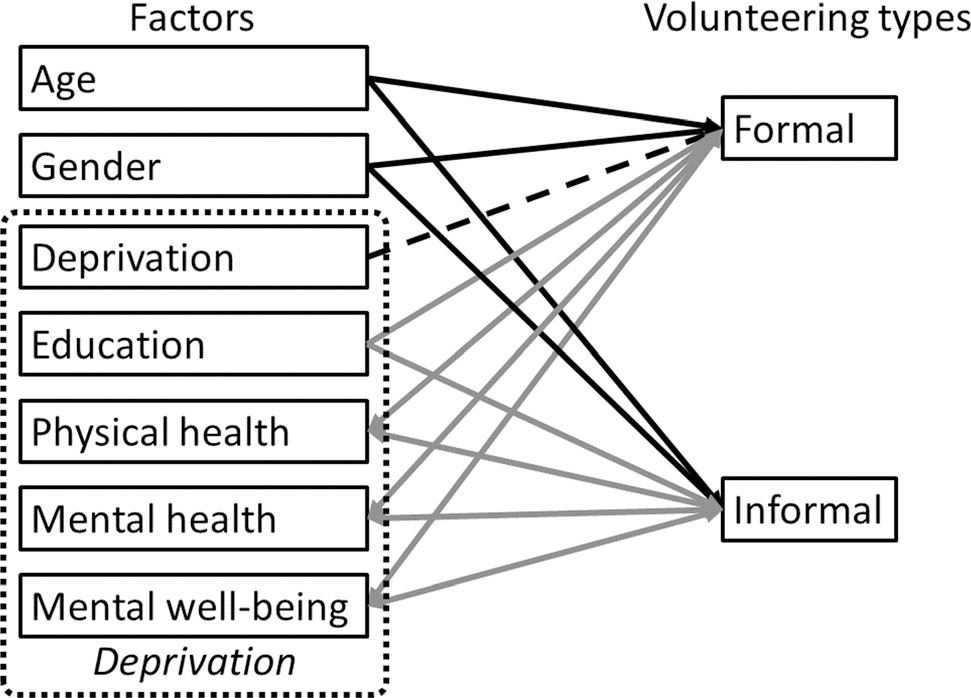
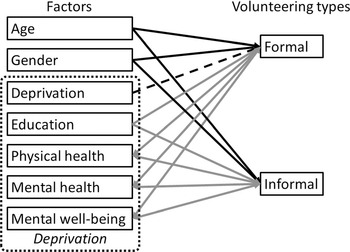
In sum, previous research has found rates of volunteering to be lower within areas of deprivation (McCulloch et al. Reference McCulloch, Mohan and Smith2012; Clifford Reference Clifford2012) and amongst those with lower physical health (Onyx and Warburton Reference Onyx and Warburton2003; Southby et al. Reference Southby, South and Bagnall2019), mental health (Mellor et al. Reference Mellor, Hayashi, Stokes, Firth, Lake, Staples, Chambers and Cummins2009), and mental well-being (Son and Wilson Reference Son and Wilson2012b). While the observed relationships between deprivation, health, and volunteering are useful and valid at the population scale, there have been recent questions raised on how these relationships stand up in particular places and communities (Dallimore et al. Reference Dallimore, Davis, Eichsteller and Mann2018). This has methodological implications as it suggests moving away from population-level data and instead conducting a focused examination of homogenous groups with shared characteristics. The unanswered question, and the focus of this study, is what factors remain or emerge as determining volunteering behaviours when there is limited variation in deprivation levels such that its effect could be attenuated. Figure 1 provides a graphical summary of the relationships between factors and volunteering rates found in previous research, and the main purpose of the current study.
Each of these factors have been found to be associated with formal or informal volunteering in the literature. However, education, physical health, mental health, and mental well-being are all associated with deprivation (dotted box) (Marmot Reference Marmot2020). This paper is seeking to explore what happens to the grey arrows if deprivation is attenuated (dashed arrow)
Methods
We first describe the study context, followed by the analysis methods. The data presented in this paper were collected as part of a research and innovation project, named Smartline, in the county of Cornwall, South West UK. Smartline is a partnership project led by the University of Exeter with Cornwall Council and Coastline Housing Association Ltd. Coastline Housing is an independent, not-for-profit HA owning and managing over 4500 homes in Cornwall. Coastline’s stated purpose is to ‘build great homes and offer great services provided by great people’. Coastline exemplify a HA who are blending commercial and social tasks (Blessing Reference Blessing2012; Purkis Reference Purkis2010) with a strong commitment to community investment and co-producing services which meet the local need (Brandsen and Helderman Reference Brandsen and Helderman2012). For example, they are members of the Placeshapers group which pledges to re-invest 100% of profits back into their homes and communities and help people into employment. And they have two departments, Customer Access and Community Investment, which are solely dedicated to customer well-being and community improvement. They also have over 20 working partnerships with local VCSO’s who support customers with employability, mental health, and volunteering.
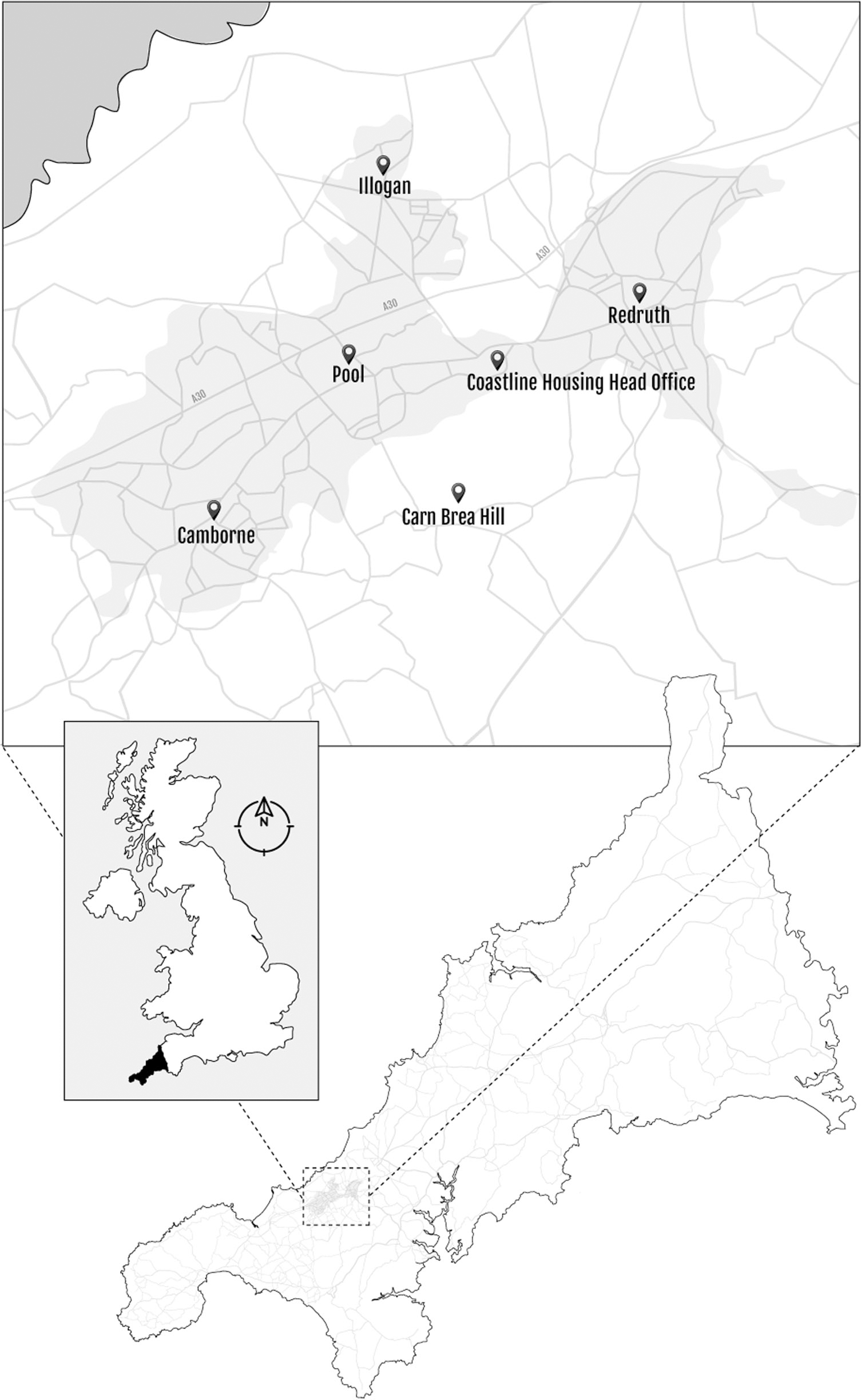
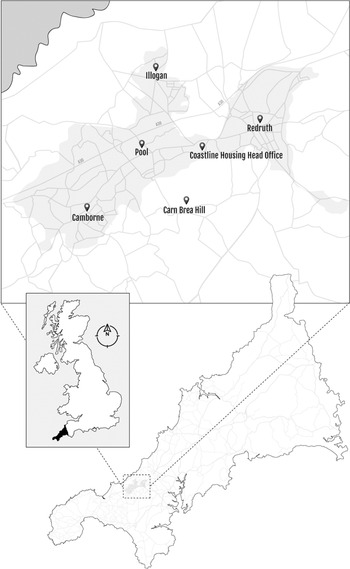
The study location (see Fig. 2) is an area of interlinked conurbations in central Cornwall; namely the Camborne, Pool, Illogan and Redruth (CPIR) area where Coastline manage 1791 properties. The CPIR areas represent the largest urban conurbation in Cornwall, with 11% of the Cornish population (Cornwall Council 2019). This is one of the most deprived regions of Cornwall with 1 in 4 residents living in the 20% most deprived neighbourhoods in England. Physical and mental health issues are of particular concern in the CPIR area as 31.1% (England average = 19.8%), or 17,465 people, are living in a health deprivation ‘hotspot’. In particular, 23% (England average = 18%) of people in the CPIR area have a limiting long-term illness while 4.6% (England average = 2.7%) of working age adults are receiving mental health-related benefits (CC 2019).
Study Location
Data Collection
330 Coastline tenants were recruited to complete a survey about their health, well-being, community, and volunteering. This survey was approved by the University of Exeter Research Ethics Committee and conformed to the principles embodied in the Declaration of Helsinki. The data were collected between September 2017 and June 2018 using a face-to-face survey. This is a unique placed-based data set. Participants are geographically bounded, all living within a 20 km radius of each other, and therefore, the contextual variables of place and community history are likely to be similar.
Independent Variables
Demographic Attributes
Individual attributes of gender and age were recorded. Gender was coded 0 female and 1 male. Age was measured in years from 18 to 92.
Socio-Economic Attributes
Education was categorised by an ordinal measure comprising 4–11 years, 11–16 years, 16–18 years, undergraduate and postgraduate education. Current occupation type and level were recorded, with details provided in the Results section.
Deprivation
Index of Multiple Deprivation (IMD) rank was attributed to each participant based on postcode according to 2015 records (MHCLG 2015). IMD is a compound measure and captures a number of contextual (living environment, crime, barriers to housing and services) and resource (income, employment, education, health) variables (MHCLG 2015); all of which are consistent predictors in resource theory.
Physical and Mental Health
Physical and mental health data were captured using the SF-12v2® Health Survey (Maruish Reference Maruish2011; Brazier et al. Reference Brazier, Harper, Jones, O’Cathain, Thomas, Usherwood and Westlake1992). The instrument has two components. The physical health component (PCS) evaluates general health, mobility activity, amount accomplished because of physical problems, limited ability to climb stairs, work limits because of physical problems, and work limits because of pain. The mental health component (MCS) focuses on participants’ feelings of depression and anxiety, social activity, amount accomplished, and carelessness (Ware et al. Reference Ware, Kosinski and Keller1996). PCS and MCS each capture morbidity and aetiology especially in relation to impact on functioning and therefore are often referred to as measures of physical and mental health-related quality of life (Maruish Reference Maruish2012).
Mental Well-Being
The Short Warwick-Edinburgh Mental Well-being scale (SWEMWBS) survey instrument was used to capture positive mental well-being (Stewart-Brown 2018). This scale captures a wide conception of well-being, including affective-emotional aspects, cognitive-evaluative dimensions, and psychological functioning (Tennant et al. Reference Tennant, Hiller, Fishwick, Platt, Joseph, Weich, Parkinson, Secker and Stewart-Brown2007).
Dependent Variables
Formal and informal volunteering behaviour data were collected using questions from the Volunteering and Charitable Giving section of the UK Cabinet Office Community of Life Survey 2016–17 (HM_Gov 2017).
Analysis
We used probit regression to determine the predictors of formal and informal volunteering. To recap, we are particularly interested in the relationship between volunteering and physical health (PCS), mental health (MCS), and mental well-being (SWEMWBS). We therefore use PCS, MCS, and SWEMWBS as our three main predictor variables (or independent variables). Four control variables are also included as predictors in the analyses: Age, IMD rank, Education, and Gender.
The outcome variables (or dependent variables) are formal volunteering and informal volunteering. Each variable has two levels, representing whether or not the participant performs that activity.
Probit Regression
Regression analysis provides a model in which values of the predictor variables can be combined in order to produce the outcome variables. It therefore allows the effects of multiple potential contributing factors to be modelled simultaneously. Regression outputs include a parameter for each predictor that represents the strength of its relationship with the outcome variable(s).
Probit regression is appropriate for modelling binary outcome variables because the probit function links between a continuous unbounded value predicted from the regression equation and a bounded probability of one of the two outcomes.
Formal and informal volunteering rates are potentially correlated. Bivariate probit regression allows both outcomes to be entered into the same model and can therefore take into account any relationship between the two underlying variables.
Multicollinearity
Multicollinearity between groups of predictor variables was assessed using variance inflation factors (VIFs), provided in Table SI. VIFs for all predictor variables were below 1.5.
Results
Descriptive Statistics
Participants’ PCS, MCS, and SWEMWBS scores did not differ from scores across England and Wales (Williams et al. Reference Williams, Maguire, Morrissey, Taylor and Wyatt2020). Current occupation type (330 responded) revealed 58.5% of participants were retired, or long-term sick or disabled, and 37.3% were looking after home or family, working, or in education or training. Self-reported national identity (324 responded) and ethnicity (257 responded) both showed little variation, with 98.1% selecting a region of the UK (British, Cornish, English, Scottish, and Welsh), and 96.1% reporting as white.
In support of the socio-economic homogeneity of the cohort, 76.5% of participants (306 responded) had a current or previous routine and manual occupation (as opposed to managerial and professional or intermediate).
Given high levels of correlations between the education categories, low levels of 4–11 years only (0.9%) and of undergraduate and postgraduate education (6.1%), particularly when split across volunteers and non-volunteers, the data were coded according to a binary split between up-to-16-years UK education and post-16 education.
For all 330 participants, 23.3% were involved in formal volunteering, and 41.2% in informal volunteering in last 12 months. These figures can be compared to UK national rates, where 37% formally volunteered, and 52% informally volunteered (HM_Gov 2017). This result is consistent with existing evidence that higher deprivation is associated with less volunteering, and informal volunteering is proportionally higher in such areas (Shandra Reference Shandra2017; Williams Reference Williams2003; Baines and Hardill Reference Baines and Hardill2008). Tables SII and SIII shows the descriptive statistics for the predictor variables split by formal and informal volunteering and split by the levels of the categorical predictors.
Physical Health, Mental Health, Mental Well-Being, and Formal and Informal Volunteering
PCS, MCS, and SWEMWBS are predictors in separate analyses, each combined with control variables of Age, IMD rank, Education, and Gender. We conducted a two-stage analysis, comprising a regression with the control variables only and a regression for each of the three predictors of primary interest plus the control variables. Nine participants were excluded due to missing data, resulting in 321 participants.
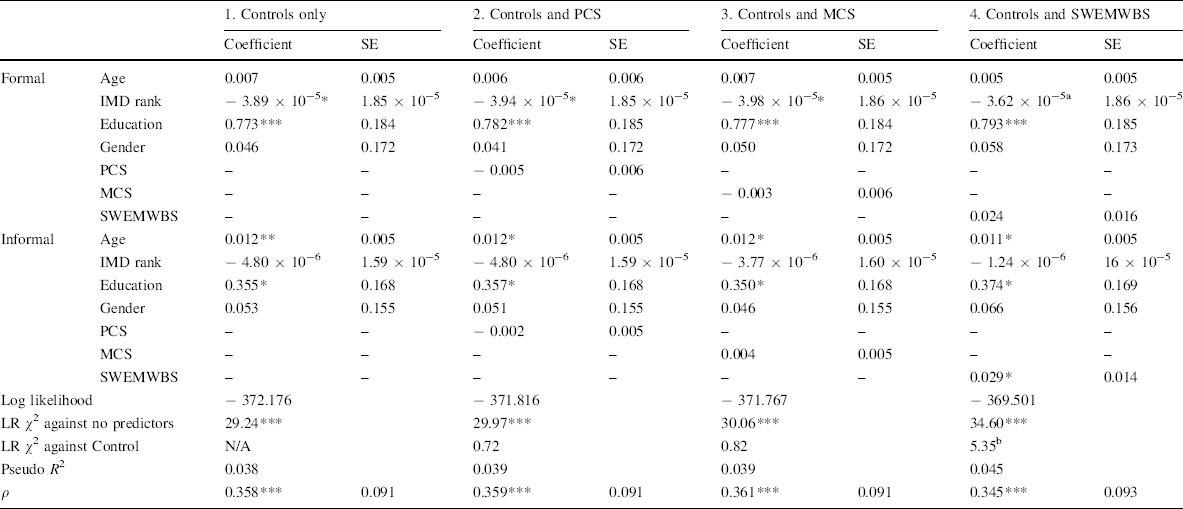
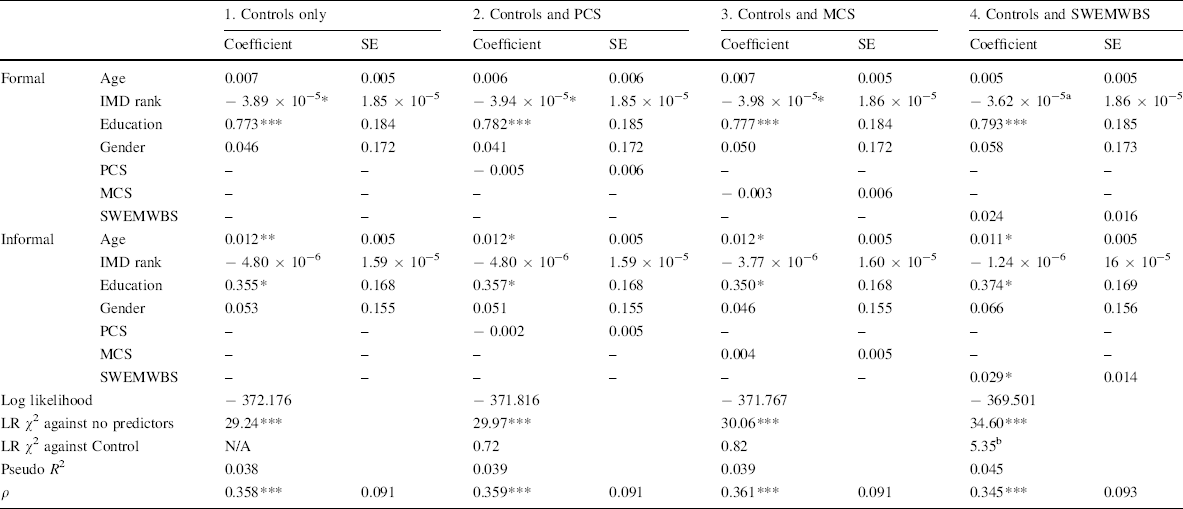
Table 1 shows the outputs from the four separate regression analyses. All models were a significantly better fit than the null model (with no predictors). The models including a predictor of interest were not a significantly better fit than the model comprising the control variables only, except for a trend towards significance for the SWEMWBS model (χ 2 = 5.35, p = 0.069). Pseudo-R 2 was largest for the SWEMWBS model, at 0.045. The low value indicates that the variance in volunteering would be better explained by including other, unknown, factors. However, given that the range for an excellent model fit is 0.2–0.4 (McFadden Reference McFadden1977), the current value appears reasonable, in the context of providing a significantly better fit than the null model.
Results from the bivariate probit regression models predicting formal and informal volunteering
1. Controls only |
2. Controls and PCS |
3. Controls and MCS |
4. Controls and SWEMWBS |
||||||
|---|---|---|---|---|---|---|---|---|---|
Coefficient |
SE |
Coefficient |
SE |
Coefficient |
SE |
Coefficient |
SE |
||
Formal |
Age |
0.007 |
0.005 |
0.006 |
0.006 |
0.007 |
0.005 |
0.005 |
0.005 |
IMD rank |
− 3.89 × 10⁻⁵* |
1.85 × 10⁻⁵ |
− 3.94 × 10⁻⁵* |
1.85 × 10⁻⁵ |
− 3.98 × 10⁻⁵* |
1.86 × 10⁻⁵ |
− 3.62 × 10⁻⁵a |
1.86 × 10⁻⁵ |
|
Education |
0.773*** |
0.184 |
0.782*** |
0.185 |
0.777*** |
0.184 |
0.793*** |
0.185 |
|
Gender |
0.046 |
0.172 |
0.041 |
0.172 |
0.050 |
0.172 |
0.058 |
0.173 |
|
PCS |
– |
– |
− 0.005 |
0.006 |
– |
– |
– |
– |
|
MCS |
– |
– |
– |
– |
− 0.003 |
0.006 |
– |
– |
|
SWEMWBS |
– |
– |
– |
– |
– |
– |
0.024 |
0.016 |
|
Informal |
Age |
0.012** |
0.005 |
0.012* |
0.005 |
0.012* |
0.005 |
0.011* |
0.005 |
IMD rank |
− 4.80 × 10⁻⁶ |
1.59 × 10⁻⁵ |
− 4.80 × 10⁻⁶ |
1.59 × 10⁻⁵ |
− 3.77 × 10⁻⁶ |
1.60 × 10⁻⁵ |
− 1.24 × 10⁻⁶ |
16 × 10−5 |
|
Education |
0.355* |
0.168 |
0.357* |
0.168 |
0.350* |
0.168 |
0.374* |
0.169 |
|
Gender |
0.053 |
0.155 |
0.051 |
0.155 |
0.046 |
0.155 |
0.066 |
0.156 |
|
PCS |
– |
– |
− 0.002 |
0.005 |
– |
– |
– |
– |
|
MCS |
– |
– |
– |
– |
0.004 |
0.005 |
– |
– |
|
SWEMWBS |
– |
– |
– |
– |
– |
– |
0.029* |
0.014 |
|
Log likelihood |
− 372.176 |
− 371.816 |
− 371.767 |
− 369.501 |
|||||
LR χ 2 against no predictors |
29.24*** |
29.97*** |
30.06*** |
34.60*** |
|||||
LR χ 2 against Control |
N/A |
0.72 |
0.82 |
5.35b |
|||||
Pseudo R 2 |
0.038 |
0.039 |
0.039 |
0.045 |
|||||
ρ |
0.358*** |
0.091 |
0.359*** |
0.091 |
0.361*** |
0.091 |
0.345*** |
0.093 |
|
SE is the standard error, N/A not applicable, ρ is the model correlation between the two outcome variables, LR is the likelihood ratio
Significance *p ≤ 0.05, **p ≤ 0.01, ***p ≤ 0.001, ap = 0.052, bp = 0.069
All models exhibited a significant positive bivariate correlation (ρ), indicative of a positive relationship between the two outcomes, such that the probability of engaging in formal volunteering increases with the probability of engaging in informal volunteering, and vice versa.
For the control variables, all models revealed Education as a predictor of formal volunteering and informal volunteering, IMD rank as a significant (or strong trend towards significant) predictor of formal volunteering, and Age as a predictor of informal volunteering. The coefficients show that formal volunteering increases with post-16 education and decreases with IMD rank, and informal volunteering increases with post-16 education and with age. The strength of the IMD rank as a predictor is lowest in the SWEMWBS model. Gender was not a significant predictor for either type of volunteering.
For the variables of primary interest, PCS and MCS were not significant predictors of volunteering, while SWEMWBS was a significant predictor of informal volunteering.
Marginal Effects of SWEMWBS
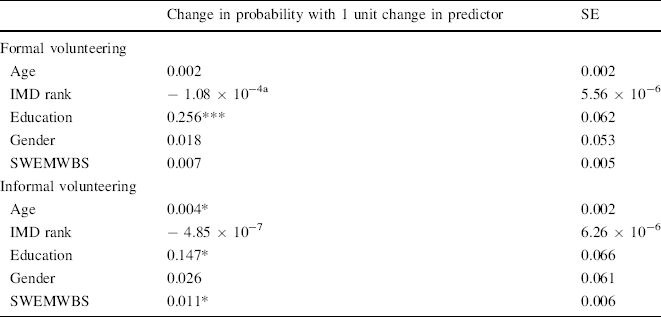
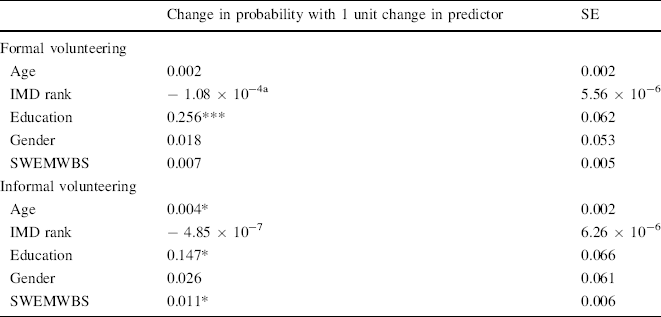
Given the significance of SWEMWBS as a predictor, and the trend towards SWEMWBS improving the fit to the data over the control variables alone, we present the marginal effects for the model that comprised SWEMWBS and the control variables as predictors. See Table 2. The change in probability for SWEMWBS shows that an increase in the well-being score by 1 point increases the probability of informal volunteering by 1.1% (p = 0.043). In our cohort, the difference between the maximum (35.0) and minimum (12.4) SWEMWBS is 22.6, a difference that would increase the probability of informal volunteering by 25%.
Marginal effects from the SWEMWBS bivariate probit regression predicting formal and informal volunteering, when other variables are held constant at their mean value
Change in probability with 1 unit change in predictor |
SE |
|
|---|---|---|
Formal volunteering |
||
Age |
0.002 |
0.002 |
IMD rank |
− 1.08 × 10⁻⁴a |
5.56 × 10⁻⁶ |
Education |
0.256*** |
0.062 |
Gender |
0.018 |
0.053 |
SWEMWBS |
0.007 |
0.005 |
Informal volunteering |
||
Age |
0.004* |
0.002 |
IMD rank |
− 4.85 × 10⁻⁷ |
6.26 × 10⁻⁶ |
Education |
0.147* |
0.066 |
Gender |
0.026 |
0.061 |
SWEMWBS |
0.011* |
0.006 |
Significance *p ≤ 0.05, ***p ≤ 0.001, ap = 0.051
Conclusion and Discussion
The purpose of this study was to determine if physical health, mental health or mental well-being are predictors for volunteering activity amongst social housing tenants. The participants included a relatively homogenous group of social housing tenants in a deprived area of the UK. Our key finding is that mental well-being, rather than physical health or mental health, is a significant predictor of volunteering. There was also some evidence that volunteering rates increased with higher levels of deprivation (lower IMD rank). In line with previous studies, education and age were significant predictors of volunteering. We found mental well-being to be a significant predictor of informal volunteering behaviour.
Control Variables
Consistent with many other studies (Musick and Wilson Reference Musick and Wilson2007; Son and Wilson Reference Son and Wilson2012a), the results provide evidence that volunteering activities increase with post-age-16 education (secondary/further education), with a stronger effect for formal than informal volunteering. This finding provides a robustness to the observation that an increase in education level is associated with an increase in volunteering, even when in an area of relatively low education levels. The attenuated effect for informal volunteering is also in line with previous studies, which found an attenuated or non-significant effect (Shandra Reference Shandra2017; Musick and Wilson Reference Musick and Wilson2007).
Informal volunteering activity increased with age. Given research shows that a decline in health or increasing functional limitations, associated with ageing, may impede elderly adults’ engagement in volunteering (Tang et al. Reference Tang, Morrow-Howell and Choi2010; Binder and Freytag Reference Binder and Freytag2013), one might then ask why informal volunteering increased rather than decreased with age. An explanation might rest on McNamara and Gonzales (Reference McNamara and Gonzales2011) findings that a decline in health is not associated with a decline in volunteering if older people are already engaged with volunteering, although we do not have data on participants’ long-term volunteering to support this argument. Another reason for the opposite effects of age relates to the survey used for this study and the threshold of commitment to be counted as informally volunteering. The survey question asks about activity within the last year. Therefore, while poor physical health can reduce engagement in formal volunteering, in our study, it appears unlikely to affect flexible and potential infrequent informal volunteering.
There was no evidence of a relationship between gender and either type of volunteering. Research in the US has found that women generally volunteer more (Musick and Wilson Reference Musick and Wilson2007). However, other work shows that the reliability of gender as a predictor for volunteering depends strongly on the type of volunteering undertaken (Einolf and Chambré Reference Einolf and Chambré2011). Our survey captured all types of volunteering by a generic question supplemented with examples; hence, effects of gender in specific volunteering activities are likely to be minimised.
The results provide some evidence that IMD has an effect on formal volunteering. However, the direction of the relationship is counter to what would be expected from the literature (McCulloch et al. Reference McCulloch, Mohan and Smith2012; Southby et al. Reference Southby, South and Bagnall2019), with a lower IMD rank (higher deprivation) being associated with increased formal volunteering activity. This result suggests that there is not a simple linear relationship between IMD Ranks and volunteering, but that when people are living in an area of high deprivation, a decrease in deprivation levels no longer corresponds to an increase in volunteering. One reason could be that the less deprived people do not see the need for such support (Overgaard et al. Reference Overgaard, Petrovski and Hermansen2018). The pattern is partially in line with previous work, showing that once well-being and the effects of financial strain on well-being are taken into account, the positive relationship between income levels and volunteering is no longer apparent (Son and Wilson Reference Son and Wilson2015). This might be because people living in social housing get more opportunities to volunteer than comparable people in private (rental or owner) housing.
However, our results also suggest there are positive drivers for formal volunteering amongst the most deprived. In some of our qualitative interview responses (study forthcoming), participants who expressed high levels of life difficulty and low levels of well-being also cited volunteering as a support mechanism for them. Further research would be required to provide valid evidence, but we posit that these positive drivers relate to mental well-being gains providing an increase in general day-to-day motivation.
Physical Health and Volunteering
25.2% of participants (330 responded) reported a current occupation of long-term sick or disabled as opposed, for example, to employed, actively looking for work, etc. Given that physical health and mobility is a potential barrier to volunteering (Southby et al. Reference Southby, South and Bagnall2019), it would be expected that physical health would have been a significant factor. However, we found no evidence of a relationship between physical health and either type of volunteering. We suggest that physical health is not a predictor of volunteering because of (1) the type of volunteering activity that the social housing tenants undertake; and (2) the topography of the study area, which is mainly flat. In terms of the type of volunteering, in our study, formal volunteers were mostly raising money for local charities by taking part in sponsored events or handling money whilst working in charity shops (half of formal volunteering fell into this latter category). The second largest type of formal volunteering was for local community or neighbourhood groups, with most in this category being a volunteer Coastline Customer Representative. This role involves attending meetings at for which door-to-door transport is provided, devised as part of Coastline Housing’s inclusivity and accessibility policies. Informal volunteers were mostly helping a neighbour with everyday social care tasks; providing little-and-often support which by definition requires minimal travel. All these types of volunteering are not physically strenuous, nor is the terrain of the study area physically demanding to navigate. For example, charity shops were easily accessible by bus or a flat walk from participants’ housing. We argue that they types of volunteering this cohort conduct require a low amount of physical fitness and could therefore account for the lack of effect.
The wider point here relates to inequality, transport, and the inclusivity policies of HA’s. A known, but under examined, barrier to volunteering is transport for those who are older, disabled, or of poor health (Martinez et al. Reference Martinez, Crooks, Kim and Tanner2011). In this case, the HA provisioned transport and therefore addressed this barrier, playing a crucial role by designing, facilitating, and supporting in house volunteering opportunities which are tailored to their tenants needs and overcome physical health barriers (Leviten-Reid and Campbell Reference Leviten-Reid and Campbell2016; Shandra Reference Shandra2017). In doing so, they address inequalities in volunteering.
Mental Health and Volunteering
There was no evidence of a relationship between mental health (measured by the SF-12v2® Health Survey) and either type of volunteering. This is at odds with previous studies which have found anxiety (Handy and Cnaan Reference Handy and Cnaan2007) and depression (Salt et al. Reference Salt, Crofford and Segerstrom2017; Principi et al. Reference Principi, Galenkamp, Papa, Socci, Suanet, Schmidt, Schulmann, Golinowska, Sowa, Moreira and Deeg2016; Li and Ferraro Reference Li and Ferraro2006) to be barriers to volunteering. One explanation for a lack of effect is that volunteer work could operate as a coping or compensation mechanism in which people in poor mental health turn to volunteering as a means of overcoming low morale and restoring self‐esteem, and to increase self-value within society (Penner Reference Penner2004). As discussed for IMD rank, qualitative responses from participants suggest that those going through life difficulties reported volunteering as a motivational support for themselves. Therefore, low mental health might not be a barrier to volunteering.
Mental Well-Being and Volunteering
We have revealed a positive relationship between SWEMWBS and informal volunteering rate, with an increase in mental well-being being associated with a rise in volunteering behaviours. This finding is consistent with previous studies emphasising the importance of mental well-being as a psychological resource determining who volunteers (Son and Wilson Reference Son and Wilson2015), and population scale studies which found positive mental health to be an antecedent of volunteering by contributing to the agentic capacity for productive activity (Andersson and Glanville Reference Andersson and Glanville2016; Hong and Morrow-Howell Reference Hong and Morrow-Howell2010). In addition, similar to Tang et al. (Reference Tang, Morrow-Howell and Choi2010), the current study found positive mental well-being to be more significant that physical health in predicting volunteering.
Mental well-being relates to the psychosocial and environmental conditions (Speight et al. Reference Speight, Mcmillan, Barrington and Victor2007), and therefore, explanations of this relationship need to consider local social factors. As explored above, these factors enable volunteers to participate in activities that promote well-being. Indeed, Son and Wilson (Reference Son and Wilson2015) discuss the need for resources theories to include psychological resources as a means to determine who volunteers. They conclude that the reason that people of lower incomes are less likely to volunteer can be attributed to the effects of financial strain on well-being. Well-being has been considered to be both an outcome and a predictor of one’s involvement in volunteering activity (Thoits and Hewitt Reference Thoits and Hewitt2001). It is therefore possible that there is an interrelated positive effect, which could be of benefit to HAs and their tenants, with volunteering allowing an increase in mental well-being.
Study Limitations and Methodological Reflection
There are three types of limitations in this study and one point of methodological reflection. Firstly, participants were recruited as part of a wider research and innovation project, which may mean participants were inclined to contribute to local initiatives. Such a bias is difficult, if not impossible, to avoid, and presumably exists in other studies on volunteering in which participation is voluntarily (an ethical requirement). In addition, such a bias could only explain a generally higher rate of volunteering rather than the patterns in the predictors of volunteering.
The second point refers to both a limitation and a strength of the methodology. Data were collected from socially and demographically homogenous group of 330 social housing tenants who live within a connected conurbation in central Cornwall. The limitation is that the findings could be place and community specific. The strength of this data set is that the contextual variables, with regard to place, history and socio-economics, are similar for all participants and therefore reducing the likelihood that other factors not captured in this study could explain the relationships found.
The third limitation in the study is unable to specify causal relationships for volunteering. A longitudinal study would be required to disambiguate the cause and effect between mental well-being and informal volunteering.
Finally, in addition to these limitations, we offer a methodological reflection on the necessity of helping respondents to correctly identify formal and informal volunteering”. Based on the notes of the researchers who conducted the surveys, participants sometimes failed to recognise that some of their activities constituted informal volunteering. Similar to previous studies (Martinez et al. Reference Martinez, Crooks, Kim and Tanner2011; Overgaard et al. Reference Overgaard, Petrovski and Hermansen2018), we found that formal volunteering was easily identified, but some participants did not initially recognise their activity as informal volunteering until prompted with the survey definition or examples. This potential definitional ambiguity is a methodological risk which future research needs to mitigate for, as this study did, with the research team conducting the surveys face to face, guided by a script, which enabled a full, clear, and consistent explanation of the distinction between formal and informal volunteering to be established. Otherwise, as Benenson and Stagg (Reference Benenson and Stagg2016) note, the depth and richness of mutual support which sustains disadvantaged communities may be understated.
Implications
Worldwide, volunteering is a policy priority and has also become important to HAs as a mechanism for social investment. However, the positive impacts have not been fully realised for disadvantaged or socially excluded groups, which often live within social housing (Southby et al. Reference Southby, South and Bagnall2019). Responding to calls for an analytical focus on ‘inequality in volunteering’ (Hustinx et al. Reference Hustinx, Grubb, Rameder and Shachar2019), this study contributes to new research by examining the relationship between health, well-being and volunteering behaviours amongst a social housing community. This study provides evidence that, in this community, the potential barriers to volunteering of physical and mental health have been mitigated by local geographies of accessibility and of supportive and inclusivity policies of HAs.
Acknowledgements
The Smartline project is receiving up to £4,188,318 of funding from the England European Regional Development Fund (Grant No. 05R16P00305) as part of the European Structural and Investment Funds Growth Programme 2014–2020. The Ministry of Housing, Communities and Local Government (and in London the intermediate body Greater London Authority) is the Managing Authority for European Regional Development Fund. Established by the European Union, the European Regional Development Fund helps local areas stimulate their economic development by investing in projects which will support innovation, businesses, create jobs and local community regenerations. For more information visit https://www.gov.uk/european-growth-funding. Additional funding is from the South West Academic Health Science Network.


 Open access

