




Introduction
Though archaeologists have studied Paquimé (a UNESCO World Heritage Site in Chihuahua, Mexico) for decades, key debates remain unresolved, particularly concerning its social organisation. Was it cosmopolitan? An elite-managed hierarchical society? Was its efflorescence the result of natural population growth or a large migration during the twelfth to thirteenth centuries AD? In this study, we examine how burial 23-8 (Reich Lab ID# I22220) from the House of the Well, a genetically male child whose parents were more closely related than first cousins, can provide answers to these questions.
Paquimé background
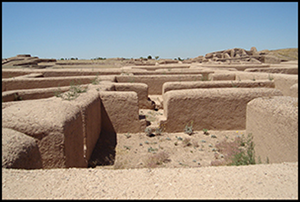
Paquimé is one of the most significant sites in the Mexican Northwest/US Southwest (Northwest/Southwest). The Joint Casas Grandes project, led by Charles Di Peso, excavated a portion of the site from 1959–1961. The project and subsequent analyses form the foundation of archaeological understanding about Paquimé. Paquimé dates to AD 1200–1450 and was made primarily of adobe architecture (Figure 1). Its size and elaboration were unrivalled in the precontact Northwest/Southwest, and it was undoubtedly the political and ceremonial centre of the region. Paquimé had approximately 1100 rooms, and some of the apartment-style buildings were at least three storeys tall. Multiple architectural features distinguish it from contemporaneous sites, including an approximately 113m-long ‘serpent’ mound, a large cruciform mound, at least two ballcourts, plazas, an area with large roasting pits and an aqueduct that carried water into the site from a spring approximately 6km to the north-west. Abundant trade goods, especially from west Mexico, were stored at Paquimé—including over four million pieces of marine shell (Nelson et al. Reference Nelson, Canchola, Punzo Díaz and Minnis2015; Punzo Díaz & Villapando Reference Punzo Díaz, Villapando, Minnis and Whalen2016)—and the site was home to a macaw breeding community, with macaw pens and hundreds of macaw burials (Di Peso Reference Di Peso1974: vol. 4).
Adobe architecture at Paquimé (photograph by authors).

Paquimé was undoubtedly central to sociopolitical developments in its region, though scholars continue to debate the nature of the site's origin, social organisation and decline. Archaeologists have revised many of Di Peso's hypotheses, especially that Mesoamerican pochteca traders (long-distance merchants associated with the Aztec Empire) founded Paquimé (Dean & Ravesloot Reference Dean, Ravesloot, Woosley and Ravesloot1993; Whalen & Minnis Reference Whalen and Minnis2009; Pailes & Searcy Reference Pailes and Searcy2022). Whether Paquimé's efflorescence was the result of migration from the Mimbres-Mogollon region to the north, influence by an elite lineage from the Chaco Canyon-Aztec Ruins region, local population growth, or the allure of socio-religious leaders remains unresolved (Whalen & Minnis Reference Whalen and Minnis2001a & Reference Whalen and Minnisb; VanPool & VanPool Reference VanPool and VanPool2007; Lekson Reference Lekson2009; Pailes & Searcy Reference Pailes and Searcy2022). There is also no consensus on Paquimé's end, though evidence suggests it was unpleasant. Nearly 100 human skeletons from the site's terminal occupation were left unburied; these have variously been attributed to violence, disease or starvation, raising the possibility that Paquimé met an ignominious end (Di Peso Reference Di Peso1974: vol. 8; Ravesloot Reference Ravesloot1988; Walker Reference Walker2002; Casserino Reference Casserino2009). Despite this, some Paquimé residents and their descendants remained in the region. Through a reanalysis of Spanish documents, extant Colonial-era architecture, artefacts and cranial modification, Douglas and Brown (Reference Douglas and Brown2023) argue that the Suma people, whom the Spanish encountered during their early expeditions, were descendants of the inhabitants of Paquimé and the Casas Grandes regional system.
Insights into Paquimé's hierarchy from burial data
Paquimé's social structure, degree of hierarchy and elite influence have received much attention since the Joint Casas Grandes project (e.g. Schaafsma & Riley Reference Schaafsma and Riley1999; Whalen & Minnis Reference Whalen and Minnis2001a & Reference Whalen and Minnisc; VanPool & VanPool Reference VanPool and VanPool2007; Lekson Reference Lekson2009; Pailes & Searcy Reference Pailes and Searcy2022). Studies that have explored questions of the site's social structure through burial data (e.g. Ravesloot Reference Ravesloot1988; Casserino Reference Casserino2009; Rakita Reference Rakita2009; Offenbecker Reference Offenbecker2018; Waller et al. Reference Waller, Offenbecker, Kelley and Katzenberg2018) have found evidence of social stratification and concluded that some lineages were linked to political and religious power (Pailes & Searcy Reference Pailes and Searcy2022: 90). Rakita (Reference Rakita2009: 148) argues for the presence of an exclusive ancestor worship cult at Paquimé that legitimised power through sacrifice. Other studies of burial group 44-13 in the House of the Dead (Offenbecker Reference Offenbecker2018; Waller et al. Reference Waller, Offenbecker, Kelley and Katzenberg2018), the most elaborate burial at Paquimé, found social distinctions among the 12 individuals. An upper layer contained the co-mingled skeletal remains of five individuals who had indicators of poor health, such as enamel hypoplasia and porotic hyperostosis, along with cut marks and evidence of post-mortem processing (including possible cannibalism; Casserino Reference Casserino2009). In contrast, the seven individuals in the lower layer were articulated and associated with ritually significant grave goods (e.g. smashed ceramic hand drums, a turkey sacrifice and Ramos Black ceramic vessels). They also had many fewer markers of health stress and post-mortem processing. Offenbecker (Reference Offenbecker2018) conducted a strontium (Sr) isotope study of three individuals from the upper layer and two from the lower and found that the lower layer individuals were locals, while two of the three individuals from the upper layer were non-local. Additionally, King and colleagues (Reference King, Searcy, Yost and Waller2017) identified microscopic botanical evidence embedded in the dental calculus of two of the individuals in the upper layer burial that suggested they had recently consumed corn beer and may have been inebriated shortly before their death and interment. Taken together, these lines of evidence could be indicative of sacrificial victims being brought from outside Casas Grandes, ritually killed, and then buried with elites who were born and lived locally.
House of the Well, unit 8, burial 23-8
The House of the Well, in the north-east portion of Di Peso's excavation (Figure 2a), was given its name due to the unique subterranean walk-in well found within it (Di Peso et al. Reference Di Peso, Fenner and Wesche1974a: 382). This well was approximately 12m underground (Di Peso et al. Reference Di Peso, Fenner and Wesche1974a: 377). To access it, one had to use a steep staircase, passing a human calvarium (skull) embedded in the floor entrance and other ritual artefacts such as copper tinklers, small stone effigies and turquoise and shell beads (VanPool Reference VanPool2003: 702). According to Di Peso and colleagues (Reference Di Peso, Fenner and Wesche1974a: 382), the habitations closest to the well were affluent and had “the best acequia and sewage services”. The rooms in the House of the Well also contained more specialised goods than any other area of the site, with millions of marine shells from 60 species, the bulk of the raw ricolite, turquoise, salt, selenite and copper ore, as well as a stack of 50 or more non-locally made Gila Polychrome bowls, smoking pipes, decapitated effigy vessels and the highest number of macaw sacrifices (n = 34) of any area at Paquimé (Di Peso et al. Reference Di Peso, Rinaldo and Fenner1974c; Offenbecker Reference Offenbecker2018; VanPool Reference VanPool2003). Through an analysis of ritual objects, particularly ceramic effigy vessels and imagery, smoking pipes and caches of mineral concretions, quartz and small fetishes, VanPool (Reference VanPool2003) argues that shaman-priests were elite leaders at Paquimé and that their power was concentrated at the House of the Well.
Location of room 21 and burial 23-8 at Paquimé: a) Paquimé site map (produced by S. Ure & M. Searcy); b) diagram of room 21 (adapted from Di Peso et al. Reference Di Peso, Rinaldo and Fenner1974c: 408 with permission of The Amerind Foundation, Inc.); c) position of burial 23-8 (from Di Peso et al. Reference Di Peso, Rinaldo and Fenner1974c: 410 with permission of The Amerind Foundation, Inc.).

Though not in direct contact with the well itself, room 21c in the House of the Well was the bottom floor of a rare three-storey room that was an important, non-typical domestic room. It lacked a cooking hearth, was larger than most rooms (12.75 × 5.35m), had elaborate stairs to the upper storey and contained artefacts including copper objects and a scarlet macaw pen on an upper floor. Three substantial wooden pillars supported the roof and upper floor (Figure 2b). Each pillar posthole had large, shaped stone support discs at the bottom, with turquoise pendants placed as offerings beneath them. Wrapped around the base of one roof-support post was burial 23-8, which consisted of a two- to five-year-old child placed on top of a sandstone disc (Figure 2c). According to Di Peso and colleagues (Reference Di Peso, Rinaldo and Fenner1974b: 376), “the body position of burial 23-8 indicated that this child was placed as some sort of supplicatory offering at the time the post support was seated, during the Paquimé Phase remodelling”. Additionally, the back left side of the skull exhibits damage, possibly from a fatal blow, leading Di Peso to classify burial 23-8 as a sacrifice. Though Di Peso recorded several other possible sacrifices, most notably the upper-level individuals in burial 44-13 located in the House of the Dead, burial 23-8 was distinct in its form and context. The Joint Casas Grandes Project excavated 57 individuals from the House of the Well (9.9% of the burials from the site). Of those 57 individuals, 25 were in formal pits beneath house floors, 18 were in formal pits beneath plazas and 14 were unburied. Di Peso excavated 13 children in the House of the Well, with six beneath house floors, four beneath plazas and three unburied. Burial 23-8, wrapped around a post, was unique in the House of the Well and at the site. Our new genetic analyses, described below, reveal another distinct attribute of this child interment.
Genetic analysis of burial 23-8
Burial 23-8 was analysed as part of the Proyecto de Investigación de Poblaciones Antiguas en el Norte y Occidente de México (PIPANOM), which examines changes in population structure through time in western and northern Mexico, in close collaboration with researchers in the region (see ethics statement). Our analysis pipeline for a sample from burial 23-8 included processing of skeletal material, sequencing, bioinformatics and data quality assessments (as described, for example, in Lazaridis et al. Reference Lazaridis2022; see online supplementary material (OSM) for methods description). These methods confirmed that burial 23-8 produced authentic ancient DNA (aDNA) data (Table 1; see also OSM and Table S1). DNA sequences have appreciable damage at the terminal ends as expected for genuine aDNA. The match rate to the mitochondrial consensus sequence has a 95% confidence interval of 99.4–100%, consistent with minimally contaminated data (Table S2). Analysis determined the individual to be genetically male. Uniparental markers (mitochondrial haplogroup C1b and Y-chromosome haplogroup Q1a2a2b1a~) are consistent with Native American populations.
Ancient DNA data generated for burial 23-8.

After confirming data authenticity, we combined the genetic data of burial 23-8 with that of 609 previously published ancient individuals from across the Americas (Table S5) and 170 previously published modern individuals (including Chane, Huichol, Karitiana, Zapotec, Mixe, Mixtec, Piapoco, O'odham, Quechua, Surui, European and Mbuti; Table S6). We conducted population-level analyses (Principal Components Analysis (PCA) (Patterson et al. Reference Patterson, Price and Reich2006), ADMIXTURE (Alexander et al. Reference Alexander, Novembre and Lange2009) and outgroup f3 statistics (Patterson et al. Reference Patterson2012)) to examine burial 23-8's ancestry and if it was significantly different from that of other previously published individuals.
PCA (Figure 3b & c) demonstrates that burial 23-8 and other previously published ancient individuals from the Northwest/Southwest (Villa-Islas et al. Reference Villa-Islas2023; Nakatsuka et al. Reference Nakatsuka2023) are shifted towards modern-day O'odham (Pima) ancestry (modern O'odham people are Uto-Aztecan speakers and maize farmers whose homeland traditionally stretched across the modern Mexico-US border). The O'odham were one of the groups the Spanish encountered during their conquest of the Northwest/Southwest beginning in the mid-sixteenth century and still reside in the region today.
Population genetics analysis of burial 23-8: a) map showing the locations of all published Americas individuals included in analysis (generated in Tableau v. 2023.1 using OpenStreetMap data); b) PCA of burial 23-8 (red star) with published modern and ancient individuals from the Americas. PCA created by calculating axes using modern populations and projecting ancient individuals onto the axes (see OSM Table S6); c) detail from PCA showing only Meso- and North America individuals; d) ADMIXTURE plot at K = 9 of burial 23-8 (far left) with other published ancient (left) and modern (right) populations. Populations ordered by geography and similarity of ancestry cluster assignment percentages to burial 23-8; e) outgroup f3 results of test f3 (burial 23-8, test population; Mbuti.DG). Higher values indicate greater amounts of allele sharing with burial 23-8. Error bars represent two standard errors. Modern populations capitalised (figure by authors).

Outgoup f3 analysis (Figure 3e) provides similar results to PCA, with burial 23-8 having more allele sharing with modern O'odham and ancient individuals geographically closest to Paquimé. As with PCA and outgroup f3 analysis, ADMIXTURE analysis reveals that burial 23-8 has ancestry most like ancient individuals in closest geographic proximity (Figure 3d). Similarity in ancestry decreases with increasing distance from Paquimé.
Our analyses indicate that burial 23-8's ancestry was like that of other individuals who lived in the Northwest/Southwest during the last 2000 and more years, with burial 23-8's ancestry particularly close to modern O'odham. Though we do not explore population substructure extensively, we find that in general the ancestry of ancient individuals in Central and North America is clinal and correlates with geography. This finding replicates previous studies of ancient and modern populations in Central and North America (Aguilar-Ordoñez et al. Reference Aguilar-Ordoñez2021; Villa-Islas et al. Reference Villa-Islas2023).
Runs of homozygosity
Runs of homozygosity (ROH) are large stretches of the genome where the DNA an individual receives from their mother is identical to the DNA they receive from their father, due to the mother and father sharing a recent common ancestor as would be expected for the offspring of siblings or cousins (Ceballos et al. Reference Ceballos, Joshi, Clark, Ramsay and Wilson2018). Quantifying and analysing ROH in ancient genomes can be used to estimate the size of the communities in which people lived and the degree of relatedness (consanguinity) of an individual's parents (e.g. Cassidy et al. Reference Cassidy2020; Ringbauer et al. Reference Ringbauer, Steinrücken, Fehren-Schmitz and Reich2020; Skourtanioti et al. Reference Skourtanioti2020). ROH are recorded in centimorgans (cM), which is a measure of genetic distance between two positions on a chromosome. Higher cM values demonstrate that more of the genome is held in common between two (or more) ancestral individuals. Analytical tools such as hapROH (Ringbauer et al. Reference Ringbauer, Novembre and Steinrücken2021) quantify the ROH found in an ancient genome. Segments of ROH are pooled by length and summed. The total sum of short–medium ROH segments is used to make inferences about population/mating pool size, as small, isolated populations are likely to contain individuals that are distantly (or closely) related to one another and, thus, mating pairs in the population will likely share some shorter lengths of ROH (i.e. more closely related by chance). Conversely, if these individuals had low summed short–medium ROH values, their immediate ancestors were likely part of larger, more heterogeneous populations. Summed ROH values greater than 20cM (henceforth long ROH) can be used to make inferences about consanguinity. The more closely related an individual's parents, the more long ROH are contained within that person's genome.
We found a long ROH value of 270.09 for burial 23-8 using hapROH (Table 2). This is the second largest long ROH value published for individuals from the Americas (n = 237, mean long ROH = 17.76, median long ROH = 0), exceeded only by an individual from San Clemente Island, California (Nakatsuka et al. Reference Nakatsuka2023, Figure 4, see also Tables S3 & S7). In a simulation of 1000 individuals, Ringbauer and colleagues (Reference Ringbauer, Novembre and Steinrücken2021) found that the range of summed long ROH for first cousins (third degree genetic relatives) was between 50–500cM (Ringbauer et al. Reference Ringbauer, Novembre and Steinrücken2021: supp. mat. p 32). However, only 29/1000 of these first cousin simulations had a value higher than 270.09, which suggests that burial 23-8's parents were more closely related than first cousins. We used data from Ringbauer and colleagues (Reference Ringbauer, Novembre and Steinrücken2021) to compare the ROH values for burial 23-8 with expected ROH values for particular familial relationships (Figure 5). The most probable type of relationship is second degree, which arises when parents are half-siblings, uncle-niece, aunt-nephew or grandparent-grandchild (Ringbauer pers. comm.).
hapROH results for burial 23-8 by ROH segment length. cM = centimorgans.

Histogram of long ROH for published Americas individuals binned by summed long ROH values (figure by authors).

Stacked bar plot of ROH values for burial 23-8 and average values for specific familial relationships (figure by authors).

Radiocarbon analysis
Radiocarbon dating produced a range of AD 1301–1397 (95.4% confidence; 620 ± 15 BP; PSUAMS-10865; Figure 6, see OSM), falling within Paquimé's apogee during the Medio period. Di Peso and colleagues (1974c: 407) produced a dendrochronological date of AD 1113p-1234vv for the post burial 23-8 was wrapped around, pre-dating the radiocarbon date we obtained by over a century. However, previous work has identified issues with Di Peso's tree ring dates, mainly that many dates were too early because they did not account for the shaping of beams and removal of outer rings (Dean & Ravesloot Reference Dean, Ravesloot, Woosley and Ravesloot1993). We propose that the most likely scenario is that the interment of burial 23-8 was contemporaneous with the erection of the post.
Radiocarbon age of burial 23-8. Calibrated in OxCal v4.4.4 (Bronk Ramsey Reference Bronk Ramsey2021), with IntCal20 (Reimer et al. 2020) (figure by authors).

Strontium analysis
We used remnant cochlea powder from aDNA analysis to analyse burial 23-8's Sr isotope ratio (see OSM). Burial 23-8 yielded a ratio of 0.70723 ± 0.000010, falling within the range for the site (0.7068–0.7075; Figure 7) and suggesting the child spent their short life at or near Paquimé. Our Sr analysis aligns with previous isotopic research at Paquimé that found only local individuals buried in the House of the Well (Offenbecker Reference Offenbecker2018). This, coupled with the abundance of ritually significant features and artefacts found there, indicated to Offenbecker (Reference Offenbecker2018) that the people buried in the House of the Well were part of a local elite group.
Strontium isotope values of individuals buried at Paquimé. All values other than burial 23-8 (star) published in Offenbecker (Reference Offenbecker2018: 62–66) (figure by authors).

Discussion
Researchers have used ROH to study aspects of the past that were previously difficult to ascertain. Fernandes and colleagues (Reference Fernandes2020) used pools of 12–20cM segments to examine ancient Caribbean population size. Estimates for effective population size of two major clades—Ceramic-era south-east coast of the Dominican Republic and Ceramic-era Eastern Greater Antilles—were much smaller than most previous estimates (3082 (95% confidence interval: 1530–8150)). Despite this, ancient inhabitants of the Caribbean did not have high levels of consanguinity overall; in other words, an individual's parents were not likely to be more closely related than second cousins (Fernandes et al. Reference Fernandes2020).
In contrast, Ringbauer and colleagues (Reference Ringbauer, Steinrücken, Fehren-Schmitz and Reich2020) found high levels of consanguinity after AD 1000 in the central Andes. The long ROH values identified were typical of individuals whose parents were first- or second-degree cousins. The rate of close-kin unions was not consistent through time but increased from nine per cent to 46 per cent after AD 1000. The authors attribute this increase to changing kinship patterns during the Late Intermediate period after the Tiwanaku and Wari cultures declined.
In a study examining ROH in a substantial global aDNA dataset (1785 ancient individuals across 45 000 years), Ringbauer and colleagues (Reference Ringbauer, Novembre and Steinrücken2021) found lower levels of consanguinity than might be expected from ethnographic or anthropological literature. Only 54 individuals had long ROH summing to above 50cM (with 11/54 individuals from isolated island populations). Application of hapROH to modern data (1941 modern individuals from approximately 150 present-day populations) revealed that 176 individuals had long ROH summing to greater than 50cM (consistent with being third- or fourth-degree relatives) (Ringbauer et al. Reference Ringbauer, Novembre and Steinrücken2021). These individuals geographically cluster in the present-day Near East, North Africa, Central/South Asia and South America, where cousin marriages are more common than in other areas (such as Western Europe).
Cassidy and colleagues (Reference Cassidy2020) examined 44 Irish Mesolithic and Neolithic individuals using a different method to measure homozygosity in a genome. Their study identified an individual from the Newgrange passage tomb with extreme consanguinity. This individual (NG10), an adult male, had parents who were most likely siblings (we computed a long ROH value of 687.41 for NG10 using hapROH). Cassidy and colleagues (Reference Cassidy2020) suggest that the pairing of NG10's parents was socially sanctioned and likely restricted to ruling families to consolidate and legitimise power. Burial 23-8 has a lower long ROH value than NG10 but, given the unique burial context, the coupling of burial 23-8's closely related parents may also have been a way to legitimise elite hierarchical status.
Consanguinity and social status
Ethnographic and sociological work has found that close-kin relationships are rare and that most social groups view unions of siblings as incest and thus taboo (Levi-Strauss Reference Levi-Strauss1969; Burton Reference Burton1973; Schneider Reference Schneider1976; Shepher Reference Shepher1983; Bateson Reference Bateson, Wolf and Durham2004; Gates Reference Gates, Wolf and Durham2004; Wolf & Durham Reference Wolf and Durham2004). There are exceptions to the nearly universal sibling incest taboo, perhaps the most well-known being sibling pairings in Roman Egypt (Scheidel Reference Scheidel, Wolf and Durham2005). A cross-cultural study by Goggin and Struevant (Reference Goggin, Sturtevant and Goodenough1964) found that taboos against sibling unions most often occurred in societies with some degree of social hierarchy and in which elites/rulers were exempt from social norms. Responding to Goggin and Struveant (Reference Goggin, Sturtevant and Goodenough1964), van den Berghe and Mesher (Reference van den Berghe and Mesher1981) found that 34/42 ethnographically observed societies condoned sibling or half-sibling mating only for royals or aristocrats. They state that “sibling incest is thus confirmed to be overwhelmingly a strategy of polygynous, high-status people; the higher the status, the more polygynous, the more likely the incestuous strategy” (van den Berghe & Mesher Reference van den Berghe and Mesher1981: 1988). Gates (Reference Gates, Wolf and Durham2004: 153) further expounds on the work of Goggin and Struveant (Reference Goggin, Sturtevant and Goodenough1964) and van den Berghe and Mesher (Reference van den Berghe and Mesher1981), arguing that sibling and other close-kin unions among elites in “high-chiefdom/almost-state” societies would have been a way for precocious leaders to “construct auras of power by haughty taboo-breaking”.
Most of the anthropological and ethnographic discussion of close-kin union taboos and exceptions to them have focused on siblings but genetic studies suggest that other types of close-kin relationships were also avoided. Of all the ancient individuals examined by Ringbauer and colleagues (Reference Ringbauer, Novembre and Steinrücken2021), only two—an individual from Israel dating to the sixth millennium BC and an individual from Russia dating to the third millennium BC—had long ROH values greater than burial 23-8 (545.02 and 324.87, respectively). Some modern individuals have been identified with long ROH over 50cM, though only 71 of 1941 had summed long ROH greater than 120cM, the expected value for first cousins (Ringbauer et al. Reference Ringbauer, Novembre and Steinrücken2021). This suggests that even first-cousin pairings (and anything closer than that) are typically taboo. In contrast, multiple individuals from the Andes had long ROH values expected for the offspring of first- or second-degree cousins (though only 2/13 individuals with elevated ROH had values expected for first-cousin unions). It is also worth noting that the small-scale polities of the Andean Late Intermediate period had social hierarchy equivalent to the ‘high-chiefdom/almost-state’ level societies discussed above that used close-kin relationships as political capital.
Implications of burial 23-8 for Paquimé
The parents of burial 23-8 were likely half-siblings, aunt/uncle-niece/nephew, grandparent-grandchild, or some other combination of kin that shared between 25 and 50 per cent of their genomes. Only a few sequenced ancient individuals in the Americas (and globally) have long ROH values as high as burial 23-8. It is, of course, possible that burial 23-8 was the result of an illicit relationship or coerced sexual interaction. It is also possible that the parents were unaware of their close genetic relationship. Though the dynamics of the interactions that led to the birth of this genetically male individual remain unknown, the unique burial context in the House of the Well and the local Sr isotopic signature indicate the special social standing of the parents. This aligns with studies that have found close-kin unions were primarily limited to high-status individuals who reproduced with relatives to consolidate power.
Rakita (Reference Rakita2009) has argued that Paquimé's elite used mortuary rituals and manipulation of closely guarded skeletal remains (such as those in burial 44-13) to extend their status as people who could operate outside of social norms, thus codifying their elevated social positions. In the case of burial 44-13, the comingled individuals in the upper layer were non-local and in poor health, they were processed (and possibly consumed) as part of a sacrificial act and then buried without any grave goods. Thus, their sacrifice starkly contrasts with burial 23-8; the child of a close-kin pairing, born and raised locally and interred near turquoise pendants, under a support post in a ritually significant room, in an important building where only locals were buried.
Unlike the sacrificial victims in the upper level of burial 44-13 at the House of the Dead, burial 23-8 was articulated and a local. Burial in the House of the Well, which previous studies have shown to be a ritually charged and significant place where local elites established and nurtured their power, suggests that this child was part of the local lineage that may have controlled access to the well and other rituals at Paquimé (particularly related to water; Rakita Reference Rakita2009; VanPool Reference VanPool2003). As far as we know, there are no other recorded instances of burials associated with ritually significant grave goods placed under posts in the greater Northwest/Southwest. However, child sacrifice was a practice that occurred throughout ancient Mesoamerica (Crandall & Thompson Reference Crandall, Thompson, Thompson, Alfonso-Durruty and Crandall2014; Toyne Reference Toyne2015; Prieto et al. Reference Prieto2019; Tiesler et al. Reference Tiesler, Suzuki and Pereira2021), as was the use of sacrifice in the consecration of ritually significant buildings (Medrano Enríquez Reference Medrano Enríquez2021). In addition, studies of pre-contact Mesoamerican rituals have shown that human sacrifice was one of the most potent ways to placate the gods or receive their assistance, with elite sacrifice being the most powerful (López Luján & Olivier Reference López Luján and Olivier2010). Sacrificing a child born of two people from a local, elite lineage would have been a powerful way to consecrate the House of the Well and augment social, political and ritual standing.
Conclusion
This study is the first to report genome-wide data from Paquimé. These data provide exciting new insight into Paquimé's social structure. Burial 23-8 at Paquimé is that of a young boy whose parents were closely related, producing the second highest summed long ROH of any ancient individual from the Americas published to date. This was the only individual at Paquimé interred around a post. We find it very unlikely that these were coincidences. Our review of ethnographic/anthropological literature and global aDNA data suggests that taboos against close-kin unions were common and not limited to sibling relationships. Recorded instances of when such relationships are condoned most often occur among elite families within socially stratified societies. These results suggest that burial 23-8 was part of a similarly hierarchical society at Paquimé. Archaeologists have long debated the nature of Paquimé's social organisation. The data from burial 23-8 suggest that there was an elite class at Paquimé, who may have tried to consolidate power by establishing mating pairs of close relatives.
Ethics statement
Burial 23-8 was analysed as part of the joint PIPANOM project, of which authors M. Snow, JLPD, SL, DR and JS are collaborators. Approval of the project was granted by the Instituto Nacional de Arqueología e Historia (INAH), no. 401.1S.3-2018/1732. Research and sampling were conducted using methods that minimise the destructive impact on skeletal material. Because of its colonial history, consultation with local and Indigenous communities in Mexico is complex, and there is no standardised protocol beyond research approval by the INAH. For this project, aDNA data and preliminary results generated in the United States were shared directly with Mexican collaborators and students and at academic and public symposiums on multiple occasions. We incorporated feedback from these sessions into ongoing PIPANOM research. This project contributed to capacity building in Mexico by using grant funding to purchase sampling equipment and laboratory supplies, providing training and information sessions to students and local community members, and supporting student stipends. This project also included the preparation of a Frequently Asked Questions (FAQ) document in Spanish that was distributed and made available at the Museo de las Culturas del Norte at Paquimé.
Acknowledgements
Permission to study burial 23-8 was granted by the INAH, Mexico. Fatma Zalzala, Aisling Kearns, Nadin Rohland, Swapan Mallick and Matthew Mah provided wet lab and bioinformatics processing and support. Alison Barton and Harald Ringbauer assisted with interpretation of hapROH data and results. We thank Éadaoin Harney for reading an early version of the manuscript. We acknowledge the Indigenous people whose ancestors we study.
Funding statement
DR is an Investigator of the Howard Hughes Medical Institute and the aDNA laboratory work was supported by an Allen Discovery Centre grant and by grant 61220 from the John Templeton Foundation. The author-accepted version of this article, that is, the version not reflecting proofreading and editing and formatting changes at Antiquity following the article's acceptance, is subject to the Howard Hughes Medical Institute (HHMI) Open Access to Publications policy, as HHMI lab heads have previously granted a non-exclusive CC BY 4.0 licence to the public and a sublicensable licence to HHMI in their research articles. Pursuant to those licences, the author-accepted manuscript is available at PubMedCentral under a CC BY 4.0 licence immediately upon publication.
Data availability
Genomic data for burial 23-8 are available at the European Nucleotide Archive and the National Centre for Biotechnology Information under the accession number PRJEB71964.
Supplementary material
To view supplementary material for this article, please visit https://doi.org/10.15184/aqy.2024.94.


 Open access

