


South Asian migrants and their offspring living in industrialized countries (henceforth ‘South Asians’) are at high risk of developing type 2 diabetes mellitus( Reference Wild, Roglic and Green 1 – Reference Bindraban, van Valkengoed and Mairuhu 4 ). In the Netherlands, the prevalence among the Hindustani Surinamese, who are of South Asian origin, is about four times greater than the prevalence among the ethnic Dutch( Reference Bindraban, van Valkengoed and Mairuhu 4 ). Given this high risk of diabetes, efforts have been made to develop lifestyle interventions that are culturally targeted to the South Asian population at risk( Reference Nicolaou, Vlaar and van Valkengoed 5 , Reference Douglas, Bhopal and Bhopal 6 ). In practice, the effectiveness of such interventions will depend on whether those diagnosed as being at high risk attend the counselling that is offered.
Previous studies among patient groups have found that increased risk perception enhances attendance at an intervention( Reference Wyer, Joseph and Earli 7 , Reference Toft, Kristoffersen and Aadahl 8 ). Risk perception (Fig. 1) can be defined as the subjective assessment of the probability that someone will get a certain disease (susceptibility) and how concerned someone is with the consequences (severity)( Reference Cameron 9 – Reference Dorman, Valdez and Liu 11 ). Strategies to increase risk perception, particularly communication about common risk factors, are commonly used to enhance attendance at lifestyle interventions. However, whether a similar association of risk perception with attendance can be assumed for South Asian populations, as was done for patient groups in previous studies, has not been investigated. At the same time, there are reasons to expect this association to be different from associations in other, generally lower-risk populations.
Conceptual model and implementation of the measurements in the study design (M, measurements; RCT, randomized controlled trial). *Measured items of risk perception: causal beliefs consisted of three items, i.e. heredity and general and group-specific lifestyle factors; susceptibility was an overall item and controllability was only measured for physical activity( Reference Cameron 9 ). †The results of the screening were communicated to the participants.

First, because a family history of diabetes is more common among South Asian populations than other populations( Reference Bindraban, van Valkengoed and Mairuhu 4 ), South Asians are expected to perceive themselves as more frequently susceptible than the general population( Reference Dorman, Valdez and Liu 11 – Reference Claassen, Henneman and Nijpels 13 ). A family history of diabetes is thought to increase the awareness of one’s own risk and, therefore, to motivate one to attend a lifestyle intervention. If, however, most of the population is aware of the increased risk, this might decrease the importance of focusing on risk perception to improve attendance.
Second, due to this frequent family history of diabetes in combination with the high prevalence of diabetes in the community, heredity may be considered more often than in other populations to be a more likely cause of diabetes than an unhealthy lifestyle( Reference Nicolaou, Vlaar and van Valkengoed 5 , Reference Claassen, Henneman and Nijpels 13 ). On the one hand, such heredity beliefs may trigger participation in a lifestyle programme( Reference Claassen, Henneman and van der Weijden 14 – Reference Marteau and Lerman 16 ). On the other hand, these heredity beliefs may cause a feeling of inevitability and a perception of little controllability( Reference Nicolaou, Vlaar and van Valkengoed 5 , Reference Marteau and Lerman 16 – Reference Senior, Marteau and Peters 20 ). If this is the case, it might lead to non-attendance at a lifestyle programme. Fatalism, which is related to heredity beliefs and has been observed in the South Asian population, might reinforce this behaviour( Reference Nicolaou, Vlaar and van Valkengoed 5 , Reference Marteau and Lerman 16 , Reference Senior, Marteau and Peters 20 , Reference Lawton, Ahmad and Hanna 21 ).
Finally, causal beliefs about the risk of diabetes in the South Asian population may differ from the generally measured causes( Reference Nicolaou, Vlaar and van Valkengoed 5 , Reference Raberg Kjollesdal, Hjellset and Bjorge 22 ). For example, participants in focus group discussions mentioned the traditional meals as a cause of diabetes and, in particular, the traditional use of large amounts of oil, white rice or masala (spices)( Reference Nicolaou, Vlaar and van Valkengoed 5 ). Such group-specific causal beliefs were also seen as an important cause of the onset of diabetes in a South Asian population in Norway( Reference Raberg Kjollesdal, Hjellset and Bjorge 22 ). These beliefs may be more strongly related to attendance than general causal beliefs.
In the current study we aimed to assess risk perception and its association with attendance at a diabetes lifestyle intervention (focusing on diet and physical activity (PA)) or a control intervention for 18- to 60-year-old Hindustani Surinamese (of South Asian ancestry) at high risk of diabetes in a randomized controlled trial in The Hague, the Netherlands. Specifically, we assessed: (i) the extent to which a risk of diabetes is perceived and the causal beliefs, i.e. general lifestyle beliefs (perceiving general risk factors as causes of diabetes), group-specific lifestyle beliefs, heredity beliefs, perceived susceptibility and perceived controllability by PA; and (ii) the association of these constructs with attendance.
Experimental methods
Study population
The study population consisted of participants in the DH!AAN study, a randomized controlled trial (Trial number NTR1499) designed to study the effectiveness of a culturally targeted, intensive lifestyle intervention for the prevention of diabetes and cardiovascular risk factors among the Hindustani Surinamese (South Asians; Box 1) at high risk of diabetes( Reference Vlaar, van Valkengoed and Nierkens 24 ). The study was conducted according to the Medical Ethics Committee of the Academic Medical Center of Amsterdam. Written informed consent was obtained from all participants.
Additional information about the origin of the Hindustani Surinamese
The term ‘Hindustani Surinamese’ refers to people of South Asian ancestral origin and their offspring who migrated to the Netherlands via Suriname. The Hindustani Surinamese are the descendants of the labourers from North India – Uttar Pradesh, Uttaranchal and West Bihar – who were indentured between 1873 and 1917( Reference Choenni and Harmsen 23 ).
Study design
Details of the DH!AAN study have been published elsewhere( Reference Vlaar, van Valkengoed and Nierkens 24 ). Briefly, South Asian adults aged 18–60 years were selected from forty-eight general practice lists in The Hague. People with known diabetes and pregnant women were excluded. All potential participants received an invitation for an initial screening for diabetes risk (Fig. 1). The participants in the initial screening were informed of their screening results. Subsequently, those at high risk of diabetes received an invitation to take part in the DH!AAN trial. This included persons with impaired fasting glucose (fasting plasma glucose of 5·6–6·9 mmol/l), impaired glucose tolerance (2-h post-load glucose of 7·8–11·0 mmol/l), a glycated Hb (HbA1c) level of 42 mmol/mol or more, and/or a homeostasis model assessment of estimated insulin resistance (HOMA-IR) of 2·39 or more.
The letter of invitation to the trial contained general information about the trial, i.e. information about the random assignment to one of the lifestyle interventions and the planned measurements at baseline and after 1 and 2 years. The invitation was followed by a telephone call from a member of the study team. We randomly allocated invitees who provided informed consent to either the lifestyle intervention or the control intervention. Details about the allocated intervention were given after the baseline measurement. In total, we recruited 536 people who completed the baseline measurement between 18 May 2009 and 11 October 2010( Reference Vlaar, van Valkengoed and Nierkens 24 ).
Lifestyle intervention
After the baseline measurement, we invited the participants allocated to the lifestyle group to the intervention, which consisted of culturally targeted individual lifestyle counselling. This could be supplemented with a family session, two group-based cooking classes and a supervised PA programme, as described previously( Reference Nicolaou, Vlaar and van Valkengoed 5 , Reference Vlaar, van Valkengoed and Nierkens 24 ). All participants were contacted by letter and by telephone and were referred to a study dietitian near their place of residence. The dietitian was given the participant’s contact information and was instructed to contact the participant directly to make an appointment. If the dietitian had not reached the participant after three telephone attempts, the study team sent a letter to ask the participant to contact the dietitian’s office.
Control intervention
After the baseline measurement, the control group was offered two group sessions (after the baseline measurements and after 6 months) in which they received generic information about diabetes, the current guidelines for diet and PA, and methods for achieving the recommended levels of PA( Reference Vlaar, van Valkengoed and Nierkens 24 ). We invited all participants to the programme by letter and by telephone. During the telephone call, the participants were given the opportunity to make an appointment for the first group session. Those who we did not reach with three attempts received a letter requesting them to call the study team for an appointment.
Data collection
The baseline and follow-up measures of the trial each included a structured face-to-face interview, a physical examination and blood tests. We assessed the levels of fasting glucose (hexokinase method; Roche Diagnostics), 2-h post-load glucose (oral glucose tolerance test (OGTT) with glucose load 75 g, glucose determined by the hexokinase method; Roche Diagnostics), insulin (immunoassay, sandwich principle; Roche Diagnostics) and HbA1c (HPLC). The results of their blood tests and the physical examination were given to the participants (Fig. 1).
Measurements and definitions
Attendance
We defined attendance at the lifestyle intervention as having attended at least one counselling session as reported in the dietitians’ registration files. In the control intervention, attendance was defined as having attended the first group session as reported in the student dietitian’s registration. Because the student dietitian had incompletely registered attendance for some sessions, we supplemented the data for the control group with self-reported attendance and verified these combined data with our own study administration of the appointments. If a mismatch for a participant in the control group was found, attendance data were considered missing. On this basis, one participant was excluded, leaving the data for 535 of the 536 participants for analyses.
Risk perception
Risk perception was measured during the baseline interview (Fig. 1). We measured perceived susceptibility and two components of Leventhal’s Common-Sense Model of illness representation and self-regulation( Reference Leventhal, Kelly and Leventhal 25 ); i.e. causal beliefs and perceived controllability by PA (Fig. 1).
Causal beliefs were measured with twelve statements about the perceived influence on the onset of diabetes of certain behaviours or characteristics on a 3-point Likert scale. The statements concerned: (i) general lifestyle beliefs related to seven general risk factors of diabetes (e.g. ‘Are you at high risk of diabetes when you are overweight?’); and (ii) three group-specific lifestyle beliefs (e.g. ‘Are you at high risk of diabetes when you eat masala?’) derived from our focus group discussions( Reference Nicolaou, Vlaar and van Valkengoed 5 ). It is relevant to note that not the correctness of the statement, but rather that the existence of the belief was important. The third question (iii) concerned two statements about heredity (e.g. ‘Are you at high risk of diabetes if you have a family member with diabetes?’)( Reference Lindstrom and Tuomilehto 26 , Reference Kohinor, Stronks and Nicolaou 27 ). The beliefs related to overweight, unhealthy food, little exercise, hypertension, age and smoking were combined into a single factor based on the results of internal consistency analysis (n 6, α=0·63). When the score was at least 4 of 6, participants were classed as ‘perceiving general lifestyle as a cause of diabetes’. We excluded one statement, concerning the perception of gestational diabetes, from the analysis due to the many missing values.
Perceived susceptibility was measured with a three-item perceived susceptibility score on a 5-point Likert scale (n 3, α=0·63)( Reference Claassen, Henneman and van der Weijden 14 ). The items were dichotomized into high susceptibility (positive score) and low susceptibility (negative or neutral value as a reference).
Perceived controllability was measured with a one-item score on a 5-point Likert scale (‘Do you believe that PA lowers your chances of developing diabetes?’), and it was dichotomized similarly to perceived susceptibility.
Potential confounders and effect modifiers
We identified sociodemographic factors (age, gender, education and family history of diabetes in first- or second-degree relative), screening results at baseline (a high OGTT result at baseline and a high BMI), other psychosocial factors and the stage of change towards behaviour change as potential confounders in our analyses. This was based on previous studies, behaviour change models and the mental model of being at risk (Fig. 1)( Reference Wyer, Joseph and Earli 7 , Reference Toft, Kristoffersen and Aadahl 8 , Reference Rosenstock 28 – Reference Claassen 30 ). Moreover, we also considered sociodemographic factors, screening results at baseline, allocation to the control intervention and having a family member in the trial as potential effect modifiers( Reference Lindstrom, Sundberg-Petersson and Adami 31 , Reference Aggarwal, Liao and Allegrante 32 ). The online supplementary material details the measurement of these factors, and we present them briefly here.
Screening results at baseline
We selected the parameters from the results of baseline measurements that we communicated to the participants. We calculated BMI as weight (kg)/height (m)2. We classified blood test results on the basis of the fasting and 2-h post-load glucose values from the OGTT, the HbA1c value and the HOMA-IR. We calculated the HOMA-IR as glucose (mmol/l) multiplied by fasting insulin (mU/l) divided by 22·5( Reference Matthews, Hosker and Rudenski 33 ). One group represented participants with ‘a high OGTT result at baseline’ (impaired fasting glucose and/or impaired glucose tolerance) and one group represented participants with ‘no high OGTT result at baseline’ (e.g. those with only an elevated HbA1c level and/or elevated HOMA-IR). As the OGTT was the only recommended diagnostic option until recently( 34 ), we expected that it might provide a more recognizable risk marker for the participants than the other measures and that this could influence the attendance.
Other psychosocial factors
We addressed these factors in the baseline questionnaire. Internal consistency analysis resulted in three factors for attitudes towards PA and diet: direct (n 4, α=0·64) and indirect attitudes towards PA (n 7, α=0·67) and attitude towards conventional healthy diet behaviours (n 10, α=0·84). Two factors were formed for social support: perceived social support for PA from other family members and close relatives (n 2, α=0·68) and perceived social support for conventional healthy diet behaviours (n 5, α=0·94).
Self-efficacy was reflected in two combined factors: perceived self-efficacy for PA (n 5, α=0·73) and perceived self-efficacy for conventional healthy diet behaviours (n 5, α=0·66). Due to empty answer categories, we dichotomized the resulting variables (a positive value v. a negative or neutral value as reference).
The stages of change towards diet and PA were classed as being motivated or unmotivated to change the diet according to the Dutch guidelines and PA within 6 months( Reference Vlaar, van Valkengoed and Nierkens 24 ). The stage of change towards diet was measured for each specific diet behaviour. One factor was formed for stage of change towards conventional healthy diet behaviours (n 5, α=0·73).
Statistical analyses
First, we used means with standard deviations or numbers and percentages to describe the demographic characteristics, screening results, stage of change and other psychosocial factors in the total population, which we stratified by attendance. We then used independent-sample t tests and Mann–Whitney U tests to analyse differences between the attendees and non-attendees in sociodemographic characteristics, allocation to the lifestyle or control intervention, screening results, stage of change and all other psychosocial factors. To limit the number of potential confounders in the analyses, we selected only those with P<0·25 for the association with attendance as potential confounders for the further analyses.
Second, we described the prevalence of the risk perception parameters and determined the univariate association between these parameters and attendance at the lifestyle or control intervention by means of logistic regression analysis.
Third, we determined whether the selected potential confounders attenuated the association between risk perception and participation. Then we determined whether sociodemographic factors, screening results at baseline, allocation to the control intervention or having a family member in the trial modified the association of the risk perception factors with attendance.
Finally, we carried out a sensitivity analysis to determine whether the potential dependency between participants belonging to the same general practice influenced the association between risk perception and attendance in the final model. We did not find evidence of differences between practices (data not shown). Given the small number of participants with members from the same household in the study (n 49), we refrained from carrying out a multilevel analysis with a level to account for household.
For all analyses, with the exception of the selection of the potential confounders, we considered P<0·05 as statistically significant. We used the statistical software package IBM SPSS Statistics 19·0 for the analyses.
Results
Characteristics of the population and attendance
Of all participants included in our analyses (n 535), 49·5 % were men, the mean age was 43·5 (sd 10·4) years, and 11·8 % had a low level of education. Moreover, 76·2 % had a family history of diabetes, and the mean BMI was 27·5 (sd 4·1) kg/m2 (Table 1). Approximately two-thirds of the participants (n 361, 68·2 %) attended the lifestyle intervention or the control intervention. Attendees were older and more frequently had a higher OGTT result at baseline than non-attendees.
Baseline characteristics of the study sample; Hindustani Surinamese (South Asians) aged 18–60 years participating in a diabetes lifestyle or control intervention for South Asians in The Hague, the Netherlands (DH!AAN study)
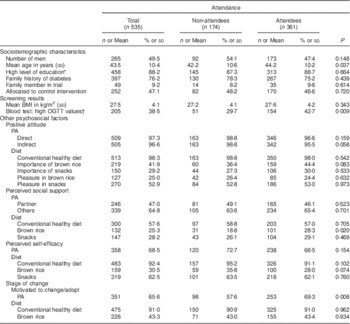
OGTT, oral glucose tolerance test; PA, physical activity.
Data are presented as n and % unless otherwise indicated.
Differences in baseline characteristics were calculated with independent-sample t tests (continuous data) and Mann–Whitney U tests (binary data).
* Education was classified as low (low vocational training or lower secondary education) or high (intermediate vocational training and higher secondary education to higher vocational training or university).
† The blood test results were classed for participants with ‘a high OGTT result at baseline’ (impaired fasting glucose and/or impaired glucose tolerance) and participants with ‘no high OGTT result at baseline’ (e.g. only an elevated glycated Hb level and/or an elevated homeostasis model assessment of estimated insulin resistance).
Risk perception
Most participants perceived the general lifestyle factors, consuming large amounts of sugar and white rice (but not masala) as causes of the onset of diabetes (Table 2). Moreover, although 72·5 % perceived ‘being a South Asian’ (heredity) as a cause of diabetes and 88·9 % perceived a ‘family history of diabetes’ (heredity) as a cause, 87·0 % believed that one can control diabetes by being physically active. In addition, less than half of our study population (44·2 %) perceived themselves as susceptible to the onset of diabetes.
The univariate association of risk perception with attendance at a diabetes lifestyle or control intervention for South Asians among Hindustani Surinamese (South Asians) aged 18–60 years in The Hague, the Netherlands (DH!AAN study)

DM, type 2 diabetes mellitus; PA, physical activity.
Data are presented as n and %.
* Six common risk factors: overweight, too little exercise, unhealthy diet, age more than 35 years, smoking and hypertension.
Relationship of risk perception parameters to attendance
In general, attendees more frequently reported the causal beliefs, perceived high susceptibility and perceived controllability by PA than non-attendees (Table 2). For instance, attendees reported perceiving a family history of diabetes as a cause of diabetes more frequently than non-attendees did, and more often perceived themselves as susceptible to the onset of diabetes. However, all these factors, except perceiving a family history of diabetes as a cause of diabetes (OR=1·76; 95 % CI 1·01, 3·07), were not significantly associated with attendance.
On the basis of the criterion of P<0·25 for the association with attendance, we selected the perceived attitude towards PA, replacing white rice with brown rice, self-efficacy, social support regarding the consumption of brown rice, and motivation to increase PA as potential confounders in the further analysis (Table 1). The OR estimates for the association of the risk perception parameters with attendance, although not statistically significant, remained comparable after adjustment for all risk perception parameters and potential confounders (Table 3). We found no evidence for effect modification by age, gender, education, family history of diabetes, allocation to the control intervention, having a family member in the trial, a high OGTT result at baseline or a high BMI.
Odds ratios of association of risk perception parameters with attendance after mutual adjustment for risk perception (model 1) and corrected for potential influencing factors; Hindustani Surinamese (South Asians) aged 18–60 years participating in a diabetes lifestyle or control intervention for South Asians in The Hague, the Netherlands (DH!AAN study)

DM, type 2 diabetes mellitus; PA, physical activity; NA, not applicable.
Data are OR and 95 % CI of the parameter of risk perception in the indicated model.
* Model 1 consisted of all risk perception parameters.
† Only the six parameters of attitude with a P<0·25 were included in the univariate analyses; i.e. direct and indirect attitudes towards PA and the importance of replacing white rice with brown rice.
‡ Only the parameters of perceived self-efficacy with P<0·25 were included in the univariate analyses; i.e. perceived self-efficacy for changing PA, adoption of a conventional healthy diet, and replacing white rice with brown rice.
§ Six common risk factors: overweight, too little exercise, unhealthy diet, age more than 35 years, smoking and hypertension.
|| Note: perceived controllability by PA change was also one of the seven variables included in the indirect attitude towards PA and is therefore closely correlated with this variable.
Discussion
The attendance of our South Asian population at the lifestyle or control intervention was comparable with the attendance at lifestyle interventions in studies among other ethnic and high-risk populations( Reference Dornelas, Stepnowski and Fischer 35 – Reference Gatewood, Litchfield and Ryan 38 ). Moreover, our South Asian population had several perceptions that were similar to those of other populations at increased risk of diabetes( Reference Toft, Kristoffersen and Aadahl 8 , Reference Claassen, Henneman and Nijpels 13 , Reference Harwell, Dettori and Flook 17 , Reference Whitford, McGee and O’Sullivan 39 – Reference Jones, Roche and Appel 43 ). In contrast, a South Asian population in Norway less frequently reported perceiving the influence of general lifestyle and heredity than our population( Reference Raberg Kjollesdal, Hjellset and Bjorge 22 ). This might be related to the Norwegian South Asian population’s level of education being lower than that of our population. In spite of these educational differences, group-specific lifestyle factors were frequently perceived as causes of diabetes in both studies( Reference Raberg Kjollesdal, Hjellset and Bjorge 22 ). This indicates that cultural beliefs may influence the causal beliefs in our South Asian population.
Although we expected many participants to have a higher perceived susceptibility due to a high awareness and possible feelings of inevitability caused by the high prevalence of diabetes in their families, we found a relatively low prevalence of perceived susceptibility in our population. This low prevalence of perceived susceptibility was in line with previous findings( Reference Toft, Kristoffersen and Aadahl 8 , Reference Claassen, Henneman and Nijpels 13 , Reference Whitford, McGee and O’Sullivan 39 – Reference Jones, Roche and Appel 43 ). As in other populations at high risk of diabetes, a plausible explanation for the low prevalence of perceived susceptibility in our South Asian population is unrealistic optimism, as in Weinstein’s theory( Reference Claassen, Henneman and Nijpels 13 , Reference Weinstein 44 ), which states that some people believe that they are healthier than others, often because they do not correctly apply their knowledge about the main risk factors to themselves.
Despite the fact that several participants in our study reported being aware of the general lifestyle beliefs, perceiving themselves susceptible and perceiving diabetes to be controllable by PA, we did not find that these participants were more likely to attend the diabetes prevention programme than those who did not report this. In addition, we did not find that the group-specific lifestyle beliefs were associated with attendance.
We had expected that the heredity beliefs would have been associated with attendance. Nevertheless, the perceived influence of having a family history of diabetes was not significantly associated with attendance after adjustment for relevant confounders. This suggests that the heredity beliefs in our population are not strong triggers for participation.
This lack of association between the other parameters of risk perception and attendance contrasts with previous work in the general population that found an association of general lifestyle beliefs, perceived susceptibility and perceived controllability with attendance( Reference Wyer, Joseph and Earli 7 , Reference Toft, Kristoffersen and Aadahl 8 , Reference Cooper, Lloyd and Weinman 45 ). The lack of association of general lifestyle beliefs and perceived susceptibility with attendance might be related to a limitation in the data collection tools used. For instance, we only used a more general measure rather than a personalized one. A more personalized measure in which the awareness of someone’s own health is taken into account might be a better predictor. For instance, Toft and colleagues measured both general perceived susceptibility and perceived susceptibility based on the participant’s current behaviour (e.g. ‘Do you think your dietary habits increase your risk of cardiovascular disease?’) and found that only susceptibility linked to the participant’s current dietary behaviour was positively associated with attendance after correction for confounding( Reference Toft, Kristoffersen and Aadahl 8 ). In addition, Cooper and colleagues used the Illness Perception Questionnaire and found an association between lifestyle causal beliefs and attendance. This questionnaire seemed to place more emphasis on the relationship between the participant’s own behaviour and the illness state( Reference Cooper, Lloyd and Weinman 45 ).
Our population more frequently reported perceived controllability of diabetes than other populations at risk of diabetes( Reference Harrison, Hindorff and Kim 40 , Reference Pijl, Henneman and Claassen 46 , Reference Petrie, Weinman and Sharpe 47 ). Yet, the lack of association with controllability might be an indication that the role of perceived controllability is different among South Asians than among other populations. However, we wish to be cautious because we included only one measure of perceived controllability and it focused on PA, while our lifestyle intervention also focused on diet.
Limitations
Our study has several limitations. First, the enrolment in the intervention trial (including screening) was partly selective. The participants tended to have a higher level of education than the eligible non-participants of the intervention trial and to have a family history of diabetes. Such selective participation has also been observed in other studies( Reference El Fakiri, Bruijnzeels and Foets 48 – Reference Blackwell, Foster and Isom 50 ). As these parameters have been shown to be associated with higher risk perception, our reported risk perception may have been overestimated. However, given the lack of association between the measured risk perception parameters and attendance, we do not believe that the reported association was affected.
Second, we measured risk perception after the results of the initial screening had been communicated to the participants. This personal risk communication may have positively affected the risk perception. Although this may have influenced the generalizability of our findings concerning risk perception, this limitation would not have influenced the association of risk perception and attendance itself.
Third, we did not measure the perceived consequences of diabetes, which is also a recognized aspect of risk perception. We cannot rule out the fact that this factor might have influenced attendance in our population, although previous studies do not show an association between perceived consequences of diabetes and attendance( Reference Wyer, Joseph and Earli 7 , Reference Toft, Kristoffersen and Aadahl 8 ). Similarly, as already mentioned, we only measured the perceived controllability by PA and not by diet.
Finally, we were unable to account for family influences in our analyses although family members may increase social support, resulting in a positive influence on attendance at an intervention( Reference Aggarwal, Liao and Allegrante 32 ). Moreover, we did not take into account other factors that might have contributed to attendance at the diabetes prevention programme. For instance, distance from the intervention location or depression may have influenced attendance( Reference Wyer, Joseph and Earli 7 , Reference Aggarwal, Liao and Allegrante 32 ).
Conclusions
In summary, our study is the first to analyse the role of risk perception in attendance at a lifestyle intervention for a population at high risk of diabetes. Our 18- to 60-year-old South Asian population, identified by screening as being at high risk of diabetes, frequently reported lifestyle and heredity as causes of diabetes and reported a high perceived controllability of diabetes by PA. However, most did not perceive themselves as susceptible to diabetes. The risk perception parameters were not significantly associated with attendance at the lifestyle and control interventions. This suggests that strategies to increase general measures of risk perception may have little influence on this high-risk population’s attendance. Although attendance might be increased by making the risk information during recruitment more personalized, our data suggest that future research should determine whether there are determinants other than risk perception (e.g. attitude or subjective norm) that might more effectively enhance this population’s attendance.
Acknowledgements
Financial support: This study was funded by the Netherlands Organization for Health Research and Development (ZonMW; grant number 120620023). ZonMW had no role in the design, analysis or writing of this article. Conflicts of interest: None. Authorship: E.M.A.V. analysed the data, contributed to the interpretation and drafted the manuscript. B.J.C.M., V.N., M.N. and K.S. were consulted for the design and interpretation and reviewed the manuscript. I.G.M.v.V. contributed to the design of the study, interpretation of the data and reviewed/edited the manuscript. Ethics of human subject participation: The Medical Ethics Committee of the Academic Medical Center of Amsterdam, the Netherlands, has approved the study.
Supplementary material
To view supplementary material for this article, please visit http://dx.doi.org/10.1017/S1368980014001086



